Bermuda
Bermuda
BermudaMarch 2025
Wednesday March 12
Bermuda had never been on my radar but when British Airways were doing a sale on all inclusive holidays back in September, it seemed rude not to take up the offer. The six hour flight on Wednesday March 12 left at a respectable 2.25pm and we arrived at 7.15pm three hours behind UK time.
We had had to fill out immigration forms on the plane, declaring we weren’t bringing in plants, food etc. The welcome by the official at the tiny L.F. Wade International Airport was friendly and we got stamps in our passports. Outside, a man stood with my name on a piece of paper. It was our hotel transfer. It was a bit of a shock when we asked how long it would take and he said ‘5-7 minutes’. From the airport, we crossed the causeway and could see our hotel opposite.
The ‘Grotto Bay International Resort and Spa’ was a modest hotel popular with Americans, British and locals but not too crowded before the peak season started. Perched on a hill, it had a heated swimming pool, hot tub, small sandy beach and a unique feature, a cave where you could descend to swim which was a new experience. And another cave where you could have spa treatments. From a pagoda, you could also feed the fish that swarmed like piranhas.
The staff were exceptionally friendly and couldn’t do enough for us. The meals were also of a high quality starting with an all you can eat breakfast, some lunchtime choices or menu options and an array of evening choices from the menu with lots of fish options and a wonderful entrecote steak. Afternoon tea with cakes was also available and a couple of times, we skipped lunch and had this instead. There was an excellent choice of cocktails including the famous ‘Rum Swizzle and we sampled as many as was decent.
Our spacious room at the top of the hotel overlooked the sea and wonderful sunrises and was cleaned daily. We had a noisy Kiskadee bird that would sing its heart out every morning. These birds had colourful yellow breasts but were the ‘bullies’ of the Bermuda bird world. Yellow loquat fruit trees guarded the entrance to our room. All said and done, we were delighted with everything. The only hiccup was that scuba diving did not start on the island until April/May so I had to miss this opportunity. I paddled one of their kayaks around the bay instead.
We were staying before the ‘peak season’ took off with the arrival of the cruise ships. Bermuda has a mild climate although we missed a storm just before our arrival. It was bright and sunny throughout our stay with temperatures between 21-24’c. On the first day by the pool, I turned bright red.
Bermuda has a distinctive culture that combines a reverence for British traditions dating back to colonial days with a more relaxed attitude befitting a subtropical island. It was strange to see a policeman at the airport that looked like a British one. There were also British red telephone kiosks and letter boxes. The houses were all decorated in relaxing pastoral colours and there seemed to be an informal rule that you did not paint your house the same colour as your neighbour. The senior hotel management wore traditional long Bermuda shorts with long black socks so that only their knees were showing. They had a variety of colours and looked very smart.
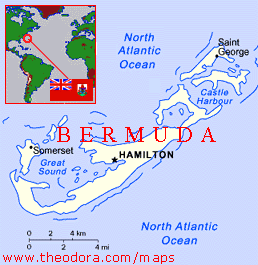
When Bermuda was developed back in the early 1600s, surveyors carved out the area around St George’s (then the capital) and divided the rest of the archipelago into eight districts named after the Bermuda Company’s original investors: Hamilton, Smith’s, Devonshire, Pembroke, Paget, Warwick, and Sandys. They were all given these districts. The island(s) connected by causeways is only 21 miles long with some main roads connecting the districts and 1200 smaller roads crisscrossing them.
Bermuda has a great public transport system with pink and blue buses covering the entire island. We were given a monthly bus pass by the hotel and made the most of it. Buses seemed to appear every 15 minutes. When locals boarded, they said ‘Good morning’ or ‘Hello’ to the other passengers. The bus drivers seemed to know every one and it felt like a real community of polite, courteous people.
St George was less than 15 minutes from our hotel and to get there we passed the airport. Back in 1609, a British ship called the ‘Sea Venture’ enroute to Jamestown, Virginia was shipwrecked. Founded in 1612, St George qualifies as one of the oldest towns in the Western Hemisphere. We were amazed that it was such a picturesque and very well preserved example of a New World outpost which is now a UNESCO World Heritage Site. Starting at the old dock where a tall ship with three masts was moored, we explored the winding side streets, walled lanes and quaint labyrinthine back alleys of this 400 year old town, past an array of tidy preserved buildings from the 1650s to early Twentieth Century.
All roads in the tiny town eventually led to King’s Square with the two story putty coloured Town Hall (built 1808) dominating it and off to the side, the Old State House (built in 1620) which was vacated in 1815 when the capital moved to Hamilton. We were welcomed by the ornately uniformed ‘Town Crier’ who rang his bell and bellowed out our names. Nearby were replica stocks and a seesaw-like ducking stool.
Across the road from Kings Square with a lovely flight of stairs leading up to it was St Peters Church, for us the highlight of St Georges. Some parts of this whitewashed stone church date back to 1620 and it holds the distinction of being the oldest continuously operating Anglican church in the Western Hemisphere. The current church replaced a 1612 structure destroyed in a storm, was extended in 1713 and had a tower added in the 19th century. The red cedar alter was carved in 1615. The spacious inside with rows of boxed wooden pews had rough hewn pillars, exposed cedar beams and candlelit chandeliers. It was the simplicity of it all which was stunning. Large slated wooden windows were propped open to allow a wonderful breeze to circulate. The walls had an array of marble plaques where most of the named people from centuries ago, seemed to have died from fever or consumption. There was a Visitors Book for the VIPs where there were photos and signatures by people such as Queen Elizabeth in 1963 and Charles and Diana (pregnant with William) in the early 1980s. Outside, a graveyard had graves of prominent Bermudians and a separate one for slaves and free blacks. Overall, St George was the jewel in the crown of Bermuda and we returned there later in the week.
The city of Hamilton in the heart of Pembroke is a bustling little capital with a permanent resident population of 1500 households. Bermuda has around 78,000 people. The locals refer to it as ‘the town’ and it is the home to Bermuda’s principle harbour, bus station and most of its shops. By the time it became the capital in 1815, St George’s had already been going for 200 years.
Near the bus station was the stunning white City Hall and Arts Centre which had a clock tower with a bronze wind vane with all the compass points on it instead of numerals. Coming down Queen Street, the Museum of the Bermuda Historical Society was closed. At the bottom on Front Street, we found the small but locally famous ‘Birdcage’, which is a traffic box, but traffic was so light that there was no sign of a policeman in it.
Along Front Street with its row of shops (including a Marks and Spencer), we eventually reached an imposing mansion which we thought was where the Governor must live. But it turned out to be the Cabinet Building (built 1841) which houses Bermuda’s Senate. In front of it on the roadside was the Cenotaph for fallen Bermudian soldiers.
Down by the ferry port, we found a plaque commemorating the ‘Bermuda Triangle’ which covers Bermuda to Miami, Florida (taking in the Bahamas), down to San Juan, Puerto Rico and back up to Bermuda. Using Kim Dismont Robinson’s brief account of the ‘Bermuda Triangle’ in Fodor’s Bermuda Guide it said that “Long before the myth of the Bermuda Triangle became legend, Bermuda had already earned a reputation as an enchanted island. It was nicknamed ‘The Devil’s Island’ by early sea travellers….it may have inspired Shakespeare when writing ‘The Tempest’…..an early origin of the myth may stretch back as far as Coumbus who noted in his logbook about a haywire compass, strange lights and a burst of flame falling into the sea…. In the past 500 years at least 50 ships and 20 aircraft have vanished in the Triangle, mostly without trace, no bodies, nothing….For example, in 1945, 5 US bombers took off from Florida on a routine training mission. The planes and 27 men were never seen again….Scientific explanations include the obvious extreme weather conditions where “White squalls” – intense, unexpected storms arrive without warning on otherwise clear days, along with waterspouts (sea tornadoes). The most recent theory could be the result of large deposits of methane gas spewing up from the ocean floor. Hughe eruptions of methane bubbles may push water away from a ship, causing it to sink. If the highly flammable methane then rises into the air, it could ignite in an airplane’s engine causing it to explode and disappear…. Fact of fiction, the Triangle is a part of local lore that won’t disappear any time soon.” That said, whenever we asked any local about it, they said they didn’t believe in any of it.
From Hamilton’s small ferry port we caught a cheap ($4.50) 30 minute passenger only ferry ride across to the Royal Naval Dockyard. The trip allowed us to see some of the lovely residences on the islands and decide, based on the obvious wealth, that it was not worth looking in nay estate agent windows.
At the furthest West End tip in the parish of Sandys is Bermuda’s largest tourist attraction, the Royal Naval Dockyard. As we approached, we could see the imposing twin clock towers and tall defensive walls. After the American Revolution in 1776, the British had no place to anchorage or repair ships. Around 1809 when we were fighting Napoleon, Bermuda was chosen as the place to build a stronghold. Nicknamed the ‘Gibraltar of the West’, the Dockyard operated as a shipyard for nearly 150 years. Historic structures such as the Clocktower and Cooperage building still exist along with the old walls, but trees and shrubs have replaced the vast stretches of concrete. For a Friday afternoon, we were surprised that much of it was closed so we just explored the whole complex and enjoyed the fact that few tourists were there. Bermuda did not seem to get going properly until the cruise ships arrived.
On another day, we caught a bus to Hamilton and a connecting one to Horseshoe Bay. This is Bermuda’s most famous beach and is a gently curving crescent lapped by turquoise water. There were some tourists here in addition to a group of school boys being ordered to run laps across and back along the beach numerous times. The legendary pink sand, caused by the destruction tiny crab shells, was not visible under the midday sun. It looked like normal beach sand to me.
We had been told that day by a bus driver that hump backed whales had been spotted heading north for the summer. She told us where we might see them just before Gibbs Lighthouse but an hour of staring out at sea did not result in any whales being spotted. No matter, we had seen them in Alaska last autumn (not the same ones, obviously).
Overall, we were hypnotised by Bermuda – the friendliness of the people, the relaxing ambience, the gorgeous weather and the lovely sights. It would be nice to return but we felt that we had done it justice but you should go there at least once in your lifetimes – but go all inclusive! Ironically, our wedding certificate was issued in Bermuda. When we got married at sea on the P&O cruise ship the ‘Azure’, it was registered in Bermuda for tax reasons and that’s where our certificate was printed.