Australia (Part 1a)
Australia (Part 1a)
Australia (Part 1a)January 2001
As I sat at my final Kuta 'Happy Hour' session, about 4 hours before the plane left, a video of "November Rain" by Guns & Roses came on and it began to lash down outside. It was the heaviest rainstorm I could ever remember seeing. Within 30 minutes, I waded out into 6" of water back to my room. By the time I walked to catch a bemo to the airport, there was a foot of water in the streets and it was still rising when I entered the airport terminal 3km from the centre. Arriving in just my shorts and flip-flops and my pack in a plastic sack, I looked like a drowned rat and one of the "boat refugees".
The 6-hour overnight Geruda flight to Melbourne was comfortable enough and we arrived in Australia around 8am (3 and a half-hours ahead of Indonesian time). The hostesses walked down the aisles and sprayed everyone with whatever it is they spray you with when you enter Australia. It is the only country I've visited where they do this. ("excuse me sir, your underarm deodorant doesn't seem to be working. Let me try this stuff out on you"). Or do they think that the rest of the world is covered in lice?
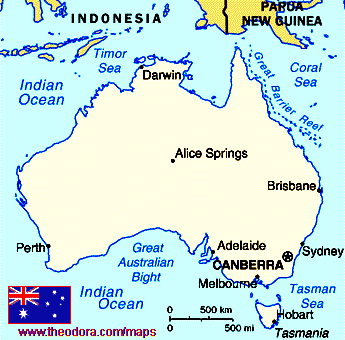
Australia. Oz. The 19th country on this trip and another large one (6th largest in world) to cover. It would take nearly 5 months. The place needs little introduction. Only 19m people live in an area, the size of the USA and all but a million of them live within 200km of the coast in 6 major cities. Away from the coast, it is a vast flat barren wasteland - the 'Outback'. Australia is now, simply, the most fashionable long haul country to visit and everybody who watched the Sydney Olympics saw Oz come of age (well, except me) and wants to visit. In 1999, they got 900,000 visitors. In 2000, it was 5 million!
It was strange to arrive in a western country after months of the 'third world'. English signs. English standards. English tidiness and inevitably, English bureaucracy. I got the full works and it took an age. On the plane, we had had to fill in a form declaring that we were carrying no fruit, seeds, soil and other items that might lead to the decline and fall of the Australian Empire.
Passport control. "G'day mate". Various questions: How long have you been travelling? Where have you been? (how long have you got?), How much money have you got?, How long are you staying? Where are you staying? That was the fastest interview. After that, I ground to a halt.
I was passed onto another interviewer who asked the same questions. This time I had to list the countries. I was asked "Do you have a criminal record?" to which I replied "I didn't realise we still had to have one to get into Australia" (a joke remark on the English prisoners who settled Oz). Big mistake. He inspected my money belt to see my flight ticket, ETA visa, old and new passports, drivers' licence, a printout of my Internet bank account, credit cards, US dollars, birth certificate, last tax return, lottery ticket etc. "How you been here before?" Yes. 16 years ago. "It has changed a bit in 16 years". "Yeah but I bet your culture hasn't developed as fast as a yoghurt's". He scribbled something on my card. I knew it was a slow process because my pack was already on the luggage belt when I went to collect it.
I approached the "Nothing to Declare" green channel. "Excuse me sir, could you go to the "Red Channel". "But I've got nothing to declare". "Well your card has been marked as 'Requiring more inspection'. Its just procedure". I joined a line of old Chinese women tourists, a 14 year old kid, a couple of people with their lives in suitcases. And waited 10 minutes. "If you could just stand over here sir, someone will be with you in a few minutes". 10 minutes later, I'm still waiting. Over in the corner, 8 smartly dressed Oz immigration officials were gathered around a TV and laughing. "Any chance of getting arrested in this country?" I proclaimed. More apologies. "You're getting the top man mate. You should be honoured".
At this point, I realised that I had 2 bananas in my day bag, which I had thrown in when I packed, thinking I'd eat on the journey, but had forgotten about. I mentioned it to a female official. "Bad news mate" she replied. Eventually, the 'top man' arrived. I lugged my pack over to his desk. It was still soaked from the rainstorm in Kuta. I told him about the bananas. "But on your form, you have declared that you are carrying no fruit. This is a legal document and you have broken the law". "Oh gimme a break, I forgot about them and since I haven't cleared immigration yet, I haven't technically entered Australia yet". Eventually he let them go. Another 20 questions. He turned out to be quite chatty and in the end he didn't even bother to search my backpack. I asked him why I had got such a grilling. "Because you have been travelling long term through every shithole between England and God's country and you are prime 'drug carrying, itinerant worker' material". Eventually I was told that I was free. Congratulations, Australia, it took longer to enter you than any other country so far.
Some General Photos of AustraliaI was heading for Mildura on the Victoria/New South Wales border to visit my relatives and pick up the campervan. Originally, I intended to fly there from Melbourne, but the next plane was in 6 hours time. So I caught a bus downtown to the Spencer St bus/railway station. The next bus to Mildura was leaving in 8 hours. I hopped on a train to Bendigo and decided to hitch most of the 560km distance. Culture shock! Western prices! How much?
It was the end of the summer and Victoria was burnt to a crisp golden brown in the fields. There were fire bans everywhere because one spark was destroying thousands of acres. Bendigo was a nice tidy country town and the people were very friendly. Within minutes, I had 3 short lifts from locals who took me towards the Calder Highway on the outskirts of town. The last guy even drove me 10km out of his way. I didn't have to wait long for another ride. A 'truckie' pulled up and drove me 100km to Charlton. Sitting up in the cab, looking out across the scenery, it is the best way to see Australia, but now increasingly difficult as many truck firms prevent their drivers picking up hitchers due to 'insurance reasons' (i.e. if they crash, you can sue). I ground to a halt in Charlton - the last roadhouse before Mildura 300km up the highway. It was blazing hot - 39'C and I waited over 2 hours but nothing came past, except a road train carrying ostriches in the back. He stopped to hose them and the carriages down with water. Even the garage attendant took pity and brought out cold drinks to me as I waited.
Around 5.30pm, as the heat subsided, I walked into town, resigned to staying there the night. But kept walking to the other side of town and thought that I might as well keep trying until it got dark. Imagine my delight when a Chinese guy picked me up soon after. He was going all the way to Mildura and I was dropped near my auntie's farm south of Mildura before 9pm that evening. Case solved! So on my first day, I was reminded of how friendly the Oz people were.
For the record: I had previously spent a year in Australia from Nov 84 - Nov 85 on a 'working holiday' visa (after I finished my Master's Degree at the LSE). The idea was that you were allowed to work/travel for a year. These visas are now all the rage with the British kids who want a 'gap' year between high school and university. When I left England in 1984, Aussie culture was an unknown quantity - Paul Hogan was advertising 'Fosters Lager' on TV as the first Aussie beer to try and break the English market, 'Neighbours' soap opera hadn't started and noone ever BBQ'd. By the time I returned, 'Crocodile Dundee' had been a massive success, everyone was glued to Aussie soap operas, and drinking Aussie beer outside at the BBQ.
I had based myself in Sydney and worked on the nightshift at a food factory making muesli, before becoming a legal clerk at the Director of Public Prosecutions for 3 months. During my 5 months in Sydney, I hitched around New South Wales, Victoria and Canberra.
At a dinner party at Bondi Beach, I met Linda who was from Adelaide in South Australia and looking for a male flatmate. An English friend, Andy, had just flown out on a similar visa and we thought what the hell, lets move to Adelaide. We spent a week driving across the barren NSW Barrier Highway (‘Mad Max 2' country) to get there. I got temporary jobs at Santos Oil Company firstly as a handyman and then an administration officer. An English girlfriend, Dawn, flew out on the same visa and I went to Sydney to pick her up and brought her back to Adelaide. The 3 of us settled very comfortably into Adelaide jobs and social life for 3 months, exploring South Australia at the weekends.
For the final four months, Dawn and I took off on an epic tour of Australia. Hitching from Adelaide up to Brisbane, then up the Queensland coast all the way to Cairns, to see the Great Barrier Reef' then across to Alice Springs/ Ayers Rock area in the Northern Territory, and then up to the 'Top End' to do Kakadu National Park and Darwin. Dawn headed south for a job and I went right around Western Australia via Perth and caught the 44-hour train ride cross the Nullabour Desert to Adelaide. Headed for Tasmania for a week and flew out of Melbourne for New Zealand. I had loved the place and didn't want to leave when my year was up.
You need this background to put this trip into perspective. I had already visited most of Australia's most famous sights, and had done the 'circuit' once, but hitching, buses and trains only allow you to stop at certain places. This time, I had a campervan at my deposal and intended to fill in the gaps visit new places as well as returning to the more famous places.
I spent my first week in Australia, resting up at my relatives' farm. My auntie Ruth has been out here since the early 1950's and made the mistake of marrying an Aussie! Keith. They are pretty much retired and live on a 3000-acre farm in the tiny village of Carwarp, near Mildura. I was able to enjoy home cooking, TV, a swimming pool, books, dairy products and just about everything I had forgotten about after travelling for 15 months. There was a heat wave during that week and the temperature soared to 47'C, the 3rd highest in Mildura's history. My suntan improved, but not my weight. Victoria's libraries also have 'free' Internet PCs available. Usually you get an hour, so I took advantage of that.
My parents bought a campervan in Australia over 5 years ago. They try and fly out every November, before the European winter and spend 4 months travelling around during the Oz summer, returning to the UK for the spring. This year, they were not here, so I would be able to use it. I checked it out. A white Mazda automatic, it contained a fridge, microwave, gas cooker, sink, lots of cupboards, a roof that went up when you camped (tall enough to stand), and two long seats that pulled together to form a double bed. The van was fully equipped with bed sheets, utensils, everything you could need. You plugged in an electric cable at the campsites to provide power and electric lights inside. When you were travelling, the fridge ran off an internal battery. This would become my home for weeks on end.
I took the van for a few warm up drives. Mildura is one of the few 'outback' towns that is actually increasing in size. As part of Victoria's 'Garden State', it has a Mediterranean climate (warm/dry), fertile lands irrigated by the 'Murray River', the longest in Australia, and is a major fruit growing centre of oranges and grapes. There are "Fruit fly" warning signs everywhere. I only remembered Mildura for having two of the world's largest things: firstly a large "Humpty Dumpty", sitting on a wall, but more importantly, the world's longest bar. This serving table stretched around the centre of a workingman's club for about 120ft like a 4 leafed clover with the bar staff behind it. I was dismayed to hear that the bar had been cut up and destroyed as had Humpty. Noone had put him back together again.
I also attempted to visit the World Heritage listed Mungo National Park, about 150km north of Mildura. The earliest known inhabitants of Australia were discovered here and dated at 60,000 years ('Mungo Man'?). The original ancient lake dried up and winds swept the lake floor into strange lunar landscapes called, for some reason, "The Great Walls of China". But there was a 60km rough unsurfaced road to get into the park, and I decided that the van was worth more than a visit here. One of Australia's major problems for the tourist is that so many attractions are off the beaten track and only accessible by 4-wheel drive. It was strange to see dead kangaroo road kill littering the roadside in differing states of decomposition.
Jo had planned to fly to Hobart, Tasmania (via Sydney) from Auckland, New Zealand, a week after I arrived. So I booked a ferry ticket to Tasmania for Jan 18th and drove 560km overnight from Carwarp to Melbourne in the van, ever alert to the wildlife sitting on the road. I arrived in Melbourne at dawn to find new (to me) electronic tag toll roads into the centre. I skirted around the ring road and headed for Melbourne docks to board the gigantic high-speed black catamaran called the "The Cat". This was a fast day crossing over the 240km over the Tasman Sea, rather than the overnight ferry. It took less than 7 hours. It was the start of the great Australian Adventure.
"Tasmania is Australia's only island state which has given it a distinctive historical and cultural development from the mainland" (Lonely Planet). Its isolation has helped preserve the colonial heritage as well as much of the original wilderness areas. Discovered by a Dutchman, Abel Tasman in 1642, the British eventually took it over and considered it a perfect location for penal settlements in the early 19th Century for convicts who had re-offended in the Australian colonies. Convict transportation, finally ended here in 1856, but reminders of the island's convict days and early colonial history are everywhere. Tasmania is also infamous as the place where all the local Aborigines were rounded up or killed in the first 35 years of European settlement. By 1847, only 47 out of the original 4000 were still alive.
Today, Tasmania (480,000 pop) is a major tourist destination. It is about the same size as Ireland (and twice that of Switzerland), and the undulating countryside is rich and fertile. The population lives mainly on the north and SE coasts, while the SW and West coasts are wild and virtually untouched - the great wilderness area. There are 17 National parks here and over our 12 day stay, we attempted to take in a variety of them using a 'vehicle pass' to visit all the parks for a very reasonable £13. You got a passport and a cute stamp at every one you visited. Which was nice.
When I arrived at Georgetown, I was asked if I was carrying any fruit, veg or food into the island (more agricultural pest protection). I motored south through the beautiful Tamar Valley past Launceston and stopped for the night at Ross in the heart of Tasmania's premier wool growing area. It was my first night at getting the campervan set up on a caravan park while shire horses and ponies munched the grass around the van. These caravan parks are excellent in Australia. Clean tidy amenities with hot showers, toilet paper!, gas BBQs, laundry, kitchens and often swimming pools. They are also cheaper than staying in hostels.
Ross was a beautiful Victorian historical village, set by the Macquarie River, with Australia's 3rd oldest bridge (1836) and surrounded by thousands of sheep grazing in parched fields. The old centre dating from 1812, was still relatively un-modernised. The wide streets, shaded by canopies of leafy trees were lined with many of the original wooden houses as well as the civic buildings which had been constructed from local golden sandstone (often by convicts). At the Church I read about their 1855 incident when, during a Sunday service, their 'wind up' organ refused to stop. It was finally dragged outside to a paddock and left while it played on for a few more days and then died a death. I'd rate it as the finest village in Tasmania and it was certainly nicer than Richmond up the road, which gets more publicity, because it has Australia's oldest bridge.
Photo of RossThe following day, I picked Jo up at Hobart airport. She couldn't stop talking about New Zealand and how wonderful it was. Tell me about it Jo. I spent 6 months there, back in 1986. She had thought about getting me a ‘Pat a Possum' G-string made of possum fur (‘one pat isn’t enough', but the thought of me in one of those made her throw up.
We proceeded on a generally clockwise tour of Tasmania, starting with the 'Peninsula Trail', a beautiful twisting wooded road, SE of Hobart towards Port Arthur. The largest penal settlement was built here on a narrow peninsula around 1830. Between 1830 and 1877, 12,500 convicts served sentences here and many fine buildings were constructed by them. Port Arthur even had Australia's first (if short) railway except that the convicts pushed the train wagons along the track and then jumped on for the downhill stretches. It developed from a prison town into a thriving community with various industries, burnt down in bush fires and eventually became Tasmania's premier tourist attraction. It last got attention in 1996 when a lone gunman fired on tourists and killed 35 of them.
Photo of Church at Port Arthur Penal ColonyThe well-presented historic site of Port Arthur had a lot to keep you busy with a 2-day admission ticket that covered everything. There were comprehensive displays on convict life and transportation. I learnt that convicts had been sentenced 7 years hard labour for stealing shoes, cheese, wine, bread, and trousers. 14 years for stealing a turkey, and life for stealing sheep, a flute, a hankichief. Then a guided tour of some of the buildings, a boat trip out around the old harbour and finally many buildings to explore on your own - many were ruins, but many of the houses had been restored and could be toured. I was even able to get dressed up as a scullery maid in traditional costume with a broom. It was certainly worth a day's attention and had improved greatly since my last visit. Doo Town up the road had every road and house name with the world "Doo" in it.
Two things struck me about Tasmania. The weather changes all the time all over the island. Mini climates seem to exist. I had been amazed to see the fields burnt to a crisp on the first day, and yet freeze to death overnight at Port Arthur. I remember it raining every day during my last visit. It was miserable. This time the weather was up and down, but I definitely lost my suntan! The other thing was the enormous amount of road kill on the roads. Flattened wildlife was everywhere - possums, Tasmanian Devils, wallabies. My road kill statistics soared into 3 figures.
On our way west, we passed through Hobart where two US Aircraft carriers had moored in the massive natural harbour. The streets were full of American sailors dressed in white wandering around, and wondering (like us), how a capital city could be shut at 6pm on a weekday? Tasmania had a very small-town feel to it and has long been the butt of Arkansas type jokes about in-bred families.
The National Parks were our prime destinations. Every park has many walks of different lengths and grades and there is information about the flora and fauna everywhere. We headed for the various World Heritage sites of beautiful natural rain forests that cover 20% of Tasmania - about 1.4 million hectares.
The 'South West Nat Park' was full of myrtle, sassafras and celery top-pine trees covering rugged hills about 1000m tall. We walked the short "Creepy Crawly Nature Trail". Then followed the road past vast man made lakes to the Gordon Dam near Strathgordon. Built in the 1970's, it was a controversial project to harness the area's water to provide power for the entire island. A massive 140m high dam was built which then formed Lake Gordon with a surface area of 272 sq. km - the largest water storage in Australia. It was an impressive construction - almost causing vertigo as you descended the steep steeps down to it and walked along the top, with the 140m drop on your left. Gordon Power Station was constructed 183m underground near the dam and is controlled remotely from Hobart.
The only problem with this trip is that the road ends at the dam and you have to return over 100km back along the same road. You will see a wonderful name for an antique shop in a village - "Junk and Disorderly" and come across 'Mt Field Nat Park' ("a Park for all seasons") which is a delightful protected area, with lovely trails to walk. The closest took in the waterfalls, the largest of which, Russell Falls, is 40m high - transparent sparkling water tumbling down through giant eucalyptus and myrtle trees. There was also a 'Short Tall Trees' walk, past magnificent towering Swamp Gum trees. A clinometer instructed you how to measure the height of one of these which was 79m - apparently the second tallest trees in the world after the Californian Redwood (I'm not so sure). We also did an hour-long walk up through a narrow rocky trail to Lake Mitchell, a glacial lake. The greenery of the forests, the rugged brown outline of the hilltops and light blue sky filled with white puffy clouds surrounded the deep blue water. Outstanding.
We saw a few 'Echidna', long spiny Australian hedgehogs with long thin snouts and orange flecked spines that would crawl into a ball at any sound and then poke out their snouts when they thought the coast was clear. Unfortunately, this defensive mechanism didn't work when a car ran them over at night. The best thing about camping at the National Parks is the wildlife that comes out around sunset. Here, fat cuddly black Tasmanian wallabies called ‘pedemelons’ surrounded our van. The fat cuddly possums were also fearless in their quest for food. Both these lovely creatures were prime road kill in Tassie. We only saw flat or dead Tasmanian Devils, stocky and black in colour with a white patch on their chest, sharp teeth and nothing like the Warner Brother's cartoon character.
Lake St Clair Nat Park is at the southern end of the 'world famous' Cradle Mountain-Lake St Clair National Park. Carved out by ice during several glaciations, at 180m, it is the deepest lake in Australia. The 4-mile 'Woodland Nature' walk took you through six different vegetation communities and lots of bird life singing to each other. Every Nat Park deserved days of exploration, but we only had time to get general overviews.
Photo of Lake St ClairWe passed through the Franklin-Gordon Wild Rivers Nat Park, a region of dramatic mountain peaks, deep river valleys and gorges. Crossing 'Conglomerate River', we drove up a twisty road and climbed over the strange bare bleached-out, multi-coloured hills and deep eroded gullies and into Queenstown. 100 years of mining based on huge copper deposits, large scale firewood cutting and logging operations and the sulphurous smelting processes, coupled with extensive bush fires and heavy rainfall have denuded the hills of all vegetation around here. It looked a right ecological mess. But Queenstown (2700 pop) itself is a nice sleepy frontier town of lovely old wooden Victorian hotels with verandas and some fine old buildings. The 1902 Post Office brightly painted in orange and yellows stood out like a beacon.
On my last visit, I had visited nearby Strahan on the coast for a lovely cruise into the Wilderness area along the Gordon River, with dolphins swimming around and complete silence when the engines were turned off. Another "Land that time forgot" scenario. But we passed on the inflated $44 and more commercialised excursion this time.
The Cradle Mountain region is a country of wild open moorland heath, broken by deep gorges and forested valleys, dotted with numerous lakes and tarns. In spectacular afternoon sunshine, we walked around Dove Lake with the jagged craggy mass of Cradle Mountain looming over it. Flies were merciless as I cooked a BBQ.
Photo of Cradle MountainThe following morning, it poured with rain as we attempted to climb Cradle Mountain which was supposedly a 6-8 hour walk. You start on the ‘Overland Track (which takes you 80km down to Lake St Clair 4 days away - the walk we didn’t have time for) past Wombat Peak and around Crater Lake. This was a large beautiful 60m deep glacial lake hidden by 200m cliffs covered with deciduous beech trees. At Marion’s Lookout, soaked, Jo called it a day and returned. I walked on and went for the summit via a steep rough rocky route between huge dolomite boulders. At 1545m, the summit was covered in rain clouds which cleared for 5 minutes allowing me a view over the entire area. I was back at the van having taken 4 hours for the return trip. That evening, a small black leech attached itself in between my toes and must have sucked a toe dry before I noticed it. A possum also adopted us and tried to get in the van.
At Mole Creek National Park, we did a tour of Marakoopa Cave which took us past subterranean areas covered in stalactites and stalagmites and glow worms. It wasn’t the best cave system I’d ever seen, but an enjoyable visit.
Latrobe called itself the ‘Platypus Capital of the World' but we didn’t see any. It also boasted the ‘oldest continuously playing band in Australia' (1872). Since it was a brass band, they must be out of breath by now.
January 26th was ‘Australia Day' (their National Day). They were celebrating 100 years of Federalism (after the English Govt were told to go forth and multiply in 1901). As the rest of the nation had a lie in, we were up at 5am to visit the Narawntapu National Park on the northern coast. We wanted to see some Forester kangaroos grazing at dawn.
A lovely scarlet/orange sunrise led us past fields of grazing sheep and cattle to the flat grassy heathlands of the Park. The massive roos eluded us, but we saw over 200 smaller grey kangaroos and pedemelons bouncing around and having their breakfast. Wombat holes were also everywhere, but we only saw one disappear down his hole when the rain started. They hate rain! Wombats are strange creatures - like a small round furry cuddly pig. On my previous visit I had visited Mt William Nat Park and seen 12ft tall Forester roos. Their foot long scrotums were as impressive as their height. Incidentally, I have seen “Kangaroo scrotums" for sale as small leather money pouches (something for the wife!).
We spent the rest of the day at the Westbury ‘Rodeo' Despite the pouring rain which kept up all afternoon, there was a keen crowd of locals. They were all dressed in their cowboy hats and wet weather gear to see the competitions in an arena that gradually turned into a mud bath. A commentator kept up a non-stop banter and let us know what we were watching. There were various events:
It was a very entertaining day and we saw some of the top rodeo people do their stuff. There is a keen rodeo circuit around Australia to watch the horse culture and cattle driving skills of the ‘Outback'. Ironically, this rodeo was the only time I ever saw Australians on horseback.
At Hadspan, we took in Entally House (1819) with its fine grounds and at Launceston, walked up the Cataract Gorge between towering granite cliffs with the river below us. This is a lovely area of Victorian gardens and cable cars crossing the gorge near the centre of town. We also used our first ‘Drive In Bottle Shop' where you drive into a shop that sells booze. You tell them what you want and they bring it to your car. What a great concept! We have drive in fast food outlets in the UK, but I’d never seen this. Our nanny state would say it was encouraging drinking and driving. I’d call it a ‘One Stop Grog Shop'
We headed for the east coast to visit the beautiful Freycinet National Park which is set on a long narrow peninsula of red/pink granite mountains These are called ‘The Hazards' and rise straight out of the sea. The white beaches, crystal clear water, bush walking and water activities made it a popular place. In blistering sunshine, we climbed Mount Amos, which although only 422m in height was a steep and strenuous climb up a well marked trail. We had to use both hands to pull ourselves up some parts. From the top we had a beautiful view of ‘Wineglass Bay' said to be one of the top 10 beaches in the world. I must have visited over 30 of the ‘top 10 beaches'
We descended and walked through a wooded pass to this bay on the other side of the hills. Wineglass Bay is a 2-km horseshoe shaped stretch of fine white sand, with clear tranquil blue water and a backdrop of red granite hills and green forests. It was a lovely place for lunch and a dip while a school of dolphins frolicked in the water.
Photo of Wineglass BayHeading south down the Tasman Highway, we passed ‘Break-me-neck' hill and ‘Bust-me-gall' hill. But no sign of ‘Bugger-me-old-boots' hill. Zipping through Hobart again, we ended up on the most southerly road in Australia to visit the Hartz Mountains National Park. We followed the ‘Devil’s Backbone' hills into this “window into the SW Wilderness" while huge logging trucks came past with tons of timber to be processed. The vegetation that survives has to put up with high wind, frost and snow. So the tall eucalyptus forest and rainforest on the edge of the park were replaced by snow gums. We started the 5-hour walk for the Hartz Peak, But midway, rain clouds covered the hills, winds roared around and rain and sleet crashed down. Freezing to death, we got the hell out of there. Bloody Tasmanian weather!
Editor’s note: We pause here for other places in Tasmania with silly names: Snug, Window Pane Bay, Flintstone, Flowerpot, Snobs Point, Penguin, Daisy Dell, Cramps, Milkshake Hills Forest Reserve, Cooee, Lemon Thyme Power Station. Thank you. Now on with the story.
Hobart (126,000 pop) is Australia’s second oldest city and its southernmost capital. It “has managed to combine the benefits of a modern city with a rich colonial heritage and a serene natural beauty"(Lonely Planet). I suppose so, but it only had one thing to interest us - the Cadbury’s Chocolate Factory. Yesss! Cadbury’s was founded in England (naturally) in 1824, by John bet-you-can’t-guess-what-his-surname-was. They built a factory in Hobart, Tasmania back in 1922 because of the ready supply of exceptionally high quality fresh milk from Tassie cows. The cocoa beans, grown in Indonesia and Malaysia are processed in Singapore. Here, the dried beans are crushed to separate the shell from the nib inside (‘winnowing'), then ‘roasted' in special ovens and ground to produce a fluid called ‘cocoa mass'. This is shipped to Tasmania as the main ingredient.
In Tasmania, powerful presses also extract the cocoa butter vital to making chocolate, leaving a cocoa solid used to produce cocoa powder. Full cream milk, cocoa butter and sugar are added to the cocoa mass. The resulting paste is ground up through rollers and the liquid chocolate is stirred for 12 hours in a conch which develops the flavour and creates the final velvety smooth texture. It is stored in large heated kettles and continuously stirred. Then dropped into mouldings for the various chocolate products, cooled and packaged. They produce 1.5 million bars of chocolate every 24 hours and a total of 65 million tons of chocolate a year. On this tour, we ate half a day’s work. Plenty of samples. Which was nice. We also had to wear silly hairnets and remove our watches. They didn’t want to see little Johnny enjoying a ‘Freddo Frog' then choke on a Timex. In the chocolate shop afterwards, we could buy the rejects at half price. I nearly cried. Very recommended tour if you want to put on weight. I know I did.
Downtown, reeling from chocolate poisoning, we walked around the old part (well, old for Australia). St David’s was the original 1804 cemetery, which fell into disuse and was then landscaped into a lovely park with some of the original tombstones. A monument listed every passenger on the first dozen boats to arrive in Tasmania, but the surname Jack was nowhere to be seen. There were plenty of other families. One wonders what made them want to leave England and sail on a rough voyage to the other side of the world to a completely unknown place to start a new life? Why do any of us leave our homes? Why are we here? Where are we going? And are we taking sandwiches?
We had hoped to visit the ‘Timewarp House' -a collection of 20th Century social history (i.e. rooms set up from different decades with all the original furniture/equipment). This had closed down and probably been beamed up into space somewhere to reappear in another time in another city. The Botanical Gardens were nice if you wanted a quiet walk.
That night at a caravan park, in Cambridge, near Hobart Airport, our neighbour was a retired professional Aussie soldier. 58 years old with 35 years of experience under his belt. He was full of tales about living in Borneo keeping the Indonesian army at bay in the early 1960s. Sukarno’s personal guard were “tough little bastards" he said. "20 of them holed up in a fort had 600 of us pinned down. When we finally broke in, we found 2 soldiers left. One was blind, the other had his hands shot off. He was telling the blind guy where to shoot!"
He had done two tours of Vietnam. His first only lasted 17 days when he stepped on a mine. Unlike American soldiers, the Aussies had no drug problems. “It was down to discipline" he said. “As a commander, I told my troops that if I caught anyone under the influence of drugs I’d shoot him - as a potential hazard to the safety of the rest of the men" It was also down to the fact that the Aussies were volunteers, not conscripted like the Americans. They wanted to go.
He told me how they had originally tried to help the Vietcong wounded. One day, two injured Vietcong walked into their camp and pretended to surrender. One ducked down and the other let loose with an automatic weapon killing 6 Aussie soldiers. “After that, we took no prisoners"
I asked how the Aussies, Kiwis and British troops got on in Vietnam. “We seemed to spend as much time fighting each other as the Vietnamese. One night in a bar, we were brawling with some Kiwis. Some Pom (English) soldiers tried to break it up. The Aussies and Kiwis beat them up and then went back to fighting each other”. Over a few beers, the evening was an education and I never even asked him his name.
Jo’s plane left at 9am for Melbourne. I drove her to the tiny airport and then had the campervan serviced. We had driven over 2000km around Tasmania. I headed north for Devonport. There was a sign on the road which proclaimed “Roadside Slasher Ahead". Excuse me? It turned out to be someone trimming the grass edges.
As you leave the airport there are two signs. One says “Welcome to Tasmania - discover your natural state" which I thought was a very snappy slogan. For a relaxing holiday you can find colonial history, storming scenery and a laid back atmosphere of small town life. The other sign was “Keep your butt inside the car" warning people not to drop cigarettes out of car windows because of the threat of fire. You will also see other signs all around the island like “Moo Poo" and “Pony Poo". Fertiliser is a big seller by the side of the road.
In a Devonport carpark, I met Jock, a retired Scotsman who’d lived here for 50 years and “never regretted a day". He told me about the recent visit by the latest woman to fly in the Space Shuttle. She gave a speech and said “When we flew around the earth, we would see this ‘emerald jewel' a green treasure just south of the dry yellow Australia. I just had to come to Tasmania". Which went down a storm especially with the tourist offices.
My last visit to Tasmania in November 1985 had been a non-stop rain swept week of seeing various sights in the pouring rain. Even though I had rented a “Mad Max 2" car - a V8 monster to hurl myself around the island, I had come away disappointed. I left it thinking “nice place if you want to retire or die". But after this visit, with more time, a lot more of the island visited and maybe a mellower attitude with age, I’d thought it offered something for everyone - young or old, fit or lazy.
The ‘Spirit of Tasmania' operates between Melbourne and Devonport. It is a huge ferry which can accommodate 1300 passengers and 600 vehicles. Its 9 decks are more like a hotel than a ferry. This was my home for the night and I took advantage of the all-you-can-eat-evening-buffet in with the price of the bed and trip overnight. Along with a movie, it was very pleasant and a little different from all those Indonesian ferries. It should be. It costs more to travel by boat than aeroplane now.
A 6.30am announcement let us know that the all-you-can-eat-breakfast was available. I managed to make that last about 90 minutes before we docked in Melbourne around 8.30am. Jo was there at the ferry terminal, having visited Melbourne Gaol yesterday to see where Ned Kelly got strung up and his death mask. I’d done Melbourne’s sights thoroughly before. It was time to head for the Outback. Time to see the ‘real' Australia.