

|
It has rained yesterday but today, the sun is bright. I am riding in the backseat of a taxi from my hotel. I just arrived in Japan and already I feel dizzy. This is amazing. On each side of the road, there are plants bigger than my sight. They belong to Nippon Steel and I am looking at the biggest steel plant in the world, the Chiba factories. While driving, the taxi driver looks at me through the front mirror. He certainly does not have so many clients who are foreigners and so he tries to simulate a conversion. He glances again at me and says "Kinoh, Takanohanaha kekkon siteiru. Sugoi desune!" (Yesterday was the wedding of Takanohana). "Eh?" I reply. I studied Japanese at University but speaking is a whole different thing so I could just smother a bit. "Shinbun wo mite kudasai!". While I stare at the front page of today's newspaper I see a huge and proud Japanese man in a white kimono with a much smaller woman hand-in-hand coming out of a Buddhist ceremony hall. Big is not a pseudonym for Japanese... So how could I have thought that I was looking at two giants in one day! Just a mere coincidence but there I was, plunged in Japan for 10 months. At that time, I would not guess that I would become a sumo fan and be back three later for yet another giant, Toyota. |
|
There are six tournaments during one year in the following order: Tokyo (January), Osaka (March), Tokyo (May), Nagoya (July), Tokyo (September) and Kyusyu (November). Each tournament contains 15 days of confrontation commencing on a Sunday and obviously finishing on a Sunday. Each sumo fighter meets an opponent everyday on an intelligent mix of round-robin type and ranking type tournament. The winner of the tournament is the one with the most wins at the end (or in common sumo language, the least defeats). There are three general divisions in order of importance, Makushita (amateur), Jyuryo (semi-professional) and the Makuuchi (professional). A one day tournament begins at about 9 o'clock in the morning going through the makushita until 15 o'clock. The Jyuryo is relatively small and lasts only one hour. At around 16 o'clock, the sumo begins to be shown on TV until 18 o'clock. With the strictest hierarchy, the day becomes more and more exciting with the strongest sumo appearing during the last half an hour. |

|
Throughout my first year in Japan, I watched almost all the sumo digest TV programs late in the evening. They are summaries of the same day's tournament performances. Because the sumo's actual fighting time is much shorter than the actual performance, the program shows in only 25 minutes about two hours worth of sumo entertainment from 16 to 18 o'clock in the afternoon. I am not saying that the real sumo is too slow to the point of being boring but the fact is, it is faster and at a more reasonable time.

|
The whole sumo world is divided in two, the East and West sides with the East being more venerable. In the upper ranks of the Makuuchi division stands four levels of champions in order of importance: Komusubi, Sekiwake, Ozeki and the supreme champion, the Yokozuna. Each level contains usually three or four sumo fighters (at least two, one for each side). This is why it is confusing talking about champions in sumo because there are so many! But simply speaking, the first Yokozuna on the East Side could be considered the uppermost champion. |
At the lower levels, the sumo fighters are easily classified maegashira 1, 2, 3... with one on the East and West Sides. And then, the Jyuryo division classified Jyuryo 1, 2, 3... all the way down to the lowest ranked sumo fighter makushita 25.
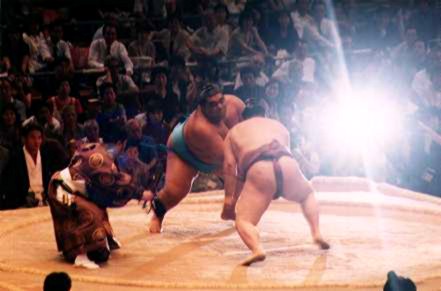
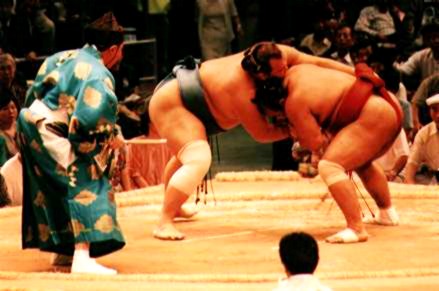
Before the actual meeting, the sumo will purify the dojyo by throwing sacred salt. Tachi-ai ("tachi" meaning standing up and "ai" meeting) is more and more frequent as the hierarchy of the sumo rivals increases. All the while they meets each other, they measure their opponent's strengths and weaknesses and look in the eyes for a psychological gain. The referee disciplines this ritual until the real combat occurs. BANG! The sumo fighters win his bout by bringing his opponent out of a straw ring fixed on a dojyo (mud mat where the sumo fights). He also wins if his opponent touches the ground with anything else than his feet. Real exciting!

|
With 15 days of competition, 8 victories or more are considered a kachi-kosi. Usually, in this case, the sumo fighter is promoted to upper ranks. In the other hand, a make-kosi (8 defeats or more) could mean demotion to lower ranks. Hence, in general from one tournament to another the ordinary sumo fighters move a lot from one position to another. Fighting stronger sumo pushes him lower where weaker sumo fighters enable him to get higher. A real yo-yo! After watching for some time, the names and the faces of the sumo fighter placed on the four levels of champions are easily recognizable. They tend to fight each other quite often because they do not change positions that much during one year, Above all, when one reaches the supreme champion level of Yokozuna, he cannot be demoted any more. Hence, if he becomes weak (by accident or by age), he must retire from the sumo world. Usually, two make-koshis in a row could mean retirement. As a matter of fact, the slightest running nose could make him take leave of the present tournament in fear of losing too many matches. |
Interestingly enough, same rank sumo will fight the same rank at some point during the tournament. But if a sumo "breaks" the pack and excels against stronger players (as it happens often with a rising star), he will be "forced" to match over against stronger and stronger sumo. Hence, the possibilities that this sumo wins the tournament by defeating only relatively weak opponents are slim.
Like any other sport, one cannot be an absolute fan without knowing the rules of the game. This is why I went through all the explanations about the sumo classes and the sequence of the tournament. But the real excitements are the sumo fighters themselves of course! Their personalities, although not as flamboyant as the WWF wrestlers, are still very much fascinating. And inside the sumo world, the small details mean everything. For example, the way one sumo throws the salt for the purification of the dojyo or the practice of the tachi-ai is well acclaimed.
|
All the sumo fighters belong to different "stables" which is spooky English comparison to the horse races. In Japanese, the word is more synonymous to a brotherhood house where the master is usually an ancient champion who decided to lend his skills and knowledge to the next generation. Very strict hierarchy is again of rigor. It is not uncommon to hear about the lowest ranking apprentice sumo cleaning up the "house" constantly and servicing the upper-ranked sumo like slaves... I don't know really if it is true but one thing is probably right, they do work their ass off to get to the higher ranks... |
|
The notion is brotherhood is central to the sumo world and competition between the stable is extremely fierce. For the same reason, sumo fighters of the same stable cannot contest against each other in a tournament. The only exception is that if two or more sumo fighters finish the tournament with an equal number of wins, a small play-off ensues to determine the winner. This is really exciting because it is the only time in which sumo fighters of the same stable can fight each other!
The most powerful stable is the "Futagoyama" stable. It took me a long time to be able to read the name of the stable because with these three simple characters, there are many ways to pronounce them. Literally, "two-sons-mountains" which probably refers to the two sons of the stable master, who are Takanohana (Tall flower) and Wakanohana (Young flower). Peotic! The names of the sumo fighters are fictional and regularly embody beautiful Japanese concepts. They are both Yokozunas but Takanohana is stronger and more successful than his brother. Takanohana's strengths are his impeccable technical abilities and stability while the smaller Wakanohana is swift and intelligent. Finally, there is also a respectable Ozeki and his name is Takanonami (Tall teardrops). He is the one of the tallest sumo at 196 centimeters, which enables him to scrupulously "carry" his opponent out of the ring.
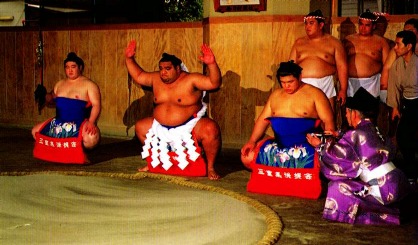
The second most powerful house is the "Musasigawa" stable that is well known from its name Musashi referring to the famous samurai Miyamoto Musashi who could manipulate two swords, one in each hand. It was experienced two amazing up-to-date achievements. The Hawaiian Ozeki Musasimaru won consecutively the January and March tournaments which earned him the veneered title of Yokozuna. At the same time, the new powerful star Sekiwake Dejima (Moving Island) keeps on collecting many post-tournament awards at every tournament (Fighting Spirit, Technique and Outstanding Performance prices).
|
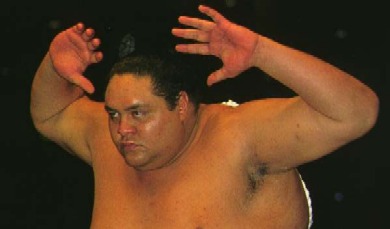
There are many other stables and many other incredible sumo fighters and at that point, it is just better talking about the most extraordinary of them all. The Hawaiian Yokozuna Akebono (Rising sun) belongs to a relatively weak stable (there is no other sumo in the Makuuchi division) but he is himself the most intimidating sumo fighter ever been on earth. When ready for the battle, his eyes are frightening enough to give chicken bumps to the crowd! Just imaging being into his opponent's little brain! The tallest sumo at 204 centimeters and 227 kilograms, his technique is to stretch his long arm and push his rival with a series of quick thrusts out of the ring. His hands are so strong that I heard that he is able to splash an apple in his palm! His only weaknesses are his long legs whereas he did suffer many accidents keeping him away for lengthy intermissions. |
|
Fit for the Nagoya Bashyo? Still digesting the sumo language. Well, ready or not, I am going in!!!
It is already Wednesday of the second week of the tournament but I have been following this tournament very carefully like anyone else. Kimura-san, a colleague of the Gilles generously gave us tickets for the Nagoya Bashyo and with him we are heading for the arena. It is located nearby the Nagoya castle thus reuniting two ancestral elements of Japanese culture.
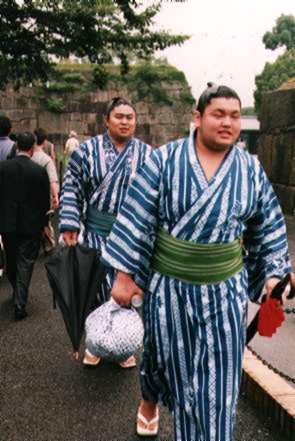
On our way to the door, sumo fighters are walking around benevolently wearing kimono and laughing loudly. The smell of their hair painted in dark is strolling around. Unique people engineered to fight in a ceremonious battle. Colossal master of their art and of respectful character, they almost belong to a mystical legend. Big and expensive cars are coming to a private parking nearby the entrance could only belongs to sumo champions. Yet to the dojyo and already, I feel overwhelmed by the excitation!
|
Inside the arena, it is much smaller than I previously thought from watching TV. I was expecting the size of a Forum (for hockey) but it turns out to be may be the size of a gymnasium. This is good news because we are sitting quite far from the dojyo and we still able to see them fighting very fine. Normal arena chairs for us please. The cushions, closer to the dojyo are sold in 4-sets and are very expensive, ranging from 500 to 800 dollars! Large companies give most of them to highly valued customers. Welcome to Japan Inc! |
I am going to learn a lot of things today. Unfortunately, there is not enough space and time to tell them all here. Most of them are interesting details though. For example, all the referees belong to only two families, again of hereditary lineage: the Kimuras and the Nimoris. Of course, with time, other people from other families are hired but in order to perform, must change their family name to comply with that rule. Callers of sumo fighters at the beginning of the fight, dojyo broom cleaners, etc are all people set to live by the rule and strict hierarchy. Amazing!
|
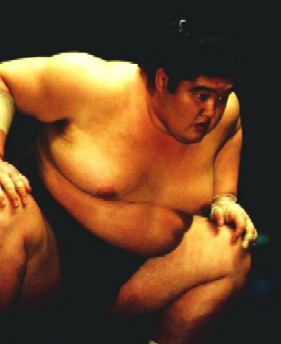
All the while I am learning things from Kimura-san (yes, coincidentally his name is Kimura but with nothing to do with the sumo world), sumo from the Jyuryo division (semi-professional) are fighting. Soon, professional division begins and I can see the first foreigner sumo fighters, one from Argentina whose name is as funny as his face: HoshiTango (The tango star). An American named Sentoryu (Fighting dragon) from St-Louis and two others Mongols are also performing. It is bad day for non-Japanese fighters because they all lost... I told Gilles to watch out for a white spot, Dejima, a sumo fighter from Kanazawa with an exceptionally white skin for Japanese. He is the challenger of the sumo tournament with only two losses while Akebono is the leader with one loss. You see this is how we follow a sumo tournament: The crowd despises any Yokozuna leader and any lower ranked challenger who could overthrow him will be cheered. Both won today magnificently and this means a final clash during the last days of the tournament is possible! |

|
|
Dejima on the last day of the tournament was able to equal Akebono's two losses and won the play-off to entitle himself champion of the Nagoya Bashyo. In the newspaper, I could read that Dejima said upon accepting the promotion to sumo's second highest rank as Ozeki: "I will devote myself and work hard to become a strong warrior." This was my sumo experience at the Nagoya Bashyo. In fact, I did find it hard to explain my feelings about it and I did skip many other interesting results. Well, it will be marvelous to follow the next Bashyo in September in Tokyo. Good luck Dejima! |

