
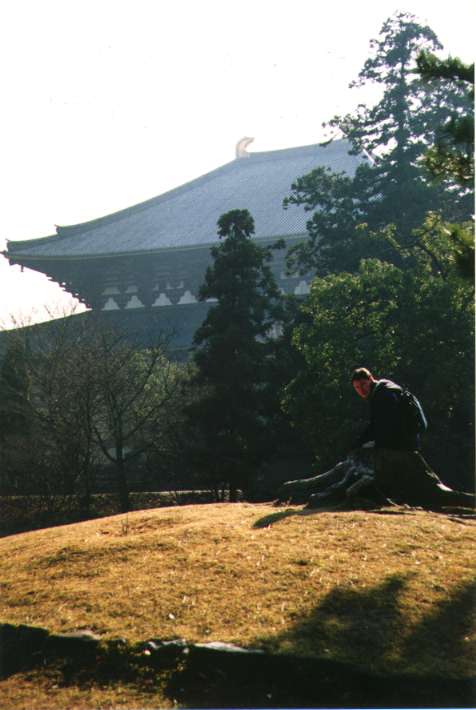

Gilles Rey-Mermet and I had planned this trip to Nara many times before but the timing was always wrong. However, a special gOnh festival (or gOnh matsuri) was taking place on the Thursday (17) and Friday (18) of the same week and thus it was the perfect time to take two highly expected days off for myself. We booked our Youth Hostel (Seishonen Kaikan) for three nights. A Japanese style room to change from the concrete of our dormitory.
|
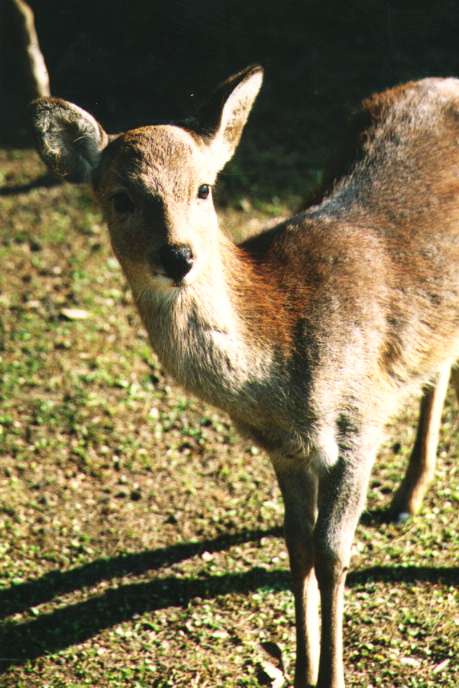
DAY 1: Sniffing deersWe arrived in the middle of Thursday afternoon. The sunshine was perfect although the weather was a little bit chilly but with a muffler around the neck, there was no problem. Walking straight through the downtown, we headed toward the famous Nara Park (Nara koen) where the gOnh festival was taking place. Entering the park, we immediately saw a few deers sniffing other peoplefs coats. Quite interestingly, they are 1200 left totally free in this park, walking around and hoping that tourists will give them their famous deer cookies. Very cute and not scared at all, they make perfect poses for photography as if they were trained to do so?! Along the way to the site of the festival, we encountered some people dressed in costumes of the Edo period. Realizing that we missed an important parade that finished just few minutes before we arrived. Zut! But the 17th is the sacred day for the festival and we had no clue where we were going into... |
|
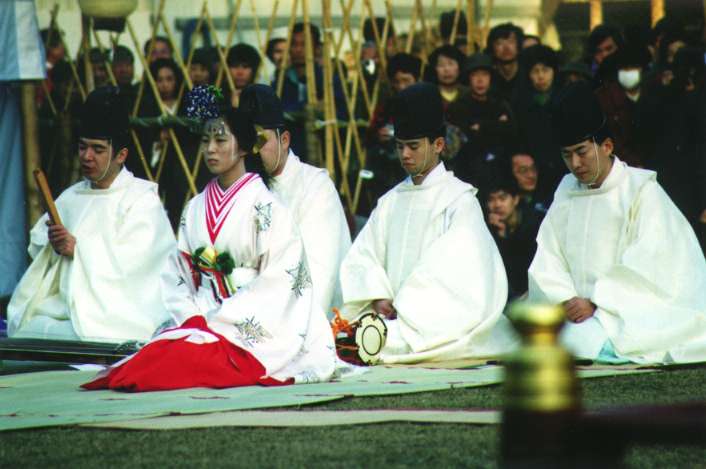
At the site of the festival was installed a small wooden temple and girls dressed of white kimonos with golden flowers pictures. They were four of them dancing very slowly on the melody of a Japanese folkloric music played by five Shintoist singing priests, a drummer and two flutists. The atmosphere was extremely relax and everybody was listening quietly the ceremony. In fact, there were not so many people, may be a hundred. There will be many ceremonies of the same style until late in the evening. While it is getting colder and darker, other priests set different fires around the stage to warm up the crowd. Dancing samurais with strange and fearful Noh masks and groups of all-white priests communicating with the gods make the scenes seem to taken virtually out of time. |
|
Like many other festivals, the crowd is invited to be patient while enduring the cold. The final part is coming soon and new people to the festival never really know what is going to happen next. Mystic or totally astonishing, the long wait for the surprise is always worth it. At the end of the last dance, the fires are cold off with pine branches. A heavy smoke screen invades the stage and there is no more visible light suddenly. No more photography is allowed from now on. All the priests that were assisting the ceremony step to the stage and, helping each other start removing every precious objects (like incensing tabernacle, statues, swords, etc.) of this wooden temple. They form a packed column and march toward the southeast part of the park. Wondering what is going, someone tells us that this temporary wooden temple have been constructed this morning at 1h:00 and the ceremonies lasted all day long until 11h:00. The precious objects necessary to the festival must be moved back to the original temple, which is Wakamiya-ji, located deep inside the park.
Walking slowly and quietly, the crowd follows the chanting priests. The sky is extraordinary beautiful with stars barely visible through the trees. The sandy road is illuminated by braises that fell off from the torches hold by the highest priest. It seems to be interminable because everybody is walking so slowly but we finally get there. Priests return the precious objects to their respective places in the temple. The white kimono girls perform one last ceremony and the holiest priest gives the ultimate benediction to the crowd. The festival is terminated. Deep frozen and tired, we get back to our Youth Hostel and put the heater to maximum.
|
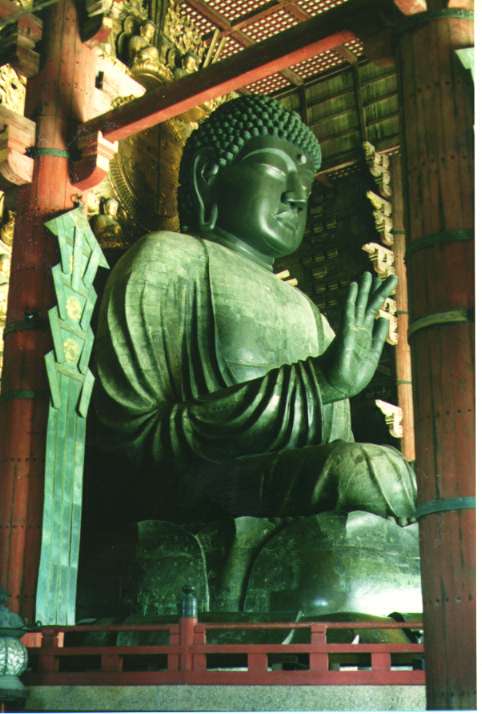
DAY 2: Dignity of the BuddhaThe second day was more relax and we both woke fairly late. At the same stage as yesterday was a Noh representation and a sumo tournament at 13h00. We had time to visit the Todai-ji temple during the morning. The Todai-ji temple is the star attraction in Nara. It is the largest wooden building in the world and houses the Great Buddha, one of the largest bronze images in the world. It also deserves a place in the record books for the largest concentration of tour groups, including hundreds of uniformed kids wearing yellow baseball caps being herded by guides. In fact, I asked everyone in my department and they all recalled their trip to Nara when they were at elementary school. It is almost an obligation and it is well seen by parents. As we circle the statue, we could see a wooden column with a small hose at the base. Popular belief maintains that those who can squeeze through are ensured of enlightenment. We both made our way to enlightenment pretty easily. I heard later from coworker than the size of the hole correspond to one nostril of the Buddha. Wow! I am wondering if at the same, we get immunity against nose discharges... |
|
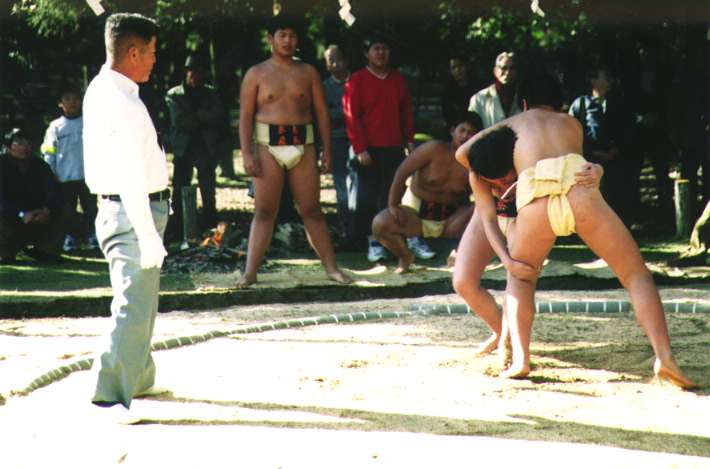
I was particularly interested in the sumo tournament. Their levels of education from elementary school to college and adult categorized the players. Hence, thin little kids were fighting at first. However, the third match-up was particularly horrible. Two inexperienced sumo players more or less fell together out of the ring and one of them knocked badly the ground. Shaking and gasping for air, he collapsed suddenly. The crowd was paralyzed instantaneously. It is useless to say that the incident gave a grave tone to the rest of the tournament while the ambulance was transporting the victim. It is only at a close distance that we realize how much dangerous this sport is. This incident did not affect my joy for sumo but clearly did not invite me to practice it either... It seems that not only the fat around the elite sumo players allow more puissance but also certainly helps the sumo, while falling, to absorb the floor (i.e. like a cushioning effect). |
|
The sentoh routine was electrifying for that we enjoyed a hot bath at high voltage! Electric current court circuiting inside the water makes the body muscles totally shivering. Get in and out is really painful but once inside the feeling is inexplicable. I assume that this treatment must be very beneficial to aged people with arthritis. The body totally exhausted from the electric shocks, the evening is spent writing postcard in an Italian restaurant and planning the following days.
|
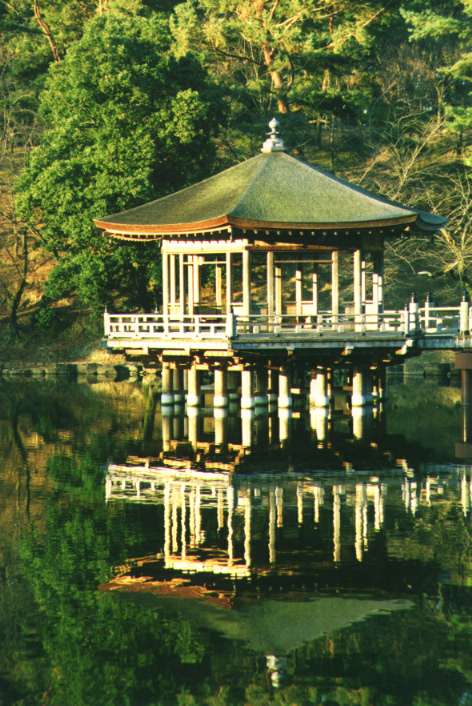
DAY 3: A special miyage for the bossToday is day gtempleh. Riding by rented bike around the park makes it a very pleasant day. Just to enumerate a few, we visited the Nigatsu-do and Sangatsu-do halls, the Kasuka Taisha shrine, the Kofuku-ji temple and the Isuien garden. In the latter, we spent the lunch eating next to the beautiful garden. We ate traditional Japanese dish made from grated yam, barley and rice. We also spent the dinner eating in another traditional Japanese restaurant named Yamazakiya. They served us local delicacy called narazuke, tart vegetable pickled in sake. They are famous throughout Japan and sell in souvenir shops. Other typical souvenirs include Noh masks, protecting warrior statues and deerfs droppings in chocolate (which I bought for my boss, ha ha). This is without saying that Japanese girls in Nara are very beautiful. Imagine two lonely guys in any big city. It is so easy to look around and appreciate long combed hair and very pretty faces... Sorry Maki, Madoka, etc... |
Well, well. Once again, we are faced with the Kansai-ben, the dialect of the region that includes Osaka, Kyoto and Nara. The responsible of Youth Hostel possesses a very strong one while greeting us for the X-mas season. We leave Nara for the nearby town of Horyuji where the temple of the same name is located. This temple was found in 607 and is renowned as the oldest temple in Japan. Pagodas and treasure halls complete our tour of the town. We take the express train back to Nagoya knowing certainly more about Buddhism than any average Japanese...

