

How do I start a story about Hong Kong? Amid all the stereotypes it has received, such as the Pearl of Orient, one of the four Chinese Dragons, and the political suspense of the 1998 hand-over (on which I even wrote a political article back in my high school years), I could not just figure out what Hong Kong would be. Again, the frantic stories of two James Clavell's books (i.e. Taipan and Noble House) were coming back to mind. Describing ups and downs of Hong Kong life seemingly more exciting than the modern Japan life in itself, I hoped to feel it in only 5 days of travel.
This trip to Hong Kong also bring many "first time" for myself (meaning my conscious self... I traveled a lot between 3 months and 3 years but it does not have much meaning for me). It is the first time that I go in a country where I do not understand the spoken language even though most Chinese in Hong Kong do speak a fair English and I could read more than half of the Chinese characters. It is also the first time that I put my foot on the "old continent" since Kowloon is attached to the Chinese mainland (but not Hong Kong which is an island). It was the first time I could see the sun (and the moon for the same reason) right above me being very close to the equatorial latitude. Gee, there are certainly more "first times" but I forgot them...
By looking in the airline booklet, we realized, not without relief, that all the scheduled flights were transferring through Taipei, Taiwan and actually, no flight was going into Mainland China. Thus, the plane belonged to the Republic of China (ROC) and the flight hostesses were our first official encounter with the Chinese gent feminine. I kept saying to Gilles that I could distinguish between Japanese and Chinese girl. Well, at that level of beauty, not yet...
|
The travel agency, H.I.S., offered this trip for 50000 yens, an exceptionally cheap trip because of the low season and because the Japanese tourism to Hong Kong has dropped by 30% since two years in reaction to the discovery that Japanese tourists were charged double price. Hence, the service from the airport in a high-class bus and the hotel (the room was small but by Hong Kong standard, still acceptable) were excellent. From the airport (an architectural icon in itself) located on Lautau island to our Standford Hotel on the northern part of Kowlown (Yau Ma Tei station), the bus trip offered an easy look-out for the first aligned apartment skyscrapers and container pile-ups at the huge Hong Kong maritime piers. I think that the most obvious thing that the newcomers to Kowloon perceive is that rich and poor to their extreme dwell not far from in a shoddy fashion. The evident example is the Peninsula, one of the most expensive hotel in the world adjacent to the Chungking Mansions which are totally decadent apartments. In fact, if it was not for the glowing architecture of some buildings, one would think that Kowloon had survived an atomic bomb without having time to renovate. | 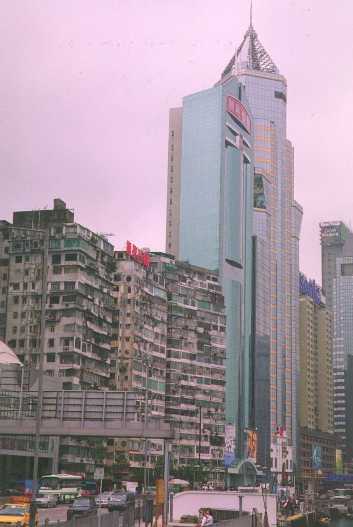
|
|
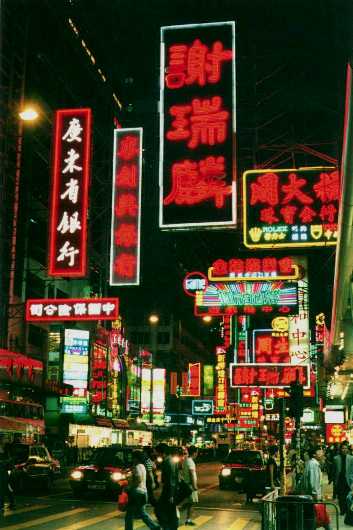
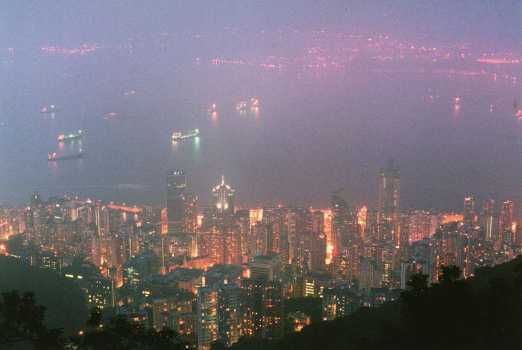
But Kowloon has one thing shared by the Victoria peak, one of the most amazing view in the world: the sight of the downtown of Hong Kong on the other side of the Hong Kong bay. The weather is cloudy as it is much common here (the rainy season is before long) but Gilles tries some "long-pause" nighttime pictures. An exhilarating wall of skyscrapers faces us up front and to as far as could see. We were joking about nightmarish endless city worlds with Osaka still fresh in our memory and thankful that Japan is an island as well as Hong Kong. Oups! I forgot to say that Hong Kong taxi drivers are the craziest in the world and crossing a street at the intersection, even on the green light, is amazingly dangerous. Double double-checking on both sides and not trusting the direction lights of cars is an inevitable necessity for pedestrians in Hong Kong. Incidentally, the number of cars per inhabitant in Hong Kong is surprisingly very low because of a 100% tax on them. Hence, the boulevards literally belong to the taxis, tramways and buses. But don't worry mom and dad, I am still alive to write this story... |
The walk to the metro station (here, the word "subway" means an underground pedestrian passage) is already a nose-opener. The spicy smell of duck (and dog?!) meat resting in the front window of the restaurants vents rapidly in the street. Why do they have to put it in front of everybody's stomach is still a Chinese puzzle. Anyway, we are not very hungry after the super-British style breakfast buffet served at the hotel.
Today, we want to walk from North Point station (in fact, on the East side of the Hong Kong island) to the Central station (deep in down town). It is amazing to look at all this skyline of skyscrapers of dazzling modernity and prosperity and think and its historical, political and economical importance in the world. The same feeling of yesterday comes back as the mix of rich and poor is astonishing. Hong Kong still maintains a high degree of flexibility for 50 more years thanks to a treaty agreement between UK and China. But I am not so sure that this vision had been embraced by the leaders of the Chinese communist party which (supposedly) promotes economic equality hence the clash seemed unavoidable at the time of the hand over. History has proved wrong but who can tell... And talking about instability, the bombing of the Chinese embassy in Belgrade and the subsequent protestations just one week before our departure was a bit chilling too. Hmmmm!
|
Jumping in the elevator of a tall building hoping to get a view, we are allowed to look by a nice insurance company employee who spoke perfect English. Across the skyscrapers, we notice how unbelievably crowded the northern side of the Hong Kong Island actually is. About the only natural places left to build on are the steep hills rising up. Also funny is Happy Valley, a huge park destined for horse races in the middle of one of the most condensed area in the world. Also reclamation along the harbor edge continues and buildings once on the waterfront are now several hundred meters back (poor Peninsula Hotel). Still walking, we finally reach the Central area where the most impressive architectural treasures can appear quite magnificent, especially in the right light conditions (which Gilles tend to complain a bit...). An eclectic assortment of historical remnants, churches, parks and gardens contribute to a surprising harmony of ancient and modern themes. |
|
The supper in the Lan Kwai Fong district is nice. Foreigners abound (on a strict comparison with Japan) but we are too tired to even think about hanging out tonight. It is humid and the rain finally pours just when we arrive to our hotel. Gee, is it the dreary rainy season commencing?!
|
What is a baba cool? |
|
The sun is red hot and the sweat is salty... I thank god for sunscreen cream #30.
|
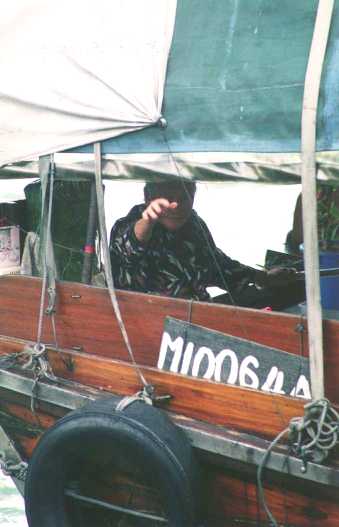
We take the ferry back to southern part of Hong Kong or more precisely at Aberdeen. There, a large number of boat peoples are trying to invite us to one of the many floating restaurants in the bay. The slightest glance with draw them to the shore, waving hands and hoping that we will snap on one of their relay-boat. They certainly get a big commission because they are quite annoying. Paying the bus fare is also a bit frustrating. The Chinese driver does not move a single finger to show us how much and how to pay. Grrr. The Lonely Planet warning about the fact that Hong Kong people are often rude, pushy and impatient helps us to understand. But in general, this driver would be the absolute worst thus it was not too bad after all. Thus back in downtown, we head for the finest of Hong Kong: the Peak Tram to Victoria Peak. Gilles was all proud to show that the tram has been fabricated in Switzerland. The tram actually gets to only about two thirds of the top. We did not see the reason at once but upon further walking to the very top that we saw why: the top is clouded almost year-round. Poor rich owners of penthouses... But we are still able to see through the most of the clouds and the view is breathtaking. |
|
Hong Kong is to Los Angeles what Macau is to Las Vegas. Both are popular because of the vicinity of the megalopolis. Macau is so entrenched to Hong Kong that Hong Kong dollars are used totally indifferently (even in the bus fare!) in Macau but the same cannot be done the other way around. Thus we don't really need to seek to exchange our money and head directly to the one-hour catamaran tour to Macau. Macau has been a Portuguese colony since 1550 as a lucrative trading post between China (cotton and textiles) and the West Coast of India (spices and aromatic goods) and Japan (silver, swords and lacquerware). Pretty smart, these Portuguese traders!!! Thus, the colonial influence is much older and sharper than in Hong Kong. This fine mix of Portuguese and Chinese architecture is unique and we appreciated it by walking in the backward narrow streets of Macau. The pastel colors are everywhere painted on buildings and even on peoplefs clothes. |

|
|
Talking about peoplefs clothes, at 7 ofclock in the evening, we were overwhelmed by women dressed in light purple hurrying to their respective casino. Because this is mostly what Macau is really for...gambling. But our bermuda pants are prohibited thus (un)fortunately, we could not take a glimpse or drop a few bucks in the slot machines. Oh well, it will wait for my honeymoon in Las Vegas... DAY 5: The second Chinese puzzleToday, we took the plane back still looking at the beautiful Japanese hostesses (well, I think they were Japanese this time?). |

|

