Rotating (Kerr) Black Holes
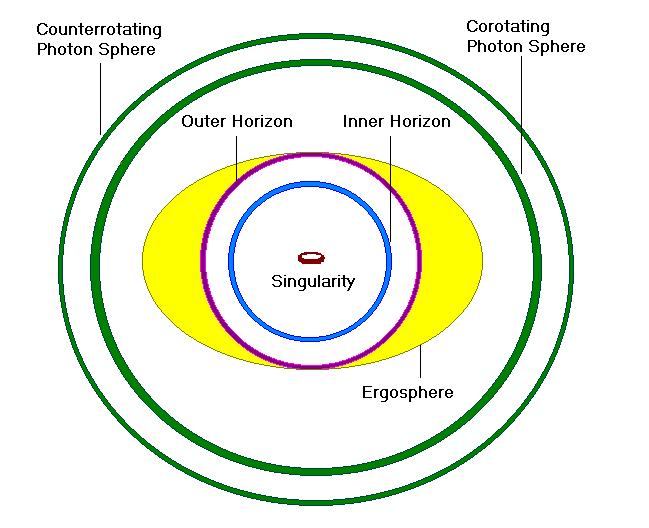
The rotating black hole is the most common type of black hole. This is due to the fact that stars from which black holes are created are already in motion, and continue to spin even after they collapse. Rotating black holes can no longer be described using Schwarzschild's ideas, so we use the metrics of a scientist named Kerr. This type of black hole has several unique properties:
Double Photon Spheres
The fact that a Kerr black hole has an axis of rotation complicates the matter of photon spheres. Light rays hitting the black hole at the equator or at angles to the equator have an option: to travel against the direction of rotation, in the counterrotating sphere, which is farthest from the singularity; or to travel with the direction of rotation in the corotating sphere, which is closer to the centre of the hole.
Ergosphere
Since this class of black hole is explained using the oblate spheroidal coordinate system(which is based on ellipses rather than circles), it is not symmetrical like the previous two types. The ergosphere is an ellipsoid (3D ellipse) region that exists just outside the outer event horizon. Unlike the event horizon and photon sphere, which are just mathematical distances, the ergosphere is a real, physical space, and it changes shape depending on the speed of the black hole. The faster the speed of rotation, the longer the ellipsoid's major axis becomes (it billows out from the center).
The outer edge of the ergosphere acts as the Kerr black hole's static limit, or the space where the escape velocity reaches c, the speed of light.
Double Horizons and the Ring Singularity
This is where rotating black holes become really interesting. They have double horizons, which means spacetime is inverted once, then reverted to its original state. This causes the singularity to be a place in space, as opposed to a moment in time.
Also, the singularity of a rotating black hole is not a point - it is ring-shaped, and therefore labelled ring singularity. The ring singularity is, of course, rotating, and due to its speed and immense mass it creates a frame-dragging effect. This causes a huge curvature in spacetime.
So what does it all mean? Since the ring singularity is a place rather than a time, it is theoretically possible for an observer to look into and "through" the singularity. It would appear as an oval or circular "window" (depending on the angle at which it is viewed) and many theorists believe that one could observe and infinite number of points in spacetime, or an infinite number of different universes. This leads us to the topic of wormholes, which are discussed in a different chapter.
Accretion Disk and Twin Jets
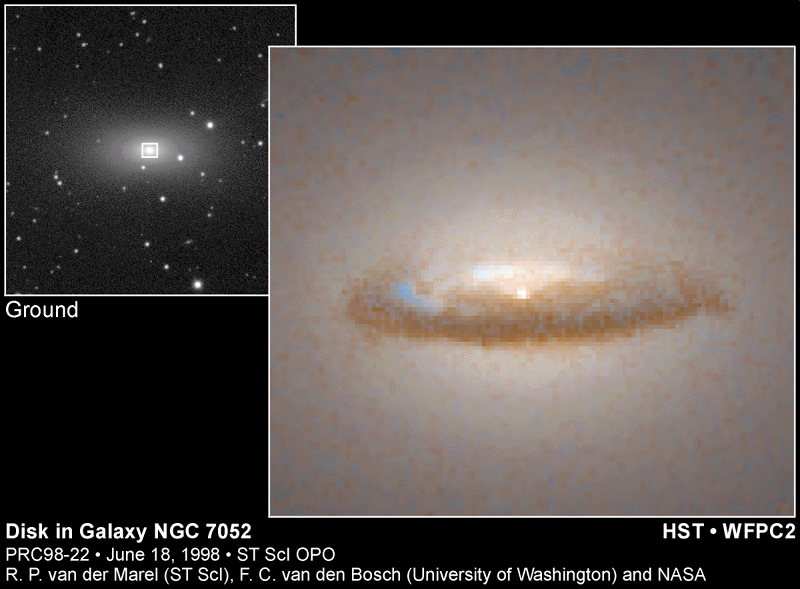
Since black holes themselves absorb light, they are very difficult for us to see. Instead, we see the accretion disk of the black hole. This disk is formed by dust particles and gases, usually the left-overs of the supernova that formed the black hole. It appears to glow because the particles in the disk are actually emitting light; as a dust particle spins closer and closer to the singularity, it loses some of its gravitational potential energy. Following the Law of Conservation of Energy, that lost energy is converted to heat and light. Often the particles move so quickly and lose so much gravitational potential energy that they begin emitting x-rays, which are detectable in space.
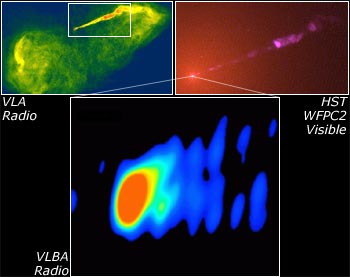
The black hole also generates an electric field. When this electric field moves around the black hole, it creates a magnetic field perpendicular to its direction of rotation. Therefore, electrons are propelled at tremendous speeds away from the black hole at an angle parallel to its axis of rotation, and like the dust particle, they begin to emit light. Sometimes they can be propelled so fast that they emit gamma rays. This creates the phenomenon known as twin energy jets.
Back to the Table of Contents

