Emitter or source follower stability
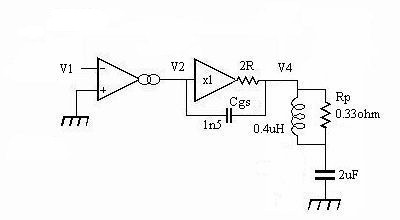
Adding a small inductor in series with the output of a power amplifier may sometimes be necessary to ensure stability of the overall feedback loop with a range of capacitive loads. Consider the circuit shown next in simplified form driving a 2uF load:
This circuit uses a conventional source-follower lateral mosfet output stage with series inductor to reduce capacitive load effects, and without any added high frequency compensation. The output stage is driven from a high impedance, as a 'worst-case' example.
The output stage is represented by a unity gain stage with a 2 ohm output impedance, and the total combined mosfet gate-source capacitance, Cgs, is shown as 1500pF. Both output impedance and Cgs vary with output current level, and the values shown are about the worst case for the lateral mosfets used at Iq = 100mA. With an ideal current source driver stage the open-loop gain of the amplifier is proportional to the input impedance of the output stage, which is not just the impedance of Cgs because the full driver stage output voltage does not appear across this capacitor, only a reduced value determined by the potential divider formed by the 2 ohm output impedance and the load, and so we may expect the effective input capacitance to be fairly low at low frequencies, but increase with increased frequency because of the falling load impedance.
The potential divider just mentioned is not however a resistive divider because the load has a reactive component, and so it does not just reduce the voltage across Cgs, it also changes its phase, so the effect is something more complex than just an increase in capacitance at higher frequencies. With a fixed capacitance the resulting open-loop gain reduction would be just -6dB/octave, but with this increasing capacitance the rate is greater. The phase shift of a pure capacitance, even if it had different values at different frequencies, would be 90 degrees, but the input impedance of the output stage is not just a pure capacitance, and adds a phase shift which can approach 180 degrees with consequent risk of instability. For the phase shift to actually reach 180 deg. the input impedance of the output stage would need to be a negative resistance rather than a capacitance.
To see the extent of the problem the phase shift was plotted using AIM-Spice, and the next diagram shows the phase shift at input, V2 in red, and output, V4 in green.
The phase shift at the input of the output stage is the red trace, and this reaches a maximum in excess of 160 deg between 6kHz and 10kHz. This is not what we would expect if our mosfet output stage has a capacitive input impedance, the phase shift could then only reach 90 deg. There is evidently a negative resistance component also. (This is not a consequence of using an output inductor, it is still present with this shorted. The capacitive load is the problem.)
The negative resistance is not itself a serious problem because it has a series capacitance, but if the output stage were to be driven from an inductive source so that the capacitance is cancelled at some frequency then the result would be similar to a Colpitts oscillator, and oscillation is then possible. If wiring inductance is kept low this should not be a problem, but the effect of the phase shift on loop stability may still be important. The green trace shows that the total phase shift added by the output stage is close to 180 deg from 10kHz to 100kHz, and if we want unconditional stability we can add no more phase shift inside the feedback loop in this frequency range.From this we can conclude that driving a mosfet output stage from a high impedance is not ideal, and the inclusion of an emitter follower stage as in the MJR7 is helpful. Alternative low impedance driver stages need careful design to ensure they remain stable driving a load with a negative resistance component. The original MJR6 did drive the output stage from a high impedance, but there was little additional high frequency compensation round the feedback loop, the falling input impedance of the output stage at high frequencies was primarily used to stabilise the loop.
For a bipolar output stage everything gets more complex, the base-emitter capacitance includes 'diffusion capacitance' proportional to emitter current, so Cbe for a high power transistor such as the MJL3281A can vary from something like 10n at low current up to typically 20uF at 10A, and the output impedance can also vary over a wide range.