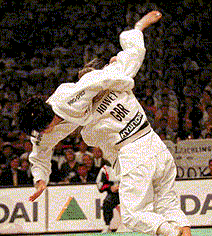
.CONTEST.
JUDO IN GENERAL.
Judo means the 'Gentle Way', a martial art derived from ju-jutsu and a form of highly-sophisticated wrestling. A contest takes place on a mat 9 m (30 ft) square. Outside the mat there is a safety area of 1 m (3 ft 3 in) all round. A contest is judged by a referee within the contest area, plus two judges situated at opposite corners of the mat. The contest must take place within the limits of the area.
All judoka (competitors) wear the judogi (judo suit), a loose-fitting garment of white or off-white, and even blue. The jacket is fastened by a belt(obe) which goes twice round the body and is tied with a square knot. The colour of the belt indicates the competitor's standard. At the start the fighters face each other and make a standing bow (ray). This is a traditional courtesy and formality before and after a bout. The referee then calls hajime (begin). A bout lasts around 3-4 minuets. There are no rounds, as in boxing, but a decisive score may end the contest. If a contest is not a clear victory one way or the other, the judges indicate the winner with their batons and the referee has the deciding vote.
Fighters are judged on throwing technique (nage-waza), and holding technique (katame-waza). Violations and fouls are also determining factors. The main object is to score an ippon (full point), worth ten points. This may be awarded for a throw of considerable force; lifting the opponent from the mat to shoulder height; making an effective stranglehold or lock; maintaining a hold for 30 seconds. A fighter who just fails to make an ippon may be awarded a wazari, worth seven points. Two wazari equal one ippon (wazari-awaseti-ippon). Should a fighter score only one wazari but have a serious foul committed against him or her, then he or she can win outright. A fighter may also gain a decision by means of a yuko (five points), a koka (three points).
Infringements result in penalties as follows: (1) shido-3 point penalty; (2) chui-a caution and deduction of five points; (3) keikoku-a warning and deduction of seven points; (4) hansoku-make-disqualification and loss of ten points.
As in other martial arts, style and correctness of technique are important and the referee takes these into consideration. If there is no clear points advantage then a bout may be decided on superior style, technique, or aggressiveness.
Scores are made by either throwing the partner, holding the partner, or from achieving a submission.
Throws.
Holds
Armlocks and strangles
back