

"Take Two"
Bryan Adrian
Heidi Seiler looked in the mirror and saw her face replicated endlessly in the
fractured glass. Her eyes appeared sunken. The air was lurid and stale from a
dozen cigarettes sucked to their butts within the last hour. Livid circles under
her eyes gave in to her world weariness. She gnawed on the neck of an open
bottle of brandy and wiped mascara away from her cheeks. A stream of tears
flowed from her chin. She daubed her neck and chin with a soiled towel and lit
another sweat stained cigarette with her other hand.
"Christ! Tastes like generic soy sauce."
Not a soul was within hearing distance. She stubbed out her cigarette onto the
cosmetic stand and then stretched out on the floor. The telephone began to ring
only minutes after she had fallen into a deep trance. Heidi cursed as she
stumbled toward the phone half asleep.
"Hello."
"Heidi, can you meet me in fifteen minutes at B-Bar?
"What's wrong Art?"
"Nothing's wrong. Just hurry. Get there by 9:30."
"Can you buy my drinks? I'm broke."
"Sing me a new song," responded Art after a hesitation.
"I'll be on time," she replied nervously.
This kind of conversation with Art was a regular feature in their relationship
now. Art had dropped Heidi over a year and a half earlier but still kept alive
this somewhat useful alliance. Dialogue had been reduced to a steady sawing
sound, the missing teeth in the saw long forgotten. Within five minutes Heidi
was put together in her East Village thrift store fashion attire. She dressed
like many other production assistants for independent films, except for a few
minor details-sunglasses and a broad brimmed hat worn throughout the night. It
helped her hide red and often dilated eyes. For similar reasons she also wore
long sleeve shirts, even in the oppressive heat and humidity of August.
As Heidi locked up her apartment on her way out, a delightful wave of
anticipation overtook her.
"Maybe Art can hook me up with a PA job," she dreamed.
Heidi entered the B-Bar on Avenue B and East 7th Street at precisely 9:30 pm.
The tail end of a conversation was taking place at Art's table as Heidi threaded
her way to them through the phlegmatic crowd.
"I can't do it Art. She's my friend too and it's just not right ..."
"Fuck you Doug, you're the only one who knows how to tell it to her and make it
stick without pain."
Nobody noticed Heidi as she grabbed a chair at their table. She pretended not to
have heard any part of their conversation.
"It's good to see ya Doug. You're looking good Art. You still working on a film
together?"
"Yeah. No hitches yet. With a few more investors, we'll be unbeatable.
This film might even make it commercially. National distribution, the works!"
boasted Art.
"That's great Art. Do ... do you think I can get on as a production assistant?"
"Sorry. No," responded Art dryly.
The film talk ambled on self-importantly until the pair of friends and
filmmakers felt they were sufficiently cut off from the boring and hopeless
masses who didn't discuss the making of films. The common denominator that held
the patrons of this bar together was an utter lack of concern over whether or
not others could overhear their private conversations. It was a form of
Manhattan social masturbation, combined brutishly to exhibitionism. Only here in
the East Village, it could be even more pronounced than in the retail trade
subculture. Everyone was on the make, and each patron felt himself specifically
appointed to bring the latest word to all those not fortunate enough to live in
the local art and film mini-world. Posing and posturing had become a disease
making the New York scene dangerously anaemic, perhaps as destructive a force as
AIDS. Posturing and posing were now insinuated into the blood and heart of
social contact in
both the arts and in the streets. Some wags already prophesied
that necrophilia would be the new, hot marketable theme.
Art's words didn't really matter much to his entourage in B-Bar. His discourses
were by now considered stock replies among those who knew him. The noise of one
hundred people honing their technique of self-aggrandizement created a deafening
insect-like noise in the bar. Gums and tongues rubbed like locusts' wings. The
barroom jukebox and its parade of eighteen hit songs had become nearly
inaudible.
Old institutions of the East Village still stubbornly remained. Drug dealing and
chronic abuse of substances ranging from cheap, strong Nighttrain wine to heroin
and amphetamines and explosive recipes like "Speedballs". It's often easy to
spot at least one drug dealer in an East Village bar with a simple checklist.
Look for the guy who never sits down or pays for a drink with his own money.
Constantly in motion with cigarette dangling sinisterly from moist, unkissable
lips, these entrepreneurs circumnavigate the bars like smoking garbage barges.
Heidi retreated deep within her thoughts. Her imagination leapt backwards in an
effort to reconstruct the conversation she had partially overheard between Art
and Doug as she entered the bar. To spend even a short amount of time with Art
had recently become increasingly difficult. Art's inattentiveness to her pain
and personal unfulfillment proved to be an ever widening cause of estrangement
between them. It had been more than a year since they quit living together. Now,
too, their friendship seemed fragile, subject to fracture by the slightest of
evening breezes.
Art took notice of the wistful __expression engulfing Heidi's mood. At one time
he could read her face as thoroughly as a computer printout. Now for him her
face bore resemblance to old and soiled cookbooks. Computers and cameras and
young starlets now commanded his attention readily.
"Heidi. I asked you here to get the 2nd set of keys back from my extra
apartment. I got to put up a cameraman from Los Angeles for a few months." Blood
drained from Heidi's cheeks and nearly stole the fortitude she would need to
endure the remainder of Art's edict. Authoritatively, he proceeded. "You got to
find new housing arrangements quickly. I told you from the start that this could
happen any time."
"This is why you called me here Art?"
Art didn't answer instead motioning to his acquaintance near the door to join
him. The fellow responded enthusiastically and headed for an empty chair.
Heidi felt the tissue of her security being torn as she slowly accepted the
reality of her sudden expulsion. Darning needles of paranoia knitted at her
brain, mincing it until it was no more reliable than soppy bags of spent coffee
grinds. A sinking anxiety descended from her temples slowly to her chest,
finding release through a tepid liquid as it trickled down her groin. Startled
and near nervous collapse, she abruptly left Art and his buddies, moments before
losing total control of her bladder in a spasm of relief in the dark and
miserable streets. Her eyes were puffy and moist.
Their itchiness compelled her to scurry home in even greater haste. Whenever she
looked up from the ground a drunken derelict or a victim of unemployment or
drugs invariably loomed out of the darkness and reminded her of the plight of
the disenfranchised. Several junkies and freebase obsessive-types noticed the
terror of alienation scrawled on her face. It looked as if some delinquents had
suddenly fallen upon her and sprayed graffiti all over her cheeks and forehead
in vulgar signatures. She pushed her way through the iron curtain of malingerers
and climbed the stoop leading to her apartment, six floors up.
Once inside, she flung off her damp and yellowing slacks and dropped down onto
her lumpy mattress on the floor. Shutting tightly, her inner eyelids became a
type of projector screen. She found small comfort in the images of bloody
tongues sticking out at her in derision. The mouths from which the tongues
rudely protruded heaped scorn in gobbets of saliva obscenely in her direction. A
litany of school bells rang in her head making her remember parochial school and
crave middle class comforts, or if that was no longer available to her, religion
or some other opiate for her struggling soul. She responded to their ultimatum.
Heidi floated quite some time in this delirium until piercing telephone rings
penetrated her thoughts. She walked mindlessly towards her cosmetics stand and
noticed that it was in sore need of a good cleaning. Then, remembering the
phone, she scrambled towards it and answered.
"Yes... Hello."
"Miss Seiler?"
"Yes?"
"Heidi Seiler?"
"Yes."
"Good evening. I'm Bob Bartlett, program director for NBC miniseries. I wanted
to let you know, in all fairness, knowing you'll need every minute left to make
new arrangements for work ... uhhh ... well, it's impossible to use you on our
new project."
"I don't understand. You promised me the assignment weeks ago."
"Miss Seiler, I'm sorry. It was a very difficult decision for all of us. Our
regular set dresser returned from maternity leave and we can't dismiss such a
godsend."
"Can't she wait a few goddamned months longer?"
"No Miss Seiler. ABC offered her a higher paying position this morning and we
don't want to lose her. She's returning to us more out of loyalty than financial
interest. So you see ..." An incandescent burst of color bathed Heidi's face in
red. A speeding ambulance passed in the streets below.
"Thank you very much for calling Bartlett. Call me again sometime you poncie
little motherfucker."
"... errr, yes. We will keep you in mind for the future. Good luck and
good-bye."
Heidi sat motionless. Her elbows dug painfully into her thighs as she hung her
head and let blood rush into her cranium making it heavier than lead. She began
to cry and cradled her face in her hands. Then she sat upright, and as if for
the first time, took a long look at her surroundings. They appeared
extraordinarily grim. Drab furnishings and colorless squalor entombed her in a
hell composed of stuffy air and frugality. She became sullen. Despite her
growing apathy, she picked herself up from the old chair and walked toward her
mattress again. Her depression continued to darken and rumble. Each fleeting
thought that bubbled up from her brain was absorbed by a dark force whose
immensity was more horrible than a starless and moonless nighttime sky.
Not a typical darkness, but one that resembled a hostile desert in which a
greatly reduced and badly defeated army makes its final retreat through a
pitch-black night. Immobility began its slow and deep extinguishment of her
desire for life, light and joy. A seductive inertness lowered her completely
onto the mattress and her head accidentally slammed hard against the uncovered
floor. Her eyes dimmed in syncopation to the dying thoughts that struggled for
token recognition in her descending grip on reality.
Sweat streamed from her flesh. The overall effect was akin to being dipped
alternately into hot and cold tubs by a behemoth sadist. A breeze coming in
through the window chiseled relief out of the heavy Manhattan humidity. Heidi
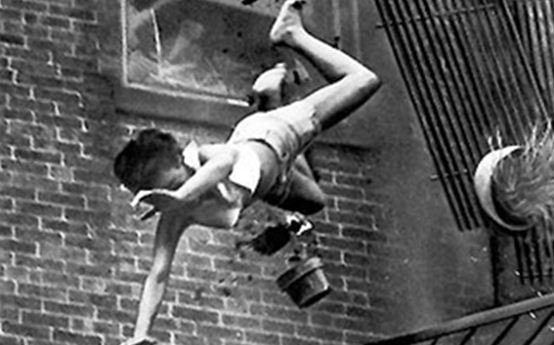
was suddenly animated and arose abruptly to throw open the window and climb over
the ledge and onto the fire escape. Her hair and bared breasts received
comforting caresses from the wind blowing in off the East River. She inhaled
deeply, filling her lungs to full capacity. A feeling of giddiness suffused her
limbs. She felt she was being picked up on the wings of a great bird and
liberated from all earthly concerns. In a sweeping gesture she arched her arms
above her head in a ballerina pose and stood on the balls of her feet. An
ecstatic smile spread across her face as she attempted to leap in perfect
balletic form from one wing of the great bird to its fully extended counterpart.
The bird vanished. The doctors in the trauma unit of Beth Israel Hospital made
another examination of their now familiar patient. Their routine report, as
always, unchanged, since the night of her admission-the night she had been found
shattered among the broken beer bottles and syringes on the sidewalk beneath her
6th floor apartment and directly in front of the customers of a sidewalk cafe. A
large card, stuck to the headboard of her bed, still notified the staff of the
ICU of her inert condition:
COMATOSE. CONTINUE INTRAVENOUS.
"Dr. Goldtaker. Do you think she'll ever come out of it?
"Who can say? It's only been three months. Haven't you heard? The interns have a
pool, guessing the day she'll pull out of it, if ever. It's growing almost as
big as the Lotto."
A young man carrying a shoulder sack and wearing a major Hollywood studio
tee-shirt entered the room. An air of guilt had been following him since Heidi's
morbid plunge. It badgered him to recall how he had egotistically pursued his
own career, often at Heidi's expense, neglecting her aspirations and needs, yet
grabbing everything she offered him like a hungry orphan. Very few people knew
the extent of Heidi's contributions to his success and the measure of support
she had given him during his formative years as a filmmaker.
A hospital staff member informed Art that there had been no progress. The cause
of her accident was still unknown and was no longer discussed. The police had
concluded that there had been no foul play and that they would perhaps never
learn if her fall had been accidental or suicide attempt. No one would ever
know, if she didn't recover from her coma.
Eight months later Heidi regained consciousness. She was slowly phased out of
the hospital, and on the day of her release was presented with a dazzling
bouquet of flowers from the doctors and nurses, including a note of
encouragement signed "from all of us" written in Art's most decorative
handwriting.
Art opened the door of the hospital for Heidi as she emerged from the First
Avenue main lobby. Shafts of October sunlight stretched toward her and gave her
a congratulatory warm kiss from the clear unadulterated sky. Her past with Art
seemed far away indeed, as did her other abusive dependencies. Now that she had
made a pilgrimage through the valley of death, the mere presence of his body
seemed mocked by the lasting substantiality she had found in that mythical
place. Even the shadows on the River Styx seemed to have more weight than Art.
She kept the lips of her Psyche sealed tightly around her thoughts, willing to
share such treasures only with the initiated or special spiritual types. Secrecy
had earned her respect since her special journey.
Art, in other words, had become insignificant.
All throughout their relationship, Art had erroneously thought that Heidi's
parents lived in an ashram in Germany, address unknown. It had fallen upon him
to act as responsible family member in the eyes of the hospital administration
and the police when they found his address and phone number in her possession.
He was the one who identified her broken form in the ICU on the night of the
accident, and who signed all authorizations for her immediate medical care. A
cab finally pulled up into the emergency entrance of Beth Israel.
Several ill and coughing homeless folk who were been sitting curbside, praying
and begging for admission, had to jump quickly to get out of the cab's
trajectory toward cash dispensing customers. Art and Heidi quickly entered the
cab. The cab bolted out into traffic and then careened in typical fashion around
a city bus that held up most of the traffic. Heidi sang out with exuberance.
"I think I'll go to Southern California to visit my parents! You thought you
knew all about me Art. Actually ... you don't!"
Art looked out of the window at a group of policemen standing around a mugging
victim, writing out endless reports, talking among themselves and laughing, not
noticing that the mugged businessman was bleeding fatally on the sidewalk,
pleading with his hands for help. Art knew the months ahead would be difficult
for him.
Through her parents, Heidi made arrangements to live in California. The days
went by more tempestuously than the crashing Pacific waves. Art didn't know what
role was required of him when he was around her or was asked by others about
their relationship. He was heard describing to a bartender a new film idea
titled "The Tragedy of Heidi" in an impersonal tone of voice which revealed a
callousness toward her suffering. "It has incredible potential to become a
mega-hit" he was overheard saying by several strangers seated around the long,
horseshoe shaped bar. One of those who overheard was a good friend of Heidi's
and she wasted no time reporting back to Heidi the next day.
After many emotional outbursts and accusations of an intimate nature, Art
accused her of being haughty. Heidi left Art. She told him he needed to be alone
with his fascination with himself and his incipient success. She then flew first
class to Malibu. Her parents, greatly relieved to have her away from her
destructive tendencies, rented her a beautiful bungalow with a sweeping view of
the beach below. From the tranquillity of her bedroom she contemplated the seas
of the world and watched the red ball of the setting sun bleed into the infinity
of the Pacific ocean. It rewarded her in a deeper sense than her discarded,
former pleasures. Heidi took up writing a film script with considerable gusto.
Her health and confidence rose on higher and higher tides of well-being.
Art finally came out to Malibu at about the time Heidi had completed the
withdrawal program and the final draft of her script.
Things hadn't changed much between them during the silent undertow of time. The
encounter was a hollow exchange for both of them, the emptiness of it mercifully
concealed behind a gridlock of courtesies and mock pleasantries. Art returned to
New York after a few days. His film schedules were getting tighter and tighter
and he had to return to Manhattan before things took an unexpected turn.
That's what he told Heidi.
Right before he left, however, Heidi noticed that he had betrayed his real
intentions by exhibiting greater and greater dissatisfaction with her new
independence and strength. Gone forever were the days when she submitted her
services and opinions to him like some kind of dog on its back, waiting for a
belly massage.
Nearly a year later a movie was produced and distributed based on Heidi's script
titled "The Disfigurement of Hope" about a young woman named Hope. The story
came to be known in the industry, particularly in the jargon of the studio press
releases, as a strong affirmation of the courage and nobility of the human
spirit. It starred a young East Village actress who, if not for this lucky
break, would have headed towards unwitting self-destruction. Heidi gained
celebrity status due to the overnight success of her script and the
well-publicized story of her survival after her fall. Investors contributed
without question to whatever new scripts she produced. Their overriding concern
was only that she give her approval for immediate production-films could now be
made nearly as quickly as TV episodes and market forces dictated constant
production.
While reading West and East Coast reviews of her film, and still enjoying the
amenities of her Malibu retreat, a small two-paragraph review on the last page
of the Los Angeles Times arts & entertainment section caught her attention. It
was written by a stringer covering the East Village and the subject was the
directorial disgrace of her former mate, Art.
His film "i am what i am" had flopped into the abyss of reviled box office
disasters. Many elements of his film had repeatedly been ridiculed. Art's
directing career was doomed to be forever confined to his limited scope and
audience in the obscurity of the East Village.
Heidi put down the newspaper, leaned back and fell into an untroubled sleep of
peace, solitude...and gratitude.
####################
WANDERING
by Bryan Adrian
Little mink
scurrying in the mounting snow
seeking shelter
whiskers rippling
helter skelter
paws descending
in movements low
Fear not
the wind swept dunes
nor ice glazed rivers
casting blinding winter light
as swooping swallows importune
sweet rescue from your plight
Listen to your breathing
cut through sheets of cold
a secret sleeping in the silence
to you in fact is told
more bracing
than doubt's scheming
Distant lies a wooded knoll
and welcome comfort cabin
deserted long ago
by woodsmen
quite well rationed
caring nothing
about pelts or stoles
Make haste
before night's curtain falls
to black out your performance
for in that hospice beats
another heart
with Springtime's urgings
and call to mate
a family in the offing
undebated
POEMS
by BRYAN ADRIAN
"Permanent Friend"
As I voyaged on, I met a friend, newly found yet quite familiar.
His was supposedly a shocking personality, a unique blend.
This end of the galaxy sings of similarity.
I ask you, friend, have you the feeling that I am what you are to me?
Are you a concept or are you a pen?
A pen, ink and point, an instrument of the Supreme Will.
I sense that you agree with me, even though you do not speak.
What is it you're doing now?
The way you glimmer, prance and preen,
suggests to me ... you?
... a Queen?
Queen of what?!
You are my imagination.
Your are my love.
You are all there is.
"WHY NOT", by Bryan Adrian
Fighting and fractures and plundering
Ho hum
Man strives for money and energy
Dump truck
Tyrants burp loudly annihilate
Mushroom
Congress embezzles another year
Duck speak
Poultices sanitize hi-tech wounds
Chin up
Hospitals sanctify overdrive
Cancer
Music drones listlessly out our lives
Top ten
Somewhere a mystic's chants mesmerize
Slow down
Industries profit with additives
Defects
Peaches and cream are for everyone
Oh rot
Stop stop stop Stop stop stop Stop stop stop
Why not?
===============================================
THE MISBEGOTTEN
by Bryan Adrian
Eating with face
muzzled to bowl
little baby goo goos
kitty coos
No flame flickers
caressing companionship
incandescent terror alone
projects from ill used eyeslits
No cries of mama papa
evoke sympathetic tears
torrents of parental resentment
drown junior's nightly meal
The creaking of the door
pursued by the smacks of fists
a daily spelling bee
lessons learned at daddy's knee
The dankness of the closet
does not surcease
welts that saddle on
to a black release
Time dimensionless
in suspended animation
measured and regulated
by sheer intensity of pain
A brief fusion
of the opposite sexes
brought into creation
a breathing contusion
The infant a fixture
in a slap happy home
a shadow
of society's seizure
another poem by Bryan Adrian
MARTINIQUE
She has the airs of a Queen
although her eyes betray her
during each mincing
minuet of pomp
when the dukes
and the dauphins
hang out at the rump
sipping Champagne
Her thoughts go down
to the floor of the cabin
where her blacksmith's muscles
hammer out precision
For there she oft felt
her buttocks burn hot
held firm in the hands
of her horseshoer
from the Celtae Lands
(a Huguenot she preferred not,
she hadn't even
one Walloon to her name
for that lot!)
Her royal diet
had been heavy in gold
the sustenance of wheat
was seldom her treat
Like a poor sparrow
fed on such stuff
(she'd been snorting
much too much snuff)
till trapped she became
in this quite silly game
Trains of petticoats
pulled at her waist
yet none of the Court
dared to challenge
her high royal tastes
Or perhaps even show
their true animal faces
(Not even the Picards,
the Condes, nor the Bourbons!)
Emptiness took over
and drained her face pale
the powder and talc
like bread had gone stale
her heart ached daily
until growing quite frail
she craved new sensations
dirt caked
on every fingernail
At last her blacksmith
did something real fancy
he crashed through the ballroom
and crumpled the pansies
(they fought back
like jabbering dandies)
His exit a thrilling
and virile abuduction
without the slightest hint
of staying for luncheon
Once away
from the castle and gardens
and into the fields and forests untrodden
he deflected a spark
with his big hammer's bite
(the petticoats widened
her thighs flew like kites)
The flames
of her belly
licking
vast freedoms
emptying her brain
of scruples and shame
Naked she sang
her song with the doves
filling his cabin
with echoes of love
For decades she blessed him
with legions of babies
the nobles reacted
as if they had rabies
They alerted their goldsmiths
and assembled round the clock
billions of baubles
ant armies
to caravan their adornments
The Order had reacted
as if the whole wide World
-- were indeed --
ABSOLUTE---leeeeeeeeee
forgery -C-R-A-Z-Y !!
================
