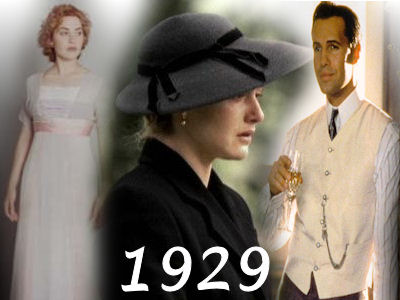
Bang!
Rose Hockley jumped, startled, as a gunshot rang out through the house she shared with her husband of seventeen years, Caledon.
She hesitated for a moment, afraid of what she might find, but then pushed herself away from her desk and raced in the direction of Cal’s study.
When she got there, the sight that met her eyes made her scream and scream, until at last two servants pulled her away, shutting the study door and escorting her to her sitting room where, overcome by the shock, she fainted.
Three Days Later
Rose stood before the casket that contained the mortal remains of her husband. Dozens of other people also gathered around the open grave, most fellow members of society or top managers from Hockley Steel. Many were there more out of morbid fascination with the latest in a string of suicides committed by formerly wealthy businessmen who had lost everything in the stock market crash than out of any affection for Cal Hockley. He had grown increasingly unpopular the last few years of his life, especially amongst those who had to work with him.
Rose shivered slightly, wrapping her coat around her more securely against the November chill. The veil on her black hat covered her face, protecting her from the gazes of others. She did not want them to see that, although she was still in shock over the way Cal had died, her eyes were dry. She had not wept any tears over him yet. She didn’t know if she ever would.
As the minister’s voice droned on, speaking empty words of comfort that she couldn’t quite bring herself to believe, her mind wandered back over the years since she had made the fateful decision that had eventually brought her to this moment.
*****
After the horrors of the sinking of the Titanic, Rose had hidden in steerage aboard the Carpathia, avoiding anyone who had been a part of her life before the sinking. She had sat alone, mourning Jack, but in spite of the promise she had made to him, she had no idea what to do next. Should she stay in steerage, hiding away from everyone she had known before, perhaps allowing them to think her dead? Should she return to first class, back to the life she had known—and rebelled against? Should she even complete the trip to America, or should she slip away to the back of the ship when no one was looking, jumping overboard to join Jack, thus completing what she had started the night they had met?
In the end, Cal’s presence had made the decision for her. Late that afternoon, he had come down to steerage, searching for her in hopes that she might have survived, even if she was with the man Cal had called "the gutter rat."
Rose had turned away when she saw him, pulling the blanket over her red hair in hopes that he would not notice her, but when he had come near, something in her had made her turn around, and he had seen her.
"Rose!"
She looked at him dully, feeling nothing—not hatred, not contempt, not the fleeting adoration she had felt for him in the early days of their courtship—nothing.
"Rose, your mother and I have been looking for you…"
She looked at him, not sure what to say, what to do. "Cal, I…"
"We thought you had been lost. Your mother has been crying over you for hours, hoping that you might be found, but knowing how unlikely it was." He stopped, looking around. "Sweetpea, where is…" He couldn’t quite bring himself to say the name.
"Don’t call me Sweetpea. I don’t like that name."
Cal was silent for a moment. "All right, Rose. I shall try to remember that."
"As to Jack, he…the sea took him." She looked up, surprised at the brief flicker in his eyes of…something. Compassion? Sympathy? She couldn’t be sure, but his next words made the decision that she had been unable to make before.
"Come back to us, Sw—Rose. Your mother is sick with worry, and I…I am glad to see that you’re alive." It was the closest he could come to admitting what he felt for her.
For a moment, she thought of refusing, but something inside her—perhaps the slight hope that had risen in her when Cal had momentarily shown sympathy, or the fact that she loved her mother and felt guilty for walking away from her as she had the night before, or the desire to be with people she knew who had been through the same tragedy she had survived…or perhaps just the fact that she was still cold, and the thought of the warm clothing and comfortable bed she might have in first class had appealed to her—had made her look up at Cal, then nod her head.
"All right, Cal."
And she had followed him back to first class.
*****
Rose and Cal had been married on the day originally planned for their wedding—June 13, 1912. All of those invited had come to the wedding, even those who had originally declined the invitations. The wedding of two survivors of the worst maritime disaster in recent memory was a big event, regarded by some as the social event of the season. Cal had spared no cost for the wedding, allowing Ruth to plan the event, as Rose was still grieving over Jack and showed little interest in her pending nuptials.
Rose had felt guilty as she had started down the aisle towards Cal. Was this what Jack had wanted for her? Was she breaking her promise to him? Had he died so that she could marry Cal and live in luxury?
Still, she had only hesitated a moment before answering, "I do." The nagging voice of her conscience had told her to stop, to say no, to walk away, but she hadn’t listened. She had pushed the thoughts to the back of her mind, and had gone through with the wedding.
*****
To her surprise, her marriage to Cal had not proven as bad as she had feared. Her defiance aboard the Titanic had taught Cal that she was not a meek, obedient trophy to be seen on his arm and cement his social status. She had a mind of her own, and if he wished to keep her, he had to respect her.
Cal had initially objected when she had joined the women’s suffrage movement, soon becoming a leader, but after Rose had heatedly refused to back down, he had surprised her by acquiescing. His grudging permission had made him appear progressive, appealing to some people, and though many of the more conservative members of society hadn’t liked it, his high social standing and money had kept them from ostracizing him for what they thought was his inability to control his wife. Of course, as Rose had noted dryly to a fellow suffragette, it hadn’t hurt that quite a number of society women were supporting the same cause as she was.
Rose had also written two books in the early years of their marriage, one about the need for women’s suffrage and one about the sinking of the Titanic. The one about the sinking had been hard for her to write, but had also been cathartic. It had been a way for her to finally speak about the events of that night in a fashion that wasn’t excessively polite or formalized, a way to express how she still felt about the tragedy that had changed her world. Though she never mentioned Jack, the emotions came through anyway, and the book, published on the first anniversary of the sinking, had become a bestseller.
Her time with Cal had not been as bad as she had feared, either. When he had shown that he could respect her, she had given him respect in return, and had even learned to love him, if only a little. Sometimes she felt that it was a betrayal of Jack to feel this way, but it didn’t stop what she felt for Cal. Though she never loved him as she had loved Jack, he was a part of her life, one that, after a while, she felt no need to fight against.
There had been children born to them, too. Their son, James Hockley, had been born on July 4, 1913, and their daughter, Sarah, had been born on August 8, 1915. Cal had been delighted with the children, showering them with attention and spoiling them outrageously when he could find time from his busy schedule. The children had adored him, vying for his attention when he came to see them in the nursery. In spite of the reservations that Rose had still held about Cal, she laughed with him when their son and daughter rushed to see him, happiness evident in their young faces.
Then, early in 1919, the happy life they had built came crashing down. The United States had entered the Great War in April of 1917, and though Cal’s money and connections had kept him from being drafted, Rose had watched the young men going off to war and realized, more than once, that if Jack had lived he would have been among them—and a part of her was glad that he would never be a part of it. She had been grateful, in a way, for the money and connections that had kept Cal with her, safe from harm. Still, she had rejoiced when the war had ended, glad that it was over and hoping that it truly would be the last war.
It had been the events following the war that had brought their world crashing down around them, though. Early in January, after a day of playing in the snow at a local park, both James and Sarah had become feverish and had developed coughs and runny noses. Rose and the children’s nanny had put them to bed with assurances that they would feel better in the morning, but when morning came, the two children were much worse, and Rose herself was beginning to feel ill, with the same fever and cough as her children and joints that ached so badly that she didn’t want to leave her bed.
Rose’s fever had risen as the day progressed, and soon she had been aware of little but her own discomfort and her increasing difficulty in breathing. She knew that the doctor had come, knew that Cal had spent a great deal of time sitting beside her, but she had not known anything else until her lungs began to clear and the fever broke more than a week later.
After several hours of exhausted sleep, Rose had awakened to find Cal sitting beside her. His face was wan and haggard, showing several days’ growth of beard. She had never seen him look so unkempt, not even following the sinking of the Titanic.
She had looked at him with alarm, wondering if he, too, was ill, but when he had assured her that he was fine, she had asked to see the children, to assure herself that they, too, were all right.
It was than that her world had come crashing down. She had never seen Cal break down before, had rarely seen him without his calm demeanor, but when she had asked to see the children, he had buried his face in his hands, his shoulders shaking, and finally, between sobs that he couldn’t seem to control, had told her that the children had died—Sarah three days before, and James the following morning.
Rose hadn’t believed him at first—hadn’t wanted to believe him. "You’re lying," she had whispered, knowing even as she said it that he wasn’t. But she couldn’t believe him. It couldn’t be true. Her children, only three and five years old, could not have died.
When Cal reached out to her, trying to comfort her, Rose pushed his hands away and climbed out of bed, staggering with weakness. Cal tried to stop her, but she was determined to see for herself.
Holding onto the walls and furniture, Rose made her way to the nursery, flinging the door open and stopping short at the sight of the stripped bare beds, the toys that lined the shelves, waiting to be played with. The room smelled strongly of antiseptic, and was cold and empty.
Still, she didn’t want to believe. She could see snow falling outside in the dimming light of late afternoon…the children loved snow.
Vehemently, she shook her head. "I can’t believe Mrs. Scoggins would take them out in this weather…not when they’ve been ill so recently. I must speak to her…I don’t know what she was thinking…"
"Rose…" Cal reached out to her, pulling her into his arms as she looked around the room, fighting against the truth she had already realized.
"Where are they? Where are my children…my babies?" Rose saw a familiar object sitting on a table nearby and reached to pick it up. The well-worn teddy bear was Sarah’s favorite toy—she refused to go anywhere without it. She wouldn’t be without it now, unless…
"They’re gone, aren’t they?" she asked Cal, her voice muffled as she buried her face in his chest. "They’re really gone."
"Yes," Cal replied simply, his control back—though he had to struggle to maintain it. "Yes, Rose, they’re…gone."
For a long time, the two parents clung to each other, seeking comfort from their mutual grief over the loss of their children.
*****
James and Sarah had been buried the next day. When Rose had seen them lying in their caskets in the parlor, where the viewing had taken place, she had had to restrain herself from rushing to the coffins and lifting them out, begging them to come back to her. Their little faces had been perfect and serene, almost looking as though they were sleeping, but too pale, too still to be alive. Rose had clung to Cal throughout the funeral, feeling as though she would never stop crying.
When Rose had fully recovered from her own bout with influenza—the "Spanish flu" that killed millions—she had noticed a new distance in Cal. He was polite, of course—he was always polite—but he didn’t speak to her as much as he once had, and she noticed a simmering anger in his eyes sometimes when he looked at her.
When she had finally confronted him about it, months later, he had refused to say anything at first, but then had exploded, angrier than she had seen him at any time since they had been on the Titanic, and had told her bluntly that the children’s deaths were her fault, that she shouldn’t have taken them out to play in the snow the day they had gotten sick.
Rose had shouted back at him, angry and defensive, reminding him that millions of people had died from the Spanish flu, whether they went anywhere near the snow or not, and that if he had been so worried about them, he should have found something for them to do inside, where it was warm.
He had hit her then, hit her so hard that she had fallen, hit her for the first time since they had been on the Titanic. She had lain crumpled on the floor, tears running down her bruised face, as he had screamed at her, so angry she had been afraid of him. Abruptly, he had stopped shouting and turned on his heel, walking away from her. She had heard the front door slam a moment later, and had slowly gotten to her feet, shaking.
Her maid had rushed to help her, but she had waved her away, wanting only to be alone. Cal is right, she thought. If only I hadn’t taken them out in the cold, they might be alive now.
Cal had arrived home late that night, more drunk than Rose had ever seen him. He had staggered into their room, staring at her for a moment, then staggered into a guestroom and passed out atop the bed, still fully clothed.
In the morning, he had apologized to her. She had accepted the apology, still half-believing that he was right.
They had never spoken of the incident again. Later, they had reconciled somewhat, but in spite of their best efforts, no more children had been born. Rose had never conceived again.
*****
As time had passed, they had taken separate rooms, and in the last two years they had rarely spoken, had rarely spent any time together, except for at obligatory social functions. Rose had spent her time working on her various causes and writing her novels and poetry, while Cal had dedicated himself to Hockley Steel, which he had inherited following the death of his father in 1922, and to making as much money as possible. He had invested every cent he could get in increasingly risky ventures in the stock market—so much that when the stock market crashed, he was left with little more than worthless paper. The vast wealth that he had enjoyed and had worked so hard to accumulate was a thing of the past.
*****
It had been only two weeks later that Cal, despondent over the loss of his fortune, had put a pistol in his mouth. Rose had been the first one to reach the study after his suicide, some horrible feeling telling her what had happened.
It hadn’t prepared her what she had seen, though. It hadn’t prepared her for the sight of her husband of seventeen years lying in a pool of his own blood, more blood and brain tissue spattered across the wall behind him. He had died instantly, but his eyes were open, staring at her, she thought, in an accusing fashion, as if she could have saved him if only she had been enough for him.
A feeling of horror had washed over her, and she had screamed, bringing the servants who hadn’t already been alerted by the sound of the gunshot running to her side. Her maid and Cal’s valet had grabbed her arms, pulling her away from the study and back towards her own sitting room, where she had crumpled to the floor in a faint, awakening sometime later in her own bed, her maid at her side.
The police had been called, and the doctor, but there had been nothing anyone could do for Cal. The doctor had prescribed a sedative for Rose, but she had thrown it away, not wanting the drug to dull her mind and thoughts.
*****
There had been no viewing, of course, and the funeral was closed casket, at Rose’s insistence. There had been little the mortician could do to improve the way Cal looked after his violent death, and Rose did not want to either shock or titillate anyone with the sight of his mutilated head.
*****
Now, as the casket was lowered into the ground and the mourners drifted away, Rose stood alone beside the grave, watching as the dirt was shoveled back into the hole that was Cal’s final resting place. At last, the tears that she had been unable to shed earlier streamed down her face, hidden by her black veil.
"Why, Cal? Why?" she whispered. "Why was the money so important? Why did you kill yourself over it? It wasn’t everything…it couldn’t have been everything. You had your life, and your health…and you had me. We could have started again. Why was I not enough for you?"
Rose waited until the gravediggers finished their task and walked away, looking back at her occasionally, before kneeling down before the freshly turned earth. She looked at the simple headstone marking the grave, all she could afford after paying off the creditors who had come calling the day after Cal’s death. Nearby, two more elaborate headstones marked two small graves, those of James and Sarah.
She looked back at Cal’s headstone, carved simply, with only his name and the dates of his birth and death. "Cal," she whispered again, pulling her coat tighter against the growing chill, "sometimes I wondered if I did the right thing in marrying you. Before Jack died, he made me promise to go on, to never give up, no matter what happened. Was I giving up when I married you? Sometimes I thought so, but other times…I did love you, you know…maybe not in the way I loved Jack, but there was something there. I think you loved me, too, as hard as it was for you to show it. Where did we go wrong? It started with the deaths of the children, I think—but we weren’t the only couple who ever lost children, and yet it didn’t come to this for most others. How did it happen that we became so centered on our own lives that we were never there for each other? If I had been there for you, perhaps you wouldn’t have taken this drastic final step. But why was money so important to you? Was it always that way—the most overwhelmingly important thing in your life? Was everything else always secondary? You were born to wealth and privilege, but it was never enough. You wanted more—and now, it’s killed you."
Rose paused, wiping her eyes, before going on. "I put our house up for sale today, Cal. I can’t afford to keep it, and…there wouldn’t be much point in me living in that mansion all alone. We may not have spoken much in the last two years, or spent much time together, but now, with you gone…the place is empty. There’s no one home."
She got to her feet, looking down at the grave. "Jack told me to never give up, no matter what happened, and maybe this is what he meant. I’ve lost everything now…Jack, my children, my husband…but I’m going to go on. I’m not going to take your route. I’m going to go on, and keep living, no matter how hard it may be. I still have the Heart of the Ocean…I’ll sell it if I have to, if I can’t support myself some other way. I married you, and I lived a life of luxury all these years…but that’s over now. I have to start again. Maybe things would be different if I hadn’t gone back to first class with you on the Carpathia all those years ago…but I’ll never know for sure. I do know that my life with you wasn’t a waste, no matter how it turned out…I worked hard at my causes, and maybe I even made a difference. I’ve written books that are even now keeping people’s interest, and I have another that will be published soon…it might even be made into a moving picture. I had two wonderful children, who I loved dearly in the short time I had with them…and I loved you. I made it count, just like Jack said, and I’d like to think that maybe both our lives were the better for it, at least for a while.
"I’m leaving now, Cal. When the house is sold, I’m leaving for California. I asked Mother to come with me…but she won’t. She wants to stay here, and I won’t try to stop her. Each of us has to find our own place in the world…and while I’ll come back to visit, I won’t be living here anymore. I’m going to start over, because there’s nothing else I can do now, and because there are a lot of things I still want to do in life. I’m going to do all the things Jack and I talked about…you might have enjoyed some of them, I think, if you had ever given them a chance. But I guess I never gave you a chance to think about them…those things Jack and I talked about were mine, things I didn’t want to share with anyone. A part of my heart always belonged to him…but a part of it will always be yours, too. You can’t live with a person for so long and not feel something when they’re gone, even if you don’t love them…but I did love you, at least a little. Life may not have turned out the way either of us hoped or expected, but there was a time when we were happy, and I’ll always cherish those memories, just as I always cherished my memories of Jack."
Rose turned to leave, but stopped after just a few steps and turned back to the grave. "I hope that you’ll find happiness, Cal, wherever you are now. I hope that you are with our children. And if you see Jack…tell him that I kept my promise, that I made it count."
She turned away, walking resolutely toward the cemetery gates. When she reached them, she looked back once, then walked on, her face resolute. She had made it count all these years…and she was still keeping her promise. No matter what happened, she would go on. She would be stronger than Cal had been, stronger than she herself had once been.
She would go on, and she would make it count.
The End.