Introduction (Top)
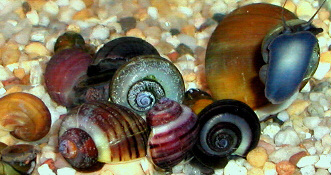
Bridgesiis are one of the few species of apple snails which has been cultivated to produce a wide variety of colors. These colors range from golden to green, and from ivory to purple. There are 3 primary factors in determining the color of a snail: the shell base color, the stripe color, and the foot color:
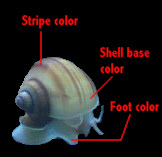
In the case of the snail above, the shell base color would be considered white (ivory), the stripe color purple (the picture is a bit faint), and the foot color white. (Any spots of orange or yellow pigments is NOT counted in the foot color). This is one of the rarest color types, but it serves as a good model for showing how to distinguish the color elements. Determining the color of a snail can sometimes be a bit tricky, especially where purples are concerned, and there is quite a bit of overlap between certain colors. There are even some colors which start out looking like another color, and then darken into their true color with age. However, for the majority of colors, and the most common colors, it is relatively easy to determine the color. The steps below can be used to figure out a snail's color type, assuming it is one of the commonly available types:
- 1) What is the snail's foot color?
- If light, then go to 2.
- If dark, then go to 7.
- 2) Light foot. What is the snail's shell base color?
- If yellow then go to 3.
- If white or very close to white, then go to 4.
- If green/dark green, then go to 5.
- If purple/pink, then go to 6.
- 3) Light foot, yellow shell base. Does the snail have stripes?
- If no stripes, then it is GOLDEN.
- If brown stripes, then it is a STRIPED YELLOW*.
- 4) Light foot, white shell base. Does the snail have stripes?
- If no stripes, then it is IVORY.
- If red-ish brown or purple stripes, then it is LIGHT STRIPED PURPLE.
- 5) Light foot, green shell base. Does the snail have stripes?
- If no stripes, then it is PLAIN OLIVE.
- If brown, black, or dark green stripes, then it is STRIPED OLIVE.
- 6) Light foot, pink/purple shell base. Does the snail have stripes?
- If no stripes, then it is PLAIN PURPLE.
- If dark purple stripes, then it is a STRIPED PURPLE.
- 7) Dark foot. What is the snail's shell base color?
- If yellow then go to 8.
- If white or very close to white, then go to 9.
- If green/dark green, then go to 10.
- If purple/pink, then go to 11.
- 8) Dark foot, yellow shell base. Does the snail have stripes?
- If no stripes, then it is JADE (also called Dark Yellow).
- If brown stripes, then it is a WILD TYPE.
- 9) Dark foot, white shell base. Does the snail have stripes?
- If no stripes, then it is BLUE.
- If red-ish brown or purple stripes, then it is DARK STRIPED PURPLE.
- 10) Dark foot, green shell base. Does the snail have stripes?
- If no stripes, then it is DARK PLAIN OLIVE.
- If brown, black, or dark green stripes, then it is DARK STRIPED OLIVE.
- 11) Dark foot, pink/purple shell base. Does the snail have stripes?
- If no stripes, then it is DARK PLAIN PURPLE.
- If dark purple stripes, then it is a DARK STRIPED PURPLE.
* Unfortunately, not all colors can be catigorized using those steps, since not all snails fall neatly into the descriptions. Striped Yellow is an example of this. While most Striped Yellow snails are relatively easy to distinguish, some purple forms masquerade as Striped Yellows until they are about 1/2" big, and then they suddenly begin to darken. The stripes become more purple, and the shell base can change color. This particular "morphing" color does not have a name as it is not very common, but so far it tends to be refered to as a "Brown Purple".
Color Examples (Top)
Since there is such a wide variety of colors, and descriptions alone can be vague or confusing, the following is a table of bridgesii colors, including common colors and some rare ones. All images are used with permission and are meant as examples to show the range that certain color types have. If a certain snail does not look 100% like one of the pictures, that doesn't mean it isn't the same color if it matches the text description. Please note that availablility is categorized by my own experiences and those of other people I know. Local availability of all colors will vary.
| Color |
Description |
Availability |
|
| Ivory |
The "albino" snail, although the color is not truely albinistic, as it posesses some pigment in the form of body spots. Their shell hue ranges from perfectly white, to slightly off-white or yellowish. These are often called "albino mystery snails". |
Rare. Although there are numerous breeders of Ivories, they are still relatively rare in the pet trade. Large chains like Petco or Petsmart almost never carry them, though periodically they can be found through smaller privately owned stores. |
|
|
| Golden |
The foot color ranges from white to yellow-ish, and the shell color ranges from opaque yellow to semi-transparent yellow. These are sometimes called "Inca Snails", or "Gold Mystery Snails". |
Common.This is one of the most, if not the most common color type of bridgesii. Golden bridgesiis even outnumber wild-type bridgesiis in the pet trade at this point. These snails can be found at almost any large chain or private store that carries apple snails. |
|
| |