Lenape (Delaware)
Delaware and Shawnee Indians and the Republic of Texas
Delawares
Delaware/Lenape
Handbook of Texas - Delaware Indians
|
Outline of Class Discussion:
The Caddo Confederacies of East Texas
Introduction: The Caddoes were highly successful agriculturalists.
With their abundant food supply, a relatively dense population with
complex social institutions developed. To many Texans
their significance comes from their naming of the state. The
peoples of this confederation called each other "Tayshas," meaning "allies" or "friends."
Spaniards used the word for them as well as other friendly Indians.
Probably the pronunciation was closer to "Tayshas" or "Taychas" than to "Texas."
There were more than two dozen tribes joined loosely together into three
confederacies. The largest of these was the Hasinai, occupying the upper Neches and Angelina River valleys.
The second was the Kadhadachos or Caddo proper that occupied northeast Texas and
southwest Arkansas. The third group, the Natchitoches, lived in Louisiana.
There were also independent Caddo nations.
These tribes and confederacies shared a common language, Caddo, with dialectal differences.
They probably originated in the Southeast as their cultures had the
Circum-Caribbean influences.
Background:
- People have lived in East Texas for about 12,000 years
- Paleo-Indians lived in the region from about 9000-6000 BCE
- Archaic culture followed from about 6000-200 BCE - hunters who
used "atlatls"
- About 200 AD revolutionary ideas began filtering into East Texas from more advanced cultures
- Over several centuries introduction of corn agriculture, pottery, bow & arrow transformed nomadic hunters and gatherers into village dwellers
- Late Archaic people were receptive to changes
- Earliest pottery manufactured in East Texas was crude, but apparently superior to previously available containers
- Change occurred more rapidly after the Caddo moved into the Neches Valley
- Most successful of prehistoric groups, the Caddo who in the late 8th century settled in the Neches Valley
- Caddo brought with them bow and arrow, agriculture, tradition of living in large family dwellings in permanent villages
- Local Archaic peoples quickly accepted these new ideas, completing transition from nomad to farmer
- Dominated life in East Texas forests for almost 1,000 years
- Precise ancestry of Caddoes not determined and within the Caddo Area, different cultural groups
- Eleven centuries of Caddoan culture - three major periods
-
Early Caddo (700-1300 CE)
- Late Caddo (1300-1700 CE)
- Historic Caddo (1700-1850 CE)
- About 800 CE Early Caddo populations began to increase
- Introduction from Southwest of eight-rowed corn, "maiz de ocho" caused increase
- When the Early Caddoes settled in the Neches River Valley about 800 CE, they established the southwesternmost known ceremonial center of the Mound Builder culture
- It was a frontier settlement
- Remained within the sphere of influence of parent group by maintaining political and economic relationships with the Red River centers
- Participated in great Mississippian trade networks
- Brought a way of life previously unknown in East Texas
- Caddoan Mounds of East Texas functioned as a major regional trade center
- Archeologists believe that war played no significant role at Caddoan Mounds; no defensive
fortications
The Mounds:
- Caddoes brought to East Texas characteristics of older mound building cultures
- Evolving in the woodlands of eastern North America since about 1000 BCE
- Mound Builders three cultural divisions:
- Early Woodland (1000-200 BCE)
- Middle Woodland (200 BCE-500 CE)
- Late Woodland (500-1600 CE)
- The Late Woodland division included the Mississippian culture, of which the Caddos of East Texas were a part
- Tradition of elaborate burial ceremonies during Early and Middle
- Late Woodland Mississippian cultures added temple platform mounds
- Early Caddos did not build the mounds immediately upon arrival, rather, the mounds slowly emerged in series of building stages for 400-500 years
- The burial mound began with a large subsurface burial of five individuals
- As decades passed, earth was mounded over the original burial as others added
- The mound rose to twenty feet in height and over 90 feet in diameter
- Exquisite artifacts placed in the burials
- Although not totally excavated, the mound originally contained perhaps 90 individuals
- Soil carried and deposited on the mounds in 30-50 pound basket-loads
- Caddoan Mounds reached its peak population and influence about 1100 CE
- Population was large enough to provide the labor necessary for construction of the three mounds
- Ceremonies performed on or around mounds unknown
- Analysis of excavated materials suggests that some ceremonial buildings were deliberately destroyed by fire
- Moundbuilding strictly a cultural expression
Life Among the Caddoes
While Europeans taken aback by Caddo notions of fashion, that was not their most disquietening trait
- What really drove the Europeans nuts was their custom of weeping and
wailing when they met strangers; both men and women; learned that women weeped in face of
impending death which Europeans learned to watch for as signal
- Despite weeping, Europeans were generally welcomed with great ceremony, presents, and ritual washing faces of visitors
Subsistence and Material Culture:
- The Caddo welcome also revealed their material success - had surplus to give
- They were first and foremost agriculturalists - corn, beans, squash, sunflower seeds, tobacco most important
- Men helped clear land, women in charge of gardens in the MATRILINEAL society
- Women also gathered nuts, fruits, spicy pepper weed, roots, tubers
- Men responsible for hunting and fishing with deer most important;
disguised selves with skin, antlers; also hunted bears (mainly for fat), bison, wild hogs (javelinas or razorbacks),
prairie chickens, ducks, turkeys, rabbits, mice and snakes; also fished extensively (used trotlines with dough or meat bait identical to today's)
- Women prepared food; preserved; stored in baskets placed in ashes to discourage weevils; smoke curing; dried meat in sun or fire to make jerk
- Housing:
- Although houses might be smoky in today's terms, they were comfortable dwellings
- Scattered dwellings surrounded the "inner village" where elite lived around the temple and burial mounds
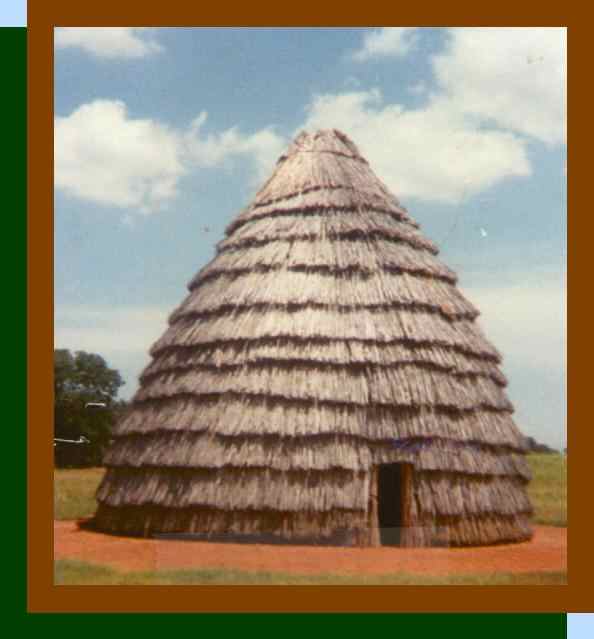
- Houses "bee-hive" or conical shape, 25-45 feet in diameter, thatched
- Up to 40 people in one
- When family decided needed house, contacted the "caddi" who set date and delegated authority to "tammas"
- Festive, congenial occasion although "tammas" used switches to punish the latecomers (in good will)
- recipient family prepared feast
- temples like houses only larger and on mounds
- Fire in center of house constant; if went out, temple fire always burned
- beds of reed matting with frame of sticks and buffalo skins
- men helped build house which was rare among Texas Indians
- Pottery:
- Caddoes created a rich variety of durable pottery goods
- Common technique of "coiling"
- Delicate shapes of many of vessels and intricate geometric decorations applied by engraving or incising reveal the artistic talents of the Early Caddo craftsmen
- Included fragile long-stemmed smaoking pipes, earspools and beads for personal adornment, and small
human and animal figurines called "effigies"
- Dark gray and chocolate brown; also yellowish to reddish wares depending on firing process
- Trade:
- Stone materials of superior quality, especially flint and fine-grained sandstone had to be imported
- Flints came from Central Texas and the mountainous regions of Oklahoma and Arkansas
- fine-grained sandstone for abrading bone and shell came from adjacent areas of East Texas or Louisiana
Occupational Specialists:
-
Caddo had occupational specialists who were relieved of other responsibilities
- Reflects economic level - luxery of supporting specialists
- included politic-religious leaders and perhaps artisans
- no other Texas Indians reached that level
- Also extensive trade - used bow and salt for trade
- Caddoan Mounds major regional trade center
- Artifacts from Appalachian Mountains, copper from Great Lakes, shells from coast
- Woman's work: pottery, baskets, make utensils, both men and women tanned hides
- Of course, childbirth always woman's work
Childbirth and Raising Children:
- when approaching time, she built small hut on bank of creek or river with "clinging pole,"
unassisted birth, washed in stream even if icy and went home to resume regular duties
(not much different than today)
- Naming ceremony about a week later by priest, usually diminutive name of parents -
girls named by woman shaman, boys by men
- Name might be kept or take name of guardian spirit
- Unlike others, no fear of using name of dead
- Unwanted children, infanticide not regarded as criminal
- Nursing for several years
- Boys toughened by harships and deprvations, instructions by elders, foot races
- Grandmothers important in training both boys and girls in correct behavior although most important
for males - maternal uncles more than father
- Ready for marriage when skilled hunters or successful warriors
Marriage:
- He had to gain favor of her parents; left venison, if they took meant approval
- No ceremony beyond announcement by "caddi"
- Divorce simple and common
- Wives exhcanged, bartered
- Noble women expected to be faithful, adultery punished
- Usually monogamous, some polygyny - inherited brother's wife and children
- Were "berdaches" among Caddoes
Death:
-
Ceremony depended on social position
- body dressed in fine clothes
- burial in few hours for ordinary; 2 days if important so confederacy could gather
- Copious weeping
- food and personal items interred
- coffins for important
- in recent times believed that soul did not leave the vicinity of the body for six days so needed food
- practice of passing hands over corpse or grave
- Messages could be sent through a recently deceased person to dead relatives
Political Organization:
-
bureaucratic, graded offices
- An "elite" ruling class and "common" class
- each confederacy headed by "xinesi" (pronounced "chenesi" or "shinesi");
hereditary by male line
- Next a "caddis" (plural "caddices") - tribal chiefs also inherited - some
were women
- in large tribes next came canhas or canahas who assisted
- next the "chayas"
- Then "tammas" like sheriffs
- War heroes "amayxoya" who wore special insignia
- few quarrels, insolent and lazy punished
- much power of xinesi and caddi derived from roles as priest and as voices of the gods
- most government jobs/tasks by kinship units
- clan names - animals
Village Life:
-
Divided into two distinct areas - the "inner" village and the "outer" village
- The inner village contained two temple mounds and a burial mound
- The "elite" ruling class lived and conducted ceremonial functions of government and religion
- The outer village consisted of the scattered dwellings, shaded work areas, and farming plots of the common class
Warfare:
-
two general motives - revenge for slaying of relatives and personal glory
- Caddo not oriented around war
- centuries of relative peace
- elaborate preparations; communicate with smoke signals
- hit and run riads
- dying her's death not Caddo way
- spoils better
- tenacious defenders, though
- took scalps, tanned and worn or hung on doorway
- captives killed after women tortured by amputating fingers, cut off bits of flesh, gouging out eyes
- Before war, usually san and danced for seven or eight days, offering to their gods such things as corn, tobacco, bows, and arrows, incense
- Prayed for courage and strength; asked the water to drown their enemies, fire to burn them, arrows to kill them, wind to blow them away
- If killed in battle, body not buried but left to be devoured by beasts and birds; condition in other world better than those of natural causes
Sports:
- foot racing, form of hockey, loop & pole game, dice,
unlike many Texas Indians not much gambling
Supernaturalism:
- Like other Southeastern Indians, believed in omnipotent deity -
creator of universe and all within it - This "great spirit" - Ayanat Caddi or Ayo-Caddi-Aymay or "great captain"
- Several versions of how this god was created but all share the belief that
in the beginning there was but one woman
- She had 2 daughters - one a virgin and one pregnant
- One day two girls attacked by hideous, giant monster - tore pregnant girl apart and ate her
but the virgin escaped by climbing a tree
- When monster attacked tree, maiden jumped into water and escaped despite his drinking all the water
- Told mother who returned to site and found a drop of blood in acorn sheel, covered shell with another and carried
it home where placed in a small covered jar
- During night heard sound in jar, when opened discovered perfectly formed
boy the size of a finger
- overjoyed, covered jar, next day had become full-sized man
- He defeated the onster and with grandmother and aunt went to sky where he ruled the world
- Not much known about Caddo religious beliefs
- Caddo adored the Sun
- Also "flood myth" in which surviving Caddo family became the origins of all Indians
- Some individuals had supernatural partners or helpers acquired without the guardian-spirit quest so common among Plains
Indians - could be inanimate objects, natural phenomenon or animals
- Religious practices focused on temples attended by the xinesis
- "coconicis" - two boys who the supreme being sent to help the Caddoes - intermediaries and
oracles between supreme god and the xinesis
- No one allowed to see the boys
- Xinesi would predict disasters, misfortune if people did not bring enough food
- Probably annual ceremony of renewal
- also each tribe large group of shamans devoted to curing
-
Societies or guilds of medicine men like Beaver, Mescal-bean, Yuko
- Interpreting their dreams
- Believed sickness caused by witches
- Sucking affected areas of body, sweating of patient, herbs
- If shaman unsuccessful could be killed by his own relatives
- Shaman also foretold events, blessed new homes, named new-born children, and consecrated crops
- Most important religious ceremonies at harvest; others at planting, clan rituals
- Used "black drink" fermented yaupon common in Southeast
Decline:
- The reasons for the decline and eventual abandonment of Caddoan Mounds are not clear
- Possibly cycle of bison
- By 1300 CE, Caddoan Mounds lay abandoned
- Cultural deterioration took place - labeled by archeologists as the Late Caddo Period
- Late Caddo continued to build mounds
- Often late Caddoan ceremonial centers did not include burial mounds
- Abandonment suggests weakening of the old social tradition
- Trade changed - ceased to participate in the far-reaching exchange network
- Continued limited and indirect trade to the west - Puebloan-type pottery fragments found and a
little turquoise from New Mexico
- Many characteristics of the older culture remained
- Social hieracrch, loose confederacies, growing crops, beehive-shaped houses, pottery although not as fine as Early Caddo vessels
- With arrival of Europeans, Caddos have undergone tremendous change, upheaval, and dislocation
- 1857 - forced to leave homeland, placed on Brazos River reservation where they starved, died of disease, suffered
constant harrassment from hostile Plains tribes
- Today about 2000 Caddos
Related historical arrivals:
- Much in common culturally but distinctive peoples arrived in Texas in historic era from other areas of Southeast
- Included, among others, Delaware, Shwnee, Cheyenne, and ALABAMA-COUSHATTA
- Alabama-Coushatta have largest of only two reservations in Texas today but did not arrive in in Texas until
1780s - originally two tribes within Creek Confederacy
Resources:
Newcomb, W. W., The Indians of Texas: The Caddo Confederacies: East Texas
Caddoan Mounds
Glover, William B.,
A History of the Caddo Indians
To Next Class Discussion: Indians of the Texas Coast
|