 |
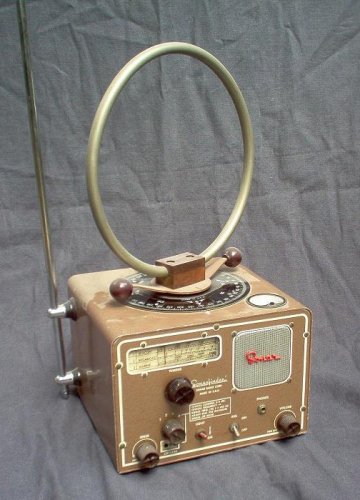
Sonar Model 45 Manufactured by Sonar Corporation of Long Island, NY, in the late 1940's. This is the "classic" loop antenna RDF. It has beacon, marine and broadcast bands. It runs on two 45 volt batteries, and one 1 1/2 volt filament and light battery. There is a crystal position on the band knob, allowing the user to plug in crystal in the front of the unit for dead-on tuning to a specific frequency. Compare this unit with the Sonar Model 65 Radiotelephone. |
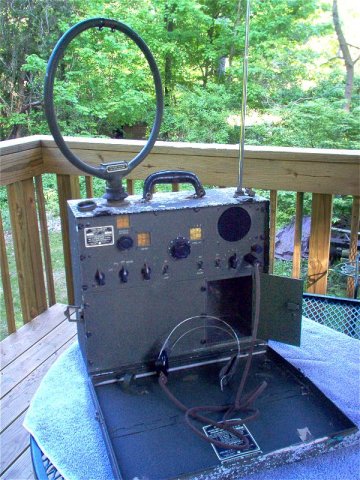 |
DAG-1 U.S. Navy, 1942. Portable unit, frequency range 1.6 to 18.2 mhz. This one was listed for $19.95, back in 2005 I think. The pictures were small and blurry, and the seller had bad feedback. I think this all helped me to win the radio... no one else bid on it. It also "helped" that the case has very bad paint. But the paint inside is like new. It took me awhile to get him to send it to me... I think I didn't see it for almost two months, and almost gave up. But I'm glad I waited... this is a very special radio. Mine was only missing the ground rod (aluminum tube), and the compass. I've seen only two more of these come up since I won this... the first sold for $585, and the second for $500. I suspect they will go much higher the next time. Click on the image for more info and pics. |
 |
Dane CG It is meant to be a portable unit, taking a 90 volt A/B battery. The loop antenna is encased in the protective lid. When the lid is removed, a shaft is plugged into the edge of it. Then the shaft is plugged into the unit. Receives on beacon band, 180-400 KC, only. No speaker, I got this unit with the original earphone set. I think the design was meant to be evokative of the classic chronometer or boxed compass. A clever take on the use and technology involved... no other firm saw it this way. Included with this unit was a copy of the original, drawn schematic blueprint, and the original headset. |
 |
Dane GC Model 101, serial number 1054 (54th made?) Here is a more traditional style Dane GC, by the General Communications Corportation, in Bouton, Massachussetts. I was surprised to find and win another loop, as late as 2011, and even more surprised that I got it for only $25. Other more common RDFs seem to have been going for big money... I've seen a couple of them sell for $200 and more, for models which only two or so years ago would have been $10. This is really nice quality unit, with a brass plate cabinet, and thick copper loop. It think it may be just pre WWII. The tubes are octal. A thoughtful past owner included a wiring diagram for the A/B batteries, which were thankfully not still int the unit... it is clean and corrosion free inside. I am somewhat unclear why they call it a "repeater". The rose states, "Magnetic Compass Repeater". This could not transmit, so it would not be able to "repeat" any signal. I have to try to find out the reason for this. |
 |
Apelco DFR-12. I am really surprised loop antenna RDF's are still so available. I'm sure their awkward and bulky design spelled doom for most of them. This model has provisions for up to eight crystals. It is HUGE at over 25" tall, with the 13 1/2" diameter loop made of 1" tubing. Click on the image for more information/pics. |
 |
Radiomarine
AR-8711 This is a simply magnificent radio. It has a great style, and many features not found on other RDF's of it's era... which seems to be approximately 1949 to 1954. Unfortunately, the seller bent the antenna out of shape when packing... but I intend on replacing it, and repainting this beautiful radio. And, to see it with the matching transceiver, click here.  |
 |
Ray-Jefferson Model 483 I was lucky to finally find one of these... only the second one which has shown up in at least eight years on eBay. It must be uncommon. The dial and speaker trim are the same design and materials as my Ray-Jefferson Model 635 Tranceiver. So I've managed to assemble another "sister-set". You can see the two compared on the sister-set page. This unit has a massive loop, real military-style. The dial face graphics are deeply stamped into polished stainless steel, with special markings for emergency, ship-to-ship, and time signal frequencies. Interestingly, the time signal was 5.0 MHZ... isn't it around 3.4 MHZ now? It is the usual beacon (marked "X"? That's usually a crystal designation), marine and broadcast receiver, with two extra positions for crystal tuning. But another anomoly is that the sense antenna is not built on the receiver... it was to be attached to a terminal on the back of the set. They must have had some pretty strict instructions on setting up the sense antenna, as it's placement would be critical to finding the "true null". It also has a noise limiter, and a squelch... making this a very sophisticated unit for it's time, rivaled in features only by the Apelco DFR-12, above. |
 |
EdZ, Kg6uts, contributed this picture of his Cape Cod Navigator. This is the first of these I had seen, the only other images being in an ad. It's not surprising that has a low number 14. I'm thinking that not too many were made. Ed says that the radio has three bands, 1.3-2.9 Mc, 550-1200 Kc, and 220-540 Kc. These are just a bit off the usual marine, broadcast and beacon bands. The unit comes with a fine, built in compass:  |
 |
Learadio APR-1. This is one of the first Learadio pilot radio direction finders, if not the first. I believe it is prewar, from about 1939. But I have not been able to confirm this. It is a five tube, battery only unit. Tube complement are: 2 of 1N5G, 1A7G, 1H5G, and 1A5G. Batteries are the typical 1.5 v. "A", and 88.5 (90v.) "B". The label states it has a 465 KC I.F. It has beacon and broadcast bands, but no aircraft/marine band. The beacon band has two settings: One for the internal, directional loop, and the other for the external antenna. Back in the day, the beacon band also had weather and information stations, and so one would want a larger, non-directional antenna when scanning those. Although primarily designed as a small aircraft RDF, these were "crossover" units, perfectly suitable for marine operation. So I include it here. Both Lear and Zenith cross-marketed their RDF units to the aircraft and boating fields. |
 |
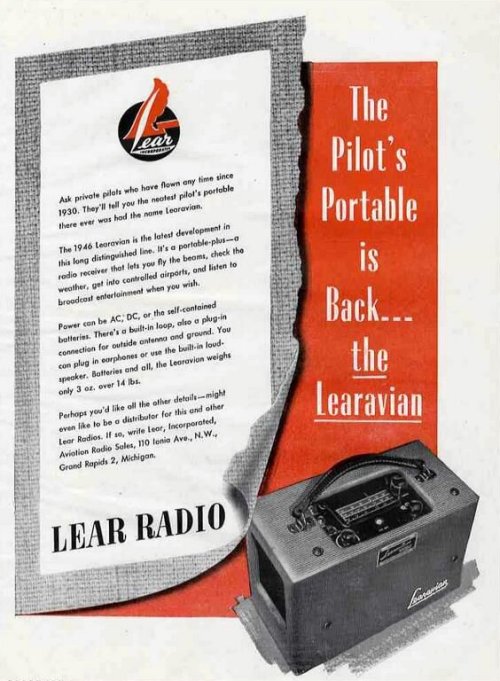
Learavian 402c. 7 tube super heterodyne AC/DC receiver, with broadcast, 2.2 to 6.2 mHz marine, and beacon. About 1948. Although primarily marketed as an aircraft navigation RDF, I wanted this receiver because a small mysterious firm from Rhode Island, Mason-Bowles, was marketing "their own" RDF. They seem to have taken the 402C and strapped it to their own board and lazy-susan with a compass, and resold it. I intend on making a replica Mason-Bowles setup. I'll post the project on it's own page linked here, as it progresses. There are also more pictures of the 402 C there. And here is a 1946 ad for this series, announcing it's return to the market. Well I suppose the return of the portable Learavian after the war... the pre-war portable was a different design. |
 |
Learavian 402 C, wood model. I have not found the reason some of these are wood finished. Was it a special, higher priced model? A different model year? In addition to the attractive honduras mahogany plywood case, the radio has a dashing leather strap and heavy plated brass loops and clasps. I only saw two other wood Learavians, and they no longer had the strap. This radio does not make a peep. I paint shopped the volume knob in this shot, it's missing. Time to get out the plastic casting supplies. The volume pot is frozen anyway, for now. It needs a new dial cover, too, so I may make a form and create one in the kitchen oven. Or I might just leave it... getting busy around here. Isn't this a pretty radio? Looks like it really means business, too. |
 |
Another version of the Learavian 402c, in two tones, and two fabrics. The center section is the more common "airline" cloth covcring, and the ends are done in a faux leather. The light line between the two is actually fabric covered "piping", or "welting", making this a fairly labor intensive covering compared to the simple all-fabric ones. The handle is a real leather, though, to match the ends. I think this is it for the Learavian 402 series, but I would not be completely suprised if another one didn't show up. William Lear was also the inventor of the 8 track casette system, among many other inventions. He was also the designer of the Learjet, and founder of the company. |
 |
Lear Radio model PB10a, three band radio direction finder. Primarily for aircraft use, this unit was (like the 403c's above) perfectly suited for marine duty. It has the marine, beacon and broadcast bands. It is from the early 1950's, and certainly has the look of the period... but not stylish, more "machine age". I've been lucky to find both of these early model Lear radios (finally!) and look forward to getting them in running order so I can use them while there are still beacons to fix on. Adrian in Great Britain has both Lear radios, also, and his site is a must see... for all the portables he has put together in his own collection: Adrian's Battery Portable Tube Radios |
 |
Very similar to the Lears
above, the Bendix PAR-80 was meant to be a multi-purpose marine/air RDF
and information center. This is a high quality wooden suitcase radio,
with vinyl covering and leather edging. Covers marine, beacon and
broadcast bands. I think these radios were meant to tag along with the
expected private aircraft boom of the post war years. A similar radio was also offered as a broadcast band only... why miss the market once they were all tooled up? An odd thing is, though, that the radio face is metal on the all band, and plastic on the AM version. The manual of operation does give rudimentary instructions for using this to DF. But without a compass, signal strength meter, or even a sharp edge to the case to place on a chart, it would be for basic homing operations at best. They do explain that when a beacon and fog horn are simultaneous, you can count off the time between the two. Multiplying the result by 1.8 will give you your distance from the beacon... as it is the distance the fog horn sound traveled in that time. These usually sell for about $25 to $50, but inexplicibly, one just sold for $255! (April, 2008) You never know... |
 |
Sea Pal This appears to be a post WWII radio. They seem to be very rare, as this is the first one I found "in the flesh" in over ten years. None appear, to my knowledge, on the interenet. I have had an ad for a similar model on this site for some time... it's down in the last section. This is a battery/AC/DC unit. I've not tried to fire it up, as the cord is a mess. The antenna/cover is missing. As you can see from the picture, the hinges are the take-apart pin type. After removing, the antenna would be plugged into the jack receptacle on the top for direction finding. I am guessing it was not a loop, but a flat wire coil antenna, like the Learavians. For this reason, I thought it would fit in this section. I'm not sure I will ever get to the project, but if I do, I could make a new antenna/cover for it. I would use an extra antenna I have from a wrecked Lear, then cover it with muslin or canvas cloth. I could then match the color with paint... and I'll bet I could get it pretty close. Matching the hinges and clasp might not be so easy, though. |
 |
Raytheon Model 354
Transistor Direction Finder Here is another one I did not even know existed, until it appeared on eBay. It has the usual beacon, broadcast and marine bands. There is no sense antenna or circuit, so there would be no way to differentiate between the true null and false null (180 degrees out). I believe it is from the mid 50's, by the plug in transistors (2), and battery complement (4 6v Eveready 744 in parallel). The case being mostly empty space points to an early "post-tube" unit... when a public might be suspicious of a much smaller unit. This is also the only RDF with an assymetric antenna I know of. Why this was done, I don't have a clue. I would rather see them centered on the antenna pivot. Was this an attempt as determining true null, without a sense circuit? If I find a manual, it might clear this up. Photographed on the classic tug, Emil P. Johannsen, courtesy of the Johannsen family of the Viking Marina in Verplanck, NY. |
 |
Ray Jeff model 6150, automatic direction finder. This is a really high quality unit from the 1970's. I was able to find this top-notch example in August, 2010, for only $13. Once again it simply shows patience on eBay will pay off, as they usually sell for well over $50. The speaker did not work, but that was not in the ad so it did not affect the price. I was able to replace the woven wires which attach to the whisker ends of the speaker coil... it is a delicate job, as the whiskers are thinner than human hair. But it is common problem on old speakers, which seem to often use a corrosive flux in this area. I have found many corroded and detatched. This has the usual beacon, broadcast, marine (old) and VHF bands. A wonderful machine, a sensitive reciever... oh and a 70's design classic, all cream with a "woody" vinyl faceplate! |
| Youtube video of the Ray
Jeff 6150 in action. I couldn't find a manual on this unit, so it took me awhile to figure out it's operation. This is because the "verify" button apparently has more than one function, and sensitivity of the rotating antenna is adjusted by an unmarked knob in the battery compartment. The combination of these settings meant I had to play with the radio and all variations before I got it running properly. The antenna is not manually adjustable.... but when you have it set to "radio", you can move adjust the ant. position with the "verify" button. But when in ADF mode, the verify is used to differentiate between the false and true "null". If the sensitivity knob is incorrectly set, however, the antenna just rotates endlessly, or not at all. |
|
Conion RDF-150: This is not
owned by me... it was on ebay, and was just too steep at almost $200. I
watched the auction, and the price went down to about $112, with a buy
it now. Unfortunately, it still sold for more than I would or could
have offered... and is now up again, for $388! I suppose that since it
is uncommon, the owners are hopeful that this will translate into
"valuable"... but in my experience, this is not always the case. Who
knows though, I've been wrong before. Interesting unit, in any case... |
|
 |
RCA Radiomarine Portaguide CRM-DIB. All transistor, early 1950's. Surprisingly uncommon... I think, non-existant on the internet as I write this. Click on the image for a dedicated page, with more images and information. |
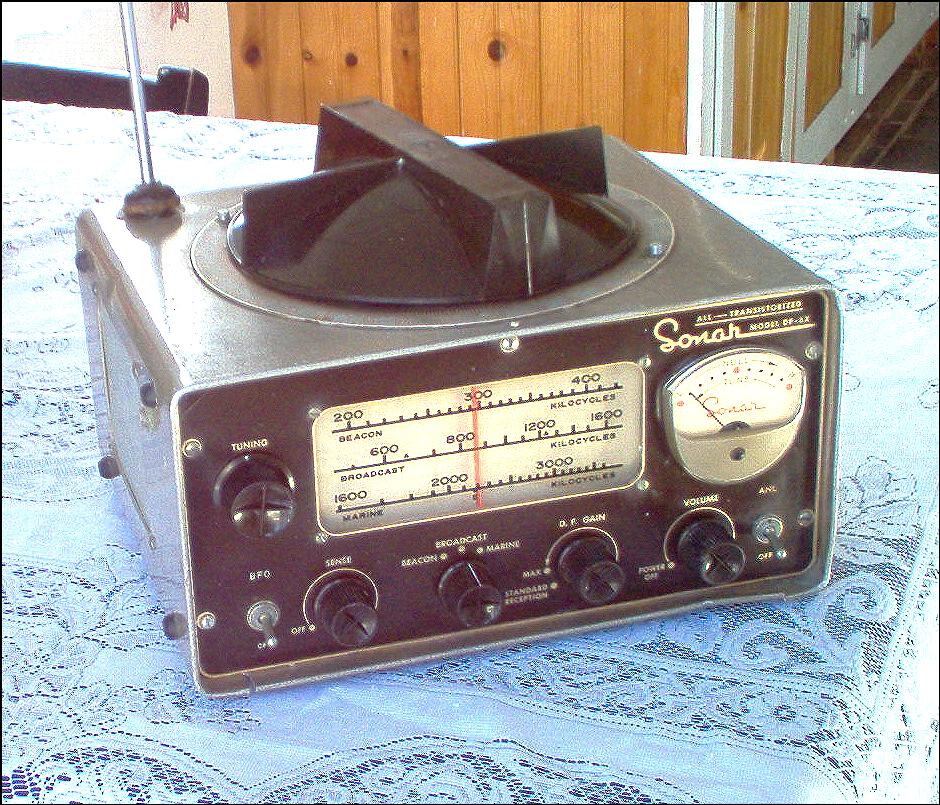 Another Sonar unit, a model DF-6F all
transistor. Being from the mid-1950's, the transistors were "plug in"
components, as was the practice for vacuum tubes of the time. This unit
runs on 9 volts, and operates flawlessly on one 9 volt transistor
battery. I've put many hours on one alkaline battery, the terminals of
which conveniently matched up perfectly with the two prongs of the
original battery plug. The manual
states that you will get over 4000 hours of use with the original
battery, and "should the battery ever need replacing", they tell you
how to do so! How is that for efficiency? Receives on beacon,
broadcast, and the original "marine" band of 1.6 to 4 MC. Included is a
"sense" feature, which injects a signal to the whip antenna, thus
allowing the unit to eliminate the "false" null. Another Sonar unit, a model DF-6F all
transistor. Being from the mid-1950's, the transistors were "plug in"
components, as was the practice for vacuum tubes of the time. This unit
runs on 9 volts, and operates flawlessly on one 9 volt transistor
battery. I've put many hours on one alkaline battery, the terminals of
which conveniently matched up perfectly with the two prongs of the
original battery plug. The manual
states that you will get over 4000 hours of use with the original
battery, and "should the battery ever need replacing", they tell you
how to do so! How is that for efficiency? Receives on beacon,
broadcast, and the original "marine" band of 1.6 to 4 MC. Included is a
"sense" feature, which injects a signal to the whip antenna, thus
allowing the unit to eliminate the "false" null. This is a high quality, well designed and in my opinion, beautiful radio... meant to deliver in difficult conditions. |
 Sonar model 1301. This is a later
unit than the DF-6F to the left. The company was modernizing the look,
but retained the "Sputnik" 50's looking plastic casting for the
antenna. To bring the design up to date otherwise, they used a brushed
aluminum nameplate on the top, high tech knobs with spun aluminum
centers, and a slightly trimmer, angled cabinet. The solid bent
aluminum bar handle fits with this look. The usual three bands are
found, with one interesting addition. There is a crystal controlled,
VHF weather band. It picks up the NYC NOAA weather up by me. I found
this feature surprising, because I had a assumed that the VHF weather
services came about when the marine comm. frequencies switched over to
VHF also. But this unit has the older 1.6 to 4.0 MC marine band. Was
this a transitional unit? Produced just before the proliferation of VHF
for communications, when it would have been hard to sell that band, but
when NOAA had weather broadcasting up and running? Click on image for
large version. Sonar model 1301. This is a later
unit than the DF-6F to the left. The company was modernizing the look,
but retained the "Sputnik" 50's looking plastic casting for the
antenna. To bring the design up to date otherwise, they used a brushed
aluminum nameplate on the top, high tech knobs with spun aluminum
centers, and a slightly trimmer, angled cabinet. The solid bent
aluminum bar handle fits with this look. The usual three bands are
found, with one interesting addition. There is a crystal controlled,
VHF weather band. It picks up the NYC NOAA weather up by me. I found
this feature surprising, because I had a assumed that the VHF weather
services came about when the marine comm. frequencies switched over to
VHF also. But this unit has the older 1.6 to 4.0 MC marine band. Was
this a transitional unit? Produced just before the proliferation of VHF
for communications, when it would have been hard to sell that band, but
when NOAA had weather broadcasting up and running? Click on image for
large version. |
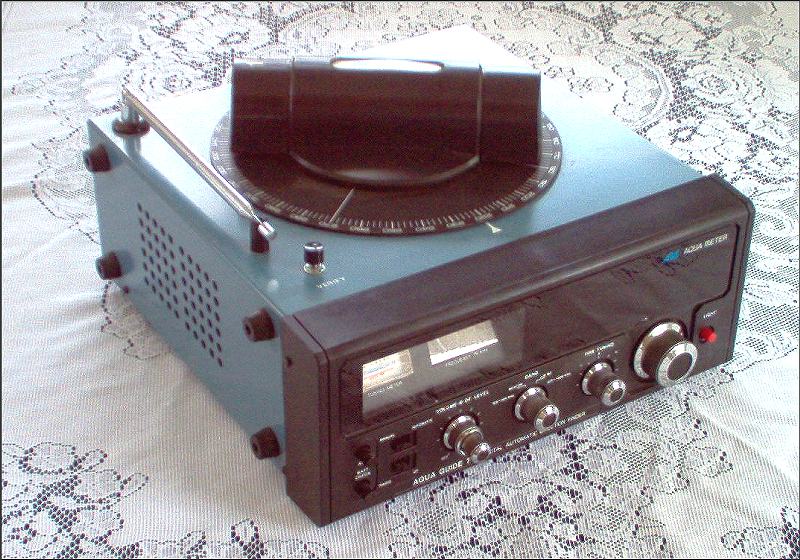 I'm not exactly sure how I got this
beauty, a digital readout Aqua Guide 712, by Aqua Meter, for under $10.
The unit is practically brand new... all plastic perfect, foam seals
perfect, not a scratch on it anywhere. It looks like it came from the
factory this morning. While it only receives on two bands, beacon and
broadcast, the
function is otherwise quite sophisticated. It is actually an "ADF", or
automatic direction finder. Rather than have a lit panel display or a
rotating compass card to show direction, this unit actually has a
small motor TURN the antenna toward the null! A little creepy, almost,
as it grinds around to the null, then swings back and forth a bit until
it is "satisfied" on the bearing. I believe these units where among the
last produced for marine navigation... possibly well into the late
1980's. I'm not exactly sure how I got this
beauty, a digital readout Aqua Guide 712, by Aqua Meter, for under $10.
The unit is practically brand new... all plastic perfect, foam seals
perfect, not a scratch on it anywhere. It looks like it came from the
factory this morning. While it only receives on two bands, beacon and
broadcast, the
function is otherwise quite sophisticated. It is actually an "ADF", or
automatic direction finder. Rather than have a lit panel display or a
rotating compass card to show direction, this unit actually has a
small motor TURN the antenna toward the null! A little creepy, almost,
as it grinds around to the null, then swings back and forth a bit until
it is "satisfied" on the bearing. I believe these units where among the
last produced for marine navigation... possibly well into the late
1980's.Also sold under the brand "Mariner", as the model 7000. |
 Here the AquaGuide firm Here the AquaGuide firmput together a true multi- purpose unit, the model 705. The impact of CB radio channels in the late 70's is reflected in that band being included. Not very useful though, in that there is an analog slide rule dial, and the frequencies are posted, rather than the channel numbers. And they did not include a channel/freq. list in the manual! Finding traffic on CB, therefore, involves a lot of searching. And once found, the user cannot be absolutely sure of the CB channel being heard, even with a channel/freq. list at hand. There are also FM, VHF, AM broadcast and beacon bands. Very sensitive, quality receiver, with an 18 mile long dial cord, winding around it's insides from pulley to pulley like the web of a drunken spider. I got this unit without the ferrite antenna, which I pirated from a very sad parts 712. This enabled me to put together this top end model at very low cost. |
 Pearce-Simpson DF-765. My guess is early to mid 1970's, but I can't be sure. I think this is a beautiful unit... and built like a Hum Vee. "Short-wave", broadcast and long wave (beacon). This one needs much work... the chrome handle supports are rusted, the paint is in bad shape. The knobs are not really all there, nor all intact. I copied one knob in Paint Shop Pro to fake the photo. $4.99 on eBay... with shipping, $11.49. |
 The ubiquitous RCA AR-8712. I found this on eBay (what a surprise!) for $9.95. The reason for the good price is the condition... it was sold as non working, there is pencil marking on the face panel, and the paint is really poor. Good part is, it is all original... when many I've seen have incorrect knobs and screws and whatnot. Click on the image for the restoration page. |
 Pearce-Simpson Gladding Islander. Runs on either 8 C cells or house current. AM, Beacon, Marine, FM and two VHF bands. Very sensitive unit, with nice sound. Funny thing, though... it's covered with padded vinyl! I suppose it was classy looking in the early to mid 70's, but it is distinctly un-nautical. The VHF on this picks up air traffic communications in my area, crystal clear. |
 This Coastal Navigator is a high quality radio, with one of the most well made cases on any of the RDF's. It is formed aluminum, all seams are filled, and the battery door is sturdy and finely fitted. I'm not sure who actually manufactured this Japanese unit, as I've seen it with the badge of different makes. Some are: Jackson FR-622B, Sanshin FR-662B, Newmar Nav 101, "Maricom II", Electra, and "Fleet Marine Supply Fleetmaster 10". It has Beacon, Broadcast and Marine, with an addition X-tal (crystal) position, and a BFO switch for code and SSB reception. |
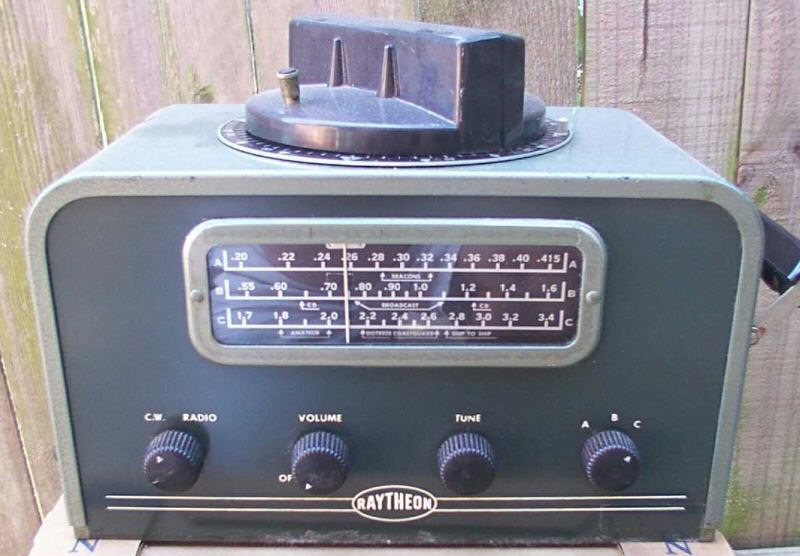 A
compact, quality tube unit from Raytheon. Receives on Beacon, Broadcast
and Marine bands. It operates on both an A/B battery and 110volt AC
line current. From the late 40's, early 50's. There is another
variation on this unit, with only beacon and broadcast bands. For some
models there is a nice red "Raytheon" logo badge on the front. A
compact, quality tube unit from Raytheon. Receives on Beacon, Broadcast
and Marine bands. It operates on both an A/B battery and 110volt AC
line current. From the late 40's, early 50's. There is another
variation on this unit, with only beacon and broadcast bands. For some
models there is a nice red "Raytheon" logo badge on the front. I used this unit as a learning tool, tracing out the circuit with my signal generator. I soon realized that more than one of the old wax caps were bad, so I replaced them all. I also replaced the electrolytic with a set, all four of which fit neatly back into the cardboard tube for the original. Radio is strong, clean and sensitive now. |
 Sonar
DF-7X. This would be the interim model to the two sonars at the
top of this table... the DF-6X and the 1301. They went with a "modern"
gray finish, and changed the knobs to more 60's tech versions with spun
aluminum inserts. The meter was also "techified" from the cool
40's/50's roundy version. But the chassis is still the same as the 6X,
right down to the stenciled "DF-6X" visible when changing batteries! I
think this was a small company, and small changes were a big impact on
the bottom line. They did what they could, as they could, to stay
competitive in a style conscious market... while still delivering what
the customer really needed... whether the customer knew it (or
appreciated it) or not. Sonar
DF-7X. This would be the interim model to the two sonars at the
top of this table... the DF-6X and the 1301. They went with a "modern"
gray finish, and changed the knobs to more 60's tech versions with spun
aluminum inserts. The meter was also "techified" from the cool
40's/50's roundy version. But the chassis is still the same as the 6X,
right down to the stenciled "DF-6X" visible when changing batteries! I
think this was a small company, and small changes were a big impact on
the bottom line. They did what they could, as they could, to stay
competitive in a style conscious market... while still delivering what
the customer really needed... whether the customer knew it (or
appreciated it) or not. |
 Ray
Jefferson Model 660 RDF/ADF. The number of models some manufacturers
offered is dizzying. This model carries marine VHF, broadcast, CB, FM
and the beacon band. It has a motor driven antenna, to find the signal
automatically. There is a sense circuit, too. I was given this radio by
a great guy I met up in Vermont when I mentioned I collected these
units. The battery boxes were cracked and corroded, so I replaced them
with a set of boxes I had in a hopeless Ray Jeff unit. Other than that,
the unit is immaculate. Ray
Jefferson Model 660 RDF/ADF. The number of models some manufacturers
offered is dizzying. This model carries marine VHF, broadcast, CB, FM
and the beacon band. It has a motor driven antenna, to find the signal
automatically. There is a sense circuit, too. I was given this radio by
a great guy I met up in Vermont when I mentioned I collected these
units. The battery boxes were cracked and corroded, so I replaced them
with a set of boxes I had in a hopeless Ray Jeff unit. Other than that,
the unit is immaculate. |
 Munston "Bay Shore" RDF. This radio, with it's manual,
was in a store on eBay for months. I did not purchase it for so long
because it looked sort of "bland" in the pictures. I finally bought it
because it was so unique... I have never seen another like it. I think
it has a super low production, and may be very rare. There is no other
Munston radio on the internet that I can find... I was pleasantly
surprised how nice a look it has in person. It only needed a good
cleaning, but the antenna cover needed repainting. The dial cover is
Plexiglas.
Munston "Bay Shore" RDF. This radio, with it's manual,
was in a store on eBay for months. I did not purchase it for so long
because it looked sort of "bland" in the pictures. I finally bought it
because it was so unique... I have never seen another like it. I think
it has a super low production, and may be very rare. There is no other
Munston radio on the internet that I can find... I was pleasantly
surprised how nice a look it has in person. It only needed a good
cleaning, but the antenna cover needed repainting. The dial cover is
Plexiglas.The antenna cover is very cool. It is vacu-formed plastic, and I have a suspicion that the top half of it's mold was from a butter dish cover! I'm still looking for the exact butter dish, but there were many like it in the 1940's and 1950's. Radio is 12v, all transistor, and it works. |
 |
To the left is a Sperry
three band RDF. The bands are changed with the
left knob, which turns a paper covered drum under the long window. The
black case of the unit is actually fiberglass... hand laid fiberglass.
I'm not sure I've ever seen this on a radio, let alone any consumer
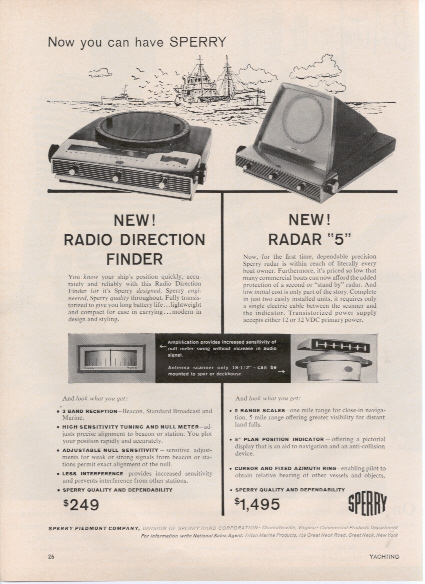
product outside of a car or boat. The front section is cast aluminum. Sperry also made a "sister" radar unit, with the circular upper section tipped forward and housing the radar's CRT. It's shown in this 1959 ad, with prices for both units. This has a real Star Trek look... like one of Bone's diagnostic devices, or a phaser. It came with a handle, which is unscrewed for this shot. I think the handle was an afterthought... it is for carrying, of course, but also protects the highly stylized and vulnerable sticky-outy knobs. |
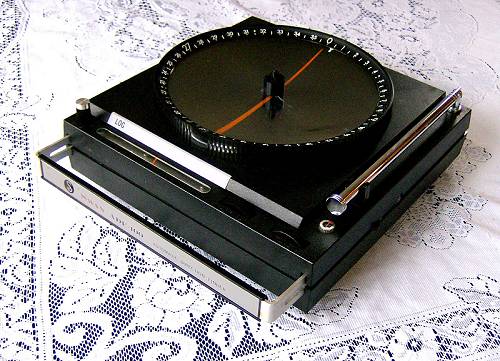 |
Very similar in design
concept to the Sperry, above, is this Swan
ADF-100 automatic direction finder. I would not be surprised if it were
inspired by the Sperry, in fact. It is labeled as a Swan, by Swan Electronics in California and made in Japan. I have also seen this radio as a Vega Vexilar, which is a company out of England. I've also seen it as the EMI Autofix 100, being sold by someone in England. It is probably a generic Japanese unit for re-branding. I'm not sure if they start out that way, or if one importer sells it to the other "re-branders". The radio has beacon, BC and marine, with a rotating drum scale. And interesting feature is the lit "log" bar, which is presumably to mark known stations with a grease pencil. The radio comes with a vinyl carrying case and earphones. Beautiful example of high tech seventies design. |
| |
Click on the youtube video to the left to see the Swan ADF-100 in action. Although the speaker is small, and the sound quality bad, the DF feature of the radio is very sure and accurate. |
 |
Bendix Navigator 440.
Beacon, Broadcast and Marine bands,
with a sense circuit. Interesting it has a sense feature, but no sense
antenna. This model appears in a Bendix "how to" radio direction finding booklet, but with a loop antenna. Since this antenna plugs in with a 1/4" jack, perhaps they are interchangeable (with ant. trimming?). In this 1959 ad, it also shows the loop. Maybe my ferrite bar is wrong, and from a different radio? It needs a power supply, as none is included for battery or A/C line. There is a 12v filament line, but I am not sure of the plate voltage as of yet. Probably 90v, but I'll look it up before I start playing around, of course. I think this wins the RDF beauty contest. It looks like the dashboard from a 1950's Italian sports car. I have a picture of it next to it's sister unit, the Skipper Custom 28, on this page. |
.  |
Allen
Bradford DF-O_Matic. Must have a unique circuitry to allow the strength readout to show "left" and "right". No sense antenna, so I'm not yet sure how they did this. The antenna is modeled after a horseshoe crab carapace!  |
 |
Allen Bradford DF-O-Matic Navigator Radio, model 300. I just won this on eBay for $11. The radio works fine. This one has a sense circuit, and one of the most readable sense meters I have seen. It is right where it should be, next to the sense knob, and reads horizontally "left" and "right". Very intuitive, I think... would-be welcome in a bad situation. |
 |
I do not
own the ICC Direction Finder to the left, but wanted to show it as a
comparison to the Allen Bradford, above. Soon after winning the AB,
maybe a week later, this unit showed up on eBay. I think it is pretty
clear that this unit came from the same factory as the AB, but intended
for a different brand. It has a few unique features... the antenna
casting, the speaker punch-out, the knobs, and so on. This business
model of "re-branding" is still common today, when if you buy a TV,
oven, computer, or even car, you may be buying a product virtually
identical to several different brand and model names. This practice
seems to have grown after WWII, when image became more important than
substance, and efficiency in production methods trumped innovation.
When your customer knows nothing about technology of a product, why
would a company spend money appealing to a non-existant "techno-sense".
Just silkscreen your name on a radio out of a catalog, your investment
was zero, and profit maximum. |
 |
Polaris Marine Direction Finder HE-12, by Lafayette. The radio's audio circuit does not work, but is not open or shorted, as I can hear strong stations, faintly. I will have to trace out the circuit. The top knob is to turn the antenna, with directly touching it. Transistorized, three band. Ebay, $9.95. The radio as I got it had no back, which surprised me since I could not see it in the shot he took. He wrote me a week later saying he found the back, and would send it for $3. Unfortunately two knobs were smashed through bad packaging, and one was missing already as I knew. So three knobs here are paint shopped in the image. Perhaps I should have this under "portable", but there is no handle, and you cannot pick it up with the antenna. |
  |
My friend Don Tompkinson, KPC6NDB, is also an RDF, and many other radio type, collector. He has these two other rebrands of this RDF: An Olson RA-432, and the Brothertone Model RN-381. Below is a picture Don took of the Brothertone chassis, which is very similar to the Olson, and to my Polaris.  |
 |
Dennis Banker sent me this picture of his DF-383, which has no maker name on it. In many ways it is identical to the RDFs of Don's, and mine, except for a having a slide rule dial, and different meter. Perhaps they were all by Layfayette, or by another company for sale and eventual "re-branding" by other firms. This was often done by the late 60's, and through the end of the manufacture of RDF's. The most often re-branded radio is the Coastal Navigator, seen a few radios, above. And the Aquaguide shows up as a Sanchin, and there are other examples. |
 |
Bendix 550. High quality unit, with beacon, broadcast and (old) marine bands. Like other collectors, I usually avoid radios with stickers and such... but an RDF with beacon station dymo labels is different. The labels themselves tell a story about the radio's life, and the cruising life of the past owner. This radio was used in the Seattle area, and has the frequency and morse code for several area beacons, along with an all important "304" in the center of the dial, with a pointer to the exact tuning point. The 304 label on the top of the radio has the designation "POINT DIS" next to it, which I am surmising is "Discovery Point", which juts out into Puget Sound. I can imagine the skipper finding great reassurance, many times, in being able to quickly hear the familiar tones of 304, coming home to Seattle at night, or in a fog... then turning the antenna until Discovery Point was safely passed. |
 |
Bendix 550a. Seemingly the next model after the above 550. The entire radio has been redesigned, but the bands and function remain identical... with one addition, a WX weather band tuner. That is the modern VHF WX band. This is interesting, because I do not believe it was much longer after the weather band, that the VHF marine com band was instituted. So it is hard for me to imagine the decision process at Bendix which left off a VHF band on a radio which was clearly a high end, expensive unit. I suppose there were a few disappointed buyers who had this radio a couple of years, and found the marine band almost useless. Nonetheless, this is a very sensitive and quality radio, and fully functional as an AM broadcast and weather receiver today. |
 |
Apelco DFR
40. This is another top of the line, rugged and well engineered unit.
Beacon, broadcast, (old) marine. It is one of the more sensitive units
I have, I popped 12 D cells... that's right, 12!... into the radio, and
picked up a Washington, D.C. station. I'm 50 miles above NYC! The
battery compartment is a finely made metal box, which is removable for
cleaning or loading batteries. The "sense" circuit is very clear. On
some radios, the difference between sense and straight DF are not so
easy to discern. But on this radio, the difference is readily apparant
with a big swing of the meter."Volume" control is actually a real
"gain" control. Apelco must have been purchased by Raytheon at this point, as the Raytheon model 356 is almost identical, but with different paint and logos. Funny thing... they bothered to make a different DF antenna casting, rather than just use labels on the two brands. See below: |
 |
Raytheon RAY-356 Ranger II. Well I suppose it is not almost identical to the above Apelco, but very close. It has less trim, and a more utilitarian meter, but otherwise the same. 1.6 to @ 4.0 MC "old" marine, .55 to 1.6 broadcast, and 15 to @500 KC beacon. Like the Apelco DFR 40, the gain is used as the volume. 1/8" phone jack, BFO and sense circuit. |
 |
Raytheon RAY - DF 20 Tom McKee sent me this picture of his radio, and writes, "This is a transistorized unit powered by 4 D cells or from external 12 volts dc through an internal dropping resistor. It is actually two receivers in one cabinet - a tunable one for the bands shown on the dial and a Xtal controlled one for two VHF FM channels." That is a nice looking radio, and I don't see them all that often. You can see Tom's radio website at: http://www.imradioha.org/Shipboard_Gear.htm |
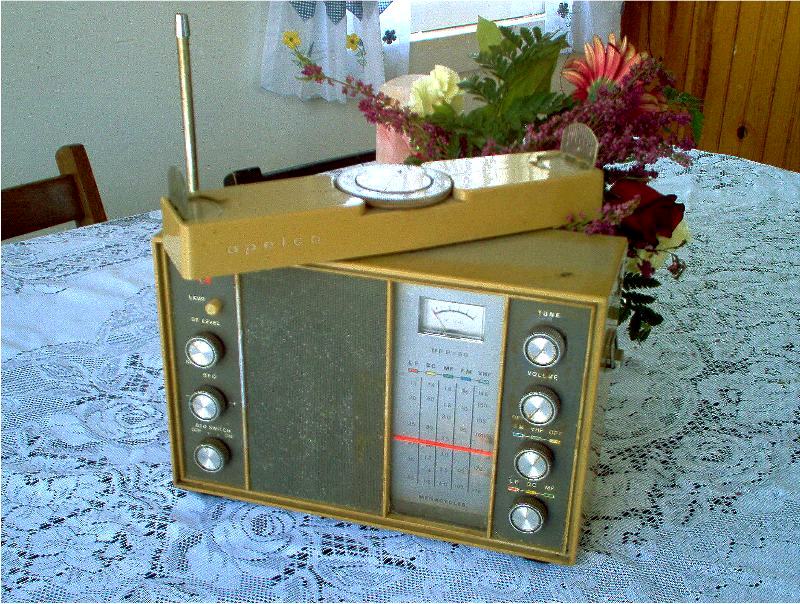 This Apelco model DFR-50 was a real
surprise when I got it. The pictures on eBay were unclear, and did not
do the unit justice. I think this is the reason I got it for under $10.
It is an ugly greeny-mustard color, and some may find the 70's
contemporary styling unattractive. So I somehow expected the unit to be
cheaply built... but the surprise lies in the absolute top-notch
quality of the radio chassis and circuit. And it is a sensitive
receiver, with a clear tone. Besides the usual Broadcast, Marine and
Beacon bands, there are both an additional FM and VHF band. The FM
sound is actually very good for a small, mono radio. Unfortunately my
radio is well worn, stained and missing a couple of parts. I've
retouched the picture to eliminate some of it's actual flaws, such as a
missing knob disc on the upper, "tune" knob. Still one of my favorites,
though. This Apelco model DFR-50 was a real
surprise when I got it. The pictures on eBay were unclear, and did not
do the unit justice. I think this is the reason I got it for under $10.
It is an ugly greeny-mustard color, and some may find the 70's
contemporary styling unattractive. So I somehow expected the unit to be
cheaply built... but the surprise lies in the absolute top-notch
quality of the radio chassis and circuit. And it is a sensitive
receiver, with a clear tone. Besides the usual Broadcast, Marine and
Beacon bands, there are both an additional FM and VHF band. The FM
sound is actually very good for a small, mono radio. Unfortunately my
radio is well worn, stained and missing a couple of parts. I've
retouched the picture to eliminate some of it's actual flaws, such as a
missing knob disc on the upper, "tune" knob. Still one of my favorites,
though. |
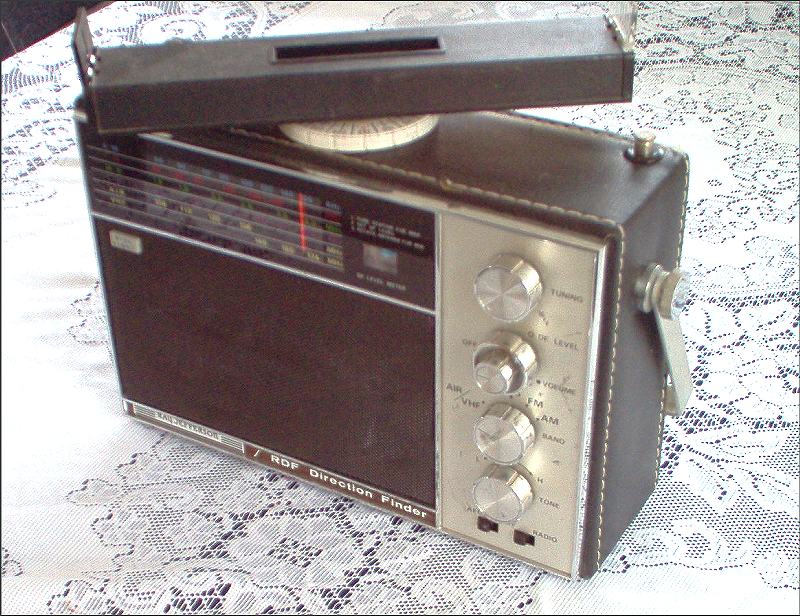 The sensitivity on
all bands, and the sound quality, is much better than the lesser than
average quality of the set and components would indicate. Can't lose
for $5.60 on eBay. The sensitivity on
all bands, and the sound quality, is much better than the lesser than
average quality of the set and components would indicate. Can't lose
for $5.60 on eBay.This same radio was also sold by Pearce-Simpson as the Gladding Cyclone. There is no difference but the labels. Bands are AM, FM, marine, LW (beacon), AIR (vhf 108-136 MC), and "VHF" (modern marine, 140-174 MC). |
 This is the fairly common Pilot II by
Nova Tech. It receives
Beacon, Broadcast, Marine and VHF. Unfortunately the VHF range stops
before the current VHF marine range and weather, or it would be quite
handy today. Although the RDF function is very accurate, with deep
nulls and a sensitive meter, the radio is rather broadly marked on the
top with degree markings. The seem too rude to enable accurate
navigation... the one drawback I see in these fine radios. I use my
less than perfect model as a portable AM around the house and yard. This is the fairly common Pilot II by
Nova Tech. It receives
Beacon, Broadcast, Marine and VHF. Unfortunately the VHF range stops
before the current VHF marine range and weather, or it would be quite
handy today. Although the RDF function is very accurate, with deep
nulls and a sensitive meter, the radio is rather broadly marked on the
top with degree markings. The seem too rude to enable accurate
navigation... the one drawback I see in these fine radios. I use my
less than perfect model as a portable AM around the house and yard.This was made in several versions: The early Pilot, with Beacon, Broadcast, Marine; the white plastic Action and Action II, which included police bands, and the gray plastic version made for Bendix as the Navigator 420. There was a model with a CB band, too... called the "Nova CB". Click on image for larger pic. |
 Near the end of Nova Tech as a company,
they seem to have
begun having their radios made in Hong Kong. This "Nova 3" RDF has a
much cheaper feel, with different antenna and knob castings. They did
away with the aluminum grill, and replaced it with a cream plastic
version. The circuitry is much cheaper looking than earlier Japanese
made models. They also dropped the VHF band of the Nova Pilot II, and
went back to the original Pilot's Beacon, Broadcast and Marine bands.
Update: I'm thinking this is super rare: I have seen many of the Pilot
II"s, like a hundred or more, and a dozen or so Pilot's... but this is
the only Nova 3 I have ever seen. Near the end of Nova Tech as a company,
they seem to have
begun having their radios made in Hong Kong. This "Nova 3" RDF has a
much cheaper feel, with different antenna and knob castings. They did
away with the aluminum grill, and replaced it with a cream plastic
version. The circuitry is much cheaper looking than earlier Japanese
made models. They also dropped the VHF band of the Nova Pilot II, and
went back to the original Pilot's Beacon, Broadcast and Marine bands.
Update: I'm thinking this is super rare: I have seen many of the Pilot
II"s, like a hundred or more, and a dozen or so Pilot's... but this is
the only Nova 3 I have ever seen.I show it next to a similar era Nova Tech two band radio... broadcast and marine/aero beacon! This was one cent on eBay, with $4 shipping. Works perfectly... I had to make a new logo badge for it, though. Click on image for larger pic. |
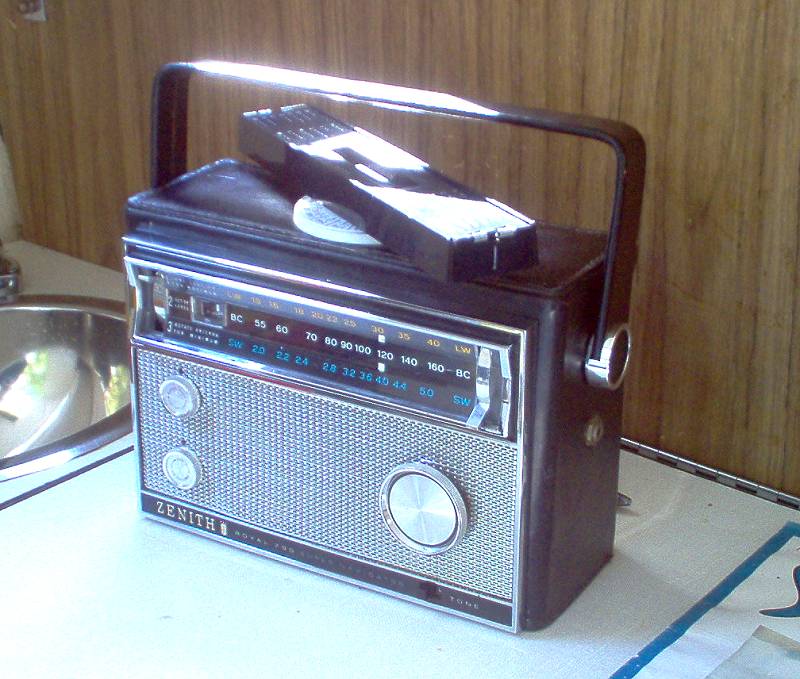 Zenith Royal 790 Super Navigator. Three
bands, LW (beacon),
BC & SW (marine, 2.0-5.0). This mid-60's unit is all solid state,
with plug in transistors. Some other
790
"Super" Navigators, needed to have the entire radio rotated to take a
bearing. But others like this one, have a separate rotating antenna.
This is a
fine receiver, and works flawlessly. I assembled this unit from two
radios, one with great leather, but bad metal and plastic, and the
other with the opposite problems. Sensitivity is extraordinary, pulling
in AM stations hundreds of miles away. The built in short-wave antenna
picks up hams from Maine to Maryland. And here is a 790 in the
beginning of the movie, "The Sailor Who Fell From Grace With the
Sea", from 1976. Zenith Royal 790 Super Navigator. Three
bands, LW (beacon),
BC & SW (marine, 2.0-5.0). This mid-60's unit is all solid state,
with plug in transistors. Some other
790
"Super" Navigators, needed to have the entire radio rotated to take a
bearing. But others like this one, have a separate rotating antenna.
This is a
fine receiver, and works flawlessly. I assembled this unit from two
radios, one with great leather, but bad metal and plastic, and the
other with the opposite problems. Sensitivity is extraordinary, pulling
in AM stations hundreds of miles away. The built in short-wave antenna
picks up hams from Maine to Maryland. And here is a 790 in the
beginning of the movie, "The Sailor Who Fell From Grace With the
Sea", from 1976. |
 This beauty, an almost new condition Bendix Navigator 420, I found on eBay for only $9.95... with the original box, spare strap, earphone, and unused power adapter. I've seen similar units go for ten times as much, without box or papers. Not that I'm complaining... The unit was actually made by Nova-Tech, and is very close to the Nova-Tech Pilot. But it has the addition of a "consolan" switch on the antenna. Click on image for larger version. |
 |
To the left is another
seemingly uncommon variation: The grey Nova-Tech. The radio is owned by
Charlie Ivermee, in Britain... and he kindly sent the picture for this
site. So the question is: Was Nova-Tech using up the grey cases (which
ordinarily appear on the Bendix re-branded models), or did they
regularly, but only for a short time, offer a grey version? Charlie
wonders if it is simply a UK version. Perhaps, because the grey seems
to be a Bendix USA trademark... used across their model line. Just a
guess, though. Any ex-Nova Tech employees out there, who would know? Please write... The radio is one of the earlier versions, being a "Nova PAL", and so not offering the VHF feature of the Pilot II. This radio also offers a "Consolan" switch, which is not offered on all Nova PAL's. For an image of the inside, click here. |
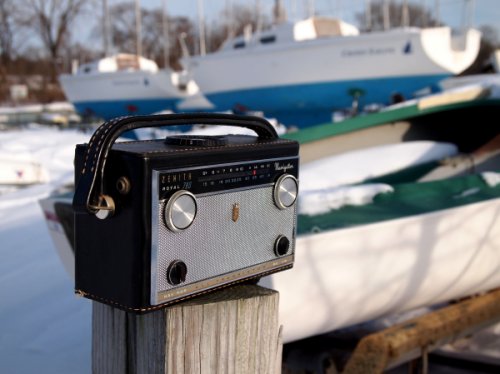 |
Zenith Royal 780 "Navigator". Early to mid 1960's, all transistor. The "Super Navigator" version of this radio has the additional marine/SW band. This radio is beacon and broadcast. It is covered in beautiful black leather, and is of extraordinary quality. I was really pleasantly surprised. I was lucky to find a nice one, with almost perfect leather and chrome. The other surprise was the amazing sensitivity of the radio... I am fairly certain it is the most sensitive of all the beacon receivers in my collection... I can pick up beacons as far away as southern New Jersey (RNB), CLB and DIW in North Carolina, and YLQ, UL and YMW in Canada! (I am about 40 miles north of New York City). On BC I've picked up WPHT in Philly, CKLW in Detroit, WLW in Cincinatti, and WHAS in Louisville. All this with the built in ferrite bar... but there is a jack for an external antenna. An awful lot of radio for $11. |
 |
Hitachi WH-1160, 11 Transistor, 4 bands. Shortwave (3.8-12mhz), Marine (old marine, AM 1.6-4.5 mhz), Broadcast and Beacon. The beacon starts at 185 khz, which is unusual, as this band should start at 150. This is a nice quality radio, which I first thought would be another permutation of the Ray Jefferson at the top right of this section. But it is an entirely different radio and chassis, if the case is still the same. No FM or VHF, for one thing. The plastic antenna casting is different, as are the clear sights. I found this radio in the marine radio section of eBay, which helped get it at a bargain (I think). It was not listed as an RDF. But I suppose I am giving away an eBay trick there... RDF's show up under many other categories, just as T/O's can show up under strange headings... like one under "marine radios" right now! |
 |
RCA Yachtsman: I had seen maybe three of these on eBay, and missed all of them. This is one of the nicest ones I had seen, and for some reason, won it for $12.00 (it did need a major cleaning, and three tubes). They usually go for $35 and above. It is a real fab-fifties classic tube portable, in gleaming, avocado green molded plastic . Line cord, or A/B battery operation. It is hard to pin down the decision process when the design team conceptualized a radio like this. It does have the rotating bar antenna, but then, inexplicibly, does not have the marine beacon band! This is the first time I've seen it omitted. And then, no compass markings at all. So one is left with "SW", which is of course the marine band, with markings for the 2182 emergancy frequency; and broadcast band. So you could listen to ship traffic, and get marine weather reports. I suppose this was primarily a beach radio, then, with a the navigational capability a minor bonus. You would be able to find your way back to shore, in a fog or at night, on your daysailor. That would be about it, but maybe, enough. |
 |
I've given this radio it's
own section for the time being, as it is such a unique case. I have not
been able to find a name
on it, but it is made in Japan. The brand was probably on the missing,
decorative strip, which I
filled in with Paint Shop Pro. The purpose of this type of radio was to eliminate a step in the radio navigation process. The navigator would align the chart with the course of the ship, then use the RDF ruler to plot radio bearings directly on the chart. In theory this is a good idea. In practice, I would guess "not so much". If one can imagine, or is familiar, with the course of a boat or ship, it is almost always a bit variable. If the boat veers 5 degrees, so does the chart, and then, so does one's plot. So then for accuracy with this instrument, one is left with a stationary position... such as a windless morning at a mooring? Tied to a slip? Oh well. One of those really great ideas... which somehow still is great, in a vague idealistic way... while being wholly impractical. Standard beacon, BC and marine, runs on four AA's. The good part is that it makes them very rare, and quite interesting. When I have a moment, I will make a video of this oddity in operation, and post it here. From my very stable, non-veering kitchen, though. |
To the right is a Youtube video demonstrating the use of this device. The link to the video is: https://www.youtube.com/watch?v=xVrNmwRDVOo |
 |
The Hartman (also shown as
an "Allen" in the "radios I do not have" section) is a unique design.
It is as small as a handheld, but it not really intended to be a
portable. It comes with a mounting bracket to mount it to a bulkhead.
AM broadcast only. I opened this up, and was not surprised to find that the radio chassis was simply from a cheap transister AM model, mounted in the rotating radio/compass rose/speaker unit. Although the little domed compass has "Hartman" silkscreened on it, it appears to be little more than a poor automobile dashboard unit, fitted to the case of this RDF. The radio works, as well as the simplist AM transistor radios of this time worked: It is scratchy sounding, and non-discriminating. I think it was unethical of any company to put a unit like this together, and then package it as a fine, precision device... when people would be relying on it, in some cases, to save their lives. |
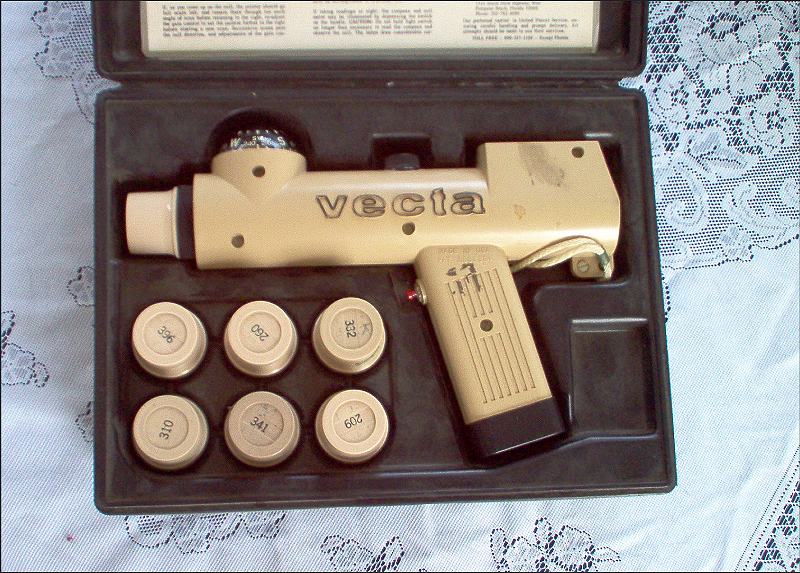 The Vecta series of RDF's takes a
different approach to tuning. Rather than a variable capacitor, the
owner would purchase a set of "crystals"... really tuned coils... in
specific frequencies for the area they would be navigating.
Interestingly, these tuning coils were made from one oz. containers
with screw on lids. The Vecta people mounted a male vacuum tube plug to
the lids, using it as the plug-in connection to the RDF unit. The Vecta series of RDF's takes a
different approach to tuning. Rather than a variable capacitor, the
owner would purchase a set of "crystals"... really tuned coils... in
specific frequencies for the area they would be navigating.
Interestingly, these tuning coils were made from one oz. containers
with screw on lids. The Vecta people mounted a male vacuum tube plug to
the lids, using it as the plug-in connection to the RDF unit. In 1978 this was a pricey model at $252.50. Compare to the much simpler Radiofix of the same era, which only cost $45. For this reason it surprises me that there are so many out there, and Vecta claimed over 15,000 sold by 1979. I also wonder at the system itself... although there are advantages to the tuned coils, I think a single unit, with rotating or button tuning, would be much more practical. Click here to see a .pdf file of the patent. |
 Here is the seemingly rare "Hailer" version of the Vecta. The hailer plugs into the socket for the tuner modules. You turn a switch to "hail", and the unit is a megaphone! Then, when you press another button, it is converted to a loud wailing siren. And if that is not 007 enough, when set to hail, with the button not pressed, it is a sound amplifier... for "distant sound buoys, and voices". It is still an RDF, however. It all fits into a special case. The unit came with the original price list: This unit cost a staggering $338.50 in 1978. If that is not high enough, there is also a repair bill of over $130 in 1979! That is what my GPS cost in 2005. |
 This
unit, called the "LOCATOR", is actually the British Lo-Kata, re-labled
for International Marine Instruments of Stamford, Connecticut. The
rechargeable cells had leaked inside, but they did not cause too much
damage. I am going to solder in four AAA rechargeable, which will allow
it to be used with it's charging base. It covers broadcast and beacon,
but I have yet to try it. The "300" in the picture I added with Paint
Shop Pro... the unit is not on. This
unit, called the "LOCATOR", is actually the British Lo-Kata, re-labled
for International Marine Instruments of Stamford, Connecticut. The
rechargeable cells had leaked inside, but they did not cause too much
damage. I am going to solder in four AAA rechargeable, which will allow
it to be used with it's charging base. It covers broadcast and beacon,
but I have yet to try it. The "300" in the picture I added with Paint
Shop Pro... the unit is not on.I think this is just a perfect example of 1970's modern design. Little is ergonomic in it's form... the handle has a rectangular profile, for one thing. But it's just so cool and different. I look forward to having it sit on a bookshelf, playing talk radio on AM. It will be quite the oddity. |
 Seabeam2, made by Electronics Laboratories in England. The tuning range is the usual beacon 200 to 400 khz. I also have this unit as a "Seafix", by the same company. They relied on an odd rechargeable, which may have been 9 volts. Now that I got this nice Seabeam2, I think will wire in a 9 volt battery holder and try it out. The rechargeable is about to leak anyway... |
 Here is a really fancy Seafix. Digital tuning! It has a heavy, but well balanced, quality feel. You press the trigger to activate the radio. I 'm not sure of the advantage to that, except that the radio will never be left on. The compass is a top quality unit... possibly a Sestrel, but I have not opened the case as of yet. The compass is prismatic, with a clear and bright reading of the bearing to the signal appearing upright in the line of sight. This would allow it to be used as a visual bearing compass... something left out of other handhelds, surprisingly. For instance, if you could only get one radio fix, with this unit you could add a visual fix in some cases, and have your location. This radio arrived with fresh batteries, and works perfectly. I picked up Stewart (SW, 335 khz.) and Otims (MG, 353khz) in New York. |
 Radiofix Navigator, with built in compass.
Like most hand held units, this only receives beacon frequencies of 180
to 400 KC. Made in England by Euromarine. I got this unit for
only $5 at a tag sale. Radiofix Navigator, with built in compass.
Like most hand held units, this only receives beacon frequencies of 180
to 400 KC. Made in England by Euromarine. I got this unit for
only $5 at a tag sale. I found a black Radiofix with box and instructions. Works like new, looks like new. Originally cost $45, which would have been quite a bargain when other handhelds, like the Vectas, where $200 and above. |
 |
The somewhat uncommon Aptel
DDF 300. It has electronic tuning, using red LEDs built numbers for the
display. A unit like this would have cost several hundred dollars, new.
The chassis looks entirely hand built and assembled, and it is quite complex. My radio does have a nice bright display, but it does not properly tune in stations, nor show the proper display while changing stations. I have had it apart, and cleaned all switch contacts, and the various ribbon-wire connections to the several IC boards inside, but the most I got was random number displays. On other interesting thing on this radio... which I've seen mostly on other vintage British units... is that the earphones are not electrical: The actual earphone speaker is in the unit, and the earphones and "wires" you see in this picture are really just tubes to carry the sound to the ear. It is simple but effective, and would be far more reliable in the wet circumstances on a boat. |
 Wow. This is about as sci-fi as it gets in RDF's. The row of red buttons clicks up the individual numeral column for the frequency. High quality all around in this "Seabeam Seafarer". Works fine. |
 Davis seems to have been a very small company which found a niche in inexpensive versions of navigation gear... they made a plastic sextant, a hand bearing compass, and a couple of versions of RDF's. This one seems to have been made with the "works" from a cheap Japanese AM radio, and a very poor compass of the $1 variety. I would guess that the compass was simply taken from a folding camping compass, which would have been cheap and easy for them to obtain... it still has those green lines on the glass. |
 |
 Hudson American: A rectangular "loop" antenna? What are the odds of finding one of these beauties? From a 1948 Yachting magazine. |
 W.W.II field unit. I do not know much about these... about three have shown up on eBay in about 6 years. I think the first one I saw went for about $130... but people have wised up. The last one was about $300, I think... and the next will probably top $500. Luckily not one I "have" to have. |
 I've found no other reference to this radio, or even this company, anywhere else. Update: I took a closer look at the ad, scanning it at high resolution. My daughter thought the brand shown on the radio stated with an "L"... it's a Learavian 402 C! See the page on the radio, and Mason-Bowles "replica project". |
 Heathkit DF-1. I think this may be thier earliest DF kit, but they made several versions through the 1970's. |
 OH, My. OH, My.Intervox. Wow. |
 Allan Marine. I've only seen two of these, then no more. I'll bet it has the guts from a standard transistor AM radio, installed into thier own case thingy. Just a guess. But I doubt this company made, or had made for them, their own receiver. Probably from about 1970. See the "Hartman", above. Same unit with minor detail differences. |
 E.M. Sargent from the 1930's. I know nothing about this unit, but would guess the lidded chrome dome is covering a magic eye tube. This is from the eBay picture. I know someone who has another of these, but missing the chassis. There must be more out there, somewhere... |
 Sputnik by Guest I suppose this is made by the same "Guest" company which is still into lighting, but I am not sure. it has a cool 50's space age look to it. |
 Sea Pal. It has a cloth covered case like the Zenith Universals. It appears the cover has the loop in it, and is plugged into the top for DF'ing. I wonder... if I sent $59.50 to the address on the ad, would I still receive a brand new Sea Pal a couple of weeks later? |
 Very
nice Hamnarlund RDF-10. Two on eBay in about 6 years, as far as I
can tell. The trouble is, as with Heathkit, you would be bidding
against brand collectors. Very
nice Hamnarlund RDF-10. Two on eBay in about 6 years, as far as I
can tell. The trouble is, as with Heathkit, you would be bidding
against brand collectors. |
 Monster ADF Bendix, a type
of which show up rarely on eBay, and which draws the $$$ when they do.
Extraordinary unit. I actually saw on on the set of an old Stargate
episode, along with much equipment on an alien planet. All the gear was
spray painted flat gray to make it look "extraterrestrial", I guess. Monster ADF Bendix, a type
of which show up rarely on eBay, and which draws the $$$ when they do.
Extraordinary unit. I actually saw on on the set of an old Stargate
episode, along with much equipment on an alien planet. All the gear was
spray painted flat gray to make it look "extraterrestrial", I guess. I got an email from Mark, who explained, "The CRT on your Bendix ADF did display bearings as a propeller shaped trace. I used one on a commercial fishing boat in the 60s. The antenna was a stationary crossed goniometer type loop." |
 Bludworth
Marine Port Pilot. When this was on eBay, the seller said that there
were no wires or connections on the radio... if this is correct, then
it means the radio ran on batteries. But it's not so large, and the
unit must be from the tube era... so I'm not sure what it all means. I
was thinking this was not a receiver, and only an antenna and antenna
trimmer. But then, there would still have to be a wire coming out of it. Bludworth
Marine Port Pilot. When this was on eBay, the seller said that there
were no wires or connections on the radio... if this is correct, then
it means the radio ran on batteries. But it's not so large, and the
unit must be from the tube era... so I'm not sure what it all means. I
was thinking this was not a receiver, and only an antenna and antenna
trimmer. But then, there would still have to be a wire coming out of it.But perhaps it is a mid-50's transistor model, and it would then all make sense. |
 Sony TD-81 A unit. Easily one of the top five beauties. Again, you will be bidding against brand collectors, and at the same time, RDF collectors, and anyone who just loves a gorgeous '70's design masterpiece. |
To the left is an Apelco DFR-10, from an eBay ad. |