Hello there, and thanks for visiting!
I am currently busy designing and building a modern steam-powered automobile. At present, the blueprints are nearly completed, and I hope to begin major construction work in the very near future. My design goal is a modern steam car, of the same size, shape and weight as a modern car with a conventional gasoline engine. It will have a modern body, and new modern equipment throughout. Modern wheels, tires, brakes, steering, suspension, etc.. The powerplant will be completely automatic. Its advantages will include smooth, silent, fast-accelerating performance, precision control, enjoyable easy driving, clean running, alternative fuel capability, and overall lower cost per mile. I believe that my steam car's fuel mileage will be about the same as a comparable conventional gas car in normal driving. For development and extended test-driving purposes, it will use easily-available regular unleaded gasoline at first. The 10-gallon water tank will need refilling at long intervals.
If it runs well and reliably in extended road use, I will consider putting it into limited production. Many of those who have experienced steam cars prefer the sweet-running "steam car driving experience", in the same way that many people prefer sailboats to motor boats. Unfortunately, however, at present there are no steam cars in production, and very few people have ever driven or taken a ride in one.
This website is "under major construction" at present. I plan to add a number of articles about steam cars, including articles explaining my own steam car's design and why I think that the steam automobile is "the car of the future".
Today, news media reports are full of information on electric cars, gas/electric hybrid cars, fuel cell cars, even compressed-air cars. Almost no mention is ever made of steam-powered cars. So how does anyone today end up interested in steam cars? Well, my own steam car oddyssey began in 1978, with a chance discovery of "Floyd Clymer's Steam Car Scrapbook" (originally published in 1945) in a local library. The compactness and simplicity of steam car powerplants, and various articles on their performance, pleasant running, economy, durability, and various other advantages, as detailed in Clymer's book, intrigued me.
A year later I discovered a steam car club. I joined to learn more, and was surprised to find that there were a number of inventors and developers working on steam automotive technology. It also came as a surprise to me that hundreds of antique steam cars are still in operation around the world, and very much enjoyed by their drivers and passengers alike. Many years of intensive study followed, during which I developed my own design ideas and hypotheses. Around 1998, I started to get serious about actually designing, building, and testing my own steam car.
In 2005, I visited England to see the Modelworks steam car factory (see below), and in the process was fortunate to ride in 3 excellent Stanley Steamers. That first-hand experience convinced me that "classic" steam cars are indeed very enjoyable and pleasant vehicles! And anything fun has "product potential"!
Many people believe that all steam cars use more fuel per mile than comparable cars with internal combustion (IC) gas engines, and that this dooms steam car technology. I will provide evidence that this view is incorrect, on this website, in the near future. I posted an article about this topic on my old GeoCities/Reocities website, which has now disappeared, and I have yet to locate a backup copy of that article.
A few "preview" points from that article: the latest modern V8 gas-engined "full sized" pickup trucks (like the Chevy Silverado, RAM 1500, and Ford F150), of the same weight and frontal area/air-drag as steam-powered 1920s Stanley sedans, get about the same fuel mileage as the comparable Stanleys. This shows that modern gas-car and 1920s steam car powerplant efficiency is about the same on the road. Also, while IC engines can use less fuel per horsepower/hour than steam car engines, that superior efficiency is only achieved at a single torque and speed output. If the IC engine is large enough for highway speed and good acceleration, then it will run at much lower loads almost all the time on the road, and at those lower than optimal-efficiency loads, the fuel efficiency of the IC engine drops to the same as the traditional/classic steam car. This efficiency drop is well documented in what are called "brake specific fuel consumption" (BSFC) charts.
Most discussions of the relative efficiency of steam and gas-engine cars focus entirely on maximum test-bench efficiency, and do not factor-in the crucial issue of IC engine part-load/low-load efficiency. This leads to incorrect conclusions.
The internal-combustion engine's low-load efficiency drop is why gas/electric hybrid vehicles exist. The gas/electric hybrid propulsion system runs its gas engine closer to its optimum-efficiency torque and rpm output for more of the time on the road, thus saving considerable fuel relative to a gas-engined car with a conventional transmission in city driving. Alas, the sophisticated extra equipment in a gas/electric hybrid car costs more than the fuel it saves, so the technology is not economically viable for most drivers. High powerplant cost is why, even after many years of mass production, gas/electric hybrid vehicles, like battery-electric vehicles (BEV's) and diesel cars, comprise only a small percentage of the world automobile fleet.
However, even if the "lower net thermal efficiency of steam cars" theory were correct (which it is not), it would be a moot point, because a steam car can be modified to run on low-cost wood chips and/or other solid biofuels. I am working on this idea, which in my opinion is highly technically feasible. My first steam car will run on gasoline for road tests, to work out the engine, boiler, and other equipment which will later be used in my "Second Generation" solid-fueled steam car. In commercial production, buyers could choose either the gasoline-powered or solid-fueled option.
The solid-biofuel steam car will be far less expensive to run per mile than a comparable IC-engined car, without the poor performance and other inherent problems of IC cars fitted with wood-to-gas converters (called "gasogenes"; btw, running on wood-gas instead of gasoline fuel cuts IC engine horsepower in half), and it will be absolutely "carbon-neutral" -- IE, its carbon/CO2 emissions to the atmosphere will equal the CO2 absorbed out of the atmosphere by growing its biofuel. If it's cheaper per mile, and absolutely carbon-neutral, then its net thermal efficiency, compared to IC-engine cars, becomes a moot point.
I believe that my "Second Generation" steam car's combination of far lower fuel and equipment costs per mile (relative to other vehicles) and carbon-neutral fuel will attract great support from automobile buyers/drivers, environmentalists, car manufacturers, and governments.
"Talk is cheap", and that is why this website has not been updated in a long time. What is needed is not talk but a good-running new traditional steam car to demonstrate the real-world potential of the technology. Therefore -- except for these brief comments -- I have been putting my time and energy into designing, blueprinting, and building a new steam car, instead of "generating text" in websites, internet forums, emails, or social media.
(7-15-2020)
Relative Efficiencies of Steam Cars and Other Cars
-- Buckminster Fuller
click here for latest progress reports on my steam car design work. The project continues!
(Latest update, 7-15-2020)
click here for a rough sketch of my current steam car propulsion system design, showing about 90% of the basic details, with some basic explanatory notes on "how it works". Page still under construction, with a number of details illustrated, but not yet described in the text.
Monday, November 2nd, 2009
It is time for an update to this page. This is to announce that my previous "main website", at Geocities, has now closed. In fact, as of October 26th, 2009, Yahoo has closed _all_ of the old Geocities websites, including the Geocities web-hosting service itself!
Due to my continuing steam automobile design work, which is very time-consuming, I did not have time to migrate the files over to this website, which will now be my main website. Fortunately, however, the files were archived elsewhere, and I will be moving them here a bit at a time in the future. Much of the information at my old GeoCities website was pretty out of date anyway due to extensive design changes, so at this point I am not sure if I will be moving all of it to this website.
Also, as noted previously on my old website, my main focus the past few years has been designing and building my steam car, not talking about it on the internet. Designing a steam automobile is very difficult and time-consuming, and consequently I found that I just didn't have time to post regular progress reports, or discuss/debate the design and various related design issues on discussion forums. When I did get sidetracked into those things, the design work slowed down substantially.
However, I do like to keep some easily-accessed record of my progress, even if the updates are few and far between and the details scanty.
I don't know how long it will take to move my older webpages to this website, or how many of them will "make the cut". Some of the more important articles will definitely be moving here, along with the "updates" page, which I will continue to update now and then. I also hope to be putting more photos and drawings on this website in the near future. Including photos of the things I've been building in the shop, and perhaps some general drawings of my steam car. Some of the older drawings which appeared on my GeoCities website were pretty crude, and/or long outdated -- depicting design ideas which I dumped many years ago -- and I don't think they will be missed.
The subtitle of my GeoCities website was "The Digital Junkyard", a reference to my habit of not weeding out or discarding old/outdated material, just adding brief notes about design changes, and letting old stuff pile up. I may be doing less of that in this "new improved" website. In fact, I am going to start by cutting out some of the old "deadwood" on this page.
This website, and the various webpages herein, may look a little rough and screwy while I migrate files over and add new content ... but then again, my webpages always look that way anyway! LOL
So, as I always say to those who visit my cluttered and amazingly disorganized workshop in a tumble-down 1916 wood-framed garage building, "Watch your head and feet!" And have fun!
Here are a few of my favorite steam
car images.
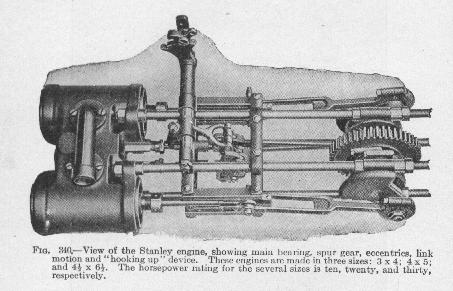
The Stanley steam car engine, in 4" bore x 5" stroke
and 251 cubic inches displacement, is the classic
steam automobile engine. Actually, I think that the
above picture is of the slightly earlier version, in
3-5/8ths bore -- never mind the caption. Think of this as the "350 Chevy of
classic steam cars".
The Stanley brothers rather conservatively rated
this engine at "20 horsepower" (it would produce up
to 100 hp on temporary overload). They also
produced "10 hp" and "30 hp" engines, with equally
conservative ratings and boilers to match.
In case you're new to steam cars and are thinking of
a road locomotive with some guy shoveling coal,
forget it. Steam car boilers and engines fitted
right into regular, ordinary-looking automobiles,
ran on ordinary fuels, and often you couldn't tell
that it was a steam car except that it ran so
quietly. They also get about the same fuel mileage
as gas cars, have great acceleration, and run
amazingly smoothly. Most steam cars were built from
around 1900 to 1925-30, and plenty of those are
still on the road. There have been several projects
since then to get new steam cars on the road, with a
few dozen newer vehicles successfully added to the
steam car population, and I am working on such a
project right now. For more on this, check out my
other website.
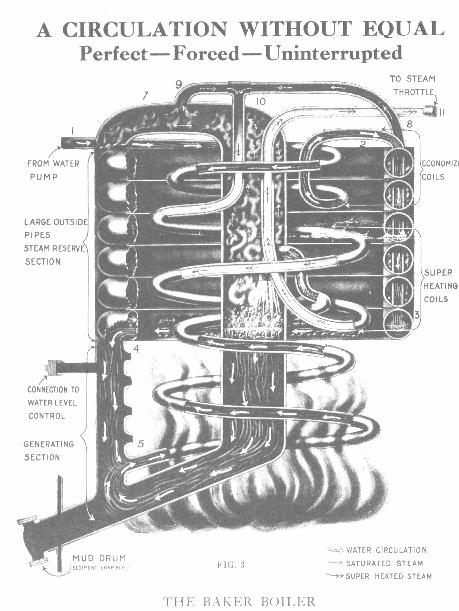
The Famous Baker Boiler
Floyd Clymer's Steam Car Scrapbook says of this
boiler:
"Several years ago the Baker Steam Car was built
at Pueblo, Colorado. An illustration of the boiler
used is shown here. Many steam car enthusiasts felt
that the Baker Boiler was an exceptionally good one.
It was a water-tube boiler, built in four sections
-- each section a separate and distinct unit which
was assembled -- yet each section functioned
individually. Baker contended that with his boiler,
efficiency was materially increased, and scaling and
choking of tubes was eliminated, and the boiler was
easily cleaned. The boiler was controlled by
positive and dependable automatics. -- Clymer."
A few people who have owned and operated these
boilers have told me a slightly different story!
However, the Baker boiler did the job, and is
certainly an interesting design. Having studied
factory blueprints of the unit, I can attest that it
would be a bear to build one of these today. Among
other things, Baker used about 4 different sizes of
tubing, and there was enough welding involved to
keep a certified welder busy for days.
Reportedly the sole surviving Baker steam car is
currently undergoing restoration.
For more information on the Baker boiler and the
Baker steam car, check out "Steamy Dreamer" by
Barbara P. Baker (Grand Junction, Colorado:
Centennial Publications, 1995).
Lest ye think that steam cars are strictly
antiques, gaze upon the noted SES boiler of 1974, an
ultramodern product from the era when steam cars
were being investigated as a solution to the air
pollution problem. In the late 1960s-early 70s, it
was not at all certain that gas car exhaust could be
successfully cleaned up. But it was well known that
steam cars, with their hot, continously-burning,
low-pressure combustion chambers (technobabble for
"firebox"), could burn fuel much more cleanly than
the cooled, pulse-fired, oily, high-pressure
cylinders of a gas or diesel engine. Since then,
there have been great improvements in
internal-combustion pollution controls, but steam
cars can still run cleaner today.
Alas, with the total focus on clean emissions in the
late '60s-early '70s, fuel mileage was completely
overlooked, with the result that experimental steam
cars of that era got worse fuel mileage than
comparable gas cars. Then the 1973 oil embargo hit,
fuel mileage became the number-one issue, and the
steam car projects of the time were "Dead On
Arrival".
The SES steam car was one such project. However,
its very efficient boiler was not to blame, and it
was an impressive design. It measured only 16
inches diameter by 20 inches long, weighed only 110
pounds, and produced enough steam to run an engine
at about 130 horsepower, plenty to run a large
luxury sedan with excellent performance.
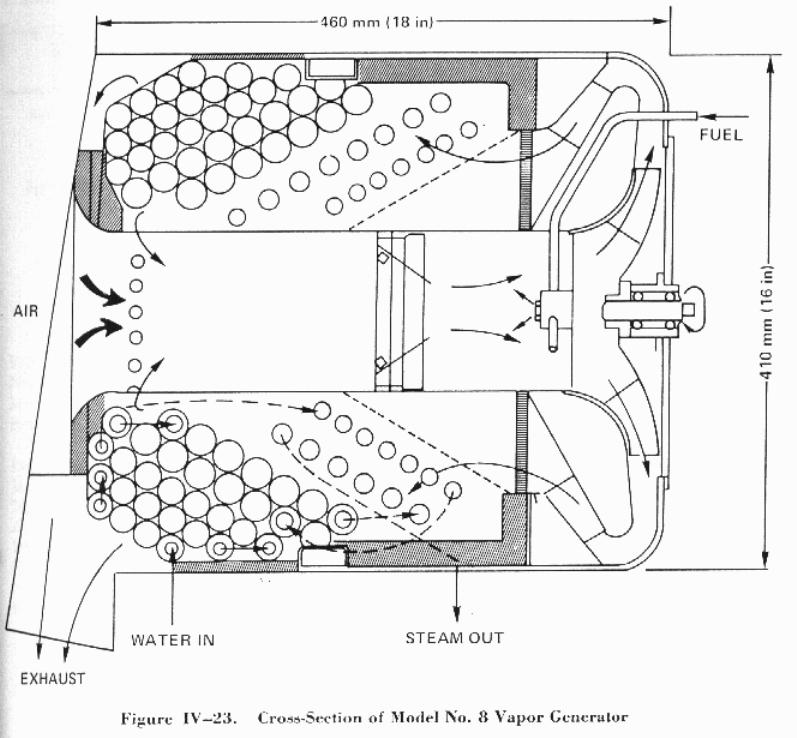
In the picture above, air is drawn in from the left
towards a VW Beetle cooling fan at the right. On
the way, it passes a pressurized fuel nozzle which
sprays fuel into the oncoming air. The fuel/air mix
then passes through the fan, turns around, and blows
back toward the left, burning as a compact mass of
flames at a cone-shaped perforated-metal flameholder
denoted by the dotted lines. Hot gas from the
combustion flows over plain tubes (small circles)
and then over finned tubes (large circles) before
exiting the unit as (superclean) exhaust. One of
the tricks used was to run the boiling water through
a coil of tubing right next to the flames, picking up
tremendous heat from a small surface area, and
cutting the size and weight of the boiler
tremendously.
As in all super-lightweight boilers, fire and water
controls were difficult to design and tune.
Reportedly the 1970s electronics which were used to
control this boiler filled several large cabinets.
Today all that equipment could be replaced with a
tiny computer.
Brow Steam Car Engine/Axle Mockup
"You cannot change things by fighting the existing reality. To change something, build a new model that makes the existing model obsolete."
Latest News
<
2010 Brow Steam Car System Diagram
Steam Stuff
Here are 3 photos of a motion-test mockup of the "B142" steam automobile engine/axle unit which I am designing and building. The mockup was successfully completed and motion-tested in March, 2002 -- pump construction now underway. Update: Pump frame has been completed (pictured here), and 4 pictures of the complete mockup rig have been added.
(Updated, 8-27-2003)
Components
Here is a scrapbook page devoted to various completed steam car components, and other odd items of interest. A peek into the workshop of the Mad Steam Inventor!
(Added, 3-8-2005)
Meet The Team!
The alleged research and development team working hard to bring you "the steam car of the future". A bit of halloween humor, courtesy of Brow Motors.
New Locomobile Steam Cars Now In Production!
Around 2005-2006, the folks at Modelworks International in England manufactured roadworthy replicas of the 1901 Locomobile steam car, in kit form. About 75 of these kits were sold and assembled, and are now chuffing about on the road in various countries. Alas, these have now gone out of production, and ModelWorks is no longer in business. However, here is a page which I wrote about the Modelworks Likamobile at the time. Lots of illustrations and information on the Locomobile steamers, info on the Modelworks project, and links to one Likamobile builder's pages.
(Updated, 11-4-2005)
The White Steam Car Throttle
A biggie sized scan of a couple pages from the 1909 White Steam Cars instruction book, Models M & O. If you ever wondered how steam cars control the flow of steam to the engine, here is a picture of one type of valve used. Stanley steamers used a somewhat different valve. Not sure what type of throttle valve my steam car will use, but I am leaning toward using the Stanley type as it seems easier to fabricate (note the screw threads in the White throttle). You'll have to scroll around this megascan to get the whole picture, but the detail is worth it.
(Added, 8-29-2003)
The Stanley Steam Car Throttle
And for comparison, here is a rather grainy picture of the throttle used in the Stanley steam car.
(Added, 8-31-2003)
Two Interesting Boilers
Here are some drawings, photos, and descriptions of the Field boiler (a finger-tube boiler) and the Rider boiler (a J-tube type boiler), in scrapbook scans from the 1903 edition of J.E. Homans' classic "Self-Propelled Vehicles". If you are interested in designing and/or building your own boiler, these might provide some ideas or inspiration.
(added, 1-22-2007)
Baker Boiler Blueprints
(added, 8-10-2012)