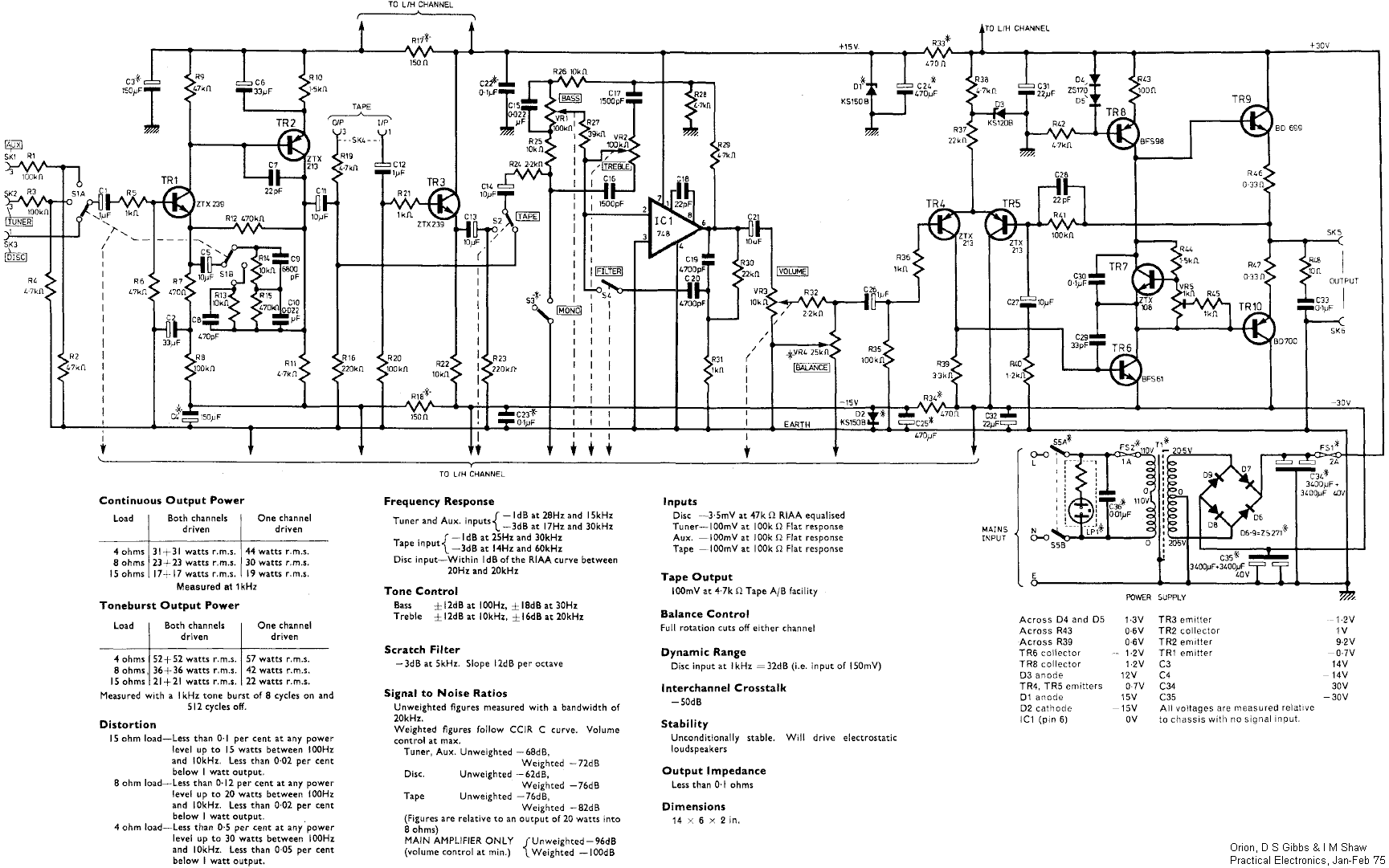
Practical Electronics Gemini and Orion.
A sophisticated self-build approach was offered by Gibbs' and Shaws' 1970/1 PE Gemini, with the preamplifier housed separately from the power supply and power amps. This compared favourably to, say, Quad amplifiers designed at the same time, with a saving in cost (preamp - £17, main amp - £28).
The first power amplifier stage provides all the voltage amplification at low power levels, the cascode arrangement providing a means of eliminating 'early effect' distortion by means of limiting the current under short circuit conditions (a similarity has been seen in other later designs, like the 1988 Cyrus 1). Note the relatively low impedances of the feedback network (increasing the 39R to 82R can extend the bass with little subjective difference in gain, although the 1k5 can be similarly raised to 2k2).
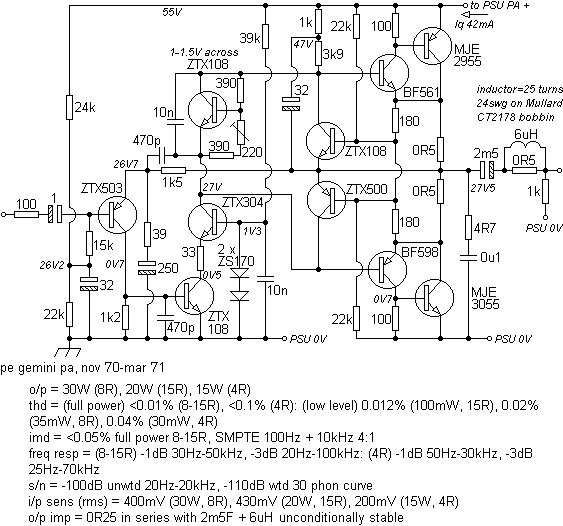
A class B current-limited output stage gave a current gain of 2,000 but a voltage gain below 1. High bias stability was achieved by using fully complementary compound Darlington output pairs acting as two stage feedback amplifiers, any change in the junction temperatures of the output pair being reduced by the loop gain of the stage, about 7. A fully-complementary output stage overcomes the drawback encountered with some quasi-complementary designs where the transfer characteristic becomes markedly assymetrical at low signal levels, then contributing to distortion. For this reason, low-level distortion figures are usually absent from an amplifiers' specification. 1.5-2mm thick duralumin strips were then used (with heat-sink compound) to thermally bind the (Ferranti e-line) bias and driver transistors together.

With these arrangements, "after sustained operation into a short-circuit with the output transistors running at 100°C case temperature, the bias had changed by only 10mA from the correct figure of 30mA, and it returned to within 2mA of the correct current in less than a minute", which is commendable even by todays' commercial standards. Similar topologies are seen in the next years' Texan and much later designs.

Two heat-sinks were used (1.1°C/W Redpoint 6W/1 or equivalent), one for all of the output transistors (stereo) and a separate one for the regulators' output device. These were mounted on the outside of the PSU/PA case allowing a very free airflow around them.

A substantial mains transformer was specified, the regulated power supply providing 55V at 2A (6A peak, both channels at full sine wave power into 8 ohms), the slow switch-on characteristic preventing speaker transients and allowing a controlled start-up. The mains was fed and switched from the preamp case, which should then include any mains filtering, if fitted.

The preamp was also supplied by the regulator (40V @ 35mA). This, after the input switching, used a virtual earth mixer for the mic preamps (disco use), a gain stage (x4), a steep switchable low-pass filter and volume, tone and balance controls, all optimised for low distortion characteristics.