| From the Hymns of Zarathustra to the Songs of Borbadby
Iraj Bashiri
copyright 1995, 2003
|
|
| From the Hymns of Zarathustra to the Songs of Borbadby
Iraj Bashiri
copyright 1995, 2003
|
The Indo-European Background
Ancient cultures have, over the centuries, developed their own unique cosmology and mythology. A cursory look at the Bundahishn and Firdowsi's Shahname, 1 is sufficient to indicate the depth of the drama that characterizes the Iranian peoples' account of the genesis of their own culture. This, however, is not the only way to access ancient Iranian culture. We can examine the archaeological remains in Iran, beginning with Siyalk in the center of the plateau. On the basis of the artifacts discovered, we can follow the events that led to the emergence of the Iranians as a people, the formation of their society, the development of commerce and, more importantly, the introduction of the divine right of kings as the mainstay of their culture. 2 This background then leads to the rise of the Achaemenian, Parthian, and Sassanian Dynasties. Still a third method combines what data is available in the present material culture with what might have logically existed in the culture centuries ago. This latter method necessarily takes us outside the local Iranian beginnings and into the world of the Indo-Europeans. Who are the Indo-Europeans?
An answer to this question was first offered in the eighteenth century when correspondences were established between a vast number of languages geographically scattered between India and Ireland. For example, the word father, with certain phonological variations, is found in all the genetically related
languages descending from Indo-European. The phonemic form of the German word for father is fater, the French is pe:r, the Gothic is fadar, Latin and Greek use pater, the Sanskrit word is pitar, the Persian is pedar and the Pashto is pidar. Elementary phonology accounts for these differences, establishing *pater as the Proto-Indo-European word for father. The asterisk (*) indicates that the form is a reconstruction. Similarly, words for mother, brother, sister, and daughter in these languages yield *mater, *bhrater, *sweser, and *dhugheter, respectively.
One important word that we can reconstruct is agros, referring both to the village, which included a number of households, and to its immediate cultivated and uncultivated surroundings. Agros was the "world" of the Indo-European. Anything beyond the agros belonged to an unknown and thereby awe-inspiring world. Early in the morning the cattle were taken to pasture in the meadows beyond the cultivated fields surrounding the settlement. The man of the household counted the animals as they were entrusted to the shepherd. One of two counting systems, either a four-base system that used the twelve finger joints, or a five-base system that used the four fingers and the thumb, was employed in counting. The man repeated this procedure when the cattle returned early in the evening to make sure that all the livestock were back safely. The shepherd was usually accompanied by one or two guard dogs; dogs were among the earliest animals to be domesticated.
In the fields surrounding the village, barley was cultivated (wheat was unknown and was not cultivated until much later in the Middle East). Since the people were primarily cattle breeders and herders, their knowledge of agriculture was not as sophisticated as their understanding of animal science. Indeed their very lives depended on the milk, wool, meat, and leather produced by their livestock. Their respect for these animals, reflected in later texts, clearly underscores the value they placed on the animal kingdom.
Each village consisted of a number of families organized around the father, known as pater familias. This individual was responsible for the protection and well-being of the unit, and the family revolved around him. His wife, who came from a different family, gave up her identity with her own blood relations and formed new relationships within her man's household. The term "wife," in fact, cannot be reconstructed because this individual was referred to only as "mother," "daughter-in-law," etc.; she was never addressed via her relationship to her husband.
One of the main tasks of the pater familias was to invite the gods to a sacrificial meal. If the gods were happy with the family, they would descend and partake of the feast. The religious system of the Indo-Europeans, therefore, was quite simple. All gods lived in the sky. There was no need to erect temples in the village and, consequently, there was no word for temple. The father was the priest of the family, so there was no priestly caste distinct from the heads of the families. The people worshiped the eternal elements including water, fire, the wind, the moon, the dawn and the heavens as representatives or personifications of the deity.
Gradually the animals and plants within the agros acquired special status as totems. Sacred totems were safeguarded while evil totems were annihilated. As a result of this strict system of distinguishing sacred from evil animals and plants, a rich body of vocabulary on the flora and fauna of the agros can be reconstructed. The discovery of this vocabulary is significant for locating the original homeland of the Indo-Europeans. 3
The precise reasons for the disintegration of the Indo-European community are not clear. Perhaps in search of better pastures, the bulk of the population traveled westward, later forming the Greco-Roman and other European civilizations. A small group, known as the Aryans, also referred to as Indo-Iranian, moved south and east, settling in the northern regions of the Caspian Sea and the Aral Lake, the area of the present-day southern Russia and Kazakhstan. The Aryan community believed in abstract gods who dwelled in the sky and sent representatives to earth. A pantheon of gods, similar to the one developed by the European branch, took shape. Gods like Mithra, Varuna, Anahita, Indra, and Khshathra oversaw the deeds of mortals and meted out rewards and punishments.
Around 3,500 years ago this Aryan group also disintegrated into smaller units, its members migrating in different directions. One group, the Indic peoples, eventually settled in the Punjab in the northwestern part of the Indian subcontinent. There they displaced a rather advanced civilization, the material remains of which have been excavated at Mohenjo-Daro, Chanhu-Daru, and Harappa. The other branch, the Iranic peoples, settled south of the Aral Lake in what came to be known in medieval times as Khwarazm. At the time, however, this place was called Airyana Waejah or "land of the Aryans." It was in Airyana Waejah that a new Iranian cosmology and mythology grew out of the old system. Ahura Mazda, breaking away from the Asuras, formed a new pantheon and initiated His search for a prophet who would communicate his message to the people. Yama and others were tested, before Kaykhusrau announced the advent of the Prophet Zoroaster to the court of his successors.
Attributed to the prophet of ancient Iran, the ethical religion Zoroastrianism was believed to have been communicated to Zoroaster by the supreme deity of the faith, Ahura Mazda. Our knowledge of the life and deeds of the prophet is based partially on the fabulous accounts supplied by the clergy at a later time and partially on the sacred books of the faith. A portion of Ferdowsi's Shahname, Daqiqi's contribution to be exact, is dedicated to an explanation of the events in Iranian cosmology and mythology that led to the rise of the ancient prophet.
According to tradition, Zoroaster (also referred to as Zarathustra) lived 280 years before Alexander the Great's defeat of Darius III in BC 330. 5 If Zoroaster lived for seventy years, 6 he could have been born anytime between BC 618 and 630. 7 Scholars investigating Zoroastrianism and ancient Iran, especially Mary Boyce, have placed Zoroaster's birth much earlier, around BC 1,000. 8 Given the textual and stylistic qualities of the Gathas, believed to be authentic renditions of Zoroaster's conversations with Ahura Mazda, the latter date seems to be more credible. According to Boyce's calculation, therefore, Zoroaster died in BC 930 or 923.
According to the Gathas, Zoroaster spent much of his youth meditating in the desert, seeking an answer to the riddle of existence. Zoroaster's search to find a way which would lead to prosperity in this world as well as in the hereafter apparently culminated in the recognition of an omniscient mind (Mazda) as the creator and benefactor of cattle, plants, and humanity. The very simplicity of the prophet's query regarding the warp and woof of the cosmos indicates the depth of his vision and promises immortality for his message:
Until the end of the seventeenth century, very little was known about Zoroaster and his religion. The rediscovery of the ancient texts of the faith by the French traveler Anquetil Du Perron shed new light on the achievements of Zoroaster and revealed a new vista on our understanding of his religion. The discovery and translation of the books of the faith such as the Vendidad and the Bundahishn further opened the way to an understanding of the principles of the religion and of Zoroaster's view of our place in the cosmos and our relation to the Maker.
Who was the father of Righteousness at the birth?
Who appointed their path to sun and the stars?
Who but [T]hou is it through whom the moon waxes and wanes?
Who set the Earth below in its place and the sky of the clouds,
that it shall not fall?
Who [created] the waters and the plants?
Who yoked their swift steed to wind and clouds?
Who, O Wise One, is the creator of Good Mind?
What artificer made both light and darkness?
What artificer made sleeping and waking?
Who made morning, noon, and night,
That remind the wise man of his task? 9
The Bundahishn (Book of Creation) provides a concise view of the world, especially of the 12,000-year-long cosmic time during which the forces of Ahura Mazda and Angra Mainyu battle for the hegemony of the world. We learn, for instance, that during the first 3,000 years of the cosmic year, Ahura Mazda created the Farahvashis and conceived the idea of his would-be creation. He used the insensible and motionless Void as a weapon against Angra Mainyu, and at the end of that period, Angra Mainyu was forced to submission and fell into a stupor for the next 3,000 years.
Taking advantage of Angra Mainyu's absence, Ahura Mazda created the Amesha Spentas (Holy Immortals), along with the material world, consisting of the sky, waters, earth, plants, the sacred white bull, and Gayomart, the cosmic man. What's more, he permeated his kingdom with truth in order to prevent Angra Mainyu from reaching and destroying it. Angra Mainyu, however, through a hole in the sky, entered Ahura Mazda's creation and all but destroyed it.
When the destruction ended and Angra Mainyu tried to leave Ahura Mazda's creation, he could not. The sky, permeated by truth, had patched itself up, keeping evil permanently within itself. Furthermore, it turned out that not everything in Ahura Mazda's creation had been destroyed. Gayomart's seed, which had gone to the moon, was purified by the sun and returned to the earth at the beginning of the third 3,000-year cycle. On earth, it grew into a rhubarb plant with two stems extending from the base: Mashiya (first man) and Mashiyana (first woman). Subsequently, these two populated the earth, especially after Ahura Mazda took away the sweetness of children so that their parents did not devour them at birth. The creation of the universe is accomplished by Ahura Mazda in seven steps. First, Ahura Mazda created the sky out of shining metal. It looked like an egg, and the top of it reached the endless light. He then placed the rest of his creation within the sky. Out of the substance of the sky, he created the waters and assigned wind, rain, mist, storm, and snow as helpmates for this second creation. Third, from the substance of the waters, Ahura Mazda created the round earth, with far flung passage-ways, hills and dales. The plants were created fourth and grew in the middle of the earth to the height of one foot with water and fire assigned as the plants' helpmates. He also fashioned his fifth creation, the sacred white bull, in the middle of the earth. So that the bull might gain strength and thrive, Ahura Mazda assigned the waters and plants as his helpmates. The creation of humanity came next. He fashioned Gayomart, the cosmic man, shining like the sun; but Gayomart, as we have seen, was not to last long. He was killed by Angra Mainyu. Sleep was assigned as Gayomart's helpmate. As his last creation, Ahura Mazda fashioned fire out of truth and allowed it to permeate his entire creation.
As the supreme deity, Ahura Mazda is the embodiment of the spiritual as well as the material existence of the cosmos. He rules his kingdom through his six manifestations, the Amesha Spentas. Each manifestation takes care of certain human needs through an appropriate Yazad or Yazata (archangel also referred to as adorable one). The Yazata, in turn, relates to the individual through the individual's Farahvashi (guardian angel). According to this system, therefore, when an individual prays, the prayers are taken up by the person's own Farahvashi, who communicates those prayers to an appropriate Yazata. This Yazata, then, takes those prayers to a higher level by communicating them to the appropriate Spenta, through whom Ahura Mazda hears that individual's prayer in his soul. The number of the Amesha Spentas is six, but that of the Yazatas is finite but unknown. The number of Farahvashis is the same as the number of human beings inhabiting the globe at a given time. The following is an account of the Amesha Spentas, their role and their nature as they govern the world for Ahura Mazda.
The first Spenta is Vohu Manah, who essentially combines innate intellectual capacity with learning capability, offering his acquired wisdom to mankind for the improvement of his soul and mind. The animal kingdom represents Vohu Manah in this world. Asha Vahishta, the second Spenta, symbolizes truth and righteousness, and embraces the unchanging aim of creation as it evolves toward perfection. The building blocks of life, truth and righteousness, guide the world away from evil and direct it in the way of truth. Fire, the most sacred element in the faith, represents Asha Vahishta on earth. Khshathra Vairya, or holy sovereign power, concentrates on humanity as a force capable of influencing the outcome of the cosmic battle between good and evil. This power, when used freely and unselfishly, benefits the entire Ahuric creation, including the plants and animals. Representing Khshathra Vairya in the world is the sky, while Spenta Armaiti is represented by the planet earth. The divine qualities of love and devotion as well as the social welfare of humanity, animals, and plants are also a function of Spenta Armaiti. Represented by water, Haurvatat (happiness) reflects the mental and physical well-being of the individual. A healthy mind in a healthy and pure body exemplifies a prosperous warrior in Ahura's struggle against evil. Finally, Amaratat, or immortality, personifies the destination of those who have vanquished evil and crossed the Chinavat Bridge, or the Bridge of the Separator, to enter Garodman (the fourth heaven). Plants represent Amaratat in this world. In later times, the juice of the haoma plant, an intoxicant, was served to the faithful by the Magi as a foretaste of immortality. These creations are of one mind, one voice, one act, one father, and one ruler, Ahura Mazda.
The male and female Yazatas are ordered hierarchically just below the Amesha Spentas. The origin of the Yazatas is traceable to Aryan concepts retained by Zoroaster as well as some innovations of the prophet himself. These we shall refer to as the Indo-Iranian Yazatas and the Iranian Yazatas, respectively. The Indo-Iranian Yazatas include Mithra, Airyaman, Haoma, Verethrangha, Parendi, Rata, Nairyosangha, Apam Napat, Ushah, Vayu, and others. The Iranian Yazatas include Atar, Ardvi-Sura-Anahita, Hvarekhshaeta, Maongha, Tishtrya, Drvaspa, Sraosha, Rashnu, Raman, Daena, Chisti, Erethe, Rasanstat, Ashi, Vanghuhi, Arshtat, Asman, Zam, Manthra, Damoish, and many others. Like the Amesha Spentas, the Yazatas are abstract in nature, and like Mithra, who personifies the sunlight, Maongha, Ardvi-Sura-Anahita and Atar personify the moon, water, and fire, respectively.
According to their function on earth, the Yazatas are divided into subgroups and are assigned to appropriate Spentas, though their main task remains the same: to assist the devout. There are two major categories of Yazatas, the celestial and the terrestrial. The clearest picture of the complex relations that existed between humanity and its Maker in ancient times is attained by outlining some of the functions of these angels.
The celestial Yazatas, representing Divine Wisdom, include Daena, Chisti, and Sraosha.
Daena is the genius of the holy law of Ahura Mazda. A female divinity, Daena is the very embodiment of religion as a link between humanity and God. Although one of the least personified Yazatas, she has a "Yasht" (hymn) assigned to her and named after her.
Chisti, the divinity of religious wisdom, is good and upright. Rectitude personified, Chisti is the Yazata most desired by Zoroaster, who implores her to grant him clear vision. It is through the deeds of Chisti that the faithful hope to approach Ahura Mazda. Other Yazatas representing rectitude include: Mithra, Rashnu, Arshtat, Erethe, Rasanstat, Verethrangha, Raman, Rata, Akhshti, and many others.
Mithra, the greatest of the Yazatas, has a "Yasht" in his adoration that is eight times longer than the one for Ahura Mazda. The guardian of contracts, Mithra is the strongest, sturdiest, and most active of all the Yazatas. From pre-Zoroastrian times, due to Mithra's association with the sun, a union has been hinted at between the kingdoms of Ahura Mazda and Mithra.
Rashnu is the personification of truth. Called "the most upright," he is the most knowing, the most discerning, the most fore-knowing, the most far-seeing, the most helpful, and the most dangerous enemy of thieves and bandits. In the afterlife, Rashnu, who has a "Yasht" consecrated to him, presides over the ordeal court.
Arshtat is the female genius of truth. Cooperating with Mithra, Saraosha, and Rashnu, she is the genius of abundance in the world. Though minor, Erethe and Rasanstat are two female divinities of truth, whose epithet is "good."
Verethrangha is the angel of victory. One of the most popular Indo-European divinities, Verethrangha is the patron angel of the Iranian lands. He is invoked by armies that meet in battle. Capable of assuming different forms under different circumstances, Verethrangha adds the concept of metamorphosis to the Iranian religion.
Raman is the genius of joy in life, though the joy that Raman grants is not spiritual, but material. Raman's gift appears in the form of a rich harvest, fertile fields, wide pastures, abundant fodder and thick foliage. He works in close association with the terrestrial Yazata Vayu (wind).
Rata is the genius of charity. She oversees charity, grace, and alms-giving. Through Rata, Ahura Mazda rewards the devout and offers the faithful hope to approach His favor.
Akhshti, the female angel of peace is invoked in company with Vohu Manah, the good mind.
Sraosha is the Yazata who returned victorious from the battle with the demons to a dwelling supported by one thousand pillars. He is the embodiment of intuitive wisdom as well as of physical beauty. He is the one to whom Ahura Mazda taught his doctrines so that he may teach the world.
The number of the Yazatas is in the hundreds of thousands, and thus they all cannot be mentioned and discussed. Suffice it to say that the function of the Yazatas remains the same: whenever invoked, they assist the devout to perform their worldly and religious duties.
The terrestrial Yazatas-which include light, wind, fire, water, and earth-are the agents of Ahura Mazda who regulate the affairs of this world so that no harm is inflicted on the faithful.
Hvarekhshaeta, one of the many Yazatas who appears under the general function of light, is the genius of the sun deified. The sixth "Yasht" and the first "Niyayesh" (praise) are dedicated to him, and he is recognized by the epithets "imperishable," "radiant," and "swift-horsed." The rising of the sun, which brings purification to the earth, is glorified by hundreds and thousands of minor Yazatas who distribute the rays of the sun upon the earth.
Maongha is the moon personified. Seen and referred to as the possessor of the seed of the bull, the moon is also perceived as the possessor of water, warmth, knowledge, and healing.
Vayu, an Indo-European Yazata, is the wind deified. Because wind can be at once productive and destructive (good and evil), Vayu is created by both Spenta and Angra Mainyu. The devout always sacrifice to that aspect of Vayu that is created by Spenta. With the epithet "on high," Vayu strikes terror among all and fearlessly enters the deepest and the darkest places to smite the demons. Of strong stature, of high foot, wide chest, broad thighs, and powerful eyes, Vayu wears a golden crown and a golden necklace.
Atar is the genius of fire personified. The cult of sacrifice to the fire goes back to the Indo-European times. Many times in the Avesta, Atar is referred to as the son of Ahura Mazda. Atar is the intermediary through which the devout ascend to the realm of Ahura Mazda, and as a result, Atar is the guiding Yazata for the devout. When Mithra rides his golden chariot, it is Atar who accompanies him to show the way.
Ardvi-Sura-Anahita is the goddess of the waters, also called "undefiled." One of the few divinities mentioned in the inscriptions of the Achaemenians, Ardvi-Sura-Anahita is celebrated in one of the longer "Yashts" and in the 65th chapter of the Yasna. Besides Ardvi-Sura-Anahita, there is also an Indo-Iranian divinity of waters, Apam Napat, who seems to have been eclipsed by Anahita, the chief presence presiding over all waters.
Finally, Zam is the female angel personifying the earth, her name derived from the Avestan word for earth. The functions of Zam overlap with those of Spenta Armaiti, the Spenta who oversees the welfare of people, animals, and plants with love and devotion.
In Zoroaster's scheme humanity plays a decisive role in the outcome of the conflict between good and evil. If someone acts according to the dictates of the faith (i.e., speaking the truth, performing acts sanctioned by the prophet, and not allowing evil to penetrate thoughts), he or she will not only automatically aid the kingdom of good but will also decrease the kingdom of evil by the same amount since the two kingdoms draw on the same force for power. If, on the other hand, the individual follows the dictates of Angra Mainyu and his archangels, he will diminish the power of good in favor of evil and, consequently, will help evil and chaos to prevail.
The principle according to which one person aids one or the other of these kingdoms is known as the free-will principle, according to which the fate of the world depends on the individual's reaction to good and evil. Zoroaster, however, blunts the force of free will with a degree of fatalism by asserting that in the end the kingdom of good will vanquish the kingdom of evil (i.e., all souls will be saved, although some will first suffer punishment for their sins).
Zoroastrianism is a monotheistic religion, emphasizing the immortality of the soul and affirming the existence of life after death. The Zoroastrian view of life after death is different from the view in Buddhism, where the soul is reincarnated in various forms before it attains a final, tranquil state. The soul of the Zoroastrian faithful is ushered into the abode of light as soon as it becomes worthy of being received by Ahura Mazda.
Fascination with the afterlife reached such a degree during Sassanian times that the whole community became interested in a visual manifestation of the worth of prayer in this world; accordingly, these ancients sought a way by which they could unveil the mysteries of the hereafter. The Book of Arda Viraf documents these concerns, providing a detailed account of a seven-day journey to the nether regions, including visits to purgatory, heaven, and hell. In this account, Viraf, a respected mu'bad, lived with his seven sister-wives. One day Viraf was called upon to make a journey to the other world and return with news of the condition and fate of the departed. Since he had been chosen by lot from among seven of the most pious Zoroastrian mu'bads of his time, he agreed to make the trip. He then washed, put on new robes and prepared for the journey.
When all was ready, Arda Viraf took a strong dose of the narcotic Mang mixed with wine, lay down on a carpet and lost consciousness. While his soul traveled in the underworld, his body stayed in this condition for seven days and nights. During this time, as the mu'bads and Viraf's sister-wives watched over him, Viraf's soul initially stayed around his body for three days. At dawn on the fourth day, it began its lonely sojourn in the nether regions, first meeting with Sraosha (Surush, in later texts) and Ataro Yazata. These angels remained with Viraf as his guides throughout the journey. The first place Viraf saw was the Chinavat Bridge, three steps from where he met the angels. Separating heaven from hell, this bridge is reported to become narrow as a strand of hair for the wicked but wide and easily passable for the virtuous. Before crossing the bridge, Viraf met his own Farahvashi, the embodiment of his good and evil acts, words, and thoughts in this world. His Farahvashi was a beautiful virgin, which indicates that his deeds, words and thoughts had been good. Under the protection of the angel Mihr and with the assistance of his guides, Viraf crossed the bridge with ease and entered the abode of the "ever-stationary" Hamistagan. In this place, reminiscent of purgatory, Viraf met with those whose deeds, words and thoughts of good and evil were equally balanced. From here Viraf's guides led him to the abode of light.
During his ascent to heaven, Viraf passed the star track, the moon track and the atmosphere of the sun, and finally, he entered Garodman, the abode of Ahura Mazda. Before appearing before Ahura Mazda, Viraf was received by the archangel Vohuman (Vohu Manah), who ushered him into the presence of Ahura Mazda and other luminous deities: the Amesha Spentas (i.e., the six aspects of Ahura Mazda), the Farahvashi of Zoroaster, Kavi Vishtaspa, and the Farahvashis of other scions of Zoroastrianism in the past. Finally, Ahura Mazda ordered the angels to guide Viraf through heaven and hell.
Viraf's tour of heaven revealed a community generally conforming to his expectations. Faithful Zoroastrians were divided into four groups or castes: priests, the performers of sacrificial rites, warriors, and agriculturists. Other pious people, too, had found a place in heaven depending on their contribution to the expansion of the kingdom of good on earth and upon their adherence to the religion of Zoroaster. Hell was a lonesome place, hot and cold, gloomy and full of stench. Therein lived those who had not fulfilled their commitment to good deeds, words and thoughts, as well as those who had contributed to the expansion of the kingdom of evil. At the end of his tour of hell, Viraf was met by Angra Mainyu, the god of evil, who mocked and ridiculed those who had followed him to their destiny in his abode. Having seen heaven and hell, Viraf returned to Ahura Mazda, who extolled the religion of Zoroaster and assured Viraf of the truth of Zoroastrian principles such as the duality of good and evil and individual freedom to participate in the expansion of either kingdom, aware of the future reward that his choice would bring. On the seventh day of his sojourn, Viraf regained consciousness and asked immediately for a fast scribe to document his experience before forgetting any details.
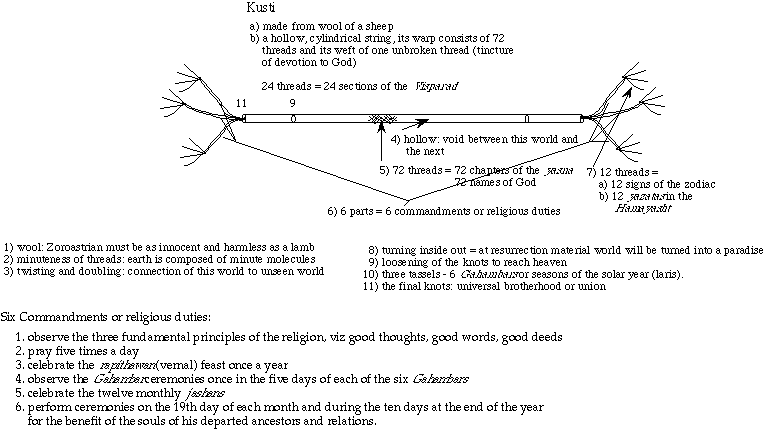
Being an ethical religion based on justice, Zoroastrian laws are devised to regulate human affairs so that the individual can live a prosperous life on earth and attain Garodman in the hereafter. The process of preparation for this good afterlife begins when children are between the ages of nine and fourteen. At this time the children are made conscious of their mission on earth and are taught responsibility for their thoughts, words, and deeds during every moment of their mortal life. A ceremony (nowjat) in which the children are given a belt (kusti) and a shirt (sudrah) completes this stage.
Both items bestowed in the ceremony have symbolic value. The kusti is a hollow, cylindrical string made from the wool of a sheep. The warp of the kusti consists of seventy-two and the weft of a single, unbroken thread. On each side of the kusti, there are three tassels, each of which ends in four strands. Each of these various parts of the kusti is symbolically rich and central to an understanding of the intent of the faithful person wearing it. The wool, for instance, represents innocence, the minuteness of the thread reflects the composition of the earth from minute particles, and the twisting and doubling that goes into the making of the body of the kusti represent the connection between this world and the unseen. Similarly, the hollow of the kusti represents the void between the two worlds, the seventy-two threads the seventy-two chapters of the yasna, 10 and the six tassels at the ends the following six Zoroastrian commandments: 1) observation of the fundamental principles of good thoughts, good words, and good deeds; 2) observation of the gahambars; 3) praying five times a day; 4) celebration of the rapithawan (vernal) feast once a year; 5) celebration of the twelve monthly jashans; and 6) celebration of death rituals for the souls of the departed (on the 19th day of each month and during the last ten days of the year).
After the kusti is woven, it is turned inside out, which expresses the hope that at resurrection the material world will be turned into a paradise, and before the cylinder reaches the tassels, the weave is loosened to indicate that heaven is accessible to all. Finally, the three tassels on each side suggest the six gahambars (seasons of the solar year), the final knots symbolize universal brotherhood, and the twelve strands on each end the twelve signs of the zodiac. 11
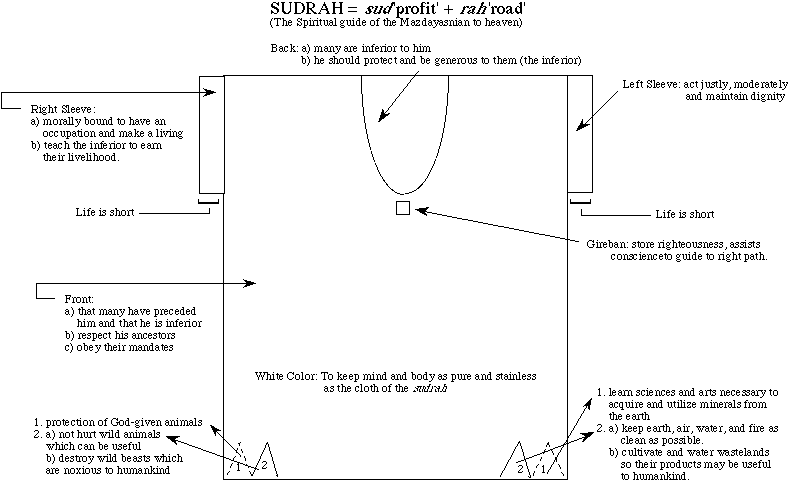
The kusti is tied around the waist over the sudrah, a white garment with symbolic values of its own. With its white color, the sudrah reminds the faithful that they should keep their body and mind pure. The back of the sudrah informs the faithful that many are inferior to him and that they must be protected and shown generosity. At the bottom of the back, on each side, there is a triangle sewn into the cloth with the one to the left suggesting that the faithful must study the sciences and arts necessary for harnessing the mineral resources of the earth. The triangle to the right reminds the faithful that the animal kingdom is under human protection.
The front of the sudrah indicates that many have preceded the faithful and that the will of the ancestors must be carried out. Like in the back, two triangles are sewn to each side of the front. On the left, one triangle indicates that the sacred elements of earth, air, water, and fire must remain undefiled and that wastelands must be cultivated and watered. On the right, the other triangle indicates that beneficial animals must be nourished while the harmful must be destroyed. The sleeves of the sudrah are very short to signify that man's life on earth is short. Whereas the left sleeve reminds the faithful to be judicious, moderate, and dignified, the right sleeve urges the faithful to have an occupation and to teach the young an occupation.
In the top center of the front, under the "V" of the neck a small "bag" called gireban is sewn. Through an opening on the top of the gireban, the faithful symbolically store righteousness, earned daily by practicing the commandments.
Children are also made aware of the importance of purity and of the laws governing the exposition of corpses in the dakhmas, rituals surrounding coming in contact with defiling agents, especially dead bodies. Marriage and procreation are considered duties, so the disregard of the institution of marriage is deemed detrimental to the enhancement of the kingdom of good. Honesty, truth, charity, and hospitality are recognized as virtues, as are tilling the soil, breeding cattle, and tending dogs and oxen.
Certain ancient Zoroastrian beliefs like next-of-kin marriage were performed by the nobility to prevent mixing noble and common blood; they are alien to Christians, Jews, and Muslims. Certain other laws like restricting abuse of water and mineral resources are advanced for their time.
The Zoroastrian calendar is quite elaborate with months and days assigned to patrons and a number of designated festivals. Prominent among them are the Nau Ruz (new year), Mihragan (the day consecrated to Mithra) and the gahambars (festivals connected with the six seasons of the year). The days on which the dead are remembered are of special significance.
It is impossible to walk through the ruins of Persepolis and not see the symbolism relating to the triad of gods that were worshiped at the time. Like the symbolism of the kusti and the sudrah, the architectural remains of Persepolis tell their own story. The most prominent symbol, of course, is that of Ahura Mazda, hovering over the head of the ruler.
Ahura Mazda's astrological sign is the planet Jupiter. Wind and air symbolize his elemental aspects as do the sky his location and birds, especially eagles, his animal nature. The head of the eagle appears atop many of the columns still standing in the structure. In human form the deity appears as a perfect man with a long, trimmed beard. Cypress and lead represent his plant and metal worlds, respectively. Of colors, Ahura Mazda favors azure, turquoise blue, and green. Turquoise, lapis-lazuli, and emerald are his favorite jewels.
A similar set of values represents the god Mithra, another of the gods of the triad. Mithra's astrological sign is the sun. Light symbolizes his elemental aspect as does the earth his location and lions and horses, his animal nature. The human form of the deity is a youth resembling a crown prince carrying a bow and three arrows. The palm tree, lotus blossoms, and sunflowers represent his plant nature, while gold symbolizes his metal world. Of colors, Mithra favors red, yellow, orange, gold, and purple. Ruby is his favorite jewel.
The goddess Anahita's astrological sign is the moon. Water, snow, rain, hail, and dew symbolize her elemental aspect as do the rivers and seas her location and bulls, rams and other horned animals, her animal nature. She appears as a tall, slim, beautiful lady resembling a queen, wearing a diadem. Lotus blossom represents her plant nature while silver symbolizes her metal world. Anahita favors the color white with pearl as her favorite jewel.
Achaemenian artists used these aspects of the triad in choosing the appropriate colors, ornaments, and motifs for the palaces. The most ingenious combination of these aspects, however, is the bird-like being that hovers above the king's head in the Achaemenian friezes. Prominent features of the bird are the spread out wings and the tail. The bird, of course, is the eagle, symbolizing Ahura Mazda. Often the human body of Ahura Mazda is added above the wings. On the two sides of the body, there are two tails. Examined closely, they are the tails of lions, symbolizing the sungod Mithra. Below the wings, on the two sides of the eagle's tail, are another set of two tails. These tails, however, are those of two bulls, symbolizing the goddess Anahita. The body of the eagle is usually a circle, representing the farr. 12
The Achaemenians made extensive use of these symbols, and they appear in many combinations, especially in the form of griffons, in the decoration of their places at Susa and Pasargadae. The head, wings, and claws of the eagle are usually attached to the body of a lion with the horns and tail of a bull.
The correct dynastic line of the Achaemenians is still to be determined. The reasons for the indecisiveness include a number of similar names mentioned by the later Achaemenian monarchs regarding their own ancestry, ancient reports of Western historians, and a lack of reliable evidence that could firmly and properly assign the very early rulers their places in the dynastic line. The eponymous ancestor of the Achaemenians is Hakhamanesh or Achaemenes, whose name is a compound of hakhi (friend) and manesh (disposition, temperament) meaning "devoted to friendship." Achaemenes was an overlord or clan chief, not a king, though he could have been lord of a domain in the early decades of the seventh century before Christ. He might have been a vassal of the king of Media and might have mobilized the combined forces of Parsumash and Anshan against Assyria in BC 681. The title of king is used for the first time in relation to the son of Achaemenes, Teispes or Cheshpesh. Teispes I was followed by Cambyses I, and Cyrus I, whom we know of only through later references. We have slightly more information about Teispes II, Cyrus II, and Cambyses II, who follow them. The Achaemenian Empire begins with the son of Cambyses II, Cyrus III the Great. He is followed by his son Cambyses III the Conqueror of Egypt. With the death of Cambyses III, this line of the dynasty comes to an abrupt end.
Teispes II ruled over Anshan and Elam, both located in the present-day Khuzistan province of Iran. In the hostilities between the Elamites and the Assyrians, he remained neutral. Teispes II had two sons, Cyrus and Ariaramnes, between whom he divided his kingdom at his death. It is not clear from the sources whether Ariaramnes actually ruled, even though he referred to himself as king of kings in an inscription unearthed at Hamadan:
Ariaramnes, the Great King, King of Kings, King in Persia, son of Teispes the King, grandson of Achaemenes. Saith Ariaramnes the King: This country Persia which I hold, which is possessed of good horses, of good men, upon me the Great God Ahura Mazda bestowed. By the favor of Ahura Mazda I am king in this country. Saith Ariaramnes the King: May Ahura Mazda bear me aid. 13
Arsames, who followed Ariaramnes, also considered himself Iran's king of kings as is evident from his inscription at Hamadan:
Arsames, the Great King, King of Kings, King in Persia, son of Ariaramnes the King, an Achaemenian. Saith Arsames the King: Ahura Mazda, great god, the greatest of gods, made me king. He bestowed on me the land Persia, with good people, with good horses. By the favor of Ahura Mazda I hold this land. Me may Ahura Mazda protect, and my royal house, and this land which I hold, may he protect. 14
The denial of kingship to both is documented in a statement by Darius I about his own rule being the ninth in the line of the Achaemenian kings. 15 If that is the case we are either speaking about a different line of kings, or we should deny two of the earlier kings their kingship. No matter how this dynastic puzzle is resolved, however, there is no doubt about the great significance to be attached to the line of Ariaramnes in relation to the rise of his grandson, Darius I, and in conjunction with the survival of the Achaemenian line.
Cyrus II, the grandfather of Cyrus III the Great, could have ruled over both Anshan and Parsumash. And after the fall of Elam to Assyria, he could have become a vassal of the Assyrian king. The appearance of his son, Arukku, carrying tribute to the court at Nineveh is evidence that some kind of relationship existed. Submission to tyrannical Assyrian rule, therefore, cannot be totally ruled out.
Cambyses II (Old Persian, Kambujiya) ruled Anshan for one year: from BC 600 to 559. He succeeded his father as the ruler of Anshan and married the daughter of Astyages. Cyrus III the Great was born of that marriage.
Cyrus III the Great (Cyrus) ruled for twenty-nine years: from BC 559 to 530. Born sometime between BC 585 and 575, in either Media or Parsa, he was the son-in-law of Astyages, the Median king and overlord of the Persians. As the first great leader of the Achaemenian Dynasty, Cyrus rebelled against Astyages, the last king of Media, and defeated him in BC 550. By shifting the power from Media in the northwest of present-day Iran to the Khuzistan and Pars provinces to the south, he established the noble house of Achaemenes among the ruling houses of his day, especially Lydia, Babylonia, and Assyria which, at the time, was ruled by Media. 16 They had now to contend with Cyrus rather than with the Median kings.
After the consolidation of his power in Pars and Media, rather than close to home, Cyrus decided to attack the kingdoms on the fringes of the now defunct Median domain. Therefore, he subjugated Armenia and conquered Lydia around BC 547 before taking on Babylonia in BC 539. When the time came, however, Babylonia fell without resistance. This most easy but famous victory, celebrated throughout the land, was documented in the Chart of Cyrus, inscribed on a clay barrel:
(one line destroyed)
... [r]ims (of the world) ... a weakling has been installed as the enű 17 of his country [the correct images of the gods he removed from their thrones, imi]tations he ordered to place upon them. A replica of the temple Esagila he has ... for Ur and the other sacred cities inappropriate rituals ... daily he did blabber [incorrect prayers]. He (furthermore) interrupted in a fiendish way the regular offerings, he did... he established within the sacred cities. The worship of Marduk, the king of the gods, he [chang]-ed into abomination, daily he used to do evil against his (i.e., Marduk's) city ... He [tormented] its [inhabitant]s with corvée (lit., a yoke) without relief, he ruined them all.
Upon their complaints the lord of the gods became terribly angry and [he departed from] their region, (also) the (other) gods living among them left their mansions, wroth that he had brought (them) into Babylon (Su.an.na.ki). (But) Marduk [who does care for] ... on account of (the fact that) the sanctuaries of all their settlements were in ruins and the inhabitants of Sumer and Akkad had become like (living) dead, turned back (his countenance) [his] an-[ger] [abated] and he had mercy (upon them). He scanned and looked (through) all the countries, searching for a righteous ruler willing to lead him (i.e., Marduk) (in the procession). (Then) he pronounced the name Cyrus (Ku-ra-as), king of Anshan, declared him (lit, pronounced [his] name to be(come) the ruler of all the world. He made the Guti country and all the Manda hordes bow in submission to his (Cyrus') feet. And he (Cyrus) did always endeavor to treat according to justice the black-headed whom he (Marduk) has made him conquer. Marduk, the great lord, a protector of his people/worshipers, beheld with pleasure his (i.e., Cyrus's) good deeds and his upright mind (lit., heart) (and therefore) ordered him to march against his city Babylon (Ká.dingir.ra). He made him set out on the road to Babylon (DIN-TIR) going at his side like a real friend. His wide-spread troops-their number, like that of the water of a river, could not be established-strolled along, their weapons packed away. Without any battle, he made him enter his town Babylon (Su.na.na, sparing Babylon (Ká.dingir.ra) any calamity. He delivered into his (i.e., Cyrus's) hands Nabonidus, the king who did not worship him (i.e., Marduk). All the inhabitants of Babylon (DIN-TIR) as well as of the entire country of Sumer and Akkad, princes and governors (included), bowed to him (Cyrus) and kissed his feet, jubilant that he (had received) the kingship, and with shining faces. Happily they greeted him as a master through whose help they had come (again) to life from dead (and) had all been spared damage and disaster and they worshiped his (very) name.
I am Cyrus, king of the world, legitimate king, king of Babylon, king of Sumer and Akkad, king of the four rims (of the earth), son of Cambyses (Ka-am-bu-zi-ia), great king, king of Anshan, grandson of Cyrus, great king, king of Anshan, descendent of Teispes (Si-is-pi-is), great king, king of Anshan, of a family (which) always (exercised) kingship whose rule Bel and Nebo love, whom they want as king to please their hearts.
When I entered Babylon (DIN-TIR) as a friend and (when) I established the seat of the government in the palace of the ruler under jubilant and rejoicing, Marduk, the great lord, [induced] the magnanimous inhabitants of Babylon (DIN-TIR) [to love me], and I was daily endeavoring to worship him. My numerous troops walked around in Babylon (DIN-TIR) in peace, I did not allow anybody to terrorize (any place) of the [country of Sumer] and Akkad. I strove for peace in Babylon (Ka.dingir.ra) and in all his (other) sacred cities. As to the inhabitants of Babylon (DIN-TIR), [who] against the will of the gods [had/were..., I abolished the corvée which was against their social standing. I brought relief into their dilapidated housing, putting (thus) an end to their (main) complaints. Marduk, the great lord, was well pleased with my deeds and sent friendly blessings to myself, Cyrus, the king who worships him, to Cambyses, my son, the offspring of [my] loins as well as to all my troops, and we all [praised his great [godhead] joyously, standing before him in peace.
All other kings of the entire world from the Upper to the Lower Sea, those who are seated in throne rooms, (those who) live in other [types of buildings as well as] all the kings of the West land living in tents, 18 brought their heavy tributes and kissed my feet in Babylon (Su.an.na). (As to the region) from ... as far as Ashur and Susa, Agade, Eshnunna, the towns Zamban, Me-Turnu, Der as well as the region of the Gutians, I returned to (these) sacred cities on the other side of the Tigris, the sanctuaries of which have been ruins for a long time, the images which (used) to live therein and established for them permanent sanctuaries. I (also) gathered all their (former) inhabitants and returned (to them) their habitations. Furthermore, I resettled upon the command of Marduk, the great lord, all the gods of Sumer and Akkad whom Nabonidus has brought into Babylon (Su.an.na) to the anger of the lord of the gods, unharmed, in their (former) chapels, the places which made them happy.
May all the gods whom I have resettled in their sacred cities ask daily Bel and Nebo for a long life for me and may they recommend me (to him); to Marduk, my lord, they may say this: "Cyrus, the king who worships you, and Cambyses, his son, ... " ... all of them I settled in a peaceful place... ducks and doves,... I endeavored to fortify/repair their dwelling places...
(six lines destroyed). 19
In Lydia, Cyrus treated the defeated king Croesus with kindness. And upon his entrance into Babylon, as we have seen, he touched the hand of Marduk, the Babylonian god who had been outshined by the moon god, Sin. He even went as far as proclaiming himself an appointee of Marduk, a practice that Darius I used later in relation to Ahura Mazda and himself.
Cyrus headed a semi-nomadic people. He sought to establish a prosperous kingdom by bringing the peoples of many nations together and by creating a sense of harmony in the land. Peoples of the defeated nations, especially those who recognized the value of stability for trade, supported him.
Cyrus expanded his rule by capturing the key domains of his time, countries that were on the trade routes and which had gathered much wealth, especially in grain and gold. To the west he now had access to Lydian gold, which he could use to provide funds for his wars of expansion. But his troops also needed provision. Access to the fertile lands of the Nile was the answer to that problem. He could even garnish his gains with ivory from Ethiopia and build lavish palaces to replace his nomadic tents. To the east, Cyrus extended Iranian rule as far as Capisa, north of present-day Kabul and, in the northeast, as far as the city of Cyropolis, hoping to establish relations with the kingdoms in the Far East.
When he was sixty-one years old, Cyrus was killed in battle, in BC 529, fighting in the east against the Massagetae of Scythia. Queen Tomyris, whose son had been killed by Cyrus, had Cyrus decapitated. Then she, reportedly, dipped the severed head in human blood and said, "Cyrus, have your fill of blood!" Cyrus's body was carried to Parsa and buried in a humble tomb at Pasargadae, at a place called Murghab.
Cyrus administered his kingdom wisely. He continued the administrative practices of the Medes in the heartland and did not introduce drastic changes in the cultures and lifestyles of the other newly acquired lands. He respected the gods of the other nations and based his rule on tolerance. As a token of his generosity, Cyrus freed 40,000 Jews from captivity in Babylon. They were allowed to take all their valuables, including 5,400 silver and gold utensils with them. For this act, Cyrus was loved and venerated by the Jews, and his name was immortalized in the Torah (cf., Ezra 1:14; Isaiah 45:13).
Among the ancient world figures, Cyrus rivals Alexander the Great and Julius Caesar. He is recognized as a conqueror of the hearts of his subjects. He ushered in an era of tranquillity and prosperity blessed with justice where before only Assyrian tyranny had ruled. Although a decisive ruler, Cyrus did not kill any kings or sack any lands. Rather he befriended defeated monarchs and rebuilt temples left in ruin by conquerors before him. "Even is his boyhood," wrote Xenophon, "grown men were captivated by Cyrus's wisdom, resilient spirit, guilelessness and physical beauty." 20 Cyrus combined sagacity and statesmanship with valor and a zeal for world conquest. He was a determined and steadfast man who put wisdom ahead of the sword. 21
Cambyses III (Cambyses) ruled for eight years: from BC 530 to 522. He was the eldest son of Cyrus III from the daughter of an Achaemenian nobleman. During Cyrus's lifetime, Cambyses was, for eight years, the crown prince and the governor of Babylonia. At the time of Cyrus's death, Cambyses, the Regent of Babylonia, was fully informed about the top decisions that his father had made. He was aware, for instance, that his father intended to invade Egypt and to annex Ethiopia to Persia. After his accession to the throne, therefore, Cambyses implemented Cyrus's plan and captured Egypt. He also planned some conquests of his own which included annexation of the Oasis of Amon and of Carthage. In reality, however, he succeeded only in annexing northern Ethiopia before his supplies ran out and he was obliged to return to Egypt. Cambyses was also responding to news arriving from Iran that his brother, Smerdis, had usurped the throne in the heartland.
Cambyses was a very different king from his father. He did not rule wisely. Indeed, according to Darius, after Cambyses restored order and assumed the rulership of Iran, unknown to the members of the court and the public, he had his rebellious brother, Smerdis, eliminated. This deed then plagued him throughout his stay in Egypt, especially when a Magian named Gaumata-perhaps the only person knowledgeable about Smerdis's death-usurped the throne. In northern Ethiopia at the time, the attempt by Cambyses to return to Iran and restore order was aborted by his mysterious death en route to Iran. Whether he was killed or committed suicide due to his maniacal tendencies remains a question. He died, however, in the summer of BC 522 in Egbatana (Syria), Syria.
Cambyses lacked many of Cyrus's virtues, especially his tolerance. He mocked the religion of the Egyptians and destroyed their temple. He even stabbed the sacred Apis bull at Memphis, an act for which the Egyptians never forgave him.
Darius I the Great (Darius) ruled for thirty-six years: from BC 522 to 486. He was born in BC 550, most likely in the eastern regions of the present-day independent republics of Central Asia. His name is a compound of dara (possessor) and vohu (good), meaning "he who is innately good." He was the son of Hystaspes of the line of Achaemenes. Upon the mysterious death of Cambyses III, he rushed from Egypt to the Persian heartland. Aided by a party of six noblemen, he eliminated the pretender Gaumata and, at the age of twenty-eight, assumed the rulership of Iran. In Egypt, he had commanded the Immortals and had served as the king's spear bearer and bodyguard.
While Cyrus III and Cambyses III both carried the divine right (farr) to rule, Darius was not so endowed. His claim to the Achaemenian throne, therefore, needed divine sanction. To gain Ahura Mazda's benevolence and the support of the Persians, he fought nineteen battles during the same year. His bas-relief, commemorating his efforts for the unification of Iran, speaks for itself:
Saith Darius the King: "This is what I did by the favor of Ahura Mazda in one and the same year after that I became king. XIX battles I fought; by the favor of Ahura Mazda I smote them and took prisoner IX kings..." 22
And to further establish his legitimacy, Darius married Attosa, Cyrus the Great's daughter.
After Elam, Media, Assyria, Parthia, Margiana, and Scythia joined Persia and formed the Persian Empire, Darius's stance changed from consolidator to expansionist. To the east he captured the Indus valley and pushed the Scythians as far back as Sughdia. To the west, he crossed the Bosphorus and the Danube, pursuing fleeing Scythians deep into European territory. Nonetheless, even though the Scythians fled before his army and even though Thrace and Macedonia fell to his commanders, Darius did not extend his rule beyond his reach-not until all the necessary elements for a major war with the Greek city-states were in place. Instead, Darius concentrated his energy on administration. He knew that through administration he could provide a successful defense for the East and that a good and just administration would produce a grateful citizenry. This latter, he thought, was instrumental in not only gathering a good force together but feeding it as well. About his efforts in promoting trade by connecting ancient sea routes, he says the following:
I am a Persian. From Persia I seized Egypt. I commanded this canal to be dug from the river, Nile by name, which flows in Egypt, to the sea which goes from Parsa. Afterward this canal was dug as I commanded, and ships passed from Egypt through this canal to Parsa as was my will. 23
In his quest for a just and efficient administration, he raised the number of satrapies to twenty. 24 Each satrapy was administered by five royal appointees with the following charges:
The satrapies were connected to the center by the Royal Road. On this road, 1,677 miles in length, 111 stations were in operation, each able to provide fresh horses to the chapar or the messengers of the king. In seven days, the messengers covered the distance between Sardis and Susa, usually crossed by the Silk Route caravans in the course of three months.
In addition to following Cyrus's lead and allowing his subjects to retain their languages, religions, and cultures, Darius also reformed the tax system so that the farmers paid a tax relative to the yield of their land rather than a fixed amount. He introduced coinage (darik) and banking, improved agriculture by building qanats 25 and canals, and instituted a system of wages for the various tasks requiring hired labor at the court. 26
In BC 499, the time of tranquillity and construction gave way to a time of war when, the Ionians set fire to the city of Sardis in Asia Minor (Anatolia). This attack, in addition to several Greek uprisings in Persian-held domains, convinced Darius that the time had come to curb the excesses of the Greek city-states. The armies, Greek and Persian, met at Marathon in BC 490. Darius's armies, commanded by Mardonius and Datis, did not withstand the joined forces of the Greek city-states. Accepting defeat, Darius returned to Persia. There, before he died at Persepolis in BC 486, at the age of sixty-four, he chose Xerxes, his son by Attosa, to succeed him.
Persepolis was the crown of this religious and humane king's building projects. It was built as a showcase to meld the peoples of the vast empire together. Foreign dignitaries who arrived in Persepolis to congratulate the king on the occasion of the Nau Ruz, could appreciate the contributions of their people to the empire. Babylonian bricklayers, Median and Egyptian goldsmiths and designers, and carpenters from Ionia and Caria had worked together, building and decorating the palace with cedar from Lebanon, ivory from Ethiopia, turquoise from Khwarazm, and gold from Lydia.
The internal problems of the empire, however, were not easily masked by such shows of splendor. Breakaway satrapies, like Babylon and Egypt, had to be brought back into the fold. And, of course, this feat was not easily achieved due to the encouragement and support that those satrapies received from the Greek city-states. 27
Xerxes I ruled for twenty-one years: from BC 486 to 465. After Darius's death, Xerxes, the eldest among the four children born to Attosa, became king. His twelve years of governorship of Babylonia distinguished him among the other claimants, including Artabazanes.
Xerxes was born around BC 519. At the time of Darius's death in BC 486, he was thirty-seven years of age. As a first order of his rule, he quelled rebellions in Bactria, Egypt, and Babylonia. He dealt with Egypt and Babylonia personally and, after they were brought into the fold, stripped them of their autonomy. Even the statue of Marduk that had been installed in the city of Babylon by Cyrus the Great was taken away from the kingdom of Babylonia.
Like his father, after returning tranquillity to the land, Xerxes took measures to strengthen the Persian army. He intended to march on Greece and subdue the Greek city-states once and for all. He spent four years marshaling forces, digging canals, cutting roads through woods, and holding diplomatic negotiations with Greece's neighbors. Then, in the spring of BC 480, he brought his army to the Hellespont, from where he intended to lead them to Athens. It took seven days for his army of between 360,000 and two million to cross the Hellespont on a bridge made up of warships. At one point, when the sea was stormy, Xerxes ordered the sea to be whipped three hundred lashes to calm it down.
Although there were some initial setbacks, Xerxes won the battle of Thermopyle against the Greek city-states. That made him the only Persian monarch ever to march triumphantly into Athens. Having burned the Acropolis, Xerxes decided to return to Iran. But the war raged on and quite unwillingly he found himself drawn into a naval confrontation at Salamis. It was a confrontation that he knew he could not win because he faced Themistocles, the naval commander who had defeated his father at Marathon. But the army had to fight.
The battle at Salamis went badly for the Persians. Xerxes withdrew his troops and, fearing that he might become stranded in Europe, headed for the bridge of boats that he had left in place at the Hellespont. The command of the army and of the administration of the new satrapies in Europe was relegated to Mardonius and other commanders.
Xerxes died in BC 465, at the age of fifty-four. He achieved his goal of capturing Athens, but he failed to stem the tide of Greek incursions into the lands of the East. 28
Xerxes was the last great king of kings of the Achaemenian Dynasty. After his death, the empire continued its slow move downward, and patterns leading to its disintegration emerged. The less ambitious and incapable monarchs who followed failed to exploit the satrap system to instill stability in the vast empire. In fact, at the very moment when the king of kings needed these combined forces to repel the advances of the Greek city-states in Asia, the satraps were raising banners of rebellion, each trying to carve out kingdoms of their own from the moribund body of the empire.
The main concern of the throne during those dark days remained Greece, which pushed the Iranians out of Europe and remained impervious to all oriental intrigues. Furthermore, with the help of Greece, some Persian satrapies-Egypt and Syria in particular-declared themselves independent while others entertained similar plans. Iran, too, played the sabotage game, pitting Athens against Sparta. But the strategy was abandoned due to its prohibitive costs.
Darius III, the last Achaemenian emperor, was the grand-nephew of Artaxerxes II. He had to be recalled from his satrapy in Armenia to assume the rulership of Iran. He ruled for six years: from BC 336 to 330. Incompetent, cunning, and indecisive, Darius III could not withstand Alexander of Macedon's advance. He was defeated at Issus, and again at Gaugamela (BC 331). He fled before Macedonia's advancing army to Central Asia, where he was murdered by one of his own satraps in BC 330. With Darius III's death, the Achaemenian Empire came to an end.
The Achaemenian Empire, which lasted for over two centuries, underwent the three usual phases of rise, decline, and fall. Its rise was meteoric, its decline illusory, due to the gradual decay that set in toward the end of Xerxes I's reign, and its fall was tragic as monarch after monarch failed to recapture the farr that had brought the dynasty its many victories and untold glory.
What was the secret of the early Achaemenians that eluded their heirs? Except for Cambyses III, even though he conquered Egypt and northern Ethiopia, the early Achaemenian monarchs distinguished themselves as wise statesmen who employed excellent managerial and military techniques. They used their might for the common good, always seeking means that would elevate the empire's prosperity and the nation's well-being. During the first eighty or so years of the empire, Iran was a real world power to contend with. It was a unified realm even though its people belonged to many nations who had been allowed to use their own local languages, worship their own gods, and promote their own lifestyles. Outwardly they were Medes, Persians, Babylonians, and Egyptians, but inwardly they all were loyal subjects of the same king of kings to whom they brought tribute and for whom they fought battles.
What's more, the early Achaemenian era was fiscally sound. The Achaemenians coined the first Persian money called Darik, introduced a uniform tax system, and standardized the weights and measures used throughout the empire. Discouraging slave labor in the construction of their palaces-as opposed to serfdom whereby the individual was tied to the land and could be bought and sold-the Achaemenians paid wages to men, women, and children who contributed to the construction of roads, bridges, and many magnificent buildings at Susa, Pasargadae, and Persepolis. As is evident from the following list drawn up during the reign of Xerxes I, the wages were paid in shekels: 29
|
||
|
|
|
|
|
|
|
|
In addition, even though native Persians were exempt from taxes, the taxes were moderate and fair for the rest of the population, based on the yield of the land and geared to the individual's ability to pay.
The governmental structure of the Achaemenian Empire embraced all levels of society and provided incentive to produce. It was based on the Zoroastrian concept of universal rulership. The monarch, appointed by Ahura Mazda, was the chief source of law, order, and guidance. He dispensed his authority throughout the empire by means of an assembly of notables. The membership of this assembly varied from king to king and even included some members, like the satraps, who rarely appeared at the court. The membership of the assembly included, but was not limited to, satraps, the chief administrator, chief religious personages, military garrison commanders, and advisors. Each member contributed in a unique way to aspects of the king's stewardship of the empire, and for this reason, all these positions and many others at the court and in the satrapies were filled with individuals of Persian blood whose loyalty to the throne was beyond question.
The satraps played a major role in the governance of the empire. They acted as minor kings in otherwise independent kingdoms. In some cases, they coined their own money, levied their own taxes, and appointed most of the satrapy's administrators. Only the surplus tax was sent to the treasury of the great king. In addition, the satraps had their own armies, which they fielded when necessary in support of the king. During the rule of the early monarchs, when security was tight and transgressions were punished outright, the satraps rarely entertained the thought of rebellion or of unseating a reigning monarch.
The administration of the Achaemenian Empire was sophisticated. It consisted of various offices, each dealing with specific aspects of the social, political or economical needs of the realm. The most important office at the Achaemenian court was the office of the chief administrator. This office, in addition to the supervision of the governing apparata of the state, oversaw the collection of taxes, as well as the allocation of the same for state and royal projects. The chief administrator carried out his duties with the help of many lower level bureaus. For instance, one bureau sent supervisors to the satrapies to oversee the division of the taxes. It was the responsibility of the chief administrator to make sure that the taxes levied were divided equitably among the satraps and the king of kings. Another bureau took over the allocation process as soon as the taxes and the reports of the previously discussed bureau were filed at the court. Another major office in the administration was the office of the chief scribe. All communications, local, national, and international were processed at this office. The offices of the chapar and the "eyes and ears" of the king also worked in tandem with this office. The chief scribe, who was also the postmaster, was privy to much information that was not usually at the disposal of the other members of the assembly of notables.
The religious affairs and, to a great extent, the judiciary duties of the Achaemenian Dynasty were in the hands of the Magi, a priestly family of the Medes that had retained its status after the change of dynasty. Under Cyrus the Great, the Magi became very powerful. Gaumata, alleged to have usurped the throne while Cambyses III was in Egypt, was a Magi. Darius sought to curb the influence of the Magi in the administration, but apparently he did not succeed in establishing a direct link between the monarch and Ahura Mazda. The Magi continued to remain strong and influential.
The Magi believed in the principles of good and evil, promoted next-of-kin marriages, and exposed their dead to the elements rather than burying them, as was the custom of their Achaemenian overlords. Being a closed society, the Magi had made their profession hereditary. The responsibilities of the Magi at the Achaemenian court included officiating sacrifices, interpreting dreams, and studying astrology. They also dabbled in medicine, guarded the tombs of the Achaemenian kings, and participated in coronation ceremonies. Some even became advisors to kings.
At the Achaemenian court, in theory, the king was the chief judge and lawgiver. Often, however, he relegated his judicial capacity to senior wise men of the court, freeing himself to attend to the more pressing national and international problems. In practice, the laws were legislated by the Magi who, in the early years of the empire, had the exclusive right to judicial duties. Punishment was commensurate with the nature of the crime with lesser crimes resolved by administering a set number of lashes or fines of a certain amount of gold. Treason, adultery, murder, burning the dead, entering the king's quarters without permission, sitting on the king's throne in his absence, or insulting the members of the royal family were punishable by death.
The military commanders also played a vital role in keeping law and order and, along with the "eyes and ears" of the king, prevented the satraps from inciting rebellion or creating chaos in the land. They commanded their own squadrons, stationed within the satrapies; rather than to the satrap, however, the military commanders were responsible to the monarch and to his appointed secretaries only. The military commanders contributed to the Immortal guards and, consequently, served the prime minister by commanding the elite core of one thousand that guarded the king. As the first units to enter the battlefield, the military commanders' forces were the most reliable; in fact, they were the main executors of the king's offensive and defensive strategies.
Finally, the advisors played a political as well as a social role in the governance and the administration of the empire. To begin with, there were only seven influential families in Iran at any given time. The king's family was one, albeit the most influential, of these families. The king rarely made decisions without consulting the heads of the other families and, usually, chose his wives from among their daughters. Emissaries to foreign courts, envoys to convey special messages to the satrapies, and arbiters in support of the king's interests world-wide were chosen from among the members of these families.
The social structure of the Achaemenian Empire, too, was a reflection of the Zoroastrian universal order. The smallest societal unit was the family, but not all families shared the same size and status. As we have seen, the king's family-including a harem, an untold number of attendants, eunuchs, and workers-was the most important. The six families were the next in the hierarchy. The families of the satraps, administrators, priests, and commanders formed the rest of the fabric of the upper echelon of the Achaemenian society.
Each family was part of a clan, a lineage, and a tribe. Whether the chief of a tribe was included among the ruling elite decided the potential of that tribe's receiving land grants. If the tribe was included, where in the hierarchy it was placed would further define the roles that its members would play at the lineage, clan, and family levels. Future rights and opportunities available to each family were thus filtered through an invisible selective process. What made this complex scheme work without creating a great deal of unhappiness was the divine quality attached to Iranian rulership. At the beginning, Ahura Mazda had selected the king (cf., Qayomart) and, as the omnipotent ruler, the king had assigned responsibility to the satraps, nobles, and the rest of society, down to the bondsmen. Divine appointments were beyond mortal questioning.
Rights and privileges were awarded by the king in the form of land grants. Major contributors to the throne received large land holdings, which were then divided by the great families into smaller parcels and distributed among lower-level families for management. The process continued until there was no more land to be distributed. Those with land then hired the landless peasants to oversee the tilling and management of their parcels of land for a set share of the yield. The actual tilling, however, was done by serfs and bondsmen who were bought and sold with the land.
The sound fiscal economy which was mentioned earlier had two sides: a consumer side and a producer side. While the governors and administrators formed the consumer side of the Achaemenian economy, producers were the field workers, serfs, prisoners of war, and other bondsmen who, for obvious reasons, had failed to garner a piece of land to till for themselves. The gap between the haves at the top of the pyramid and the have-not serfs and bondsmen at the base was filled by a third group of skilled workers, artisans, and traders. This diverse group, which often incorporated barbers, stonecutters, bakers, and builders stimulated the economy by transforming agricultural and livestock products into food and consumer products, paving the way for setting up industrial enterprises.
The later Achaemenians, beginning with Xerxes I after his defeat at Salamis, abandoned the practices that had brought their ancestors glory and their nation prosperity. They no longer either headed their armies in battle or examined the quality or the suitability of the men who were sent from the satrapies for duty in the army of the king. Drawn more to harem intrigue than to the arena of world politics, the last monarchs relegated major decisions to incompetent flatterers and, when needed, imposed their will through intimidation and cruelty. Not surprisingly, they no longer enjoyed the loyalty and respect of their subjects. Furthermore, the enormous expenses that they incurred from waging pointless wars put a heavy burden on the treasury and, consequently, on the public. More importantly, their actions were detrimental to the well-being of the middle class that had been created by the earlier rulers in order to stimulate the economy and keep the administrative wheels of the empire lubricated. Under the last Achaemenians, the economy became stagnant, the satrapies became unruly, and the peasantry became destitute. In addition to all this decline, there was no one who could guide the empire.
Neither Cyrus III nor Darius I reared sons who could match them in statesmanship and wisdom. They nevertheless kept their children involved and informed of the affairs of the empire, grooming them for the future kingship of the realm. Ultimately, rather than educating and promoting their next-of-kin for leadership, the later Achaemenian monarchs eliminated all claimants to the throne. They also killed the generals, nobles, and would-be supporters of those claimants. Were it not for the extended and improved system of communication, the sophisticated governmental and administrative structures outlined above, and the tolerance exercised by the early monarchs, the empire would have collapsed much sooner than it did.
Contacts between Iran and Western cultures took place in early antiquity. The best known, of course, were the wars waged by Darius the Great and Xerxes I against the Greek city-states. Continuation of these hostilities ultimately led to the invasion of Asia by Alexander of Macedonia in BC 334, when an incompetent king, Darius III, ruled a weak Persian Empire.
Known as the son of Zeus and the true son of Achilles, Alexander ruled for thirteen years: from BC 336 to 323. He was born in Pella, Macedonia (now in Greece), in BC 356 to Philip II, king of Macedonia, and Olympias, the daughter of the king of Epirus. Throughout her life, Olympias refused to accept that Philip was Alexander's father. "Alexander's real father," she insisted, "was Zeus."
From childhood, Alexander's attention was drawn to politics and the military. His early training at the hand of his mother's uncle, Leonidas, provided him with a healthy body, as well as a strong will. At the age of thirteen, he was turned over to Aristotle who, for three years, taught him zoology, medicine, astronomy, philosophy, logic, poetics, ethics, and politics. Aristotle also taught the young prince much about the world of his time, especially about the Persians. Aristotle taught Alexander that the enslaved Persians, ignorant of etiquette, the arts, and sciences, were waiting to be liberated from the tyranny of their kings.
Alexander received his military training from his father. King Philip, in semi-formal sessions, taught Alexander the art of warfare. But more importantly, he fully involved the young prince in the affairs of state, allowing him to put his theoretical knowledge of politics into practice. Often Philip sent Alexander as his representative to important negotiations with the southern Greek states. It was with Alexander's aid, for instance, that Philip finally garnered the title of the Supreme Commander of all Greek forces poised to liberate the Greek domains long held by the Persians on the eastern coast of the Aegean Sea in Asia.
Philip was killed in BC 336. Having eliminated all rivals with the aid of his mother, Olympias, the twenty-two-year old Alexander was elected by the army as the new king of Macedonia. He also retained Philip's title of the Supreme Commander of all Greek forces which at the time were being trained and organized for a war against the Persian "barbarians." The main motive of the Greeks in this invasion, besides economic and political gains, was vengeance. Under Xerxes I, the Persians had marched into Athens and set fire to the Acropolis. The Greeks now wanted to humiliate the Persians.
At this time the Persian Empire consisted in the east of what are today the independent republics of Central Asia, Afghanistan, and part of Pakistan. In the center was present-day Iran and to the west was most of the contemporary Middle East, including Egypt and Asia Minor. Out of the twenty satrapies into which the empire was divided, Egypt had been the most troublesome for the Achaemenian monarchs, even for Darius and Xerxes.
In the three battles that ensued, the armies on both sides were tested for organization, strategy, and loyalty. At the heart of Alexander's army was the cavalry, which consisted of approximately 6,100 riders out of a total personnel count of 65,000. 30 After the cavalry had driven a wedge into enemy lines, the infantry phalanx with their long spears and shields took over. The loyalty of the Greek troops was to Alexander, their general and god-king. The Persian army, always superior in number of warriors, was commanded by the Persian nobility. In that army, blood ties and closeness to the king and his satraps determined and secured each commander's rank and sphere of activity; ability and experience were of secondary, often even tertiary concern. Furthermore, a considerable number of the Iranian armies' fighting men, including the famous commander Memmon, were Greek mercenaries who continuously exerted less effort than they had been paid for.
In addition, the Greeks had gained much knowledge about and insight into the Persians' way of life from contacts with Persian and other traders who frequented their coasts. Using this knowledge, the Greeks had evaluated the military might of Persia carefully, had studied her land mass for strategic points, and had learned about her war tactics and weaponry. This information further enabled the Greeks not only to devise new and better tactics but also to forge appropriate weapons with which to penetrate the ranks of the Persians, who relied instead on their superior numbers and ignored these aspects of their military.
The first battle between Alexander's army and the forces of Darius III was at the Granicus Rriver in BC 334. The Persian defenders, in spite of the advantage of the strategically important heights they commanded, failed to implement their main plan to eliminate Alexander in a melee. On the contrary, two thousand of their troops were captured and dispatched to Macedonia as prisoners of war, while the rest of the army withdrew to the east, to Issus. Alexander marched victoriously into Sardis and, on his way to Issus, loosened the Gordian Knot in Central Anatolia. 31
Darius chose Issus for his decisive battle with Alexander because it was placed strategically at the junction of Mesopotamia, Arabia, and Egypt. He intended to prevent Alexander from entering either Mesopotamia or Egypt. But that, too, was not to be. The Persian defeat at Issus was more disastrous than at Granicus-Darius's family and his entire entourage fell into Greek hands. From now on, Darius had to negotiate for ceasing of hostilities against his nation while pleading to Alexander for the life and well-being of his family. He went so far as to offer to cede most of the lands to the west of the Euphrates to the invader. Nevertheless, Alexander rejected the offer.
At the risk of Darius's regrouping and coming at him in full force, Alexander decided to dispossess Persia of Egypt before heading for Mesopotamia and the Persian heartland. Between Issus and Egypt, however, was Tyre, and its defenders were not ready to surrender to Alexander. It took a seven-month-long siege before Tyre surrendered. After this most spectacular victory of his military career, Alexander entered Egypt, where he was received with open arms. There he founded a city that still bears his name: Alexandria. He consulted the oracle at Amon-Re to confirm his vision of the world. While the Greek oracle at Delphi had already confirmed that he was the son of Zeus, Amon-Re confirmed that he was also the son of the god Amon and that he would conquer the whole of the known world. Alexander left Egypt in BC 331.
Alexander was adored by the men in the military. To them he was the tactician who never erred and the general who never lost a battle. He knew when to rest his soldiers, when to strike the enemy, and-more importantly-where to get food for his host. In addition, his troops always received handsome purses for their efforts in battle, money that they could send home for their loved ones or invest for the future of their children and of Greece.
The last battle between Darius III and Alexander took place on the plain of Gaugamela, near what is now Mosul, in present-day Iraq. Again the Persian army was routed-and for the last time. After this victory, the gates of the cities of Babylon, Susa, Persepolis, and Ecbatana were thrown open to the conqueror. Darius III fled, leaving behind his entourage and his harem, while Alexander marched into one of the most exquisite sights in antiquity, the ceremonial palace of Persepolis with its Apadana and the hundred-column Hall of Xerxes. Alexander stayed in Persepolis long enough to make sure that the gold furnishings and the precious stones that had decorated the doors and walls of the palace (10,000 mules and 6,000 camels carried the load) were on their way to Greece. At the end, before leaving for Susa, Ecbatana, and Ray, he sacrificed the palace to the gods as a symbol of his great devotion and as a signal to the Persian satraps, notables, and mu'bads that the might and glory of Persia was now a thing of the past. The pillaging of the city and the rape of women and girls ensued the burning of Persepolis.
After Persepolis, Alexander pursued Darius relentlessly until word finally came that Bessus, one of Darius's own satraps in Bactria, had killed the monarch. Alexander was also apprised that the same Bessus had proclaimed himself the new king of Bactria. Bessus was hunted down and, upon being captured, was executed at the hands of Persian loyalists for the murder of Darius. Bactria, with its capital at the city of Bactra, received special consideration and became the center for dissemination of Hellenism in Asia. Before Alexander now stood the Hindu Kush and, beyond it, the fertile river valleys of the Oxus, the Jaxartes, and Zarafshan. Alexander headed for Sughdia where he refurbished the city of Samarqand around the year BC 328. Having reduced Central Asia, Alexander now was ready to invade India and complete his conquest of the rest of the world.
In India, the monsoons put an end to Alexander's grandiose plan of world conquest. Tired and uncompromising, his commanders and soldiers refused to go any farther into Asia. Promising that he would return to finish the task, Alexander agreed to return to Babylon by way of the Gedrusian desert in present-day Baluchistan. Over two thousand men, women, and children died of thirst, snake bite, and sheer exhaustion during this long and arduous march. Shortly after that, Alexander himself died suddenly in Babylon in BC 323, at the age of thirty-two. His embalmed body, placed in a golden coffin, was sent to Alexandria, Egypt, for public display and burial.
An extraordinary individual, Alexander rejected the norms of his time. Although Aristotle had taught him that the Persians were uncouth barbarians devoid of civilization, in practice he sought to understand the Persian culture and, more importantly, forge a new union in which Greeks and Persians could shed the ignorance and the hatred of the past and rid themselves of isolation and hostility. To achieve that new world, Alexander set out to repopulate the old world with offspring of mixed Greek and Persian marriages. Fusing the educational efforts of the two cultures, Alexander had concluded, required a new set of family values. Leading the formation of the future family unit, therefore, Alexander himself chose a Persian bride, Roxane (Roshanak), and 10,000 others for his soldiers and generals. He also facilitated the instruction of 30,000 youths from the best Iranian families in Greek language, customs, and military science. Furthermore, Persian soldiers were included in the infantry while Persian satraps and commanders were retained at their previous posts. The addition of the regal robe of the king of kings of Persia to his wardrobe and the donning of the purple silk robe, which was exclusive symbol of kingship and which he wore very well, completed his advocacy of tolerance and cooperation, the hallmarks of the new empire.
Alexander's demand that they should obey him as they would have a Persian monarch did not sit well with Greek generals who had fought with him at Granicus, Issus, and Gaugamela. Refusing to prostrate themselves before Alexander, they tried instead to reach him and hold him in their arms in the manner of Greek commanders. Adhering to the long-standing tradition of Persian kingship, however, Alexander discouraged all personal proximity, signaling his adoption of the Persian regard for the sanctity of the royal space around the throne. Kneeling (proskynos) and kissing the ground before him were the options left to those who visited Alexander. Furious at Alexander's new ways, Cleitus, who called Alexander an "effeminate general," echoed the sentiments of most Greeks who regarded the young ruler a bastard. In retaliation, and at the cost of great personal distress, Alexander killed the general for his insolence.
Alexander's sudden death deprived him of a chance to make arrangements for a successor. The army chose Alexander's half-brother Philip III and his unborn son, Alexander IV, to succeed him, but neither choice guaranteed the unity necessary for the success of Alexander's cultural fusion program. Real power was divided between Antipater in Greece and Perdiccas in Asia with many other ambitious generals-Antigonus and Seleucus among them-vying for power. Of those able commanders, Antigonus finally eclipsed the rest and emerged as the future ruler of Europe and Asia. Seleucus and others temporarily obeyed him.
While Alexander had used the military might of Greece to forge political and cultural unity among the peoples of Europe and Asia, Antigonus used the military to eliminate those of Alexander's commanders, especially Ptolomy and Seleucus, who aspired to form powerful dynasties of their own. Out of the struggle that ensued, Alexander's empire emerged divided, torn between the Macedonian monarchy headed by Antigonus in Europe, the Ptolemaic monarchy in Egypt and southern Syria, and the Seleucid monarchy under Seleucus I in the East.
The founder of the Seleucid Dynasty is Seleucus I Nicator (conqueror), whose father, Antiochus, 32 was one of Philip II's commanders. After the capture of Susa, Seleucus became one of Alexander's trusted generals, commanding several thousand warriors. He also proved his value in the battle on the Hydaspes River in India. Like Alexander, he had an Iranian wife, Apama, whom Alexander had chosen for him. 33 At the time of Alexander's death, he commanded the cavalry. In the struggle for succession that ensued Alexander's death, Seleucus defeated Antigonus, captured Babylonia in BC 312, and marched into Media and the lands to the East. The East, at the time, besides present-day Iran included four other provinces (i.e., the satrapies of Bactria and Sughdia, Kabulistan and its environs, Herat and Sistan, and Qandahar and Baluchistan).
Like Alexander, Seleucus was resolute, brave, and benevolent. He was also a builder, constructing more than sixty cities, including one capital city on the Tigris called Seleucia on the Tigris and another on the Orontes, in Syria, called Antioch. In time, these cities became two of the most powerful commercial centers of the region. Unlike Alexander, Seleucus regarded the conquered peoples as inferior to Greeks. Consequently, his royal road that connected main centers of commerce did not contribute to the expansion of Greek culture into the eastern provinces as had been Alexander's wish. In fact, Seleucus's policies created friction between the indigenous population and the new rulers, resulting in hostility and division at a time that his kingdom was in need of unity and harmony.
In administration, Seleucus left the practices of the Achaemenians and Alexander untouched with the exception of fiscal matters. His only minor concession in this regard was the division of the empire from twenty into seventy-two satrapies, allowing non-Greek elements a slightly higher degree of influence in the governance of the state. But even this concession was not genuine in that many of the newly formed satrapies had been projected to be sacrificed for the creation of stability for the rest of the nation. This new move saw the light when, in BC 305, in the course of a visit to the East and in the context of his battles with the rulers to his west, Seleucus I made a deal with Chandragupta, the king of India. He agreed to give up the territories to the south of the Hindu Kush (i.e., the present-day Afghanistan and Baluchistan), in exchange for 500 elephants to be used in battles against his adversaries in Mesopotamia.
Like all the other dynasties of the past, the Seleucid Dynasty had its strong and weak points. The strength of the empire rested in its vast domain and its well-organized network of Greek cities, especially Seleucia and Antioch. Its weakness lay in its lack of a national identity. It could not persuade those with ethnic and national affiliations, especially the Iranians, to rally around the king. Unlike the Achaemenians who trusted the Iranians and Alexander who relied heavily on the Greeks, the Seleucids, because they had imposed their rule, did not enjoy the support of the ethnic and nationality groups they ruled. For this reason, the more their power became consolidated in the region, the more it became apparent to them that they needed the loyalty and the trust of their subject nations.
A solution to the loyalty problem had been tested in Egypt where Greek rulers had reintroduced the concept of a deified king. Thinking that the solution might resolve their problem, the Seleucids adopted the plan. The strategy did not work. Rather than unify the peoples, the concept of a god-king, as opposed to divine kingship, created discord and division for obvious reasons. The Egyptians were used to being governed by gods such as the sungod Re while the Persians were not. Neither the legendary kings of Iran-Kayumars, Kayka'us, and Kaykhusrau-nor the historical monarchs-Darius and Cyrus-had considered themselves God. They had spoken strongly about their being appointees of Ahura Mazda, but not Ahura Mazda Himself. Jamshid, the only legendary monarch to be so disposed, lost his farr simply because he tried to reach the stars and the abode of God.
Nevertheless, after the death of Seleucus I, Antiochus I Soter (the savior) firmly established himself as god in BC 281. Statues of his divine person were placed in all the Greek cities of the empire, and the kings who succeeded him also chose similar titles: Theos (god) and Epiphanes (appearance of god), for instance. But neither the deification of the king nor the saturation of the cities of the empire with Greek citizens imported from Europe could fill the vacuum created by a genuine national identity crisis. In fact, by BC 256, under Antiochus II, a united East, comprised of Bactria, Sughdia, and Merv had come into existence. This confederation successfully fought the Seleucids and established the Greco-Bactrian kingdom in the East. Within a few years, Parthia and Hyrcania also broke away, driving a wedge between Seleucia on the Tigris and the newly formed Bactrian kingdom in present-day northern Afghanistan. The move by Parthia not only curtailed Greek interests in the East but also jeopardized the territorial integrity of Bactria, which fell victim to the Yueh-chih nomads once it was isolated. The demise of Bactria brought Parthia prosperity and allowed it to expand westward into Seleucid territory.
The breaking away of Bactria and Parthia was not so much due to the strength of those satrapies, although strength was a factor in the equation, but more due to the weakness of the Seleucid Empire under Antiochus II. As mentioned, the Seleucid Empire lacked national unity, a shortcoming that did not go unnoticed by the Western powers still vying for their shares of Alexander's Eastern gains. In order to reach their ends, therefore, the Western powers followed policies that aimed at a gradual strengthening of the restive Eastern provinces of the former empire. They continued supporting those satrapies until they overcame the Seleucids and gained their independence.
Taking advantage of the next two weak rulers, Seleucus II and Seleucus III, the Parthians appeared on the Euphrates rapidly expanding their domain. However, their advance was not only stopped there suddenly, but they were pushed back by Antiochus III the Great (BC 223-187) who once again expanded the Seleucid Empire as far as India. This dramatic change of events returned the Parthian kings, if only temporarily, to their past positions, namely the governance of the satrapies for the Seleucids. Emboldened by this victory in the East, Antiochus III, upon his return to Antioch, invaded the lands to his west. He intended to annex Macedonia and, in the process, revive the empire of Alexander, but at Magnesia, Rome, stepping forward to protect the interests of the Western world, dealt Antiochus III a fatal blow. Following the accord reached at Apamea, Antiochus III gave up all his possessions in Asia Minor, and, of course, he lost all the prestige that he had recently gained in the East. Predictably, the Parthians regained their lost territories and reestablished their rule as the heirs of Achaemenes.
The rise of Cyrus the Great is important both for his establishment of an empire and for bringing peoples as distant as Lydia and Cyropolis together. Building on Cyrus's accomplishments, Darius exposed the cultures that Cyrus had nurtured to his own brand of Zoroastrian thought and Ahuric order and took that way of life to Europe. He intended to form Iranian colonies in Europe that, once interconnected, would lead to the establishment of the Ahuric order and the worship of Ahura Mazda throughout the world. Darius's plan, however, did not succeed. As we have seen, Darius was defeated at Marathon by the Greek city-states, and his vast empire gradually disintegrated.
The Iranians' determination to conquer the West was fueled by their duty to preserve and expand the Ahuric order set forth by Ahura Mazda as the only way for salvation for humanity. In this effort they followed the deeds of such greats as Kaykhusrau, who had defeated the Khaqan of China and reestablished Mazdaism in Turan. With a divinely appointed warrior-king like Darius at the head of a huge army, the Iranians were certain of victory over the disparate armies of the Greek city-states.
But the city-states were neither disunited nor weak; they drew strength from their long-standing experience with democracy and from institutions based on a rational approach to governance and administration. In addition to allowing social mobility and political freedom, the Greeks used their knowledge of the sciences to create superior weapons, as well as command viable military and naval forces. The West's defeat of the Persians at Marathon, and later at Salamis, had enhanced their opportunity to improve their defenses. It even had encouraged them to a change of strategy from a defensive attitude against the East to an offensive stance. The League of Corinth in BC 337, in which all Greek city-states except Sparta had participated, was a direct outcome of the new attitude born of the West's trust in the invincibility of democratic institutions.
Alexander of Macedon, the commander of the Pan-Hellenic forces, utilized the power that the democratic institutions and the technological progress of the time afforded him and became not only the ruler of the greater part of the world of his time, but also the founder of the type of empire that Darius had hoped to establish. After achieving victory in all fronts, and in order to promote Hellenism, the roots of which rested in Homer's Iliad and Odyssey, Alexander created small Greek-ruled enclaves in present-day Iran, Afghanistan, and Central Asia, and he trusted those small kingdoms to a mixed leadership of Eastern and Western rulers. Before long, Greek rule and Alexander became beacons of hope for a world in disarray; they were looked to not only for leadership but also for the establishment of new societal norms.
Alexander's task was enormous-in some ways more taxing than providing strategy, provision, and incentive for his large army in Asia. He had to rule two very different domains. Though united under the alliance of Corinth, one was still not fully devoid of anti-Macedonian sentiments, and another had been divided even under its own king of kings. Iran under the last Achaemenians was a kingdom fraught with struggle for power and intrigue. Could Alexander, even temporarily, tolerate the excesses of divine rulership while creating a medium that promoted democracy? His decision on the nature of the new order was crucial to the future of the two nations as well as of the world as a whole.
Alexander knew for certain that had it not been for Darius's defeat at Marathon in BC 490, Greeks would not have had the opportunity to live their lives in freedom and nurture their culture to what it was during his time. There was no question, therefore, that Greek institutions were central to his overall strategy. Why had the superior armies of Iran been defeated twice by smaller numbers of Greeks? A study of the defeats of Darius and Xerxes revealed that the Persian kings had been burdened with an enormous amount of responsibility, much more responsibility than one individual could carry. It was in the nature of divine kingship that only the king possessed the required insight into the inner workings of the cosmos, and only he could uphold the primordial Ahuric order. Put differently, Darius and Xerxes were defeated not so much because they were lacking in ability, but because they were handicapped by the very force that had made them kings of kings. How could the same individual chart military strategy, deploy troops, and provide for an enormous army while, single-handedly, attending to internal intrigue and international diplomacy as well?
Alexander did not have to go far for an answer. Rather than being permeated with the will of a deity, Greek culture promoted personal choice, freedom, and mobility for all. The individual had the right to participate in all affairs and contribute to the shaping of future events. Affairs of state were discussed in the open among those knowledgeable, and solutions to complicated issues were arrived at in general meetings and after reaching a consensus. The elected leaders' sense of nationalism, patriotism, and valor uniquely qualified them for their responsibilities.
As can be seen, bringing together these divergent philosophies-distinct as capitalism and communism-and offering the new empire a cause around which its multi-lingual and multi-cultural peoples could rally was not an easy task. Yet Alexander solved the problem with the same ease with which he undid the knot at Gordium. To borrow a much-quoted axiom and make it suit the times, he laid the foundation of an empire that was Persian in form but Greek in content. This strategy which did not sit well with some proud Greeks, did not do well for the Iranians either.
Capitalizing on the good will of those who trusted him, Alexander began the implementation of his Hellenization program while still in Central Asia. There, as well as in Afghanistan and Iran, he built garrison cities, water works, bridges, and fortifications, giving substance to Darius's wish to create a communication network that would unite the world of the time, and he laid the foundation of a unified culture.
The divisions among the peoples of Asia and Europe, however, were too deeply set to be easily breached. Like the Greeks, the Iranians, too, were skeptical of Alexander's designs for their homeland. The Zoroastrian mu'bads, our main local source of information, for instance, held Alexander responsible for the destruction of Iranian culture. Referring to him with the epithet gijastag (accursed), they blamed him for the destruction of their temples of fire and the burning of their most valuable copy of the Avesta. Their hatred for Alexander became even more intense in subsequent years as Ahura Mazda was gradually eclipsed by Zeus, Mithra by Apollo, Verethrangha by Heracles, Ashi by Nike, and Armaiti by Demeter. 34 The mu'bads sought ways whereby they could influence events and avert the impending destruction of their faith, but the task was not easy, especially as long as Parthian princes continued to import Roman ways into Iran through their frequent and lengthy stays in Rome.
The romantic and the traditional saw yet a different Alexander. Identifying the Macedonian with such illustrious Iranian saint-figures as Kaykhusrau, they imagined him searching for the fountain of youth in regions that only their fertile imaginations could create. In his ceaseless search for the elixir, King Iskandar encountered countless difficulties and strange creatures, including talking trees and talking snakes. He even met people with ears so large that the owners used them as blankets to rest upon. Within a short time, the Iranian story tellers took Alexander so deeply into Persian culture that little of his Macedonian identity remained.
Alongside the mu'bads and the romantically oriented were many Iranians who were impressed with the Greeks' attitude toward trade, travel, and adventure. They appreciated the way that the Greeks had employed proficiency in mathematics, medicine, geography, history, and the arts to improve aspects of life still in primitive stages in their own land. But what was perhaps the most intriguing aspect of Greek culture was the Greeks' philosophical approach to religion and to the nature of the deity. Before long, many Iranians found themselves listening to Greek music and poetry, attending Greek theater, and imitating Greek paintings and the plastic arts. It was also with the help of these same people that Alexander built roads and cities and promoted diversity as far and wide as he did. Knowing that Alexander had been subjected to at least four known conspiracies, all with the aim of stopping his liberal stance in relation to the conquered peoples, 35 these like-minded Persians believed in Alexander's sincerity and in his quest for a true fusion of the cultures of East and West. After all, Alexander had liberated those in the middle of the Iranian pyramid of power-the merchants, craftsmen, and bureaucrats-and had pushed the frontiers aside, ushering commerce and the flow of new and vibrant ideas into Iran by both land and sea. The equity and justice that permeated society and the prosperity that was in such stark contrast to what had transpired under the recent kings and satraps, were the results of the liberal measures of the new ruler.
Although Alexander did not assign an heir to his vast empire, his program of fusion of cultures was not abandoned. The generals who followed him, in spite of the intense struggle for power that consumed their time, carried out Alexander's wishes by building Greek centers wherein Greek power was preserved. They also followed Alexander's economic program as a result of which Iran, for instance, could export clothing, ornaments, drugs, precious stones, carpets, seed corn, lead, and pedigreed dogs. But none of these, not even the return to the ease and comfort of the earlier days, gave Iranians cause to rejoice. The root cause of the Iranian scorn rested in Alexander's policy for change for Iran. In his egalitarian society, Alexander had placed the interests of the Greeks first, promoting the superficial but attractive aspects of Iranian culture. The discriminatory nature of this treatment did not reveal itself until toward the end of the Parthian era. At that time it became obvious that Aramaic, the language of the Achaemenians, had given way to Greek and that the fundamental tenets of Zoroastrianism had ceded to Greek interpretation. Subsequent rulers, especially the first Sassanian monarchs, reacted very strongly against this trend. The later Parthians' reaction to Hellenism is reflected in their collection of the text of the Avesta, while the Sassanians reestablished Zoroastrian orthodoxy and strengthened the ancient social order.
Very little information remains about the longest ruling house of Iran, the Parthian Dynasty, which for some five hundred years held sway over most of the lands previously ruled by the Achaemenians. What information exists is culled from the writings of Western writers like Appian of Alexandria, Athenaeus, Orosius, Justinian, and Poseidonius, who often mix the political history of Parthia with that of the unstable Seleucids, resulting in a distorted picture of the role of both dynasties during this period of Iranian history. The difficulty is compounded by the fact that the Sassanians systematically erased all vestiges of Parthian Iran by defacing monuments and remodeling statues. The Sassanians even reduced the Parthian era by two centuries to avert an apocalypse foretold by the Prophet Zoroaster. All this, of course, belongs to the future.
Geographically, the original home of the Parthians was east of Ecbatana and Ray and west of Herat, the present-day province of Khurasan. The neighboring states of Parthia were Sistan to the south, Merv and Khwarazm to the north, Herat to the east, and Hyrcania (present-day Gurgan) to the west. Linguistically, the Parthians belonged to the Indo-Iranian branch of the Indo-European family. They spoke an Iranian language, the remnants of which are extant in Parthian Middle Persian.
Culturally, the Parthians were from the nomadic peoples of the steppe. Love of the hunt and hard drinking were among their distinguishing characteristics, as was use of the bow and arrow, especially as a lethal weapon. Once on a swift horse, the Parthian archer did not have a match. Historically, Parthia was acquired by Cyrus the Great as a part of his initial thrust east, and it remained in the empire until the defeat of Darius III and the fall of the empire. Parthia surrendered to Alexander without a fight.
As mentioned in relation to the political history of the Seleucids, during the rule of Antiochus II, Diodotus, the satrap of Bactria, rebelled against the Seleucid ruler and pronounced himself the king of Bactria. Shortly afterwards, Parthia, too, rose against Antiochus II at a time when the Seleucid ruler was engaged in the west, fighting a war with Egypt. In subsequent decades the Parthians, unlike the Greco-Bactrians, who were easily overrun by the Yueh-chih, consolidated their territorial gains and expanded their domain considerably until it reached from Herat to Babylonia and Assyria. The architects of the burgeoning Parthian Empire were Mithradates I and Mithradates II. 36 The former, like Cyrus the Great, founded the empire while the latter, like Darius, consolidated his predecessor's gains by organizing the military and reforming the administration. 37
Striking out of Parthia proper, Mithradates I quickly annexed Media, Persis, Babylonia, and Assyria in the West and Herat, Sistan, and Gedrosia to the East. Understanding the strategic value of Seleucia on the Tigris for trade and for the cultural hold it created on Seleucid possessions in general, he built the garrison city of Ctesiphon across from it. In time Ctesiphon became Parthia's fourth and most powerful center, holding the expansionist aspirations of Rome at bay.
Mithradates I died in BC 137. At his death, Parthia consisted of Parthia proper, Hyrcania, Media, Babylonia, Assyria, Elam, and Persis. Phraates II and his uncle, Artabanus II who followed him, barely held the empire together. Expansion to the west that had been a most likely scenario at the death of Mithradates I, was no longer possible due to the invasion of the Yueh-chih nomads who, having overrun the Greco-Bactrian kingdom to the east of Parthia, now threatened Parthia as well. Under Mithradates II, however, the situation changed again. Mithradates II pushed the nomad invaders away from Parthian borders all the way to Sughdia, recapturing all lost territories, including Merv, Herat, and Sistan. He also consolidated Parthian power in the West. After Mithradates II, the survival of the Parthian Dynasty was assured. Henceforth the question was one of territorial expansion, the degree of economic and political might, and especially friendly or hostile stance vis-ŕ-vis the West.
The history of Parthia, with its turbulent relations with the lingering Seleucid Empire and with Imperial Rome, is long, involved, and recursive, so it cannot be covered in the space allowed here. That history, however, can be somewhat generalized and divided into three main phases with each phase building on the activities and ideological trends of the previous phase.
The first phase dealt with the expansion and the consolidation of the Parthian Empire as the Parthian capital moved from Nisa to Hectampylos to Ecbatana and, eventually, to Ctesiphon. During this phase, as the fortunes of the Seleucids waned until their empire was totally eclipsed by Rome, the empire of the Parthians waxed, making them a formidable power in Mesopotamia. A main feature of this phase was the existence of friendly relations between Rome and Parthia that reached their zenith during the rule of Augustus Caesar, when many Persian princes were the guests of the Roman court. At that time Greek language and Greco-Roman culture permeated Iran to such a degree that for some Iranians, the Iranian past became all but a dream.
The truce between Rome and Parthia was motivated by commercial as well as political concerns. Both nations regarded the Seleucids as usurpers of their natural rights and both strove to weaken Seleucid hold on the lands between the Mediterranean Sea and the Euphrates by implementing policies that undermined Seleucid interests in the region. These anti-Seleucid policies eventually resulted in the collapse of the Seleucid Empire.
Phase two was a continuation of the first phase only in the sense that cordial relations between Parthia and Rome were honored. There was, however, a major difference. As rivals, Rome and Parthia intended to dispossess each other of territory that had been held by their predecessors. Rome, as the inheritor of the legacy of Alexander, regarded the Parthian feudal lords expendable and consequently looked upon Syria and Egypt as future Roman territory. The Parthians considered themselves the rightful descendant of the Achaemenian kings. Syria, Egypt, and Asia Minor, they believed, were rightfully theirs. Meanwhile, however, they followed the dictates of diplomacy and adhered to a policy of coexistence. Phase three began with open Roman hostility against Parthia in BC 53. Using Syria as a springboard from which to invade and conquer the Parthian Empire during his pro-consulship Crassus invaded Iran. But he did not succeed since both he and his son were killed in a major battle at Carrhae. Surena, the Parthian commander, returned from Carrhae, carrying Crassus's Roman eagles with him. The growing hostility between Rome and Parthia also sounded the death knell for Hellenism which had flourished in the region since the time of Alexander. Throughout the Seleucid era and into the Roman Empire, Hellenism had been allowed to flourish in both the Seleucid domains and in the cities held by the Parthians. That process was now to be halted, and in its place the culture of Iran as it had been promoted under the Achaemenians was to be reestablished. To implement the new policy, Vologeses II (AD 148-192) broke the truce with Rome and replaced the Greek language with Parthian Middle Persian. He also ordered that the Avesta, the sacred book of the Zoroastrians, especially the Videvedat or Vendidad or Videvedat (defense against demons), be organized and codified.
The de-Hellenization process, of course, was not easy. It had taken Hellenism a long time to penetrate Iranian culture; it would take just as long to put a meaningful end to it. Due to a scarcity of communication, the rural areas had not been affected greatly. In the reforms of Vologeses II, therefore, the urban centers, especially those with overt affiliation with Seleucid and Roman sympathy, were targeted. In these centers, the use of the Greek language was banned and the phrase philhellene was dropped from the coinage. The statues of Greek gods, which by now had blended into the religious landscape of ancient Parthia, were toppled and, once again, Ahura Mazda, Mithra, Verethrangha, Ashi, and Armaiti were revered. This process gradually weakened Rome's strong cultural influence; and restored Zoroastrianism its prestige as the sole religion of Iran. To assure that Rome would honor Iran's wishes and stay at a safe distance, xenophobia was added to religious fervor. By the time that the Parthian power was eclipsed by Sassanian might, Hellenism had already been overtaken by Zoroastrianism.
At its zenith, the Parthian Empire consisted of Parthia proper centered on Ctesiphon, as well as a number of domains over which it had direct jurisdiction. Parthian satraps were sent to these regions to collect taxes and administer justice. Parthia also exerted influence over and provided security and support for a number of other kingdoms from which it received tribute.
The power of the king under the Parthians was much more limited than under the Achaemenians. Administratively, the king followed the traditional tribal law and ruled by consensus. Government consisted of two houses-a Royal Council and a Council of Elders. The former was populated by adult males of the royal house, the latter by experienced male elders and religious personages of Parthian blood. Major decisions, such as the appointment of a new king, took place in a Supreme Council in which select members from both the Royal Council and the Council of Elders participated.
Membership in the Supreme Council was a Parthian right and the royal house had very little influence on most of those making the decisions. The king had to satisfy three requirements for kingship: Parthian blood; competence in rulership, administration, and soldiery; and being the elder son of the reigning king. If these three requirements were not met, the Supreme Council would consider other eligible individuals close to the crown, going down the line, if circumstances required, as far as the king's uncles. After a king was appointed, however, the situation changed. The all-powerful king, in order to secure his position, usually eliminated those Council members who had either voted against his election as king or who now disagreed with his policies as king.
The degree of power invested in the nobles as a class at this time is also unprecedented in Iranian history. The nobles could dismiss a king or replace him with a king of their choice. They could do so, because the king's military was superior to each individual satrap's army but insignificant compared to the power of the combined forces of the satraps. Indeed, the great wars that the Parthians fought against Rome during the second phase of their rule were fought by the contingents contributed by the nobility. The powerful house of Suren, for instance, must have played a role reminiscent of the legendary houses of Sam and Vise in Firdowsi's Shahname.
The Parthians continued the Achaemenian practice of next-of-kin marriages as when Cambyses III married his own sister, as well as many of the other Achaemenian traditions and traits. They treated their captives with respect and remained faithful to their word. Although to a lesser degree than for the Sassanians, Zoroastrianism played a unifying role-the very role that the Seleucids had hoped deification of their emperors would play for them.
Built in the third century before the Christian era, the great wall of China was intended to keep the nomads roaming to the north, in the Gobi desert, away from the sedentary population of China to the south. The northern nomads, known as the Hsiung-nu, were of Turko-Mongol origin. They had short, stocky bodies, as well as characteristically Mongolian large round heads, broad faces, wide nostrils, bushy mustaches, and slit eyes. 38 In the main, they were cattle herders and livestock breeders, moving with the herds between summer and winter quarters. As individuals, they were ferocious warriors who tied the severed heads of their first victims to their saddles and who used the skulls of their enemies for their drinking cups.
By the middle of the third century, the Hsiung-nu had become united into a formidable confederation of tribes. In search of new pastures, they left the Gobi for China, the present-day Kansu Province, and its fertile plains to the west of the Yellow River. When confronted with the massive wall of China, its fortifications, and defense capabilities, the Hsiung-nu satisfied themselves with the capture of the easier regions to the west of the river, populated at the time by the Indo-European Yueh-chih. This is the first time that the Turko-Mongol peoples of Upper Asia come into contact with the Indo-European peoples living farthest to the east of their original homeland, wherever that homeland might have been in Europe, Asia Minor, or the Urals.
The Yueh-chih were no match for the Hsiung-nu. Under pressure, the Yueh-chih divided themselves into two groups, the Lesser and the Greater Yueh-chih. The former followed the Yellow River to its source in the Tibetan uplands, where the Lesser Yueh-chih became assimilated into the Tibetan culture. The Greater Yueh-chih crossed the Gobi desert and entered the Ili Valley and Issyk Kul Basin, which was at the time inhabited by the Wu-sun.
Supported by the mighty Hsiung-nu confederation that spanned the northern territories between the Urals and Manchuria, the Wu-sun defended their territory against the Yueh-chih, leaving the Yueh-chih to continue their march and enter present-day Ferghana valley and the Jaxartes region. Here the Yueh-chih met and displaced the Saka population of the region.
As was discussed earlier, two eastern kingdoms broke away from the Seleucid Empire under the rule of Antiochus II and gained their independence. They were the kingdoms of Bactria and Parthia. The Yueh-chih, in their march south overran Bactria. After consolidating the powers of their five chiefs in a new dynasty, the Kushan Dynasty, they settled in present-day Afghanistan and northwestern India. From there, under Kujula Kadpheses I, the great Kushan Empire rivaled the other great powers of that time, Parthia, Rome, and China. Under Vima Kadpheses II (son of Kujula Kadpheses I) the empire spread even farther into India as well as to the west and north.
The most well-known emperor of the Kushans is the great Kanishka, an ardent follower of the precepts of the Buddha. Kanishka expanded the Kushan Empire to include lands from the Oxus to Patna on the Ganges and from the Pamirs to the Indus River and Iran. Kanishka had two capitals, one in Bagram in Capisa (Kabulistan region, north of the city of Kabul) and one in Purusupura (Peshawar), but most of his efforts were spent on making Gandahara a powerful center for trade as well as for religious and literary activity.
In later times, as we shall see, the Kushans were defeated by the Sassanian kings of Iran and were forced to migrate even farther into India, the land of their fellow Buddhists. In India, they gradually lost their identity as an independent nation and were assimilated into the Indian culture.
The Saka, on the other hand, had their eyes on the territories of the Parthians to their west. After the death of Mithradates I, when the Seleucids temporarily reasserted themselves and engaged the Parthians in Syria and Mesopotamia, the Saka took Merv, Herat, and Sistan, expanding their rule extensively along that of the Yueh-chih in Bactria. Pharaates II and Artabanus II, as we have seen were quite powerless against the Saka. The coming into power of Mithradates I, however, put an end to both the Seleucids' hope for recapturing the lands that they had lost to the Parthians and to any aspirations for expansion that the Saka entertained. Mithradates II consolidated Parthian gains in the West and invaded the land of the Saka to the East. He pushed the Saka as far back as Sughd, where they remained for the rest of the Parthian era, a constant threat to Parthian-held territories in the East, nothing more.
Along with the Spice Route that connected India, Somalia, and Yemen to the Byzantine and Iranian trade centers, the Silk Route played a vital role in the rise of Islam. The Silk Route flourished between the second and the eighth centuries AD, stretching between Antioch in the West and Xian in China in the East. On it rested the great cities of Mesopotamia, including Palmyra and Ctesiphon, as well as those on the Iranian plateau, Ecbatana, Ray, Hectampylos, Herat, and Merv. In Central Asia, the Silk Route visited Bukhara and Samarqand, and the territory beyond Kashghar where it was divided into a southern and northern route. From here, the caravans had to decide on the best way to cross the Taklamakan Desert. To the north were the more numerous towns of Kucha, Kara Shahr, and Loulan on the Lob Nor. This route also included many small stopping places, especially between Urumchi and Lanchow. The larger ones being Hami, Ansi, Suchow, Kanchow, and Liangchow. 39 The two routes were united again in Tungwang before they entered China proper. From there to Xian the caravans were protected by the Chinese and their defensive Wall.
Major items exported by the Roman Empire and its governing territories, Syria and Egypt, consisted of gold and silver plates, woolen and linen textiles, topaz, coral, and amber. Often frankincense, glassware, and wine from the Baltic were also included. On their way back to Rome, the merchants brought cotton cloth, indigo, spices, semi-precious stones, pearls, ivory, steel swords, and furs from India and rubies, lapis-lazuli, silver, turquoise, various gums, and drugs from Afghanistan and Central Asia. The main item for which the Europeans took the trouble of traveling along the dangerous Silk Route, was, of course, raw silk which came from China as well as furs, and gold. The silk was processed in factories in Asia Minor and made into fabric.
Evidence of the extent of cultural exchange that took place in the early Christian era between Rome, Parthia, Central Asia, and China is found in Roman glassware found in China and in Indian pottery found in Pompeii. 40 The Parthians were mostly satisfied by receiving tariffs from caravans crossing their country. During the fifth and sixth centuries, however, Shapur II and Khusrau I cultivated an Iranian silk culture, competing with both the eastern and western markets. The Byzantine church's boycott of Iranian silk indicates the level of progress achieved by the Sassanian silk producers. 41
The legends that establish the identity of the eponymous ancestor who founded the Sassanian Empire in AD 224, Sassan, have one thing in common: They confirm that Ardashir's rise to power, in spite of its inherent difficulties, was successful. Many legends explain the circumstances of the rise of Ardashir to power. We shall begin this chapter with three of those legends.
One tradition relates that Sassan was a prince of the Fars Province and a vassal of Gochihr, chief petty king of Persis, whose daughter he married. Papak, Sassan's son from Gochihr's daughter, overthrew his grandfather, Gochihr, and proclaimed himself the ruler of Persis in AD 208. Papak's son, Ardashir, then established the Sassanian dynasty. Another tradition relates that Sassan was one of king Papak's shepherds. When Papak dreamed that Sassan's son would become the future ruler of the world, he gave his daughter in marriage to Sassan. Ardashir, the founder of the Sassanian Dynasty, was born of this marriage. A third tradition ascribes Sassan's motives for attaining kingship of the region to a quest for the rejuvenation of the ancient Achaemenian Empire and a great desire for the expansion of the Zoroastrian faith.42 This tradition introduces Sassan as a high dignitary and a mu'bad in charge of the Anahid temple of fire at Istakhr in the province of Pars. At the time, Sassan's son, Papak, governed a small kingdom on the Bakhtagan Lake. With the help of the king of Pars, a vassal of the Parthian king Ardavan V, 43 Papak succeeded in making his younger son, Ardashir, the governor of Darabjird. Soon after that, Papak ousted the Parthian king's vassal and proclaimed himself the king of Pars. Ardavan refused Papak recognition and, after Papak's death continued his policy of withholding consent to Papak's elder son, Shapur. The situation became especially difficult when Shapur, too, was killed at Darabjird and was succeeded by his younger brother, Ardashir. As the following quotation from the Karnamak illustrates, Ardashir benefited from farr (divine favor) and khvarna (kingly charisma). He was destined to become king: Thereupon Ardawan 44 equipped an army of 4,000 men and took the road towards Pars after Artakhshir. 45 When it was mid-day he came to a place by which the road to Pars passed, and asked, 'At what time did those two riders whose faces were set in this direction pass by here?' Then said the people, 'Early in the morning, when the sun rose, they passed by swiftly as the wind Artai, and a very large ram ran after them, than which a finer could not be found. We know that already ere now he will have put behind him a distance of many parasangs, and that it will be impossible for you to catch him.' So Ardawan tarried not there, but hastened on. When he came to another place, he asked the people, 'When did those two riders pass by?' They answered, 'To-day at noon did they go by like the wind Artai, and a ram ran after them.' Then Ardawan was astonished and said, 'Consider: the two riders we know, but what can that ram be?' Then he asked the Dastur, who replied, 'That is the Kingly Splendour (Khurra-i-Khud'a'ih) it hath not yet overtaken him, but we must make haste It is possible that we may catch them before it overtakes them.' Then Ardawan hastened on with his horsemen. On the second day they had put behind them seventy parasangs: then a caravan met them. Ardawan asked the people, 'In what place did you meet those two riders?' They replied, 'Between you and them is still a distance of twenty parasangs. We noticed that beside one of those riders a very large and mighty ram sat on the horse.' Ardawan asked the Dastur, 'What signifies this ram which is beside him on the horse?' He answered, 'May'st thou live for ever! The Royal Splendour 46 hath overtaken Ardashir in no wise can we now take them captive. Therefore weary not yourself and your horsemen more, nor further tire the horse, lest they succumb. Seek in some other way to prevail against Artakhshir.' When Ardawan heard this, he turned back and betook himself again to his home. 47
After defeating Ardavan's appointed governor for Pars and proclaiming himself king, Ardashir forced the other princes of Pars into submission, united the province under religious (i.e., Zoroastrian) rule, and extended his suzerainty over Isfahan and Kirman. To defend Ctesiphon from being captured by Ardashir, Ardavan commissioned the king of Ahwaz to kill Ardashir, but he could not defeat him. Instead, Ardashir marched on Ctesiphon and, in the course of three battles, overthrew Ardavan. The elimination of Ardavan (AD 224), as we shall see, was the first in a series of battles during which Ardashir, over a period of two years, consolidated his hold on Iran.
Ardashir I, the founder of the Sassanian Dynasty and of the Sassanian Empire, ruled for seventeen years: from AD 224 to 241, including fifteen years as king after he was crowned in AD 226. In Iranian history, the death of the ruler has always been accompanied by chaos within the realm, along with intrigue and possible incursions into the land from the outside. The downfall of Ardavan was in no way different. While putting down internal strife, Ardashir had to contend with the growing power of a Roman-supported coalition headed by Armenia and equipped by the Scythians and the Kushans. Like Darius the Great before him, Ardashir fought the coalition and also quelled all local rivals, triumphing over all his enemies. He then extended his empire from the Euphrates River in the west to Merv, Herat, and Sistan in the east. Like Mithradates I of the Parthian Dynasty, Ardashir forged a strong army under the close supervision of his son and crown prince Shapur and unified the faith. This latter accomplishment was managed with the aid of Tansar, a chief herbad, at the expense of a great number of lives.
Among Ardashir's deeds are the expansion of the Iranian frontiers in all directions and the reduction of the power of the local kings, which he accomplished by centralizing the government. Furthermore, he replaced the liberal Seleucid and Parthian practices with his own imperial brand of forced conformity. 48 His doctrine of the inseparability of state and religion guided Iran for four centuries under his successors and has since influenced the political and religious thought in Iran.
In order to create a new order on the basis of the teachings of Zoroaster, with the help of Tansar, Ardashir diligently continued the efforts of the Parthian kings, especially Vologeses II around AD 148-192, to codify and standardize the Avesta. His motives in this regard stemmed as much from a religious belief in the supremacy of good over evil as from a societal need. Under the Parthians, Iranian nationals had been loosely united. Ardashir, using the power of the Zoroastrian faith, intended to concentrate the energies of all Iranians, from the Indus to the Syrian desert, on one single issue: the divine order sanctioned by Ahura Mazda. As a first step, therefore, he established Zoroastrianism as the state religion and even resurrected the Immortals to implement his doctrine of law and order according to the dictates of religion.
Ardashir regarded the Parthians as usurpers to the throne of Iran, and he did everything in his power to discredit the Parthian rulers and destine them for oblivion. His systematic campaigns to discredit his predecessors included defacing monuments, remodeling buildings, destroying literature, and distorting history. As mentioned, under Ardashir, even the number of years during which the Parthians held sway over Iran was reduced by two hundred years in order to postpone the predetermined end of the world predicted by Zoroaster.
Ardashir was concerned with the security of his kingdom. Realizing that security and prosperity went hand in hand, he constructed a number of new cities and rebuilt many of the old. To improve agriculture, he had a number of canals dug, and to improve commerce, he saw to the building of roads and bridges. Finally, to improve public relations, he reduced all fines. Even the cutting of hands as punishment was prohibited.
Ardashir's son, Shapur I, reigned for thirty-one years: from AD 241 to 272. Proclaiming himself the king of kings of Iran and exterior Iran, Shapur I was a warrior king, extremely proud of his prowess, as is evident from one edict, in which he brags of the strength of his arm: This is I, the Mazdian lord Shapur, king of kings of Iran and exterior Iran, of divine lineage, son of the Mazdian lord Ardashir, King of Kings of Iran, of divine lineage; and grandson of Papak, the king; and I shot this arrow in front of the satraps, the princes, the nobles, and the people of title, when I had my foot on this cleft. The arrow I shot fell beyond the [designated] pile. [It fell] to a place where even if there was a pile it would not be visible from the outside [i.e., where the person shooting the arrow stands]. Then I ordered a new pile built [where my arrow landed]. Let whoever has a good arm, put his foot on this cleft and shoot toward that [new] pile. Whoever throws his arrow there has a good arm. 49
Drawing on his experience as the satrap of the Kushan lands, Shapur I continued the efforts of his father in establishing, expanding, and centralizing the empire. During his rule, Iran was extended to the east to include the lands occupied by the Kushans. According to his inscription at Naqsh-i Rustam, the cities of Peshawar (in present-day Pakistan), Bactra, Samarqand, and Tashkent became tributary to Persia, leaving only a fraction of the Kushan Empire untouched. 50 To the west, he continued the war with Rome, capturing the major fortresses of Nisibi and Carrhae. Although he did not succeed in defeating Valerianus at Antioch (AD 256), he nonetheless defeated and captured the Roman Emperor at Edessa (AD 260). Shapur I not only kept the Roman Emperor prisoner for the rest of his life, but humiliated him by having him kneel before his horse every time he mounted it. Five friezes were made of this treatment of Valerianus, the most prominent being those at Bishapur and Naqsh-i Rustam. Many more smaller tablets were dispatched to the provinces to "advertise" the king's victory.
In Rome, Shapur I installed his own emperor, Cyriadis, and bestowed on him the title of Caesar. In addition, in various small communities in Iran, he settled some 70,000 Roman legionnaires whom he had brought back with him as prisoners of war. These prisoners, many of them specialists-architects, engineers, and technicians-were employed on public works projects. They built cities (like Gundishapur), dams (like Shushtar, now Band-i Qaysar), roads, and bridges. As a result of this free labor, the Khuzistan province of Iran prospered greatly.
Shapur I involved himself in religious and cultural affairs as much as in military matters. He commissioned translations of numerous Greek and Indian works on medicine, astronomy, and philosophy. In his search for a religion that was suitable for all his subjects, Shapur I became acquainted with and showed favor to the Prophet Mani, founder of Manicheism. Curbing the authority of the influential clergy, Kardir, in particular, was one reason for the king's support of Mani.
Mani's esteem at the court, however, lasted only as long as Shapur lived. Upon Shapur I's death, although his successor, Hormuzd I, retained Mani at his court and kept him in high esteem, Bahram I did not. Disdaining Mani's anti-Zoroastrian/ Manichean philosophy, he asked the prophet to defend his beliefs against Kardir, a staunch promoter of the orthodoxy. Mani lost both the debate and his place at the court. Though he was executed, Mani's faith survived for centuries, gaining disciples in lands as distant as China. We shall discuss Manicheism later when we examine Shapur I's contribution among a number of efforts made by Sassanian kings to create a better, balanced, and just rulership in the kingdom.
The consolidation of the empire under Ardashir I and Shapur I contributed immensely to the survival and continuation of Sassanian rule during the reign of the weaker kings who followed, especially Bahram II and Nerses, who ceded most of western Iran, in particular Armenia, to Rome. Without that solid base, the empire would not have endured to be rescued by Shapur II.
Shapur II reigned for seventy years: from AD 309 to 379. During the early years of this monarch's rule-Shapur II was pronounced king when he was still in his mother's womb-the Kushans had reestablished their kingdom in the east, on both sides of the Hindu Kush. Following the example of the first Sassanians, Shapur II, after he became officially king at the age of sixteen, spent five years campaigning in the east until almost all the Kushan lands were placed under Iranian overlordship. In the west, Armenia, having become part of the Christian domains (AD 303), was distancing itself from Iranian rule in a substantial way. The adoption of Christianity by Constantine the Great (AD 306-337) in AD 313 placed Armenia's loyalty in a separate camp from Iran's. Consequently, Iran could look forward to discord within its own borders, including revolts that stemmed from ethnic strife among Iranians instigated by the Hephthalites and religious intrigue instigated by Rome, pitting the Manicheans, Christians, and Zoroastrians against each other. Often these disturbances shook the very foundation of the empire and elicited drastic action. Shapur II, for instance, did not hesitate to raze Susa to diminish the influence of Christian Rome in Zoroastrian Iran.
Shapur II fought the Romans in three battles. When he failed in achieving victory in war, he forced the Iranian Christians to convert to Zoroastrianism or executed them. This policy gradually softened Rome's position. In AD 337, Rome responded favorably to Shapur's demands. Further progress into Roman territory brought the Romans to the negotiation table, and the death, in battle, of Emperor Julian, forced the Romans to cede Armenia, as well as other western territories captured earlier from Iran to Shapur II (AD 363). Consequently, Armenia became an Iranian province.
During the latter part of Shapur II's reign, a major change occurred in the east of Iran. As a result of the formation of the Juan-juan confederacy, 51 the nomadic Hephthalites were pushed out of Inner Asia. Seeking new pasturelands, they invaded the agricultural region of the upper Oxus around AD 371 and replaced the Kushans. Shapur II engaged the Hephthalites in battle, defeated them, and subsequently used their power successfully against Rome. Although they dominated India, the center of Hephthalite power remained in Central Asia, in the vicinity of Balkh and Badakhshan.
After Shapur II, Bahram V (AD 421-439) curbed the expansionist aspirations of the Hephthalites in the east by killing their khaqan and resolved the problems of Christian intrigue in Iran by making the Christian church of Iran independent. After Bahram, however, social upheavals and an emerging Hephthalite zest for power continued to plague and weaken Iran, resulting in a pattern in which a weak Iran was at the mercy of a powerful neighbor to its east. This malaise was especially palpable during the rule of King Firuz (AD 459-484), when Iran was plagued with a seven-year draught followed by an invasion of the Hephthalites. Firuz, who had defeated his brother, Hormuzd III, with the assistance of the Hephthalites, was now captured by Hephthalites. Unable to pay war indemnities, he left his son, Qubad, as a hostage to assure the nomads that he would not ally himself with other powers against them. As a result of this crisis, and Iran's inability to solve its own problems, the Hephthalites interfered in the most intimate affairs of the country, including succession, for almost a half century. The real beneficiaries of this dismal Iranian situation, of course, were Rome and the newly formed Byzantine Empire.
Qubad's forty-year reign was spread over two terms: from AD 488 to 496 and, again, from 499 to 531. Before he became king, Qubad was a hostage of the Hephthalites for two years. During his captivity, he had learned much valuable military knowledge from the nomads, and during his stay with them, he established several connections which greatly impacted his future life and rule.
After Firuz's death, the Hephthalites aided Qubad in gaining the throne of Iran, which had been awarded to Qubad's uncle, Balash. Qubad's Iranian ally at the time was the feudal lord Zarmihr. Toward the end of Qubad's first term, however, a conflict developed between Qubad and Zarmihr with regard to the distribution of wealth in the kingdom. Qubad felt that some of the wealth must filter down to the peasants who tilled the land and provided comfort for the upper echelon, but Zarmihr, who commanded the loyalty of the upper echelon (i.e., the lesser kings, nobles, and the clergy), disagreed. Unrest in Armenia and a revolt by Jamasp, Qubad's brother, further complicated the situation.
Under Firuz a large segment of the Iranian population had fared very poorly. Famine and pointless wars in the east had taken their toll on the granaries and the treasury alike. Firuz had tried to arrange a loan with Rome, but no assistance had materialized. Upon his gaining enough power to withstand internal opposition, Qubad tried to free some of the wealth that had accumulated at the top. Zarmihr and his supporters opposed Qubad's plan vehemently. Considering the extent of wealth and power of the minor kings and the nobles, as well as the process of accumulation and consolidation of power in ancient Iran, it was foolhardy for anyone to attempt such a drastic reform. Qubad tried it nevertheless.
Seeking a plan or a policy that would limit the power of the rich and allow the masses a free hand to influence affairs, Qubad came across a reformer named Mazdak who preached a doctrine of peace through sharing of property. Qubad invited Mazdak into his inner circle, evaluated his plan and, against all advice, implemented the reforms. The class struggle that ensued swept Qubad out of office.
In AD 496, the last year of Qubad's first term, three forces were vying for power in Iran. These were Qubad, who had lost most of his support; Mazdak, who was enjoying the benefits of his communistic reforms; and the minor kings, nobles, and the mu'bads, who intended to restore the society to its pre-Mazdakite state. In this clash, as mentioned, the minor kings, nobles, and mu'bads won. In the course of a coup d'état, they seized Qubad, tried him, and imprisoned him in the "Castle of Oblivion." Qubad, it seems, still enjoyed the support of a large number of the upper echelon of the society-the council's vote to execute him did not receive a majority vote.
Once again Qubad sought assistance from the Hephthalites. Having fled from the prison in southwestern Iran, Qubad made his way to the camp of the nomads and asked for assistance. The Hephthalites helped Qubad, enabling him to become king for a second term. Three years after having been overthrown, Qubad returned to power by overthrowing his brother, Jamasp. During his longer rule of thirty-two years-as opposed to eight years for the first term-Qubad not only moderated his reforms but also changed his stance vis-ŕ-vis the Mazdakites. Under the guidance of the orthodox clergy and with the help of his younger son, Khusrau, Qubad agreed to aid in the undermining of Mazdak's power and prestige.
As a first step toward discrediting Mazdak, Qubad and Khusrau summoned the mu'bad of Pars to Ctesiphon to prove that Mazdak, far from being the Messiah he claimed to be, was a mere astronomer. The mu'bad, therefore, asked Mazdak many questions regarding theology and astronomy before addressing Mazdak's social reforms until, finally, he came to the point. With regard to the sharing of women, he asked Mazdak, if twenty men were allowed to sleep with the same woman and one made her pregnant, who of those men, for matters of inheritance, would be the father? Mazdak could not name the true father. The next question dealt with sharing property. The mu'bad asked Mazdak how-if everyone were allowed to partake equally of the means of subsistence on earth-would the king of kings reward a subject for the good he had done? Again Mazdak did not respond properly. In defense of his lack of knowledge, Mazdak explained that he did not have any claim to personal knowledge. He had preached, he said, revealed doctrine dictated by the sacred fire. If responsible at all, he concluded his defense, he was responsible to the sacred fire alone.
In summary, by bribing one of Mazdak's close friends, Khusrau discovered that Mazdak had recently acquired a piece of property adjacent to the temple of fire. From that property, he had dug a tunnel ending underneath the place of the fire in the temple. Mazdak had been communicating with the fire by placing a man in that spot, a man who would recite prepared responses to his queries. The disclosure of this trickery, along with Mazdak's inability to persuade the court that his doctrine was sound, cost the reformer his prestige at the court.
Qubad and Khusrau, however, did not reveal their intentions to Mazdak. On the contrary, they promoted Mazdak long enough to obtain a list of his followers. With that list, they sought out some 12,000 Mazdakites and exterminated them along with their leader.
The Mazdakite movement often overshadows the achievements of King Qubad who fought two major wars against Byzantium and was victorious in both. He fought his former allies, the Hephthalites, for ten years (AD 503-513) and all but decimated their power, clearing the way for their demise during Khusrau I's rule. Finally, he crowned his achievements with a series of long-term reforms that also bore fruit during the reign of Khusrau I.
Known to the classical sources as Chosoroes, 52 to the Arabic sources as Kisra, and to the Iranians as Anushiravan the Just, 53 Khusrau I ruled for forty-eight years: from AD 531 to 579. His rule was autocratic, but tempered with justice. Because of this balance, he is remembered as one of the most distinguished reformers and law-givers in the history of his country.
Little is known about Khusrau's early life except that he was born around AD 510, the son of Qubad and a peasant girl. Reportedly Qubad, while escaping to the land of the Hephthalites, had married that girl, though this is only one of many legends reported about Khusrau.
As we have seen, early in his life, Khusrau became involved in the opposition against the Mazdakites and assisted his father in undermining the power of the reformer. Working with his father on matters of state had many advantages for Khusrau. He learned first hand, for instance, not only much about administration and military affairs, but also about the enormous power that the minor kings, nobles and the mu'bads wielded in the government of Iran. As a first step, therefore, he launched a program of reforming the military, the tax structure, and the government bureaucracy.
In order to safeguard the security and the prestige of the country, Khusrau I decentralized the army. He settled his subject tribes in the four marches of the empire and appointed four chief commanders to them: one to check the invasion of the Turks in the east, one to deal with the Byzantines and their Arab allies, one to check the nomadic Hephthalites in the Central Asian steppe, and one to guard the South. To help his commanders, in addition to building many fortresses and defensive walls, he assigned each commander soldiers, either paid or conscripted, and a number of nobles. The latter action freed him from the immediate interference of the nobles in the affairs of state. Only the bureaucracy and the clergy remained near him at the center.
Equipped with the knowledge of the extent and significance of his father's reforms, Khusrau I also undertook a program of reforming the tax system. At the time of his death, Qubad was implementing a far-reaching taxation plan that was based on an accurate assessment of the land holdings in the country as well as the amount of yield. As king, Khusrau I completed the implementation of that plan. He also ordered a census to be taken of the population, livestock, and palm and olive trees so that a head tax could be imposed on the basis of the status of his subjects in the realm as well as their ability to pay. Taxes were collected three times a year and, unlike before, in cash. The practice not only facilitated record keeping, but limited the amounts that the government could spend on wars and reforms as well. Khusrau I's program of taxation lasted into Islamic times.
The reform of the tax system alone would not have yielded Khusrau I's desired results were the reforms not accompanied by measures to expand agriculture. In this regard, Khusrau launched a program of expanding the cultivated lands by adding new lands to the existing farms. The expansion into new lands, of course, demanded access to more water and seed grain; therefore, he introduced new measures for increasing irrigation through the use of canals and created incentives so that farmers could access the water and seed necessary for their new fields. The remnants of Khusrau I's canals are still seen in the Nahsawan canal system in present-day Iraq.
Before turning his attention to foreign affairs, Khusrau I reorganized the internal affairs department, which was in need of reform due to the Mazdakite movement and the damage that it had incurred to the administration and the economy. Khusrau sought out those who were wronged by Mazdak's reforms and compensated their damages. He forced those who held confiscated property to return such property to the rightful owners without question, and he also reformed the bureaucracy by creating a number of divans under his prime minister, Buzurgmihr. Khusrau I, however, distinguished property from inherent rights, which he did not return to the old aristocracy. Instead, he created a new class of dihqans (land magnates) and invested the power to them, to ensure that they would be loyal subjects of the throne.
Once roads and bridges were rebuilt, villages were rehabilitated, canals were cleaned, and lost livestock were restored to the people, commerce picked up and the quality of life in the realm was improved. Ctesiphon became the hub of economic activity, and artisans, poets, and sages from all around flooded the court. The sages sought to hold discussions about medicine, philosophy, and astronomy with their colleagues at the court of the shah, especially with his well-known court minister, Buzurgmihr. Among these savants of the age were seven Roman refugees who, following the closure of the ancient academy of Athens in AD 529, had been invited to Iran. They were greatly instrumental in establishing the medical college of Gundishapur in the city of the same name.
In foreign affairs, too, Iran fared quite well. Under Khusrau I, now called Anushiravan, the wars between Iran and Rome continued. Nine years after ascending the throne, Khusrau I invaded and captured the city of Antioch. For the countless prisoners that he brought from the West, he built the city of Veh Antiok Khusrau. He also invaded Yemen, which at the time was ruled by Ethiopia. With the capture of Yemen, the control of the Spice Route from India to Byzantium fell into Iranian hands. Yemen remained under Iranian control until the end of the Sassanian era (AD 651).
While Khusrau I was fighting in the west, the Hephthalites had regained their power in the east. Thus, after a decade of war on the Western front, Khusrau I began another series of campaigns in the east. Whereas in the west he had used sheer offensive tactics, in the east he resorted to diplomacy. He allied Iran with the Western Turks, enemies of the Hephthalites. Together, they invaded and overthrew the Hephthalites, and the spoils were divided equally among the Iranians and the Western Turks, establishing the Oxus as the boundary between the two kingdoms of Iran and Turkistan. The demise of the Hephthalites, of course, did not assure the security of Iran. Iranian and later Muslim rulers had to carry on a losing battle against the Turks until at the beginning of the eleventh century, when the Turks established their supremacy in the region.
Khusrau I's relations with the other eastern neighbors, especially India, were cordial and rewarding. Many Indian traditions were presented to the king of kings to be incorporated into the culture of Iran. Among these was the well-know Kalilah wa Dimnah, which was translated from Sanskrit into Pahlavi at this time. However, the literary piece that most reveals the cordial relations between Iran and India is a Middle Persian text about the invention of the game of chess. 54 After the game was tested in India, it was sent to Iran with an Indian envoy who, on behalf of the king of India, challenged the dexterity and intelligence of the Iranians. India's challenge was met, and a response from Iran in the form of another board, the game of backgammon, was issued. This game employed symbolic references to the Zoroastrian creation myth, including the deity, the conflict between light and darkness, free will, and the Resurrection Day.
Khusrau I's son, Hormuzd IV (AD 579-590), was a weak king. For a long time, he was at the mercy of one of his own restive generals, Bahram Chubin. He especially became jealous of Bahram when the general defeated the Western Turks, the successors of the Hephthalites in the east and killed their khaqan. To rid himself of Bahram, Hormuzd dispatched him to the West to check the progress of the Romans. In a war between Iran and Rome, at Lazica, Bahram was defeated. To disgrace the general, Hormuzd sent him a dress and a spindle. Utterly disgusted, Bahram rebelled against the king. Soon after, he engaged the Turks in another battle and won. With his honor restored, Bahram then called Hormuzd IV's legitimacy into question. He claimed that he, a Parthian prince, rather than Hormuzd, was the legitimate claimant to the Parthian throne.
When the news of Bahram's rebellion reached the capital, the nobles and the priests-among them Bostan and Bindeo (the king's brothers-in-law)-blinded Hormuzd IV and proclaimed Khusrau II king. Hearing about Khusrau's accession, Bahram besieged the capital, crowned himself king, and struck new coins. Khusrau II, seeking a peaceful resolution of the problem, invited Bahram to his side and offered him great distinction. But Bahram refused to submit. In a battle that ensued, Khusrau II was defeated. Aided by Bindeo, he fled to the Bayzantine emperor, Maurice, leaving Bahram, a commoner, the crown and the scepter. Bahram Chubin ruled Iran for one year: from AD 590 to 591.
In order to procure equipment and an army, Khusrau II ceded a good portion of western Iran, including Armenia, to Byzantium. Flanked by Byzantine guards and at the head of a mercenary army, Khusrau II returned to Iran with pomp and glory. Among his initial acts as the new monarch was the execution of all those who had murdered his father, including Bindeo. Realizing Khusrau II's newly acquired power, Bahram Chubin escaped to Turkistan, where he was assassinated. The legendary exploits of Bahram Chubin, however, lived on not only in Iranian lore, but in Iranian eschatology as well. 55
Khusrau II, the grandson of Khusrau I (Anushiravan), ruled for thirty-eight years: from AD 590 to 628. Under Khusrau II, the last great king of the Sassanian era, the empire reached its greatest expansion. After him the dynasty began its decline. Under Yazdagird III, Iran fell to the Arab invaders in AD 651.
After his return to Iran, Khusrau II strengthened his forces and, upon the death of Emperor Maurice, embarked on a program of conquest. On the Western front, he destroyed the Arabic kingdom of Hira in AD 603 next he invaded Byzantium, recaptured Armenia, and marched across Cappadocia in AD 610. The following year, he captured Gaza and invaded Egypt, and after that he captured Babylon (the ancient name for Cairo) and Alexandria. His armies extended their reach up the Nile River as far as Ethiopia. In the north, he seized the Holy Cross in Jerusalem in AD 615 and returned to Anatolia. Next, he marched across Asia Minor, captured Ancyra (Ankara), and besieged the Byzantine capital of Constantinopole in AD 617. On the eastern front, he defeated the final Hephthalite incursions, instigated by the rulers of Turkistan.
These victories would not have materialized for Khusrau II were it not for the untiring efforts of two of his generals: Shahrbaraz and Shahin. Together they pushed the frontiers of Iran almost as far west as had their Achaemenian ancestors. In AD 622, however, the Byzantines turned the tide of Iranian conquests. Within six years of that date, the Byzantine Emperor Heraclius (AD 610-641) defeated Khusrau II at Nineveh, less than a hundred miles from his capital of Ctesiphon. This sudden turn of events stunned Khusrau Parviz. Like his father, he blamed his generals and the common people for his misfortunes. He ordered the slaughter of large numbers of prisoners, executed Shahrbaraz and desecrated Shahin's corpse. 56 For these and many other insane acts of vengeance against the innocent, Khusrau II was killed in AD 628, at the hand of his own son born to a Roman princess.
Khusrau II was a bad-tempered, highly insecure, and egotistical person. During his thirty-eight years as king, he executed almost all Sassanian males eligible to ascend the throne as well as scores of generals and men of distinction. He is reported to have had 3,000 wives, excluding thousands of women employed in his court as singers, dancers, and maids. He also had 3,000 man servants, 8,500 horses and camels, 76 elephants, and 12,000 mules. 57 Khusrau II's treasury boasted of untold riches and significant amounts of jewelry. It contained, among other priceless items, chess sets of ruby and emerald, backgammon sets of coral and turquoise, asbestos napkins, ivory thrones, and crowns studded with pearls the size of a sparrow's egg. Acquisition of these rare objects would not have been possible without exacting heavy taxes on the merchants, landowners, and craftsmen, as well as gouging of the nobles and the minor kings. Everyone had to contribute to the opulence of the court of the king, an opulence that is usually exemplified in the following description of one of four carpets in Khusrau II's palace, representing the four seasons of the year:
Khusraw Parviz 58 commissioned what must have been the most expensive carpet in history, which was laid in the palace at Ctesiphon, the Sassanian capital. According to later Arab sources this was designed with astonishing realism as an enormous garden, with flowerbeds, stones, trees and streams represented by gold and silver thread, silk and precious stones; the intention was that the king should be able to enter the hall and, whatever the season, believe it was springtime. Unfortunately, the Arabs who overthrew the Persian monarchy appreciated the carpet so much that they cut it up to share it out; the pieces were dispersed, and vanished centuries ago. 59
Khusrau Parviz is known to have had three sources of joy: his beloved wife, Shirin his musician, Borbad and his horse, Shabdiz. Borbad's life story sheds light on the life of the court as a whole
Although there is no hard evidence on Borbad's date of birth, 60 we can estimate that he was born towards the end of the sixth century, somewhere between AD 580 and 590. This estimate is based on Firdowsi's assertion that Borbad was a young musician at the court of Khusrau Parviz at the turn of the seventh century, i.e., sometime between 600 and 610.
Borbad's place of birth, too, is yet to be established. Early sources (Musa Ibn-i Isa-i Kasravi, Abu Ishaq-i Istakhri, Abu Mansur-i Tha'alibi, and others) relate him to the city of Merv, a major center of culture during the Sassanian era. Iranian literature in general also refers to him as Borbad-i Marvazi. The contradicting sources include the seventh century Arabian poet Khalid Faizi and Zakariya-i Qazvini (1203-1283). The latter, in his Asar al-Bilad wa Akhbar al-Ibad refers to the town of Jahrum, in Fars Province, as the birthplace of the bard. The most logical place for the development of the musician's talent, however, seems to have been Merv.
At the time of his arrival at the court of Khusrau Parviz in Ctesiphon (Mada'in), Borbad was already an accomplished musician. He seems to have begun at the lower courts and gradually worked his way up to the higher courts, quite in the same way that Farrukhi Sistani visited 'Amid As'ad and Abu al-Muzaffar Ahmad Ibn-i Muhammad Chaghani before entering the service of the Samanid amirs of Bukhara.
In Ctesiphon, Borbad came in contact with Sarkash, a harp player, who headed the king's entertainment department. Every new artist, before he could be heard by the king, was examined by Sarkash. Borbad was no exception. Upon hearing Borbad's wonderful voice and appreciating his skill, the aging Sarkash recognized the threat that the young musician posed. He left instructions to keep the young musician away from the court.
Borbad, too, realized that as long as Sarkash was Khusrau Parviz's chief of entertainment, the gate of the court was closed to him. He, therefore, entered the king's pleasure palace with the assistance of a friend-the king's chamberlain. One night, when the king was being entertained, he camouflaged himself among the high branches of a nearby tree by wearing green clothes. When the king's goblet was filled, he sang Dadafarid (source of justice), his first song for the occasion. The king was pleased. He ordered the garden to be searched and the musician to be found and brought to him. Borbad could not be found.
When the king's cup was filled a second time, Borbad sang his second song called Paikar-i Gurd (battle of the brave). Again the king ordered the premises to be searched and again Borbad could not be found. When the king's goblet was filled for the third time, Borbad sang his Sabz dar Sabz (green on green). Hearing that, the king drank deep. Then he rose and said:
Upon hearing that Borbad climbed down, introduced himself, and stood aside. Sarkash was shamed by the discovery. Turning to him, the shah said:
Borbad retained the status of "king of bards" at Parviz's court for some eighteen to twenty years thereafter.
Like the date of his birth, the time and circumstances of Borbad's death are also unknown. Some sources report that he was poisoned by Sarkash while Khusrau Parviz was still living. Others attribute his death to the jealousy of other bards. Still others state that he survived Khusrau Parviz but left the court during the rule of Shiruyeh. The latter scenario further states that Borbad went to Isfahan and lived the rest of his life in that city.
Borbad is reported to have composed songs for every month and every day of the year. A skillful artist and the king's companion, he could relay the most distressing news to the Khusrau without being chastised. For instance, Khusrau Parviz had said that whoever brought him the news of the death of his horse, Shabdiz, would be executed. When Shabdiz died, Borbad wrote a song. In it he conveyed the sad news without verbalizing it. Hearing that the king said, "You sing as if Shabdiz were dead!" Borbad retorted, "Your majesty, you said it yourself."
Returning to Khusrau II, he merely extended the territory of the empire to its Achaemenian boundaries. Unlike the early Achaemenian and Sassanian monarchs, however, he was oblivious to the great changes beyond Rome that shaped the policies and the aspirations of his neighboring kingdoms. If he were aware of those changes, his actions indicate that he was too conceited to consider them serious and, thereby, worthy of attention. His attitude toward his Arab neighbors, for instance, is apparent from the reception that two bare-footed bedouins sent by the Prophet Muhammad received when they brought the following letter from the Prophet to him:
In the name of God, the Merciful, the Compassionate. From Muhammad the Apostle of God to Khusraw son of Hormuzd. But to proceed. Verily I extoll unto thee God, beside whom there is no other God. He it is who guarded me when I was an orphan, and made me rich when I was destitute, and guided me when I was straying in error. Only he who is bereft of understanding, and over whom calamity triumphs, rejects the message which I am sent to announce. O Khusraw! Submit and thou shalt be safe, or else prepare to wage with God and with his apostle, a war which shall not find them helpless! Farewell! 63
Reportedly, Khusrau II tore up the letter and ordered the satrap of Yemen to march on Medina, seize the author of the letter, and bring him to Ctesiphon in chains. The reaction of the king and his courtiers to the bedouins and their message was predictable. They marveled at the ignorance of the Arabs. They apparently did not know that the king of kings had recently defeated the Byzantine Emperor. The Arabs, however, knew that and more. They knew also that the king of kings had all but ended the line of Sassan and that his distant relatives vied perennially over the decaying corpse of the degenerating monarchy in Iran.
Khusrau II was succeeded by a number of minor rulers. Between AD 628 and 632, twelve rulers-six in AD 631- ascended the throne including two of the daughters of Khusrau II, Pourandukht (AD 631) and Azarmidukht (AD 632). Yazdagird III (AD 632-651), whose legitimacy as a Sassanian king is questionable, was the last monarch of the dynasty. He was a mere child when he was first put on the throne. In fact, he is reported to have fled to Istakhr for fear of becoming king; he was, nevertheless, brought to Ctesiphon and installed. The actual power, it goes without saying, was in the hands of the four generals who had installed Yazdagird III on the throne. Their houses had been responsible for the security of the marches since the time of Khusrau I, and those marches now had become prosperous kingdoms which, they felt, belonged to them more than to the child king. Their refusal to cooperate with the king at a crucial time in the history of Iran, weakened the central administration and made it vulnerable to incursions from the outside.
In the first year of Yazdagird III's rule AD 632, the Arab invasion of Iran and the East began. In AD 636, Yazdagird III lost the Battle of al-Qadisiyyah. He fled from Ctesiphon to Media, hoping that his generals would hold off the invasion. They could not. The Sassanian forces were defeated again at Nihavand in AD 642. Yazdagird III sought refuge in district after district until he was slain in Merv. With his death, the Sassanian Empire, as well as Iranian rulership, came to a close. The future empires, led by Arabs, Turks, and Mongols, merely enriched Iran's cultural heritage at the expense of its national identity. Echoes of Iran's past glory, however, reverberate now and then in the life and times of Iranians like Abul Qasim Firdowsi, Mirza Taqi Khan Amir-i Kabir, and Muhammad Musaddiq.
The rise of the Sassanian Dynasty, like the Achaemenian Empire, was meteoric. Unlike the Achaemenian's experience, however, the Sassanian Dynasty, which lasted for over four centuries, experienced periodic rises and declines. The first era of decline followed the consolidation of power by Shapur I and lingered until the reign of Shapur II, who regained much of Iran's lost territory and restored the dynasty's prestige. The pattern, nevertheless, was repeated by the immediate successors to Shapur II, including Qubad, during his first term. Under their rule, the dynasty was reduced to a destitute kingdom, looking to Rome for assistance. Named after the legendary Kaykhusrau, Khusrau I decimated the Hephthalites and raised the empire to the heights it had enjoyed under Cyrus and Darius. His efforts, however, were marred by wars of succession. Khusrau II was the last monarch to rescue the dynasty. But rather than arresting the socio-political and economic malaise that plagued it, he concentrated his efforts on territorial expansion. What was not lost by Khusrau II himself toward the end of his rule, was lost by those who survived the tyranny of his last years. In addition to the internal turmoil two fresh, nomadic peoples flanked Iran. In the east, the Western Turks sought the overlordship of Ma Wara' al-Nahr and Khurasan and, in the west, Arab bedouins had their eyes on the riches of Ctesiphon. No power could have saved the moribund empire from the fate that awaited it.
The administrative structure of the Sassanian Empire was very much like that of the Achaemenian Dynasty. The king, especially during the reign of the early Sassanians, was in full control of the affairs of the state. The king of kings chose all the kings as well as appointed his heir to the throne. The day-to-day decisions were made by the Grand Wazir, who also served as the king's counselor.
Under the early Sassanians, the command of the army and the marches were intertwined with the administration of townships and villages. The smallest unit of governance was the village. Chosen from among the influential people of the village, the village head administered the village and its surrounding fields. A number of villages in the same region were administered by a district chief chosen from among the influential individuals in the district. The district chief lived in the largest village of the district. The next larger unit, the province, was administered by a provincial governor appointed by the regional governor. In charge of the administration of a number of provinces, the regional governor was appointed by the king of kings and permitted to carry the title of king. The extent of the territorial authority of the regional governor was determined by the king of kings.
In an effort to revitalize class distinctions that had been lost under the Seleucid and Parthian rulers, the early Sassanians had installed a complementary socio-economic aspect to the governance structure. The overhauled system was complete with distinct clothing, housing, insignia, and means of transportation for each class. From birth, individuals were tied to a fixed and permanent occupation. Since the occupations were assigned by divine will, no one could either alter them or abandon them for other callings. Professions such as those of the members of the military, the scribes, or the priestly caste were absolutely beyond the reach of the sons of shoemakers, builders, and peasants. Only very talented youths, if they could impress the king, would be allowed to join the army, the priesthood, or the correspondence bureau.
At the apex, the king of kings and the royal family enjoyed the revenue of the crown lands as well as the benefit of enormous gifts brought from the many lands under the rule of the crown. Being the most influential family in the land, thousands of men and women served the royal family in various capacities. Among the members of the first family, the crown prince, usually governing one of the important satrapies, held the most power and prestige. The most important court offices were those of the chamberlain, the chief of protocol, the king's confidant, the royal astrologer, and the keeper of the seals. In addition, of course, there were the royal clowns, harem attendants, and serfs who worked the land.
Consisting of a number of ministers, the Grand Wazir's cabinet controlled a large bureaucracy, connecting the royal court with its subjects. The members of the cabinet of ministers were the chief priest, who also managed the temples of fire; the chief judge, who oversaw the correct execution of the judicial decrees of the king; the commander-in-chief, who took charge of the various branches of the army; the chief of the scribes, who issued all edicts; and the minister of agriculture and commerce, who was responsible for assigning and collecting revenue as well as for keeping an exact record of the income and expenditures of the realm. For each office, the king of kings had a special seal. After a minister had presented his report, if it were satisfactory, the king would seal the report and have it placed in the archives by the keeper of the royal seals.
The clerical apparatus at the court was part of the Sassanian bureaucracy usually referred to as the divan. It included the offices of the judiciary, treasury, revenue collection, and reallocation, court income, royal stables, non-profit activities, and the chief court physician. The correspondence bureau attended to the communication between the ruler and his subjects as well as between the ruler and his allies and foes on the international scene. All edicts, treaties, land grants, and appointment documents were processed in this office and dispatched. Each document carried a different weight and required a different writing style. The scribes, therefore, were organized hierarchically, depending on the range of skills each scribe commanded. Books of advice, dictated by the king, were also penned by the scribes and embellished by the court artists. These works, usually addressed to the heir apparent, described the king's personal views on government, providing guidelines for future kings.
Because of the proximity of the office of the chief scribe to that of the king of kings, and because the office dealt in secret documents, each needing a particular nuance or style, often the efforts of the chief scribe were subjected to intense criticism. In such cases, the life of the chief scribe hung in the balance. Shapur I, for instance, is known to have strangled his chief scribe with his own hands for a sentence construed to have been insulting to the court.
The postal service was intimately connected to the office of the chief scribe. The main responsibility of the postmaster was conveyance of information from one point in the empire (usually the capital of Ctesiphon) to another point. The postmasters, both the one at the capital and those in the provinces, were also responsible reporting to the king. This, however, was done indirectly.
During the Sassanian era the chapar had opened a local branch as well. It carried messages from local governors to local administrators. These carriers, however, were not using fast horses and did not pass the mail to waiting carriers. They often walked from village to village and distributed the mail. They, too, reported their assessment of the conduct of affairs at the lower levels to their superiors. The fast chapar, now using camels in addition to horses, continued the tradition of moving the mail as quickly as possible.
Due to the king of king's interest in its decrees, the office of the chief judge was a most difficult office to manage. Nevertheless, Sassanian law was based on the Avesta, the interpretation of the text of the Avesta, and the decrees of the chief priest. In addition, in difficult cases, both the accuser and the accused were asked to take an oath or to undergo an ordeal to prove their innocence. The ordeals included walking through the fire and emerging unharmed or sustaining one's composure while molten metal was poured on their chest. As a rule, the judicial system favored the powerful, especially the king, and oppressed the multitude. Punishments, depending on the nature of the crime and the mood of the king or the chief judge, included lashes of the whip, maiming, long imprisonment, and death.
Stationed below the royal court and the Wazir's bureaucracy were the regional governors, otherwise known as minor kings. They acquired land and water from the king of kings. The income from these landholdings was partially returned to the king of kings as gifts. Most of the rest, however, was distributed among the nobles and the clergy to sustain their loyalty. Without the loyalty of the nobles and the clergy, the minor kings could not muster the huge armies expected of them to fight the wars of the king of kings.
The minor kings headed large bureaucracies of their own. At the head of their administrative units were the chiefs of the agriculturists, the artisans, and the commercial magnates of the domain. The officers of the bureaucracy included the chief of protocol, the head of a royal guards unit, the head of land tax collection, the chief of treasury, and a number of tax collectors, accountants, and clerks.
The seven major families that were a part of the fabric of the Achaemenian power structure were present in the Sassanian structure as well. Families like the Qaren (in Ray), the Suren (in Sistan), the Sipahbad (in Dehistan and Gurgan), and others were constantly at odds with the minor kings for the attention of the king of kings. Receiving parcels of land from the minor kings and gifts from their subjects, the Sassanian nobles were the wealthiest land owners in the empire. For instance, the budget of Shapur of Azerbaijan reveals that his valuables included 20,000,000 dinars of pure gold 500,000 dinars in gold and silver utensils 600,000 dinars in precious stones; 30,000 horses and mules; 20,000 sheep; 30,000 camels; 1,700 Turkish, Roman, and Abyssinian slaves; and 400 female slaves. It should be added that Shapur was not a particularly distinguished nobleman, simply one whose wealth was recorded-and that this account omits the extremely large harem a noble such as Shapur would have held. after all, some nobles are reported to have held harems of more than 1,000 women.
Much of the power of the king of kings, minor kings, and the nobles was based on the influence of the priestly caste among the lower strata of the uneducated society. There were three temples of eternal fire in Iran at the time. They were the Azar Faranbagh or the fire of the priests, in Pars the Azar Gushnasp or the royal fire, in Shiz, Azerbaijan and Azar Barzin or the fire of the agriculturists, in Nishapur. The priests dominated the social, ethical, and personal aspects of life through the management of these temples. In addition, they sent their surrogates to the villages to propagate their teachings. As the Vendidad, the law book of the faith, testifies, the priests saw demons lurking in almost every act, no matter how minor. The individual was duty-bound to confess any deed that could have aided the kingdom of evil; to atone, the sinner either had to be whipped a certain number of lashes or had to make a commensurate payment to the church. Minor lapses, like inadvertently breathing on the sacred fire, not placing pared nails under the hinges of a door where they should turn into dust, or neglecting to bury fallen hair strands while reciting the appropriate prayers created great spiritual predicaments from which one could escape only by paying a large sum of money. Since most of these so-called sinners did not have money, the church accepted livestock and grain as well. These redemption fees continually added to the opulence of the church and the prosperity of the ruling class.
The military mirrored the society of the time most perfectly. People from all walks of life appeared among the ranks of the army, they were assigned particular tasks, not necessarily compatible with their abilities. The nobleman's son became a commander, the small landowner's son became a cavalryman, and the serf's son an infantryman. Changing ranks, unless decreed by the king, was almost impossible.
The families that were most exploited were generally from three classes: the azatan (merchants, artisans, landholders), all of whom were free; the bandakan (slaves and serfs who tilled the land, offering their produce to the upper classes without question); and at the very bottom, the usara (prisoners of war who had no real status or rights). Even though they needed the small amount they made for purchasing seed grain and for attending to the needs of their herds, at every juncture, these poverty-stricken people were expected to offer expensive gifts to their superiors. If they could not afford gifts of gold and livestock, they were expected to offer their sons and daughters instead. Women, if they were beautiful, were forced into the harems of the kings, while boys were mostly expropriated for slavery at court or for military duty in the king's wars for expanding the empire.
Until the rule of Khusrau I, this arrangement kept the power in the king of king's hand and allowed little room for manipulation by the minor kings, the nobles, and the priests. As already discussed, Khusrau I divided the army into four groups and placed them on the frontiers of the empire. He also decentralized the bureaucracy, creating a feudal society in the process. Within a short time after Khusrau I, commanders like Bahram Chubin, took advantage of the weakness of the central administration and assailed the monarchy, aided by nobles and priests. That internal struggle for power, along with the inexhaustible wars with Byzantium for Armenia, eventually, resulted in the collapse of the empire as a whole.
The Sassanian Empire grew rich in wealth as well as in art and culture. While the consolidation years were spent in wars, the latter years were spent in harvesting the fruits of those wars. Philosophers, physicians, artists, and poets flooded the court of the king of kings to meet their peers and to contribute to the culture of their time. Many games, including the games of chess and backgammon, were made at this time as were the "star table," the predecessor of many later Islamic tables, and a special alphabet for the Avestan language. The codification of the Avesta, the gathering of the history of ancient Iran, and the writing of the Khudayname, the source book for Firdowsi's Shahname, were all undertaken at this time. The mood of the age, however, is best captured in a Middle Persian text, a legacy of the Sassanian scribes, explaining the invention of the game of chess in India and of the game of backgammon in Iran:
In the Name of GodIt is said that the king of India, in order to test the wisdom and knowledge of Iranians at the court of Khusrau Anushiravan as well as for his own personal benefit, devised a chessboard-sixteen pieces of emerald, sixteen others of red ruby-and sent it to the court of the Shah. This board, which was brought by Tatragatvas, the best among all Indians, was accompanied by 1,200 camel loads of gold, silver, jewels, pearls and 90 elephant loads of feminine gowns and ornaments.
The king of India, in an accompanying letter, wrote: "Since you are the king of kings and, therefore, king over all of us, your wise men must be wiser than our wise men. If you can, explain the workings of this board; otherwise send suitable tribute."
The king asked for three days' respite. None of the learned men could explain the mystery of the board.
On the third day, Buzurgmihr of Bakhtagan rose and said, "O King, may you be immortal. To this day I have not revealed the workings of this set so that you and all Iranians shall know that in the land of Iran I am the wisest. I will explain the workings of the set and will keep the Indians under tribute. Furthermore, I will devise a different board and send it to the king of India. This will be made in a way the Indians will never be able to explain and they will have to pay us double tribute. This also will prove that our wise men are wiser than theirs.
Three times the king of kings said "Bravo Buzurgmihr" and ordered the Treasury to give him 12,000 dirhams.
The next day Buzurgmihr summoned Tatragatvas and said to him: "In this game Sachidarm has utilized war tactics.
First of all, there are two head-lords who know the rules. He has likened them to two kings. He also has likened the rooks to left and right towers (auxiliaries), the Queen to minister of war, the bishops (Persian elephants) to his supporters, the knights (Persian horse) to his cavalry and the pawns (Persian foot soldiers) to his infantry." After this explanation, Tatragatvas played three games with Buzurgmihr. Buzurgmihr won all three games. His success filled the Iranians with pleasure.
Tatragatvas stood up and said: "May you remain immortal. God has bestowed on you glory, luck, strength, and victory. You are the king of Iran and exterior-Iran. This chess set after its invention was given to a committee of Indians to solve. A big prize was to be given to the person who could reveal its workings. No one could solve it. Your Buzurgmihr, due to his knowledge, solved it with speed and ease and with that he added a treasure to the treasury of the king of kings."
The next day the king summoned Buzurgmihr and asked him: "Buzurgmihr, what is it that you said you would make and send to Sachidarm?"
Buzurgmihr said, "Among the recent rulers of the house of Sassan, Ardashir was the most active and the most learned. I will invent the backgammon in his name. In it I will liken the board to the holy earth; its thirty days and nights; fifteen white pieces to fifteen days and fifteen black pieces to fifteen nights. I will further liken the throw of the dice to the movement of heavenly bodies and the revolution of the earth. I will liken the first piece to Urmazd (God) because He is unique and because He created all the good things.
I will liken the second piece to thought and the world and the third to 'good thought,' 'good works,' and 'good deeds.' The fourth, I will liken to the mixture of nations as they come from all four corners: the East, the West, the North and the South. I will liken the fifth to light since the sun, the moon, the stars, the fire and the comet come from the sky. Finally, I will liken the 6th to the 6 gahanbar festivals. In this manner, the invention of backgammon will be a recreation of the world by Urmazd and the movement of the pieces will be the same as the existence of people in the world: they collide with each other and leave the world. The next arrangement of the pieces, after the board is cleared once, is like the Resurrection Day when all dead come to life again."
This [explanation] came at an auspicious hour when the king was happy. He ordered 12,000 horses to be decorated with gold and pearls. Along with this he had 12,000 worthy youth with 12,000 armors, seven...and 12,000 Indian steel swords, 12,000 belts and seven...to be prepared. He further provided 12,000 men and horses as well as other praiseworthy items. Then the king chose Buzurgmihr as the leader of this caravan and sent him to India.
After his meeting with Buzurgmihr the king of India asked for forty days. But none of the wise men of India could explain the workings of the backgammon set. Finally Buzurgmihr, after receiving double the amount of tribute, returned to Iran in glory and pomp.
During the rule of the Sassanians, often what happened outside the country was as important as what happened within Iran. The important events of the time included the rise of Christianity and its influence on Zoroastrian thought, both of which gave rise to Manicheism acceptance of Christianity by Armenia and by Constantine the Great, making Iran's hold on Armenia even more tenuous than it had been; and the division of the Roman Empire into the Byzantine and Roman Empires (AD 395). Among these, the fate of Armenia played a decisive role in the demise of the Sassanian Dynasty and in considerably weakening Byzantium, allowing the Arabs to assert their power in the region.
On the eastern front, the Kushan's had been replaced by the more powerful Hephthalites. Capitalizing on inherent divisions among Iranian claimants to the throne, the Hephthalites dictated Iranian policy for over fifty years. Khusrau I eliminated the Hephthalites, but he could not diminish the threat of the Western Turks whose ranks continued to grow on the eastern marches of Iran. Using the base prepared by the Arabs on the ruins of the Sassanian domains, the Turks built a mighty Islamic Empire, dictating terms even to the Caliphs of Islam.
The Arab influence grew gradually. For example, Hormuzd II was killed in a battle against the Arabs in 310 and Bahram V would not have become king without the assistance of the Amir of Hira. Similarly, the Byzantines would not have been able to fight Iran without Arab assistance. In spite of all these indications of the rising power of the Arabs, especially after the formation of the tribal confederacy under the Prophet Muhammad, Iran never felt truly threatened by the growing might of Arabia. This blindness had three aspects. First, Iran never came to grips with the reality of its own socio-economic problems which were destroying the faith of the masses in the divinity of the king of kings and of the Ahuric order. Secondly, the later Sassanians seemingly did not learn anything from their predecessors, the later rulers of the Achaemenian Dynasty. Instead, they allowed distrust of next-of-kin to decimate the line of deserving Sassanians, depriving the nation of badly needed leadership. Thirdly, they did not realize that wars, whether they end in victory or defeat, sap a country of its vitality, allowing it to fall victim to external aggression.
A thorough discussion of these aspects is outside the purview of this book, below we shall examine the narrow line of the divine right of kings and its relevance to the fall of the dynasty to the brotherhood of Islam. To do so, we shall look at the reforms that were suggested by Mani and Mazdak as well as the kings' motives that allowed their exposure. The discussion, of course, will be general, allowing for the development of the larger idea.
As mentioned, Ardashir I reinstituted the Zoroastrian religion and forced its precepts on the people. And, as explained, by the time of Shapur I, Ardashir's reforms had resulted in an opulent church, a wealthy nobility, and a large body of exploited peasants and serfs. Analyzing the bases of his support, Shapur I knew that since there was no limit to the greed of nobility, sooner or later it would incite the people against him and usurp the throne. Furthermore, he knew that at that juncture the clergy, too, would ally themselves with the nobility. Hoping to build a class of priests loyal to the crown, therefore, he allied himself with the Prophet Mani and allowed him to promote Manicheism in Iran. Was Manicheism the answer?
Manicheism, a dualistic faith, synthesized the Judeo-Christian traditions with Gnosticism, Buddhism, and orthodox Zoroastrianism. Mani, a Babylonian with an obscure past, preached that, like the rest of creation, humanity may contain something of the divine. It is each individual's duty to extract that spark of goodness and set it free.
Good and evil, however, were not balanced in an individual. Neither, according to Mani, did everyone necessarily possess a spark of goodness. This degree of possible goodness in the individual, then, created a hierarchy among the adherents whereby, only some could look forward to tranquillity in the abode of light after death. Others would be abandoned in darkness.
The lowest degree in Mani's hierarchy was assigned to the wicked, with the hearers or combatants just above. These were allowed many amenities of life, as they received relatively little or none of the blessings of the afterlife. They were allowed, for instance, to marry, drink wine, eat flesh, and procreate. The teachers or elders who occupied the highest rank, on the other hand, could neither marry nor acquire property. Individual elders were hierarchically categorized, from the representative of the prophet to the level of the hearers. The latter were hierarchically categorized from the lowest level of the elders to the level of the wicked.
In the afterlife the souls of the elect (i.e., teachers or elders) would be ushered directly to "the pillar of glory." From there, they would ascend to the abode of light by way of the moon. The souls of the hearers would join the elect after they passed through a long process of purification and wandering. The souls of the wicked, however, would remain in this world in hopeless misery until the final conflagration, after which they would be consigned to the realm of darkness for ever.
As can be seen, Manicheism has much in common with Buddhism, although the extent of Mani's knowledge of the Buddha's teachings is not known. Indeed, after Mani's death and subsequent spread of Manicheism into the Far East, attempts were made to recognize Mani as a reincarnation of the Buddha. Similarly, Manicheism has close ties to Christianity. As is well-known, St. Augustine was a Manichean before he became a Christian.
Moreover, Manicheism shared certain tenets with orthodox Zoroastrianism. Manichean eschatology, for instance, is similar to that of orthodox Zoroastrianism. Nonetheless, the differences between the two faiths outshine the similarities by far. Mani's evaluation of the material world was the exact opposite of Zoroaster's. For instance, Zoroaster taught that one must earn a living through daily labor, marry, and have many children. In this way, the Prophet believed, warriors could be produced to fight on the side of the good and bring about the triumph of Ahura Mazda over Angra Mainyu (the lord of evil). At its core, this view is founded on the premise that the material world is basically blessed and that it can be enhanced at the expense of the kingdom of evil. Mani, on the other hand, preached that one's material body, like the rest of the material creation, is basically evil. The good in humanity, Mani said, is miserably overwhelmed by an evil force which thrives on marriage, procreation, and lust. To liberate good and enable it to triumph over evil, Mani taught celibacy and self-mortification. Thus, where orthodox Zoroastrianism taught that all souls would be eventually saved, some after suffering hardship, Manicheism taught that all souls, except a select few, would be destined to suffer a miserable existence on earth. In this way, he preached, the blessed elements of the body-water, fire, and breeze-would be extracted by the sun, the moon, and the shining gods so they may be sent to heaven; the rest, inherently dark and evil, would be automatically discarded and destined for hell. It was this aspect of Mani's religion, the aspect that distinguished humanity from wealth and arrogance of power, that appealed to Shapur I.
However, reforms that fail to enjoy a consensus during their implementation are usually good as long as their main supporters hold sway. Their long-term success depends on the strength of the minority that truly believe in them. Mani's case is a good example. Having allowed the use of his holy mission for the promotion of a secular end (i.e., restraining the power of the nobility and the clergy), Mani had lost the favor of his real disciples. At the court, too, he had lost much of his support. Not wishing to continue the policies of Shapur I and Hormuzd I, Bahram I had Mani executed, posting Mani's skin filled with straw at the gate to welcome visitors to the city of Gundishapur. But although Mani's life was lost in the struggles for power, his message for humanity survived, influencing both Zoroastrianism and Christianity.
Manicheism somewhat marred the untainted spirit that the Zoroastrian scriptures had inculcated in the simple tillers of the land. Until the advent of Mani, the Zoroastrians felt that all efforts expended aided the kingdom of good. Rather than the uncontested domain of good thoughts, deeds, and words, suddenly a grim and evil world was emerging-one in which the lie played the prominent role. Peering through the darkness of which Mani spoke, only sparks of goodness twinkled in the depths. Before this, they realized, they had been poor economically, but Mani made them feel poor spiritually as well. Why should their king, the epitome of justice on earth, enslave them as evil enslaves light? Ironically, they were asking the very tough questions that Shapur II had hoped Mani's message would suppress. Instead of helping Shapur II, Mani thus sharpened the focus on the prevalence of corruption at the top of the Sassanian power structure and illuminated the vulnerability of the individuals at the bottom. Mani shook the pillars of the divine right to rulership.
When faced with a similar situation, King Qubad reacted differently. Rather than having the crown fight for the rights of the masses to a better life, he allowed the masses to fight for themselves. The communistic reforms of Mazdak, Qubad thought would create harmony among the wealthy and the poor by introducing a much desired element of equality into the economic balance of the empire. It was at a great risk to his rule and to his person, therefore, that he invited Mazdak to his court and promoted his teachings.
Mazdak appeared during the early years of Qubad's first term (AD 488-496) preaching a dualistic doctrine that manifested itself both on the spiritual and societal levels. On the spiritual plain, Mazdak spoke about the conflict between the forces of light (good) and darkness (evil). He believed that light was absolutely free in its actions while ignorance limited darkness. On the social level, synthesizing economics, philosophy, and theology, Mazdak preached a communistic doctrine espousing communal ownership of property and of women.
In essence, Mazdak taught a doctrine of reformed Zoroastrianism-one closer to the dictates of the ancient prophet than to the creed preached by his contemporary mu'bads. He argued that God, rather than a chosen few, had placed the means of subsistence in the world for all mankind. Human beings, Mazdak said, have wronged each other. As a result, a few have taken possession of the entire means of subsistence, depriving the multitude of the enjoyment of the bounty of God.
As the trustee of Qubad, Mazdak persuaded his followers to dispossess those in the realm who had hoarded property and had filled their harems with countless women. The common people, who had suffered enormously at the hands of the kings, nobles, and mu'bads, seized this opportunity to invade the houses of the wealthy and forcibly deprive them of their dwellings, women, and wealth.
Mazdakism shares certain features with Manicheism. Like Mani, Mazdak preached asceticism and forbade the slaughter of cattle. For this reason, when Mazdak tried to proclaim his reforms as a return to orthodox Zoroastrianism, the established clergy opposed him vehemently, criticizing Mazdak for both Manichean and communistic tendencies. Zoroaster had neither sanctioned asceticism nor preached a doctrine of sharing of wives and property. The minor kings and nobles, too, rejected Mazdak's reforms outright because in them they saw the demise of the traditional Iranian lifestyle and of their own sources of support. However, the king, who saw in Mazdak's reforms a tool for curbing the excesses of the minor kings, nobles, and the clergy, supported the reforms wholeheartedly. As a result, Mazdak found acceptance at the court, for a while. During that time, Mazdak, rather than the chief priest, participated in the major social functions of the realm and, of course, used this privilege to proselytize freely.
Mazdakism represents the intellectual growth and the collective thought of Iranians between the rise of the Sassanian dynasty and the time of Qubad (AD 224-488). During this time, it seems both the world and the Iranian people had changed. After the injection of Manichaen thought into the otherwise pristine view of the universe, criticism and rebellion against authority were not reprehensible sins any more. In fact, by including Qubad among his followers, Mazdak proved that the king and the peasant shared humanity on the same footing, that they were equally in need of the bounty of Ahura Mazda on earth. How else could a communistic system work? More importantly, how else could the divine right of kings be further undermined? Mazdak moved the reforms of Mani ahead and destroyed the credibility of the divine right of kings.
The last Sassanian monarch to consider seriously the root cause of malaise in pre-Islamic Iran was Khusrau I. Reviewing the efforts of the monarchs before him (including legendary kings such as Jamshid, Kayka'us, and Kaykhusrau), Anushiravan discovered that Shapur I and Qubad had tried to remedy the apparent manifestations of what ailed Iran, jeopardizing the very essence of kingship in the process. They had been very much like Jamshid and Kayka'us while Iran needed the emergence of a Siyavosh or a Kaykhusrau.
The society that the mu'bads had created in the name of Ahura Mazda was intended to benefit the masses but, in the end, it benefited themselves, the kings, the warriors, and the nobles. As a result, in the process of creating a just society, those in charge of dispensing justice had systematically obstructed it. Anushiravan, decided to usher in justice in the manner of Kaykhusrau, rather than by setting up reformers like Mani and Mazdak. He set himself up as the real judge to renovate Iran as his namesake had done. To communicate his intentions clearly to all, he symbolized his rule of justice in a bell, installed at the main gate of his palace. Even an animal, he said, if maltreated by an owner after it is old, can seek justice from him by sounding that bell. Within a short time, Anushiravan's kingdom was relieved of tyranny, and the threats to the internal security of the nation ceased.
Anushiravan, however, was the exception not the rule. Soon after him the monarchs returned to the practices of the past, promoting alienation of those who knew about the tyranny of the court but who, did not voice their concerns due to circumstances. This new attitude was strengthened by Zurvanism, which was now nourished by the legacies of Manicheism and Mazdakism.
Zurvanism specifies in that limitless, eternal, and uncreated Time is the source of all being and all things. For a thousand years, Zurvan (Time Eternal) offered sacrifices so that out of merit for his devotion, he would be granted a son. He was not granted a son. Gradually doubt destroyed Zurvan's steadfast belief in the merit of sacrifice. Because of his doubt, two sons were born: First Ahriman, the evil personification of his doubt, issued from the womb and ruled for nine thousand years, creating the world's demons in the process. Then Ohrmazd, the blessed fulfillment of his desire, issued from the womb and ruled the skies, creating the heaven and the earth in the process. The struggle between the two adversaries must result in the restoration of the Absolute.
Zurvanism was a response to the dualistic principle on which Orthodox Zoroastrianism draws. The question was this: If two principles are in existence, where is their unique source and which of the principles is primary? Neither, responded the Zurvanites, who espoused the belief that the creation of the universe rather than the act of God was the result of an evolutionary development whereby the formless, primeval matter-the infinite time and space-assumed finite form. By rejecting the existence of heaven, hell, afterlife, reward, and punishment-the major sources of hope and fear of humanity-the Zurvanites promoted a fatalistic attitude that permeated the society with pessimism and doom. Time and fate, they said, decide all.
Zurvanism, of course, had existed before the time of the late Sassanians when it took over the society with a vengeance. In fact, the darkest aspects of Manicheism offer a much more optimistic view than Zurvanism, just as the communistic side of Mazdakism is a mild version of the homogeneity that characterizes time. Zurvanism emerged after the rule of Khusrau I in a society that had already undergone changes. The community that accepted Kaykhusrau and his farr had not been struggling with larger issues such as the place of humanity in the universe, the apparent impotence of good, and the primacy of evil. Neither had it dealt with the more concrete aspects of life such as coping with the difficulties of giving up the freedom of a tribal existence for the confining comfort of urban life. Things such as social mobility had not been issues of concern under an accepted Ahuric order, but they were now becoming the main concerns of the people.
Unable to penetrate the invisible walls that surrounded their existence and blocked the way of their children to a better life, Sassanians became complacent and fell prey to the fatalism of Zurvan. While the royal court struggled to keep itself afloat, the king's subjects were struggling to keep themselves from self-destruction. In the past, it was the kings who looked for ways to reorder the society. In seventh century Iran, it seems, it was the people who had begun to find a faith that would forge a new rulership. Zurvanism thus sounded the death knell for orthodox Zoroastrianism, opening the way for Islam.