Here you will find interesting facts about horses.
_____________________________________________________
A stallion is a male horse
_________________________________
A mare is a female horse
_________________________________
A foal is a baby horse of any sex.
_________________________________
A filly is a young female horse.
_________________________________
A colt is a young male horse.
_________________________________
A foal is a yearling after it's first birthday.
_________________________________
A sire is the word used for the father of a horse.
_________________________________
A dam is the word used for the mother of a horse.
_________________________________
The average life span for a horse is around 20-25 years.
_________________________________
Horses fall into four main groups:
Light: Horses with small bones, thin legs and weighing less than 1300 pounds
Heavy Horses: Draft horses which can weigh up to 2000 pounds are strong with large bones, sound hooves and sturdy legs.
Ponies which are usually not more than 58 inches tall (14.2)
_________________________________
A mustang is a feral horse.
_________________________________
Horses are measured by the width of a human hand-4 inches or 10 centimeters. Measurement is taken from the ground up to the withers, the highest point on the horse's shoulder.
_________________________________
The oldest pony reliably recorded was named Teddy E. Bear, and lived to be 55. He was owned by Kathy Pennington of Virginia Beach, VA. He was still alive as of 1998.
_________________________________
The smallest breed is the Falebella of Argentina. The tallest of the breed stands about 74cm (30 inches) at the shoulder.
_________________________________
World Record for log pulling was set in 1893. 2 Clydesdale Stallions hauled a sledge stacked with timber weighing 128 tonnes. The equivalent of pulling 22 African Elephants.
_________________________________
The record for the longest jump over water is 27 ft., 6 3/4 in., by Something, ridden by Andre Ferreira (South Africa) in Johannesburg, South Africa on April 25, 1975.
_________________________________
There are over 350 different breeds of horses and ponies.
_________________________________
The longest tail measured was 22ft long was grown by an American Palomino named Chinook.
_________________________________
The longest mane was 18 ft long and grown by a Californian mare named Maude.
_________________________________
Horses have 2 blind spots. One is directly behind them and the other is directly in front of them.
_________________________________
A horse's heart weighs about 10 pounds.
_________________________________
The average horse's head weighs 11.84 pounds.
_________________________________
Most foals are born at night under the cover of darkness and away from prying eyes and possible danger.
_________________________________
In the wild, the mare decides when and where the herd will go while the stallion takes up the rear.
_________________________________
Horses can drink up to ten gallens of water a day.
_________________________________
It's impossible to predict a horse's color from the foal coat color. They generally will go through several color changes. The color finally becomes fixed around two years of age.
_________________________________
The difference between a mule and a hiny. The mother of a mule is a Mare and the father is a Jackass. The mother of a hiny is a Jenny and the father is a Horse.
_________________________________
Horses expend more energy lying down than they do when they are standing up.
_________________________________
Rabbits are more closely related to horses than they are to rats or mice.
_________________________________
Jumping is not a natural activity for horses and left to their own devices most will go around obstructions.
_________________________________
China not only has the most people in the world, but also has the most Horses with 10,000,000
_________________________________
The fastest Pony Express ride was 7 days, 17 hours and was carrying Lincoln's inaugural address.
_________________________________
There is no such thing as a white horse. They are all called gray horses because they have little black and white hairs that combine to make them look white. Horses which are white with blue/brown eyes, a pink mouth, and pink ears are called Extreme Tovero, Cremello, Perlino or American Cream.
_________________________________
There is no such thing as an albino horse. To be a true albino one must have pink skin, white hair, and pink eyes. Pink eyes are not seen in horses, and horses in fact lack the albinism gene.
_________________________________
Horses cannot vomit.
_________________________________
The male seahorse is the one who gets pregnant and delivers the baby seahorses
_________________________________
EQUINOPHOBIA - Fear of horses.
HIPPOPHOBIA - Fear of horses.
_________________________________
If a statue in the park of a person on a horse has both front legs in the air, the person died in battle; if the horse has one front leg in the air, the person died as a result of wounds re ceived in battle; if the horse has all four legs on the ground, the person died of natural causes.
_________________________________
Horses cannot breathe through their mouths.
_________________________________
The only horse to defeat the great race horse Man'O War was named 'Upset'
_________________________________
The tallest documented mule was Apollo. Foaled in 1977, measures 19.1hh, and is the offspring of a Belgian mare crossed with a mammoth jack.
_________________________________
Showjumping was first televised in Great Britain in 1948 during the Olympic Games in Wembley, London.
_________________________________
The smallest horse ever recorded is "Little Pumpkin". Foaled on April 15, 1973; he stood 14 inches high and weighed just 20 pounds a year later.
_________________________________
The oldest horse ever recorded was Old Billy. Foaled in 1760, he died on November 27, 1822, having reached an incredible 62 yrs. of age.
_________________________________
The tallest documented horse was a shire gelding named Sampson. Foaled in 1846, he measured 21.2hh in 1950 weighed 3,360 pounds.
_________________________________
The oldest horse to ever win a race was Revenge, who won at Shrewsbury, England, in 1790, at the age of 18.
_________________________________
The fastest horse ever recorded was Big Racket, who on Feb. 5, 1945 reached the amazing speed of 43.26 mph, in a quarter of a mile race in Mexico City.
_________________________________
Buffalo Bill Cody was given a snow white horse by the painter, Rosa Bonheur, whom he treasured named Isham. When due to bankruptcy, Isham was to be auctioned off, a friend bought him and gave him back to Buffalo Bill.
_________________________________
Horses hooves grow approx. 0.25 inches a month and take nearly a year to grow from coronet band to the ground.
_________________________________
The Book of Revelation has 4 symbolic horsemen which represent the evils that come at the end of the world. the man of conquest rides a white horse, the man of famine rides a black horse, the man of war rides the red horse and the man of plagues rides a pale horse. These men are referred to as the Four Men of the Apocalypse.
_________________________________
St. George, St. Steven and St. Anthony are patron saints pf the horse.
_________________________________
A healthy adult horse should have a resting pulse rate of 36-40 beats per minute.
_________________________________
The highest prized horse race in the world is the Dubai World Cup in Japan which has a purse of $2.4 million.
_________________________________
Arabians have one less rib, one less lumbar bone, one less tail bone than any other breed of horse. This acconts for their compact conformation through the back and the high tail carriage.
_________________________________
The Romans are thought to have invented the first horseshoe. Called a hipposandal, it was not nailed on but tied with leather strings and therefore, removable.
_________________________________
One of General Washington's favourite Chargers was called Nelson. He rode Nelson throughout the American Revolution. When the General retired to Mount Vernon, so did Nelson.
_________________________________
The highest show jump ever recorded was 2.47 metres, (8ft 1 inch) cleared by Huaso, ridden by Capt. Alberto Larraguibel Morales at Santiago, Chile, on Feb. 5, 1949.
_________________________________
The word 'Dressage' comes from the French verb "dresser" meaning to train.
_________________________________
An old name for the chestnuts found on the insides of horses' legs is, "Night Eyes". It is ancient chinese myth that horses can travel at night because they have 'night eyes' on their knees.
_________________________________
The smallest horse to ever win the Grand National was Battleship, sired by Man O' War. He was 15.2hh and ridden by Bruce Hobbs, who at 17 yrs. old and 6ft. 3 inches tall was both the youngest and the tallest jockey to do so.
_________________________________
In 1040, Lady Godiva struck a deal with her husband Leofric the Dane, to make him reduce the heavy taxes he had imposed on the townsfolk. It was agreed that if she rode a horse naked through the streets and all the townsfolk remained indoors to spare her dignity, then he would reduce taxes. They both kept their sides of the bargain and Lady Godiva rode 'clad in nought but my long tresses' and Leofric cut the taxes.
_________________________________
In 1875, 1000 tonnes of manure was removed from London's streets daily.
_________________________________
The small intestine of the horse is about 75.5 ft. long.
_________________________________
Epona is the mythological goddess of the horse, the ass and the mule.
_________________________________
King Alexander III of Scotland, 1249-86, died when he rode his horse over a cliff in the middle of the night.
_________________________________
In the wild, a horse will eat for 20-22 hrs a day and sleep for 2-4 hrs.
_________________________________
In 1931, a brown mule named Pal in Oregon, U.S.A, saved his owner from an attack from an enraged bull, earning him the Latham Foundation's Gold award for animal heroes.
Links used:Horse Facts
_________________________________
Interpreting sounds horses make:
1. The Snort
This carries the message, "There may be danger here". It is performed by a horse experiencing a conflict between curiousity and fear.It detects something that arouses it's interest, but which makes it slightly wary, and the snorting reaction does two things simultaneously; it clears the animal's respiratory passage, ready for action, and it also alerts the other members of the herd to the possibility of danger. Because the snorting horse faces the possible threat, the sound acts as an indicator of the direction of which the threat is coming, allowing the other horses to focus on it as well. In a sense it is the equine equivilant to the much louder canine bark. The snorting horse, unlike the barking dog, can only be heard from a distance of about 50 yards. This means if it has spotted something worrying in the far distance, it can alert its companions without revealing the presence of the herd to what may be a prowling predator.The snort is a powerful exhalation of air through the nose, with the mouth held shut. It lasts between 0.8 and 0.9 of a second and has an audible fluttering pulse created by the vibrations of the nostrils. The head is usually held high, as is the tail, with the hwole body of the horse showing a state of excitement and readiness for fleeing. Although it's most common use is when a strange object is detected in the distance, it is also frequently employed when a stallion challenges another. Again, the mood is one of great interest tinged with anxiety-a state of conflict.
2. The Squeal
This is a defensive signal. In aggressive encounters it means "Don't push me any further" and suggests to the rival that if it fails to desist, retaliation will be provoked. A lactating mare that has sore nipples and resents being touched will also squeal as a protest. And a flirting mare being approached by a stallion will object to his advances with the same sound. In all cases, the squeal acts as a protest signal, saying "Stop it!" but in sexual encounters it sometimes has an added nuance, the message being "Stop it, I like it!" Squeals vary considerably in intensity. They may be as short as 0.1 of a second or as long as 1.7 seconds. At full strength they may be heard as far as 100 yards away. Some of the loudest squeals are heard during encounters between stallions and mares. Squealing is usually performed with a closed mouth, but sometimes the corners of the mouth may open slightly.
3. The Greeting Nicker
This is a low pitched gutteral sound with a pulsating quality that is employed as a frioendly "come here" signal. It is used at close quarters, once the companion has been recognized, and can be heard at a distance of up to 30 yards. It is given when one horse greets another one in a welcoming fashion and it is also commonly heard at horse's feeding time, when it is given to the human companion bringing them thier food. In such cases it has been called a 'begging' sound, but it is really more of a general salutation-the horse is in effect saying "Hello! Good to see you".
4. The Courtship Nicker
Performed by a stallion approaching a mare, this is also a greeting, but it carries a specifically sexual flavor to arouse the interest of the female. The human equivalant would be something flirtatious like "Hello, beautiful!". As the stallion performs this nicker, he often nods his head vigorously, keeping his mouth shut and the nostrils wide open. This kind of nicker is longer, lower and more broken up into syllables. Different stallions have different pulse rates in thier courtship nickers, so that it should be possible for the female to identify the approaching male without even looking at him.
5. The Maternal Nicker
This is given by a mare to her foal and is very soft, barely audible from a distance. It is used when the mare is mildly concerned about her offspring's safety and the gentle intimate message is "Come a little closer". Foals react to this sound from birth, without any learning process. In fact, it is possible to get a newborn foal to follow a human simply by imitating this sound, so complusive is their respose to it.
6. The Neigh
Sometimes called the whinney, this sound starts out as a squeal then ends with a nicker. It is the longest and loudest of horse calls, lasting an average of 1.5 seconds and being audible over half a mile away. This is the equine equivalent of the canine howl, given when one horse becomes isolated from it's group, or when it spots it's companions in the distance. Usually the call is answered the messages being something like "I am over here, is that you?" and "Yes, it's me, I hear you." It helps to keep a group together or at least maintian contact at a distance. Experiments have revealed that horses react more strongly to the nieghing members of their own groups than to strange horses. And mares are more responsive to their own foals than to other young horses. This proves that each neigh is learned as a means of personal identification. Listening closely to different neighs, it soon becomes clear that they do in fact have their own special quality. There are even breed differences in addition to individual ones. And it is possible to tell a male neigh from a female one by the little grunt that stallions add at the end of their calls. Some people believe that neighing is a sign of fear or panic. It is a request for information not a cry of alarm.
7. The Roar
When horses are fighting seriously and are in a savagly emotional mood-it may be intense fear, intense rage or both at once-they can be heard to roar, or at a higher pitch-to scream. These sounds are rarely heard in domestic horses unless they are wild in a natural herd or are being kept in a large breeding group-not a common occurance where modern horse management is concerned.
8. The Blow
This is like the snort, without the pulsations or fluttering quality in the nose. It is a simple exhalation of air though the nose and carries a similiar message to the snort, but with less tension. the blow may say "What's this?" but sometimes it appears to simply be a signal of well-being, saying no more than "life is good!".
In addition horses may be heard to grunt and groan with exertion or boredom, sigh occasionally and snore loudly, but these are of minor signifigance in their vocal repertoire. In truth, the horse does not have a very elaborate language of sounds and does not use them in a rigid manner. Not one of them is confined to a single context with a single message. Although 'typical' messages have been given here, each sound can be heard in a whole variety of situations, where other elements of the social event alter it's precise meaning. Equine vocalizations should always be 'read' with this in mind.
~ Excerpt from Desmond Morris's "Horsewatching"
______________________________________________
HORSE PARTS
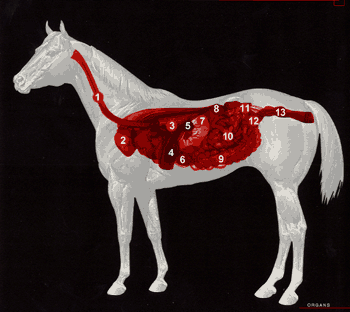
1. Esophagus
2. Lung, right
3. Diaphragm (cut border)
4. Liver
5. Pancreas
6. Colon, ventral (right)
7. Stomach
8. Kidney, right
9. Cecum
10. Intestine, small
11. Ovary, right
12. Uterine (fallopian) tube, right
13. Rectum
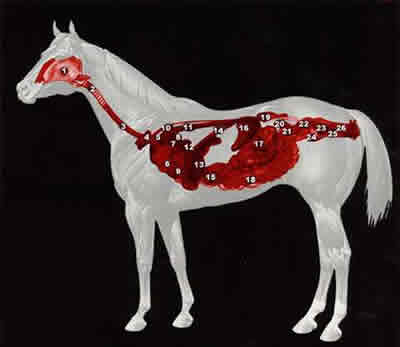
1. Pharynx
2. Thyroid gland
3. Trachea
4. Brachiocephalic trunk
5. Vena cava, anterior
6. Heart
7. Pulmonary artery (cut)
8. Bronchus, left (cut)
9. Coronary artery, left
10. Thoracic duct
11. Aorta, thoracic
12. Vena cava, posterior
13. Liver
14. Diaphragm, (cut border)
15. Intestine, large (colon)
16. Spleen
17. Intestine, small
18. Colon, ventral (left)
19. Kidney, left
20. Ovary, left
21. Uterine (fallopian)tube, left
22. Ureter, left
23. Cervix
24. Urinary bladder
25. Urethra
26. Vagina
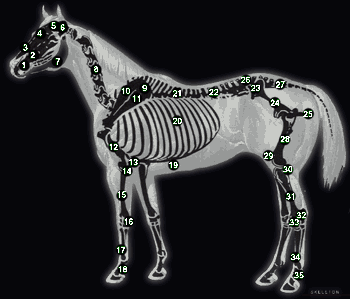
1. Premaxilla
2. Maxilla
3. Nasal
4. Frontal
5. Parietal
6. Occipital
7. Mandible
8. Cervical vertebrae
9. Cartilage of scapula
10. Scapular spine
11. Scapula
12. Humerus
13. Olecranon
14. Ulna
15. Radius
16. Carpus
17. Metacarpals
18. Phalanges of forefoot
19. Costal cartilages
20. Ribs (18)
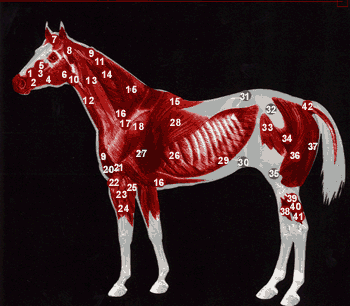
1. Levator nasolabialis
2. Zygomaticus
3. Buccinator
4. Facial vein
5. Levator labii sup. proprius
6. Masseter
7. Scutularis
8. Parotido-auricularis
9. Rhomboideus
10. Jugular vein
11. Splenius
12. Sterno-cephalicus
13. Brachiocephalicus
14. Serratus cervicis
15. Trapezius
16. Pectorals, deep
17. Supraspinatus
18. Deltoid
19. Pectorals, superficial
20. Biceps brachii
21. Brachialis
22. Ext. carpi radialis
23. Common digital ext.
24. Deep flexor
25. Ulnaris lateralis
26. Serratus thoracis
27. Triceps brachii
28. Latissimus dorsi
29. Obl. abdominis ext.
30. Aponeurosis of obl. abd. ext.
31. Lumbodorsal fascia
32. Gluteal fascia
33. Tensor fascia latae
34. Gluteus superficialis
35. Fascia lata
36. Biceps femoris
37. Semitendinosus
38. Long digital extensor
39. Soleus
40. Lat. digital extensor
41. Gastrocnemius
42. Saccrococcygeus
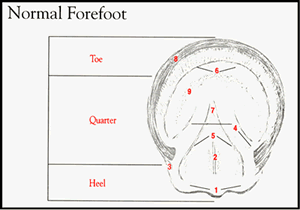
1. Bulbs
2. Central sulcus of frog , (spine of frog) (frog stay)
3. Angle of wall
4. Bars
5. Collateral sulcus
6. White Line
7. Apex of frog
8. Wall
9. Sole
From The American Quarter Horse Association Website
_____________________________________________________________
HOME
EMAIL

