
This is an unofficial collection of ideas that throw light on the Avesta and broaden our knowledge using revelation from Oahspe. Many views are not my own, and may not appear be amenable to Oahspe.
Therefore I state that Faithists worship no Gods, Lords or Saviours, but only One, Great Spirit, Jehovih, Unbegotten Father of All, who can not be comprehended in His Entirety.
This research finds knowledge of Him in sources that once existed, or live on and remember Him even today. It is not intended to embrace the parts of corrupt and outdated scripture or religious practice where his name or nature might have been undermined by limited innovation, interpretation or deliberate deception. I encourage you to be cautious with what I have presented.
Also, it is often not possible to be accurate when given knowledge is vague or in conflict. There are bound to be errors. I invite you to join me in expanding, revising and updating it as contributions from discussion accumulate and we approach nearer the truth.
By searching out the roots of ceremony in Zoroastrian, Jewish, Chinese, Hindu and Native American tradition, we might progress with the changes we see happening around us as we enter Kosmon. The basic form of ritual (given in the start of the Vendidad and Yasna) can be better understood by first getting some background from information below.
I quote these lines from Oahspe to preserve Faithist values, and ensure the liberty and individuality for all readers:
From the Book of Inspiration Chapter X
To show thee that no two men see alike anything I created;
To make thee sceptical to others' versions of My words, and yet make thee try to discover My words and My Person, of thine own self, to see Me and hear Me.
Thou hast put Me away, and said: Natural law! Moral law! Divine law! Instinct! Reflection! Intuition! Second sight!
I say unto thee: I have abolished all these things. I will have them no more, forever!
I have no laws; I do by virtue of Mine own Presence.
I am not far away; behold, I am with thee.
I gave no instinct to any creature under the sun. By My Presence they do what they do.
I give no tuition by intuition; I am the Cause to all, and for all.
I am the most easily understood of all things.
My Hand is ready to whosoever will reach forth unto Me.
My Voice is ready and clear to whosoever will turn away from other things, and away from philosophies and ambiguous words, serving Me in good works.
My Light is present, and answereth unto all who follow their all highest knowledge.
I dedicate this study to George Riddle, peace be with him, who urged me to make my original letter to the Oahspe group, which has become this website, more presentable.
Question to Oahspe group
Sent: Wednesday, November 14, 2001 12:44 PM
"does anyone know of a good comparison between Zarathustrian teachings and Hindu teachings.
Or even simply Hinduism considered by itself?"
Reply:
As the editor's comments at the end of the book of God's word point out, Zarathustra is to be found as the great quest at the heart of any religion. The nature and teachings of the pure incarnate personality, are the basis of any virtuous religion. This quest is taken up by folklore in the Puranas and lines of wisdom in the Upanishads and other Vedic texts. By around 1850 Scholars driven to uncover the eastern mysteries translated the sacred texts, leaving for us only to extract the relevant essence.
Question continues
"As I understand it, Hinduism essentially allows for any expression of the Almighty, that is, each Saint or God acts as an expression of the All Highest. Thus each God or Saint becomes as a sort of exemplar and by paying them respect and contemplating them, one can draw closer to the Creator.
Each God or Saint thus presents a roadway to the world of the divine or spiritual realm. The Hindus have many sects, the Jains are one who practice a sort of vegetarianism."
Vindyu was to be preserved as an example in Kosmon as to how man was in past times (Is this right?).
Included in India and the broad term Hinduism is everything from idolism, sun worship and phallic cults to the topmost virtuous devotional religions and the heights of human attainment. All these twists and turns of humanity we have come across in Oahspe.
The simple unifying truth gets lost sight of in religious rivalry and fanatic element, to be pieced together by the great wisdom of the occasional pundit. As well as an exemplar, the Gods or aspects of the divine might be conceived of as something found within ourselves. The soul, while all the time bounded by its own inescapable Fate, emanates, projects, expands, begets states of being - descends, falls into plurality, separation, division - enters into a journey that plays out its dualism, its struggle between potencies, extremes of good and evil, light and dark, simultaneously through a myriad of selves interacting within re-occurring archetypal, mythical, heroic themes. As a response, the negative, denial of self, the Eastern sceptical side might perceive this as something to be set aside as a mere reflection, a distraction in the mirror of the mind, a mask to our true nature.
The Jains are as much Hindu as Buddhists can be considered to be Hindu.
Only a short while ago most of India was vegetarian and mainly still is.
Zarathustra and Sakaya would never have finalised how the world should see the true reality,
so the evolution of religious and philosophical thought is purposely left to be ongoing. And progress it did, even by the hand of "Krishna" (who is the light of the Vaishnavas or bakhti movement), Shankara (who changed the tide from Buddhism to Modern Hinduism, the originator of Advaita Vedanta and the original convener of the entire body of modern orthodox Hindu sects that meet at the Kumba Mela) and Caitanya and Ramanuja (who brought Hinduism out of the cold of impersonal Vedantic thinking). Pockets of obscure devotional communities persist, whose only desire is the love of God. Here you might find a comparison, though only in practice, not by the letter of the law or the name of their God.
Question continues
" Does Hinduism have any common ethics or teachings that reach across its many sects? If so, what are they?
And along the lines of George's question, any rules or guidelines for how to live in a brotherhood or community?"
One would think that the earthly decrees of Div are enshrined in the existing cast system as given by the Laws of Manu and the Brahmanas.
The emancipation of the soul is provided for by a resurrection/ascension process or code of conduct according to ones caste, to coordinate the social strata - a bit like the Zhou Li (rights of Zhou) that Confucius was said to have found essential for harmony, or the rights and ceremonies that were needed to be restored by Joshu, preparing and initiating one into a higher existence (though upon examination the detail must have gone astray, or become obsolete). This order gives India its cultural distinctiveness and runs through its entire social fabric.
Because it is still understood and holds respect, its normal for village life to take care of crops and business while renunciates go off to fulfil inner callings (similar to Buddhist monks), marriages to be arranged and the father honoured. Reformers have come and gone (one being "Buddha") leaving behind them a trail of practices. Priests of the Brahmin caste still adhere to rigid formula for ritual worship, performing their services to individuals by sacred bathing spots with a sequence of offerings of libations, malas of flowers and incense.
[Its of interest that both Brahmins and Zoroastrians wear the sacred thread-girdle]
The lengthy details of these are given in parts of 3 of the 4 Vedas, the Brahmanas, Âpastamba's aphorisms on the sacred law and the Laws of Manu. In the thousands of small and large temples and ancient sacred sites of deities daily practice of Puja takes place at certain times - a ritual (you may have seen the Hari Krishna version) involving the circling of fire or incense in graceful loops before
the deity (of various folklore) while uttering holy words. There are ashrams that have a daily program of yoga, meditation and darshan (a spiritual talk) for renunciates or westerners; and recluses who have abandoned it all in the forests and caves.
The Vedic hymns to the Vedan Gods (some examples are given below) bring out a spirit more characteristic of Zoroastrianism than modern Hinduism, leading one to think of the Vedic period as a lost and forgotten civilisation, so much so that the Hari Krishnas never keep the "real" Vedas in their library, but mislead people to believe that Vedic authority comes from the much later Srimad Baghavatam, and its comparatively modern Gods.
Question continues
"These many Gods and many sects under the one unifying dome of the Creator brings
to mind the Greek Pantheon, except Zeus (aka Anuhasaj) sat atop that".
Depending how far back you go De'yus also sat atop the Hindu Pantheon.
The term Father is sometimes used to refer to Prajapati (Fragapatti?) (Manu [Man]- supporter of the world) and sometimes Dyaus. Dyaus or Dyauspitar is the earliest god in the Rgveda and represents the consort of Earth and progenitor or Father (pitar) of the gods (Dyaus-pita or God the Father in Sanskrit). His name is the greatest indicator of a "proto Indo-European " or Indo-Aryan culture spanning from Northern India to Europe.
His name is related to the word Deiwos (he is the god). Dyéus Patér is the protector of the Artus, the enforcer of natural law. As such, he is called "Artuspotis," "Lord of the Artus". [Artus is the pattern of the universe. Artus is the root of the Vedic rta/rita.]
He is a god of justice. His sacred animal is the ox, power under control.
Surya the sun-god is referred to as the eye of Varuna and the son of Dyaus and rides through the sky on his chariot led by his twin sons, the Asvins who represent his rays; Ushas, the dawn is his wife or daughter. Maruts are storm-gods shaped by Rudra.
The original meaning of the word Deity is shown in the Sanskrit word Dyaus meaning heaven, or Heaven personified, (just as sanctuary comes from Sanc-tu - Dyaus's heavenly capital.) not to be confused with 'divas' and 'deva', (bright, heavenly) -- hence devas, the bright beings, nor the Avestan "daeva" or "evil spirit".
The same 'Protector, Sky or Father God is found in the Roman language as Ju Pater or Jupiter or Jupiter Optimus Maximus (the Best and Greatest) and in Latin as deus and Jov-pater. From the same root we have the Latin names of deities: Diana, Janus, Juno.
Also he was known to the Greeks as the supreme god Zeus, Zeu-pater (father), Zeus Pater, theos or dios, Dyaus-pita and Die-patyros and the Thracian desa or desu.
In the Germanic or Teutonic languages he was known as Teut, tiu, Tiv, Tues (as in Tuesday, ie. Tiwesday), Tiwaz, Tiw in the north, Ziu in the south, Tuetates to the Kelts. Tig to Anglo-Saxons and the war god Tyr to Norse.
In Old Irish or Gaelic he is dia, Old Prussian he is deues, and Gaulish he is dusii, Dei, Dazh, Dassa, etc. in the Slavic languages he is Dievs, Dievas (Baltic), in Phrygia he is Tios, in Illyrian he is Dei-patyro/s, in Umbrian he is Iuve-patre. In Luvian he is Tatis, Tiwaizand in Palaic he is Tiyaz Papaz. Among the Scythians he was just Papaeus, "Father." In French he is dieu and Spanish he is Dios.
Here are some miscellaneous verses from the Rg Veda that mention Dyaus.
'Sing forth to lofty Dyaus a strength bestowing song'
[Here Dyaus is identified with Indra (originally a dragon slayer ), who seems in later times, to have succeeded to the functions assigned to the former god].
[In Oahspe, Indra was one of the forty-nine Saviours who preached the Triune doctrine of the Father, Son and Holy Ghost]
'High glory hath the Asura' [the divine one Indra, as the supreme Dyaus]
'Wise Asura, thou king of wide dominion, loosen the bonds of sins by us committed'.
[Asura: an incorporeal, spiritual divine being; the Zend Ahura.
Later Asura was taken to mean demon (as in the churning of the ocean of nectar of immortality by the Divas (gods) and Asuras. In "An introduction to Oahspe" by Martha H Jones she points to a reference where Asuras comes from the word Asu, which originally meant, "the living, he who lives and moves in the great phenomena of nature"].
'Our Father Heaven' [Zeus, Jupiter]
'Indra, to thee I sing, to Dyaus, to Rudra (later becomes Siva) glorious in himself'.
'Bringing sacrifice to bounteous Rudra, this juice for chink to you whose wrath is fleeting, with Dyaus, the Asura's heroes, I have lauded the Maruts as with prayer to Earth and heaven.
The offering of soma juice for drink to you whose wrath is fleeting'.
[The offering of soma juice is presented to Rudra and to his sons the fierce but easily appeased Muruts or storm gods, who are lauded as the heroes of Dyaus the immortal, and also supplicated
the deities Heaven and Earth.]
'I praise him who with his heroic followers expelled the Asuras from heaven: and I praise the Maruts who abide between heaven and earth'.
'To Indra, Dyaus the Asura hath bowed down, to Indra the mighty earth. All gods of one accord have set Indra in the front, pre-eminent'.
'Thy (Indra's) Father Dyaus esteemed himself a hero; most noble was the work of Indra's maker'.
[I have met a Sanskrit scholar who indeed says that the pronunciation of Dyaus translated from the Rig-Veda is correct, since extreme accuracy of sound was needed for ritual purposes and so names were preserved with the utmost care.]
The Language of Ancient India
The language of the Vedas is a fully perfected literary language. The hymns of the Rig Veda are composed in the earliest stage of that literary language called "Vedic Sanskrit" as opposed to the later day Classical Sanskrit which was stereotyped at the end of the fourth century B.C and Prakrits (languages of the common people) . It differs from the latter about as much as Homeric from Attic Greek. It exhibits a much greater variety of forms than Sanskrit does. The language of the Rig Veda also differs from Sanskrit in its accent, which, like that of ancient Greek, is of a musical nature, depending on the pitch of the voice, and is marked throughout the hymns.
Avestan and Sanskrit have strong similarities, which can be seen in a comparison of the Vedas with the Avesta. Sanskrit has three branches, the Theravada Buddhist Pali, the Jain Prakrit, and the third comprised of the many languages of modern India, some including Hindi (northern India), Urdu (Pakistan, India), Bengali, the Romani related Gurgurati.
[The "Gujerati" are mentioned in Saphah. Apart from Bombay, the main area in India for Parsees is Gurjerat. Bombay Parsee temples will not allow outsiders to come in. I hear that the Zoroastrians in Iran, still dress in their white traditional clothing.]
In addition to ceremonies, the mythologies of both the Vedas and the Gathas believe that Yama (the Avestan Yima) is the ancestor of all humans (Aryans); that the demon Vrtra was slain by Vrtrahan (Verethraghna); that Thrita was the first physician; Mitra (the Persian Mithra) is the sun god; Aryaman (Airyman, or in Oahspe, Airyamaishya or Airyama) is the god presiding over marriage; and the drink Soma is the Avestan Haoma,
Its "doctrines", which are probably not the hymns of the 4 Vedas, must be the Brahmanas (~800-600 BC), Upanishads, the Laws of Manu [Man] (contemporary with the first spreading of Buddhism) etc.
The Vedas were also called the Sruti (or revealed literature, that which was heard by the rishis or seers) or Agamas, as opposed to Smriti, (or traditional literature). They were divided into Samhita (original text) and Brahmana (interpretation) .The Brahmanas (sacerdotal commentaries with often mythical and fanciful explanations of the sacrifices) had three main parts, namely the Brahmana (interpretation of rituals), Aranyaka (work on worship and contemplation) and the Upanishids (philosophical questions).
The Rig, Sama, Yajur, and Atharva Samhitas and their Brahmanas make up the Karmakanda (meaning practice or sacrifice).
The Âranyaka portions of the Brâhmanas and the Upanishads are the Jnana/gñânakanda (knowledge of Brahman).
The ancient Upanishads, ie. those which occupy a place in the Samhitâs, Brâhmanas, and Âranyakas may be older than 600 BC, ie. anterior to the rise of Buddhism. The age of the other numerous Upanishads is difficult to fix.
The Aranyakas are called the forest texts, because ascetics retreated into the forest to study the spiritual doctrines with their students, leading to less emphasis on the sacrificial rites that were still performed in the towns.
The term Upanishad means literally "those who sit near" Although there are over two hundred Upanishads, only fifteen are mentioned by the philosophic commentator Shankara (788-820 CE). These fifteen and the Maitri are considered Vedic and the principal Upanishads; the rest were written later and are related to the worship of Shiva, Shakti, and Vishnu. The oldest and longest of the Upanishads are the Brihad-Aranyaka and the Chandogya from about the seventh century BC.
Vedangas were later works, which were found to be necessary to understand Vedic texts. Swami Sivananda tells us they correspond to the twenty-one Nasks of the Avesta. They were works on Shiksha (phonetics), Kalpa (rituals), Vyakharana (grammar), Nirukta (etymology), Chhandas (metre) and Jyotisha (astronomy). Vedangas were necessary because by the time of the Brahmanas, spoken Sanskrit had drifted far from Vedic Sanskrit. In order to preserve the Srutis, Shiksha and Chhandas were necessary to interpret the external form and internal structure of the Srutis.
Rigveda consists of hymns written during different periods. The exact period of the writing/composing of the Rigveda is attributed to different times by the European and Indian scholars. European scholars believe the period to be between 1500-1000 BC whereas Indian scholars believe it to be 4500 BC, based on the astronomical evidence in the Rigveda. Some hymns themselves speak of old and new hymns. They were sung many years before they were put into writing.
A quarter of the Rigveda is dedicated to Indra, indicating his importance in that period. The identification of Indra ranges from being a purely human Aryan warrior who had a weakness for wine (Soma) and women to that of the supreme deity of the Indo-Aryans. He is considered the greatest enemy in the Avestan Gathas.
By the time of Yajurveda, the Rigvedic gods like Indra and Varuna lost their importance giving place to three gods; one each from the celestial (Vishnu), mid-regional (Rudra-Shiva) and the Terrestrial (Prajapati-Brahma) planes.
The Brahmanas contain Itihasa (history) and Purana (narrative prose of myths). In the Brahmanas, there is a complete transfer of power from Rigvedic gods Indra and Varuna to Vishnu and Rudra. "
In these times sacrifices were glorified and became more powerful than the Vedic gods. Japa or the practice of chanting a mantram like Aum practiced ascetically with the sacrifices was believed to produce all one's desires. Knowledge and truth was emphasised; through truth the right to heaven was retained and they prayed for intelligence and wisdom. Mental activity analysing the rites and their explanation, and abstractions were increasing in the religion.
[This is contemporary with the triune doctrine, "that knowledge, which implies general education, was the best preventative against crime and misery."]
A judgment after death using a scale to weigh good against evil is described in the Satapatha Brahmana.
The gods are described as being truthful and the demons as being false. The [supposedly] new god Prajapati practiced tapas to create cosmic fire and light, and warmth of the body and breath. He created and entered into things as form and name, giving them order. He made mind more important than the word. Eventually Prajapati was replaced by Brahma, who would become the Creator God in the trinity that would include Vishnu, a sun-god who became the Preserver, and Shiva, who was derived from the indigenous Rudra, the Destroyer [there is a distinction between Brahman and Brahma].
Hell was still feared, but by practicing austerity (tapas) to gain knowledge individuals hoped to be born into a better world after death or be liberated from the endless cycle of rebirth (reincarnation). Non-attachment (vairagya) purified the body and overcame death.
Brahman is present in all people in the form of the atman or soul. He is the spiritual essence underlying all reality. Only Brahman is real. He is one, limitless, impersonal, indefinable, without qualities, eternal, unchanging, inactive (complete in itself thus no need to act). We must realise, in our journey, that Brahman and atman are one, that our essential self transcends our individuality, our limitations, even our death; this realisation brings release (moksha) from illusion. Seeing the world as full of particulars, individuals with egos acting in competition, life as diversity and change -- all this is Maya (illusion). Release (moksha) from the endless cycles of illusion [not to be mistaken for reincarnation] does not mean "non-being".
All gods and the world are only aspects of Brahman, only an illusion in comparison to the one reality. This is the insight of the Upanishads, recognising an ultimate unity in the multiplicity of gods and all life. Whoever worships another divinity thinking it is other than oneself does not know.
There are those of us who would reject such teachings as those of a false god, and others who would dabble with them precariously. Our little wisdom is challenged when we try to determine whether Jehovih or Es can be described in the way Brahman is - a qualityless, changeless or motionless being, yet the cause of quality, change and motion, into which all gets ultimately resolved. Is the joy of an eternal Brahman the ageless happiness of an attained soul?
From the First Book of God Ch.XIV, The first Bible of Vind'yu
Jehovih, who by the Brahmins was called Ormazd, sent His light to the earth world once for every hundred generations [3,300 years]. Of the times before the submersion of Pan, each cycle was called one man
[Manu? In the 'Laws of Manu', the total period of a cycle was 24,000 years. The sum of the four ages comes to 12,000 years, one Maha Yuga], and the length of his life three thousand years.
Which were: Zarathustra from the races of Shone and This; and of Zarathustra,
Haman; of Haman, Wonchakaka, who begat Zoar, who begat Theo, who begat Andassah, who begat Mur, who begat Romsat; these were tribes of the Zarathustrian order, who rejected idols, Lords, Gods, Saviours, rulers on the earth or in the heavens above the earth, save Ormazd, the Creator.
…..Anu, who begat the I'hins Maha, who begat with the I'hins Brah, who had both voice and power from the Father. And he was called Brahma because of his great wisdom.
This implies that the word Brahma may already have referred to wisdom before the man was born.
Kabalactes caused a warring sect who falsely called themselves Brahmins to cause destruction in Vind'yu, its inhabitants supposing they were under the God Brahma's influence. Later Kabalactes established himself in India as Buddha. Buddhism today is identified by Hindus to be a reinterpretation of Brahman doctrines. Only the wisdom of Sakaya validates it as an original religion. Soon after, Ennochissa assumed the name Brahma and became Budha's rival to possess the oracles in Vind'yu and Chine'ya. Today there is only one temple of Brahma in all India at Pushkar, Rajastan.
The 'Brahman' of the Upanishads is earlier than the false Brahma (Ennochissa), and the Trinity.
Oahspe shows from the discourse between the great philosopher king Tee-zee and the Brahman prophet Tseeing that the origins of Brahmanism go back before Chine (~1550 BC). The account given below can still be found, but is not the essential part (encapsulated in Vedanta) that has become a prime source for philosophers, and recently physicists.
Tseeing said: First was Brahma, which was round like an egg. Then Brahma broke open, and the shell was in two halves, and one-half was the sky and the other half was the earth. Then Brahma incarnated himself in the earth, but he came not up as one only, as he expected, but he came up in millions of parts, and every part was a living thing. And this is all there is or was or ever shall be.
Brahma saw that some men were good and some evil. That justice might be done he called all the nations and tribes of men before him and said:
Whoever delighteth in the earth, it shall be his forever. And though he die, his spirit shall have power to re-incarnate and shall have indulgence in the earth forever.
But whosoever delighteth in spirit shall dwell forever in heaven and have heavenly delights. But since heavenly delights are not after the manner of earthly delights, the spiritual chooser shall not live like earth-people but shall live secluded, and shall torment his flesh with fasting and castigations. Neither shall he marry or live with woman, nor beget children, nor have any indulgence on the earth whatever, save merely to live, for the earth is not his, nor is he of the earth. And the more he tortures the flesh, the higher shall be his bliss in heaven.
Nearly all mortals chose the earth. And Brahma repented of his former decree, for the people were sinful beyond bounds. He sent a flood of waters and destroyed them, then sent Zarathustra into the world to give new judgment. And Zarathustra opened the door of heaven anew, saying: Whoever after this chooseth Brahma, and will torture his flesh, and hate the earth, and live away from the world, him will I save from the earth and from hell also, for I am very efficient and influential with the Creator.
Some are born for the earth forever, and some are born for heaven. Nevertheless, the way is open unto all, to choose which they will, earth or heaven.
The magician priest Gwan Le offered Tee-zee an explanation similar to Hari Krishnas:
All things alive have two parts, the corporeal and the spiritual; all dead things are but one, which is the spirit. Thou were first a stone then thy soul went into silver, then gold; and animal life, then a low order of man, then into the high order of man.
Thus came man from the beginning, re-incarnating over and over, higher and higher. And when he is perfected in spirit he never more returneth.
In the M'hak degree (Book of Saphah) the Brahman of this time holds to what he understands as the Zarathustrian law. His negative attitude, hating earthly things for fear becoming bound or inflicted by them (as in Gnosticism), results in his rejection of happiness and rejoicing in the Father.
Chine puts negativity and reincarnation aside, telling Tee-zee:
The Ever Present quickeneth him into life in his mother's womb; and he is then and there a new creation, his spirit from the Spirit Jehovih, and his body from the earth; a dual being the Father createth him. His destination is everlasting resurrection; in which matter, man can have delightful labor as he riseth upward forever and ever.
"he who hath attained to understand that all things are but one harmonious whole, hath also attained to know what is meant by the term, All Person, for He is All; and, consequently, Ever Present, filling all, extending everywhere.
In contradistinction from Him, two philosophies have run parallel, which are darkness and evil. One saith the All is not a person, being void, and less than even the parts thereof; the other saith the only All High is the great angel I worship, who is as a man, and separate from all things.
These comprise the foundation of all the doctrines in the world, or that have ever been or ever will be. The latter is idolatry, which is evil; the second, unbelief, which is darkness; and the first is faith, truth, love, wisdom and peace.
Swedenborg points out that the heavenly oneness is not a characterless colourless, tasteless homogeneous substance as is water, nor is the purity qualityless , but more a perfection that becomes apparent in a gathering of its parts or an expression of its personality that makes that whole, a harmony of diversity. He attributes his 'alternative to impersonal Oneness' to 'The Lord'.
"Heaven's perfection arises out of the diversity of the good. A "oneness' which is complete is formed from differing elements. A "one" which is not from differing elements is not really anything. It has no form, and therefore no quality. A "one" that comes into being from differing perfectly formed elements, in proper turn joining another like a congenial friend, has a perfect quality. Heaven is a "one" made up of different elements arranged in the most perfect form, for the heavenly form is the most perfect.
We can see from all beauty, charm, and delight that move the senses and the passions that this is the source of all perfection. These do in fact come into being and flow only from the concord and harmony of many elements which agree and accord, whether manifesting themselves all at once in an orderly arrangement, or following each other in a sequence. This does not happen from a "one" without many elements. So it is said that variety is pleasing; and its attraction is known to be in proportion to its quality.
This offers a kind of mirror-view of how perfection results from differing elements, even in heaven. For the things that happen in the material world offer a kind of mirror-view of things in the spiritual world."
The problem of unity versus plurality is solved in various ways.
Brahman and Maya, or Yin and Yang, can be understood as Plato's "Existence", consisting of the "Same" (visible, heaven, macrocosm) and "Different" (sensible, corpor, microcosm, finite), the two concentric spheres that comprise existence, permeated and bounded by the soul (the third invisible concentric sphere, which encompasses All and interpenetrates to the heart of corpor). Or in Gnostic terms, a transition from the noumenal to the sensible, brought about by a flaw, a passion, or a sin.
In the Book of Fragapatti Ch.X Fragapatti tells us:
For a basis to reason from, consider the etherean (nirvana), the atmospherean (heavenly) and the corporeal (material) worlds to constitute His body; and the motion therein and thereof, the manifestations of His Power and Wisdom. Since we ourselves have these things in part, we find we have another attribute embracing all the others, which is combination concentrated into one person. Then we give to Him, who embraces all things within Himself, combination concentrated into one person, otherwise, He is our inferior, which cannot be.
Oahspe tells us through the three in One (Father, Mother, and Son), Jehovih becomes the many (plurality).
"These three comprise all things; and all things are but one. Nevertheless, each of these has infinite parts. And every part is like unto the whole."
What really is the unutterable state of existence or 'high estate' of the higher Heavens?
Here are some sayings that warrant attention.
The eternal nature is that which does not invoke an opposite.
One perceives objects related to each other spatially and temporally, and experiences interpenetration of space and time in the infinite, timeless and yet dynamic present.
Undifferentiated consciousness of pure being is the heart.
Uncontaminated pure consciousness is equal to Brahman
You are the divine that is at the root of all existence.
Truth is all pervading consciousness, love is the binding force.
Being self conscious makes us different from the animal world but is not Cosmic consciousness
They say Buddha, maybe Sakaya, hesitated to answer questions about the ultimate nature and explanation of reality. Echoing the doctrine of Maya or illusion, science with the support of technology has rushed in to fill the void.
David Bohm's 'Implicate Order' and the discovery of the Hologram gives a new meaning to the ancient concept:
"the whole being is enfolded in each of its parts and each of its parts contains the whole."
The union of Atman with Brahman (Parama-Atman) are like Philo of Alexandria's union of human mind with the Divine Mind. Therefore knowledge of God is Man's supreme Bliss. God's existence (according to Stoics) is as a supremely transcendent being without quality, whose pervasive immanence rules and directs all. His omnipresent vitality, the all traversing Logos, has its highest terrestrial manifestation in the human intellect, identified (by Philo and the Stoics) as the inseparable portion of the Divine Voice. He creates the universe out of relatively non-existent, qualityless passive and lifeless primordial matter (in Samkhya, Purusha is the qualityless, static Self, the universe being evolved from Prakriti, his dynamic counterpart).
[Stoicism developed the idea of Pantheism - the doctrine that this material world is no different from God. The universe, and all its beings, is the real manifestation or transformation of God. Stoics asserted that the entire cosmos was made from one element, fire. As in Zoroastrianism, God was of the nature of subtle fire, which condensed into being physical fire, from which the elements formed. Thus the cosmos is the condensation of God, "in whom we live and move and have our being". Later, Paul of Tarsus was to take this Stoic saying out of context and apply it to his Christianity.
Spinoza argued that there is only one reality, one universal substance, "God", and that mind and matter (as elaborated in Descartes dualistic system), which appear distinct and opposed, are only two of the infinite modes or attributes that this one substance possesses
In pantheism reality is actually non-other than God. The universe is the body of God(dess). The ultimate reality is love and compassion. All things are interrelated holistically into a single unity. The polar opposites of mind and body, male and female, persona and shadow, ego and unity are reconciled in the immediate present
The universe is not so much rationally knowable but accessible to intuition. One exists in the present moment of here now, in a state of love, compassion, peace and centeredness. Reality is better known through meditation, chanting, music and dance than through the intellect, although intellectual knowledge still represents a valid aspect of understanding reality.]
[There are great dissimilarities between the conceptions of the author (said to be Philo) of the "De Vita Contemplativa" (in which he talks of Essenes) and those of Philo. The latter looks upon Greek culture and philosophy as allies, the former is hostile to Greek philosophy. He repudiates a science that numbered among its followers the sacred baud of the Pythagoreans, inspired men like Parmenides, Empedocles, Zeno, Cleanthes, Heraclitus, and Plato, whom Philo prized. He considers the symposium a detestable, common drinking-bout. This can not be explained as a Stoic diatribe; for in this case Philo would not have repeated it. And Philo would have been the last to interpret the Platonic Eros in the vulgar way in which it is explained in the "De Vita Contemplativa," 7 [ii. 480), as he repeatedly uses the myth of double man allegorically in his interpretation of Scripture. It must furthermore be remembered that Philo in none of his other works mentions these colonies of allegorising ascetics, in which he would have been highly interested had he known of them. But pupils of Philo may subsequently have founded near Alexandria similar colonies that endeavoured to realise his ideal of a pure life triumphing over the senses and passions; and they might also have been responsible for the one-sided development of certain of the master's principles. While Philo desired to renounce the lusts of this world, he held fast to the scientific culture of Hellenism, which the author of this book denounces. Although Philo liked to withdraw from the world in order to give himself up entirely to contemplation, and bitterly regretted the lack of such repose, he did not abandon the work that was required of him by the welfare of his people.]
In "Anacalypsis" Godfrey Higgins quotes Mr. Faber's work on the Origin of Heathen Idolatry:
"Among the Hindoos we have the triad the of Brama-Vistnou-Siva (Trimurti, or Trinity), springing from the monad Brahm: and it is acknowledged, that these personages appeared upon earth at the commencement of every new world, in the human form of Menu [Manu] and his three sons. Among the votaries of Buddha we find the self-triplicated Buddha declared to be the same as the Hindoo Trimurti. Among the Jainists, we have the triple Jina, in whom the Trimurti is incarnate.
A Siberian medal in the imperial collection at Petersburgh exhibits the figure of the triple God seated on the Lotus. The Jakuthi Tartars of the House of Japhet, (the most numerous people of Siberia) worshiped a triplicated deity under the three denominations of Artugon, and Schugo-tangon, and Tangara. This Tartar God is the same even in appellation with the Tanga Tanga of the Peruvian's: who, like the other tribes of America, seem plainly to have crossed over from the Northeastern extremity of Siberia.
Agreeably to the mystical motions so familiar to the Hindoos, that the self-triplicated great Father yet remained but one in essence, the Peruvian suppose their Tanga-tanga to be one in three, and three in one: and in consequence of the union of Hero worship with the astronomical and material systems of idolatry, they venerated the sun and the air, each under three images and three names.
The Greeks and Romans had their Jupiter, Neptune, and Pluto; three in number though one in essence, and all springing from Cronus. The Canaanites had their Baal-Spalisha or self-triplicated Baal. The Goths had their Odin, Vile, and Ve: who are described as the three sons of Bura, the offspring of the mysterious cow. And the Celts had their three bulls, venerated as the living symbols of the triple Hu or Menu. To the same class we must ascribe the triads of the Orphic and Pythagorean and Platonic schools: each of which must again be identified with the imperial triad of the old Chaldaic or Babylonian philosophy. This last was a triad shining throughout the whole world, over which presides a Monad."
The priest chants one of the most famous verses from the Upanishads:
From the unreal lead me to the real!
From darkness lead me to light!
From death lead me to immortality!
Out of God (Brahman) came the Brahmin caste of priests and teachers and the Kshatriyas to rule, development through the Vaisyas and the Sudras. The highest principle was justice (dharma), which added meaning to equality among the weak and strong, poor and rich. Those who spoke the truth spoke justice, because they are the same. By meditating on the soul (atman) alone, one does not perish and can create whatever one wants. Whatever suffering occurs remains with the creatures; only the good goes to the soul, because evil does not go to the gods.
The concept of prana as the life energy of the breath is exalted as that which is identified with and establishes the entire soul. As the life force, prana, found in trees, animals, and people in ascending order, could not be impure or bad. Human immortality is identified with the soul (atman) not the body.
The soul is identified with goodness [as in the Hermetica], the real, the immortal, and the life-breath (prana), which is veiled by name and form (individuality). By restraining the senses and the mind, one may rest in the space within the heart and become a great Brahmin and like a king may move around within one's body as one pleases. The world of name and form is real, but the soul is the truth or reality of the real.
Immortality cannot be obtained through wealth. All persons and things in the world (husband, wife, sons, wealth, gods, etc.) are not dear for love of them, but for the love of the soul. The soul is the overlord of all things, as the spokes of the wheel are held together by the hub.
The principle of action (karma) is explained as "becoming good by good action, and bad by bad action."
How can one get beyond the duality of seeing, smelling, hearing, speaking to, thinking of, and understanding another? Can one see the seer, smell the smeller, hear the hearer, think the thinker, and understand the understander? It is the soul which is in all things; everything else is wretched. By passing beyond hunger and thirst, sorrow and delusion, old age and death, by overcoming desire for sons, wealth, and worlds, let a Brahmin become disgusted with learning and live as a child; disgusted with that, let one become an ascetic until one transcends both the non-ascetic and the ascetic states. Thus is indicated a spiritual path of learning and discipline that ultimately transcends even learning and discipline in the soul, the inner controller, the immortal, the one dwelling in the mind whom the mind does not know, who controls the mind from within.
The one departing this world without knowing the imperishable is pitiable, but the one knowing it is a Brahmin.
The following refrain is repeated often:
That soul is not this, not that.
It is incomprehensible, for it is not comprehended.
It is indestructible, for it is never destroyed.
It is unattached, for it does not attach itself.
It is unfettered; it does not suffer; it is not injured.
The soul is considered intelligent, dear, true, endless, blissful, and stable. The knowledge that is the light in the heart enables one to transcend this world and death while appearing asleep. The evils that are obtained with a body at birth are left behind upon departing at death. One dreams by projecting from oneself, not by sensing actual objects. In addition to being free from desire the ethical admonition of being without crookedness or sin is also indicated. At death the soul goes out first, then the life, and finally the breaths go out.
The soul is made of everything; as one acts, one becomes. The doer of good becomes good; the doer of evil becomes evil. As is one's desire, such is one's resolve; as is the resolve, such is the action, which one attains for oneself. When one's mind is attached, the inner self goes into the actions of one's actions. Whatever one does in this world is a consequence of the other world on this world of action (karma).
By releasing the desires in one's heart, one may be liberated in immortality, reaching Brahman (God). One is the creator of all, one with the world. Whoever knows this becomes immortal, but others go only to sorrow. The knowing is sought through the spiritual practices of repeating the Vedas, sacrifices, offerings, penance, and fasting. Eventually one sees everything, as the soul overcomes both the thoughts of having done wrong and having done right. The evil does not burn one; rather one burns the evil. In the soul's being the world-all is known. The student should practice self-restraint, giving, and compassion.
The Chandogya Upanishad belongs to the Sama Veda and is the last eight chapters of the ten-chapter Chandogya Brahmana. The first two chapters of the Brahmana discuss sacrifices and other forms of worship. As part of the Sama Veda, which is the chants, the Chandogya Upanishad emphasises the importance of chanting the sacred Aum. The chanting of Aum is associated with the life breath (prana), which is so powerful that when the devils struck it they fell to pieces.
The religious life recommended in the Chandogya Upanishad has three parts. The first is sacrifice, study of the Vedas, and giving alms; the second is austerity; and the third is studying the sacred knowledge while living in the house of a teacher.
The soul in the heart is identified with Brahman (God), and it is the same as the light which shines higher than in heaven. Knowing and reverencing the sacrificial fire is believed to repel evil doing from oneself. To the one who knows the soul evil action does not adhere, just as water does not adhere to the leaf of the lotus flower. To know the soul as divine is called the "Loveliness-uniter" because all lovely things come to such [just as Hari Krishnas call Krishna 'All Attractive'].
The doctrine of reincarnation is clearly implied in the Chandogya Upanishad as it declares that those whose conduct is pleasant here will enter a pleasant womb of a Brahmin, Kshatriya, or Vaisya; but those of stinking conduct will enter a stinking womb of a dog, swine, or outcast.
At death the voice goes into the mind, the mind into the breath, the breath into heat, and heat into the highest divinity, the finest essence of truth and soul. If the life leaves one branch of a tree, it dries up; and if it leaves the whole of it, the whole dries up. The soul is the essence of life and does not die, therefore we ought to identify with the soul.
Truly, indeed, when the living soul leaves it,
this body dies; the living soul does not die.
That which is the subtle essence
this whole world has for its soul.
That is reality (truth). That is the soul.
That you are, Svetaketu.
Just as we cannot taste the different parts of water in which there is salt, just so is Being hidden in all of reality, but it is not always perceived.
The soul, which came to be identified with Brahman, is none other than the fire of the heart, that is worshipped by Brahmans and Zoroastrians. It is the fire that consumes evil, and burns with dedication to the voice of Jehovih.
Ramana Maharshi describes his own experience of self-realisation as follows: -
The self is the heart, self-luminous. Illumination arises from the heart and reaches the brain, which is the seat of the mind. The world is seen with the mind, so you see the world by the reflected light of the self. The world is perceived by an act of the mind. When the mind is illumined, it is aware of the world. If it is not so illumined, it is not aware of the world. If the mind is turned in towards the source of illumination, objective knowledge ceases, and self alone shines as the heart.
Also:
What is realised is that the source of self is the heart as undifferentiated light of pure consciousness into which reflected light of the mind is completely absorbed.
The Tree of Language
China, India, Europe and America, the four branches of the earth, languages from one root. What was the tree, and where grew it, that none can find it? Where lieth the submerged continent, the forgotten world? Whence escaped the struggling mortals, to float to far off continents, and tell the tale in all lands of a mighty flood?
And out of the ground the LORD God formed every beast of the field, and every fowl of the air; and brought them unto Adam to see what he would call them: and whatsoever Adam called every living creature, that was the name thereof.

1. Pan, (of language) the first guttural sounds approximating words.
a) Poit, beginning of labial word-sounds.
b) Huit, first acquiesced language.
c) Fus, first written word-signs.
2. Chine, monosyllabic.
3. Yi'ha, combination words.
4. Vede
a) Sanscrit, mixture
b) Algonquin, after the sacred name E-Go-Quin.
5. Abram, first words; original text.
a) Fonece, following the sound, but not the signs. (writing)
b) Aham, amalgamation.
6. Araba (first Egyptian also) 'Teeth and thorax.'
7. Ebra, the old; the sacred
a) Helos
b) Greek
c) Latin
8. Hebrew
From One comes three
1) Chine - Chinese languages are Jaffethic
2) Araba - Semitic languages are Hamitic,
3) Yi'ha - Sanskrit and Algonquin are Shemitic. The two are alike, which is indicated by similarities between Tibetan, Hopi and Zuni languages.
4) Abram - Indo-European languages are from Yi'ha (Shemitic)
[The tree implies that Hebrew is more related to European languages than semitic]
Thus, Chinese, Indian, American and European can be thought of as four branches of languages from one root [Chine, Yi'ha (Indian/American) and Abram (Phoneacian, Araba) ].
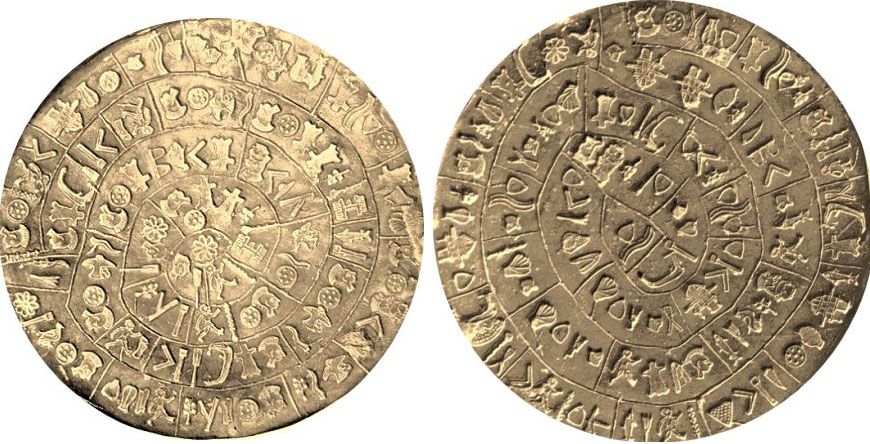
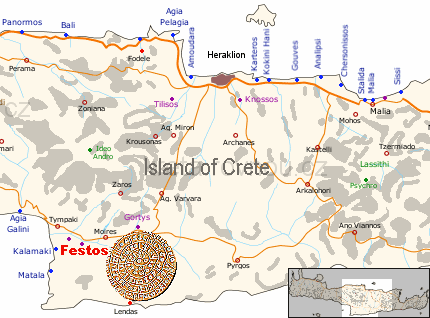

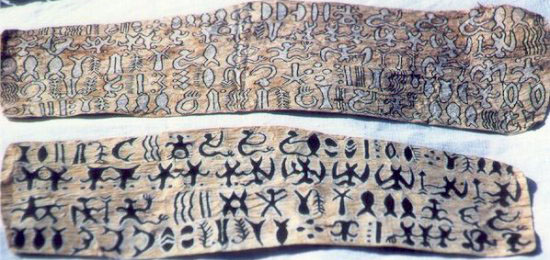
Proto-World language
A proto-language is a language which was the common ancestor of related languages, or
a system of communication during a stage in glottogony, that form a language family.
The ancestral proto-language is reconstructed by comparing members of the language family.
Examples of unattested but (partially) reconstructed proto-languages include Proto-Indo-European, Proto-Uralic and Proto-Bantu - the ancestors of Indo-European, Uralic and Bantu languages, respectively. The Proto-Norse language is attested in the Elder Futhark runic inscriptions.
Proto-World language refers to the hypothetical, most recent common ancestor of all the world's languages - an ancient proto-language from which are derived all modern languages, all language families, and all dead languages known from the past 6,000 years of recorded history.
Proto-World is theorized to have been spoken roughly 500,000 to 100,000 years ago, the time speculated by archaeogenetics for the phylogenetic separation of the ancestors of all humans alive today.
In such a scenario, Proto-World would spread from a small population out to other human populations long after they separated.

In 1903 the pioneering Danish linguist Holger Pedersen proposed "Nostratian", a proto-language for the proto-languages of the Semitic (later broadened into Afro-Asiatic), Indo-European, Uralic, Altaic and Eskimo-Aleut language families.
 A representative grouping of Nostratic includes:
1) Afro-Asiatic
2) Kartvelian
3) Indo-European
4) Uralic
5) Dravidian
6) Altaic
7) Eskimo-Aleut
The 3rd millennium BC (excluding the Anatolian branch) in Armenia according to the Armenian hypothesis (proposed in the context of Glottalic theory);
The 5th millennium BC (4th excluding the Anatolian branch) in the Pontic-Caspian steppe according to the mainstream Kurgan hypothesis;
The 6th millennium BC in India according to Koenraad Elst's Out of India model.
The 7th millennium BC in Anatolia (the 5th, in the Balkans, excluding the Anatolian branch) according to Colin Renfrew's Anatolian hypothesis;
The 7th millennium BC (6th excluding the Anatolian branch) according to a 2003 glottochronological study before the 10th millennium BC, in the Paleolithic Continuity Theory.
Proto-Indo-European as described in the early 1900s is still generally accepted today; subsequent work is largely refinement and systematization, as well as the incorporation of new information, notably the Anatolian and Tocharian branches unknown in the 19th century.
There is no direct evidence of Proto-Indo-European, because it was never written. All PIE sounds and words are reconstructed from later Indo-European languages using the comparative method and the method of internal reconstruction.
The proposal of a higher-level relationships encompassing PIE and Uralic. The evidence usually cited in favor of this is the proximity of the proposed Urheimaten of the two families, the typological similarity between the two languages, and a number of apparent shared morphemes.
Other proposals, further back in time (and correspondingly less accepted), model PIE as a branch of Indo-Uralic with a Caucasian substratum; link PIE and Uralic with Altaic and certain other families in Asia, such as Korean, Japanese, Chukotko-Kamchatkan and Eskimo-Aleut (representative proposals are Nostratic and Joseph Greenberg's Eurasiatic); or link some or all of these to Afro-Asiatic, Dravidian, etc., and ultimately to a single Proto-World family (nowadays mostly associated with Merritt Ruhlen). Various proposals, with varying levels of skepticism, also exist that join some subset of the putative Eurasiatic language families and/or some of the Caucasian language families, such as Uralo-Siberian, Ural-Altaic (once widely accepted but now largely discredited), Proto-Pontic, and so on.
Theories and History about Indo-Aryan Origins
Aryan is the archaic term for Indo-Iranian peoples (Indo-Aryan, Iranian, Dardic and Nuristani peoples), that is, speakers of Indo-Iranian languages.
Arya is a Sanskrit and Avestan word used by Zoroastrians, Hindus, Buddhists and Jains. It is thought to have derived from the Aramaic and Syriac word for Arya meaning Lion. Arya is related to the Indo-European word "Aristocracy" and was used in the same context in Vedic tradition, as a designation for moral and spiritual heroes. Later this term came to signify anyone of good and noble character. Arya can be an adjective or a noun depending on pronunciation meaning kind, favorable, or devoted, master, respectable, honorable, noble, owner, a member of the three highest varnas (castes), particularly a Vaisya.
The Amarakosha (a thesaurus of Sanskrit ca. 450 AD) defines 'arya' thus: "An arya is one who hails from a noble family, of gentle behavior and demeanor, good-natured and of righteous conduct. Arya refers to one's standing in the varna system: an arya is a free man and not a member of a lower caste or a slave. This social standing was not, however, necessarily related to ethnic, linguistic, or racial identity. At an early period, the cultural area where the varna system was used, along with the linguistic area where Indic languages were spoken, would have been nearly the same. This region (northern and central India; the Indus and Ganges plains) was called Aryavarta, meaning "abode of the noble people". At present, these cultural and linguistic spheres overlap but are quite distinct from each other.
The Western interpretation of arya as the name of a particular race became known in India in the 19th century and was generally accepted by Hindus and Hindu nationalists, though combined with religious self-identification. Vivekananda remarked: "...it is the Hindus who have all along called themselves Aryas. Whether of pure or mixed blood, the Hindus are Aryas; there it rests."
The interpretation of the Sanskrit words in Europe was influenced by words in Avestan: airya and airyana meaning "nobly born" and "respectable", but also "Iranian". Iranian refers to all the speakers of the Iranian languages, at the time not yet differentiated from each other at the time of the composition of the Zoroastrian Yashts texts, where Zarathustra is described to have lived in Airyanem Vaejah meaning "Expansion of Aryans". The word "Iran" (Eran) itself comes from Proto-Iranian Aryanam "(land) of the Aryas (Iranian)". Airya was distinguished from anairya, non-Iranian, and is clearly to be understood as the name of a self-identified nation, ethnic group, or linguistic group. The word and concept of Airyanem Vaejah is present in the name of the country Iran (lit. Land of Aryans) which is a modern-Persian form of the word "Aryana" (lit. Country of Aryans).
The word "arya" in the modern Persian language, also means "noble", "Aryan", or "Iranian"
The term Arya is often found in Hindu, Buddhist, and Jain texts. In the Indian spiritual context it can be applied to Rishis or to someone who has mastered the four noble truths and entered upon the spiritual path. The religions of India are sometimes called collectively arya dharma, a term that includes the religions that originated in India (e.g. Hinduism (Sanatana Dharma), Buddhism, Jainism, Sikhism).
Asia has been regarded as the cradle of the Aryans, from where they spread over the whole surface of the inhabited earth. In 1808 Zend was believed to be the mother of Sanscrit and the other Aryan languages; and as it was spoken in Media it followed that the highlands of Media, Armenia, and Georgia were the original home of the Aryans.
The resemblance found between Zend and Sanscrit was proof that the Iranians and Hindoos were in ancient times one people with a common country, and that union continued to exist long after the European Aryans had migrated westwards.
Zarathustrians or Zoroastrians, who claim to be the original Indo-Europeans, believe that the writers of the Zend Avesta [and the Vedas known in both those scriptures as Aryas (Aryans)] originated in the mythical Airyana-vaejah [the Arctic, 20,000 years ago, according to one writer]. Ahura Mazda, in three subsequent periods, bade Yima to lead his overflowing tribes to migrate southwards and westwards, on the " way of the sun".
Max Muller believed that they came from central Asia. Indian scholars like B.G.Tilak think of the Arctic circle as the original home
The first Indo-European speakers entered central Europe about 2300 BC.
In 2000 BC Indo-Aryans left the eastern Iranian steppes of ancient Sogdiana, Chorasmia/Khorezmia, and Bactria, crossed the Caucasus Mountains entered Armenia and spread southwards towards the Elburz [Alburz] range (near Tehran, on the south end of the Caspian sea).
In 1600-1000 BC waves of Aryans entered Greece. [This coincides with the wars of Baal and Astharoth]
The Hittite kingdom was founded in 1650 BC. They installed the Kassite dynasty in Babylon in 1590 BC. Abraham supposedly appears in 1500 BC. The Elamites sacked Babylon and terminated the Kassite dynasty 1168 BC. Nebuchadnezzar I of Babylon defeated Elam in 1105 BC. Sargon II of Assyria destroyed the Hittites of Urartu in 717 BC.
http://en.wikipedia.org/wiki/Ugarit
A Note about Conventional Chronology
From "http://www.knowledge.co.uk/sis/ancient.htm"
A Note about the Westward Drive of Shem
From 'Teutonic Mythology' [1887]
http://www.boudicca.de/teut.htm
From Of Hindoo Scriptures Chapter III:
From The Book of Wars, Chapter XXI:
From The first Fonecean Bible in Oahspe:
Genesis 15:7 says:
From The first Fonecean Bible Ch.XII:
From the Book of Lika Ch.X:
From God's Book of Eskra Ch.L:
Celts may have inhabited northern France and western Germany in 1200 BC, though it is generally said that Celts emerged in South Central Europe and the British islands in about 500 BC and they settled in Ireland 300 BC. Clans of Britons, Angles, Celts, Picts, Scots, Saxons, Jutes existed in Britain after the fall of the Roman empire. (410 AD).
[The reference to the fall of the Egyptian empire may be:
The time when Egypt became a province of the Roman empire after Cleopatra's suicide (30 BC) is too late.
From Book of God's Word Ch.VI:
When Zarathustra was half grown, the Lord began to manifest through him, giving signs and miracles and prophecy before the Listians who lived in the Forest of Goats. This forest was of the width in every direction, save the east, of forty days' journey for a man, and in all that region there were no houses, the inhabitants living in tents made of bark and skins.
The Listians or Shepherd Kings known as Hyksos in the Egyptian records were the Phoenicians, the Parsi'es (Sumerians, Persians, Medes etc) of the people of Shem, who through Abraham became associated with the tribe of Ham
So the great westward journey, centering on the 35 degree north latitude, started in Northern Afghanistan/Pakistan/Kashmir with the Shepherd Kings and Parsi'e'ans united with Ham and continued to Spain, USA and now Japan, China and the focus is back on Afghanistan/Pakistan/Kashmir where a world crisis now looms.
The 17th century orientalist Edward Pococke wrote:
Ashkenazi, a Scythian group gave the world Guatama Buddha.
"The Phoenicians held their own civilisation to be the most ancient and declared it to be thirty thousand years old. There is however no doubt that they were one of the first civilised nations of the world, if not the first, and that Phoenicia was not their first home. The Panis or Panih of the Rig Veda were the same people as the ancient Phoenicians of Afghanistan."
Budha's heavenly kingdom "Celonia" over Egupt mentioned in Oahspe and the connection of Phœnician cosmogony with the Buddhic school makes the following less nonsensical, since a large population of Jews lived in Alexandria.
The Cabeiri are the Khyberi, or people of the Khyber. They are the Khebrew-i, or Hebrews. We have, in the Cabeiri, the representatives of a form of Bud-histic worship and Bud'histic chiefs, extending from the Logurh district (Locri) to Cashmir, the object of worship of the Hya (Yah), and the Phoenician race, for they are but one. They are the Khebrew-i, or Hebrews ... The tribe of Yudah/Yuddhi (Judah) is in fact the very Yadu (Yadava)
He alleges that the pious "Hyperboreans" of ancient Greek writers are the Hebrews, and the northern limits of Afghanistan is the starting point of these two great families of language, and consequently of nations. "The Afghans have claimed descent from the Jews, or Ioudaioi (Youdai-oi); the reverse is the case. The Haibrews or Khaibrews, are descended from the Yadoos. In that very land of the Yadoos, or Afghans - Dan and Gad, still remain of the feeble remnants of Jewish antiquity"
From "http://www.viewzone.com/phoenician.html"
Question continues
Of the line in "Earthly History of the Faithists of the East cast more light" (in Oahspe)
Mine have no Gods but Me.
it's my opinion that although Brahman can be personal (when regarded as the Self) or impersonal, and the false Gods and idols (such as Krishna, Vishnu, Devi) can be conceived of or worded to satisfy Jehovih, only few individuals are unfettered by idolism. Bigotry, fanaticism, cruelty and hypocrisy lurk behind the mask of self-righteousness.
Gods and Goddesses of Dawn
Fragapatti proclaimed Yima, Lord God of the heavens of Shem, resting upon the earth.
Because mortals discovered that prophecy could come from the spirits of the dead, they ceased to perfect themselves, and they grew up in idleness. Osiris walled them apart, so that there was no communion betwixt the two worlds. But mortals confounded judgments and perverted laws of Jehovih. Wisdom ran in a thousand roadways. There was no uniformity between any of them. Yima pursued a mean betwixt the two. He allowed certain spirits to return to mortals, and permitting certain mortals to attain su'is and sar'gis, and to see and commune with spirits. But provided them in judgment, making the process of inter-communion a secret amongst mortals.
Through Zarathustra, Yima established temples where Lords communed with rab'bahs, who were called God-irs to whom alone, with their sub-priests, the communion betwixt spirits and mortals was known. Mortals were left to believe that they attained to spirit communion by great purity and wisdom. The manifestation of drujas to mortals became a mark of evil against truth.
Yima appointed Lords unto Shem who became as the roots to the tree of heaven.
[It is strange that the Zoroastrian name for Zarathustra seems to come from these last Lords ie. Zartosht Spitama. Similarly it is strange that {amesha, cpentas} [who are Gods of the United Hosts of Heaven] forms the word Amesha Spentas and {Zaothra and Barecma} are ritual objects, but in the Oahspe they appear next to each as names of Lords of the Hosts in Heaven, suggesting an alteration or mixup on someones part.
Zarathustra
Lords of farmers and herdsmen
The Lords of time keeping, who had dominion of the change of watch, were:
From the AOGEMADAECA/Aogemaidê (meaning "we accept")
From The Bundahishn (Creation), or Knowledge from the Zand Ch 31.
From The Bundahishn Ch 34.
On the reckoning of the years.
From the DENKARD
Sivananda tells us Mazdayasnism was first revealed by Homa to King Jamshid. Afterwards it was revealed to King Fiedoon. Then it was revealed to Thirta [Thrita? or Hirto?]. Lastly it was revealed to Zoroaster.
From the KHANDOGYA-UPANISHAD
Yima/Jamshid
Thraetaona/Faridoon
Fereydun, also pronounced Faridun, in medieval Persian Firedun, Middle Persian Fredon, and Avestan Thraetaona is the name of an Iranian mythical king and hero who is an emblem of victory, justice and generosity in the Persian literature.
All of the forms of the name derive, by regular sound laws, from Proto-Iranian Thraitaunah and Proto-Indo-Iranian Traitaunas.
Zahhak or Zohhak (in Persian) is a figure of Persian mythology, evident in ancient Iranian folklore as Aži Dahaka, the name by which he also appears in the texts of the Avesta. In Middle Persian he is called Dahag or Bevar-Asp, the latter meaning "he who has 10,000 horses". Aži is the Avestan word for "serpent" or "dragon". It is cognate to the Vedic Sanskrit word ahi, "snake", and without a sinister implication. In Persian mythology, Dahaka is treated as a proper name. Aži Dahaka is the source of the modern Persian word azhdaha or ezhdeha (Middle Persian azdahag) meaning "dragon", often used of a dragon depicted upon a banner of war. In Vedic tradition, the only dragon of importance is Vritra, but "there is no Iranian tradition of a dragon such as Indian Vrtra, who guards the cosmic waters and is defeated by the gods themselves." Vedic tradition has only one other dragon besides Vrtra - ahi budhnya, the benevolent 'dragon of the deep'.
The Story of Zohak the Serpent King
Kaiumers first sat upon the throne of Persia, and was master of the world. He took up his abode in the mountains, and clad himself and his people in tiger-skins, and from him sprang all kindly nurture and the arts of clothing, till then unknown. Men and beasts from all parts of the earth came to do him homage and receive laws at his hands, and his glory was like to the sun. Then Ahriman the Evil, when he saw how the Shah's honour was increased, waxed envious, and sought to usurp the diadem of the world. So he bade his son, a mighty Deev, gather together an army to go out against Kaiumers and his beloved son Saiamuk and destroy them utterly.
http://classics.mit.edu/Ferdowsi/kings.1.shahsold.html
Zarathushtra's Place of Origin
Oahspe tells us that Parsi'e, the land of Zarathustra, was in the midst of Jaffeth (China), Ham (Egypt) and Shem (Vindu).
Other legends name Balkh as the home of the three wise men. [see also Shambhala as Balkh]
[Bactria was also the location of the temple of Anahita (an Avestan Goddess). It was so rich that it attracted Syrian kings to plunder it. Anaitis was a Scythian goddess, but she is identified also as Assyrian Mylitta, the Arabian Alytta and the Greek Venus Urania. In Armenia girls prostituted themselves in her name (maybe after she was assimilated as Ishtar by the Babylonians). Artaxerxes Mnemon, one of the rulers of Achaemenid dynasty was among her devotees.]
The Avestan texts don't mention West Iran, Median or Persian regions, areas or places, nor do Archemenid inscriptions ever mention Zarathustra. Greek sources (~350 BC.) show that by their time Zarathustra was already a mythical figure.
Therefore he could not have belonged to a period contemporary with or close to the Archemenids (559 BC).
[History estimates the date of the Trojan war at 1200 BC. This would mean Zarathustra was 6,200 BC. The time when Zarathustra lived is about 7,000 BC. in Oahspe. If the Trojan War was part of the wars in Parsie as a result of Baal and Astharoth under Osiris, its date is about 1870 BC. That would give a date for Zarathustra at about 6,870 BC.]
According to Zoroastrian tradition (or a Greek source?), he flourished 258 years before Alexander and was 40 years old when this event occurred, thus indicating that his birth date was 628 BC.
According to this wikipedia Zoroastrian calendar article, the Seleucids introduced the practice of dating by era rather than by the reign of individual kings. Their era became known as that of Alexander, or later the Seleucid era. Zoroastrian priests resented the Seleucids and established their own era of Zoroaster. That was the first serious attempt to determine the dates associated with Zoroaster. Priests had no Zoroastrian historical sources, and so turned to Babylonian archives. From these they learned that a great event in Persian history took place 228 years before the era of Alexander. This was the conquest of Babylon by Cyrus the Great in 539 BCE. But the priests misinterpreted this date to be the time the "true faith" was revealed to their prophet, and since Avestan literature indicates that revelation happened when Zoroaster was 30 years old, 568 BCE was taken as his year of birth. The date entered written records as the beginning of the era of Zoroaster, and the Persian Empire. This incorrect date is still mentioned in current encyclopedias as Zoroaster’s birth date. The Parthians adopted the same calendar system and dated their era from 248 BCE, the date they succeeded the Seleucids.
Yazdgerd III, the last ruler of the Sassanid dynasty, introduced 632 as the beginning of a new era, and this last imperial Persian calendar was known as the Yazdgerdi calendar.
In "History of Zoroastrianism" M. N. Dhalla, High Priest of the Parsis, Karachi, India, 1938 writes:
King Vishtaspa
From Vendidad 17. Ashi Yasht
YASNA 53 Verse 2
The Zoroastrians translate the same verse thus:
Among the grandees of the court of Vishtaspa mention is made of two brothers, Frashaoshtra and Jamaspa to whom Zoroaster was closely related. In legends Zarathustra had three wives of whom the last was Hvovi, the daughter of Frashaoshtra. The husband of his daughter, Pourucista, was Jamaspa. The role of intermediary was played by the pious queen Hutaosa. His, first disciple, Maidhyoimaongha, was his cousin.
From YASNA 53 - The Vahishtoishti Gatha
Vishtaspa stands at the meeting point between the Old World and the new era which begins with Zoroaster.
Such a story about Zarathustra and King Vishtaspa does not occur in Oahspe. Rather it says:
Oahspe gives us two possible origins for King Vishtaspa.
M.N. Dhalla claims: From Book of Saphah
From Oahspe
Other Sources
The Vedic hymns use the word kavi in the sense of a sage, seers and Soma priests. The Karapan, belong to the class of the Kavi. Kavis and Karapans or seeingly blind and hearingly deaf are likened to Pharisees and Scribes of the Bible
From the Yasna:
From The Bundahishn (Creation), or Knowledge from the Zand (Zend)
From The Zand-i Vohuman Yasht
In Saphah
The Frawardin Yasht
None of these kings play a part in known history (including the Median and Archemenid, Parthian and Sassanian empires)
[Another writer says:
Encyclopedias say:
From the Behishtan Inscriptions Of Darius
I am Darius the Great King [Adam Dârayavaush xshâyathiya vazraka], Darius the King says By the favour of Ahuramazda [Dârayavaush xshâyathiya vashnâ Auramazd âha] From "Old Persian Texts" Darius writes of himself (in his inscriptions) as if fighting in an endless apocalypse against "followers of the Lie (angra-mainyus) " favoured by Ahura Mazda. Indeed with his successor Xerxes the world came closest it has ever been to an apocalypse. The above inscription goes on to talk of various pretenders:
One might think Darius too was himself a similar usurper. Darius does not come from the lineage of Cyrus, but names himself son of Vishtaspa (a mythical king). Xerxes I his son claims his mother to be Atossa (which is the same name as Hutaosa, Queen of Vishtaspa).
..... Cyrus + Cassandane ........ Vishtaspa + Hutaosa
How Ashtaroth possibly recouped power over the eastern nations from Looeamong
http://www.iranchamber.com/history/atossa/atossa.php
Another writer confuses it more:
Darius I describes himself as an Archaemenid Parsa, an Arya of Aryan (Iranian) descent.
From the Naqsh-I-Rustam inscription of Darius
I am Darius the Great King, [adam Dârayavaush xshâyathiya va zraka]
The Daiva Inscriptions Of Xerxes At Persepolis
By 620 the Babylonians had grown tired of Assyrian rule and were weary of internal struggle and were easily persuaded to submit to the order of the Chaldean kings. In about 630 BC Nabopolassar became king of the Chaldeans. In 626 he forced the Assyrians out of Uruk and crowned himself king of Babylonia.
Nabopolassar fought against the Assyrian king Ashur-uballit II and then against Egypt, his successes alternating with misfortunes. In 605 he died in Babylon while Nebuchadrezzar/Nebuchadnezzar was with his army in Syria; he had just crushed the Egyptians near Carchemish. In 601 he tried to push forward into Egypt but was forced to pull back. He attacked Palestine at the end of 598. King Jehoiakim of Judah had rebelled, counting on help from Egypt. Jerusalem was taken on March 16, 597. Jehoiakim had died during the siege, and his son, King Johoiachin, together with at least 3,000 Jews, was led into exile in Babylonia where they were treated well. Zedekiah was appointed the new king.
Astyages succeeded his father Cyaxares the Great in 585 BCE. He married Aryenis, the sister of King Croesus of Lydia to seal the treaty between the two empires. Astyages inherited a large empire, ruled in alliance with his two brothers-in-law, Croesus and Nebuchadnezzar of Babylon, whose wife, Amytis, Astyages' sister, was the queen for whom Nebuchadnezzar was said to have built the Hanging Gardens of Babylon.
The reign of Astyages was noted for its both its stability and for the growth of Zoroastrianism throughout his empire, at the same time that Croesus was overseeing an explosion of secular thought in the west (through the philosophers he patronized, Thales [Thules?], Solon, Aesop...), and Nebuchadnezzar was turning Babylon into the greatest metropololis the world had yet seen. After thirty-two years of relative stability, Astyages lost the support of his nobles during the war with Cyrus the Great, resulting in Astyages', Croesus' and Babylon's overthrow and the formation of the Persian empire.
Nabonidus resided in northern Arabia in 552. His viceroy in Babylonia was his son Bel-shar-usur, the Belshazzar of the Book of Daniel.
[Tradition has confused Nabonidus with his predecessor Nebuchadrezzar II. The Bible refers to him as Nebuchadnezzar in the Book of Daniel.] Cyrus turned this to his own advantage by annexing Media in 550. Nabonidus, in turn, allied himself with Croesus of Lydia in order to fight Cyrus. Yet, when Cyrus attacked Lydia and annexed it in 546, Nabonidus was not able to help Croesus. In 542 Nabonidus returned to Babylonia. He appointed his daughter to be high priestess of the god Sin in Ur, thus returning to the Sumerian-Old Babylonian religious tradition. The priests of Marduk looked to Cyrus, hoping to have better relations with him than with Nabonidus.
http://www.iranchamber.com/history/cyrus/cyrus_charter.php
A chronicle drawn up just after the conquest of Babylonia by Cyrus, gives the history of the reign of Nabonidus ('Nabuna'id'), the last king of Babylon, and of the fall of the Babylonian empire. In 538 BC there was a revolt in Southern Babylonia, while the army of Cyrus entered the country from the north.
It seems that Looeamong stepped aside during the reign of Xerxes for Ashtaroth to bring about her own end in the war with Baal. In 484 BC Xerxes (son of Darius I) took away the golden statue of Bel (Marduk, Merodach) [a possible indication of Ashtaroth's power becoming restored]. From 483 he prepared his expedition with great care. In 480 BC Xerxes set out from Sardis with a large fleet and a numerous army (some have claimed that there were over 2,000,000). At first Xerxes was victorious everywhere. The Greek fleet was beaten, Athens conquered, the Greeks driven back to their last line of defence at the Isthmus of Corinth and in the Bay of Salamis. The Battle of Salamis (September 28, 480) decided the war. Of the later years of Xerxes little is known.
The Debate over the historical accuracy of the Book of Esther
[Book of Ezra 4:4-7:
3) The name of an ally of Nebuchadnezzar in the Book of Tobit. He is identified with Cyaxares I
of Media. Mordecai was carried away from Jerusalem by Nebuchadnezzar in 597 B.C.E. The view that it was Mordecai is consistent with the identification of Ahasuerus with Cyaxares. A traditional Catholic view is that he is identical to the Ahasuerus of the Book of Daniel.
[Book of Daniel 9.1-2:
4) The name of the father of Darius the Mede in the Book of Daniel.
Book of Daniel 10.1
Book of Daniel 11.1-2
Josephus names Astyages as the father of Darius the Mede and the description of the latter as uncle and father-in-law of Cyrus by mediaeval Jewish commentators matches Cyaxares II said to be the son of Astyages by Xenophon. Thus this Ahasuerus is commonly identified with Astyages. He is alternatively identified, together with the Ahasuerus of the Book of Tobit, as Cyaxares I, said to be the father of Astyages. Views differ on how to reconcile the sources in this case. One view is that the description of Ahasuerus as the father of Darius the Mede should be understood in the broader sense of grandfather or ancestor. Another view notes that on the Behistun Inscription, "Cyaxares" is a family name, and thus considers the description as literal, viewing Astyages as an intermediate ruler wrongly placed in the family line in the Greek sources.
In the Book of Esther, Ahasuerus is married to Vashti, whom he puts aside after she rejects his offer to visit him during a feast. Mordecai's cousin Hadassah is selected from the candidates to be Ahasuerus's new wife. When she entered the royal harem she received the name Esther.Hadassah means "myrtle" in Hebrew and the name Esther is most likely related to the Median word for myrtle, astra, and the Persian word setareh meaning star - the myrtle blossom resembles a twinkling star.
Esther is (in the Hebrew version) one of only two books of the Bible that do not directly mention God (the other is Song of Songs). It is the only book of the Tanakh that is not represented among the Dead Sea scrolls. It has often been compared to the first half of the Book of Daniel and to the deuterocanonical Books of Tobit and Judith for its subject matter.
Esther was equated with the similarly sounding Ishtar.
The story hints of divine intervention in the remark of Mordecai to Esther when he said "who knows whether you have not come to the kingdom for such a time as this?" referring to Esther's destiny to become the kings wife due to the circumstance that contested Vashti's personal virtue and independence.
This example became a major day of celebration, not to be forgotten by them.
A Sanhedrin or "council") is an assembly of 23 judges Biblically required in every city. The Great Sanhedrin is an assembly of 71 of the greatest Jewish judges who constituted the supreme court and legislative body of ancient Israel. The make-up of the Great Sanhedrin included a chief justice (Nasi), a vice chief justice, and sixty-nine general members who all sat in the form of a semi-circle when in session. When the Temple in Jerusalem was standing, (prior to its destruction in 70 CE), the Great Sanhedrin would meet in the Hall of Hewn Stones in the Temple during the day, except before festivals and Shabbat.
"Assemble for me seventy men of the elders of Israel, whom you know to be the people's elders and officers, and you shall take them to the Tent of Meeting, and they shall stand there with you."
Classical Rabbinic tradition holds that the Sanhedrin began with seventy elders, headed by Moses, for a total of seventy-one. As individuals within the Sanhedrin died, or otherwise became unfit for service, new members underwent ordination, or Semicha. These ordinations continued, in an unbroken line: from Moses to Joshua, the Israelite elders, the prophets (including Ezra, Nehemiah) on to all the sages of the Sanhedrin. It was not until sometime after the destruction of the Second Temple that this line was broken, and the Sanhedrin dissolved.
The prayers for Purim, now used in the synagogue, as also the practice of springing rattles and other noisy demonstrations of anger, contempt, and scorn with which the name of Haman is greeted, are of much later date. The Jews kept these days holy in the time of Josephus, but today, though the synagogue has prescribed for them special prayers and portions of Scripture, they are chiefly marked by boisterous and uproarious merrymaking, even beyond the limits of decency. A modern version of this allegory says:
M. N. Dhalla says that King Vishtaspa was succeeded by weak kings and Eastern Iran soon lost political importance. Zarathushtra, likewise, was not blessed with successors of commanding personalities to carry on missionary work. His religion could not penetrate into Western Iran, where the cult of the Indo-Iranian divinities had a strong hold over the minds and hearts of the people. Mithra occupied the pre-eminent position among them, with the non-Iranian Anahita as the close second in importance. Ahura Mazda outshone Mithra. Mithra, Anahita, and other bagas, as seen from the inscriptions of the successors of Darius, accepted to work under the new supreme God.
Timeline of the period
Ahura Mazda
Ahura Mazda itself is found in its Assyrian equivalent Assara Mazas in an inscription of Assurbanipal. Though the inscription bears the date of the reign of king Assurbanipal, it records the use of this Assyrian form of 'Ahura Maida' in the latter part of the second millennium.
[There is little to distinguish him from Jehovih in the above. He is unapproachable, not as follows]
Ahura Mazda is spirit in his being. The cardinal attribute Most Beneficent Spirit is his very essence. Zarathushtra conceives of Ahura Mazda in thought and apprehends him with his eye. He asks him to teach by the word of his mouth and to tell him with the very tongue of his mouth.
He upholds the earth and firmament from falling. He made the moon wax and wane, and determined the path of the sun and stars. He yoked swiftness to wind and clouds. He clothed the heavenly realms with light. He it was who made morning and noon and night. He created kine, waters and plants. He created human beings and their spirits, breathed life in their bodies and endowed them with the freedom of will.
The great mission of the prophet is to lead all to see for themselves that their welfare depends on the faithful adherence his laws. He exhorts his hearers to give a careful hearing to his words, understand with clear discernment what he tells them, and, with the discreet exercise of the freedom of the will, with which Ahura Mazda has endowed them, make their own choice of conduct. The divine lawgiver has established the moral order in the beginning of the world.
M. N. Dhalla continues:
[Unless a secret lineage exists beyond the reach of adventurers, the studies put forward by Zoroastrians themselves indicate that Zoroastrianism is, like the Essenes, Druids and Gnostics, a revived movement whose knowledge, and maybe even tradition, is interpreted from Scripture and history. Rather than speculating about many prophets with the name Zarathustra having existed at different times (as Martha Jones, quoting Higgins has said), the evidence suggests there is one only, whose time has been lost to us.
Page 87,91,591&649 Vol. 1 of "Anacalypsis" by Godfrey Higgins:
The reason why Zoroastrians (and historical authorities) popularly believe him to be ~600 BC seems to be because of their nationalistic adherence to Iranian history, where the father of Darius I (522-486) is Hystaspes (Vishtaspa), the legendary patron of Zoroaster. The Zarathustra that Dhalla, a Zoroastrian representative, portrays and follows bears more likeness to Paul the Apostle ie. a reformer (not a lawgiver) of an already existing Aryan/Zarathustrian religion, with a missionary zeal that poses the question: - does this spirit has something in common with the Zarathushtra of Oahspe or does it get introduced with the efforts of the Pre-Christian Triunes to sway the Zadokite priests and convert apostate Jews, Levites and Zoroastrians to their cause.]
Assertions from the Spirit World
I am Zarathustra, Zerdusht or Zoroaster, the Daniel of the Jewish Scriptures. I lived in the days of Nebuchadnezzar, Belshazzar, Darius Hydaspes and Cyrus. The Jewish book of Daniel, was stolen bodily from the books written by myself, or through me, concerning Ormuzd and Mithra. The medium comments: The spirit forces with which Zarathustra was working, were four-fold, the leaders or chiefs, of which were, first, Hermes Trismegistus, the Egyptian philosopher and sage, who lived 1150 BC; second, Gautama Sakyia Buddha, the Hindoo medium and sage, who lived about 950 BC; third, himself, Zarathustra, the Median or Persian medium and sage, who lived 650 BC; and fourth, Apollonius of Tyana, the Cappadocian medium and sage, who lived from the beginning to the end of the first century AD.
[I assume he refers to Darius I (522-486 BC), the son of Hystaspes/Vishtaspa.
He became King after Cyrus II, Cambyses and the false Bardiya/Pseudo-Smerdis/Guatama the Magian [magush] reigned. Most think Darius the Mede was Gubaru, the governor of Gutium (Assyria) under Belshazzar, who went over to the Persian side when they conquered Babylon in 539 BC. He became the first governor of Babylon.
The time of Daruis's father Hystaspes/Vishtaspa is avoided. From the following information:
Arsames 615-? B.C. Arshaam in Persian, son of Ariaramn
it can be seen why Zoroastra, being contemporary with Vishtaspa, is thought to have existed about 600 BC.]
The medium continues: Now as Zoroaster the magian seer knew under what king's reign he lived and wrote, and the Jewish prophet Daniel did not, we conclude that justice requires us to believe the spirit of Zoroaster, and to disbelieve the Book of Daniel, so far as that very essential point is concerned. Nothing has more puzzled theologians and historical critics, than to find a place in history for the king Darius of the Book of Daniel. [since the time of Darius the Mede is after 539 BC, and the time of Darius I is even after him (522-486 BC), I would have thought Darius the Mede was closer to Zoroastra's time.]
From " Zarathustra or Zerdusht"
Also
Some modern scholars believe that the four visions of Daniel 7, 8, 9, and 10-12 were intended to reassure Jewish martyrs persecuted between 176 and 164 BC by the Syrian monarch Antiochus IV Epiphanes that the Syrian onslaught would swiftly pass as did Babylonian, Persian, and Greek. Verse 12:2-3 in the book of Daniel, credited to a legendary Daniel (who never wrote it), was an expression of hope for Resurrection and eternal life for saints and sinners impelled by this historical crisis.
According to Bernard Muller, ("The Prophesies of Daniel"), the beasts can be defined as:
The Prophesies of Daniel
Book of Daniel 2.1
Book of Daniel 4.5
Book of Daniel 5:1-5
Book of Daniel 6:1-24
Book of Daniel 7.1-8
Book of Daniel 8:1-10
Book of Daniel 9.1
Book of Daniel 5:1-5
Book of Daniel 11.1-5
Michael and the Last Judgement, Book of Daniel 12:1-4
Hermes
The dating of the Corpus Hermetica (attributed to Hermes Trismegistus) is somewhere between the third century BC and the first century AD. According to one legend Hermes Trismegistus, who was a grandson of Adam and a builder of the Egyptian pyramids, authored the books. But, more probably the books were written by several succeeding persons.
From information given in Oahspe Thoth can be either Thothma of the time of Osiris, or Pherna, alias Hermes, one of the Chine'ya and Vind'yu rebel Gods that fled from the Triune kingdoms in the east.
Thoth or Hermes was called the scribe of truth, the twice-great; and that they held Set to be the name of the god of Asiatic people.
In ANACALYPSIS Godfrey Higgins writes:
"Colonel Franklin says, The learned Maurice entertains no doubt that the elder Boodh of India is no other that the elder Hermes Trismegistus of Egypt, and that that original character is of antidiluvian race; ….
Here Higgins speculates that "thrice greatest Hermes" is to be identified with the Trimurti: - Divine Wisdom (the first emanation), the logos, and, the solar fire, the sacred, never-to-be-spoken OM [this might correspond to Father, Son and Holy Spirit], (which he sees being the same as Brahman, Vishnu, and Siva), united in one person of Buddha.
One extreme website claims "Pythagoras founded the Cult of Hermes, based on the Order of Thoth in 530 B.C.
It says in Oahspe, Book of Wars 50.39, "Nevertheless, with all Thothma‘s wisdom, and the wisdom of his Gods, he fell on a stone and died suddenly on the day he was one hundred years old".
The DENKARD,
Book 8: Contents of the Nasks (Ancient Canon of Zoroastrianism)
First, the golden, that in which Ohrmazd displayed the religion to Zartosht.
Zand-i Vohuman Yasht, Ch 1.1
[Christian evangelists might gain some meaning from Ohrmazd's interpretation:]
Ohrmazd spoke to Zartosht thus: 'That root of a tree, and those four branches, are the four periods which will come.
[A variation of this theme further in the Nask gives:
[The tale continues in similar description to how Hindus convey their Kali Yuga.]
Ohrmazd spoke thus: 'Righteous Zartosht! I will make it clear: the token that it is the end of thy millennium, and the most evil period is coming, is that a thousand kinds, a myriad of kinds of demons of the race of Wrath, rush into the country of Iran (Airan shatro) from the direction of the east, which has an inferior race and race of Wrath. They have uplifted banners, they slay those living in the world, they have their hair disheveled on the back, and they are mostly a small and inferior (nitum) race, forward in destroying the strong doer; O Zartosht the Spitaman! The race of Wrath is miscreated and its origin is not manifest. 26. Through witchcraft they rush into these countries of Iran which I, Ohrmazd, created.
This prophecy further on mentions the 'archangels' Mihr, Srosh, Rashn who correspond to the Hyan period (probably about 800-600 BC).
In the ideal of a perfect State in Plato's Republic (corresponding to the Hyan period), wives and children are to be in common; and all education and the pursuits of war and peace were also to be common. The governors were to place their soldiers in houses which were common to all, and to contain nothing private, or individual; and no one was to have any of the ordinary possessions of mankind. They were to be warrior athletes and guardians, receiving from the other citizens, in lieu of annual payment [lieutenant], only their maintenance, and they were to take care of themselves and of the whole State.
Homer prayed to the Muses to tell him how discord first arose among rulers and their supporters. They said when guardians are ignorant of the law of births, and unite bride and bridegroom out of season, the children will not be goodly or fortunate. They will be found to fall in taking care of all, first by under-valuing music; which neglect will soon extend to gymnastic; and hence the young men will be less cultivated. In the succeeding generation rulers will be appointed who have lost the guardian power of testing the metal of the different races [castes?], which, like Hesiod's [725 BC], are of gold and silver and brass and iron. And so iron will be mingled with silver, and brass with gold, and hence there will arise dissimilarity and inequality and irregularity, which always and in all places are causes of hatred and war. This the Muses affirm to be the stock from which discord has sprung.
Plato's Republic might originate from the time of Taenas [Plato's Timaeus?] (who gave us the original concept of the Holy Ghost). This is the earliest Classical Greek period (~900 BC [Homeric poems] - 500 BC) which would also correspond to the earliest the Hyan period. Probably the start of the Hellenistic Period of Alexander (300 BC) and the era of Saviours marks the end of the Hyan period.
Plato's Republic throws light on three Zoroastrian concepts:
1) The vision of Zarathustra/Daniel, and why the spirit would associate Daniel with Zarathustra.
2) The word xshâyatha (King), and Khshathra (dominion) has an equivalent Sanskrit word, Kshatriya that refers to the ruling and fighting caste of the Hindus.
3) Each Amesha Spenta/Ameshaspand presides over an element. Khshathra-vairya or Shehrewar Ameshaspand presides over metal. Some have suggested a connection with the test of molten metal.
The Muses
They are not to be confused with The Fates, the divine daughters of Zeus and Themis, the Goddess of Necessity.
Music
In the Mazzaroth it says:
From " The Mazzaroth (or The Constellations)
H. Shapero writes:
Sacred Books of the East
The Avesta (said to be incorrectly called the Zend-Avesta) is a library containing different sacred texts which were written during a very long period in different languages. It resembles a prayer book and has few narratives.
It is claimed that as Zoroastrian religion spread, Iranians began collecting and compiling ancient history, philosophy, science, tradition, laws and beliefs of their ancestors. The Arabic historians Tabari and Masudi state that the Zoroastrian texts were copied in gold on 12,000 cowhides. Parsi tradition speaks of twenty-one Nasks or volumes written by Zarathushtra.
Apocalyptic Middle Persian texts composed at the end of the fourth century BCE (when Alexander conquered Persia) supposed the existence of other texts. It can be deduced from a remark by the Roman author Plinius the Elder (23-79 CE), who writes about the Alexandrine scholar Hermippus of Smyrna (third century BCE) that a large religious literature existed:
The passage below is from "http://www.livius.org/sao-sd/sassanids/sassanids.htm"
It is said that the Avesta was revealed by Ormazd to Zoroaster and by Zoroaster to Vistâsp, king of Bactria. King Vishtaspa ordered two archetype copies of these sacred texts. One of these copies perished in the flames when Iskander the Rûmi (Alexander the Great) burned the royal palace at Persepolis. The other, tradition maintains, was taken by the conquering hordes to their own country, and rendered into Greek.
In the Dînkart, a Pahlavi book of great authority with the Parsis, according to a proclamation ascribed to Khosrav Anôsharvân (531-579), the collection of the Avesta fragments was begun in the reign of the last Arsacides, and was finished under Shapûr II (309-380). King Valkash (Vologeses), it is said, first ordered all the fragments of the Avesta which might have escaped the ravages of Iskander, or been preserved by oral tradition, to be searched for and collected together. The first Sassanian king, Ardeshîr Bâbagân, made the Avesta the sacred book of Iran, and Mazdeism the state religion: at last, Âdarbâd under Shapûr II, purified the Avesta and fixed the number of the Nasks, and Shapûr proclaimed to the heterodox: 'Now that we have recognised the law of the world here below, they shall not allow the infidelity of any one whatever, as I shall strive that it may be so.'
From Oahspe:
When Lot escaped out of Sodom, he halted in a small city called
Ben-ab, and tarried there whilst Sodom and Gomorrah were being consumed with
fire; and because he was saved, he called the place Zoar, because he was a
worshipper of the doctrines of Zarathustra, who was called in the Fonecean
language Zoa-raastra. And the place was called Zoar for more than a thousand
years.
The Bible distinguishes between Amorites and Ammonites
Another source says:
The Chaldeans of Beth Nahreen (Mesopotamia which is current days Iraq, east Syria, and south east Turkey) are a live continuation of all the indigenous people of Mesopotamia whether their tribal names were Sumerians, Akkadians, Amorites, Babylonians, Assyrians, Chaldeans, and Aramaeans. The language of the Chaldean people is Aramaic, a different dialect than that spoken by Jesus.
Hamito-Semitic Tongues:
The Semitic subfamily includes:
These languages are believed to have evolved from a hypothetical parent tongue, proto-Semitic. The place of origin of proto-Semitic is still disputed: Africa, Arabia, and Mesopotamia are the most probable locations.
The oldest known writing system employed by Semitic-speaking peoples is Sumerian cuneiform (4000 B.C), though Sumerian was not a Semitic tongue.
According to a Greek tradition the Phoenicians passed on their alphabet to the Greeks. The oldest extant Early Hebrew text [the Gezer calendar] is dated at about the 11th or 10th cent. BC. Old Hebrew writing (barely discernible from Phoenician
Tocharians of Jaffeth, or Zarathustrians of Oas?
Loulan, capital of the Loulan (Kroraina) Kingdom, was a small, prosperous commercial city on the famous Silk Road about 2,000 years ago. It was described as the "cradle of civilisation in the Middle Ages". The city suddenly disappeared from the area in the third century, until 100 years ago when ruins were discovered.
Archaeologists found the ruins of government offices, homes, Buddhist pagodas and temples, and also dried rivers, dead poplar trees, farmland and ancient tombs around the ancient city, which covered approximately 100,000 square meters.
In the early 1990's, a French anthropological team working in Afghanistan in the area of the Khyber Pass found a Caucasoid tribal group, matrilineal, speaking a seemingly archaic I-E dialect. The tribe might possibly be a remnant group of Indo-Europeans.
Sir William Jones (1746-1794) proposed that Sanskrit word resemblance to Greek and Latin could be explained by a common, earlier source. These early people and their language were originally referred to as Aryan, but that term was perverted by the Nazis to the extent that most scholars no longer use it, referring the term Indo-European, due to the extremely wide geographical dissemination. 19th century German linguists called the language "Ur-Sprache" or original speech.
The Nostratic Proto-Language hypothesis, defined as a hypothetical macro-family of languages, embracing Indo-European, Afro-Asiatic, Kartvelian, Uralic, Altaic and Dravidian, looks to a single common origin and a world proto-culture. It suggests that the last glacial melt and drowning of the Black Sea Shelf caused Indo-Europeans to migrate from central Eurasia into the Fertile Crescent and elsewhere, where their remnant cultures are the Sumerians, Akkadians, Kurgans, Shang, Tocharians, Hittites, the Sanskrit speakers, the Indus Valley culture, Minoans, the megalith cultures (e.g. Stonehenge), Mycenae, Malta, Canary Islands, Easter Island, and the Hebrews.
Evidence for European languages at the end of the prehistoric period finds that, with exceptions (such as Basque or Etruscan), they belonged to a root language (Indo-European language) which branched into Indo-Iranian, Germanic (English), Italo-Latinic (Latin), Balto-Slavic (Polish), Hellenic (Greek), Celtic, Albanian, Armenian, Tocharian (Chinese Turkestan) and Anatolian (Hittite, now extinct). All have sub-groups and branches. (ie., Germanic > English)
Refer to Indo-European Family of Languages
The "Indo-Iranian" branch became Old Persian, Parhlavi and Persian in Iran, Avestan in central Asia, and in India the early form of the Sanskrit of the Vedas.
The Avestan language belongs to the Indo-Iranian branch of the Indo-European family of languages.
The Persian or Iranian language divides into 3 time periods:
3. Modern Iranian languages - New Persian, Kordi (Kurdish) and Pashto (Persian-Pashto), an official language of Afghanistan; and Tajik (Persian-Tajik), spoken in Tajikistan.
Zend In this order of languages Zend is older than Sanskrit.
Also:
It is not clear when Oahspe mentions " Vedic, Yi'ha and Zend, from which Sanskrit descended as it is to this day", whether Zend could be the 'Old Persian' (Avestan) language or its special Gâthic dialect. It's tempting to say Yi'ha is Gâthic (which is thought to be older) and Zend is classical Avestan, since we know Yi'ha was around even after Sakaya's time (528 BC) because after Kabalactes remodelled the sacred books he commanded all languages to be hereafter made out of Vedic, Yi'ha and Zend. The two Indo-European dialects of Tocharian should also be considered. But whichever it is Oahspe reveals that it is the source of Sanskrit!
Indeed this very point sparked the following language debate.
In the 18th century it was customary to call the language of the Avesta 'Zend' (referring to the Zend Avesta). Zend is now not thought of as a language since the translation of the word Zend means 'a commentary or explanation'. The expression 'Avesta and Zend' was used in Pahlavi commentary to designate 'the law with its traditional and revealed explanation.' To Theosophists Zend (dyan) Avesta (vidya) is the study (dyan) of knowledge (vidya).
Avesta means 'the law' (from the old Persian âbastâ), and is the proper name of the original texts, so the language of the Avesta is now simply called 'Avestan'.
It remains strange how Zend came to be thought of as a language in the first place.
Saphah says, of the Lords of the Hosts in Heaven:
I'm not sure if the numbered list of Gods above are meant to be members of the "Zend".
Oahspe refers to Zend as the name of a language. From the above it seems the word Zend also became used for the name of a collective of high Lord Gods during the Hyan period (~900-300 BC). (probably most active around 300 BC, though maybe anytime up to 1000 BC, the beginning of Triune control, though many of the gods are much older). The Zend seem to also be the oagas or Gathas, who are Gods according to the additional comment "By the Ayustrians, Gathas meant Gods".
There are also many equivalent Avestan Gods to substantiate this.
From the VISPERAD, Ch.1
It would make sense then that Zend Avesta meant 'Law of the Gods', and possibly did indeed originally get called that. Other possibilities are that Zend might have been thought of as a language given of the Gods or a Godly language. In these senses it would have still been called 'Zend Avesta', or Law given in the language or speech of Gods.
From YASNA 58 - The Fshusho Mathra (Mantra or Sacred Word)
The Gathic parts comprise of
[Yasna Haptanghaiti is not one of the 5 Gathas. Notice that I inserted it in its proper numerical order of Yasna chapters to show that the order of Gathas is the same as the order of the Lords of the Hosts in Heaven given in Saphah. Moreover, this Gathic chapter called Yasna Haptanghaiti has the same name as the Mithraic Lord given in Saphah ie Yacna-Haptan-haiti.]
B) The three fundamental prayers of Zoroastrians:
C) The Airyema Ishyo formula (Yasna Chapter 54)
The so-called "Five Gathas" of the Yasna are named after the "Heads of spiritual societies in atmospherea" (highlighted above) who were Mithraic Lords of the Hyan period [Aunviti, Haptanaihaiti, Ustavaiti, Cpenta'Mainyus, Kshathra, Vahistoisa].
In Summary
[see below]
The many instances of orders of names being duplicated in Oahspe and the Avesta can have a positive or a negative explanation. They can act as proof that both were taken from heavenly library records, or be a source of suspicion for sceptics that ideas were taken from existing sources. My opinion is that the information given in Oahspe is just enough to make sense out of the corrupted, superstitious and distorted understanding we have of what the Avesta depicts today in the eastern traditions or western innovations.
It appears from all this that Zoroastrians only speculate over the names and meanings in the Avesta. Just as Gnostics have perhaps resorted to finding the hidden meaning or Gnosis in ancient texts that became senseless as a factual record, but meaningful as an allegory, parable or symbol, the meaning of the Avesta must be sought after by such means.
From YASNA 54 - The Airyema-Ishyo
As the linguists of both Europe and India worked on the Gathas it became clear that the language of the Gathas was far older than the language spoken in Iran at the time of King Darius' father. The language of these hymns (Gathic Avestan) resembles the Sanskrit of the Indian Rigveda, hymns that were probably composed in the Punjab between 1500 and 1200 BC.
Persian often uses an h where Sanskrit uses an s, such as haoma for soma. The Gathic word Ahura, meant 'divine lord' (as in Ahura Mazda), while in Hindu writings asuras were demons (though in the early writings asuras were respected gods).
The reverse occurs with the Hindu term for divinities, devas. In Gathic Daeva means 'demons'.
In Osiris, Son of Jehovih Ch. V
In the history given in Oahspe the false Ahura opposed the Devas, so the devas would have been portrayed in mortal history of the period as the evil ones and Ahura (Ashura) as good. The Vedas still maintain the original sense of to represent a celestial God-like being, and recall Ahura's rebellion against the Deva in these words.
The Old Persian language and its Gathic dialect are no longer understood, therefore the Avestan texts needed to be translated using their accompanying Pahlavi versions. The language of the Avesta, particularly the Gathas is extremely difficult and interpretation can be uncertain. They were transcribed in a late alphabet (Pahlavi) derived from Aramaic.
The Yasna is divided into the older and younger Yasna according to the period of its language.
The Vispêrad (meaning "worship of all the Masters or Chiefs) is a long liturgy made up from Yasna and Vendidad texts with many additional invocations.
One writer says:
From "Is The Vandidad a Zarathushtrian Scripture"
Yasna 25.5
In 224 CE, the Parthian rulers of Iran were replaced by a new Persian dynasty, the Sassanids. New texts were added to the already existing corpus, the most important being [supposedly] the Visperad, Vendidad and the Khorda Avesta. The language of this period is Pahlavi.
The Pahlavi translation of the Vendîdâd, which was not finished before the latter end of the Sassanian dynasty, contains many Zend quotations from books which are no longer in existence; other quotations, as remarkable in their importance as in their contents, are to be found in Pahlavi and Parsi tracts, like the Nîrangistân (precepts or rules of conduct for the organisation of the cult) and the Aogemaidê (meaning "we accept").
From the Aogemaidê (Part of the Avesta Fragments)
The Bundahis (Bundahishn) contains much matter which is not spoken of in the existing Avesta, but which is very likely to have been taken from Zend books which were still in the hands of its compiler. It is a tradition with the Parsis, that the Yasts were originally thirty in number, there having been one for each of the thirty Izads (Yazads) who preside over the thirty days of the month; yet there are only eighteen still extant.
From the Vistâsp Yast (Part of the Avesta Fragments)
From the Hadhôkht Nosk (Also part of the Avesta Fragments)
Zarathushtra asked Ahura Mazda: ' O Ahura Mazda, most beneficent Spirit, Maker of the material world, thou Holy One!
'O Maker! how do the souls of the dead, the Fravashis of the holy Ones, manifest themselves?'
A similar vision of heaven and hell in 'The Book Of Arda Viraf' in which Viraf gives an account much like Dante [yet it is at least several centuries older than "The Inferno".
[Notice that the place where his soul remains for three days is reversed for the evil man. Ie. in the Hadhôkht Nosk the soul sits near the skull, not the feet]
Also First Book of God Chapter XIV - The first Bible of Vind'yu. says:
The following comparison of the important Book of God's Word Chapter VIII, with the opening passages of the Vendidad (in italics) will unfold and put into context the phenomenal/historical/mythical world of Avesta with the help of Oahspe. I've also included additional verses from Saphah and elsewhere in the Avesta.
Book of God's Word
[Hands and wings here seem to represent the potential of corpor and spirit (or realm of the mind) respectively, opposites that come into being. This is the basis of Zoroastrian symbolism (see Symbol of the Farohar)]
The first best highest place He created was the All Possibility [Being and Non-being]. And the second best highest place He created was the All Good. With Him are all things Possible. With Him are all things Good.
Vendidad
Book of God's Word
Vendidad (Book Of Law)
Fargard 2.
20. "The Maker, Ahura Mazda, called together a meeting of the celestial Yazatas, in the Airyana Vaejo, of high renown, by the Vanguhi Dairya. The fair Yima, the good shepherd, called together a meeting of the best of the mortals, in the Airyana Vaejo of high renown, by the Vanguhi Daitya."
Ohrmazd Yasht (Hymn to Ahura Mazda)
The Greater Bundahishn
[Airyanem Vaejah is the Avestan name of the original homeland of the Iranian peoples. The meaning of vaejah is uncertain; it has been interpreted as "seed" or "germ", but it is more likely to have meant "stretch" or "expanse". The term Airyanem Vaejah or Eranwez is echoed in the name of the country Eran (Modern Persian Iran), from proto-Iranian aryanam" (land) of Aryas/Iranians", and also in the name Eranshahr (Realm of Aryas/Iranians). These names first appear in the reign of Ardashir I, at the beginning of the Sasanid Empire. The term Vaejah can possibly be derived from the Vedic "vij" and would thus suggest the region of a fast-flowing river.
Book of Saphah Book of God's Word
Vendidad
The Greater Bundahishn
Book of God's Word Vendidad We worship Sraosha (Obedience) the blessed, whose house stands with its thousand pillars, as victorious, on the highest height of high HARAITI, self-lighted from within, star-studded from without,
Book of God's Word Vendidad
Book of Saphah
The Bundahishn writes: Vendidad
The Greater Bundahishn
Book of Saphah
The Greater Bundahishn
Book of God's Word Then came Anra'mainyus, the Black Doubt, the Sa-gwan, sowing seeds.
Book of Saphah Vendidad
The Greater Bundahishn Book of God's Word Book of God's Word
Book of Saphah
The Greater Bundahishn
Vendidad
Book of Saphah
Vendidad
[Note: most of the above heavenly places [Airyanem Vaejah (situated in the direction of Atropatene), Ragha (Ray, or Rhagae), Merv and Bakhdhi (Balkh) etc as highlighted earlier) have been identified by translators as places on earth, who therefore give an earthly explanation for these 'heavenly' places. Look at the map of Ancient Persia shown previously to locate these three places]
Book of God's Word Ch IX These are the chief first best places created: First, the earth and the air and the water, and all the living that are on them and in them. Out of darkness, void! Waste, and nothing was, as seeming nothing. And shaped He, the Creator, Ormazd, the shape of things. The living that live; the living that are dead; the first of all that breathed, created the Creator, Ormazd. With legs or wings, or hair or feathers, or naked; to crawl or walk or fly, created the Creator, Ormazd, all the living.
To all to live a life; a right to live and die, out of the life of Ormazd gave He them life and death.
This passage is from the Rgveda, Book 10 Hymn 129 Song of Creation (Nasadiya Hymn) [read also this note of precaution]
The Lords' Fifth Book Ch. I, Of Hindoo Scriptures tells us:
One writer comments:
From the Third Book of Corpus Hermeticum by Hermes Trismegistus called "The Holy Sermon."
From the Tenth Book of Corpus Hermeticum by Hermes Trismegistus called "The Mind to Hermes".
Here's the Corpus Hermetica link
See http://www.geocities.com/collectumhermeticus/thecorpushermeticum.htm
and
http://www.geocities.com/collectumhermeticus/hermestrismegistos.htm
Book of God's Word Ch IX
Kore Kosmou (meaning 'Virgin of the World')
When He [possibly De'yus] judged it fit, He breathed into the Gods and Loves [his companions], and freely poured the splendor which He had within His heart, into their minds, in ever greater measure;
[In Oahspe damons are angels who engraft themselves on mortals, known as re-incarnated spirits who usurp the corporeal body, as of an infant, and grow up in it, and holding the native spirit in abeyance.
He said: "My sons, ye children of My Nature, fashion things! Take ye the residue of what My art hath made, and let each fashion something which shall bear resemblance to his own nature. These will I further give to you as models."
He took and set in order fair and fine, agreeably to the motions of the souls, the world of sacred animals, appending [engrafting?] as it were to those resembling men those which came next in order, and on these types of lives He did bestow the all devising powers and all-contriving pro-creative breath of all the things which were for ever generally to be.
And He withdrew, with promises to join unto the visible productions of their hands breath that cannot be seen, and essence of engendering its like to each, so that they might give birth to others like themselves. And these are under no necessity to do aught else than what they did at first.
Thereon, out of the upper stuff which had its topmost layer superfluously light, they formed the race of birds; while they were doing this the mixture had become half hardened, and by this time had taken on a firm consistency. Thereon they fashioned out the race of things which have four feet. Next they did fashion forth the race of fish, needing a moist substance of a different kind to swim in; and as the residue was of a cold and heavy nature, from it the Souls devised the race of creeping things.
Book of God's Word
From the Book of Divinity Ch XIII
Vendidad
[Though Yima is spoken of as a man, his activity is like a secondary God to Ahura Mazda who conducts meetings in the Highest heaven and creates the world.]
Then I, Ahura Mazda, brought two implements unto him: a golden seal [or ring] and a poniard [dagger] inlaid with gold. Behold, here Yima bears the royal sway!
The Zarathustrians, later known as Brahmins became mingled with the mongrel race due to the fall of Aji, and under the influence of Ctusk (Ahura) became like tyrants by the time of Brahma (~4000 BC). In summary Yima's race grew seventy times seven, and thrice Yima enlarged the earth by the aid of the golden ring and poniard [dagger] inlaid with gold. All this took 1,000 winters which coincides with the rule of Zohak/Dahak/Azi Dahaka, or if added together 1,900 winters, which coincides with the rule of Ctusk (Ahura).
Historians say the ice age broke on the ancient home and the Aryans were forced to migrate southwards, to the southeast and the southwest.
Geologists say ice sheets and glaciers retreated to their present position about 8,000 BC.
The "divine Yama, the son of Vivasvat" is also found in "The Laws of Manu" and the Bhagavad Gita ch. 4, where Krishna claims to Arjuna that he "instructed this imperishable science (what they call transcendental knowledge) to the Sun God of Vivasvan, and Vivasvan to Manu". Arjuna answers that "the Sun God Vivasvan is senior by birth to Krishna, and is suspicious. Krishna's alluring speech then persuades him.
Book of God's Word
Here I make one straight line; and now I make another straight line, and now another, all joined.
And later, from the declaration of Asha, then King of Oas
First, that there is an Ormazd, Creator, Person! Whose Soul is in all the world, and in all things in the firmament above; Who is Father; Who is the Light of light, Creator of darkness and men, Who is forever The Going Forth; Who is Cause of causes; larger than all things seen and unseen; the Power of all power.
Further on from the book of Divinity Afterward, Div decreed [Book of Divinity, Ch 11]:
The emissaries of Ahura, the false, had been most active in extending the kingdom of their idol. Ahura was most cunning with the last Divan act: Instead of interdicting it, he altered it, so it read as followeth, to wit: Whatsoever is worshipped, having comprehensible form or figure, is an idol. He that worshippeth an idol, whether of stone or wood, or whether it be a man or an angel, sinneth against the All Highest, who is personated in Ahura'Mazda, the Holy Begotten Son of all created creations!
And
Also
And from Saphah Yima, a Saviour; self-assumed Lord of the earth. He said he was the Son of Ahura'Mazda, doing His will. He claimed to have been born of Mi, Mother of the Creator, and he was the only begotten Son; that he lived on earth and worked miracles. Through him and his spirit emissaries, mortals were inspired to construct the written doctrines of the Vedas as they now are.
The passage above given again here:
implies that Jehovih is not Mi Himself, but of Himself creates Mi, who in turn conceives the Son.
Is there an existence that can be separate from Self such that creation comes after a period of unembodied inexistence? Can there be an observer without the observed?
"He said, I am the soul of all; and the all that is seen is of my person and my body."
What is the vanguard of the Breath of Life? What is at the line between light and dark, or the link between extremes of infernal and divine? If there is no beginning, then there was not a time when planets, suns, even advanced civilisations and Gods were not. As the All speaks, His universe simultaneously and incessantly comes into, or goes out of existence according to His majesty and order.
Though worlds come into being and go out of being (as such), yet Ormazd
remaineth; He is the Forever; and within Him are all creations created.
From Se'moin Plate 62:
The passage from Apollo Ch. XIII:
can mean that She was not there before the world's foundation, but comes into being upon [self begotten] creation (if it is possible, since this would involve existence/creation to be separable from Self, that is, creation comes after a period of non formed non existent Beingness), becoming His counterpart, His Lover embodying Her Lover's love in all created things. Both substance and ideation come to the seat of one's experience through the senses and the mind. If 'The foundation of the world' is taken to mean 'that which is perceived', 'the external extremity of state' or even 'the innermost, subtlest essence of beauty', it becomes harder to make a distinction between the two united in one. One wonders Who lies behind the foundation of the world.
According to Aristotle, all things in the material universe have matter and form. The form of a living thing is its soul (psyche, Latin 'anima'). Aristotle believed that while matter can exist without form, form cannot exist without matter, and therefore the soul cannot exist without the body.
In Hindu thought, nama describes the spiritual or essential being, and rupa the physical (similarly to 'essence' and 'accidence' in Catholic theology to describe transubstantiation).
From Se'moin Plate 62:
Porphyry (c. 232-304), disciple of Plotinus, quotes:
The All, Primordial One encompasses not only what is, but also all potentialities, all possibilities . He comprehends all that might be, and out of that totality manifests what is.
The Whole is simultaneously mind and matter, one and many, stability and change. He is and is not, for He unifies Being and Not-being. The One is the source and origin of the order and beauty, the goal towards which everything strives [like the Pole of attraction, the 'Strange Attractor' of Terence McKenna, or the 'Universal Attractor' of Teilhard, the inclusive Center in which everything is gathered together], the end of all becoming, the Good.
The All, Primordial One in Mahayana Buddhism is the 'primordial Mind', or 'the Voidness'.
The phenomenal universe of appearances (the whole Sangsara) and the unmanifest Noumenal State (Nirvana) as an inseparable unity, are one's mind (in its natural, unmodified, primordial state of the Voidness). Realisation of the undifferentiated Oneness of Sangsara and Nirvana (the ultimate duality) leads to deliverance, and is the aim and end of Dharma.
The Meaning of Kosmon
Matthew 13:35 says "I will utter what has been hidden since the foundation of the world (apo kataboles kosmou)."
Katabolhs "creation," is a compound word: kata, "down," and bolhs , "to throw." It describes God throwing down the world. The Vulgate [Latin translation] uses the translation "a constitutione mundi". But kataboles really implies the foundation of the world results from a violent crisis; order that comes out of disorder; the attack that provokes a resolution.
The word Ecumenism is derived from the Greek 'oikoumene' meaning the habitable earth.
When in Matthew 24:14 it says: "And this gospel of the kingdom shall be preached in all the world [oikoumene] for a witness unto all nations; and then shall the end come" the word oikoumene is used, meaning all the nations under control of the Roman Empire. That is how the word oikoumene was used in those days. It did not mean the whole earth. One can think the end spoken of here was the end of that age, and of Jerusalem as a nation, with its inhabitants, not the end of the whole world.
Perhaps the phrase 'foundation of the world' as given in the passage from Apollo was meant to be taken in some sense of the New Testament use of the term instead.
The Myth of Hyperborean Apollo
Apollo bursts forth out of the deep night at Delos; all the goddesses greet his birth. He walks, he seizes his bow and lyre, his arrows whirr through the air, his quiver rattles on his shoulder. The sea throbs, and all the island shines in a flood of flame and gold. He is the epiphany of divine light, who by his august presence creates order, splendor and harmony of which poetry is the marvelous echo.
The abstract thought of a time before which Mi ever existed is not new.
The Rgveda hymn 'Song of Creation', that speaks of a time when there was:
" not non-existence nor existence, no realm of air, no sky beyond it, no death nor immortality, no days and nights.
seems to look further than this world and its heavens, steering us between the extremes of non-existence nor existence, the state of union of ' that' with I, the indifferent, undifferetiated experiece yogis speak of.
[Oahspe shows us that the origin of this passage could be from De‘yus' misguided philosphy (given in Book of Wars Ch 23.20), given by "before my time both heaven and earth were void as to a Godhead". And because heaven and earth were void, seers were persuaded to "know I created them from voidance to my own glory".
In response to these ideas mortals asked "you cut off the heavens of the ancients, the Nirvanian regions beyond Chinvat. You teach us that De‘yus is the All High Ruler. What, then, is the all highest for man? How did the worlds come about? Where did man come from? How was the creation created?"]
Where there is duality, there one sees another, but where everything has just become ones own self, then whereby and whom would one see, smell and taste.
"On the Origin of the World" of "The Nag Hammadi Library" explains that contrary to Genesis and the Babylonian myth of Marduk who vanquishes Ti'amat, the primordial goddess of marine water etc., that begin with a type of watery darkness, the 'chaos' was a shadow projected by that which preceded it.
From On the Origin of the World
[In "The Martyrdom Of Isaiah", Beliar and Sammael (Satan) sawed Isaiah in halves by the hand of Manassah. When Isaiah went up into the firmament, he saw Sammael and his host. There was great struggle in it, and the words of Satan, and envying of one another. And just as it is above so also it is on earth, for the likeness of what is in the firmament is here on earth.]
http://www.earth-history.com/Judaism/origin-world.htm
Watchers and the Book of Enoch
Genesis Ch 6 (Jewish translation of the Torah)
Zecharia Sitchin in 'Stairway to Heaven' claims:
The Book of Enoch Ch 6-10 talks of the angels, the children of the heaven, the Watchers in a way that comes across as severe, saying:
It is claimed The "sons of God" is taken to mean "angels" by some and "Sons of Seth" by others. Lucifer's rebellion is thought to be a different case. It is also claimed that the Annunaki had children that became known as the Nephilim, Rephaim, Emim, Gibborim, Zamzummim, Anakim, Ivvim, and a few other names; that Demons are the spirits of the dead Nephilim.
The Anunnaki, the Sumero-Mesopotamian divine council
The apsû (also known as abzu or engur) was the name for the mythological underground freshwater ocean in Sumerian and Akkadian mythology. Lakes, springs, rivers, wells, and other sources of fresh water were thought to draw their water from the apsû.
The epic names three primeval gods: Apsu, the fresh water, Tiamat, the salt water, and their son Mummu, apparently the mist. Several other gods are created, and raise such a clamor of noise that Apsu is provoked (with Mummu's connivance) to destroy them. Ea (Nudimmud), at the time the most powerful of the gods, intercepts the plan, puts Apsu to sleep and kills him, and shuts Mummu out. Ea then begets Marduk, greater still than himself. Tiamat is then persuaded to take revenge for the death of her husband. Her power grows, and some of the gods join her. She elevates Kingu as her new husband and gives him "supreme dominion." Marduk defeats and killed Tiamat, and forms the world from her corpse.
After Ea killed Apsû, he began to dwell inside of the dead god. This is considered as the origin of the 'apsû where Ea lives', in myths set during later time periods. Marduk, though called "firstborn son of the apsû," is actually Ea's son, not Apsû's; the title is meant to be taken metaphorically, as Marduk was the first "child" born in the apsû. It would suggest that Abzu may have been the original name by which the divinity of Enki later became known.
Enlil was the name of a chief deity in Babylonian religion. The name is of Sumerian origin and has been believed to mean 'Lord Wind' though a more literal interpretation is 'Lord of the Command'. Enlil was formerly incorrectly read as Bel by scholars, but Enlil was not given the title Bel 'Lord' more than many other gods. The Babylonian god Marduk is mostly the god called Bel (or Baal) in late Assyrian and Babylonian inscriptions and it is Marduk that mostly appears in Greek and Latin texts as Belos or Belus.
Nippur yielded its prerogatives to Marduk's Babylon when it became the centre of the empire, and the attributes and the titles of Enlil were transferred to Marduk. But in the doctrine of a triad of gods symbolizing heaven, earth and water, Enlil retained the earth as his province. Enlil's position as the second figure of the triad made his sanctuary a place of pilgrimage to which Assyrian kings down to the days of Assur-bani-pal paid their homage equally with Babylonian rulers.
The Baal cycle was a Canaanite cycle of stories regarding Baal. They were found written in a kind of cuneiform alphabet on a series of clay tablets found in the Tell of Ugarit. There are several tales about Baal fighting Evil and Chaos, or building his palace.
Baal is a Semitic title and honorific meaning lord that is used for various gods, spirits and demons particularly of the Levant.
The Anunnaki consist of;
The Mesopotamian divine council had 12 members (at times 8 gods are considered the council), but 12 is the more prevalent number). In Sumero-Mesopotamian religion the head of the Anunnaki council was not Shamash the sun god, but the Great Anu (later, Marduk), of Uruk and the other members were his offspring. His place was taken by Enlil, (En=lord, lil=wind,air), who at some time was thought to have separated heaven and earth.
Babylonian syncretism and Gnosticism
[The Chaldæans call the God Dionysos (or Bacchus), Iao in the Phoenician tongue (instead of the intelligible Light), and he is also called Sabaoth [This word is Chaldee, TzBAUT, meaning hosts; but there is also a word SHBOH, meaning The Seven], signifying that he is above the Seven poles, that is the Demiurgos.]
The Three Degrees ... The Holy Trinity
The woodcut (left) by Franchino Gafori (1508) shows a correspondence between the Chaldean planets on the right, the Muses on the left and the tones and intervals of the Pythagorean musical scale (Lydian, Phrygian, Dorian etc.) in the middle. At the bottom is planet Earth represented as the center of this cosmos, surrounded by the four ancient elements. At the top is Apollo treading on the three headed serpent.
The Spindle of Necessity provides a model of the solar system given by:
Plato's concept of eight spheres operating in musical harmony one with another became the standard model of the universe until the 17th Century A.D.
By Hellenistic times (ca. 300 B.C.) Plato's ordering of the spheres became arranged by the apparent speed at which each planet moved around the Earth. Thus the ordering became: Fixed Stars, Saturn, Jupiter, Mars, Sun, Venus, Mercury and Moon.
Plato's Myth of Er says:
The Myth of Er goes on to say:
Here is the description of the creation of these spheres from the Timaeus of Plato.
In c. 500 A.D. a poem by Martianus Cappella entitled, De Nuptiis Philologiae told of the courtship of Mercury and Philologia that travels up through the planetary spheres to the castle of Zeus, where their wedding takes place. During the journey, the Gods of the planets are identified. The planetary spheres are moved by the Muses
emitting the sounds of "Music of the Spheres". Also, the intervals between the planetary spheres are correlated with the Pythagorean musical intervals of the seven tone scale. It formed the cosmology later revived by the allegorical marriage performed in heaven called Chemical Nuptials of Christian Rosencrutz.
Neoplatonism, Christian Mysticism and Ascension
The music of the spheres
"The heavens declare the glory of God, and the firmament showeth his handiwork. Day unto day uttereth speech, and night unto night showeth knowledge. There is no speech nor language where their voice is not heard. Their line is gone out through all the world and their words to the end of the world."
Composer Jean Sibelius, a Lutheran from Finland hearkened back to Saint Clement when he wrote that "the essence of man's being is his striving after God. The music is brought to life by means of the logos.
"Composers, in their creative work "...respond and give voice to certain metaphysical visions. Most composers speak explicitly in philosophical terms about the nature of the reality they try to reflect. When the forms of musical expression change radically, it is always because the underlying metaphysical grasp of reality has changed as well."
"Cicero spoke of music as enabling man to return to the divine region, implying a place once lost to man. What is it, in and about music, that gives one an experience so outside of oneself that one can see reality anew, as if newborn in a strange but wonderful world? British composer John Tavener proposes an answer to this mystery in his artistic credo: 'My goal is to recover one simple memory from which all art derives. The constant memory of the paradise frm which we have fallen leads to the paradise which was promised to the repentant thief. The gentleness of our sleeply recollection promises something else. That which we once perceived in a glass darkly, we shall see face to face.' We shall not only see; we shall hear, as well, the New Song.
http://www.renewamerica.us/columns/hutchison/050228
Later in 'On the Origin of the World' the seven authorities and their angels laid plans and came to Adam and Eve saying,
[It's possible that the solution to this riddle is given to us in the Kore Kosmou]
The Catholic Encyclopedia says the Naassenes
[Naga, or Nagas, the Indian mythological snake, remained in Hebrew as Nahas - snake. In Hindu legends of the Nagas, the Nagas are snake-shaped beings who came from one of seven worlds (levels of a subterranean nether world and are the keepers of mighty powers of consciousness. Aboriginal legends state that serpent beings waged many wars around Ayers Rock (in the heart of Australia). According to legends cobras are descended from the Nagas, Serpent gods of Bharat, or ancient India. Their worship has been traced to prehistoric Dravidian times before the Aryan invasion (almost 1600 BC). The Naga's power to inflict disproportionate physical damage or almost instantaneous death is explained in the Hindu Vedas as paralleling the energy of creation or fire. The Naga's are said to have appeared at the birth of Guatama Siddharta and the Serpent also played a large part in the legends surrounding Krishna. Pilgrims would travel to the Lake of the Great Nagas, Lake Manosarowar, or to Mount Kailas, the abode of Shiva. Naga (the 'naked') babas of India are 'warrior ascetics'.]
Yaldabaoth [the craftsman or workman, the Demiurge, Samael, Saklas, Satan], Pistis's own reflection and breath in the chaos, whose motion was like a lion is not unlike the evil God Baugh-Ghan-Ghad in Book of Saphah, who resembles the Sphinx of the Great Pyramid (which is said to be over 10,000 years old by some) goes forth fearless like a lion. Thousands of years after Apollo, he similarly declares that the sun and earth are under His feet. His mortal representative (also Baugh-Ghan-Ghad) is descended from Baugh-ghan-ghad, and by Him incarnates in Mi, virgin of the corporeal world. Like the Jewish and possibly Egyptian High priest (a Cohen), the chief priest was called Kohen.
The chief evil spirit manifests a light in the midst of black smoke, showing a man's face of fire, and having the body (dark) of a lion.
From "Adversus Haereses" by Irenaeus about Ophite mythos
The Poemander of the Corpus Hermeticum also speaks of "Light, the Mind, and God" who preceded a "Moist Nature" [Mi?] that appeared out of Darkness. It depicts the Mind as being God, itself an androgynous being (hermaphrodite), being Male and Female, Life and Light, brings forth by his Word [verbal expression?] the Workman, being God of the Fire and the Spirit, like 'Yaldabaoth' fashioned and formed seven Governors of the Sensible World.
The Stoics believed that terrestrial bodies (sun, moon, stars) are nourished by vapours or humidity (from the sea, fountains, the earth), and that the inclinations of the souls of the dead attracted to their nature a humid spirit of watery skin. They, evoked by bile and blood and insnared by corporeal love, condense this watery vehicle like a cloud become visible, apparitions of images, spirits coloured by the influence of imagination.
But pure souls are averse from generation.
From Poemander of Hermes Trismegistus
In 'A Valentinian Exposition' from The Nag Hammadi Library, its inspiration most likely being of Looeamong maybe before he took the name Kriste, it says:
The Father, that is the root of All, the ineffable One who dwells in the Monad. He dwells alone in silence, and silence is tranquillity, since after all he was a Monad, and no one was before Him. He dwells in the Dyad, and in the Pair, and his Pair is silence. And he possessed the All Dwelling within Him. And as for Intention and Persistence, Love and Permanence, they are indeed unbegotten. God came forth: the Son, mind of the All that is, it is from the Root of the All that even His thought stems, since he had this one (the Son) in mind
Here the 'spouse of the creator' is silence
"the words of Judgment in God's light, (Jehovih's Son), as the Word came to (or was rendered by) Es, Daughter of Jehovih"
Seemingly as immediate as His Silence is His Wisdom. The following is from the King James Version of the Bible, Book of Proverbs
8:1 Doth not wisdom cry? and understanding put forth her voice?
Is Es the same as Mi?
I venture to say that there is a dividing line between Es and Mi, Es being the emancipated realms and Mi, the womb of the lower heavens (earthly passions and desires).
I blow My breath upon a corporeal world, and man springeth forth into life, the highest of My created lights. In
the womb of Mi, I fashion his spirit. When he is shapely and white, I deliver him. I open the heaven of suns, and warm his soul. Brighter than diamonds he
cometh forth; male and female come they; as stars for My everlasting worlds.
Dressed as Brides and Bridegrooms for My chambers of Light and Love.
Further on the Brides and Bridegrooms of Apollo's dawn respond:
"From Mi, my mother, the earth, who conceived me, I rise me up and go, forever."
Book of Cpenta-Armij, Chapter I says:
A first cause who is a Person out of Whom comes Mi, who conceives of and gives birth to the Son, who is the voice (word, logos) is physically mirrored in the virgin birth of Zarathustra. This, and myths based on this, would be how many early cultures resolved their origin.
The difficulty of the primordial Virgin Mi conceiving of the Inconceivable lends itself to eastern and western thought.
Logic says there is no possibility for something to come out of nothing, or it would not be nothing. Before the world is (if there is a before), we assume that God is First and transcendent, the Unbecoming, Unbegotten First Cause. If God has no evil in Him, being and experiencing only His own perfection, fullness and completeness, consisting of only Himself, where is it possible for imperfection and evil to arise out of All Good, and how is it that something less than Himself can come out of Himself, Him being the completeness and fullness, and if it could, why was it needed to do this?
Asha, the king who became a holy man [Book of God's Word] says:
Second, I'hua'Mazda, His Only Begotten Son, born of the Virgin Mi (the Substance Seen).
Here 'the Substance Seen' seems to be only what is visible (to corpor and Es?)
Tantra says Shaki/Prakriti is what lets Purusha see himself, whereas Maya is that factor that causes Siva/Purusha to think he is separate from manifestation, which is only illusion, dualism.
Neo-Gnostics have God (not Es) as the passive, potential principle. He is to them timeless and unchanging, consciousness without separation. His first thought (Barbelo) serves as the active, energetic complement, the driving force behind creation, infinite consciousness overflowing into multiplicity.
From the Apocryphon of John
I [John, the brother of James - who are the sons of Zebedee] saw in the light a youth who stood by me. While I looked at him, he became like an old man. And he changed his likeness (again), becoming like a servant. There was not a plurality before me, but there was a likeness with multiple forms in the light, and the likenesses appeared through each other, and the likeness had three forms.
He said to me, John, John, why do you doubt, or why are you afraid? You are not unfamiliar with this image, are you? - that is, do not be timid! - I am the one who is with you (pl.) always. I am the Father, I am the Mother, I am the Son.
And he looked at Barbelo with the pure light which surrounds the invisible Spirit, and (with) his spark, and she conceived from him. He begot a spark of light with a light resembling blessedness. But it does not equal his greatness. This was an only-begotten child of the Mother-Father which had come forth; it is the only offspring, the only-begotten one of the Father, the pure Light.
[The Son is given as 'the pure Light' in this narrative. New Age terms such as Cosmic or Christ Consciousness, are not found in Oahspe. The person of the Son is not identified with a pantheistic physical universe or a man or god in this context, but with the Unbegotten Creator in manifestation, his Word in expression - 'the Expression of things'. When Christ is referred to as the 'Word', or Logos, implying that it is Christ that creates, this is erroneous, since it is Jehovih that creates. His Word is spoken and executed through a man, agent, or God. The statement "I am the light and the life" comes from the voice of Jehovih himself, and is not meant as being Christ or Osiris.]
And the invisible, virginal Spirit rejoiced over the light which came forth, that which was brought forth first by the first power of his forethought, which is Barbelo [Here Barbelo is the first power which gives birth to forethought]. And he anointed it with his goodness until it became perfect, not lacking in any goodness, because he had anointed it with the goodness of the invisible Spirit. And it attended him as he poured upon it. And immediately when it had received from the Spirit, it glorified the holy Spirit and the perfect forethought, for whose sake it had come forth.
[Oahspe differs with this statement in that only Jehovih (the Unbegotten) can create, whereas the 'expression of things' (the Son's) function seems more to be the agent through whom Jehovih can have voice and expression, and in whom, together with Es (the holy Spirit, who completes the Son), Jehovih becomes manifest throughout His entirety (spiritually and cosmically, including all living creatures) and (borrowing some useful ideas from this text) through their unity in the Son they glorify and honor Him with a mighty voice'].
And the eternal life and his will and the mind and the foreknowledge attended and glorified the invisible Spirit and Barbelo, for whose sake they had come into being.
And the holy Spirit completed the divine Autogenes, his son, together with Barbelo, that he may attend the mighty and invisible, virginal Spirit as the divine Autogenes, the Christ whom he had honored with a mighty voice. He came forth through the forethought. And the invisible, virginal Spirit placed the divine Autogenes of truth over everything. And he subjected to him every authority, and the truth which is in him, that he may know the All which had been called with a name exalted above every name. For that name will be mentioned to those who are worthy
of it.
And a voice came forth from the exalted aeon-heaven: 'The Man exists and the son of Man.' And the chief archon, Yaltabaoth, heard (it) and thought that the voice had come from his mother. And he did not know from where it came. And the whole aeon of the chief archon trembled, and the foundations of the abyss shook. And of the waters which are above matter, the underside was illuminated by the appearance of his image which had been revealed. And when all the authorities and the chief archon looked, they saw the whole region of the underside which was illuminated. And through the light they saw the form of the image in the water.
John 14:26 But the Comforter, which is the Holy Ghost, whom the Father will send in my name, he shall teach you all things.
The Peshitta Aramaic of Romans 8:16 opens with "And 'she' the Ruach gives testimony..."
There are numerous Jewish and Christian groups who think the gender of the Holy Spirit is feminine because of the Hebrew word for Spirit, Ruach, though the Greek word for Spirit (Pneuma) is neuter, and the Latin one is masculine, because the Logos ("oracles" - words) of God were are said to be given unto the Jews (Rom. 3:1, 2). King James translators understood the concept of Christ having His own Spirit (feminine counterpart), by using the terms "Holy Spirit" (Mother - Spirit of God), and "Holy Ghost" (Daughter - Spirit of Christ). The B'nai Yashua Synagogues holds to the feminine view of the Holy Spirit (Ruach HaKodosh).
The Catholic Church states "No one comprehends the thoughts of God except the Spirit of God." It makes known his Word, his living Utterance, but the Spirit does not speak of himself. The Spirit who "has spoken through the prophets" makes us hear the Father's Word, but we do not hear the Spirit himself. The world cannot receive [him], because it neither sees him nor knows him.
Plutarch writes of the famous Forty-seventh Proposition of Pythagoras, erroneously attributed to Euclid which states that the hypotenuse of a right-angled triangle is equal to the sum of the squares of the other two sides:
Thich Nhat Hanh, a Vietnamese monk in the Zen tradition, who worked tirelessly for peace during the Vietnam War, rebuilding villages destroyed by the hostilities, now internationally known for his teaching on mindfulness advocates the practice of observing the coming and going, being and non-being which is subject to individual perception in order to get to the self existent truth which lies in its midst, or in the moment.
In the Oahspe opening passage:
it is not clear whether what is corpor existed in 'the All', or whether His Speech (All Motion) churned this into existence. Does the universe begin when corpor is precipitated out of a homogenous, unified beginning (a Monad), or did Spirit, plasma, the stars, even civilisations always exist somewhere while elsewhere they were just forming (similar to a Steady State Theory, but including the Useen realms].
Also in:
It is also not explained how the Expression of things, to receive and to impart, the Voice, word or Logos, the All Speech, the All Communion refers to the Son or Vivanho or Apollo etc.
Common to many philosophies there is an agent between the incomprehensible Father, and the cosmos (Mother, nature). Western thought sees the soul (psuche) as the agent between Plato's "intuitable archetype or Form" and it's imaged realm of becoming (nature).
In Ch 2 of his 4th Ennead, the neoplatonis Plotinus says:
One could deduce that the souls when they leave the intelligible first enter the space of heaven. For if heaven is the better part of the region perceived by the senses, it borders on the last and lowest parts of the intelligible."
[The word "Intelligible" is used in the Platonic sense, to denote a mode of being, power or perception, transcending intellectual comprehension distinct from, and superior to, ratiocination. The ancients recognised three modes of perception, viz., the testimony of the various senses, the ordinary processes of intellectual activity, and intelligible conceptions. The anatomy of the Soul was carried farther than this. Ultimately it was identical with divinity, yet in manifested being it was highly complex.]
For the Gnostics the first born undifferentiated only begotten Son of the Father is the result of the Father (unmanifest - except through his Son, Christ) conceiving of Himself. Therefore Christ was the image of All Knowledge and embodiment of the universe in a form able to be comprehended by us (which makes us wonder how the ancients understood I'hua'Mazda ), and we are contained in Christ and he in us (according to Valentinus and possibly Paul the apostle).
From the Book of 1 John
Most Christians yield authority to a council of men who made themselves sole interpreters of this point. Hindus and Confucians, rather, turn diversity to their own advantage and become enriched by it.
The Nag Hammadi text 'Eugnostos' offers an interesting elaboration (probably with unnecessary complications and flaws) upon this where it says (in effect):
The Eugnostos continues:
[Son of Man can be taken as a Greek literal translation of the Aramaic idiom which was in common use as a synonym of "man", thus signifying that Jesus was the man par excellence. However the Christian claims of Jesus being God, meaning that he was Son of Man seem to imply a "Gnostic" origin. In Gnostic tradition "The Man," or "Man," was a title of the Logos; "Son of Man" was therefore a very appropriate designation for one who was "kin to Him," that is, one in whom the "Light-spark" was bursting into a "Flame."]
The Eugnostos, which is without apparent Christian influence, and not recognised as Gnostic, was used by a Christian Gnostic editor as he composed the 'Sophia of Jesus Christ'.
The Eugnostos which is vaguely believed to be from the first century BC, and the 'Sophia of Jesus Christ', which is vaguely believed to be from the first century AD, are compared in the Nag Hammadi texts.
The 'Eugnostos' itself doesn't use the word 'Christ', but uses the original term 'first begotten Son', 'Son of Man', or 'Son of God'. Only the term Saviour is used, referring to the light revealed by the 'Son of Man's (Christ's) consent with Sophia.
Amitabha, the Buddha of boundless, immeasurable light, the fourth of five Buddhas of meditation [Vairochana, Vajra-Sattva, Ratna-Sambhava, Amitabha and Amogha-Siddhi] represents the Buddha essence innate in man.
Cabala and Freemasonry
The Hermetic-Kabbalist ex-Jesuit Kircher claimed all Jewish wisdom was derived from the Egyptians and transmitted through the initiate Moses. Like Giordano Bruno, he regarded Egyptian polytheism as the source of Greek, Roman and later Jewish religions, and (unlike others) the source of Cabalistic knowledge as Egyptian.
In Hermetic Qabalah the ten sephiroth pertain to astral or magical worlds
Kabbalah symbolism is found also in Rosicrucianism and Freemasonry. The general pattern is used to denote the various Masonic virtues, and the paths to their attainment are discerned in the 'tracing boards' used to this day in rituals likened to entry to the spiritual temple of Solomon. The 'Supreme Being' at the top is represented by a crown (keter), an All-Seeing Eye, or a glowing pyramid.
Some say in the Quabbalah, the upper Holy Triad of Kether, Binah and Hochmah are the head and shoulders of Adam Kadmon.
The lower seven points represent the seven lower sephiroth
of the manifest world, the creative Elohim of Genesis.
The medieval Jewish Qabbalah took the expression "in the image of God" and
projected a vision of Adam Kadmon/Qodmon, the primordeal Adam, as one of the configurations by which the emanation of divine potencies that constituted the simultaneous self-revelation of God and his creation could be imagined.
[From the Encyclopedia of Religion]
The Gnostic Anthrôpos, or Adamas, a cosmogonic element, a pure mind conceived hypostatically as emanating from God and not yet darkened by contact with matter was considered as personified idea, the Beginning, the Name of God, the Logos, immortal, incorruptible, the human reason conceived as the World-Soul. The cosmogonic Anthrôpos was mixed up with the first man, Adam. The Catholic Encyclopedia claims these ideas, also found in Talmudism, Philonism, Gnosticism, and Trismegistic literature, all come from the late Mazdea development of the Gayomarthians or worshipper of the Super-Man.
Eliphas Levi thus describes the Great Prototypal Man:
The Rev. Abba Nazariah, D.D., founder of the Modern Essene Church of Christ somehow ascribes Kabbalah to Essenes:
qq
In the religious writings of Kabbalah, Adam ?admon is a phrase meaning "father time," or "Primal Man". The oldest rabbinical source for the term "Adam ha-?admoni" is Num. R. x., where Adam is styled, not as usually, "Ha-Rishon" (the first), "Ha-Kadmoni" (the original). It is said that Adam ?admon had rays of light projecting from his eyes. In Lurianic Kabbalah, Adam ?admon acquired an exalted status equivalent to Purusha, denoting the Manifest Absolute itself, the primeval Soul that contained all human souls.
Adam ?admon is comparable to the Anthropos of Gnosticism and Manichaeism. There is also a similar concept in Alevi and Sufic philosophy called Insan-i Kamil, the Perfect or Complete Man.
Philosophical views concerning the Primal Man are a compound of mythology, Greek philosophy, and rabbinical theology. Around the late first century BC, Arius Didymus wrote in Concerning the Opinions of Plato:
Besides all individual men there is a certain conception of man ... uncreated and imperishable.
And in the same way as many impressions are made of one seal, and many images of one man, so from each single idea of the objects of sense a multitude of individual natures are formed, from the idea of man all men, and in like manner in the case of all other things in nature.
Also the idea is an eternal essence, cause, and principle, making each thing to be of a character such as its own.
[edit] In Philo
The first to use the expression "original man," was Philo, in whose view the heavenly man, "as being born in the image of God, has no participation in any corruptible or earthlike essence; whereas the earthly man is made of loose material, called a lump of clay." The heavenly man, as the perfect image of the Logos, is neither man nor woman, but an incorporeal intelligence purely an idea; while the earthly man, who was created by God later, is perceptible to the senses and partakes of earthly qualities. From the Biblical account of Adam, who was formed in the image of God, and the first man, whose body God formed from the earth (Genesis 2:7), Philo combines the Platonic doctrine of ideas; taking the primordial Adam as the idea, and the created man of flesh and blood as the "image." That Philo's philosophic views are grounded on the Midrash, and not vice versa, is evident from his seemingly senseless statement that the "heavenly man," the ???????? ?????p?? (who is merely an idea), is "neither man nor woman." This doctrine, however, becomes quite intelligible in view of the following ancient Midrash.
[edit] In Midrash
The remarkable contradiction between the two above-quoted passages of Genesis could not escape the attention of the Pharisees, to whom the Bible was a subject of close study. In explaining the various views concerning Eve's creation, they taught[4] that Adam was created as a man-woman (androgynous), explaining ?????? ?????????? (Genesis 1:27) as "male and female" instead of "man and woman," and that the separation of the sexes arose from the subsequent operation upon Adam's body, as related in the Scripture. This explains Philo's statement that the original man was neither man nor woman.
This doctrine concerning the Logos, as also that of man made "in the likeness,"[5] though tinged with true Philonic coloring, is also based on the theology of the Pharisees. For in an old Midrash[6] it is remarked:
'Thou hast formed me behind and before' (Psalms 139:5) is to be explained 'before the first and after the last day of Creation.' For it is said, 'And the spirit of God moved upon the face of the waters,' meaning the spirit of the Messiah ["the spirit of Adam" in the parallel passage, Midr. Teh. to cxxxix. 5; both readings are essentially the same], of whom it is said (Isaiah 11:2), 'And the spirit of the Lord shall rest upon him.'
This contains the kernel of Philo's philosophical doctrine of the creation of the original man. He calls him the idea of the earthly Adam, while with the rabbis the spirit (???) of Adam not only existed before the creation of the earthly Adam, but was preexistent to the whole of creation. From the preexisting Adam, or Messiah, to the Logos is merely a step.
[edit] In the Talmud
Before discussing the subject of Adam ?admon in the Kabbalah, there is a fundamental theosophical statement by Akiba in the Talmud relative to this topic. He says, in Abot, iii. 14, "How favored is man, seeing that he was created in the image! as it is said, 'For in the image, ????????? made man'" (Genesis 9:6). That "in the image" does not mean "in the image of God" needs no proof; for in no language can "image" be substituted for "image of God." There is, moreover, another difficulty in this passage: the verse quoted is not that of Genesis 1:27, wherein the creation of man in the image of God is primarily stated. Genesis 9:6 treats only secondarily of man's creation. The selection of a secondary quotation in support is not a little surprising to those familiar with the usual rabbinical mode of quotation. In point of fact Akiba does not speak only of the image (??????) according to which man was created, but also of the likeness.[7] ????????? really has no other signification than "after the image." Akiba, who steadfastly denies any resemblance between God and other beings—even the highest type of angels—teaches that man was created after an image—that is, an archetype—or, in philosophical phrase, after an ideal, and thus interprets Genesis 9:6, "after an image God created man," an interpretation quite impossible in Genesis 1:27. Compare the benediction in Ket. 8a, ????? ???? ???? ??????, wherein God is blessed because "He made man in His image, in the image of a form created by Him." The concluding explanatory words of this benediction intimate, in Akiba's style, that Adam was created after the image of a God-created type.
[edit] In Kabbalah
[edit] Zohar
Closely related to the Philonic doctrine of the heavenly Adam is the Adam ?admon (called also Adam 'Ilaya, the "High Man," the "Heavenly Man") of the Zohar, whose conception of the original man can be deduced from the following passages: "The form of man is the image of everything that is above [in heaven] and below [upon earth]; therefore did the Holy Ancient [God] select it for His own form."[8]
As with Philo the Logos is the original image of man, or the original man, so in the Zohar the heavenly man is the embodiment of all divine manifestations: the Ten Sefirot, the original image of man. The heavenly Adam, stepping forth out of the highest original darkness, created the earthly Adam.[9] In other words, the activity of the Original Essence manifested itself in the creation of man, who at the same time is the image of the Heavenly Man and of the universe,[10] just as with Plato and Philo the idea of man, as microcosm, embraces the idea of the universe or macrocosm.
[edit] Luria
The conception of Adam ?admon becomes an important factor in the later Kabbalah of Luria. Adam ?admon is with him no longer the concentrated manifestation of the Sefirot, but a mediator between the En-Sof ("Infinite") and the Sefirot. The En-Sof, according to Luria, is so utterly incomprehensible that the older Kabbalistic doctrine of the manifestation of the En-Sof in the Sefirot must be abandoned. Hence he teaches that only the Adam ?admon, who arose in the way of self-limitation by the En-Sof, can be said to manifest himself in the Sefirot. This theory of Luria's, which is treated by ?ayyim Vital in "'E? ?ayyim; Derush 'Agulim we-Yosher" (Treatise on Circles and the Straight Line), leads, if consistently carried out, to the Philonic Logos.
[edit] In Christianity
Adam ?admon—Diagram illustrating the Sefirot (Divine Attributes). (From Ginsburg, The Kabbalah.)[edit] Pauline Christianity
The above-quoted Midrash is even of greater importance for the understanding of the Pauline Christology, as affording the key to Paul's doctrine of the first and second Adam. The main passage in Pauline Christology is 1 Corinthians 15:45-50. According to this there is a double form of man's existence; for God created a heavenly Adam in the spiritual world and an earthly one of clay for the material world. The earthly Adam came first into view, although created last. The first Adam was of flesh and blood and therefore subject to death—merely "a living soul"; the second Adam was "a life-giving spirit"—a spirit whose body, like the heavenly beings in general, was only of a spiritual nature.
As a pupil of Gamaliel, Paul simply operates with conceptions familiar to the Palestinian theologians. Messiah, as the Midrash remarks, is, on the one hand, the first Adam, the original man who existed before Creation, his spirit being already present. On the other hand, he is also the second Adam in so far as his bodily appearance followed the Creation, and inasmuch as, according to the flesh, he is of the posterity of Adam.
With Philo the original man is an idea; with Paul He is the pre-existent Logos, incarnate as the man Jesus Christ. With Philo the first man is the original man; Paul identifies the original man with the second Adam. The Christian Apostle evidently drew upon the Palestinian theology of his day; but it can not be denied that in ancient times this theology was indebted to the Alexandrians for many of its ideas, and probably among them for that of pre-existence. The Midrash thus considered affords a suitable transition to the Gnostic theories of the original man.
[edit] Clementine literature
It has been said that the Midrash already speaks of the spirit (p?e?µa) of the first Adam or of the Messiah without, however, absolutely identifying Adam and Messiah. This identification could only be made by persons who regarded only the spirit of the Scripture (meaning, of course, their conception of it) and not the letter as binding. In such circles originated the Clementine Homilies and Recognitions, in which the doctrine of the original man (called also in the Clementine writings "the true prophet") is of prime importance. It is quite certain that this doctrine is of Judæo-Christian origin. The identity of Adam and Jesus seems to have been taught in the original form of the Clementine writings. The Homilies distinctly assert:[11]
If any one do not allow the man fashioned by the hands of God to have the holy spirit of Christ, is he not guilty of the greatest impiety in allowing another, born of an impure stock, to have it? But he would act most piously if he should say that He alone has it who has changed His form and His name from the beginning of the world, and so appeared again and again in the world until, coming to his own times, . . . He shall enjoy rest forever.
The Recognitions also lay stress upon the identity of Adam and Jesus; for in the passage[12] wherein it is mysteriously hinted that Adam was anointed with the eternal oil, the meaning can only be that Adam is the anointed. If other passages in the "Recognitions" seem to contradict this identification they only serve to show how vacillating the work is in reference to the doctrine of the original man. This conception is expressed in true Philonic and Platonic fashion in i. 18, where it is declared that the "interna species" (?d?a) of man had its existence earlier. The original man of the Clementines is, therefore, simply a product of three elements, namely, Jewish theology, Platonic-Philonic philosophy, and Oriental theosophy; and this fact serves to explain their obscurity of expression on the subject.
[edit] Other Christian sects
In close relationship to the Clementine writings stand the Bible translator Symmachus and the Jewish-Christian sect to which he belonged. Victorinus Rhetor[13] states that "The Symmachiani teach Eum—Christum—Adam esse et esse animam generalem." The Jewish-Christian sect of the Elcesaites also taught (about the year 100) that Jesus appeared on earth in changing human forms, and that He will reappear.[14] That by these "changing human forms" are to be understood the appearances of Adam and the patriarchs is pointed out by Epiphanius,[15] according to whom the Jewish-Christian sects of Sampsæans, Ossenes, Nazarene, and Ebionites adopted the doctrine of the Elcesaites that Jesus and Adam are identical.
The "Primal Man" of the Elcesaites, was also, according to the conception of these Jewish Gnostics, of huge dimensions; viz., ninety-six miles in height and ninety-four miles in breadth; being originally androgynous, and then cleft in two, the masculine part becoming the Messiah, and the feminine part the Holy Ghost.[16]
[edit] Gnosticism
The Primeval Man (Protanthropos, Adam) occupies a prominent place in several Gnostic systems. According to Irenaeus[17] the Aeon Autogenes emits the true and perfect Anthrôpos, also called Adamas; he has a helpmate, "Perfect Knowledge", and receives an irresistible force, so that all things rest in him. Others say[18] there is a blessed and incorruptible and endless light in the power of Bythos; this is the Father of all things who is invoked as the First Man, who, with his Ennoia, emits "the Son of Man", or Euteranthrôpos.
According to Valentinus, Adam was created in the name of Anthrôpos and overawes the demons by the fear of the pre-existent man (tou proontos anthropou). In the Valentinian syzygies and in the Marcosian system we meet in the fourth (originally the third) place Anthrôpos and Ecclesia.
In the Pistis Sophia the Aeon Jeu is called the First Man, he is the overseer of the Light, messenger of the First Precept, and constitutes the forces of the Heimarmene. In the Books of Jeu this "great Man" is the King of the Light-treasure, he is enthroned above all things and is the goal of all souls.
According to the Naassenes, the Protanthropos is the first element; the fundamental being before its differentiation into individuals. "The Son of Man" is the same being after it has been individualized into existing things and thus sunk into matter.
The Gnostic Anthrôpos, therefore, or Adamas, as it is sometimes called, is a cosmogonic element, pure mind as distinct from matter, mind conceived hypostatically as emanating from God and not yet darkened by contact with matter. This mind is considered as the reason of humanity, or humanity itself, as a personified idea, a category without corporeality, the human reason conceived as the World-Soul. The same idea, somewhat modified, occurs in Hermetic literature, especially the Poimandres.
[edit] In Manichaeism
A portion of these Gnostic teachings, when combined with Persian and old Babylonian mythology, furnished Mani with his particular doctrine of the original man. He even retains the Jewish designations "Insan Kadim" and "Iblis Kadim", as may be seen in the Fihrist. But, according to Mani, the original man is fundamentally distinct from the first father of the human race. He is a creation of the King of Light, and is therefore endowed with five elements of the kingdom of light; whereas Adam really owes his existence to the kingdom of darkness, and only escapes belonging altogether to the number of demons through the fact that he bears the likeness of the original man in the elements of light concentered in him. The Gnostic doctrine of the identity of Adam, as the original man, with the Messiah appears in Mani in his teaching of the "Redeeming Christ," who has His abode in the sun and moon, but is[19] identical with the original man. It also appears in this theory that Adam was the first of the sevenfold series of true prophets, comprising Adam, Seth, Noah, Abraham, Zoroaster, Buddha, and Jesus. The stepping-stone from the Gnostic original man to Manichaeism was probably the older Mandaean conception, which may have exercised great influence. Of this conception, however, there remains in the later Mandaean writings little more than the expression "Gabra ?admaya" (Adam ?admon).[20]
[edit] In Islam
[edit] Ismailism
The relation of the Islamic sects to Jewish Gnosticism in their teachings concerning the incarnation of the Divine Being is very uncertain. It is only known that their theories contain more Gnostic than Buddhist elements; and in this connection it was probably not by mere accident that the founder of one of their sects, Abdullah Ibn Saba (652), was a Jewish apostate. Their Gnostic character plainly appeared a century later (765), when Abdallah's views were systematized by the Ismailians. Their doctrine was then stated as follows: "God has effected seven successive incarnations of His being, in the shape of prophets whom He sent into the world; and these were Adam, Noah, Abraham, Moses, Jesus, Mohammed, and the Mahdi".[21] It is not difficult to discern herein the Clementine theory of the sevenfold prophetic chain beginning with Adam and ending with the Messiah (Mahdi).
[edit] Druze
A further development of the Islamic doctrine is that of ad-Darazi, whose adherents, under the name of Druze, form at the present day an independent community, religiously as well as politically. Ad-Darazi in 1017 publicly preached in the mosques that Adam's soul had passed into Ali, his son-in-law, and from him to the Fatimides.[22] It is interesting to note that the identification, partial or complete, of Adam (the original man) with the Savior of man is universal, however varying the conception of the Messiah-Mahdi may be.
[edit] In Mormonism
The Adam–God theory was taught by Brigham Young and other early leaders of the Church of Jesus Christ of Latter-day Saints. According to Young, it was first taught orally by Joseph Smith, Jr. before his death in 1844. Whether or not Smith actually held the doctrine, the first recorded explanation was by Young in 1852:
When our father Adam came into the garden of Eden, he came into it with a celestial body, and brought Eve, one of his wives, with him. He helped to make and organize this world. He is MICHAEL, the Archangel, the ANCIENT OF DAYS! about whom holy men have written and spoken—He is our FATHER and our GOD, and the only God with whom WE have to do. Every man upon the earth, professing Christians or non-professing, must hear it, and will know it sooner or later.[23]
Today, this doctrine is generally accepted within Mormon fundamentalism. The LDS Church, however, has repudiated the doctrine. Some within the LDS Church believe that the doctrine was never taught, or that it was misunderstood.
[edit] In mythology
Main article: Cosmic Man
Outside of an Abrahamic context, the Cosmic Man is also an archetypical figure that appears in creation myths of a wide variety of cultures. Generally he is described as bestowing life upon all things, and is also frequently the physical basis of the world, such that after death parts of his body became physical parts of the universe. He also represents the oneness of human existence, or the universe.
For instance, in the Purusha sukta of the Rigveda, Purusha (Sanskrit puru?a, ????? "man," or "Cosmic Man") is sacrificed by the devas from the foundation of the world—his mind is the Moon, his eyes are the Sun, and his breath is the wind. He is described as having a thousand heads and a thousand feet
Whereas Atsiluth is a direct emanation from En Soph (the unmanifest God), the second realm, Beri'ah, is an emanation from `Atsiluth. Beri'ah is the realm of the highest ranking angels of the universe, the Highest Heavens. This realm contains only pure spiritual energy.
The third realm, Yetsirah, is an angelic realm, but not as high as Beri'ah. The angelic beings of light in this realm are higher in spiritual development than human beings, but lower than those of the Beri'ah Higher Heavens. Within the realm of Yetsirah are seven sub-realms called "The Seven Heavens". Only when a being has progressed through these seven heavens of Yetsirah -- via spiritual evolution over long duration -- is that being able to ascend to the arch-angelic realm of the Beri'ah Higher Heavens. Yetsirah is not as physical as our realm, nor as subtle as Beri'ah. The lower regions of Yetsirah are more physical than the higher regions of that realm.
The fourth realm, Asiyah, is the physical universe. Within Asiyah are countless sub-realms, some extremely dark and dense, some relatively light and subtle. Through our thoughts, words and deeds, we rise to the higher regions of Asiyah, or fall to the hell-pits of Asiyah."
From Ancient Essenes And the Modern Church
by Brother Nazariah.
We could speculate that Atsiluth (Divinity), being a direct emanation from En Soph, is the All Highest, All encompassing, incomprehensible abode of Jehovih (if Jehovih can be seperated into a small corner). Briah (Archangelic) may correspond to the Etheric heavens (Nirvana), and Yetzirah (Angelic) may correspond to the Atmospherean higher and lower heavens.
"Invoke me on the Tablet of the sun, and the world, and the crown, high raised".
The tablet is layed out like the Ten Sefiroth of the Kabbalah, shown on the right.
The spheres of
The Kabalah has a parrallel with the Chaldæan Oracles and Egyptian Theology.
Chaldæan Theology contemplated four divisions of things:
Seven spheres extended through the last three Worlds, viz., one in the Empyraeum or verging from it, three in the Ethereal and three in the Elementary Worlds. These are not the Planets but are representative of them.
The Kabalah has ten powers successively emanated by the Illimitable Light.
http://www.esotericarchives.com/oracle/oraclez.htm
Do you think "Adam of Light" or the Zohar "Grand Man" could be compared to the following passage in Oahspe?
Occultists, Swedenborg and Correspondences,
Spiritualism, the system of doctrines or practices founded on the belief that the spirits of the dead can hold communication with the living, especially through a "medium" was unknown in Swedenborg's day. Swedenborg was a visionary whose references to the spiritual and celestial worlds, and to the spirits and angels who inhabited them, are direct, explicit and relate to his personal experiences and can be compared with Dr. John Dee some two hundred years earlier.
Swedenborg says in 'Heaven and Hell':
"The heavens declare the glory of God, and the firmament shows His handiwork. Day unto day utters speech, and night unto night reveals knowledge" (Psalm 19:1, 2).
"Every human being has been so created that Jehovih's Presence may come down through him even to the lowest things of natural order, and from the lowest things of natural order may return to Him."
http://highermeaning.org/Authors/GSC/Anthology.shtml
Swedenborg's Interdependent Levels
There are three heavens quite distinct from each other — an inmost or third heaven, an intermediate or second, and an outmost or first. They follow each other and are —just like the top of a person, called his head, his middle or body, and his extremities or feet. The Divine that comes forth and down from the Lord is similar in design, so heaven has three parts.
Swedenborg's (speculative) Doctrine of the Limbus
http://www.theisticscience.org/theisticphysics/limbus.htm
[The Catholic Church says the means of regeneration provided for this life do not remain available after death, so that those dying unregenerate are eternally excluded from the supernatural happiness of the beatific vision or Apocatastasis. These souls enjoy and will eternally enjoy a state of perfect natural happiness; and this is what Catholics usually mean when they speak of the limbus infantium, the "children's limbo."]
The Organic Heavens
Swedenborg's Grand Man "Not only all the individual parts of the human being correspond to the Grand Man, but also every single thing in the universe."
"There are various forms of government in the Lord's spiritual kingdom, different from one community to another. The differences depend on the kinds of service the communities undertake. Their kinds of service are patterned after those involved in all the members of man, to which they correspond. One kind of service is appropriate for the heart, others for the lungs, liver, pancreas and spleen, and others for each sensory organ. Just as these have different functions in the body, communities have different functions in the Grand Man, which is heaven.
Swedenborg's Organic Heavens
Swedenborgs Perception of Time and Space
Swedenborg Compared to Plato
Gautama Buddha taught of nominalism, the view that universals are arbitrary names imposed upon the sensory flux. The Greek nominalists could have been influenced by him. The Buddhist views centre on anatman (non-essentialism), but extended to 'subtle impermanence' (the basis of Heraclitus' assertion). For Buddhism, universals are samvrti - existing only within those conventions that accept them.
Changes of State of Angels in Heaven
[I am cautious of this, as the Lord himself can be taken as a self image. The way Swedenborg perceives the Lord might be useful to understand how Jehovih's love flows into heaven and is received.]
Time in Heaven
Representations and Appearances in Heaven
The Sun in Heaven
From Heaven and Hell by Emanuel Swedenborg.
In reply to the above Sat, 1 Dec 2001 13:31:24 -0800:
"You wrote: Its puzzling why I'hua'Mazda calls himself 'His Only Begotten Son'
Response:
I'm not sure I agree with/understand/am satisfied by your answer:
"In the course of a score of years, the matter culminated in Oibe and a few of his favoured Lords proclaiming a new kingdom, styled, The All Highest Kingdom in the All Highest Heaven! And the title he assumed was, Thor, the only begotten Son of All Light! Thor, the All Light Personated! Thor, the Personal Son of Mi, the Virgin Universe! "
"Second, I'hua'Mazda, His Only Begotten Son, born of the Virgin Mi (the Substance Seen). Pure and All Holy; Master of Men; Person of Word; Essence of Ormazd revealed in Word; Saviour of men; Holder of the keys of heaven; through Whose Good Grace only the souls of men can rise to Nirvana, the High Heaven: "
Book of God's Word Chapter XI
Book of God's Word
Book of Saphah Vendidad Book of God's Word
Book of Saphah
The Greater Bundahishn
Vendidad
[Sasanian monarchs were represented as a dragon-slayer freeing the waters for the world. Emperor Ardeshir I was portrayed slaying the dragon of Kerman. This myth is found in the Avesta where the legendary Pishdadian king Thraetaona (Fredon) battles the dragon-king Dahaka/Zohak for the waters of the world. In a variation of this myth, Tishtrya battles the demons of drought Apaosha and Spenjaghrya for rain. The belief that the ruler must combat a dragon to free rain and water for the world is also present in the Rg Veda, where Indra defeats the dragon Vrtra. The motif of a ruler or god as the bringer of rain, and hence fertility, through battle with forces which withhold water from the world is of great antiquity, as in the Old Babylonian Creation epic where Marduk, the chief god of Babylon, vanquishes Ti'amat, the primordial goddess of marine water.]
Slayers of dragons were known in the days of Zarathustra.
Book of God's Word
Saphah says:
Haoma, the Indian Soma, is an intoxicating plant, the juice of which is drunk by the faithful for their own benefit and for the benefit of their gods. It comprises in it the powers of life of all the vegetable kingdom.
'And I Ahura Mazda brought down the healing plants that, by many hundreds, by many thousands, by many myriads, grow up all around the one Gaokerena.
In India also, healing plants are said to have come down from heaven:
'Whilst coming down from heaven, the plants said: He will never suffer any wound, the mortal whom we both touch' (Rig-veda X, 97, 17).
Vendidad
Haoma
also has a metaphysical quality. Vapours rise up from Mount Us-hindu that stands in the middle of the mystical sea of Vouru-Kasha (see below) becoming clouds that follow the wind, along the ways which Haoma traverses, the increaser of the world.
From the YACNA (or Yasna):
Thrita, the First Healer, was the first who drove back death and disease, as Ahura Mazda had brought to him down from heaven ten thousand healing plants that bad been growing up around the tree of eternal life, the white Hôm or Gaokerena.
[From Saphah:
This blessedness was given him, this gain did he acquire, that to him two son were born, Urvakhshaya and Keresaspa, the one a judge confirming order, the other a youth of great ascendant, ringlet-headed, bludgeon-bearing.
[From Saphah:
(Continuing) Book of God's Word
Vendidad
Book of God's Word
Vendidad
Book of Saphah Book of God's Word
Book of God's Word
Vendidad
The Greater Bundahishn
Vendidad
The sixteenth of the good lands and countries which I, Ahura Mazda, created, was the land by the sources of the Book of God's Word
Varna and the castes of Hinduism, still kept today
The Manusmriti (Laws of Manu) is regarded as an important work of Hindu law and ancient Indian society. It is one of the eighteen Smritis of the Dharmasastra; and is a part of the Shruti literature. It explains itself as a discourse given by Sage Manu to rishis having begged him to enlighten them on the topic. The book is ascribed to Manu, according to the Hindu mythology, the forefather of all humans. Certain historians believe it to have been written down around 200 B.C.E. under the reign of Pusyamitra Sunga of Sangha clan, who is alleged to have persecuted many Buddhists.
"A student should observe Brahmacharya and study the Vedas with their subsidiary subjects for 9, 18, 36 years, or until they are completely mastered" (III: 1)
Critics should note subsequent developments in Hindu thought, and to consult contemporary Hindu authorities who can explain the role of these sources in normative Hindu beliefs.
While certain verses such as (III - 55, 56, 57, 59, 62) glorify position of women, verses such as (IX - 3, 17) suppress the position and freedom of women. Verse (IX - 18) discourage women from reading vedic scriptures, while the verse (II - 240) allows women to read vedic scriptures.
Though the scripture is known to be rarely used in Indian history, it is believed to have played a great role by British and Communist scholars. Manusmriti was quoted, especially by the British Colonial rulers of India as "the law-book" of the Hindus. Many Hindus allege that the colonial British rulers resurrected the Manusmriti, used it to frame the "Hindu Civil Code" and to exploit and supress Hinduism. They regarded the Varna of Manusmriti as being to do with 'race', while Marxists regarded it to do with 'class' and used it to justify various postulates on history and civilization.
From The Laws of Manu
To Brahmanas he assigned teaching and studying (the Veda), sacrificing for their own benefit and for others, giving and accepting (of alms).
Let students, according to the order (of their castes), wear (as upper dresses) the skins of black antelopes, spotted deer, and he-goats, and (lower garments) made of hemp, flax or wool.
The sacrificial string of a Brahmana shall be made of cotton, (shall be) twisted to the right, (and consist) of three threads, that of a Kshatriya of hempen threads, (and) that of a Vaisya of woollen threads.
Note: Zoroastrians also wear a girdle (kusti).
[A Brahmin youth is first invested with a sacred symbolic cord worn from the left shoulder to the right hip, which is done at about 8 years of age; for a Brahmin the thread is cotton; warriors of flax; traders of wool. A similar custom prevails amongst the Parsees; the cord in this case goes thrice round the waist. It is three yarns twisted into one thread, and three of such threads knotted into a circle, symbolising "one in three, and three in one"; it also signifies these conquests, over speech, thoughts, actions.]
Counsels of the Ancient Sages [The Book of Counsel of Zartosht] Ch 39.
[Could it be more than coincidental irony that to a Hindu a Sudra is one who has lowest character?
It has been proposed that the Shudras were same as Dasas and Dahyus , who are portrayed as enemies of the Aryans in the Vedas , and who it is said were enslaved by the Aryans[citation needed ]. But the latter groups are also encountered in the Avestan texts and no subjugation is mentioned, though enmity is. This is because the Dasa, Dasyus or Pani as they are sometimes referred to were Iranic. The Iranians proudly call themselves "Dahyu." Panini was a Pashtu Brahmin of Hinduism who came to India to learn Sanskrit [2]
A Brahmana shall (carry), according to the sacred law, a staff of Bilva or Palasa; a Kshatriya, of Vata or Khadira; (and) a Vaisya, of Pilu or Udumbara.
Let (the first part of) a Brahmana's name (denote something) auspicious, a Kshatriya's be connected with power, and a Vaisya's with wealth, but a Sudra's (express something) contemptible.
(The second part of) a Brahmana's (name) shall be (a word) implying happiness, of a Kshatriya's (a word) implying protection, of a Vaisya's (a term) expressive of thriving, and of a Sudra's (an expression) denoting service.
The names of women should be easy to pronounce, not imply anything dreadful, possess a plain meaning, be pleasing and auspicious, end in long vowels, and contain a word of benediction.
A Brahmana is purified by water that reaches his heart, a Kshatriya by water reaching his throat, a Vaisya by water taken into his mouth, (and) a Sudra by water touched with the extremity (of his lips).
(The ceremony called) Kesanta (clipping the hair) is ordained for a Brahmana in the sixteenth year (from conception); for a Kshatriya, in the twenty-second; and for a Vaisya, two (years) later than that.
Also, De'yus's God either Sudga or Te-in had a captain or general named Cpenta-mainyus.
Spenta Mainyu is Ahura Mazda's Most Progressive Mentality with which He created "the world" and Angra Mainyu is evil or regressive mentality. "Spenta" (Progressive) is meant in the sense of being incremental, augmenting, evolving, growing, uplifting and edifying.
It is said that the so-called dualism of Zoroastrianism comes from the interplay of Spenta-Mainyu or Holy Spirit (or good mind) with Angramainyu (evil mind).
In Oahspe the seventh plateau in atmospherea was closest to etherea (in the time of Apollo).
The seventh heaven cometh in M'git'ow (dawn), the morning.
1. Time, the steed, runs with seven reins (rays), thousand-eyed, ageless, rich in seed. The seers, thinking holy thoughts, mount him, all the beings (worlds) are his wheels.
2. With seven wheels does this Time ride, seven naves has he, immortality is his axle. He carries hither all these beings (worlds). Time, the first god, now hastens onward.
The supplementing power is Angra-Mainyu, the source of evil which is the root of matter and in its personified aspect is the father-brother of seven evil demons [as in Oahspe, Satan is the leader of the tetracts]. Angra-Mainyu later became Ahriman, Satan, or Ahimanyu of the Rig Veda.
Saphah adds:
In the Eugnostos of the Nag Hammadi texts mentioned previously, the universe consists of the Error (perishable realm, foundation of the world) which contests with the truth below or outside of the Imperishable realm.
The Zoroastrian and Gnostic 'dualism' is sometimes explained as a 'fall' of angels or a war of gods. Many prophets of Oahspe testify to the existence of two extremes of light and darkness.
The Bundahishn articulates this thus:
YASNA 30 from Ahunavaiti Gatha (28-34) [part of the Gathas]
YASNA 32
YASNA 31
These are Amesha Spentas. They are explained in Hapta
The following is given in Saphah:
ASHA, oratory. Power of reciting with effect.
In Zarathushtra's theology Asha is the Ordering Principle of Creation. In the physical world Asha is what can be defined as an amalgam of laws that uphold the Cosmos. But in human lives Asha translates as what is Righteousness, Order and Truth.
Holiness (Asha) is the best of all good: it is also happiness.
Happy the man who is holy with perfect holiness!
You can hear it sung in audio at this link.
It sounds just like any Hindu Bajan anywhere in India. It is sung at the beginning (and elsewhere) of the Yasna (sacred liturgy) thus:
YASNA 0 - INTRODUCTION
[A Zaotar is a priest connected with a school of thought that produced very elaborate and learned religious poetry.
According to Zarathushtra human beings are endowed with Vohu Manah (the Good Mind), which enables them to comprehend Asha, and make the right choices that make the living world progress towards Asha. The Avestan word Vohu Manah or Vohu-manô, ('good thought') is Vohuman in Pahlavi and Bahman in Persian and Parsi The Sassanian Bundahishn says: Mainyu (as in Spenta Mainyu) has been translated as "Spirit". Linguistically it has no association with the spirit in the western sense. It is a way of thinking about life or reality, a mindset, a sense, a mental inclination or disposition. In the Bundahishn consciousness is given as 'bod ', very much like the Buddhist 'Bodhi' and Hindu 'Budhi' that refers to consciousness. According to Sankara: The Rig Veda gives another sense in these various lines:
It is said in the Avesta that the Moon was produced from Vohumano (the Good Mind) and in the Vedas it is produced from the Manas of Purusha [mind of the Self]. The Moon is the Keeper of the Seed of the Bull, the Ameshaspentas pour the Moon's glory (Khoreno - Theosophic Aura-Augoides) on the earth.
Mah Niyayesh (Litany to the Moon)
Since the Avesta also speaks of the "seed of the waters", the "seed of the earth", the "seed of the plants", the "seed of the holy Zarathushtra", and the "seed of the Aryan nations", this would imply they are refering to essence or spirit.
In the English Oahspe's editor's notes at the end of the book of Saphah note 6 it says:
In 'Morals and Dogma' by Albert Pike, he says:
I conclude that the seed of the bull is meant to mean the seed or essence of mind, the mind of the Self (Father), the realm of Nirvana, whose vigour and motion is conveyed through the Moon, the Keeper of the 'essence', the bridge (Chinvat) or gate, to His/Her body, the earthly womb of nature.
From Saphah:
Yasna 57 The Srosh Yasht
12. Rashn Yasht
The legendary mountain has given its name to two physical features of the world.
Alborz enjoys a central role in the historical texts of Iran such as the Shahnama, and also in Persian mythology. Additionally, it is thought to be the dwelling place of the Peshotan, a Messiah like figure awaited by devotees of Zoroastrianism.
It should not be confused with Mount Elbrus in the Caucasus Mountains, which also derives its name from the legendary mountain Hara Berezaiti of Persian mythology.
The mountain has several secondary names, including Haraiti "the guarding one" (feminine), Taera "peak" (Middle Persian Terag) and Hukairya "of good deeds" (Middle Persian Hukar). In the Avesta, Hara Berezaiti is a polar mountain around which the stars revolve .
Aban Niyayesh (Litany to Water)
It is also the mountain behind which the sun hides at night. Given the latter function, Hara was also interpreted as the mountain chain that surrounds the world.
The Bundahishn CH 5
Hara is tall and luminous, free from darkness and the predations of the daevas or evil spirits. The sacred plant haoma grows on Hara. It is also the home of the yazata Mithra. The river Aredvi Sura (personified as the goddess Anahita) springs from Hara and flows into the Vourukasa Sea.
It is the site in legend of sacrifices (yasnas) to the yazatas Mithra, Sraosa, Aredvi Sura, Vayu, and Druvaspa, by sacrificers such as the divine priest Haoma (personification of the sacred plant) and kings like Haosyanha (Hushang) and Yima (Jamshid).
17. Ashi Yasht
10. Mihr Yasht (Hymn to Mithra)
9. Drvasp Yasht
Later Persian legend endowed the mountain with characteristics that placed it more firmly in this world, distant but accessible. Harborz is to be found in Eranvej (Airyanem Vaejah), the original homeland of the Iranian peoples. In Ferdowsi's Shahnama, Alborz is the place of refuge for Fereydun when he is sought for by the spies of Zahhak. It is the dwelling-place of the Simorgh, where he brings up the infant Zal. It is also the region where Key Qobad dwells before being summoned to the throne of Iran by Rostam.
Like the myths of the 'First Time' in Egypt, the Vedas originate from the period of the 'gods' at Mount Meru, the land of the gods. The Mahabarata describes:
Vishnu Purana states:
Meru is most likely reminiscent of Mouru of Oahspe.]
a) Cycle of Apollo - Apollo founded Gau in the place Hored had been, extending over Jaffeth, Shem and Ham. Gau became overrun by a false God.
Meiners pointed out the mythical identity of the Mount Alborg, of the Parsis with the Mount Meru of the Hindus, as a proof that the Parsis had borrowed their mythology from the Hindus: the conclusion was incorrect, but the remark itself was not so. Kleuker fancied that he could remove the difficulty by stating that Mount Alborg is a real mountain, nay, a doubly real mountain, since there are two mountains of that name, the one in Persia, the other in Armenia, whereas Mount Meru is only to be found in Fairyland.
From Saphah:
VISPERAD
From Saphah:
The Baresman, or sacred bundle of twigs (or "slender wands"), is a ritual implement, perhaps a conduit for channeling the power outwards, and thus is a prototypical 'magic wand'.
Ashi-vanuhi, Goddess of dress. She was fourth Airon [Aion, Eon?) under Mithra. The duties of her inspiration to mortal women were to clothe themselves and to decorate themselves with gold and silver ornaments. She had twelve hundred Goddesses under her, and they were allotted one day in each month to speak and teach through the magicians and oracles and prophets and high priests. Some of these spirits spoke through the seers by entrancement, and some wrote on the sand-table. Prior to this period Iranian women seldom wore clothes.
Avesta
Saphah says: " Hura, a one-time man. Happiness is called an entity; so is unhappiness; so is faith; so is unbelief; and they are likened to seeds planted, which grow by nurture, according to the behaviour of mortals, into great trees. If, therefore, a man strive for Hura (happiness), it will grow in him, and not until he so striveth. And likewise of the other entities."
In the Avestan dictionary huraodha means "fair or of lovely of form, beautiful, good looking"
The (supposed) Three Orders of Angels
2. Fravashis (Faravahars or Farohars, Guardian Angels)
The Fravashi also serves as an ideal which the soul has to strive for and emulate, and ultimately becomes one with after death [like a Parodar ].
They manifest the energy of God, and preserve order in the creation. They are said to fly like winged birds, and are represented by a winged disk
, often with a person superimposed [as in the above representation. This is also used as an emblem].
3. YAZATAS (Angels)
Some examples of the many Yazatas include:
Akhshti: Yazad personifying peace Of the editor's note (end of Saphah)
"Mithra the first was about 4,000 years before Kosmon. Mithra the second was about 2,000 years before Kosmon."
The earliest mention in Oahspe of Mithra is "Karapa, the false Mithra" (which implies an earlier Mithra) being one of the chiefs of Kabalactes and his captain Yima's staff (who appears no earlier than 1000 BC).
Later, after Ka'yu (551-479 BC) and Sakaya, the Triunes gave to mortals forty-nine Saviors (including Mithra) within maybe two hundred years, in order to establish the Trinity.
15. Thereupon a coalition was entered into by the three Triunes to give to mortals forty-nine Saviors, in order to establish the Trinity.
[The forty-nine Saviours are:
Yohans (Johns) were offspring of the Egyptians and western Uropan aborigines. The name Yohannas of Heleste and Uropa could possibly be that of St. John the Divine. According to the Book of Fenagh, a 16th century Irish manuscript, St. John was a Culdee. Moreover, Christine Hartley in The Western Mystery Tradition (1968) writes: "The first suggestion of the idea that St. John the Divine was a Kelt came from a paper given in the Scottish Lodge of the Theosophical Society in 1894....The opening of his Gospel is the natural opening of the Kelt who had come to Christianity. There is the basic Keltic certainty that in the beginning there was the Word - Logos - the Supreme Being - 'the same was in the beginning with God'….Those first five verses separate St. John from the other Apostles ... In 1771 an anonymous Gaelic writer put forward the idea that Christianity was already upon Iona before the coming of Columba and that the Island was already dedicated to St. John 'for it was originally called I'Eion - the Isle of John - whence Iona'."
The Celtic Church of Britain and Gaul, claimed its religious tenets were directly derived from the mystical teaching of St. John the Apostle. In Britain these Celtic monks were known as Culdees, from the gaelic Culdich, which has been translated as "certain strangers".
There was a tradition that during the reign of the Roman Emporer Domitian (81-96 A.D) some of the disciples of the apostle John visited Caledonia (ref. History of Paganism in Caledonia by Thomas Wise, 1884).
Atoning and Suffering Saviours
Hesiod writes:
Well might the sun in darkness hide,
The scriptural reference to the cross in Deuteronomy 21:22, often taken as prophetic of Jesus, is to hanging on a tree, and Peter and the apostles (Acts 5:30;10:39) say Jesus had been hanged on a tree. Crucifixions generally did not involve nailing but tying.
Acts 26:14
Zeus fired a thunderbolt that sent the captive to Tartarus (the underworld) still bound.
Zeus's thunderbolt shook the earth, rocks were rent, nature became convulsed and in a storm, which threatened the dissolution of the universe.
Confinement to Tartarus is death, liberation from Tartarus is resurrection.
Graves says about the account of the crucifixion of Prometheus of Caucasus, as furnished by Seneca, Hesiod, and other writers, that:
http://classics.mit.edu/Aeschylus/prometheus.html
Tityus was another god punished by crucifixion.
Some place him in Corinth not Lydia. He betrayed to humanity certain divine secrets that he heard at the dinner table with them, and also stole nectar and ambrosia, the food of the gods, which confers immortality. The Greek gods reserved immortality to themselves.
The Indian chief Red Jacket is reported to have replied to the Christian missionaries:
Brethren, if you white men murdered the son of the Great Spirit, we Indians have nothing to do with it, and it is none of our affair. If he had come among us, we would not have killed him. We would have treated him well. You must make amends for that crime yourselves.
Sixteen Crucified Saviours
Graves says Thulis (Zulis) of Egypt (1700 BC) died the death of the cross. Ultima Thule was the island which marked the ultimate bounds of the extensive empire of this descendant of the Gods.
http://oll.libertyfund.org/Texts/Voltaire0265/Works/0060-06_Bk.html
The point he is making is that Thulis is not before Herodotus (480-425 BC), but around the time of Ptolemy (~300 BC)
http://www.phoenixmasonry.org/arcane_schools/part_2.htm
And:
http://www.theosophical.ca/EgyptianBeliefPWB.html
The Theosophists leave out the essential part, but make the connection with the Trinity.
Some of the dates given by Graves for saviours are more in the time (about 1700 BC) when Ashtaroth and Baal first broke away from Osiris and established their own kingdom. That's when in Osiris' heaven there revolted one who took the name Thammus and had himself proclaimed to mortals through the oracles as "The Only Son Of The Great Spirit, The Savior Of Men".
And in Sudga's heavenly kingdom Vishnu and Chrisna also revolted at that time .
The crucifixion of the Mexican god Quezalcoatl (crucified 587 BC) is explicit, unequivocal, tangible, and ineffaceable, "being indelibly engraven upon metal plates." One of these plates shows him as having been crucified on a mountain. Another shows him as having been crucified in the heavens, as S Justin tells us Christ was. Sometimes he is shown as having been nailed to a cross, sometimes with two thieves hanging with him, and sometimes as hanging with a cross in his hand. The "Mexican Antiquities" (vol. vi. p. 166) says, "Quexalcote is represented in the paintings of 'Codex Borgianus' as nailed to the cross." Also in the "Codex Borgianus," is found the account of his crucifixion, death, burial, descent into hell, and resurrection on the third day. The "Codex Vaticanus," contains the story of his immaculate birth by a virgin mother by the name of Chimalman.
Other incidences include his forty days' temptation and fasting, his riding on an ass, his purification in the temple, his baptism and regeneration by water, his forgiving of sins, being anointed with oil, etc.
The Roman saviour Romulus (Quirinus) was put to death by wicked hands (crucified 506 BC), died and the whole earth was covered in darkness, finally was resurrected, and ascended to heaven.
Ixion, a mythical king of Thessaly (400 BC), was crucified on a wheel, according to Nimrod. The rim represented the world, and the spokes constituted the cross. It is declared, "He bore the burden of the world" (that is, "the sins of the world") on his back while suspended on the cross. Hence, he was sometimes called "the crucified spirit of the world." Zeus condemned him to be crucified on the solar wheel as it traversed the sky forever. A man tied to a wheel is crucified because his body forms a cross.
After that, at about the time of Joshu (over 100 BC), Hecla, alias Jah, alias Tyronia, alias Nileus; Nemertis, alias Itra, alias Prometh'ya, alias Ari, alias Mithra, was one of the Chine'ya and Vind'yu rebel Gods, that fled from the Triune kingdoms in the east, and established himself in Europe. Soon afterwards Looeamong proclaimed in heaven and earth that he was The Kriste.
Near Eastern influences on Mithraic worship
Mithraism, like the classical world, was not based on permanent dogmas, but shifted its focus under changing circumstances.
Historians say there is no parallel in ancient Iran to the tauroctony (Mithras in the act of killing a bull, accompanied by a dog, a snake, a raven, and a scorpion). In no Iranian myth or text does Mithra have anything to do with killing a bull [though in the Gathan myth of Gaya Maretan Ahriman himself shedded the sacrificial blood, killing Gavyokdat the Primeval Bull, and men and animals and plants came into being from the various parts of their slaughtered bodies.]
There was a rich intermingling of religious systems that came together in Asia Minor. That Mithraic worship was present in Asia Minor from ancient times is evident through the great number of theophorous names of rulers such as Mithridates Eupator the last ruler of Pontus. Mithra had appeal to the militaristic mentality on account of the ancient Iranian recognition of Mithra as a protector of kings and warrior-defender of truth.
During the centuries preceeding Roman Mithraism a common thread between the iconography of the tauroctone from the 4th century BC onward and later illustrations of initiates in Roman Mithraea and the Tauroctony suggests a link between death cults of the Near East and Roman Mithraism. The positioning of the foot of the mystagogus on the back of the calf of initiates in illustrations found in Mithraea and the positioning of the lion's paw on the back of the rearward leg of the bull in coinage minted in Tarsus under the satrap Mazaeus, show a striking similarity. The scene symbolizes the god of death, Nergal, as two different coin issues of Tarsus refer to Nergal. Roman Tauroctony scenes render Mithras with his foot on the back of the bull's rearward leg (the Mithraic Hold).
The Old Persian term krp', equivalent of karapan, is used to designate the cult. The latter is a term used by Zoroaster in the Gathas to denote non-Zoroastrian priests.
Zervanism
Kronos-Saturn
The Orphic element
The Egyptian influence
A statue of Aion from Ostia, now in the Vatican, shows gradual attempts to establish a universal and all-embracing divinity by ascribing a variety of attributes to the god. On his chest are Jupiter's thunderbolts flanked by two keys, and beside his feet are the hammer and tongs of Vulcan, the magic wand of Mercury, the cock of Aesculapius and the pine-cone of Attis. The keys indicate Janus, the Roman god who, as gate-keeper of heaven, opens the gates at sunrise and closes them again at sunset. According to Marcus Messala, a consul of 53 B.C., Janus was the same as Aion. Macrobius goes further and says that Janus created and ruled the Universe and that his four heads symbolize his power over the four winds of the cosmos.
The Identification of Mithra with the Sun
In iconography Mithras is depicted as the "unconquered sun" or "sol invictus" holding a torch, an entity that transcends Helios the sun god, existing outside of the cosmos in the supermundane solar world.
In the sixth and seventh century BC [about the time when Oahspe says the sacred books were remodelled], a vast reformation of the Persian pantheon was supposedly undertaken by "zarathustra", retaining hundreds of Persian deities and assembling them into a complex hierarchical system. Within this vast pantheon, Mithras gained the title of 'Judger of Souls'.
For over three hundred years until the end of the fourth century the rulers of the Roman Empire worshipped the god Mithras. Aurelian, Diocletian, and Julian the Apostate took the Mithraic titles of 'Pius', 'Felix', and 'Invictus' (devout, blessed, and invincible) legitimising their rule by divine right, as opposed to heredity or vote of the Senate.
True faithists were those who did not accept any kings save Jehovih.
Mithra as the Hypercosmic Cause that Underlies Creation
Oahspe says:
Philo, Chaldeans and neoplatonists expressed it thus:
Mithras would have been identified with the Platonic "hypercosmic sun" by Mithraists of Platonist background such as Numenius, Cronius, and Celsus.
The Chaldaean Oracles (late 2nd cent. C.E.) thought by Porphyry and later Neoplatonists as being a divine revelation,
distinguished between two fiery bodies: one possessed of a noetic nature and the visible sun. The former was said to conduct the latter. According to Proclus, the Chaldaeans call the "solar world" situated in the supramundane region "entire light." The supramundane sun was known to them as "time of time".
There is a connection between Plato's cave allegory and his myth Phaedrus which reads:
Philo's 'De Opificio Mundi' says:
Aristotle said:
Aristotle was not defining the word, but was alluding to that being whose aión, or existence is continuous and eternal.
Depictions of Aion vary. The Persian version depicts a male figure with lions head, body entwined by large snake, right hand holds a key. The Classic figure wholly human stands within a circle of time (zodiac) [shown right]. Phanes bursts forth in flames from a primeval egg. He is winged, his body, entwined by a large snake, holds a thunderbolt in his right hand.
According to Orphic tradition the primeval Chronos gave birth to Aither (air) Erubus (dark) and Chaos. He fashioned in Aither an egg which split in two. Phanes (phaino meaning 'I shine'), first born of gods sprang forth.
"Perhaps the egg or embryo called Phanes ("what is manifest") or Eros ("life force") whose icon is a serpent entwined seven times around a large egg, from which proceeded all life and existence, similar to the Kundalini wrapped three and a half times around the egg of the muladhara chakra, arises out of infinite form as does Adam Kadmon arise out of the light of His own reflected unbegotten existence." Perhaps the Kundalini wrapped three and a half times around the egg of the muladhara chakra represents a cosmic cycle.
Eros and the Inner Process
Mithraism and the Galactic Alignment
Jacob's ladder "was set up on the earth, and its top reached to heaven; and there the angels of God were ascending and descending on it. And behold, the Lord stood above it" (Gen.28:12, 13).
It has been thought that Mithras is the personified force of the precession of the equinoxes, capable of moving the entire cosmic sphere.
His cosmic power is depicted by artworks in various ways. One example shows Mithras holding the cosmic sphere in one hand while with his other hand he supposedly rotates the circle of the zodiac (shown right).
In 'Galactic Alignment' J. Jenkins says:
[Some modern nationalistic Zoroastrians hold a popular image of Zarathustra to bear more likeness to the missionary zeal of Paul of Tarsus, the Apostle. The same spirit as in the time of the "anointed one", Cyrus the great or Kava (Kavi, or Karapan) Vishtaspa, comes again to Paul of Tarsus during his apocalyptic endeavour.]
Stoic philosophy is characterised by astronomical knowledge and a belief in a 'cosmic sympathy' through which everything in the universe is connected. A Great Year was recognised to schedule the destruction of the world (ekpyrosis), followed by its regeneration (palingenesis).
Porphyry, quoting Eubulus, explains in the Cave of the Nymphs (see below) that the Mithraic cave in which Mithras kills the bull was meant to be an image of the cosmos.
On the Homeric Cave of the Nymphs by Porphyry (233-305 CE) the Neoplatonist mystic of Phoenicia
What are we to understand by the Cave, in the island of Ithaca, which Homer describes in the following verses?
ie. "an olive with spreading branches stands at the head of the Ithacensian port; and near it is a cave both pleasant and obscure, which is sacred to the nymphs who are called Naiads. Within the cavern, bowls and capacious amphora are formed from stone, in which the bees deposit their delicious honey. There are likewise within the cave long stony beams, on which the nymphs weave purple webs wonderful to the sight. Perpetual waters flow within the grotto. But there are two gates: one towards the north gives entrance to mortals descending: but the other towards the south which is more divine, is impervious to mankind; and alone affords a passage to ascending immortals."
"The nymphs residing in caves shall deduce fountains of intellectual waters to thee, (according to the divine voice of the Muses,) which are the progeny of a terrene spirit. Hence waters bursting through every river, shall exhibit to mankind perpetual effusions of sweet streams."
From hence Pythagoreans, and after them Plato took occasion to call the world a cave.
And Plato in the seventh book of his Republic, speaking of the condition of mankind in this sensible world, says, "Behold men as if dwelling in a subterranean cavern, whose entrance opens through the whole cave to the admission of the light."
Hence it is customary with the Greeks to call nymphs `married', as those who are copulated to generation; and to wash in a bath whose waters are derived from fountains or perpetual rills. This world then is sacred and pleasant to nymphs, i.e. to souls proceeding into a material nature, and to genii participating of generation, although it is naturally dark and opake; on which account some are of opinion that souls are composed from a certain aerial opacity.
The present cave therefore must be allowed sacred to souls, and to those more particular powers denominated nymphs, who from their being praefects of rivers and fountains are called `pegaiai' and `naide', i.e. fountain and river divinities.
But with respect to this cave of the nymphs in Ithaca, Homer was not alone content with saying that it had two gates, but he adds that the one looks to the north, and the other, more divine, to the south which is not pervious to men, but is alone open to immortals."
But from Capricorn in an inverse order:
From among these theologists consider Cancer and Capricorn as two ports; Plato calls them two gates. Of these, they affirm that Cancer is the gate through which souls descend, but Capricorn that through which they ascend, and exchange a material for a divine condition of being. Cancer is, indeed, northern and adapted to descend: but Capricorn, is southern, and accommodated to ascent. And, indeed, the gates of the cave which look to the north are with great propriety said to be pervious to the descent of men: but the southern gates are not the avenues of the gods, but of souls ascending to the gods. On this account the poet does not say it is the passage of the gods, but of immortals; which appellation is also common to our souls, whether in their whole essence or from some particular and most excellent part only they are denominated immortal.
On this account the doors of the Homeric cavern are not dedicated to the east and west, nor to the equinoctial signs, Aries and Libra, but to the north and south, and particularly to those ports or celestial signs which are the nearest of all to these quarters of the world: and this because the present cave is sacred to souls, and to nymphs the divinities of waters.
Likewise to the southern hemisphere they added the south, because it is hot, and to the northern hemisphere, the north, on account of the coldness of the wind in that quarter. Again, it was not without reason that they connected winds with souls sinking to generation, and again separating themselves from its stormy whirl: because, according to the opinion of some, souls attract a spirit, and obtain a pneumatic substance.
When the god is at his meridian they place a symbol of midday and of the south in the gate of the temple. Besides, in other gates it was esteemed unlawful to speak at all times; because they considered gates as sacred. On this account too the Pythagoreans, and wise men among the Egyptians, forbade any person to speak while passing through gates or portals; for at that time the divinity who is the principle of the universe is to be worshipped in silence.
Homer elsewhere makes mention of the gates of the sun, signifying by these Cancer and Capricorn: for the sun proceeds as far as these signs, when he descends from the north to the south; and from thence ascends again to the northern parts. But Capricorn and Cancer are situated about the milky circle, Cancer occupying the northern extremity of this circle, and Capricorn the southern.
The olive, consecrated at the head of the port signifies that the universe is the offspring of an intelligible nature, separated by a diversity of essence, and ever present energies, not remote, but situated on its very summit, that is governing the whole with perfect wisdom from the dignity and excellence of his nature.
"Pythagoras thought that the empire of Pluto, began downwards from the milky way, because souls falling from thence, appear already to have receded from the gods.
Hence, that which is called lectio by the Latins, is called by the Greeks `anagnosis', or repeated knowledge; because when we learn any truths, we recognize what we naturally knew, before material influxion, rushing into the body, had intoxicated the soul. But it is this hyle or matter which composes all that body of the world, which we every where perceive adorned with the impressions of forms. Its highest and purest part, however, by which divine natures are either sustained or composed is called nectar, and is believed to be the drink of the gods: but its more inferior and turbid part is the drink of souls.
Saturn, it energises according to a ratiocinative and intellective power.
This assertion of Pythagoras that the people of dreams, are souls situated in the milky way, admirably contributes to elucidate the following passage in the 24th book of the Odyssey, respecting the descent of the suitors' souls to the region of spirits: "But they passed beyond the flowing waters of the ocean, and the rock Leucas, and the gates of the sun, and the people of dreams: and they immediately came into meadows of asphodel, where souls the images of the dead reside." For it is evident from hence that the souls of the suitors passed through the galaxy, or the seats of the blessed.
http://www.prometheustrust.co.uk/TTS_Catalogue/2_-_Porphyry/2_-_porphyry.html
The Paradox of Idolisation and Denial of a creator
Of the forty-nine Saviours that taught triune doctrine, Mithra was of the land of Parsi'e. Tarsus is on the western side of Parsi'e, inside Turkey but near the border of Syria. Triune inspiration presumably came through Pythagoreans, Platonism, Stoics, Philo etc., on the western side, and from the east through the Vedic Karapan cult, most likely established by Karapa, the false Mithra, one of the chiefs of the triune god Kabalactes whose symbol, like the other triunes was the bull. Karapans were the non-Zoroastrian priests unpopular in the Gathas.
The so-called celestial origin of crucifixion in solar myths is said to be a sun crossing over the celestial equator, the heavenly sign of the equinoxes. The image of a crossover in the sky would be a cross like the Greek letter Chi (X) not a Plus (+). The traditional Roman sign of the Christian was Chi Ro, the first two letters of the name Christ.
It is said that the Manichean faith succeeded as an heir to Mithraism. It died out in the West by the 6th century, but led to the creation of several early Christian heresies, such as those of the Cathars (Albigenses).
Links
With such grim rites as the European cult had, its important not to mix them up with the Mithra of the earlier Avestans (the Indians (Haptans) and Persians).
Some creation-myths say that creatures [living things] have sprung from the bodies of the primeval man or of the cosmic cow killed by the gods or, as in the case of the later Zoroastrianism, by the Evil Spirit. In Babylonian mythology it is Marduk who killed Tiamat and the creatures came into existence from his body. According to Vedic texts the gods sacrificed Purusha and brought the earthly and aerial creatures into being from his body. Ahriman, say the Pahlavi works, killed Gaya Maretan, the Primeval Man [The Avestan word 'Gayo-maretan' is the Pahlavi word 'Gayomard'] and Gavyokdat, the Primeval Bull, and men and animals and plants came into being from the various parts of their slaughtered bodies.
One wonders how the Lords of the Second Resurrection see themselves or reveal their state of being in the higher heavens. Whether the many myths given here are just falsehood or fantasy, or whether elaborate explanations, allegories and parables are necessary to get that across.
From the FRAWARDIN YASHT
From the VISPERAD 21. YASNA 13, 26 & 69
The Catholic Encyclopedia in a biased but intelligent discussion about Gnoticism mentions:
One writer says:
The Gathas speak of three beings, Geush Tashan, 'the Creator of the Bull or Cow,' Geush Urvan, 'the Soul of the Bull or Cow,' and Gav Azi, 'the Bull or Cow Azi.' (giver of joy and prosperity, represents the animal creation) Gosh, Goshorun, "Geush Urvan" or "geus urva" is the soul or spirit which departed from the primeval ox ["body of the Cow", "spirit of the animal kingdom", "soul of the bounteous Cow"] when the evil spirit attacked it; she is supposed to be the heavenly protector of all animals, and is also called Drvaspa.
Its worth mentioning that the 'soul of the primeval ox' or 'spirit of the animal kingdom' Geush Urvan is like the 'World Soul' or 'Anima Mundi', a concept that originated with Plato in the "Timaeus". The Greek Neoplatonists made the World Soul an important emanation (intermediary) of God, which was the immediate creator of the material universe - the lowest aspect of God (in Gnosticism this is like Sophia Achamoth or Lower Wisdom, the daughter of Higher Wisdom, who becomes the mother of the Demiurge). The World Soul is referred to as female (making it probably the model for the World card in the Tarot).
The Neoplatonist Peter Abelard and Meister Eckhart identified the Anima Mundi with the Holy Spirit.
By the 13th century the World Soul became part and parcel of the western Christian worldview.
Geush Urvan complains in a bewailing tone before Ahura Mazda that anger, rapine, plunder, and wickedness are harassing its very existence and therefore its soul sighs for a deliverer. Ahura Mazda holds a celestial conference to redress the grievances of the Soul of the Kine. After patient deliberations, in which Vohu Manah, the genius of cattle, Asha, the guardian of peaceful, settled life, and Geush Tashan take part, Vohu Manah, as the premier councillor, declares that Zarathushtra is the only mortal who has heard the divine commands, and he is the one person suited to be sent to the world as the spiritual and temporal lord who could remove the grievances of Geush Urvan.
From the Ahunavaiti Gatha (which includes YASNA 28-34)
YASNA 28
YASNA 29
Unto you, O Creator, the Soul of Mother Earth complained thus: Wherefore did you create me? Who gave life to me? Anger, rapine, outrage, blunder, aggression and violence are everywhere. There is no protector for me, except Thee. Therefore, reveal to me a saviour who could show me a way out of this difficulty.
2. Then the Ox-Creator asked of the Right: "Hast thou a judge for the Ox, that ye may be able to appoint him zealous tendance as well as fodder? Whom do ye will to be his lord, who may drive off violence together with the followers of the Lie?"
Thereupon, the Creator of Mother Earth, asked Asha, who shall be Thy saviour for the people of the world, so that we may be able to offer her, besides protection, fostering zeal as well.
3. To him the Right replied: "There is for the Ox no helper that can keep him away. Those yonder have no knowledge how right-doers act towards the lowly". (The Ox-Creator): "Strongest of beings is he to whose help I come at call".
Thus made Asha reply to Ahura Mazda! The leader to be selected for people of the world should be neither unjust nor cruel, but a very kind non-inimical person. It is true that I do not recognise such a person amongst people of the world who could protect the righteous against this wicked ones. Nevertheless, I am certain that he should be the strongest of mortals unto whose call we may respond with haste.
4. (Asha) "Mazda knoweth best the purposes that have been wrought already by demons and by mortals, and that shall be wrought hereafter. He, Ahura, is the decider. So shall it be as he shall will."
Undoubtedly, Ahura Mazda is best aware of the actions performed by the daeva worshippers and their hosts in the past and of the functions which shall be performed by them in future. Since the judgment of such actions shall be made by Ahura Mazda alone, we are, therefore, satisfied with His Wishes whatever they may be.
5. (The Ox-Creator) "To Ahura with outspread hands we twain would pray, my soul and that of the pregnant cow, so that we twain urge Mazda with entreaties. Destruction is not for the right-living, nor for the cattle-tender at the hands of Liars."
The soul of creation and I, both with uplifted hands and full respect praise Ahura Mazda and appeal to Him to prevent harm from righteous and good people and their leader and to safeguard them from the attack of wicked persons and enemies.
6. Then spake Ahura Mazda himself, who knows the law with wisdom: "There is found no lord or judge according to the Right Order for the Creator hath formed thee for the cattle-tender and the farmer."
Thereupon Ahura Mazda, enlivening life's wed with His Wisdom, spoke thus: Is not even one capable Master nor even a single spiritual leader and Saviour known by Thee who may surpass others in purity and righteousness? Was it not for this that Thou wast put in charge as Shepherd and preserve of the Creation of this World?
7. This ordinance about the fat hath Ahura Mazda, one in will with Right, created for cattle, and the milk for them that crave nourishment, by his command, the holy one. (The Ox and Cow:) "Whom hast thou, O Good Thought, among men, who may care for us twain?"
Ahura Mazda continued thus: The holy songs increasing good luck, ie. Ahunvar, is from Ahura of-one-will with Asha. It is song for the progress of the world and prosperity of the people inspired by Mazda. After a moment's silence, Ahura Mazda continued again: O, Vohuman, whom do you think to be the Saviour who can help people and save them from going astray.
8. (Vohu Manah:) He is known to me here who alone hath heard our commands, even Zarathushtra Spitama; he willeth to make known our thoughts, O Mazda, and those of the Right. So let us bestow on him charm of speech.
Ahura Mazda continued: The only one who hath listened to our commands is well known to me. He is the holy the Zarathushtra Spitama. He is the only person who is eager to proclaim through his songs of praise the path of truthfulness. Therefore, sweetness of speech shall be granted to him.
9. Then the Ox-Soul lamented: "That I must be content with the ineffectual word of an impotent man for my protector, when I wish for one that commands mightily! When ever shall there be one who shall give him (the Ox) effective help?"
Thereupon, the Soul of Mother Earth bewailed. Should I accept the support of a feeble man and listen to his words. In fact, I desired the aids of a strong and mighty king. When shall such a person arise and bring strong-handed succour to me?
10. (Zarathushtra:) Do ye, O Ahura, grant them strength, and O Asha, and O Good Thought, that dominion, whereby he (the Saviour) could produce good dwellings and peace. I also have realised thee, Mazda, as the first to accomplish this.
O, Ahura Mazda and Asha, bestow upon them (Zarathushtra and his followers) spiritual strength and power. O, Vohuman, grant mental power, cleverness and full wisdom to Zarathushtra, so that he may lead the world to peace and rest. O, Mazda, we all recognise him as Thy noblest son and best of creation, and accept him as our best leader.
11. "Where are Right and Good Thought and Dominion? So, ye men, acknowledge me, for instruction, Mazda, for the great society." (The Ox and Cow:) "O Ahura, now is help ours, we will be ready to serve those that are of you."
The Soul of Mother Earth continues: when shall ye all, Asha, Vohuman and Khashathra bring your welcome steps to us? When shall, O Mazda, the Society of Magas, (the Magians) accept your teachings? O, Lord of Life, now that a helper has come to aid us we are also ready to serve both Thee and Thine.
From the Bundahishn ("Creation"), or Knowledge from the Zand CHAPTER 4
YASNA 31
YASNA 44 [From Ushtavaiti Gatha (43-46)]
2. This I ask Thee, tell me truly, Ahura, whether at the beginning of the Best Existence the recompenses shall bring blessedness to him that meets with them.
6. This do I ask Thee, O Ahura and wish you to tell me truly. Are the problems which I explain true indeed. . Does love and faith towards God increase by good work, truth and righteousness? Does Khashathra increase through pure mind? For whom hast thou created this fruitful and joy bringing Mother Earth?
7. This I ask Thee, tell me truly, Ahura. Who created together with Dominion [Khashathra] the precious Piety? Who made by wisdom the son obedient to his father? I strive to recognise by these things thee, O Mazda, creator of all things through the Holy Spirit.
7. This do I ask Thee, O Ahura and wish you to tell me truly. Who created in us the faith in God and the power to serve our brothers? Who made the son dutiful to his father, and placed the love and respect of father in the hearts of children. I shall try, O Mazda, to recognise Thee as Lord Supreme through the Holy Spirit (Wisdom).
8. I could keep in mind thy design, O Mazda, and understand aright the maxims of life which I ask of Good Thought and Right. How will my soul partake of the good that gives increase?
I wish, my Lord, to realise Thy teachings through Vohuman and to enjoy perfection in life through truth and purity. How and by performing what sorts of goodness would my soul attain peace and joy?
9. This I ask Thee, Ahura - whether for the Self that I would bring to perfection, that of the man of insight, the Lord of Dominion would make promises of the sure Dominion, one of thy likenesses, O Mazda, who dwells in one abode with (Right) and Good Thought.
[This verse, which speaks differently to varying souls, suggests that Mazda extends his power and authority to the man of insight according to the measure that he reflects His likeness of Right (Asha) and Good Thought (Vohuman), which is another way of saying obedience.]
This do I ask Thee, O Ahura. In what manner should I dedicate my whole self to Thee for performing the holy service with full power? I would realise this truth through religious knowledge. Thy devotee, O Mazda, shall at last dwell in Thine abode, ie. the paradise, through truth, pure mind and serving humanity.
10. This I ask Thee, tell me truly, Ahura. The Religion which is best for (all) that are, which in union with Right should prosper all that is mine, will they duly observe it, the religion of my creed, with words and action of Piety [faith or Armaiti], in desire for thy (future) good things, O Mazda?
This do I ask Thee, O Ahura and wish you to tell me truly. Do thou advise me about thy inspiring faith which is the best blessing for all the living beings. The faith which is in accord with truth and helps the progress of the world. Do enlighten, O my Lord, in our hearts the light of faith or Armaiti (faith towards God), so that through its light our actions may turn towards truth and righteousness. Do guide us, O Mazda, so that our yearning may be to reach Thee.
Geush Urvan could also be interpreted to mean 'the future child yet in the mind of its Mother', or the Lamb of Peace, a "sign of the flight of the defenceless" that rests in meekness.
Yasna 11 Prelude to the Haoma-Offering.
Oahspe explains: The term, horses signifies dominions in the lower heavens. The term, cow, usually meant adaptability to the creative period. In the original Panic, cow meant receptivity, as in English a term of dollars signifies the extent of a man's possessions, although he may have only lands and houses. So horses in the Yi-ha had no reference to the animal horse, nor had cow any reference to the animal cow. But in the lapse of ages, these figures received an earthly interpretation.
From the Book of God's Word Chapter X
I'hua'Mazda said unto Zarathustra, the All Pure: To receive and to impart; what else hath man; what more desireth he? Then I'hua'Mazda made a picture of a cow, and a picture of a horse, a strong male horse dashing forth. And he asked Zarathustra, saying: Which of these signifieth receiving; which of these signifieth to impart? And Zarathustra perceived. From the Book of Saphah and Tablet of Se'moin
The name of Zarathushtra means, in ancient Iranian, "yellow camel" (zara = yellow, ushtra = camel), or "old camel." A name containing animals such as camels and horses marked a person as important. A similar naming practice occurred among the ancient Greeks where names containing "-ippos" or horse denoted high birth - such as Philippos (lover of horses), Aristippos (best horse), or Xanthippos (yellow horse).
The later Zoroastrians said the name meant "Golden Light," derived from the word zara and ushas, light or dawn.
A verse about the Proto-Indo-European goddess Awsós the goddess of the dawn, also known as Ushah, Female Yazad of the dawn, the Vedic Ushas, and Teutonic Eostre (or Ostara, Esther and Easter) says:
Throughout the Rig Veda, waters are described as cows.
In the myth of Prajapati (probably from Fragapatti), the lord of creation, the sun, protector of all creatures, he is in love with His daughter Usas, the dawn (daughter of the sun) [at sunrise, the sun runs after the dawn]. She rises when he approaches.
M'git'ow, morning, sunrise (Panic). Dawn, M'git'ow (Algonquin). Tigiatow (Vede).
[The Mazzaroth quotes the Ven. Bede, "in libro temporibus," saying:
Book of Saphah
The tablet of Osiris says:
After Kabalactes made Vind'yu 'a land of ruins and remodelled the sacred books of he re-established the tau (bull) as the sign of his power, being white to signify 'All Pure'.
Since Oahspe shows that the opposite of receptivity (cow) is force or projection (bull), called Tau, or Thaw, it could be symbolised by a hammer.
Mythology gives a clue to the difference between mares and cows with its distinction between Cow Goddesses and Mare Goddesses.
Mare Goddess
Sawelyosyo Dhughter (Baltic, Saules meita) "Daughter of the Sun" is a symbol of Dyéus Patér , or a maiden who conducts the sun through the sky. A phrase *suens kwekwlos, "wheel of the sun," is reconstructible from Sanskrit, Germanic, Celtic, and Slavic. The symbol of the sun is a circle, usually with rays, and sometimes with an equal-armed cross (left) inside it. This was commonly put in graves.
The Welsh Rhiannon is a Mare Goddess. There is a Hindu image of a fiery mare that must be kept submerged lest she destroy the world.
Demeter of Phigalis was lusted after by Poseidon. She changed herself into a mare and ran from him. He changed himself into a stallion, followed her, and raped her. Because of her rage over this she was given the name "Fury." The Demeter/Poseidon connection makes an association, with the sea. Waves are called "horses" throughout Europe.
Cow Goddess
From "http://www.ceisiwrserith.com/pier/deities.htm"
Yima pressed the earth with his golden ring and forced the 'Spenta Armaiti' to stretch asunder and to bear flocks and herds and men." (Farg. II, 10.)
1. ALL this, whatsoever moves on earth, is to be hidden in the Lord (the Self). When thou hast surrendered all this, then thou mayest enjoy.
In the Rig Veda, Surya, is called a bull. In the Atharveda, Rohita (the Sungod) is addressed as the bull arranging the day and night, and in many rites the bull is a symbol of the Sun. The unicorn or urus bull represented on the Indus Valley seals "may have been a symbol of the Sungod". An object with rays associated with the Urus-bull, "may be the Sun-disc".
[The image of a bull was one of the signs above the throne of De'yus (called the Edict of the Bull). To go forth (bull) was Osiris and to rest in meekness (the lamb) was Isis.
Kabalactes re-established the tau (bull) as the sign of his power and made it white, symbolic of 'The All Pure'. Looeamong also used, the sign of the bull.]
Rohita is identified with the sacrifice, offering himself and a "primaeval sacrifice" from which all are born and the universe is created. Hence, in the millennium prior to the common era, and in the culture that spawned the Persian, appears the motif of the sun god as the bull, performing a sacrifice or sacrificing himself for the welfare of the universe.
Theosophists say Mihir in his solar aspect is the Life-Power of the Central Sun. Mihir in its cosmic aspect is the universal invisible light, surrounding and within, above and below, in front and behind, and by the power inherent in it, produces physical stars and in the intervening spaces unseen ones whose music can be heard.
The dwelling place of Mihir extends over the manifested universe and he has eight friends who from watch-towers guard the faithful, and also listen to those who lie unto that Soul of Light and Lustre.
From the VISPERAD 7.
[D. Jahanian, M.D says:
E:\Rainbow\The Zoroastrian-Biblical Connections -- Influence of Zoroastrianism in Other Religions.htm
Saphah From the Vendidad:
The transfiguration, the rehabilitation of existence, the last judgement and final day of humanity's existence can be understood as Frasho-kereti [called frashagird in Pahlavi]. Frasha means forward; fresh, new; frashô-carethrãm [frashô-caretar] is one who promotes the renovation of the world. Verse 69 of Aogemadaeca (an Avesta fragment) gives frasho-charethrau as "the world of resurrection". Also zaranyo-kereto seems to mean golden throne.
From Saphah
In the Avesta Tishtrya is the Yazad (angel) of the star Sirius. Tishtrya also presides over the fourth month and the thirteenth day of each month. Sirius directs the rain.
The Mazzaroth says:
The vocation of the sons of Ivalde as the keepers of the Hvergelmer fountain and of the Elivagar has its counterpart in the Iranian mythology, and is attributed to Thjasse's prototype, the star-hero Tistrya (Tishya). The fountain Hvergelmer, the source of the ocean and of all waters, has in the Iranian mythology its counterpart in the immense body of water Vourukasha. Just as the Teutonic world tree grows from its northern root out of Hvergelmer, the Iranian world tree Gaokerena grows out of Vourukasha (Bundehesh, 18). Vourukasha is guarded by Tistrya, assisted by two Yazatas. Assisted by these and by the " ferves [fravashis] of the just," Tistrya defends Vourukasha, and occasionally fights against the demon Apaosha, who desires to destroy the world. Tistrya, as such, appears in three forms: as a youth with bright and glistening eyes, as a wild boar, and as a horse. These forms have their counterparts in the Teutonic mythology. One of Thjasse's brothers (EgilOrvandel-Ebur) has the epithet "wild boar," and his other brother (Slagfin) bears the epithet Hengest (a gelding. Slagfin is symbolised as a horse), and Thjasse-Volund himself, who for years was possessor of the "remedy against aging," and was regarded as a youth with a "white neck" and with glittering eyes, which after his death were placed in the heavens as stars?
H. P. Blavatsky's Secret Doctrine suggests:
Orthodox Parsis recite:
There is a correspondence of Zrvan Daregho-Khaodata, the Circle of Time, with the four seasons of the Great Year (the signs at the 4 quarters of the zodiacal wheel), the precessional cycle, which could be the fourth motion of vorkum.
Ohrmazd created the Time of Long Endurance [Zravana-daregho-khadhata], which is reckoned to be of 12,000 years. He connected therewith the celestial sphere, its chart and the heavens.
There is an inconsistency between the Indian and Iranian Bundahishn
The Indian Bundahishn
The Iranian (Greater) Bundahishn
The Indian Bundahishn
If Antares is Vanand it can never be the chieftain of the south while Sirius is in either the west or east.
This makes the Indian Bundahishn
For Ahura Mazda gave him assistance; so did the waters and
the plants; and Mithra, the lord of wide pastures, opened a wide
way unto him.
Unto Tishtrya the bright and glorious star, and unto the powerful Satavaesa, made by Mazda, who pushes waters forward, be propitiation, with sacrifice, prayer, and glorification.
The word druj is not strange to Zoroastrians.
Zarathustra has been treated as being of the same school as theosophy and Plato. Proclus collected seventy Tetrads of Zoroaster and wrote commentaries on them. Prodicus the Gnostic [or Sophist of Ceos, 470 BC], contemporary of Socrates, had secret books of Zoroaster. The first centuries of Christianity studied it more than had ever been before.
Religion has served to illustrate the diverse ways that Spirit will express through those who seek to know, and accommodate its broad outreach. I give thanks to the Zoroastrian spirit that has struggled for so long in the face of ongoing persecution, whose light has guided Man's passage through time among all the empires of the day, a testimony that Faith can truly withstand the test of time.
The term Arya is used 36 times in 34 hymns in the Rig Veda. "The particular Vedic Aryans of the Rigveda were one section among these Purus, who called themselves Bharatas." Thus it is possible that at one point Arya did refer to a specific tribe.
In the Ramayana, the term Arya can also apply to Raksasas or to Ravana, if their behaviour was "Aryan". In several instances, the Vanaras and Raksasas called themselves Arya. The monkey king Surgriva is called an Arya.
The Ramayana describes Rama as "Arya, who worked for the equality of all and was dear to everyone."
According to the Mahabharata, a person's behaviour (not wealth or learning) determines if he can be called an Arya. The terms Arya or Anarya are often applied to people according to their behaviour. Dushasana, who tried to disrobe Draupadi in the Kaurava court, is called an "Anarya". Vidura, the son of a Dasi born from Vyasa, was the only person in the assembly whose behaviour is called "Arya", because he was the only one who openly protested when Draupadi was being disrobed. The Pandavas called themselves "Anarya" when they killed Drona through deception.
According to Swami Vivekananda, "A child materially born is not an Aryan; the child born in spirituality is an Aryan." He further elaborated, referring to the Manu Smriti: "Says our great law-giver, Manu
In Chinese Buddhist texts, arya is translated as "sheng", while in Japanese texts the term is translated as "sei".
The Mahavibhasa states that only the noble ones (aryas) realize all four of the four noble truths and that only a noble wisdom understands them fully. It also describes the aryas as the ones who "have understood and realized about the truth of suffering, (impermanence, emptiness, and no-self
[Anatta])" and who "understand things as they are". In the Yogacarabhumi the aryas are described as being free from the viparyasas (misconceptions).
Several Buddhist texts show that the "arya path" was taught to everybody, including the aryas, Dasyus, Devas, Gandharvas and Asuras. Buddha taught his Dharma to the Four Heavenly Kings of the four directions. In this story, the guardians of the east and the south are aryajatiya (aryas) who speak Sanskrit, while the guardians of the west and the north are dasyujatiya (Dasyus) who speak Dasyu languages. In order to teach his Dharma, Buddha has to deliver his discourse in Aryan and Dasyu languages. Avalokitesvara taught the arya Dharma to the asuras, yakshas and rakshasas.
It was thought, in 1820, that an Avestan passage which spoke of sixteen countries seemed to refer to a migration from a more northerly and colder country.
These sixteen regions were taken to be stations in the migration of the Indo-Iranian people from their original country, and it was thought that the track of the migration could be followed back through Persis, Baktria, and Sogdiana (see map) up to the first region created by Ormuzd, which, accordingly, must have been situated in the interior highlands of Asia, around the sources of the Jaxartes and Oxus. This part of Asia was supposed to have had originally a warmer temperature, but Ahriman destroyed it with frost and snow, and it became colder, wherefore the inhabitants found it necessary to seek new homes in the West and South.
The Tadchiks, remnants of a people who today speak Iranian dialects, were regarded as descendants of the original Aryan people who remained while other parts of the same people migrated to Baktria or Persia and became Iranians, or migrated down to Pendschab and became Hindus, or migrated to Europe and became Celts, Greco-Italians, Teutons, and Slays.
The highlands of Central Asia were like a divider of Aryan folk-streams, which through Baktria sought their way to the plains of Persia, through the mountain passes of Hindukush to India, through the lands north of the Caspian Sea to the extensive plains of modern Russia, and to Western Europe.
Angra Mainyu caused an evil winter to fall on Airyana-vaejah. The Arctic, formerly a Paradise, [the Arctic and sub-Arctic regions were once temperate as evidenced by the fossil record] became cold and inhabitable. Forewarned by Ahura Mazda, Yima led a further successful migration towards the hospitable south.
Some say for 20,000 years from the Upper Palaeolithic period to the beginning of the Bronze Age (c. 3000 BC), Europe had a seemingly matrifocal, pre-agrarian culture, sedentary and peaceful, extending from the eastern shores of the Black and Mediterranean seas to the Aegean and Adriatic seas. Then Indo-Europeans (6000-4000 BC.) spread both agriculture, technology, and language to the existing population. [This is the time that Ctusk inspired the Parsi'e'ans to emigrate to Heleste (~5500-4200 BC).]
An Indo-Iranian homeland is said to have existed on the south Russian steppes, east of the Volga around 5000-2000 BC. Gimbutas claims the domestication of the Horse (4500-4000 BC) in the south Russian Volga steppes and the first wave of Kurgans put an end to Old European culture between 4300 (first wave) -2800 BC. The Kurgan/Steppe theory depicted the Indo-Europeans as a chariot warrior aristocracy, with primarily a herding economy from the area between the Don and Volga Rivers, on the steppes of the Caucasus and the Carpathian Mountains.
In 3400 BC the second wave and in 3000 BC the third wave of Kurgan migration began [coinciding with the control of Dyaus (3080-2000 BC), the war of the Baghavad Gita at Kuruksetra (~3000 BC) under Sudga, development of Major urban centres such as Uruk, Nippur, Susa, and Ur in the time of the Sumerian ruler of Uruk, Gilgamesh, and Menes uniting Egypt].
[The highest peak in the Caucasus is Mount Elbrus (5,642 m) which, in the western Ciscaucasus (northern portion of the Caucasus) in Russia, is considered the highest point in Europe.
The concept of a "Caucasian race" was first proposed by the German scientist Johann Blumenbach (1752-1840). His studies based the classification of the Caucasian race primarily on skull features, which Blumenbach claimed were optimized by the Armenians and Georgians. The reason the Caucasus had such an attraction to Blumenbach was because of its proximity to Mount Ararat, which is the historical homeland of the Armenians where according to the Biblical account, Noah's Ark, eventually landed after the flood. Blumenbach believed that the original humans were light-skinned, that the Caucasians had retained this whiteness as a constant, and that darkness of skin was a sign of change from the original. The tribe of Japheth was supposed to have originated in the Caucasus, then spread north and westwards. The term Caucasoid (Caucasian-like) also came into use to encompass a larger grouping of populations with similar skull-shapes, including many North African, South Asian and Middle Eastern peoples. In the USA Caucasian is used for a group referred to as White Americans. In Europe, "Caucasian" refers exclusively to people who are from the Caucasus.]
The Kassites (1600-1160 BCE) [Elamites? of 3000 BC] designated Godhead by the Indo-European term bugash (the Avestan baga, Sanskrit bhaga, Slavic bogu and Phrygian bagaios). Surya was worshiped by the Aryan Kings of Babylon, by the Kassites under the name Suryash (the Sanskrit Surya) the sun, and in the Mitanni pantheon as Shuwardatta.
The Hurrians formed the kingdom of Mitanni in 1480 BC. Tuthmosis III defeated the Mitannis and conquered Syria in 1458 BC. In 1400 BC [after the Exodus] the Mitannis conquered Assyria and reconquered Syria. In1400 BC the Mitanni king Artatama and the Egyptian Pharaoh Tuthmosis IV [Akhnaton] signed a peace treaty.
In 1339 BC Hittite ruler Suppiluliuma conquered the Mitanni king Mattiwaza and in the treaty is listed among the divine witnesses are Mitra-ash (Mithra), Uruwana (Varuna), Indra, and the Nashatiyanu (Nasatya) gods.
A treatise that uses Sanskrit words was discovered in the Archives of the Hittite capital Boghaz-Keui/Boghazkoy/Boghaz Koi in the north of modern Turkey. Assyria destroyed the Mitanni empire in 1307 BC
Excavations in El-Amarna in Egypt have yielded the fact that about the middle of the 2nd millennium BC, Kings and Princes with typical Vedic names were ruling in the region of modern day Syria. Some of the names are Artamanya, Aryavirya, Yashodatta, Suttarna and Dushratta. Thutmose IV married a daughter of Artatma the King of the Mitanni Kingdom in the Upper Euphrates River area.
A letter addressed by Dushratta, Artatama's grandson, written to Akhnaton, says that it was not until Thutmose asked seven times that King Artatma agreed to his marriage proposal. [Tuthmosis IV 1419-1386, Amenhotep III 1386-1349, Amenhotep IV (Akhenaten) 1350-1334]
Amenhotep III married Tiy, daughter of Yuaa (a foreigner "from North Syria") and of Tuau. During this time in Egyptian history, the ruling aristocracy of Egypt, were of mixed Egyptian and Mitanni ancestry.
According to Akhnaton, Aton was both the male and female.
He says to Aton,
"Father and Mother of all that You have made."
This parallels with the Vedic terms for the Sun, Savita, (male) and Savitri (female) or the Sun and the Sun's energy [Soul and "World" or Purusha and Prakriti].
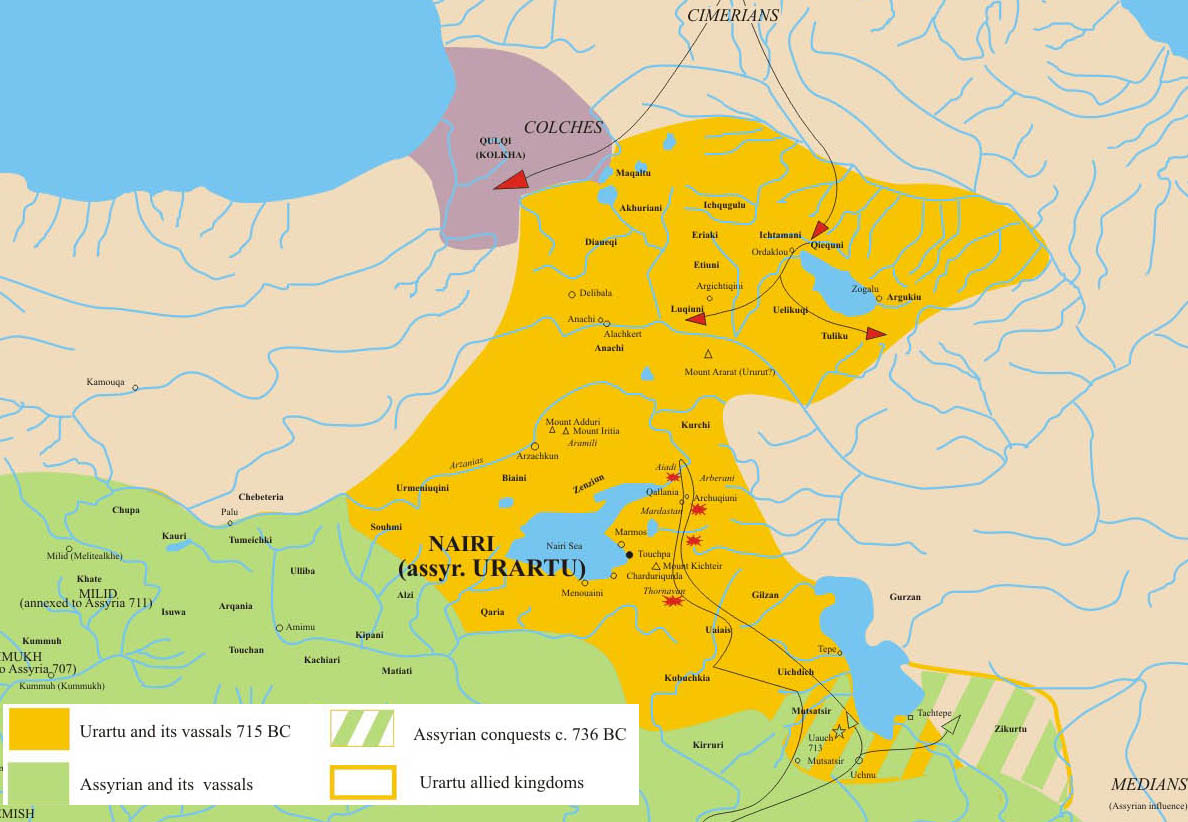
Cimmerian invasions of Colchis, Urartu and Assyria during 715-713 BC
Ugarit was an ancient cosmopolitan port city (now the modern site of Ras Shamra), sited on the Mediterranean coast of northern Syria. It was at its height from ca. 1450 BCE until 1200 BCE. Excavations have since revealed an important city that takes its place alongside Ur and Eridu as a cradle of urban culture, with a prehistory reaching back to c. 6000 BCE, perhaps because it was both a port, and at the entrance of the inland trade route to the Euphrates and Tigris lands. The excavations uncovered a royal palace of 90 rooms laid out around eight enclosed courtyards, many ambitious private dwellings, including two private libraries that contained diplomatic, legal, economic, administrative, scholastic, literary and religious texts. Crowning the hill where the city was built were two main temples: one to Baal the "king", son of El, and one to Dagon, the chthonic god of fertility and wheat.
Several deposits of cuneiform clay tablets were found, constituting a palace library, a temple library and two private libraries; all dating from the last phase of Ugarit, around 1200 BCE. The tablets found at this cosmopolitan center are written in four languages: Sumerian, Akkadian (the language of diplomacy in the ancient Near East), Hurrian and Ugaritic. No less than seven different scripts were in use at Ugarit: Egyptian and Luwian hieroglyphics, and Cypro-Minoan, Sumerian, Akkadian, Hurrian, and Ugaritic cuneiform.
During excavations in 1958 CE, yet another library of tablets, the "Claremont Ras Shamra Tablets" was uncovered. In 1973 CE, an archive containing around 120 tablets was discovered. In 1994 CE more than 300 further tablets were discovered covering the final years of the Bronze Age city's existence. The most important piece of literature recovered from Ugarit is arguably the Baal cycle, describing the basis for the religion and cult of the Canaanite Baal.
Later Ugarit fell under the control of new tribes related to the Hyksos, who mutilated the Egyptian-style monuments. The last Bronze Age king of Ugarit, 'Amurapi, was a contemporary of the Hittite king
Suppiluliuma II. Ugarit was destroyed at the end of the Bronze Age. A cuneiform tablet found in 1986 CE shows that Ugarit was destroyed probably in 1195 BCE. Ugarit had already been destroyed in the 8th year of Ramesses III. Many other Mediterranean cultures were deeply disordered just at the same time, apparently by invasions of the mysterious "Sea Peoples".
Scribes in Ugarit appear to have originated the Ugaritic alphabet around 1400 BCE; The discovery of the Ugaritic archives has been of great significance to biblical scholarship, as these archives for the first time provided a detailed description of Canaanite religious beliefs during the period directly preceding the Israelite settlement. These texts show significant parallels to Biblical Hebrew literature, particularly in the areas of divine imagery and poetic form.
Ugaritic religion centered on the chief god, Ilu or El, the "father of mankind", "the creator of the creation". The Court of El or Ilu was referred to as the 'lhm (Elohim gods). The most important of the great gods was Hadad, the king of Heaven, Athirat or Asherah, Yam (Sea, the god of the primordial chaos, tempests, and mass-destruction) and Mot (Death). Other gods worshipped at Ugarit were Dagon (Grain), Tirosch, Horon, Resheph (Healing), the craftsman Kothar-and-Khasis (Skilled and Clever), Shahar (Dawn), and Shalim (Dusk).]
Immanuel Velikovsky
Herodotus's chronology implied that the great pyramids of Giza were built after Middle Kingdom [12th dynasty, 1991-1782].
In the early third century, Jewish history was brought to Egypt under the Ptolemys, and translated into Greek as the Septuagint. Manetho, a priest and scribe of Heliopolis at the time of Ptolemy Philadelphus (285-247), composed accounts (now lost) of the history (contradicting Herodotus in many places).
Josephus (c80AD) revealed many of Manetho's errors. Epitomes of Manetho's king lists by two Christian chronologists, Africanus c220AD and Eusebius c320AD, have also survived.
Syncellus from Constantinople c800AD is our main surviving source for Manetho's works, although he tells us nothing of his source materials. He is also the sole source of a work he attributes to Manetho called 'The Book of Sothis' which gives a list of Egyptian kings, with annotations linking Egyptian and Jewish historical events. It gives names in an order that is non-chronological. It would be wrong to assume that the early historians such as Manetho, Eusebius, Africanus, Josephus and Syncellus actually knew Egypt's true early history any better than the version told to Herodotus.
Sir Isaac Newton showed that ancient history had been made many centuries too ancient. A devout Christian, but a fearless Biblical critic, he uncovered many discrepancies in and between the King James, Masoretic, Samaritan, and Septuagint versions, and derived 'proofs' based on astronomy to fix a few key dates. From a synthesis of literary evidence, he then recast ancient history. He was the first revisionist to use the precession of the zodiac signs for retrocalculating dates.
By the end of the 19th century, many historians had suggested that the mono-idolistic cult of Akhenaten was a result of a Hebrew influence. Freud, a collector of Egyptian antiquities wrote in 1939 'Moses and Monotheism' in which he linked Moses and Akhenaten. Immanuel Velikovsky, a psychiatrist, was intrigued by Freud's book. In 1952 'Ages in Chaos', ignited a public debate on ancient chronology.
According to Revisionists, archaeologists artificially increased the age of lower strata in order to meet the expectations of excessive antiquity among historians. Using this elongated time frame, great empires of the past such as the Sumerians, Akkadians and Old Babylonians were invented by late 19th C and early 20th C scholars to fill the historical voids. The ancient Greek and Roman historians knew nothing of these ancient peoples.
Heinsohn showed that the Bronze Age started in China and Mesoamerica some 1500 years later than in the Near East. He cited the Indus Valley where the civilisations, dated from Mesopotamian seals of 2400BC, sit right underneath the Buddhist strata of 7-6th Century. Thus some sites only about 30km apart have chronologies some 1500 years apart. But in the same strata, supposedly 1500 years apart, they frequently find the same pottery.
Heinsohn set out many chronological problems and argued for equating the Mittani with the Medes and the Hittites with the Late Chaldeans. He said Sumerian is the language of the well known Kassite/Chaldeans
"The race which was to found the European nations, has, like the sun, wended its way from east to west. A mystic harmony was found to exist between the apparent course of the sun and the migrations of people. The minds of the people dwelling in Central and Eastern Asia seemed to be imbued with a strange instinctive yearning.
The Aryan folk-streams into Europe, were the forerunners of the Teutonic migrations. The Europeans themselves are led by this same instinct to follow the course of the sun: they flow in great numbers to America, and these folk-billows break against each other on the coasts of the Pacific Ocean."
The tribes of Ham were characterised by their westward migration.
In olden times the Gods had inspired the Parsi'e'ans to migrate toward the west and inhabit the lands of Heleste, [Balkans, Georgia, Armenia etc, becoming the Hittites and later the Philistines etc] and they carried with them three languages: the Panic, of Jaffeth; the Vedic, of Vind'yu, and the Parsi'e'an.
Out of the hosts of Parsi'e, who were of the people of Shem, who were since the days of the flood, came Abram. God led Abram away from He-sa, his native place. These, then, are the generations of the line whence came Abram, that is to say:
Of Shem and the seventy tribes, first going forth beyond the mountains of Owatchab-habal, Tur who settled in Parsi'e, and his descendants Goe, and his descendants Wawa, and his descendants Sadr.
"I am the LORD that brought thee out of Ur of the Chaldees, to give thee (Abraham) this land to inherit it."
In Genesis 28 Isaac gave the blessing of Abraham to Jacob and his seed, that he may inherit the land "which God gave unto Abraham".
In the Book of Cpenta-armij, Ch. XI, the light that extended from the Father's throne down to the delivered hosts of Abram and moved westward as they migrated was as an inheritance of Jehovih's light.
When Abraham asked concerning lands. God said: "I led thee to that which was neglected and waste in the eyes of the kings' peoples, and I said: This is thy inheritance. Sufficient is it for thee and thy people to buy burying-places for the dead, which shall not be disturbed. But of all other lands, neither buy nor sell. And after thy people have improved a place, and a king cometh against thee, saying: Either by purchase or by battle, I will have this land; thou shalt say:
Nay, neither by purchase nor by battle, shalt thou inherit that which is Jehovih's. But if thou desirest the land, then will I give it thee without money and without battle.
And it shall come to pass upon my chosen that they shall be driven from place to place, whither I will lead them; and they shall make the waste lands to bloom like gardens, and the deserts to yield ample harvests; for they shall dig wells, and till the soil, and prove unto the nations of the earth the glory of thy works."
[So the land of Israel was not given as a possession, but something that would be relinquished if circumstance demanded.
There is a majority of Jews today who would think otherwise. Nevertheless amongst this fanatical, zealot, military framework are those who "dig wells, and till the soil". Around them rages a forboding apocalypse that forever keeps them God-fearing. It's unclear to me if this is God's plan for the Jews, or an aberration of it.]
The heirs of Moses were lead westward until they circumscribed the earth and completed it by the time of Kosmon.
From the time of Joshu's death, in Jerusalem, the Faithists in Arabin'ya [Egypt and Palestine], Heleste [perhaps Greece and Turkey, Armenia, Syria and Crimea etc.] and Uropa [Eastern Europe] who called themselves Israelites and Jews, and many being apostates, eating flesh, and marrying with other peoples, began to migrate, mostly toward the west.
After the fall of the Egyptian empire her people migrated westward, hundreds of thousands of them, and they settled in western Uropa, where these people married with the aborigines. Their offspring were called Druids, Picts, Gales (Gaelic), Wales (Welsh), Galls (Gauls), and Yohans (Johns), all of which are Eguptian names, preserved to this day.
Now, when the Faithists were moved by the inspiration of God to have no more kings, and to flee away from the Kriste'yan warriors, they came amongst the people above mentioned. (The apostate Faithists married with them, and their offspring were the forefathers of those now called, French, German, Russian and English.)
God, Son of Jehovih, had said: Suffer the apostates to so marry, for here will I find a way to raise up disbelievers in the false Kriste; and they shall ultimately become believers in Jehovih only.
For, inasmuch as I have suffered them to become scattered, so will I appropriate them as seed to quicken all the races of men to comprehend the All One.
1) the time of Exodus (~1500 BC)
2) when the Assyrians captured Memphis (671 BC)
3) when the Persians conquered Egypt (525 BC)
4) 332 BC, when Alexander conquered Egypt
It's possible that a wave of migrants fled Egypt on any of these occasions.
The Lord said to Zarathustra: Behold the people who fly from the kings! I have made them kings over goats and over the beasts of the fields.
And from this time forth the Listians styled themselves shepherd kings.
The Lord inspired Zarathustra to teach them to build houses, and tame the goats, and to live in cities, and otherwise subdue the earth through righteousness; the chief centre of their habitations being on the river Apherteon and its tributaries. And it was from these inhabitants that sprang in after years the migrants called Fonece'ans, signifying, out of the mountains.
[The Akkadians called their predecessors Shukmerians, and spoke of the Land of Shumer. Sitchin said it was the biblical Land of Shin'ar whose name - Shumer - meant the Land of the Watchers (Ta Neter) to the ancient Egyptians, the land from which the gods had come to Egypt.]

Semitic looking figureheads, with beards (absent in the indigenous peoples) and floppy hats
There are many people writing about the connection of India with the Middle Eastern people, and even with Zunis, Hopis and Olmecs.
typical of Phoenician sailors (Right) found in Mexico attributed to the Olmec culture.
One eccentric writer claims that Kheeberi (Heber) are the Phoenicians and Jews (Hebrews), by seeing similarities in words of different languages. His website becomes unusual, but it gives some quotes that are relevant to Oahspe. Here are some of his claims.
"the Cashmirians and the people of Balk sprang from Leda - or Ladakh"
The history of the Scythians began in the Khyber Mountain region of Afghanistan and Pakistan.
In 1904, Jogendra Mohon Gupta, wrote that the Phoenicians were the fathers of all world civilisations:
"As to Zarathustra (the first), he did indeed teach something similar to that taught by the Hindus as described. Check Ahura'Mazda in Oahspe's Saphah (p644 in Blue Oahspe and in little Green; p662 in big Green Oahspe): Descended by the Yi-ha light through mortals ... revealed from Zarathustra ... then by Buddha and Brahma ... || Also the remainder of the Segments in Saphah dealing with the subject including Ahura'Mazda and Earthly History of the Faithists of the East cast more light."
Mine have no idols nor images of Me.
Mine bow down not before idols.
Mine covenant in My name secretly.
Mine remember the four sacred days of the moon.
Mine honor their parents.
Mine kill nothing I have made alive.
Mine commit not adultery.
Mine steal not, nor tell lies; nor covet anything.
Mine return good unto all men.
After Fragapatti established Mouru , council chamber and capital of Haraiti, he appointed High Council of the first house of Mouru, among them:
Airyama, God of Kruse;
Gatha-Ahunavaiti, Goddess of Halonij;
Haptanhaiti, God of Samatras;
Yima, God of Aom;
Sudhga, God of Laka;
Dews, Goddess of Vaerethagna;
Ustavaiti, Goddess of Maha-Meru;
Cpentas, God of Butts; Vairyo, God of Nuga-gala;
D'Zoata and her brother, Zaota, God and Goddess of Atarevasksha;
Yatha, God of Ameshas,
Yima gave protection and miracles to Zarathustra, and became controller over mortals, to the end that they become Faithists in Jehovih and His dominion.
The Aoshoan Lords included:
Yaztas, Hom
The Thestasias Lords included: Amesh and Amesha; Armait.
The general Lords were called Ashem, with voice; that is to say, Ashem-vohu,
Yima made twenty-five Lords controllers of the Voice, with mortals, to take the place of Samati after the death and ascension of Zarathustra, for which reason they were called the Ashem-vohu.
Lords in chief, given for the kingdoms of the Sun, in the land of Shem included:
Shahkya, Thraetem, Hakdodt, Maidoyeshemo, Zartushta, and Cpitama.
And the child's mother's name was Too'che [the virgin mother], and the father's name Lo'ab. Too'che was su'is born herself, and was by Sa'moan, an angel, obsessed before she conceived, and during the time of maternity not suffered to wake from her unconscious trance. Thus, the child was born of All Light, and in that same day the obsession fled, and Too'che proclaimed within the city that no man was father to the child, but that she conceived from All Light, believing, because unconscious in gestation.
Book Of God's Word Ch II:4
Zoroaster (Zaras, Zaratas, or Zaratus) is a Greek transliteration of the name Zarathustra, which becomes Zarathushtra in Avestan, Zaratusht in Pahlavi, Zardasht, Zartosht, Zartusht or Zardosht in modern Persian language.
It is said that his clan name is Spitama, his father according to the later Avesta was Pouruchaspa (many horses), his mother Dughdova (milkmaid) and his great-grandfather Haecataspa/Haichatspa. His birthday is celebrated on March 26, as part of the Iranian New Year Festival.
The cow was Gava, or Gaush in ancient Persia, Gau or Gai in modern India, and milk in Sanskrit is dughda.
Zoroaster's mother Dughdova was said to be a virgin since she conceived after she had been visited by a shaft of light. In another tradition his virgin mother Dughdova was impregnated when the glory of Ahura Mazda descended from heaven and entered her house. The soul of the prophet was placed by God in the sacred Haoma plant (which Zarathustra condemned in the Gathas) and the prophet was conceived through the essence of Haoma in milk.
The Lords of farmers and herdsmen under Yima were: Gaomah [Gaya Maretan/Gayo-maretan/Gayomard], Hoshag, Tamur, Jamshed [known as Yima in the Avestan literature], Freden, Minochihr-bani and Hus.
Copurasastras, Vaitimohu and Howitchwak.
[In Saphah Gah is "the change of the watch of the Gods. In the Avestan texts the Gahs are prayers for each period of the day.]
(Part of the Avesta Fragments)
85. For if there were or could be any escape from death, the first of the world, Gayomard, king of the Mountain, [would have escaped],
88. Or there was Hoshang, the Peshdadian,
89. Who destroyed two-thirds of all the evil creatures of Ahriman;
91. Or there was Tahmuraf, the well-armed, the son of Vivanghat,
94. Or there was Jim, the Shed, the good shepherd, the son of Vivanghat; (he was Shed, that is to say, shining; he was a good shepherd, that is to say, he kept in good condition troops of men and herds of animals);
95. Who, for 616 years, 6 months and 13 days, kept this world free from death and old age, and kept away greed and need from the creation of Ohrmazd;
96. Yet, when death came over him, he delivered up his body and could not struggle with death.
100. Or there was Fredun, the Athwyan. Who smote and bound Azi Dahak, that great evil-doer;
On the race and offspring of the Kayans
Hooshang was son of Fravak, son of Siyamak, son of Mashye (Adam), son of Gayomard. Tahmurasp was son of Vivangha, son of Yanghad, son of Hooshang.
Yim [Jamshed], Tahmurasp, Spitur, and Narsih, whom they also call 'the Rashnu of Chino,' were all brothers.
From Yim [Jamshed] and Yimak, who was his sister, was born a pair, man and woman, and they became husband and wife together; Mirak the Aspiyan and Ziyanak Zardahim were their names and the lineage went on. 5. Spitur was he who, with Dahak [Zohak], cut up Yim [Jamshed].
Dahak [Zohak] was son of Khrutasp, son of Zainigav, son of Virafsang, son of Tazh, son of Fravak son of Siyamak; by his mother Dahak [Zohak] was of Udai, son of Bayak, son of Tambayak, son of Owokhm, son of Pairi-urvaesm, son of Gadhwithw, son of Drujaskan, son of the evil spirit.
Faridoon the Aspiyan was son of Pur-tora the Aspiyan, son of Sok-tora the Aspiyan, son of Bortora the Aspiyan, son of Siyak-tora- the Aspiyan, son of Sped-tora the Aspiyan, son of Gefar-tora the Aspiyan, son of Ramak-tora the Aspiyan, son of Vanfragheshn the Aspiyan, son of Yim [Jamshed], son of Vivangha; as these, apart from the Aspiyan Purtora, were ten generations, they every one lived a hundred years, which becomes one thousand years; those thousand years were the evil reign of Dahak [Zohak]. 8. By the Aspiyan Pur-tora was begotten Faridoon, who exacted vengeance for Yim [Jamshed]; together with him also were the sons Barmayun and Katayun, but Faridoon was fuller of glory than they.
By Faridoon three sons were begotten, Salm and Tuj and Airik; and by Airik one son and one pair were begotten; the names of the couple of sons were Vanidar and Anastokh, and the name of the daughter was Guzhak. 10. Salm and Tuj slew them all, Airik and his happy sons, but Faridoon kept the daughter in concealment, and from that daughter a daughter was born; they became aware of it, and the mother was slain by them. 11. Faridoon provided for the daughter, also in concealment, for ten generations, when Manush-i Khurshed-vinik was born from his mother, [so called because, as he was born, some of] the light of the sun (khwarshed) fell upon his nose (vinik).
From Manush-i Khurshed-vinik and his sister was Manush-khurnar, and from Manush-khurnar [and his sister] was Manuschihar [Minochihr-bani] born
..... By Kavad was Kay Apiveh begotten; by Kay Apiveh were Kay Arsh, Kay Vyarsh, Kay Pisan, and Kay Kaus begotten; by Kay Kaus was Siyavakhsh begotten; by Siyavakhsh was Kay Khosraw begotten. 26. Kersasp and Aurvakhsh were both brothers. 27. Athrat was son of Sahm, son of Turak, son of Spaenyasp, son of Duroshasp, son of Tuj, son of Faridoon. 28. Lohrasp was son of Auzav, son of Manush, son of Kay Pisin, son of Kay Apiveh, son of Kay Kobad. 29. By Kay Lohrasp were Vishtasp, Zarir, and other brothers begotten; by Vishtasp were Spend-dad and Peshotan begotten; and by Spend-dad were Vohuman, Ataro-tarsah, Mitro-tarsah, and others begotten.
Time was for twelve thousand years; and it says in revelation, that three thousand years was the duration of the spiritual state, where the creatures were unthinking, unmoving, and intangible; and three thousand years was the duration of Gayomard, with the ox, in the world.
As this was six thousand years the series of millennium reigns of Cancer, Leo, and Virgo had elapsed, because it was six thousand years when the millennium reign came to Libra, the adversary rushed in, and Gayomard lived thirty years in tribulation. 3. After the thirty years Mashye and Mashyane (Adam and Eve) grew up; it was fifty years while they were not wife and husband, and they were ninety-three years together as wife and husband till the time when Hooshang came.
Hooshang was forty years, Tahmurasp thirty years, Yim [Jamshed] till his glory departed six hundred and sixteen years and six months, and after that he was a hundred years in concealment.
Then the millennium reign came to Scorpio, and Dahak [Azi Dahaka/Zohak the Serpent-King, Ctusk, or the false Ahura?] ruled a thousand years.
[The name of Astyages, the son of Cyaxares, the last king of Media (585 BCE-550 BCE), who was dethroned in 550 BCE by Cyrus the Great, is Ishtovigu in Persian, is spelled as Astyages by Herodotos; as Astyigas by Ctesias , as Aspadas by Diodorus; is Ištumegu in Akkadian, Rishti Vega Azhi Dahâk in Median, Azhdahak in Armenian, and Azh Dahâk in Kurdish. This association with evil may be due to the practices of his time.]
After the millennium reign came to Sagittarius, Faridoon
reigned five hundred years; in the same five hundred years of Faridoon were the twelve years of Airik, Manuschihar was a hundred and twenty years, and in the same reign of Manuschihar, when he was in the mountain fastness (dushkhvar-gar), were the twelve years of Frasiyav; Zob the Tuhmaspian was five years.
Kay Kobad was fifteen years; Kay Kaus, till he went to the sky, seventy-five years, and seventy-five years after that, altogether a hundred and fifty years; Kay Khosraw sixty years; Kay Lohrasp a hundred and twenty years; Kay Vishtasp, till the coming of the religion, thirty years, altogether a hundred and twenty years.
Vohuman son of Spend-dad a hundred and twelve years; Humai, who was daughter of Vohuman, thirty years; Darai [Darius I] son of Chihar-azhad, that is, of the daughter of Vohuman, twelve years; Darai son of Darai fourteen years; Alexander the Ruman fourteen years [Iskander the Rûmi or Alexander the Great].
The Ashkanians bore the title in an uninterrupted (a-arubak) sovereignty two hundred and eighty-four years, Ardashir son of Papak and the number of the Sasanians four hundred and sixty years, and then it went to the Arabs.
29. Exposition in the good religion regarding the origin of the formation of the peoples (living) on the outskirts of Iran.
Know that the formation also of the religion and customs of the people of the borders, whose original country was Iran, is (derived) from the original religion and faith of their Iranian ancestors. For, the power they have attained is owing to the Iranian religion; and those who have become lords of the world are (descended) from Hooshang, Tahmurasp, Jamshed, Faridoon; Erach, and other Iranians.
Again, a check should be given to the advancing strength and the attack of the "Yahud" [Jewish] religion of Rum and "the Masahiya" [Messiah, ie. Christian] religion of Khavar, and the "Mani" religion [Manichaeism] of Turkestan, lest their wickedness and degradation should enter into (our) co-religionist friends and the purity of our religion, which is older than that of Rum, should be dimmed.
Part 3, 5th PRAPATHAKA, 19th KHANDA
Therefore the first food which a man may take, is in the place of Homa. And he who offers that first oblation, should offer it to Prana (up-breathing), saying Svaha. Then Prana is satisfied,
If Prana is satisfied, the eye is satisfied, if the eye is satisfied, the sun is satisfied, if the sun is satisfied, heaven is satisfied, if heaven is satisfied, whatever is under heaven and under the sun is satisfied.. And through their satisfaction he (the sacrificer or eater) himself is satisfied with offspring, cattle, health, brightness, and Vedic splendour.
The legendary Shah Jamshed was the fourth and greatest of the early Shahs of mankind in Firdausi's Shahnama. The name has also been transliterated Jamshyd, e.g. in the Rubaiyat of Omar Khayyam [a collection of poems attributed to the Persian mathematician and astronomer Omar Khayyam (1048 - 1123). Rubaiyat means "quatrains": verses of four lines].
Shah Jamshed is based on the figure Yima Xsaeta of the Avesta. Yima Xsaeta is in turn is based on a proto-Indo-Iranian heroic figure Yamas, from whom Vedic Yama also derives. In the Avesta, Yima was the son of Vivashat, who in turn corresponds to the Vedic Vivasvat, "he who shines out", a divinity of the Sun.
The name Jamshid is originally a compound of two parts, Jam and shid, corresponding to the Avestan names Yima and Xsaeta, derived from the proto-Iranian Yamah Xšaitah. Yamah and the related Sanskrit Yama may be interpreted as "the twin". It became Persian Jam. In later Persian, the word jam means "pure".
Xšaitah meant "bright, shining" or "radiant". By regular sound changes xšaitah became Persian 'shed'. The suffix -shid is the same as that found in other names such as khorshid ("the Sun", originally "the radiant Sun", Avestan hvare-xsaeta).
Over time, the Avestan hero Yima Xšaeta became the world-ruling Shah Jamshid of Persian legend and mythology.
Jamshid had command over all the angels and demons of the world, and was both king and high priest of Hormozd . He was responsible for a great many inventions that made life more secure for his people: the manufacture of armor and weapons, the weaving and dying of clothes of linen, silk and wool, the building of houses of brick, the mining of jewels and precious metals, the making of perfumes and wine, the navigation of the waters of the world in sailing ships. Jamshid also divided the people into four groups: the priests, warriors, farmers, artisans. Jamshid had now become the greatest monarch the world had ever known. He was endowed with the royal farr (Avestan hvar?na), a radiant splendor that burned about him by divine favor. One day he sat upon a jewel-studded throne and the divs/deevs [in this case demons] who served him raised his throne up into the air and he flew through the sky. His subjects, all the peoples of the world, marvelled and praised him. On this day, which was the first of the month of Farvardin, they first celebrated the holiday of Nawroz ("New Day"). Some Zoroastrians to this day call the day Jamshed-i Nawroz.
Jamshid was said to have had a magical seven-ringed cup, the Jam-e Jam which was filled with the elixir of immortality and allowed him to observe the universe. Jamshid's capital was erroneously believed to be at the site of the ruins of Persepolis, which for centuries (down to 1620 CE) was called Takht-i Jamshed, the "Throne of Jamshid". However, Persepolis was actually the capital of the Achaemenid kings and was destroyed by Alexander.
In comparing the Avesta legends above with the Oahspe, Thraetem was a Lord of Shem serving Yima in the time of Zarathustra, and Freden/Fredon/Faridoon was one of the Lords of farmers and herdsmen under Yima. There is a distinction between Thraetem and Thraetaona, the latter seems to be a holy name, not a historical being. Thrita is distinct from the two. If this is so, the following is in error.
Traitaunas is a derivative of Tritas, the name of a deity or hero reflected in the Vedic Trita and the Avestan Thrita. Both names are identical to the adjective meaning "the third", a term used of a minor deity associated with two other deities to form a triad. In the Indian Vedas, Trita is associated with gods of thunder and wind. Trita is also called Aptya, a name that is probably cognate with Athwiya, the name of Thraetaona's father in the Avesta. Traitaunas may therefore be interpreted as "the great son of the deity Tritas".
The Avesta identifies the person who finally disposed of Aži Dahaka as Traetaona/Fredon. Originally he may have been recorded as the killer of the dragon Aži Dahaka. The Avesta has little to say about the nature of thraetaona's defeat of Aži Dahaka, other than that it enabled him to liberate the two most beautiful women in the world. Later sources, especially the Denkard, provide more detail. Fredon is said to have been endowed with the divine radiance of kings (xvarrah, modern Persian farr) from birth, and was able to defeat Dahag/Zahhak at the age of nine, striking him on shoulder, heart and skull with a mace and giving him three wounds with a sword. However, when he did so, vermin (snakes, insects and the like) emerged from the wounds, and Ormazd told him not to kill Dahag, lest the world become infested with these creatures.
Instead, Fredon bound Zohak in a cave underneath the mythical Mt. Damavand (later identified with Damavand, one of the high mountains of the Alborz chain) with chains tied to great nails fixed into the walls of the cavern where he will remain until the end of the world.
[The Oahspe equivalent of Damavand seems to be the four evil corners of the VARENA, where Aži Dahaka/Zohak/serpent/evil is bound, over whom the name Thraetaono has power.]
Afterwards Fereydun became the king and according to the myth, ruled the country for about 500 years. At the end of his life he allocated his kingdom to his three sons; Salm, Tur, and Iraj. Iraj was Fereydun's youngest and favored son and inherited the best part of the kingdom namely Iran. Salm inherited Asia Minor ("Rum", more generally meaning the Roman Empire, the Greco-Roman world, or just "the West") and Tur inherited Central Asia ("Turan", all the lands north and east of the Oxus, as far as China), respectively. This aroused Iraj's brothers' envy and encouraged them to murder him. After Iraj's murder, Fereydun enthroned Iraj's grandson, Manuchehr, before his decease. Man?chehr's attempt to revenge his grand father's murder initiates the Iranian-Turanian wars.
Aži Dahaka is described as a monster with three mouths, six eyes, and three heads (presumably meaning three heads with one mouth and two eyes each), cunning, strong and demonic. But in other respects Aži Dahaka has human qualities, and is never a mere animal. In a post-Avestan Zoroastrian text, the Denkard, Aži Dahaka is identified as an Arab, and as the source of the writings of Judaism (in this context identified as a religion opposed to Zoroastrianism).
The following is an extract from "The Epic of Kings" (the Shahnameh) by the poet Ferdowsi, written 1010 AD. There are parallels with the Book of Daniel, and the story of Zarathustra.
In "The Ultiumate Encyclopedia of Mythology" it said:
Zohak had a terrifying dream ... He ordered all the children to be put to death (as did So-qi, king of Oas in Zarathustra's time, and Herod), but the baby Feridun (like Zarathustra) survived. I have not found this repeated anywhere else.
Now the Serosch, the angel who defendeth men from the snares of the Deevs, and who each night flieth seven times around the earth that he may watch over the children of Ormuzd, when he learned this, appeared like unto a Peri and warned Kaiumers. So when Saiamuk set forth at the head of his warriors to meet the army of Ahriman, he knew that he was contending against a Deev, and he put forth all his strength. But the Deev was mightier than he, and overcame him, and crushed him under his hands.
Kaiumers commanded Husheng, the son of Saiamuk, "Take the lead of the army, and march against the Deevs." And the King, by reason of his great age, went in the rear. Now there were in the host Peris; also tigers, lions, wolves, and other fierce creatures, and when the black Deev heard their roaring he trembled for very fear. Neither could he hold himself against them, and Husheng routed him utterly. Then when Kaiumers saw that his well-beloved son was revenged he laid him down to die, and the world was void of him, and Husheng reigned in his stead.
Now Husheng was a wise man and just, and the heavens revolved over his throne forty years. justice did he spread over the land, and the world was better for his reign. For he first gave to men fire, and showed them how to draw it from out the stone; and he taught them how they might lead the rivers, that they should water the land and make it fertile; and he bade them till and reap. And he divided the beasts and paired them and gave them names. And when he passed to a brighter life he left the world empty of a throne of power. But Tahumers, his son, was not unworthy of his sire. He too opened the eyes of men, and they learned to spin and to weave; and he reigned over the land long and mightily. But of him also were the Deevs right envious, and sought to destroy him. Yet Tahumers overcame them and cast them to earth. Then some craved mercy at his hands, and sware how they would show him an art if he would spare them, and Tahumers listened to their voice. And they taught him the art of writing, and thus from the evil Deevs came a boon upon mankind.
Howbeit when Tahumers had sat upon the golden throne for the space of thirty years he passed away, but his works endured; and Jemshid, his glorious son, whose heart was filled with the counsels of his father, came after him. Now Jemshid reigned over the land seven hundred years girt with might, and Deevs, birds, and Peris obeyed him. And the world was happier for his sake, and he too was glad, and death was unknown among men, neither did they wot of pain or sorrow.
Then it came about that the heart of Jemshid was uplifted in pride, and he forgot whence came his weal and the source of his blessings. He beheld only himself upon the earth, and he named himself God, and sent forth his image to be worshipped. But when he had spoken thus, the Mubids, which are astrologers and wise men, hung their heads in sorrow, and no man knew how he should answer the Shah. And God withdrew his hand from Jemshid, and the kings and the nobles rose up against him, and removed their warriors from his court, and Ahriman had power over the land.
Now there dwelt in the deserts of Arabia a king named Mirtas, generous and just, and he had a son, Zohak, whom he loved. And it came about that Ahriman visited the palace disguised as a noble, and tempted Zohak that he should depart from the paths of virtue. And he spake unto him and said - "If thou wilt listen to me, and enter into a covenant, I will raise thy head above the sun."
Now the young man was guileless and simple of heart, and he sware unto the Deev that he would obey him in all things. Then Ahriman bade him slay his father, "for this old man," he said, "cumbereth the ground, and while he liveth thou wilt remain unknown." When Zohak heard this he was filled with grief, and would have broken his oath, but Ahriman suffered him not, but made him set a trap for Mirtas. And Zohak and the evil Ahriman held their peace and Mirtas fell into the snare and was killed. Then Zohak placed the crown of Thasis upon his head, and Ahriman taught him the arts of magic, and he ruled over his people in good and evil, for he was not yet wholly given up to guile.
Then Ahriman imagined a device in his black heart. He took upon himself the form of a youth, and craved that he might serve the King as cook. And Zohak, who knew him not, received him well and granted his request, and the keys of the kitchen were given unto him. Now hitherto men had been nourished with herbs, but Ahriman prepared flesh for Zohak. New dishes did he put before him, and the royal favour was accorded to his savory meats. And the flesh gave the King courage and strength like to that of a lion, and he commanded that his cook should be brought before him and ask a boon at his hands. And the cook said - "If the King take pleasure in his servant, grant that he may kiss his shoulders."
Now Zohak, who feared no evil, granted the request, and Ahriman kissed him on his shoulders. And when he had done so, the ground opened beneath his feet and covered the cook, so that all men present were amazed thereat. But from his kiss sprang hissing serpents, venomous and black; and the King was afraid, and desired that they should be cut off from the root. But as often as the snakes were cut down did they grow again, and in vain the wise men and physicians cast about for a remedy. Then Ahriman came once again disguised as a learned man, and was led before Zohak, and he spake, saying - "This ill cannot be healed, neither can the serpents be uprooted. Prepare food for them, therefore, that they may be fed, and give unto them for nourishment the brains of men, for perchance this may destroy them."
But in his secret heart Ahriman desired that the world might thus be made desolate; and daily were the serpents fed, and the fear of the King was great in the land. The world withered in his thrall, the customs of good men were forgotten, and the desires of the wicked were accomplished.
Now it was spread abroad in Iran that in the land of Thasis there reigned a man who was mighty and terrible to his foes. Then the kings and nobles who had withdrawn from Jemshid because he had rebelled against God, turned to Zohak and besought him that he would be their ruler, and they proclaimed him Shah. And the armies of Arabia and Persia marched against Jemshid, and he fled before their face. For the space of twice fifty years no man knew whither he was gone, for he hid from the wrath of the Serpent-King. But in the fulness of time he could no longer escape the fury of Zohak, whose servants found him as he wandered on the sea-shore of Cathay, and they sawed him in twain, and sent tidings thereof to their lord. And thus perished the throne and power of Jemshid like unto the grass that withereth, because that he was grown proud, and would have lifted himself above his Maker.
So the beloved of Ahriman, Zohak the Serpent, sat upon the throne of Iran, the kingdom of Light. And he continued to pile evil upon evil till the measure thereof was full to overflowing, and all the land cried out against him. But Zohak and his councillors, the Deevs, shut ear unto this cry, and the Shah reigned thus for the space of a thousand years, and vice stalked in daylight, but virtue was hidden. And despair filled all hearts, for it was as though mankind must perish to still the appetite of those snakes sprung from Evil, for daily were two men slaughtered to satisfy their desire. Neither had Zohak mercy upon any man. And darkness was spread over the land because of his wickedness.
But Ormuzd saw it and was moved with compassion for his people, and he declared they should no longer suffer for the sin of Jemshid. And he caused a grandson to be born to Jemshid, and his parents called him Feridoun.
Now it befell that when he was born, Zohak dreamed he beheld a youth slender like to a cypress, and he came towards him bearing a cow-headed mace, and with it he struck Zohak to the ground. Then the tyrant awoke and trembled, and called for his Mubids, that they should interpret to him this dream. And they were troubled, for they foresaw danger, and he menaced them if they foretold him evil. And they were silent for fear three days, but on the fourth one who had courage spake and said - "There will arise one named Feridoun, who shall inherit thy throne and reverse thy fortunes, and strike thee down with a cow-headed mace."
When Zohak heard these words he swooned, and the Mubids fled before his wrath. But when he had recovered he bade the world be scoured for Feridoun. And henceforth Zohak was consumed for bitterness of spirit, and he knew neither rest nor joy.
Now it came about that the mother of Feridoun feared lest the Shah should destroy the child if he learned that he was sprung from Jemshid's race. So she hid him in the thick forest where dwelt the wondrous cow Purmaieh, whose hairs were like unto the plumes of a peacock for beauty. And she prayed the guardian of Purmaieh to have a care of her son, and for three years he was reared in the wood, and Purmaieh was his nurse. But when the time was accomplished the mother knew that news of Purmaieh had reached the ears of Zohak, and she feared he would find her son. Therefore she took him far into Ind, to a pious hermit who dwelt on the Mount Alberz. And she prayed the hermit to guard her boy, who was destined for mighty deeds. And the hermit granted her request. And it befell that while she sojourned with him Zohak had found the beauteous Purmaieh and learned of Feridoun, and when he heard that the boy was fled he was like unto a mad elephant in his fury. He slew the wondrous cow and all the living things round about, and made the forest a desert. Then he continued his search, but neither tidings nor sight could he get of Feridoun, and his heart was filled with anguish.
In this year Zohak caused his army to be strengthened, and he demanded of his people that they should certify that he had ever been to them a just and noble king. And they obeyed for very fear. But while they sware there arose without the doorway of the Shah the cry of one who demanded justice. And Zohak commanded that he should be brought in, and the man stood before the assembly of the nobles.
Then Zohak opened his mouth and said, "I charge thee give a name unto him who hath done thee wrong."
And the man, when he saw it was the Shah who questioned him, smote his head with his hands. But he answered and said - "I am Kawah, a blacksmith and a blameless man, and I sue for justice, and it is against thee, O King, that I cry out. Seventeen fair sons have I called mine, yet only one remaineth to me, for that his brethren were slain to still the hunger of thy serpents, and now they have taken from me this last child also. I pray thee spare him unto me, nor heap thy cruelties upon the land past bearing."
And the Shah feared Kawah's wrath, beholding that it was great, and he granted him the life of his son and sought to win him with soft words. Then he prayed him that he would also sign the testimony that Zohak was a just and noble king.
But Kawah cried, "Not so, thou wicked and ignoble man, ally of Deevs, I will not lend my hand unto this lie," and he seized the declaration and tore it into fragments and scattered them into the air. And when he had done so he strode forth from the palace, and all the nobles and people were astonished, so that none dared uplift a finger to restrain him. Then Kawah went to the market-place and related to the people all that which he had seen, and recalled to them the evil deeds of Zohak and the wrongs they had suffered at his hands. And he provoked them to shake off the yoke of Ahriman. And taking off the leathern apron wherewith blacksmiths cover their knees when they strike with the hammer, he raised it aloft upon the point of a lance and cried - "Be this our banner to march forth and seek out Feridoun and entreat him that he deliver us from out the hands of the Serpent-King." Then the people set up a shout of joy and gathered themselves round Kawah, and he led them out of the city bearing aloft his standard. And they marched thus for many days unto the palace of Feridoun.
Now these things came about in the land of Iran after twice eight years were passed over the head of Feridoun. And when that time was accomplished, he descended from the Mount Alberz and sought out his mother, questioning her of his lineage. And she told him how that he was sprung from the race of Jemshid, and also of Zohak and of his evil deeds.
Then said Feridoun, "I will uproot this monster from the earth, and his palace will I raze to the dust."
But his mother spake, and said, "Not so, my son, let not thine youthful anger betray thee; for how canst thou stand against all the world?"
Yet not long did she suffer the hard task to hinder him, for soon a mighty crowd came towards the palace led by one who bare an apron uplifted upon a lance. Then Feridoun knew that succour was come unto him. And when he had listened to Kawah, he came into the presence of his mother with the helmet of kings upon his head, and he said unto her - "Mother, I go to the wars, and it remaineth for thee to pray God for my safety."
Then he caused a mighty club to be made for him, and he traced the pattern thereof upon the ground, and the top thereof was the head of a cow, in memory of Purmaieh, his nurse. Then he cased the standard of Kawah in rich brocades of Roum, and hung jewels upon it. And when all was made ready, they set forth towards the West to seek out Zohak, for, they knew not that he was gone to Ind in search of Feridoun. Now when they were come to Bagdad, which is upon the banks of the Tigris, they halted, and Feridoun bade the guardians of the flood convey them across. But these refused, saying, the King bade that none should pass save only those who bore the royal seal. When Feridoun heard these words he was wroth, and he regarded not the rushing river nor the dangers hidden within its floods. He girded his loins and plunged with his steed into the waters, and all the army followed after him. Now they struggled sore with the rushing stream, and it seemed as though the waves would bear them down. But their brave horses overcame all dangers, and they stepped in safety upon the shore. Then they turned their faces towards the city which is now called Jerusalem, for here stood the glorious house that Zohak had builded. And when they had entered the city all the people rallied round Feridoun, for they hated Zohak and looked to Feridoun to deliver them. And he slew the Deevs that held the palace, and cast down the evil talisman that was graven upon the walls. Then he mounted the throne of the idolater and placed the crown of Iran upon his head, and all the people bowed down before him and called him Shah.
Now when Zohak returned from his search after Feridoun and learned that he was seated upon his throne, he encompassed the city with his host. But the army of Feridoun marched against him, and the desires of the people went with them. And all that day bricks fell from the walls and stones from the terraces, and it rained arrows and spears like to hail falling from a dark cloud, until Feridoun had overcome the might of Zohak. Then Feridoun raised his cow-headed mace to slay the Serpent-King. But the blessed Serosch swooped down, and cried - "Not so, strike not, for Zohak's hour is not yet come."
Then the Serosch bade the Shah bind the usurper and carry him far from the haunts of men, and there fasten him to a rock. And Feridoun did as he was bidden, and led forth Zohak to the Mount Demawend. And he bound him to the rock with mighty chains and nails driven into his hands, and left him to perish in agony. And the hot sun shone down upon the barren cliffs, and there was neither tree nor shrub to shelter him, and the chains entered into his flesh, and his tongue was consumed with thirst. Thus after a while the earth was delivered of Zohak the evil one, and Feridoun reigned in his stead.
All viewpoints on where or when Zarathustra was born are speculative. Some place his birth in western Iran and call him a Mede because of a late Iranian tradition linking him with Azerbaijan, and linguistic reasons based on the Avesta (which are discarded by scholars).
According to the Avesta (Yasna, 9, 17), Airyanem Vaejah, on the river Ditya, the old sacred country of the gods, was the home of Zoroaster, and the scene of his first appearance. There, on the river Darejya (Vend., 19. 4) stood the house of his father. The river Dhraja lay in Airan Vej (Bundahish 20, 32 and 24, 15), on its bank was the dwelling of his father, and that there Zoroaster was born. Airan Vej was situated in the direction of Atropatene (Bundahish 2, 12) [see map], and consequently Airyanem Vaejah or Iran-Veg is identified with the district of Arran on the river Aras (Araxes), close by the northwestern frontier of Media (border of Azerbaijan and Armenia today).
[In Oahspe Airyana-Vaja is the first best of places, so can not be a physical place.
(Highlighted names are explained below and some are referred to in Oahspe)]
Other traditions make him a native of ancient Ragha, outside the modern city of Ray (Rai) near Tehran, or belonging to the tribe of Magu.
The supreme head of the Zoroastrian priesthood (zarathushtrotema) had his residence in Ragha at a later (Sassanian) time (Yasna, 59, 18).
Geographical boundaries of the Avesta are impossible to locate but are given an "Eastern Iranian" generalisation. These include all Afghanistan and some neighbouring regions. The "Eastern Iranian" language of the Gathas could cover the vast area stretching from the Hindu Cush mountain range to the southern reaches of Seistan/Sistan, Arachosia (modern Qandahar/Kandahar) and Drangiana (the area of the Helmand river and border regions of Iran) [see map]. The discovery of the 3rd century BC Hilmand civilisation uncovered a warrior aristocracy that ruled in an Aryan-like society of 3 classes - priests warriors and shepherds.
[Parsua (Parsi'e in Oahspe) was later called Parsa "Persia" , hence Farsi, the native name for modern Persian.]
It would have stretched from Mesopotamia (Iraq), across the Zagros mountains into and Iran (Persia and Media), through Central Asia to China. The "city of the sun", Oas, the "centre of the world" could have been ancient Balkh. Paktra, named Bactria by classical writers, which came to be called Balkh after the conquests of Islam. It is a northern province of modern Afghanistan, which borders to the north the Oxus River and the former USSR. Bactria is now known as Afghan Turkistan. Balkh is also called Bakhdhi (the name in Oahspe for the third holy place in heaven). Legend says that Zarathustra appeared during the reign of Gushtaspa (Vishtaspa or Hystaspes) at Bactra/Bakhdi (Balkh) "the beautiful, of the high - streaming banner" [Balkh is near the city of Mazar- e Sharif and the silk road town of Konduz in the north, known in the news for the Taliban prisoner uprising].
The Mazzaroth says:
Hyde quotes from Abulfaragius, that Zeradusht (or Zoroaster) taught the Persians that in the latter times a virgin should bring forth a son, and that when he should be born, a star should appear, and should shine and be conspicuous in the midst of the figure of the virgin. It is then said that he commanded his disciples, the Magi, when they should see the star, that they should go forth where it directed them, and offer gifts to him that should be born.

Map showing Balkh in Bactria, Ragha (Rai) near Tehran (not shown) and Atropatene (below the Caucasus) [the river Oxus is labelled as Amu Darya].
Below Atropatene is Hamadan (the Ecbatana, or Achmetha of the Bible [Ezra 6:2] ), the ancient capital of the Medes. Note the areas of Persis/Fars/Pars? (the main region of Zoroastrians today), Merv (where the archaeologist Sarianidi is excavating the 7,000 year old ancient site of Margush) Herat, Sistan and Drangiana where the Helmand civilisation was found. The rivers Hari-rud, Helmand, Tigris, Euphrates, Indus (in blue), and places like Syria, Georgia, Egypt, Ispahan/Esfahan Sakastan/Sikistan/Sigistan/Sistan are mentioned in the Greater Bundahishn. Turan is where Turanians come from I suppose.
The river Oxus once poured into the Caspian Sea, but now it flows into the Aral Sea, and the modern city of Balkh [the old Bactrus], which once stood on its banks is now a few miles away. A succession of mighty natural forts spread over Bactria asserts the safe strategical position of the city.
The Aryans and the Iranians of Bactria spoke the same language, worshiped Varuna, the shining Vault of Heaven; Mithra; Vayu; the wind that pushes aside the storms and clears the heaven; Yama, the primeval man, reigning over the blessed souls in paradise. In their ceremonies they also drunk the sacred Juice, Soma. These two races slowly drifted apart as time went on, for not known reasons. Although the history of early Bactria is vague, the historians gather that as early as the second millennium B.C., a powerful confederacy, centered in Bactria existed in South Central Asia. Walled Cities (Merv, Maracandra, Balkh) with central castles (kal'ah) existed in Bactria by 900 BC.
The first historical account of Persians (Parsua) near Lake Urnia are in 843 BC and of Medes (Madai) in Hamadan (see map above) are in 836 BC. In Persian sources, the Scythians (8-3rd C BC) were called Saka.
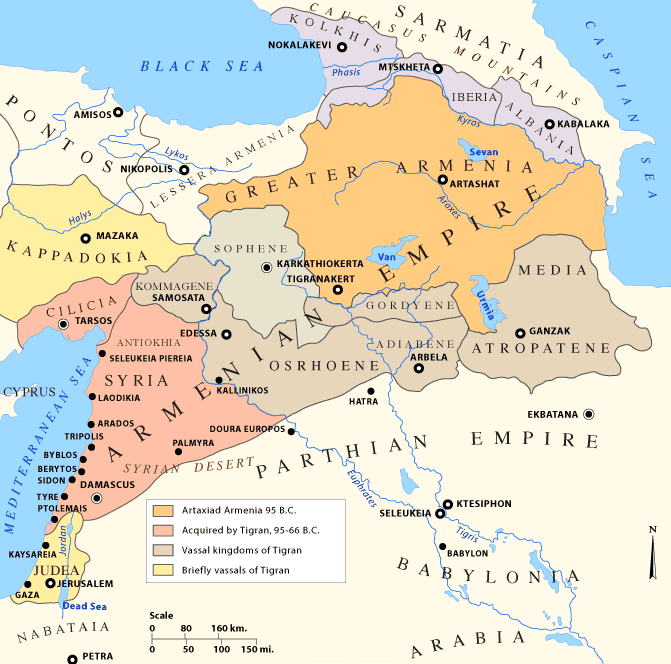
Map showing Atropatene (below Media). Albania is north of Greece today.)
Atropatene was an ancient region in modern north western Iran, formerly a part of Media. Atropatene was the name of Iranian Azerbaijan from the time of Alexander the Great until the Arab conquest of Iran, after which Arabs modified the name into Azerbaijan. It was called Atropatene or Media Atropatene after Atropates who made it independent soon after the death of Alexander the Great.
The hypothesis that Zarathustra came from NE Iran in Chorasmia (Khorezm) or the regions near Merv and Herat at the eve of the establishment of Cyru
Atropatene was the name of Iranian Azerbaijan
Zarathustra's name is not mentioned by Herodotus (480-425 BC) who seems unaware of him in his sketch of the Mado-Persian religion. It occurs for the first time in a fragment of Xanthus of Lydia, and in the Alcibiades of Plato (~347 BC), who calls him the son of Oromazdes. Hermodorus and Hermippus of Smyrna place him 5000 years before the Trojan war.
Eratosthenes (c275-194), head of the great library of Alexandria some decades after Manetho studied the works of Homer, Manetho, and other early Greek historians, and derived a date for the Trojan War of c1193-1183. This he did by identifying 17 Spartan kings who reigned in succession from the return of the Heraclidae to Thermopylae. He then assumed that three generations lasted 100 or 120 years, and arrived at a total of 622 years for their combined reigns. This early date was strongly disputed at the time by others, including some Greek ruling families who could trace their genealogies back to ancestors who had fought at Troy. They said this date was over 300 years too early, and that the war had ended not more than three generations before the start of the first Olympic Games in 776. Pausanias reports that the argument was partially settled by allowing both views to co-exist, with the Olympic Games first starting in 12C, then starting again in 8C after a lapse of some 400 years. Today the genealogical evidence from several Greek rulers is again ignored, and the CC has embraced Eratosthenes' early 12C date for Troy. His use of those ridiculously long average reign lengths is conveniently ignored.
Xanthus places him 6000 years before Xerxes (~484 BC) [6000 years before Xerxes is 6484 BC.]
Eudoxus of Cnidus and Aristotle (384-322 BC) place him 6000 years before the death of Plato (~347 BC), and Aristotle was not one to make a statement without a good reason for it. Agathias remarks it is no longer possible to determine with any certainty when he lived and legislated and adds, "The Persians say Zoroaster lived under Hystaspes, but do not make it clear whether by this name they mean the father of Darius or another Hystaspes. He was their teacher and instructor in the Magian religion, modified their former religious customs, and introduced a variegated and composite belief. Bunsen . . . finds that Zarathustra Spitama lived under the King Vistaspa about 3,000 years B.C., and describes him as 'one of the mightiest intellects and one of the greatest men of all time."
Zarathustra received his prophetic calling in about his thirtieth year. He went into the forest where the earth and waters, birds and beasts, sun and moon, stars and planets became Zarathushtra's teachers, and read lessons written by the hand of the maker in every pebble, leaf, dewdrop and sunbeam, in every star and planet. Here he plunged into a reverie and communed with his inner self. Mind alone can understand and realise the supreme mind. Vohu Manah, who "impersonates" the divine mind, came to Zarathustra, who conceived Him as holy.
God called upon Zarathustra to proclaim His "Manthra" to humanity. He was The "Manthran" - the harbinger of God's thought-provoking message [Manthra corresponds to the Vedic word "Mantra" and means "the prophetic word of great moral significance". Mantra later became synonymous with 'spells of magical charms']. He speaks of his faith in terms of a universal religion.
He won as a convert King Vishtaspa, who may have lived in eastern Iran or Bactria, and became the court prophet (in the Hebrew sense of a prophet ie. giving a revolutionary message of religious purity and social justice, speaking out against corrupt priests and potentates).
We sacrifice to Ashi Vanguhi, who is shining, high .... and powerful.
49. To her did the tall Kavi Vishtaspa offer up a sacrifice behind the waters of the river Daitya.
"O Zarathushtra, what righteous man is thy friend for the great covenant?
It is the Kava Vishtaspa at the consummation."
"Then let them seek the pleasure of Mazda with thoughts, words, and actions, unto him praise gladly, and seek his worship, even Kava Vishtaspa, and Zarathushtra's son, the Spitamid, with Frashaoshtra, making straight the paths for the Religion of the future Deliverer which Ahura ordained."
So, let all strive with thought, word and deed to satisfy Mazda. Let each one choose to perform good deeds as his worship. Kavi Vishtaspa, the faithful devotee of Zoroaster together with Maidyo-Mah and Frashaoshtra are treading the path of Truth and have chosen the Faith inspired and revealed by the Saoshyant, or the Saviour of Mankind, taught by Ahura.
Zarathustra is said to have had six children, but they may be only symbolic of the Amesha Spentas. The last Gatha is composed for the marriage of Zarathushtra's daughter Pouruchista (Full of Wisdom [as is the Gnostic Sophia]).
1. (Zarathushtra) - The best possession known is of Zarathushtra Spitama, which is that Mazda Ahura will give him through Right the glories of blessed life unto all time, and likewise to them that practice and learn the words and actions of his Good Religion.
2. Then let them seek the pleasure of Mazda with thoughts, words, and actions, unto him praise gladly, and seek his worship, even Kava Vishtaspa, and Zarathushtra's son, the Spitamid, with Frashaoshtra, making straight the paths for the Religion of the future Deliverer which Ahura ordained.
3. Him, O Pouruchista, thou scion of Haechataspa and Spitama, youngest of Zarathushtra's daughters, hath (Zarathushtra) appointed as one to enjoin on them the fellowship with Good Thought, Right, and Mazda. So take counsel with thine own understanding, with good insight practice the holiest works of Piety.
4. (Jamaspa): Earnestly will I lead her to the Faith, that she may serve her father and her husband, the farmers and the nobles, as a righteous woman (serving) the righteous. The glorious heritage of Good Thought ... shall Mazda Ahura give to her for all time.
5. (Zarathushtra): Teachings address I to maidens marrying, and to you (bridegrooms) giving counsel. Lay them to heart and learn to get them within your Selves in earnest attention to the Life of Good Thought. Let each of you strive to excel the other in the Right, for it will be a prize for that one.
[Oahspe does not record such a change. Rather the Gathas seem to be part of the "old Aryan" or Haptan religion which was corrupt by this time. Iranians held the fire sacred and stopped burning their dead, exposing the dead to vultures instead. Dogs were held sacred and people were punished severely for harming them].
He is a historical figure in the Gathas and the prophet is indebted to him for his success. In Yasna, 53, 2. he is spoken of as a pioneer of the doctrine revealed by Ormazd. In the relation between Zoroaster and Vishtaspa lies the germ of the state church which afterwards became subservient to the interests of the dynasty and sought its protection.
Zarathushtra's death is nowhere mentioned in the Avesta; in the Shah-Na'ma he is said to have been murdered at the altar by the Turanians in the storming of Balkh.
But there is no holiday commemorating the martyrdom of the Prophet, and scholars say that Zarathustra died peacefully.
"The Lords and Gods of the lower heavens were awarded by Mithra petty kingdoms in atmospherea belonging to Vind'yu. Usually, each mortal city was allotted to the keeping of one of these spirit Saviours, Lords or Gods who professed to give the revelations of Zarathustra, who had ceased in men's eyes to be a man, but a principle of Truth descended from Ahura'Mazda, Creator.
In Saphah (referring to the Haptan period, possibly 4,000 BC, long before 1500 BC, an early estimate of Zarathustra's time.) Kava-viscacpa is given as a council or and friend of Zarathustra, a high, Holy Lord and Giver of Truth.
Of course the man Zarathustra was not alive in Haptan times and so this is meant to be in keeping with Mithraic inspiration.
In Book of Wars Ch. XXXV it says:
After Sudga founded in his new heavenly place (after ~3000 BC) he set out to make himself ruler of heaven, with T-loyovogna, who had a small kingdom in the Valley of Hachchisatij, in Vind'yu, king of all the earth. T-loyovogna captured the city of Abtuib, ruled over by Azhis and appointed Vistaqpa to be governor, with right to bequeath it to his son after him.
The second Iranian dynasty is known as the Kavi or Kianian [Kayanian].
[He must have been referring to a mythical dynasty]
Its renowned kings who [supposedly] lived before the coming of Zarathustra were Kavi Kavata, Kavi Usa, and Kavi Haosrava. Vishtaspa retains this title and Zarathushtra speaks of him as Kavi Vishtaspa. Vishtaspa is the last king who shares this epithet with his royal predecessors.
It is said Zarathushtra began his prophetic propaganda in the west of Iran and later in the extreme east. Bactria, which was the meeting place of travellers and merchants from distant lands, was the seat of the Kavi kings. The king, says Zarathushtra, has attained the knowledge of the sacred lore. Vishtaspa, Frashaoshtra, and others who have now turned Zoroastrian, invoke and adore Ahura Mazda and tread the straight paths of the Saviour ordained by him. The Turanian chieftain Fryana came over to the new faith and Zarathushtra immortalises his clan in his holy hymns.
Franrava, God of the Turanians, the opposers of Faithists. He who inspired the Turanians to war and to deeds of cruelty.
Oan (Panic). Persons who have risen in intelligence, but not in Es. One who believes man is the highest of all things in the world. One who believes there is no person or thing of personality but man. Ho'an, that that leads to Ugh'sa, particularly lust. The impulse of the flesh they called the highest, M'oa (Gau). They fell from industry and decency, saying: We shall have no forms nor rites, being free. And they became the prey of spirits of idleness and lust, who feast on sinful mortals. Yo'anyi said: If I love meat I will eat meat; if I love strong drink I will have strong drink; if I love sexual indulgence then will I have sexual indulgence. Who can restrain me? Are not my desires well created? I should not deny them? (Vede.) And the druks came upon the Yo'anyi, for their philosophy had divided them amongst themselves, one against another, and their progeny became Tur'anyi (Turanian).
God wrote in the sand the word Te-In, and it was as if a flame of fire pierced the ground.
Po said: From this time forth Te-In shall be the name of the tribes who have faith in the Creator only.
And the names Dyaus became paramount to all other Gods in Vind'yu and eastern Parsi'e; and the name Te-In, in Jaffeth (China), and the name Lord God, in Arabin'ya (Egypt).
Te-In made Kan Kwan mortal king of Jaffeth, with the title, King of the World, and Sun, and Moon, and Stars! Te-in said to Kan Kwan when the earth is subdued unto himself the king shall show unto the people that there is but one High Ruler in heaven, whether he be called Ho-Joss or Joss, or Po-tein, or Te-in, and that I am the Person. But in no case shall the king suffer the worshippers of the Great Spirit to remain alive upon the earth.
Ti'an is the Chinese word for the supreme power that creates and operates everything in the universe
Chao Dynasty, 1121-255 BC, notable, the rulers were Hsiung-nu and Tung-i, Northern "barbarians" (Turanians) who defeated the Shang. They enforced their exogamic rules and clan/moiety set ups while the Chinese word for "bride" became the word for "enemy" and the Chinese began to treat women very badly. The name for Sky God, "Shang-ti," became "Ti'en" similar to "Tengri" (Turanian word) and the Chou Emperors spoke the language of the other Northern Turanians (which is wholly unrelated to Chinese).
[In the light of this, one wonders why, in contemporary Chines history, the Rites of Zhou/Chou are so important to Confucius. There is a possibility that his life has been misrepresented somewhere along the line. (The biographies of both Confucius and Laozi mention Confucius visiting the Zhou capital to meet Laozi the Zhou Kingdom's archivist, to get access to the documents, with Confucius expressing admiration for Laozi who gave the sage advice about prudent conduct and about traditional rituals.)]
In ancient Persia, the Turanians (called "Turia") were the ancient enemies of the Aryas (Aryans, Persians). Considering that previously, in India, these Turanians were called Chandravansa and known as NAGA, Serpents, it comes out that the Aryans believed that the "Serpents" cursed them.
"By their dominion the Karapans and the Kavis accustomed mankind to evil actions"
The Bundahishn forms one part of the "Zand-akasih," ["knowledge of the commentary (Zend)"]. It has been preserved in two recensions, known respectively as the Indian and the Greater or Iranian Bundahishn. The latter is the more complete and contains much matter that is unknown to the Indian recension. The text may have been prepared from a Pahlavi translation and commentary of some Avesta work, such as the Damdat Nask [Nask means great scripture or ancient canon. The twenty-one Nasks correspond to the Vedangas of Hinduism, dealing with all kinds of Sciences, viz., medicine, astronomy, agriculture, botany, etc.] which is not extant now.
The first translation of Bundahishn in Gujarati language was published in 1819. In 1880 Dr. E. W. West published his first English complete translation
The Bundahishn is the "Genesis" of Iranian literature and has three main themes:
1) The creation of Ohrmazd and the Counter creation of the Evil Spirit (Gannak Menok)
2) The nature of the earthly Creatures.
3) The Kayan dominion, their lineage and abodes, and the vicissitudes befalling their realm of Eranshahr/Iranshahr [meaning Iranian Empire. The name Iran and Aryan race comes from the "first of places and best created", Eranvej (Iran Vej) or Aryan Vaeja (Airyanem Vaejah), the Airyana Vaeja of Oahspe]
Kayanians (Kavi) and heroes were supposedly created in Khvaniras, the best of seven lands that arose after a flood. The evil spirit also produced most from Khvaniras on account of the superiority which he saw in it. The good religion of the Mazdayasnians was created in Khvaniras and afterwards conveyed to the other regions. Soshyans, who makes the evil spirit impotent and causes the resurrection and future existence, is born in Khvaniras. [see below]
25. By Kavad was Kay Apiveh begotten; by Kay Apiveh were Kay Arsh, Kay Vyarsh, Kay Pisan, and Kay Kaus begotten; by Kay Kaus was Siyavakhsh begotten; by Siyavakhsh was Kay Khosraw begotten.
28. Lohrasp was son of Auzav, son of Manush, son of Kay Pisin, son of Kay Apiveh, son of Kay Kobad.
29. By Kay Lohrasp were Vishtasp, Zarir, and other brothers begotten; by Vishtasp were Spend-dad and Peshotan begotten; and by Spend-dad were Vohuman, Ataro-tarsah, Mitro-tarsah, and others begotten.
Hiac-kaus is Lord of the Seal of Heaven who bestowed the power of Ahura'Mazda on mortals, enabling the prayers of the living to redeem from torments the spirits of their forefathers.
132. We worship the Fravashi of the holy king Kavata/Kavi Kavata/Kavad;
We worship the Fravashi of the holy king Aipivanghu/Kay Apiveh;
We worship the Fravashi of the holy king Usadhan/Kavi Usa;
We worship the Fravashi of the holy Arshan/Kay Arsh;
We worship the Fravashi of the holy Pisanah/Kay Pisan;
We worship the Fravashi of the holy king Byarshan;
We worship the Fravashi of the holy king Syavarshan/Siyavakhsh;
We worship the Fravashi of the holy king Husravah/Kavi Haosrava;
Sovereignty over Iran, in every age, was restricted to a single family. Iranian history was perceived as the eras of these ruling families. These are:
The rule of Gayomard (Avestan: Gayo Maretan) idealised as "mortal life," the prototype of humanity, and the beginning of the human race
The Pishdadian dynasty and the rise of civilisation
The Kayanian era, which included the Achaemenian dynasty, Arsacids and Sasanian royal family.]

Cyrus the Great
King Vishtaspa does not seem to have any place in any historical chronology, and the Gathas give no hint on the subject. In former times the assertion often was, and even now is often put forward, that Vishtaspa was one and the same person with the historical Hystaspes, father of Darius I. This identification is in conflict with Avestan genealogy. Hutaosa (Queen of Vishtaspa) is the same name as Atossa (the daughter of Cyrus the Great) but in history Atossa was the wife of Cambyses and Darius, otherwise, no name in the entourage of our Vishtaspa can be brought into harmony with historical nomenclature.
Hystaspes or Hystaspis, Old Persian Vishtaspa, 6th cent. B.C., ruler of ancient Persia, father of Darius I. Under him Darius was governor of Parthia. The legendary patron of Zoroaster is also called Hystaspes or Vishtaspa; he may or may not be the same as Darius' father.
(Trilingual inscription on face of a gorge beneath a panel of sculptures)
[note the words Vishtâspahyâ (Hystaspes), manâ (as in Vohumanu and speech) Haxâmanishiya (Achaemenian), and pitâ (father), an indo Aryan word, as in Jupiter (Father Ju or Zeus). Note also the similarity to Sanskrit. The word xshâyatha is similar to the Sanskrit Kshatriya, or men of the ruling and fighting class and the Amesha Spenta of desirable dominion, Khshathra Vairya.
King of Kings, [xshâyatha xshâyathiyânâm]
King in Persia, [xshâyathiya Pârsaiy]
King of countries [xshâyathiya dahyûnâm]
son of Hystaspes [Vishtâspahyâ puça],
grandson of Arsames [Arshâmahyâ napâ],
an Achaemenian [Haxâmanishiya thâtiy].
Darius the King says [Dârayavaush xshâyathiya manâ]
My father was Hystaspes [pitâ Vishtâspa]
Hystaspes' father was Arsames [Vishtâspahyâ pitâ Arshâma]
Arsames' father was Ariaramnes [Arshâmahyâ pitâ Ariyâramna]
Ariaramnes' father was Teispes [Ariyâramnahyâ pitâ Cishpish]
Teispes' father was Achaemenes [Cishpâish pitâ Haxâmanish thâtiy].
Darius the King says [Dârayavaush xshâthiya]
For this reason we are called Achaemenians. [Avahyarâ diy vayam Haxâmanishiyâ]
From long ago we have been noble. [tha hy âma hy hacâ paruviyata
From long ago our family had been kings. [âmâtâ ama hy hacâ paruviyata hyâ amâxam taumâ xshâyathiyâ âha]
Darius the King says there were 8 of our family [thâtiy Dârayavaush xshâyathiya VIII manâ taumâyâ tyaiy paruvam who were kings before me [xshâyathiyâ âha]
I am the ninth [Adam navama]
9 in succession we have been kings [IX duvitâparanam vavam xshâyathiyâ amahy thâtiy]
I am King [Adam xshâyathiya amiy]
Ahuramazda bestowed the kingdom upon me [Auzamazdâ xshaçam manâ frâbara thâtiy]
Darius the King says [Dârayavaush xshâyathiya imâ]
These are the countries which came to me [dahyâva tyâ manâ patiyâisha]
by the favour of Ahuramazda [vashn Auramazdâha]
I was king of them [adamshâm xshâyathiya âham]
Persia [Pârsa], Elam [Ûvja], Babylonia [Bâbirush], Assyria [Athurâ], Arabia [Arabâya], Egypt [Mudrâya], (those) who are beside the sea [tyaiy drayahyâ], Sardis [Sparda], Ionia [Yauna], Media [Mâda], Armenia [Armina], Cappadocia [Katpatuka], Parthia [Parthava], Drangiana [Zraka], Aria [Haraiva], Chorasmia [Uvârazmîy], Bactria [Bâxtrish], Sogdiana [Suguda], Gandara [Gadâra], Scythia [Saka], Sattagydia [Thatagush], Arachosia [Harauvatish], Maka [Maka] in all, 23 provinces [fraharavam dahyâva XXIII] 
Darius I - Darius the Great (521-486 BC)
"Darius the King says:
A son of Cyrus, Cambyses by name, of our family -- he was king here -- there was a brother, Smerdis by name, having the same mother and the same father as Cambyses. Afterwards, Cambyses slew that Smerdis. When Cambyses slew Smerdis, it did not become known to the people that Smerdis had been slain. Afterwards, Cambyses went to Egypt. When Cambyses had gone off to Egypt, after that the people became evil. After that the Lie waxed great in the country, both in Persia and in Media and in the other provinces.
Darius the King says: Afterwards, there was one man, a Magian [magush], named Gaumata. He lied to the people thus: "I am Smerdis, the son of Cyrus, brother of Cambyses." After that, all the people became rebellious from Cambyses, (and) went over to him, both Persia and Media and the other provinces. He seized the kingdom. After that, Cambyses died by his own hand. This kingdom which Gaumata the Magian took away from Cambyses, this kingdom from long ago had belonged to our family. After that, Gaumata the Magian took (it) from Cambyses; he took to himself both Persia and Media and the other provinces, he made (them) his own possession, he became king.
Darius the King says: There was not a man, neither a Persian nor a Mede nor anyone of our family, who might make that Gaumata the Magian deprived of the kingdom. The people feared him greatly, (thinking that) he would slay in numbers the people who previously had known Smerdis; for this reason he would slay the people, "lest they know me, that I am not Smerdis the son of Cyrus." Nobody dared say anything about Gaumata the Magian, until I came. After that I sought help of Ahuramazda; Ahuramazda bore me aid. I with a few men slew that Gaumata the Magian, and those who were his foremost followers. I took the kingdom from him. By the favor of Ahuramazda I became king; Ahuramazda bestowed the kingdom upon me.
Darius the King says: The kingdom which had been taken away from our family, that I put in its Place; I reestablished it on its foundation. As before, so I made the sanctuaries which Gaumata the Magian destroyed. I restored to the people the pastures and the herds, the household slaves and the houses which Gaumata the Magian took away from them. I reestablished the people on its foundation, both Persia and Media and the other provinces. As before, so I brought back what had been taken away. By the favor of Ahuramazda this I did: I strove until I reestablished our royal house on its foundation as (it was) before. So I strove, by the favor of Ahuramazda, so that Gaumata the Magian did not remove our royal house.
Darius the King says: This is what I did after I became king.
Darius the King says: When I had slain Gaumata the Magian, afterwards one man, named Asina, son of Upadarma -- he rose up in Elam. To the people he said thus: "I am king in Elam." Afterwards the Elamites became rebellious, (and) went over to that Asina; he became king in Elam. And one man, a Babylonian, named Nidintu-Bel, son of Ainaira -- he rose up in Babylon; thus he deceived the people: "I am Nebuchadrezzar the son of Nabonidus." Afterwards the Babylonian people all went over to that Nidintu-Bel; Babylonia became rebellious; he seized the kingdom in Babylon.
After that I sent (a message) to Elam. This Acina was led to me bound; I slew him.
After that I went off to Babylon, against that Nidintu-Bel who called himself Nebuchadrezzar. There I smote that army of Nidintu-Bel exceedingly. "
It would be possible that Xerxes I was the son of Atossa (daughter of Cyrus II), but then how could Darius be son of Vishtaspa?
Then the daughter of Cyrus the Great, queen of Hystaspes/Vishtaspa, whose son was Darius I, would also be mother of Xerxes I, her own son's son. I doubt whether she would have had a child to her own son.
Darius I was the first to speak of Achaemenes, who he claimed was an ancestor of Cyrus the Great and therefore the progenitor of the entire line of Achaemenid rulers. However, some scholars hold that Achaemenes was a fictional character used to legitimize Darius' rule, and that Darius I usurped the Persian throne.
According to Herodotus, the native leadership debated the best form of government for the Empire. It was decided that oligarchy would divide them against one another, and democracy would bring about mob rule resulting in a charismatic leader resuming the monarchy. They decided a new monarch was in order, particularly since 'they' were in a position to choose him. Darius I was chosen monarch from amongst the leaders. He was cousin to Cambyses II and Smerdis, claiming Ariaramnes as his ancestor.
I would think that the historical Atossa and the mythical Hutaosa, Queen of Vishtaspa are not the same. The website below thinks otherwise.
............ \ .......... / ...........................\ ......... /
.. Cambyses + Atossa ------ + ----- Darius I
.............................. \ ......................../
........................................ Xerxes
Atossa's name has been intertwined with that of Anahita. Atossa, the daughter of Cyrus the Great, wife of Cambyses and Darius and mother of Xerxes witnessed the reign of the four first Achamenian kings. The first mythological-historical personality encountered with the same name, namely Hutossa or Hutos, is the wife (or according to some sources) the daughter of Garshasb (Vishtaspa), a Kiyani ruler.
In Iran's pre-Islamic era, marriage to close relatives, including daughters and sisters, was a common practice with the simple reason to keep up the blood and relation in the monarchial and aristocratic family. The mythological Hutossa Kiyani and the historical Achamenian Atossa might have been the first cases of getting married to their kin. Hutossa/Hutaosa (as mentioned in Avesta), was married to Goshtasb/Vishtaspa and gave birth to several babies. She was the first political figure to be converted to Zoroastrianism by Zoroaster. She called on Goshtasb to convert. Since then the Zoroastrian belief was officially accepted. Persian girls were called by the name Atossa as a sign of respect for her. The sister and wife of Ardeshir II and the wife of Ardeshir III were called Atossa. She was the second female personality (after Anahita) who was titled a "Lady" (a religious title). Since then such a title was gradually granted to some queens.
Atossa's mother, the Cassandane Queen, Pharnaspes's daughter and a Persian lady of noble birth was the favorite wife of Cyrus the Great. Cyrus's son and heir, Cambyses (522-525 BC) took reign concurrent to getting married to his sister Atossa. According to Herodotus, the Greek historian, before then marriage to the kin (sisters) was not practiced among the Persians. Nonetheless, owing to his falling deeply in love with his sister, Cambyses gathered all the Persian judges and made them to give such a marriage a legitimate and legal aspect, which authorized him to do so for the first time.
Darius, despite having a wife and numerous children, got married to Atossa. Given that Darius came from an origin of Achamenian dynasty which was not entitled to rule, he decided to get married to the daughter of Cyrus the Great and Cambyses' sister and wife in order to legitimize his rule. It is said that Atossa was an ambitious, power-seeking woman. As the spouse of Darius she could gain political and social status. That's how Atossa became "The Ladies Lady" at the climax of the Achamenian power and glory.
According to Herodotus, "Atossa was of great authority, and during the Greek war initially recommended by her, Darius made use of her advice. She was even interested in accompanying her husband in the process of war." Herodotus quoting Atossa says "It seems so strange that despite all your might and power you are sitting still without embarking on any war, conquering any land and enlarging Iran's territory and increasing its glory. A young monarch as rich as yourself deserves to embark on making some achievements and prove to the Iranians that a great man is ruling over them".
Four sons were born to Darius and Atossa, among whom the oldest was named Xerxes.
Xerxes was not the oldest son (since Darius had another wife before getting married to Atossa) and according to custom, a monarch had to be replaced by his first son, so arguments took place between them. Xerxes claimed that his mother was the "Savior of Persian Tribe". Eventually, the 35-year-old Xerxes was appointed as the crown prince, while the unprecedented measure reflected the high authority of "The Ladies Lady". That's how Xerxes, the grandson of Cyrus the Great took reign after his father (486-465 BC), while Darius' older son from his other wife was the best candidate deserving to replace his father and had already been trained for it.
Seems like Atossa didn't find Xerxes' war with Greece reasonable and she was apparently one of the opponents of entering into such a conflict. She had been quite upset while the monarch was on his way to Greece. Once she heard about the defeat of her son, she got really disturbed and exasperated. She had realized that there is no consequence to the war.
In the time of the elder Cyrus, or Khai-Khosru the Persian conqueror of Media, the State system was the Median Magism of the first Zaradust of Bactria. This Cyrus was the father of Cyaxarus or Ahashuerus, of Cambyses, and of Bardes. Cyaxarus on his father's death succeeded to the moiety of East Persia, and married Esther, or Atossa, so named after Ishter, the goddess who descended into Hades. Cambyses (Lohrasp) was a half brother by the daughter of Astyages (Afrasaib) king of Media, and inherited the other moiety; he conquered Egypt about 520 B.C., and having first slain his brother Bardes (Bardiya/Smerdis/Guatama the Magian), and then destroyed Cyaxarus, married his widow Atossa, and so again united Media and Persia.
His son Cyrus II. favoured the Magi and liberated the Jews; he conquered Babylon 518 B.C., and died without issue 506 B.C. The way was thus paved for Darius Hystaspes, or the son of Gustasp, of the Achaemenion or Royal race of Persia, had been Viceroy of Egypt 520 B.C., and who, on the death of the crazy Cambyses 518 B.C., would seem to have married his widow, in which case she would have been the wife of three kings; and the pretensions of Darius might thus originate, as he was not, by birth, entitled to the throne. There is a legend which says that seven princes entered into a confederacy, and agreed, on their journey, that whosoever's horse first neighed, at sight of the rising sun, should be King, and the lot fell to Darius. This prince was everywhere successful, but the contest ended in the destruction of the Magi, whose growing power had long been offensive to the Persian Mazdeans. The destruction of the Magi was commemorated by a festival termed the Magaphonia.
The Achaemenid royal geneaology

Behishtan Inscriptions
(on south face of steep ridge north of Persepolis)
A great god [baga vazraka]
is Ahuramazda [Auramazdâ]
who created this earth [hya âm bumâm adâ]
who created yonder sky [hya avam asm, ânam adâ]
who created man [hya martiyam adâ]
who created happiness for man [hya shiyâtim adâ martiyahyâ]
who made Darius king, [hya Dârayavaum xshâyathiyam]
one king of many, [akunaush aivam parûvnâm xshâyath]
one lord of many [iyam aivam parûvnâm framâtâ ram]
King of Kings, [xshâyathiya xshâyathiyânâm ]
King of countries containing all kinds of men, [xshâyathiya dahyûnâm vispazanâ nâm]
King in this great earth far and wide, [xshâyathiya ahyâyâ bûmi yâ vazrakâyâ dûraiapiy]
son of Hystaspes, [ Vishtâspahyâ puça]
an Achaemenian, a Persian, son of a Persian [Haxâmanishiya Pârsa Pârsahyâ puça]
an Aryan, having Aryan lineage. [Ariya Ariya ciça]
Darius the King says [thâtiy Dârayavaush xshâyathiya]
By the favor of Ahuramazda [vashnâ Auramazdâhâ]
these are the countries [imâ dahyâva tyâ]
which I seized outside of Persia [adam agarbâyam apataram hacâ Pârsâ]
I ruled over them [adamshâm patiyaxshayaiy]
what was said to them by me, [manâ bâjim abara ha]
that they did; my law -- [tvashâm hacâma]
that held them firm; [athahya ava akunava dâtam]
they bore tribute to me [tya manâ avadish adâraiya]
Media [Mâda], Elam [Ûvja], Parthia [Parthava], Aria [Haraiva], Bactria [Bâxtrish], Sogdiana [Suguda (this is like the name of the false god Sudga)], Chorasmia [Uvârazmish], Drangiana [Zraka], Arachosia [Harauvatish], Sattagydia [Thatagush], Gandara [Gadâra], Sind [Hidush], Amyrgian Scythians [Sakâ], Scythians with pointed caps [tigraxaudâ], Babylonia [Bâbirush],, Assyria [Athurâ], Arabia [Arabâya], Egypt [Mudrâya], Armenia [Armina], Cappadocia [Katpatuka], Sardis [Sparda], Ionia [Yauna], Scythians who are across the sea [Sakâ tyaiy paradraya], Skudra, petasos-wearing Ionians [Skudra Yaunâ takabarâ], Libyans [Putâyâ], Ethiopians [Kûshiyâ], men of Maka [Maciyâ], Carians [Karkâ].
Darius the King says [thâtiy Dârayavaush xshâyathiya]
Ahuramazda, when he saw this earth in commotion, [Auramazdâ yathâ avaina imâm bûmim yaudatim]
thereafter bestowed it upon me, [pasâvadim manâ frâbara mâm]
made me king; [xshâyathiyam akunaush]
I am king. [adam xshâyathiya amiy]
By the favor of Ahuramazda [vashnâ Auramazdâhâ]
I put it down in its place; [adamshim gâthavâ niyashâdayam]
Trilingual, on stone tablets.
Xerxes [Xshayârshâm] the King [xshâyathiyam] says:
……. And among these countries there was (a place) where previously false gods (Daevas) were worshipped.
Afterwards, I destroyed that sanctuary of the demons [âha yadâtya paruvam daivâ ayadiya pasâva]
and I made proclamation, "The demons shall not be worshipped!" [adam avam daivadânam viyakanam]
Where previously the demons were worshipped, [utâ patiyazbayam daivâmâ yadiyaisha yadâyâ paruvam daivâ ayadiya]
there I worshipped Ahuramazda and Arta (Asha) reverently [avadâ adam : Auramazdâm : ayada âtya paruvam]
Cyaxares/Hvakhshathra/Kayxosrew (625 - 585 BC) the most capable king of Media reorganized and modernized the Median Army, then joined with King Nabopolassar of Babylon. This alliance was formalized through the marriage of Cyaxares daughter, Amytis with Nabopolassar's son, Nebuchadnezzar II. These allies overthrew the Assyrian Empire and destroyed Nineveh and Nimrud [probably Ashtaroth's dominion] in 612 BC and split the Assyrian empire (Mesopotamia to Babylon and Elam to Media) while Egypt recovered control of Palestine and Syria. After this victory, the Medes conquered Northern Mesopotamia, Armenia and the parts of Asia Minor east of the Halys River, which was the border established with Lydia.
According to the Old Testament, Judah rebelled again in 589, and Jerusalem was placed under siege. The city fell in 587/586 and was completely destroyed. Many thousands of Jews were forced into "Babylonian exile," and their country was reduced to a province of the Babylonian empire. The revolt had been caused by an Egyptian invasion. In 568/567 he attacked Egypt, again without much success, but from that time on the Egyptians refrained from further attacks on Palestine. Nebuchadrezzar lived at peace with Media throughout his reign and acted as a mediator after the Median-Lydian war of 590-585.
Awil-Marduk (called Evil-Merodach in the Old Testament; 561-560), the son of Nebuchadrezzar, was unable to win the support of the priests of Marduk [probably Bel (Enlil) or Baal]. His reign did not last long and was soon eliminated. His successor was Neriglissar 559-556.
The next king was the Aramaean Nabonidus (556-539). His mother was a priestess of the god Sin in Harran; she came to Babylon and managed to secure responsible offices for her son at court. The god of the moon rewarded her piety with a long life. The faction who supported Nabonidus was probably those opposing the priests of Marduk, who had become extremely powerful. Nabonidus raided Cilicia in 555 and secured the surrender of Harran, which had been ruled by the Medes. He concluded a treaty of defense with Astyages of Media against the Persians, who had become a growing threat since 559 under their king Cyrus II. He gave preference to his god Sin and had powerful enemies in the priesthood of the Marduk temple.
Herodotus reported Astyages as a vain and superstious king who had a dream where his daughter, Mandane gave birth to a son who would destroy his empire. Fearing this to be true, Astyages arranged a marriage between Mandane and Cambyses I of Anshan (Iran). Astyages believed a union would produce a child incapable of taking his throne. When a second dream warned Astyages of the dangers of Mandane's offspring following her marriage to Cambyses I, Astyages sent his courtier to kill the child, Cyrus II, but, unwilling to spill royal blood, he gave the infant to a shepherd, Mitridates, who raised him as his own son. In 553 BCE, King Cyrus the Great made war on Astyages' Media. After three years of fighting, Astyages' troops mutinied and Astyages was handed over to the enemy. Cyrus then went on to pillage Astyages's capital of Ecbatana. Though Cyrus II is considered to be Astyages' grandson through Mandane it is not known whether Cyrus II made this claim in order to legitimize his overthrow of Astyages or if he really was Astyages' direct descendant. After Astyages' overthrow, Croesus marched on Cyrus II to avenge Astyages. Cyrus II defeated Croesus, and overthrew Lydia in 547 BCE. Cyrus II's conquests continued with Babylon a few years later, combining the three former empires into his new empire of Iran.
It appears that Ashtaroth's intrigue gained sway in the time of Evil-Merodach and Nabonidus after her loss of Assyria, until in 539 Cyrus attacked northern Babylonia with a large army, defeating Nabonidus, and entered the city of Babylon without a battle. It became a territory under the Persian crown but kept its cultural autonomy.
Cyrus attributed his victories to YHVH and restored the temples of Marduk, and Bel (Enlil).

Cyrus Cylinder, the "First Charter of Human Rights"
The charter of Cyrus the Great, a baked-clay Old Persian cuneiform cylinder, was discovered in 1878 in excavation of the site of Babylon. The Cyrus Cylinder reads:
I am Kourosh (Cyrus), King of the world, great king, mighty king, king of Babylon, king of the land of Sumer and Akkad, king of the four quarters, son of Camboujiyah (Cambyases), great king, king of Anshân, grandson of Kourosh (Cyrus), great king, king of Anshân, descendant of Chaish-Pesh (Teispes), great king, king of Anshân, progeny of an unending royal line, whose rule Bel and Nabu cherish, whose kingship they desire for their hearts, pleasure. When I well -disposed, entered Babylon, I set up a seat of domination in the royal palace amidst jubilation and rejoicing. Marduk the great god, caused the big-hearted inhabitations of Babylon to .................. me, I sought daily to worship him.
He continues:
At my deeds Marduk, the great lord, rejoiced and to me, Kourosh (Cyrus), the king who worshipped him, ...
I gathered together all their inhabitations and restored (to them) their dwellings. The gods of Sumer and Akkad whom Nabounids had, to the anger of the lord of the gods, brought into Babylon. I, at the bidding of Marduk, the great lord, made to dwell in peace in their habitations, delightful abodes.
May all the gods whom I have placed within their sanctuaries address a daily prayer in my favour before Bel and Nabu, that my days may be long, and may they say to Marduk my lord, "May Kourosh (Cyrus) the King, who reveres thee, and Camboujiyah (Cambyases) his son ... [ . . . ] their [ . . . ] I permitted all to dwell in peace [ . . . ]
Cyrus now assumed the title of "king of Babylon," claimed to be the descendant of the ancient kings, and made rich offerings to the temples. At the same time he allowed the foreign populations who had been deported to Babylonia to return to their old homes, carrying with them the images of their gods. Among these populations were the Jews, who, as they had no images, took with them the sacred vessels of the temple.
Christian exegetes regarded Cyrus as a prefiguration of the Messiah .
Cyrus the Great figures in the Old Testament as the patron and deliverer of the Jews from captivity. In the first year of his reign he was prompted by Jehovah to make a decree that the temple in Jerusalem should be rebuilt and that such Jews as cared to might return to their land for this purpose. He sent back with them the sacred vessels which had been taken from the temple and a considerable sum of money to buy building materials with. Herodotus and other non-biblical historians of the time made no mention of any of this.
Ashtaroth or Baal must have had some control during the time of Cambyses. After the work had been stopped by enemies of the Jews it was recommended under the exhortations of the prophets, and when the authorities asked the Jews what right they had to build a temple they referred to the decree of Cyrus.
Looeamong must have regained control in the time of Darius I.
Darius, who was then reigning, caused a search for this alleged decree to be made, and it was found in the archives at Ecbatana ('Achmetha.' Ezra 6:2), whereupon Darius reaffirmed the decree and the work proceeded to its triumphant close. Daniel was in the favor of Cyrus, and it was in that year of Cyrus that he had the vision recorded in his tenth chapter.
Cyrus issued the decree of liberation to the Jews (Ezra 1:1, 2), concerning which Daniel had prayed (Daniel 9:3) and prophesied (v. 25). The edict of Cyrus for the rebuilding of the Second Temple at Jerusalem marked a great epoch in the history of the Jewish people. However, some of the non-Jewish peoples of Samaria hired counselors to frustrate the Jews from completing the rebuilding throughout the reign of Cyrus, Xerxes ('Ahasuerus'), and Artaxerxes, until the reign of Darius.
In 'Antiquities of the Jews' by Flavius Josephus, Josephus says, "After the slaughter of the Magi, who, upon the death of Cambyses, attained the government of the Persians for a year, those families which were called the seven families of the Persians appointed Darius, the son of Hystaspes, to be their king. Now he had made a vow to God that if he came to be king he would send all the vessels of God that were in Babylon to the temple at Jerusalem."
also
"the structure of the temple was brought to a conclusion by the prophecies of Haggai and Zechariah, according to God's commands, and by the injunctions of Cyrus and Darius the kings."
Darius discovered Cyrus' original decree "at Achmetha, in the palace that is in the province of the Medes" (Ezra 6:2), and recommissioned the building of the Jewish temple in Jerusalem.
The following story may reveal the machinations of Looeamong, Baal and Ashtaroth to influence apostate Jews.
[Ahasuerus is a name used several times in the Hebrew Bible as well as related legends and apocrypha. The name is generally thought to be equivalent to Xerxes, both being derived from the original Persian Khashayar-sha.
Ahasuerus may refer to:
1) The name of the king of Persia in the Book of Esther. He is generally identified with Xerxes I or Artaxerxes II Mnemon.
In 'The Book of Esther in the Light of History' (1923) it is posited that the events of the book occurred during the reign of Artaxerxes II Mnemon, in the context of a struggle between adherents of the monotheistic Zoroastrianism [presumably upheld by Looeamong] and those who wanted to bring back the Magian worship of Mithra and Anahita
[this is an indication power that once Ashtoreth (now fallen) had over the apostate Zoroastrians]. Some Christian readers have tried to see the story as a Christian allegory, in the same vein as the Song of Solomon.
The Greek version of the Book of Esther refers to him as Artaxerxes and Josephus relates that this was the name by which he was known to the Greeks. Similarly the Midrash of Esther Rabba, I, 3 identifies him as Artaxerxes.
2) The name of a king of Persia in the Book of Ezra. Jewish tradition regards him as the same as the Ahasuerus of the Book of Esther. 19th century Bible scholars suggested that he might be Cambyses II.
Then the people of the land weakened the hands of the people of Judah, and troubled them in building, And hired counsellors against them, to frustrate their purpose, all the days of Cyrus king of Persia, even until the reign of Darius king of Persia. And in the reign of Ahasuerus, in the beginning of his reign, wrote they unto him an accusation against the inhabitants of Judah and Jerusalem. And in the days of Artaxerxes [this must be the time of Artaxerxes I Longimanus 465-424 B.C] wrote Bishlam, Mithredath, Tabeel ; and the writing of the letter was written in the Syrian tongue.]
In the first year of Darius the son of Ahasuerus, of the seed of the Medes, which was made king over the realm of the Chaldeans; In the first year of his reign I Daniel perceived in the books the number of the years, which according to the word of the LORD to Jeremiah the prophet, must pass before the end of the desolations of Jerusalem, namely, seventy years.]
In the third year of Cyrus king of Persia a thing was revealed unto Daniel, whose name was called Belteshazzar; and the thing was true, but the time appointed was long: and he understood the thing, and had understanding of the vision.
Also I in the first year of Darius the Mede, even I, stood to confirm and to strengthen him.]
His prime minister Haman (an Agagite) plots to have Ahasuerus kill all the Jews, without knowing that Esther is Jewish. At the risk of endangering her own safety, Esther warns Ahasuerus of Haman's plot to kill all the Jews. Haman and his sons are hanged on the stake he had had built for Mordecai, and Mordecai becomes prime minister in Haman's place. However, Ahasuerus's edict decreeing the murder of the Jews cannot be rescinded, so he issues another edict allowing the Jews to take up arms and kill their enemies, which they do.
By the time Esther was written, the foreign power visible on the horizon as a future threat to Judah was the Macedonians of Alexander the Great, who defeated the Persian empire about 150 years after the time of the story of Esther; the Septuagint version noticeably calls Haman a Macedonian where the Hebrew text describes him as an Agagite.
Esther is usually dated to the 3rd or 4th century B.C.E. Jewish tradition regards it as a redaction by the Great Assembly of an original text written by Mordecai. The Greek additions to Esther are dated to the 2nd century B.C.E.
For the last hundred and fifty years, critical scholars have seen the Book of Esther as a work of fiction, while traditionalists argue in favour the story being historical.
The name Ahasuerus is seen to be based on Xerxes but the exploits of a real Persian king do not enter into the Book of Esther, which is a fictional tale of palace intrigue, attempted genocide and a brave Jewish queen. In support of the idea that the story is a fiction, scholars have pointed to the many improbabilities of the story (that Esther is taken from the house of the Jew Mordecai, but is not known to be a Jew; that the edicts of the Medes and Persians cannot be rescinded; that Ahasuerus would agree to kill an entire people without being told their name; that Ahasuerus would give the Jews leave to murder thousands of their enemies) as suggesting that it is a fictional story. They also note that none of the events depicted in Esther are attested from any other source.
As early as the eighteenth century, the lack of clear corroboration of any of the details of the story of the Book of Esther with what was known of Persian history from classical sources led some scholars to doubt that the book was historically accurate.
From the late nineteenth century onwards, several scholars explored the theory that the Book of Esther actually was a myth related to the spring festival of Purim which may have had a mixed West-Semitic/Akkadian/Canaanite origin.
According to this interpretation, the tale is about the triumph of the Babylonian deities Marduk (Merodach) and Ishtar over the deities of Elam, or more likely, the renewal of life in the spring and the casting out of the scapegoat of the old year. Although this view is not widely held by the religious scholars today, it remains well known.
The fact that the events of the Book of Esther gave rise to the spring festival of Purim was a reason for scholars arguing that the story emerged from seasonal myth. As the 19th/early 20th century scholars did not have the benefit of the Ugaritic texts, they sought an origin in Akkadian tradition rather than the more local West Semitic cultures. In particular, these scholars drew comparisons between individuals in the Book of Esther and various real and alleged Babylonian and Elamite gods and goddesses.
The custom of preparing hamantaschen at Purim is reminiscent of a description of Ishtar in Jeremiah 7:18
The children gather wood, and the fathers kindle the fire, and the women knead their dough, to make cakes to the queen of heaven, and to pour out drink offerings unto other gods, that they may provoke me to anger.
Hamantaschen literally means "Haman's pockets". Haman, the villain of Purim, wore a triangular hat according to legend. A hamantasch is a cookie in Jewish cuisine recognizable for its 3-cornered shape, made by rolling the dough thin, cutting it into circles (of various sizes), placing filling in the center, and folding in three sides. I dont understand why the villain would be remembered in this way.
Mordecai was equated with Marduk (Merodach, Belos, Zeus, Bel-Merodach).
Vashti was said to be an Elamite goddess named Mashti.
Haman was said to be an Elamite god named Uman or Human (or other variations) or alternatively a Babylonian demon.
The festival of Purim was equated with various real and conjectural pagan festivals, including an alleged Elamite or Babylonian festival marking the victory of Ishtar and Marduk over Uman and Mashti similar to the triumph of Esther and Mordecai over their rivals Haman and Vashti. Other suggestions were: the Babylonian New Year festival (Sumerian Zagmuk, Akkadian Akitu, called Sacaea by Berosus) honouring Marduk -it was suggested that purim ("lots") originally referred to a belief that the gods chose one's fate for the year by lots.
These arguments were subsequently shown to be flawed:
Ishtar was well known to the Jews who officially opposed her worship. Her name in Hebrew scriptures is Ashtoreth which is phonetically unrelated to Esther despite the superficial similarity when transliterated into English.
The name Mordecai is indeed most commonly connected with that of the god Marduk but its meaning is understood to be "[servant] of Marduk". The name Marduka or Marduku (considered equivalent to Mordecai) has been found as the name of officials in the Persian court in thirty texts from the period of Xerxes I and his father Darius, and may refer to up to four individuals with the possibility that one of these is the Biblical Mordecai. Jewish tradition relates that it was a replacement of Mordecai's Hebrew name Bilshan. Similar accounts of Jews in exile being assigned names relating to Babylonian gods is seen in the Book of Daniel.
An Elamite goddess named Mashti is purely conjectural and unattested in sources, whereas "Vashti" can be understood as a genuine Persian name meaning "beautiful".
An Elamite or Babylonian festival marking a victory of Ishtar and Marduk over alleged Uman and Mashti is purely conjectural and unattested in sources. The Babylonian New Year occurs at a very different date to Purim (in the month of Nisan not Adar). A decision of fate by lots by the gods is not attested in any sources.
Elamite theophoric elements such as Khuban, Khumban or Khumma are known but are pronounced with an initial guttural consonant and not as Uman or Human, and are phonetically unrelated to the Persian name Haman meaning "magnificent".
Those arguing in favour of an historical reading of Esther, most commonly identify Ahasuerus with Xerxes I or occasionally with Artaxerxes II (ruled 405 - 359 B.C.E.
Herodotus wrote that Xerxes sought his harem after being defeated in the Greco-Persian Wars. He makes no reference to individual members of the harem with the exception of a domineering Queen consort Amestris, who has often been identified with Vashti by those arguing the historical reading. The identification is problematic however - Amestris remained a powerful figure well into the reign of her son, Artaxerxes I while Vashti is portrayed as dismissed in the early part of Xerxes's reign. (Alternative attempts have been made to identify her with Esther, although Esther's father is a Jew named Abihail and she is portrayed as merely one of numerous concubines in Ahasuerus' harem.)
Strangely, the tale serves to denigrate the name of Haman, a name in the lineage of the Zarathustrian order of the 'first Bible of Vind'yu. Also, the earliest accounts of Medes locate them in Hamadan, the word Achaemenian is translated from the Old Persian word Haxâmanishiya, and that the Persian name Haman means "magnificent".
The defiance of Mordecai, whose strength of character refused to show subordination to any master, resulted in a grave test for the Jews. It is symbolic of the independence that the Israelites had enjoyed up until their captivity.
The Book of Esther seems to be an allegory that sends a message of retribution to evildoers, that their wicked plots shall come upon their own heads. It reminds us of the emancipation promised to those who live by the higher light from those who would seek "to get mastery over them". Yet, carnage wreaked upon the enemies of the Jews, the direct result of the heroin's (Esther) petition to the king, was inflicted by the hand of the Jews themselves.
The heavenly defender of the Jews then was Looeamong. Because he "pursued Ashtaroth in conjunction with Baal, and overthrew her and her kingdom, and cast them into hell, he became as a lion, savage at the taste of
blood". Defying calls for restraint he said "Nay, till I have Baal also cast into hell, I will not cease the carnage of mortal blood".
So, in this case the justice seems to be administered by the lower heavens.

Esther 9:26 Wherefore they called these days Purim after the name of Pur. The Jews ordained, and took it upon themselves, and their descendants, and upon all such as joined them, that without fail, that they would keep these two days according to what was written, and at the appointed time every year; And that these days should be remembered and kept throughout every generation, every family, every province, and every city; and that these days of Purim should not fail from among the Jews, nor the memorial of them perish from their seed.
The Shrine of Esther and Mordechai in Hamadan, Iran, is a popular attraction for Iranian Jews.
The Feast of Purim or the Feast of Esther is observed in memory of the preservation of the Jewish nation at the time of Esther. The name 'Purim' is derived from 'the lot' which Haman cast in connection with his wicked desire (Esth 3:7; 9:24). It was proposed by Mordecai to perpetuate the anniversary of this great deliverance on the 14th and the 15th of Adar (about the beginning of March), and universally agreed to by the Jews of his time (Esth 9:17-24). Nevertheless, according to the Jerusalem Talmud, its general introduction after the return from Babylon formed a subject of grave doubt and deliberation among the 'eighty-five elders'- number which, according to tradition, included upwards of thirty prophets.
The learned Jost suggests that these '85 elders' were really the commencement of 'the great synagogue,' to which so many of the Jewish ordinances were traced in later times. 'The great synagogue' may be regarded as the 'constituent' Jewish authority on all questions of ritual after the return from Babylon.
The Greek root for the name suggests that the institution may have developed during the Hellenistic period. Judaism. The Torah records God commanded Moses as follows:
Jewish tradition proposes non-greek derivations of the term Sanhedrin.
"The Persian equinoctial ceremonies dedicated to Mithras (one of the forty-nine Saviours listed in Oahspe) seem to have involved crucifixion, when Haman the Wicked, standing for the winter sun, is crucified in Esther (Easter?) to arise as the summer sun who is the Saviour, Mithras".
Interesting that the Mazzaroth and modern 'pagan' revival all find a solar, astrological or seasonal explanations of ancient worship. Indeed some of the forty-nine Saviours (Ari or Aries, Mithra etc.) and even Jesus, once represented the start of the zodiacal year or spring Equinox]
Second Temple Judaism: c. 538 BCE-135 CE, Persian Period: 538-333, Celts settle from Italy to Ireland: 500
Edict of Cyrus (first return from Exile): 538
525 Cambyses conquers Egypt, Cyprus, Samos
522 Darius I, Temple rebuilt: 520-515, Judean prophets Haggai and Zechariah: 520
518 Darius regains Egypt, 499 Ionian War (revolt from Persia)
496 Rome defeats the Latin tribes at Lake Regillus
496 Sophocles (tragedian) is born, 495 Alexander I rules over Macedonia
494 The first victory of the plebeian class over the patricians for more power
494 Tribunate established in Rome
493 Rome and Latin League make a treaty for protection against Etruscans
490 Darius I defeated by the Greeks at Marathon
486 Xerxes demands tribute from Greece but is refused
480 Xerxes invades Greece with 100,000 men, wins at Thermopylae
480 Persians suffer defeats by the Greeks at Salamis, Plataea and Mycale
480 Confucious dies, Warring States period begins in China
474 Carthaginians defeat the Etruscans in a naval battle at Cumae, 469 Birth of Socrates
465 Xerxes is murdered 465-425 Artaxerxes I (Longimanus)
460 Birth of Hippocrates, the father of modern medicine, Age of Pericles in Athens
460 Inaros revolt in Egypt (Athenian support)
458 Ezra? [7th year Artaxerxes], Torah (Pentateuch) given status as Scripture: ca. 450
457 First Pelopennesian war between Athens and Sparta
452 Wars over succession following the death of Alexander I in Macedonia
450 Laws of the Twelve Tables codified and published in Rome
449 Sacred War between Athens and Sparta over the Oracle of Delphi
448 Peace of Callius [Persia/Athens], 445 Nehemiah
447 The construction of the Parthenon begins
443 Office of the Censor is created in Rome
431 Second Peloponnesian War between Athens and Sparta
429 Birth of Plato (student of Socrates)
423-404 Darius II (Nothus), 404-359 Artaxerxes II (Mnemon), 404 Persia reclaims Greek Asia Minor
413 Athens attacks Sicily and fail, 409 Carthage invades Sicily
404 Athens surrenders to Sparta to end the Peloponnesian War 401 Sparta goes to war with Persia
398 Amyrtaios frees Egypt, 359-338 Artaxerxes III (Ochus), 343 Egypt reconquered, 336-330 Darius III
Hellenistic period: 333-63, Alexander the Great: 333/331, Ptolemaic rule of Palestine 312-200
Coming of Rome to the east Mediterranean: ca. 230-146
Ptolemy IV Philopator, 221-203, Prophets (2nd division of Jewish Scriptures) accepted as Scripture: c.200
Qumran community: ca. 200 BC-135 CE, Seleucid rule of Palestine 200-166 BCE
Death of Simon the Just: 198, Antiochus IV Epiphanes: 175-164, Maccabean rebellion: 168/167-165
Hasmonean era: 165-63, Simon (Hasmonean) acclaimed high priest and ethnarch: 140
John Hyrcanus I: 134-104, Rome (Pompey) annexes Palestine: 63
Roman period: 63 BCE - 140 CE, Herod, king of Judea: 40-4, Roman empire begins: 31
Jews expelled from Rome: 19 CE, Pilate, governor of Judea: 26-36
Said date of crucifixion: 30, Attempt to place statue in Jewish temple: 41
Judean war against Rome: 66-74, Fall of Jerusalem: 70, Fall of Masada: 73/74
"Council of Jamnia": 90, Bar-Kokhba revolt: 132-135
From Oahspe
In the 1200th year after Fragapatti [5850 BC, in the time of the Deva], in the east colony of Haraiti, one Ctusk (possibly Zohak of the Bundahishn), a former Lord of Jehovih's host, renounced Jehovih, the Creator, and falsely proclaimed himself Ahura, the All Master [Mazda].
He taught that he had inspired Zarathustra and that he was Ahura'Mazda, the Personation of Ormazd, who was Void and was life, death and resurrection.
Ahura, founded a second heaven in the heavenly region above the lands of Heleste. In two hundred years Ahura's hosts inspired the Parsi'e'ans and the Arabin'yans to emigrate by tens of thousands to the land of Heleste, which was inhabited by druks and wanderers, full of wickedness. Ahura inspired his immigrants to destroy the native druks. He abolished circumcision and put no restriction on marriage, and so druks married with the worshippers of Ahura. A fourth race rose up which was mongrel, being dark, short and less noble.
The mongrels, the worshippers of Ahura'Mazda triumphed in India, China and Egypt. They built great cities and kingdoms, and ruled over the I'huans to great injury and enslaved the Zarathustrians. Heleste and Japan had become strongholds for Ahura, who had pursued the warfare till all the Faithists in those two divisions had been put to death.
Ahura's emissaries discovered that by pressing the forehead flat, which holds corporeal judgment, the judgment of the brain was driven up into light-perceiving regions at the top of the head.
After a'ji began to fall Zarathustrians gave up celibacy, and some married with the mongrels,
and they with the druks, so the foundations of caste were broken up. Ahura took advantage of the age of darkness to sow disbelief in Jehovih.
In the land of Heleste and Japan the name of Jehovih or the Great Spirit was not taught, for none of these would be received. But the name Mazda, the Creator; the Voice that spake to Zarathustra, the all highest light in the soul was used.
Hence it was known from that time forth that the origin of the word Master, as applied to the Creator, sprang from those two countries only.
Vishnu protected the mortals of Vindyu and Jaffeth and Arabin'ya, which were soon to be flooded by the hosts of Ahura being cast down on the earth and his kingdoms precipitated to the earth.
When a comet fell on the earth darkness of twelve days followed and more than four score hells founded within Ahura's heavenly regions, and he himself was cast into one of them. Soon afterwards Abram, Po, Brahma, and Ea-Wah-Tah were born.
________________________________________________________________________________
Ahura [Lord (Indo-Iranian)] Mazda [Wise (Iranian)]
sits at the apex among the celestial beings of Garonmana [Garothman, ie. Heaven]. He is not begotten, nor is there one like unto him. Beyond him, apart from him, and without him nothing exists. He is the supreme being, brighter than the brightest of creation, higher than the highest heavens, older than the oldest in the universe. There are non to struggle successfully with him for the mastery of the heavens. He is the first and foremost, most perfect, almighty absolute sovereign, beneficent, changeless, the same now and for ever, moving all, yet moved by none. He will decide victory between the rival hosts of good and evil. He is the first possessor of felicity and joy. Many are his attributes. They are not accidents of his being, but are his very essence.
He is also spoken of as distributing good and evil to men by his own hands, and as observing with his eyes all things hidden and open. He lives in the empyrean enthroned in his majesty. He is ever present in the straight paths that lead mankind to righteousness. In his resplendence he lives in the heavenly realms and wears the firmament as his garment.
Ahura Mazda [like Krishna] has his celestial mansions in the highest heavens, upon the vast expanse of the earth and in the hearts of the righteous persons. He is transcendent in as much as he is infinitely more sublime and greater than his creatures. Yet he is not so remote and ineffable as not to be approached and addressed and greeted by his ardent worshippers. He is immanent in the sense that man can enter into close and loving relations with him, and own him as his father and brother and friend. He befriends those who seek his friendship and loves those who long for his love. Zarathushtra addresses Ahura Mazda as his friend. He is life's safest anchorage. With his good understanding, man can imitate him and be like unto him by promoting the welfare of all around him through righteousness.
The prophet prays for his vision and communion with him. He strives to approach him through Good Mind, and through his devoted supplications. With outstretched hands he aspires to reach him with songs of praise on his lips. Thus will he continue his praise, he says, as long as he has strength and vigour, and adds that the stars and the sun and the dawn all unite in singing praise unto him.
In the beginning when Ahura Mazda lived in his supreme self-sufficiency, he conceived the thought to clothe the heavenly realm with light. He created 1ight, and darkness was there, for darkness shadows light. He is the father and creator of the Ameshas Spentas and of Geush Tashan (see below).

Mithras as Atlas
He has created the universe through his wisdom and rules it through wisdom. He is the most knowing one. He is the far-seeing and all-seeing one. He knows all that is done in the past and all that will be done in the future, and judges through his omniscience. Human beings have their masks drawn on their faces and none can see what is hidden within. But Ahura Mazda has an eye over them all and with penetrating eyes he sees their open and secret faults.
"With the return of the pre-Zoroastrian divinities also came the ancient rituals and sacrifices, offerings and libations. The beliefs and practices of the old faith were engrafted on the religion. The writers ascribe them to the authorship of Zarathushtra.
[Ironically it is here that Oahspeans will find a remnant of the original Zarathustrian religion (being careful to discriminate between this and the corrupt Babylonian culture)].
He is himself depicted as glorifying and worshipping the great Indo-Iranian divinities whom he did not recognise in his Gathas. He is shown begging them for various boons. The Indo-Iranian religion that Zarathushtra came to replace by his religion of reform thus lives as an indissoluble part of his religion. Zoroastrianism became a blend of the Indo-Iranian religion and Zarathushtra's religion of reform. And so it remains up to the present day."
"Zoroaster.…was the founder of the Magi, who were priests of the religion
of...whom the Sun was the visible form or emblem.…In Persia they had five
Zoroasters [quoting "Nimrod" 231].…Seven Zoroasters are recorded by different
historians.…How many Zoroasters there were, or whether more than one, it is
difficult to determine; but one of them was thought by Hyde.…to have lived in
the time of Darius Hystaspes.…There were probably as many Zoroasters as
cycles."
On July 1, 1881 the following spirit communication was then given:
[Note: I have chopped most out.]
[The latest time when Daniel could have served under Nebuchadnezzar II is 562 BC, when he died, and the earliest time he could have been under Cyrus is 539 BC when he conquered Babylon.
Therefore the shortest time when Daniel could have served under those kings is well over:
562 - 539 = 23 years
the earliest time he could have been under Darius I is 522 BC. 562 - 522 = 40 years]
The Hebrew book, called the 'Book of Daniel,' contains the account of the actual earthly experiences of Zoroaster at the court of Nebuchadnezzar, and the other kings whom I have already named. All that is mentioned as having transpired in the 'Book of Daniel' occurred through myself as a medium, and has no relation whatever to a Jewish Daniel, but solely relates to Zarathustra of the Persians.
I was known as Aronamar at the court of Cyrus. I want you to understand that, at the court of that king, I was in the position of a philosopher, who, having reasoned upon the law of cause and effect, would stand at any court, or in any other condition of life. In the reign of Darius Hydaspes, I went through the ordeal of being cast into a lion's den (possibly 538 BC); but I was a medium, and was attended by a power that protected me from physical injury; but it was through what may be regarded as superior mesmeric and psychological power.
I received this from spirits; and through that power I was enabled to calm the fury of lions. It was I, Zarathustra, who read the handwriting on the wall, in the days of Belshazzar, and I did this through the power of spirits. I assure you that I was the original Daniel, and the Jews appropriated my works.
There was a religious teaching promulgated in the age in which I lived on earth, which was attributed to Hermes Trismegistus, that a child should be born of a virgin. This was a common belief at that time. Back of me and behind me lies what is known as the Phallic religion. That religion taught that the forces of nature express themselves in an individual unit. Back of, and beyond that was the philosophical religion taught by Hermes Trismegistus.
This philosophical religion was derived from the planetary and stellar systems, and embodied the principle known to you moderns as the law of cause and effect. Back of and beyond that was a Hindoo-Chaldaic religion which took its rise at the base of the Himalaya mountains. There was also a very ancient Phoenician religion.
The latter religions had, as their chief idea, the relations of heat and cold, and their effects in nature upon men and crops on which they depended for sustenance. And here I want you to observe what I say particularly. The great Western Continent--by you called America--was progressing, at one time, side by side with the Eastern Continent; and a man named Bochica taught all the laws of cause and effect, in Bolivia and Peru, long before Manco Capao and his wife appeared there. And I want you to say, at the close of your book, that all the sciences, and all the knowledge of antiquity are concentrated in two books.
The nature of one of them (The Book of Revelation) has been explained to you by Apollonius of Tyana, and the other is the 'Book of Daniel.' Those two books open up to you the secrets of antiquity. By this I mean when properly understood and interpreted, but not when literally read.
________________________________________________________________________________
Another especially important statement made in reply to a question I asked was, that he was not the mythical Zoroaster, the founder of Magianism, or the religion of the Magian astrologers, who dated many centuries before himself, but that he was the author of the Zend-Avesta, and the founder of the theology in relation to Ormuzd and Mithra.
The spirit had only communicated with me once and that more than three years before, as Aronamar. When he announced himself as Zarathustra or Zoroaster, and not as Aronamar, as I had come to know him, I was especially on the alert, and when he announced himself as Daniel of the Jewish Scriptures, I settled down into that conviction. When he stated he lived in the days of Nebuchadnezzar, Belshazzar, Darius Hydaspes and Cyrus, I felt very sure he had betrayed his purpose to deceive.
It is true that in the Book of Daniel it is stated that that prophet and seer was at the courts of Nebuchadnezzar, Belshazzar, Darius the Mede, and Cyrus, king of Persia; but the spirit seems to have designedly mentioned a circumstance that shows that the time that he lived could be fixed with the greatest certainty, while the Book of Daniel is strangely at fault in fixing the time of the reign of the third mentioned king [Darius the Mede of the bible is not historically identifiable].
The spirit of Zoroaster says that he not only lived at the courts of the first two named Babylonian kings, but that he subsequently lived at the court of Darius "Hydaspes," as the spirit gave the surname. There is not a question that this designation of the king Darius, to whom he referred, was the Darius Hystaspes of the books of Ezra, Haggai and Zechariah. Whether Hystaspes or Hydaspes is the correct rendering, I have no means of determining. The difference is between the d and st. That Zarathustra lived and wrote in the reign of Darius Hystaspes is certain [I would disagree], and that Daniel did not live in the reign of Darius the Mede, seems equally certain.
Hystaspe (Vishtaasp in Persian) son of Arsames
522-486B.C Darius I son of Hystaspes
"The earliest copy of the book of Daniel is dated around 125-100 B.C.E. The Old Testament apocryphal book 'Wisdom of Jesus Son of Sirach', written in Hebrew around 200-180 B.C.E., lists the (Jewish) 'famous men' in chapters 44-51: Joseph (the counterpart of Daniel at the Pharaoh's court) and the major prophets (Isaiah, Jeremiah, Ezekiel) are named, but not Daniel. Furthermore, the book of Daniel was not originally included in 'the prophets'.
In Daniel 7 the expression 'son of man' appears, which is important for Christian understanding of Jesus. The heavenly Son of Man appears in a vision in Daniel 7:13 in which an Ancient of Days appoints 'one like a son of man' to execute justice in the destruction of the evil ones. [Micah described six hundred years earlier a descendent of David "whose origin is from of old, from ancient days.] This human figure is best understood as an angel. Later on in Daniel, resurrection is promised both for the faithful dead and for villains, who will be resurrected so that they may be sentenced to eternal perdition. Hammaskilim ('those who are wise'), apparently the elite of the apocalyptic group, will then shine as the stars in heaven (Dan 12:3).
The Son of Man "first appears as pre-existent in the apocryphal First Book of Enoch
7:4 "The first was like a lion, and had eagle's wings." - Belshazzar (Neo Babylonian empire). Daniel's vision supposedly occurred during Belshazzar's reign.
7:5 "And suddenly another beast, a second, like a bear. It was raised up on one side, and had three ribs in its mouth between its teeth" - Cyrus the Great (Persian empire). The three ribs are Media, Lydia and Babylon.
7:6"After this I looked, and there was another, like a leopard, which had on its back four wings of a bird. The beast also had four heads, and dominion was given to it." - Alexander the Great (Greek/Macedonian empire). The four heads are the Hellenist kingdoms which resulted from the division of Alexander's empire.
7.7 "After this I saw in the night visions, and behold, a fourth beast, dreadful and terrible, exceedingly strong" with "huge iron teeth" and " ten horns" - Antiochus IV Epiphanes (Seleucid kingdom). The ten horns are the ten kings who preceded Antiochus.
Book of Daniel 1.1-7:
In the third year of the reign of Jehoiakim king of Judah came Nebuchadnezzar king of Babylon unto Jerusalem, and besieged it. And the Lord gave Jehoiakim king of Judah into his hand, with part of the vessels of the house of God: which he carried into the land of Shinar to the house of his god; and he brought the vessels into the treasure house of his god.
And the king spake unto Ashpenaz that he should bring certain of the children of Israel, and of the king's seed; Children in whom was no blemish, and skilful in all wisdom, and cunning in knowledge, and understanding science, and such as had ability in them to stand in the king's palace, and whom they might teach the learning and the tongue of the Chaldeans. Now among these were of the children of Judah, Daniel, Hananiah, Mishael, and Azariah:
And in the second year of the reign of Nebuchadnezzar Nebuchadnezzar dreamed dreams, wherewith his spirit was troubled, and his sleep brake from him.
2.31 Daniel answered in the presence of the king, and said, "Thou, O king, sawest, and behold a great image. This great image, whose brightness was excellent, stood before thee; and the form thereof was terrible. This image's head was of fine gold, his breast and his arms of silver, his belly and his thighs of brass, His legs of iron, his feet part of iron and part of clay. Thou sawest till that a stone was cut out without hands, which smote the image upon his feet that were of iron and clay, and brake them to pieces. Then was the iron, the clay, the brass, the silver, and the gold, broken to pieces together, and became like the chaff of the summer threshingfloors; and the wind carried them away, that no place was found for them: and the stone that smote the image became a great mountain, and filled the whole earth. This is the dream; and we will tell the interpretation thereof before the king.
Thou art this head of gold. And after thee shall arise another kingdom inferior to thee, and another third kingdom of brass, which shall bear rule over all the earth. And the fourth kingdom shall be strong as iron: forasmuch as iron breaketh in pieces and subdueth all things: and as iron that breaketh all these, shall it break in pieces and bruise. And whereas thou sawest the feet and toes, part of potters' clay, and part of iron, the kingdom shall be divided; but there shall be in it of the strength of the iron, forasmuch as thou sawest the iron mixed with miry clay. And as the toes of the feet were part of iron, and part of clay, so the kingdom shall be partly strong, and partly broken. And whereas thou sawest iron mixed with miry clay, they shall mingle themselves with the seed of men: but they shall not cleave one to another, even as iron is not mixed with clay. And in the days of these kings shall the God of heaven set up a kingdom, which shall never be destroyed: and the kingdom shall not be left to other people, but it shall break in pieces and consume all these kingdoms, and it shall stand for ever. Forasmuch as thou sawest that the stone was cut out of the mountain without hands, and that it brake in pieces the iron, the brass, the clay, the silver, and the gold; the great God hath made known to the king what shall come to pass hereafter: and the dream is certain, and the interpretation thereof sure.
Nebuchadnezzar the king, unto all people, nations, and languages, that dwell in all the earth saw a dream which made me afraid, and the thoughts upon my bed and the visions of my head troubled me. Therefore made I a decree to bring in all the wise men of Babylon before me, that they might make known unto me the interpretation of the dream.
4:18-27 This dream I king Nebuchadnezzar have seen. Then Belteshazzar said: The tree that thou sawest, which grew, and was strong, whose height reached unto the heaven, and the sight thereof to all the earth; Whose leaves were fair, and the fruit thereof much, and in it was meat for all; under which the beasts of the field dwelt, and upon whose branches the fowls of the heaven had their habitation: It is thou, O king, that art grown and become strong: for thy greatness is grown, and reacheth unto heaven, and thy dominion to the end of the earth. And whereas the king saw a watcher and an holy one coming down from heaven, and saying, Hew the tree down, and destroy it; yet leave the stump of the roots thereof in the earth, even with a band of iron and brass, in the tender grass of the field; and let it be wet with the dew of heaven, and let his portion be with the beasts of the field, till seven times pass over him; This is the interpretation, O king, and this is the decree of the most High, which is come upon my lord the king: That they shall drive thee from men, and thy dwelling shall be with the beasts of the field, and they shall make thee to eat grass as oxen, and they shall wet thee with the dew of heaven, and seven times shall pass over thee, till thou know that the most High ruleth in the kingdom of men, and giveth it to whomsoever he will. And whereas they commanded to leave the stump of the tree roots; thy kingdom shall be sure unto thee, after that thou shalt have known that the heavens do rule.
Belshazzar the king made a great feast. Belshazzar, whiles he tasted the wine, commanded to bring the golden and silver vessels which his father Nebuchadnezzar had taken out of the temple which was in Jerusalem; that the king might drink therein. They drank wine, and praised the gods of gold, and of silver, of brass, of iron, of wood, and of stone. In the same hour came forth fingers of a man's hand, and wrote over against the candlestick upon the plaister of the wall of the king's palace: and the king saw the part of the hand that wrote.
5:17-31
Then Daniel said before the king, And this is the writing that was written, MENE, MENE, TEKEL, UPHARSIN. This is the interpretation of the thing: MENE; God hath numbered thy kingdom, and finished it. TEKEL; Thou art weighed in the balances, and art found wanting. PERES; Thy kingdom is divided, and given to the Medes and Persians. In that night was Belshazzar the king of the Chaldeans slain. And Darius the Mede (or Median) took the kingdom, being about threescore and two years old.
It pleased Darius to set over the kingdom an hundred and twenty satraps, which should be over the whole kingdom; And over these three presidents, of whom Daniel was first. Then the presidents and princes (satraps) sought to find grounds for complaint against Daniel but they could find none. Then these satraps assembled together and said to King Darius: All the governors have consulted together to make a firm decree, that whosoever shall ask a petition of any God or man for thirty days, save of thee, O king, he shall be cast into the den of lions; that it be not changed, according to the law of the Medes and Persians. Now when Daniel knew that the writing was signed, he went into his house and kneeled three times a day, and prayed, and gave thanks before his God, as he did aforetime. Then these men assembled, and found Daniel praying and making supplication before his God. Then they came near, and spake before the king concerning the king's decree.
Then the king, when he heard these words, was sore and set his heart on Daniel to deliver him: and he laboured till the going down of the sun. Then the king commanded, and they brought Daniel, and cast him into the den of lions. Then the king arose and went unto the den of lions and said to Daniel, "is thy God able to deliver thee from the lions"? Daniel said, My God hath sent his angel, and hath shut the lions' mouths, that they have not hurt me.
And the king commanded those men which had accused Daniel to be cast into the den of lions, them, their children, and their wives; and the lions had the mastery of them.
[This lesson is reminiscent of the lesson learnt in the book of Esther.]
In the first year of Belshazzar king of Babylon Daniel had a dream and visions of his head upon his bed: then he wrote the dream, and told the sum of the matters. Daniel said, I saw in my vision by night, and, behold, the four winds of the heaven strove upon the great sea. And four great beasts came up from the sea, diverse one from another. The first was like a lion, and had eagle's wings: I beheld till the wings thereof were plucked, and it was lifted up from the earth, and made stand upon the feet as a man, and a man's heart was given to it. And behold another beast, a second, like to a bear, and it raised up itself on one side, and it had three ribs in the mouth of it between the teeth of it: and they said thus unto it, Arise, devour much flesh. After this I beheld, and lo another, like a leopard, which had upon the back of it four wings of a fowl; the beast had also four heads; and dominion was given to it. After this I saw in the night visions, and behold a fourth beast, dreadful and terrible, and strong exceedingly; and it had great iron teeth: it devoured and brake in pieces, and stamped the residue with the feet of it: and it was diverse from all the beasts that were before it; and it had ten horns. I considered the horns, and, behold, there came up among them another little horn, before whom there were three of the first horns plucked up by the roots: and, behold, in this horn were eyes like the eyes of man, and a mouth speaking great things.
7:9-12 I beheld till the thrones were cast down, and the Ancient of days did sit, whose garment was white as snow, and the hair of his head like the pure wool: his throne was like the fiery flame, and his wheels as burning fire. A fiery stream issued and came forth from before him: thousand thousands ministered unto him, and ten thousand times ten thousand stood before him: the judgment was set, and the books were opened. I beheld then because of the voice of the great words which the horn spake: I beheld even till the beast was slain, and his body destroyed, and given to the burning flame. As concerning the rest of the beasts, they had their dominion taken away: yet their lives were prolonged for a season and time.
7:13-15 I saw in the night visions, and, behold, one like the Son of man came with the clouds of heaven, and came to the Ancient of days, and they brought him near before him. And there was given him dominion, and glory, and a kingdom, that all people, nations, and languages, should serve him: his dominion is an everlasting dominion, which shall not pass away, and his kingdom that which shall not be destroyed. I came near unto one of them that stood by, and asked him the truth of all this. So he told me, and made me know the interpretation of the things.
7:17-21 These great beasts, which are four, are four kings, which shall arise out of the earth. But the saints of the most High shall take the kingdom, and possess the kingdom for ever, even for ever and ever. Then I would know the truth of the fourth beast, which was diverse from all the others, And of the ten horns that were in his head, and of the other which came up, and before whom three fell; even of that horn that had eyes, and a mouth that spake very great things, whose look was more stout than his fellows. I beheld, and the same horn made war with the saints, and prevailed against them;
7:22-27 Until the Ancient of days came, and judgment was given to the saints of the most High; and the time came that the saints possessed the kingdom. Thus he said, The fourth beast shall be the fourth kingdom upon earth, which shall be diverse from all kingdoms, and shall devour the whole earth, and shall tread it down, and break it in pieces. And the ten horns out of this kingdom are ten kings that shall arise: and another shall rise after them; and he shall be diverse from the first, and he shall subdue three kings. And he shall speak great words against the most High, and shall wear out the saints of the most High, and think to change times and laws: and they shall be given into his hand until a time and times and the dividing of time. But the judgment shall sit, and they shall take away his dominion, to consume and to destroy it unto the end. And the kingdom and dominion, and the greatness of the kingdom under the whole heaven, shall be given to the people of the saints of the most High, whose kingdom is an everlasting kingdom, and all dominions shall serve and obey him.
In the third year of the reign of king Belshazzar a vision appeared unto me, Daniel. I was at Shushan in the palace, which is in the province of Elam. I saw there stood before the river a ram which had two horns: and the two horns were high; but one was higher than the other, and the higher came up last. I saw the ram pushing westward, and northward, and southward; so that no beasts might stand before him, neither was there any that could deliver out of his hand; but he did according to his will, and became great. And as I was considering, behold, an he goat came from the west on the face of the whole earth, and touched not the ground: and the goat had a notable horn between his eyes. And he came to the ram that had two horns, which I had seen standing before the river, and ran unto him in the fury of his power. And I saw him come close unto the ram, and he was moved with choler against him, and smote the ram, and brake his two horns: and there was no power in the ram to stand before him, but he cast him down to the ground, and stamped upon him: and there was none that could deliver the ram out of his hand. Therefore the he goat waxed very great: and when he was strong, the great horn was broken; and for it came up four notable ones toward the four winds of heaven. And out of one of them came forth a little horn, which waxed exceeding great, toward the south, and toward the east, and toward the pleasant land. And it waxed great, even to the host of heaven; and it cast down some of the host and of the stars to the ground, and stamped upon them.
8:11-17 Yea, he magnified himself even to the prince of the host, and by him the daily sacrifice was taken away, and the place of the sanctuary was cast down. And an host was given him against the daily sacrifice by reason of transgression, and it cast down the truth to the ground; and it practised, and prospered. Then I heard one saint speaking, and another saint said unto that certain saint which spake, How long shall be the vision concerning the daily sacrifice, and the transgression of desolation, to give both the sanctuary and the host to be trodden under foot? And he said unto me, Unto two thousand and three hundred days [2300/365 = 6.3 years]; then shall the sanctuary be cleansed. And it came to pass, when I had seen the vision and sought for the meaning, then there stood before me as the appearance of a man. And I heard a man's voice say, Gabriel, make this man to understand the vision. So he said unto me, Understand, O son of man: for at the time of the end shall be the vision.
8:18 Now as he was speaking with me, I was in a deep sleep on my face toward the ground: but he touched me, and set me upright. And he said, Behold, I will make thee know what shall be in the last end of the indignation: for at the time appointed the end shall be. The ram which thou sawest having two horns are the kings of Media and Persia. And the rough goat is the king of Grecia: and the great horn that is between his eyes is the first king. Now that being broken, whereas four stood up for it, four kingdoms shall stand up out of the nation, but not in his power. And in the latter time of their kingdom, when the transgressors are come to the full, a king of fierce countenance, and understanding dark sentences, shall stand up. And his power shall be mighty, but not by his own power: and he shall destroy wonderfully, and shall prosper, and practise, and shall destroy the mighty and the holy people. And through his policy also he shall cause craft to prosper in his hand; and he shall magnify himself in his heart, and by peace shall destroy many: he shall also stand up against the Prince of princes; but he shall be broken without hand. And the vision of the evening and the morning which was told is true: wherefore shut thou up the vision; for it shall be for many days.
In the first year of Darius the son of Ahasuerus, of the seed of the Medes
, was made king over the realm of the Chaldeans; In the first year of his reign I Daniel understood by books the number of the years, whereof the word of the LORD came to Jeremiah the prophet, that he would accomplish seventy years in the desolations of Jerusalem.
9:25 Whiles I was speaking in prayer, even the man Gabriel, whom I had seen in the vision at the beginning, being caused to fly swiftly, touched me about the time of the evening oblation. And he said, O Daniel, I am now come forth to give thee skill and understanding. Seventy weeks are determined upon thy people and upon thy holy city, to finish the transgression, and to make an end of sins, and to make reconciliation for iniquity, and to bring in everlasting righteousness, and to seal up the vision and prophecy, and to anoint the most Holy. Know therefore and understand, that from the going forth of the commandment to restore and to build Jerusalem unto the Messiah the Prince shall be seven weeks, and threescore and two weeks: the street shall be built again, and the wall, even in troublous times.
9:26 And after threescore and two weeks shall Messiah be cut off, but not for himself: and the people of the prince that shall come shall destroy the city and the sanctuary; and the end thereof shall be with a flood, and unto the end of the war desolations are determined. And he shall confirm the covenant with many for one week: and in the midst of the week he shall cause the sacrifice and the oblation to cease, and for the overspreading of abominations he shall make it desolate, even until the consummation, and that determined shall be poured upon the desolate.
10.1 In the third year of Cyrus was revealed unto Daniel, whose name was called Belteshazzar; and the thing was true, but the time appointed was long: and had understanding of the vision.
10:5 I looked, and behold a certain man clothed in linen, whose loins were girded with fine gold of Uphaz: His body also was like the beryl, and his face as the appearance of lightning, and his eyes as lamps of fire, and his arms and his feet like in colour to polished brass, and the voice of his words like the voice of a multitude.
10:11 And he said unto me, O Daniel, I am come for thy words. But the prince of Persia withstood me one and twenty days: but, lo, Michael, one of the chief princes, came to help me; and I remained there with the kings of Persia. Now I am come to make thee understand what shall befall thy people in the latter days: for yet the vision is for many days.
10:20 Then said he, Knowest thou wherefore I come unto thee? and now will I return to fight with the prince of Persia
: and when I am gone forth, lo, the prince of Grecia shall come.
10:21 But I will shew thee that which is noted in the scripture of truth: and there is none that holdeth with me in these things, but Michael your prince.
In the first year of Darius the Mede I stood to confirm and to strengthen him. And now will I shew thee the truth. Behold, there shall stand up yet three kings in Persia; and the fourth shall be far richer than they all: and by his strength through his riches he shall stir up all against the realm of Grecia. And a mighty king shall stand up, that shall rule with great dominion, and do according to his will. And when he shall stand up, his kingdom shall be broken, and shall be divided toward the four winds of heaven; and not to his posterity, nor according to his dominion which he ruled: for his kingdom shall be plucked up, even for others beside those. And the king of the south shall be strong, and one of his princes; and he shall be strong above him, and have dominion; his dominion shall be a great dominion.
11.6-8 And in the end of years they shall join themselves together; for the king's daughter of the south shall come to the king of the north to make an agreement: but she shall not retain the power of the arm; neither shall he stand, nor his arm: but she shall be given up, and they that brought her, and he that begat her, and he that strengthened her in these times. But out of a branch of her roots shall one stand up in his estate, which shall come with an army, and shall enter into the fortress of the king of the north, and shall deal against them, and shall prevail: And shall also carry captives into Egypt their gods, with their princes, and with their precious vessels of silver and of gold; and he shall continue more years than the king of the north.
11:9-13 So the king of the south shall come into his kingdom, and shall return into his own land. But his sons shall be stirred up, and shall assemble a multitude of great forces: and one shall certainly come, and overflow, and pass through: then shall he return, and be stirred up, even to his fortress. And the king of the south shall be moved with choler, and shall come forth and fight with him, even with the king of the north: and he shall set forth a great multitude; but the multitude shall be given into his hand. And when he hath taken away the multitude, his heart shall be lifted up; and he shall cast down many ten thousands: but he shall not be strengthened by it. For the king of the north shall return, and shall set forth a multitude greater than the former, and shall certainly come after certain years with a great army and with much riches.
11:14-20 And in those times there shall many stand up against the king of the south: also the robbers of thy people shall exalt themselves to establish the vision; but they shall fall. So the king of the north shall come, and cast up a mount, and take the most fenced cities: and the arms of the south shall not withstand, neither his chosen people, neither shall there be any strength to withstand. But he that cometh against him shall do according to his own will, and none shall stand before him: and he shall stand in the glorious land, which by his hand shall be consumed. He shall also set his face to enter with the strength of his whole kingdom, and upright ones with him; thus shall he do: and he shall give him the daughter of women, corrupting her: but she shall not stand on his side, neither be for him. After this shall he turn his face unto the isles, and shall take many: but a prince for his own behalf shall cause the reproach offered by him to cease; without his own reproach he shall cause it to turn upon him. Then he shall turn his face toward the fort of his own land: but he shall stumble and fall, and not be found. Then shall stand up in his estate a raiser of taxes in the glory of the kingdom: but within few days he shall be destroyed, neither in anger, nor in battle.
11:21-30 And in his estate shall stand up a vile person, to whom they shall not give the honour of the kingdom: but he shall come in peaceably, and obtain the kingdom by flatteries. And with the arms of a flood shall they be overflown from before him, and shall be broken; yea, also the prince of the covenant. And after the league made with him he shall work deceitfully: for he shall come up, and shall become strong with a small people. He shall enter peaceably even upon the fattest places of the province; and he shall do that which his fathers have not done, nor his fathers' fathers; he shall scatter among them the prey, and spoil, and riches: yea, and he shall forecast his devices against the strong holds, even for a time. And he shall stir up his power and his courage against the king of the south with a great army; and the king of the south shall be stirred up to battle with a very great and mighty army; but he shall not stand: for they shall forecast devices against him. Yea, they that feed of the portion of his meat shall destroy him, and his army shall overflow: and many shall fall down slain. And both of these kings' hearts shall be to do mischief, and they shall speak lies at one table; but it shall not prosper: for yet the end shall be at the time appointed. Then shall he return into his land with great riches; and his heart shall be against the holy covenant; and he shall do exploits, and return to his own land. At the time appointed he shall return, and come toward the south; but it shall not be as the former, or as the latter. For the ships of Chittim shall come against him: therefore he shall be grieved, and return, and have indignation against the holy covenant: so shall he do; he shall even return, and have intelligence with them that forsake the holy covenant.
11:31-37 And arms shall stand on his part, and they shall pollute the sanctuary of strength, and shall take away the daily sacrifice, and they shall place the abomination that maketh desolate. And such as do wickedly against the covenant shall he corrupt by flatteries: but the people that do know their God shall be strong, and do exploits. And they that understand among the people shall instruct many: yet they shall fall by the sword, and by flame, by captivity, and by spoil, many days. Now when they shall fall, they shall be holpen with a little help: but many shall cleave to them with flatteries. And some of them of understanding shall fall, to try them, and to purge, and to make them white, even to the time of the end: because it is yet for a time appointed. And the king shall do according to his will; and he shall exalt himself, and magnify himself above every god, and shall speak marvellous things against the God of gods, and shall prosper till the indignation be accomplished: for that that is determined shall be done. Neither shall he regard the God of his fathers, nor the desire of women, nor regard any god: for he shall magnify himself above all.
11:38-45 But in his estate shall he honour the God of forces: and a god whom his fathers knew not shall he honour with gold, and silver, and with precious stones, and pleasant things. Thus shall he do in the most strong holds with a foreign god, whom he shall acknowledge and increase with glory: and he shall cause them to rule over many, and shall divide the land for gain. And at the time of the end shall the king of the south push at him: and the king of the north shall come against him like a whirlwind, with chariots, and with horsemen, and with many ships; and he shall enter into the countries, and shall overflow and pass over. He shall enter also into the glorious land, and many countries shall be overthrown: but these shall escape out of his hand, even Edom, and Moab, and the chief of the children of Ammon. He shall stretch forth his hand also upon the countries: and the land of Egypt shall not escape. But he shall have power over the treasures of gold and of silver, and over all the precious things of Egypt: and the Libyans and the Ethiopians shall be at his steps. But tidings out of the east and out of the north shall trouble him: therefore he shall go forth with great fury to destroy, and utterly to make away many. And he shall plant the tabernacles of his palace between the seas in the glorious holy mountain; yet he shall come to his end, and none shall help him.
And at that time shall Michael stand up, the great prince which standeth for the children of thy people: and there shall be a time of trouble, such as never was since there was a nation even to that same time: and at that time thy people shall be delivered, every one that shall be found written in the book. And many of them that sleep in the dust of the earth shall awake, some to everlasting life, and some to shame and everlasting contempt. And they that be wise shall shine as the brightness of the firmament; and they that turn many to righteousness as the stars for ever and ever. But thou, O Daniel, shut up the words, and seal the book, even to the time of the end: many shall run to and fro, and knowledge shall be increased.
12:5-13 Then I Daniel looked, and, behold, there stood other two, the one on this side of the bank of the river, and the other on that side of the bank of the river. And one said to the man clothed in linen, which was upon the waters of the river, How long shall it be to the end of these wonders? And I heard the man clothed in linen, which was upon the waters of the river, when he held up his right hand and his left hand unto heaven, and sware by him that liveth for ever that it shall be for a time, times, and an half; and when he shall have accomplished to scatter the power of the holy people, all these things shall be finished. Then said I, O my Lord, what shall be the end of these things? And he said, Many shall be purified, and made white, and tried; but the wicked shall do wickedly: and none of the wicked shall understand; but the wise shall understand. And from the time that the daily sacrifice shall be taken away, and the abomination that maketh desolate set up, there shall be a thousand two hundred and ninety days [1290/365 = 3.5 years]. Blessed is he that waiteth, and cometh to the thousand three hundred and five and thirty days [1335/365 = 3.66 years]. But go thou thy way till the end be: for thou shalt rest, and stand in thy lot at the end of the days.
________________________________________________________________________________
Thoth (or Tehuti), Mercurius or Mercury, "the first Hermes" "the great one" to whom ancient writers attribute the origin of human science and the invention of astrology and the zodiac, the great scribe who first composed books of astronomy, "the second Hermes", "the Greek Logos" and Hermes Trismegistus meaning the "thrice greatest Hermes" by some believed to be Adam, Seth, and Enoch who according to legend carried an emerald, upon which was recorded all of philosophy, - are all sometimes understood to be the same.
Newton said: "Mercurius is called thrice greatest, having three parts of the philosophy of the whole world, since he signifies the Mercury of the philosophers.... and has dominion in the mineral kingdom, the vegetable kingdom, and the animal kingdom".
The hermetic maxim "As above, so below" is attributed to the Egyptian god Thoth (Hermes Trismegistus).
Thoth's depiction in the Egyptian Judgment scenes as the Ibis headed Scribe recording the destiny of the weighing-in of the spirit's heart against the feather of truth, and the tradition that Thoth invented the earliest writing, Hieroglyphics, lead Rev. C. Th. Odhner to conclude that Thoth represented the ancients' concept of the Ancient Word.
[In Fragapatti Ch 28.25 the editor notes that the origin of Ibis worship comes from Oibe, when mortals made images of birds (oibe or ibis), and dedicate them to Oibe. Later Oibe turned false and assumed the title "Thor, the Only Begotten Son of All Light, All Light Personated, Personal Son of Mi, the Virgin Universe". Spirits persuaded mortals to worship Thor and Ibis.
Elsewhere the editor notes that Ibis, Iboi is a Phoenician word. Book of Wars Ch 23.3 says Baal was bestow the Sign of the Sacred Bird, Iboi, and Ashtaroth was bestowed with the fete by De‘yus. So Baal, and not Thothma was the Ibis scribe. Moreso, Ashtaroth could be Ananke, the the personification of "Fate", or Themis the Goddess of "Necessity"]
Thoth as the Greek Hermes (or his Roman equivalent Mercury) was shown with birds' wings on his cap and sandals and caduceus to indicate him as the messenger between gods and man.
Caesar stated that the Norse Odin "is our Mercury". Odin shared attributes of Thoth. He surrendered his eye to the well for wisdom and invented the original sacred language, the Runes. Like Mercury he had wings on his cap. The birds 'thought and memory' who circle the world daily to gather truths sat on his shoulders.
Some separate Thoth as one who governed over mystical wisdom, magic, writing and other disciplines and was associated with healing, while Hermes was the personification of universal wisdom and the patron of magic.
The combined myths of these gods report that both Thoth and Hermes revealed to humankind the healing arts, magic, writing, astrology, science, and philosophy. Thoth wrote the record of the weighing of the souls in the Judgment Hall of Osiris
Classical writers who had visited Egypt such as Herodotus, Diodorus, Siculus and Proclus extolled the wisdom of Egyptian priests, especially their revered knowledge of the heavens and motions of the stars. Yet it remained out of reach to renaissance scholars such as Cosimo de' Medici because it was written in hieroglyphic. Then in 1460 Cosimo announced he had a collection of the lost fabled books of Hermes Trismegistus. The learned circles of Florence believed that the 'divine' Plato had himself been taught philosophy by the priests of Egypt. Cosimo's adopted son Marsilio Ficino made a Latin translation of the 14 tracts (books) of the Hermetica.
Ficino had given his translation the title Pimander, the name of the mysterious 'universal mind' that had revealed to Hermes the divine wisdom. Pimander, derived from the original Greek Poimadres is said to be derived from Peime-n-Re, meaning the knowledge of Re (Ra).
Logos Teleios, 'the Perfect Discourse', known as Asclepius had previously been translated into Latin earlier, but it became customary to attach the Asclepius to the Hermetica, the whole forming one corpus known as the Corpus Hermeticum (the philosophical Hermetica).
A further booklet is sometimes added known as the Definitions of Asclepius.
Ludovico Lazzarelli narrated how his master Don Giovanni Mercurio da Correggio helped him find these lost writing of Hermes Trismegistus (called Mercurio by the Italians) in an obscure tract titled 'The Letter of Enoch'.
On Palm Sunday April 1484 Giovanni Mercurio, then 33 (the supposed age of Christ at his crucifixion) rode into Rome on a black stallion dressed in black and wearing a golden belt and purple shoes, a crown of thorns and on his brow a silver lunar crescent on which were written the words:
"This is my son Pimander, whom I personally chose …. to install my truth and justice upon all nations…"
Lazzarelli, who adopted the name Enoch and was Giovanni's most ardent disciple, found the Definitions of Asclepius while:
"scrutinising old books, and over a cup of nectar which flowed from the crater (bowl) of Hermes Trismegistus by which is meant the book titled the Definitions of Asclepius" [this is like the bowl of Pythagoras which Proclus gives to drink from].
Marsilio Ficino and the renaissance philosophers believed Hermes Trismegistus was a historical person, a view shared by the Christian Hermetic-Cabalist Pico della Mirandola. Ficino said Trismegistus (thrice great) was the greatest of philosophers, priests and kings. His successors were Orpheus, Aglaophemus, Pythagoras and Philolaus, teacher of Plato. His works were the true source of ancient wisdom. According to tradition (Iamblichus, c.245-c.325), both Pythagoras and Plato viewed the pillars from which the Hermetic texts were transcribed.
In 1544 the theologian Vergerius said:
"many chronographi, among who is Cicero, suppose that Hermes Trismegistus is the person who the Egyptians call Thoth. He must have lived before Moses."
The doctrine of Hermes Trismegistus was thought to be the same as that of Plato, who passed it on to his pupil Aristotle, tutor of Alexander. The 'magia naturalis' (natural 'sympathetic' magic of Hermes), supplemented by Cabalistic magic was seen by many to have the potential to establish a benevolent link between heaven and earth.
The renowned Renaissance hermeticist Pico della Mirandola (1463-94) was first to marry together Hermetism with Cabalism (literally 'tradition'). Florentines believed they had discovered in Kabbalah a lost divine revelation that could give the key to understanding both the teachings of Pythagoras, Plato, and the Orphics, and the inner secrets of Catholic Christianity. He presented 900 theses for public debate in Rome and believed he could prove the dogmas of the Trinity and the Incarnation through Kabbalistic axioms.
Pico argued that Jesus (Iesu in Hebrew) by cabalistic interpretation could mean God, the Son of God and the wisdom (spirit) of God, ie., the Trinity.
All this caused a sensation in the intellectual Christian world, and the writings of Pico and his follower Johannes Reuchlin (1455-1522) led to great interest in the doctrine of Divine Names and in practical (magical) Kabbalah (culminating in Cornelius Agrippa of Nettesheim's De Occult Philosophia (1531) and to further attempts at a synthesis between Kabbalah and Christian theology.
Pico had to seek refuge from the inquisition in France and returned to the protection of Lorenzo the magnificent (Medici ruler of Florence 1469-1492).
In 1493 the infamous, corrupt Pope Alexander VI revoked Pico's charges. Alexander's interest in Christian Hermetic-Cabalism might be explained by his secretary's theory that the Pope was a descendant of Osiris, based on self forged ancient texts. The Pope commissioned Pinturicchio to decorate the ceiling of his apartment in the Vatican with farcical scenes of Hermes Trismegistus, Isis and the Apis bull (Serapis).
The Picatrix
"The Chaldeans affirm that Hermes was the first … he constructed a city with 4 gates. On the eastern gate he placed the form of an eagle, on the western gate he placed a bull, on the southern gate the form of a lion ), and the southern gate the form of a dog. Into these images he introduced spirits which spoke, nor could any enter without permission."
Casaubon (1559-1614) argued that none of the texts could have been written by an ancient Egyptian named Hermes Trismegistus (as was believed since their discovery in 1460). By analysis he attributed them to the early Christian period in the first three centuries AD.
Thoth (Hermes) was credited with all the sacred books. He was said to have succeeded in understanding the mysteries of the heavens and to have revealed them by inscribing them in sacred books which he then hid here on Earth, intending that they should be searched for by future generations but found only by the fully worthy." These sacred books are often referred to as the 42 Books of Instructions or the 42 Books of Thoth which describes the instructions for achieving immortality.
Clement of Alexandria stated thirty-six of the Hermetic books contained the entire Egyptian philosophy; four books on astrology; ten books called the Hieratic on law, ten books on sacred rites and observances, two on hymns in honor of the gods, and the rest on writing, cosmography, geography, mathematics and measures and training of priests. Six remaining books concerned medicine and the body discussing diseases, instruments, the eyes and women.
Most of the Hermetic books along with others were lost during the burning of the royal libraries in Alexandria. The surviving books were secretly buried in the desert where they are presently located. A few initiates of the mystery schools, ancient secret cults, supposedly know their location.
Manetho the High Priest of Heliopolis, under Ptolemy Philadelphus, 304 BC wrote a history preserved by Eusebius and Josephus. The subject-mater he asserts to have been extracted from the sacred pillars of the first Hermes Trismegistus, from inscriptions made in the sacred language of Thoth, translated after the Flood, written in the sacred character, and deposited in the sacred recesses of Egypt. His first book was history of heroes and demigods, his second of eight dynasties, and his third of twelve.
But more likely, it is Thoth who was captain of Looeamong's hosts that gave to mortals forty-nine Saviours. Thoth was his chief warrior angel, fighting against Baal who rallied the Israelites and Ezra and later warriors to call themselves Christians and made Constantine victorious in Roma. Thoth, alias Gabriel inspired the Council of Nicea and after upward of a thousand years of service to Looeamong, formed a heaven of his own called Kalla-Hored, the place of seven steps, in hada and raised up Mohammed.
He also managed Budha's heavenly kingdom "Celonia" over Egupt when Looeamong was obliged to cede Egupt to him.
In Oahspe Book of Wars 48.14 it says, in honor of the prophet of De‘yus whose name was Thoth, Hojax named himself, Thothma, which is to say, God-Thoth. Osiris told Hojax: You are the very Thoth reincarnated and you shall be God of the earth. This implies that the god Thoth and Thothma are the same.
In the "Book of the Dead," it is said, "Tet, which is Set," thus confirming the identification of Seth and Thoth ).
[Early Gnostics (Christians) are sometimes called Sethians, named after Seth, Adam's son in Genesis 4:25, and Luke 3:38. Hojax named himself Thothma in honour of De'yus's prophet Thoth who gave us Genesis. Did Thoth name himself (Seth) in Genesis? One could think Sethians passed on the hidden spiritual knowledge of Thothma which eventually became mere Christian theology.]
"The Egyptian cosmogony, like the Phœnician, is professedly of the Buddhic school: for the fullest account which we have of it is contained in a book ascribed to Hermes or Thoth: but Hermes or Thoth is the same person as Taut, who is said to have drawn up the Phœnician system: and Taut again is the same as the Oriental Tat or Buddha."
Buddha in Egypt, was called Hermes Trismegistus; Lycophron calls him Tricephalus. This speaks for itself, as we have seen that Buddha is identified with Brahman, Vishnu, and Siva."
Pepi II (reigned c. 2278 BC–c. 2184 BC) was a pharaoh of the 6th dynasty in Egypt's Old Kingdom. His throne name, Neferkare (Nefer-ka-Re), means "Beautiful is the Ka of Re". He succeeded to the throne at age six, and is credited with having the longest reign of any monarch in history at 94 years (which would make him 100 years old). His reign marked a sharp decline of the Old Kingdom. While the power of the nomarchs grew, the power of pharaoh dissolved. With no dominant central power, local nobles began raiding each other's territories and the Old Kingdom came to an end within mere decades after the close of his reign.
Pepi II's pyramid complex is located in Saqqara, close to many other Old Kingdom pharaohs. His pyramid is a modest affair compared to the great pyramid builders of the Fourth Dynasty, but was comparable to earlier pharaohs from his own dynasty. It was originally 78.5 metres high. The pyramid was the center of a sizable funerary complex, complete with a separate mortuary complex, a small, eastern satellite pyramid.
The ceiling of the burial chamber is decorated with stars, and the walls are lined with passages from the Pyramid texts. An empty black sarcophagus bearing the names and titles of Pepi II was discovered inside.
Following in the tradition of the final pharaoh of the Fifth Dynasty, Unas, the interior of Pepi II's pyramid is decorated with pyramid texts, magical spells designed to protect the dead. Well over 800 "utterances" are known to exist, and Pepi II's contains 675 such utterances, the most in any one place.
Only two statues identified as representing Pepi II exist, both of these portraits depict Pepi II as a young child. There are few official contemporary records or inscriptions of Pepi's immediate successors, and for this reason in many books Pepi II is typically credited as being the last verifiable pharaoh of the Sixth Dynasty and of the Old Kingdom.
________________________________________________________________________________
Hindus [Hari Krishnas, Brahma Kumaris etc.], Zoroastrians and Daniel's biblical prophecies all have a common tale of Yugas/cycles of time/Aeons relating to Golden, silver, bronze and iron ages. This seems to originate in writings brought forward in the Denkard.
It is a ninth century encyclopedia of Zoroastrian religion, but with quotes from materials thousands of years older, including lost Avestan texts. It is the single most valuable source of information on this religion aside from the Avesta.
Sudgar/Sudkar/Studgar/Istudgar/Sooghda/Sughdhas/Sudga Nask (book).
Fargard 7. The four periods in the millennium of Zartosht
Second, the silver, that in which Vishtasp received the religion from Zartosht.
Third, the steel, the period within which the Organizer of righteousness, Adarbad Mahraspandan, was born.
Fourth, the period mingled with iron
is this, in which is much propagation of the authority of the apostate and other villains, as regards the destruction of the reign of religion, the weakening of every kind of goodness and virtue, and the disappearance of honour and wisdom from the countries of Iran.
In the same period is an account of the many perplexities and torments of the period.
Zartosht asked for immortality, then Ohrmazd displayed the omniscient wisdom to Zartosht, and through it he beheld the root of a tree, on which were four branches, one golden, silver, steel, and one mixed up with iron.
He arose from sleep and reflected that this was a dream.
That of gold is when I and thou converse, and King Vishtasp shall accept the religion, and shall demolish the figures of the demons, but they themselves remain in a concealed spirit state, for evil proceedings.
And that of silver is the reign of Ardashir the Kayanian king (Kai shah) [whom they call Vohuman son of Spend-dad], who separates the demons from men, scatters them about, and makes the religion current in the whole world.
And that of steel is the reign of the glorified Khosraw Noshirvan, son of Kobad/Kovad/Kavad/Qubad [531-579 AD], when he keeps away from this religion the accursed Mazdak, son of Bamdad, who remains opposed to the religion along with the heterodox.
And that which was mixed with iron is the evil sovereignty of the demons with disheveled/dressed?/uncovered? hair of the race of Wrath [the progeny of Aeshma/Eshm the demon], when it is the end of the tenth hundredth winter (sato zim) of thy millennium, O Zartosht the Spitaman
And I saw a tree on which were seven branches, one golden, one of silver, one brazen, one of copper, [one of tin], one of steel, and one was mixed up with iron etc.]
O Zartosht the Spitaman! They will lead these Iranian countries of Ohrmazd into a desire for evil, into tyranny and misgovernment, those demons who are deceivers, so that what they say they do not do, and they are of a vile religion, so that what they do not say they do.
And their assistance and promise have no sincerity, there is no law, they preserve no security, and on the support they provide no one relies; with deceit, rapacity, and misgovernment they will devastate these my Iranian countries.
And at that time, O Zartosht the Spitaman! all men will become deceivers, great friends will become of different parties, and respect, affection, hope, and regard for the soul will depart from the world; the affection of the father will depart from the son; and that of the brother from his brother; the son-in-law will become a beggar from his father-in-law, and the mother will be parted and estranged from the daughter.
'When it is the end of thy tenth hundredth winter, O Zartosht the Spitaman! the sun is more unseen and more spotted [sunspots?]; the year, month, and day are shorter; and the earth of Spandarmad is more barren, and fuller of highwaymen; and the crop will not yield the seed, so that of the crop of the corn-fields in ten cases seven will diminish and three will increase, and that which increases does not become ripe; and vegetation, trees, and shrubs will diminish; when one shall take a hundred, ninety will diminish and ten will increase, and that which increases gives no pleasure and flavour. And men are born smaller, and their skill and strength are less; they become more deceitful and more given to vile practices; they have no gratitude and respect for bread and salt, and they have no affection for their country
'And in that most evil time a boundary has most disrespect where it is the property of a suffering man of religion; gifts are few among their deeds, and duties and good works proceed but little from their hands; and sectarians of all kinds are seeking mischief for them. And all the world will be burying and clothing the dead, and burying the dead and washing the dead will be by law; the burning, bringing to water and fire, and eating of dead matter they practice by law and do not abstain from. They recount largely about duties and good works, and pursue wickedness and the road to hell; and through the iniquity, cajolery, and craving of wrath and avarice they rush to hell.
'And in that perplexing time, O Zartosht the Spitaman! -- the reign of Wrath with infuriate spear and the demon with disheveled hair, of the race of Wrath, --- the meanest slaves walk forth with the authority of nobles of the land; and the religious, who wear sacred thread-girdles]
on the waist, are then not able to perform their ablution, there will be only one a thousand, in a myriad, who believe in this religion, and even he does nothing of it though it be a duty; and the fire of Warharan, which will come to nothing and collapse, the care-taker does not supply it properly with firewood and incense;
'Honorable wealth will all proceed to those of perverted faith; it comes to the transgressors, and virtuous doers of good works, from the families of noblemen even unto the priests, remain running about uncovered; the lower orders take in marriage the daughters of nobles, grandees, and priests; and the nobles, grandees, and priests come to destitution and bondage.
The misfortunes of the ignoble will overtake greatness and authority, and the helpless and ignoble will come to the foremost place and advancement; the words of the upholders of religion, and the seal and decision of a just judge will become the words of random speakers among the just and even the righteous; and the words of the ignoble and slanderers, of the disreputable and mockers, and of those of divers opinions they consider true and credible, about which they take an oath, although with falsehood, and thereby give false evidence, and speak falsely and irreverently about me, Ohrmazd.
They who bear the title of priest and disciples wish evil concerning one another; he speaks vice and they look upon vice; and the antagonism of Ahriman and the demons is much brought on by them; of the sin which men commit, out of five sins the priests and disciples commit three sins, and they become enemies of the good, so that they may thereby speak of bad faults relating to one another; the ceremonies they undertake they do not perform, and they have no fear of hell.
And in that tenth hundredth winter, which is the end of thy millennium, O righteous Zartosht! all mankind will bind torn hair, disregarding revelation, so that a willingly-disposed cloud and a righteous wind are not able to produce rain in its proper time and season. And a dark cloud makes the whole sky night, and the hot wind and the cold wind arrive, and bring along fruit and seed of corn, even the rain in its proper time; and it does not rain, and that which rains also rains more noxious creatures than water; and the water of rivers and springs will diminish, and there will be no increase. And the beast of burden and ox and sheep bring forth more painfully and awkwardly, and acquire less fruitfulness; and their hair is coarser and skin thinner; the milk does not increase and has less cream; the strength of the laboring ox is less, and the agility of the swift horse is less, and it carries less in a race.
And on the men in that perplexing time, O Zartosht the Spitaman! who wear the sacred thread-girdle on the waist, the evil-seeking of mis-government and much of its false judgment have come as a wind in which their living is not possible, and they seek death as a boon; and youths and children will be apprehensive, and gossiping chitchat and gladness of heart do not arise among them. And they practice the appointed feasts of their ancestors, the propitiation of angels, and the prayers and ceremonies of the season festivals and guardian spirits, in various places, yet that which they practice they do not believe in unhesitatingly; they do not give rewards lawfully, and bestow no gifts and alms, and even those [they bestow] they repent of again.
And even those men of the good religion, who have reverenced the good religion of the Mazdayasnians, proceed in conformity with those ways and customs, and do not believe their own religion. And the noble, great, and charitable, who are the virtuous of their own country and locality, will depart from their own original place and family as idolatrous; through want they beg something from the ignoble and vile, and come to poverty and helplessness; through them nine in ten of these men will perish in the northern quarter.
And rule and sovereignty come to slaves, and their will and pleasure will become current in the world. That wicked evil spirit, when it shall be necessary for him to perish, becomes more oppressive and more tyrannical.'
So Ohrmazd thus: Tell it then to those who are not aware of the hundred winters so that for the preservation of their souls, they may remove the trouble, evil, and oppression which those of other religions cause in the ceremonies of religion. And, moreover, I tell thee this, O Zartosht, that whoever, in that time, appeals for the body is not able to save the soul, for he is as it were fat, and his soul is hungry and lean in hell; whoever appeals for the soul, his body is hungry and lean through the misery of the world, and destitute, and his soul is fat in heaven.
Zartosht inquired: 'O creator! in that perplexing time are there righteous, and religious people who wear the sacred thread-girdle (kusti) on the waist, and celebrate religious rites with the sacred twigs (Barsom)?
Ohrmazd said to Zartosht thus: 'Of the best men is he who wears the sacred thread-girdle and remains in the good religion of the Mazdayasnians.
A man who dies gloriously in war becomes honoured as being of the golden race.
The patriotism of the best and bravest elite philosopher guardians is tried in critical moments by "the test of pleasures and pains", hardships and dangers. He who came forth pure, like gold tried in the refiner's fire, was made a ruler, a philosopher/warrior king, and received honours and rewards in life and after death.
Rulers call themselves fellow-guardians and citizens, but the people call them saviours and helpers.
When discord arose the two races were drawn different ways: the iron and brass fell to acquiring money and land and houses; but the gold and silver races, not wanting money but having the true riches in their own nature, inclined towards virtue and the ancient order of things. There was a battle between them, and at last they agreed to distribute their land and houses among individual owners; and they enslaved their friends and maintainers, whom they had formerly protected in the condition of freemen, and made of them subjects and servants; and they themselves were engaged in war and in keeping a watch against them.
Khshathra Vairya/Vohu Khshathra/Sheherevar is the Amesha Spenta of desirable/ideal dominion, the Kingdom & Holy Sovereignty of Virtue, equivalent to Ksha-thra-vairya [given in Saphah].
One of the Mithraic Lords of the Hyan period was Kshathra, who, like the Fate Lachesis (who measures life) Gatha-Vohu-Khsha-thra is the Lord of Measure [the more one approaches to benevolence of the "Above" the greater is one's measure (dominion) and increase.]
Royal glory, divine grace or khvarenah, implies shining and "the sun". Mythical heroes came from Khvaniras
The word muse is used figuratively to denote someone who inspires an artist.
In Greek mythology the Muses (Mousai, meaning song or poem) are nine Greek goddesses of the arts and sciences associated with the Roman Camenae.
According to Hesiod's Theogony, they are the daughters of Zeus and Mnemosyne [Latin Minerva], goddess of memory.
The Muses were both the embodiments and sponsors of performed musical speech [maybe similar to Vede, Yiha or Gathic recitations]. mousike (music) was the art of the Muses.
In the archaic period, before the widespread availability of books, philosophy was a sub-species of mousike. Herodotus named the nine books of his Histories after a different Muse.
They brought both prosperity and friendship.
The three original Muses were: Aoide ("song", "voice"), Melete ("practice" or "occasion") and Mneme ("memory").
The canonical nine Muses are Euterpe (music), Calliope (epic poetry), Clio (history), Erato (lyric poetry), Melpomene (tragedy), Polyhymnia (sacred poetry), Terpsichore (dancing), Thalia (comedy) and Urania (astronomy).
Pythagorus built a shrine of the Muses at the center of a city, to promote civic harmony and learning. Local cults of the Muses were associated with springs or fountains. The Muses were also occasionally referred to as Corycian nymphs after the Corycian Cave .
They were venerated in Delphi. Apollo became known as Mousagetes (Muse-leader). The Library of Alexandria and its circle of scholars were formed around a mousaion ("museum" or shrine of the Muses)
A popular Masonic lodge in pre-Revolutionary Paris was called Neuf Seurs ("nine sisters", ie. nine Muses), and was attended by Voltaire and Benjamin Franklin. A museum, originally a cult place of the Muses, is now a place for the public display of knowledge.
[In stark contrast, physics has ascribed Necessity to determinism implicit in Newtonian world view. The universe has no choice. It has to happen according to fixed dynamic laws.]
All living things must eventually submit to them. Their names are: Clotho, Lachesis and Atropos. Life is woven by Clotho, measured by Lachesis and finally, in a very literal sense, the thread of life is cut by Atropos. They laugh at our feeble attempts to cheat them because they always prevail.
The fates are simply "the spirits" in Oahspe.
Music reflects the harmonies and the moral order of the universe and therefore, has a divine origin. It can embody objective realities and manifest intrinsic values and is not just about subjective personal taste or the passing fads of a culture. music formulated according a higher order suggests to the listener that the heavens, the earth and nature embody orderly forms, and manifest a divine beauty and harmony which reflects the Creator.
"Amusement" meant to be charmed by the Muses. Music comes from Greek mousike, the art of the Muses . The music of the Greeks did not signify merely the harmony of sounds , but actually imbodied the idea of inner harmony of the spirit , the becoming at one with the spirit of the Muses , so that the soul responded in harmonic rhythm to the beat of universal harmony .
Music is a striving for harmony in life combined with aesthetic , in contrast with intellectual and physical branches of study and development. It was culture of the essential person, the ego or soul , whereas the other two divisions care for and supply the needs of the mind and of the body.
Music, considered as the essential harmony not only in cosmic but in human life , has fallen from that high estate to being little more than the harmony of sounds : one may be an expert instrumentalist without having much harmony in one's soul .
In this modern, limited sense music combines and appeals to the aesthetic and the mathematical . While we have the power to be enraptured by harmony and melody , we can also learn how these are related to numbers, ratios , vibrations , and all those physical facts studied in acoustics and the laws of modern musical harmony and counterpoint .
Harmony and rhythm underlie the cosmos , as is expressed in the phrase, "the music of the spheres "; and number and proportion underlie the whole process of evolution . Apollo , uniting the attributes of the sun, bears in his hand a heptachord or seven-stringed lyre (corresponding to septenates such as seven musical tones , seven prismatic colors, seven human or cosmic principles, etc). From it the god evoked the harmony that governs the worlds in their motions.
One of its correspondences is the seven sacred planets , Apollo being the sun. As the ancients all regarded the sun, under whatever name, as a seven- or twelve-rayed one (the logoi proceeding from the sun's heart , finding their respective individual habitations in the planets ) the heptachord is thus the actual or organic structure of the solar system ; and in reality Apollo's heptachord (septachord) is Apollo's own self flowing forth in seven logoic powers (similar to Amesha Spentas).
The sacred number seven is characteristic of divisions of the octave ,
Music is represented as having been taught to man by Apollo, Isis -Osiris , Thoth , Edris (in the Koran ), Confucius etc. Music was represented as one of four divisions of mathematics , the others being arithmetic , astronomy , and geometry . The music of sound arouses in us a power which needs to be controlled, as it can carry us to heights from which we may fall. If regarded as a sensual indulgence , even though a refined one, its true import is not realized. If carried into our lives, so as to aid in harmonizing our relationships to other lives, then it is the unfolding influence of the real music of the spheres of cosmic harmony . For music is "the most divine and spiritual of arts".
________________________________________________________________________________
The great Persian poet Ferdusi, who was born in the year 916, studied the works of the Guebres, or fire-worshippers, whose lawgiver Zerdusht, or Zoroaster, was by some supposed to be the prophet Daniel, or at least to have been one of his disciples. From Ferdusi's chief work, the Shah-nameh, or hero-book of Iran, a history in verse, collected from the ancient chronicles of Persia, this passage is given. "At this time," the reign of Gushtasp, or Darius Hystaspes, "sprang up in Iran a tree, of which the leaves were counsel, and the fruit was wisdom. An old man appeared on the earth, in his hand the staff of Aud (the same as Hud), and blessed was his footstep. His name was Zerdusht, and his arm smote the ill-working Ariman.
To the shah of the world he spake thus: 'I am a messenger of heaven, and will show thee the way of the Lord. In Paradise I have kindled my fire offering, and the Creator said to me, take this flame with thee: behold the heaven above and the world beneath; I produced them without water and without earth. See man, whom I have made, and know that no one is like me, who am the preserver of all. Now that thou knowest all this to have come from me, honour me as the Creator of all. From him who speaketh with thee receive faith, and teach his ways and his laws, as the great Architect teaches thee. Choose wisdom, use all things earthly as trifling; and learn that faith is the true life, and without it majesty is worthless.'
Gushtasp and Serir (Serir, Cyrus) listened to his words, also Zohrasp at Balk. The great and wise of all places came to the shah to seek conversion, the idol-worship was suppressed, and the worship of fire founded in its stead. The fire-temple at Bersin was erected, and worship and holy rites were there established. A holy cypress of Paradise he planted before the door of the fire-temple; and it was written on its high-sprouting branches how Gushtasp had declared for the true faith, and placed this tree in testimony that his soul was growing up in the right way."
"According to the Dabistan, Zerdusht, or Zoroaster, appeared as a religious reformer in the reign of Gushtasp V, by most historians ancient and modern identified with Darius Hystaspes. This makes him cotemporary with Haggai and Zechariah, and a few years later than Ezekiel and Daniel."
It was said by the translator of the Zend Avesta, M. Anquetil Du Perron, that the Zend was the old language of Media, and that the books preserved in that very ancient language were the genuine works of Zerdusht, or Zoroaster, and written in the fifth or sixth century before Christ.
In the sixth chapter of Ezra, Darius acknowledges "the true faith," ordering sacrifices to be offered to the God of heaven, and prayers to be made for the life of the king and of his sons.
Hyde, quoting from Abulfaragius, says that Zoroaster the Persian, in the time of Daniel the prophet, predicted to the Magi, or Astrologers of Persia, the future appearance of a star which would notify the birth of a mysterious child, the Almighty Word which created the heavens, whom He commands them to adore.
The doctrines of belief in an evil principle, the promise of an incarnation of the Deity, the destruction of the world by fire, and a general resurrection, the second Zoroaster would hear from the prophet Daniel, while the first of the name, said to be cotemporary with Nimrod, would know them by immediate tradition from Noah, Daniel 7 and 12.
In much later Zoroastrian traditions, some of which were not recorded until centuries after the Arab conquest, the life of the Prophet abounds with miracles and divine interventions.
His mother glowed with the divine Glory usually reserved for kings; the soul of the prophet was placed by God in the sacred Haoma plant (which Zarathushtra condemned in the Gathas) and the prophet was conceived through the essence of Haoma in milk (though the birth is not a virgin birth.). The child glowed brightly. He was cared for by a mother wolf in the wilderness (as is Romulus).
Tradition-minded Zoroastrians do accept these legends as truth. Modern Zoroastrians discount the legends as pious fantasies, noting that there are no miracles or supernatural interventions in the Gathas.
The Gathas are regarded as the inspired composition of a poet-prophet rather than a text dictated by a heavenly being. Zarathushtra was inspired by God, through the Bounteous Immortals of Vohu Manah, Asha, and the others - but he was not a passive recipient of the divine wisdom. In accordance with Zoroastrian philosophy, he reached God through his own effort simultaneously with God's communication to him.
Zarathushtra was never divine, not even in the most extravagant legends. He remained a man like all others, though divinely gifted with inspiration and closeness to Ahura Mazda. His life is an inspiration for Zoroastrians. After his death. Zarathushtra's great soul attains almost the level of a Bounteous Immortal, but still is not merged in the divinity.
The humanistic, monotheistic, moral philosophy found in the Gathas caused enlightenment philosophers such as Kant and Diderot to mentioned him as a model; the playwright Voltaire wrote a play called "Zoroaster." The French composer Rameau wrote an opera called "Zoroastre" and the free-thinking Mozart used a variant of the name for his character Sarastro in "The Magic Flute". Sarastro is the priest of the Sun and Light who defeats the Queen of the Night. In the 20th century Nietszche was inspired by Zarathushtra's example when expounding his philosophy in 'Thus Spake Zarathustra', though there is no identifiable Zoroastrian teaching in the Nietszche work.
Oahspe tells us that contemporary with the wars of Looeamong [about the time of Cyrus the Great (559-528 BC)] the terrible conflicts in the heavens of Kabalactes caused India to become a land of ruins. Then he began to clear away the ruins and remodel the sacred books.
The sacred books Kabalactes had rewritten were: the Avesta, Vendidad, Vispered (in content almost the same as the Yasna, but serving a different function), Yacna [or Yasna, from which is extracted the Gathas] and the Khordavesta. Then (in the order of the Oahspe account) Sakaya was born [history says Prince Siddhartha Gautama achieved enlightenment at about 528 BC] and we are told 'there had been bloody times in Vind'yu for four hundred years'. Therefore they were being written around the time of Sakaya and Mahaviru (Jains), in the time of the shramanas [wandering ascetic teachers of heterodox belief, including so-called Buddha], contemporary with the Achaemenian empire, or even later.
Kabalactes also commanded all languages to be hereafter made out of Vedic, Yi'ha and Zend, from which Sanskrit descended, as it is to this day.
History says the following:

Approximate extent of Parthia, Scythia and Sarmatia in the 1st century BC.
In the time of the Archaemenid Empire [which was probably established under Looeamong, then became usurped when it came under Ashtaroth's influence] Zoroastrian was the state religion. The anti Zoroastrian Hellenistic Seleucid Dynasty brought about as a result of Alexander's (311-246 BC.) conquest was overthrown by the Parthians (211 BC.). The Sassanians overthrew the Arsacids (named after the founder of the Parthians). The Parthians were apparently very intent on maintaining good relations with China and sent their own embassies, starting around 110 BC.The existing Avesta comes from the Sassanian period.
The exact time of the Avesta's creation is not known. However, its roots are considered to go back to the second millennium BC. The bulk of the Avesta was probably written before the Parthian period, the period when it is said that the Avesta was written down, though some scholars have denied this, while others maintain it was even earlier in the Achaemenian period. It is likely that the Parthian Younger word Avesta (âbâsta) meaning 'the law' comes from the Parthian age.
The twenty-one Nasks were divided into three equal parts of seven each. These three divisions are classified under the headings: Gasanik, pertaining to the Gathas, the Hadha Mansarik - mandatory prayers, rituals, and regulations, and the Datik, which is that pertaining to law.
Some of the lost Nasks are preserved in part in the Yasna, Yashts, and Nirangistan.
After the downfall of the Achaemenian empire, the Avestan language began to decay. When it grew unintelligible to the people, the learned priests undertook translations and explanations of the Avestan texts into Pahlavi. These commentaries on the original Avestan texts are called âzainti in Avesta, and zand in Pahlavi. The explanatory texts now came to be known as Avastak-u Zand (Avesta and the commentaries).
Extensive Pahlavi literature that came into existence under the Sasanians (200 AD. - 8/900 A.D) [named after its initiator, a Zoroastrian Priest by the name of Sassan] has mostly perished. The works that have reached us were written after the downfall of the Sasanian empire. The compilation of the most important work of the period, the Dinkard/Denkard, commenced in the ninth century. The Denkard, Vijirkard-i Dinik, and the Persian Rivayets
Eventually the Pahlavi texts themselves needed further explanation and the added commentary is called Pazand/Pazend.
The Pazend texts were written in Avestan script.
"Hermippus, who wrote most painstakingly about the whole art of magic and interpreted two million verses by Zarathustra, also added lists of contents and handed down the name of Agonaces as the teacher who instructed him, placing him [Zarathustra] five thousand years before the Trojan War."
After Alexander's death the priests of the Zoroastrian religion met together, and by collecting the various fragments that had escaped the ravages of the war and others that they knew by heart, they formed the present collection, which is a very small part of the original book, as out of the twenty-one Nosks there was only one that was preserved in its entirety, the Vendîdâd.
This tradition assumes that the Avesta is the remnant of the sacred literature of Persia under the last Achæmenian kings.
The authenticity of this record has been questioned, chiefly on account of the part that it ascribes to an Arsacide prince, which seems hardly to agree with the ideas generally entertained about the character of the Sassanian revolution. Most Parsi and Muhammedan writers agree that it was the Sassanian dynasty which raised the Zoroastrian religion from the state of humiliation into which the Greek invasion had made it sink. Therefore it seems strange to hear that the first step taken to make Mazdeism a state religion was taken by one of those very Philhellenic Parthian princes, who were so imbued with Greek ideas and manners. Yet no Parsi would ever have thought of making them share what was in his eyes their first and best title of honour with any of the despised princes of the Parthian dynasty.
In olden times the Gods had inspired the Parsi'e'ans to migrate toward the west and inhabit the lands of Heleste, [Balkans, Georgia etc,] and they carried with them three languages: the Panic, of Jaffeth; the Vedic, of Vind'yu, and the Parsi'e'an; and because they used the same sounds, mostly, but different written characters, a confused language sprang out of these, and was called Fonece, and the people thus speaking were called Foneceans [Shemites, *Semites or Proto-Persians], that is to say: We will use the same sounds, but take to our judgment to use whatsoever written characters we choose.
[*We know today that Phoenician is a Semitic language. Are then Parsi'e'ans or Foneceans Semites or Indo-Aryans? (Sumerian is not a Semitic tongue.) Also if Panic, Vedic and Parsi'e'an languages use mostly the same sounds, these would be the hypothetical Proto-Language being sought after.]
Hence, Fonece is the first and oldest of mortal-made languages; and this was styled in heaven the period of the emancipation of mortals from the dictatorship of angels in regard to written signs and characters and words. Jehovih had said: In that respect man on earth hath advanced enough to stand alone; and it was so, for, from that time to this, neither Jehovih nor his angels have given any new language or written characters to mortals. And all languages that have come from that time onward, are but combinations and branches, and amalgamations and malformations of what existed then on the earth.
When Lot departed out of Zoar, there went with him two tribes, and there were born of the house of Lot, offspring to the two tribes who accompanied him, and these became the nations in after years known as Moabites and Ammonites, who were of the Foneceans, as their names show, and they followed the doctrines of Zarathustra. [The existence of a Moabite language is known from a single inscription in that language dating from about the 9th cent. B.C., from proper names that occur in the Old Testament, and from the inscriptions of other peoples.]
The Book of Deuteronomy (in the Bible) says:
1:38 But Joshua the son of Nun, which standeth before thee, he shall go in thither: encourage him: for he shall cause Israel to inherit it.
1:44 And the Amorites, which dwelt in that mountain, came out against you, and chased you, as bees do, and destroyed you in Seir, even unto Hormah.
2:8 we turned and passed by the way of the wilderness of Moab. And the LORD said unto me, Distress not the Moabites, neither contend with them in battle: for I will not give thee of their land for a possession; because I have given Ar unto the children of Lot for a possession.
2:18 Thou art to pass over through Ar, the coast of Moab, this day:
2:19 And when thou comest nigh over against the children of Ammon, distress them not, nor meddle with them: for I will not give thee of the land of the children of Ammon any possession; because I have given it unto the children of Lot for a possession.
23:3 An Ammonite or Moabite shall not enter into the congregation of the LORD; even to their tenth generation shall they not enter into the congregation of the LORD for ever:
These include Arabic, Hebrew, Coptic, and Syriac.
The Hamitic subfamily includes ancient Egyptian and its descendant Coptic, Berber languages, Cushitic and Chad languages.
The descendants Ham, the second son of the biblical Noah, supposedly were the original speakers of the Hamitic languages. The name Cushitic is derived from Cush, a son of Ham.
The Semitic languages are named after Shem or Sem, the oldest son of Noah.
Northeast Semitic: - Akkadian
Northwest Semitic: - Canaanite (Hebrew
Southwest Semitic: - Arabic
Southeast Semitic: - South Arabic (preserved in inscriptions), Sabaean (inscriptions were also discovered in Ethiopia) and Minaean (8th cent. BC or earlier).
A Semitic language/s was brought from S Arabia to Ethiopia during the first millennium B.C. At that time the native languages of Ethiopia were Cushitic.
Semitic Ethiopian: - North Ethiopic (Geez or classical Ethiopic, Tigre, and Tigrinya), South Ethiopic (Amharic
[Looeamong falsely called himself Christ, which is the Ahamic word for knowledge. Neither understood any man in those days that the word Christ had any reference to a man or person.]
The source of the proto-Semitic alphabetic script has been variously conjectured to be Egyptian hieroglyphics
North Semitic script consists of a Canaanite branch (which gave rise to Early Hebrew and Phoenician, and the Greek alphabet, the parent of all modern European alphabets, including the Roman and the Cyrillic) and an Aramaic branch.
In addition to being the parent of Square Hebrew letters, from which evolved modern Hebrew writing, the Aramaic alphabet is the ancestor of Arabic writing, the Syriac scripts, and other Semitic alphabets. Aramaic writing probably also gave rise to the significant alphabetic writing systems of Asia, such as the Devanagari alphabet so widely used in India.
As Islam spread to various nations in Africa and Asia, it was accompanied by the Arabic alphabet. For example, Arabic writing was adapted for Persian, Pushtu, Urdu, Malay, the Berber languages, Swahili, Hausa, and Turkish. (Since 1928, however, the Roman alphabet has been used for Turkish.)
A group of naturally mummified remains has been discovered in the Tarim Basin, China. The remains are Caucasoid. Many are blondes and redheads, with blue eyes.
They probably represent an Indo-European group, though we cannot determine their language from the remains. However, their clothing is clearly related to the Tocharians from written and pictorial remains. As the Tocharians were located south of these burials, a linguistic affinity is possible.
The weave of their clothes is identical to that of "clo mor", the tweed and tartan weave used by the Gaels. One of the females is wearing a tartan dress.
One of the older females is wearing an extremely tall conical hat, reminiscent of a "witch's hat" of yore. Tall, conical caps and helmets were worn in historic times by the Celtic aristocracy, and in Gaelic Ireland, tall conical hats were worn by the high chiefs and nobility until at least 1719, as witnessed by portraits of that date.
They appear to have been warriors, herdsmen, and traders, and been highly skilled in medicine. The few clues to their language are in the form of words that appear to be copied in the Chinese manuscripts. Their physical appearance, clothing and belongings strongly resemble those in extant paintings of the Tocharians further south. They appear to have died out or left the region in antiquity.
In 1980, archaeologists unearthed the perfectly preserved body of a woman in an ancient tomb, who died more than 3,800 years ago. In 1998, the well-preserved body of an infant, who died about 4,000 years ago and the remains of an old man, who died more than 1,500 years ago were also unearthed in the area.
Other findings in the area include a host of precious relics like coloured coffins, carpets, inscribed wooden slips, coins, lacquer ware, carved wooden utensils and pottery.

Map of Xinjiang, the Uygur Autonomous Region of northwest China, showing Lop Nur Lake (where Loulan was located on the west bank) [right], Turfan (Turpan) in the eastern part of the Tarim basin and Kucha (Kuqa), further to the west where Turfanian or East Tocharian and Kuchean or West Tocharian manuscripts were found. The Pamir Mountains (bottom, left) are said to be Mount Meru, at the junction of the Hindu Kush, Karakoram (which extend from the Himalayas), Kunlun (below Pamirs), and Tian Shan ranges (center, top).
Tocharian is an extinct Indo-European language discovered at the turn of this century as a result of archaeological expeditions to Chinese Turkestan. The area consists primarily of a vast arid expanse known as the Tarim Basin, bounded by mountains on three sides which separate it from the adjacent areas of Tibet, India, Afghanistan, and the five Central Asian republics. Buddhism and Nestorian Christianity penetrated the area. Although the vast majority of the indigenous inhabitants today are Turkic, there were significant numbers of Indo-European peoples in the area prior to the second millenium BC.
Near many cities in the area are the ruins of ancient settlements, many of them Buddhist monasteries. The dry climatic conditions have resulted in the preservation of a large number of historical documents that were stored there. In the 1890s European explorers began to bring these documents to the museums of Europe. Included in these finds were works written in Chinese, Tibetan, and numerous other languages. Two of these languages, previously unknown, proved to be related to each other. In fact, they were close enough to be considered to be two dialects of an earlier common language. Most of the manuscripts containing them were written in the Brahmi script, a north Indian syllabary, on palm leaves, Chinese paper, and wooden tablets. It soon became apparent that a large proportion of the manuscripts were translations of known Buddhist works in Sanskrit and some of them were even bilingual, thus making the decipherment of the new language much easier. The bulk of the texts were dated from the seventh and eighth centuries. Besides the religious texts, there were also monastery correspondence and accounts, commercial documents, caravan permits, and medical and magical texts.
Linguistic analysis showed that the newly discovered language was Indo-European, although it seemed to bear little resemblance to the other known IE branches, especially the geographically close Iranian branch. On the basis of references in Old Turkic manuscripts to the speakers of this language as the Twghry, these people were identified as the Tocharoi, a tribe mentioned in classical Greek writings as having lived in Bactria (eastern Iran and Afghanistan) in the second century AD. Thus, the language was called Tocharian, its two dialects being designated as A and B.
Dialect A was represented in manuscripts coming from around the towns of Qarashahr and Turfan, located in the eastern part of the Tarim basin. Therefore, it is commonly referred to as Turfanian or East Tocharian.
Dialect B is sometimes called Kuchean or West Tocharian, due to the fact that most manuscripts containing it were found near the town of Kucha, further to the west.
Whether or not the speakers of these dialects were truly the Tocharoi is open to debate. The speakers of Tocharian were probably part of a very early migration from the central Indo-European area, possibly as early as 2000 BC. Their culture lasted up until the end of the first millenium of our era, after which time they were either assimilated into the growing Turkic population in the area or simply died out. However, during their time in Central Asia, they played a key role in propagating Buddhism amongst the Turks and it may also have been via the Tocharians that Buddhism spread from India into China proper. Attempts to positively identify the Tocharians have thus far proved unsuccessful.
Left: Old Persian written in the wedge-shaped cuneiform script.
Once deciphered, scholars could read literature of Sumerians, Semitic Akkadians; Babylonians and Assyrians; Amorites; the people of Ugarit; Luvians, Hurrians and Hittites; Persians; and other peoples who inhabited western Asia between 3000 BC and 400 BC.
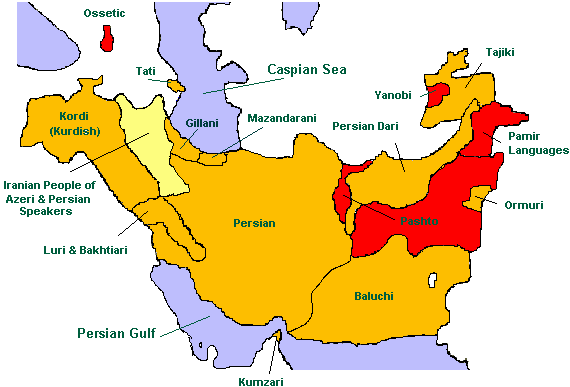
Indo-Iranian languages
Iranian (Aryan) languages are spoken in Iran, Iraq, Turkey, Arran (republic of Azerbaijan), Afghanistan, Tajikistan, Pakistan, China, Turkmenistan, Georgia, Russia and other scattered areas of the Caucasus Mountains.
Group
Languages & Major Dialects
Province
Ancient
Medieval
Modern
East Iranian
Avestan
ancient Persia
Sogdian
central Asia
Khotanese
Khwarezmian (Chorasmian/Khorezmian)
central Asia
Bactrian
Pashto
Afghanistan,West Pakistan
Old Ossetic
Ossetic
Caucusus
West Iranian
Old Persian
Parthian
Persian
Iran (Persia)
Middle Persian
Kurdish
Iran, Iraq, Turkey
Baluchi
Iran,West Pakistan
Tajiki
central Asia
1. A prehistoric Persian language known as the Old Persian and sometimes as Zend, now extinct and no longer understood. It is the language of literally writing, beginning long before 1000 BC. and lasting until 300 BC.
2. Middle Persian [3rd century BCE (the fall of the Achaemenids) to 8th-10th century CE]. It is a continuation of the Old Persian, and includes Parthian, Sogdian and Pahlavi [the language of the courts in Baghdad until the 900's A.D]. It is claimed that Arabic really comes from the Persian Pahlavi, not from Arabs.

Pahlavi

Above: Avestan Script
The Avesta is written in the Sassanian Pahlavi script [itself derived from Aramaic], which is much later than the conveyed language. The writing is read from right to left. The alphabet is phonetic
The chapter called Ahura'Mazda, Creator in the Book of Saphah begins:
"Descended by the Yi-ha light through mortals, and in the Vedan Gods revealed from Zarathustra in Juian, Zend, and Haizariyi, and thence into Vede, and thence into Sanskrit, and by Brahma and by Buddha."
Kabalactes caused India to be "but a land of ruins", remodelled the sacred books (the Avesta, Vendidad, Vispered, Yacna and the Khordavesta) and commanded all languages to be hereafter made out of Vedic, Yi'ha and Zend, from which Sanskrit descended, as it is to this day (Book of Eskra Ch 22).
[This makes sense if the"Vedic Sanskrit" of the Rig Veda is the 'Vedic' mentioned here, and Sanskrit as it is to this day is Classical Sanskrit (discussed above after the section about the Rg Veda and Dyaus).]
In 1808 John Leyden regarded Zend as a Prakrit dialect, parallel to Pali.
To Erskine Zend was a Sanskrit dialect, imported from India by the founders of Mazdeism, but never spoken in Persia. His main argument was that Zend is not mentioned among the seven dialects which were current in ancient Persia [according to the Farhang-i Jehangiri (A large Persian dictionary compiled in India in the reign of Jehangir)], and that Pahlavi and Persian exhibit no close relationship with Zend.
Emmanuel Rask showed that the list of the Jehangiri referred to an epoch later than that to which Zend must have belonged, and to parts of Persia different from those where it must have been spoken; he showed further that modern Persian is not derived from Zend, but from a dialect closely connected with it; and he showed that Zend was not derived from Sanskrit. As to the system of its sounds, Zend approaches Persian rather than Sanskrit.
The origin of many gods and heroes, whom the Parsi worship and epical history of Iran were derived from and revealed by the same source as the myths of Vedic India.
Burnouf gave the first notions of a comparative mythology of the Avesta and the Veda, by showing the identity of the Vedic Yama Yama with the Avesta Yima, and of Traitâna with Thraêtaona and Ferîdûn. At the same time the ancient Persian inscriptions at Persepolis and Behistun were deciphered by Burnouf in Paris, by Lassen in Bonn, and by Sir Henry Rawlinson in Persia. Thus was revealed the existence of a twin language heard from the mouth of Darius bearing a striking likeness to that of the Avesta in nearly every feature. Since then it is agreed that Zend is not an artificial language, or of foreign importation, or without root in the land where it was written.
Heads of spiritual societies in atmospherea, of those days.
Maideashenea, Patishahaya, Ayathrema, Maidyarrah, Hamachapathmada, Yemehataman,
Aunviti, Haptanaihaiti, Ustavaiti, Cpenta'Mainyus, Kshathra, Vahistoisa, Airyamaishya, Fshushamanthra, Hadhaokhta, Cpenta-armaiti, Zaothra and Barecma, Mithra, Kamaqactra, Havanana, Aarevahsha, Roethwiskare, Vohu-Kasha, Aiwyoonhana, Nairayo-canha, Asha-vahista, Haome, Lord of Haoma rites, Frava-daiti, Lord of Fravishes, Pailvish-hahin and Ustav, Beryejaga, Avathrema, Tistrya and Yima, Son of the Sun, the All Light.
Of the second rank above these were:
The Gods of the United Hosts of Heaven.
The Creator, Chief over all, Yima and Mithra, Amesha, Cpentas, Havanyi, Cavaghi
and Vicya, Rapithurna. Fradotfshu and Zantuma, Fradatvira and Dagyevma,
Aiwicruthrema-Aibigaza, Fradat-vicpanum-hujyaiti, Vishaptatha, Ish-Fravashi,
Athwya and Kerecacpa, promoted by special decree.
In addition to the above, the oagas (Gathas) of Zinebabait (afterward Lower India) the Zend, The Lord Gods, that is, officers of kingdoms in heaven and ruler over nations on earth. [Among a list of 11 are included the following]
3. Rashnu, a Fragapattician of the Yi-ha period.
4. Haha-Naepta (Goddess) of the host of Fragapatti, of the Theantiyi period.
By the Ayustrians, Gathas meant Gods.
5. Iaya-Haptanhaiti, special to Haptan, of the Hi-ga period.
7. Naotara, who gave many sciences to mortals
8. Thrita, God of healing
9. Hiac-kaus, Lord of the Seal of Heaven who bestowed the power of Ahura'Mazda on mortals, enabling the prayers of the living to redeem from torments the spirits of their forefathers.
11. Ashi-vanuhi, Goddess of dress.
Further on in the Saphah chapter where "Lords of atmospherea ministering through the temples and oracles to mortals of the Hyan period, embraced in Mithra inspiration" are listed, some of their names confirm them to be Gathas.
They are:
The Gatha-Ahunavaiti, Yacna-Haptan-haiti, the Goddess Mother, Gatha-Ustavaiti, her Holy Sister, Goddess Gatha-Cpenta-Mainyu, her Holy Daughter, Goddess Gatha-Vohu-Khsha-thra, the Lord of Measure, Airyama, Fshnsha-manthea, Hadhaokhta, Creator, Ever Present Spirit in all places, Ruler over all else and Dispenser.
[Many of Fragapatti's High Council of the first house of Mouru have the same name as the Mithraic Lords, but I cant believe they are the same, but only assumed their names, or perhaps initially served under Mithra independently for Jehovih's sake. Some also had a title of Gatha. ie. Gatha-Ahunavaiti, Goddess of Halonij, and Haptanhaiti, God of Samatras; Ustavaiti, Goddess of Maha-Meru. These, or the Mithraic Lords of the same name, have the "Five Gathas" named after them]
5. And I announce and complete (my Yasna) to the Gatha Ahunavaiti, the holy, ruling in the ritual order, and to those women who bring forth many sons of many talents, Mazda-given, and holy lords of the ritual order, and to that (chant) which has its Ahu and its Ratu (before it in the Yasna).
And I celebrate, and will complete (my sacrifice) to the Yasna Haptanghaiti, holy, and ruling in the ritual order, [and to the water Ardvi Anahita].
6. And I announce, and I (will) complete (my Yasna) to the Gatha Ushtavaiti, the holy, ruling in the ritual order, and to the mountains which shine with holiness, the abundantly brilliant and Mazda-made, the holy lords of the ritual order.
And I announce, and (will) complete (my Yasna) to the Gatha Spenta-mainyu , the holy, ruling in the ritual order; and I celebrate and will complete (my Yasna) to Verethraghna (the blow of victory) Ahura-given, the holy lord of the ritual order.
7. And I announce, and (will) complete (my Yasna) to the Gatha Vohu-khshathra , holy, ruling in the ritual order, and to Mithra of the wide pastures, and to Raman Hvastra, the holy lords of the ritual order. And I celebrate and will complete my Yasna to the Gatha Vahishtoishti , the holy, ruling in the ritual order. And I celebrate and will complete my Yasna to the good and pious Prayer for blessings, the benediction of the pious, and to that Yazad, the redoubted and swift Curse of the wise, the holy lord of the ritual order.
8. And I announce, and (will) complete (my Yasna) to the Airyema-ishyo, the holy lord of the ritual order, and to the Fshusho-mathra, and to that lofty lord Hadhaokhdha, the holy lord of the ritual order.
9. And I announce, and (will) complete (my Yasna) to the questions asked of Ahura, and to the lore of Ahura, to the Ahurian Dahvyuma (Dahyuma), and to the Ahurian Zarathushtrotema [according to Zoroastrians a Zarathushtrotema is the supreme head of the Zoroastrian priesthood], holy lords of the ritual order, and to the farm-house with its pastures which give pasture to the Kine of blessed gift, and to the holy cattle-breeding man.
8. We sacrifice to the entire collection of the Praises of the Yasna, with the careful structure of their language which has reached the most its object. And we offer (our homage) in our celebrations to Thy body, O Ahura Mazda! the most beautiful of forms, these stars, and to that one, the highest of the high (Pazand) such as the sun was called. Yea, we worship the Praises of the Yasna which were the production of the world of old.
The Gâthâ's
The Gathas are written in metres (musical, cadenced) which correspond to the metres of the Sama Veda. Part of the Avesta is written in a Gatha dialect, but most of it is written in a later classical dialect. The Gathic parts are mingled with the classical text in the Yasna (Sacred Liturgy). The Gatha dialect is said to be used by Zarathustra because it had a more primitive form. But a Theosophist points out that geographical location can also cause this apparent chronological variation (for example the long distance from Bactria to Persis).
The Gathic chapters are said to be Zarathustra's own words and today are separated and compiled into a book of "Hymns of Zarathushtra" or Gathas. The Gâthâ's are said to have been transmitted orally until they were written down in the second half of the first millennium BCE. They were recited by the Zoroastrians in their daily liturgy.
A) The Five Gathas:
1) Ahunavaiti Gatha (Yasna Chapters 28-34 also here and here)
The Yasna Haptanghaiti (Yasna Chapters 35-42)
2) Ushtavaiti Gatha (Chapters 43-46)
3) Spentamainyush Gatha (Chapters 47-50)
4) Vohukhshathra Gatha (Chapter 51)
5) Vahishtoishti Gatha (Chapter 53)
1) Yenhe hatam [All those beings of whom Ahura Mazda knows the goodness…]
2) Ashem Vohu [Holiness is the best of all good (See below)]
3) Yatha ahu vairyo [The will of the Lord is the law of holiness…]
[Notice that Airyamaishya, or Airyama is listed above in the "Heads of spiritual societies in atmospherea".]
The Gathas
Hyan Mithraic Lords
Lords of Hosts
Vispered Gods
Ahunavaiti
Gatha-Ahunavaiti
Aunviti
Gatha Ahunavaiti
Yasna Haptanghaiti
Yacna-Haptan-haiti
Haptanaihaiti
Yasna Haptanghaiti
Ushtavaiti
Gatha-Ustavaiti
Ustavaiti
Gatha Ushtavaiti
Spentamainyush
Gatha-Cpenta-Mainyu
Cpenta'Mainyus
Gatha Spenta-mainyu
Vohukhshathra
Gatha-Vohu-Khsha-thra
Kshathra
Gatha Vohu-khshathra
Vahishtoishti
Vahistoisa
Gatha Vahishtoishti
Airyema Ishyo
Airyema
Airyamaishya
Airyema-ishyo
Non Gathic
Fshusho Mathra
Fshnsha-manthea
Fshushamanthra
Fshusho-mathra
Hadhokht Nask
Hadhaokhta
Hadhaokhta
Hadhaokhdha
Let the Airyaman, the desired friend and peer, draw near for grace to the men and to the women who are taught of Zarathushtra, for the joyful grace of the Good Mind, whereby the conscience may attain its wished-for recompense. I pray for the sacred reward of the ritual order which is (likewise so much) to be desired; and may Ahura Mazda grant it, (or cause it to increase).


One could find a Sanskrit equivalent for almost any Avestan word.
Some scholars say that a 600 BC date is still plausible if Gathic was an artificially preserved sacred language, like Latin, which continued in literature and rituals thousands of years after it had ceased to be spoken.
An example (left) of Avestan text from Yasna 10.6 is rendered word for word in Sanskrit on the right.
Translated it means: `Mithra that strong mighty angel, most beneficent to all creatures, I will worship with libations'
Recent work discounts this theory, as the linguists show that the Gathas are not the work of an academic writing in a dead language; they show all the signs of poetry composed and recited in an oral tradition, similar to the heroic poetry of Homer or the Rig-Vedas.
Persian historians and many authors have rejected this date. Azarghoshasb places Zarathushtra at 3500 BC, Kavasji and Bharucha at 4000-6000 BC and Katrak at 6600 BC. Most scholars agree on 1700 B.C. to 1000 B.C.
[It might also be the case that Deva and daeva have separate meanings.]
Osire came to a place in the lower heaven called Vibrahj, signifying resplendent, where ruled with treacherous tyranny the false God, Daveas.
Because he had "spurned his own name" angels and mortals were afterwards made to "curse and shun the name, Daveas".
The collection of Zend fragments, known as the Zend-Avesta, is divided into two parts in its usual form.
The first part contains the Yasna, the Vispêrad, and the Vendîdâd.
These three books are found in manuscripts in two different forms: either each by itself, in which case they are generally accompanied by a Pahlavi translation; or the three mingled together according to the requirements of the liturgy, as they are not each recited separately in their entirety, but the chapters of the different books are intermingled; and in this case the collection is called the Vendîdâd Sâdah or 'Vendîdâd pure,' as it exhibits the original text alone, without a translation.
The second part, known as the Khorda Avesta or 'Small/Short Avesta,' is composed of short prayers which are recited not only by the priests, but could be used by all the faithful, at certain moments of the day, month, or year, and in presence of the different elements; these prayers are the five Gâh, the thirty formulas of the Sîrôzah, the three Âfrigân, and the six Nyâyis.
But it is also usual to include in the Khorda Avesta, although forming no real part of it, the Yasts (Yashts) or hymns of praise and glorification to the several deities (also said to be written by Zarathustra but transmitted in Younger Avestan) and a number of fragments, the most important of which is the Hadhôkht Nosk. Some say, because the Yasts were not so important as the hymns to Ahuramazda (Gathas), they were memorised less carefully than the Gâthâ's. These hymns survive in the 'Younger (classical) Avestan' language.
The older Yasna was also written in Gathic; at least some of them seem to be older than the Gâthâ's, and appear to have been reworked in the light of the teachings of Zarathustra. The younger Yasna is written in Younger (classical) Avestan.
The Yasna contains litanies for sacrifice and all kinds of rituals, eg., the use of the trance-inducing beverage Haoma, and offerings to water and fire.
Over the centuries, new liturgic texts were written in Younger Avestan.
The Vendidad is a compilation of religious laws and of mythical tales codified in the Parthian age (141 BC - 224 AD). Its name is a corruption of Vidaevadata, 'against the demons'. Its language is a type of Younger Avestan different to cuneiform texts of the Persian empire, so it was probably written later, during the Parthian period.
"The Vendidad or Book Of Law against the Daevas (Dataam vi-daevaam) is in contrast to Zarathushtrian Law (Daataam Zarathushtrim).
Asho Zarathushtra did not make laws for his followers during his lifetime.
[Asho is a Persian name meaning pure of heart, Osho is a term derived from the ancient Japanese, said to be first used by Eka to address his master Bodhidharma]
No one approached Asho Zarathushtra to know what should be done to a thief or a murderer. Had some one asked him, he would have replied: "I have not come to create a government within a government. I have come to teach people how to lead a good life. Had he been asked: "What law should we follow?" The reply would have been: "Follow the existing laws."
[My understanding is that Oahspe answers this by advising to follow the existing laws and governments for Jehovih's sake, implying, I assume, that there are times when the powers that be are not for Jehovih, when we should rather follow our conscience.]
He would have advised the people to consider those laws with their wisdom and knowledge because social laws change in every era and place, and people do not remain the same. Every law which was prepared and enforced by the wise men of a people in the past was good and useful for its own day.
The Magi were the religious leaders of the Median people. Median, Azerbaijanian, and Babylonian religious leaders are not the same as the Zarathushtrian Mobeds although all of them carry the same title of "Magi". They had the monopoly of performing religious rituals. Their profession was hereditary. They gradually introduced all their beliefs, rituals and customs under the garb of Zarathustra's teachings. Their strategy saved them their former position in the new religion. They forced the Dakhmeh-nashini [disposal of the dead], upon Zarathustrians. They forbade Zarathustrians from burying or cremating their dead. The composers of the story of the Aryan countries were non-Zarathushtrian, and that it belongs to a period much older than the Zarathushtrian era. Zurvanistic creed goes to pre-Zarathushtrian times.
[Much of the Vendidad is like the book of Leviticus is to the bible, that is, not suitable for these times.
Like this writer, some Zoroastrians only accept the Gathas, believing the Vendidad to have been corrupted by Magi. But for Oahspeans, it's opening chapters remarkably follow word for word verses from the Book of God's Word Chapter VIII, in its opening Chapters, as demonstrated below.]
The Zarathushtrian Doctrine was against magic and superstitions. Zarathushtra replaced hypocrisy and deceit with virtue and excellence. He advocated freedom of will and intellect. The Zarathushtrian religion was greatly harmed by the Median Magi. They controlled one's life from birth to death."
Therefore the laws of the pre-Zarathushtrian Vendidad should not be considered today as proper and practical. The laws were prepared and enforced during different periods in places. Law scriptures are of lesser importance in that they change. They could never be equal with the Gathas, prayers, rituals, and regulations.
One cannot accept the present version of the Vendidad to be the copy of the old origin.
5. And we worship the holy wind which works on high, placed higher than the other creatures in the creation; and we worship this which is thine, O Vayu! and which appertains to the Spenta Mainyu within thee; and we worship the most true religious Knowledge, Mazda-made and holy, and the good Mazdayasnian law.
6. And we worship the Mathra Spenta [mãthra/manthra means Sacred Word] verily glorious (as it is), even the law pronounced against the Daevas, the Zarathushtrian law, and its long descent; yea, we worship the good Mazdayasnian Religion, and the Mathra which is heart-devoted and bounteous; yea, we worship the Mazdayasnian Religion maintained in the understanding of the saint; and we honour that science which is the Mathra Spenta, and the innate understanding Mazda-made, and the derived understanding, heard with ear, and Mazda-made.
The Sassanids were devout Zoroastrians and did much to improve the understanding of the ancient texts. There were already several commentaries on the Avesta, but they imposed a new version, the Zand. It became an integral part of the books.
Under the Sassanid king Chosroes II Parvêz (591-628), a Zoroastrian high priest named Tansar established the canon of Avestan texts. It contained all the texts that we have already seen, but also some books on cosmogony and law, a biography of Zarathustra, apocalypses and several expositions of doctrine. This library was certainly written down; it is called the Great Avesta.
In 642, the Arabs invaded Iran. They were tolerant towards Zoroastrianism, but Islam became the dominant religion and some Avestan works were translated into Arabian, the originals being lost. In the eighth century, relations between Muslims and Zoroastrians became hostile and the Zoroastrians started to redefine themselves; their ancient religion and old language were important aspects of their new self-image. The antagonism between the two groups continued to grow in the ninth century, when caliph Mutawakkil ordered the holy cypress at Kâshmar, which was very important to the Zoroastrians, to be cut down (in 846). Many Zoroastrians decided to migrate to India. Several texts from the Avesta are therefore known from Indian translations.

Fire-temple of Yazd
Between 1037 and 1157, the Seljuk Turks ruled Iran (nominally under the caliphs of Baghdad). Harshness towards non-Muslims increased, but it was nothing compared to the events of 1256, when the Mongol leader Hulagu, a grandson of Genghis Khan, invaded Iran, Iraq and Syria (his men destroyed Baghdad in 1258). For the first time, Zoroastrianism was actually persecuted, and many books were burnt. This was repeated in 1381, when Timur Lenk, a Muslim Turk from Samarkand, invaded and ravaged Persia. The Zoroastrians were forced to withdraw to desert towns like Yazd and Kerman.
From 1501 onward, Iran was independent under the dynasty of the Safavids. Their kings were Shi`ite Muslims and were in general harsh towards Zoroastrians. The latter were even forced to conversion by shah `Abbas II (1642-1667), who had many of them massacred at Isfahan. Again, many Avestas were destroyed.
What remains of the Avesta today, is about a quarter of the Great Avesta of the sixth century. A summary called the Denkard contains some very ancient traditions. Using the Denkard, the Zand and the traditions of medieval Zoroastrianism (including the Bundahishn and Shayest Na-Shayest) large parts of the Great Avesta can be reconstructed. However, this reconstruction is hypothetical, and some European scholars have decided that these texts are only useful for the study of medieval Zoroastrianism.
From "http://www.livius.org/aa-ac/achaemenians/achaemenians.html"
6. May the immortal soul have its share in Paradise!
7. And may the pleasure and comfort that will dissipate the pain of the immortal soul come to us!
8. At the fourth dawn, may the holy, strong Sraosha, and Rashn Rast, and the good Vae, and Ashtad the victorious, and Mihr of the rolling country-side, and the Fravashis of the righteous, and the other virtuous spirits come to meet the soul of the blessed one,
9. And make the immortal soul pass over the Chinvad bridge (see below) easily, happily, and fearlessly!
10. And may Vahman, the Amshaspand, intercede for the soul of the blessed one,
11. And introduce it to Ohrmazd and the Amshaspands!
We have a fair specimen of what these lost texts may have been in the few non-liturgical fragments which we still possess, such as the Vistâsp Yast and the blessing of Zoroaster upon King Vistâsp, which belong to, the old epic cycle of Iran, and the Hadhôkht Nosk (book of scriptures), which treats of the fate of the soul after death.
21. The young king Vishtaspa asked Zarathushtra: 'With what manner of sacrifice shall I worship and forward this creation of Ahura Mazda?'
Zarathushtra answered: 'Go towards that tree that is beautiful, high-growing, and mighty amongst the high-growing trees, and say thou these words: "Hail to thee! O good, holy tree, made by Mazda! Ashem Vohu!"
'Let the faithful man cut off twigs of baresma, either one, or two, or three: let him bind them and tie them up according to the rites, being bound and unbound according to the rites.
'The smallest twig of Haoma, pounded according to the rules, the smallest twig prepared for sacrifice, gives royalty to the man (who does it).' Ashem Vohu: Holiness is the best of all good.
1. Zarathushtra asked Ahura Mazda: 'When one of the faithful departs this life, where does his soul abide on that night?'
Ahura Mazda answered: 'It takes its seat near the head, singing the Ushtavaiti Gatha and proclaiming happiness: "Happy is he, happy the man, whoever he be, to whom Ahura Mazda gives the full accomplishment of his wishes!" On that night his soul tastes as much of pleasure as the whole of the living world can taste.'
At the end of the third night, when the dawn appears, it seems to the soul of the faithful, one as if it were brought amidst plants and scents; it seems as if a wind were blowing from the region of the south, from the regions of the south, a sweet-scented wind, sweeter-scented than any other wind in the world.
And it seems to the soul of the faithful one as if he were inhaling that wind with the nostrils, and he thinks: 'Whence does that wind blow, the sweetest-scented wind I ever inhaled with my nostrils?'
And it seems to him as if his own conscience were advancing to him in that wind, in the shape of a maiden fair, bright, white-armed, strong, tall-formed, high-standing, thick-breasted, beautiful of body, noble, of a glorious seed, of the size of a maid in her fifteenth year, as fair as the fairest things in the world.
And the soul of the faithful one addressed her, asking: 'What maid art thou, who art the fairest maid I have ever seen?'
And she, being his own conscience, answers him: 'O thou youth of good thoughts, good words, and good deeds, of good religion, I am thy own conscience!
'Everybody did love thee for that greatness, goodness, fairness, sweet-scentedness, victorious strength and freedom from sorrow, in which thou dost appear to me;
'And so thou, O youth of good thoughts, good words, and good deeds, of good religion! didst
love me for that greatness, goodness, fairness, sweet-scentedness, victorious strength, and freedom from sorrow, in which I appear to thee.
'When thou wouldst see a man making derision and deeds of idolatry, or rejecting (the poor) and shutting his door, then thou wouldst sit singing the Gathas and worshipping the good waters and Atar, the son of Ahura Mazda, and rejoicing the faithful that would come from near or from afar.
'I was lovely and thou madest me still lovelier; I was fair and thou madest me still fairer; I was desirable and thou madest me still more desirable; I was sitting in a forward place and thou madest me sit in the foremost place, through this good thought, through this good speech, through this good deed of thine; and so henceforth men worship me for my having long sacrificed unto and conversed with Ahura Mazda.
'The first step that the soul of the faithful man made, placed him in the Good-Thought Paradise;
'The second step that the soul of the faithful man made, placed him in the Good-Word Paradise;
'The third step that the soul of the faithful man made, placed him in the Good-Deed Paradise;
'The fourth step that the soul of the faithful man made, placed him in the Endless Lights.'
Then one of the faithful, who had departed before him, asked him, saying: 'How didst thou depart this life, thou holy man? How didst thou come, thou holy man! from the abodes full of cattle and full of the wishes and enjoyments of love? From the material world into the world of the spirit? From the decaying world into the undecaying one? How long did thy felicity last?'
And Ahura Mazda answered: 'Ask him not what thou askest him, who has just gone the dreary way, full of fear and distress, where the body and the soul part from one another.
'[Let him eat] of the food brought to him, of the oil of Zaremaya: this is the food for the youth of good thoughts, of good words, of good deeds, of good religion, after he has departed this life; this is the food for the holy woman, rich in good thoughts, good words, and good deeds, well-principled and obedient to her husband, after she has departed this life.'
When one of the wicked perishes, where does his soul abide on that night?'
Ahura Mazda answered: 'It rushes and sits near the skull, singing the Kima Gatha (Y46), O holy Zarathushtra!
'"To what land shall I turn, O Ahura Mazda? To whom shall I go with praying?"
'On that night his soul tastes as much of suffering as the whole of the living world can taste.'
At the end of the third night, O holy Zarathushtra! when the dawn appears, it seems to the soul of the faithful one as if it were brought amidst snow and stench, and as if a wind were blowing from the region of the north, from the regions of the north, a foul-scented wind, the foulest-scented of all the winds in the world.
And it seems to the soul of the wicked man as if he were inhaling that wind with the nostrils, and he thinks: 'Whence does that wind blow, the foulest-scented wind that I ever inhaled with my nostrils?'
The first second third step that the soul of the wicked man made laid him in the Evil-Thought Hell;
The second step laid him in the Evil-Word Hell; The third step laid him in the Evil-Deed Hell;
The fourth step that the soul of the wicked man made laid him in the Endless Darkness.
Then one of the wicked who departed before him addressed him, saying: 'How didst thou perish, O wicked man? How didst thou come, O fiend! from the abodes full of cattle and full of the wishes and enjoyments of love? From the material world into the world of the Spirit?
From the decaying world into the undecaying one? How long did thy suffering last?'
Angra Mainyu, the lying one, said 'Ask him not what thou askest him, who has just gone the dreary way, full of fear and distress, where the body and the soul part from one another.
'Let him eat of the food brought unto him, of poison and poisonous stench: this is the food, after he has perished, for the youth of evil thoughts, evil words, evil deeds, evil religion after he has perished; this is the food for the fiendish woman, rich in evil thoughts, evil words, and evil deeds, evil religion, ill-principled, and disobedient to her husband.
Ahura Mazda answered: 'They manifest themselves from goodness of spirit and excellence of mind.'
Then towards the dawning of the dawn, that bird Parodarsh, that bird Kareto-dasu hears the voice of the Fire.
Here the fiendish Bushyasta, the long-handed, rushes from the region of the north, from the regions of the north, speaking thus, lying thus: 'Sleep on, O men! Sleep on, O sinners! Sleep on and live in sin.'
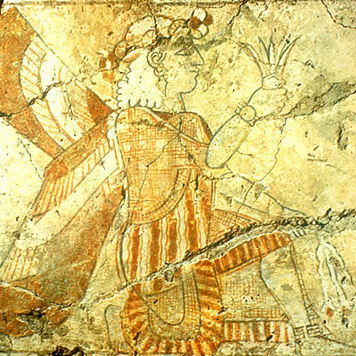
Assyrian winged genius (1350-612 BC) Aleppo museum, Syria
Compare the above with the Book of Saphah where it says:
Parodars, an angel, a bird, a picture, or as one looking in a mirror sees himself. That which he sees reflected is parodars. Thus, when a pure man dieth, his soul for three days remaineth near the head of his corporeal body, reciting prayers and anthems, but on the fourth day he waketh to his condition and riseth
and goeth forth. The first living creature he seeth is parodars (a female); a flying person of great beauty. He saluteth her, inquiring who she is. She answereth him, saying: I am thine own soul and good thoughts. I am the law thou hast builded up on the corporeal earth. Behold me, I am thyself, and now thou seest thine own self. I am most beautiful, because thy earth-thoughts were beautiful. I am pure because thy earth-thoughts were pure. Put away thyself and come thou and inhabit myself. I am the part that can ascend to nirvana, the
second heaven; thou art the part that dwelleth as a druj, a bound spirit. On the fifth day the pure man putteth away self and inhabiteth the parodars, and so ascendeth and becometh a Lord in heaven. (Foivitat.)
Foivitat saith: If an evil man die, his soul remaineth at his feet three days. On the fourth it goeth abroad; but because of its clouds, it beholdeth not parodars, the smothered bird, but it goeth into places that stink the nose, to the places that deafen the ears, to the places that blind the eyes, and, like a druj, can not speak truth, can not find love, can not learn. The soul of such a man becometh the inhabitant of foul houses and of battle-fields where madness liveth on madness, and evil spirits can not depart.
Brahma said: Seest thou a star? Now I say unto thee, there is an old legend that the pure in heart, looking upward, oft see their own paroda, and think it belongeth to another. Yu-tiv reassured Brahma that she saw the star,
(Note: words in pink are the ones of interest found in the Avesta and explained in Saphah)
First, Ormazd was, and He created all created things. He was All; He is All. He was All
Round, and put forth hands and wings. Then began the beginning of things seen, and of things unseen.
Ahura Mazda spake unto Spitama Zarathushtra, saying: I have made every land dear (to its people), even though it had no charms whatever in it: had I not made every land dear (to its people), even though it had no charms whatever in it, then the whole living world would have invaded the AIRYANA-VAJA
Ormazd then created the first best of places, the longest enduring, the AIRYANA-VAJA (etherea), the highest of good creation.
[Also in the Book of Saphah Airyana is "the good, created things"
Airyana seems to be a feminine intonation of the word Iran
Fargard 1.
Sixteen perfect lands created by Ahura Mazda, and as many plagues created by Angra Mainyu.
2. The first of the good lands and countries which I, Ahura Mazda, created, was the AIRYANA VAEJA, by the Vanguhi Daitya (by the good river Daitya). Thereupon came Angra Mainyu, who is all death, and he counter-created the serpent in the river and winter, a work of the Daevas. There are ten winter months there, two summer months; and those are cold for the waters, cold for the earth, cold for the trees. Winter falls there, the worst of all plagues.
21. Hail to the Glory of the Kavis! Hail to the Airyanem Vaejah!
Hail to Ardvi, the undefiled well! Hail to the whole world of the holy Spirit!
The first of places the best created was Eranvej The name Iran and Aryan race comes from the "first of places and best created", Eranvej (Iran Vej or Aryan Vaeja).
In the Yashts, Airyanem Vaejah is the land where Zarathustra sacrificed to the yazatas. It is considered the best of places, but on the other hand the Vendidad claims that there are two months of summer there and ten of winter. It suffers from flooding at the end of winter. Yima was taught by Ahura Mazda how to build a shelter to protect the inhabitants of the land from the dreadful winter. Areas to which these tribes finally relocated include Iran, Afghanistan and northern India.
Airyanem Vaejah is reckoned to have been located somewhere between the Caucasus and south Asia. In the Avesta, Zoroaster states that he lived in Airyanem Vaejah also called Eranvej, the Iranian expanse. In the listing of sixteen countries of the Vedidad, Airyanem Vaejah seems to lie to the north of all of these. Some experts suggest that Airyanem Vaejah was probably centered around Khwarazm (see Chorasmia/Khorezmia on map), a region that is now split between several Central Asian republics. Some researchers believe that Iran vig was located in what is now Afghanistan, the northern areas of which were a part of Ancient Khwarezm and Greater Khorasan. The book "Arctic home of the Aryans"
combines indications from the Rigveda and the Avesta to conclude that "Airyanem Vaejah," the homeland of the Aryans, lies within or very proximate to the Arctic circle. It has also been suggested that Airyanem Vaejah could refer to Kashmir.]
Airyana, a protector. (See Tablet Se'moin.) In Tablet Biene he is made in the form of a lion, with man's face.
Maori (Mouru?), the second holy heaven.
Out of MOURU, of the regions of Haraiti, came the Voice, created by the Creator Ormazd; came to I'hua-Mazda; and now cometh to thee, Zarathustra, thou All Pure.
[House of Mouru was the council chamber and capital of Haraiti, the place of the throne of Fragapatti, in the lower heavens. The mythical Mount Meru is most likely reminiscent of Mouru . In Middle Persian, the mythical mountain Hara Berezaiti became Harborz, in Modern Persian Harborz became Alborz. This has the secondary name of Haraiti ]
8. The third best created was the valiant Merv (see map of Bactria above), that is, it performs works and organisations of great fame.
The third best created places created Ormazd, which was HARAITI, a high heavenly good place, a Home of Fragapatti, a Creator Son of the heavenly Airyana-vaja, a rescuer of men and spirits from Anra'mainyus, the evil of blood and bone.
Gau, place of science in heaven.
"First he produced the celestial sphere, and the constellation stars are assigned to it by him; especially these twelve whose names are Varak (the Lamb), Tora (the Bull), Do-patkar (the Two-figures or Gemini), Kalachang (the Crab), Sher (the Lion), Khushak (Virgo), Tarazhuk (the Balance), Gazdum (the Scorpion), Nimasp (the Centaur or Sagittarius), Vahik (Capricorn), Dul (the Water-pot), and Mahik (the Fish); which, from their original creation, were divided into the twenty-eight subdivisions of the astronomers, of which the names are Padevar, Pesh-Parviz, Parviz, Paha, Avesar, Beshn, Rakhvad, Taraha, Avra, Nahn, Miyan, Avdem, Mashaha, Spur, Husru, Srob, Nur, Gel, Garafsha Varant, Gau, Goi, Muru, Bunda, Kahtsar, Vaht, Miyan, Kaht."
12. The fifth best created was Nisay, between Merv and Balkh.
Nisai, faith, belief; a created place in the unseen heavens, which nurtureth man's soul, created by Ahura'Mazda, the good Creator.
10. The fourth best created was Balkh, good to behold; the men of that place hold the banner with activity.
Bakhdhi, third holy place in heaven.
[The order of holy place in Saphah differs slightly from the Book of God's Word possibly because it follows more that of the Haptan times.]
The second best created is the plain, the abode (dwelling place) of the Syrians, which is Bakdat.
Ormazd then created association [clans] by words bringing men together, HAROYU
Haroyu, confederate republics in heaven.
The sixth best created was Harey.
The sixth of the good lands and countries which I, Ahura Mazda, created, was the house-deserting Haroyu. Thereupon came Angra Mainyu, who is all death, and he counter-created tears and wailing.
The seventh of the good lands and countries which I, Ahura Mazda, created, was Vaekereta, of the evil shadows. Thereupon came Angra Mainyu, who is all death, and he counter-created the Pairika Knathaiti, who claves unto Keresaspa.
The ninth of the good lands and countries which I, Ahura Mazda, created, was Khnenta which the Vehrkanas inhabit. Thereupon came Angra Mainyu, who is all death, and he counter-created a sin for which there is no atonement, the unnatural sin.
The tenth of the good lands and countries which I, Ahura Mazda, created, was the beautiful Harahvaiti. Thereupon came Angra Mainyu, who is all death, and he counter-created a sin for which there is no atonement, the burying of the dead.
Haetumat, emancipated heaven above the lower or bound heavens.
The eleventh of the good lands and countries which I, Ahura Mazda, created, was the bright, glorious Haetumat. Thereupon came Angra Mainyu, who is all death, and he counter-created the evil work of witchcraft.
And this is the sign by which it is known, this is that by which it is seen at once: wheresoever they may go and raise a cry of sorcery, there the worst works of witchcraft go forth. From there they come to kill and strike at heart, and they bring locusts as many as they want.
Came to Zarathustra, the All Pure, the voice of I'hua'Mazda, by the hosts of Haraiti: Hear me, O Zarathustra; I am I'hua'Mazda. Hear thou of thy Creator, who created all created things.
1) Then there was not non-existence nor existence: there was no realm of air, no sky beyond it. What covered all, and where? what sheltered? what concealed?
Was it the water's fathomless abyss?
[All this was water.]
2) Death was not then, nor was there aught immortal: No sign was there of the days and night's divider. There was That One that breathed, breathless [windless], by it's Self [by its own nature/by its own impulse]: apart from it was nothing whatsoever.
3) Darkness there was, at first concealed in darkness, this All was undiscriminated chaos (veiled in profound gloom - an ocean without light). This all was void and formless: The Germ that still laid covered in the husk burst forth, one nature; by the great power of warmth was born that unit.
4) Thereafter rose desire, the primeval seed [of the mind] and germ of spirit. Sages searched with their heart's thought the existent's kinship in the non-existent.
5) Transversely was their severing line extended [a division between the upper world and the lower, and to bring duality out of unity/bond between existence and non-existence]. What was above it then? What was below it? There were begetters [seed placers]; there were mighty forces [powers], free action here [impulse beneath] and energy up yonder [giving-forth above]
6) Who verily knows and who can declare it, whence it was born and whence comes this creation? The Gods are later than this world's production. Who knows then whence it first came into being? Perhaps it formed itself or perhaps it did not.
7) He, the first origin of this creation, whether he formed it all or did not form it, whose eye controls this world in highest heaven, who looks down on it, he verily knows it, or perhaps he knows not.
Before this time there were two things in the world: Voidness was one, and Vachis was the other. Vachis vach, and the world was. So it came to pass that Voidness was divided into two parts, the seen and the unseen worlds.
The meaning of vach can be gathered from vachah - words. Vachis vach means "speech spoke".
'Song of Creation' says "Then there was not non-existence nor existence ... Was it the water's fathomless abyss? ... There was That One that breathed, breathless [windless], by it's Self; apart from it was nothing whatsoever. "
The Rig Veda believes that the universe was created from nothing. Before the world began " there was neither Ought nor Naught, no sky, beyond covered all", that the universe "existed unmoved, without vibration and then this began to vibrate and all these creations came out of it, that one breath, calm, self-sustained naught else beyond it". This is later linked with the concept of seed mantra or sacred sound Ohm.
The glory of all things, God and that which is Divine, and the Divine Nature, the beginning of things that are. God, and the Mind, and Nature, and Matter, and Operation, or Working and Necessity, and the End and Renovation. For there were in the Chaos, an infinite darkness in the
Abyss or bottomless Depth, and Water, and a subtle Spirit intelligible in Power;
and there went out the Holy Light, and the Elements were coagulated from the Sand out of the moist Substance. And all the Gods distinguished the Nature full of Seeds [essences of form, "esse" or Es?]. And when all things were unterminated and unmade up, the light things were divided on high. And the heavy things were founded upon the moist sand, all things being Terminated or Divided by Fire; and being sustained or hung up by the Spirit they were so carried, and the Heaven was seen in Seven Circles. And the Gods were seen in their Ideas of the Stars, with all their Signs, and the Stars were numbered, with the Gods in them. And the Sphere was all lined with Air, carried about in a circular, motion by the Spirit of God. And every God by his internal power, did that which was commanded him; and there were made four footed things, and creeping things, and such as live in the Water, and such as fly, and every fruitful Seed, and Grass, and the Flowers of all Greens, and which had sowed in themselves the Seeds of Regeneration.
As also the Generations of men to the knowledge of the Divine Works, and a lively or working Testimony of Nature, and a multitude of men, and the Dominion of all things under Heaven and the knowledge of good things, and to be increased in increasing, and multiplied in multitude. And to every Soul in flesh begins to be wise as the Operation of the course of the Gods in the Circles [like Hindu Demi-Gods], lives in them.
See also the seven Worlds set over us, adorned with an everlasting Order, and filling Eternity, with a different course. For all things are full of Light, but the Fire is nowhere. For the friendship and commixture of contraries and unlike became light shining from the Act or Operation of God, the Father of all Good, the Prince of all Order, and the Ruler of the seven Worlds.
19. Without green fruit, none could be ripe; without evil none could be good. So Ormazd created all creation, and called it good; but lo, and behold, there was nothing to do. All things moved not; as if dead, all things were as nothing.
20. Then Ormazd blew His breath outward, and every created thing went into motion. And those at the front were called All Good, and those at the rear were called all evil. Thus created the Creator the Good Creation and the Evil Creation; the I'hua'Mazda and the Anra'mainyus.
The Osirian Bible, some of which became erroneously transcribed into the Ezra Bible (today's Torah or Old Testament) is different to the substance of what originally De'yus incorporated into his Bible. The Kore Kosmou may well contain a part that is missing, interpreted into a newer Gnostic sense.
Core bore to Zeus 'nine azure-eyed flower-weaving daughters' (probably the Muses),
4. Hermes made explanation how he had been able to hand on the Perfect Vision. But when the sun did rise for me, and with all-seeing eyes I gazed upon the hidden mysteries of that new dawn, and contemplated them, slowly there came to me conviction that the sacred symbols of the cosmic elements were hid away hard by the secrets of Osiris.
5. Hermes ere he returned to Heaven said, when he hid his books away:
"O holy books, Become unseeable, for every one whose foot shall tread the plains of our land, until old Heaven doth bring forth meet instruments for you, whom the Creator shall call souls."
The time was come for cosmos to awake.
God [De'yus, known today as Deus (God) who here appears to be equivalent to the Gnostic Demiurge] smiled and said: "Nature, arise!" And from His word there came a marvel, feminine, possessed of perfect beauty [Kore, Isis, Mi, Virgin of the World (Kosmon)] , gazing at which the Gods stood all-amazed. And God the Fore-father, with name of Nature, honoured her, and bade her be prolific.
Then He spake: "Let Heaven be filled with all things full, and Air, and Æther too!"
He, no longer willing that the world above should be inert, but think good to fill it full of breaths, so that its parts should not remain immotive and inert, He thus began bringing forth of His own special work.
Taking breath from His own breath and blending this with knowing Fire, He mingled them with certain other substances which have no power to know until out of it smiled a substance far subtler, purer, and more translucent than the things from which it came; it was so clear that no one but the artist could detect it.
9. And since it neither thawed when fire was set unto it (for it was made of fire) nor yet did freeze when it had once been properly produced (for it was made of breath) but it kept its mixture's composition a certain kind, peculiar to itself, of special type and blend, which God called psychosis. It was from this coagulate He fashioned souls enough in myriads, moulding with order and with measure the efflorescent product of the mixture for what He willed, with skilled experience and fitting reason, so that they should not be compelled to differ any way one from another [as in Plato's 'Same' as opposed to 'Different', the ordered higher heavenly hierarchies?].
10. For, you must know the efflorescence that exhaled out of the movement God induced, was not like to itself. For that its first florescence (flowering) [All Possibility?] was greater, fuller, every way more pure, than was its second [All Good?]; its second was far second to the first, but far greater than its third [AIRYANA-VAJA (etherea)?]. And thus the total number of degrees reached up to sixty [sixty grades of souls]. In spite of this, in laying down the law, He ordered it that all should be eternal, as though from out one essence, the forms of which Himself alone could bring to their completion.
11. Moreover, He appointed for them limits and reservations [Dawns?] in the height of upper Nature, that they might keep the cylinder a-whirl [Aeon, nature, wheel of Dharma?] in proper order and economy and thus please their Sire. And so in that all-fairest station of the Æther He summoned unto Him the natures of all things that had as yet been made [here supposedly De'yus means his fallen companions of atmospherea, but he intends in this sense to mean the Gods, Etherians], and spake these words:
"O Souls, ye children fair of Mine own breath and My solicitude, whom I have now with My own hands brought to successful birth and consecrate to My own world, give ear unto these words of Mine as unto laws, and meddle not with any other space but that which is appointed for you by My will.
"For you, if ye keep steadfast, the Heaven, with the star-order, and thrones I have ordained fulfilled with virtue, shall stay as now they are for you; but if ye shall in any way attempt some innovation contrary to My decrees, I swear to you by My most holy breath, and by this mixture out of which I brought you into being, and by these hands of Mine which gave you life, that I will speedily devise for you a bond and punishments."
12. And having said these words, the God, who is my Lord, mixed the remaining cognate elements (water and earth) together, and (as before) invoking on them certain occult words of great power (though not so potent as the first) He set them moving rapidly [planets?], and breathed into the mixture power of life [interaction, motion]; and taking the coagulate (which like the other floated to the top) He modeled out of it those of the sacred animals possessing forms like unto men's [lower orders, intermediate between 'the Beast' and God, maybe Daimons, associated with the Demiurge's hierarchy?].
The mixtures' residue He gave unto those souls that had gone in advance [the alleged Gods, Etherians] and had been summoned to the lands of gods, to regions near the stars, and to the choir of holy daimons.
In the theurgic rites of Pythagorean theology Daimones are Mediating Spirits, messengers between the Gods and us who reside in the Air intermediate between the earth and the heavens, where the Gods reside. The Moon is the boundary between the aerial domain and the aetherial heavens, and so that is where Their Ruler, Hekate, has Her domain. They convey divine Providence (Pronoia) into the sublunary realm. They interpret the Gods and are the agents of divination, oracles, and rituals. They are ministering spirits who care for people, and are often called Savior (Sôtêr). Many rituals are directed to Daimones (who have feelings and can be swayed)].
And then answered I'hua'Mazda: To VIVANHO, the first of men who had words; the first of women who had words. In the first best created days of pure men and pure women I came, I revealed.
6. To this God replied: In the name of Jehovih, greeting and love unto Cpenta-armij, Goddess of Haot-saiti. I receive thy loo'is with joy, and I appoint unto them my favored God, Yima, God of a thousand years' tuition, namesake of Yima, son of Vivanho, the Sweet Singer.
[Since Vivanho is given as one of the triad, the God Yima seems to be second to a legendary Etherian god by the same name.]
Myths of Yima
Fargard 2
Thus, under the sway of Yima, three hundred winters passed away, and the earth was replenished with flocks and herds, with men and dogs and birds and with red blazing fires, and there was room no more for flocks, herds, and men.
Then I warned the fair Yima, saying: O fair Yima, son of Vivanghat, the earth has become full and there is room no more for flocks, herds, and men.
Then Yima stepped forward, in light, southwards, on the way of the sun, and (afterwards) he pressed the earth with the golden seal, and bored it with the poniard, speaking thus: O Spenta Armaiti, kindly open asunder and stretch thyself afar, to bear flocks and herds and men.
And Yima made the earth grow larger by one-third than it was before.
Thus, under the sway of Yima, six hundred winters passed away, and the earth was replenished and there was room no more for flocks, herds, and men.
Then Yima stepped forward, in light, southwards, on the way of the sun, and (afterwards) he pressed the earth with the golden seal, and bored it with the poniard, speaking thus: O Spenta Armaiti, kindly open asunder and stretch thyself afar, to bear flocks and herds and men.
And Yima made the earth grow larger by two-thirds than it was before.
Thus, under the sway of Yima, nine hundred winters passed away, and the earth was replenished and there was room no more for flocks, herds, and men.
The Maker, Ahura Mazda, called together a meeting of the celestial Yazatas in the Airyana Vaejo of high renown, by the Vanguhi Dairya. The fair Yima the good shepherd, called together a meeting of the best of the mortals, in the Airyana Vaejo of high renown, by the Vanguhi Daitya.
To that meeting came Ahura Mazda; he came together with the celestial Yazatas. To that meeting came the fair Yima, the good shepherd; he came together with the best of the mortals.
And Ahura Mazda spake unto Yima, saying: O fair Yima, son of Vivanghat! Upon the material world the evil winters are about to fall, that shall bring the fierce, deadly frost; upon the material world the evil winters are about to fall, that shall make snow-flakes fall thick.
And the beasts that live in the wilderness, and those that live on the tops of the mountains and those that live in the bosom of the dale shall take shelter in underground abodes.
Before that winter, the country would bear plenty of grass for cattle, before the waters had flooded it. Now after the melting of the snow, O Yima, a place wherein the footprint of a sheep may be seen will be a wonder in the world.
Therefore make thee a Vara (possibly a Varena) as long as a horse riding ground, two hathras long on every side of the square [a hathra is about one mile], and thither bring the seeds of sheep and oxen, of men, of dogs, of birds, and of red blazing fires. Make it to be an abode for man.
There thou shalt make waters flow in a bed a hathra long; there thou shalt settle birds, on the green that never fades, with food that never fails.
Thither thou shalt bring the seeds of men and women, and of every kind of cattle of the greatest, best, and finest on this earth; the seeds of every kind of tree, of the highest of size and sweetest of odour on this earth, the seeds of every kind of fruit, the best of savour and sweetest of odour. All those seeds shalt thou bring, two of every kind, to be kept inexhaustible there, so long as those men shall stay in the Vara.
In the largest part thou shalt make nine streets. Thou shalt bring a thousand nine hundred men and women. That Vara thou shalt seal up with thy golden ring, and thou shalt make a door, and a window self-shining within.
O Maker of the material world, thou Holy One! What are the lights that give light in the Vara which Yima made?
Ahura Mazda answered: There are uncreated lights and created lights.
[The uncreated light shines from above; all the created lights shine from below. The sight of the stars, the moon, and the sun are missed, and a year seems only as a day.]
Every fortieth year, a male and a female are born to every couple, and for every sort of cattle. And the men in the Vara live the happiest life. [They live there for 150 years; some say, they never die.]
In the Katha-Upanishad there is a profound tale narrated by Yama, the God of Death. In the Avesta, Yima was the son of Vivashat, who in turn corresponds to the Vedic Vivasvat, "he who shines out", a divinity of the Sun.
I'hua'Mazda said to Zarathustra, the All Pure: Behold me, O thou, Zarathustra!
Then Zarathustra answered, saying: Thou hast made a triangle: What is the meaning, O I'hua'Mazda?
Then answered I'hua'Mazda, saying: Three in one, O Zarathustra: Father, Mother, and Son; Ormazd, the ghost of all things; Mi, the seen and unseen, and Vivanho, the expression of things.
Second, I'hua'Mazda, His Only Begotten Son, born of the Virgin Mi (the Substance Seen). Pure and All Holy; Master of Men; Person of Word; Essence of Ormazd revealed in Word; Saviour of men; Holder of the keys of heaven; through Whose Good Grace only the souls of men can rise to Nirvana, the High Heaven:
Third, Zarathustra, A man, All Pure, conceived by a Virgin, and born wise, being one with I'hua'Mazda, who is one with Ormazd.
Whatsoever is worshipped, having comprehensible form or figure, is an idol. He that worshippeth an idol, whether of stone or wood, or whether it be a man or an angel, sinneth against the Creator.
Ahura'Mazda, the Creator! The Only Begotten Son of the Unknowable! Behold, I come; I, the Creator! I have come to judge heaven
Osiris made his Godhead to consist of three persons: first, himself, as The Fountain of the Universe, whose name was Unspeakable; second, Baal, His Only Begotten Son, into whose keeping he had assigned the earth and all mortals thereon; and, third, Ashtaroth, His Virgin Daughter, into whose keeping he had assigned life and death, or rather the power of begetting and the power to cause death with mortals.
I am in the keeping of Hong-she, Saviour of man. Who was Hong-she?
The only begotten Son of the Unseen. He was the incarnate and spiritual Son of the All Light of heaven and earth, born of the Virgin Mi, who was descended from the far-off star, Tristya.
________________________________________________________________________________

Right: Old Irish cross at Tuam (Ireland), erected before Christian times.
Its curious why I'hua'Mazda allowed Asha to declare him 'Ormazd's Only Begotten Son', which later becomes the theme of idolatry.
[Prophet wearing a brimless Zarathustrian scarlet hat (sign of Hi-rom),
being tested on the wheel?]
"These are the things seen and things unseen, created by Ormazd, thy Creator: Mi, the Mother Almighty: Then is Voice, the Expression of things, the All Speech, the All Communion, created by Ormazd, thy Creator, and by Mi, the Almighty Mother, a virgin never before conceived, and this was Vivanho, the Son. "
Can Jehovih ever be without a body?
It is said that Jehovih's entire body is composed of etherean, atmospherean and corporeal realms, the motion in and of these are manifestations of His Power and Wisdom and an attribute of combination concentrated into one Person embraces All within Himself.
Through our own seeming 'finite, microcosm' of three interdependent parts, our body, mind and Spirit, we have the means to understand His Macrocosmic Infinite Person that is three in one, - the house, the body, and All-Dweller, within.
Songs sing of God as Love, Lover and Beloved.
We hear of the soul being the witness, that which underlies one's persona, revealing, but is never revealed, the pre-existent Spirit that walks every road.
50. Sed, the sign of wisdom; of gentleness, a lamb, A sheep with a woman's face; symbol of love. A symbol of stars and zodiac. And Sed rose up on the third day after the creation of the world and stood above the sun. The Great Spirit, E-O-Ih, said: This is My Son. The corporeal sun ye can behold at high noon, but My Son Sed standeth above this. All that are gentle and good draweth he to My kingdom, Nirvana. Do not unto another what ye would not desire done unto you, or ye shall not behold My Son Sed, who standeth on My right hand. The earth is Mine, saith Sed; by love will I redeem it.
Proclaim ye Apollo in heaven and on earth. He is risen! Higher than the sun is the Holy Begotten of Jehovih! Out of the Virgin Mi is he come, Holy; in symmetry and music, there is none like Apollo.
She was My betrothed from the foundation of the world; Spouse of your Creator.
Her name was Mi, Mother of Mine Holy Begotten Son.
[A hat's shape is not the hat itself, nor is its colour the hat, nor is its size, nor its softness, nor anything perceptible to the senses. The hat itself (the 'substance' or 'essence') has the shape, the colour, the size, the softness and the other appearances, but is distinct from them. While the appearances, which are referred to as accidents, are perceptible to the senses, the substance is not]
In Buddhism, Aristotle's "matter and form" is "rupa and nama". Rupa refers to the physical, while nama refers to the person.
Namarupa is a compound in Sanskrit and Pali meaning "name (nama) and form (rupa)". Nama and rupa are mutually dependent, and not separable; as namarupa, they designate an individual being. Feeling, perception, intention, contact and attention is called name. The four elements, and form dependent on the elements is called form. Namarupa may be used synonymously with the five aggregates (body, feeling, perception, intention, and consciousness). In keeping with the doctrine of anatta, "the absence of an enduring, essential self", nama and rupa are held to be constantly in a state of flux, with only the continuity of experience (itself a product of dependent origination) providing an experience of any sort of conventional 'self'. Namarupa is the fourth of the Twelve Nidanas. Thus, in the Sutta Nipata, the Buddha explains "name & form are brought to a halt without trace with the cessation of consciousness.
55.Mi, spirit, My'ra, spirit of earth (English). Mary, lamb (spirit). Mi'ra, a virgin, was before man a dweller on the earth, nor was there any man for her. The All Unseen conceived her. Her son was Osiris (Aribania). Mi, mother of all men; spouse of the Unseen (Tau). The earth was Mi, and Mi was the
earth. The Great Spirit moved on the earth and the earth conceived and brought forth man. Mother of Gods (king spirits). The sons of Mi were all I'su, free from sin.
The world is said to be self-born, in perfect symphony with itself, and thus the cause of its own qualities. Matter (like Prakriti, the conjectured One primordial substance) is considered infinite on account of its formless nature and of itself destitute of the attributes by which it is formed and becomes visible, but it receives impression of ornamenting form. Being sluggish and inert the ancients gave to it the symbol of a stone or rock. They considered a cave as the symbol of this generated and sensible world. Through the dark union of matter, the world is obscure and dark, but from the presence and supervening ornaments of form [the Ever-Present Spirit by which the world subsists] it is beautiful and pleasant.
The gods partake of the highest and purest part (nectar) of the substance of the world adorned with the impressions of form, but mortal souls drink of its more inferior and turbid part..
The soul of the world has no division, if the simplicity of a divine nature is considered; and in another respect has considerable division if we regard the diffusion of the former through the world, and of the latter through the members of the body.
The `nous hylikos', or material intellect, is Bacchus who, in the Orphic mysteries, proceeds from an indivisible part and divides into particulars. Hence he is torn in pieces by Titanic fury, and then the fragments are collected into the indivisible one. The unity of the worlds nature is not forsaken by its manifestation and involution since it is apparent in the entire cycle.
The first and truest seat of the soul is in the intelligible world, where she lives entirely divested of body, and enjoys the ultimate felicity of her nature.
Pythagoreans tell us the Primordial One unites all dualities by joining the opposites. By uniting them it must in some sense be a Unity. The One becomes Two (Monad and Dyad). Monad is limited and finite, as opposed to unlimited and infinite, since He is One (finite), as opposed to many (Dyad).
The changeless, static Essence (Monad) is the Male Pole (Father) yet it has the Power (Shakti) or dynamic of Becoming (Potential, Change), to move toward more substantial embodiment, greater Multiplicity; this is the Female Pole (Mother, Dyad). This would cause it to lose its definition of identity, so it turns back toward its origin to mirror its Essence. This is the 'Expression of things', the Offspring, the Actualisation of the potential emanating from the Essence, which constitutes the third Pole (Son). Thus emanation is a continuous cyclic flux (a triangle in a circle). By the Dyads Power to Change and by this cyclic alternation does Time come into being. In terms of process, change (Becoming) is the mean between finite, One (Beginning) and the Infinite End (Son), but that in terms of Character, the Offspring is the Mean between the Extremes or Opposites (Father and Mother, Many).
The Primal Elements are the passions of God's Will desiring Himself. It is Himself as Mother or Spouse desiring Himself as Father.
In Trismegistic tractates the "Feminine Aspect" of Deity is called Wisdom, Nature, Generation, or Isis. He is Wisdom as desiring Himself - that Desire being the Primal Cause as Mother of the whole world-process, which is consummated by His Fullness uniting with His Desire or Wisdom, and so perfecting it. This is the whole burden of the Gnostic Sophia-mythus.
The primordial Mind itself is the mirror. This pure mirror-like true essence behind all Sangsaric things alone is real, permanent and non-transitory, whereas the phenomenal is transient and unreal. Just as a mirror reflects images, so the true essence embraces all phenomena and all beings, and things exist in and by it.
The earliest of the Hermetic writings (possibly 510 B.C.,) is the Kore Kosmou or Virgin of the World, wherein an account is given of the foundation of the world.
The expression "before the foundation of the world" (pro kataboles kosmou) or its equivalent "from the foundation of the world" (apo kataboles) is found in nine places in the New Testament: Matthew 13:35; 25:34; Luke 11:50; John 17:24; Ephesians 1:4; Hebrews 4:3; 9:26; 1 Peter 1:20; Revelation 17:8.
Matthew 26:13 and Mark 14:9 says "Verily I say unto you, wheresoever this gospel shall be preached throughout the whole world [kosmon], this also that she hath done shall be spoken of for a memorial to her [the woman with the alabaster jar]."
Luke 11:50-51 says "That the blood of all the prophets, which was shed from the foundation of the world, may be required of this generation"
John 17:24 says "for thou lovedst me before the foundation of the world"
Ephesians 1:4 says "According as he hath chosen us in him before the foundation of the world, that we should be holy and without blame before him in love"
Hebrews 9:26 says "For then must he often have suffered since the foundation of the world: but now once in the end of the world hath he appeared to put away sin by the sacrifice of himself."
Peter 1:20 says "Who verily was foreordained before the foundation of the world, but was manifest in these last times for you"
Revelation 17:8 says "and they that dwell on the earth shall wonder, whose names were not written in the book of life from the foundation of the world, when they behold the beast that was, and is not, and yet is."
The word Kosmon/kosmos (world-order) means either "world" or "order, arrangement, ornament, adornment "; and in the original there is frequently a play upon the two meanings, as in the case of logos.
Ton aisthêton kosmon means the sensible or manifested world, our present universe, as distinguished from the ideal eternal universe, the type of all universes.
Kosmon, another form of the word kosmos (cosmos, or universe) is used to mean 'the whole world'. Since oikoumene is used for the known world, wheras kosmon is used for whole world, I conclude that the word 'kosmon' or 'kosmou' in the New Testament refers to a future time when the known world of old is exended to include all continents, races, customs and languages, and the whole world will be united.
Kosmon has its cause in the completeness of heaven towards which, and in whose image, the world moves.
[Apollo (Greek) Also called Phoebus is primarily the god of light, and is also associated with the sun, hence a giver of life, light, and wisdom to the earth and humanity . Apollo and Artemis are the mystic sun and the higher occult moon . Apollo stands for order, justice, law, and purification by penance . He is the healer , father of Aesculapius
His lyre is the sacred or septenary , seen in the sevenfold manifestations of the Logos in the universe and man; he is also the sun with its seven planets .]
Apollo, teacher of men, likes to sojourn among them; he enjoys himself in their cities among male youth, in the contests of poetry and the palestra, but he lives there only temporarily. In Autumn he returns to his homeland, to the country of the Hyperboreans. The latter are the mysterious people of luminous, transparent souls who live in an eternal aurora of perfect happiness.
Apollo returns to Delphi every Spring when peans and hymns are sung. He arrives, visible only to the initiates, in his Hyperborean brightness, drawn in a chariot by melodious swans. He returns to live in the sanctuary where Pythia transmits his oracles, where the wise men and poets listen. Then the nightingales sing, the Fountain of Castalia bubbles with silver wavelets, the living echoes of a blinding light and celestial music penetrate the heart of men and women, even moving through the veins of nature.
The country of the Hyperboreans is the afterlife, the empyrean of victorious souls whose astral auroras lighten the multicolored regions. Apollo himself personifies immaterial and intelligible light, of which the Sun is but the physical reflection, and whence flows all truth. Hyperborean Apollo therefore personifies the descent from heaven to earth, the incarnation of spiritual beauty in flesh and blood, the afflux of transcendent truth through inspiration and divination.
________________________________________________________________________________
[that is, if one allows a concept, such as the Unbegotten, to be abstracted from something Existent]
Genesis and the Rig Veda's Hymn of Creation attempt to deal with this. Also Vedanta (and a Buddhist version) has always needed to account for the perfection of a changeless, eternal Brahman being compromised by the existence of evil in our perishable corporeality by hypothesising that our perception of it is only Maya (illusion), or samsara, adding that the 'Unmanifest Brahman' was not exhausted after creation (being infinite), but lies dormant as a residual part of Himself within us and can be attained as the highest realisation of yoga, or by adhering to Dharma.
This is paralleled in Tantra by the latent potential of Kundalini that can be fully awakened.
Of a mysterious One Thing, this All, void and formless, breathless that breathed by its own nature,
apart from which there is nothing,
at first concealed in darkness, from whose night arose the billowy flood of sea
by warmth arose desire, the primeval seed and germ of spirit that Sages searched for with their heart's thought
to discover a kinship in the non-existent."
"On the Origin of the World" serves to expand the limited concept of heaven and earth (Mi?), endowing us with an early concept of Nirvana/Etheria which it calls Eighth (sometimes ninth) Heaven
After the natural structure of the Immortal beings had developed out of infinite time, a likeness then emanated from Pistis (faith) called Sophia (wisdom).
It exercised volition, and became a product resembling the primeval light. Immediately her will manifested itself as a likeness of heaven, having an unimaginable magnitude.
It was between the Immortals and those things that came into being after them.
She (Sophia) functioned as a veil dividing mankind from the things above.
Now the eternal realm (aeon) of truth has no shadow outside it, for the limitless light is everywhere within it. But its exterior is shadow. From it, there appeared a force, presiding over the darkness. And the forces that came into being subsequent to them called the shadow 'the limitless chaos'. From it, every kind of divinity sprouted up together with the entire place, so that also, shadow is posterior to the first product. It was in the abyss that the shadow appeared, deriving from Pistis.
Then shadow perceived there was something mightier than it, and felt envy; and when it had become pregnant of its own accord, suddenly it engendered jealousy.
[Jealousies rose in the first resurrection and overspread the earth as a result of Apollo beautifying the inhabitants of the earth]
Since that day, the principle of jealousy amongst all the eternal realms and their worlds has been apparent. Now as for that jealousy, it was found to be an abortion without any spirit in it.
[Oahspe talks of spirits of abortions (fetals)]
Like a shadow, it came into existence in a vast watery substance. Then the bile that had come into being out of the shadow was thrown into a part of chaos. Since that day, a watery substance has been apparent. And what sank within it flowed away, being visible in chaos: as with a woman giving birth to a child - all her superfluities flow out; just so, matter came into being out of shadow, and was projected apart. And it did not depart from chaos; rather, matter was in chaos, being in a part of it.
And when these things had come to pass, then Pistis came and appeared over the matter of chaos, which had been expelled like an aborted fetus - since there was no spirit in it. For all of it (chaos) was limitless darkness and bottomless water. Now when Pistis saw what had resulted from her defect, she became disturbed. And the disturbance appeared, as a fearful product; it rushed to her in the chaos. She turned to it and blew into its face in the abyss, which is below all the heavens.
And when Pistis Sophia desired to cause the thing that had no spirit to be formed into a likeness and to rule over matter and over all her forces, there appeared for the first time a ruler, out of the waters, lion-like in appearance, androgynous, having great authority within him, and ignorant of whence he had come into being. Now when Pistis Sophia saw him moving about in the depth of the waters, she said to him, "Child, pass through to here," whose equivalent is 'Yaldabaoth' [the craftsman or The Demiurge]
.
Since that day, there appeared the principle of verbal expression, which reached the gods and the angels and mankind. And what came into being as a result of verbal expression, the gods and the angels and mankind finished. Now as for the ruler Yaldabaoth, he is ignorant of the force of Pistis: he did not see her face, rather he saw in the water the likeness that spoke with him. And because of that voice, he called himself 'Yaldabaoth'. But 'Ariael' is what the perfect call him, for he was like a lion). Now when he had come to have authority over matter, Pistis Sophia withdrew up to her light.
When the ruler saw his magnitude - and it was only himself that he saw: he saw nothing else, except for water and darkness - then he supposed that it was he alone who existed. His [...] was completed by verbal expression: it appeared as a spirit moving to and fro upon the waters. And when that spirit appeared, the ruler set apart the watery substance. And what was dry was divided into another place. And from matter, he made for himself an abode, and he called it 'heaven'. And from matter, the ruler made a footstool, and he called it 'earth'.
Next, the ruler had a thought and by means of verbal expression he created an androgyne. He opened his mouth and cooed to him. When his eyes had been opened, he looked at his father, and he said to him, "Eee!" Then his father called him Eee-a-o ('Yao'). Next he created the second son. He cooed to him. And he opened his eyes and said to his father, "Eh!" His father called him 'Eloai'. Next, he created the third son. He cooed to him. And he opened his eyes and said to his father, "Asss!" His father called him 'Astaphaios'. These are the three sons of their father.
Seven appeared in chaos, androgynous. They have their masculine names and their feminine names. The feminine name is Pronoia (Forethought) Sambathas, which is 'week'.
And his son is called Yao: his feminine name is Lordship.
Sabaoth: his feminine name is Deity.
Adonaios: his feminine name is Kingship.
Elaios: his feminine name is Jealousy.
Oraios: his feminine name is Wealth.
And Astaphaios: his feminine name is Sophia (Wisdom).
These are the seven forces of the seven heavens of chaos. And they were born androgynous, consistent with the immortal pattern that existed before them, according to the wish of Pistis: so that the likeness of what had existed since the beginning might reign to the end.
Now the prime parent Yaldabaoth, since he possessed great authorities, created heavens for each of his offspring through verbal expression - created them beautiful, as dwelling places - and in each heaven he created great glories, seven times excellent. Thrones and mansions and temples, and also chariots and virgin spirits up to an invisible one and their glories, each one has these in his heaven; mighty armies of gods and lords and angels and archangels - countless myriads - so that they might serve.
And they were completed from this heaven to as far up as the sixth heaven, namely that of Sophia. The heaven and his earth were destroyed by the troublemaker that was below them all. And the six heavens shook violently; for the forces of chaos knew who it was that had destroyed the heaven that was below them. And when Pistis knew about the breakage resulting from the disturbance, she sent forth her breath and bound him and cast him down into Tartaros. Since that day, the heaven, along with its earth, has consolidated itself through Sophia the daughter of Yaldabaoth, she who is below them all.
Now when the heavens had consolidated themselves along with their forces and all their administration, the prime parent became insolent. And he was honored by all the army of angels. And all the gods and their angels gave blessing and honor to him. And for his part, he was delighted and continually boasted, saying to them, "I have no need of anyone." He said, "It is I who am God, and there is no other one that exists apart from me." And when he said this, he sinned against all the immortal beings who give answer. And they laid it to his charge.
Then when Pistis saw the impiety of the chief ruler, she was filled with anger. She was invisible. She said, "You are mistaken, Samael," (that is, "blind god").
Genesis Ch 6:1-8 (King James Version of the Bible)
And it came to pass, when men began to multiply on the face of the earth, and daughters were born unto them, That the sons of God saw the daughters of men that they were fair; and they took them wives of all which they chose. And the LORD said, My spirit shall not always strive with man, for that he also is flesh: yet his days shall be an hundred and twenty years. There were giants in the earth in those days; and also after that, when the sons of God came in unto the daughters of men, and they bare children to them, the same became mighty men which were of old, men of renown. And God saw that the wickedness of man was great in the earth, and that every imagination of the thoughts of his heart was only evil continually. And it repented the LORD that he had made man on the earth, and it grieved him at his heart. And the LORD said, I will destroy man whom I have created from the face of the earth; both man, and beast, and the creeping thing, and the fowls of the air; for it repenteth me that I have made them. But Noah found grace in the eyes of the LORD.
When men began to increase on earth and daughters were born to them, the divine beings saw how beautiful the daughters of men were and they took wives from among those that pleased them....It was then, and later too, that the Nephilim appeared on earth - when the divine beings cohabited with the daughters of men, who bore them offspring. They were the heroes of old, the men of renown."
"The Akkadians called their predecessors Shukmerians, and spoke of the Land of Shumer. It was, in fact, the biblical Land of Shin'ar. It was the land whose name - Shumer - literally meant the Land of the Watchers to the ancient Egyptians. It was indeed the Egyptian Ta Neter - Land of the Watchers, the land from which the gods had come to Egypt."
And it came to pass when the children of men had multiplied that in those days were born unto them beautiful and comely daughters. And the angels, the children of the heaven, saw and lusted after them, and said to one another: 'Come, let us choose us wives from among the children of men and beget us children.'
And and they began to go in unto them and to defile themselves with them, and they taught them charms and enchantments, and the cutting of roots, and made them acquainted with plants. And they became pregnant, and they bare great giants.
The 'worlds people' become established:
And Azazel taught men to make swords, and knives, and shields, and breastplates, and made known to them the metals of the earth and the art of working them, and bracelets, and ornaments, and the use of antimony, and the beautifying of the eyelids, and all kinds of costly stones, and all colouring tinctures. And there arose much godlessness, and they committed fornication, and they were led astray, and became corrupt in all their ways. Semjaza taught enchantments, and root-cuttings, 'Armaros the resolving of enchantments, Baraqijal (taught) astrology, Kokabel the constellations, Ezeqeel the knowledge of the clouds, Araqiel the signs of the earth, Shamsiel the signs of the sun, and Sariel the course of the moon.
There is a sense of jealousy towards mortals having knowlege.
The following context (for the time of Noah) is interwoven with the times of Michael, Uriel, Raphael, and Gabriel.
Thou seest what Azazel hath done, who hath taught all unrighteousness on earth and revealed the eternal secrets which were (preserved) in heaven. And now the souls of those who have died are crying and making their suit to the gates of heaven, and their lamentations have ascended: and cannot cease because of the lawless deeds which are wrought on the earth.
Then said the Most High, the Holy and Great One spake, and sent Uriel to the son of Lamech, and said to him: Go to Noah and tell him in my name "Hide thyself!" and reveal to him the end that is approaching: that the whole earth will be destroyed, and a deluge is about to come upon the whole earth, and will destroy all that is on it. And now instruct him that he may escape and his seed may be preserved for all the generations of the world.
And again the Lord said to Raphael:
Bind Azazel, place upon him rough and jagged rocks, and cover him with darkness. And on the day of the great judgement he shall be cast into the fire. And heal the earth which the angels have corrupted, and proclaim the healing of the earth, that they may heal the plague.
And to Gabriel said the Lord:
... destroy the children of the Watchers from amongst men: send them one against the other that they may destroy each other in battle
And the Lord said unto Michael:
Go, bind Semjaza and his associates for seventy generations till the day of their judgement and of their consummation, till the judgement that is for ever and ever is consummated. In those days they shall be led off to the abyss of fire: and to the torment and the prison in which they shall be confined for ever.
Destroy all wrong from the face of the earth and let every evil work come to an end: and let the plant of righteousness and truth appear: and it shall prove a blessing; the works of righteousness and truth shall be planted in truth and joy for evermore. And then shall all the righteous escape, And shall live till they beget thousands of children, And all the days of their youth and their old age Shall they complete in peace.
Enoch explains:
But you were formerly spiritual, living the eternal life, and immortal for all generations of the world. And therefore I have not appointed wives for you; for as for the spiritual ones of the heaven, in heaven is their dwelling.
And now, the giants, who are produced from the spirits and flesh, shall be called evil spirits upon the earth, and on the earth shall be their dwelling. Evil spirits have proceeded from their bodies; because they are born from men and from the holy Watchers is their beginning and primal origin; they shall be evil spirits on earth, and evil spirits shall they be called.
You have been in heaven, but all the mysteries had not yet been revealed to you, and you knew worthless ones, and these in the hardness of your hearts you have made known to the women, and through these mysteries women and men work much evil on earth. Say to them therefore: You have no peace.
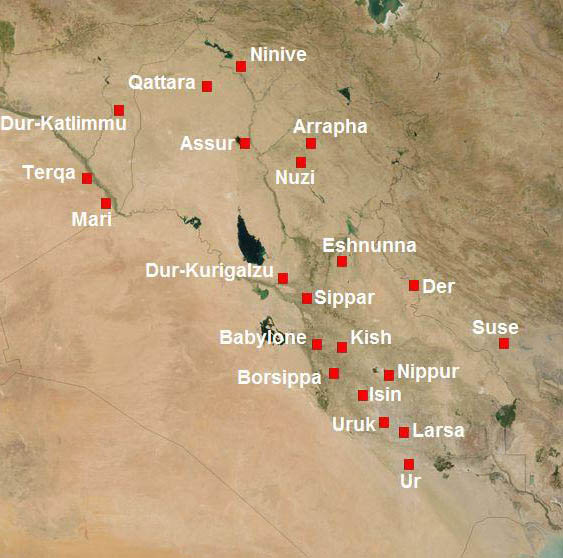
Cities of Sumer, showing Arrapha, an ancient Assyrian city (modern Kirkuk) founded around 2000 BC.
One writer thinks the Watchers were the Annunaki. They left their first estate (heaven), to go to the earth to co-habitate with human women.
The Anunnaki (ancient Sumerian word for 'those who came from Heaven to Earth', 'those of royal blood') are the children of the Creator God Anu and Antu. They are a group of Sumerian deities related to the Annuna (the 'Fifty Great Gods'). It is thought that the title originally came from the Sumerian (Anu=heaven/sky, na=and, Ki=Earth), described as the fifth generation of Gods in the Enuma Elish.
The term Anunnaki in this context would be identical to "hashamayim ve'et ha'arets", "the heaven and earth" used in the opening verse of Genesis 1:1 "In the beginning God created the heaven and the earth."
The Anunnaki were the High Council of the Gods, and Anu's companions. They were distributed through the Earth and the Underworld. The best known of them were Asaru, Asarualim, Asarualimnunna, Asaruludu, En-Ki (Ea for the Akkadians), Namru, Namtillaku and Tutu.
According to later Babylonian myth, the Anunaki were the children of Anu and Ki, brother and sister gods, themselves the children of Anshar and Kishar (Skypivot and Earthpivot, the Celestial poles). Anshar and Kishar were the children of Lahm and Lahmu ("the muddy ones"), names given to the gatekeepers of the Abzu (Apsû) temple at Eridu, the site at which the Creation was thought to have occurred.
The head of the Anunnaki council was the Great Anu, (rather than being just a sky god, Anu in Sumerian actually means "sky"), of Uruk and the other members were his offspring. His place was taken by Enlil, (En=lord, lil=wind,air), who at some time was thought to have separated heaven and earth. This resulted in an ongoing dispute between Enlil of Nippur and his half brother Enki
of Eridu regarding the legitimacy of Enlil's assumption of leadership. Enki, (En=lord, Ki=Earth), in addition to being the God of fresh water, was also God of wisdom and magic. When the Igigi went on strike and refused to continue to work maintaining the universe, on the Shappatu (Hebrew. shabbat, Eng. sabbath) Enki created humankind to assume responsibility for the tasks the Gods no longer performed.
The Sumerian god Enki (Ea in Akkadian) was believed to have lived in the apsû since before human beings were created. His wife Damgalnuna, and mother Nammu also lived in the apsû.
[Enki seems to correspond to the soul (Goshorun), of the primeval ox (apsû) that came out from the body of the ox even as the soul from the body of the dead.]
Eridu appears to be the earliest of Sumerian urban settlements. In the Sumerian king list, Eridu is named as the city of the first kings. The king list gave particularly long rules to the kings who came before the "flood", and shows how the centre of power progressively moved from the south to the north of the country.
Adapa U-an (Oannes), elsewhere called the first man was a half-god half-man, culture hero, called by the title Abgallu (Ab=water, Gal=Great, Lu=Man) of Eridu. He was considered to have brought civilisation to the city, and served Alulim.
Enki was the Sumerian counterpart of the Akkadian water-god Ea. Like all the Sumerian and Babylonian gods, Enki/Ea began as a local god, who came to share, according to the later cosmology, with Anu and Enlil, the rule of the cosmos.
In the city Eridu, Enki's temple was known as "the abzu temple" and was located at the edge of a swamp, an apsû.Certain tanks of holy water in Babylonian and Assyrian temple courtyards were also called apsû or abzu. These may be regarded as precursors to the washing pools of Islamic mosques, or the baptismal font in Christian churches.
Apsu is a sanskrit word that means "in water(s)." This term predates the use of Apsu in the Sumerian myth that places Babylon as the center of religion.
Apsû is depicted as a deity only in the Babylonian creation epic, the Enûma Elish (8th Century B.C). In this story, he was a primal monster made of fresh water and a lover to another primal deity, Tiamat, who was a creature of salt water.
The gods who sided with Tiamat are initially forced to labor in the service of the other gods. They are freed from their servitude when Marduk decides to slay Kingu and create mankind from his blood. Babylon is established as the residence of the chief gods. Finally, the gods confer kingship on Marduk, hailing him with fifty names. Most noteworthy is Marduk's symbolic elevation over Enlil, who was seen by earlier Mesopotamian civilizations as the king of the gods.
Many scholars have noted striking similarities between the creation story in the Enûma Elish and the first creation story in the Book of Genesis. For example, Genesis 1 describes six days of creation, followed by a day of rest; the Enûma Elish describes six generations of gods, whose creations parallel the days in Genesis, followed by a divine rest. In both stories, creation begins with light and ends with humankind, created for "the service of the gods" from the blood and bone of Kingu according to the Enûma Elish. Also, the goddess Tiamat parallels the primordial ocean in Genesis; the Hebrew word used in Genesis for the primordial ocean has the same etymological root as "Tiamat".
Enlil was the god of wind, or the sky between earth and heaven. One story has him originate as the exhausted breath of An (God of the heavens) and Ki (goddess of the Earth) after sexual union. Another is that he and his sister Ninhursag/Ninmah/Aruru were children of an obscure god known as Enki 'Lord Earth' (not the famous Enki) borne by Ninki 'Lady Earth'.
When Enlil was a young god, he was banished from Dilmun, home of the gods, to Kur, the underworld for raping a young girl named Ninlil. Ninlil followed him to the underworld where she bore his first child, the moon god Sin. After fathering three more underworld deities, Enlil was allowed to return to Dilmun.
Enlil was also known as the inventor of the pickaxe/hoe (favorite tool of the Sumerians) and caused plants to grow. He was in possession of the holy Me, until he gave them to Enki for safe keeping, who summarily lost them to Inanna in a drunken stupor.
Enlil's relation to An 'Sky', in theory the supreme god of the Sumerian pantheon, was somewhat like that of a prime minister in a constitutional monarchy compared to the supposed monarch. While An was in name ruler in the highest heavens, it was Enlil who mostly did the actual ruling over the world.
By his wife Ninlil or Sud, Enlil was father of the moon god Nanna (in Akkadian Sin) and of Ninurta (also called Ningirsu). Enlil is sometimes father of Nergal, of Nisaba the goddess of grain and others.
Enlil is associated with the ancient city of Nippur. At a very early period prior to 3000 BC Nippur had become the centre of a political district of considerable extent. Inscriptions show that Enlil was the head of an extensive pantheon. Among the titles accorded to him are "king of lands," "king of heaven and earth" and "father of the gods".
His chief temple at Nippur was known as Ekur, signifying 'House of the mountain', and such was the sanctity acquired by this edifice that Babylonian and Assyrian rulers, down to the latest days, vied with one another in embellishing and restoring Enlil's seat of worship. Grouped around the main sanctuary, there arose temples and chapels to the gods and goddesses who formed his court, so that Ekur became the name for an entire sacred precinct in the city of Nippur.

Marduk
The Babylonian name Marduk in Sumerian, is spelt as Amarutu in Akkadian/Elamite and means, "solar calf", or "calf of the sun god". In the Bible he is Merodach. He is normally referred to as Bel, "Lord". He was a late generation god from ancient Mesopotamia and patron deity of the city of Babylon, who, when Babylon permanently became the political center of the Euphrates valley in the time of Hammurabi ((1793-1751 BC), started to slowly rise to the position of the head of the Babylonian pantheon, a position he fully acquired by the second half of the second millennium BC.
Babylon is the Greek variant of Akkadian Babilu meaning "Gateway of the god". It was the "holy city" of Babylonia from around 2300 BC, and the seat of the Neo-Babylonian empire from 612 BC. In the Old Testament, the name appears as Babel, interpreted by Genesis 11:9 to mean "confusion", from the verb balal, "to confuse". The earliest mention of Babylon is in a dated tablet of the reign of Sargon of Akkad (2350 - 2100 BC). Over the years, its power and population waned. From around the 20th century BC, it was occupied by Amorites (nomadic Semitic tribes), flooding southern Mesopotamia from the west. During the domination by the Kassites (1595-1155 BC), the city was renamed "Karanduniash". Babylon gradually became subject to the rule of Assyria. During the reign of Sennacherib of Assyria, Babylonia was in a constant state of revolt, and suppressed only by the complete destruction of the city of Babylon. In 689 BC, its walls, temples and palaces were razed to the ground. Shamash-shum-ukin headed a revolt in 652 BC against his brother in Nineveh, Assurbanipal. Babylon was besieged by the Assyrians and starved into surrender.
Since the time of Dyaus was between 3080 - 2000, and Baal 1,720 BC - 320 AD
Nibiru, to the Babylonians, was the celestial body or region sometimes associated with the god Marduk.
Marduk's original character is obscure, but whatever special traits Marduk may have had were overshadowed by the reflex of the political development through which the Euphrates valley passed and which led to imbuing him with traits belonging to gods who at an earlier period were recognized as the heads of the pantheon. There are more particularly two gods - Ea and Enlil's powers and attributes passed over to Marduk. Marduk beomes viewed as the son of Ea. The father voluntarily recognizes the superiority of the son and hands over to him the control of humanity. After Hammurabi, the cult of Marduk eclipsed that of Enlil, although the cult of Enlil enjoyed a period of renaissance during the four centuries of Kassite control in Babylonia (c. 1570 BC - 1157 BC). The only rival to Marduk came after 1000 BC with Anshar of Assyria. In the south, Marduk reigned supreme.
The Enûma Elish tells the story of Marduk's birth, heroic deeds and becoming the ruler of the gods. It includes the fifty names of Marduk. In Enûma Elish, a civil war between the gods was growing to a climactic battle. The Anunnaki gods gathered together to find one god who could defeat the gods rising against them. Marduk answered the call and was promised the position of head god. When he killed his enemy, he "wrested from him the Tablets of Destiny, wrongfully his" and assumed his new position. Under his reign humans were created to bear the burdens of life so the gods could be at leisure.
In late Babylonian astrology, Marduk was connected to the planet Jupiter. As the ruler of the late Babylonian pantheon, he was equated with the Greek god Zeus (Latin Jupiter), hence the name of the planet.
Marduk was associated with the sun, similarly to Ra. Marduk rose to power starting circa 2200 BC, and the Egyptian god Amun-Ra which the Thebans Egyptian rulers worshipped also rose to power at around this time. This coincides with the fact that the Era of Aries started at around 2200 BC and might have some relationship. Nabu, god of wisdom, is a son of Marduk.
Nibiru, to the Babylonians, was the celestial body or region sometimes associated with the god Marduk.
[The time of Dyaus was between 3080 - 2000, and Baal 1,720 BC - 320 AD]
"Baal" can refer to any god and even to human officials; in some mythological texts it is used as a substitute for Hadad, a god of the sun, rain, thunder, fertility and agriculture, and the lord of Heaven. Since only priests were allowed to utter his divine name Hadad, Baal was used commonly. Nevertheless, few if any Biblical uses of "Baal" refer to Hadad, the lord over the assembly of gods on the holy mount of Heaven, but rather refer to any number of local spirit-deities worshipped as cult images, each called baal and regarded as an "idol".
Because more than one god bore the title "Ba'al" and more than one goddess bore the title "Ba'alat" or "Ba'alah," only the context of a text can indicate which Ba'al 'Lord' or Ba'alath 'Lady' a particular inscription or text is speaking of.
Though the god Hadad (or Adad) was especially likely to be called Ba'al, Hadad was far from the only god to have that title. The Baal cycle place the dwelling of Ba'al/Hadad on Mount Zephon, so one can probably take as evident that references to Ba'al Zephon in the Tanach and in inscriptions and tablets refer to Hadad. It is said that Ba'al Pe'or, the Lord of Mount Pe'or, whom Israelites were forbidden from worshipping (Numbers 1-25) was also Hadad. In the Canaanite pantheon, Hadad was the son of El, who had once been the primary god of the Canaanite pantheon, and whose name was also used interchangeably with that of the Hebrew god, Yahweh.
1 Kings 16.31 relates that Ahab, king of Israel, married Jezebel, daughter of Ethba'al, king of the Sidonians, and then served habba'al ('the Ba'al'.) The cult of this god was prominent in Israel until the reign of Jehu, who put an end to it (2 Kings 10.26).
It is uncertain whether "the Ba'al" 'the Lord' refers to Melqart, to Hadad, who was also worshipped in Tyre, or Ba'al Shamîm 'Lord of Heaven' who was also worshipped in Tyre and often distinguished from Hadad.
King Ahab, despite supporting the cult of this Ba'al, remained at the same time also a follower of Yahweh. Ahab still consulted Yahweh's prophets and cherished Yahweh's protection.
The worship of Ba`al Hammon flourished in the Phoenician colony of Carthage. Ba'al Hammon was the supreme god of the Carthaginians and is generally identified by modern scholars either with the northwest Semitic god El or with Dagon, and generally identified by the Greeks with Cronus and by the Romans with Saturn.
Classical sources relate how the Carthaginians burned their children as offerings to Ba'al Hammon. Such a devouring of children fits well with the Greek traditions of Cronus.
Ba'al Hammon's female cult partner was Tanit.
Ba'alat Gebal ("Lady of Byblos") appears to have been generally identified with 'Ashtart.
At first the name Baal was used by the Jews for their God without discrimination, but as the struggle between the two religions developed, the name Baal was given up in Judaism as a thing of shame, and even names like Jerubbaal were changed to Jerubbesheth.
Since Ba'al simply means 'Lord', there is no obvious reason why it could not be applied to Yahweh as well as other gods. Perhaps it was. The judge Gideon was also called Jerubaal, a name which seems to mean 'Ba'al strives' though Judges 6.32 makes the claim that the name was given to mock the god Ba'al, whose shrine Gideon had destroyed, the intention being to imply: "Let Ba'al strive as much as he can ... it will come to nothing."
After Gideon's death, according to Judges 8.33, the Israelites went astray and started to worship the Ba'alîm (the Ba'als) especially Ba'al Berith ("Lord of the Covenant.")
House of El Berith', that is, 'the House of God of the Covenant'. Was Ba'al then here just a title for El?
at some period Ba'al and El were used interchangeably. 1 Chronicles 9.40. 1 Chronicles 12:5 mentions the name Bealiah meaning "Yahweh is Ba'al."
Certainly some of the Ugaritic texts report hostility between El and Hadad, perhaps representing a cultic and religious differences reflected in Hebrew tradition also, in which Yahweh in the Tanach is firmly identified with El and might be expected to be somewhat hostile to Ba'al/Hadad and the deities of his circle. But for Jeremiah and the Deuteronomist it also appears to be monotheism against polytheism (Jeremiah 11.12): according to the number of the streets of Jerusalem you have set up altars to burn incense to the Ba'al.
One finds in the Tanach the plural forms 'Ba'als' and ''Ashtarts', though such plurals do not appear in Phoenician or Canaanite or independent Aramaic sources.
Sexuality might characterize part of the cult of the Ba'als and 'Ashtarts.
Another theory is that the references to Ba'als and 'Ashtarts (and Asherahs) are to images or other standard symbols of these deities, that is statues and icons of Ba'al Hadad, 'Ashtart, and Asherah set up in various high places.
Because the word Baal is used as a common substitute for the sacred name Hadad, confusion often arises when the same word is used for other deities, physical representations of gods and even people.
Historically, this confusion was resolved the nineteenth century as new archaeological evidence indicated multiple gods bearing the title Ba'al and little about them that connected them to the sun. In 1899 an article states:
That Baal was primarily a sun-god was for a long time almost a dogma among scholars and is still often repeated. This doctrine is connected with theories of the origin of religion which are now almost universally abandoned. The worship of the heavenly bodies is not the beginning of religion. Moreover, there was not, as this theory assumes, one god Baal, worshipped under different forms and names by the Semitic peoples, but a multitude of local Baals, each the inhabitant of his own place, the protector and benefactor of those who worshipped him there.
In the astro-theology of the Babylonians the star of Bel was not the sun : it was the planet Jupiter.
Until archaeological digs at Ras Shamra explaining the Syrian pantheon, the demon Ba'al Zebûb was frequently confused with various Semitic spirits and deities entitled ba'al.
Beelzebub, or more accurately Ba'al Zebûb was originally the name of a deity worshipped in the Philistine city of Ekron.
Baal is a northwest Semitic word signifying 'The Lord, master, owner (male), husband' cognate with Akkadian Bel of the same meanings. In medieval Judaism, a rabbi who appeared to have supernatural powers was called a Ba'al Shem 'Master of the Name' with no perception of any connection with Ba'al as a title for a pagan god.
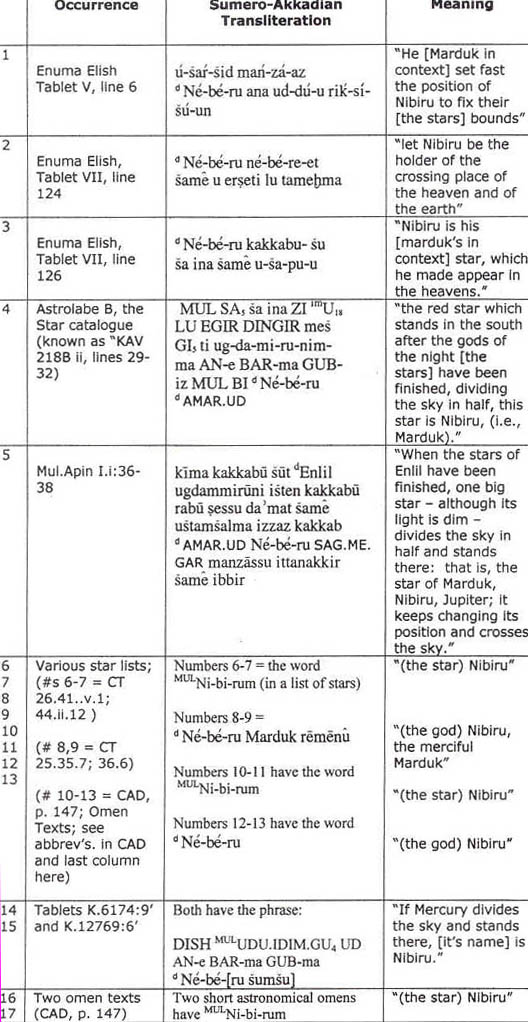
Complete listing of the word "nibiru" in astronomical contexts
According to Mesopotamian Mythology the Anunnaki are 7 gods of the underworld, or fates. In the underworld realm they function as judges of the dead.
1) Enlil
The Stars in the Bible
2) Enki En-Ki (Ea)
3) Inanna
4) Ninhursag
5) Ninlil
6) Nannar
7) Utu
Job 9:9 Which maketh Arcturus, Orion, and Pleiades, and the chambers of the south.
Job 38:31Canst thou bind the sweet influences of Pleiades, or loose the bands of Orion?
Amo 5:8 that maketh the seven stars and Orion, and turneth the shadow of death into the morning, and maketh the day dark with night: that calleth for the waters of the sea, and poureth them out upon the face of the earth
I Corinthians 15:40 There are celestial bodies, and bodies terrestrial: but the glory of the celestial is one, and the glory of the terrestrial is another."
Deut: 4:32 Ask now about the former day's, long before your time, from the day's God created man on earth.
Deut:32:7 Remember the days of old: consider the generations long past, ask your father and he will tell you.
Isaiah:46:9, remember the former thing's, things of long ago, I AM GOD (YHWH) and there is no other LIKE ME, I make known the end from the beginning, from ancient times, what is still to come.
Job:8:8 For enquire, I pray thee, of the former age, and prepare thyself to the search of their fathers."
Matthew 13:11 it is given unto you to know the mysteries of the kingdom of heaven, but to them it is not given.
[This is like Hirto, one half of the shell ascended, the other half became the foundation of the world].
This resulted in an ongoing dispute between Enlil of Nippur and his half brother Enki of Eridu regarding the legitimacy of Enlil's assumption of leadership. Enki, (En=lord, Ki=Earth), in addition to being the God of fresh water, was also God of wisdom and magic. When the Igigi went on strike and refused to continue to work maintaining the universe, on the Shappatu (Hebrew. shabbat, Eng. sabbath) Enki created humankind to assume responsibility for the tasks the Gods no longer performed.
The Anunnaki were the High Council of the Gods, and Anu's companions. They were distributed through the Earth and the Underworld. The best known of them were Asaru, Asarualim, Asarualimnunna, Asaruludu, En-Ki (Ea), Namru, Namtillaku and Tutu.
The Sumerians believe in existence of a planet that orbits two solar-systems called Nibiru which is home to two races; the Anu and the Nephillium. Every 3600 years this celestial body enters our solar system.
At the Fifth Congress of Orientalists (Berlin, 1882) Kessler brought out the connection between Gnosis and the Babylonian religion, not the original religion of Babylonia, but the syncretistic religion which arose after the conquest of Cyrus. When Cyrus entered Babylon in 539 B.C., two great worlds of thought met, and syncretism in religion began.
The persuasion that the planetary system had a fatalistic influence on this world's affairs, stood its ground on the soil of Chaldea.
The greatness of the Seven - the sacred Hebdomad (the Moon, Mercury, Venus, Mars, the Sun, Jupiter, and Saturn) symbolized for millenniums by the staged towers of Babylonia, remained undiminished. They ceased to be worshipped as deities, but remained archontes and dynameis, rulers and powers whose force was dreaded by man. They were changed from gods to evil spirits. Beyond the Hebodomad was the infinite light in the Ogdoad, and every human soul had to pass the adverse influence of the god or gods of the Hebdomad before it could ascend to the only good God beyond.
This ascent of the soul through the planetary spheres to the heaven beyond (an idea known to ancient Babylonians) began to be conceived as a struggle with adverse powers, and became the first and predominant idea in Gnosticism.
Gnostic eschatology, consisting in the soul's struggle with hostile archons in its attempt to reach the Pleroma,
is said to be the soul's ascent through the realms of the seven planets of Babylonian astrology to Anu. The early church Father Origen, referring to the Ophitic system, gives the names of the seven archons
as Jaldabaoth, Jao, Sabaoth, Adonaios, Astaphaios, Ailoaios, and Oraios, and tells us:
Jaldabaoth (Child of Chaos) -- Saturn, called "the Lion-faced") is the outermost, and chief ruler, later the Demiurge.
Jao (Iao, perhaps from Jahu, Iyo) is Jupiter.
Sabaoth (the Old-Testament title 'God of Hosts') was Mars.
Astaphaios (taken from magic tablets) was Venus.
Adonaios was the Sun (the Hebrew term for "the Lord", used of God; Adonis of the Syrians represented the Winter sun in the cosmic tragedy of Tammuz; in the Mandaean system Adonaios represents the Sun)
Ailoaios, or sometimes Ailoein (Elohim, God), Mercury;
Oraios (Jaroah? or light?), the Moon.
 The Chaldean Planetary Spheres
Planet
Hierarchy
Muse
Aeon
Sephirah
Steiner/Heindel
Latin/Greek
[Spirits of ...]
Ain Soph
Primum Mobile
Seraphim
Kether
Love
8. Fixed Stars
Cherubim
(Zodiac)
Hokmah
Harmonies
7. Saturn
Throni
Polyhymnia
Ialdabaoth
Binah
Will
6. Jupiter
Dominationes/Kyriotetes
Euterpe
Iao
Hesed
Wisdom
5. Mars
Potestates/Dynameis
Erato
Sabaoth
Geburah
Movement/Motion/Individuality
4. Sun
Principatus/Archai
Melpomene
Adonaios
Tipheret
Form
3. Venus
Virtues/Exusiai
Terpsichore
Astaphaios
Netzach
Personality,Egoism/Mind
2. Mercury
Archangels
Calliope
Ailoaios
Hod
Fire
1. Moon
Angels/Messengers
Clio
Oraios
Hesod
Twilight
0. Earth
Thalia
Malkuth
The Spindle of Necessity
In The Republic by Plato, The Spindle of Necessity is mentioned in Book 10, Myth of Er. The cosmos is represented by the Spindle attended by sirens and the three daughters of the Goddess Necessity known collectively as The Fates. Their duty is to keep the rims of the spindle revolving. The Fates, Sirens and Spindle are used in 'The Republic', partly, to help explain how known celestial bodies revolved around the Earth according to Plato's understanding of cosmology and astronomy.
The "Spindle of Necessity", according to Plato, is the same as a standard Greek spindle, consisting of a hook, shaft and whorl. The hook was fixed near the top of the shaft. At the base was the whorl [a disc]. The hook was used to spin the shaft, which in turn spun the whorl on the other end.
[The shaft is like the axis (cosmic tree), the hook is like the constellation of Draco the dragon, the centre of which is the pole of the ecliptic, the northern pole of the shaft, about which precession rotates the sphere of the stars. The whorl is the disc of the solar plane with its planets
Placed on the whorl of his celestial spindle were 8 "orbits". Each of these orbits created a perfect circle.
Orbit 1
Stars (outermost)
Orbit 2
Saturn
Orbit 3
Venus
Orbit 4
Mars
Orbit 5
Mercury
Orbit 6
Jupiter
Orbit 7
Sol
Orbit 8
Moon
When precession became a clearly understood, the eighth sphere was divided into a ninth sphere which became the primum mobile, and a new eighth sphere which held the fixed stars which were perceived as moving with respect to the sphere of the primum mobile.
Components of the primum mobile are the vernal point, the celestial equator, the other equinox, and the solstices.
... they came to a place where they could see from above a line of light, straight as a column, extending right through the whole heaven and through the earth, in color resembling the rainbow, only brighter and purer; another day's journey brought them to the place, and there, in the midst of the light, they saw the ends of the chains of heaven let down from above: for this light is the belt of heaven, and holds together the circle of the universe, like the under-girders of a ship. From these ends is extended the spindle of Necessity, on which all the revolutions turn. The shaft and hook of this spindle are made of steel, and the whorl is made partly of steel and also partly of other materials. Now the whorl is in form like the whorl used on earth; and the description of it implied that there is one large hollow whorl which is quite scooped out, and into this is fitted another lesser one, and another, and another, and four others, making eight in all, like vessels which fit into one another; the whorls show their edges on the upper side, and on their lower side all together form one continuous whorl. This is pierced by the spindle, which is driven home through the centre of the eighth. The first and outermost whorl has the rim broadest, and the seven inner whorls are narrower, in the following proportions --the sixth is next to the first in size, the fourth next to the sixth; then comes the eighth; the seventh is fifth, the fifth is sixth, the third is seventh, last and eighth comes the second. The largest (of fixed stars) is spangled, and the seventh (or sun) is brightest; the eighth (or moon) colored by the reflected light of the seventh; the second and fifth (Saturn and Mercury) are in color like one another, and yellower than the preceding; the third (Venus) has the whitest light; the fourth (Mars) is reddish; the sixth (Jupiter) is in whiteness second. Now the whole spindle has the same motion; but, as the whole revolves in one direction, the seven inner circles move slowly in the other, and of these the swiftest is the eighth; next in swiftness are the seventh, sixth, and fifth, which move together; third in swiftness appeared to move according to the law of this reversed motion the fourth; the third appeared fourth and the second fifth. The spindle turns on the knees of Necessity; and on the upper surface of each circle is a siren, who goes round with them, hymning a single tone or note. The eight together form one harmony; and round about, at equal intervals, there is another band, three in number, each sitting upon her throne: these are the Fates, daughters of Necessity, who are clothed in white robes and have chaplets upon their heads, Lachesis and Clotho and Atropos, who accompany with their voices the harmony of the sirens --Lachesis singing of the past, Clotho of the present, Atropos of the future; Clotho from time to time assisting with a touch of her right hand the revolution of the outer circle of the whorl or spindle, and Atropos with her left hand touching and guiding the inner ones, and Lachesis laying hold of either in turn, first with one hand and then with the other.
 In the Myth, souls journey along what some say is the Milky Way to the celestial axis (the shaft) of Necessity which rests on the knees of Ananke (or Adrasteia), the personification of "Fate" or "Necessity".
The three daughters of Necessity preside over the choosing of lots for the fate of the soul, and join with the sirens in singing who utter the heptachord of the music of the spheres.
In the Myth, souls journey along what some say is the Milky Way to the celestial axis (the shaft) of Necessity which rests on the knees of Ananke (or Adrasteia), the personification of "Fate" or "Necessity".
The three daughters of Necessity preside over the choosing of lots for the fate of the soul, and join with the sirens in singing who utter the heptachord of the music of the spheres.
In Oahspe, Fete has the sign of a cross inside a circle. It is the uspoken, unwritten law of Jehovih from which none (Gods, Man and beast) can escape. The way to avoid suffering is to do that which brings eternal happiness.
Plato's way of happiness is also an outcome of the fates, but differs with Oahspe in that Oahspe considers the modern concept of reincarnation to be false. In terms of Oahspe engrafters, or 're-incarnated spirits' are those who engraft themselves on mortals. Damons are angels who are engrafters who usurp the corporeal body (as of an infant) and grow up in it, and holding the native spirit in abeyance.
When Er and the spirits arrived, their duty was to go at once to Lachesis; but first of all there came a prophet who arranged them in order; then he took from the knees of Lachesis lots and samples of lives, and having mounted a high pulpit, spoke as follows: `Hear the word of Lachesis, the daughter of Necessity. Mortal souls, behold a new cycle of life and mortality. Your genius will not be allotted to you, but you choose your genius; and let him who draws the first lot have the first choice, and the life which he chooses shall be his destiny. Virtue is free, and as a man honours or dishonours her he will have more or less of her; the responsibility is with the chooser--God is justified.'
When the Interpreter had thus spoken he scattered lots indifferently among them all, and each of them took up the lot which fell near him, all but Er himself (he was not allowed), and each as he took his lot perceived the number which he had obtained. Then the Interpreter placed on the ground before them the samples of lives; and there were many more lives than the souls present, and they were of all sorts. There were lives of every animal and of man in every condition. And there were tyrannies among them, some lasting out the tyrant's life, others which broke off in the middle and came to an end in poverty and exile and beggary; and there were lives of famous men, some who were famous for their form and beauty as well as for their strength and success in games, or, again, for their birth and the qualities of their ancestors; and some who were the reverse of famous for the opposite qualities. And of women likewise; there was not, however, any definite character them, because the soul, when choosing a new life, must of necessity become different. But there was every other quality, and they all mingled with one another, and also with elements of wealth and poverty, and disease and health; and there were mean states also.
And here is the supreme peril of our human state; and therefore the utmost care should be taken. Let each one of us leave every other kind of knowledge and seek and follow one thing only. He should consider the bearing of all these things which have been mentioned severally and collectively upon virtue; he should know what the effect of beauty is when combined with poverty or wealth in a particular soul, and what are the good and evil consequences of noble and humble birth, of private and public station, of strength and weakness, of cleverness and dullness, and of all the soul, and the operation of them when conjoined; he will then look at the nature of the soul, and from the consideration of all these qualities he will be able to determine which is the better and which is the worse; and so he will choose, giving the name of evil to the life which will make his soul more unjust, and good to the life which will make his soul more just; all else he will disregard. For we have seen and know that this is the best choice both in life and after death. A man must take with him into the world below an adamantine faith in truth and right, that there too he may be undazzled by the desire of wealth or the other allurements of evil, lest, coming upon tyrannies and similar villainies, he do irremediable wrongs to others and suffer yet worse himself; but let him know how to choose the mean and avoid the extremes on either side, as far as possible, not only in this life but in all that which is to come. For this is the way of happiness.
And according to the report of the messenger from the other world this was what the prophet said at the time:
`Even for the last comer, if he chooses wisely and will live diligently, there is appointed a happy and not undesirable existence. Let not him who chooses first be careless, and let not the last despair.'
And when he had spoken, he who had the first choice came forward and in a moment chose the greatest tyranny; his mind having been darkened by folly and sensuality, he had not thought out the whole matter before he chose, and did not at first sight perceive that he was fated, among other evils, to devour his own children. But when he had time to reflect, and saw what was in the lot, he began to beat his breast and lament over his choice, forgetting the proclamation of the prophet; for, instead of throwing the blame of his misfortune on himself, he accused chance and the gods, and everything rather than himself. Now he was one of those who came from heaven, and in a former life had dwelt in a well-ordered State, but his virtue was a matter of habit only, and he had no philosophy. And it was true of others who were similarly overtaken, that the greater number of them came from heaven and therefore they had never been schooled by trial, whereas the pilgrims who came from earth, having themselves suffered and seen others suffer, were not in a hurry to choose. And owing to this inexperience of theirs, and also because the lot was a chance, many of the souls exchanged a good destiny for an evil or an evil for a good. For if a man had always on his arrival in this world dedicated himself from the first to sound philosophy, and had been moderately fortunate in the number of the lot, he might, as the messenger reported, be happy here, and also his journey to another life and return to this, instead of being rough and underground, would be smooth and heavenly.
All the souls had now chosen their lives, and they went in the order of their choice to Lachesis, who sent with them the genius whom they had severally chosen, to be the guardian of their lives and the fulfiller of the choice: this genius led the souls first to Clotho, and drew them within the revolution of the spindle impelled by her hand, thus ratifying the destiny of each; and then, when they were fastened to this, carried them to Atropos, who spun the threads and made them irreversible, whence without turning round they passed beneath the throne of Necessity; and when they had all passed, they marched on in a scorching heat to the plain of Forgetfulness, which was a barren waste destitute of trees and verdure; and then towards evening they encamped by the river of Unmindfulness, whose water no vessel can hold; of this they were all obliged to drink a certain quantity, and those who were not saved by wisdom drank more than was necessary; and each one as he drank forgot all things. Now after they had gone to rest, about the middle of the night there was a thunderstorm and earthquake, and then in an instant they were driven upwards in all manner of ways to their birth, like stars shooting.
My counsel is that we hold fast ever to the heavenly way and follow after justice and virtue always, considering that the soul is immortal and able to endure every sort of good and every sort of evil. Thus shall we live dear to one another and to the gods.
"And thus the whole mixture out of which he cut these portions was all exhausted by him. This entire compound he divided lengthways into two parts, which he joined to one another at the centre like the letter X, and bent them into a circular form, connecting them with themselves and each other at the point opposite to their original meeting-point; and, comprehending them in a uniform revolution upon the same axis, he made the one the outer and the other the inner circle. Now the motion of the outer circle he called the motion of the same, and the motion of the inner circle the motion of the other or diverse. The motion of the same he carried round by the side to the right, and the motion of the diverse diagonally to the left. And he gave dominion to the motion of the same and like, for that he left single and undivided; but the inner motion he divided in six places and made seven unequal circles having their intervals in ratios of two-and three, three of each, and bade the orbits proceed in a direction opposite to one another; and three [Sun, Mercury, Venus] he made to move with equal swiftness, and the remaining four [Moon, Saturn, Mars, Jupiter] to move with unequal swiftness to the three and to one another, but in due proportion."
In the Middle Ages the Hellenistic Muses were replaced with the Celestial Hierarchy of Dionysius. Robert Fludd (born 1574) united the Chaldean planets and the angelic hierarchy at the time when three Rosicrucian Manifestoes are maded public (1614).
The nine-fold planetary hierarchy which corresponds to the ninefold angelic hierarchy of Dionysius represents the ancient seven Chaldean planets with the addition of earth at the bottom and the sphere of the zodiac at the top. The doctrine of the
ascent of the soul through seven successive stages of being or consciousness is said to originate with the Babylonian myth of Tammuz and Ishtar. Later, this doctrine appears in the Poimandres of Hermes, the royal arches of Enoch, the seven heavens of St. John's Revelation and Mohammed's Night Journey To Heaven with the angel Gabriel.
The doctrine of the planetary spheres was accepted by Gnostics at the School of Alexandria. In 'On the Origin of the World' given above the Demiurge of Saturn gave birth out of himself to six sons or aeons, who together became the seven planetary spirits of the created material world. Gnostic wisdom, bearing a mixture of the Christos and Greek Platonics was lost in destruction of the great library of Seraphium by Emperor Theodosius and his crazed Christians.
The teaching of the ascent and descent of souls through the celestial gateways is further developed by Plotinus (~204-270) into the concept of emanations to bridge the gap between an infinite, spiritual and immaterial, and unchanging Source or God that lies beyond matter, with a finite, material, and changing world. The explanation of physical phenomena involves the participation in higher levels of the chain of being.
A series of supernatural intermediaries, hierarchy and abstract mathematicals describe the steps in the creative descent and a mystical ascent back to the One.
The influence of the celestial spheres on human life, the occult virtues of natural objects and the Neoplatonic theory of correspondences between material objects and spiritual intermediaries are because sensible nature is derived from and correlated with the immaterial.
The individual soul emulates the Plotinian act of creation by travelling down through the 7 cosmic spheres.
The 'Beauty' that Plato described the supreme being by became an archetype of the supreme One with a spiritual purpose (that was largely unconscious) to attract and lift the human soul toward the One. Alienation is a Platonic term to describe the individual soul separated from its spiritual home while imprisoned in the body. Beauty leads the embodied soul to remember and long for its true spiritual home.
The mystic used Plotinus' negative dialectic to successively deny attributes of that intermediary, eventually stripping the concept of the One of all multiplicity and imperfection and arriving at an "unknowing" of the One.
The ultimate union with the One also ultimately required an act of love. This was developed by Augustine and Pseudo-Dionysius as a theology of union through love, and courtly love became a 'Platonic' love that led to a mystic journey and spiritual ascent, as seen in Petrarch, Dante and the romance of the Grail legends.
This negative journey is implicit in concepts like the 'cloud of unknowing' and the 'dark night of the soul'.
Plotinus pointed out that three types are predisposed to undertake the mystical ascent: the philosopher, the musician, and the lover.
The creative descent is illustrated in Botticelli's Primavera (~1478) by an ecstatic dance supervised by Eros. Mercury (Hermes) reaches upward for the return to the beyond.
In Dante's 'Paradisio' Beatrice describes the nine choirs of angels and their association with the nine spheres of heaven, a cosmology taken from the Neoplatonist Pseudo-Dionysius' Celestial Hierarchy.
Ficino's (1433-1499) Neoplatonic Academy in Florence was a spiritual community that incorporated mysticism and the gradual ascent to God through the Neoplatonic emanations.
Hesiod (8th century B.C) described the Muses as female divinities who dance on Mount Helicon. (Some Greeks place the Muses on Mt. Olympus and some place them on Mt. Parnassus.) The Muses danced in a sacred grove in "bright places" adorned with works of art. The Muses and Graces, who are also goddesses, unite in dance under the direction of Apollo. The seeker climbed Mount Helicon from a dark valley towards the light where the Muses were dancing. He ascended from confusion in the valley and drew towards the light and clarity of divine "One." As the climber reached great heights he could see breathtaking vistas and hear the choral music of the Muses. Enchanted by the divine music, he joined the dance. The poet or the musician who has danced with the Muses descends the mountain inspired by the laws of beauty, harmony and grace. He sang enchanted songs to the barbarians in the dark miasma in the valley and directed them towards the light so that they could become civilized men.
Pythagoras discovered that exact ratios of vibrating string produce harmonies. Since music is based upon ratios of numbers, he concluded that music is the ordering principle of the world. The Greek word for ratio is logos, which also means reason and word. Therefore, a reasoning intelligence, namely God, must lie behind the orderly creation. Man has the gift of reason and can discern something about the order of the cosmos. Music is designed to reflect the larger harmonies that exist in the universe and assists human reason in discerning those harmonies.
Aristotle theorized that the planets and stars are set upon concentric crystalline spheres which rotate around the earth. He said that if Pythagorus is correct about ratios, the heavenly spheres are arranged in harmonic ratios. Each sphere produces a musical tone, and the revolution of the various spheres in concert produces harmonies and melodies. The "music of the spheres" vibrates through the world and we can accompany this music and participate in the harmony of the universe.
Schools of Europe and music was one of seven disciplines of study. Through the work of these Christian scholars, the "One" of Hesiod became God and the "logos" of Pythagorus became Christ. However, Hesiod's account of the ascent of mount Helicon did not match Aristotle's Music of the Spheres. It required the thinkers of the High Middle Ages, who had a genius for synthesis, to reconcile these two models of music and find a place for them in Christian spirituality.
The ascent of Mount Helicon is similar the Neoplatonic ascent to the One, developed by Plotinus (3rd century). Christian mystics were already using an adapted form of the techniques of Plotinus in their meditations and prayers seeking union with God. The Gregorian Chant with its mystical, detached and other worldly evocations was the perfect accompaniment for this form of mystical spirituality. St. Thomas Aquinas (13th century) used Hesiod's mountain ascent to the light and to the One because it fit the mystic spirituality of ascent in stages to union with God. The first half of the ascent was an arduous struggle. This involved the arduous process of practicing painful spiritual disciplines. The second was the mystic flight. Instead of dancing with Muses the mystic soars upward and hears the music of the spheres as he is approaching union with God. The scholar has to master classical Latin with pain and suffering on the first half of the mountain climb before he can soar with joy as he reads the classics. The musician has to painfully master the difficult techniques of his art before he can play the music of the spheres and soar to sublime delights.
Dante's ascent up the spiral road of Mount Purgatory in Purgatorio is like Acquinas' painful ascent of the lower half of the mountain. Dante (14th century) was guided by Virgil.
At the top of Mount Purgatory Dante found the earthly paradise, the end of earthly labors. The next part of his journey was to soar upwards by sheer grace from the top of Mount Purgatory to the crystalline spheres. Dante heard the music of the spheres as he ascended through nine concentric crystalline spheres of heaven in his journey towards union with God. Dante's guide to the spheres was Beatrice, who served as Dante's Muse.
Dante integrated Hesiod's concept by having Beatrice appear on the mountain top. He integrated Aristotle's music of the spheres by having Dante and Beatice ascend up to the spheres of heaven. Dante's mystic flight after struggling up the spiral mountain corresponds to Acquinas' sequence of struggling half way up the mountain and flying the second half. By depicting Purgatory as a journey and a heavy labor, Dante reconciled Catholic doctrine with Hesiod and with Neoplatonic spirituality and music.
After Copernicus discovered that the earth revolved around the sun, the music of the spheres became a metaphor instead of a sound made by literal crystalline spheres.
The Renaissance, Protestant Reformation, and Catholic Counter-reformation each added metaphysical substance to replace the literal cosmology of Dante.
Renaissance philosophy sponsored a renewed popularity of the metaphysics of Neoplatonism. The great chain of being represented an ontological hierarchy of higher and higher levels of being. Artists and poets began to climb mountains to meditate and seek inspiration from their Muses in the higher altitudes of being. Musicians climbed mountains hoping to hear the music of the spheres. They still believed in the spheres and Muses, as metaphysical states of being, but not as physical entities.
Protestant music conceptually returned to the concept of Pythagoras, which was harmony as logos, logos as the Word of God and The Logos as Christ. A new music of proclamation of the Word and praise sprang up. Bach, a German Lutheran, wrote a cantata based upon the following passage from Psalm 19. Notice how this passage perfectly harmonizes proclamation and praise.
The Catholic Church of the Counter-reformation was the inspiration of baroque music, architecture and culture. The theme of this culture was grandeur and obedience. Kings began to claim to rule by divine right. Dieu et Mon Droit (God and My Right) was their motto. The church had a very close relationship with these kings. Cardinal Richelieu ruled France. The court of the pope, known as "The Holy See," had a great throne from which the pope ruled. When he made a statement "Ex Cathedra" (from the throne) that statement allegedly had the authority of infallibility. "Cathedrals" were the thrones of bishops, or contained such thrones surrounded by baroque glory.
The influence of an intense rationalism in philosophy, led to the development of the techniques of harmony which were mastered by the period 1700 - 1750, the era of Bach and Handel. The rigorous technical mountain climbing phase of musical development was almost over and the time to soar in bliss was at hand.
Then came the golden era of Mozart and Haydn. In 1755, a controversy erupted about whether harmony or melody should dominate in music. Rameau argued that harmony should dominate because music should bring reason and order to a disordered world. Harmony is the rational principle in music (the "classical" view). Rousseau argued that melody should dominate over harmony. The spirit soars with the melody and the spiritual aspirations of man take flight (the "Romantic" theory).
Baroque music was classical in that harmony was emphasized. Mozart was a transitional composer between classical and romantic music and struck a balance between melody and harmony.
Haydn spanned from the late Baroque to the early Romantic eras of music composition. Beethoven wrote many purely classical pieces, but his melodies often soared with such sublimity or struck with lightning flashes of such passion that the melody dominated the harmony in a new way. He was the first great composer of the Romantic era.
"for 2,500 years music in the west had a shared concept of reality. But by the early twentieth century, this was no longer true. Music was re-conceptualized so completely that it could no longer be called music, i.e., with melody, harmony and rhythm. This rupture was a reflection of a deeper metaphysical divide that severed the composer from any meaningful contact with external reality. As a result, art was reduced to the arbitrary fragments of sound."
Then the new contemporary music, cut off from external reality, comes from a subjective inner world, the same realm from which pagan tribes get their music of primaeval rhythm and chant inspired by shamans.
Composer John Adams said that tonality died when Nietzshe's God died. "When God disappears, the intelligible order of the creation disappears. If there is no God , Nature no longer serves as a reflection of its Creator. If you lose the Logos of St. Clement, you also lose the ratio (logos) of Pythagoras. Nature is stripped of its normative power."
If there is no preexisting intelligible order to go out to and apprehend, and to search through for what lies beyond it - which is the Creator - what then is music to express? If external order does not exist, then music collapses in on itself...Any ordering of things becomes simply the whim of man's will." (And no one has any grounds for criticizing the whim of another man.) "Without a 'music of the spheres' to approximate, modern music, like the other arts, begins to unravel. Music's self-destruction became logically imperative once it undermined its own foundation."
twentieth century music collapsed into nihilism, in the hope that composers seek to return to tonal music anchored in a higher metaphysics.
________________________________________________________________________________
"The fruit of all the trees created for you in Paradise shall be eaten; but as for the tree of knowledge, control yourselves and do not eat from it. If you eat, you will die."
The Beast [the instructor] who in this account is made to be the wisest of all creatures says,
"What did God say to you? Was it 'Do not eat from the tree of knowledge'. Do not be afraid. In death you shall not die. For he knows that when you eat from it, your intellect will become sober and you will come to be like gods, recognizing the difference that obtains between evil men and good ones. Indeed, it was in jealousy that he said this to you, so that you would not eat from it."
Eve had confidence in the words of the instructor. She gazed at the tree and saw that it was beautiful and appetizing, and liked it; she took some of its fruit and ate it; and she gave some also to her husband, and he too ate it. Then their intellect became open. For when they had eaten, the light of knowledge had shone upon them. When they clothed themselves with shame, they knew that they were naked of knowledge. When they became sober, they saw that they were naked and became enamored of one another. When they saw that the ones who had modelled them had the form of beasts, they loathed them: they were very aware.
The Ophites (ophianoi, from ophis, serpent), recognized the serpent as symbol of the supreme emanation, Achamoth or Divine Wisdom. (Zoe-Sophia). [Sophia Achamoth or Lower Wisdom, the daughter of Higher Wisdom, became the mother of the Demiurge, said by some to be the God of the Jews].
According to the Peratae there exists a trinity of Father, Son, and Hyle (Matter). The Son is the Cosmic Serpent, who freed Eve from the power of the rule of Hyle. The universe they symbolized by a triangle enclosed in a circle. The number three is the key to all mysteries.
[One form of pantheism, present in the early stages of Greek philosophy, held that the divine is one of the elements in the world whose function is to animate the other elements that constitute the world. This point of view, called Hylozoistic (Greek hyle, "matter," and zoe, "life") pantheism, is not monistic, as are most other forms of pantheism, but pluralistic.]
Gnostic salvation is not merely individual redemption of each human soul; it is a cosmic process. It is the return of all things to what they were before the flaw in the sphere of the Æons brought matter into existence and imprisoned some part of the Divine Light into the evil Hyle (matter). This setting free of the light sparks is the process of salvation.
________________________________________________________________________________
The Ophites (Greek for snake) were members of numerous Gnostic sects in Syria and Egypt about 100 AD. The Ophite sects revered the serpent of Genesis as a symbol of gnosis, which the tyrant Yaldabaoth tried to hide from Adam and Eve. Christian heresiologists took particular offense at turning their view of the serpent on its head.
Irenaeus does not use the name "Ophite," but Theodoret, who copies his description, gives that title to them, and he has been followed by later writers.
Creation began as a series of emanations:
Bythos (Depth); Father of All (the First Man); Ennoia, the Son of Man (the Second Man) The Holy Spirit, the First Woman Water; Darkness; The Abyss; Chaos
Of the beauty of the Holy Spirit, both First and Second Man became enamoured, and they generated from her a third male, an Incorruptible Light, called Christ. But the excess of light with which she had been impregnated was more than she could contain, and while Christ her right-hand birth was borne upward with his mother, forming with the First and Second Man the True and Holy Church, a drop of light fell on the left hand downwards into the world of matter, and was called Sophia (Wisdom) or Prunikos, an androgynous being.
By this arrival the still waters were set in motion, all things rushing to embrace the Light, and Prunikos wantonly playing with the waters, assumed to herself a body, without the protection of which the light was in danger of being completely absorbed by matter. Yet when oppressed by the grossness of her surroundings, she strove to escape the waters and ascend to her mother, the body weighed her down, and she could do no more than arch herself above the waters, constituting thus the visible heaven. In process of time she was able to free herself from the encumbrance of the body, and leaving it behind to ascend to the region immediately above.
Meanwhile a son, Yaldabaoth, born to her from her contact with the waters, having in him a breath of the incorruptible light left him from his mother, by means of which he works, generates from the waters a son without any mother. And this son in like manner another, until there were seven Archons, ruling the seven heavens; a Hebdomad which their mother completes into an Ogdoad.
Yaldabaoth, Iao, Sabaoth, Adonaios, Elaios, Astaphanos, Horaios (or=light)
But it came to pass that these sons strove for mastery with their father Yaldabaoth, whereat he suffered great affliction, and casting his despairing gaze on the dregs of matter below, he, through them, obtained a son Ophiomorphus, the serpent-formed Nous, whence come the spirit and soul, and all things of this lower world; but whence came also oblivion, wickedness, jealousy, envy, and death. Yaldabaoth, stretching himself over his upper heaven, had shut out from all below the knowledge that there was anything higher than himself, and having puffed up with pride at the sons whom he had begotten without help from his mother, he cried, “I am Father and God, and above me there is none other.”
On this his mother, hearing him, cried out “Do not lie, Yaldabaoth, for above thee is the Father of All, the First Man, and the Son of Man.”
When the heavenly powers marvelled at this voice, Yaldabaoth, to call off their attention, exclaimed," Let us make man after our image." Then the six powers formed a gigantic man, the mother Sophia having given assistance to the design, in order that by this means she might recover the Light-fluid from Yaldabaoth. For the man whom the six powers had formed, lay unable to raise itself, writhing like a worm until they brought it to their father, who breathed into it the breath of life, and so emptied himself of his power. But the man having now Thought and Conception (Nous and Enthymesis), forthwith gave thanks to the First Man, disregarding those who had made him.
At this Yaldabaoth planned to despoil the man by means of a woman, and formed Eve, of whose beauty the six powers being enamoured generated sons from her, namely, the angels. Then Sophia devised by means of the serpent to seduce Eve and Adam to transgress the precept of Yaldabaoth; and Eve, accepting the advice of one who seemed a Son of God, persuaded Adam also to eat of the forbidden tree. And when they ate they gained knowledge of the power which is over all, and revoked from those who had made them. Thereupon Yaldabaoth cast Adam and Eve out of Paradise; but the mother had secretly emptied them of the Light-fluid in order that it might not share the curse or reproach. So they were cast down into this world, as was also the serpent who had been detected in working against his father. He brought the angels here under his power, and himself generated six sons, a counterpart of the Hebdomad. These seven demons always oppose and thwart the human race on whose account their father was cast down.
Adam and Eve at first had light and clear spiritual bodies, which on their fall became dull and gross; and their spirits were also languid because they had lost all but the breath of this lower world which their maker had breathed into them; until Prunikos taking pity on them gave them back the sweet odour of the Light-fluid through which they woke to a knowledge of themselves and knew that they were naked.
Then Yaldabaoth is represented as making a series of efforts to obtain exclusive adoration for himself, while he is counteracted by Prunikos, who strives to enlighten mankind as to the existence of higher powers more deserving of adoration. In particular the prophets who were each the organ of one of the Hebdomad, the glorification of whom was their main theme, were nevertheless inspired by Sophia to make fragmentary revelations about the First Man and about Christ above, whose descent also she caused to be predicted.
Sophia, having no rest either in heaven or on earth, implored the assistance of her mother, the First Woman. She, moved with pity at her daughter's repentance, begged of the First Man that Christ should be sent down to her assistance. Sophia announced his advent by John, prepared the baptism of repentance, and by means of Yaldabaoth, got ready a woman to receive the annunciation from Christ, in order that there might be a pure and clean vessel to receive him, namely Jesus, who, being born of a virgin by divine power, was wiser, purer, and more righteous than any other man. Christ then descended through the seven heavens, taking the form of the sons of each as he came down, and deprived each of their rulers of his power. For wheresoever Christ came the Light-fluid rushed to him, and when he came into this world he first united himself with his sister Sophia, and they refreshed one another as bridegroom and bride, and the two united descended into Jesus, who thus became Jesus Christ. Then he began to work miracles, and to announce the unknown Father, and to declare himself manifestly the son of the First Man. Then Yaldabaoth and the other princes of the Hebdomad, being angry, sought to have Jesus crucified, but Christ and Sophia did not share his passion, having withdrawn themselves into the incorruptible Aeon. But Christ did not forget Jesus, but sent a power which raised his body up, not his flesh and blood body, for this cannot lay hold of the kingdom of God, but his animal and spiritual body. So it was that Jesus did no miracles, either before his baptism, when he was first united to Christ, or after his resurrection, when Christ had withdrawn himself from him. Jesus then remained on earth after his resurrection eighteen months, at first himself not understanding the whole truth, but enlightened by a revelation subsequently made him, which he taught to a chosen few of his disciples, and then was taken up to heaven.
The story proceeds to tell that Christ, sitting on the right hand of the father Yaldabaoth, without his knowledge, enriches himself with the souls of those who had known him, inflicting a corresponding loss on Yaldabaoth. For as righteous souls instead of returning to him are united to Christ, Yaldabaoth is less and less able to bestow any of the Light-fluid on souls afterwards entering this world, and can only breathe into them his own animal breath. The consummation of all things will take place when, by successive union of righteous souls with Christ, the last drop of the Light-fluid shall be recovered from this lower world.
________________________________________________________________________________
When he had thus said, he was changed in his Idea or Form and straightway in the twinkling of an eye, all things were opened unto me: and I saw an infinite Sight, all things were become light, both sweet and exceedingly pleasant; and I was wonderfully delighted in the beholding it.
5. But after a little while, there was a darkness made in part, coming down obliquely, fearful and hideous, which seemed unto me to be changed into a Certain Moist Nature, unspeakably troubled, which yielded a smoke as from fire; and from whence proceeded a voice unutterable, and very mournful, but inarticulate, insomuch that it seemed to have come from the Light.
6. Then from that Light, a certain Holy Word joined itself unto Nature, and out flew the pure and unmixed Fire from the moist Nature upward on high; it is exceeding Light, and Sharp, and Operative withal. And the Air which was also light, followed the Spirit and mounted up to Fire (from the Earth and the Water) insomuch that it seemed to hang and depend upon it.
7. And the Earth and the Water stayed by themselves so mingled together, that the Earth could not be seen for the Water, but they were moved, because of the Spiritual Word that was carried upon them.
Poemander said "I am that Light, the Mind, thy God, who am before that Moist Nature that appeareth out of Darkness, and that Bright and Lightful Word from the Mind is the Son of God. Understand it, That which in thee Seeth and Heareth, the Word of the Lord, and the Mind, the Father, God, Differeth not One from the Other, and the Unison of these is Life. But first conceive well the Light in thy mind and know it."
10. When he had thus said, for a long time me looked steadfastly one upon the other, insomuch that I trembled at his Idea or Form.
11. But when he nodded to me, I beheld in my mind the Light that is in innumerable, and the truly indefinite Ornament or World; and that the Fire is comprehended or contained in or by a most great Power, and constrained to keep its station.
12. Pimander said "Hast thou seen in thy mind that Archetypal Form, which was before the Interminated and Infinite Beginning?"
Trismegistus: "But whence, or whereof are the Elements of Nature made?"
Pimander : "Of the Will and Counsel of God; which taking the Word, and beholding the beautiful World (in the Archetype thereof) imitated it, and so made this World, by the principles and vital Seeds [corporeal entity?] or Soul-like productions of itself."
13. For the Mind being God, Male and Female, Life and Light, brought forth by his Word another Mind, the Workman (separated from the Father, being in the sphere of Generation or operation) and seven Governors, which in their Circles contain the Sensible World, whose Government or Disposition is called Fate.]
14. Straightway leaped out, or exalted itself front the downward born Elements of God, the Word of God into the clean and pure Workmanship of Nature, and was united to the Workman, Mind, for it was Consubstantial; and so the downward born Elements of Nature were left without Reason, that they might be the only Matter.
15. But the Workman, Mind, together with the Word, containing the Circles and Whirling them about, turned round as a Wheel his own Workmanships, and suffered them to be turned from an indefinite Beginning to an undeterminable End; for they always begin where they end.
16. And the Circulation or running round of these, as the Mind willeth, out of the lower or downward-born Elements brought forth unreasonable or brutish creatures, for they had no reason, the Air flying things, and the Water such as swim.
17. And the Earth and the Water was separated, either from the other, as the Mind would: and the Earth brought forth from herself such Living Creatures as she had, four-footed and creeping Beasts, wild and tame.
18. But the Father of all things, the Mind being Life and Light, brought forth Man, like unto himself, whom he loved as his proper Birth, for he was all beauteous, having the Image of his Father.
19. For indeed God was exceedingly enamoured of his own Form or Shape, and delivered unto it all his own Workmanships. But he seeing and understanding the Creation of the Workman in the whole, would needs also himself Fall to Work, and so was separated from the Father, being in the sphere of Generation or operation.
20. Having all Power, he considered the Operations or Workmanships of the Seven; but they loved him, and every one made him partaker of his own Order.
21. And he learning diligently and understanding their Essence, and partaking their nature, resolved to pierce and break through the Circumference of the Circles, and to understand the Power of him that sits upon the Fire.
22. And having already all power of mortal things, of the Living, and of the unreasonable Creatures of the World, stooped down and peeped through the Harmony, and breaking through the strength of the Circles, so shewed and made manifest the downward-born Nature, the fair and beautiful Shape or Form of God.
23. Which when he saw, having in itself the unsatiable Beauty and all the Operation of the Seven Governors, and the Form or Shape of God, he Smiled for love, as if he had seen the Shape or Likeness in the Water, or the shadow upon the Earth of the fairest Human form.
24. And seeing in the Water a shape, a shape like unto himself in himself he loved it, and would cohabit with it; and immediately upon the resolution, ensued the Operation, and brought forth the unreasonable Image or Shape.
25. Nature presently laying hold of what it so much loved, did wholly wrap herself about it, and they were mingled, for they loved one another.
26. And for this cause, Man above all things that live upon Earth, is double; Mortal because of his Body, and Immortal because of the substantial Man: For being immortal, and having power of all things, he yet suffers mortal things, and such as are subject to Fate or Destiny.
27. And therefore being; above all Harmony, he is made and become a servant to Harmony. And being Hermaphrodite, or Male and Female, and watchful, he is governed by and subjected to a Father, that is both Male and Female and watchful.
29. This is the Mystery that to this day is hidden, and kept secret; for Nature being mingled with Man brought forth a Wonder most wonderful; for he having the Nature of the Harmony of the Seven, from him whom I told thee, the Fire and the Spirit, Nature continued not, but forth with brought forth seven Men all Males and Females and sublime, or on high, according to the Natures of the Seven Governors."
________________________________________________________________________________
The Silence of the Monad in the 'Valentinian Exposition' may be of some use in understanding the opening lines in 'The Book of Judgment'
8:2 She standeth in the top of high places, by the way in the places of the paths.
8:3 She crieth at the gates, at the entry of the city, at the coming in at the doors.
8:4 Unto you, O men, I call; and my voice is to the sons of man.
8:5 O ye simple, understand wisdom: and, ye fools, be ye of an understanding heart.
8:6 Hear; for I will speak of excellent things; and the opening of my lips shall be right things.
8:7 For my mouth shall speak truth; and wickedness is an abomination to my lips.
8:8 All the words of my mouth are in righteousness; there is nothing froward or perverse in them.
8:9 They are all plain to him that understandeth, and right to them that find knowledge.
8:10 Receive my instruction, and not silver; and knowledge rather than choice gold.
8:11 For wisdom is better than rubies; and all the things that may be desired are not to be compared to it.
8:12 I wisdom dwell with prudence, and find out knowledge of witty inventions.
8:13 The fear of the LORD is to hate evil: pride, and arrogancy, and the evil way, and the froward mouth, do I hate.
8:14 Counsel is mine, and sound wisdom: I am understanding; I have strength.
8:15 By me kings reign, and princes decree justice.
8:16 By me princes rule, and nobles, even all the judges of the earth.
8:17 I love them that love me; and those that seek me early shall find me.
8:18 Riches and honour are with me; yea, durable riches and righteousness.
8:19 My fruit is better than gold, yea, than fine gold; and my revenue than choice silver.
8:20 I lead in the way of righteousness, in the midst of the paths of judgment:
8:21 That I may cause those that love me to inherit substance; and I will fill their treasures.
8:22 The LORD possessed me in the beginning of his way, before his works of old.
8:23 I was set up from everlasting, from the beginning, or ever the earth was.
8:24 When there were no depths, I was brought forth; when there were no fountains abounding with water.
8:25 Before the mountains were settled, before the hills was I brought forth:
8:26 While as yet he had not made the earth, nor the fields, nor the highest part of the dust of the world.
8:27 When he prepared the heavens, I was there: when he set a compass upon the face of the depth:
8:28 When he established the clouds above: when he strengthened the fountains of the deep:
8:29 When he gave to the sea his decree, that the waters should not pass his commandment: when he appointed the foundations of the earth:
8:30 Then I was by him, as one brought up with him: and I was daily his delight, rejoicing always before him;
8:31 Rejoicing in the habitable part of his earth; and my delights were with the sons of men.
8:32 Now therefore hearken unto me, O ye children: for blessed are they that keep my ways.
8:33 Hear instruction, and be wise, and refuse it not.
8:34 Blessed is the man that heareth me, watching daily at my gates, waiting at the posts of my doors.
8:35 For whoso findeth me findeth life, and shall obtain favour of the LORD.
8:36 But he that sinneth against me wrongeth his own soul: all they that hate me love death.
The English Oahspe has a note (No.6) at the end of the book of Saphah which discriminates between the earth (Ah, Pan) in abstract and Mi as relating to living creatures. Mi, the "earth as our Mother", is the womb in which the spirit of a mortal dwells (his earth body), while the Ever-Present Spirit which impregnates the world is called Father.
In the Book of Apollo Ch. XI it says:
Three births hath the Father given unto all men. In the first, man hath nothing to do, as to his shaping or time in his mother's womb. In the second he hath a little more to do as to directing his course during his mortal life; but for the third, for the higher heavens, he must work for his own deliverance.
Cpenta-armij said: Three kinds of earth deliverance for man created the Creator; First from his mother's womb, coming crying, blank and helpless; second, from the tetracts (earthly passions and desires), serious and full of fear; third, from the enemies of the Great Spirit. This is the Feast of Spe-ta.
In the previously quoted Oahspe passage about making three straight lines all joined (a triangle) Mi was described as the seen and unseen.
Mi (Shakti or Prakriti), as in Samkhya philosophy [supposedly propounded by Kapila (Capilya)] is depicted as the material basis of existence, the virgin which takes the form of, or mirrors the Self (Purusha).
Only love could tell when, why and how Purusha comes into "proximity" to Prakriti, but what was said to be initially unseen, static and potential [qualities in common with both Purusha and Prakriti], its most essential unitary undifferentiated, unevolved form, [which could be taken to be the 'foundation of the world' or mother], becomes impregnated and evolves progressively into dynamic manifestation, its seen/observed manifested differentiated material nature.
The three in one in theistic Samkhya is: Purusha, Prakriti and Ishwara, or Hiranyagarbha.
The teaching of Maya-Vada from the Advaita Vedanta school declares that the world is Maya, an illusory appearance of the 'Reality'. Maya is defined as that mysterious power which makes the real appear as something which it is not. The world in itself is unreal, the 'Self' alone being real, which is the reality underlying the world.
(just as a rope might be mistaken for a snake, the snake obscures the rope, the world obscures the Self. What now appears to us as this multiple world of names and forms in time and space is just the real Self who is the One indivisible Reality, nameless Formless, changeless, timeless and spaceless. Appearance excludes reality just as the false snake conceals the real rope. So long as the Self appears to us as the world we shall not realise Him as the Self. Apart from the Reality (Self) the world has no existence. If the world were real, there were no unchangeable Reality without which there can be no deliverance.
It is asserted that this teaching is not to be found in the Upanishads. It is an invention of Sankara. More recently Ramana Maharshi testifies to it (see Maha Yoga by Ramanasramam).
[Some of this piece is similar to 'On the Origin of the World'.]
And I asked to know it, and he said to me, The Monad is a monarchy with nothing above it. It is he who exists as God and Father of everything, the invisible One who is above everything, who exists as incorruption, which is in the pure light into which no eye can look.
He is the invisible Spirit, of whom it is not right to think of him as a god, or something similar. For he is more than a god, since there is nothing above him, for no one lords it over him. For he does not exist in something inferior to him, since everything exists in him. For it is he who establishes himself. He is eternal, since he does not need anything. For he is total perfection. He did not lack anything, that he might be completed by it; rather he is always completely perfect in light. He is illimitable, since there is no one prior to him to set limits to him. He is unsearchable, since there exists no one prior to him to examine him. He is immeasurable, since there was no one prior to him to measure him. He is invisible, since no one saw him. He is eternal, since he exists eternally. He is ineffable, since no one was able to comprehend him to speak about him. He is unnameable, since there is no one prior to him to give him a name.
He is immeasurable light, which is pure, holy (and) immaculate. He is ineffable, being perfect in incorruptibility. (He is) not in perfection, nor in blessedness, nor in divinity, but he is far superior. He is not corporeal nor is he incorporeal. He is neither large nor is he small. There is no way to say, 'What is his quantity?' or, 'What is his quality?', for no one can know him. He is not someone among (other) beings, rather he is far superior. Not that he is (simply) superior, but his essence does not partake in the aeons nor in time [time and space (unseen spheres of state of being)]. For he who partakes in an aeon was prepared beforehand.
For the perfection is majestic. He is pure, immeasurable mind [like Sakyamuni Buddha or Brahman].
He is life-giving life. He gives the immeasurable, incomprehensible light.
How am I to speak with you about him? His aeon is indestructible, at rest and existing in silence, reposing (and) being prior to everything. For he is the head of all the aeons, and it is he who gives them strength in his goodness. For we know not the ineffable things, and we do not understand what is immeasurable, except for him who came forth from him, namely (from) the Father. For it is he who told it to us alone. For it is he who looks at himself in his light which surrounds him, namely the spring of the water of life. And it is he who gives to all the aeons and in every way, (and) who gazes upon his image which he sees in the spring of the Spirit. It is he who puts his desire in his water-light which is in the spring of the pure light-water which surrounds him.
fore
And his thought performed a deed and she [forethought of Barbelo but personified here to appear separate, just as the Amesha Spentas are thought to be personified virtues or qualities of Ahura Mazda, or at least of and attained to be one with Him] came forth, namely she who had appeared before him in the shine of his light. This is the first power which was before all of them (and) which came forth from his mind, She is the forethought of the All - her light shines like his light - the perfect power which is the image of the invisible, virginal Spirit who is perfect [the Unbegotten's Self-conscious Perfection considered as a virgin, the Barbelo (Es?), none having been before Her]. The first power, the glory of Barbelo, the perfect glory in the aeons, the glory of the revelation, she glorified the virginal Spirit and it was she who praised him, because thanks to him she had come forth. This is the first thought, his image; she became the womb of everything, for it is she who is prior to them all, the Mother-Father, the first man, the holy Spirit, the thrice-male, the thrice-powerful, the thrice-named androgynous one [as is Hermes], and the eternal aeon among the invisible ones, and the first to come forth.
She requested from the invisible, virginal Spirit - that is Barbelo - to give her foreknowledge. And the Spirit consented. And when he had consented, the foreknowledge came forth, and it stood by the forethought; it originates from the thought of the invisible, virginal Spirit. It glorified him and his perfect power, Barbelo [Here 'his perfect power, Barbelo' is like Shakti is to Siva, or Prakriti to Purusha], for it was for her sake that it had come into being.
And she requested to grant her indestructibility, eternal life, truth. And the invisible Spirit consented. And when he had consented they came forth and attended and glorified the invisible, excellent Spirit and his Barbelo, the one for whose sake they had come into being.
This is the pentad of the aeons of the Father, which is the first man, the image of the invisible Spirit; it is the forethought, which Barbelo, and the thought, and the foreknowledge, and the indestructibility, and the eternal life, and the truth.
This is the androgynous pentad of the aeons, which is the decad (these and their opposite gender) of the aeons, which is the Father.
These can be compared to the Amesha Spentas
(the role of Khshathra (Dominion) is possibly assumed by Christ) The Pentad of the Aeons of the Father vs The Amesha Spentas and Hinduism
Gnostic
Attribute
Zoroastrian
Attribute
Hindu
1)
forethought of the All
glory of Barbelo (Pronoia)
womb of everything
the Mother-Father mind
virginal Spirit, none having been before Her
perfect glory in the aeons
the thrice-maleVohu Mano
Good Mind, the Pure Heart
Prakriti
2)
foreknowledge
prior aquaintance
Spenta Armaiti
Discernment between Right and Wrong
Shakti
3)
indestructibility
incorruptibility
Haurvatat
4)
eternal life
Ameretat
Immortality
5)
truth
will
Asha
Truth
And it requested to give it a fellow worker, which is the mind, and he consented gladly. And when the invisible Spirit had consented, the mind came forth, and it attended Christ, glorifying him and Barbelo. And all these came into being in silence.
And the mind wanted to perform a deed through the word of the invisible Spirit. And his will became a deed and it appeared with the mind; and the light glorified it. And the word followed the will. For because of the word, Christ the divine Autogenes created everything.
For from the light, which is the Christ, through the gift of the Spirit the four lights appeared from the divine Autogenes.
And the three are will, thought, and life. And the four powers are understanding, grace, perception, and prudence. And grace belongs to the light-aeon Armozel, which is the first angel. And there are three other aeons with this aeon: grace, truth, and form. And the second light is Oriel, who has been placed over the second aeon. And there are three other aeons with him: conception, perception, and memory. And the third light is Daveithai, who has been placed over the third aeon. And there are three other aeons with him: understanding, love, and idea. And the fourth aeon was placed over the fourth light Eleleth. And there are three other aeons with him: perfection, peace, and wisdom. These are the four lights which attend the divine Autogenes, (and) these are the twelve aeons which attend the son of the mighty one, the Autogenes, the Christ, through the will and the gift of the invisible Spirit. And the twelve aeons belong to the son of the Autogenes. And all things were established by the will of the holy Spirit through the Autogenes.
And from the foreknowledge of the perfect mind, through the revelation of the will of the invisible Spirit and the will of the Autogenes, the perfect Man appeared, the first revelation, and the truth. It is he whom the virginal Spirit called Pigera-Adamas, and he placed him over the first aeon with the mighty one, the Autogenes, the Christ, by the first light Armozel. And he glorified the invisible Spirit, saying, 'It is for thy sake that everything has come into being and everything will return to thee. I shall praise and glorify thee and the Autogenes and the aeons, the three: the Father, the Mother, and the Son, the perfect power.
And he placed his son Seth over the second aeon in the presence of the second light Oriel. And in the third aeon the seed of Seth was placed over the third light Daveithai. And the souls of the saints were placed (there). And in the fourth aeon the souls were placed of those who do not know the Pleroma and who did not repent at once, but who persisted for a while and repented afterwards; they are by the fourth light Eleleth. These are creatures which glorify the invisible Spirit.
And the Sophia of the Epinoia, being an aeon, conceived a thought from herself and the conception of the invisible Spirit and foreknowledge. She wanted to bring forth a likeness out of herself without the consent of the Spirit and without her consort. And something came out of her which was imperfect and different from her appearance.
And when she saw the consequences of her desire, it changed into a form of a lion-faced serpent. And she called his name Yaltabaoth.
This is the first archon who took a great power from his mother. He created for himself other aeons with a flame of luminous fire which (still) exists now, and begot authorities. The fifth one is Adonaiou, who is called Sabaoth. The sixth one is Cain, whom the generations of men call the sun. The seventh is Abel. The twelfth is Belias, it is he who is over the depth of Hades. And he placed seven kings - each corresponding to the firmaments of heaven - over the seven heavens, and five over the depth of the abyss, that they may reign.
"Now the archon who is weak has three names. The first name is Yaltabaoth, the second is Saklas, and the third is Samael.
And the archons created seven powers for themselves, and the powers created for themselves six angels for each one until they became 365 angels.
And when the mother recognized that the garment of darkness was imperfect she repented with much weeping. And the whole pleroma heard the prayer of her repentance, and the holy Spirit poured over her from their whole pleroma. And she was taken up not to her own aeon but above her son, that she might be in the ninth until she has corrected her deficiency.
And he said to the authorities which attend him, 'Come, let us create a man according to the image of God. and according to our likeness, that his image may become a light for us.
And they created by means of their respective powers in correspondence with the characteristics which were given. And each authority supplied a characteristic in the form of the image which he had seen in its natural (form). He created a being according to the likeness of the first, perfect Man. And they said, 'Let us call him Adam, that his name may become a power of light for us.'
And when the mother wanted to retrieve the power which she had given to the chief archon, she petitioned the Mother-Father of the All. He sent the five lights down upon the place of the angels of the chief archon. They advised him that they should bring forth the power of the mother. And they said to Yaltabaoth, 'Blow into his face something of your spirit and his body will arise.' And he blew into his face the spirit which is the power of his mother; he did not know (this), for he exists in ignorance. And the power of the mother went out of Yaltabaoth into the natural body, which they had fashioned after the image of the one who exists from the beginning. The body moved and gained strength, and it was luminous.
And the rest of the powers became jealous, because his intelligence was greater than that of the chief archon. And when they recognized that he was luminous, and that he could think better than they, and that he was free from wickedness, they took him and threw him into the lowest region of all matter.
But the Mother-Father had mercy on the power of the mother which had been brought forth out of the chief archon, for the archons might gain power over the natural and perceptible body. And he sent a helper to Adam, luminous Epinoia which comes out of him, who is called Life.
And the luminous Epinoia was hidden in Adam, in order that the archons might not know her, but that the Epinoia might be a correction of the deficiency of the mother.
And the man came forth because of the shadow of the light which is in him. And his thinking was superior to all those who had made him. They took fire and earth and water and mixed them together with the four fiery winds. And they brought Adam into the shadow of death, in order that they might form him again from earth and water and fire and the spirit which originates in matter, which is the ignorance of darkness and desire, and their counterfeit spirit. This is the tomb of the newly-formed body with which the robbers had clothed the man, the bond of forgetfulness; and he became a mortal man. This is the first one who came down, and the first separation. But the Epinoia of the light which was in him, she is the one who was to awaken his thinking.
And the archons took him and placed him in paradise. And they said to him, 'Eat, that is at leisure,' for their luxury is bitter and their beauty is depraved. And their luxury is deception and their trees are godlessness and their fruit is deadly poison and their promise is death. And the tree of their life they had placed in the midst of paradise.
And the savior taught the mystery of the archon's life, which is the likeness of their spirit. The root of this (tree) is bitter and its branches are death, its shadow is hate and deception is in its leaves, and its blossom is the ointment of evil, and its fruit is death and desire is its seed, and it sprouts in darkness. The dwelling place of those who taste from it is Hades, and the darkness is their place of rest.
"But what they call the tree of knowledge of good and evil, which is the Epinoia of the light, they stayed in front of it in order that he (Adam) might not look up to his fullness and recognize the nakedness of his shamefulness. But it was the savior who brought about that they ate
[ie. the instructor, or beast of 'On the Origin of the World'.]
John said to the savior, "Lord, was it not the serpent that taught Adam to eat?" The savior smiled and said, "The serpent taught them to eat from wickedness of begetting, lust, and destruction, that Adam might be useful to him. And Adam knew that he was disobedient to the chief archon due to light of the Epinoia which was in him, which made him more correct in his thinking than the chief archon, who consequently brought a forgetfulness over Adam.
And John said to the savior, "What is the forgetfulness?" And he quoted from Is 6:10, "I will make their hearts heavy, that they may not pay attention and may not see".
Then the Epinoia of the light hid herself in Adam. And the chief archon wanted to bring her out of his rib. But the Epinoia of the light cannot be grasped. Although darkness pursued her, it did not catch her. And he brought a part of his power out of him. And he made another creature, in the form of a woman, according to the likeness of the Epinoia which had appeared to him. And he brought the part which he had taken from the power of the man into the female creature, and not as Moses said, 'his rib-bone.'
And Adam saw the woman beside him. And in that moment the luminous Epinoia appeared, and she lifted the veil which lay over his mind. And he became sober from the drunkenness of darkness. And he recognized his counter-image, and he said, 'This is indeed bone of my bones and flesh of my flesh.' Therefore the man will leave his father and his mother, and he will cleave to his wife, and they will both be one flesh.
And our sister Sophia is she who came down in innocence in order to rectify her deficiency. Therefore she was called Life, which is the mother of the living, by the foreknowledge of the sovereignty of heaven. And through her they have tasted the perfect Knowledge. I appeared in the form of an eagle on the tree of knowledge, which is the Epinoia from the foreknowledge of the pure light, that I might teach them and awaken them out of the depth of sleep. For they were both in a fallen state, and they recognized their nakedness. The Epinoia appeared to them as a light; she awakened their thinking.
And when Yaltabaoth noticed that they withdrew from him, he cursed his earth. He found the woman as she was preparing herself for her husband. He was lord over her, though he did not know the mystery which had come to pass through the holy decree. And they were afraid to blame him. And he showed his angels his ignorance which is in him. And he cast them out of paradise and he clothed them in gloomy darkness. And the chief archon saw the virgin who stood by Adam, and that the luminous Epinoia of life had appeared in her.
[The Gnostics next reveal their reason for sexual abstinence.]
"Now up to the present day, sexual intercourse continued due to the chief archon. And he planted sexual desire in her who belongs to Adam. And he produced through intercourse the copies of the bodies, and he inspired them with his counterfeit spirit.
And the two archons he set over principalities, so that they might rule over the tomb [the body]. And when Adam recognized the likeness of his own foreknowledge, he begot the likeness of the son of man. He called him Seth, according to the way of the race in the aeons. Likewise, the mother also sent down her spirit, which is in her likeness and a copy of those who are in the pleroma, for she will prepare a dwelling place for the aeons which will come down. And he made them drink water of forgetfulness, from the chief archon, in order that they might not know from where they came. Thus, the seed remained for a while assisting (him), in order that, when the Spirit comes forth from the holy aeons, he may raise up and heal him from the deficiency, that the whole pleroma may (again) become holy and faultless.
And I (John) said to the savior, "Lord, will all the souls then be brought safely into the pure light?" He said to me, "Great things have arisen in your mind, for it is difficult to explain them to others except to those who are from the immovable race. Those on whom the Spirit of life will descend and (with whom) he will be with the power, they will be saved and become perfect and be worthy of the greatness and be purified in that place from all wickedness and the involvements in evil. Then they have no other care than the incorruption alone, to which they direct their attention from here on, without anger or envy or jealousy or desire and greed of anything. They are not affected by anything except the state of being in the flesh alone, which they bear while looking expectantly for the time when they will be met by the receivers (of the body). Such then are worthy of the imperishable, eternal life and the calling. For they endure everything and bear up under everything, that they may finish the good fight and inherit eternal life.
I said to him, "Lord, the souls of those who did not do these works (but) on whom the power and Spirit descended, will they be rejected?" He said, "If) the Spirit (descended upon them), they will in any case be saved, and they will change. For the power will descend on every man, for without it no one can stand. And after they are born, then, when the Spirit of life increases and the power comes and strengthens that soul, no one can lead it astray with works of evil. But those on whom the counterfeit spirit descends are drawn by him and they go astray."
And I said, "Lord, where will the souls of these go when they have come out of their flesh?" And he said, "The soul in which the power will become stronger than the counterfeit spirit, is strong and it flees from evil and, through the intervention of the incorruptible one, it is saved, and it is taken up to the rest of the aeons."
And I said, "Lord, those, however, who have not known to whom they belong, where will their souls be?" And he said, "In those, the despicable spirit has gained strength when they went astray. And he burdens the soul and draws it to the works of evil, and he casts it down into forgetfulness. And after it comes out of (the body), it is handed over to the authorities, who came into being through the archon, and they bind it with chains and cast it into prison, and consort with it until it is liberated from the forgetfulness and acquires knowledge. And if thus it becomes perfect, it is saved."
And I said, "Lord, how can the soul become smaller and return into the nature of its mother or into man?" Then he he said, "That soul is made to follow another one (fem.), since the Spirit of life is in it. It is saved through him. It is not again cast into another flesh."
[It seems that reincarnation is rejected.]
And I said, "Lord, these also who did not know, but have turned away, where will their souls go?" Then he said to me, "To that place where the angels of poverty go they will be taken, the place where there is no repentance."
And I said, "Lord, from where did the counterfeit spirit come?" Then he said, "The Mother-Father, i.e., the Epinoia of the foreknowledge of light, raised up the offspring of the perfect race and its thinking and the eternal light of man. When the chief archon realized that they were exalted above him in the height, he wanted to seize their thought, not knowing that they surpassed him in thinking, and that he will not be able to seize them.
"He and his authorities (his powers) committed adultery with Sophia, and bitter fate was begotten through them, which is the last of the changeable bonds. And it is of a sort that is interchangeable. And it is harder and stronger than she with whom the gods united, and the angels and the demons and all the generations until this day. For from that fate came forth every sin and injustice and blasphemy, and ignorance and every severe command. And thus the whole creation was made blind, in order that they may not know God, who is above all of them. And because of the chain of forgetfulness, their sins were hidden. For they are bound with measures and times and moments, since fate is lord over everything.
I, therefore, the perfect Pronoia of the all, changed myself into my seed, for I existed first, going on every road. For I am the richness of the light; I am the remembrance of the pleroma.
And I went into the realm of darkness and I endured till I entered the middle of the prison. And the foundations of chaos shook. And I hid myself from them because of their wickedness, and they did not recognize me.
Again I returned for the second time, and I went about. I came forth from those who belong to the light, which is I, the remembrance of the Pronoia. I entered into the midst of darkness and the inside of Hades, since I was seeking (to accomplish) my task. And the foundations of chaos shook, and again I ran up to my root of light, lest they be destroyed before the time.
Still for a third time I went - I am the light which exists in the light, I am the remembrance of the Pronoia - that I might enter into the midst of darkness and the inside of Hades. And I filled my face with the light of the completion of their aeon. And I entered into the midst of their prison, which is the prison of the body. And I said, 'He who hears, let him get up from the deep sleep.' And he wept and shed tears. Bitter tears he wiped from himself and he said, 'Who is it that calls my name, and from where has this hope come to me, while I am in the chains of the prison? And I said, 'I am the Pronoia of the pure light; I am the thinking of the virginal Spirit, who raised you up to the honored place. Arise and remember that it is you who hearkened, and follow your root, which is I, the merciful one, and guard yourself against the angels of poverty and the demons of chaos and all those who ensnare you, and beware of the deep sleep and the enclosure of the inside of Hades.
And I raised him up, and sealed him in the light of the water with five seals, in order that death might not have power over him from this time on.
And behold, now I shall go up to the perfect aeon. I have completed everything for you in your hearing. And I have said everything to you that you might write them down and give them secretly to your fellow spirits, for this is the mystery of the immovable race.
________________________________________________________________________________
The Holy Spirit
Holy Ghost was the common name for the Holy Spirit in English prior to the 20th century. The original meaning of the English word ghost paralleled the words spirit or soul. In 1901 the American Standard Version of the Bible translated the name as Holy Spirit, as had the English Revised Version of 1881-1885 upon which it was based.
In the first verse of the Torah there is the reference to The Spirit hovering over the waters and intimately involved in Creation. Some translate this as "wind" or "breath", which are closer to the meaning of the actual Hebrew word ('ruach').
In Aramaic, Ruha d-Qudsha means "the spirit of holiness" (corresponding to Hebrew Rûa ha-Qôd, and Arabic ar-Ru 'l-Qudusi). For Jews, Muslims and Syriac-speaking Christians it signifies the Holy Spirit mentioned in both the Quran and the Bible. In Mandaeanism, however, this name refers to an evil female spirit allied with the Jewish God, whom they call Adunay and consider an evil spirit. They believe that Ruha d-Qudsha founded Jerusalem, together with her sons the seven planets.
In the Scripture, the word most frequently used for "spirit" is ru'ach, meaning "breath; wind; spirit." The word "Spirit" translates into the Greek New Testament word pneuma. Judaism does not have a developed pneumatology. The Universal Jewish Encyclopedia tells us the designation of the third person of the Trinity, the Holy Ghost, stems from a Hebrew figure of speech, the ruah hakodesh (holy spirit). In Jewish usage, however, this concept was never identified with a separate person, but with a Divine power which could fill men, as, for instance, the prophets." -
In Christian religions the Holy Spirit (Hebrew Ruah haqodesh; Latin: Spiritus Sanctus; also called the Holy Ghost) is the third consubstantial Person of the Holy Trinity (which make up the single substance of God) or the Godhead.
The Hebrew word 'ruach' (Aramaic 'rucha') is grammatically feminine as is the phrase Ruach HaKodesh, which in John. 14-16 means "comforter" and can be identified in Isaiah 66:13 as YHWH acting as a "mother".
Isaiah 66:13 As one whom his mother comforteth, so will I comfort you .
Rom. 8:16 The Spirit itself beareth witness with our spirit, that we are the children of God .
Islamic interpretations consider the Holy Spirit (Arabic: ruhul qudus) to be the archangel Gabriel, signifying its role as an Agent of Revelation. Gabriel delivered the Word of God to Muhammad. The actual term "Holy Spirit" is used in the following verses in the Qur'an: 2:87;2:253 ;5:110; and 16:102. In these verses, the Holy Spirit is strongly supportive of Moses, Jesus, and Muhammad in their divine missions. In Islam, angels are genderless and have no will of their own, meaning it is impossible for them to disobey God.
Christians that trace their roots to belief in the Nicene Creed view the Holy Spirit as God himself or the Breath of God, a form of God, or a manifestation of God. Other Christians believe the Holy Spirit to be one of three main entities. The Holy Spirit is the One who guides a person to correctly interpret and understand the word of God. Since He knows each person perfectly, and it is understood that people think differently, He can transfer information to people in ways that they would comprehend it (Acts of the Apostles 2:7). The Holy Spirit is the Spirit of the Eternal God and the unity of the Divine Trinity. He is different from Jesus in that He does not have a physical manifestation and that He dwells in and amongst God's people as a spiritual guide, counselor or a Comforter, guiding people in the way of the truth.
The Spirit dwells inside everyone's body being His temple (1 Corinthians 3:16).
The Holy Spirit enables a person to access his or her own innate abilities. Gifts that may be bestown include prophecy, tongues, healing, and knowledge.
The experience of the Holy Spirit is referred to as being "anointed", signifying a sign of Confirmation, called "chrismation" in the Churches of the East. Its full force can be grasped only in the primary anointing of Jesus. Christ (in Hebrew "messiah") means the one "anointed" by God's Spirit. Water signifies one Spirit in Baptism, the living water welling up in us to eternal life, and fire symbolizes the transforming energy of the Holy Spirit's actions.
Trinitarian doctrine sees Jesus as specially in possession of the Spirit for the purpose of granting the Spirit to mankind, uniting them with Himself, and in Himself also uniting them with the Father. In John, the gift of the Spirit is equivalent to eternal life, knowledge of God, power to obey, and communion with one another and with the Father.
"The Word and the Holy Spirit is brought to completion in the Church, which is the Body of Christ and the Temple of the Holy Spirit. Thus the Church's mission is not an addition to that of the Holy Spirit, but is its sacrament in her whole being and members.Because the Holy Spirit is the anointing of Christ, it is Christ who, as the head of the Body, pours out his Holy and sanctifying Spirit among his members of his Body to nourish, heal, give them life, and organize them.
Christians believe the "Fruit of the Spirit is love (Gk: agape), joy, peace, patience, kindness, goodness, faithfulness, gentleness, [and] self-control."
Some Christians claim that when they align themselves with God the Holy Spirit dwells inside of them.
With the infusion of the Holy Spirit Christians can live with a holiness of character. The Holiness movement, at times has been looked upon as legalism, and sometimes went that path. Yet the call to holiness of character should not be perverted by history. One who follows the Holy Spirit and is indwelled by the Spirit will live a life that has the fruit of the Spirit coming out of it, but this is not only for our own benefit, it is to serve God, and others.
The movement of the Holy Spirit gives power for serving the kingdom of God and to glorify Him.
In the belief of many nontrinitarian religions (Christadelphians, Unitarians and Jehovah's Witnesses) the Holy Spirit is God's spirit or God's active force, and not an actual person. Some Christadelphians believe that the Holy Spirit /Comforter is an Angel.
The Church of Jesus Christ of Latter-day Saints teaches that the name "Holy Spirit" has many references, depending on its usage and the context in which it appears. The term "Holy Spirit" can denote the Holy Ghost; Spirit; the Spirit of God; Spirit of the Lord; Spirit of Christ (or Light of Christ) or even Spirit of Truth. Latter-day Saints teach that these terms are distinct from one another, showing the many aspects and/or functions of God.
According to the New Catholic Encyclopedia, "The Old Testament does not envisage God's spirit as a person, neither in a philosophical sense, nor in the Semitic
sense. God's spirit is simply God's Power. If it is sometimes represented as being distinct from God, it is because the breath of Yahweh acts exteriorly (Isa. 48:16; 63:11; 32:15). Rarely do the OT writers attribute to God's spirit emotions or intellectual activity (Isa. 63:10; Wis.1:3-7). When such expressions are used, they are mere figures of speech that are explained by the fact that the RUAH was regarded also as the seat of intellectual acts and feeling (Gen. 41:8).
Neither is there found in the OT or in rabbinical literature the notion that God's spirit is an intermediary being between God and the world. This activity is proper to the angels, although to them is ascribed some of the activity that elsewhere is ascribed to the spirit of God".
Roman Catholic teaching has always held the Holy Spirit to be a distinct Person of the Trinity, not just an aspect or manifestation of some attribute of the Father or the Son.
According to the Binitarianist 'Living Church of God', "The Holy Spirit is the very essence, the mind, life and power of God. It is not a Being. The Spirit is inherent in the Father and the Son, and emanates from Them throughout the entire universe (1 Kings 8:27; Psalm 139:7; Jeremiah 23:24). It was through the Spirit that God created all things (Genesis 1:1-2; Revelation 4:11). It is the power by which Christ maintains the universe (Hebrews 1:2-3). It is given to all who repent of their sins and are baptized (Acts 2:38-39) and is the power (Acts 1:8; 2 Timothy 1:6-7) by which all believers may be "overcomers" (Romans 8:37; Revelation 2:26-27) and will be led to eternal life".
________________________________________________________________________________
"Universal Nature, in its utmost and most perfect extent, may be considered as made up of Intelligence, Matter and Kosmos, a word which equally signifies either beauty and order or the world itself. The first of these is what Plato is wont to call the Idea, the Examplar, and the Father; to the Second of them he has given the name of the Mother, the Nurse, and the Place and Receptacle of Generation; and to the latter of them, that of the Offspring, and the Production."
The Egyptians likened this universal Nature to a "most beautiful and perfect triangle", and Plato likened it to his Commonwealth.
Sethantes Ch. XX says "no self-existence of his own made I man, but from Myself"
Transcendentalist Henry David Thoreau, 1817-1862 said "its not what you look at but what you see".
"All was. All is. All ever shall be. The All spoke and motion was, is and ever shall be; and, being positive, was called He and Him. The ALL MOTION was his speech. He said, I AM! And He comprehended all things, the seen and the unseen. Nor is there anything in all the universe but what is part of him.
He is three things in one which are, first, the ghost, the soul, which is incomprehensible; second, the beast, the figure, the person which is called individual; and third, the expression, to receive and to impart".
These three comprise all things; and all things are but one; nor were there more, nor ever shall be. Nevertheless, each have infinite parts, with every part like unto the whole. Each of all created things have these three attributes in them.
"that sun in the divine realm is Intellect and next after it is soul, dependent upon it and abiding while Intellect abides. This soul gives the edge of itself which borders on this [visible] sun to this sun, and makes a connection of it to the divine realm through the medium of itself, and acts as an interpreter of what comes from this sun to the intelligible sun and from the intelligible sun to this sun.
[St. Paul used the terms pleroma, the æon of this world, the archon of the power of the air, in Ephesians and Colossians.
4:8 He that loveth not knoweth not God; for God is love.
4:9 In this was manifested the love of God toward us, because that God sent his only begotten Son into the world, that we might live through him.
4:12 If we love one another, God dwelleth in us, and his love is perfected in us.
4:13 Hereby know we that we dwell in him, and he in us, because he hath given us of his Spirit.
4:16 And we have known and believed the love that God hath to us. God is love; and he that dwelleth in love dwelleth in God, and God in him.
4:17 Herein is our love made perfect; as he is, so are we in this world.
I'll post an article about Capilya's Samkhya Philosophy and how Sattva, Atman, Hiranyagarbha, Adi-purusha, Mahat and Boddhi are terms expressing the Indian understanding of this.
The Urantia Book and Swedenborg also have light to offer on this subject.
'The eternal unborn, infinite, everlasting Forefather or "Father of the Universe" of no beginning or end, of no name and form [namarupa, ie, not an individual being, but All Person] of unsurpassed semblance [or of no likeness to anything in Heaven or the World] and unchanging good, looks simultaneously to every side, every direction [as does Brahma] to above and below, to the innermost and outermost, and confronts His own unbegotten existence, his ineffable joy, light and rest, His All Perfect reflection, as in a mirror, and knows Himself (as in Oahspe "He said, I AM! And He comprehended all things").
Embracing all mind, thought, reflection, rationality and power equally, (born of the foreknowledge of "Unbegotten"), and by the majesty and authority that is in Him, He becomes Self-Father and begetter, the beginning and principle of what is visible, and decides to have his likeness to become a Great Power.
[The Taittiriyaka-Upanishad, Second Valli, Seventh Anuvaka sheds light on this, saying:
'In the beginning this was non-existent (not yet defined by form and name). From it was born what exists. "That" made itself its "Self", therefore it is called the Self-made. That which is Self-made is a flavour (can be tasted), for only after perceiving a flavour can any one perceive pleasure. Who could breathe, who could breathe forth, if that bliss (Brahman) existed not in the ether (in the heart)? For he alone causes blessedness. ]
The beginning (principle) of that Light became Immortal Man, androgynous, comprising of the male who is Begotten, Perfect (Mind), and the female of whom is All Wisdom, Sophia, the begettress, who resembles Her brother/consort. She is uncontested Truth, for below Her Aon (Sphere/era), 'error' contests with 'truth'.
[Here the Son is a hypostatised power of the Father's desire, rather than born of Mi]
This self perfected begetter, the First Man [Adam of Light, primordial Purusha, Adi-Buddha, or "cosmic Buddha" of the Kalacakra teachings or "Grand Man"] reflected with Great Sophia, His Consort, and revealed His first begotten Son, named 'Son of Man', or 'Son of God'
[In the Gnostic 'Sophia of Jesus Christ' he is called Christ (probably the origin of the term for Jesus as the Son of Man)
who also being androgynous, has His female name, Sophia, Mother of the Universe, called Love.]
His kingdom is full of shining ineffable light and joy, imperishable glory and measureless jubilation.
Then Son of Man (Christ) consented with Sophia and revealed a Great Androgynous Light. His masculine name is Saviour, his feminine, Pistis Sophia.
This suggests that the Eugnostos is how Triune doctrine stood until over forty years after Joshu's death, when Looeamong falsely assumed the name Christ.
Avalokiteshvara, Manjushri and Vajra-pani are the Three Chief Teachers.
Avalokiteshvara is said to be the spiritual offspring of Amitabha who resides in Devachan (realm of the Devas). He is a Bodhisattva, one who has renounced his right to enter Nirvana in order to help guide mankind to the Great Liberation. The Delai (grand) Lama is said to be the incarnation of Avalokiteshvara whose first historical representative in Tibet was 1391-1475 AD.
Tibet's guru Padma-Sambhava who re-established Mahayana in Tibet and spread it throughout the world, is said to be the divine incarnation of Avalokiteshvara, born in a lotus from the emanation of Amitabha.
The Buddha's prophecy of the birth of Padma-Sambhava says Padma comes 12 years after his death, yet Padma arrived in Tibet 747 AD.
The mantra 'Om Mani Padme Hum' [Om the Jewel in the Lotus Hum], makes direct appeal to Avalokiteshvara, who is Amitabha's celestial Bodhisattvic reflex, the personification of the self-generative cosmic force, the Om, or Aum of the mantra being its symbol.
So it appears that the Buddha essence, the innermost essence of our being, or soul, is Om, the Silence, the self-generative 'Forethought' (Barbelo), spouse of the Unbegotten Father of Gnosticism, who is represented as "the Jewel in the Lotus" in Buddhism.
The Buddha essence is mystically personified in the three Kayas (forms), the Dharma-Kaya (the body of the Buddha, the true body wherein all Buddhas in Nirvana are in inconceivable at-one-ment), the Sambhoga-Kaya (the mind the reflected body of glory in the heaven worlds where dwell Dhyani Buddhas, Bodhisattvas and other Buddhas within the Sangsara when not incarnate) and Nirmana-Kaya (speech, the body of incarnation in which they dwell when among men)
The Cabala is called the image of God or the tree of Life.
In Judaic Kabbalah
The Catalan philosopher and mystic, Raymon Lull (1232 - c.1316). based Christian Kabbalah on the importance which Christian
Here we have all the Kabbalistic Sefirot
In this we see the influence, not only of Kabbalah, but also of Aristotlean categories, Augustinian Platonism (nearly all the Lullian Dignities can be found listed as Augustine's Divine Attributes), and the celestial hierarchies of angels of the Christian Neoplatonist, Dionysius
He said the tree of the Sephiroth could be used as a key to the workings of every level of the universe. On the cosmological level the lowest 7 Sephiroth are the 7 Chaldean planets, and the upper triad are the spheres of the fixed stars.
The Sepher Yetzirah speaks of 32 occult paths of wisdom on which the Lord of Hosts engraved his name. They represent the 10 sephirot and the 22 letters of the Hebrew alphabet.
32 degrees must be taken in the Scottish Rite in order to reach full masonic enlightenment (the 33rd degree).
Right: The Grand Man Of The Zohar
"That synthesis of the word, formulated by the human figure, ascended slowly and emerged from the water, like the sun in its rising. When the eyes appeared, light was made; when the mouth was manifested, there was the creation of spirits and the word passed into expression. The entire head was revealed, and this completed the first day of creation. The shoulders, the arms, the breast arose, and thereupon work began. With one hand the Divine Image put back the sea, while with the other it raised up continents and mountains. The Image grew and grew; the generative organs appeared, and all beings began to increase and multiply. The form stood at length erect, having one foot upon the earth and one upon the waters. Beholding itself at full length in the ocean of creation, it breathed on its own reflection and called its likeness into life. It said: Let us make man--and thus man was made. Hereby is man but the shadow of a shadow, and yet he is the image of divine power. He also can stretch forth his hands from East to West; to him is the earth given as a dominion. Such is Adam Kadmon, the Primordial Adam of the Kabalists. Such is the sense in which he is depicted as a giant; and this is why Swedenborg, haunted in his dreams by reminiscences of the Kabalah, says that entire creation is only a titanic man and that we are made in the image of the universe."
(From The History of Magic.)
"According to Essene Kabbalah mysticism God creates the universe in a series of four emanations which become realms:
The first emanation creates "Atsiluth", the realm of the Divine Archetypes. These archetypal representations are the perfect ideals or models for all things created in the physical world. The Divine Archetypes for humankind are the masculine Adam Kadmon with his feminine counterpart Shekhinah. (He considers Jesus is to be a messianic incarnation of Adam Kadmon, thus called "the first child of God".)
And since only the realm of Divine Archetypes was created directly by God -- all further steps of creation being accomplished by Adam Kadmon and Shekinah united as "The Word" - Jesus, as Adam Kadmon, is also called "the Only Begotten son of God". Jesus himself stressed that we are all children of God, but only Adam Kadmon and Shekhinah -- by virtue of being Divine Archetypes -- were directly Begotten by God.)
The seven sub-realms in Yetzirah can be the Seven Heavenly Mountains known as Aoasu (signifying land and sky world) in Oahspe plate 10 and mentioned in the Vedas. Aoasu had its foundation on the earth (being 20 - 100 miles above the earth's surface), and it undulated with mountains and valleys.


Plate 78. Tablet of Hy'yi:
Keter (Crown, Infinite Light & Wisdom),
Chohman (Pure Energy, Spiritual Force, Father)
Binah (Pure Love & Understanding, Mother)
could be seen as comprising the triangle
and the remaining seven
Chesed (Majesty, Power & Authority)
Geburah (Strength, Justice)
Tipereth (Harmony, Beauty, Perfection, Unity)
Nedzach (Lover, Creativity, Inspiration)
Hod (Intellect, Communication)
Yesod (Vision, Memory, Cycles, Illusion)
Malkuth (Physical Reality)
being the seven mystical Governors of Hermes.
"Man as well as nature is called saptaparna (seven-leaved plant), symbolized by the triangle above the square."
One is a circle. Two is a cross. Three is a triangle. Four is a square. Together they make ten.
1) First Mind, intelligible World of Supramundane Light, Eternal, 1st Triad (Pater, Potentia/Mater, Mens) "Paternal Depth"
2) Second Mind, Empyræeum World, Intelligible & Intellectual Triad having beginning but no end; Creative World, 2nd Triad
3) The Aethereal World, Intellectual Triad having a beginning and end, transitory, dual 3rd Triad.
4) The fourth or Elementary World, is governed by Hypezokos, or Flower of Fire, the builder of the world.
These form three Triads of Powers, synthesized in a tenth, extend through four worlds
1) Atziluth
2) Briah
3) Yetzirah
4) Assiah
Now these observations apply also to the Chaldæan system.
Kabalistic Scheme
Chaldæan Scheme
World of
Boundless
Ain Suph
The Intelligibles
Paternal Depth
Atziluth
Illimitable Light
Ain Suph Aur
First Mind
or of God
-----
A radiant triangle
World of
The Intelligible Triad
Supra-mundane Light
Pater Mater or Potentia: Mens
Kether (crown)
World of
Binah
Chokmah
Second Mind
Briah
-----
DivineForces
(Intelligence)
(Wisdom)
Intelligibles and Intellectuals
Iynges
in the Empyræan World
Synoches, Teletarchæ
World of
Geburah
Chesed
Intellectuals in the
Third Mind
Yetzirah
Tiphereth
Ethereal World
Three Cosmagogi
or of Formation
Hod
Netzach
(Intellectual guides inflexible)
Yesod
Three Amilicti (Implacable thunders)
World of
Malkuth
Elementary World
Hypezokos (Flower of Fire)
Assiah
Ruled by Adonai Melekh
The Demiurgos
Effable, Essential and Elemental orders
Material Form
The Earth-Matter
of the Material Universe
-----
The Earth-Matter
Chaldæan Scheme of Beings
Hyperarchii (Archangels)
Azonoei ( Unzoned gods)
Zonoei ( Planetary Deities)
Higher demons (Angels)
Human Souls
Lower demons, elementals
Fiery, Airy
Earthy, Watery
Evil demons
Lucifugous
the kliphoth
A small minority of Hebrews still worshipped Jehovih, having colleges of prophecy and places of
learning. But the great majority of them were worshipers of the Lord and God, believing the Great Spirit was only a large man in heaven, after the manner of Baal, or Dagon, or Ashtaroth, or any other God.
God said of them: Though they pretend to be of many kinds, I see but two: Those who worship the Ever Present, Jehovih; and those who are drifting into heathenism.
Emanuel Swedenborg was heavily influenced by the theology of Michael Servetus. Nontrinitarians were executed (such as Servetus), or forced to keep their beliefs secret (such as Isaac Newton). Servetus was burned at the stake in 1553 under John Calvin.
The Encyclopedia of Religion says occultism refers to practices based on the doctrine of correspondences relating a living, dynamic reality, a web of cosmic and divine analogies and homologies that become manifest through imagination. Humans use language for creating a psychological model of the "real" world in our heads. We represent the world outside within ourselves, and in so doing create a map of reality which only approximates reality itself.
Mythologists, Structuralists and Semanticists speak of transposing the Kantian principle (that at the instant of its reception, all knowledge involves a synthesizing activity of the mind) into the key of myth. Myth becomes a synonym of the mythopoeic mode of consciousness."
The Hermetic Tradition linked spiritual ideas from the time of Thoth, Pythagoras, Greek and Roman philosophers, the mystical Grail legends with their eastern and Celtic roots (12th Cent.), the pre-Renaissance world of Paracelsus and Aquinas, and contributed to Giordino Bruno during the revival of NeoPlatonism in the Age of Enlightenment when Newton, Kepler, astrologers, astronomers and Swedenborg became absorbed in these ancient "sciences". The Romantic and Transcendental philosophers and PreRaphaelite artists perpetuated the idea of the upper or inner level of reality through the 19th Century. The Jungian Psychologists, Symbolists, Mythologists, and Linguistic Structuralists serve that end today, keeping alive the rational idea of the reality of the spirit.
Rene Guenon believed acceptance of a symbolic meaning doesn't negate the literal or historical meaning. He said the law of correspondences is the foundation of all symbolism and by virtue of it everything translates and expresses this principle in its own way and according to its own level of existence, so that all things are related and joined together in total, universal harmony which is, in its many guises, a reflection of its own fundamental unity. Any one thing may be regarded as an illustration or symbol of metaphysical principles and higher levels of reality."
The archetype, first coined by ancient philosophers, is a hypothetical and irrepresentable psychoid factor in "the Collective Unconscious" (which Jung equates with Swedenborg's "Spiritual World" and Agrippa's "World Soul"). It is unknowable, "numinous," like an affection, and can only be sensed by its affects. It is not a "thing," but rather a moving spiritual force which may ultimate itself in many ideas and forms. It does not refer to anything that is or has been conscious, but is an unconscious core of meaning. Jung says an archetypal content expresses itself in metaphors.
In discussing his theory of synchronicity, Jung dismisses what he refers to as the old theory of correspondences.
"No reciprocal causal connection can be shown to obtain between parallel events, which is just what gives them their chance character. The only recognizable and demonstrable link between them is a common meaning or equivalence. The old theory of correspondences was based on the experience of such connections -- a theory that reached its culminating point and also its provisional end in Leibnitz' idea of pre-established harmony, and was then replaced by causality. Synchronicity is a modern differentiation of the obsolete concept of correspondence, sympathy, and harmony. It is based not on philosophical assumptions but on empirical experience and experimentation." [Jung's Synchronicity]
His doctrine of correspondences is in the tradition of Paracelsus (1493-1541), the sixteenth century physician and alchemist who overturned orthodoxy and outraged his contemporaries. Paracelsus preserved the Neoplatonist intermediaries between man and heaven and distinguished an ontological pre-eminence, but he mainly researched the domain of nature, correspondences among metals, planets, organs of the body etc.,. Man was a microcosm containing within all the elements of the macrocosm [the sofist Protagoras (485 BC) thought "Man is the measure of all things"].
Swedenborg's revelations of the second coming were in the Millenarian tradition which had its own upsurge in the 1780's around such odd characters as Richard Brothers, who had taken up Swedenborgian doctrines at Avignon with the Abbé Pernety, and Count Grabianka (a confirmed Swedenborgian).
During the last decades of Swedenborg's life there was a huge proliferation in mainland Europe of what are known as the Hauts Grades: varieties of Masonic and quasi-masonic orders that reflected, not the basic ethos of Freemasonry, but the presumed qualities of medieval chivalry, the psycho-spiritual quests of the ancient Mystery schools, and the Rosicrucian myth of Christian Rosencreutz. Swedenborg was not a freemason and had no involvement with Masonic Rites, Degrees or Orders of any kind.
The Abbé Pernety established his Hermetic Rite of Freemasonry at Avignon in 1766, but it did not contain Swedenborgian elements until Pernety returned from Berlin in 1785 and transformed his Rite into the Illumines d'Avignon. They were joined by Count Grabianka, who attempted to bring Pernety's Rite to London.
Both Brothers and Grabianka attended meetings in London at the home of the Rev. Jacob Duche who, while studiously avoiding a commitment to the New Church, encouraged the study of both Swedenborg and Jacob Boehme, the German mystic of the early seventeenth century who was the first expositor of Theosophy.
"Unless the Divine Human flowed into all things of heaven, and, according to correspondences, into all things of the world, no angel or man would exist."
Jehovih is the Perfect All Knowledge and All Person who, as a unity, all mirror and look to for their self-existence, identity and reality. Man, being in His Image through his soul and mind, and with everything in nature being symbolic of, and in relation to Him, one could think that Jehovih is the Only Man, and those only are men who receive His Person (as Swedenborg thought).
Swedenborg teaches there is a correspondence between things of the spiritual world and those in the natural.
It is an organic, living relationship, in which the spiritual flows into the natural and forms it to serve a use.
This seems to be the same as the Hermetic maxim "As above, so below" and the Bible in Jacob's Ladder and Psalms:
All that proceeds from Jehovih is order, and that order proceeds as an influx. The influx forms discrete degrees of existence with each degree containing forms of use. These forms relate to each other according to correspondence in which the things of a higher degree flow into things of a lower degree giving them life, while the things of the lower degree act as a necessary foundation allowing the things of the higher degree to live. For example, the spirit flows into the body, giving it life, while the body acts as a foundation for the spirit allowing it to live. They both live because of each other.
Influx is effected by correspondences (or agreement, as where it is said that man's external mind must be reduced to correspondence with the internal mind). Whenever discrete degrees are in correspondence, there is at once influx. Correspondences are dynamic, not static. This keeps the natural world alive from the spiritual.
Thought and speech correspond (if the person is sincere); thought and speech are on discrete levels; and thought flows into speech, not speech into thought.
When the external mind (which speaks and acts) is brought into order by repentance and self-compulsion, then it comes into a state of correspondence with the internal mind (where conscience is); therefore conscience flows into the external mind and fills it with its essence, so that the external as to quality is like the internal. "Blessed is the man whose external man corresponds to his internal man"
In esoteric cosmology, a plane, other than the physical plane, is conceived as a subtle state of consciousness that transcends the known physical universe. Religious, and esoteric teachings propound the idea of a whole series of subtle planes or worlds or dimensions which, from a center, interpenetrate themselves and the earth, and all the structures of the universe. This interpenetration of planes culminates in the universe itself as a physical structured, dynamic and evolutive expression emanated through a series of steadily denser stages, becoming progressively more material and embodied. The emanation is conceived to have originated at the dawn of the universe's manifestation, in The Supreme Being Who sent out - from the unmanifested Absolute beyond comprehension - the dynamic force of creative energy, as sound-vibration ("the Word"), into the abyss of space. This dynamic force is being sent forth, through the ages, framing all things that constitute and inhabit the universe.
The concept of planes of existence might be seen as deriving from shamanic and traditional mythological ideas of a vertical world-axis. For example a cosmic mountain, tree, or pole (such as Yggdrasil or Mount Meru) — or a philosophical conception of a Great Chain of Being, arranged metaphorically from God down to inanimate matter.
The original source of the word "plane" is the late Neoplatonist Proclus, who refers to to platos, "breadth".
Swedenborg implies vertical levels and horizontal continous planes (heights and breadths).
The more inward reaches of a person, too, the regions of his inner and outer mind, are arranged in a similar design. He has an inmost, an intermediate, and an extremity, because when he was created the whole Divine design was transcribed into him. Indeed he was fashioned as a Divine design in a form, and was therefore fashioned as a heaven in its smallest image.
As a result, the individual is in touch with the heavens as far as his more inward reaches are concerned. After death he arrives among angels of the inmost or intermediate or outmost heaven, depending on his own acceptance of what is Divinely good and true during his life on earth.
The Divine which flows in from the Lord and is accepted in the third or inmost heaven is called celestial, so the angels there are called celestial angels. The Divine which flows in and is accepted in the second or intermediate heaven is called spiritual, so the angels there are called spiritual angels.
But the Divine which flows in is accepted in the outmost or first heaven is called natural. However, since the “naturalness” of that heaven - unlike the “naturalness” of the world — contains something spiritual and celestial, the heaven is called “celestial-natural” and “spiritual-natural,” and so are its angels.
All perfection increases as one moves inward and decreases as one moves outward. For more inward things are nearer the Divine and are intrinsically more pure.
Angelic perfection lies in intelligence, wisdom, love — in everything good and every resultant happiness. It does not lie in happiness alone, for happiness without the rest is superficial, not inward.
Since for angels of the inmost heaven the more inward elements are opened on the third level, their perfection vastly exceeds the perfection of angels in the intermediate heaven. The perfection of angels of the intermediate heaven exceeds the perfection of angels in the outmost heaven to a similar degree.
This distinctiveness means that an angel of one heaven cannot have access to angels of another heaven. That is, no one from a lower heaven can ascend, and no one from a higher heaven can descend. Anyone who ascends from a lower heaven is gripped by a tension to the point of pain. He cannot see people there, much less talk with them. And anyone who descends from a higher heaven loses his wisdom, stammers, and falls prey to despair.
But when the Lord raises people from a lower heaven to a higher one to see the glory there, they are prepared first, and they are attended by mediating angels who serve as agents of communication.
Even though the heavens are so different that the angels of one cannot share fellowship with angels of another, still the Lord joins all the heavens together by means of a direct and an indirect flow. The direct inflow is from Himself into all the heavens, and the indirect is from one heaven into another. In this way, He makes the three heavens one, so bound together from the first to the outmost that nothing unconnected exists. Anything that is not tied in with the first by something in between does not endure, but disintegrates and becomes nothing.
No one can grasp how the heavens are divided, or even what the inner and outer person are, if he does not know the arrangement of the Divine design in levels. Inner and outer things are arranged as distinct, not as continuous.
Levels are continuous and noncontinuous. With continuous levels, it is like the lessening of light from blazing to dark, or the lessening of sight from things in the light to things in the shade, or like levels of air purity from bottom to top. These levels are assigned spatial units. Levels which are not continuous, but are distinct, are rather as “leading” and “following,” like cause and effect or like producer and product. These levels are in every single thing in the whole world, levels of production and composition with one thing obviously resulting from another, a third from that, and so on and on.
The person who does not get a good grasp of these levels has no way of knowing the distinctions between the heavens, between man’s inner and outer powers, between the spiritual world and the natural world, or between man’s spirit and his body. As a result, he cannot understand the nature or the source of correspondences and representations or the nature of inflow.
Every angel and person has something inmost and highest, where the Lord’s Divine flows in first or most directly. It is by this "inmost or highest” that man is man and is differentiated from animals, since they do not possess it. This is why man, unlike animals, can as to his more inward reaches or what belongs to his inner and outer mind, be raised by the Lord toward Himself. Man can believe in Him, be moved by love for Him, and so can see Him. As a result also, man can accept intelligence and wisdom and can talk from rational processes. This is also the source of man’s living to eternity. What the Lord arranges and takes care of at his center is above any angel's thought and wisdom.
The term means a border, fringe or edge, and refers here to the border substance of the natural world where nature touches the spiritual world, or where the body is immediately responsive to the influx of the spirit. It attempts to explain why memory and thus man's spirit can be preserved from dissolution when the body dies.
There exists within man's body an inmost substance, an eminent fluid next to the soul, which is the soul's agent in the body. It is so subtle and perfect that it can not be affected by the destructive forces of disease or death. The limbus of the eternal spirit conveys the soul in its embodiment in nature.
It is the purest substance, derived from the highest or universal aura of nature and organized by man's mind into a correspondent form. The limbus gives fixation to the corporeal memory of man, which marks the lowest or sensual degree of his mental life.
At death the vital substances (limbus as well the spirit) of man cant remain in corporeal things and are gathered together in a moment even if parts of the body were scattered over a thousand miles. For the limbus still lives, as the body was living, from the soul. Yet the limbus is a natural substance, and thus has no spiritual attributes, no mental powers. It is not the mind nor the soul. Its only attributes are those of nature, thus of motion; even though these motions, or potentialities to motion are like the magnetic stresses on a recording tape. Its form could be described more as an invisible wave interferance pattern (rather than movements), perpetually reintegrating without losing their characteristic uniqueness, or as a DNA-like code, which is itself not a body, but its key. The limbus is not the mind or. Man rises into the spirit world, not in a limbus, but in a spiritual body, which has been formed during earth-life "by the truths and goods which flow in from Jehovih.
Man is first born a human in the world primarily that his spirit may procure this unto itself and fashion it as a permanent containant for his mind or spirit through which he is limited, but can subsist in eternity. An inmost soul is appropriated to Man at his birth in the natural world. This is also the beginning of his mind, consciousness and formation of memory.
The body is only a covering of the soul, composed of such things as are of the natural world, but the soul is from the spiritual world.
The soul forms itself into three discrete degrees, which are called the celestial, the spiritual and the spiritual-natural. They are meant to be opened successively. The two higher degrees of the mind, the celestial and spiritual, are beyond man's consciousness while on earth, even though they can be opened to receive influx from Jehovih. They derive their form solely from the substances of the spiritual world.
The lowest, the spiritual-natural operates in the organs of the physical brain and body, and there prepares for itself the natural mind (that degree of the mind that man consciously uses the world for sensation, memory, imagination and reason, and that forms attitudes towards good and evil by an exercise of conscious choice). It is "woven from the substances of both worlds (spiritual and natural) in the brain where the mind resides in its primes. The spiritual associates with the inmost natural organs of the brain, and make thought and sensation possible. The soul interprets changes of state in the physical structures of the brain.
In the material body, all man's conscious thought was tied in with changes in these natural substances of his brain. But after death the spirit is freed from this dependency, and can perceive things apart from nature; can directly perceive his spiritual environment, to which he formerly had been blind. He can see other spirits and can commune with them through a spiritual medium which has nothing in common with space or natural substance.
The limbus has a role in fixing the personality of a spirit and a medium between spirits and men. It is called a "medium" between the spiritual and the natural because through this spirits and angels can be adjoined and conjoined to the human race, for there is conjunction. When a spirit is exerting an influence or influx into the mind of a man, there is an activity in the limbus of the spirit and a communication set up in the inmost sphere of nature which affects the natural substances of the natural mind of the man, or those inmost organics of his brain which are on the same level or degree and in a receptive state.
Every man, after death, puts off the natural which he had from the mother, and retains man's principal and purer substance, the essence of which is supra-celestial (the soul). This is enclosed in the spiritual (the real natural mind called the intellectual mind) which he had from the father, which in turn is enclosed within a certain border (limbo) whose essence is mediate between the natural and the spiritual.
The spiritual substances continue on when man dies; wherefore, after death when man becomes a spirit or angel, that same mind remains in similar form in which it was in the world.
The natural substances of the mind (which recede or fall back after death) do not perish. Instead they withdraw from that intimate relation which they had with the spiritual substances while in the life of the body. They form a skin (selected out of the natural world) for the spiritual body to subsist in. The departing spirit retains this border but does not take it along into the spiritual world for nothing natural can enter the spiritual world.
After death the 'limbus' remains in nature, yet its substance retains its organization and remains independent, unaffected, emancipated from the bonds and trammels of earthly changes of nature. On its substance is impressed a form corresponding to the man's character as to his reception of love and wisdom. It would even retain the record of all his earthly life.
It is said that with those in hell, the "limbus" is above and with those in the spiritual the "limbus" is below. The natural ideas and delights which once belonged to the life of their corporeal memory, are valued above spiritual things. Hells are within the sphere of the natural degree of the mind only, the degree formed in concurrence with natural substances.
Heavenly places and governments are the cause and forerunners of good governments manifested amongst mortals.
In Oahspe an organic community is when one puts away individual self in favour of being a co-worker in collective utilities of system and order (maybe hospitals, nurseries, schools, and factories etc). This is the beginning of the second resurrection.
In the organic heavens all the members of each heaven are as a unit with the whole, they waste not their strength and time in isolated endeavours, but apply themselves to affiliation, for attaining to the higher kingdoms.
Fragapatti created and named the organic body called the Diva, making God the Chief thereof, with the title, Div, even as is known to this day in the sacred books of mortals.
To rise into the organic kingdoms in heaven, is to free yourself from self, which is also the first lesson of liberty.
The higher heavens are not permitted to run at loose ends, or without order or concert of action. Their discipline is not less systematic than that of a mortal general's army
"Heaven is called the Grand Man because it corresponds to the Lord's Divine Human."
All the forms of government there agree in focusing on the public good as their objective, and within this good, the good of each individual. This happens because
everyone in heaven is under the care of the Lord, who loves everyone and provides out of Divine Love that the common good be the source from which individuals receive their own good. Each one receives what is good as he loves the whole. For to the extent that one loves the whole, he loves everyone and each one. And because this love is the Lord's, he is beloved by the Lord to that extent, and is given what is good.
The Divine-True that comes from the Lord is what possesses all the power in the
heavens; for the Lord, in heaven, is the Divine-True made one with the Divine-Good. To the extent that angels welcome this, they are "powers."
To the degree that an angel is true from the Divine and good from the Divine, he is a
"power," because to this degree the Lord is with him. No angel is engaged in, identical "good" and "true" as another for in heaven there is unending variety.
The ones who make up the arms in the Grand Man or heaven are possessed of the greatest power, because they are involved in things more true, and the good from heaven flows into their true elements. So too the strength of the whole person is channelled into the arms, and the whole body puts its energies to work through them."
Though Oahspe divulges Swedenborg's Lord to be false, Swedenborg has some of the innermost insights known (but some are developments of the bible, or Plato).
The angels collectively are called heaven, since they make it up. It is the Divine from the Lord that makes heaven overall and in every part. The Divine coming from the Lord is the good content of love and the true content of faith. So to the extent that people accept what is good and true from the Lord, they are angels, and are heaven, for the measure of their acceptance is the measure of their involvement in love and faith and in the light of intelligence and wisdom, and the measure of their resultant heavenly joy.
Granted that all these things come from the Lord's Divine, and that heaven, for the angels, is within them, it is the Lord's Divine that makes heaven.
The Divine which emanates from the Lord, influences angels, and makes heaven, is love. All the people who are there are actual models of love and charity. They look bewilderingly beautiful; love radiates from their faces, their speech, and every detail of their lives.
Nothing can emerge from itself. All things emerge from a First, which they call the very Being of all life. Enduring is constant emergence. If anything is not kept in constant connection with the First it will utterly disintegrate.
There is only one fountain of life. Man's life is one of its brooks, which would trickle away if it did not stay constantly supplied from its fountain. Nothing comes from that only fountain of life, that is not Divinely good and true.
The Divine-True flows into heaven from the Lord out of His Divine Love. Divine Love is like the sun's fire and the resulting truth like light from the sun.
Love for the Lord dwells in the inmost or third heaven; love toward the neighbour dwells in the second or intermediate heaven. There are spiritual spheres of life which emanate from each angel and spirit and envelop him. By means of these spheres, one can tell sometimes even at a distance what they are like in affections of love, because these spheres flow out from each individual's life of affection and its resultant thought, or from his love's life and its resultant faith.
Heaven is divided into "the celestial kingdom" (angels; ones who accept the Divine that emanates from the Lord more inwardly) and "the spiritual kingdom." There is an inmost or third heaven, an intermediate or second, and an outmost or first heaven. They follow each other and are interdependent. The more inward reaches of a person, the regions of his inner and outer mind, are arranged in a similar design. He has an inmost, an intermediate, and an extremity, because when he was created the whole Divine design was transcribed into him, a heaven in its smallest image. As a result, the individual is in touch with the heavens as far as his more inward reaches are concerned.
The Divine flows in from the Lord and is accepted in the inmost celestial heaven, the second or spiritual heaven, and the outmost or natural heaven, which contains something spiritual and celestial.
The outer and the inner in the heavens are arranged like the capacity to intend and its capacity to discern in man. The capacity to intend is like a flame, and the capacity to discern like the light that comes from it.
In spite of the fact that everything in heaven seems to be in a place and in space just like things in the world, angels have no concept or idea of place or space.
All journeys in the spiritual world occur by means of changes of the state of more inward things, to the point that journeys are simply changes of state. This is how I have been brought into the heavens by the Lord; this is how I have been brought to planets in the universe. Angels do not have any spatial intervals. Instead, there are states and changes of state. Nearness are similarities, and distances dissimilarities, in the state of more inward elements. People who are in similar states are near each other, and people who are in dissimilar states are far apart.
There are no spaces in heaven except outward states that correspond to inner ones.
There is no other source of the various heavens' distinctness, of that of communities in each heaven or of individuals in each community. This also gives rise to the complete separation of the hells from the heavens.
This can be understood more clearly by considering man's thoughts, in that spaces do
not exist for them. For whatever a person earnestly gives his mental attention to becomes, so to speak, present to him. In a continuum, distances are perceived only through items that are discontinuous. For angels, their sight is coordinated with their thought and their thought with their affection
The Lord is present with each individual in proportion to love and faith, with everything seeming near or far in proportion to His presence. This is how angels come to have wisdom, because this is how they come to have outreach of thought, and how there occurs a communication of all the elements in the heavens.
Plato believed that the material world as it seems to us is not the real world, but only its shadow. The forms are archetypes or abstract representations of the many types and properties (universals) of things we see all around us. There is a form for every object or quality in reality (forms of human beings, mountains, colors, courage, love, and goodness). "God" is identical to the Form of the Good. Forms exist in a "Platonic heaven," and when people die (or by contemplation, become detached), their souls achieve reunion with the forms. Souls originate in this "Platonic heaven" and have recollection of it even in life.
The objects that participate in a Form are called particulars. Forms are not the cause of a particular. If the Form cannot exist, the object under that Form (the particular) cannot exist.
The Forms constitute the possibility of things, they are the necessary condition for a particular to exist.
These Forms represent the essence of various objects: they are that without which, a thing would not be the kind of thing it is. For example, there are countless tables in the world but the Form of tableness is at the core, it is the essence, of all of them. Plato held that the World of Forms was separate from our own world and also the true basis of reality. Forms are, in this way, the most pure of all things. True knowledge was the ability to grasp the world of Forms with one's mind.
A Form is aspatial and atemporal (outside space and time). It does not exist within any time period. It did not start, there is no duration in time, and it will not end. It is not eternal in the sense of existing forever. It exists outside time. Forms have no spatial dimensions, and thus no orientation in space. They are non-physical, but they are not in the mind. Forms are extra-mental.
A form is an objective "blueprint" of perfection. The Forms are perfect themselves because they are unchanging. For example, it is only the intelligibility of the Form "triangle" that allows us to know the drawing of a triangle.
Plato contends that prior to incarnation we have a recollection of the perfect forms. It was during stress of birth that we forget the Forms.
Aristotle claimed that the human mind naturally thought in the abstract and that the fact that a person could separate forms from objects in their own mind didn't necessarily mean that forms existed separately from objects. Aristotle calls the theory of forms "idle chatter" in Posterior Analytics.
Heraclitus said that "we never step twice into the same river." Water has continued forward and the river is no longer the same. Since nothing ever stays the same from moment to moment, any knowledge we think we have is obsolete before we acquire it.
Plato answers Heraclitus by saying our intellect can contemplate the same river any number of times, for river as an idea, as a form, remains always the same. There is a distinction between the world of the senses and the world of the intellect: one can only have opinions about the former, but one can have knowledge about the latter. For that reason, the intelligible world is the real world, the sensible world is only provisionally real, like the shadows on the wall of a cave.
River, as a universal, is a timeless idea in which the mutable rivers partially participate, as the material world is an imperfect mirror of the real world. Platonic realism, in denying full reality to the material world, differs with modern realism, which assert the reality of the external world.
Aristotle transformed Plato's forms into blueprints implicit in material things. An oak is a member of a species, having much in common with all the oak trees of past and future. Its universal, its oakness, is a part of it. A biologist can study oak trees and learn about oakness, finding the intelligible order within the sensible world. Such views made Aristotle a moderate realist.
Thomas Aquinas said, "this nature (meaning a universal) has a dual being: one in singular things, another in the soul. In singular things it has a multiple being through the diversity of those things, but is also the being whose form doesn't change, namely the absolute."
The medieval nominalist William of Ockham wrote "that a universal is not something real that exists in a subject ... but that it has a being only as a thought-object in the mind." Ockham disbelieved in any entities that were not necessary for explanations. He wrote, there is no reason to believe that there is an entity called "humanity" that resides inside Socrates. Nothing is explained by that. This method of proceeding has come to be called Ockham's razor.
Berkeley said when one thinks of a triangle it is always obtuse, or right-angled, or acute. There is no mental image of a triangle in general. General terms fail to correspond to extra-mental realities and they don't correspond to thoughts either.
Mill concedes that every human mind performs the trick Berkeley thought impossible.
Peirce believed that general ideas exist as a psychological fact.
There are three ways in which a realist might explain why universal conceptions are more lofty than those of particulars; the moral/political answer, the mathematical/scientific answer, and the anti-paradoxical answer.
In 1948 Richard M. Weaver wrote, "the defeat of logical realism in the great medieval debate was the crucial event in the history of Western culture; from this flowed those acts which issue now in modern decadence."
Roger Penrose contends that the foundations of mathematics can't be understood absent the Platonic view that "mathematical truth is absolute, external, and eternal, and not based on man-made criteria ... mathematical objects have a timeless existence of their own...."
By "changes in angels' states," we understand their changes in love and faith, hence in
wisdom and intelligence, and therefore in their state of life.
When angels are at the peak of love, they are in the light and warmth of their life,
surrounded by radiance and delight. When they are at the bottom of the scale, they are in shade and cold, or in a shrouded and unpleasant state. These states come in sequence like the daily changing states of light and shade, warmth and cold, or morning, noon, evening, and night in the world. Morning corresponds to the state of angels' love in full radiance, noon to their wisdom, evening to wisdom veiled, and night to no love or wisdom. Night has no correspondence with the states of people in heaven, but with people in hell. States of visible things change. The things around them choose a form that accords with the things within them.
Changes of state occur for many reasons.
Anything pleasant about life and heaven (which they get from the love and
wisdom the Lord gives) would deteriorate bit by bit if they experienced it without respite, just as happens to people who experience pleasures and comforts without variety. Angels have self-images [proprium] just as people on earth do. It is loving themselves, and everyone in heaven is kept away from his self-image. To the extent that they are kept away from it by the Lord, they experience love and wisdom; but to the extent that they are not kept away, they experience love of self. Since everyone loves his own self-image, and since it influences him, they have changes of state or fluctuations, in series.
The Lord does not cause their changes of state, because the Lord as the sun is always flowing in with warmth and light-that is, with love and wisdom. The angels themselves are the reason, because they love their self-images, which is always leading
them astray.
Regardless of the fact that everything in heaven happens in sequence and progresses the way things do in the world, still angels have no idea or concept of time and space.
Although everything progresses in sequence for them, there are no years and days in heaven, but changes of state.
Heaven's sun is different. It does not produce days and years by sequential progression or orbital motion, but apparently causes changes of state.
So man's natural concept is transformed into a spiritual concept among angels.
Anything temporal is transformed into a concept of state on the angel's level. Spring
and morning are transformed into a concept of a state of love and wisdom as in the first state of angels. Summer and midday are changed into a concept of love and wisdom as in their second condition; autumn and evening, to the third; night and winter, to a concept of the kind of condition prevailing in hell.
Angels see in eternity an infinite state, not an infinite time.
The angelic concepts which are spiritual, change instantly and spontaneously into natural concepts proper to man. Neither angels nor men are aware that this is happening, yet all heaven's inflow into people on earth is of this kind.
Some angels were once let intimately into my thoughts, all the way into the natural ones that had considerable content derived from time and space. But because they did not understand anything at that juncture, they quickly drew back. After they had drawn back, I heard them say that they had been in darkness.
A natural person may believe his thinking would cease if concepts of time, space,
and matter were removed, since all man's thinking is based on them.
Thoughts are limited and restricted to the extent that they draw upon time,
space, and matter. They are not limited, and they expand, to the extent that they do not draw upon these, since the mind is proportionally raised above bodily and worldly matters. This is where angels get their wisdom; this is why it might well be called unfathomable - because it does not fit into concepts composed solely from things physical and worldly.
Anyone who does his thinking from natural illumination [lumen] alone cannot grasp the
idea that anything in heaven could be like anything on earth. Angels have all the senses man has, and in fact far more sensitive ones; for the light in which they see is far clearer than the light in which man sees.
The things visible in the heavens are similar to things on earth, but more perfect in form and more abundant.
Heaven is said to be opened when the more inward sight-the sight of man's spirit-is opened. For what is in the heavens cannot be seen by the eyes of man's body, but by the eyes of his spirit. When the Lord pleases, these are opened, as the person is taken out of the natural illumination in which he is engaged because of his body's senses, and is raised into spiritual light, in which he is engaged because of his spirit. It is in this latter light that I have seen things in the heavens.
The things in heaven arise from heaven's sun, while the things on earth arise from the world's sun. The things that arise from heaven's sun are called spiritual; while the things that arise from the world's sun are called natural.
In the heavens, all things arise from the Lord, according to their correspondence with angels more inward elements.
Since all the things that correspond to more inward things actually re-present them, they are called "representations." Since they do vary depending on the states of the deeper things in the angels, they are called "appearances", though things perceived by their senses, are just as realistic and far more clear, crisp, and vivid as things on earth.
[This is very useful to us if we realise that the "Lord" could be a unique and profound (but possibly misused) insight into the nature of Jehovih (save when he appears).]
This world's sun is not visible in heaven, nor is anything that comes from it, because all
such things are natural. Nature actually begins with that sun, and everything produced by means of it is called natural. But the spiritual realm, where heaven is, is higher than nature and quite distinct from anything natural.
But in heaven there is still a sun, light and warmth, there are all the things we have on earth and countless others. Heaven's sun is the Lord. Heaven's light is Divine truth, its warmth Divine good, issuing from the Lord as if from a sun. This is the source of all the things that emerge or appear in the heavens [like the pleroma].
He is Divine love, the source from which all spiritual things emerge and, via the world's sun, all natural things. That love is what shines like a sun.
Divine love is far more fiery than the world's sun. The Lord as the sun therefore does not flow directly into the heavens, but the warmth of His love is tempered bit by bit in transit. The tempering agents look like gleaming bands around the sun. Besides this,
the angels are shielded by a cloud, appropriately thin, so as not to be hurt by the inflow.
So the heavens are spaced according to acceptance. The higher heavens are nearest to the Lord as the sun. People involved in nothing good whatever, though, like those in hell, are actually farthest away; and they are just as far away as they are opposed to what is good.
However, when the Lord appears in heaven, as often happens, He does not appear
clothed with the sun, but in angelic form, distinguished from angels by something Divine shining from His face. He is not actually there in person, for His person is continually clothed with the sun; He is there with an effective presence by means of an appearance. It is quite usual in heaven for things to appear as present at the point where sight is focused or terminated, in spite of the fact that this may be quite remote from the place where they actually are. This presence is called the presence of inner sight.
Since the Lord, because of the Divine love which is in Him and from Him, is visible in
heaven as a sun, all the people in heaven turn steadily toward Him. People in the celestial kingdom turn toward Him as a sun; people in the spiritual kingdom turn toward Him as a moon. But the people in the hells turn toward the dark and gloomy entities that come from the contrary source, and so turn their backs to the Lord. This is because all the people in the hells are involved in self-love and love of the world, and are therefore opposed to the Lord.
This turning occurs because all people in the other life direct their attention to the controlling forces within themselves, that is, to their loves. It is also these more inward elements that make the face of an angel or spirit; and in the spiritual world there are no fixed compass points like those in the natural world, it is the face that determines the direction.
[This idea may come from the Christian belief in the guardian Angel which always beholds the face of God (Matthew 18:10).]
Because all the things that come from the Lord face Him, the Lord is the common center, the source of every direction and boundary. For the same reason too, all the things beneath are in His presence and under His guidance, whether they are in the
heavens or on earth.
I think he did so to indicate there is only ONE God of man, that is, there can be and is only one Master of the I'huan."
If God's work is to open mans understanding to Jehovih, why would he make man dependent on Himself? Asha certainly was not looking for more Gods.
If what you mean is that he is simply the servant of mortals with the title 'God' he could have saved the Gnostics, Valentinus and Plotinus a lot of long winded speculation by phrasing it that way. The interpretations of those days in their languages of 'only begotten' didn't lead them to think that, even though such a concept was easiest of all for them. Were there not other Sons of Jehovih, and if it relates to his title, why use 'begotten', even after the manner of Oibe, who must have introduced mortals to this concept 400 years before Zarathustra? God would only make use of his idea if there was some true value in it for the sake of mortal understanding.
________________________________________________________________________________
And then I'hua'Mazda revealed the secrets of heaven and earth to him, and commanded him to write them in a book; the which he did; and this was the first book, the Zarathustrian law, the I'hua'Mazdian law.
By this authority then, I, Zarathustra, by the power of I'hua'Mazda, reveal the created creations. Ormazd created a good creation. First, the land and water and firm things; Out Of The Unseen And Voice [Mi and the Son] created He them. Second, the lights, heavenly; and the heat and the cold everywhere. Third, all living animals, and fish and birds. Fourth, man and woman.
From Rg Veda HYMN CXC. Creation.
Thence was the Night produced, and thence the billowy flood of sea arose.
2 From that same billowy flood of sea the Year was afterwards produced,
Ordainer of the days nights, Lord over all who close the eye.
3 Dhatar, the great Creator, then formed in due order Sun and Moon.
He formed in order Heaven and Earth, the regions of the air, and light.
Then spake Ormazd through His Son, Vivinho, saying: Speech! Voice! Words! and man and woman were the only talking animals created in all the created world. Ormazd then created death, Anra'mainyus; with seven heads created He him. First vanity (uk), then tattling (owow), then worthlessness (hoe'zee), then lying (ugs'ga), then incurable wickedness (hiss'ce), then evil inventions for evil (bowh-hiss), then king and leader (Daevas).
Daevas, all evil, and evil men in general. But a real and wholly acting Daeva is a sodomite.
Daevas and Pairikas were the opposers in heaven to the Fravashis.
Yatu, to sin against Ahura'Mazda, or against one's own being.
Jahi, taurus, the bull. The God of force. In the Ebraic language this same God is called Jah. The Panic origin is Taughad. The spiritual meaning, force, or force of character, or energy to do, or decree with authority.
"I reject the authority of the DAEVAS, the wicked, no-good, lawless, evil-knowing, the most druj-like of beings, the foulest of beings, the most damaging of beings. I reject the Daevas and their comrades, I reject the demons (yatu) and their comrades; I reject any who harm beings. I reject them with my thoughts, words, and deeds. I reject them publicly."
"Then the malice of the wicked worshippers of the DAEVAS, of the Yatus and their followers, of the Pairikas and their followers, will be affrighted and rush away. Down are the Daevas!"
"The most lying words of falsehood fled away; the Jahi, addicted to the Yatu, fled away; the Jahi, who makes one pine, fled away; the wind that blows from the North fled away; the wind that blows from the North vanished away"
Variena, a circle divided by cross-lines into four quarters; made for Thraetaono, a holy name, which had power over the Dahaka, serpent, ie., evil.
The fourteenth best created was the four cornered Var, that is Damavand. Its having four corners is this that it is of four sides, of which one says that water comes into the country from the four ends of the district.
The fourteenth of the good lands and countries which I, Ahura Mazda, created, was the four-cornered Varena, for which was born Thraetaona, who smote Azi Dahaka.
To Ashi Vanguhi did Thraetaona, the heir of the valiant Athwya clan, offer up a sacrifice in the four-cornered VARENA.
The Lords' Third Book Ch. III
The Lord raised up seers in Guatama, Shem, Ham and Jaffeth, whom he instructed in the methods of slaying beasts of prey and serpents. And the names of the great slayers are preserved to this day in the mortal histories of these countries.
"Haoma in the latter sacrament of the Vede, was saluted as heaven's perfect type of corporeal beauty and cleanliness"
There are two Haomas: one is the yellow or golden Haoma, which is the earthly Haoma, and which, when prepared for the sacrifice, is the king of healing plants; the other is the white Haoma or Gaokerena, which grows up in the middle of the sea Vouru-kasha, surrounded by the ten thousand healing plants. It is by the drinking of Gaokerena that men, on the day of the resurrection, will become immortal.
The lightest pressure of thee, HAOMA, thy feeblest praise, the slightest tasting of thy juice, avails to the thousand-smiting of the Daevas.
Wasting doth vanish from that house, and-with it foulness, whither in verity they bear thee, and where thy praise in truth is sung, the drink of HAOMA, famed, health-bringing.
All other toxicants go hand in hand with Rapine of the bloody spear, but Haoma's stirring power goes hand in hand with friendship. [Light is the drunkenness of Haoma (Pazand).]
Who as a tender son caresses Haoma, forth to the bodies of such persons Haoma comes to heal.
Of all the healing virtues, Haoma, whereby thou art a healer, grant me some. Of all the victorious powers, whereby thou art a victor, grant me some. A faithful praiser will I be to thee, O Haoma, and a faithful praiser (is) a better (thing) than Righteousness the Best; so hath the Lord, declaring (it), decreed.
THE HOM YASHT (Yasna 9.)
"At the hour of Havani [sunrise to midday], Haoma came to Zarathushtra, as he served the (sacred) Fire, while he sang aloud the Gathas.
And Zarathushtra asked him: Who art thou, O man who art of all the incarnate world the most beautiful in Thine own body of those whom I have, seen, thou glorious [immortal]?
Thereupon gave Haoma answer, I am Haoma, the holy and driving death afar; pray to me, O Spitama, prepare me for the taste. Praise toward me in (Thy) praises as the other [Saoshyants] praise.
Thereupon spake Zarathushtra: Unto Haoma be the praise. What man, O Haoma, first
prepared thee for the corporeal world? What blessedness was offered him? what gain did he acquire?
Thereupon did Haoma answer me: Vivanghvant was the first of men who prepared me for the incarnate world. This blessedness was offered him; this gain did he acquire, that to him was born a son who was Yima, called the brilliant, (he of the many flocks, the most glorious of those yet born, the sunlike-one of men), that he made from his authority both herds and people free from dying, both plants and waters free from drought, and men could eat imperishable food.
In the reign of Yima swift of motion was there neither cold nor heat, there was neither age nor death, nor envy demon-made. Like fifteen-yearlings walked the two forth, son and father, in their stature and their form, so long as Yima, son of Vivanghvant ruled!
Who was the second man, O Haoma! who prepared thee for the corporeal world? What
sanctity was offered him? what gain did he acquire?
Thereupon gave Haoma answer, he the holy one, and driving death afar: Athwya was the second who prepared-me for the corporeal world. This blessedness was given him, this gain did he acquire, that to him a son was born, Thraetaona of the heroic tribe who smote the dragon Dahaka/Zohak/ Dahak/Azi Dahaka, three-jawed and triple-headed, six-eyed, with thousand powers, and of mighty strength, a lie-demon of the Daevas, evil for our settlements, and wicked, whom the evil spirit Angra Mainyu made as the most mighty Druj [against the corporeal world], and for the murder of (our) settlements, and to slay the (homes) of Asha!
Who was the third man, O Haoma! who prepared thee for the corporeal world? What
blessedness was given him? what gain did he acquire?
10. Thereupon gave Haoma answer, the holy one, and driving death afar: Thrita, [the most helpful of the Samas], was the third man who prepared me for the corporeal world.
Thrita, God of healing, the founder of a mortal race to whom he revealed the secret remedies for all diseases. He enjoined that the remedies should only be revealed from father to son on the death-bed, and when the father thus revealed, he himself lost all power to heal. ]
He who smote the horny dragon swallowing men, and swallowing horses, poisonous, and green of color, over which, as thick as thumbs are, greenish poison flowed aside, on whose back once Keresaspa cooked his meat in iron caldron at the noonday meal; and the deadly, scorched, upstarted, and springing off, dashed out the water as it boiled. Headlong fled affrighted manly-minded Keresaspa.
Cruvara, serpent with four legs. This was the lizard species, and in the time of Yi-ha they were sufficiently large to eat twelve full-grown men at a meal. They were of a dark green color, and fifty paces in length.
Gaccus, a giant who contrived traps to destroy the great serpents, the Cruvaras.]
Who was the fourth man who prepared thee, O Haoma! for the corporeal world? What
blessedness was given him? What gain did he acquire?
Thereupon gave Haoma answer, he the holy, and driving death afar: Pourushaspa was the fourth man who prepared me for the corporeal world. This blessedness was given him, this gain did he acquire, that thou, O Zarathushtra! wast born to him, the just, in Pourushaspa's house [Like Abraham, Pourushaspa's genealogy is confused], and thou, O Zarathushtra! didst recite the first the Ahuna-vairya, four times intoning it, and with verses kept apart [(Pazand) each time with louder and still louder voice].
And thou didst cause, O Zarathushtra! all the demon-gods to vanish in the ground who aforetime flew about this earth in human shape (and power. This hast thou done), thou who hast been the strongest, and the staunchest, the most active, and the swiftest, and (in every deed) the most victorious in the two spirits' world.
Thereupon spake Zarathushtra: Praise to Haoma. Good is Haoma, and the well-endowed, exact and righteous in its nature, and good inherently, and healing, beautiful of form, and good in deed, and most successful in its working, golden-hued, with bending sprouts. As it is the best for drinking, so (through its sacred stimulus) is it the most nutritious for the soul.
Then He created the boon of rest, for the weary, Haraquaiti.
After that he created sweet-smelling and rich-growing pastures, URVA.
Urvar dwelt on a star and was forgotten in the lapse of ages, and the star worshiped in his stead., also a star thus named.
And Ormazd created combination, which is strength, Chakhra.
[The 7 chakras of yoga can be interpreted as the 7 levels or spheres of experience associated with organs of the body, from lowest to highest as the Kundalini rises. There is a correspondence in the apocryphal books of the 'Secrets of Enoch', the 'Ascension of Isaiah' and the 'seven Karshvares of the Aryans (see below)]
Then Ormazd, the Creator, created the power to live without kings; like the I'hins in the east, and the name of this power He created was RANHA
The twelfth of the good lands and countries which I, Ahura Mazda, created, was Ragha of the three races. Thereupon came Angra Mainyu, who is all death, and he counter-created the sin of utter unbelief.
28. The twelfth best created was Rak of the three races, that is Atarpatakan. For this reason one calls it "of the three races", because the athravans {priests}, the warriors, and the husbandmen of the place are good.
Chapter XII
I'hua'Mazda said unto Zarathustra, the All Pure: Three castes have I made; the first are the I'hins, sacred above all other people, because they keep my commandments; second, the I'huans, more powerful created I them than other people, because by them I will subdue the earth; and third, the druks, the evil people, who will not learn.
I'hua'Mazda said to Zarathustra, the All Pure: Remember the caste of men; keep thy blood in the place I created thee; nor shalt thou marry but in the caste I created thee.
I'hua Mazda said: A thousand castes I created among the I'huans: The king, the doctor, the magician, the priest, the farmer, the bearer of burdens, the messenger, swift-footed, and for all other occupations under the sun. Each and all within their own castes created I them; nor shall they marry but in the caste I created them.
It is said the caste system based on color (varna) was established during the period of the Brahmanas [900 and 700 BC]. The essential difference was between the light-skinned Aryans, who made up the top three castes (priestly Brahmins who taught and expounded the sacred texts, warrior Kshatriyas who ruled, defended the people and administeried justice, and artisan Vaisyas who did trade, crafts, and farming) and the dark-skinned Dasas (Dasyus) the servant Sudras/Shudras (serfs) who performed agricultural labour). Anyone who did not belong to the four Varnas was an outcast.
It is believed that 'Dwija' (twice-born) are actually Aryans, while Shudras are Dravidians. This conception relies on Aryan Invasion Theory, which is losing ground on basis of modern research.
Varna is a Sanskrit term meaning type, order, colour or faith, preference, religious affiliation, conviction, or "to choose". In the Zend Avesta and the Gathas, the word Varana or Varena (from the root Var ("put faith in, to believe in") is said to be used in the sense of preference (or religious affiliation, conviction, faith, religious doctrine, choice of creed or belief), though I havent found where . In the Rig Veda, the word varNa means colour. In 17 out of 22 times it refers to the light of gods like Soma, Agni or Ushas.
The terms Varna (class) and Jati (caste) are two distinct concepts. Varna (literally "arrangement" in Sanskrit) is a supposed unification of all the Hindu sub-castes or jatis into either four groups: Brahmin, Kshatriya, Vaishya, Shudra, or into one of several varna-sankaras.
Varna refers to the Hindu belief that most humans were created from different parts of the body of the divinity Purusha
"The Brâhmana was his mouth, of both his arms was the Râjanya made. His thighs became the Vaishya, from his feet the Sûdra was produced."
In the Purusha Sukta hymn the word Varna is not used, and it is the only hymn of the Rig Veda where the words Vaishya and Sudra are used. The Purusha Sukta hymn is considered to be one of the youngest parts of the Rig Veda.
Varnashrama dharma refers to the system of classes of social life and stages of individual life in Hinduism. The traditional classification of the stages of a Hindu's life into Brahmacharya("student life"), Grihastha ("householders life"), Vanaprastha ("anchorite life") and Sannyasa ("renunciate life") has been sanctioned in the Hindu scriptures. This classification is believed by the Hindus to lead to a fulfillment of the four aims of life, namely Dharma ("righteousness"), Artha ("wealth"), Kama ("sensual gratification") and Moksha ("salvation").
Hindu tantrics, whose Agamic texts are known collectively as the Tantras
It is clear that in the early Vedic times, the Varna system (if it at all existed) meant classes with free mobility of jobs and intermarriage. One hymn of the Rig Veda
"I am a bard, my father is a physician, my mother's job is to grind the corn......"
The following verse of the Manusmriti sanctions support for vocational non-hereditary caste system.
"As the son of Shudra can attain the rank of a Brahmin, the son of Brahmin can attain rank of a shudra. Even so with him who is born of a Vaishya or a Kshatriya" (X: 65)
The four principal varnas are described in Manu's code, viz. Brahmins, Kshatriyas, Vaishyas, and Shudras.
According to Concise Britannica, Manu Smriti's present form is dated to be 1st Century A.D.
It is one of the most controversial works of Hindu literature owing to its alleged discrimination of women and shudras (based upon western translations). Hindu scholars have however argued that the revelance or awareness of the scripture was not considerable until the British brought it into the limelight as an important Hindu scripture.
The interpretations of Hindu scriptures especially Manusmriti and Shruti are known to be greatly contrasting, where western interpretation tend to deviate towards racial and gender discrimination, those by Hindu scholars are comparatively egalitarian. It should however be kept in mind while reading manusmriti that the scripture is neither contemporary with modern views nor does it hold itself authority as an eternal law-book.
The following verses are interpretations and not direct translations.
"A wise man would do well to practise both Yamas(abstentions) and Niyamas(observances) and He who practices one without the other, never makes any progress, on the contrary he simply degenerates, in other words, leads a degraded life in this world." (IV: 204)
"A man of low character can never succeed in acquiring knowledge of the Veda; in keeping up his vows of celibacy, truthfulness, etc.; nor in fulfilling his duties towards duties towards man and God, keeping control over his passions and desires, being steadfast in his devotion to truth and righteousness, and performing good deeds." (II: 97)
"Both state and society should make it compulsory upon all to send their children (both male and female) to school after the 5th or 8th year. It should be made a penal offence to keep a child at home after that age." (VII: 152)
Marriage
"Let a maid wait for three years after she is marriageable (has begun to menstruate) and then let her choose for herself a husband, who is her equal." (IX: 90)
"Let a student who has not violated his vows of Brahmacharya and has conducted himself righteously according to the advice of his preceptor, enter married life after he has studied with their subsidiary sciences, the four Vedaas, three Vedas, two Vedas, or at least one Veda." (III: 2)
Let a twice-born man after having obtained the consent of his teacher and taken the ceremonial bath, return home and espouse a maid, of his own Class, endowed with excellent qualities." (III: 4)
"It is better that men and women should remain single till death rather than marry unsuitables (i.e, incompatible qualities, characteristics and temperaments)." (IX: 89)
"Marriage is of eight kinds - brahma (mutual consent of both the bride and groom), deva (gift of richly adorned daughter to an officiating priest of a great yajna), arsha (daughter in lieu of consideration given by the groom), prajapathi (mutual consent of families), asura (marriage upon bribing of the bride and groom), gandharva (intercourse of maiden and her lover out of sexual desire), rakshasa (forceful abduction of bride), pisacha (where bride is intoxicated, sleeping, mentally disordered), in the order of piety of the marriage." (III: 21 to 34)
Caste System
"Studying and teaching (vedas), performing and assisting in Yajna, giving alms and receiving gifts - these six are duties of a Brahmin." (I: 88)
"To protect people by perfect justice; to bestow gifts; to perform Homam and other Yajnas; to study the Veda and other scriptures; to abstain from sensual gratification - these are the duties of a Kshatriya" (I: 89)
"To keep herds of cattle, to bestow gifts, To perform Yajnas, to study the Veda and other Shastras (sciences), to lend money on interest, to cultivate land. These are the duties and qualifications of a Vaishya" (I: 90)
"To serve the twice-born, without showing disrespect, jealousy or conceit. This one thing alone is a Shudra's duty and qualification." (I: 91)
Status of Women
"If the husband does not please his wife, she being unhappy, the whole family is unhappy and miserable; but if the wife be quite contended with her husband, the whole family enjoys felicity." (III: 62)
"Let women be always propitiated by their fathers and brothers, by their husbands and the brothers of their husbands, in other words, they should speak sweetly to them and provide them with good food, nice clothes and ornaments, and thereby keep them happy. Those who seek prosperity and happiness should never inflict pain on women." (III: 55)
"Where women are honored, in that family great men are born; but where they are not honored, there all acts are fruitless. Where women pass their days in misery and sorrow because of the misdeed (such as adultery) of their husbands that family soon entirely perishes, but where they are happy because of the good conduct of their husbands, the family continually prospers." (III: 56,57)
"Let women, therefore, be always honored by being given presents of clothes an ornaments, and supplied with good food at festivals, jubilees and like occasions, and thereby made happy by those men who are desirous of wealth and prosperity." (III: 59)
Though divorce and remarriage of divorcees is allowed in Manu Smriti, widow remarriage is sanctioned only if the marriage has not been consummated, otherwise the widow (or widower) are to practice Brahmacharya. (IX: 77).
"A Dwija as well as his children who, instead of studying the Veda, wastes his time in doing other things soon goes down to the level of a Shoodra (lowest in character)." (II: 168)
The Lord caused the Brahmana, the Kshatriya, the Vaisya, and the Sudra to proceed from his mouth, his arms, his thighs, and his feet.
The Kshatriya he commanded to protect the people, to bestow gifts, to offer sacrifices, to study (the Veda), and to abstain from attaching himself to sensual pleasures;
The Vaisya to tend cattle, to bestow gifts, to offer sacrifices, to study (the Veda), to trade, to lend money, and to cultivate land.
One occupation only the lord prescribed to the Sudra, to serve meekly even these (other) three castes.
The girdle of a Brahmana shall consist of a triple cord of Munga grass, smooth and soft; (that) of a Kshatriya, of a bowstring, made of Murva fibres; (that) of a Vaisya, of hempen threads.
Shayest Na-Shayest ('Proper and Improper') Ch 4.
A sacred thread-girdle (kusti), should not be made of silk, but the hair a goat or camel, and from other creatures among the lowly.
What are the reason and cause of tying on the sacred thread-girdle (kusti) which, when they shall tie it on is said to be so greatly valuable, and when they shall not tie it the sin is so grievous?
A token and sign of worship is of great use, and a great assistance, therein the Kusti is very restraining from the sin in thought, word, and deed.
The sacred thread-girdle [kusti] is as a sign of the service of the sacred beings, a token of sin ended, and a presage of beneficence; and one is to put it on and to gird it, in the neighborhood of the heart and on the middle of the body, with the religious formula accompanying the glorious scripture.
The star-studded girdle of the spirit-fashioned good religion of the Mazda-worshippers.
The kusti is to be within the middle third and near to the uppermost third of the body, put on, with a religious formula, around the body, over the garment of Vohuman ie. the Sudra (sacred shirt). When two shirts are put on, and they shall tie the girdle over that which is above.
The staff of a Brahmana shall be made of such length as to reach the end of his hair; that of a Kshatriya, to reach his forehead;
(and) that of a Vaisya, to reach (the tip of his) nose.
This whole series (of ceremonies) must be performed for females (also), in order to sanctify the body, at the proper time and in the proper order, but without (the recitation of) sacred texts.
The nuptial ceremony is stated to be the Vedic sacrament for women (and to be equal to the initiation), serving the husband (equivalent to) the residence in (the house of the) teacher, and the household duties (the same) as the (daily) worship of the sacred fire.
________________________________________________________________________________
From Saphah:
As Anra'mainyus (evil), in atmospherea, looketh downward to the earth to evil, so Cpenta'mainyus (good), of etherea, looketh upward to good.

Plate 10 of Oahspe. Haraiti, Zeredho and the Seven Heavenly Mountains founded by Fragapatti
Theosophy claims that in Zend tradition Ahuramazda and Angramainyu are not two opposing beings, but powers (shaktis) of Ahura Mazda. His Spirit Spenta-mainyu (Mainyu-Spirit) is the source from which emanates Ahura Mazda into sevenfold nature or seven hierarchies of beings.
The 'Secrets of Enoch' 'Ascension of Isaiah', the Corpus Hermeticum and "On the Origin of the World" of the "Nag Hammadi Library" also speak of seven circles, spheres or heavens, and seven principles of Akasha are seven manifested planes of the seven-skinned Egg.
Atharva-Veda XIX 53 Prayer to Kâla (time), personified as a primordial power.
Phorminx (Greek) The seven-stringed lyre of Apollo which he gave to Orpheus, is built by and produces sound when the breath of the spirit sweeps over its strings (principles or elements). It represents the sevenfold mystery of initiation, seven-principled nature, and other corresponding septenates.
The Avestan 'Airyanem Vaejah' designates the cradleland of the Aryan-Iranians, located not in any of the earth's seven climates, but at the centre of the central zone, the eighth climate. It was there that Yima received the command to construct a vara. This vara or paradise had a gate and luminescent windows which secreted an inner light within, for it was illuminated by both uncreated and created lights. Its various meanings include a subterranean sanctuary, an ark, and the human body.
Pythagoras taught that seven was composed of the numbers three and four, explaining that "on the plane of the noumenal world, the triangle was Deity's image: 'Father-Mother-Son'; and the Quaternary, the perfect number. Seven was called by the Pythogoreans the vehicle of life for it consisted of body and spirit: the body was held to consist of four principal elements, while the spirit was in manifestation triple, comprising the monad, intellect or essential reason, and mind.
The original parent of both the Vedic and Avestic systems, the Ah-hi [Yi-ha?] of the Esoteric Doctrine, is the common parent of the Avesta Angra and the Vedic Ahi. Ahi, the serpent of evil, or the Cycle of Matter, is really the manifested Universe, the flesh made by the Word.
Just as "Light and darkness are the world's eternal ways" (Gita, VIII) so do Spento- and Angro- Mainyus commence, sustain, and renovate the cycle of necessity, Ahura Mazda himself being the primal expression thereof.
The two primeval centripetal and centrifugal forces, Spento and Angro, are the omnipotent basis of the universe. They cause manifestation and dissolution.
Ahiram, betrayer of secrets, becomes in the lower heavens a confederate with the Daevas, the drujas, the Kikas, the Paris and the Ughsa of the Yi-ha period.
The religion of the Mazdayasnians declared that Ohrmazd is supreme in omniscience and goodness. The region of light is the place of Ohrmazd, which they call 'endless light. Ahriman in darkness, with backward understanding and desire for destruction, was in the
abyss, and it is he who will not be [as though the death of one is the life of the other] ; and the place of that destruction, and also of that darkness, is what they call the 'endlessly dark.' And between them was empty space, that is, what they call 'air,' in which is now their meeting. [Swedenborg, who travelled through Heaven and Hell calls this "the world of spirits"]
And, secondly, on account of the omniscience of Ohrmazd, both things are in the creation of Ohrmazd, the finite and the infinite; And the sovereignty of the creatures of Ohrmazd is in the future existence, and the creatures of Ahriman will perish at the time when the future existence (eternity) occurs.
[Endless light is limited by endless dark, One cancels out the other. In addition the two are not connected directly but separated by a void, or an intersection of two circles (Vesica Pisces). A comparison may be how separate life after death is envisaged while experiencing sentient life.]
Ohrmazd, through omniscience, knew that Ahriman exists.
The evil spirit, on account of backward knowledge, was not aware of the existence of Ohrmazd; and, afterwards, he arose from the abyss, and came unto and saw the light. Because of his malicious nature, he rushed in to destroy that light of Ohrmazd, and he saw its bravery and glory were greater than his own; so he fled back to the gloomy darkness, and formed many demons and fiends; and the creatures of the destroyer arose for violence.
Then Ohrmazd, with a knowledge of which way the end of the matter would be, went to meet the evil spirit, and proposed peace and promise of becoming immortal and undecaying, hungerless and thirstless in return for his assistance. But Ariman resolved to force all creatures into disaffection to Ohrmazd and affection for himself.
And Ohrmazd spoke thus: 'You are not omniscient and almighty, O evil spirit! so that it is not possible for thee to destroy me, and it is not possible for thee to force my creatures so that they will not return to my possession. Then Ohrmazd, through omniscience, knew that: If I do not grant a period of contest, then it will be possible for him to act so that he may be able to cause the seduction of my creatures to himself. As even now there are many of the intermixture of mankind who practice wrong more than right.
Ohrmazd spoke to the evil spirit thus: 'Appoint a period! so that the intermingling of the conflict may be for nine thousand years [the time since Fragapatti and Zarathustra, in the dawn of the cycle of Loo till the arc of Kosmon]. For he knew that by appointing this period the evil spirit would be undone. Then the evil spirit, unobservant and through ignorance, was content with that agreement.
Ohrmazd also knew this, through omniscience, that within these nine thousand years, for three thousand years everything proceeds by the will of Ohrmazd, three thousand years there is an intermingling of the wills of Ohrmazd and Ahriman, and the last three thousand years the evil spirit is disabled, and they keep the adversary away from the creatures.
Ohrmazd exhibited to the evil spirit His own triumph in the end, and the impotence of the evil spirit, the annihilation of the demons, and the resurrection and undisturbed future existence of the creatures for ever and everlasting. And the evil spirit, who perceived his own impotence and the annihilation of the demons, became confounded, and fell back to the gloomy darkness.
1. Now I will proclaim to those who will hear the things that the understanding man should remember, for hymns unto Ahura and prayers to Good Thought; also the felicity that is with the heavenly lights, which through Right shall be beheld by him who wisely thinks.
2. Hear with your ears the best things; look upon them with clear-seeing thought, for decision between the two Beliefs, each man for himself before the Great Consummation, bethinking you that it be accomplished to our pleasure.
3. Now the two primal Spirits, who reveal themselves in vision as Twins, are the Better and the Bad, in thought and word and action. And between these two the wise ones chose aright, the foolish not so.
4. And when these twain Spirits came together in the beginning, they created Life and Not-Life, and that at the last Worst Existence shall be to the followers of the Lie, but the Best Existence to him that follows Right.
5. Of these twain Spirits he that followed the Lie chose doing the worst things; the holiest Spirit chose Right, he that clothes him with the massy heavens as a garment. So likewise they that are fain to please Ahura Mazda by dutiful actions.
6. Between these twain the Daevas also chose not aright, for infatuation came upon them as they took counsel together, so that they chose the Worst Thought. Then they rushed together to Violence, that they might enfeeble the world of men.
7. And to him (i.e. mankind) came Dominion, and Good Mind, and Right and Piety gave continued life to their bodies and indestructibility, so that by thy retributions through (molten) metal, he may gain the prize over the others.
8. So when there cometh their punishment for their sins, then, O Mazda, at Thy command shall Good Thought establish the Dominion in the Consummation for those who deliver the Lie, O Ahura, into the hands of Right.
3. (Zarathushtra) -- But ye, ye Daevas all, and he that highly honors you, are the seed of Bad Thought -- yes, and of the Lie and of Arrogance, likewise your deeds, whereby ye have long been known in the seventh region of the earth.
4. For ye have brought it to pass that men who do the worst things shall be called beloved of the Daevas, separating themselves from Good Thought, departing from the will of Mazda Ahura and from Right.
5. Thereby ye defrauded mankind of happy life and immortality, by the deed which he and the Bad Spirit together with Bad Thought and Bad Word taught you, ye Daevas and the Liars, so as to ruin (mankind).
8. Among these sinners, we know, Yima was included, Vivanghen's son, who desiring to satisfy men gave our people flesh of the ox to eat. From these shall I be separated by Thee, O Mazda, at last.
9. The teacher of evil destroys the lore, he by his teaching destroys the design of life, he prevents the possession of Good Thought from being prized. These words of my spirit I wail unto you, O Mazda, and to the Right.
10. He it is that destroys, who declares that the Ox and the Sun are the worst things to behold with the eyes, and hath made the pious into liars, and desolates the pastures and lifts his weapon against the righteous man.
11. It is they, the liars, who destroy life, who are mightily determined to deprive matron and master of the enjoyment of their heritage, in that they would prevent the righteous, O Mazda, from the Best Thought.
12. Since they by their lore would pervert men from the best doing, Mazda uttered evil against them, who destroy the life of the Ox with shouts of joy, by whom Grehma and his tribe are preferred to the Right and the Karapan and the lordship of them that seek after the Lie.
13. Since Grehma shall attain the realm in the dwelling of the Worst Thought, he and the destroyers of life, O Mazda, they shall lament in their longing for the message of Thy prophet, who will stay them from beholding the Right.
14. To his undoing Grehma, and the Kavis, have long devoted their purpose and energies, for they set themselves to help the liar, and that it may be said, "The Ox shall be slain that it may kindle the Averter of Death to help us."
15. Thereby hath come to ruin the Karapan and the Kavi community, through those whom they will not have to rule over their life. These shall be born away from them both to the dwelling of Good Thought.
21. Mazda Ahura by virtue of His absolute Lordship will grant a perpetuity of communion with Haurvatat and Ameretat, and with Asha, with
Khshathra, and with
Vohu Manah, to him that in spirit and in action is his friend.
After the invocation to Ahura'Mazda, the Creator, the All Brilliant, the All Majestic, the All Greatest, Best and Most Beautiful, then the following Gods are invited, to wit:
Vohu-mano, Ashavahista, Ksha-thra-vairya Cpenta-armaiti etc. who are mainly Amesha Spentas.
[These same Gods all have Vedic equivalents:
Vohu-manô is a personification of the Vedic sumati [Samati] (see next section); Asha Vahista is revered in the Vedas as Rita; Khshathra vairya is the same as the Brahmanical Kshatra; Spenta Ârmaiti is the Vedic goddess Aramati.
Vohu, ie., ga-mo, signifieth voice.
Mano, ie., c'fome, signifieth word in the Yi-ha language.
VOHU-MANO, who is the voice and engraved word. (In the back period the Scriptures were taught orally, man to man, repeating over and over the same texts, until the whole three thousand Holy and Most Sacred Verses were learned. The position of the Most Holy Lord, Vohu, was to be present in spirit and person or through His representative spirit underlings, and see to it that there were no innovations in the original text, and to assist the learner to remember the words.
The general Lords were called Ashem, with voice; that is to say, Ashem Vohu, Lords in chief.
In the Book of Fragapatti
"Yima made these Lords controllers of the Voice, with mortals, to take the place of Samati, [God of heaven and earth] after the death and ascension of Zarathustra, for which reason they were called the Ashem-vohu."
Vohu-manô is a personification of the Vedic sumati,
Today the Mazdayasnian prayer named Ashem-Vohu or "invocation of Asha" (at the beginning of the KHORDA AVESTA) is translated as:
1. I profess myself a Mazda-worshipper and a Zoroastrian, opposing the Daevas, accepting the Ahuric doctrine.
2. To Fire, the son of Ahura Mazda. To you, O Fire, son of Ahura Mazda. With propitiation, for worship, adoration, propitiation, and praise.
3. 'Yatha Ahu Vairyo' [The will of the Lord is the law of holiness ...], the
zaotar should say to me 'Atha ratush ashatchit hacha', the knowing Ashavan (or possessor of Asha, a general term encompassing the entire priestly cast) should say.
Ashem Vohu ...(3). ]
Oahspe gives the meaning of Zaotar to be a priest through whom the Gods can cause rain to fall.
Some "Aryan" religious institutions are the Hotr of Vedas, (Zaotar of the Gathas), Adhvaryu (Rathwi) and the Atharvan (Atharva) who were specifically trained priests;
The performance of the Agnihotra sacrifice is prescribed by Vedic texts and the 'Laws of Manu'.]
Ohrmazd created his creatures in the confusion of Ahriman; first he produced Vohuman ('good thought'), by whom the progress of the creatures of Ohrmazd was advanced.
The evil spirit first created Mitokht ('falsehood'), and then Akoman ('evil thought').
The first of Ohrmazd's creatures of the world was the sky, and his good thought (Vohuman), by good procedure, produced the light of the world, along with which was the good religion of the Mazdayasnians
Both Mainyu and Vohu-manô have a similar meaning to the Hindu and Greek word manas.
Advaita Vedanta speaks of manas (reflection), buddhi (intellect), chitta (memory) and ahankara (egoity).
The Pañkadasî Upanishad (I, 20) distinguishes between manas and buddhi, by saying
mano vimarsarûpam syâd buddhih syân niskâyatmikâ
ascribing reflection to manas and decision to buddhi.
On the death of him who possesses the lower knowledge, his senses are merged in the manas, the manas in the chief vital air (prâna), the vital air in the individual soul (gîva [jiva]), the soul in the subtle elements. According to Râmânuga the combination (sampatti) of the senses with the manas is a mere conjunction (samyoga), not a merging (laya).
It is not the Self thinking, but the upâdhis, i.e. especially the manas with which the Self is connected.
Give to the Manas, Indra with Maruts, gifts universal, gifts of cattle foremost.
By whom the Manas recognize the day-springs.
Welcome to you be this the hymn of praises uttered by Manas.
This praise was made, O liberal Lords, O Asvins, for you with fair adornment by the Manas.
In the name of God. May the majesty and glory of Ormazd, the beneficent lord, increase. (Hither) may come the purifier Moon, the Yazad Moon. Of all sins ... I repent
4. Who (is it) through whom the Moon waxes (and) wanes, (other) than you?
5. We sacrifice to the Moon that has the seed of the bull, the righteous and master of Asha. Now I look at the Moon. Now I present myself to the Moon. Now I behold the brilliant Moon. I present myself to the brilliant Moon. There stand the Amesha Spentas, they hold the glory, they bestow the glory on the earth created by Ahura.
When the Moon warms with its light, then the golden-colored plants always grow up together from the earth in the spring. (We sacrifice to) the new-moon days, the full-moon days, and the intervening seventh day.
I will sacrifice to the Moon that has the seed of the Bull, the bestower, radiant, glorious, possessed of water, possessed of warmth, possessed of knowledge, possessed of wealth, possessed of riches, possessed of discernment, possessed of weal, possessed of verdure, possessed of good, the bestower, the healing.
The feminine of earth is Mi. the spirit of a mortal dwells in a womb, which is his earth body; consequently the earth is called Mother, while the Ever-Present Spirit which impregnated earthly things is called Father. Ah, or Pan is earth in abstract, but Mi is earth relative to living creatures.
Therefore the Seed of the Bull seems to be a way of saying the Ever-Present Spirit, the Father. This comes through the Ameshaspentas (mediators, all of one accord with the Sun, whose throne is above the Moon and swift-horsed Sun) and impregnates the earth.
"The Persians considered the Moon to have been impregnated by the Celestial Bull, first of the signs of spring. "
This interpretation is astrological, meaning that the sun was in the constellation of Taurus at the time of the vernal equinox during the epoch when the observation was made, which at that time marked the beginning of the year and also the time of the fertility of the earth (spring).
Neither the Ever-Present Spirit, nor Pike's Taurus interpretation of the Seed of the Bull explains the involvement of the moon. The moon could be regarded as the physical representation of an unseen mediator through which the vigour and motion of the higher realms are executed and acted upon nature, since it is at the boundary (Chinvat) between the ethereal and the earth's heavens.
In theurgy the moon is the boundary between the aerial domain (the Damon realm) and the etherial heavens, where the Damon Ruler, Hekate, has Her domain.
Arbury, the Father's Kingdom, literally around about all worlds. Alburj (Yi'ha).
21. We worship Sraosha (Obedience) the blessed, whose house stands with its thousand pillars, as victorious, on the highest height of high Haraiti, self-lighted from within, star-studded from without, to whom the Ahuna-vairya has come.
23. 'Whether thou, O holy Rashnu! art on the Hara Berezaiti, the bright mountain around which the many (stars) revolve, we invoke, we bless Rashnu.
I invoke his friendship towards this var prepared, towards the fire and the baresma, towards the full boiling [milk], towards the var of oil and the sap of the plants.
25.'Whether thou, O holy Rashnu! art upon the Taera of the height
Haraiti, around which the stars, the moon, and the sun revolve,…

Mount Damavand, Iran's tallest mountain is located in Alborz mountain range.
Hara Berezaiti is the Avestan name given to a legendary mountain or mountain range around which the world is structured.
Hara Berezaiti reflects Proto-Iranian Hara Bezati. Bezati is the feminine form of the adjective bezant - "high", the ancestor of modern Persian boland. Hara may be interpreted as "watch" or "guard", from an Indo-European root ser - "protect". In Middle Persian, Hara Berezaiti became Harborz and in Modern Persian Harborz became Alborzwhich is cognate with Elbrus.
1) The Alborz mountain range in northern Iran (also written as Alburz or Elburz), which stretches from the borders of Armenia in the north-west to the southern end of the Caspian (Mazandaran) Sea, and ends in the east at the borders of Turkmenistan and Afghanistan. The largest mountain in the Middle East, Mount Damavand, is located in the range.
2) Mount Elbrus in the Caucasus range, near the border of Russia and Georgia.
4. The great, far-famed, who is as much in greatness as all these waters that run along on this earth. Who, the strong one, flows forth from the height Hukairya to the Sea Vourukasha.
3. Mount Alburz is around the world and is connected with the sky. The Arezur ridge [of the Alburz mountain] is a summit at the gate of hell, where they always hold the concourse of the demons."
[In later Zoroastrian, the Harborz mountain was the site of the Cinvat bridge, where souls are judged.]
"As the evil spirit rushed in, the earth shook, and the substance of mountains was created in the earth. First, Mount Alburz arose; afterwards, the other ranges of mountains (kofaniha) of the middle of the earth; for as Alburz grew forth all the mountains remained in motion, for they have all grown forth from the root of Alburz."
The revolution of the sun is like a moat around the world; it turns back in a circuit owing to the enclosure (var,) of Mount Alburz around Terak.
The Terak of Alburz is that through which the stars, moon, and sun pass in, and through it they come back. For there are a hundred and eighty apertures (rojin) in the east, and a hundred and eighty in the west, through Alburz; and the sun, every day, comes in through an aperture, and goes out through an aperture; and the whole connection and motion of the moon and constellations and planets is with it: every day it always illumines (or warms) three regions (karshwar) and a half, as is evident to the eyesight. And twice in every year the day and night are equal, for on the original attack, when it (the sun) went forth from its first degree (khurdak), the day and night were equal, it was the season of spring; when it arrives at the first degree of Kalachang (Cancer) the time of day is greatest, it is the beginning of summer; when it arrives arrives at the sign (khurdak) Tarachuk (Libra) the day and night are equal, it is the beginning of autumn; when it arrives at the sign Vahik (Capricorn) the night is a maximum, it is the beginning of winter; and when it arrives at Varak (Aries) the night and day have again become equal, as when it went forth from Varak. So that when it comes back to Varak, in three hundred and sixty days and the five Gatha days, it goes in and comes out through one and the same aperture; the aperture is not mentioned, for if it had been mentioned the demons would have known the secret, and been able to introduce disaster.

Mount Meru the world mountain, rising from the sea, surmounted by holy radiation with sun
[Hara has an alternate meaning, being the will centre, a gateway or energy centre located below the navel, a concept that probably emerged from the hara of martial arts. Also in the Upanishads names such as Hara, Rudra, Siva, Bhagavat, Agni, Âditya, Vâyu, etc apply to the Highest Self or the Highest Brahman. The concept of Hara shares many characteristics with the Hindu Mount Meru and the Buddhist Sumeru and the name was used for Sumeru by the Iranian Sakas who converted to Buddhism. Like the Egyptians and the Akkadians, the Indians conceived of two opposed polar mounts: the arctic Meru, known as Sumeru (su = good, beautiful) was the dwelling of the gods, and the antarctic Meru, or Kumeru (ku = bad, miserable), was the dwelling of the demons.]
and moon circling around it, as depicted in a Buddhist cave sanctuary in Chinese Turkestan.
24. 'To Ardvi Sura Anahita did Haoshyangha, the Paradhata, offer up a sacrifice on the enclosure of the Hara, upon the enclosure of the Hara, the beautiful height, made by Mazda.
37. To Ashi Vanguhi did Haoma offer up a sacrifice, Haoma, the enlivening, the healing, the beautiful, the lordly, with golden eyes, upon the highest height of the Haraiti Bareza.
12. 'We sacrifice unto Mithra who first of the heavenly gods reaches over the Hara, before the undying, swift-horsed sun; who, foremost in a golden array, takes hold of the beautiful summits, and from thence looks over the abode of the Aryans with a beneficent eye.
49. 'We sacrifice unto Mithra for whom the Maker, Ahura Mazda, has built up a dwelling
on the Hara Berezaiti, the bright mountain around which the many (stars) revolve where come neither night nor darkness, no cold wind and no hot wind, no deathful sickness, no uncleanness made by the Daevas, and the clouds cannot reach up unto the Haraiti Bareza;
51. 'A dwelling that all the Amesha-Spentas, in one accord with the sun, made for him in the fulness of faith of a devoted heart, and he survevs the whole of the material world from the Haraiti Bareza.
88. 'We sacrifice unto Mithra to whom the enlivening, healing, fair, lordly golden-eyed Haoma offered up a sacrifice on the highest of the heights, on the Haraiti Bareza, he the undefiled to one undefiled, with undefiled baresma,undefiled libations, and undefiled words;
16. We offer up a sacrifice unto the powerful Drvaspa, made by Mazda and holy, who keeps flocks in health. Who yokes teams of horses for assistance to the faithful.
17. To her did Haoma offer up a sacrifice, Haoma, the enlivening, the healing, the beautiful, the lordly, with golden eyes, upon the highest height of the Haraiti Bareza.

The Land of Shambhala. In the centre is Mount Meru, surrounded by 8 petal-shaped regions and ice mountains.
Mount Meru is said to be the Pamir Mountains (Tajikistan), just above the Hunza valley. They hold a commanding position midst the junction of the Hindu Kush, Karakoram (which extend from the Himalayas), Kunlun, and Tian Shan ranges (Pamir, Kunlun, and Tian Shan ranges are shown on the Xinjiang map). They are among the world's highest mountains. Some Tibetans think Shambhala (with Mount Meru at the center as shown in the illustration) might be in Tibet, perhaps in the Kunlun mountains (Shambhala is surrounded by ice mountains).
At Meru the sun and the moon go round from left to right every day, and so do all the stars ... The mountain by its lustre, so overcomes the darkness of night, that the night can hardly be distinguished from day ... The day and night together are equal to a year to the residents of the place ...
The Avesta maintained that in later years Airyana Vaejo was a place in which:
The stars, the moon and the sun are only once a year seen to rise and set, and a years seems only a day.
"Flowing through the sphere of the moon, the ganges falls on mount meru and flows in every direction to sanctify the entire world. Bathing in the water of the ganges destroys all the sins."
Here is a summary of the place of the heavenly plateaus and capitals where the throne of God, Jehovih's Son, was situated throughout history of heaven. The throne was established anew at the beginning of most cycles.
b) Cycle of Osire - Osire broke down the walls of Gau and founded Vibrahj (over the land of shem) as his central kingdom. Samati's (God of heaven) home was in Mount Vibhraj, a heaven created in heaven, a thousand miles high.Vibhraj was on the roadway betwixt Aoasu and Zeredho. Vibhraj became depleted of people by the time of Fragapatti.
c) Cycle of Loo (Fragapatti) - Mouru the capital of Haraiti became the place of the throne.
d) Cycle of Cpenta-armij - God provided for the removal of his hosts to Craosivi before the arrival of Cpenta-armij.
e) Cycle of Bon - Lika committed the throne of Jehovih in the uninhabited plateau Theovrahkistan, broad as the earth, high above the lands of Jaffeth, and Vind'yu, and Arabin'ya. God was brought to Yogannaqactra, capital of Theovrahkistan.
f) Thereafter the place of the throne was not revealed, save for the collective term 'Paradise', which applied to the many plateaus of Jehovih connected by 'Roads of Paradise', and the 'heavenly city of Paradise'.
'Meru' has several meanings, including a mountain in Asia, the north geographical pole, the north celestial pole, the earth's spin axis, the world axis connecting earth to higher realms, and the cerebrospinal axis of the human body. In Hindu mythology Meru is the mystical mountain at the centre of the world, where Indra has his palace. The summit of Mount Meru or Sumeru (called Shveta-dvipa in the Puranas), is the mystical north pole. Sometimes this sacred land is said to be located in the 'centre' or 'navel' of the earth. The northern paradise is often associated with a world tree, a world mountain or pillar from which four rivers emerge, and a world-engirdling serpent. The pillar, mountain, or tree links our own 'middle earth' with the upper and lower worlds.

Cpenta mainyu is shown holding the Zaothra in her left hand, and Baresman
in her right in this modern rendition of the Amesha Spenta. (right)
Myazda, or Dracona, feast of sacrament. Rice or other meal made into cakes and ate in remembrance of the Vow to Purify Myself.
"With a Baresman brought to its appointed place accompanied with the Zaothra at the time of Havani [sunrise to midday], I desire to approach the Myazda-offering with my praise, as it is consumed"
"Yea, further, we present (them to the Bountiful Immortals with an especial gift) these thoughts well thought, these words well spoken, these deeds well done, these Haomas, Myazdas, Zaothras, and this Baresman spread with sanctity"
Zaothra, holy water, also God of sprinkling. When the worshipers were assembled they were frequently sprinkled with water by the spirits.
Zaota, a priest, through whom the Gods can cause rain to fall.
Strangely , in Saphah Zaothra and Barecma are Lords of the Hosts in Heaven.]
The barsom is identified with the Barhis or sacred grass (Kusha grass) of the Brahmans, which they spread at their sacrifices as a seat for the gods who are expected to come, or wooden sticks placed in a certain order when chanting the sacred verses of the Samaveda at the time of the Soma libation.
The object of performing the barsom ceremony seems to be the payment of homage to the vegetable creation of God. In the ritual, the holy water (the zaothra) is poured over the barsom. The zaothra or purified water represents rain through which the world receives the gift of water from God.
We sacrifice to Ashi Vanguhi, who is shining, high, tall-formed, well worthy of sacrifice, with a loud-sounding chariot, strong, welfare-giving, healing, with fullness of intellect, and powerful;
For her brightness and glory, I will offer her a sacrifice worth being heard; I will offer up unto Ashi Vanguhi a good sacrifice with an offering of libations. We sacrifice unto Ashi Vanguhi with the libations, with the Haoma, with the baresma, with the wisdom of the tongue, with the holy spells, with the words, with the deeds, with the libations, and with the rightly-spoken words.
Those men whom thou dost attend, O Ashi Vanguhi! have houses that stand well laid up, rich in cattle, foremost in Asha, and long-supported. Happy the man whom thou dost attend! Do thou attend me, thou rich in all sorts of desirable things and strong!
The men whom thou dost attend, O Ashi Vanguhi! have their ladies that sit on their beds, waiting for them: they lie on the cushions, adorning themselves, ....(obscure), with square bored ear-rings and a necklace of gold: 'When will our lord come? when shall we enjoy in our bodies the joys of love?' Happy the man whom thou dost attend! Do thou attend me, thou rich in all sorts of desirable things and strong!
The men whom thou dost attend, O Ashi Vanguhi! have daughters that sit ....(obscure); thin is their waist, beautiful is their body, long are their fingers; they are as fair of shape as those who look on can wish. Happy the man whom thou dost attend! Do thou attend me, thou rich in all sorts of desirable things and strong!
The men whom thou dost attend, O Ashi Vanguhi! have hoards of silver and gold brought together from far distant regions; and garments of splendid make. Happy the man whom thou dost attend! Do thou attend me, thou rich in all sorts of desirable things and strong!
Thy father is Ahura Mazda, the greatest of all gods, the best of all gods; thy mother is Armaiti Spenta; thy brothers are Sraosha, a god of Asha, and Rashnu, tall and strong, and Mithra, the lord of wide pastures, who has ten thousand spies and a thousand ears; thy sister is the Law of the worshippers of Mazda.
Praised of the gods, unoffended by the righteous, the great Ashi Vanguhi stood up on her chariot, thus speaking: 'Who art thou who dost invoke me, whose voice is to my ear the sweetest of all that invoked me most?'
And he said aloud: 'I am Spitama Zarathushtra, who, first of mortals, recited the praise of the excellent Asha and offered up sacrifice unto Ahura Mazda and the Amesha-Spentas; in whose birth and growth the waters and the plants rejoiced; in whose birth and growth the waters and the plants grew; in whose birth and growth all the creatures of the good creation cried out, Hail!
And the great Ashi Vanguhi exclaimed: 'Come nearer unto me, thou pure, holy Spitama! lean against my chariot!'
Spitama Zarathushtra came nearer unto her, he leant against her chariot.
And she caressed him with the left arm and the right, with the right arm and the left, thus speaking: 'Thou art beautiful, O Zarathushtra! thou art well-shapen, O Spitama! strong are thy legs and long are thy arms: Glory is given to thy body and long cheerfulness to thy soul, as sure as I proclaim it unto thee.'
The first wailing of the great Ashi Vanguhi is her wailing about the courtesan who destroys her fruit: 'Stand thou not near her, sit thou not on her bed!' - 'What shall I do? Shall I go back to the heavens? Shall I sink into the earth?'
The second wailing of the great Ashi Vanguhi is her wailing about the courtesan who brings forth a child conceived of a stranger and presents it to her husband: 'What shall I do? Shall I go back to the heavens? Shall I sink into the earth?'
This is the third wailing of the great Ashi Vanguhi: 'This is the worst deed that men and tyrants do, namely, when they deprive maids, that have been barren for a long time, of marrying and bringing forth children. What shall I do? Shall I go back to the heavens? Shall I sink into the earth?'
Zoroastrians pick a patron angel for their protection, and throughout their lives are careful to observe prayers dedicated to that angel.
1. Amesha Spentas (Archangels)
Communication between Ahura Mazda and humans is said to occur through the Amesha Spentas (beneficent/bounteous) Immortals. They are sometimes described in the Gathas as concepts, and sometimes personified spiritual beings. Amesha means immortal and Spenta means Holy. Amesha Spentas are the highest spiritual beings created by Ahura Mazda.
Fravashi, Farohar or Faravahar

Guardian spirits of men. Each person is accompanied by a guardian angel, which acts as a guide throughout life. They originally patrolled the boundaries of the ramparts of heaven, but volunteer to descend to earth to stand by individuals to the end of their days. Ahura Mazda advises Zarathushtra to invoke them for help whenever he finds himself in danger. If not for their guardianship, animals and people could not have continued to exist, because the wicked Druj would have destroyed them all.
'Adorable ones', a created spiritual being, worthy of being honoured or praised. They who deserve offerings. Like the Amesha Spentas they today have come to personify abstract ideas and virtues, or concrete objects of nature.
The Yazatas are ever trying to help people, and protect us from evil.
Also known as Izads [wizards?] or in Veda literature Yajata. In Iranian mythology they form the third rank of divine beings, and thus correspond to the elves of Teutonic mythology.
The names of about ten Zoroastrian Amesha Spentas and Yazatas that appear on the coins of Indo-Scythic rulers of Northwestern India in Greek characters
Anaghra Raocha: Yazad of the 'endless light' (Var. Aneran)
Daena: Female Yazad presiding over the religion, also, Inner Self or Conscience.
Erethe: Female Yazad personifying truth
Haoma: Yazad presiding over the haoma plant, which has medicinal and spiritual properties. (Indo-Iranian in origin)
Havani: Yazad presiding over the second watch (gah) of each day (sunrise to midday, ie., 12 noon).
Maonghah: Yazad presiding over the Moon.
Manthra Spenta: 'Holy Word', Yazad who embodies the Holy Word
[In the Vedas a mantra can mean a spell, transcendental chant, hymn or incantation.]
Mithra: Yazad presiding over the contract, personification of light. (Indo-Iranian in origin)
Paoiryaenis: Star Yazad associated with the Pleiades.
Parendi: Female Yazad of 'Abundance' or 'Plenitude'. (Indo-Iranian in origin)
Rasanstat: Female Yazad personifying truth
Rashnu: Yazad of Justice
Rata: Female Yazad (Indo-Iranian in origin) personifying charity
Tishtrya: Yazad presiding over the star Sirius. Tishtrya also directs the rain.
Ushah: Female Yazad of the dawn (Indo-Iranian in origin)
Vayu: Yazad personifying the wind or atmosphere (Var. Gowad, Govad) (Indo-Iranian in origin)
Thwasha: Personification of 'Infinite Space'
[The ancient Iranian god Mithra is referred to as Mitra (in the Vedas), Mithras (Greek and Latin form), Meitros, Mihr (which is also the Iranian word for sun), Mehr, and Meher (as in Meher Baba, the Parsee self styled mystic of India)].
16. Which labor should be accomplished within two hundred years.
God's Book Of Eskra Ch XXXVIII
His ascension to heaven was said to have occurred in 208 BC, 64 years after his birth (Graves says Mithra of Persia was crucified 600 BC). These Saviors must have existed between about 400 - 200 BC. If Joshu was about 100 BC., his person must have contrasted with theirs in his day.
Rita, Gibbor, Gaal, Efrokin, Gargra, Thules [Thulis, Thales?], of the house of Thules , Etrus, Gadamon and Shofal of Egupt.
Adakus, Mithra, Bali, Malopesus, Gonsalk, Hebron, Belus, of the house of Belus, Megath, Yodoman and Beels of Parsi'e. (Some of them were boiled in oil; some given to the lions in the dens, and some nailed on the ugsa, and left to perish.)
Datur, Promethus, Quirnus, Iyo [possibly the Etruscan God Ixion, or Osiris-Aion, said to be born of the virgin Isis on the 6 January, still kept by Armenian Christians as Christ's birthday. Isis was sometimes represented as a sacred cow and her temple as a stable which some say is the origin of the Christian belief that Jesus was born in a stable], Osseo and Yohannas of Heleste and Uropa (killed on the fete).
Indra, Yuth, Sakai, Withoban, Aria, Devatat, Chrisna, Laracqu, Hagre, Anathia, Jannassa and Janeirus
of Vind'yu.
Sam Sin, Ah Wah, Ah Chong, K'aou'foor, King Shu, Shaou and Chung Le of Chine'ya (killed on the fetes).
Manito, Quexalcote, Itura, Tobak and Sotehoo of Guatama (America).
A Johannine Church may have developed through a monastic line which became known in Celtic Britain as the Culdees.
In her book, Celt, Druid and Culdee, the author, Isabel Hill Elder, states: "John Colgan translates Culdich 'Quidam Advanae' - certain strangers - particularly strangers from a distance;
according to the ecclesiastical historian Eusebius of Caesarea (c.264-340 A.D): "The Apostles passed beyond the ocean to the isles called the Britannic Isles."
David Buchanan, a Scots writer, remarks that "those who came into our northern parts," i.e. Scotland, "and first made known unto our fathers the mysteries of heaven, were the disciples of S. John the Apostle. The Scots had received their tenets and rites from disciples to S. John.". In 'A historical account of the ancient Culdees of Iona (1811)', the author, John Jamieson, comments: "Tertullian, who flourished in this age [the 2nd century A.D], asserts, that the gospel had not only been propagated in Britain, but had reached those parts of the Island into which the Roman arms had never penetrated [the Highlands of Scotland - BD]. This perfectly agrees with the defence, made by the Culdees, of their peculiar modes of worship. For they still affirmed that they had received these from the disciples of John the Apostle."
Commenting on the Culdees, the Rev. Alexander Low, in his 'History of Scotland from the Earliest Period to the Middle of the Ninth Century (1826)' remarks: "The religious orders of men among the ancient Scots were known by the name of Culdees, from cuil, or cel, a retreat, and De, God. As the defenders of their peculiar modes of worship observe, that they receive them from the disciples of St John, it is probable that it was a name given to those refugees, who had fled to places of safety in the north, which were inaccessible to the Romans during the Dioclesian persecutions, in the second or third century."
The Culdee establishment not only excelled in astronomy, poetry, and rhetoric, but also in philosophy, mathematics, and several other arts and sciences [which exactly correlates with the learned Druids as described by Caesar Augustus - BD]….It is among the Scottish Culdees, that we are to look for that pure pattern of Christian life, such as was exemplified in the African, Greek and Egyptian Anchorites."
The Bethany group who landed in Britain, was never referred to by the British priesthood as Christians, nor even later when the name was in common usage. They were called 'Culdees', as were the other disciples who later followed the Josephian mission into Britain.
In the ancient British Triads, Joseph and his twelve companions are all referred to as Culdees, as also are Paul, Peter, Lazarus, Simon Zelotes, Aristobulus and others. The name was not known outside Britain. Even though Gaul was Celtic, the name was never employed there.]

The Aztec solar deity Quetzalcoatl,
The Persian equinoctial ceremonies dedicated to Mithras seem to have involved crucifixion.
The slain Divine Intercessor of the Caucasians, Prometheus suffered hung on a tree or a rock for the sins of mortal beings. Attis (Atys) of Phrygia (allegedly crucified 1170 BC), Ixion (400 BC), Tantalus were all hung on trees or wheels in crucifixion.
depicted crucified on an equal armed cross (right).
There have been reports of a crucified Hindu god, assumed to be Krishna, in ancient temples, crucified in 1200 BC..
Tammuz was a god of Assyria, Babylonia and Sumeria where he was known as Dumuzi. He is commemorated in the name of the month of June, Du'uzu, the fourth month of a year which begins at the spring equinox. The fullest history extant of this saviour is probably that of Ctesias (400 BC), author of Persika.
Tammuz was crucified as an atonement offering: "Trust ye in God, for out of his loins salvation has come unto us." Julius Firmicus speaks of this God rising from the dead for the salvation of the world.
The cross of Christ, as experts seem to agree, was actually a bar placed across the top of an upright, so it was not a cross at all. It was a "Tee" (T), called "Taw" in Hebrew and "Tau" in Greek. The "Taw" sign was the symbol of the dying and rising god, Tammuz, and "Taw" was the sign that was made on the heads of those marked for salvation by the god.
Histories represent him as having been an atoning offering for sin. And the Latin phrase "suspensus lingo," found in his history, indicates the manner of his death. He was suspended on a tree, crucified, buried and rose again. Attis is the Phrygian version of Tammuz. Thammuz of Syria was allegedly crucified in 1170 BC.

The Titan Prometheus is punished by Zeus for assisting humanity by being tied to a pillar, a symbolic tree like the cross while the eagle eats at his liver. Atlas, also suffering the punishment of Zeus, looks on while a snake is at his feet, standing for the underworld. A raven seems to be on the stylised tree by the head of the tormented saviour.
Prometheus was the Caucasian Orpheus, the benefactor of humanity to whom he taught architecture, astronomy, navigation, mathematics, metallurgy, medicine and such like, skills he had learned from Athene. In Attica he was worshipped as the god of craftsmen.
Humans were punished by Zeus but Prometheus took pity on them and gave them warmth. He was therefore punished too by Zeus.
Prometheus was an Indo-European sun god, as his procurement of the sun's energy as fire shows, and his depiction as Zeus Prometheus at Thurii where he holds a swastika (Sanskrit, pramantha [prometheus]), the symbol of the sun and fire, produced by a fire drill (swastika), often a tedious process which made the Aryans prefer to keep their fires permanently alight.
The punishment of Prometheus was described by Hesiod (800 BC), and other writers. He was crucified on a symbolic tree, depicted as a post, situated near the Caspian Straits.
"With shackles and inescapable fetters Zeus riveted Prometheus on a pillar."
An anonymous poet describes a scene like it, thus:
Lo! streaming from the fatal tree
His all atoning blood,
Is this the Infinite?-Yes, 'tis he,
Prometheus, and a god!
And veil his glories in,
When God, the great Prometheus, died
For man the creature's sin.
The story of Prometheus's punishment, burial and resurrection was acted in pantomimes written by the great Aeschylus in Athens, five hundred years before Christ.
Prometheus, whose name means "forethought," [like the Barbelo of Gnostisism] had foreseen it all. The line "Don't kick against the pricks" that is attributed to Christ addressing Paul is proof that the author knew the play.
And when we were all fallen to the earth, I heard a voice speaking unto me, and saying in the Hebrew tongue, Saul, Saul, why persecutest thou me? it is hard for thee to kick against the pricks.
26:15 And I said, Who art thou, Lord? And he said, I am Jesus whom thou persecutest.
Several other saviours were cruelly punished by Zeus. At one time they were the gods of foreign, rebellious or defiant people and so have been punished in hell in the myths of the Greeks.
"it is stated that he was nailed to an upright beam of timber, to which were affixed extended arms of wood, and that this cross was situated near the Caspian Straits. The modern story of this crucified God, which represents him as having been bound to a rock for thirty years, while vultures preyed upon his vitals, Mr. Higgins pronounces an impious Christian fraud."
Higgins says, "I have seen the account which declares he was nailed to a cross with hammer and nails." (Anac. vol. i. 327.)
Graves refers to Mr. Southwell who says:
"The cause for which he suffered was his love for the human race."
and Mr. Taylor says: "the whole story of Prometheus' crucifixion, burial and resurrection was acted in pantomime in Athens five hundred years before Christ"
[If Prometheus was crucified in 547 BC then Hesiod who appears in about 800 BC must have been writing about another. Graves names Aeschylus, the great Athenian writer, to be Prometheus. Aeschylus wrote his poem "Prometheus Bound" in 430 BC. You can see his poem here:]
He was forbidden to eat or drink, even though food and drink were tantalisingly available. He is hung on the branch of a fruit tree (perhaps a tree of life which has twelve fruits).
Mithras was born on the 25th of December, and his celebrations at the spring and autumn equinoxes were associated with crucifixion on a tree. The Romans saw a great deal in common between Mithras and Christ.

Orpheus crucified apparently on an anchor.
"Minucius Felix, one of the most popular Christian writer of the 2nd century (in his "Octavius," sect. 29), denied that crosses were significant to Christians at that time, charging the Pagans with displaying "gilded and adorned crosses" sometimes hung with the image of a man.
Addressing the people of Rome, he says:
Crosses, moreover, we neither worship nor wish for. You, indeed, who consecrate gods of wood, adore wooden crosses perhaps as parts of your gods. For your very standards, as well as your banners and flags of your camp, what else are they but crosses gilded and adorned? Your victorious trophies not only imitate the appearance of a simple cross, but also that of a man affixed to it, and this man St. Jerome calls a God.
Freemasons secretly taught that the doctrine of the crucifixion, atonement and resurrection preceded the Christian era, and that similar doctrines were taught in all the ancient mysteries.
Kersey Graves, in a well known book written over a century ago, gives examples of sixteen crucified gods or saviours.
He cites the god Wittoba of the Telingonesic (crucified 552 BC), woshipped apparently in the Travancore and other southern states of India in the region of Madura, who is depicted with nail-holes in his hands and the soles of his feet.
He also cites Bali a crucified God of Orissa, India 725 BC., known by several names which signify "Lord Second," his being the second person or second member of the trinity.
Most of the crucified gods occupied that position in a trinity of gods, the Son, in all cases, being the atoning offering.
Indra of Tibet (said to be crucified in 725 BC) is shown nailed to the cross. There are five wounds, representing the nail-holes and the piercing of the side. His mother was a virgin of black complexion, and hence his complexion was of the ebony hue, as in the case of Christ and some other sin-atoning saviours. He descended from heaven on a mission of benevolence, and ascended back to the heavenly mansion after his crucifixion. He led a life of strict celibacy, which, he taught, was essential to true holiness. He inculcated great tenderness toward all living beings. He could walk upon the water or upon the air and he could foretell future events with great accuracy. He practised the most devout contemplation, severe discipline of the body and mind, and completely subdued his passions. He was worshiped as a god who had existed as a spirit from all eternity, and his followers were called Heavenly Teachers.
The Celtic Druids depict their god Hesus (Esus, Teutates, [Osseo?]) of Gaul as having been crucified (834 BC) with a lamb on one side and an elephant on the other, and that this occurred long before the Christian era. The elephant, being the largest animal known, was chosen to represent the magnitude of the sins of the world, while the lamb, from its proverbial innocent nature, was chosen to represent the innocence of the victim, the god offered as a propitiatory sacrifice.
In "The Works of Voltaire", section II of 'Oracles' Voltaire says:
"The history of Thulis, whose oracle is clear and positive on the subject of the Trinity, is related only by Suidas. This Thulis, king of Egypt, was not one of the Ptolemies. What becomes of the whole oracle of Serapis, when it is ascertained that Herodotus does not speak of that god, while Tacitus relates at length how and why one of the Ptolemies brought the god Serapis from Pontus, where he had only until then been known?
Also:
Several writers give the following appropriate passage, on the authority of Suidas: "Thulis King of Egypt, thus went to the Oracle of Serapis: 'Thou who art the God of fire, and governest the course of the heavens, tell me the truth, was there ever, or will there ever be, one so powerful as myself?' He was answered: 'first God, then the Word, and the Spirit, all united in one. Go hence, O! mortal, whose life is always uncertain.'" In going thence the priests carried out the implied threat by cutting the throat of the egotistic Thulis.
Theosophists say the Egyptians attached a special value to the idea of the Trinity. Suidas relates that the Oracle of Serapis addressed Pharaoph Thulis in the following terms: "God [Father], the Word [Son] and the Spirit [Holy Ghost] which unites them, all these Three are only one, which is the Supreme whose power is eternal." This utterance is a striking formulation of Christian doctrine of the Trinity.
The 1700 BC date Graves gives for Thulis is then questionable if Thulis was king of Egypt during the time of the hellenistic God Serapis.
The Ptolemy date for Thulis (~300 BC) fits more with the times of the Saviors (600 - 300 BC).
In addition:
Like Alexander, the Emperor Vespasian (emperor 68 - 79 AD) was proclaimed the son of Amun and reincarnation of Serapis. Vespasian went through the streets of Alexandria performing miracles and on one occasion restored sight to a blind man.
Thomas Paine refuted that in 'The Age Of Reason'.
Hadrian (emperor after Trajan 117 - 138) wrote: "In Egypt the worshippers of Serapis are Christians, and bishops pay their vows to Serapis. Whenever the patriarch comes to Egypt he is made to worship Serapis by some and Christ by others."
Paul says in 1 Corinthians 8:4-6:
"As concerning therefore the eating of those things that are offered in sacrifice unto idols, we know that an idol is nothing in the word, and that there is none other God but one. For though there be that are call gods, whether in heaven or in earth, (as there be gods many, and lords many). But to us there is but one God, the Father, of whom are all things, and we in him."
Seigfreid Morenz says in Egyptian Religion:
"The acclamation 'God is One', used by the earliest Christian communities...is derived from one employed in the service of Serapis ('One is Zeus-Sarapis' [Egypto-Hellenistic]), and this in turn comes from the early Egyptian theologians' form ('One is Amon', etc.)."
This explains the earlier saviour dates (Khrisna 1200 BC and Thammuz 1160 BC etc).
Iao (Jao) of Nepal in 622 BC was crucified on a tree. The name of this incarnate god and oriental saviour occurs frequently in the holy bibles and sacred books of other countries. Some suppose that Iao is the root of the name of the Jewish God Jehovah. It has a similarity with Ieue, Iesu and Joshua, which come from the word Yeshua, "a place of salvation" [Book Of Ah'shong CH II:11].
Devatat of Siam, and Apollonius of Tyana in Cappadocia are also reported to have died on the cross.
Graves explains that Sakia was a God known as Budha Sakia, or Sakia Muni, who was worshiped as a sin atoning Saviour, who according to some accounts "was crucified (600 BC) by an arrow being driven through his body, which fastened him to a tree; the tree, with the arrow thus projecting at right angles, formed the cross, emblematical of the atoning sacrifice."
In God's Book Of Eskra Ch LIV verse 22 we are told that Kabalactes (who falsely called himself Budha) framed tales about his mortal life and took the name Sakaya Muni. We could conclude that Kabalactes later took the same name as his perhaps more popular mortal saviour. This also would have enabled the separate history of the slightly earlier Sakaya to be falsely appropriated for Kabalactes own glory.
[An ambush of Ionians (Eioneus) who were trapped and burnt in a fiery pit at this time is an example of the losses of Christians at the hands of Baal.]

Left: Relief of the Etruscan God Ixion crucified on a solar wheel

Right: The Lauburu (four heads), a traditional Basque emblem

The Celtic cross supposedly borrowed from the pre-Christian emblem of the God Taranis

Wheel of Taranis
According to the archetypal hero myth recited in Roman Mithraic rituals, the infant Mithras formed an alliance with the sun and set off to kill the bull, the first living creature ever created. While the bull was grazing in a pasture, Mithras seized it by the horns and dragged it into a cave. The bull soon escaped, but was recaptured when Mithras was given the command by the raven, messenger of the sun, to slay the bull. With the help of his dog, Mithras succeeded in overtaking the bull and dragging it again in the cave. Then, seizing it by the nostrils, he plunged deep into its flank with his knife.
As the bull died, the world came into being and time was born. From the body of the slain beast sprang forth all the herbs and plants that cover the earth. From the spinal cord of the animal sprang wheat to produce bread, and from the blood came the vine to produce wine. The shedding of the sacrificial blood brought great blessings to the world, which Ahriman tried to prevent. The struggle between good and evil which at that moment first began was to continue until the end of time.

The tauroctony is now interpreted as an astronomical star map, [as the 12 tribes of Israel were interpreted to be the 12 signs of the zodiac (according to the Mazzaroth)]. The slaying of the bull is thought to symbolise the end of end of the "Age of Taurus brought about by the precession of the equinoxes.
Mithras with his foot on the back of the bull's rearward leg (the Mithraic Hold) slaying the bull (tauroctony).
Peculiar private societies that existed after 110 BC. in Bosporan cities under the control of Mithridates Eupator indicate a prototype for later Roman Mithraism. The societies were concerned with the worship of Oriental deities, were headed by a leader termed Pater, excluded women, were composed primarily of aristocratic soldiers, and were limited to groups of 15-20 persons. The size of the societal groups suggests a striking parallel to the Mithraea found later throughout the Roman Empire, the largest of which could only accommodate roughly 40 persons. Plaques with a tauroctone image (just the bull-slaying, to differentiate from the more complex "Tauroctony" of later Roman Mithraism that involved additional complex astrological allusions and figures) have been found in Crimea (which was absorbed into the Pontic kingdom in 110. B.C.E).
Five terracotta plaques with a tauroctone were found in Crimea. If they are Mithraic, they are the oldest known representations of Mithras tauroctone (the beginning of the first century CE.)
The oldest inscription that is agreed be Roman Mithraic was found in Asia Minor, dating to 77-78 C.E.
In ancient Armenia, Persian influence had been established through the Zoroastrianism practiced there. The type of Mithraism wasn't a standard Zoroastrian cultic recognition of Mithra, but worship of a deity other than Ahura-Mazda.
Along with the private societies in Bosporan cities, a revealing inscription dating to 358 BC from southern Asia Minor suggests that there was a syncretic movement between Hellenistic and Persian/Medean divinities in the region. In this particular Aramaic inscription, the epithet ksathrapati is identified with Apollo, which for Iranians would correspond to Mithra.
[The word ksathra-pati is very much like 'Old Persian' Khshathra and Sanskrit Kshatra, which mean virtuous dominion.]
Armenia was largely in accordance with traditional Zoroastrian religion.
There are some indications that motifs developed in connection with Mithra in Armenia may have been appropriated by the Roman cult.

Mithraic stone carving showing the so-called "lion-headed god," often found in Mithraic temples, standing on
The leontocephalic
a globe that is marked with the cross, said to represent the two circles of the zodiac and the celestial equator.
Kronos with Saturn is a Greco-Roman conjunction, the key-carrying Janus is a Roman contribution, the Egyptian influences involve Sarapis, Atargatis represent Syrian elements.
It has a variety of religio-cultural influences, namely, the Greco-Roman Kronos-Saturn, the Syriac element represented by the goddess Atargatis (portrayed with a snake wound about her), the Orphic and Egyptian influence of Sarapis, the Roman key-carrying Janus influence, the Greek Aion element, the Zurvan in Persian literature, the Greek Gorgon, and the Mesopotamian god Nergal, who is often depicted in a similar pose and appearance in Assyrian iconographic remains.
Because of the presence of human sacrifice in the death cult of Nergal, as it was manifest in the Medean empire, particularly through the cruel acts of the ruler Astyages (the Medean King Cyrus overthrew in 550 BC, known as Azhi Dahâk in Median), the Zoroastrian character of the Persian conquerors would not tolerate the death cult, and it moved into Asia minor and took part in the syncretism between Hellenistic and eastern divinities.
No Mithraic temples have an inscription to tell us which deity is portrayed. Three dedicatory inscriptions to Ahriman, one in Rome, England and Austria, are carved on altars. One explanation is that they were intended to placate the god of evil. This was not unusual to the ancient way of thinking and sacrifices of wild boars were made to pacify the malicious Ahriman.
In terms of Near Eastern syncretism, Ahriman is to be identified with Nergal who is identified with the Phoenician deity Moloch. The latter is regulary designated in Greek as Kronos, and Kronos is a Greek equivalent for Zurvan.
Orthodox Zarathushtrian teachings say Zervan is a creature of Ahura-Mazda.
A separate Sassanid sect regarded Zervan Akarana, Infinite Time, as the cause and the source of all things. Ahura-Mazda and Ahriman (the two archetypes of Good and Evil) both sprang from Zervan and were subject to him, and the followers of this cult called themselves Zervanists. It seems plausible that the same Zervan, after having undergone all kinds of foreign influences, was admitted into the Mithraic pantheon.
Zervan became identified in the Greek texts with Kronos, or Chronos (Time), and, in the Roman world, with Saturn. This god is mostly portrayed in a stiff hieratic pose, with legs close together. Sometimes he is shown nude, though often his sex is disguised by a loin-cloth or by an enveloping snake, as if it were intended either to leave the deity's sex vague or to convey that both sexes were united in him, and that he was capable of self procreation. In between the coils of the snake, which often winds itself, significantly, seven times round the god, are sometimes seen the signs of the zodiac. The horrifying figure usually has a lion's head with flowing mane and wide-open mouth showing threatening protruding teeth. For even greater effect the mouth is sometimes painted red and the gullet is hollowed out.
Saturn is sometimes represented with the appearance of a snake because of excessive cold.
Sometimes this strange creature is carrying a key in both hands, a pointer to a connection with Janus, the ruler of the 'ianus', the gateway to the underworld of which he possessed the keys.
Parallels have been drawn between Saturn and Sarapis, the Egyptian deity of the realm of the dead, and Syrian figures who are entwined by snakes.
Kronos-Saturn always has a snake wound round his body and sometimes the signs of the zodiac are seen in the spaces between its coils. He often has four wings, one pair pointing upward and the other downward. Saturn is standing on a globe, and surrounded by the signs of the zodiac which decorate the vault of the cave where the bull-slaying is set.
The sevenfold windings of the snake are connected with the planets and the coils themselves indicate the course of the sun through the zodiac. He is ruler over the four winds, represented by his four wings.
The lion is an allusion to the all-devouring fire. The fire-symbolism of the Lion grade in the cult, the Lion with the fire-shovel as attribute, is related to this figure, a reminder that at the end of time all will be consumed in an overwhelming conflagration.
The goddess Atargatis was worshipped at Hierapolis in Syria. She was portrayed in the same stiff attitude as the Time-god and her body was always encircled by a snake. A mummy-like bronze of a youth entwined by a serpent whose head rests upon the head of the god, was found at Rome in a Syrian sanctuary on the Janiculum and identified as Atargatis.
Macrobius (fifth century A.D.) described in his Saturnalia two statues erected on either side of the bearded Sun-god. These statues, two female deities again entwined by snakes, had originally stood at Hierapolis. Macrobius writes that 'the portrayal of the snake indicates the rounded course of the star. This star is the sun. But According to the most recent interpretation it represents the Syrian Dionysus-Adonis who, like his father Hadad, has connections with the sun.
Representations of the birth of Mithras where the god, entwined by a serpent, is surrounded by the signs of the zodiac and the four Wind-gods provide a link between Kronos-Saturn and Mithras. There is a representation of Mithras's birth as Time-god dedicated by Felix. Felix was a member of an Orphic sect, but he later became pater of a group of Mithraic initiates.
The relief shows a naked youth standing upright with two long wings attached to his shoulders and a half-moon visible behind him. In his right hand he holds the thunderbolts and in his left a long staff. His hoof-shaped feet are resting on one half of a burning cone, and the other half is above his head. The figure is entwined by a snake with its head on top of the upper part of the cone. A lion's head is drawn on the youth's chest and on either side of it the heads of a ram and a goat. This imposing figure is surrounded by an elliptical band in which are portrayed the twelve signs of the zodiac, while in the corners of the relief are the heads of the four Wind-gods.
The hooves are reminiscent of the rustic god pan whose name means 'all' and was assimilated to Phanes, meaning 'rays'. According to the Orphic doctrine Phanes is a youthful god of light and was born from an egg, the two half-cones constituting the egg from which he springs. This egg was laid by Time; hence the son resembles his father Chronos and is portrayed as the Time-god. as Zeus, he carries thunderbolts and a staff. The zodiac and the coils of the serpent refer to the yearly course of the sun .
This fusion between Orphism and Mithraism is found in Rome, and in a Mithraeum of the third century A.D. on Hadrian's Wall. 'The begetter of light', was given the title saecularis, eternal related to saeculum, Aion, Aevum, the stem of such words as 'coeval' (same age or epoch). In other words, Mithras is the successor of Saturn whose celebrations ended in Rome on December 24th, the day before the young Mithras, the new Saturn, was born from the rock as god of light.
An Egyptian Time-god of Alexandria called by the Greek name of Aion (Aevum) was related to the goddess Kore, from Epiphanius who says that on the night of the fifth of January, at cock-crow, a statue of Aion was brought by torchlight into the open from a subterranean sanctuary dedicated to Kore. To the accompaniment of pipes and tambourines the statue was carried seven times round the temple and then returned to its place. This ceremony signifies that on that night Aion was brought into the world by Kore.
There is a connection with a statue in Rome of a god wearing only a short loin-cloth encircled by a snake, whose head rests on the god's; in both hands he holds the Egyptian ankh, the sign of life. This influence is translated into Mithraic terms in a statue found in a villa belonging to the Emperor Domitian. This statue represents a standing figure of Chronos with lion's head and four wings attached to his shoulders. He wears a short loin-cloth like the Alexandrian Aion. A very remarkable feature is the fact that he has four arms, an eye on his chest and grim-looking lions' heads on his knees and stomach. A three-headed Cerberus sites by his left foot.
There is a connection between Cerberus and the Egyptian Sarapis, the god of fertility and the realm of the dead. Macrobius, whose Saturnalia dates from the end of the fourth century A.D., explains the three heads of Cerberus as an allusion to Time: the lion's head pointing to the present, the wolf's to the past and the dog's to the future.
One source says "the veneration of this god began some 4000 years ago in Persia where it was soon imbedded with Babylonian doctrines. According to Persian mythology, Mithras was born of a virgin given the title 'Mother of God'.

A symbol of the Assyrian sun God Shamash, similar to the Pueblo Zia.
The Babylonians superimposed astrology, the use of the zodiac [meaning 'living figures' and fixed in the year 2084 BC], and the deification of the four seasons onto the Persian rites of Mithraism.
The Babylonians assimilated Ahura-Mazda to the god Baal, Anahita, (the Immaculate Virgin Mother) to the goddess Ishtar, and Mithras to Shamash, their god of justice, victory and protection (and the sun god from whom King Hammurabi received his code of laws in the 18th century BC).
As a result of the solar and astronomical associations of the Babylonians, Mithras later was referred to by Roman worshippers as 'Sol invictus', or the invincible sun."
As Platonists believed the soul mediates between intelligible sun and the cosmos (the world), Mithras was "the Light of the World", mediator between heaven and earth. He was a member of a Holy Trinity, and worshippers held strong beliefs in a celestial heaven and an infernal hell. They believed that the benevolent powers of the god would sympathise with their suffering and grant them the final justice of immortality and eternal salvation in the world to come. They looked forward to a final day of judgement in which the dead would resurrect, and to a final conflict that would destroy the existing order of all things to bring about the triumph of light over darkness.
[This Mithra would be Karapa, one of the chiefs of Kabalactes. This is also the time of Nebuchadnezzar and the Jewish captivity, the book of Daniel, up till when Cyrus II frees the Jews and finances the rebuilding of the temple of Jerusalem (515 BC). It is said that Zarathustra formed a new religion in Persia in 600 BC.]
Mithra was the most powerful Indo-Iranian divinity when Zarathushtra preached his new religion.
In 218 the Roman Emperor Heliogabalus attempted to elevate his god, the Baal of Emesa to the rank of supreme divinity of the empire by subordinating the entire ancient pantheon. Emperor Nero adopted the radiating crown as the symbol of his
sovereignty to exemplify the splendour of the rays of the sun, and to show that he was an incarnation of Mithras.
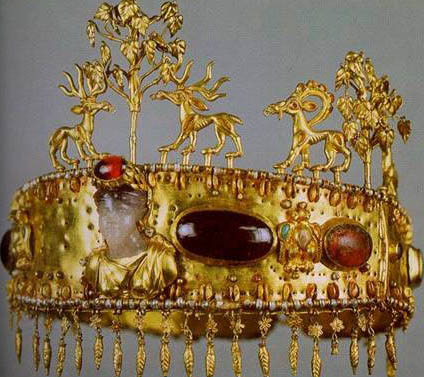
A Sarmatian diadem, found at the Khokhlach kurgan (1st century AD, Hermitage Museum)
Crowns of kings portrayed on their coinage appear to have been derived from crowns of various Zoroastrian deities. The crowns of Emperor Pirooz, Xusro II, Emperor Hormozd V Xusro III, and Emperor Yazdegerd III showed the wings of the war god Emperor Vahram (Verethragna in Avestan) and the water goddess Anahid (Anahita in Avestan)
The Persian crown, from which, it is said, all present day crowns are derived, was designed to represent the golden sun-disc sacred to Mithras.
The depiction of rays conveyed the ruler's claim to possessing the grace of Mihr (Mithra in Avestan)
The Achaemenians, Arsacids and Sasanians deviated from this, establishing religious doctrines of Zoroastrianism to justify state enforcement of imperial law and political ideology.
The Denkard expounds a "Zoroastrian" doctrine of sacral kingship, criticises Judaism, Christianity, Islam, and Manichaeism and emphasises the role of the Sasanian monarch [King of Kings in Pahlavi is Shahan-Shah] as the supreme representative of Ahura Mazda on earth.

The ring of kingship. The investiture scene of Emperor Ardeshir I, (CE 224-240) standing with royal court members before Ahura Mazda. The king and god are mounted on horses. Ahura Mazda extends a beribboned diadem which the king reaches for with his right hand while his left hand points at the deity with the bent forefinger gesture of deference.
On his equestrian investiture relief the Mazdean lord Emperor Ardeshir I, king of kings, claimed on his trilingual inscription in Pahlavi, Parthian, and Greek on the Ka'ba of Zoroaster at Naqsh-a Rustam that he was the seed from the gods, and also claimed that he was granted victory and sovereignty because he functioned as the instrument of the gods.
'As the sun is to the light of day so is Jehovih to the understanding of all the living'.
'As sunlight surpasses darkness, the brilliant radiance of the "intelligible, or noetic" sun perceptible only by mind far surpasses the visible sun.
In Book VI of the 'Republic' Plato compares the sun to the Good, saying that as the sun is the source of all illumination and understanding in the visible world (the horatos topos), the Good is the supreme source of being and understanding in the world of the forms (the noetos topos or "intelligible world"). In his allegory of the cave (Book VII) Plato symbolizes human life as life in a cave, and then describes the ascent of one of the cave-dwellers up out of the cave where he sees for the first time the dazzling light of the sun outside the cave.
The Chaldaean Oracles were the product of a Middle Platonic milieu, since they are permeated by concepts and images known from Platonizing thinkers ranging from Philo to Numenius.
For the souls that are called immortal, so soon as they are at the summit of the heavens, come forth and stand upon the back of the world: and straightway the revolving heaven carries them round, and they look upon the regions without. Of that place beyond the heavens none of our earthly poets has yet sung, and none shall sing worthily. It is there that true being dwells, without colour or shape, that cannot be touched; reason alone, the soul's pilot, can behold it, and all true knowledge is knowledge thereof.
The movement "upward", the "intelligible place" (topos noetos) in the Republic now becomes "the place beyond the heavens" (topos hyperouranios).
"The intelligible as far surpasses the visible in the brilliancy of its radiance, as sunlight assuredly surpasses darkness. That invisible light perceptible only by mind is a supercelestial constellation [hyperouranios aster], fount of the constellations obvious to sense. It would not be amiss to term it "all-brightness," to signify that from which sun and moon as well as fixed stars and planets draw, in proportion to their capacity, the light befitting each of them."
"Time is a notation of motion; and motion without a physical body is impossible. Beyond the highest heaven there is neither space, nor time, nor vacuum (void). Therefore, the things there are not by nature in space (place), nor does time make them grow old, nor is there any change in any one of those things placed beyond the outermost sweep (or current); but, unchangeable and passionless, they continue through all aióna (eternity) a name that was divinely uttered by the ancients.
For the period which embraces (comprehends) the time of every one's life, to whom, according to nature, there can be nothing beyond, has been called each ones's eternity (aión). The limit of the whole heaven, and the limit enclosing the universal system, is the divine and immortal existing (aei ón) (God) deriving his name Aión from his ever existing (aei ón.)"
The verb aió - to breathe, to live does not imply the abstract idea eternity, but of God as an ever-existing person, from whom all other personal beings derived existence and life."
In Sophocles Jupiter is called 'Aión, (the living God) the Son of Kronos.'
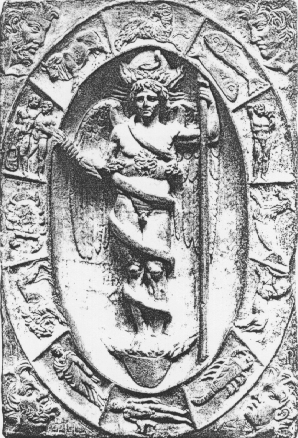
Aion in Greek philosophy is life-force, the vital spirit. He is identified with the heavens or the cosmos and is creator of the absolute, eternal and divine nature. The inscription on a statue of Aion found at Eleusis and dedicated in the time of Augustus: 'to the might of Rome and the perpetuation of the mysteries' is a divine character who 'by his holy nature remains ever the same, who has no beginning or end, undergoes no change and who is the begetter of the divine nature'.
Mithras is sometimes pictured bursting out of a rock that symbolizes the cosmos breaking through the boundary of the universe. The rock out of which Mithras is born is often shown entwined by a snake, a detail which evokes the Orphic motif of the snake-entwined cosmic egg out of which the cosmos was formed when the firstborn god Phanes Protogonus known also as Eros, Pan and Phanes-Jupiter emerged from it at the beginning of time.
Aion failed to make impact on established Greco-Roman pantheon, despite its complexity.
The Greek mysteries relate that at the very beginning of creation, only chaos existed, and from chaos was born Eros. This is how theogonia (the birth of the gods) begins and we are assured that the poet Isiodos heard it from the mouth of the Muse herself. According to Isiodos, Eros represents the driving force behind the entire theogonia. The Orphics agree that Eros appears at the beginning of theogonia and cosmogonia, and they tell us that his mother was Night, the dark goddess, and his father the Wind. From their first cosmic and elemental embrace, Eros was born from a silver egg.
The myth of Eros and Psyche describes the process of transformation. Eros cannot be separated from his beloved Psyche, since they are united by a secret and sacred bond, invisible and unconscious in man. Man's psyche remains filled with sensual, carnal desires that keep him and his mind trapped on the physical plane along with his emotions and consciousness. But a seeker must transmute the attraction of Eros and awaken the bond with his psyche so he can rise towards the "beloved.
Greek philosophers said that beauty and gnosis are inseparable and inherent in the essence of Eros.
In Symposium, Plato expounded that Eros had two aspects, one physical the other intellectual. According to Empedocles, "Aphrodite (Eros' mother; Sophia Wisdom) is Eros (Logos, the transmuting energy of pure love)," the immortal force that unites and harmoniously blends together all the elements in nature, the "bringer" and "giver" of life.
The oldest mythology of Homer does not mention Eros. Apparently Eros was not born out of a popular tradition but he is the creation of an abstract philosophical conception.
In Greek esoteric philosophy, the Eros of theogonia took part in the creation of life itself, bringing sexes together and ruling over all living creatures through the need for procreation.
Mithraism was a mystery religion that arose in the first century BC and for 400 years spread through Europe, Nth Africa, British Isles and parts of west Asia. It was the state religion of the Roman Empire. In underground sanctuaries the seeker was led through seven grades of initiation corresponding to the seven planetary spheres. The teaching involves the ascent and descent of souls through the celestial gateways. The central altar of Mithraism portrayed a bull slaying scene (tauroctony) surrounded by zodiacal signs, torchbearers etc.
The tauroctony figures represent constellations lying between Antares (Scorpio) and Aldebaran (Taurus). The sequence of constellations on the celestial equator runs from Canis Minor (dog) to Hyra (snake), Crater (cup), Corvus (raven) and Scorpio. The bulls head is Taurus and the wound is in the place of Pleiades.
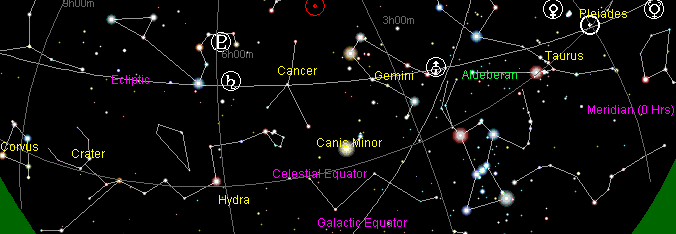
Star Chart for the year 2000 BC observed from Athens showing the Meridian of 0 Hrs piercing the Pleiades
It is thought the bright stars Aldebaran and Antares which lie opposite each other on a meridian circle with one end in Taurus and the other in Scorpius marked a zero point in time when the intersection of the ecliptic with the equatorial plane fell on it in the past.
If Aldebaran, the eye of Taurus, is taken as defining the center of Taurus at fifteen degrees, then the equinox would have left Taurus as depicted in the bull slaying scene, when the equinox point was fifteen degrees away from Aldebaran. The computer model shows that this occurred in roughly 2,000 BC.
The alignment of the line of the two stars, Aldebaran and Antares, with the intersection of the equinox two planes occurred in about 3,000 BC. This seems to correspond well with what might be called the "alpha point" of history about 5,000 years ago.
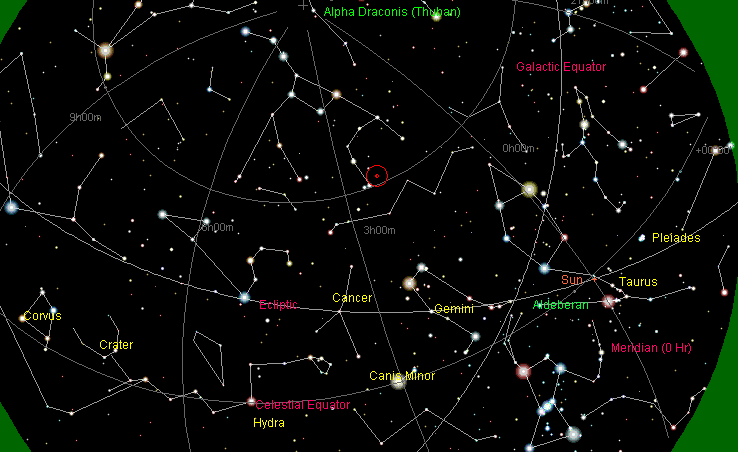
Star Chart for the year 3000 BC observed from Athens showing the Meridian of 0 Hrs piercing Aldebaran
The first documented report we have of Mithraism is found in Plutarch's report of Cilician [South eastern Turkey] "pirates" observing Mithraic rites in 67 BC. The cult most likely started in the city of Tarsus (birthplace of Apostle Paul) which was an intellectual center of Stoic philosophy (founded by Zeno (335-263 B.C.E.) in Asia Minor. The god of that city was Perseus, personified in the constellation of the same name. In Tarsus the philosopher-king and polymath (like Pythagorus) Posidonius (135-50BC) taught astrological doctrines of the Stoics and his ideas were used by Cicero and Seneca.
Hipparchus had lived on Rhodes, and Posidonius, who lived there would have been aware of Hipparchus' discovery of precession. The Stoic astrologer-philosophers were already fascinated with the concept of the great year, the idea of a long cycle of time often associated with the birth and destruction of the Universe. To many Stoics, Hipparchus' discovery would have represented the confirmation of this idea. Hipparchus estimated 36,000 years for one complete precessional cycle.
The implication of his discovery, that the fixed stars and therefore the location of the equinoxes moved backward over time, would have been seen as Earth shaking news, suggesting the existence of a previously unrecognized force, or god, standing outside of the sphere of the fixed stars of the heavens with the ability to move the very axis of the universe. This would soon be identified with the god Perseus, who could be seen in the heavens with his cape of stars spread out behind him in the form of the Milky Way.
The implication of precession was that a different sign of the zodiac had once been the location of the equinoxes. If the current sign were Aries, then the previous sign would have been Taurus. Thus the symbolism of the image of the god Perseus killing the old sign, Taurus, is sufficient to explain the Mithraic iconography.
The other figures present represent the constellations on the celestial equator below the ecliptic at the time that the equinox would have occurred in Taurus. In addition, there is additional imagery of torch bearers with one torch up and one torch down, and fruit trees in leaf and in fruit emphasizing the two equinoxes. There was also a doctrine within Mithraism involving the potential for the individual soul in possession of the right key to ascend through each of the seven planetary spheres to a realm beyond the fixed stars where Perseus dwells, and where the soul may find liberation. Persius as Mithras would have fulfilled that purpose.
It is also possible that the name itself was first coined by others referring to the pirates of Asia minor by the name of the king they were associated with.
44:24-28
Thus saith the LORD, thy redeemer …. That saith of Cyrus, He is my shepherd, and shall perform all my pleasure: even saying to Jerusalem, Thou shalt be built; and to the temple, Thy foundation shall be laid.
[The word 'Messiah' comes from the Hebrew verb 'to anoint', which itself is derived from the Egyptian word messeh, 'the holy crocodile'. It was with the fat of the messeh that the Pharaoh's sister-brides anointed their husbands on marriage. The Egyptian custom sprang from kingly practice in old Mesopotamia]
45:1 Thus saith the LORD to his anointed, to Cyrus, whose right hand I have holden, to subdue nations before him; and I will loose the loins of kings, to open before him the two leaved gates; and the gates shall not be shut;
Ch 44-45 Book of Isaiah
In the previous age in the time of Taurus the equinoxes were are aligned with the galaxy, and its end is symbolised by the tauroctony. Jenkins claims the tauroctony scenes encode the dual process of human spirituality - incarnation/manifestation/genesis, and transcendence/involution/apogenesis.
These occur at the celestial gateways in Capricorn and Cancer.
The doctrine of two doorways in the cosmic cave through which the soul ascends and descends is drawn from the neo-Pythagorean philosophers Numenius and Cronius.
The soul descends into manifestation (Genesis) through the gateway in Cancer, and ascends to the transcendental realm (apogenesis) through the gateway in Capricorn.
The placement of the solstitial gates in Capricorn and Cancer are attributed to Porphyry and Numenius (2nd cent. AD) when the solstices were in Capricorn and Cancer but goes back to an earlier time as the idea of solstices as gateways were alluded to in Homer's Odyssey.
Macrobius wrote that the sidereal location of the gateways is defined by the crossing point between the Milky Way and the ecliptic.
Jenkins notes that the gates were viewed rising heliacally (before the sun), requiring they be relocated to Gemini and Sagittarius where they sat by the time of Macrobius.
The north gate (which Jenkins calls the galactic centre) is located on the cusp of Sagittarius and Scorpio. The crossing point is located near the arrow point of Sagittarius and Scorpio's tail.
On the other side of the axis is Taurus/Gemini with Pleiades inside Taurus.
Jenkins speculates that the galactic centre is mirrored by the throne of Zeus on mount Olympus, symbol of the winter solstice and gateway of the gods. Capricorn is identified with the north, the pole star, and the semi mythical land of Hyperborea.
High at the head a branching olive grows,
And crowns the pointed cliffs with shady boughs.
A cavern pleasant, though involv'd in night,
Beneath it lies, the Naiades delight.
Where bowls and urns, of workmanship divine,
And massy beams in native marble shine;
On which the Nymphs amazing webs display,
Of purple hue, and exquisite array.
The busy bees, within the urns secure
Honey delicious, and like nectar pure.
Perpetual waters thro' the grotto glide,
A lofty gate unfolds on either side;
That to the north is pervious by mankind:
The sacred south t'immortals is consign'd.
Cronius affirms that the poet under the veil of allegory, concealed some mysterious signification. Artemidorus the Ephesian thus writes: "The island of Ithaca is distant from Panormus, a port of Cephalenia. It has a port named Phorcys; in which there is a shore, and on that shore a cave sacred to the nymphs, in which the Phaeacians are reported to have placed Ulysses."
Antiquity considered earth as the symbol of that matter from which the world is composed; so matter and earth are the same; by the symbol of a cave, signifying the formation of the world from matter. For caves are congenial with the earth herself, and comprehended by one uniform stone; whose interior part is concave, and whose exterior parts are extended over an immense space of earth. But the world being self-born (i.e. produced by no external cause but from a principle within), and in perfect symphony with itself, is allied to matter which they call, according to a secret signification, a stone and a rock. For like these hard bodies it is sluggish and inert, and receives the impression of ornamenting form: at the same time they considered it as infinite on account of its formless nature. But since it is continually flowing, and of itself destitute of the supervening investments of species by which it is formed and becomes visible, the flowing waters, darkness, or obscurity of the cavern exhibit apt symbols of what the world contains on account of that matter with which it is connected.
Hence through the dark union of matter, the world is obscure and dark, but from the presence and supervening ornaments of form (from which it derives its name) it is beautiful and pleasant. The world therefore may be called a cave on account of its participation of form, but involved in the deepest obscurity to the intellectual eye which endeavours to discern its dark foundation. So that its exterior and superficial parts are pleasant, but its interior and profound parts obscure: and its very bottom is darkness itself.
After the same manner the Persians, mystically signifying the descent of the soul into an inferior nature and its ascent into the intelligible world, initiate the priest or mystic in a place which they denominate a cave. For according to Eubulus, Zoroaster first of all among the neighbouring mountains of Persia, consecrated a natural cave, florid and watered with fountains, in honour of Mithras the father of all things: a cave in the opinion of Zoroaster bearing a resemblance of the world fabricated by Mithras. But the things contained in the cavern, being disposed by certain intervals, according to symmetry and order, were symbols of the elements and climates of the world. We find too that after Zoroaster it was usual with others to perform initiatory rites in caves and dens, whether natural or artificial. For as they consecrated temples, groves, and altars to the celestial gods; but to the terrestrial gods and to heroes altars alone, and to the subterranean divinities vaults and cells; so to the world they dedicated caves and dens; as likewise to nymphs, on account of the waters trickling, and dispersed through caverns, in which the nymphs called Naiads preside.
But the ancients not only considered a cave as the symbol of this generated and sensible world, but as the representative of every invisible power: because as a cave is obscure and dark, so the essence of these powers is unknown. But that caves are attributed to nymphs, and especially to Naiads, who dwell near fountains, and are called Naiads from the waters over whose flowing streams they preside, the hymn to Apollo indicates in these words:
"It is requisite to apply this similitude to all that has been previously said: assimilating this terrene habitation which is the object of corporeal sight, to the dark residence of a prison: but accommodating the fire shining in the recesses of the cavern to the solar light."
Theologists have considered a cave as a symbol of the sensible world, and of the powers it contains. But likewise it is a symbol of an intelligible essence if not considered as the symbol of a material and immaterial nature.
Thus the present cave since it contains perpetual waters resembles a substance united with matter, and not that which is immaterial and intelligible. On this account the cave is not sacred to mountain divinities, to those who dwell on hills, or to other deities of this kind, but to Naiads so called by the Greeks from `namata', fountains; because they preside over waters: and this term is commonly applied to all souls passing into the humid and flowing condition of a generative nature. These souls they considered as incumbent on the water, which is nourished by a divine spirit as Numenius affirms: and hence a prophet said, that the spirit of God moved on the waters.
It is known that humor invades the sun itself, and all animals descending into generation. Hence Heraclitus observes "that it appears delightful, and not mortal to souls, when they are born connected with humidity." And he says in another place, speaking of unembodied souls, "we live their death, and we die their life." Hence the poet calls men existing in generation `humid', because their souls are drenched in moisture. On this account too, such souls delight in blood and humid seed: but water administers nutriment to the souls of plants. Besides, according to the opinions of some men aerial and celestial bodies, are nourished by the vapours of fountains and rivers and other exhalations.
Thus the Stoics assert that the sun is nourished by the exhalation of the sea; the moon from the effluvia of fountains and rivers; but the stars from the exhalation of the earth. Hence according to them the sun is a certain intellectual composition formed from the sea; the moon from river waters; and the stars from terrene exhalations. It is necessary therefore that souls, whether they are corporeal or incorporeal, while they attract bodies, must verge to humidity, and be incorporated with humid natures; especially such souls, as from their material inclinations ought to be united with blood, and confined in humid bodies as in a watery tegument.
Hence the souls of the dead are evocated by the effusion of bile and blood: and souls insnared by corporeal love, and attracting to their nature a humid spirit, condense this watery vehicle like a cloud; for a cloud is nothing more than humour condensed in the air. But the pneumatic part thus condensed, through too great an abundance of humour becomes the object of corporeal sight. And among the number of these we must reckon those apparitions of images, which from a spirit coloured by the influence of imagination, present themselves to mankind.
But pure souls are averse from generation; on which account the same Heraclitus observes "a dry soul is the wisest." But souls thus desiring to be mingled with body, and attracting a humid vapour, by their propensity to generation render their pneumatic part moist and wet, and by thus verging to the ever flowing waters of generation, are deservedly called Naiads.
[The Poemander of Hermes Trismegistus says:
"I am that Light, the Mind, thy God, who am before that Moist Nature that appeareth out of Darkness, and that Bright and Lightful Word from the Mind is the Son of God."
The Bundahishn speaks of creatures in the mingled state.]
The stony bowls and urns are symbols of the aquatic nymphs. For vessels of the same form are symbols of Bacchus. And what symbol is more proper to souls descending into generation, and the tenacious vestment of body than "Nymphs weaving on stony beams purple garments wonderful to behold?" For the flesh is generated in and about the bones, which in the bodies of animals may be compared to stones. But the purple garments plainly appear to be the flesh with which we are invested; and which is woven as it were and grows by the connecting and vivifying power of the blood, diffused through every part.
Add too that the body is a garment with which the soul is invested; a circumstance indeed wonderful to the sight, whether we regard its composition, or consider the connecting band by which it is knit to the soul. Thus according to Orpheus, Proserpine, who presides over every thing generated from seed, is represented weaving a web; and the ancients called heaven by the name of `peplos', which is as it were the veil or tegument of the celestial gods.
Since the cave is a symbol and image of the world, as Numenius and Cronius affirm, it is necessary, in order to elucidate the reason of the position of the gates, to observe that there are two extremities in the heavens; viz. the winter solstice, than which no part of heaven is nearer to the south; and the summer solstice which is situated next to the north. But on the solstitial circle [ecliptic] the summer tropic is in Cancer, and the winter tropic in Capricorn. And since Cancer is the nearest to the earth, it is deservedly attributed to the moon, which is itself proximate to the earth. But since the southern pole by its great distance is inconspicuous to us, Capricorn is ascribed to Saturn, who is the highest and most remote of all the planets.
Again, the signs from Cancer to Capricorn are situated in the following order:
Leo called the house of the sun;
Virgo, or the house of Mercury;
Libra of Venus;
Scorpius of Mars;
Sagittarius of Jupiter;
Capricornus or the house of Saturn.
Sagittarius is attributed to Saturn;
Pisces to Jupiter;
Aries to Mars;
Taurus to Venus;
Gemini to Mercury;
Cancer to the Moon.
It is reported that Parmenides mentions these two ports in his book, concerning the nature of things: as likewise that they were not unknown to the Egyptians and Romans. For the Romans celebrate their Saturnalia when the sun is in Capricorn [winter solstice], and during this festivity the servants wear the shoes of those who are free, and all things are distributed among them in common; the legislator intimating by this ceremony, that those who are servants at present, by the condition of their birth, will be hereafter liberated by the Saturnalian feast, and by the house attributed to Saturn, i.e. Capricorn; when reviving in that sign, and being divested of the material garments of generation, they return to their pristine felicity, and to the fountain of life. But since the path beginning from Capricorn is retrograde, and pertains to descent; hence the origin of the word Januarius or January from Janua, a gate, which is the space of time measured by the sun while, returning from Capricorn towards the east, he directs his course to the northern parts. But with the Egyptians the beginning of the year is not Aquarius, as among the Romans, but Cancer. For the star Sothis (Sirius) borders on Cancer which star the Greeks denominate `Kynos', or the Dog. When this star rises they celebrate the calends of the month, which begins their year; because this is the place of the heavens where generation commences, by which the world subsists.
But these places are particularly adapted either to souls descending into generation, or to such as are separating from it. On this account they assigned a place congruous to Mithras, near the equinoctial; and hence he bears the sword of Aries, because this animal is martial, and is the sign of Mars:
[This further supports the idea that this Mithra is Hecla, alias Prometh'ya, alias Ari, or Aries, one of the Chine'ya and Vind'yu rebel Gods, that fled from the Triune kingdoms in the east, and established himself in Europe. This negates Porphyry's notion that Mithra is associated with the equinoctial constellation Aries]
he is likewise carried in the Bull, the sign of Venus; because the Bull as well as Venus is the ruler of generation. But Mithras is placed near the equinoctial circle, comprehending the northern parts on his right, and the southern on his left hand.
Indeed, Boreas is proper to souls passing into generation: for the northern blasts recreate those who are on the verge of death; and refresh the soul reluctantly detained in the body. On the contrary, the southern gales dissolve life. For the north, from its superior coldness, collects into one, detains and strengthens the soul in the most moist and frigid embraces of terrene generation: but the south dissolves the humid bands, and by its superior heat, having freed the soul from the dark and cold tenement of the body, draws it upward to the incorporeal light and heat of divinity.
The gates of heaven were committed to the care of the hours [times of day, Gahs].
Heavens sounding gates kept by the winged hours. [Iliad viii 393]
Again, according to Pythagoras the people of dreams are souls, which are reported to be collected in the milky way; the appellation of which is derived from souls nourished with milk after their lapse into the whirls of generation. The northern parts are properly adapted to the class of souls obnoxious to mortality and generation; but the southern quarter to immortals, exempt from the mutability inseparable from the flowing realms of generation: in the same manner as the east is attributed to the gods, and the west to daemons.
Hence since diversity is the origin of nature, the ancients considered every thing with a double entrance, as the symbol of nature. For the progression of things is either through an intelligible or a sensible nature. And if through a sensible nature, either through the sphere of the fixed stars, or through the orbs of the planets; and again either with an immortal or a mortal motion. Likewise one centre or hinge of the world is above the earth, but the other is subterranean; and one part of the heavens is eastern, and another western. Thus too night is opposed to day; and the harmony of the universe consists from the amicable junction of contrary and not similar natures. Plato also makes mention of two gates, one of which affords a passage to those ascending into the heavens, the other to those descending on the earth: and theologists place the sun and moon as the gates of souls, which ascend through the sun and descend through the moon. So, according to Homer,
Two urns by Jove's high throne have ever stood,
The source of evil one, and one of good. [Iliad xxiv 527]
In this cave all external possessions must be deposited; here, naked and suppliant, and casting aside every thing superfluous, being averse from needless possessions, it is requisite to sit at the foot of the olive, and destroy that hostile rout of passions, which lurk in the secret recesses of the soul.
Numenius thought the person of Ulysses in the Odyssey represented a man who passes in a regular manner over the dark and stormy sea of generation; and thus arrives at that region, where tempests and seas are unknown, and finds a nation "Who ne'er knew salt, or heard the billows roar". According to Plato, the deep, the sea, and a tempest are so many symbols of the constitution of matter. It is first requisite to appease, by sacrifices, labours, and patient endurance by which he transmutes himself into different forms; so that at length being stripped of the torn garments by which his true person was concealed, he may recover the ruined empire of his soul. Nor will he even then be freed from molestation, till he has entirely passed over the raging sea, and taken a long farewell of its storms
________________________________________________________________________________
Macrobius in the 12th chapter of his comment on Cicero's Scipio's dream has derived some of the ancient arcana which it contains from the present work. What he has added is translated here on account of its connection with the above passage of Porphyry.
From the confine in which the zodiac and galaxy touch each other, the soul descending from a round figure, which is the only divine form, is produced into a cone by its defluxion. And as a line is generated from a point, and proceeds into length, from an indivisible, so the soul from its own point, which is a monad, passes into the duad, which is the first protraction. And this is the essence which Plato in the Timaeus calls indivisible, and at the same time divisible, when he speaks of the fabric of the mundane soul.
For as the soul of the world, so likewise that of man will be found in one respect ignorant of division, if the simplicity of a divine nature
is considered; and in another respect capacious of division, if we regard the diffusion of the former through the world, and of the latter through the members of the body.
"As soon, therefore, as the soul gravitates towards body, in this first production of herself, she begins to experience a material tumult, that is, matter flowing into her essence. And this is what Plato remarks in the Phaedo, that the soul is drawn into body, staggering with recent intoxication; signifying by this the new drink of matter's impetuous flood, through which the soul becoming defiled and heavy, is drawn into a terrene situation. But the starry cup, placed between Cancer and Lion, is a symbol of this mystic truth, signifying that descending souls first experience intoxication in that part of the heavens, through the influx of matter. Hence, oblivion, the companion of intoxication, there begins silently to creep into the recesses of the soul. For if souls retained in their descent to bodies the memory of divine concerns of which they were conscious in the heavens, there would be no dissension among men, concerning divinity. But all, indeed, in descending drink of oblivion; though some more, and others less. On this account, though truth is not apparent to all men on the earth, yet all exercise their opinions about it: because a defect of memory, is the origin of opinion. But those discover most, who have drank least of oblivion: because they easily remember what they had known before in the heavens.
But according to the Orphic writers the `nous hylikos', or material intellect, is Bacchus, who, proceeding from that indivisible part, is divided into particulars. Hence, in the Orphic mysteries, he is reported to have been torn in pieces, by Titanic fury, and the fragments being buried, are said to have risen entire, and collected into one; because intellect by passing into a divisible from an indivisible nature, and again returning from divisible to indivisible, both accomplishes the duties of the world, and does not desert the arcana of its own nature.
"The soul, therefore, falling with this first weight, from the zodiac, and milky way into each of the subject spheres, is not only clothed with the accession of a luminous body, but produces the particular motions which it is to exercise in the respective orbs. Thus in
Jove, the power of acting.
Mars, the ardour of courage.
sun, a sensitive and phantastic nature.
Venus, the motion of desire.
Mercury, pronouncing and interpreting what is perceives.
lunar globe, a plantal nature, and a power of acting on body.
And this sphere, as it is the last among the divine orders, so it is the first in our terrene situation. For this body, as it is the dregs of divine concerns, so it is the first substance of an animal. And this is the difference between terrene and supernal bodies (under which last, I comprehend the heavens, the stars, and the other elements) that the latter are called upwards to be the seat of the soul, and merit immortality from the very nature of the region, and an imitation of sublimity; but the soul is drawn down to these terrene bodies, and is on this account reported to die, when it is inclosed in this fallen region, and the seat of mortality. Nor ought it to cause any disturbance, that we have so often named the death of the soul, which we have pronounced to be immortal. For the soul is not extinguished by its own proper death, but is only overwhelmed for a time. Nor does it lose the benefit of perpetuity, by its temporal demersion: since when it deserves to be purified from the contagion of vice, through its entire refinement from body; it will be restored to the light of perennial life, and will return to its pristine integrity and perfection."
Homer describes in these lines the complicated progression of an impure soul until it regains its original habitation in the stars, and again begins to gravitate to this terrene abode.
In the first place these souls are said to pass over the flowing waters of the ocean, and the Leucadian, or white rock. Now by this nothing more is meant than the flight of the suitors' souls to the extremity of the earth, in order to a subterranean descent. The earth is bounded by the ocean; and the Leucadian rock may be some rock on the earth's extremity, which receives the last rays of the sun.
Afterwards they are said to pass through the gates of the sun, by which, as Porphyry informs us above, we must understand the tropics of Cancer and Capricorn: and as Capricorn is subterranean, and affords a passage to ascending immortals, we must conceive that they enter through this prior to the tropic of Cancer. But in order to comprehend the perfect propriety of this transition, we must observe that the souls of the suitors on account of their impurity, are punished in the recesses of the earth, before they enter the celestial tropics, and pass into the meadows of Pluto. This the poet evidently evinces by the screaking noise which they utter, and the squalid paths through which they descend: a noise of this kind as Proclus well observes, (in Plat. Repub.) "representing a species of life solely given to appetite and imagination." After they have been purified therefore by subterranean punishment, they are fit to ascend to the people of dreams, or the souls of the blessed situated in the milky way. However as the soul, on account of her middle nature, is incapable of a perpetual sameness of situation, but is formed for infinite circulations; hence Homer, without mentioning her duration among the gods, though it is doubtless very extended, agreeable to the mystic brevity of his Muse, makes her immediately pass into the meadows of Asphodel, where souls the images of the dead reside. Now these meadows of Asphodel, form the supreme part of Pluto's dominions which commence downwards from the milky way; so that these meadows are most probably situated in the Lion, the constellation into which souls first fall, after they leave the tropic of Cancer.
In these meadows, then, the images of the dead are said to reside. Now these images, are no other than those vehicles of the soul which, from their residence in the starry regions, must be luciform, etherial, and pure. It is this phantastic spirit, or primary vehicle of the soul, which Virgil alludes to, in these beautiful lines:
"We are afterwards sent through ample Elysium, and a few of us possess the joyful plains: till a long period, when the revolving orb of time has perfected its circulation, frees the soul from its concrete stains, and leaves the etherial sense pure, together with the fire (or splendour) of simple ether."
For here he conjoins the rational soul, or the etherial sense, with its splendid vehicle, or the fire of simple ether; since this vehicle, according to Plato, is rendered by proper purgation `augoeides', or luciform, and divine. It must here however be observed that souls in these meadows of asphodel, or summit of Pluto's empire, are in a falling state; or in other words through the secret influx of matter begin to desire a terrene situation. And this explains the reason why Hercules in the infernal regions is represented by Homer boasting of his terrene exploits and glorying in his pristine valour; why Achilles laments his situation in these abodes; and souls in general are engaged in pursuits similar to their employment on the earth: for all this is the natural consequence of a propensity to a mortal nature, and a desertion of the regions every way lucid and divine. Let the reader too observe, that, according to the arcana of the Platonic doctrine, the first and truest seat of the soul is in the intelligible world, where she lives entirely divested of body, and enjoys the ultimate felicity of her nature.
Since for the soul to dwell with the gods, entirely separated from its vehicle, is to abide in the intelligible world, and to exercise, as Plotinus expresses it, the more sacred contests of wisdom.
Should it be enquired why departed souls, though in a state of felicity are compared by Homer to dreams and shadows, I answer with Porphyry that they are shadows with respect to human concerns, both because they are destitute of body, and are void of memory: for after they have passed the Stygian river, they are entirely ignorant of their pristine life on the earth, though they recognize and converse with each other, as is evident from the discourses between Patroclus, Ajax, and Antilochus. Indeed together with memory, they lose all knowledge of corporeal resemblances, which are rendered apparent through the ministry of the phantasy. For since the phantasy consists from memory, as Plato asserts in the Philebus, whatever we imagine perishes with the memory; and when this is taken away all the perturbations of the soul are removed, as she then becomes wholly intellectual, and passes into a state divinely prudent and wise. However, by means of the blood, which, as we have before observed, is, according to Homer, the instrument of the phantastic soul, departed spirits recognize material forms, and recollect their pristine condition on the earth. And to the phantasy reasoning pertains; since it is nothing more than an aggregation of memory, collected through imaginations, into the judgment of universals. But this is very different from the intellective energy, acquired by the soul beyond Acheron, which Cocytus and Pyriphlegethon fill, from the whirling streams of the dreadful Styx. Let the reader, however, remember that the phantasy is twofold, communicating in its supreme part with the rational soul, and in its inferior part with sense; and that it is this inferior part which the soul deserts, when it acquires an intellectual condition of being.

The chiefs of Kabalactes' staff included Karapa (the false Mithra), Yutobis (the false Christna), Etchwalactcha (the false Vishnu), Tidon (the false Ari), Durhea (the false Durga), Indra, Kali, Hosanne, Wahtissa (the false Agni), Owella (the false Rana), Gur (the false Siva), Cassavragga (the false Trimurthi) and Janurs [Janus?].
The task of the Triunes (before they themselves fell), to turn man away from false gods and bring him to a philosophical truth is seen in the philosophy of Brahmanism, Buddhism, Mithraism and Krishna.
Since the highest ideal is inconceivable, the origin and source of Being became described as impersonal, having no attributes (nirguna) during the travel of the earth into darker regions and the wandering of Man and angels into disbelief. This would have been beneficial for those prone to idolism and false gods, their attention fixed on a more peripheral rather than inner source. Not so for those looking for the All-Person of Jehovih.
The Triune denial of Jehovih resulted in individual souls turning to the Triunes instead eventually to make them their idols. Amid this lying spirits attempted to impersonate whatever manner of deity mortals craved.
When gods who are on the downward path cannot win by philosophical persuasion argument degenerates into war. This is when contradictions and hypocrasy first arise in religion.
Since both the Triunes and Baal contested for ideological supremacy and domination of the oracles by appealing to the local leanings of mortals, the doctrines of the Triunes sometimes could have drifted towards Baal's. To add to the confusion Hecla, alias Mithra, who was one of the Chine'ya and Vind'yu rebel Gods, that fled from the Triune kingdoms in the east, and established himself in Europe in about 100 BC., at about the time of the emergence of the proto-Roman Mithraic cult, came into alliance with Baal. The Phrygian Attis cult from Asia Minor, who produced figurines with Attis, donned in Phrygian cap, slaying the bull, may have been his.
It's possible that the tauroctony may have symbolised the ambition of the breakaway Hecla to end the triune doctrine, whose sign was the bull, simultaneously turning their gains in made in learning to his own advantage.
When Baal regained sway and power over the inroads made by Looeamong he cunningly corrupted the triune teachings and turned them to his own form (distinguished by the tendency to be more worldly, irrational and blatantly idolatrous). The inner cosmic knowledge became heathenised by Roman Emperors.

Plato, in his dialogue Timaeus said that when the creator of the universe first formed the cosmos, he shaped its substance in the form of the letter X, representing the intersection of the zodiac and the celestial equator (or the ecliptic and celestial planes), which depicts the cosmic sphere.
http://www.well.com/user/davidu/mithras.html
http://www.well.com/user/davidu/mithras.html
http://www.well.com/user/davidu/hypercosmic.html
Oahspe reveals that Gaya Maretan is simply Gaomah, one of the Lords of farmers and herdsmen appointed by Yima.
We worship the Fravashi of Gaya Maretan, who first listened unto the thought and teaching of Ahura Mazda; of whom Ahura formed the race of the Aryan nations, the seed of the Aryan nations.
We worship all the good, awful, beneficent Fravashis of the faithful, from Gaya Maretan down to the victorious Saoshyant [Saviour].
We take up our Yasna and our homage to the good waters, and to the fertile fruit-trees and to the Fravashis of the saints and to the Kine, and to Gaya (Maretan), and to the Mathra Spenta (the bounteous word-of-reason)
And we would worship the Fravashi of the Kine [an archaic term for cow, or sometimes bull], and to Kine, the herds of blessed gift, and that of the holy Kine, and to Gaya Mareyan (the first created) to the Saoshyant, the victorious.
According to the Naassenes, the Protanthropos is the first element; the fundamental being before its differentiation into individuals. "The Son of Man" is the same being after it has been individualized into existing things and thus sunk into matter.
The Gnostic Anthrôpos, or Adamas, is a cosmogonic element, pure mind as distinct from matter, mind conceived hypostatically as emanating from God and not yet darkened by contact with matter.
This mind is considered as humanity, or as a personified idea without corporeality, the human reason conceived as the World-Soul. This is developed in Manichaeism. God, in danger of the power of darkness, creates with the help of the Spirit, the five worlds, the twelve elements, and the Eternal Man, and makes him combat the darkness. But this Man is somehow overcome by evil and swallowed up by darkness. The present universe is in throes to deliver the captive Man from the powers of darkness. The cosmogonic Anthrôpos is mixed up with the historical figure of the first man, Adam. Adam was the Godhead immanent in the world and ever manifesting itself to the inner consciousness of the elect. The modified idea occurs in the "Poimandres", and is elaborated by Philo.
Adam kat eikona is "Idea, Genus, Character, belonging to the world, of Understanding, without body, neither male nor female; he is the Beginning, the Name of God, the Logos, immortal, incorruptible". These ideas in Talmudism, Philonism, Gnosticism, and Trismegistic literature, all come from once source, the late Mazdea development of the Gayomarthians, or worshipper of the Super-Man.
"According to the ancient myth Mithra killed the Primeval Bull and thereby became the creator and fashioner of the earthly beings. Zarathushtra did not include him in the heavenly hierarchy, but adapted the legend of the immolation of the Primeval Bull by Mithra to ethical ends."
Tradition explains Gav Azi as 'the three years old cow.' It is evidently gav aevodâta, 'the sole created bull or cow,' of the Later Avesta, and Gavyokdât, 'the Sole Created Bull' of the Pahlavi and subsequent Sanskrit, Persian, and Gujarati versions.
The Avestan word gav and Sanskrit word go, both mean bull or cow which can mean earth.
The Soul of the Kine is disconsolate and cries in despair that its sufferings are so great that it would be beyond the power of the prophet to assuage them. Further pleadings soften its despair and Zarathushtra is chosen for the mighty work.
Zarathushtra preaches the advantages of a settled life, and persuades his hearers to emerge from the pastoral life and embrace agricultural habits. He exhorts them to work diligently for the kine's welfare, grow fodder for their nurture, and lead an active and an industrious life. Ahura Mazda has created Armaiti's earth for the pasture of Geush Tashan.
[Note: I have added verses in italics translated by Mobed Azargoshasb below some of the verses to give a different perspective in translation. Notice that he sometimes adds the word Mazda (master) to Ahura]
1. With outspread hands in petition for that help, O Mazda, I will pray for the works of the holy spirit, O thou the Right, whereby I may please the will of Good Thought and the Ox-Soul
4. I who have set my heart on watching over the soul, in union with Good Thought, and as knowing the rewards of Mazda Ahura for our works, will, while I have power and strength, teach men to seek after Right.
1. Unto you wailed the Ox-soul, "For whom did ye fashion me? Who created me? Violence and rapine (and) savagery hath oppressed me, and outrage and might. I have no other herdsman than you; prepare for me then the blessings of pasture."
Whom do you desire O Asha to appoint as their Lord and Guide, so as to repel the army of evil and misguided persons and keep at abeyance the wrath and annoyance.
When the primeval ox [Goshorun] passed away it fell to the right hand, and Gayomard [Gayo-maretan, the mythical first man] afterwards, when he passed away, to the left hand. Goshorun, as the soul of the primeval ox came out from the body of the ox [even as the soul from the body of the dead], stood up before the ox and cried to Ohrmazd, as much as a thousand men when they sustain a cry at one time.
And Ohrmazd, in order to be much more able to keep watch over the mingled creatures than in front of Gayomard, went from the earth up to the sky.
And Goshorun continually went after him crying, and she kept up the cry thus:
'With whom is the guardianship of the creatures left by thee, when ruin has broken into the earth and vegetation is withered, and water is troubled? Where is the man of whom it was said by thee thus: I will produce him, so that he may preach carefulness?'
And Ohrmazd spoke thus:
'You are made ill, O Goshorun! You have the illness which the evil spirit brought on; if it were proper to produce that man in this earth at this time, the evil spirit would not have been oppressive in it.'
Forth Goshorun walked to the star station (payak) and cried in the same manner, and forth to the moon station and cried in the same manner, and forth to the sun station, and then the guardian spirit of Zartosht was exhibited to her, and Ohrmazd said thus: 'I will produce for the world him who will preach carefulness.'
Contented became the spirit Goshorun, and assented thus: 'I will nourish the creatures;' that is, she became again consenting to a worldly creation in the world.
8. I recognise Thee, O Mazda, in my thought, that Thou the First art (also) the Last -- that Thou art Father of Vohu Manah; -- when I apprehend Thee with mine eye, that Thou art the true Creator of Right, and art the Lord to judge the actions of life.
9. Thine was Armaiti, Thine (namely) the Wisdom of the Spirit, O Mazda Ahura, because Thou didst give (the cattle) choice whether to depend on a husbandman or one who is no husbandman.
10. So she chose for herself out of the two the cattle-tending husbandman as her lord to guard the Right, the man that advances Good Thought. He that is no-husbandman, O Mazda, however eager he be, has no part in this good message.
11. When Thou, O Mazda, in the beginning didst create the Individual and the Individuality, through Thy Spirit, and powers of understanding - when Thou didst make life clothed with the body, when (Thou madest) actions and teachings, whereby one may exercise one's convictions at one's free-will;
12. Then lifts up his voice the false speaker or the true speaker, he that knows or he that knows not, (each) according to his own heart and mind. Passing from one to another Armaiti confers with the spirit in whom there is wavering.
[Note: Again, verses translated by Mobed Azargoshasb are added in italics below some of the verses]
3. Who is by generation the Father of Right, at the first?
Who determined the path of sun and stars? Who is it by whom the moon waxes and wanes again? This, O Mazda, and yet more, I am fain to know.
4. Who upholds the earth beneath and the firmament from falling? Who the waters and the plants? Who yoked swiftness to winds and clouds? Who is, O Mazda, creator of Good Thought?
4. What power doth hold the earth and the heavens apart and prevents the later from falling down? Who is the creator of water and plants?
5. What artist made light and darkness? What artist made sleep and waking? Who made morning, noon, and night, that call the understanding man to his duty?
6. This I ask Thee, tell me truly, Ahura - whether what I proclaim is verily the truth. Will Right [Asha] with its actions give aid (at the last)? will Piety? Will Good Thought announce from the Dominion? For whom hast thou made the pregnant cow, that brings good luck?
[In Oahspe the word dominion is sometimes used to denote the capacity of the higher, more subtle ether to move, cause or rule over atmospherea, which in turn has dominion over corpor. To have dominion is to be nearer the central, the spiritual. In this sense dominion comes together with piety.]
"Three clean creatures curse betimes while yet invoking, the cow, the horse, and then Haoma."
I ascribe all good to Ahura Mazda, 'and all the best,' the Asha-owning one, splendid, xwarena-owning, whose is the cow, whose is Asha, whose is the light, 'may whose blissful areas be filled with light'.
Then Zarathustra answered, saying: Thou hast made a triangle: What is the meaning, O I'hua'Mazda? Then answered I'hua'Mazda, saying: Three in one, O Zarathustra: Father, Mother, and Son; Ormazd, the ghost of all things; Mi, the seen and unseen, and Vivanho, the expression of things. I'hua'Mazda said unto Zarathustra: These three comprise all things; and all things are but one; nor were there more, nor shall ever be. Nevertheless, O my son, each of these hath a million parts, a thousand million parts, ten hundred thousand million parts. And every part is like unto the whole; thou, O Zarathustra, also. For thou hast within thyself those three attributes, and no more. And each and all created things have these three attributes in them. Thus Ormazd created all the living creation; brothers and sisters created He them, in likeness of himself, with three entities embraced in one; which are, first, the ghost, the soul, which is incomprehensible; second, the beast, the figure, the person, which is called individual; and, third, the expression, to receive and impart.
[Note that when I'hua'Mazda speaks of Jehovih, the three are Father, Mother, and Son, but when He speaks of created living things, these have soul, individuality and perception/action.]
I'hua'Mazda said unto Zarathustra: To be negative is to be a cow; to be positive is to be a horse.
Save ye refrain from fish and flesh ye shall not find the cows, ie., receptivity. They feasted on flesh and wine and the cows went astray, ie., receptive to spiritual things. (Pali - the language of Sakaya).
Any person who is receptive of new things. Not bigoted. Haoma spake to the cows in the name of the Great Ormudz, Eolin (Vede).
As a cow uttereth; a sign of a female. Save your spirits become as cows ye can not be impregnated with new things. The much-learned man hath erected bars to keep off the cows (Chine).
Being wise in their own conceit they will not receive (Iz).
A sign of a female; usually face and breasts; sometimes the udder of a cow or mare. The mares separated themselves in heaven (Craosh). Save ye find the (receptivity) ye shall not, etc. (Fus.) All men become mares (receptive) in time to come (Zarathustra.)
Shining and young, she appears on the horizon.
Baring her breasts, she spreads her light.
With singing maidens, with streaming cows,
she dances over the earth disk's edge.
You who precede the shining wheel,
perform great deeds according to the
Artus.
At dawn fly away the evil spirits; at dawn come the shining, full of holiness (Kii).
The wise man hath found Git'm'ow full of cow, ie., receptivity, and Tau, the bull, ie., force-giving. The seventh heaven cometh in M'git'ow, the morning light (Poit).
Easter, to whom the Saxons sacrificed, was Astarte [Zoharah (Arabic for Venus), the evening star].
The name of this Saxon goddess is sometimes written Eostre [her earthly symbol, is a rabbit, hence "Easter Eggs" and the "Bunny Rabbit"], the starry, the bright.
The occurrence of Passover at the same time of year as the pagan "Easter" festivals is not coincidental. Some say the pagans believed that when their nature god (such as Tammuz, Osiris or Attis) died and was resurrected, his life went into the plants used by man as food. The matza (unleavened bread) made from the spring harvest was his new body and the wine from the grapes was his new blood.
In Judaism, matza, was not used to represent the body of a god but the poor man's bread which the Jews ate before leaving Egypt. The pagans used the paschal sacrifice to represent the sacrifice of a god or his only son, but Judaism used it to represent the meal eaten before leaving Egypt.
Instead of telling stories about Baal sacrificing his first born son to Mavet, the Jews told how mal'ach ha-mavet (the angel of death) slew the first born sons of the Egyptians. The pagans ate eggs to represent the resurrection and rebirth of their nature god, but the egg on the seder plate represents the rebirth of the Jewish people escaping captivity in Egypt.
When the early Christians noticed the similarities between Pessach customs and pagan customs, they came full circle and converted the Pessach customs back to their old pagan interpretations. The seder became the Last Supper of Jesus, similar to the last supper of Osiris commemorated at the Vernal Equinox.
The matza and wine once again became the body and blood of a false god, this time Jesus.
Easter eggs are again eaten to commemorate the resurrection of a "god" and also the "rebirth" obtained by accepting his sacrifice on the cross.]
Tau, a bull, a projector (Panic). Sign of a bull's head and horns. As the prophets interpreted so shall the king. Tau (project). His edicts are Tau, bulls. Opposite from Sed (Aries). Opposite from cow (receptivity).
Osiris, is oft confounded with Aries, a God of the lower heavens.
I am the Tau and the Sed (Taurus and Aries, bull and lamb), the power and wisdom over all and within all. The spirit of self-assertion; tyranny; to enslave; to master others per force. Tow (Aii).
The self-assuring man, or spirit. (Vede).
I am the master at the bridge Chinvat. Without my will none shall rise to Nirvana, my upper heavens. Through my good will only shall any man ascend. I am the Judge and Saviour of men. On my forehead resteth the sun; the stars are my cattle. In worship of me the stars and the sun plead before me. The horses have I placed over the cows.
I am Thaw, a bull
[Osiris-Aion was said to be born of the virgin Isis. She was sometimes represented as a sacred cow and her temple as a stable.]
Perkwúnos ("Striker") of Albania (Perendi), Thrace (modern Bulgaria) (Perkos), India (Parjanya), and Anatolia (Pirwa) is the god of thunder and lightning. He is a god of war and his sacred animal is the bull. Some Indo-European versions of him (Thor and Mars) are associated with farmers.
In some of the descendant traditions his name comes from one of his titles, the Thunderer. Thus we have the Norse Thor (Thunaraz) and Celtic Taranis. Another name by which he might be know is Koryonos, (god of the warband). His myth tells how he killed a mighty serpent and became the original and continual protector of Cosmos against Chaos.
The ancients by far preferred cow goddesses; since they were more concerned with the survival of the whole. The Mare Goddesses were not to be trifled with.
Mare Goddesses are dangerous, maybe like a pure power which is beyond our ability to control, sometimes acted out through sexuality of the individual. It is only by playing according to her rules that her power can be harnessed. They are associated with a hag, sexuality, a dark mother and ugly rites. Medb sends most of her lovers to their deaths in battle against Cú Chulainn.
Titles for the Proto-Indo-European goddess Ekwamedha [ekwos (horse) + medhwi (mead), + ya (feminine ending)] include "The Mare who Intoxicates," "The Mare who Inspires," "The Inspired Mare," or even "The Drunken Mare".
She is the goddess who provides sovereignty through mating with the one who would be king. If refused or mistreated, though, she can be vicious in her reprisals. Ekwamedha's insistence that sex will always be on her terms. "Never again" might be her motto. She is a deity who protects against rapes and punishes rapists.
The sun goddess Sawelyosyo Dhughter is connected with horses and Ekwamedha is described with solar imagery. In Proto-Indo-European times, they seem to have been different goddesses, though.
The Etruscan God Ixion crucified on a solar wheel

Cow Goddesses have qualities of maternity, safety and protection. She is a benevolent character. Her sexuality is dedicated to the maintenance of the social order, and being wife and mother. She grants the wishes of her worshipers [in the Irish, Norse, Iranian, and Indian cultures there are stories of magic cows that grant wishes].
Cow goddesses are scattered throughout the Indo-European world. The most famous is "cow-eyed Hera," from Greece. A mother of many of the gods she is called the origin of all. Her Roman equivalent, Juno has a trifunctional form - Saviour, Mother and Queen.
The many Indian, Greek and Roman, Irish and Celtic folkloric tales speak of cow and mare goddesses. The Proto-Indo-Europeans herders of cattle have a cow deity whose name means either "White Cow" or "She Who Provides Cows".
A Celtic example is Brighid. She is the patron of poets, smiths and healers. She is attended by a white cow with red ears, and is given offerings of dairy products. In later Gaelic folklore St. Brighid is called the foster mother of Jesus.
She causes cows to give milk three times a day. Her water connection comes through in the many healing wells associated with her.
Sarasvati is a goddess of purity who inspires speech, a consort of heroes, a giver of gifts, fertility, and healing. She is portrayed as white, dressed in white garments, like a sacred cow. She pours forth milk and ghee. In most descriptions, she is calm and peaceful.
In Iran we find Aredvi Sura Anahita described as "Moist, Heroic, Immaculate".
One writer suggests that in the following verse called the Isavasya or Isa-Upanishad, the Self which he equates with the Spiritual-Soul, Mihir or Mithra, is the person in the Spiritual Sun, the Avestan Khorshed (the Refulgent Sun, the Shining symbol of the Eternal Glory of God), behind the physical sun.
3. There are the worlds of the Asuras covered with blind darkness. Those who have destroyed their self (who perform works, without having arrived at a knowledge of the true Self), go after death to those worlds.
4. That one (the Self), though never stirring, is swifter than thought. The Devas never reached it, it walked before them. Though standing still, it overtakes the others who are running. Matarisvan (the wind, the moving spirit) bestows powers on it.
5. It stirs and it stirs not; it is far, and likewise near. It is inside of all this, and it is outside of all this.
6. And he who beholds all beings in the Self, and the Self in all beings, he never turns away from it.
7. When to a man who understands, the Self has become all things, what sorrow, what trouble can there be to him who once beheld that unity?
14. He who knows at the same time both the cause and the destruction (the perishable body), overcomes death by destruction (the perishable body), and obtains immortality through (knowledge of) the true cause.
15. The door of the True is covered with a golden disk. Open that, that we may see the nature of the True.
16. O Pushan, only seer, Yama (judge), Surya (sun), son of Pragapati, spread thy rays and gather them! The light which is thy fairest form, I see it. I am what He is (viz. the person in the sun).
17. Breath to air, and to the immortal! Then this my body ends in ashes. Om! Mind, remember! Remember thy deeds!
18. Agni, lead us on to wealth (beatitude) by a good path, thou, O God, who knowest all things! Keep far from us crooked evil, and we shall offer thee the fullest praise! (Rv. 1, 189, I.)
Mithra is an "Indo-Iranian deity" who appears in the Vedas as "one of the Adityas, a light deity commonly invoked with Varuna, but later giving way to Savitar (one of the names or personifications of Surya).
In the Vedic religion the Sun has many names - Surya, Savitri, Mitra, Pushan, Aditya. Each of these names grew by itself into some kind of active personality after its original meaning had been forgotten
Surya meant the Sun as offspring of the sky; Savitri the Sun as quickener or enlivener, Mitra the bright Sun of the morn; Pushan the Sun of the shepherds; Varuna was the sky as all-embracing; Aditya the sky as boundless.
They are nomina, not numina, ie. words, not deities. In Egypt the Sun is Horus in the morning, Ra at midday, Tum in the evening, Osiris during the night.

Mithras with stars beneath his cape
The Ancestors of the Indo Iranians speak of seven Karshvares (regions, countries, continents) seven worlds or spheres (atmospherean plateaux) arranged within each other like layers in an onion [as does Akasha, the seven-skinned Egg of Hinduism]. Man lives on Hvaniratha others are unknown and unaccessible to him.
Mihir's Chariot is inlaid with stars and made of spirit-substance (Mainyu-tashtem) drawn by four immortal horses, who, like Poseidon's steeds, live on ambrosia. In that chariot Mihir drives throughout Space, and the thousand well-made maces of iron on one side of that chariot fall upon the skulls of demons (Daevas).
"We sacrifice unto Mithra, the lord of wide pastures, who drives along on his high-wheeled chariot, made of a heavenly substance, from the Karshvare of Arezahi to the Karshvare of Hvaniratha called the luminous, the bright one, upon this abode of cattle, the powerful Mithra looks with a health-bringing eye; accompanied by the wheel of sovereignty, the Glory made by Mazda, and the Victory made by Ahura.
After he has smitten the Daevas, Mithra, the lord of wide pastures, drives forward through Arezahe and Savahe, through Fradadhafshu and Vidadhafshu, through Vourubareshti and Vouru-jareshti, through this our Karshvare, the bright Hvaniratha.
"6. We announce in this our celebration to Ahura Mazda, and to Sraosha (Obedience) the blessed, and to Ashi (who is the recompense), and to Rashnu the most just, and to Mithra of the wide pastures, and to the Bountiful Immortals, and the Fravashis of the saints, and to their souls, and to the Fire of Ahura Mazda, and to the Myazda, the lord, and to the well-timed
prayer for blessings as it rules in the order of our prayers, for the sacrifice, homage, propitiation, and adoration of the entire creation of the holy (and the clean).
7. Yea, these we make known in this our celebration hereby for the FRAVASHI of Zarathushtra Spitama, the saint, for its sacrifice, homage, propitiation, and praise, and to the (Fravashi) of Anghuyu who hath loved righteousness, together with all the holy FRAVASHIS of the saints, of those now dead, and of those of the living, and of those of men unborn, of the prophets that shall serve us, bringing on the
renovation
of the completed world."
By reviewing the younger Avesta and Yashts at the time of the Babylonian Conquest one realises that the innovative teachings of Zarathushtra had become intermingled with the concepts of the earlier faith and some of his doctrinal views had been expanded and even altered beyond their originality.
This "new Zoroastrianism" believed in one universal God, Ahura Mazda. But the six divine attributes were often envisioned as separate entities, perhaps in the form of archangels that with Ahura Mazda at the center, at times illogically were called seven Amesha Spenta. Zoroastrian followers developed a form of angelology and demonology out of the battle between the forces of good and evil and a Kingdom of God or chosen government where good overcomes the evil. They believed in immortality of soul, life after death, resurrection (Rastakhiz) or the end of the world, when the dead revive and the new world will have a fresh life and new beginning (Farsho Kerat or fresh act), and that the souls of the dead will be judged for their deeds of the past on the bridge of judgement (Chinovat), where they were guided by their conscience and judged by three angels (Mithra, Rashn, Sraosha), who were to differentiate them and determine the eternal dwellings of the two groups in heaven or hell.
In the Gathas the word Saoshyant (benefactor) made no reference to any promised person who shall advent, but at this time it had been transformed into the saviour of future who will perform the task of resurrection. The Israelites on the other hand, based on the preexilic writings had not developed eschatology [doctrine of death, judgement, heaven and hell]. They rather believed in Sheol or an underground and desolate world where the good and bad after death will equally end up. Angelology and demonology were absent from books of preexilic Judaism.
First, of the earth and its fullness; second, the intermediate world of spirits, where all shall sojourn for a season; and, third, the Nirvanian worlds beyond CHINVAT, where lieth unending paradise for the pure and wise.
121. Che'vot or CHINVAT (Panic). A word signifying the boundary of Work or Vortex The supposed boundary of the lower heavens or atmospherea, and the inner boundary of the emancipated heavens, etherea. A bridge between the atmosphereans and ethereans. Beware of spirits and Gods who profess to save the souls of men, saying: Only through me shall ye escape the labour of atmospherea and arise to Chinvat. I declare unto you that all such spirits and Gods belong to the lower heavens, where they have kingdoms, and they are the tyrants thereof (Zarathustra).
No man shall reach Chinvat, but by perfecting himself either on earth or in the lower heavens (Abraham)
Being lazy they catch at the promises of Saviours, hoping to fly from the earth direct to Chinvat (Fus). Save ye have learned to perfect your own selves in wisdom and goodness ye shall not rise to Chinvat (Abraham).
periphery of the earth's vortex. This line was called by the ancients the BRIDGE OF CHINVAT.
And we worship the victorious Peace as the unprostrated and unmoved. And we sacrifice to the FRAVASHIS of the saints, and to the Chinwad Bridge, and to the Garo Nmana of Ahura, even Heaven, the best world of the saints, the shining and all glorious!
Homage to the Omniscient One, to him who is compassionate, who, through Zartosht Spitaman of holy farohar [Pahlavi word for fravashi], sent for the creatures the apostleship (of religion), the knowledge of and the trustworthiness with regard to, the Religion, innate wisdom and wisdom acquired through the ears, and the instruction of, and guidance for all who are, were, and will be, and the science of sciences, viz., the bountiful Manthra, so that the soul at the CHINWAD BRIDGE may be released from hell, and may cause them to pass over the Best Existence of the holy, the bright sweet-smelling, and all-beneficent.
O righteous one, according to your will, I shall accomplish to the extent of (my) power, your worship with good thoughts, good words, and good deeds. I shall open (for myself) the brilliant way (of paradise) so that the grievous punishment of hell may not be inflicted on me. I shall pass over the CHINWAD BRIDGE and attain to the abode of paradise (which is) very fragrant, all-embroidered, and of all happiness.
The meaning of Resurrection (Rastakhiz) or the end of the world is given as being when the dead revive and the new world will have a fresh life and new beginning (Farsho Kerat or fresh act).
This eschatological [doctrine of the last or final things, especially death, judgement and heaven and hell] and soteriological [branch of theology dealing with salvation through Christ] concept is already present in the Gathas. With this Zarathustra abolished the archaic ideology of cosmic cycles and of eternal return modelled on transient archetypes, and proclaimed the expectation of an eschaton. He thus introduced a linear conception of cosmic time. According to this doctrine the final event will be completed not because of a cosmogonic ritual, but by the will of the creator.
The Great Year was divided into three parts, each a millennium in length, and beginning with a saoshyant (saviour born of the seed of Zarathustra). The last saoshyant brings about Frasho-kereti, the signs of this coming being the abolishment of meat as food for man, its replacement by a spiritual diet and the fading of sensuous desire and lust. After resurrection of the body and the test by molten metal (which both just and unjust must pass), there will take place a great eschatological sacrifice of a bull. Its fat mixed with haoma will make a drink of immortality for all men
TISTRYA, an angel from the still heavens who ruled the flocks of mortals. He was said to reside on Sirius; and that star was afterward named after him; and mortals afterward worshiped the star, forgetting the legend of their forefathers.
[De'yus's God either Sudga or Te-in had a captain or general named Try-sti-ya.]
Mahomet's grandfather is said to have tried to persuade the Korish to leave their images and worship the star Sirius, adored by the tribe Kais. Some tribes worshipped Al Moshtari, the planet Jupiter; others, as Asad, worshipped Otared, or Mercury. The Arabs had seven celebrated temples dedicated to the
seven planets. One in the chief city of Yemen to Al Zoharah, the planet Venus; the temple of Mecca, where Mahomet destroyed 365 idols in one day, was said to be dedicated to Saturn [possibly Zurvan (neo Zoroastrian), like Chronos, god as time]. These idols may have been one for each day in the year, from stars rising on those days. They however continued to acknowledge One Supreme God, Allah Taala, God Most High. They professed to worship in the stars, not the orbs, but angelic intelligences governing them, mediating between God and man. They attributed their religion to Noah [as does the Bible attribute these to Enoch], from whom, no doubt, they had their astronomical foundation.
The two primeval spirits, Spento and Angro, are the centripetal and centrifugal omnipotent forces that cause manifestation and dissolution of the universe.
Spirit-Matter, Ideation-Substance, the One Life with its dual aspect, manifests as the Universe, the Zrvan Daregho-Khaodata - sovereign time.
This Zoroastrian expression stands for "the Great Day 'Be With Us'" which the Egyptians called "Day of Come to Us."
The circle of Zrvan Daregho-Khaodata (the Circle of Time), the shadow cast periodically by the circle of knowing its own immortality (Ameretat), the great dragon of wisdom, biting his own tail for ever in limitless duration and everlasting divinity, is guarded by four Star Chieftains:
Tistrya in the East (Sirius)
Satavaesa in the West
Vanant in the South
Haptoiringa in the North (Seven Bears of the Bundahishn
"Zrvane Akarne Yazmaidae, Zrvane Daregho-Khodate Yazmaidae" - Sacrifice of praise unto the boundless Duration, sacrifice of praise unto the sovereign Time of the Great Period."
7. As it is said that Tishtar is the chieftain of the east, Sataves
the chieftain of the west, Vanand the chieftain of the south, and Haptoring the chieftain of the north.
8. The great one which they call a Gah (period of the day), which they say is the great one of the middle of the sky was the midday (or south). One of the five [periods of the day], that is, the Rapithwin [the period of high noon].
4. As one says: "Sirius [Tishtar] is the chieftain of the East, Sataves the chieftain of the South, Antares [Vanand] the chieftain of the West, the Seven Bears [Haptoring] the chieftain of the North; the Lord of the throne, Capricornus , whom they call the Lord of Mid- Heaven is the chieftain of chieftains.
The Iranian (Greater) Bundahishn
The Indian Bundahishn
Since the stations of the star chieftains can be manipulated according to the pantheon of gods, we look at the north-south axis constellations, the Northern Great Bear (Ursa Major), Draco, the dragon, midway and Capricornus in the south.
In 700 BC the sun was in Capricorn on the day of the winter solstice, the day when Capricorn shows himself as the 'Lord of Mid-Heaven' or 'chieftain of chieftains' and the period of Rapithwin (high noon). Otherwise this station can only be taken by Draco, in which is the pole of the ecliptic, the ultimate centre. In Egyptian cosmology Draco was at the centre.
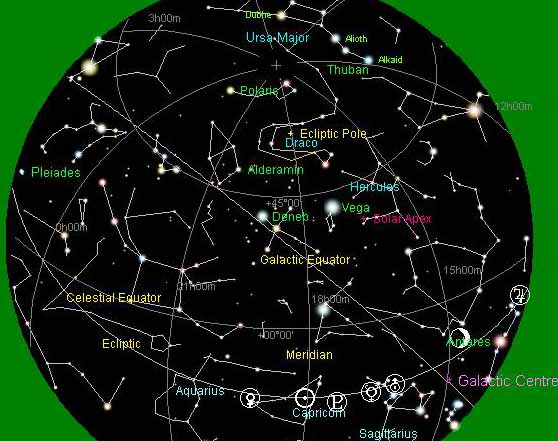 I deduce that the primal form of this configuration was:
The Pleiades instead of Sirius in the East
Satavaesa as Antares in the West
Vanant the constellation Capricorn in the South
Haptoiringa seven stars of the Great Bear Ursa Major in the North
In the chart Pleiades (small dot left of label) is seen coming up in the east (on the left), Antares is setting in the West, the seven stars of Ursa Major (from from Dubhe to Alkaid) are in the North, the sun (shown as a dot inside a circle) of 700 BC is in Capricorn and aligned on the Meridian with the Pole of the ecliptic at High Noon (the Gah of the zenith) on the day of the winter solstice which ocurred then on 28 December.
Vendidad
Tishtar Yasht (Hymn to the Star Sirius)
Ahura Mazda spake unto Spitama Zarathushtra, saying: 'We worship the lordship and mastership [of Tishtrya], whereby he protects the Moon, the dwelling, the food, when my glorious stars come along and impart their gifts to men. I will sacrifice unto the star Tishtrya, that gives the fields their share [of waters].
We offer up libations unto Tishtrya, the bright and glorious star, that gives happy dwelling and good dwelling; the white, shining, seen afar, and piercing; the health-bringing, loud-snorting, and high, piercing from afar with its shining, undefiled rays; and unto the waters of the wide sea, the Vanguhi of wide renown, and the species of the Bull, made by Mazda, the awful kingly Glory, and the Fravashi of the holy Spitama Zarathushtra.
'Unto Tishtrya, we offer up the
libations, the Haoma, the baresma, the wisdom of the tongue, the holy spells, the speech, the deeds, the libations,
and the rightly-spoken words.
We sacrifice unto Tishtrya, who is the seed of the waters, powerful, tall, and strong, whose light goes afar; powerful and highly working, through whom the
brightness and the seed of the waters come from the high Apam Napat.
We sacrifice unto Tishtrya, for whom long flocks and herds and men, looking forward for him and deceived in their hope: "When shall we see him rise up, Tishtrya? When will the springs run with waves as thick as a horse's size and still thicker? Or will they never come?"
We sacrifice unto Tishtrya, who flies, towards the sea Vouru-Kasha, as swiftly as the arrow
darted through the heavenly space, which Erekhsha, the swift archer,
the Arya amongst the Aryas whose arrow was the swiftest, shot
from Mount Khshaotha to Mount Hvanvant.
We sacrifice unto Tishtrya, that afflicts the Pairikas, that vexes the Pairikas, who, in the shape of worm-stars, fly between the earth and the heavens, in
the sea Vouru-Kasha.
We sacrifice unto Tishtrya, whose rising is watched by men who live on the fruits of the year,
by the chiefs of deep understanding; by the wild beasts in the
mountains, by the tame beasts that run in the plains; they watch
him, as he comes up to the country for a bad year, or for a good
year, (thinking in themselves): "How shall the Aryan countries
be fertile?"
We sacrifice unto Tishtrya, for whom long all the creatures of Spenta-Mainyu, those that live
under the ground, and those that live above the ground; those
that live in the waters, and those that live on dry land; those
that fly, and those that run in the plains; and all those that
live within this boundless and endless world of the holy Spirit.
Then Satavaesa makes those waters flow down to the seven Karshvares [regions, countries, continents] of the earth, and when he has arrived down there, he stands, beautiful, spreading ease and joy on the fertile countries
(thinking in himself): "How shall the countries of the Aryas grow fertile?"
'I will sacrifice unto the stars Haptoiringa, to oppose the Yatus and Pairikas.
'We sacrifice unto Vanant, the star made by Mazda; for the well-shapen
strength, for the Victory, made by Ahura, for the crushing Ascendant,
for the destruction of what distresses us, for the destruction
of what persecutes us.
'We sacrifice unto Tishtrya, whose eye-sight is sound.
For ten nights, O Spitama Zarathushtra! Tishtrya, the bright
and glorious star, mingles his shape with light, moving in the
shape of a man of fifteen years of age, bright, with clear eyes,
tall, full of strength, strong, and clever.
He is active as the first man was; he goes on with the strength
of the first man; he has the virility of the first man.
Here he calls for people to assemble, here he asks, saying:
"Who now will offer me the libations with the Haoma and the
holy meat? To whom shall I give wealth of male children, a troop
of male children, To whom shall I give wealth of oxen, a herd of oxen, and the purification of his own soul?
Now I ought to receive sacrifice and prayer in the material world, by
the law of excellent holiness."
The next ten nights, O Spitama Zarathushtra! the bright and
glorious Tishtrya
mingles his shape with light, moving in the
shape of a golden-horned bull.
The next ten nights, O Spitama Zarathushtra! the bright and glorious Tishtrya mingles his shape with light, moving in the
shape of a white, beautiful horse, with golden ears and a golden
caparison.
But there rushes down to meet him the Daeva Apaosha, in the
shape of a dark horse, black with black ears, black with a black
back, black with a black tail, stamped with brands of terror.
They meet together, hoof against hoof, O Spitama Zarathushtra!
the bright and glorious Tishtrya
and the Daeva
Apaosha. They fight
together, O Spitama Zarathushtra! for three days and three nights.
And then the Daeva Apaosha proves stronger than the bright and
glorious Tishtrya, he overcomes him.
And Tishtrya
flees from the sea Vouru-Kasha, as far as a
Hathra's length. He cries out in woe and distress, the bright
and glorious Tishtrya: "Woe is me, O Ahura Mazda! I am in
distress, O Waters and Plants! O Fate and thou, Law of the worshippers
of Mazda! Men do not worship me with a sacrifice in which I am
invoked by my own name, as they worship the other Yazatas
with sacrifices in which they are invoked by their own names.
If men had worshipped me with a sacrifice in which I had been invoked by my own name, as they worship the other Yazatas with sacrifices in which they are invoked by their own names,
I should have taken to me the strength of ten horses, the strength
of ten camels, the strength of ten bulls, the strength of ten
mountains, the strength of ten rivers."
Then I, Ahura Mazda, offer up to the bright and glorious
Tishtrya a sacrifice in which he is invoked by his own name, and
I bring him the strength of ten horses, the strength of ten camels,
the strength of ten bulls, the strength of ten mountains, the
strength of ten rivers.
Then he goes from the sea Vouru-Kasha as far as a Hathra's
length: "Hail!" cries the bright and glorious Tishtrya.
< Hail unto me, O Ahura Mazda! Hail unto you, O waters and
plants! Hail, O Law of the worshippers of Mazda! Hail will it
be unto you, O lands! The life of the waters will flow down unrestrained
to the big-seeded corn fields, to the small-seeded pasture-fields,
and to the whole of the material world!"
Then the bright and glorious Tishtrya
goes back down to the powerful the large-sized, deep sea
of salt waters Vouru-Kasha, in the shape of a white, beautiful horse, with
golden ears and a golden caparison.
He makes the sea boil up and down; he makes the sea stream
this and that way; he makes the sea flow this and that way: all
the shores of the sea Vouru-Kasha are boiling over, all the middle
of it is boiling over.
And the bright and glorious Tishtrya
rises up from the sea
Vouru-Kasha, O Spitama Zarathushtra! the bright and glorious Satavaesa rises up from the sea Vouru-Kasha; and vapours rise up above Mount
Us-hindu, that stands in the middle of the sea Vouru-Kasha.
Then the vapours push forward, in the regular shape of clouds;
they go following the wind, along the ways which Haoma traverses,
the increaser of the world. Behind him travels the mighty wind,
made by Mazda, and the rain, and the cloud, and the sleet, down
to the several places, down to the fields, down to the seven
Karshvares of the earth.
Apam Napat, O Spitama Zarathushtra! divides the waters amongst
the countries in the material world, in company with the mighty
wind, the Glory, made by the waters, and the Fravashis of the
faithful.
O Maker of the material world, thou Holy one! Which is the first place where the Earth feels sorest grief? Ahura Mazda answered: 'It is the neck of Arezura, whereon the hosts of fiends rush forth from the burrow of the druj.'
He begged of her a boon, saying: 'Grant me this, O great Ashi Vanguhi! that I may overcome Azhi Dahaka, the three-mouthed, the three-headed, the six-eyed, who has a thousand senses, that most powerful, fiendish Druj, that demon, baleful to the world, the strongest druj Druj that Angra Mainyu created against the material world, to destroy the world of the good principle; and that I may deliver his two wives, Savanghavak and Erenavak, who are the fairest of body amongst women, and the most wonderful creatures in the world.'
The "Earthly History of the Faithists of the East" in Saphah says Zarathustra taught that to be a Faithist in the Voice was the highest that man could attain. To build up one's own faith in the I Am would produce the highest happiness. He taught that each self must learn to build up itself in love and wisdom, and after them, power, trusting in the I Am.
Please now go to the article called Faithists of Hapta for the correlation of Oahspe with the Mazdayasnian tradition
Galactic Alignment
Other Links
Identifying Pan, the Submerged Continent
Encounter with Dr Kimura, and the 'Underwater Pyramid
Plasma Kosmology
The Sacred Kosmon Year
'Progress of Things' Versus 'Evolution'
Home Page


