Which came first?
The very first form of radio communication was radio telegraphy, as opposed to wired telegraphy. The telegraph key turns the transmitter on when it is closed and off when open. The operator taps out the message in a long and short, dashes and dots, code and the person on the other end who knows the code reads the dots and dashes and translates them into letters and then to words.I don't know what year radios began to talk but the method was amplitude modulation (AM). Those early transmitters probably produced as much frequency modulation (FM) as they did AM but FM hadn't been invented yet and there was no known way to detect it. So we will begin with AM.
Amplitude Modulation (AM).
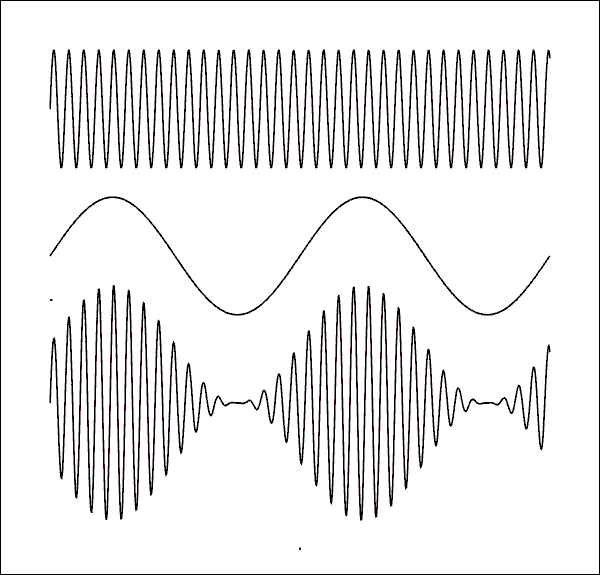
An unmodulated radio transmitter puts out a steady single frequency of constant amplitude. When it is amplitude modulated the voltage of the transmitter output is varied according to the modulating voltage. The unmodulated transmitter output is called the carrier. As we will see when we study Single Sideband (SSB) this is a total misnomer. But never mind that, it's universally called the carrier and that's what we will call it. It was named that because the early radio engineers thought the steady RF signal carried the audio through the ether.Suppose we want to transmit a steady sine wave. That's not very interesting to anyone who might be listening but who cares. We're going to transmit it anyhow. The top wave in Figure 6.1 shows an unmodulated carrier wave at the top, an audio sine wave second, and at the bottom, the carrier modulated by the audio wave.
For a verbal description click here.
Figure 6.1 Unmodulated and Modulated Radio Waves.
This looks pretty straight forward. The audio wave is added to 1 to make it all above the axis and then it multiplies the carrier wave. If I didn't need to go on to explain single sideband I could just leave it at that. But I am going on to SSB so we need to dig deeper into the AM signal.A Modulator.
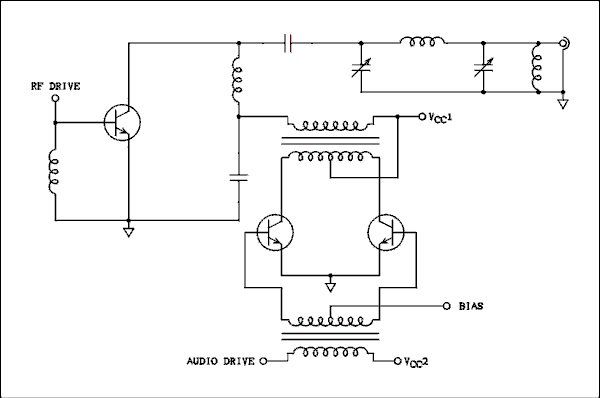
There is no difference between the theoretical operation of a mixer and a modulator. At low power the same circuit can be used for either one. As you will remember from your study of the All American 5 or the Simple Superhet a mixer creates sum and difference frequencies. So does a modulator.At power levels from about 5 watts to 5000 watts the modulation is done in the last, highest power, stage. A specially made transformer couples the audio from an audio power amplifier into the plate circuit of the RF power amplifier as shown in Figure 6.2 below.
For a verbal description click here.
Figure 6.2 Modulated Final Stage.
When there is no audio signal the DC voltage at the plate of the RF tube is equal to the HV (high voltage). When audio is applied at 100% modulation the plate voltage varies from 0 to twice the HV value. This causes the RF voltage to vary from 0 to twice the no modulation value. If the RF tube is a pentode the screen grid has to be modulated along with the plate. If you want to build an AM transmitter don't follow this plan. I made it up as I went along. It is meant to illustrate the principle not to be a construction project.Suppose we want to modulate a 100 kc carrier with a 6 kc audio wave. The modulator will pass the original frequencies through but will create two new frequencies, 94 kc and 106 kc. For 100 percent modulation, the condition shown in Figure 6.1, the new frequencies will be one half the amplitude of the carrier. These new frequencies are called sidebands.
Although the audio, 6 kc, may be present, the tuned circuits in the antenna matching network, the antenna its self, and the nature of propagation of radio waves will not allow the 6 kc audio to be picked up by a distant receiver so we will neglect that frequency from now on.
What are sidebands?
Sidebands are the new frequencies that are created on either side of the carrier wave. For example a radio station operating on 650 kc and transmitting an audio bandwidth of 50 cycles to 10 thousand cycles will have the carrier at 650,000 cycles and an upper sideband extending from 650,050 to 660,000 cycles, and a lower sideband extending from 649,950 to 640,000 cycles.It should be noted that few AM stations actually succeed in transmitting audio frequencies higher than 10,000 cycles. Even if they did who would be capable of hearing them? AM receiver designers have narrowed down the IF bandwidth to minimize interference and thereby have cut the audio response to 5,000 cycles at best. There were very few hi-fi AM tuners ever made and few sold. Although I am probably not the only one still using such a tuner I'll bet that you could count them on your bodily digits and not have to take off your shoes. But I digress.It is not possible to analyze what is going on using regular program material therefore we will stick to transmitting a sine wave tone. So, if WSM is testing their transmitter by modulating it with a 1000 cycle sine wave, say between the hours of 2 A M and 4 A M on Sunday morning, you would observe the carrier at 650 kc, an upper sideband at 651 kc and a lower sideband at 649 kc. Moreover these three frequencies have constant amplitude. So how does this turn into the wave at the bottom of Figure 6.1?In practice the example of WSM places the individual cycles so close together as to turn into a solidly colored in area on your screen. For this next part you need to be able to see the individual cycles of the carrier and sidebands so we will return to our carrier frequency of 100 kc. There are radio stations that operate in that part of the spectrum but their programs are not very interesting.
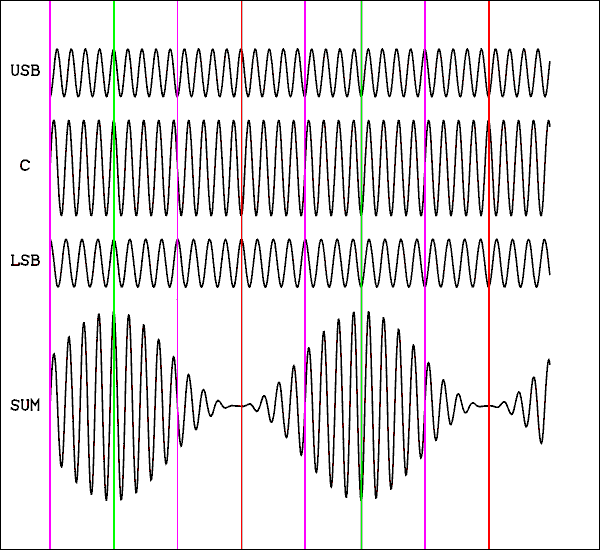
As already said a 100 kc transmitter modulated 100 percent by a 6 kc tone will produce the carrier of 100 kc and two sidebands at 94 kc and 106 kc each having half the amplitude of the carrier. Let's tune across that signal with a high class receiver that has a switch that changes the IF bandwidth. If we set the bandwidth to 100 cycles and tune across the signal we will verify that the 100 kc carrier is there and the two sidebands at 94 and 106 kc have half the amplitude of the carrier. We will also see that their amplitudes are constant as shown in Figure 6.3 below.
For a verbal description click here.
Figure 6.3 Carrier and sideband waves and their sum.
Now if we change the bandwidth setting to 15 kc we will hear the 6 kc tone. In Figure 6.3 the upper three waves are what is picked up by the receiver in the narrow band mode. It can separate the three frequencies and observe them one at a time. In the wide band mode all three signals are picked up and added together to obtain the bottom wave.The bottom wave is in deed the sum of the top three. Colored vertical lines have been used to mark off points of particular significance. The magenta (some people would call it purple) lines mark the points in time where the two sidebands cancel each other out leaving only the carrier. Green lines mark the points where all three are in phase and a sum of twice the carrier amplitude results. Red lines point out where the two sidebands add together but together they cancel out the carrier leaving no output.
If the modulation was speech or music the sidebands would not be regular sine waves but the carrier WOULD be. That's very important. The nature of the carrier, frequency, phase, and amplitude, does NOT change regardless of the type or percent of modulation.
Where Does All the Power Go?
Let's say we are running a 1 kilowatt (output) AM transmitter, legally. When there is no modulation the output power is 1,000 watts. When it is modulated to 100 percent the power in the carrier does not change but additional power is put into the sidebands. As mentioned earlier the voltage of each sideband when a test tone is being transmitted at 100% modulation is 50% of the carrier voltage. 50% voltage is 25% power, test it your self with ohms law and P=IV. That means the power in each sideband is 250 watts. So the total for the carrier plus both sidebands is 1500 watts. That extra power comes from the modulator tubes.Saving power, Suppressed Carrier - Double Sideband (DSB).
Just look at that big fat carrier sitting there doing nothing and eating up power as if it's going out of style. (Well, it did, didn't it?) We'll save that argument for another page. The carrier is necessary for normal detection. Figure 6.4 is a comparison of the envelopes of a normal AM signal and a double sideband - suppressed carrier (DSB) signal.

For a verbal description click here.
Figure 6.4 Comparison of AM and DSB signals.
Both signals are modulated by the same frequency. In the second one the carrier is missing in action and the two sidebands add together to produce a signal apparently containing twice the frequency. An attempt to detect this wave with a conventional diode detector would result in a tone of twice the actual frequency. When the audio is complex things get even worse. Music is a cacophony that not even the most modern of modern music fans would want to listen to and speech is totally unintelligible. It seems as though we need that carrier after all.Put the Carrier Beck. *
* Joke referring to the movie "Young Frankenstein". It's no big deal to put the carrier back in, not at the transmitter but at the receiver. All we have to do is to run an oscillator at the center of the IF band and let it combine with the incoming sidebands and -- voila -- a perfectly intelligible signal, maybe. If the receiver is not tuned perfectly there is an error in pitch which makes a mess of music and makes speech sound funny. This is why suppressed carrier has never become a part of consumer equipment. If the person doing the tuning is a skilled radio operator the signal can be tuned in close enough for good intelligibility. That places the use for suppressed carrier radio in the realm of private communication, as opposed to general broadcasting, and in most cases music transmission is neither allowed or necessary on such communication channels.So we have suppressed the 1000 watt carrier and saved a bunch of power but there is an additional saving that can be made. The information in one sideband is a duplicate of the information in the other. So we need to transmit only one sideband giving another 50% power saving. So our original transmitter that sent out 1500 watts under full modulation is now down to 250 watts for the same signal in the receiver on the other end.
There is actually an additional gain because of the reduction of bandwidth. The original AM, or even the double sideband, signal required a receiver with an IF bandwidth of twice the highest modulating frequency. The single sideband signal requires a bandwidth which is the same as the highest modulating frequency. For telephone quality communication, about 200 to 4000 cycles would require an AM bandwidth of 8 kc where as a single sideband receiver need only have a bandwidth of 3800 cycles.
Notice we are able to lop off the 200 cycles at the bottom. With a double sideband signal the 200 cycle lower limit gives a 400 cycle gap right in the middle of the transmitter's spectrum. There's nothing we can do with it. But in single sideband there is nothing beyond the 200 cycle limit so we can chop it off. The narrower the bandwidth the less noise is picked up and the better the intelligibility.
In practice hams, the military, and commercial communications that uses the HF band, 3 Mc to 30 Mc, use an audio frequency response of 300 to 2400 cycles which requires an IF bandwidth of 2.1 kc. That became the standard because the Collins Radio Company made the best SSB equipment for hams and military when SSB was replacing AM in the late 50s and 60s. Collins arrived at what they felt was the best compromise between bandwidth and intelligibility. They used a 2.1 kc mechanical filter in the receiver's and transmitter's IF section. A 2400 cycle upper limit may be pushing the boundary of intelligibility but if distortion is kept low a trained ear has no trouble understanding what is said. Collins knew how to keep the distortion low. The Collins rigs were, and are, easy to recognize on the air. They just sound better.
No, I don't own any stock in Collins Radio. I wish I had bought some in 1960. I also wish I had bought stock in IBM in 1955, and in Microsoft in 1980, and so on and so on. There I go again.Generating Single Sideband
There are two basic ways of generating a single sideband signal. 1) phasing, and 2) filtering. Phasing was used by some early sideband equipment made by Central Electronics and others. It is rather complicated to explain and equally as complicated to build and keep in alignment. The process involves two modulators and the audio and carrier have to be shifted by 90 degrees between the two. When the output of the two modulators is combined the other sideband is canceled out. The two balanced modulators cancel out the carrier. Aside from a few maverick experimenters, phasing rigs are not heard on the ham bands anymore.The filter method starts out with a single balanced modulator that produces a double sideband suppressed carrier signal. Then a crystal or mechanical filter removes the other sideband. Such a filter can't be tuned so the signal is generated at a fixed frequency such as 455 kc and converted to the desired frequency then increased in power to be fed to an antenna. If that sounds like a backward receiver, that's exactly what it is. Another similar filter was used in the receiver.
Transceivers.
The word transceiver is a contraction of transmitter and receiver. A transceiver is generally less expensive than separate units made by the same company because the transceiver makes double use of many of the most expensive components. The filter is probably the single most expensive part in any transmitter or receiver. Using the same filter to transmit and receive through cuts down the cost quite a lot. The second most expensive part is the VFO (variable frequency oscillator) In Collins, Heathkit and Drake equipment this oscillator is very carefully manufactured and calibrated. The need for only one reduces the cost even more. Other things such as crystals and some amplifiers also serve double duty. A transceiver sends and receives on the same frequency.Frequency Modulation (FM).
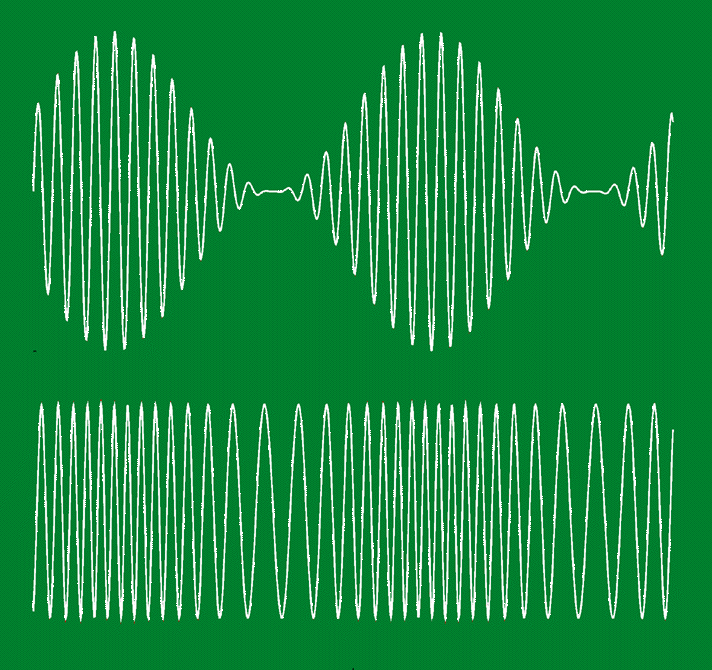
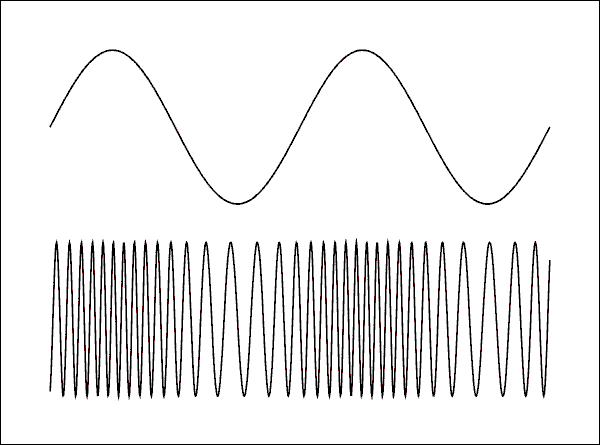
In frequency modulation the amplitude of the carrier remains constant, only the frequency is changed. Figure 6.5 below shows this.
For a verbal description click here.
Figure 6.5 Audio and frequency modulated wave.
The amount by which the frequency is changed is considerably exaggerated to show up.At the top of this page I mentioned that early AM transmitters probably had a lot of FM. In those earliest transmitters they were modulating the oscillator. If you change the DC voltage applied to an oscillator you do change the amplitude but you also change the frequency. A gadget that was very popular in the early days of transistors was a miniature AM transmitter. It was a little module with 4 wires coming out, two for the 9 volt battery, one for audio, and one for antenna. The battery negative served as the ground for audio and antenna. These produced very poor quality because of the large amount of FM that accompanied the AM.Frequency modulating an oscillator is pretty easy if your not too particular. But if you want low distortion and very little incidental AM it can get pretty complicated. The most common way in vacuum tube circuits is to use a reactance tube. That's not a particular kind of tube it's any tube that has been wired in a certain way. A capacitor or inductor is connected from the plate to the grid to shift the plate current by 90 degrees. That makes the tube appear to be an inductor or capacitor. When the plate current is changed by changing the DC bias on the grid the amount of reactance changes. The plate is connected to the tuned circuit to be modulated.If you are up on current technology you may be thinking of a variable capacitance diode (varicap). Even in transistor oscillators you have to be careful not to apply too much oscillator signal so as not to drive them into forward conduction or reverse breakdown. I have never used one of these devices in a tube circuit but I'm not confident it could be made to work. The higher RF voltages found in tube circuits would likely preclude their use unless you took very special precautions to keep the RF voltage small.
Any incidental AM that may occur can be eliminated by passing the oscillator through a tube which is being driven from cutoff to saturation. Such an amplifier might be called a limiter or it might be known as a class C amplifier. The latter are always used in radio transmitters.
FM Detection
An FM receiver contains one or more amplifiers which act as limiters. Any noise such as lightening static or noise from an electric mixer that comes in with the signal will appear as amplitude modulation of the carrier. Because there is no intelligence being transmitted by amplitude changes such changes can be removed thus considerably reducing the effect of noise. Removing such changes is what a limiter does.After limiting it is the job of the detector to recover the audio from the modulated signal. The detector starts with a special coil called a discriminator transformer. The primary and secondary are tuned as in any IF transformer but there is a third winding called a tertiary pronounced tershiary winding.
This word tertiary comes from Greek or Latin or something like that that means 3. It's all Greek to me.This tertiary winding is not tuned to resonance. The consequence is that the voltage output from this winding is shifted 90 degrees from that of the tuned secondary. That's true when the frequency is at the center of the IF band. When the incoming frequency moves a little off the phase of the secondary voltage shifts off from 0 degrees. If the frequency is below resonance the voltage will be shifted in the leading direction. If the incoming frequency is above resonance the voltage will be shifted in the lagging direction. Meanwhile the voltage on the tertiary winding does not undergo such a phase shift but remains at 90 degrees from the on resonance phase of the secondary voltage.So at the resonant frequency of the secondary the tertiary voltage leads the secondary voltage by 90 degrees. Below the resonant frequency of the secondary the tertiary voltage leads the secondary voltage by less than 90 degrees. Above resonant frequency of the secondary the tertiary voltage leads the secondary voltage by more than 90 degrees. This little transformer has converted the frequency change into a phase difference change.
The Phase Detector.
There is a simple device using a couple of diodes that will detect the phase difference between two voltages. If the difference is 90 degrees the output voltage is zero. If the difference is zero the output is positive and if the difference is 180 the voltage is negative. In between these angles the voltage is in between. There is a direct proportionality. Now if we hitch up one of these phase detectors to one of these discriminator transformers we have a circuit that will turn frequency variations into voltage variations. In other words we have an FM detector.Is that enough?
This page has been put up because of requests from viewers for this information. I have only given one schematic and that one has no values on it. If anyone wishes to experiment with FM circuits I suggest you contact me for circuits. If demand justifies it I will post more details about AM, SSB, or FM.
Life is uncertain
so eat your dessert first
and keep the tubes glowing.
Home
This page last updated March 15, 2004.