
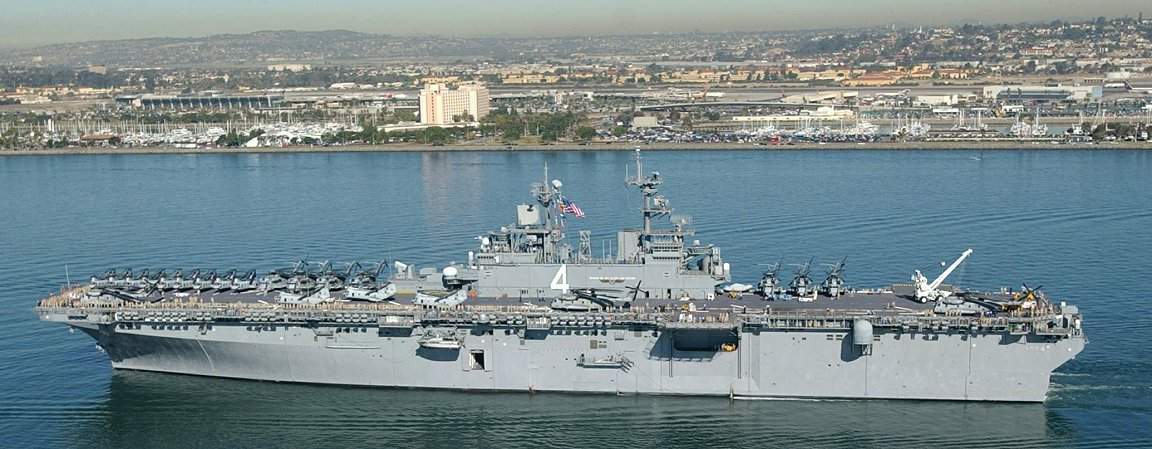
The Wasp class are the largest amphibious ships in the world. Wasp class ships are the first to be specifically designed to accomidate the AV-8B Harrier jump jet and the LCAC hovercraft, along with the full range of Navy and Marine helicopters, conventional landing craft and amphibious assault vehicles to support a Marine Expeditionary Unit (MEU) of 2,000 Marines. The ships also carry some of the most sophisticated communications, command and control capabilities afloat, alongwith state of the art electronic systems and defensive weaponry.
These ships conduct prompt, sustained combat operations at sea as the centerpiece of the Navy's amphibious strategy of "Forward ... From the Sea." They provide the means to deliver, command and support all elements of a Marine Landing Force in an assault by air and amphibious craft. In carrying out their mission, the ships have the option of utilizing various combinations of helicopters, Harrier II (AV-8B) Jump Jets and air cushion landing craft (LCAC), as well as conventional landing craft and assault vehicles, illustrating the LHD's flexibility. In addition to embarked landing craft, the ships carry four LCPLs and two utility boats. Off the landing beach, the ships can ballast more than 15,000 tons of seawater for trimming during landing craft launch and recovery operations in the well deck.
Because of the desire to maximize the number of deck spots, no ski-jump V/STOL ramp is fitted, reducing the potential effectiveness of the Harrier contingent. The hangar can accommodate 28 CH-46-equivalents. The ships have 34-ton-capacity aircraft elevators, with the stern elevator relocated to starboard from the centerline aft position on the LHA 1 class. Some 1,232 tons of JP-5 aviation fuel and about 50 tons of vehicle fuel can be carried.
To carry out its primary mission, the Wasp has an assault support system that synchronizes the simultaneous horizontal and vertical flow of troops, cargo and vehicles throughout the ship. Two aircraft elevators service the hangar bay and flight deck. Six cargo elevators, each 12 by 25 feet, are used to transport material and supplies from the 100,000 cubic foot cargo holds throughout the ship to staging areas on the flight deck, hangar bay and vehicle storage area. Cargo is transferred to waiting landing craft docked within the ship's 13,000 square foot, 266 foot long, well deck. Helicopters in the hangar bay or on the flight deck are cargo-loaded by forklift.Wasp class ships can also provide command and control and aircraft facilities for sea control missions, while operating with an aircraft carrier battle group. They transport and land ashore not only troops, but also the tanks, trucks, jeeps, other vehicles, artillery, ammunition and various supplies necessary to support the amphibious assault mission. Monorail trains, moving at speeds up to 600 feet per minute, transport cargo and supplies from storage and staging areas throughout the ship to a 13,600 square foot well deck which opens to the sea through huge gates in the ship's stern. There, the cargo, troops and vehicles are loaded aboard landing craft for transit to the beach. Air cushion landing craft can "fly" out of the dry well deck; or the well deck can be ballasted down for conventional craft to float out on their way to the assault area. Helicopter flights also transfer troops and equipment to the beach, while the ship's air traffic control capability simultaneously directs close air tactical support provided by embarked jet aircraft and helicopter gunships.
Although the ships are capable of embarking two LCU-146's this configuration is not recommended to be used for deployment planning due to the requirement to lash, block, and shore LCU-146's in accordance with current wet well procedures. During an administrative onload, two LCU-146's can be embarked and offloaded with proper planning considerations. Only pax and cargo (4K forklift and monorail) operations can be conducted when two LCU-146's are brought far enough into the well to close the stern gate. To conduct simultaneous vehicle operations with two LCU-146's, the second LCU must extend out of the well. The ships can can carry up to 61 Amphibious Assault Vehicles (Landing Vehicle Tracked Personnel LVTP-7), with 21 stowed in upper vehicle stowage and 40 stowed in the well deck.
Wasp class ships are 844 feet long with a beam of 106 feet. Two steam propulsion plants, the largest in the Navy, develop 70,000 shaft horsepower for each of the two propulsion shafts. These plants allow the 40,500 ton ship to reach speeds greater than 20 knots. Plans to have later units propelled by more economical LM-2500 gas turbines were abandoned. The ship's two propulsion plants generate a total of 400 tons of steam per hour. If the energy of the two boilers were converted to electrical power, it could power a city of 160,000. Electrictal generators aboard ship provide more than 16,000 kilowatts of power for shipboard systems. Two pumping stations provide a 450,000 gallon fueling capacity for embarked aircraft and other vehicles. Onboard distilling plants provide up to 200,000 gallons of fresh water each day.
Each Wasp class ship has accommodations for 3,000 troops and crew members. Ships crew consists of 98 officers and 983 enlisted personnel. For the comfort of the 1,075 crewmembers and 1,600 embarked troops, all manned spaces and berthing areas are individually heated and air conditioned. Crew and troop berthing are on the same deck level, with galleys and mess facilities nearby. Berthing areas are subdivided to provide semi-private spaces without adversely affecting efficiency. Deck and wall coverings are decorative but also serviceable and easy to maintain. Messing areas facilitate rapid feeding in a restaurant atmosphere. Onboard recreational facilities include a state-of-the-art Library Multi-Media Resource Center with Internet access, a weight room, arcade machines and satellite television capabilities.
The ships have six fully equipped operating rooms and a 600 bed hospital, by far the largest at sea with the exception of hospital ships. Wasp has medical and dental facilities capable of providing intensive medical assistance to 600 casualties, whether combat incurred or brought aboard ship during humanitarian missions. The corpsmen also provide routine medical/dental care to the crew and embarked personnel. Major medical facilities include four main and two emergency operating rooms, four dental operating rooms, x-ray rooms, a blood bank, laboratories, and patient wards. In addition, three battle dressing stations are located throughout the ship, as well as a casualty collecting area at the flight deck level. Medical elevators rapidly transfer casualties from the flight deck and hangar bay to the medical facilities.
This is the Navy's first class of amphibious assault ship designed and built from the keel up with accommodations for female sailors. This "Women at Sea" modification provides LHD-5 with living areas for nearly 450 female officers, chiefs, enlisted personnel and embarked troops. Overall, the ship has living areas for nearly 3,200 crew members and troops. As is the case on most large combatants, the crew is divided into several departments and divisions.
The mission of the Aircraft Intermediate Maintenance Department (AIMD) is to inspect, test and check, calibrate and repair aircraft components, as well as maintain Support and Material Handling Equipment (SE and MHE). The diverse mission is in support of the embarked Air Combat Element (ACE), Amphibious Ready Group (ARG) and Amphibious Ready Group Intermediate Maintenance Activity (ARGIMA) concept.
AIMD manning consists of one Officer, two Chief Warrant Officers, eight Chief Petty Officers, and 68 technicians. During deployments, AIMD is augmented by Marine Corps personnel consisting of two Gunnery Sergeants, three Staff Sergeants and 60 enlisted technicians. The four divisions -- Staff (IM-1), General Maintenance (IM-2), Avionics/Armament (IM-3) and Support Equipment (IM-4) -- are subdivided into 18 different work centers, each with a specialized support function.
Working together as a team, AIMD uses more than 2,700 pieces of installed, portable, rolling and armament support equipment to support over 100 systems in six different types of operational aircraft. AIMD has the capability to test, repair and service more than 4,000 individual repairable components. The level of repairs range from small delicate work performed by micro-miniature repair technicians, to large complex work tasks performed on the Amphibious Assault Crash Crane by the support equipment technicians. Altogether, AIMD normally processes in excess of 400 repairable aircraft components with a total of more than 2,000 maintenance actions completed each month while deployed.
Air DepartmentThe mission of the Air Department is to conduct aircraft handling, launch and recovery operations, including control of airborne Visual Flight Rules traffic within the ship's Control Zone. Additionally, the Air Department provides the necessary services and facilities required for the maintenance and fueling of aircraft so embarked squadrons can effectively conduct air operations in the full application of their military potential. Of equal importance is Air Department's damage control role of aircraft crash and salvage on the flight deck and aircraft fire fighting on the hangar deck.
Combat Systems DepartmentCombat Systems Department is Made up of the FC, ET, and IC ratings who maintain and operate all of the ship's Weapon Systems, Radars, Phone Systems, Communication Systems, and Gyros.
CF Division- Fire Controlman. Operating some of the most sophisticated Weapon Systems, Radars , and Computer Systems the Navy has to offer. Their overall job is to protect the ship from inbound air and surface attacks
CE Division- Electronic Technicians. The eyes of the ship. Maintain all Shipboard Surface, Air , and Navigational Radars. They are also responsible for Computer Repair , 2-M , and Torpedo Countermeasures.
CJ Division- Interior Communications. They maintain the ships Phone System, Television System, and Gyro Equipment. They are an instrumental part of the daily operation of the ship.
Deck DepartmentDeck Department consists of four officers, one Senior Chief Boatswain's Mate, One Chief Boatswain's Mate, 25 other junior Boatswain's Mates and 65 undesignated Seamen. From bow to stern, deck department works hard every day on a variety of evolutions and spaces that include the Well Deck, mooring stations, two 40,000 pound anchors, four underway replenishment stations, six boats, the ship's Quarterdecks, and all ground tackle. Deck also mans many of the topside underway watches, including the Boatswain's Mate of the Watch, helmsman, lee helmsman, aftersteering helmsman, four lookout and lifebuoy watches, and the well deck integrity watch.
Dental DepartmentThe Dental Department provides quality dental care and a full range of dental services for almost 3,000 Navy and Marine Corps personnel. Designed and built with modern and up-to-date dental technology, the ship is outfitted with an oral surgery suite, a complete prosthetics laboratory and two ultra modern x-ray units. Dental capabilities include: endodontics, oral surgery, crown and bridge, operative and preventative dentistry. The ship's dental staff consists of one dental officer and four dental technicians and is augmented when troops are embarked, by an additional dental officer and dental technician from Camp Pendleton, Ca.
Engineering DepartmentThe true heart of of the ship is the Engineering Department. These hard working professinals provide steam to propel the ship and power electrical generators, as well as maintain damage control and auxiliary systems.
The two Main Propulsion divisions, MP-1 and MP-2, are responsible for the forward and aft main machinery rooms. Comprised of Boiler Technicians (BTs) and Machinist's Mates (MMs), they not only perform complex emergent repairs on various machinery while deployed, but find the time to complete extensive space preservation efforts. The Oil Lab's skilled and professional performance ensure the smooth and safe transfer millions of gallons of fuel.
The Auxiliary (A Gang) division keeps the air conditioning plants cold, the small boats purring, and the elevators cycling. The MMs, Enginemen (ENs) and Electrician's Mates (EMs) form a cohesive unit that maintain, operate, and repair countless pieces of equipment throughout the ship. This job is essential to not only the primary missions of the ship, but also to the health and comfort of the crew. Hot water and cold air conditioning were a must to keep the crew cool and happy.
Electrical (E) division, manned by EMs, provides power throughout the ship, and maintains navigational equipment essential for safe steaming. By performing numerous repairs for other ships operating with ESSEX, they ably demonstrated that no repair was too large to accomplish.
Executive DepartmentExecutive Department's primary mission is customer service. Executive Department is similar to a city hall staff. Office Clerks, known as Yeoman and Personnelmen, maintain the records and files that enable the city to operate. All official correspondence is routed through and distributed by this department. The Executive Department staff also supports the crew and all embarked units in the following areas: career counseling, drug and alcohol abuse prevention, legal, safety, physical security, printing and maintenance, and material & management (3M). Educational programs, ranging from Navy advancement tests to college course credits, are also coordinated through this department. These essential services are performed by a varied and talented group of individuals from their chosen occupations.
Medical DepartmentThe Medical Department has the largest combatant medical facility afloat and consists of six operating rooms, a 15-bed intensive care unit, 44-bed hospital ward with 500 overflow beds. In order to support casualty care, the Medical Department has two x-ray suites, a laboratory and blood processing unit, pharmacy and both ashore and afloat. As part of our mission, we provide training in first-aid, preventative medicine and environmental safety.
Navigation Department> Navigation Department is comprised of two of the oldest ratings in the Navy, namely the QM and SM ratings. Their main jobs are to ensure the safe passage of the ship in her travels, and all external visual communications with other naval and merchant vessels. Even thought the two ratings have very different job descriptions, the department has come together as one team, each lending a distinct capability to the department as a whole. Whether it is shooting bearings while entering or leaving port, sending tactical signals to maneuver the ships in the Amphibious Ready Group or laying tracks to take the crew to far away destinations, the professionals in the Navigation Department can be relied upon to provide the best service in the Fleet.
Operations DepartmentThe Operations Department is the focal point for planning coordination and execution of missions. These missions range from complex LCAC and Flight Deck operations in support of amphibious exercises and nationally tasked operations, to underway replenishments and integrated training to prepare the ship for any contingency. The department encompasses the Combat Information Center, the true nerve center of the ship and the entity which affects each operational mission. The Operations Department also includes the Helicopter Direction Center, which expertly maintains the fluidity of a demanding flight plan and controls over 30 aircraft that are integral to Navy/Marine Corps missions. The Joint Intelligence Center and Ship's Signals Exploitation Space are also under the Operations Department's umbrella. JIC and SSES collect, analyze and disseminate vital information concerning existing threats, geopolitical climate and military conditions to allow Navy and Marine warfighters to perform their missions with minimal risk. The Operations Department's Meteorological Center is capable of charting weather activity and determining how weather conditions will affect operations.
Religious MinistriesThe Chaplain's Office conducts and coordinates command religious programs, including daily and weekly religious worship and study opportunities. Provides counseling and referral services. Facilitates Burials at Sea, Casualty Assistance Calls Officer and Critical Incident Stress Debrief training. Processes American Red Cross messages. Liaisons with other military and civilian religious programs. Organizes command's community relations projects and tiger cruises. Maintains and manages the ship's library.
Supply DepartmentThe Supply Department proudly embraces the motto "Ready for Sea." Earning their fourth well deserved Supply Blue 'E', each of the nine divisions within the Supply Department stands ready to provide Sailors and Marines with the highest level of courteous customer service. The department exceeds the expectations of all of its customers. Whether it's providing IMPAC card services, serving hundreds of meals from the four messes, doing laundry, operating the Gator Pit and vending machines, cutting hair, maintaining pay records and stocking the ATMs, delivering your mail, stacking and inventorying over 40 storerooms, managing HAZMAT or running a replenishment at sea evolutions and steel beach picnic -- the Supply team is always at work for the crew.
Specifications | |
| Power Plant | Two boilers (600 PSI), two geared steam turbines, two shafts, 70,000 shaft horsepower LHD-8 General Electric [GE] "LM 2500 plus" gas turbine engines |
| Length | 844 feet (253.2 meters) |
| Beam | 106 feet (31.8 meters) at waterline 200 feet w/flight deck elevators extended |
| Draft | 27 feet Maximum (Full Load) 36 feet at the stern [ballasted] |
| Displacement | Approx. 40,500 tons (36,450 metric tons) full load |
| Speed | 20+ knots (23.5+ miles per hour) |
| Range | 9,500 nm @ 20 knots |
| Fuel | 6,200 tons, plus 1,232 tons aircraft fuel |
| Aircraft |
(Actual mix depends upon mission) RECENT DEPLOYMENTS 12 - CH-46 Sea Knight helicopters 4 - CH-53 Sea Stallion helicopters 2 - UH-1N Huey helicopters 4 - AH-1W SuperCobra attack helicopter 6 - AV-8B Harrier attack planes OR 12 - CH-46 Sea Knight helicopters 9 - CH-53 Sea Stallion helicopters 4 - UH-1N Huey helicopters 4 - AH-1W SuperCobra attack helicopter 6 - AV-8B Harrier attack planes OR 12 - CH-46 Sea Knight helicopters 9 - CH-53 Sea Stallion helicopters 6 - AV-8B Harrier attack planes OR Assault 42 - CH-46 Sea Knight helicopters OR Sea Control 20 - AV-8B Harrier attack planes 6 – SH-60 Seahawk ASW helicopters |
| Landing Craft |
2 LCU Landing Craft, Utility or 3 LCAC Landing Craft, Air Cushion or 6 LCM-8 Landing Craft, Mechanized or 40 AAVP7A1 Amphibious Assault Vehicle [normal] or 61 AAVP7A1 Amphibious Assault Vehicle[stowed] |
| Armament |
2 - MK29 launchers for NATO Sea Sparrow 3 - MK15 20mm Phalanx CIWS mounts 8 - MK33 .50 cal. machine guns |
| Crew |
104 officers + 1,004 enlisted Ships Company 1,075 Ships Company crewmembers 1,600-1,894 Marine Detachment embarked troops |
