Blog
Faith
The Orthodox Tradition
News & Politics
About This Site
Guestbook
THE ICON CORNER: SHRINE OF OUR LADY OF KAZAN’
КРАСНЫЙ УГОЛ В ЧЕСТЬ ИКОНЫ БОЖЬЕЙ МАТЕРИ “КАЗАНСКОЙ”
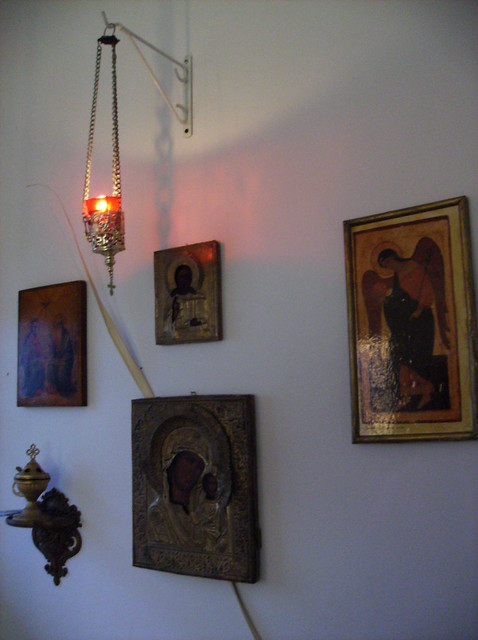
 S I like to say, icons are unique to the Christian East, particularly the Byzantine (Orthodox) rite.
I have loads of icons — most are really glorified holy cards framed or glued onto wood and
lacquered, but most are blessed and therefore real icons — but as you can see
I’ve chosen not to go overboard in displaying them.
About 10 images in all bless my krasnyj ugol (‘beautiful corner’) — really a small, altarless
chapel for praying the hours.
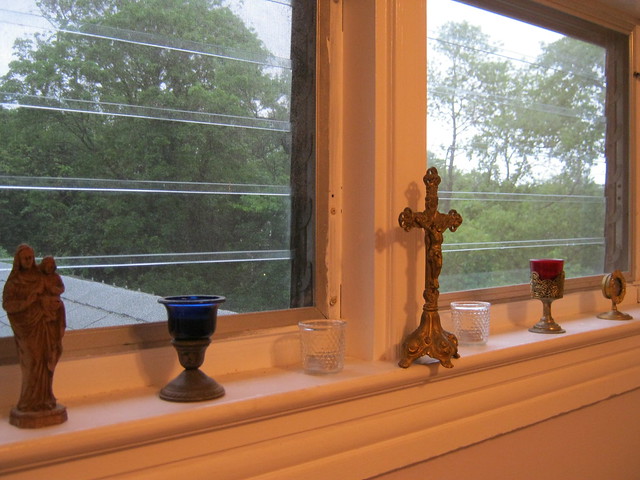
I have a good-sized but uncluttered, unlatinized Russian icon corner on the back wall of the living room, including a framed icon print of St. Seraphim of Sarov (in Catholicism, born Orthodox get the benefit of the doubt) along with a metal Russian crucifix (over the back door), icon lamp, and icons (many of them antique; two being real painted icons) of Jesus, Mary, the Trinity, St. Michael, St. Panteleimon (Pantaleone) the healer (a little framed holy cloth), a small one with various saints such as St. George and St. Nicholas, and cards of the Holy Face and the Kursk Root icon of Mary (ironic since ROCOR really doesn't like the Catholic Church, but that's not my problem); the bedroom, while largely "noble simplicity" but with my hats hanging on the walls, is all Latin Catholic (holy-water font and Sacred Heart picture) with the windowsill as a gradine or symbolic altar with metal crucifix, candles, statue of Mary, and reliquary with a relic of St. Augustine (I also have a relic of St. John Neumann). There's a Latin wall crucifix above my desk. The kitchen has a couple of framed tributes to St. Clement's including an image of the saint; a portrait of Pope Benedict is on the fridge. Rome's home but the Greek Catholics are an option. I even wear a three-bar crucifix. I have various office books for both rites (like my 1957 hand missal, nothing really new in 50 years, just originals, reprints, translations, and abridgements) and my rosaries, one at home for walks around town and another in the car. Devotionally you can do anything you want, and hooray for old latinized forms, but I'm not the kind of Catholic who wants to plonk down a Divine Mercy picture or statue (nice devotion, by the way) in a Byzantine setting; I respect rites' integrity.
The Orthodox might tell you to throw out a lot of your Latin Catholic prayer books and devotional articles; Catholics don't do the reverse, on principle. We include the East.
By the way, I like Leonid Ouspensky's rather recent idea of icons as halfway between Latin Catholic pictures and statues and a sacramental presence.