

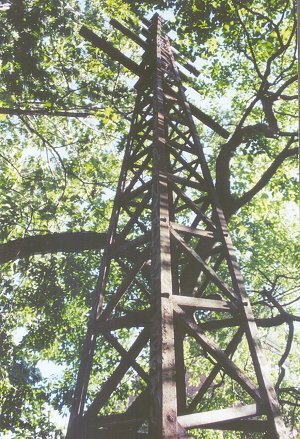
These abandoned railroad tracks were once the Long Island Railroad Rockaway Line, now known as The Dead Tracks.
This long abandoned railway sliced its way through the lower center of Queens, from the point in Rego Park where it split from
the Long Island Railroad main trunk line, southward towards and across Jamaica Bay into the Rockaways, the seaside peninsula from which it took its
name. Before joining the legion of America's derelict abandoned railroads, the LIRR's Rockaway line chugged along through nearly six decades
of service, from roughly 1908 to 1962. At that point, the tapped out and
bankrupt Long Island Railroad pulled out its engines and ticket agents, plowed
under the more easily destructable station platforms and surrendered
the dual trackbed right-of-way to the whims of mother nature
and father time.
If there is one force among us that we now know wastes no time,
it is mother nature. Only a handful of years after the last mournful
train whistle lowed along its route, the overgrown trackage had already been transformed from just another abandoned railroad right of way, into The Dead Tracks.
Though overgrown with weeds, tall grass, budding trees
and vines, The Dead Tracks were a paradise world unto itself to us. Nature's unstoppable growth fought tooth and nail for ground with less natural rusting hulks ranging
from tin cans to window fans to abandoned automobiles. All of these conspired in hiding the detritus left buried at their roots
by junkies and other such druggies, whom our parents constantly warned us about in vain
effort to stop us from venturing onto the Dead Tracks to hang
out.
In the 1960s, a parent's job became arguably much tougher, given the exploding drug culture and upsurge in crime. Having to compete with easily accessible, nearby abandoned railways definitely didn't ease their burden. An abandoned railway can be a parent's worst nightmare, as much as it appears to be their kids' best dream come true.
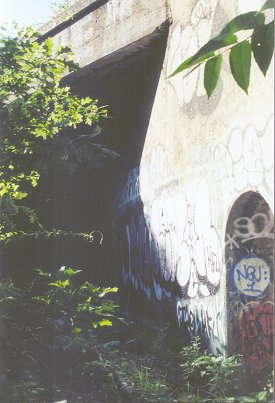
To the right is the southern portal of the ghostly abandoned tunnel
through which ran the westbound Dead Track, on its way to link
up with the Penn Station bound LIRR main line, roughly just off
of a dead ended 65th Road, behind Austin Street in Rego Park.
It was this spot, still so easily accessible in the late 1960s
through ungated and haphazardly fenced warehouse parking lots.
It was so cool to wander through this tunnel, with its arched
safety niches carved for long gone track workers to step into
at the approach of long gone trains. The abandoned tunnel's northern portal
is now sealed, in an obvious attempt to discourage both the hoodlum
and the homeless from hanging around. How well the seal has performed
its intended function I can't say. I ventured no further into
the vacuum black maw than that first visible arch when I shot
this in July 2000.
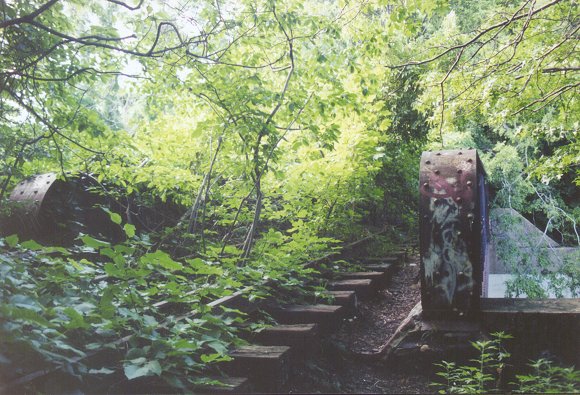
Another point of easy access to the Rockaway Line track bed was behind the little league fields of Fleet Street in Forest Hills, a couple of blocks west of Yellowstone Boulevard, several blocks south of Woodhaven Boulevard. To this day, despite the fencing in of those fields, both field and trackbed remain open to anyone with a keen enough eye to spot the gaping holes in the field fences on both sides of the abandoned tracks. The jungle growth in this heart of Queens, New York City, is astounding. This is not just terra firma you see before you; these trees are growing literally upon a bridge! And as you will see as this site is added to, this is one of the more barren sections! Presiding over this Mayan Jungle lost city of wood and steel, little seen or noticed until you suddenly look up, feeling as if you are under constant watch, and find them glowering down at you, are the silent brooding rusted skeletal remains of the towers that once relayed power lines to one another. Seeing how quickly one lil' ole abandoned railroad right of way can get consumed by mother nature definitely gives one pause as to how quickly a civilization can disappear beneath jungle growth.