Ross Bleckner
has been featured in
Architectural
Digest Artforum Art
in America Artnet
Art News
Flash Art Vivre
Angelfire
presents Ross Bleckner

Memorial I, Oil and Wax on Linen, 96 x 120", © 1994 Ross Bleckner
Ross Bleckner at Mary Boone
Art in America
– November 1996
Ross Bleckner’s
latest incarnation of the dot suggests a melting cupcake, a marshmallow,
an overripe chrysanthemum or a puffball peony. He deploys the dot in bleary,
allover patterns. He isolates the plangent puffball as an orb that nearly
fills the canvas, like a Noland target or a Mondrian flower. Each fuzzy module
is developed with small bleating strokes, and each has a hard edge oval eye-form
reserved from its throbbing mass that recalls the artist’s early affection
for Larry Poons’s ‘60s dot paintings. Bleckner’s combination of hard and
soft flourishes makes his dots pulsate against the painting’s ground, which
more often than not has been rubbed down to a scratchy grisaille or else
modulated into a multicolored field, often evocative of an Ed Ruscha sunset.
BROOKS ADAMS
The canvases in the big room of
Mary Boone’s snappy new Midtown gallery were mostly inflected with saturated
and burnt colors-yellow, orange, sienna, magenta, jade. The effect was heavy,
autumnal perhaps intentionally cloying. Bleckner’s confectionery whites
really popped across the darkened space, perhaps because each shape is so
tonally developed and is so often made to vibrate against a smudged black
contour.
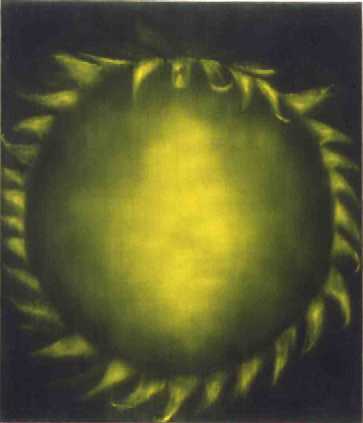
The Hope For News
depicts a big, sad sunflower that fills the vertical format with its culturally
freighted sense of melancholy, the sunflower being a well-known surrogate
for van Gogh’s suffering. Now Bleckner’s image of a burnt yellow orb is so
full of atmospheric space and air that it in turn suggests a nod to earlier
abstractionists like Dan Christensen, whose airbrushed arabesques were especially
popular in the late 1960s and early ‘70s when Bleckner was just coming of
age. Yet the artist gets his own form of abstracted petulance going in the
precisely rendered forms of in-turning, desiccated fronds, almost as if the
sunflower was sporting a Titus haircut.
The canvases in the smaller side
gallery mark the transition of the artist’s signature dot from puffball to
bubble. In color they are altogether paler, more rubbed-down and limpid than
the other works, and in mood, they are rather more buoyant.
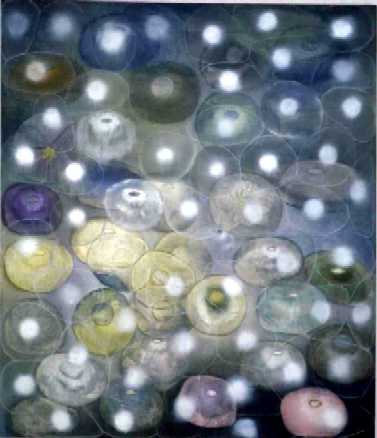
In Sickness and In Health is the fullest achievement in all regards. With its irregular network of
transparent globule forms, through which one can glimpse a secondary pattern
of white orbs, with here and there an emerging floral shape, the painting
manages to combine and synthesize all of Bleckner’s often seemingly disparate
genres. It is at once a stringent abstraction, a syrupy flower painting and
a slightly loony latter-day Symbolist allegory of germination. Bleckner here
attains a virtuoso level of glazing in his community of transparent lily-pad
forms; not since Joseph Raffael’s large field paintings of the ‘70s has there
been such a maniacally crafted approach to abstraction. In the midst of their
exquisite melancholy, these new paintings look to be among the lightest, happiest
and certainly most masterful things Bleckner has done in years.
NEW YORK - Ross Bleckner's paintings
synthesize, sometimes uneasily, two major themes of modernism: high moral
seriousness and ironic sensuality and artifice. Like those of the Symbolists
a century ago, his earlier paintings transformed old-fashioned imagery - chandeliers,
urns, bouquets - into nostalgic meditations on memory and loss. Since the
early 1990s, Bleckner has moved from objects to decorative, biomorphic patterns
made up of dots and flowers to convey an urgent melancholy.
In his most recent paintings, showing
at the Mary Boone Gallery
(745 Fifth Avenue) and at Lehmann
Maupin
(29 Greene Street) through December 19, the artist's urgency reveals itself
as a concern about mortality, evidenced in representational depictions of
cells, corpuscles and protozoic creatures. Bleckner describes this as the
"molecular structure that lies beneath the skin of my images." In muted colors,
the large-scale works, priced at $90,000 to $135,000, resemble a series of
petri dishes, each containing strikingly beautiful, abstract life-forms.
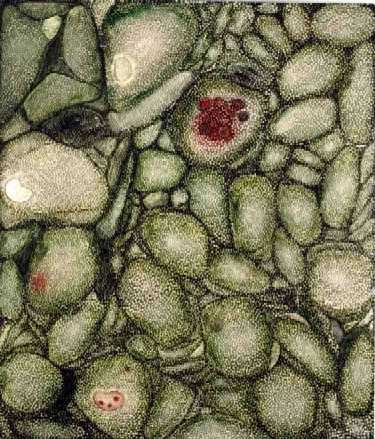
Overexpression, shown left, initially resembles mossy stones in a stream bed; on closer
inspection, the shapes reveal themselves as cells - at least one of which
appears to be carcinogenic. "I'm concerned with mutation, "Bleckner says,
"and the idea of something beautiful, like a cell, mutating into something
treacherous." Indeed, the painting is disturbing and mesmerizing, like a portentous
medical report.
For this viewer, that portent is
AIDS. But Bleckner also sees his work as addressing other issues: diseases
that come with aging and, ultimately, death - in effect, what baby boomers
have always felt exempt from. "I want to deal with the beauty and fragility
of our lives - how vulnerable we are," he says. The Symbolists, in their time,
were fascinated by the aesthetics of mortality. Bleckner, carrying on that
tradition, presents us with a bracing memento mori for our times.
STEVEN VINCENT
"Show me another profession where
you can take a nap," quips Ross Bleckner in his soothing, affable way as we
drink coffee in the skylit living room of this TriBeCa loft. A young man puts
away what remains of the vegetarian curry with white rice he prepared for
lunch-young men, in fact, keep coming and going-and Bleckner muses on stardom.
"Success is all about the fantasy you create for yourself," he says. And
what about his own celebrity? Firecrackers explode nearby-it's the Chinese
New Year-and Bleckner jumps a bit. "That has nothing to do with my work,"
he says irritably. "I wish my life were as exciting as those people make it
out to be."
On the eve of a major retrospective,
painter Ross Bleckner
has to face an unpleasant fact. He's just too, too popular.
Falling Birds
- New York Magazine
- February 20, 1995
Call it art-world sniping, but denigration
of Bleckner has become routine, even obligatory ever since that August evening
in 1993 when Bleckner threw a benefit party for the Community Research Initiative
on AIDS (CRIA) on his Sagaponack estate (formerly Truman Capote's summer
retreat), and Barry Diller, Bianca Jagger, and "Styles of the Times" showed
up. Suddenly, Bleckner, the gay activist, the mentor to young artist, the
sweet, awkward, again ingenue still learning to be what his dealer, Mary
Boone, once advised him to be-"a big artist"-had become something else: A
high society fund-raiser. A schmoozer. A socialite. An opportunist.

ROSS BLECKNER
Bleckner means a lot of things to
a lot of people, which is one reason we're lingering on the subject. As a
rather astoundingly large mid-career retrospective of some 70 paintings goes
up at the Guggenheim in March, Bleckner, at 45, seems on the verge of apotheosis,
a man about to experience genuine American fame. (That he's an early beneficiary
of a new Guggenheim policy mandating more mid-career surveys of American
artists doesn't undermine what amounts to the sanctification of his work.)
Yet no major figure on the art scene since Andy Warhol has inspired such
knee-jerk dismissal on the basis of his social life-and at least Warhol was
making smirky art about celebrity. There's a little irony in Bleckner's eager
embrace of society, and that makes people uneasy. "Artists shouldn't be starving
in the gutter," says a prominent SoHo art dealer who asked not to be identified,
"but they should aspire higher than the consumer culture they're supposed
to transcend."
Envy abounds. It's even murmured
that Bleckner, the son of relatively well-to-do parents from Long Island,
did some palm-greasing along the way. He did, in fact, lend money to art critic
Gary Indiana when the writer was broke in the latter half of the eighties,
two years after Indiana gave Bleckner a good review in The Village Voice.
Otherwise, Bleckner's record looks squeaky-clean, and he doesn't seem the
type to use such strategies, anyway. The Blecknerian assault is charmingly
direct; You see him sizing you up-your age, sexual preference, intelligence,
knowledge about art, potential friendliness or unfriendliness. He makes the
give-and-take of high-end networking seem natural, even appealing; Benignly
cunning in a Bill Clinton sort of way, he finds the middle ground, connects
with you, makes deals with you. He has never "strategized with an art dealer,"
he says sharply, but as his friend the artist Barbara Kruger puts it, "Ross
has always had a very examined relationship to power. If you understand power,
and you're smart, you never believe your own hype. You don't get deluded."
There are no books in the studio;
the paint tubes are neatly aligned; turpentine sits in burnished copper bowls
on polished wooden tables. In a large white room that forms on half of the
studio, Bleckner has put five new paintings up for view. Up on the top floor,
a quiet patio garden resembles a landscape miniature; in the apartment, the
towels draped over a radiator look as though they were cast in bronze. Bleckner's
dachshund, Mini, wiggles around happily. It's like a vast still life-everything
is studied, everything is considered. Raw authenticity is not Bleckner's style.
Both studio and apartment are in
a building he owns-six run-down floors on a scruffy block on White Street.
The real-estate holding is the keystone to Bleckner's rich-kid image, since
his father lent him the money to buy it in 1974, when he was first starting
out as an artist. In a 1984 review of a show at Mary Boone, for example, critic
Brooks Adams wrote that "perhaps because he does not have to paint for a
living, Bleckner can afford to have the last laugh." On the other hand, his
father paid less than $100,000 for the building-the price of a studio apartment
today-and the criticism sounds odd coming from a community where so many
are renters or marry well. "It's a very sixties notion, that to be an artist
you have to have suffered," says Michael Goff, editor-in-chief of Out and
one of Bleckner's protégés.
The suburb Bleckner grew up in-Hewlett
Harbor, in one of the famous Five Towns-was indeed, in the 1960s, a warehouse
for much of Manhattan's freshly accumulated wealth. What he remembers of his
childhood and adolescence, however, is crashing his Pontiac GTO and a sense
of alienation he later described in Art in America as "a certain sadness"-
the estrangement he felt as a gay youth: "I would mimic the social strategies
I saw, but I knew that for me they didn't have resonance."
After graduating George W. Hewlett
High School in 1967-other students from the era included Donna Karan; Sam
LeFrak's daughter Francine, the producer; the photographer Susan Meiseles;
and Art & Auction editor Bruce Wolmer-he enrolled at New York University,
eventually transferring to its studio-art program. He considered a career
in journalism, but also "thought about being an artist a long time," he says.
"It's scary to take the plunge." He adds, "It came to me during an acid trip."
Bleckner's education was eclectic.
He studied with conceptualist Sol Lewitt and photo-realist Chuck Close at
NYU, then did graduate work at CalArts, where John Baldessari held sway with
his own highly theoretical brand of conceptual art. He returned to New York
in 1973. "I first met Ross in the mid-seventies," Julian Schnabel remembers.
"I needed a job and he needed the paint on his ceiling scraped off. It was
horrible, thankless work, and after about half an hour, I said I didn't want
to do it. He said he wouldn't want to, either. From that day on, we were the
best of friends." Schnabel invited Bleckner to stay at his studio in Texas
for his very first show, at Houston's Contemporary Arts Museum in 1976. Things
went a little awry, though. "At dinner before my opening, my mother was complaining
about my attire-she didn't like my leather jacket," says Schnabel. "So I
got angry, walked out of the restaurant, and left Ross at the table." Bleckner
finishes the story: "I ended up escorting Julian's parents to their son's
first opening."
Nowadays, Bleckner likes to pretend
that he didn't crawl out of his studio until the later eighties, but the truth
is that both his remarkable discipline and his love of schmoozing were manifest
early on. That night, Bleckner hung out at the Mudd Club-conveniently located
right downstairs, since he'd rented the owners the space in his building-earning
the attention of dedicated clubbers like Stephen Saba, the nightlife critic
for Details. "That was in the Mudd club's heyday," Saban recalls wistfully.
"Bleckner was always there." Says Kruger: "Ross always zigzagged between being
very social and pulling back. I remember him saying all the time, 'I'd be
a recluse if there weren't so many people around.' "
By day, however, Bleckner worked
in his studio, churning out pastiches in a laborious quest for a style. "Ross
represents an interesting confluence of all these styles floating around in
the mid to late seventies," says critic Lisa Liebmann, who just published
a book on David Salle. "He represented an abstract flip side of New Image
painting, and then he was influenced by the 1979 [Cy] Twombly show, which
was seen as a failure at the time but influenced a lot of younger painters."
He had a few shows in some small and now-forgotten galleries, with only middling
success. "Whenever you wanted to talk to a dealer, they were sick," he recalls.
"I used to think every dealer in New York was sick." In 1978, he met Mary
Boone, a young dealer who was just about to start her own gallery. At his
urging, she also signed on his friends Schnabel, Kruger, and Salle, who (along
with Eric Fischl) would form the nucleus of her celebrated eighties stable.
"I saved Ross's life," Schnabel
explains, "several time. The night after my opening at Mary's, I went to Ross's
loft and found him unconscious, his leg hanging by a piece of skin." A falling
counterweight had pushed over a ladder, which had dragged Bleckner's leg
into the open elevator shaft and severed the main artery. " We took him to
the emergency room at Beekman Hospital, and he was lying around waiting for
a doctor while there was no pulse in his foot. Luckily, I reached my cousin,
who is a vascular surgeon, and we moved him into St. Vincent's and took Ross
right into microsurgery.
Bleckner kept his leg, but the episode
ushered in a bleak phase of his career. While Salle and Schnabel soared.
Bleckner stalled. His "stripe painting"-op-art candy striped on a Barnett
Newman scale-bombed on arrival at Boone in 1981. "People just thought I was
perpetuating a joke," Bleckner later told FlashArt. Boone's interest in Bleckner
dwindled rapidly until, Schnabel says, he intervened: "I told Mary, 'If you
cancel his show, I'm going to leave the gallery.' "Apparently he was persuasive,
and Bleckner's next (1983) show would sell out, although Schnabel is still
dismissive: "It was frustrating, because I really believed in Ross's work.
When people came to my studio, I'd often show them his work. She must be
doing something right if he's still showing with her after fifteen years,
but this stuff about her or anyone else making someone's career is a load
of horseshit." (Boone denies that Schnabel ever confronted her; Bleckner says
he doesn't know.)
It wouldn't have been hard for Schnabel
to defend Bleckner, if in fact that's what happened. Bleckner's dense, meditative,
nice paintings posed no threat to Schnabel's aggressive, splashy Neo-Expressionist
aesthetic. But Bleckner went even further than Schnabel did, actively seeking
out and helping young artist who could conceivably become his competitors,
buying their work, introducing them to clients. His was "a kind of godfather
role," says dealer Perry Rubenstein. "Ross will embrace something that is
subconsciously threatening to him. And most artists don't do that. They surround
themselves with artist who reflect some part of their work and don't threaten
them."
Thirty-two-year-old Alexis Rockman,
whose hallucinatory zoological paintings have made him an up-and-coming star
of the next generation, managed to turn a brief and ill-fated apprenticeship
into a friendship. "I was a miserable assistant, and Ross fired me after three
months," he says. "But we became very good friends. Ross taught me a lot
about how to be an artist, both socially and professionally-how to make myself
available, how not to alienate anybody."
The mentoring paid off: As Schnabel
and Salle began living like movie stars (and, indeed, preparing to become
movie directors), Bleckner was quietly being taken up by the East Village
art scene. Peter Halley, a young painter who rejected the kitschy heroics
of Neo-Expressionism for something cooler and more cerebral, wrote in Arts
in the early eighties that Bleckner's striped were a missing link between
a romantic modernism (Mark Rothko, say, or Willem de Kooning) and a doubting
post-modernism (Salle, for instance). Suddenly, younger artists began to tune
in. "He really orchestrated everything brilliantly," says Rockman. "These
younger guys like [painted and International With Monument Gallery director]
Meyer Vaisman and [painter and Nature Morte Gallery director] Peter Nagy started
getting interested in his work, and Ross was smart enough to encourage them.
Not that it wasn't opportunistic, but there was also something genuine."
It was at Nagy's storefront gallery
that Bleckner held his pivotal 1984 show, in which he displayed just one large
painting, which combined text and abstraction. "There was a whole discourse
about the process of making art the Halley and Ashley Bickerton and Sherrie
Levine had reopened," remembers dealer Pat Hearn. "For Ross to use that painting
was really clever." When Sonnabend Gallery brought together four East Village
artist-Halley, Vaisman, Jeff Koons, and Bickerton-for its infamous 1986 "Neo-Geo"
show, Bleckner's coterie was suddenly on top, and Bleckner, whose work was
always more sensual than intellectual, more incidental than theoretical, ended
up riding on the coattails of Neo-Geo, an aridly ideological movement rooted
in half-understood ideas of structuralism. The irony was not lost on him.
"There's always something that somebody looks at as a precedent," he says.
"maybe people got tired of slopping a lot of paint around. If my work looked
fresh to somebody, I never knew, because people were whisked past my shows
to see some ink drippings in he back room."
The idea for this show came to me
during the renovation of this building," says Lisa Dennison, the curator at
the Guggenheim responsible for the Bleckner retrospective. "One day," she
continues, "I climbed up to the skylight, and I was reminded of Ross's dome
painting. I thought of Ross's sense of the sublime quality of light-and one
of the emphases of the renovation was the restoration of the natural light
that previous administrations had blocked out." Bleckner's feel for chiaroscuro
and his darkly luminescent paint (he varnishes his paintings to get that
dim glow) did flower into some sublime works in the past ten years, and Dennison
has the pick of the lot: the dome paintings, candlelike light throbbing in
vast domes; the starry constellation paintings; and the paintings that use
urns and other funereal motifs as an allusion to AIDS.
Despite Bleckner's rich web of social
and professional connections, the show itself betrays less evidence of back-scratching
than usually crops up under close examination of a major exhibition. His
good friend David Geffen did contribute a small amount of money through his
foundation, and recent dinner partner Ron Perelman has shown a great deal
of interest in the Guggenheim lately. But Dennison, the curator, says Ross
kept the influence of collectors upon the exhibition to a minimum. " A lot
of collectors yelled at the two of us, demanding to have their pieces included,"
says Dennison. "Ross couldn't be swayed."
Bleckner's relative independence
from collectors' whims (in this instance, at least) may stem from the fact
that he is much better represented in European collections than in American
ones. Neither Geffen nor Barry Diller-another close friend-has ever bought
a painting. His biggest collector is the late Thomas Ammann, a Swiss dealer
who discovered Bleckner early on, in 1981. Spanish painter Juan Usle explains
Bleckner's Continental appeal: The paintings, he says, "have this kind of
old memory. It's like the light and atmosphere of El Greco's View of Toledo-it's
really close to a European sensibility."
Bleckner may play the social role
of a society painter-a Sargent for our time-but is his art society art? Not
in the narrow sense of a conservative portraiture, certainly, but Bleckner's
art sometimes seems to reflect the concerns of his glamorous circle more than
any personal vision. This seems especially the case with the AIDS-related
work. While undoubtedly sincere, it sometimes has the feeling of those Victorian
marble monuments under weeping willows-it's too perfect, too composed. Bleckner
deserves credit for trying to do something seductive with paint; his shimmering
surfaces are all the more powerful for being impossible to interpret rationally.
But there is a sense of finish to Bleckner's paintings-a slickness-that reduces
some of their gestures to rhetoric rather than passion. As Jerry Saltz writes
in Art in America, it's "more melodramatic than dramatic."
Bleckner's penchant for being all
things to all people deeply informs his recent work. Not only is he catholic
in his choice of influences, but he seems so happy to accommodate that people
from wildly disparate camps accept his as their own. "There's something in
there for everyone," says Lisa Liebmann. "For those who had a formal sense
for abstraction, those looking for a historicized ironic message, and those
who had a romantic sense of fin de siècle."
Bleckner's Zelig-like nature-he's
ubiquitous, yet hard to pindown-underpins his social persona as well. He often
talks about himself with mildly false modesty-it's his way of encouraging
your sympathy. But he seems genuinely needy, too, and this craving for affirmation
does a lot to explain his binge-purge attitude toward celebrity, which has
him swinging wildly between solitude and gala events. "I'm like any other
insecure guy." he says. "I'd rather be in some hypersocial environment where
I can avoid real interaction."
"Part of me wants to say," his friend
Rockman mock-admonishes, " 'Don't worry about getting in the magazines every
two minutes. You're not going to become extinct.' "
Bleckner's insecurity also reveals
itself in a very thin skin. At several points during our interview, he lashed
out at the art press, mentioning in particular reviews in Art in America by
current New York Times critic Roberta Smith and a snide remark in Art &
Auction by Smith's husband, Saltz, to the effect that Bleckner used to be
a painter but is now a socialite. Yet if you go back to these reviews, you
find that they were more or less positive.
What should we make of Bleckner's
famous friends? His friendships with Geffen et al. have to be understood in
the context of his sexual identity: The gay world is a t the core of Bleckner's
many circles, and he's become enmeshed in the tiny power elite that also revolves
around other gay starts. It seems more inevitable than egregious. And a lot
of the other flak just seems unfair. Roy Lichtenstein and Ellsworth Kelly,
for example, are both richer than Bleckner and do just as much schmoozing,
although they do it out of sight. A Lichtenstein painting commands roughly
four times what a Bleckner painting does; the older painter also has a house
in the Hamptons, and also attends the same functions as Ron Perelman (who,
through Marvel Entertainment, underwrote Lichtenstein's Guggenheim show last
year). And so what if Bleckner is socially adept? Success like his does not
occur without someone's working some angle, and Bleckner happens to be a very
good painter who knows how to work the society angle. There are equally good
painters. But here are also plenty of artists Bleckner's age whose only talent
is for schmoozing.
Besides, as Bleckner asserts, and
as his friends confirm, he genuinely adores the people he socializes with.
He's an opportunist with heart: If his favorite people happen to be among
the richest, most powerful, and most glamorous people in America, hey, that's
between God and Ross Bleckner.
JONATHAN NAPACK
There's a lot of Ross Bleckner to
see in New York City right now, with two gallery exhibitions and a spate of
Absolut Vodka ads in glossy magazines. Taken together they suggest an artist
in search of diplomatic immunity, that is, easy travel to different artistic
planets, from mystical light-filled abstraction to political art to popular
illustration. They also provide a particularly clear view of Mr. Bleckner's
strengths and weaknesses and his tendency to undermine and cheapen his own
accomplishments.
The gallery shows are at Lehmann
Maupin in SoHo and at the artist's longtime home base, Mary Boone, on 57th
Street. The Lehmann Maupin show, which includes a soupçon of political
photo-based work (a new tangent for the artist), features some of the best
paintings he has made in years, maybe ever. Seductive, refined, dominated
by his characteristic grisaille palette and infused with a melancholy inner
light, these works treat motifs and effects that the artist has pursued for
years but with a new economy and force.
Thankfully, Mr. Bleckner has jettisoned
the greasily varnished fields dotted with birds, flowers or flares of light
that dominated so many canvases in his 1995 mid-career survey at the Guggenheim
Museum. While those works were often described as memorials to the devastation
wrought by the AIDS epidemic, such meanings seem largely tacked on by admirers.
What really came across was an air of slick Victorian kitschiness.
In these new works, gray-toned expanses
of tiny overlapping shapes suggest tiny cells, the transparent cytoplasm of
larger cells, microscopic views or cross sections of skin or fish scales.
They evoke illness and the body more concretely but also more abstractly than
anything that Mr. Bleckner has done before. They also resurrect his penchant
for Op Art-like effects but seem less a quotation of the earlier style than
an attempt to extend it.
The fields are generated by a real
dazzler of a technique: hundreds of quick, closely spaced bursts from an airbrush
transform still-wet surfaces dotted with circles and spheres into fluctuating
networks of cells and shadowy forms. (Think of Yayoi Kusama nets painted
in the style of Roger Brown's tightly rendered shaded clouds.)
In fact, the new technique is so
dazzling that the first reaction to these paintings may simply be, "How were
these things made?," followed quickly by a close-up examination of the surface,
which doesn't explain much. You can almost forget to back up and look at them
whole, which is something of a weakness. Such mysterious high finish goes
bravely against the grain of most current abstraction's emphasis on self-evident
process; it's even mildly Victorian (we also look closely at paintings by
Edward Burne-Jones or Richard Dadd to try to see how they're made) but with
a contemporary sci-fi edge.
It is not surprising that one of
two paintings titled "Tolerance," in which the little cell-shapes are organized
into a big mandalalike dome or wheel, is the best work here. Its concentric
circles and radiating spokes add a larger purpose to the tiny pulsating units.
In addition, it is more loosely worked: the airbrushed cell-shapes read more
clearly as the little pool-like clearings of paint that they really are. And
they're not continuous; patches of Mr. Bleckner's casually brushed underlayer
remain visible.
Having returned to more abstract
imagery, Mr. Bleckner presents his political conscience as a kind of side
dish. Along one wall at Lehmann Maupin are a series of photographs of page
A3 of the New York Times, all with a major international story appearing beside
an ad for Tiffany's. This kind of appropriation was done much better nearly
20 years ago by some of Mr. Bleckner's contemporaries, among them Richard
Prince and Sarah Charlesworth. In addition, this juxtaposition of images
of harsh reality (war-torn Bosnia, for example) with smug promotions of high-priced
elegance seems disingenuous, considering that Mr. Bleckner's paintings belong
to the second category themselves.
Things deteriorate further at Boone,
where Mr. Bleckner essentially puts his new technique into overproduction,
something he has done before. The addition of stronger colors makes the paintings
seem more obvious and cloying. DNA-like chains of cells come in pleasant shades
of blue, yellow and pink; red is added to other works so that blood cells
and scientific illustrations are evoked. And the airbrush technique seems
to tighten, which means that many of the cells seem to be made of jelly-beans
or beads; suddenly the paintings seem more photo-realist than abstract.
The vodka ads, which also feature
the cell-shape surface, are something like the last straw. In this context,
a motif intended to set off a certain visual and poetic resonance is leveled,
stripped of seriousness and reduced to entertainment. There are very few artists
whose work can travel from art gallery to magazine advertisements and retain
anything close to their character; Andy Warhol, Keith Haring and Barbara
Kruger are possible exceptions. It would be easy to say that Mr. Bleckner
misunderstands his own art if he thinks it can, too, but maybe the misunderstanding
is ours.
ROBERTA SMITH
The mainstream of today's taste
in abstraction calls for allover patterns rather than, say, a figure/ground
dichotomy (too stodgy) or a single-color field (too academic), a highly refined
sense of surface, and the kind of untouched-by-hands technique that inspires
wonder. People these days like their abstraction impure, for instance, if
as an image it echoes some previous stylistic phenomenon (whether emotionally
charged or just piquantly quotidian) or suggests an origin in some other medium,
like TV or photography. Such associations allow for overtones of nostalgia
without breaking the barrier of cool.
This style originated, pretty much,
with Ross Bleckner's work of the 80's, and it has been adopted in varying
degrees by a wide swathe of younger painters. Two concurrent shows of his
recent work suggests that now Bleckner in turn seems to have been spurred
by the challenge of his young admirer-competitors to push himself to develop
an even slicker, more eye-catching technique, which has (perhaps surprisingly)
resulted in some of his strongest and most expansive paintings. Unlike the
work of most of the young pretenders, though, the best of Bleckner's new paintings
are huge - 10 by 9 feet - as if challenging the spirits of precursors like
Barnett Newman and Mark Rothko as well. And if Bleckner's intention was to
prove that, contrary to all we've ever been taught, slick can also be sublime,
he's pulled it off, at least intermittently.
The AbEx masters were often concerned
with the establishment of a distance and its breakdown. Rothko spoke of seeking
an effect of intimacy, and the same thing is implied in the notice Newman
posted at one of his exhibitions: "There is a tendency to look at large pictures
from a distance. The large pictures in this exhibition are intended to be
seen from a short distance." The intention was not to overpower the viewer
but to create a habitable space of color and light; the same is true with
Bleckner, only his means are different: Instead of broad, open fields of individual
colors, we have vast accumulations of tiny cellular dots, dark at their centers
but shading into brightness at their edges like the shapes in a solarized
photograph. In some of the paintings these cells simply clump together in
such a way that their individual variations in size or ratios of light to
darkness create zones of uneven density. More often, these tiny units are
bunched up so as to create a second order of organic structures, which may
even have nucleus-like centers of a distinct color. In either case, the multiplicity
of minute, irregular patches endows the embracing pictorial field with a
strong feeling of mobility and plasticity, as well as an implicit tactility
quite distinct from the more "optical" expanses of pure color espoused by
Newman or Rothko.
The best of these paintings are
near-grisailles, with just a single color, usually yellow, added to gray and
white of varying shades. (Yellow is an interesting choice, since it evokes
both gladdening associations with solar light and warmth, and dismal ones
of illness and warning.) In the somewhat smaller paintings shown at
Mary Boone Gallery, in which Bleckner threaded a number of colors through and around his cellular
conglomerations, the effect was disturbingly arbitrary, and the cell imagery
was articulated in too literal a fashion. And it was misguided to show some
weak photo-works based on newspaper appropriations à la early Sarah
Charlesworth (seen at Lehmann Maupin). Yet in some of his new paintings Bleckner achieves a unique blend of authority
and sweetness, reaffirming the scope of his project by continuing to change
while remaining true to his beginnings.
BARRY SCHWABSKY
Los
Angeles Times The New Yorker
New
York Times Village Voice
Vanity Fair
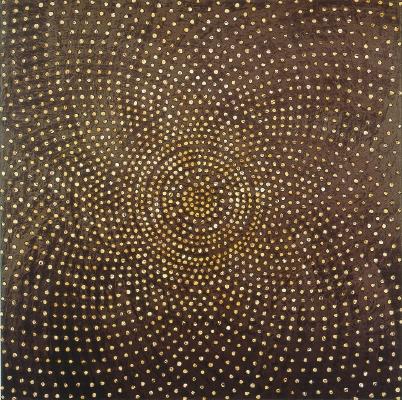
Botanical
Study, Oil on Linen, 60 x 60", © 1993 Ross
Bleckner
angelfire.com/ny/bleckner
was founded in 1996
as the first publicly
owned website pertaining
specifically to
a historically significant
contemporary painter.
Assembled
by Mark Gibson with
a group of art
connoisseurs to
build a resource about
one of the world's
most celebrated artists.
Providing only the
finest art links on the internet.
Brought to you by
Angelfire, a Lycos Network
Site in no way affiliated
with Ross Bleckner,
rbleckner.com, ACRIA, critical acclaim
personnel, representative
galleries, publishers,
institutions or
museums. Aformentioned parties
had absolutely no
input whatsoever in the
content of these
pages. Captions by Ross
Bleckner taken out
of context from interviews.
Photos copyrighted
by Sebastiano Piras, Clark
Anderson, Luis Sinco
and Carlos Rodriguez.
Featured artworks
copyright © Ross Bleckner
and respective owners.
All rights reserved.
Unauthorized duplication
is a violation of applicable laws.