|
Martian Scars
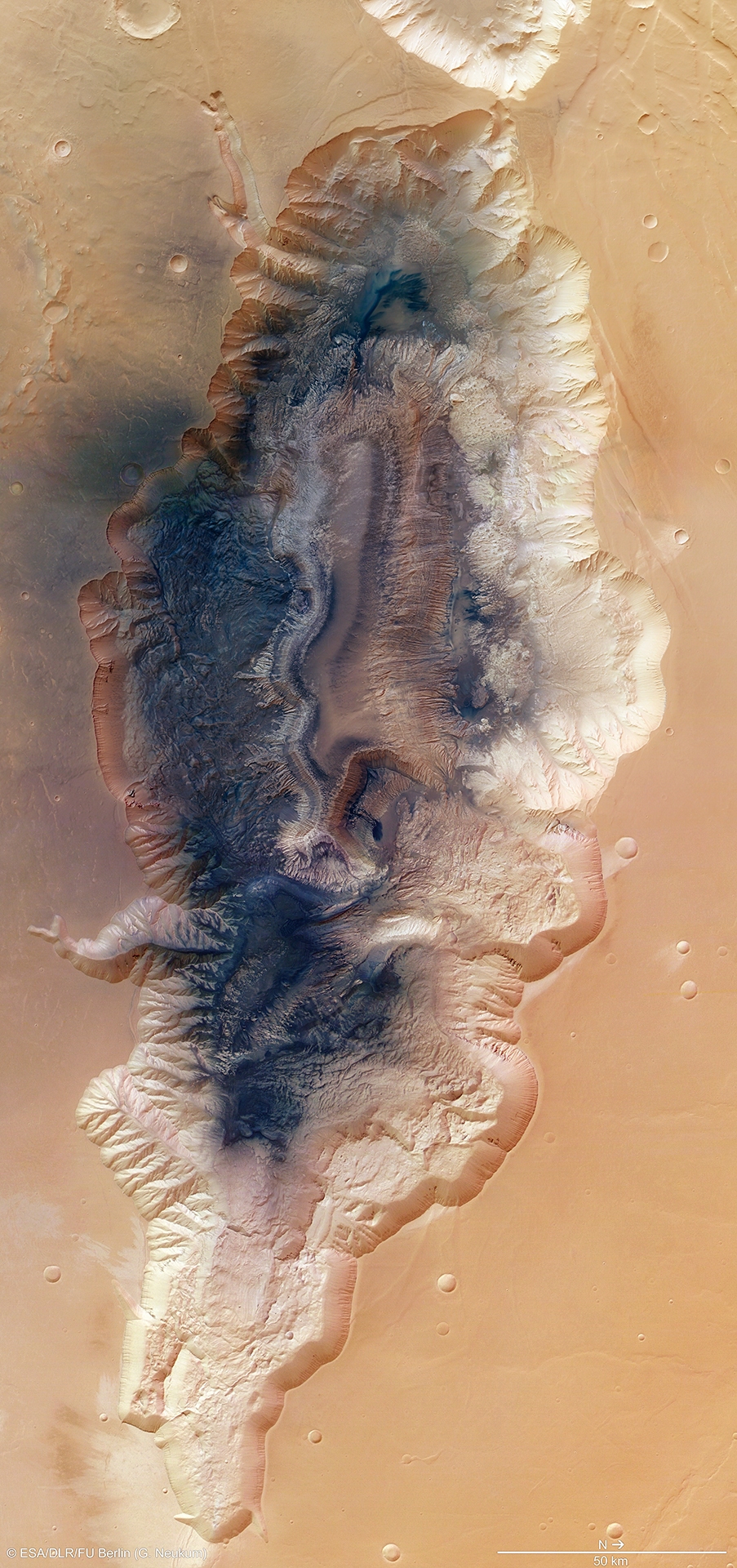
 Hebes Chasma Hebes Chasma
Released 10/10/2013 11:00 am
Ripped apart by tectonic forces, Hebes Chasma and its neighbouring network of canyons bear the scars of the Red Planet’s early history.
Hebes Chasma is an enclosed, almost 8 km-deep trough stretching 315 km in an east–west direction and 125 km from north to south at its widest point. It sits about 300 km north of the vast Valles Marineris canyon. A flat-topped mesa is located in the centre of Hebes Chasma, which was likely shaped by the action of wind and water.
The origin of Hebes Chasma and neighbouring canyons is associated with the nearby volcanic Tharsis Region, home to the largest volcano in the Solar System, Olympus Mons.
Copyright ESA/DLR/FU Berlin (G. Neukum)
Click Image for a larger one.
Handback of 2.2-metre Telescope
Telescope still operational for users from the Max Planck Society
30 September 2013
As of 1 October 2013, the MPG/ESO 2.2-metre telescope at the La Silla Observatory in Chile, will no longer be offered to the ESO community. Up to now  the telescope has been operated by ESO and made available to the ESO community, as well as users from the Max Planck Society (MPG). In future ESO will no longer offer the telescope to its users, although the Max Planck Society will continue to use it. The telescope and its instruments were also made available to Chilean astronomers and this will also continue in the future. the telescope has been operated by ESO and made available to the ESO community, as well as users from the Max Planck Society (MPG). In future ESO will no longer offer the telescope to its users, although the Max Planck Society will continue to use it. The telescope and its instruments were also made available to Chilean astronomers and this will also continue in the future.
The MPG/ESO 2.2-metre telescope was originally constructed by the Max Planck Institute for Astronomy (Heidelberg, Germany) and intended to be sited in Namibia. It was not installed there and later offered to ESO under an agreement where ESO undertook the installation of the telescope at the La Silla Observatory in Chile — achieved in 1983 — and managed its subsequent operation.
Over a period of thirty years the MPG/ESO 2.2-metre telescope has been used for much cutting-edge science, including ground-breaking research into the afterglows of gamma-ray bursts, the most powerful explosions in the Universe.
As well as its current instrumentation: the WFI camera, the much-used FEROS spectrograph and the GROND gamma-ray burst system, the MPG/ESO 2.2-metre telescope was also the host of the first common-user infrared camera offered by ESO, the IRAC system, which was installed back in 1988. All data collected with the telescope will later become available through the ESO Science Archive.
The MPG/ESO 2.2-metre telescope, particularly when used in conjunction with its Wide Field Imager (WFI), has also been one of the most productive facilities for producing beautiful images that ESO has released as photo releases (more than twenty of the Top 100 images from ESO were produced using this telescope and camera). ESO will continue to compose images from WFI data over the next few years, based on data already acquired.
Hubble Sees a Horsehead of a Different Color
 APRIL 19, 2013 APRIL 19, 2013
Unlike other celestial objects there is no question how the Horsehead Nebula got its name. This iconic silhouette of a horse's head and neck pokes up mysteriously from what look like whitecaps of interstellar foam. The nebula has graced astronomy books ever since its discovery over a century ago. But Hubble's infrared vision shows the horse in a new light. The nebula, shadowy in optical light, appears transparent and ethereal when seen at infrared wavelengths. This pillar of tenuous hydrogen gas laced with dust is resisting being eroded away by the radiation from a nearby star. The nebula is a small part of a vast star-forming complex in the constellation Orion. The Horsehead will disintegrate in about 5 million years.
For more Information Click Here.
Image Credit: NASA/ESA/Hubble Heritage Team
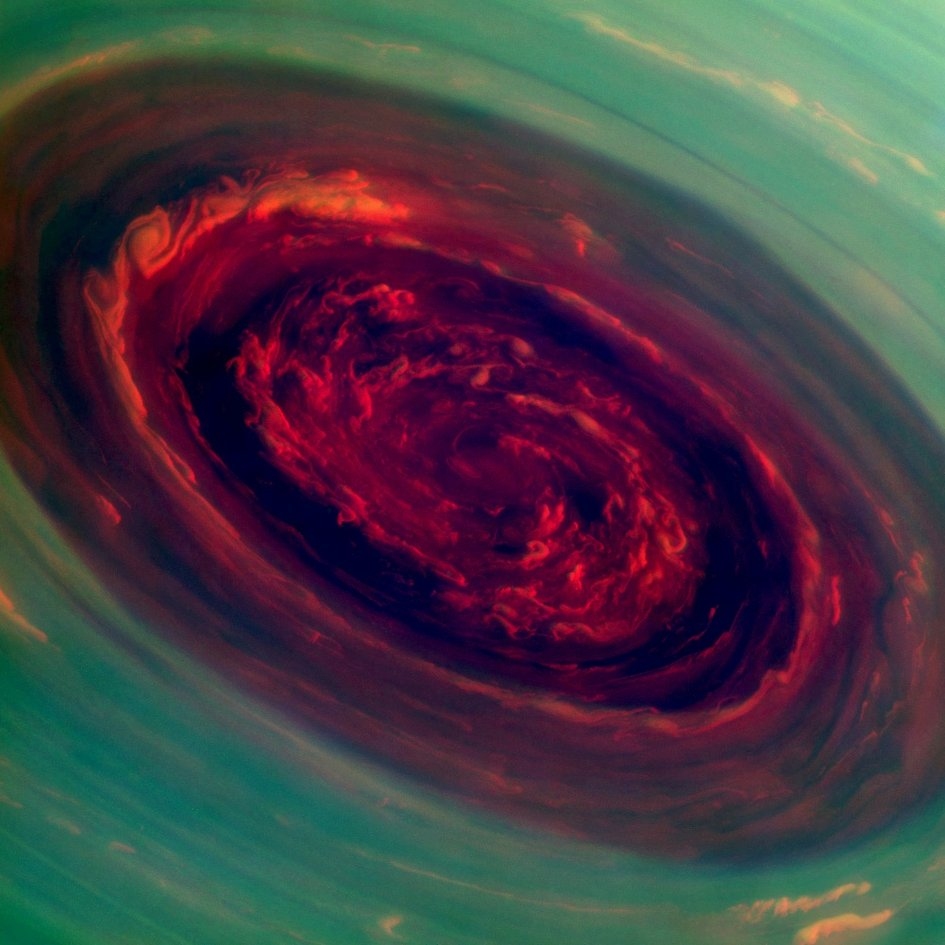
Saturn's north-pole hurricane close up
Spectacular close-up view of Saturn’s north-pole hurricane, as seen by the international Cassini spacecraft, revealing the intricate detail of cloud formations  in this dynamic feature. in this dynamic feature.
The images were captured by Cassini from a distance of about 419 000 km from Saturn on 27 November 2012, and are the first close-up views of this storm. Image scale is 2 kilometres per pixel.
The images were taken with the Cassini spacecraft narrow-angle camera using a combination of spectral filters sensitive to wavelengths of near-infrared light. The images filtered at 890 nanometres are projected as blue. The images filtered at 728 nanometres are projected as green, and images filtered at 752 nanometres are projected as red. In this scheme, red indicates low clouds and green indicates high ones.
The eye of the hurricane spans about 2000 km and the clouds at the outer edge are travelling at 540 km/h.
The hurricane shares striking similarities to those seen on Earth: both have an eye with no clouds or very low clouds at the centre, high clouds forming an eyewall, with other high clouds spiralling around the eye, and an anticlockwise spin in the northern hemisphere.
Credits:NASA/JPL-Caltech/SSI |