Performance Diary
Home | Free Mods | Intake | Ported Heads & Manifold | Exhaust | Gears | Transmission | Brakes | Parasitic HP | Fuelling | Interior | Weight | Performance | HP Gains | PartsMy Mustang wasn't completely stock after the initial fixes but it was close enough to get some baseline performance measurements. The only deviations from stock spec were hollowed out front cats, while the plugged up rear cats were replaced by two new el cheapo 2.5" straight-through mufflers. A baseline run on a Dynojet chassis dyno yielded 167.8rwhp @ 4500rpm and 217.6rwtq @ 3400rpm, equivalent to 224bhp/282lbft at the crank and close to the stock factory ratings of 215bhp/285lbft.
Most of us can relate to 0-60mph acceleration times and the 1/4 mile ET / trap speed but I chose a real-world performance measurement; the 30-70mph acceleration time in kickdown. The 30-70 time reflects the ability of a vehicle to accelerate from the on-ramp onto the highway, is a very good measure of overtaking ability, and is close to the 0-60 time for most vehicles. It's easy to measure and doesn't require a tire-smoking standing start so the results are more accurate and reproducible.
1. Stock baseline: 30-70 = 7.5secs, 1/4 mile 16.03 @ 89.4
2. Free mods: 30-70 = 7.2secs, 1/4 mile 15.83 @ 90.6
3. Intake mods: 30-70 = 6.8secs, 1/4 mile 15.61 @ 92.3
4. 3.73:1 ring & pinion: 30-70 = 6.7secs, 1/4 mile 15.54 @ 92.7
5. ASP crank pulley, mufflers: 30-70 = 6.5secs, 1/4 mile 15.36 @ 93.8
6. Ported factory E7TE heads/lower intake manifold: 30-70 = 6.1secs, 1/4 mile 15.04 @ 95.0
7. Shift kit, aluminium driveshaft: 30-70 = 5.6secs, 1/4 mile 14.70 @ 97.7 (O/D off)
8. MAC long tube headers, modified H-pipe, 190lph fuel pump: 30-70 = 5.2secs, 1/4 mile 14.37 @ 100.3 (O/D off)
9. Crane 1.7 roller rockers, BBK adjustable FPR: 30-70 = 5.1secs, 1/4 mile 14.36 @ 100.6 (O/D off)
10. MM rear lower control arms, Bridgestone Turanza tires: 30-70 = 4.9secs, 1/4 mile 14.17 @ 100.6 (O/D off)
11. 113lb weight reduction: 30-70 = 4.8secs, 1/4 mile 14.03 @ 101.5 (O/D off)
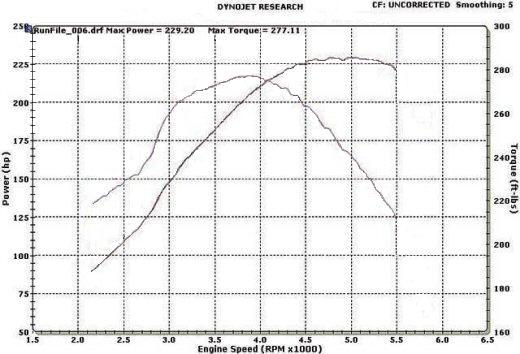
These modifications gave the Mustang the muscle it deserves, being faster than an original 1967 Shelby GT 500. In this configuration, it put down 229.2rwhp @ 5000rpm and 277.1rwtq @ 3800rpm on the Dynojet. A big improvement over stock and equivalent to 299bhp/358lbft at the crank when the 23% drivetrain loss through the AODE automatic transmission and stock torque converter is factored in. The engine itself was stock except for DIY-ported OEM heads/intake manifold and 1.7 ratio roller rockers so there was still plenty more performance potential left hidden under the table.
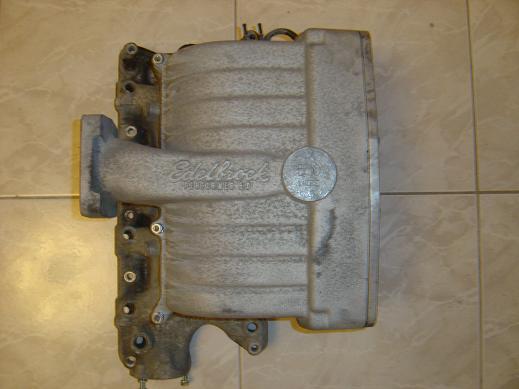
12. Edelbrock Performer intake manifold: 30-70 = 4.5secs, 1/4 mile 13.84 @ 103.0 (O/D off)
13. Further 52lb weight reduction: 30-70 = 4.3secs, 1/4 mile 13.82 @ 103.2 (O/D off)
With the Edelbrock Performer intake manifold installed, the Mustang put down 243.5rwhp @ 5150rpm and 284.2rwtq @ 3950rpm on the Dynojet, equivalent to 318bhp/367lbft at the crank. I'm very happy to have achieved my performance goal at relatively low cost, and it's come with the bonus of ~1mpg better gas mileage than stock.

 Edelbrock Performer Intake Manifold
I found a good used upper/lower manifold from ebay (also came with free Fox 65mm throttle body & EGR spacer) but it looked oxidized and really needed sprucing up. After cleaning it and painting it with heat-resistant aluminium paint it looked much better. In order to use this manifold in a '94-'95 5.0L Mustang, a throttle body adapter elbow is required so I bought the Trick Flow 75mm elbow to match the throttle body size. Since the inlet to the Edelbrock upper manifold is only 70mm in diameter, I had to enlarge it to 75mm to smoothen the transition from the adapter elbow.
The manifold swap was easy and apart from replacing a couple of frayed rubber vacuum hoses, installation went without a hitch. Upon start-up the engine idled smoothly and there were no oil/coolant leaks. Throttle response was noticeably improved and the engine felt stronger at all speeds but especially above 3000rpm. It was definitely worth the effort and I was very happy with the 14.3rwhp/7.1rwtq gain on the Dynojet.
 Dyno Runs
Stock: 167.8rwhp @ 4500rpm, 217.6rwtq @ 3400rpm
(224bhp/282lbft crank)
Modified: 243.5rwhp @ 5150rpm, 284.2rwtq @ 3950rpm
(318bhp/367lbft crank)
The improvement in HP/TQ output across the whole rpm range was dramatic with much more useable power available at higher rpm. In stock form, the engine was being choked by 5000rpm but with the current modifications, the engine can breathe much better and pull strongly up to 5500rpm.
 Future Mods?
Ultimately, the Edelbrock Performer intake manifold was indeed my last performance mod. I continued to enjoy driving the car without any further changes for the next 4 years when I decided to reinstall the AC components and make the system functional again.
After 6 years and 8 months of ownership, the itch to move on to a retro-styled S197 GT model with a manual transmission needed to be scratched and I sold the car on to a lucky new owner on 22nd October 2013 for $3268.