The Bond Street Euterpean Singing Society

Arts Group-in-Residence at the
Merchants House Museum
29 East 4th Street, New York City
SPRING FEVER! - The Song Is On the Rose
Saturday, May 18, 2013 at 7:30 PM at the MHM
The Bond Street Euterpean Singing Society revs up to a fever pitch with balmy lyrics to cure what ails you this Spring. A 19th century salon of art song sung in the Museum's authentic Greek Revival parlors. Euterpeans Anthony Bellov, Rosalind Gnatt, Jane Elizabeth Rady, Dayle Vander Sande, and pianist Jai Jeffryes perform music by Debussy, Rossini, Mendelssohn, Schumann, Wolf, Sullivan, and more. 75 minutes. $25; $10 MHM Members.
Please visit www.merchantshouse.org/calendar for reservations and more information.
The Bond Street Euterpean Singing Society (BSESS), the arts group-in-residence at the Merchant's House Museum, has been performing nightly at “‘The Merch’ since 1835 . . . ,” quoting NYC Parks and Recreation Commissioner Adrian Benepe. The group debuted at the Museum’s annual 19th-Century Holiday Party in 2004, and since then has been heard in the New York Metropolitan Area at the Washington Square Arch relighting ceremony, the Mt. Vernon Hotel and Garden (NYC), the Glenview Mansion/Hudson River Museum (Yonkers), The Theodore Roosevelt Birthplace (NYC) (for which an original work was commissioned for the 150th anniversary of TR’s birth), Woodlawn Cemetery (Bronx), and various private events. The group has also presented special programs at Bentley University (Waltham, MA), the Capitol Theatre (Rome, NY), and the Katherine Hepburn Cultural Arts Center (Old Saybrook, CT). BSESS presents an ongoing series titled “Salon Music,” in which classical, historically informed, and original music programs take place in the Merchant’s House Museum’s authentic Greek Revival double parlors, and for which BSESS was awarded a grant from the Puffin Foundation for Salon Music 2012. Following the tradition of Euterpean Societies in America since the 18th Century, the group takes its name from Euterpe, the muse of lyric poetry and music and honors the local neighborhood once known as The Bond Street Area, home to the most prominent New York families prior to the Civil War.

Euterpe, Greek Muse of Poetry and Music.
Her name means "delight," which she brings to all
those who hear her sing. The double-flute is her attribute.
Part of the mission of BSESS, being the arts group-in-residence at The Merchants House Museum, is to bring the experience of the living history of 19th-century musical works to the House. The Society debuted at MHM's holiday party in 2004, and often performs in period costume. In addition to its holiday program of songs and stories beloved in the merry season, BSESS presents original programs and parlor music concerts throughout the year. They continually build new programs to entertain and educate the public about 19th-century music. Currently in progress is a program of songs and scenes of the Bowery for future production.
Another part of our mission was to raise awareness and funds to benefit the restoration of the Tredwells' 1845 Nunns & Fischer pianoforte. Purchased by the family for the house, it still remains today in its place of privilege in the front parlor. This task now complete, we continue our work to benefit Museum programs and operations.
 To All, Wassail! -- songs and stories of the merry season
The Bond Street Euterpean Singing Society delights audiences with their holiday program of Christmas, Channukah and secular songs beloved in the 19th Century and before. There are beautiful arrangements of familiar carols, as well as surprises to put a holiday smile on your face. The music program is punctuated by readings of stories and poems of the Century.
 Love in the Parlors -- 19th-century romance in opera and song
This classical voice recital is a popular annual Valentine's Day event sung by members and guest artists of BSESS. Chosen by NBC Online as one of the top picks for 2010 and a top pick for TimeOut NY for 2012.
The program changes each year. Past composers represented include Amy Beach, Bizet, Brahms, Chopin, Donizetti, Faure, Stephen Foster, Gottschalk, Gounod, Liszt, MacDowell, Mahler, Moniuszko, Offenbach, Parry, Rossini, Schubert, R. Schumann, Johann Strauss Jr., Richard Strauss, A. Sullivan, Tchaikovsky, Tosti, and Wagner.
 Wayfaring Strangers -- a musical revue of 1820s New-York
Originally written for the Mt. Vernon Hotel Museum on East 61st Street, this program has been rewritten to recreate a house warming celebration for the Tredwells. Four historic characters chance to meet there and spend the afternoon enjoying each other's company while singing familiar tunes of the day: John Bloomfield Jervis, a celebrated engineer who learned his trade while building the Erie Canal and then went on to design the Croton Reservoir system; Sarah Josepha (Buell) Hale, most known for being editor of Goudy's Ladies' Home Journal as well as being purported to have written "Mary had a little lamb;" the enthusiastic Captain William Driver, who coined the moniker "Old Glory" for the US flag; and Mary Hone, society daughter of the once New York City mayor Philip Hone.
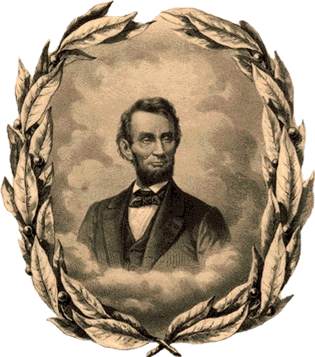 Farewell, Father, Friend and Guardian --
 a musical elegy commemorating President Lincoln's Passing
Recreated as a memorial service complete with mourning costume and arm bands, this program presents music written in 1865 commemorating Lincoln's death. The title comes from a popular song by celebrated American composer George F. Root. Accompanying the concert is a slide lecture of Lincoln's assassination, its aftermath and the funeral train that transported the president from Washington, D.C. to his final resting place in Springfield, Illinois.
