Suggestions for amplifying chromatic harmonica performance.
Check out Harp On! Amplified Harmonica for more information on harmonica amplification.
Before you spend money on gear spend half an hour just playing harmonica to yourself. Do you like what you hear? Do you enjoy the sound ? If the answer is no, then you need to work on your OWN tone, first.
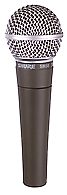 The Shure SM58 is
highly recommended quality clean vocal mic, popular with singers and acoustic
harmonica players.
The
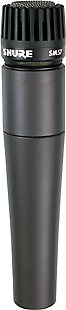
Shure SM57
is an instrument wand mic, when cupped it adds more compression to your tone
and has slightly more bass end response than the SM58.
The
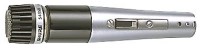
Shure 545SD is shaped like the SM57, it has a slightly different tone to
the SM57 but the same kind of compression when cupped tightly. The appeal of
this versatile mic is it can be wired to high impedance, and therefore a hot
signal that can be used to drive a guitar effects and amps, in the same way
popular bullet mics used by some harmonica players. The current model comes
standard with an on/off switch.
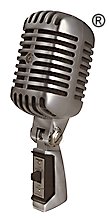
The Shure 55SH Series II gives a warm muted vintage tone of the 50's singer's genre but only intended to be mounted on a stand. There are many other good clean mics can all be setup for acoustic harmonica by mounting it on a microphone stand or held by the performer cupped with the instrument.
The Shure SM58 is
highly recommended quality clean vocal mic, popular with singers and acoustic
harmonica players.
The
Shure SM57
is an instrument wand mic, when cupped it adds more compression to your tone
and has slightly more bass end response than the SM58.
The
Shure 545SD is shaped like the SM57, it has a slightly different tone to
the SM57 but the same kind of compression when cupped tightly. The appeal of
this versatile mic is it can be wired to high impedance, and therefore a hot
signal that can be used to drive a guitar effects and amps, in the same way
popular bullet mics used by some harmonica players. The current model comes
standard with an on/off switch.
The Shure 55SH Series II gives a warm muted vintage tone of the 50's singer's genre but only intended to be mounted on a stand. There are many other good clean mics can all be setup for acoustic harmonica by mounting it on a microphone stand or held by the performer cupped with the instrument.
 You generally want a microphone with a good broad response across the spectrum.
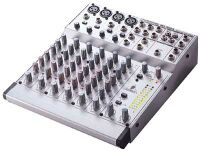
Most mics of this type can be plugged straight into any PA or mixing desk for live performance or recording. There are special direct input boxes and effects units designed for vocal mics which will accept these mics using XLR (3 pin) balanced connections.
You generally want a microphone with a good broad response across the spectrum.
Most mics of this type can be plugged straight into any PA or mixing desk for live performance or recording. There are special direct input boxes and effects units designed for vocal mics which will accept these mics using XLR (3 pin) balanced connections.
 But if you wish to use these into other effects units, guitar amplifier or amplifier emulators for different tones and effects then you'll need to get an impedance convertor from low impedance to high impedance.

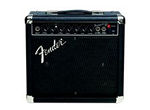 You can add a lot of warmth to your tone without losing clarity by playing through a good all-tube type A amplifier such as the Fender Bassman RI, Fender Blues Junior, Fender Super 60 or Fender Champ.
Ensure that the amplifier isn't driven too hard causing distortion, use a clean microphone like the SM58 with an impedance convertor, if you use a low impedance microphone directly into an amplifier you will get a weak tone.
If you are playing at a moderate to large venue then have a clean microphone placed in front of the amplifier fed into the PA, although in a small venue the amplifier may be enough.
You can add a lot of warmth to your tone without losing clarity by playing through a good all-tube type A amplifier such as the Fender Bassman RI, Fender Blues Junior, Fender Super 60 or Fender Champ.
Ensure that the amplifier isn't driven too hard causing distortion, use a clean microphone like the SM58 with an impedance convertor, if you use a low impedance microphone directly into an amplifier you will get a weak tone.
If you are playing at a moderate to large venue then have a clean microphone placed in front of the amplifier fed into the PA, although in a small venue the amplifier may be enough.