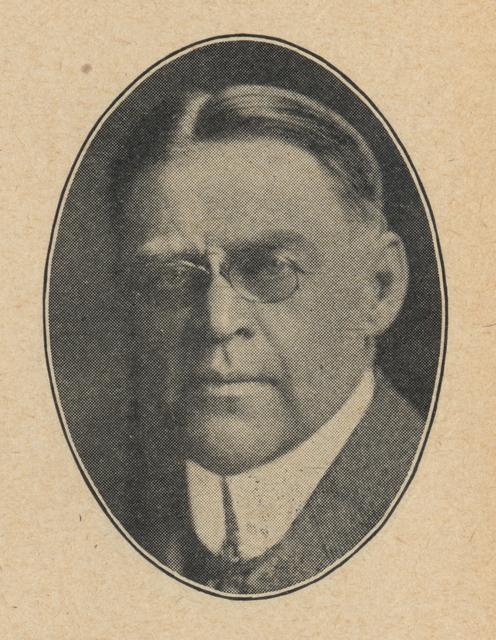
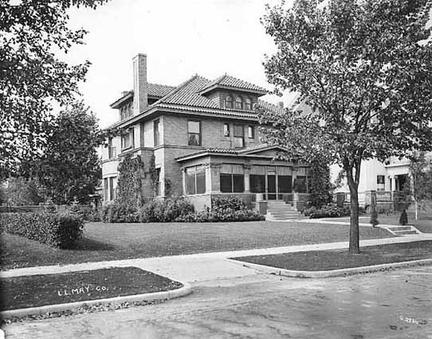
Lawrence A. Martin
General. The Washburn-Fair Oaks "Mansion" District is located in Minneapolis, just south of downtown. Fair Oaks became a fashionable neighborhood for several generations of Minneapolitans because it was convenient to downtown while it was separated by elevation of land from the working class sections of the city. The neighborhood's grandest mansions were built by the first generation of Minneapolis business leaders from the 1850's to the 1880's. Unfortunately, only one of the houses from this era remains. Today, the district consists of the early 20th century homes of the second generation elite, which are clustered around the Minneapolis Institute of Arts, Fair Oaks Park, and the First Christian Church. These structures were built on the sites of the earlier mansions. Most of the houses are now used for commercial and institutional purposes. The architecture of the neighborhood showcases the work of some of Minneapolis' most prominent architects, including William Channing Whitney, Hewitt & Brown, and Ernest Kennedy. A wide range of period revival styles were popular during this period, and most of them are represented in the district. The district was added to the National Register of Historic Places in 1977.
Specific Structures. The following presents available information on the housing styles of specific structures located along this portion of the hike:
2400 Third Avenue South: Minneapolis Institute of Arts; Built between 1911 and 1914; originally Neoclassic/Beaux Arts in style, with addition Contemporary in style; McKim, Mead & White, original museum architect, Hewitt & Brown, art school architect, and Kenzo Tange, in association with Parker, Klein Associates, addition architects. The museum is a monument designed by the American masters of the Beaux Arts style. The 1885 city directory indicates that Mr. and Mrs. E. H. Moulton, Dr. and Mrs. H. H. Kimball, Clinton Morrison, and Hon. and Mrs. D. Morrison resided at this address. The museum was built as gallery space for the Minneapolis Society of Fine Arts, replacing a small gallery in the original Minneapolis Public Library at 10th and Hennepin. The Minneapolis Institute of Arts was established in 1883. The mansion owners in Fair Oaks were major benefactors of the Institute. The Morrison family donated the site of its mansion, "Villa Rosa," for the new museum and the core of the original collection came from the private collections of the neighbors. Dorilus Morrison (1814/1816-1897/1898), the son of Samuel Morrison, a wheelwright, and Betsey Benjamin Morrison, was born in Livermore, Oxford County, Maine, was a lumberman, was in the mercantile and lumbering business in Bangor, Maine, in 1842, came to Minnesota in 1854 or 1855, spent one year in Stillwater, Minnesota, invested in a large tract of pine lands on the Rum River, was a St. Anthony lumber mill operator and business leader, engaged in the manufacture of lumber, was prominent in the development of the water power of the falls of St. Anthony, was prominent in connection with the Northern Pacific railroad, was also a large stockholder in the Minneapolis Harvester Works, was a Republican, served in the Minnesota State Senate representing Hennepin County (District 5) from 1864 to 1865, was the first mayor of Minneapolis (1867-1868 and 1869-1870), served on the Minneapolis Board of Education, was a Minneapolis Park Board commissioner, was the president of the Northwestern National Bank, built the first house in the Fair Oaks neighborhood in 1858, nine years before the area was incorporated into the city, died in Minneapolis, and is buried in Lakewood Cemetery (Section 2.) Morrison was a principal incorporator and the treasurer of the Minneapolis Mill Company, which was incorporated in 1856 and eventually owned all the water power upon the west side of the Mississippi River, several saw mills and flour mills, a large elevator, and the North Star woolen mill. Morrison was involved with the Minneapolis Harvester Works in the 1860's and with the Upper Mississippi Navigation Company and the Consolidated Elevator Company in Duluth. Morrison also was a director of the Northern Pacific RailRoad before its reorganization after the default of Jay Cooke and he built a 240 mile section of the rail line from the St. Louis River to the Red River. Dorilus Morrison was married at Livermore, Maine, to his first wife, Harriet K. Whitmore/Whittemore Morrison ( -1881), and the couple had three children, George H. Morrison, Clinton Morrison (1842-1913,) and Grace Morrison (eventually, the wife of Dr. H. H. Kimball) and his second wife, Abby C. Clagstone Morrison, was the former Mrs. A. G. Clagstone. Morrison called his residence "Villa Rosa." It was reached from the city by following a winding trail up Lowry Hill through scrub oak and hazel underbrush. Ethel Morrison Van Derlip (1876-1921) was the daughter of financier Clinton Morrison and, in 1898, married John Russell Van Derlip (1860-1935,) a lawyer from New York who came to Minneapolis in 1881, was one of the founders of the Minneapolis Institute of Arts, was a trustee of the Minneapolis Institute of Arts and its president from 1928 to 1935, and left his collection of 229 objects and 1,112 books to the Institute. Ethel Van Derlip left an endowment to the Minneapolis Institute of Arts. The museum building was originally designed to have a series of large inner courts created by a Museum, Orchestra Hall, Architectural Hall, and an Arts School. Unfortunately, only the museum frontispiece was built. It is one of the finest Beaux-Arts buildings in Minnesota, with its portico, grand stairs, rotunda, fountain court, and a third-floor central gallery lit by a sky light. The Arts School was built in 1916. In 1973-1974, the museum was enlarged with the addition of modernist wings on the east and west, and with the construction of additional gallery space behind the original building. The entrance was shifted away from the front steps to a modern glass and brick side on 3rd Avenue. Tange's designs also included the Children's Theater and the Minneapolis College of Art and Design as companions to the museum. Hanibal Hamlin Kimball was named for a family friend in Bangor, Maine, who was a U.S. Senator from Maine and was Abraham Lincoln's first term Vice-president, attended the New York Medical College, then moved to Minneapolis, and worked as a surgeon. Hanibal Hamlin Kimball married, but the couple had no children and Kimball treated his neice and nephew, Emily Ames (1893- ) and Paul Ames, the children of Paul Kimball Ames and Agnes Guptil Kimball, as if they were his children. Hannibal Hamline Kimball (1843-1928,) the son of John Kimball, a lawyer, and Abigail Homans Kimball, was born in Carmel, Penobscot County, Maine, studied at the Hampden Academy in Maine, studied at the Lewiston Seminary in Maine, studied at the Hampden Academy, studied at the Pittsfield Medical College in Massachusetts, studied at the Medical School of Maine, studied at the Bellevue Hospital Medical College in New York, graduated in medicine from the medical school of Bowdoin College in 1866, moved to Minnesota in 1867, settled in Minneapolis, married Grace Everett Morrison, the daughter of Dorilus Morrison, in 1870, was licensed to practice medicine in Minnesota in 1883, practiced allopathic medicine and surgery in Minneapolis, toured European hospitals in 1879-1880, was the medical practice partner of Dr. Calvin Gibson Goodrich for five years, was a Mason, became a Master Mason in 1872, was the president of the Hennepin County Medical Society, was the president of the Minnesota Medical Society from 1886 until 1887, was vice president of the American Medical Association, was the president of the United States Board of Pension Examiners, was a surgeon employed by various railroads, and died in Minneapolis. In 1877, Dr. H. H. Kimball was an examiner of Civil War pension applicants. F. A. Dunsmoor (1853- ) was associated for a time with H. H. Kimball in a medical practice and was a surgeon for the Milwaukee & St. Paul RailRoad. Frederick Alanson Dunsmoor (1853- ,) the son of James A. Dunsmoor and Almira Mosher Dunsmoor, was born in Harmony, Richfield Township, Minnesota, graduated from the public schools of Richfield and Minneapolis, graduated from the University of Minnesota, graduated from the Bellvue Hospital Medical College in New York in 1875, was a private student of Frank H. Hamilton, Alfred G. Loomis, Austin Flint, Sr., E. G. Janeway, and R. Ogden Doremus in surgery, diseases of the chest, pathology and chemistry, was a physician initially in a partnership with Dr. H. H. Kimball, after 1877 in solo practice, as a partner of Williard Byther Pineo, and subsequently as a partner of Dr. Nicolay H. Scheldrup in Minneapolis, was a Republican, was a Methodist, married Elizabeth Emma Billings "Bessie" Turner, the daughter of United States Army surgeon George F. Turner, in 1876, was a professor of surgery in the St. Paul Medical College from 1877 until 1879, was county physician for Hennepin County in 1879, was chair of surgery in the medical department of Hamline University from 1879 until 1881, was a founder of the village of Buxton, Minnesota, in 1880, was an organizer of the Minnesota College Hospital and was dean of the college, was active in organizing Asbury Methodist Hospital in 1892, was a physician at St. Mary's Hospital, the St. Barnabas Hospital, the City Hospital, and the Swedish Hospital, introduced antiseptic surgery to Minnesota, was the surgeon for the Chicago, St. Paul, Minneapolis & Omaha RailRoad, the Minneapolis, St. Paul & Sault Ste. Marie RailRoad, the Northern Pacific RailRoad, the Great Western RailRoad, and the St. Paul & Duluth RailRoad, was the medical director of the Surety Fund Life Company, was a member of the Minneapolis Club, was a member of the Commercial Club, was a member of the University of Minnesota Medical Department from its organization when the Minnesota College Hospital was merged into the State University in 1889 until 1913, was a member of the International Medical Congress, was a member of the National Association of Railway Surgeons, was a member of the American Medical Association, was a member of the Minnesota Academy of Medicine, was a member of the Western Surgical and Gynecological Association, was a member of the Tri-State Medical Association, was a member of the Crow River Medical Association, was a member of the North Dakota State Medical Society, was a member of the Tri State Medical Society, was a member of the Society of Physicians and Surgeons of Minneapolis, was a member of the Hennepin County Medical Association, and was a member of the Minnesota State Medical Society, made an especial and extensive study and practice of gynecology, presented the paper "Successful Surgery" before the Minnesota State Medical Society in 1892, authored the paper "The Call For Exploratory Operation in the Gall-Bladder Region" in the Journal of the American Medical Association, presented the paper "Necrosis of Soft Parts Following Enormous Subcutaneous Injections of Adrenalin" before the Minnesota State Medical Association in 1904, was a member of the Nu Sigma Nu Society, was a Mason, was a Druid, and was a Good Templar. Frederick Alanson Dunsmoor and Elizabeth Emma Billings Turner had seven children, three who lived to maturity, Frederick Laton Dunsmoor ( -1911,) Marjorie Allport Dunsmoor (Mrs. Fred) McCartney, and Elizabeth Turner Dunsmoor (Mrs. Homer) Clark. Charles Bidell was a coachman employed by F. A. Dunsmoor in 1882. Hanibal Hamlin Kimball ( -1928) died in Hennepin County. Dorilus Morrison was born in Livermore, Androscoggin County, Maine, was a banker, was a member of Minnesota State Senate from the Fifth District (1864-1865,) and was mayor of Minneapolis. In 1864, Dorilus Morrison established the fifth saw mill at St. Anthony Falls. Morrison had previously operated a gang mill on the east side and had previously been engaged in logging in the Rum River pineries. The Minneapolis Gas Light Company was founded in 1870, with Dorilus Morrison as its president. The company built a coal gasification plant at the foot of 14th Avenue South on top of the river bluff. Also in 1870, Dorilus Morrison built the Minneapolis Cotton Mill on the east side of the west side canal at the falls of St. Anthony. The mill moved to the back of the west side sawmill platform in 1877 and continued to operate into the early 1880's. Dorilus Morrison died in Minneapolis and is interred at Lakewood Cemetery, Minneapolis. Eder H. Moulton (1844-1927) was the president of Twin City Telephone Company, and, in 1886, was an incorporator of the Minnesota Homeopathic Medical College, located in Minneapolis. Clinton Morrison was one of the original incorporators of the Minneapolis, Sault Ste. Marie & Atlantic Railway Company (the "Soo Line") with W. D. Washburn, H. T. Welles, John Martin, Thomas Lowry, George R. Newell, Anthony Kelly, C. M. Loring, J. K. Sidle, W. W. Eastman, William D. Hale, Charles A. Pillsbury and Charles J. Martin and served on the original board of trustees in 1883. He was replaced by C. H. Pettit in 1884. Ethel Morrison (1876-1921) was the daughter of Clinton Morrison and Julia Kellogg Morrison and was the wife of John Russell Van Derlip (1860-1935.) Angus Washburn Morrison (1887- ) was a son of Clinton Morrison and Julia Kellogg Morrison and married Sarah Helen Truesdale (1887- ) in 1914. Curtis Hussey "C. H." Pettit (1833-1914,) the son of Joseph Pettit (1809-1892) and Hannah Grubb Hussey Pettit (1810-1869,) was born in Hanover/Hanoverton, Columbiana County, Ohio, attended a Friend's school at Sandy Springs, Ohio, attended the public schools of Hanoverton, Ohio, attended Oberlin College, was a bookkeeper in the Forest City Bank of Cleveland, Ohio, moved to Pittsburgh, Pennsylvania, was an employee of C. G. Hussey & Company, an early iron and steel firm, moved to Galena, Illinois, on a prospecting tour in 1855, later came to Minnesota in 1855, settled in Minneapolis, initially opened a bank and real estate office on Bridge Square in Minneapolis, developed the townsites of Glencoe, Minnesota, Hutchinson, Minnesota, and Watertown, Minnesota, married Deborah McBride Williams (1833-1926,) the daughter of Captain Louis Hudson Williams (1802-1889) and Tabitha Patterson McKeehan Williams (1812-1866,) in 1856, was a partner with John G. Williams in the Minneapolis Journal in 1858, was a member of the Minneapolis City Council in 1859, sold his newspaper and banking interests by 1860, established a retail hardware business, Williams Hardware Company, in 1861, was a lumberman and miller, was a member of the firm of Ankeny, Robinson & Pettit, which operated a sawmill at St. Anthony Falls, formed the firm of Pettit, Robinson & Company and operated the Pettit Flour Mill, was a stockholder in and treasurer of the Minneapolis Elevator Company and was a builder of Elevator A, was a partner of Jabez M. Robinson in timber land development in St. Louis County, Minnesota, and Lake County, Minnesota, was a Republican, was a member of the Minnesota Senate representing Hennepin County (District 5) from 1869 until 1872, was a member of the Minnesota House of Representatives representing Hennepin County (Districts 26 and 29) from 1873 until 1877 and from 1886 until 1889, where he sponsored liquor control legislation, was a member of the board of trustees of the Washburn "A" Mill Mill Disaster Relief Fund of Minneapolis in 1878, was the assignee of Norman B. Harwood of the bankrupt N. B. Harwood & Company in 1880, was a member of the Hennepin County, Fifth Congressional District and state central committees of the Republican Party, was a member for 32 years of the board of trustees of the Minnesota State Reform School/Minnesota State Training School for Boys and Girls, was a member of the board of directors of of the Minneapolis, St. Paul & Sault Ste. Marie RailRoad, was a member of the board of trustees of the Westminster Presbyterian Church, became a life member of the Minnesota Historical Society in 1907, and died in Minneapolis. Curtis H. Pettit and Deborah McBride Williams Pettit were the parents of five children, Irene Hussey Pettit (1858-1877,) Louis Williams Pettit (1862-1884,) Edward Curtis Pettit (1864-1865,) Alice Mary Pettit (1868-1869,) and Bessie Tabitha Pettit (Mrs. George P.) Douglas (1870- .) Williard/William Byther Pineo (1858- ,) the son of Benjamin C. Pineo, a stone contractor and Cordelia W. Ramsdell Pineo, was born in Columbia/Columbia Falls, Maine, was educated at Kent Hill's Seminary in Readfield, Maine, moved to Minnesota in 1882, married Saidie Kendal Cobb in 1884, graduated from the Minnesota Hospital College, graduated from the medical school of the University of Minnesota in 1885, received instruction on the eye, car, nose and throat at the Polyclinic and Manhattan Eye and Ear Infirmary of New York City from 1889 to 1890, was a physician, was a member of the Society of Physicians and Surgeons of Minneapolis, was a member of the Hennepin County Medical Society, was a member of the Minnesota Medical Society, was specialist for diseases of the eyes, nose, and throat, was a Republican, was a member of the Minneapolis Commercial Club, was a member of the Minneapolis Whist Club, was a member of the Benevolent and Protective Order of Elks, was a Scottish Rite Mason, was past master of Hennepin Lodge, No. 4, and Minneapolis Council, No. 2, was the past junior warden of Zion Commandery, No. 2. was the present wise master of St. Vincent de Paul Chapter of Rose Croix, No. 2, of the Ancient and Accepted Scottish Rite, was Right Worshipful District Deputy Grand Master of the state of Minnesota, was vice-president of the Masons' Fraternal Accident Association of Minneapolis, and was president of the University of Minnesota alumni association. Angus W. Morrison ( -1949) died in Hennepin County. The Minneapolis Mill Company was incorporated by the Territorial Legislature in 1856 and developed the water power on the west side of the river, while the St. Anthony Falls Water Power Company, also incorporated in 1856, developed the water power on the east side of the river. The only cooperative venture of the two companies was the construction of a rock-filled, timber-cribbed structure called the St. Anthony Falls Dam, built in the shape of a "V", which angled out from both shores and met upriver, and constructed between 1856 and 1858. The Minneapolis Mill Company quickly moved ahead of the St. Anthony Company in developing ways to distribute water power and built a canal angling inland from the millpond and running along the shore to carry water to numerous mill sites. The west-side water system included smaller canals to carry water from the main canal to the mills (headraces) and from the mills back to the river (tailraces.) When the system was completed, the Minneapolis manufacturing district consisted of 2.9 miles of tunnels and open canals. The canal system enabled Minneapolis to quickly surpass St. Anthony in the development of manufacturing at the falls. By 1869, Minneapolis was producing five times as much flour and twice the amount of lumber as the east-side manufacturers. The original Washburn Mill was built in 1874 by the Minneapolis Mill company. St. Anthony was eventually incorporated into the city of Minneapolis.
2400 Stevens Avenue: Preston King House/Minneapolis International Hostel; Built in 1909 (1910 according to Minneapolis property tax records); Georgian Revival in style; William Channing Whitney, architect. The structure is a 2.5 story, 6636 square foot, seven room, four bathroom, house. This house was built for Preston King, son of Colonel William Smith King. William Smith King (1828-1900) was a flamboyant newspaper publisher, was a member of Congress, and was a promoter of state agricultural fairs. Lyndale Avenue was named after the 1,400 acre farm, which bordered Lake Harriet and Lake Calhoun in south Minneapolis that was once owned by William S. King. The farm itself was named after William S. King's father, the Reverend Lyndon King. William S. King (1828-1900) was born in Malone, Franklin County, New York, attended the Franklin County, New York, common schools, then engaged in agricultural pursuits, then moved to Otsego County, New York, in 1846, and engaged as a solicitor for mutual insurance companies, was the editor of the Free Democrat in Cooperstown, N.Y., in 1852, moved to Minneapolis in 1858, was then engaged in journalism (the State Atlas, the Minneapolis Tribune, the St. Paul Pioneer Press, and the Minneapolis Journal) and agricultural pursuits, was the postmaster of the House of Representatives from 1861 to 1865 and from 1867 to 1873, founded Lakewood Cemetery in 1871, was the surveyor general of logs and lumber in the Second Congressional District of Minnesota in 1874, was elected as a Republican to the 44th Congress (1875-1877,) was engaged in cattle raising near Minneapolis, died in Minneapolis, Hennepin County, and was interred in Lakewood Cemetery (Section 2.) William S. "Old Thaumaturgus" King was a member of the Minnesota Agricultural Society in the 1870's, which demanded a Minneapolis location for the State Fair. Twin City rivalry then led to competing fairs being held simultaneously in both cities and under King’s leadership, Minneapolis outdid St. Paul with a bigger fair. Finally, in 1884, the Minnesota State Agricultural Society established a committee to negotiate for a permanent location for the fair and two sites emerged, one at Minnehaha Falls in Minneapolis and the other at the 210-acre Ramsey County Poor Farm in Hamline Township, adjacent to St. Paul’s northwest boundary. Ramsey County ended the stalemate by donating its parcel to the agricultural society and the first State Fair was held on the new site in 1885. William S. King erected a grand pavilion at Lake Calhoun in 1877 and later sold it to L. F. Menage, who converted it to a hotel, which later burned. The title "Colonel" appears to have been an honorific, since he did not serve in the Civil War in a Minnesota unit. Orange S. King (1839-1876,) the brother of William S. King, was born in Malone, New York, moved to Minneapolis in 1859, was engaged in the printing trade, worked in Minneapolis as a journalist and printer at The State Atlas, a newspaper owned by his brother, was a veteran of the First Minnesota Regiment, Company D, during the American Civil War, was wounded by a bayonet in the eye and then captured at the battle of Bull Run, was interned at Libby Prison, Richmond, Virginia, and at a prison in Salisbury, North Carolina, in 1861, was exchanged and returned to serve with the First Minnesota Regiment, was discharged from the U. S. Army in 1862, was a Republican, moved to Fergus Falls, Minnesota, in 1871, established the Fergus Falls, Minnesota, Advocate, a four page Republican-oriented newspaper with a circulation of 525, sold the paper and returned to Minneapolis in 1876, died of consumption in Minneapolis, leaving a widow and six children, and was buried at Lakewood Cemetery. Preston King joined the seed firm of Northrup, Braslow & Goodwin. In 1885 and 1886, William S. King and Caroline M. "Carrie" King were involved in litigation in the Minnesota Supreme Court real property case of William S. King, vs. Philo Remington, Caroline A. Remington, Robert S. Innes, Louis F. Menage and Amanda A. Menage. William S. King and Caroline M. King owed money that they had borrowed to buy large tracts of land in Minnesota, including the Lyndale Farm, and with creditors hounding them, the Kings convinced a New York financier, Philo Remington, to advance them $120,000 to pay off their debts in return for turning over management of their properties, including Lyndale Farm and shares in the Pioneer Press that Caroline King owned, with Robert S. Innes as trustee, but Remington never advanced the money and the Kings filed bankruptcy, and Remington fraudulently sold to Menage the Lyndale Farm. The west side of Lake Calhoun was already owned in the early 1880's by Louis Menage, so it is easy to see why Menage was willing to buy up King's debt and foreclose on the farm. In subsequent litigation, the Kings prevailed and were awarded $2 million from Menage, who then sold fictitious Minneapolis real estate mortgages in the Eastern third party market as president of the Northwest Guarantee Company/Guarantee Loan Company/Northwestern Guaranty Loan Company, a fraud that resulted in his indictment after the Panic of 1893 occurred and the creditors attempted to foreclose on those mortgages and caused Menage to flee to Guatemala for six years. Louis Menage (1850-1924) was born in Rhode Island, moved to Minnesota to cure his "weak lungs," was a developer who platted Prospect Park as a Minneapolis subdivision in 1885, and died in New Brunswick. Louis Menage, real-estate tycoon, financier, mortgage banker, patron of the arts and sciences, and civic visionary, a man of of deep faith and lax ethics, also built the Guaranty Loan Building in 1890, the first skyscraper located west of Chicago, featuring twelve stories of red granite and lacy wrought iron. Menage was the author of the "Menage forfeiture clause," added to almost every title on land he sold in Minneapolis, that provided that any purchaser who knowingly or unknowingly allowed the sale of liquor to occur on his property would automatically forfeit the title to the property back to Menage or his descendents, and functioned to vex city residents until an exasperated Legislature passed a law in 1937 specifically voiding the clause. The "Menage forfeiture clause" was not included, however, in the title to the property Menage sold to the developers who built the Minikahda Country Club. In 1884, Jesse Erastus Northrup and Charles P. Braslan started the company known as Northrup, Braslan & Company, as a wholesaler and retailer of agricultural and garden seeds. In 1887, A. H. Goodwin joined the firm, and it was renamed the Northrup, Braslan & Goodwin Company. Colonel W. S. King and his son, Preston King, brought in much needed financial support in 1894, but, in 1896, a fire destroyed a company building and the company declared bankruptcy. Upon reorganization, the firm changed its name to Northrup King in 1897, when Preston King became its secretary/treasurer, a position he held until his death in 1919. Charles C. Massie became president in 1914, after the death of Preston King and the retirement of J. E. Northrup, with Lyndon M. King as vice president. Northrup King’s board of directors made a public stock offering in the fall of 1968. The company was purchased in 1976 by Sandoz, Ltd., of Basle, Switzerland. In 1993, a group of employees and investors bought the consumer products division of Northrup, King & Company. Jesse Erastus Northrup was the son of Elijah Sears Northrup ( -1863,) a Michigan State Senator who died in Lansing, Michigan, and the great grandson of Elijah Northrup, a Revolutionary War veteran, and Amy Williams Northrup. Jesse Erastus Northrup's children were Sarah Florence Northrup (1878- ) and Edwin Barcele Northrup (1883- .) Preston King married Josephine Morrs (1868- ) in 1886 and the couple had two children, Lyndon Mars King (1887-1969) and Katherine King (1890- .) Lyndon Mars King married Helen Dunwoody Abbott (1889-1938,) the daughter of Amos Wilson Abbott (1844-1927,) a physician in Minneapolis, and Helen Griswold Wright (1858-1938,) and they had seven children. The house was then occupied by William Sweatt, the founder and president of Honeywell, and Jessie Sweatt, his wife. Honeywell can trace its roots back to 1885, when an inventor named Albert Butz patented the furnace regulator and alarm. He formed the Butz Thermo-Electric Regulator Company, in Minneapolis, in 1886. William R. Sweatt arrived in Minneapolis from Fargo, North Dakota, in 1891. He started the Sweatt Manufacturing Company, building wooden wheelbarrows, grocery boxes, and wooden washing machines at a factory in Robbinsdale, Minnesota. Sweatt invested in the Consolidated Temperature Controlling Company at about this time, and was given a seat on its board of directors. The Consolidated Temperature Controlling Co., Incorporated, acquired Butz's patents and business, and by 1893, had renamed itself Electric Heat Regulator Company. In 1898, the company was purchased by W. R. Sweatt, who, by 1916, had changed the name of the company to Minneapolis Heat Regulator Company. In 1904, a young engineer named Mark Honeywell, was perfecting the heat generator as part of his plumbing and heating business. In 1906, he formed the Honeywell Heating Specialty Company, Incorporated. In 1927, the Minneapolis Heat Regulator Company and the Honeywell Heating Specialty Company merged to form the Minneapolis-Honeywell Regulator Company, and became the largest producer of high-quality jeweled clocks. W. R. Sweatt became chairman and Mark Honeywell became president. Minneapolis-Honeywell became a defense contractor in 1940. Of particular note was its development of an electronic autopilot, which came to be used on all types of U. S. bombers during World War II. The company's name was officially changed to Honeywell Inc. in 1963. Harold W. Sweatt (1892-1980) was a former chairman of the board of Honeywell, Inc. Charles B. Sweatt was Harold Sweatt's brother. Jessie Sweatt was W. R. Sweatt's wife and the mother of Harold Sweatt and Charles Sweatt. The 1917 Catalogue of the Beta Theta Pi Fraternity, published by James T. Brown of New York, indicated that Charles Baxter Sweatt, who received a bachelors degrre from the University of Minnesota in 1916, resided at this address and that Harold Wilson Sweatt, who received a bachelors degree from the University of Minnesota in 1913 and was vice president of the Minneapolis Heat Regulator Company, resided at 2747 Fourth Avenue South. The University of Minnesota's Institute of Technology has established two endowed chairs, the Harold Sweatt Chair in Technological Leadership, held by Masoud Amin, and the William Sweatt Visiting Land Grant Chair in Technological Leadership, held by Rias van Wyck. Honeywell Inc. merged with AlliedSignal Inc., of Morris Township, New Jersey, in 1999, with Lawrence A. Bossidy, chairman, and Michael R. Bonsignore, CEO. In 1935, the home was drastically altered to become a rooming house. In 1909, Jessie Sweatt and W. R. Sweatt resided at 1729 Park Avenue. The 1909 city directory indicates that Preston King, treasurer of Northrup, King & Company, resided at 624 South Ninth Street and that William R. Sweatt, president and treasurer of the Electric Heat Regulator Company, resided at 1729 Park Avenue. Harold W. Sweatt boarded at 1729 Park Avenue in 1909. The 1910 city directory indicates that Preston King, treasurer of Northrup, King & Company, resided at this address and that Lyndon M. King boarded at this address. The 1915 city directory indicates that Mr. and Mrs. W. R. Sweatt and H. W. Sweatt resided at this address. The 1923 city directory indicates that Mr. and Mrs. W. R. Sweatt and C. P. Sweatt resided at this address. Jesse Northrup ( -1915) died in Hennepin County. Caroline M. King ( -1917) died in Hennepin County. Preston King (1923-1991) was born in Minnesota, had a mother with a maiden name of Abbott, and died in Hennepin County. Lyndon M. King (1887-1969) was born in Minnesota, had a mother with a maiden name of Morrs, and died in Hennepin County. Jessie Wilson Sweatt ( -1948) died in Hennepin County. William Richard Sweatt (1866-1937) died in Hennepin County. Harold W. Sweatt (1891-1980) was born in Minnesota, had a mother with a maiden name of Wilson, and died in Hennepin County. Charles B. Sweatt (1894-1977) was born in Minnesota, had a mother with a maiden name of Wilson, and died in Hennepin County. Charles C. Massie ( -1947) died in Hennepin County. The Minneapolis International Hostel, the former City of Lakes International House, is a youth hostel. Thomas H. Hodne, Jr., residing at 2520 Stevens Avenue, is the former owner of record of the property. Zev Oman, residing at 12011 West River Road, Champlin, Minnesota, is listed by the City of Minneapolis as the current owner of record of the property and Stevens Group LLC is the taxpayer for the property. Thomas H. Hodne, Jr., is a design architect consultant and a professor at the School of Architecture and Landscape Design at the University of Minnesota. Zev Oman and Kristi Koethe-Oman were involved in 2002 property title litigation in the Minnesota Court of Appeals over a parcel at 2400 Stevens Avenue South in Brooklyn Park, Minnesota, in Fredrick R. Schilling, et al., v Zev Oman, et al., CX-01-2014. [See note on Whitney for 2116 Second Avenue South.]
2300 Stevens Avenue South: First Christian Church Residence; Built in 1964. The First Christian Church is affiliated with the Christian Church/Disciples of Christ, a church in the Baptist and Presbyterian tradition that arose out of the teachings of Barton W. Stone (1772 - 1844,) Thomas Campbell (1763 - 1854,) and Alexander Campbell (1788 - 1866). The building is a combination of office space and an apartment. The building is owned by the Portland Avenue Church Of Christ. Stanley Washburn, vice president and general manager of the Washburn Steel Castings & Coupler Company, resided at the former 2200 Stevens Avenue South according to the 1909 city directory. The other officers of the Washburn Steel Castings & Coupler Company were W. D. Washburn, president, and C. C. Crane, secretary and treasurer, and the company officed at the Met Life Building according to the 1909 city directory. [See the note for the Church Of Christ/Campbellite Church for 180 McBoal Street.]
100 East 22nd Street: Blindness Learning In New Dimensions, Inc.; Built in 1912. The structure is a three story, 20056 square foot, office building. The 1923 city directory indicates that Mr. and Mrs. C. S. Pillsbury resided at this address. Charles S. Pillsbury was the twin brother of John S. Pillsbury. BLIND, Incorporated was an adjustment center founded in 1986 by blind Minnesotans, offers orientation-to-blindness training programs, and is affiliated with the National Federation of the Blind. Charles S. Pillsbury ( -1939) died in Olmsted County, Minnesota. [See note for Charles S. Pillsbury for 2201 First Avenue South.]
116 East 22nd Street: Alfred F. Pillsbury House; Built in 1903; English Tudor Gothic in style; Ernest Kennedy, architect. The structure is a three story, 8342 square foot, building. The house was built of local Platteville limestone. The facade is articulated by a two-story entrance bay topped by a balustrade. The bay is slightly off center, creating an assymetrical effect characteristic of the English Gothic style. The 1909 city directory indicates that Alfred F. Pillsbury, president of the St. Anthony Falls Water Power Company and the Union Terminal Elevator Company, resided at this address. Alfred Fiske Pillsbury (1876-1950), the only son of John S. Pillsbury (1827-1901), and uncle of Charles A. Pillsbury, and the brother-in-law to Edward Gale, never cared much for the family business, devoting his attention instead to art collecting during the 1930's and 1940's. Alfred F. Pillsbury became a company vice president in 1909. Time magazine, in 1940, reported that Alfred Fiske Pillsbury resigned as treasurer of the Pillsbury Company, leaving the Pillsbury family without an officer in the company until Philip Winston Pillsbury, son of Charles S. Pillsbury, class of 1924 at Yale University, known as "Teedyboom," and a guard on the undefeated, untied 1923 Yale football team, assumed the Pillsbury Company treasurer's position. Alfred Pillsbury's bequest to the Minneapolis Institute of Arts in 1950 included over nine hundred Asian objects, and it still forms the nucleus of the MIA's ancient Chinese, Islamic pottery and Chinese Qing period (1644-1911) porcelain collections. He was a stamp collector and also owned the first high-wheeled bicycle and one of the first three cars in Minneapolis. Another early auto owner was Swan Turnblad of the American Swedish Institute. Alfred Pillsbury died with an estate of $6 million, leaving his outstanding collection of Chinese bronzes, jade, and porcelain to the Minneapolis Institute of Arts. Pillsbury, Barnes County, North Dakota, population 24, reputedly was named for Alfred F. Pillsbury. Eleanor Field (Mrs. Alfred F.) Pillsbury ( -1942) was born in Boston, Massachusetts, the daughter of Massachusetts Supreme Court Chief Justice Walbridge Abner Field and Eliza Ellen McLoon Field, formerly of Rockland, Maine, married Alfred Fiske Pillsbury in 1899, and died in Minneapolis. John Sargent Pillsbury was born in South Sutton, Merrimack County, New Hampshire, arrived in Minneapolis in 1855 and set up as a hardware merchant in old St. Anthony, was a Republican member of Minnesota State Senate from 1864 to 1868, in 1871, and from 1873 to 1875, was the Governor of Minnesota from 1876 to 1882, was a regent of the University of Minnesota, and died in Minneapolis. John Sargent Pillsbury is largely considered the founder of the University of Minnesota. Ex-Governor John S. Pillsbury reputedly had more carriages than any gentleman in Minneapolis, usually driving a cabriolet and also owning an extension coupe rockaway, a canopy-top Saxon wagon and a six-seated rockaway. Charles Alfred Pillsbury (1842-1899) was born in Warner, New Hampshire, arrived in Minneapolis in 1869 and, with financial backing from his uncle, John S. Pillsbury, and his father, George Alfred Pillsbury (1816-1898), founded the Pillsbury Milling Company under the name of C. A. Pillsbury & Company in 1872, served as a Minnesota State Senator, and died in Minneapolis. The 1910 city directory indicates that Alfred F. Pillsbury, president of the St. Anthony Falls Water Power Company, president of the Union Terminal Elevator Company, and vice-president of the Pillsbury Flour Mills Company, resided at this address. The 1923 city directory indicates that Mr. and Mrs. A. F. Pillsbury resided at this address. George Alfred Pillsbury (1816-1898,) the son of John Pillsbury (1789-1856) and Susan/Susanna Wadleigh Pillsbury (1793-1876,) was born in Sutton, New Hampshire, moved to Boston in 1834, was employed by a grocery and fruit store in the Boylston Market, married Margaret Sprague Carleton (1817-1901,) returned to Sutton, New Hampshire, and was employed by John C. Pillsbury in a stove and sheet iron ware company, moved to Boston in 1848 and was employed in a wholesale dry goods store, resided in Warner, New Hampshire from 1849 until 1851, was a town selectman, was the town treasurer, was a member of the New Hampshire House of Representatives, was a postmaster, resided in Concord, New Hampshire, from 1851 until 1878, was the purchasing agent for the Concord RailRoad, was the president of the First National Bank of Concord, New Hampshire, was a member of the New Hampshire Histroical Society in 1869, was the mayor of Concord, New Hampshire, from 1876 until 1877, moved to Minneapolis in 1878, was a flour manufacturer, was a member of the firm of Charles A. Pillsbury & Company, was president of the Northwestern National Bank of Minneapolis, was a philanthropist of the Pillsbury Academy in Owatonna, Minnesota, other educational institutions and other charities, was president of the Minneapolis Common Council, was mayor of Minneapolis from 1884 until 1885, was the president of the Minneapolis Board of Trade, was the president of the Minneapolis Chamber of Commerce, was a member of the Minneapolis School Board, was a member of the Minneapolis Park Board, was a member of the Baptist church, was the president of the American Baptist Missionary Union from 1887 until 1889, funded the Pillsbury Free Library in Warner, New Hampshire, in 1891, and died in Minneapolis. George Alfred Pillsbury and Margaret Sprague Carleton Pillsbury had three children, Charles Alfred Pillsbury (1842-1899,) Mary A. Pillsbury (1849-1849,) and Fred Carleton Pillsbury (1852-1892.) Charles Alfred Pillsbury (1842-1899) was born in Warner, New Hampshire, graduated from the New Hampshire Public Schools, graduated from the New London Academy, New London, New Hampshire, married Mary Ann Stinson (1842–1902,) the daughter of Capt. Charles Stinson and Mary Ann Poore Stinson, in 1862, graduated from Dartmouth College in 1863, worked for six years as a clerk and a partner in Montreal, Quebec, Canada, at a mercantile enterprise, moved to Minneapolis in 1869, was a prominent flour miller, was a partner with George Alfred Pillsbury (1816–1898) and Frederick Carleton Pillsbury (1852–1892) in Charles A. Pillsbury & Company, was a member of the Minnesota State Senate representing Hennepin County (Districts 26 and 29) from 1877 until 1887, and died from heart disease in Minneapolis. Charles Alfred Pillsbury and Mary Ann Stinson Pillsbury were the parents of four children, George Alfred Pillsbury (1871–1872,) Margaret Carleton Pillsbury (1876–1881,) Charles Stinson Pillsbury (1878- ,) and John Sargent Pillsbury II (1878- .) Edward C. Gale ( -1943,) Eleanor Field Pillsbury ( -1946,) and Alfred Fiske Pillsbury ( -1950) all died in Hennepin County. The property has been sold four times over the last 15 years, from 116 E. 22nd Associates to D. Nordahl and K. Betzler in 1990 for $300,000, from Ken R. Betzer to Wayne M. Stevens in 1991 for $450,000, from the GMAC Mortgage Corporation to Lloyd Curt Mangel, III, in 1995 for $286,500, and from Lloyd C. Mangel, III, to J. Uriel Camarena in 2002 for $550,000. J. Uriel Camarena and Melissa Camarena are the owners and taxpayers of record for the property. Melissa Camarena is associated with MCM Designs and Uri Camarena is associated with Somos Inc.
2200 First Avenue South; Nu Way House; Built in 1900. The structure is a 2.5 story, 8236 square foot, 17 room, 30 bed, group home. Nuway House Incorporated was established in 1966 and operates two alcohol and drug counseling half-way houses. The current owner of record is Nu Way House Inc.
2201 First Avenue South; First Christian Church/Site of the Charles A. Pillsbury House; Built in 1954. The church stands on the site of the former Johnson/Pillsbury House. The Charles A. Pillsbury residence was originally built for John W. Johnson in 1883 by the architectural firm of Kees & Fisk. Johnson lived in the house for only two years before selling it to Pillsbury. Charles A. Pillsbury ( -1899,) along with his uncle John S. Pillsbury, was the founder of the flour milling company that grew to be the largest in the world. When Charles A. Pillsbury died, he left the mansion to his twin sons, John S. Pillsbury and Charles S. Pillsbury. According to legend, the two brothers decided to avoid a family dispute by tossing a coin to decide who would be the sole owner of the house. John Pillsbury won, and Charles S. Pillsbury built a house across 22nd Street, which still stands. The Johnson-Pillsbury House was razed in 1937 and the site remained vacant until the First Christian Church was built in 1954. Charles A. Pillsbury (1842-1899) paid $10,000 in 1869 for a one-third interesting a five year-old Minneapolis flourmill. His father, George A. Pillsbury, and his uncle, John S. Pillsbury, staked him. By investing in new machinery that was able to process hard spring wheat into fine white flour, the Pillsburys built a prosperous business. Also in 1869, Charles Pillsbury joined Cadwalader Washburn, the founder of the company that became General Mills, formed a millers' buying pool, despite the two men being competitors. In 1872, Pillsbury began adding four "X"s to its "Best Flour" packaging, one more "X" than the traditional marks for the highest grade flour. Pillsbury constructed the Pillsbury "A" mill between 1879 and 1881, which was the world's largest mill at the time and set a one day production record of 5,107 barrels of flour in 1882. By 1886, the C. A. Pillsbury Company was doing a $15 million per year business and was the largest milling company in the world. In 1887, Charles Pillsbury purchased the first Humphrey manlift, a wood frame belt driven elevator device invented by Seth Humphrey of South Dakota and then Faribault, for the Pillsbury "A" Mill. In 1889, the 20 year-old Pillsbury firm passed into the hands of an English financial syndicate and merged into Pillsbury-Washburn Flour Mills, including the brother of Cadwalader Washburn. Charles Pillsbury stayed on as managing director but died at the age of 57. Pillsbury-Washburn floundered in 1907 because of bad crops and it fell into receivership. One year later, a leasing company, Pillsbury Flour Mills, was organized. Three of the Pillsbury family were active in the new Pillsbury management, Alfred F. Pillsbury, Charles S. Pillsbury, and John S. Pillsbury. By 1927, Pillsbury became a public company and was first traded on the New York Stock Exchange. The Pillsbury "A" Mill, where Pillsbury’s Best bread flour is milled and various animal feeds are made, is the oldest operating flour mill in Minneapolis. General Mills traces its roots to Cadwallader Washburn, who built one of the leading milling companies in the world in the 19th Century. Cadwallader C. Washburn formed the Minneapolis Milling Company in 1856, primarily to lease power rights to mill operators. In 1866, Washburn built his first mill, the Washburn "B" mill, and in 1874, Washburn built a larger mill, the Washburn "A" mill. John Crosby became Washburn's partner in 1877. The "A" mill was destroyed by a grain dust explosion in 1878, leveling five other mills with it and destroying one-half of Minneapolis' milling capacity. Washburn replaced the "A" mill with a larger mill with better safety features and with automatic steel rollers to replace grinding wheels. In 1880, the Washburn Crosby Company entered the first International Millers' Exhibition in Cincinnati, Ohio, and won the gold, silver, and bronze medals, causing the company to rename its prime flour product "Gold Medal" flour. James Stroud Bell became the head of the Washburn Crosby mills in 1888 and was suceeded by his son, James Ford Bell, who, through a merger of regional millers (Red Star Milling Company (Kansas,) Sperry Milling Company (West Coast,) Larrowe Milling Company (Michigan,) Kell Group (Southwest,) Rocky Mountain Elevator Company (Montana,) Royal Milling Company (Montana,) and Kalispell Flour Mill (Montana),) led the Washburn Crosby Company to become General Mills in 1928, which then had 27 associated companies operating in 16 states. James Stroud Bell (1847-1915,) the son of Samuel Bell and Elizabeth Faust Bell, was born in Philadelphia, Pennsylvania, was educated in the Philadelphia, Pennsylvania, public schools, became a clerk with W. & S. Bell in Philadelphia, Pennsylvania, in 1864, became a partner with his father in the firm Samuel Bell & Son, sales agent in Pennsylvania for Washburn Crosby & Company, in 1868, married Sallie Montgomery Ford ( -1905) in Philadelphia in 1873, moved to Minnesota in 1888, engaged in flour milling, was a partner in the firm of Washburn, Martin & Company from 1888 until 1889, became the president of Washburn Crosby & Company in 1889, married Mabel Sargent in 1912, was vice president of the St. Anthony & Dakota Elevator Company, was vice president of the Barnum Grain Company, was president of the Royal Milling Company, was president of the Frontier Elevator Company, was a director of the Northwestern National Bank of Minneapolis, was vice president of the Minneapolis Trust Company, was a director of the Chicago Great Western RailRoad, was a Republican, was a Presbyterian, was a member of the Chicago Club, was a member of the Union League of Philadelphia, was a member of the Minneapolis Club, was a member of the Minikahda Club, and was a member of the Lafayette Club. General Mills survived the Great Depression through conservative fiscal policies and creative merchandising. James Ford Bell, the son of James Stroud Bell and Sallie Montgomery Ford Bell, guided the company until 1947, including the creation of "Betty Crocker" in 1921 and the development of non-food industries, including the building of bombsights and precision control instruments for Navy and Army Air Force airplanes during World War II, developing the Ryan Flight Recorder "blackbox," conducting hot air balloon experiments after World War II, and designing and building the deep sea submarine "Alvin." Diagio, the London-based owner of such prestigious labels as Johnnie Walker, Tanqueray, and Guinness, which had purchased Pillsbury decided to return to its core liquor business and shed its food businesses, sold Pillsbury to General Mills, combining the two entities into a single company, General Mills, on Halloween in 2001. Rev. Dr. Joseph Grubbs and Rev. Mark MacWhorter are the pastors of the church.
2206 First Avenue South: Built in 1900. The structure is a 2.2 story, 4780 square foot, 14 room, 11 bedroom, seven bathroom, triplex. The current owners of record are L. M. Rolfshus and D. A. Rolfshus and the taxpayer of record is Leigh M. Rolfshus, who resides in Golden Valley, Minnesota.
2218 First Avenue South: B. Patrick Cronin House; Built in 1900. The mansion is currently the location of the Alcoholics Anonymous organization of Minneapolis. Minnesota Historical Society records indicate that John Washburn resided at this address from 1888 to 1941. The 1909 city directory indicates that John Washburn was the second vice president of the Washburn-Crosby Company and resided at this address. The 1915 city directory indicates that Mr. and Mrs. John Washburn and their daughters resided at this address. The 1923 city directory indicates that Mrs. E. H. Washburn resided at this address. B. Patrick Cronin (1897-1965) was associated with Alcoholics Anonymous and with Hazelden. An alcoholic, Cronin went into the Minneapolis library to stay warm and while there read the 1939 Alcoholics Anonymous text. Cronin wrote the organization to inquire about the existence of any Alcoholics Anonymous members in Minneapolis, only to discover that there were none. On the eve of the 1940 Armistice Day Blizzard, two Chicago Alcoholics Anonymous members "barged" in on Cronin and spent the next four days working on him. Cronin went on to assist in the founding of 450 AA groups in the Midwest. Hazelden was founded in 1949 as an exclusively Alcoholics Anonymous-oriented facility. In 1910, John Washburn was a trustee for the Washburn Memorial Orphan Asylum, at Nicollet Avenue and 49th Street, with W. D. Washburn, Mrs. Frances A. Pray, Charles J. Martin, W. D. Hale, and Mrs. C. A. Holmes. Frances A. Pray was the widow of Otis A. Pray and resided at 4500 Newton Avenue South according to the 1909 city directory. Otis Arkwright Pray (1833-1890,) the son of Otis Pray and Eliza Allen Weeks Pray, was born in Livermore, Maine, learned the trade of a millwright under the direction of his father and under Daniel Beedy of Lewsiton, Maine, initially settled in St. Cloud, Minnesota, moved to Minneapolis in 1856/1857, was a manufacturer, married Frances Adeline Fenderson, the daughter of Cyrus Fenderson, in Wilton, Maine, in 1858, built the first mills on the West side of the Mississippi River in Minneapolis, the Eastman mill and the Cataract mill, manufactured mill machinery and furnishings, was the vice president of the National Bank of Commerce, was a member of the Minneapolis City Council from 1871 until 1873, supplied all the driving machinery for the Pillsbury A and B mills, installed the first roller mills in the Northwest for C. A. Pillsbury, was the builder of the Minneapolis Exposition building, was a member of the Church of the Redeemer, and died in Minneapolis. O. A. Pray resided at the corner of Second Street and Helen Avenue (now Second Avenue South) in Minneapolis in 1857. In 1881, with William D. Washburn, Joel Bean Bassett, Sumner W. Farnham, James A. Lovejoy and Otis Arkwright Pray, Loren Fletcher and Charles Morgridge Loring co-founded the Minnesota Electric Light and Electric Motive Power Company, later the Minnesota Brush Electric Company. Charles J. Martin was the secretary-treasurer of the Washburn-Crosby Company and resided at 1300 Mount Curve Avenue according to the 1909 city directory. Major William D. Hale was the U. S. Postmaster at the Federal Building who resided at 1825 Third Avenue South and William H. Hale was an assistant engineer for the Kettle River Quarries Company who boarded at 1825 Third Avenue South according to the 1909 city directory. Caroline A. Holmes, the widow of Freeland S. Holmes, resided at 615 South Eighth Street according to the 1909 city directory. Otis Arkwright Pray (1833-1890) was born in Livermore, Maine, trained as a millwright business, came to Minneapolis in 1857 and was employed on the improvements at St. Anthony Falls, built the first flour mill, the "Cataract," belonging to Eastman & Gibson, on the west side of the river in 1859,except the old government mill, then built many mills in various parts the state associated with Leander Gorton, then became a member of the firm of Webster & Pray, engaged in mill furnishings, built the Washburn B mill in 1866, formed the firm of O. A. Pray & Co. and built an extensive plant of machine works on First Street in 1876, was a member of the Minneapolis City Council for several years, was involved with the militia in Afton, Minnesota, was the coadjutor of Dr. James Harvey Tuttle (1824-1903,)minister from 1866 to 1893 at the First Universalist Church of Minneapolis, and was a most enthusiastic promoter of the Minneapolis Industrial Exposition. Bernard Patrick Cronin (1897-1965) was born outside of Minnesota and died in Hennepin County. Caroline A. Holmes ( -1920,) John Washburn ( -1930,) William D. Washburn ( -1929,) and Elizabeth Harding Washburn ( -1941) all died in Hennepin County. Frances Adeline Pray ( -1911) died in Hennepin County. Charles J. Martin ( -1926) died in Meeker County, Minnesota. The building was formerly used as a restaurant, first as the "2218 Kitchen", and then as "Broosters."
2309 First Avenue South: Built in 1900. The structure is a 2 1/2 story, 3135 square foot, eight room, four bedroom, three bathroom, house. The current owner of record is the First Christian Church. In 1916, Perry Harrison was a member of the Minnesota Historical Society and resided at the former nearby 2306 First Avenue South. In , Perry Harrison, son of Hugh G. Harrison and nephew of T. A. Harrison, was the vice president of the Security National Bank. Hugh G. Harrison formed a wholesaling venture called H.G. Harrison Company in 1879. In 1916, Harrison's grandson, Perry Harrison, joined Winston, Harper, & Fisher as vice-president and co-owner. In 1926, George R. Newell Company and Winston, Harper, & Fisher Company merged to form Winston & Newell Company, with Perry Harrison and L. B. Newell as principal shareholders. Winston & Newell was incorporated in 1926 in response to the threat that independent retailers faced from the emerging grocery store chains that began developing in the 1920's. Winston & Newell eventually became Supervalu Inc. In 1882, Perry Harrison was an officer of Company A of the Minneapolis Zouaves, a militia organization. Hugh Galbraith Harrison (1822-1891,) the son of Thomas Harrison, was born in Belleville, Illinois, graduated from McKendree College at Lebanon, Illinois, joined with his father and brothers in their milling enterprise at Belleville, Illinois, came to Minneapolis with his brothers, Thomas A. Harrison and William Harrison, in 1859, invested in property, was an original stockholder of the First National Bank of St. Paul, was a heavy investor in the St. Paul & Sioux City RailRoad, engaged in the lumber trade as partners in the firm of Joseph Dean & Company, built a lumber mill on Bassett's Creek, was mayor of Minneapolis in 1868, built the Pacific mill in Minneapolis, retired from the lumber business in 1877, was a founder, with Thomas A. Harrison, of the Security National Bank, became the president of the Security National Bank, was an organizer of the grocery house of B. S. Bull & Company in the 1870's, established the grocery house of George R. Newell & Company, was associated with the Minneapolis Trust Company, was a trustee of the Hennepin Avenue Methodist Episcopal Church, first married Irene A. Robinson (1822-1876) in St. Clair, Illinois, in 1847, and then, in 1877, married Mrs. Elizabeth Wood Hunt (1848-1931) of Allentown, Pennsylvania. Hugh Galbraith Harrison and Elizabeth Wood Hunt Harrison had six children, George Harrison, National Guard Brigadier General Perry Harrison, Edwin J. Harrison, Lewis Harrison, Hugh Harrison, and James Galbraith Harrison. Elizabeth Wood Hunt Harrison donated two Connick stained glass windows to the Hennepin Avenue Methodist Church in 1918. Elizabeth Wood Hunt Harrison was born in Chester, New York, graduated from Elmira College in 1868, was a suffragist, was the vice president of the Equal Suffrage Association of Minneapolis from 1914 until 1919, worked for the League of Women Voters, was an officer of the Political Equality Club of Minneapolis, was a member of the Minnesota Woman Suffrage Association, was a member of the Congressional Union, was a signifcant member of the Hennepin Avenue Methodist Church, once held the record for the longest tenured Bible class teacher in the United States, was the treasurer of the Needle Work Guild of Minneapolis, was vice president of the Home for Children and Aged Women in Minneapolis, was a member of the board of directors of the Minneapolis YWCA, and was a member of the board of directors of the national YWCA.
2312 First Avenue South: Built in 1968. The structure is a three story, 19806 square foot, 23 unit (five one bedroom units and 18 two bedroom units,) apartment building. The property was last sold in 1989 by Jack and Beverly Kahn to J. Myhre and B. Yates for $480,000 and in 1994 by Jack Y. Kahn to Robert J. Kleinman for $137,500. The current owner of record is the Garfield Court Partnership LLC, located at 5301 East River Road.
2318 First Avenue South: Built in 1920. The structure is a three story, 6566 square foot, office building. The property was last sold in 2000 by Jay T. and Adrian K. Mega to Derf Bistodeau for $260,000. The current owner of Derf F. Bistodeau and the current taxpayer of record is Derf D. Bistodeau.
2319 First Avenue South: Built in 1900. The structure is a 3.6 story, 4780 square foot, 14 room, six bedroom, six bathroom, duplex. The current owner of record is Beatrice A. Rothweiler and the current taxpayers of record are Beatrice A. Rothweiler and Neil Derechin.
2401 First Avenue South: Whittier Place; Built in 1925. The structure is a 2 1/2 story, 5370 square foot, lodging house. Whittier Place is an independent living and assisted living retirement center. The current owner of record is Supportive Living Solutions LLC.
17 24th Street East: Built in 1911. The structure is a 4 1/2 story, 19104 square foot, 18 room, 18 bedroom, transitional housing building. The structure is a reconverted abandoned apartment building that is transitional housing for 17 women and their children. The current owner of record is Women's Community Housing and the current taxpayer of record is Passage Community Housing.
4 24th Street East: Built in 1914. The structure is a two story, 17700 square foot, church. The current owner of the property is the Twin City Fellowship.
2401 Nicollet Avenue South: Hark's Food Market; Built in 1915. The structure is a one story, 7150 square foot, commercial building. The current owner of record is Marcellino Y. Hark.
2400 Nicollet Avenue South: McDonald's Restaurant; Built in 1961. The structure is a one story, 4254 square foot, fast food restaurant. The current owner of record is the Mcdonald's Corporation and Brenda Henry of Maplewood, Minnesota, is the franchisee.
2344 Nicollet Avenue: Built in 1923. The structure is a 3 1/2 story, 46220 square foot, office building. Minnesota Historical Society records indicate that the Hardware Mutual Insurance Building was located at this address from 1924 to 1964. The Hardware Mutual Insurance Company was founded in 1899 by a small group of Minnesota hardware dealers who met in Minneapolis to organize a mutual insurance company to protect hardware dealers from fire losses. It first did business as The Retail Hardware Dealers Mutual Fire Insurance Company and was the first class mutual insurance company. In the beginning, insurance was available only to hardware dealers, and only stock and merchandise were covered. Later, the buildings and homes of hardware dealers were also covered. Eventually, other lines of coverage were added, and products and services were extended to other states and to other classes of business and property owners. The company name changed several times, eventually to American Hardware Mutual Insurance Company. The American Merchants Casualty Insurance Company and the AHM Insurance Agency were added in 1986 and the group of companies became known as The American Hardware Insurance Group. American Hardware entered into an affiliation agreement with Motorists Mutual Insurance Company of Columbus, Ohio, in 1993 and American Hardware redomiciled from Minnesota to Ohio. The current owner of record is the City Of Lakes Waldorf School. Waldoff High School Watershed is located at this address, as is the Multiple Sclerosis Society, Lavender Magazine, the American Refugee Committee, accountant Neal Thoelke, Access to Employment, Inc., the Center for Policy, Planning and Performance, the Tibetan American Foundation, and Freedom of Speech, Inc. The City of Lakes Waldorf School was founded by six mothers in 1988 as the Waldorf City School and is an independent and self-administered school with a 40 member teaching and administrative staff serving more than 200 children from preschool through eighth grade. There are more than 170 Waldorf schools in the United States, Mexico and Canada. The Watershed High School is Minnesota’s only Waldorf Charter high school and was founded in 1996 by a group of City of Lakes Waldorf students who wished to continue their Waldorf education beyond middle school and became a public charter school in 2002.
19 24th Street West: Built in 1915. The structure is a 1.7 story, 1394 square foot, seven room, four bedroom, three bathroom, house. The owner of record is Roy Start and the taxpayer of record is the Rand Corporation, located in St. Louis Park, Minnesota.
22 24th Street West: Built in 1956. The structure is a one story, 672 square foot, building. The property was last sold in 1984 by C.H.Y & Co. to Haverstock Jr. for $226,115 and in 1997 by C.H.Y & Co. to Midtwown Holding for $167,000. The current owner of record is the City Of Lakes Waldorf School.
2401 Blaisdell Avenue South: Built in 1915. The structure is a three story, 5342 square foot, six unit (two efficiency units and four one bedroom units,) apartment building. The property was last sold in 2005 by the Scott A. Gulden Trust to Colin Hebson for $460,000. The property is currently owned by Colin Hebson, who resides in Chicago.
2400 Blaisdell Avenue South: Built in 1903. The structure is a 2 1/2 story, 10175 square foot, two unit office building. The 1909 city directory indicates that Mary C. McDonald and Millard H. McDonald, a student, both boarded at this address. The 1910-1911 Directory of the University of Minnesota indicates that Millard H. McDonald, a student, resided at this address. The 1923 city directory indicates that M. H. McDonald, Miss Mary McDonald, and W. T. McDonald resided at this address. Millard H. McDonald (1891-1963) was born in Minnesota, had a mother with a maiden name of Halpin, and died in Hennepin County. Walter T. McDonald (1887-1976) was born in Minnesota, had a mother with a maiden name of Halpin, and died in Hennepin County. Walter McDonald, a buyer for McDonald Brothers Company, a wholesale general merchandise firm, boarded at this address according to the 1909 city directory. The listed owners of the building are Phyllis S. Poehler and Ronald F. Groff.
2322 Blaisdell Avenue South: Blaisdell Manor; Built in 1915 (1900 according to Minneapolis property tax records); Georgian in style. The structure is a three story, 19931 square foot, commercial building. The mansion was built for the Bovey family, early Minnesota lumber barons. The 1923 city directory indicates that Mr. and Mrs. J. A. Bovey resided at this address. Charles A. Bovey, the treasurer at the the Bovey-Delaittre Lumber Company, resided at 12 South 13th Street according to the 1909 city directory. Charles Argalis Bovey (1832-1911) joined with John Delaittre (1832-1912), from Maine, to form a lumber company in 1871. John DeLaittre, the son of Charles DeLaittre and Rosalie Van Bartel DesIsles DeLaittre (1799- ,) and the grandson of Charles DeLaittre and Henriette DeLaittre, was born in Ellsworth Falls, Hancock County, Maine, went to sea from 1848 until 1850, went to the gold fields in 1850 at Murphy's Camp (now Murphys), California, where he made a small fortune, returned to the East in 1863, married the sister of one of his business partners and friends in California, Clara Towle Eastman, came to Minneapolis in 1865, purchased an interest in a sawmill, was a partner in the Bovey-De Laittre Lumber Company, was involved in the Eastman, Bovay & Company, was president of the Nicollet National Bank, was vice president of the Farmers' & Mechanics' Savings Bank, was a Republican, was mayor of Minneapolis from 1877 to 1879, was appointed by Governor John Pillsbury as State Prison Inspector from 1879 to 1887, was a commissioner overseeing the construction of the Minneapolis City Hall and City Court House, 1900, served as a commissioner for the State Capitol building in St. Paul in 1900, died in Minneapolis, and was buried in the family plot in Lakewood Cemetery. John DeLaittre met Clara Eastman on a return trip to Maine from California to visit his dying mother when, at the behest of his friend, William Eastman, he visited the Eastman family in New Hampshire and fell in love with Clara Eastman, but was unable to marry her until five years later, in 1865, after he had returned to California to settle his affairs. Clara Eastman was eighth of nine siblings, who were Haskett Derby Eastman, John Whittemore Eastman, Ezra Eastman, William Wallace Eastman, Annette Eastman, Charlotte Eastman, and Calista Eastman. George Eastman, of Eastman-Kodak fame, was a member of this family as well. John DeLaittre and Clara Eastman DeLaittre were married in Conway, New Hampshire, by Reverend Slason,and the couple had four children, William Francis DeLaittre, who died in Conway, New Hampshire, Francis William DeLaittre (1870-1871,) Corinne/Corine DeLaittre (1867- ,) and Karl DeLaittre (1872- .) Charles DeLaittre and Henriette DeLaittre came to Maine from France in 1790 and settled in Trenton, Hancock County, Maine. While John Delaittre played a large role in Minneapolis and Minnesota politics and affairs, as a mayor of Minneapolis (1877-1878,) he also, along with Bovey and E. J. Longyear, was one of the founders of the city of Bovey, Minnesota. The Bovey-Delaittre Lumber Company, having logged in the area and acquired land holdings, saw an opportunity in 1904 to plat and sell lots, taking advantage of the expected mining activities on the western Mesabi. John Delaittre was the president of the Bovey-Delaittre Lumber Company, while H. M. Delaittre was its vice-president, F. A. Bovey was its secretary, and C. A. Bovey was its treasurer according to the 1909 city directory. John Delaittre resided at 122 Franklin Avenue West in 1909. John Delaittre's wife was the sister of William Wallace Eastman, a partner in the Minnesota Flouring Mill and the owner of the North Star Woolen Mills. Karl De Laittre (1874-1957) was born in Minneapolis, graduated from the Minneapolis East Side High School, was secretary of the Republicn Club at Harvard University, graduated from Harvard University in 1897, was employed in the wholesale grocery business as secretary of the Green & De Laittre Company, was a banker, married Rosamond Kimball Little in Salem, Massachusetts, in 1906, was a former construction worker for the Pioneer Fuel Company on the Duluth, Minnesota, coal docks, was a former lumberman with the Bovey-De Laittre Company, was the first chairman of the Minneapolis Chapter of the American Red Cross, was a member of the Minneapolis Rotary Club in 1924, was a Republican member of the Minnesota House of Representatives representing Hennepin County (District 38) from 1904 until 1907, was a member of the Minneapolis City Council from 1909 until 1915, was involved with the Karl De Laittre Company (General American Tank Car Corp.) in 1920, was member of the Minneapolis Club, was member of the Lafayette Club, was member of the Minikahda Club, was member of the Roosevelt Club, was member of the Skylight Club, and was member of the Minneapolis Society of Fine Arts. Charles Bovey's father, John A. Bovey, had come to America from the village of Bovey Tracey in Devonshire, England. "Bovey" is a word of Saxon origin and the derivation of the name is, roughly, Bovi or Bofa in Old English, meaning "the stream." In 1871, John De Laittre, William Easton and Charles A. Bovey pooled their capital to form a company and purchase the Pioneer Mill on the Water Power Company's dam in Minneapolis. Bovey and De Laittre decided the Pioneer Mill would supply the lumber necessary for increased building in Minneapolis. Eastman sold his interest in the mill. Bovey and DeLaittre operated this lucrative sawmill until 1910. The Boveys built several homes in the Whittier neighborhood, all characterized by their stately front steps with pillars. Charles Argalis Bovey I and Hannah Caroline/Carolina Brooks Bovey (1831- ), married in 1856, and had four sons and two daughters, John Alden Bovey, Frank Alden Bovey, Charles Cranston Bovey (1864-1955,) William Howard Bovey, Caroline Hayden Bovey, and Anne Bovey. Frank Alden Bovey married Sara Newton Johnson and the couple had one son, Charles Argalis Bovey. Charles Cranston Bovey married Kate Estelle Koon Bovey (1874-1964) in 1898 and the couple had three children, Martin Koon Bovey, Sr., Ruth Alden Bovey, and Charles Argalis Bovey II (1907-1978.) Charles Argalis Bovey II worked for the Royal Mill in Great Falls, Montana, bought a farm near Great Falls and raised sheep and cattle, married Rachel Sue Ford in 1933, was elected to the Montana House of Representatives in 1942, and worked to preserve Virginia City, Montana. Charles Argalis Bovey I ( -1911) died in Hennepin County. Ruth Alden Bovey (1902- ) attended Northrop Collegiate School, married Nathaniel E. Stevens II in 1924, and resided in Wayzata, Minnesota in 1994. Ruth Alden Bovey Stevens and Nathaniel E. Stevens II had four children, Ruth Alden Stevens, Nataniel Stevens, Jr., Charles Cranston Bovey Stevens, and Murray Ten Brock Stevens. Kate Koon Bovey and Charles Cranston Bovey resided in Wayzata, Minnesota, in 1914 and donated the 1899 painting "Isles of Shoals," by Frederick Childe Hassam (1859-1935,) to the Minneapolis Institute of Arts in 1914. Ruth Bovey Stevens was the author of Just For Us, a biography of the Bovey and Kuhn families and a history of the Washburn-Crosby Company, published in Wayzata, Minnesota, by R. B. Stevens in 1992. The manor was originally acquired by the Lee family, who were the inventors of Lavoris mouthwash. In 1910, John DeLaittre authored and published the Reminiscences of John deLaittre, covering his travels in California and relating the story of meeting his future wife. John Delaittre's son, Karl DeLaittre (1874-1957,) was a banker and a politician, and his grandson, John DeLaittre (1906/1907-1992,) was a bank president (the Farmers & Mechanics Savings Bank of Minneapolis,) was a bank vice-president (the Midwest Federal Savings & Loan Association,) a government official (with the Federal Home Loan Bank Board,) and a corporate director. John De Laittre, the son of Karl De Laittre and Rosamond Little De Laittre and a grandson of lumberman John De Laittre (1983-1912,) attended Blake School until 1923, graduated from Milton Academy, Milton, Massachusetts, in 1925, earned a bachelor's degree in 1929 and a law degree in 1933 from Harvard University, participated as a member of the Harvard Mountaineering Club in an expedition to Jasper National Park in the Canadian Rockies in 1927, worked as an attorney with the Minneapolis law firm of Kingham, Cross, Morley, Cant & Taylor from 1933 to 1940, spent many years with Farmers & Mechanics as assistant treasurer from 1940 to 1942, treasurer from 1942 to 1947, vice president from 1946 to 1956, executive vice president from 1956 to 1957, and president from 1957-1962, was president of the National Association of Mutual Savings Banks from 1959 to 1960, was a member of the Federal Home Loan Bank Board from 1962 until 1966, was executive vice president of the Mortgage Bankers Association of America from 1966 to 1968, was a director of Midwest Federal Savings and Loan Association from 1974 to 1989, was a director and officer of some other mortgage and banking organizations, was involved with the Bovey and the De Laittre lumber and iron ore interests as counsel, officer, director, agent, trustee, and partner, married his first wife, Carolyn Erminger (1911-1982) in 1934, and the couple had three children, Corinne DeLaittre Ropes, Carolyn E. "Dermy" DeLaittre Hawley, and Lila DeLaittre, subsequently married Delores DeLaittre, and died in Minneapolis of heart failure. The younger John DeLaittre owned Tettegouche Camp, which eventually became Tettegouche State Park, northeast of Silver Bay, Minnesota. The "Tettegouche Club," a group of businessmen from Duluth who used the area as a fishing camp and retreat, developed the camp in 1910, and sold it to one of the members, Clement Quinn, in 1921. The DeLaittres acquired the Tettegouche property from Quinn in 1971 and through the Nature Conservancy, transferred the land to the State of Minnesota in 1979. The Midwest Federal Savings and Loan Association eventually failed and the Farmers and Mechanics Savings Bank of Minneapolis was acquired in 1983 by Carl Pohlad's Marquette Bank. Karl DeLaittre ( -1939) died in Hennepin County. Clement J. Quinn (1893-1961) was born outside of Minnesota, had a mother with a maiden name of McKenna, and died in Ramsey County. John Delaittre (1907-1992) was born in Minnesota, had a mother with a maiden name of Little, and died in Hennepin County. In the 1930's, the Windus family purchased the mansion, renamed it Windus Manor, and began a bridal business. The Windus family also rented rooms on the third floor of the house to young ladies of the local gentry. Frank A. Bovey also was the president of the Melone-Bovey Lumber Company and resided at 1300 Harmon Place according to the 1909 city directory. Karl DeLaittre ( -1939) died in Hennepin County. Emma Cecelia Windus (1907-1963) was born outside of Minnesota, had a mother with a maiden name of Trelch, and died in Hennepin County. George Windus ( -1940) and Mary Windus ( -1947) both died in Hennepin County. Harry J. Windus (1899-1964) was born outside of Minnesota, had a mother with a maiden name of Cloutier, and died in Hennepin County. From 1967 to 1977, the mansion was owned and managed by the Boys Club of America. In 1978, the property was purchased by a Women's Club that practiced a modernistic approach to health and well being, and was known for tastefully prepared dinners and brunches. In 1985, after extensive renovation, Apples Associates, Inc., a catering, event, and contract food service company, took over the mansion as its corporate headquarters and base of operations. In August, 1996, the mansion and catering operations were acquired by Mintahoe Hospitality Group, a Twin Cities catering and event planning company located in St. Paul.
2312 Blaisdell Avenue South: Built in 1963. The structure is a three story, 26 unit, apartment building which is owned by the Blaisdell Avenue Corporation. The 1915 city directory indicates that Mr. and Mrs. F. A. Chamberlain and C. F. Chamberlain resided at this address. The 1923 city directory indicates that Mr. and Mrs. F. A. Chamberlain and T. G. Cassady resided at this address. Francis A. Chamberlain, president of the Security National Bank, resided at 1758 Hennepin Avenue and Cyrus F. Chamberlain, a clerk at the Security National Bank, boarded at 1758 Hennepin Avenue according to the 1909 city directory. Thomas Cassady, a watchman, resided at 2043 Crytal Lake Avenue according to the 1909 city directory. In 1908, the Security National Bank was a creditor in the Pillsbury-Washburn Flour Mills Company bankruptcy. The 1910-1911 Directory of the University of Minnesota indicates that Bernice Barnes and Mildred Barnes, students, resided at this address. The Bank Directory of the Ninth Federal Reserve District was published from 1915 to 1928 by the First and Security National Bank of Minneapolis. Mrs. Francis A. Chamberlain was a member of the Women's Committee of the Minnesota Division Council of National Defense in 1917 and Mrs. Francis Chamberlain was the Minnesota chair of the Woman's Liberty Loan Committee of the Federal Reserve System in 1917. Francis A. Chamberlain (1855- ) was born in Bangor, Maine, moved to Red Wing, Minnesota, as a child, studied at the University of Minnesota, was a member of the Minnesota Historical Society in 1922, was cashier of the Security National Bank of Minneapolis in 1897, became the president of the Security National Bank of Minneapolis, was chairman of the special gift committee for the Minneapolis Y.W.C.A. building campaign, and was the executive committee chairman of the First National Bank & Trust Company in 1937. Cyrus Foss Chamberlain (1889-1918,) the son of Francis A. Chamberlain, a Minneapolis banker, and Frances Foss Chamberlain, was born in Minneapolis, attended Minneapolis public schools, graduated from Princeton University in 1910, was a partner in the Marsh & McLennan insurance firm until 1917, sailed for France aboard the S.S. Chicago to enter World War I, enlisted in France's Service Aeronautique in Paris, the last American in the Lafayette Escadrille, attended the aviation schools at Avord, Pau, and the G.D.E., was assigned at the Front to Escadrille SPAD 85, was reassigned to SPAD 98 and flew combat patrols with that squadron until his death in a mixup with 13 enemy fighters near La Ferte-Milon. Sergeant Chamberlain was posthumously awarded France's Croix de Guerre, with Palm. In 1928, Chamberlain's remains were removed from the military cemetery at Coulommiers to the Lafayette Flying Corps memorial near Paris. In 1921 or 1923, Wold-Chamberlain field in Minneapolis, the current Minneapolis-St. Paul International Airport, was named in his honor. The other pilot honored in the air field name was Ernest Groves Wold (1897-1918,) who was the son of Theodore T. Wold (1868- ,) who grew up in the Lowry Hill neighborhood of Minneapolis, graduated from Minneapolis West High School in 1914, attended Officers' Training Camp at Fort Niagara at the start of World War I, transferred to aviation and was commissioned a First Lieutenant, went to France, became a member of the Lafayette Escadrille, First Observation Squadron, in 1917, flew observation planes to photograph enemy locations, established an altitude record in 1918, and was killed in action near Chateau Thierry, France. Theodore T. Wold, the son of John S. Wold and Elizabeth Espeseth Wold, was born in Decorah, Iowa, attended the public schools of Decorah, Iowa, worked as a clerk in a general store at Decorah, Iowa, from 1885 until 1889, was a bank clerk at Elbow Lake, Minnesota, from 1889 until 1890, then was the assistant cashier of the First National Bank of Little Falls, Minnesota, from 1890 until 1896, then was the cashier of the Merchants Bank of Winona, Minnesota, from 1896 until 1910, was president of the Scandinavian American National Bank of Minneapolis from 1910 and 1914, was the first governor of the Ninth Federal Reserve Bank from 1914 until 1919, headed the state hotel inspection division, then was the first vice president of the Northwestern National Bank of Minneapolis, was a thirty-second degree Mason, was an Elk, was a member of the Plymouth Congregational church, was a member of the Minneapolis Club, was a member of the Odin Club, was a member of the Lafayette Club, and was a member of the Automobile Club. Theodore T. Wold married Belle E. Groves of Decorah, Iowa, in 1893 and the couple resided at 1779 Emerson Avenue South. The First National Bank of Minneapolis and the Security National Bank merged in 1915, first under the name of First and Security National Bank, and in 1920, again became the First National Bank. The Scandinavian-American National Bank, with former governor John Lind as a member of its board of directors, grew out of the Swedish-American Bank, which was incorporated in 1888 and was acquired by the Northwestern National Bank in 1908, the fifth nationally chartered bank of the sixteen commercial banks in Minneapolis. The bank consolidated with the National City Bank in 1914, and H. R. Lyon, the former president of the National City Bank, was the second president of the expanded Scandinavian-American National Bank and also was the vice president of the Russell Miller Milling Company, suceeding Theodore Wold. Suspicion of all things foreign during World War I prompted the bank to drop its ethnic connection in 1917 and change its name to the Midland National Bank. In 1926, the Midland National Bank acquired the Union State Bank and the Sixth Avenue State Bank. Northwest Bancorporation acquired the Midland National Bank in 1929, but remained largely independent until 1982, when Northwest Bancorporation was reorganized, becoming known as the Norwest Bank Midland N. A.. Wells Fargo eventually acquired the Northwest Bancorporation. The name was changed to Midland National Bank and Trust CompanyThomas Cassady ( -1922) and Francis A. Chamberlain ( -1940) both died in Hennepin County.
2302 Blaisdell Avenue South: Built in 1909. The structure is a 1.7 story, 1946 square foot, nine room, two bedroom, one bathroom, house. Minnesota Historical Society records indicate that Thomas Walston resided at this address from 1904 to 1906. The 1909 city directory indicates that George H. Rogers, vice president of the Rogers Lumber Company, and John J. Rogers, secretary-treasurer of the Rogers Lumber Company, both resided at this adddress. The 1910 city directory indicates that George H. Rogers, a vice president of the Rogers Lumber Company, resided at this address, that Arthur R. Rogers was the president of the Rogers Lumber Company, and that Alex A. Cirkler, a physician at the Syndicate Arcade, resided at 1937 Park Avenue. The 1915 city directory indicates that G. H. Rogers and Miss N. R. McCormack resided at this address. The 1923 city directory indicates that Dr. and Mrs. A. A. Cirkler resided at this address. Minnesota Historical Society records indicate that the Minnesota Baptist Convention was located at this address from 1948 to 1970. Arthur Ross Rogers ( -1938) and George Henry Rogers ( -1948) both died in Hennepin County. The 1909 city directory indicates that Arthur R. Rogers, the president of the Rogers Lumber Company, the president of the Rogers-Youmans Lumber Company, and the secretary of the H. B. Waite Lumber Company, resided at 1415 Mount Curve Avenue. In 1909, A. R. Rogers was the president, G. H. Rogers was the vice president, and J. J. Rogers was the secretary-treasurer of the A. R. Lumber Company, located at 526 Security Building. In 1909, A. R. Rogers was the president and G. H. Rogers was the secretary-treasurer of the Rogers-Youmans Lumber Company, also located at 526 Security Building. Nora McCormack ( -1928) died in Ramsey County. The 1909 city directory indicates that Alex A. Cirkler was a physician located at 429 Syndicate Arcade and boarded at 1937 Park Avenue and that Herman A. Cirkler, the secretary-treasurer of the American Rubber Company, also boarded at 1937 Park Avenue. Herman Cerkler/Cirkler (1832-1911) and Johanna Cerkler/Cirkler (1824-1894) were the parents of Ida Cirkler (1868-1930), who first married Carl G. Hille in 1880 and then married Peter A. Aurness (1861-1928,) born in Norway, in 1893. Peter A. Aurness and Ida Cirkler Hille Aurness were the parents of Rolf Cirkler Aurness (1894-1982.) Rolf Cirkler Aurness married Ruth Duesler (1894-1986,) the daughter of Hess Graves Duesler and Mabel Schroutenbach, and the couple were the parents of Peter Aurness (1926- ,) who became the actor Peter Graves, and James Aurness, who became the actor James Arness. The house is owned by Jeanine M. Marchessault and P. J. Barr. The property was last sold in 1990 by the Institute Of Cultural Affairs to Jeanine M. Marchessault and P. J. Barr for $125,000. Jeanine M. Marchessault was the 1981 Conference Coordinator for the Minnesota Association for the Education of Young Children, an organization that aims to promote the professional growth and development of those who are committed to the care and education of young children, a Region V facilitator for the National Head Start Child Development Institute, and a faculty member of the Center for Early Education and Development of the College of Education and Human Development of the University of Minnesota.
2222 Blaisdell Avenue South: Built in 1966. The building is a three story, 10086 square foot, 12 unit (one efficiency unit, five one bedroom units and six two bedroom units,) apartment building. Minnesota Historical Society records indicate that Dr. Arthur E. Benjamin resided at this address from 1902 to 1953. The 1909 city directory indicates that Arthur E. Benjamin, a surgeon, officed at the Donaldson Building and resided at this address. The 1910 city directory indicates that Arthur E. Benjamin, a physician at the Donaldson Building, resided at this address. The 1910-1911 Directory of the University of Minnesota indicates that Dr. Arthur E. Benjamin, a faculty member, resided at this address and officed at the Donaldson Building. The 1915 city directory indicates that Dr. and Mrs. Arthur E. Benjamin resided at this address. The 1923 city directory indicates that Dr. and Mrs. A. E. Benjamin resided at this address. Arthur Edwin Benjamin (1868- ) was born in Hutchinson, Minnesota, the son of Dr. John Benjamin and Elizabeth Garner Benjamin, was educated in the public schools of Hutchinson, Minnesota, was a medical student at the University of Minnesota, graduating from the medical school in 1892, located in general practice in Minneapolis, did postgraduate work in surgery in leading American and European hospitals, was a clinical instructor at the University of Minnesota, wrote a complete history of the Hennepin County Medical Society, served in Hattiesburg, Mississippi, during World War I, married Blanche Grimshaw, a daughter of Robert E. Grimshaw, and the couple had four children, Edwin Grimshaw Benjamin, Harold Garner Benjamin, Maude Elizabeth Benjamin and Alice Louise Benjamin, was a member of the Congregational church, was a member of the board of charities and correction under Mayor Wallace G. Nye, was a member of the Interlachen Country Club, was a member of the Lafayette Club, was a member of the Minneapolis Athletic Club, was a member of the Minneapolis Golf Club, was a member of the Minneapolis Civic & Commerce Association, was a member of the Better Minneapolis Commission, was a member of the Hennepin County Medical Society, was a member of the Minnesota State Medical Society, and was a member of the American Medical Association. Blanche Grimshaw Benjamin ( -1951) and Arthur E. Benjamin ( -1953) both died in Hennepin County. Alice Louise Benjamin (1913-1985) was born in Minnesota, had a mother with a maiden name of Grimshaw, and died in Hennepin County. The property was last sold in 1992 by Jack Y. Kahn to John W. Fitzerald for $205,000 and in 2000 by John and D. Fitzgerald to S. A. Bebault for $475,000. The owner of record of the property is Sandra A. Bebault of Plymouth and the taxpayer of record is 2222 Blaisdell LLC.
2221 Blaisdell Avenue South: Built in 1965. The structure is a three story, 23328 square foot, 29 unit (three efficiency units and 26 one bedroom units,) apartment building that is owned by the Blaisdell Avenue Corporation. The 1909 city directory indicates that Harry L. Robinson, secretary-treasurer of the Gamble-Robinson Commission Company, a wholesale fruit and vegetable company, resided at 1341 Vine Place and that Cynthia E. Robinson, the widow of Henry J. Robinson, resided at 25 South 13th Street. The 1915 city directory indicates that Mr. and Mrs. H. L. Robinson and Mrs. Cynthia E. Robinson resided at this address. The 1923 city directory indicates that Mr. and Mrs. H. L. Robinson and Mrs. C. E. Robinson resided at this address. Harry L. Robinson (1908-1981) was born in Minnesota, had a mother with a maiden name of Allen, and died in Hennepin County. Harry L. Robinson (1915-1966) was born outside of Minnesota and died in Hennepin County. Cynthia E. Robinson ( -1934) died in Hennepin County.
2215 Blaisdell Avenue South: Built in 1964. The structure is a three story, 21072 square foot, 23 unit (two efficiency units, ten one bedroom units, and 11 two bedroom units,) apartment building that is owned as of record by the Blaisdell Avenue Corporation. The 1909 city directory indicates that Stanley Washburn was the vice president and general manager of Washburn Steel Castings & Couplings Company, located at 830 Met Life Building, and resided at the corner of 22nd Street and Stevens Avenue. The 1915 city directory indicates that Mr. and Mrs. Stanley Washburn resided at this address. The 1923 city directory indicates that Mr. and Mrs. C. R. Stone and their daughter resided at this address. Stanley Washburn (1878-1950) attended Williams College, was a war correspondent for the Chicago Daily News in the Russo-Japanese War (1904-1905) and as a special correspondent for the London Times on the Russian front during World War I, later was a major and then a colonel in the U.S. Army, and was the author of Trails, Trappers, and Tender-feet in the New Empire of Western Canada in 1913 and of Field Notes From the Russian Front in 1917. Stanley Washburn was the son of William D. Washburn (1831-1912) and was the brother of Cadwallader Lincoln Washburn (1866-1965), of Franklin Muzzy Washburn (1861-1877), of William Drew Washburn, Jr., (1863- ), of Mary Caroline Washburn (1868- ), of Edwin Chapin Washburn (1870- ), of George Henry Washburn (1871-1872), of Elizabeth Washburn (1874- ), and of Alice Washburn (1881-1881). William D. Washburn was a Republican Senator from Minnesota. The 1909 city directory indicates that William D. Washburn, Sr., was the president of the North Star Feed & Cereal Company, the Washburn Lignite Coal Company, the Washburn Elevator Company, the Washburn Steel Castings & Couplings Company, and the Lakewood Cemetery Association. The 1909 city directory indicates that William D. Washburn, Jr., was a member of the Minneapolis Real Estate Board and dealt primarily in farm lands. Cadwallader "Cad" Lincoln Washburn was a graduate of the Minnesota School for the Deaf at Faribault, Minnesota, was a graduate of Gallaudet College, and was a graduate of the Massachusetts Institute of Technology and was an artist, an entomologist, a world traveler and explorer, a writer, an architect, a teacher, and a diplomat. In 1925, Cad Washburn traveled to the Marquesas Islands to sketch rare birds and collect eggs and, when cannibals killed his guide and he was stranded on an island with his dog, he made friends with the natives and taught them signs, for which they gave him the canoe in which he escaped from the island. At age 77, Cad Washburn married Margaret Cowles Ohrt. Cadwallader L. Washburn was the grandson of Martha "Patty" Benjamin Washburn (1792- ,) the daughter of Lieut. Samuel Benjamin and Tabitha Livermore Benjamin, and of Israel Washburn. Colonel Stanley Washburn served as a war correspondent for the Chicago Daily News with Cad Washburn during the Russo-Japanese War between 1904 and 1905. William Drew Washburn, Jr., was the husband of Florence Agnes Savier. Mary Caroline Washburn was the wife of Elbert Francis Baldwin. The 1909 city directory indicates that Edwin C. Washburn resided at 2412 1st Avenue South.
2214 Blaisdell Avenue South: Built in 1900. The house is a 3.2 story, 3258 square foot, 14 room, six bedroom, three bathroom structure. The 1909 city directory indicates that James H. McCarthy, Sr., president of McCarthy Brothers Company, a grain company located at the Chamber of Commerce Building, resided at this address and James H. McCarthy, Jr., salesman for McCarthy Brothers Company, boarded at this address. The 1923 city directory indicates that Mr. and Mrs. J. H. McCarthy resided at this address. James H. McCarthy ( -1925) and James H. McCarthy ( -1928) both died in Hennepin County. James H. McCarthy (1873-1955) was born in Minnesota, had a mother with a maiden name of Russell, and died in Hennepin County. It is currently owned by Pete Rhodes, Jr., and Kimberly K. Bedell-Rhodes. Pete Rhodes is the Vice Chair of the Minneapolis Charter Commission. Pete Rhodes and Kimberly Bedell-Rhodes own WRNB Cable Radio and, in 2003, received the "Black Radio Pioneers Awards" recognizing their achievement in founding Minnesota's first African-American owned and operated commercial Black music radio station. They were the founders of the Minnesota Black Music Awards. WRNB Cable FM service is an affiliate of the ABC Radio Networks and plays a mix of solid gold soul and today’s best R&B, Gospel, Jazz, Blues music and special entertainment features and serves over 250,000 cable subscribers throughout Minneapolis, St. Paul and the seven county metro area via Time Warner cable and AT&T Broadband Music Choice cable service. The property has been sold twice in recent years, in 1996 from Linnea A. Mielke to John J. Montour for a purchase price of $140,000 and in 2000 from John J. Montour to Pete Rhodes, Jr. and Kimberly K. Bedell-Rhodes for a purchase price of $349,000.
2208 Blaisdell Avenue South: Built in 1913. The structure is a 2 1/2 story, 5110 square foot, 12 room, five bedroom, four bathroom, house. Minnesota Historical Society records indicate that William S. Jones resided at this address from 1914 to 1924. The 1909 city directory indicates that William S. Jones, secretary and business manager for the Journal Printing Company, resided at 3316 Second Avenue South. The 1915 and 1923 city directories indicate that Mr. and Mrs. W. S. Jones and their daughter resided at this address. In 1894, the Journal Printing Company acquired the Minneapolis Times from the Minneapolis Times Company, which had been in the newspaper business since at least 1819. William Selwyn Jones ( -1946) died in Hennepin County. The property was last sold in 2002 by the estate of Clement B. Kuerbs to Jose P. Vido for $389,900 and in 2005 by Jose P. Vido to Slade J. Winchester for $789,000. The property currently is owned by J. Slade Winchester. The 1910-1911 Directory of the University of Minnesota indicates that F. L. McDonald, a student, resided at the former nearby 2202 Blaisdell Avenue South.
2201 Blaisdell Avenue South: Built in 1959. The structure is a three story, 20718 square foot, office building which is owned by the Minneapolis Urban League Inc.
2200 Blaisdell Avenue South: Built in 1970. The building is a four story, 33280 square foot, 24 unit (six one bedroom units and 18 two bedroom units,) apartment building. The 1909 city directory indicates that Morris McDonald, president of the McDonald Brothers Company, a wholesale general merchandise company located at the corner of Fifth Street and First Avenue North, resided at this address. Matthew McDonald was the vice president and treasurer and Maurice C. McDonald, Jr., was the secretary of McDonald Brothers Company in 1909. The 1909 city directory indicates that Matthew McDonald and Maurice McDonald both resided at 2400 Blaisdell Avenue South. The 1915 and 1923 city directories indicate that Mr. and Mrs. Morris McDonald and their daughter resided at this address. Matthew McDonald ( -1910) died in Hennepin County. The property currently is owned by the Blaisdell Avenue Corporation.
26 22nd Street West: The Marie Antoinette; Built in 1939. The structure is a four story, 31904 square foot, 33 unit (one bedroom units,) apartment building. The owner of record is Stanley R. Kagin, who resides at 2905 Dean Parkway.
2118 Blaisdell Avenue South: Built in 1913. The structure is a three story, 22628 square foot, office building. The current owners of record are Russell H. Underdahl and others and the current taxpayer of record is Russell H. Underdahl. John G. Purple, a special agent for the Mutual Life Insurance Company, resided at the former nearby 2115 Blaisdell Avenue South and Gertrude Purple, a student, and Marguerite Purple, a music teacher, boarded at the former nearby 2115 Blaisdell Avenue South according to the 1909 city directory.
301-305 22nd Street West: Built in 1910. The structure is a 2 1/2 story, 6438 square foot, four unit (two two bedroom units and two three bedroom units) apartment building. The 1909 city directory indicates that George W. Taylor, the manager of the Union Central Insurance Company, resided at 2404 Nicollet Avenue. The 1915 city directory indicates that Mr. and Mrs. George W. Taylor and Miss Josephine Taylor resided at this address. The 1923 city directory indicates that Mr. and Mrs. L. F. Miller resided at this address. The Union Central Life Insurance Company of Cinncinati, Ohio, was located at the Met Life Building. George Washington Taylor ( -1925) and Josephine E. Taylor ( -1952) both died in Hennepin County. Josephine E. Taylor (1896-1986) was born in Minnesota, had a mother with a maiden name of Rundquist, and died in Hennepin County. The Union Central Insurance Company was founded in 1867 in Cincinnati, Ohio, by Dr. John Pascal Paoli Peck, a physician turned businessman, was named "Union" after the Civil War soldiers who fought to preserve the Union, and "Central" because of Cincinnati's strong financial presence in what was then the center of the nation, and was the first domestic life insurance company licensed in the state of Ohio. The last sales of the property were in 1994, when Ray M. Landis sold it to Thomas Eric Dickson for $127,500 and in 2000, when the Brighton Company sold it to James R. and Laura A. Rubin for $305,000. The property currently is owned by James R. and Laura A. Rubin of Edina, Minnesota.
304-308 22nd Street West: Built in 1939. The structure is a three story, 48,124 square foot, 45 unit (34 one bedroom units and 11 two bedroom units) apartment building. The property is owned by Stanley Hall Court LLP.
2201 Pillsbury Avenue South: Built in 1910. The structure is a 2 1/2 story, 9635 square foot, 21 room, nine bedroom, seven bathroom, former parsonage or rectory. The current owner of record is Dennis Kemp.
2200 Pillsbury Avenue South: Westbriar Apartments/Former Cavour Langdon Residence; Built in 1960. The structure is a two story, 16950 square foot, 24 unit, apartment building. Minnesota Historical Society records indicate that Cavour S. Langton resided at this address from 1906 to 1946. The 1909 city directory indicates that Cavour S. Langdon, affiliated with Linton & Company, resided at this address. The 1915 city directory indicates that Mr. and Mrs. C. S. Langdon resided at this address. The 1923 city directory indicates that Mr. and Mrs. C. S. Langdon and Miss Eleanor Blakeley resided at this address. Linton & Company, comprised of Alonzo H. Linton and Cavour S. Langdon, were railroad contractors and were located at the New York Life Building. Cavour Smith Langdon (1861-1945,) the son of Robert Bruce Langdon (1826-1895) and Sarah Smith Langdon (1839-1911,) was the president of the the Minneapolis Civic & Commerce Association in 1917 and 1918. Mabel Ellen Langdon (1899-1991,) the daughter of Cavour S. Langdon and Martha Aurelia Langdon (1863-1928,) and Howard Ives McMillan (1897-1960,) the son of John D. McMillan (1860-1941) and Grace E. Thomason McMillan (1864-1933,) were married in 1921 and the couple had three children, Cavour Langdon McMillan (1922- ,) Howard Ives McMillan, Jr. (1929- ,) and Elizabeth McMillan (Mrs. Walter M., Jr.) Ringer (1924- .) The 1909 city directory indicates that John D. McMillan (1860-1941) was the president of the Osborne-McMillan Elevator Company and resided at 239 Clifton Avenue. The Osborne-McMillan Elevator Company was associated with the International Elevator Company of Winnipeg, Manitoba, and the Empire Elevator Company, the Northland Elevator Company, the Minnekota Elevator Company, and the Lemert Grain Company, all of Minneapolis. E. N. Osborne was the vice president and treasurer and F. J. Smith was the secretary of the Osborne-McMillan Elevator Company in 1909. The Osborne-McMillan Elevator Company was located at the Chamber of Commerce Building. Cavour Langdon McMillan was a navigator and bombardier in the Pacific Theater of operations during World War II from 1943 to 1945. Cavour Langdon McMillan married Mary E. Wyer in 1944. Howard McMillan, Jr., was educated at the Hotchkiss School in Connecticut (1945-1946) and served in the Army from 1952 to 1955, including a tour of duty in Japan. Howard Ives McMillan, Jr., resided in Long Lake, Minnesota, in 2005. Robert Bruce Langdon (1826-1895,) the son of Seth Langdon, was born in New Haven, Vermont, was the foreman of a construction company engaged in the building of the Rutland & Burlington Railroad in Vermont in 1848, was an employe of Selah Chamberlain in Ohio and Wisconsin, built 75 miles of the Illinois Central Railroad in 1853, built portions of the Milwaukee & La Crosse RailRoad and of the Milwaukee & Prairie du Chien RailRoad after 1853, moved to Mendota, Minnesota, in 1857, moved to St. Paul in 1858, worked on the Mobile & Ohio RailRoad between 1858 and 1860, married Sarah Smith, the daughter of Dr. Horatio A. Smith and Jerusha Bell Smith in New Haven, Vermont, in 1859, moved to Minneapolis in 1866, was engaged in railroad construction in Minnesota, the Northwestern United States, Manitoba, and Western Canada, was a general contractor associated at different times with D. M. Carpenter, David C. Shepard, and A. H. Linton, was engaged in the construction of canals, bridges, city infrastructure, and flour mills, including the first Washburn mill, was a vice president and a director of the Minneapolis & St. Louis RailRoad, was vice president of the Minneapolis, St. Paul & Sault Ste. Marie RailRoad, was a vice president of the National Exchange Bank of Minneapolis, was an official of the Great Northern RailRoad, was a director of the Twin City Stockyards at New Brighton, Minnesota, was a director of the City Bank of Minneapolis, was a partner in the wholesale grocery house of George R. Newell & Company, invested in the Terminal Elevator Company, invested in the Twin City Belt Railway, was an Episcopalian, was a member of St. Mark's Episcopal Church, initially was a Whig, subsequently was a Republican, was a member of the Minnesota State Senate representing Hennepin County (Districts 27 and 30) from 1873 until 1878 and from 1881 until 1885, was a delegate to the 1876, 1884, 1888, 1nd 1892 Republican National Conventions, and died in Minneapolis. Robert Bruce Langdon and Sarah Smith Langdon had three children, Cavour S. Langdon, Martha A. Langdon (Mrs. H. C.) Truesdale, and Caroline Bell Langdon (Mrs. William Frederick) Brooks (1866- .) Caroline Bell Langdon Brooks was the author of Robert Bruce Langdon and his descendants, published by the Miller Publishing Company in Minneapolis (1926.) The Minneapolis Civic & Commerce Association grew out of the Minneapolis Commercial Club, which was formed in 1892, when the Commercial Club and two other organizations merged in 1911. The Minneapolis Civic & Commerce Association inherited the Citizens Alliance of Minneapolis from the Minneapolis Commercial Club and the Citizens Alliance managed to break every strike in Minneapolis from its formation in 1903 through the entry of the United States into World War I. Responding to threats from the left in the form of the Nonpartisan League, the Industrial Workers of the World, union recognition throughout many western states in 1916-1917, and the 1916 Mesabi Iron Range strike, the Citizens Alliance opposed unions in Minnesota and crushed the Twin Cities streetcar strike of 1917. Caroline Bell Langdon Brooks (1866- ) was the author of Robert Bruce Langdon and his descendants, published in Minneapolis by the Miller Publishing Company in 1926. Robert Bruce Langdon was a Minnesota senator from 1873 to 1888 and was a great-grandfather of Clinton Morrison, who was a director of the First National Bank of Minneapolis and was the chairman of the Chamber of Commerce of the United States. Alonzo H. Linton ( -1911) and Cavour S. Langdon ( -1945) both died in Hennepin County. [See note on Linton and Langdon for 2505 Park Avenue South.]
2119 Pillsbury Avenue South: Built in 1971. The structure is a six story, 45500 square foot, 49 unit (four efficiency units and 45 one bedroom units,) apartment building which is owned by the Blaisdell Avenue Corporation.
2118 Pillsbury Avenue South: The structure is a 16 unit apartment building. The current owner of record is SAS Properties LLC.
2118 1/2 Pillsbury Avenue South: Built in 1903. The structure is a 1.7 story, 1646 square foot, apartment building containing three apartments, one efficiency apartment, one one bedroom apartment, and one two bedroom apartment. The 1909 city directory indicates that Charles M. Case was associated with Piper, Johnson & Case and was the vice president and the treasurer of the George C. Bagley Elevator Company and resided at this address. The 1910 city directory indicates that C. M. Case was associated with Piper, Johnson & Case, was a vice president and the treasurer of the George C. Bagley Elevator Company, and resided at this address. The 1915 and 1923 city directories indicate that Mr. and Mrs. C. M. Case resided at this address. Piper, Johnson & Case were brokers located at the Chamber of Commerce Building and included George F. Piper, George P. Case, Charles M. Case, Ellsworth C. Warner, Walter D. Douglas, and James F. Whallon in 1909. George C. Bagley was the president of the George C. Bagley Elevator Company, located at the Chamber of Commerce Building, and resided at 2645 Park Avenue in 1909. George Colt Bagley (1851- ,) a son of Dudley Selden/Shelden Bagley (1818-1906,) a grain dealer, and Martha H. Allis Bagley, was born in Stewartstown, Coos County, New Hampshire, moved to Brookfield, Vermont, in 1855, moved to Wauwatosa, Wisconsin, in 1856, worked for Crampton & Dodge, an insurance agency, moved to Colorado in 1872, returned to Plymouth, Wisconsin in 1875, married Cornelia E. Mead (1855- ,) a daughter of Milan Mead and Salina Wixom Mead, in 1876, moved to Canton, Lincoln County, South Dakota, in 1884, moved to Minnesota in 1885, settled in Minneapolis, resided at 2645 Park Avenue, was associated with several grain companies, formed a partnership with S. S. Cargill as Bagley & Cargill, built nine elevators on the H. D. division of the Chicago, Milwaukee & St. Paul RailRoad in South Dakota, bought out Cargill and incorporated George C. Bagley & Company in 1890, bought the Atlantic Elevator Company in 1899, organized the Royal Elevator Company in 1895, bought an interest in the Sabine Canal Company, which operated an irrigation canal at Vinton, Calcasieu Parish, Louisiana, in 1902, formed a partnership with Charles M. Case, George B. Case, and J. F. Whallon as Whallon-Case & Company/Wallon, Case & Company, a brokerage and loan business, organized the Homestead Elevator Company in 1905, bought a seat on the New York Stock Exchange in 1907, organized the Calcasieu, Louisiana, Land & Rice Company in 1909, was a director of the Minneapolis Fire & Marine Insurance Company, was the president of the Kellogg Commission Company, was a member of the Minneapolis Chamber of Commerce, was a member of the Duluth Board of Trade, was a member of the Chicago Board of Trade, was a member of the Minneapolis Club, was a member of the Minikahda Club, was a member of the Lafayette Club, was a member of the Automobile Club, was a member of the Society of Colonial Wars, was a director of the Winona Fire Insurance Company, and was a director of the First National Bank of Minneapolis. In 1901, the NYSE seat of L. C. Rubsamen was transferred to George C. Bagley and in 1911, the NYSE membership of George C. Bagley was transferred to Denman F. Johnson of Piper, Johnson Case. George Colt Bagley and Cornelia E. Mead Bagley had two sons, Dudley Selden Bagley ( -1895,) and Ralph Colt Bagley ( -1919.) Bagley, Minnesota, was named for George Colt Bagley. Ralph Colt Bagley, Jr. (1915-2007,) the son of Ralph Colt Bagley, Sr., and Margaret Bagley Harrison, attended the Blake School, graduated from the Lawrenceville School, entered Yale University and studied linguistics and majored in Latin, entered the family grain business while living in the Dakotas and returned to Minneapolis to become president of the George C. Bagley Elevator Company/Bagley Grain Company, was the president of the Minneapolis Grain Exchange from 1965 until 1966, was elected a Councilman of the Village of Orono from 1954 until 1963, was president of Woodhill Country Club from 1957 until 1958, was Senior Warden and served on the vestry for St. Martins by the Lake Church, was member of the board of the St. James School, was member of the board of the Abbott Northwestern Hospitals, started the Minnesota Field Archery Association with Fred Bear, was noted as a Master Bridge Player, was an avid fly fisherman, and was a golfer. Ralph Colt Bagley, Jr., was married twice, to Winifred Mackey Bagley and Mary Jim Bagley, and was the father of Ralph Colt Bagley III of Bermuda, George Noyes Bagley of New Canaan, Connecticut, Bridget Ann Bagley of Spring Park, Minnesota, and Lonny Bagley McDougall of Apollo Beach, Florida. The Minneapolis Fire & Marine Insurance Company began business in 1902 as the Winona Fire Insurance Company, changed its name in 1911, reinsured the business of the Globe Fire Insurance Company of Huron, South Dakota, in 1916, was owned and controlled by people identified with grain elevator interests in Minneapolis, had its underwriting after 1917 under the charge of its secretary, Walter C. Leach, an experienced underwriter who was the president of the Northwestern Fire and Marine Insurance Company before it was acquired by The Hartford, was licensed in 1919 in California, Colorado, Illinois, Iowa, Kansas, Maryland, Massachusetts, Michigan, Minnesota, Missouri, Montana, Nebraska, New Jersey, New York, North Dakota, Ohio, Oklahoma, Oregon, Pennsylvania, South Dakota, Texas, Washington and Wisconsin, had its mortgage loans secured largely by improved farm property located in Minnesota and North and South Dakota, and was affiliated with Western Union and the Board of Fire Underwriters of the Pacific. The officers of the Minneapolis Fire & Marine Insurance Company in 1919 were Fred C. Van Dusen, president, J. D. McMillan, vice-president, Walter C. Leach, treasurer and secretary, and F. M. Merigold, assistant secretary and assistant treasurer, and its directors, all from Minneapolis, were Charles. M. Case, the president of the Atlantic Elevator Company, John Crosby, the president of the Washburn Crosby Company, H. F. Douglas, a grain dealer, P. L. Howe, the president of the Imperial Elevator Company, Walter C. Leach, the secretary of the company, J. R. Mayfield, a grain dealer, John D. McMillan, the president of the Osborne-McMillan Company, Charles W. Sexton, general insurance, and Fred C. Van Dusen of Van Dusen-Harrington, capitalist. George F. Piper resided at 2000 Pleasant Avenue in 1909. George P. Case was the president of Mercer-DeLaittre Lumber Company and resided at 1419 Harmon Place in 1909. Ellsworth C. Warner resided at 1613 First Avenue South in 1909. Walter D. Douglas resided at 1419 Harmon Place in 1909. James F. Whallon was a grain broker who resided at 2507 Blaisdell Avenue in 1909. Montana-Dakota Grain, one of the businesses owned by the George C. Bagley Company of Minneapolis, acquired Tom Fleming’s elevator in Fergus County, Montana, between 1916 and 1928. In 1900, the George C. Bagley Company built the "Wik house" grain elevator on the Chicago & Milwaukee Railroad siding at Millard, South Dakota, and sold it to the local farmers’ cooperative in 1918. George Frank Piper (1856- ) was born Minneapolis, settled in Mankato, Minnesota, in 1870, was president of the Mankato Linseed Company, moved to Minneapolis in 1896, built a linseed oil mill, and was the treasurer of the Midland Linseed Company. Charles M. Case (1870-1959) was born in Minnesota, had a mother with a maiden name of Pratt, and died in Hennepin County. George F. Piper ( -1917,) James Frederick Whallon ( -1926,) George Bagley ( -1930,) and George Price Case ( -1944) all died in Hennepin County. The property has been sold three times since 1990, first in 1990, when J. and K. Benson sold it to R. L. Seifert for $226,130, then in 2001, when the Family Share Trust sold it to Exceltitle LLC for $940,000, and then in 2003, when NPM Properties I LLC sold it to SAS Properties LLC for $1,250,000.
2115 Pillsbury Avenue South: Former Carlson Manor; Built in 1931. The structure is a 2.2 story, 4000 square foot, 19 room, 14 bedroom, seven bathroom, house. The building formerly housed the Carlson Manor, a restaurant and caterer. It then became the Three Sons Kitchen, a restaurant and caterer. It is now a residence owned by Daniel Z. Cooper. The property was last sold in 1998 by W. W. and S. A. Carlson to Daniel Z. Cooper for $315,000.
2112 Pillsbury Avenue South: Built in 1909. The structure is a 2.5, 6158 square foot, 13 unit apartment building, with eight efficiency apartments and five one bedroom apartments. The 1909 city directory indicates that David D. Tenney was a manager for Arthur C. Andrews, a grain trader, and resided at 26 West Grant Street. The 1910 city directory indicates that David D. Tenney resided at this address. The 1915 city directory indicates that Mr. and Mrs. D. D. Tenney resided at this address. The 1923 city directory indicates that Mr. and Mrs. D. N. Winton resided at this address. Arthur C. Andrews, a grain trader located at the Chamber of Commerce Building, resided at 245 Clifton Avenue. David D. Tenney ( -1936) died in Hennepin County. Arthur C. Andrews ( -1951) died in Hennepin County. The 1909 city directory indicates that David N. Winton was secretary of the Thief River Falls Lumber Company and president of the Bemidji Lumber Company and resided at 2916 Aldrich Avenue South. David Nelson Winton was associated with the Winton Lumber Company, operated with his brother, Charles J. Winton (1862-1934). In 1909, D. N. Winton was the secretary and manager of the Thief River Falls, Minnesota, Lumber Company. David N. Winton was an at-large member of the Thief River Falls, Minnesota, city council from 1902 to 1903. David N. Winton ( -1930) died in Hennepin County. The Winton Lumber Company operated primarily in Martell, California, in Oregon as the Winton Timber Company and its successor, the Winton Oregon Timber Company, in British Columbia, Canada, as the Eagle Lake Spruce Mills, and The Pas Lumber Company of The Pas, Manitoba, and later, from 1952 to 1962, in Prince George, British Columbia. The Winton Lumber Company was a family-owned firm that was founded in Wisconsin in 1889, bought the Giscome, B. C., mill, and called it Eagle Lake Spruce Mills. In 1919, partners Charles Winton, David Winton, and Alvin Robertson purchased the Finger Lumber Company and for $1,075,000, the men took possession of the complex in The Pas, Manitoba, one tug, two steam barges, and 324 square miles of timber limits along the Carrot and Saskatchewan rivers. In 1957, The Pas Lumber Company began to liquidate its logging equipment, the sawmill closed in August, 1957, and the planing mill closed in May, 1958. The Wintons then moved their operations to the Prince George region of British Columbia. In 1910, Charles J. Winton, Sr., resided at 1324 Mount Curve Avenue, a Prairie Style house designed by architect George Washington Maher. The Winton family were financial supporters of Macalester College in St. Paul and of Princeton University. David Judson Winton (1897- ) was a son of Charles J. Winton, Sr., was the head of the Winton Lumber Company and its affiliates and subsidiaries, and served on the Macalester College Board of Trustees from 1937 to 1981. David Judson Winton was the son of Charles Joel Winton and Helen Smith Winton, married Katherine Decker, the daughter of Edward W. Decker, in 1921, and the couple had three children, Margaret Winton (Mrs. Clifford F.) Anderson (1922- ,) Katherine Winton (Mrs. Rowland) Evans (1925- ,) and David Michael Winton (1928- .) David Judson Winton was educated in Wausau, Wisconsin, the Emerson Public Grade School in Minneapolis, and the Blake School. In 1916, David Judson Winton entered Princeton University, but joined the American Field Service Ambulance Corps in 1917, serving in France with the French army, then served in the Tank Corps of the A.E.F., was wounded, and was awarded the DSC and the purple heart, was discharged from the American army in 1919, returned to Princeton, and graduated in 1920 with special faculty dispensation. Leon Brown rescued Winton from the battlefield in World War I and Genevieve Bridel was the French surgical nurse who cared for Winton during World War I. David Judson Winton began his career working in logging camps and finally settled in Minneapolis where he became head of the Winton companies with his brother Charles. Among the Winton companies were the Winton Lumber Company, Winton Company, The Pas Lumber Company Ltd., United Lumber Yards, Winton Lumber Sales Company, Kenwood Oil Company, Amador Lumber Company, Winton Oregon Timber Company, Addison Oil Company, Baldridge Logging Company, Inc., and Siskiyou-Minnesota Timber Company. David Judson Winton also served on the boards of several other organizations, including Consolidated Freightways and the Spokane International Railway Company, was the receiver of the Exchange National Bank of Coeur d'Alene, Idaho, in 1933, was a director of the old National Bank Corporation of Spokane, Washington, served as chief of the Pulp and Paper Division of the War Production Board in 1942, as chief of the WPB lumber mission to England in 1943, as the director of Region 12 of WPB in 1944, as a special assistant to the chairman of WPB in 1945, as a special assistant to the Assistant Secretary of State in 1947, as a deputy to the Assistant Secretary of the Army in 1949, and was a member of the General Agreement on Tariffs and Trade Conference in 1961-1962. David Judson Winton was a trustee or board member of the Blake School, the National Policy Committee, the Washburn Home, the Minnesota Historical Society, the Forest History Foundation, the Florida Presbyterian College/Eckerd College, and the Minnesota Association for Mental Health, was a member of the U.S. National Committee for the United Nations Educational, Scientific and Cultural Organization, of the United World Federalists, of the Atlantic Union Committee, of the Canadian-American Committee, of the British-American Committee, the National Planning Association, and the Minnesota Citizens Committee on Crime and Delinquency. David Judson Winton also was a consultant to the U.S. Department of Agriculture's Boundary Waters Canoe Area Review Committee. The Winton Reading Room at the School of Architecture of Princeton University, a gift from Mrs. C. W. Jones, David J. Winton 1920, and Charles J. Winton, Jr. 1922, was the original library of the school until the 1967-1968 school year, when the library was expanded. Winton Health Services at Macalester College was given to the college in 1952 as a memorial to Mr. and Mrs. Charles J. Winton. David Judson Winton's siblings were Helen Winton (Mrs. Carl Waring) Jones (1890- ) and Charles Joel Winton, Jr. (1899- .) Helen W. Jones (1890-1988) was born outside of Minnesota, had a mother with a maiden name of Smith, and died in Hennepin County. Charles Joel Winton, Jr., married Henrietta McDonald Winton. Clifford Anderson, who operated a plywood mill, and Rowland Evans, Jr., a columnist for the Washington Post and a contributor to the Evans-Novak Political Report were sons in law of David Judson Winton. Charles Joel Winton, Sr. (1864-1934,) died in Hennepin County. Charles Joel Winton, Jr. (1899-1981,) was born outside of Minnesota, had a mother with a maiden name of Smith, and died in Hennepin County. Charles Joel Winton III (1926-2000) graduated from the Blake School, attended Princeton University, served in the U. S. Army, graduated from Macalester College, received a MBA from Stanford University, was employed by the Winton Lumber Company, was a champion sailor in Minnesota and for the San Francisco Yacht Club, married Marie Winton and the couple had three children, Charles Joel Winton IV, Michael Winton, and Anne Winton Marsh, and died in California. Arthur C. Andrews was a Minneapolis grain merchant and outdoorsman who took an interest in conservation work, particularly in relation to Isle Royale, Michigan, and to the Grand Portage area of northeastern Minnesota and maintained a summer home on Isle Royale. Frances E. Andrews (1885-1961,) the daughter of Arthur C. Andrews and Mary Hunt Andrews, was a friend of the conservationist Ernest Carl Oberholtzer (1884-1977,) the first president of the Quetico-Superior Council and was one of the founding members of the Wilderness Society, and was active in the Audubon Society. The building is currently owned by 2112 Pillsbury Avenue So., LLC.
2108 Pillsbury Avenue South: Built in 1909. The structure is a 1 1/2 story, 1560 square foot, 14 unit (eight efficiency units, five one bedroom units, and one two bedroom unit,) apartment building. The current owner of record is 2112 Pillsbury Ave S LLC.
2100 Pillsbury Avenue South: The Sexual Violence Center; Built in 1913. The structure is a 3.2 story, 4880 square foot, 11 room, five bedroom, three bathroom, building. The 1909 city directory indicates that Herman Wehmann, a flour and feed broker, resided at 2109 Blaisdell Avenue. The 1915 and 1923 city directories indicate that Mr. and Mrs. Herman Wehmann resided at this address. In 1922, Hermann Wehmann (1861- ,) of Minneapolis, passed through Ellis Island. The last sales of the property were in 1984, when Rathbun Studio Properties sold it to the Franklin Corporation for $225,000, and in 1993, when the Franklin Corporation sold it to the Sexual Violence Center for $279,900. The current owner of record is Gary V. Kirt and the taxpayer of record is Simpson Housing Service Inc.
2020 Pillsbury Avenue South: Built in 1960. The structure is a three story, 17175 square foot, 18 unit (six one bedroom units and 12 two bedroom units) apartment building. The 1923 city directory indicates that Mr. and Mrs. W. H. Lee resided at this address. William H. Lee, cashier for the Hennepin County Savings Bank, resided at 625 South Ninth Street according to the 1909 city directory. The porch restoration project of the William H. Lee House, 625 South Ninth Street, received an award in 2003 from the Minneapolis Heritage Preservation Commission and the Minneapolis Chapter of the American Institute of Architects. Mrs. William H. Lee (Caroline Trumbull Isham) was a charter member of the Minnesota branch of the National Society of the Colonial Dames of America, formed in 1896, along with Mrs. George R. Metcalf (Julia Bowen French,) Mrs. Daniel R. Noyes (Helen A. Gilman,) Mrs. George H. Christian (Leonora Hall,) Mrs. Charles P. Noyes (Emily Hoffman Gilman,) Mrs. John Quincy Adams (Ada Walker,) Mrs. Edward H. Cutler (Lucy Dunbar,) Mrs. Edwin G. Mason (Frances Kingsbury,) Mrs. Charles Eliot Furness (Marion Ramsey,) Mrs. Reece M. Newport (Eliza Thompson Edgerton,) Mrs. George B. Young (Ellen Fellows,) Mrs. Charles A. Bovey (Hannah Caroline Brooks,) Mrs. Henry Hale (Mary Elizabeth Fletcher,) and Mrs. Charles McC. Reeve (Christine McLaren Lawrence.) William Henry Lee ( -1944,) William Henry Lee ( -1945,) and William H. Lee ( -1971) all died in Hennepin County. Wayne H. Lee (1910-1963) was born in Minnesota, had a mother with a maiden name of Wiggin, and died in Hennepin County. The current owner of record for the property is the Anderson Family Limited Partnership and the taxpayer of record is David Anderson of Eden Prairie, Minnesota.
2017 Pillsbury Avenue South: Built in 1971. The structure is a three story, 37941 square foot, 45 unit (30 one bedroom units and 15 two bedroom units,) apartment building which is currently owned by Shepard Road Partners, located in Minnetonka, Minnesota. The property was last sold in 2005 by the 2017 Pillsbury Associates LLP to Shepard Road Partners for $2,430,000.
2011 Pillsbury Avenue South: Built in 1908. The structure is a 2 1/2 story, 9736 square foot, 24 room, apartment building. The 1909 city directory indicates that Leonard R. Welles, the president of the L. R. Welles Lumber Company, resided at this address. The 1915 and 1923 city directories indicate that Mr. and Mrs. L. R. Welles resided at this address. The L. R. Welles Lumber Company was located at the Security Bank Building in 1909 and George P. Thompson was its treasurer. The L. R. Welles Lumber Company was the successor to Trimble-Winton Lumber Company in Dazey, North Dakota, and operated for a one-year period before becoming the Wells-Thompson Yard. The building is currently owned by Alliance Housing Incorporated.
2008 Pillsbury Avenue South: Former Heatherwood Bed & Breakfast; Built in 1906; Kees & Colburn, architect; John Scott Bradstreet, interior designer. The structure is a 2 1/2 story, 5544 square foot, 13 room, six bedroom, three bathroom, Blond Iron brick and terra cotta house. Minnesota Historical Society records indicate that Samuel J. Hewson resided at this address from 1906 to 1914. The 1915 city directory indicates that Hon. and Mrs. W. A. Lancaster resided at this address. The 1909 city directory indicates that William A. Lancaster, associated with the law firm of Lancaster & McGee, resided at 3145 Second Avenue South and that John F. McGee, also associated with Lancaster & McGee, resided at 2712 Pillsbury Avenue South. The 1923 city directory indicates that Mr. and Mrs. W. A. Lancaster resided at this address. Samuel James Hewson (1857- ,) the son of John Hewson and Alice Cellaway Hewson, was born in Detroit, Michigan, was educated in the Detroit, Michigan, public schools, moved to Minnesota in 1879, first settled in Le Sueur, Minnesota, was a shipping clerk in a large jobbing house in St. Paul, married Frances J. Burdick in 1885, moved to Minneapolis in 1887, was a Republican, was a Mason, was a member of the Benevolent Protective Order of Elks, was a member of the Minneapolis Club, was a member of the Minikahda Club, was a member of the Minneapolis Automobile Club, was a member of the Civic & Commerce Association, and was the general manager of the Menomonie Hydraulic Press Brick Company. Samuel James Hewson and Frances J. Burdick Hewson had two children, Katherine Jewson (Mrs. Jean W.) Johnson and Alice Jewson (Mrs. F. 0.) Woodward. William Atwood Lancaster (1859- ,) the son of Henry Lancaster, was born in Detroit, Maine, attended the common schools of Detroit, Maine, graduated from the Maine Central Institute at Pittsfield, Maine, in 1877, attended Dartmouth College for two years, read law in Augusta, Maine, with Gardiner C. Vose and Loring Farr, was admitted to the practice of law in Maine in 1881, moved to Boston, Massachusetts, from 1881 until 1884, was a member in the Delta Kappa Epsilon society, returned to Augusta, Maine, from 1884 until 1887, married Kate I. Manson, the daughter of Dr. J. C. Manson, in Pittsfield, Maine, in 1886, moved to Minnesota in 1887, settled in Minneapolis, was a Democrat, was the vice president of the First National Bank of Motley, Minnesota, and was a judge in the Fourth Judicial District from 1897 until 1899. Lancaster & McGee was a law firm located at the New York Life Building in 1909 and John F. McGee was one of its two partners. William A. Lancaster unsuccessfully represented the city, with John F. McGee and Frank Healy, in City of Minneapolis v. Minneapolis Street Railway Company, 215 U.S. 417 (1910,) which was litigation challenging a 1907 city ordinance that prescribed the rate of fare for the transportation of passengers over any street railway line in the city of Minneapolis different from a rate specified in an 1875 contract with the city. William A. Lancaster successfully represented the bank, with Claude B. Leonard and Milton D. Purdy, in Farmers & Mechanics Savings Bank of Minneapolis v. State of Minnesota, 232 U.S. 516 (1914,) which was litigation challenging state taxation of bonds that were issued by Oklahoma territory and assumed by the State of Oklahoma. William A. Lancaster unsuccessfully represented, with Nathan H. Chase and Clifford Thorne, the oil company in Pure Oil Company v. State of Minnesota, 248 U.S. 158 (1918,) which was litigation challenging an inspection fee required under a 1909 state law. John Franklin McGee (1861-1925,) the son of Hugh McGee and Margaret Heenan McGee, was born in Amboy, Illinois, read the law with C. H. Wooster in Amboy, Illinois, and in the law office of Moore & Warner in Clinton, Illinois, was admitted to the practice of law in Illinois in 1882, was in private practice in Devil's Lake, Dakota Territory, as a partner of D. E. Morgan from 1883 to 1887, married Libbie L. Ryan in 1884 in Wapella, Illinois, settled in Minneapolis in 1887 and was in private practice as the partner of A. H. Noyes until 1897, was a Republican, was a judge in the Fourth judicial district from 1897 until 1902, was in private practice in Minneapolis as a partner of Judge W. A. Lancaster from 1902 to 1923, and was a federal judge on the United States District Court for the District of Minnesota from 1923 until 1925. John Franklin McGee and Libbie L. Ryan McGee had four children. Hugh Henry McGee (1885-1947,) a graduate of West Point, was an Army instructor before serving overseas, served in the Philippines, was in action in France during the First World War, retired from the army in 1919 as a lieutenant colonel, was a banker, and was the president of Bankers Trust in New York, was a son of John Franklin McGee. The house was featured in a 1908 edition of The Western Architect. The Menomonie Hydraulic Press Brick Company was a regional brick manufacturer acquired by the Hydraulic Press Brick Company, with works in Minneapolis and in Menomonie, Wisconsin. Hydraulic press bricks were dry pressed bricks that replaced soft mud process bricks in the mid-19th Century and gained maturity in the 1870's and 1880's. The Hydraulic Press Brick Company operated in eight cities in 1893, operated 16 yards in 13 locations in 1903, and employed over 1,000 men with an annual output of 300 million bricks in 1904. William A. Lancaster ( -1924) and John Franklin McGee ( -1925) died in Hennepin County. It is now a residence owned by Peter Sturm and Kendahl D. Sweet. Peter Sturm is a Project Manager for energy conservation in the Capital Improvements Department of the Minneapolis Public Housing Agency.
2002 Pillsbury Avenue South: Built in 1903. The structure is a 3.2 story, 3456 square foot, 12 room, eight bedroom, three bathroom, house. The 1909 city directory indicates that W. Yale Dennis, president of Yale Land Company, resided at this address. The 1915 city directory indicates that Mr. and Mrs. W. Y. Dennis resided at this address. The 1923 city directory indicates that Mr. and Mrs. H. L. Melgaard resided at this address. Washington Yale Dennis (1868-1939,) of Norwalk, Huron, Ohio, was the son of Lloyd Bernard Dennis (1837-1924) and Celestina Yale Dennis (1843-1916,) married Edith Woodward (1869-1955) in 1890, and the couple had one child, Helen M. Dennis (1893-1972.) Washington Yale Dennis ( -1939) died in Hennepin County. Harold L. Melgaard (1903-1986) was born in Minnesota, had a mother with a maiden name of Mnakell, and died in Hennepin County. The current owners of the property are L. E. Broberg and G. T. Hoehn of Robbinsdale, Minnesota. The property was last sold in 1989 by Carl M. Johnson to L. E. Broberg for $115,000.
121 Franklin Avenue West: The structure is an office building with one residential unit. Minnesota Historical Society records indicate that Frederick E. Carpenter resided at this address from 1910 to 1948. The property is owned by Chad J. Campbell and the current taxpayers of record are Luc Mongeon and Michael Hill.
121 1/2 Franklin Avenue West: Built in 1908. The structure is a 2 1/2 story, 5224 square foot, 15 room, seven bedroom, four bathroom, house. The property is owned by Chad J. Campbell and the current taxpayers of record are Luc Mongeon and Michael Hill.
122 Franklin Avenue West: Built in 1962. The structure is a 71756 square foot, six story, office building. It is owned by the Minnesota Council Of Churches. It includes the Franklin Terrace Cafe. Previously, the cafe housed Virgo Catering. John R. Buzza, a lobbyist for the Metropolitan Interfaith Council on Afford Housing, and Michael Davey, a lobbyist for the Minnesota Coalition for the Homeless, both office at this address. Minnesota Historical Society records indicate that John De Laittre resided at this address from 1909 to 1916. The 1909 city directory indicates that Caroline C. Eastman, the widow of William H. Eastman, boarded at this address. The 1915 city directory indicates that Mr. and Mrs. John DeLaittre and Mrs. C. C. Eastman resided at this address. The 1923 city directory indicates that Mr. and Mrs. Horace Ropes resided at this address. Minnesota Historical Society records indicate that the Minnesota Protestant Center was located at this address from 1950 to 1967 and that the Minnesota Church Center was located at this address from 1968. Mrs. Horace Ropes donated the pen and india ink on white paper drawing "Woman with Folded Hands" by Henri Matisse (1869-1954) to the Minneapolis Institute of Arts for the John De Laittre Memorial Collection. John DeLaittre (1832-1912) married Clara Towle Eastman (1838- ) in 1865, moved to Minneapolis in 1865, owned the lumber business, Bovey-DeLaittre Lumber Company and a large sawmill in Cloquet, Minnesota, was the president of Nicollet National Bank, was a vice president of the Farmers' & Mechanics' Savings Bank, was elected Mayor of Minneapolis in 1877, was appointed by Governor Pillsbury as State Prison Inspector from 1879 to 1887, was one of the commissioners that constructed the city hall and court house, and was commissioner for the construction of the State Capitol in St. Paul. Eastman, Bovey & Company was the predecessor of the Bovey-DeLaittre Lumber Company. Horace Ropes ( -1944) and Corrine Delaittre Ropes ( -1948) both died in Hennepin County. [See the note for John DeLaittre for 2322 Blaisdell Avenue South.]
204 Franklin Avenue West: The Domestic Abuse Project; Built in 1901. The structure is a 2.7 story, 5458 square foot, 12 room, seven bedroom, two bathroom, tax-exempt commercial/office building. The 1909 city directory indicates that Luther P. Hubbard resided at this address and that Margaret T. Hubbard boarded at this address. The Domestic Abuse Project was founded in 1979 to provide a coordinated response to domestic abuse through legal advocacy, therapy, training and publications, and research and evaluation. The current owner of record is the Domestic Abuse Project.
212 Franklin Avenue West: Built in 1910. The structure is a three story, 8574 square foot, 16 room, six bedroom, four bathroom, commercial/office building. The current owner of record is John E. Sirny.
215 Franklin Avenue West: Built in 1950. The structure is a one story, 768 square foot, four room, two bedroom, one bathroom, single family residence. The property was recently sold three times, in 1983 by the Franklin Corporation to Douglas and Celia Lohmar for $60,000, in 2001 by Douglas and Celia Lohmar to Henry Stenquist for $69,500, and again in 2001 by Henry R. Stenquist to L. E. Broberg and G. T. Hoehn for $69,500. The current owners of record are L. E. Broberg and G. T. Hoehn, who reside in Robbinsdale, Minnesota.
217-219 Franklin Avenue West: Built in 1917. The structure is a 2.2 story, 9048 square foot, multifamily apartment building with five residences (three one bedroom units, two two bedroom units, and one three bedroom unit.) The 1939 St. Paul Academy Alumni Directory indicates that Harrison R. Johnston (1896- ,) who was born in St. Paul, who attended the school from 1912 until 1915, who attended a special business course at Toledo University from 1919 until 1920, was a Second Lieutenant in the 337th Machine Gun Battalion in France during World War I, who was a stockbroker employed by Lamson Brothers & Company, who engaged in the hobbies of golf, hunting and fishing, who was involved in the U. S. Amateur Golf Championship in 1929, the Western Amateur Golf Championship in 1924, the Minnesota Amateur Golf Championships from 1921 until 1927, and who was a member of the U. S. Walker Cup Teams in 1922, 1923, 1924, and 1928 to 1932, resided at this address. Harrison R. Johnston married Elizabeth H. Main in Winnetka, Illinois, in 1922 and the couple had two children, Harrison R. Johnston, Jr. (1922- ,) and Janette Johnston (1924- .)The property was last sold in 1986 by Raymond Capouch to Leroy E. Broberg for $185,000. The current owner of record of the property is Gordon Hoehn and the taxpayer of record is Leroy E. Broberg, who resides in Robbinsdale, Minnesota.
221-223 Franklin Avenue West: Built in 1917. The structure is a 2.2 story, 8888 square foot, multifamily apartment building with five residences (three one bedroom units, one two bedroom units, and one three bedroom unit.) The property was last sold in 1987 by an undisclosed seller to Leroy E. Broberg for $140,000. The current owner of record of the property is Leroy E. Broberg and the taxpayers of record are Gordon Hoehn and Leroy E. Broberg, who reside in Robbinsdale, Minnesota.
224 Franklin Avenue West: Built in 1907. The structure is a 2.7 story, 7014 square foot, 13 room, five bedroom, four bathroom, commercial/office space. The property was last sold in 2002 by The Franklin Corporation to John E. Sirny for $1,142,000. The current owner of record is John E. Sirny.
232 Franklin Avenue West: Built in 1982. The structure is a condominium building. Unit 101 was sold several times recently, in 1985 by the 1st Edina National Bank to S. J. Ulness for $69,450, in 1991 by Sarah J. Ulness to Barbara J. Lair for $68,500, in 1996 by Barbara Jean Nelson to Richard G. Gray, Jr., for $72,500, and in 1999 by Richard Gray, Jr., to David B. Swarthout for $100,000, and the current owner of record is David B. Swarthout. Unit 102 was sold in 1994 by Wayne and Elaine Pestka to Curtis V. Schultz for $47,500, and in 2003 by Nancy J. Stone to Anne M. Pelton for $122,900 and currently is owned by Anne M. Pelton. Unit 103 was sold in 1983 by Quartic Associates to J. M. Ellersich for $72,000, and is owned by Joyce M. Ellersich. Unit 104 was sold in 1985 by 1st Bank Edina to Francis Labore for $55,000, in 1987 by Francis Labore to D. L. Clark for $66,300, in 1998 by Donna Lea Clark to Julia Fisher for $67,900, in 2000 by J. Fischer and Joe Gilday to Braedi J. Gloshen for $85,900, and in 2004 by Braedi J. Gloshen to Aaron Wilson for $149,500, and currently is owned by Aaron Wilson and the current taxpayers of record are Aaron Wilson and Jessica Fox. Unit 105 currently is owned by Karen L. Ives. Unit 106 was sold in 2001 by C. R. Mack and others to Mark C. Bloom for $85,000 and currently is owned by Mark C. Bloom. Unit 107 currently is owned by J. M. Morey and Z. Hashemi and the current taxpayers of record are Zack and Joell Hashemi, who reside in New Brighton, Minnesota. Unit 108 was sold in 1985 by 1st Edina National Bank to M. H. Spears for $62,900, and currently is owned by Michael H. Spears. Unit 201 was sold in 1983 by Auartic Associates Inc. to A. J. Keller for $110,900, and currently is owned by Alice J. Keller. Unit 202 was sold in 1983 by Quartic Associates Inc. to J. M. Connelly for $78,900, in 1996 by J. C. and D. K. James to Nathaniel H. Running for $47,000, in 1997 by Nathaniel H. Running to Jeffery P. Brost for $52,500, and in 1998 by Jeffery P. Brost to Curt S. Peterson for $59,900 and currently is owned by Curt S. Peterson. Unit 203 was sold in 1985 by the First Edina National Bank to Jeffrey R. Zaucha for $59,750, in 1988 by Jeffrey R. Zaucha to John M. Buss for $58,900, in 2001 by John M. Buss to Jennifer J. Burt for $109,900, and in 2004 by Jennifer J. Burt to Michael R. Bredenkamp for $149,900, and currently is owned by Michael R. Bredenkamp. Unit 204 was sold in 1983 by Quartic Associates Inc. to S. F. Spriggs for $77,000, in 2001 by Steven F. Spriggs to Michelle R. Regnier-Birr for $109,900, and in 2003 by Michelle R. Regnier-Birr to David L. Collins for $131,900, and currently is owned by David L. Collins. Unit 205 was sold in 1985 by the First Edina National Bank to M. E. Haslerud for $55,000, and currently is owned by Marian E. Haslerud. Unit 206 was sold in 1985 by the First Edina National Bank to K. L. Ewers for $57,000, and currently is owned by Kathleen L. Johnson. Unit 207 was sold in 1985 by the First Edina National Bank to J. L. Fritz for $62,000, in 1991 by Jack L. Fritz to Susan E. Yudelman for $63,400, in 1993 by Susan E. Yudelman to Messana C. Sundstrom for $57,000, in 1996 by Messana C. and A. S. Freeman to Mary J. Nelson for $66,900, in 1998 by Mary J. Nelson to Barabar Anne Cartford for $76,000, and in 2003 by Barbara A. Cartford to Eric W. Swan for $153,000, and currently is owned by Eric W. Swan. Unit 208 was sold in 1985 by the First Edina National Bank to C. Pesenti for $62,000, and in 1987 by Carol Pesenti to I. H. Kaplan for $65,500, and currently is owned by Jeri Allyn Kaplan. Unit 301 was sold in 1988 by the First Bank National Association to N. V. Mowlem for $68,000 and currently is owned by Nancy V. Mowlem. Unit 302 was sold in 1997 by M. Schmidt and T.Labuza to Edgar E. Rojas for $59,900, and in 2001 by Edgar E. Rojas to Tracy J. Whartman for $97,000 and currently is owned by Tracy J. Whartman. Unit 303 was sold in 1985 by the First Edina National Bank to B. J. Trebisovsky for $57,000 and currently is owned by Thomas D. Knopf-Bigelow. Unit 304 was sold in 1985 by Thomas and Jeanne Denison to Equitable Investments Inc. for $73,000 and currently is owned by Debra C. Wing, who resides in Madison, Wisconsin. Unit 305 was sold in 1986 by Marianne Sharma to D. J. Long for $67,000 and currently is owned by Roxanne Tarrant/Farrant. Unit 306 was sold in 1983 by Quartic Associates Inc. to M. A. Nelson for $84,000 and currently is owned by Marybeth A. Nelson. Unit 307 was sold in 1985 by the First Edina National Bank to Miller and Shaughnessy for $69,000, in 1997 by Miller and Shaughnessy to C. J. and J. S. Wallen for $72,500, in 1999 by C. J. and J. S. Wallen to Bradley A. Strandquist for $86,000, and in 2004 by Bradley A. Strandquist to Elizabeth Hedstrom for $169,000 and currently is owned by Elizabeth J Hedstrom. Unit 308 was sold in 2000 by Keith and Patricia Kendall to Paula A. Halbach for $125,100, and in 2004 by Paula Halbach to Brian P. Schlichting for $173,500 and currently is owned by Brian P. Schlichting.
242 Franklin Avenue West: Built in 1961. The structure is a three story, 33492 square foot, multifamily apartment house and contains 34 apartment units (six efficiency units, 20 one bedroom units, six two bedroom units, and two three bedroom units.) The current owners of record are Martin Ring and others, trustees, and the taxpayer of record for the property is Martin Ring.
305-315 Franklin Avenue West: Built in 1967. The structure is a two story, 53940 square foot, multifamily apartment house and contains 72 apartment units (18 efficiency units, 36 one bedroom units, and 18 two bedroom units.) The current owner of record is Franklin Villa Partnership and the taxpayer of record for the property is Robert J. Kleinman, Jr. Mary M. Pritchard, the widow of Isaiah Pritchard, resided at the nearby former 312 Franklin Avenue West and Gladys Pritchard, a clerk for the Washburn-Crosby Company, boarded at the nearby former 312 Franklin Avenue West according to the 1909 city directory.
1926 Pleasant Avenue: Built in 1917. The structure is a condominium building with nine condominium units. The property was last sold in 1994 by Franklin Residence LLC to the Pleasant Ave Partnership for $185,000 and in 2002 by the Pleasant Avenue Ventures LLP to Zan Properties LLC for $674,000. The current owner of record is Zan Properties LLC of Chanhassen, Minnesota.
318 Franklin Avenue West: Built in 1900. The structure is a 2.2 story, 1388 square foot, five bedroom, three bathroom, single family residence. The 1910-1911 Directory of the University of Minnesota indicates that Earle C. Bailie, a student, resided at this address. The current owner of record is Olga M. Miksic.
400 Franklin Avenue West: Built in 1917. The structure is a 2.2 story, 7296 square foot, fourplex with three three bedroom units and one four bedroom unit. Minnesota Historical Society records indicate that George E. Rutledge resided at this address from 1922 to 1924 and that the structure was originally built as a duplex. The property was last sold in 1993 by the Resolution Trust Corporation to Karen M. Doom for $138,000, in 1999 by Christopher L. Pluto to Bridget Lapoint for $344,000, and in 2001 by Bridget Lapoint to Jake M. Smith for $454,000. The current owner of record is Jake M. Smith and the taxpayers of record are Jake M. Smith and Robert M. Horton.
2000 Grand Avenue South: Built in 1921. The structure is a three story, 7680 square foot, five unit, multifamily apartment house, with one one bedroom unit and four two bedroom units. The property was last sold in 1993 by Rolf Fosseen to Sverkerson and Chirhart for $119,000. The current owner of record is L. Sverkerson and the taxpayers of record are Lee C. Sverkerson and K. Chirhart, located at 2008 Grand Avenue South.
402-406 Franklin Avenue West: Built in 1900. The structure is a 2.2 story, 4387 square foot, 12 room, five bedroom, four bathroom, triplex. The property was last sold in 2000 by Thelma M. Duncan to Travis and John Meldahl for $135,000. The current owner of record is Travis C. Meldahl and the taxpayers of record are Travis C. Meldahl and John C. Meldahl, who reside at 436 Franklin Avenue West.
407 Franklin Avenue West: The property is a multifamily apartment building. The property is curently owned by L. Sverkerson and the taxpayers of record are L. Sverkerson and K. Chirhart.
411 Franklin Avenue West: Built in 1903. The structure is a two story, 1328 square foot, eight room, four bedroom, two bathroom, duplex. The property was last sold in 2000 by J. Wolfgram and C. Perusse to Ohara Enterprises Inc. for $123,000, in 2001 by O'Hara Enterprises Inc. to Ryan D. Kessler for $229,900, in 2003 by Ryan D. Kessler to Steven Elie for $295,000, and in 2004 by Steven Elie to Marcos A. Herrera for $325,000. The current owner of record is Marcos A. Herrera, who resides at 2841 East Lake of the Isles Parkway.
415-417 Franklin Avenue West: Built in 1910. The structure is a 1.7 story, 1520 square foot, eight room, three bedroom, two bathroom, duplex. The property was last sold in 2001 by Shannon Pollnow to William O. Pollnow for $193,000. The current owner of record is William O. Pollnow and the taxpayers of record are William Pollnow and Michele Pollnow, who reside in Shoreview, Minnesota.
419 Franklin Avenue West: Built in 1903. The structure is a two story, 2272 square foot, 12 room, four bedroom, two bathroom, duplex. The current owner of record is Desirray C. Williamson and the taxpayer of record is Winston B. Dolland, who resides in Bloomington, Minnesota.
424 Franklin Avenue West: Built in 1911. The structure is a 2.5 story, 2550 square foot, ten room, four bedroom, three bathroom, single family residence. The property was last sold in 1985 by K. Johnston to B. Betzler and S. Brucciani for $67,000, in 1988 by S. B. Brucciani to E. Lewis for $106,070, in 1988 by Elizabeth A. Lewis to William McEachern for $115,814, and in 1991 by William J. McEachern to Steven Little for $101,500. The current owner of record is David A. Brown.
428-430 Franklin Avenue West: Built in 1909. The structure is a 2.5 story, 3780 square foot, 14 room, six bedroom, three bathroom, duplex. The 1919 History of the Field Artillery Central Officers Training School indicates that John Russell McMillan resided at 428 Franklin Avenue West. The current owner of record is Jc Dm Tc, LLC, located at 2620 Humboldt Avenue South.
434-436 Franklin Avenue West: Built in 1930. The structure is a two story, 2890 square foot, 14 room, eight bedroom, three bathroom, duplex. The property was last sold in 1994 by James and Mary J. Botten to Kris A. Wenzel for $110,000. The current owner of record is Travis C. Meldahl, who resides at 428 Franklin Avenue West.
438 Franklin Avenue West: The property is a vacant high density office or residential lot. The current owner of record is Mesa Development Inc. The records of the 1919-1920 Minnesota World War I Soldier’s Bonus Board (#19024) indicate that Chester D. Lyford (1897- ,) a 1917 enlistee and a Sergeant in 413th M. S. Tn, M. T. C. NA, who was born in Minneapolis, had blue eyes, brown hair, and a fair complexion, was 5' 9 1/2" tall, was a salesman at induction, served in the American Expeditionary Force in France, including Toul, St. Mihiel, and Meuse-Argonne, was a salesman employed by the NorthWestern Telephone Exchange Company after the completion of service, and was unmarried, resided with his mother, Emma H. Lyford, at the nearby former 440 West Franklin Avenue.
442 Franklin Avenue West: Built in 1928. The structure is a two story, 2660 square foot, ten room, six bedroom, two bathroom, duplex. The property was last sold in 1988 by Dorothy Rivenburg to Mesa Development Inc. for $120,000. The current owner of record is Mesa Development Inc.
500 Franklin Avenue West: Wedgewood Apartments. The structure is an 18 unit multifamily apartment house. The 1909 city directory indicates that Perry G. Speakes, a salesman for the Superior Manufacturing Company, resided at this address. The current owner of record is Mesa Development Inc.
501 Franklin Avenue West: Built in 1909. Minnesota Historical Society records indicate that the Hill Crest Hospital was once located at this address. The structure is a three story, 22848 square foot, 34 unit, multifamily apartment building. The property was last sold in 1983 by Ebenezer Franklin to Leonard R. Babinski for $250,000. The current owner of record is Leonard R. Babinski, who resides in New Brighton, Minnesota.
504 Franklin Avenue West: Built in 1961. The structure is a one story, 18 unit, condominium building. Unit #1A is owned by Mary Nosbush and was last sold in 1985 by Bill L. Moses to S. Montgomery for $47,000. Unit #1B is owned by Eric D. Wylie and was last sold in 1992 by Betty B. McCambridge to Charles A. Cox for $24,000 and in 2004 by Mary Nosbush to Eric D. Wylie for $115,500. Unit #1C is owned by Joshua John McMahon and was last sold in 2001 by Verna Oberg to John M. Rhodes for $69,900, in 2003 by John M. Rhodes to Khoa Trinh for $100,000, and in 2004 by Khoa Trinh to Joshua J. McMahon for $110,000. Unit #1D is owned by Elder J. Carson and was last sold in 1988 by Robert and Mary Gilbert to R. Mariano and N. Hernandez for $45,000, in 1993 by Robert and Mary Gilbert to D. Wolfe and D. Wallen for $38,000, and in 2001 by Daniel Wallen to Elder J. Carson for $131,219. Unit #1E is owned by Byron Frank. Unit #1F is owned by Mavis B. Webster and was last sold in 1997 by Lee and Phyllis Sudit to Mavis B. Webster for $21,500. Unit #2A is owned by Aml Youssef Tadros and was last sold in 1995 by Judith A. Roseen to Donna Mae Rasmussen for $45,000 and in 2002 by Donna Mae Rasmussen to Aml Y. Tadros for $135,000. Unit #2B is owned by Kathryn E. Sternberg and was last sold in 1994 by Evan L. Johnson to Kathryn E. Sternberg for $23,900. Unit #2C is owned by Beth A. Dickman and was last sold in 1994 by Judith Breuer to M. G. and M. Nosbush for $22,500 and in 2004 by Mark G. Nosbush to Beth Dickman for $130,500. Unit #2D is owned by Janet C. Pope and was last sold in 1996 by Charles A. and Carol D. Cox to Sharon A. Kowalsky for $46,500 and in 1999 by Sharon Kowalsky to Janet C. Pope for $81,000. Unit #2E is owned by Aaron M. Wurst, with the taxpayers of record Aaron M. and Theresa L. Wurst, and was last sold in 1996 by Leona P. Stanger to T. K. and G. Mitopoulos for $22,000 and in 2003 by Georgia Mitropoulos to Aaron M. Wurst for $104,000. Unit #2F is owned by Andrea L. Renaud and was last sold in 2001 by Stanley M. Anderson to Andrea L. Renaud for $67,102. Unit #3A is owned by Thang Truong and was last sold in 1985 by O'Neill/Johnson to J. O. Snustad for $53,493, in 1992 by C.A. and C.D. Cox to Douglas G. Frost for $39,000, in 1996 by Douglas G. Frost to Gerald J. Baden for $49,000, in 2003 by Gerald J. Baden to Ann Rybarczyk for $140,700, and in 2005 by Ann Rybarczyk to Thang Truong for $170,000. Unit #3B is owned by Richard J. Petschauer and was last sold in 1995 by Delores Mund to Douglas G. Knight for $18,500 and in 1999 by D. G. and S. A. Knight to Richard J. Petschauer for $57,000. Unit #3D is owned by Chad M. Bennett and was last sold in 1991 by Eo Properties to James O. Snustad for $71,829 and in 2001 by James Snustad to Chad M. Bennett for $175,000. Unit #3E is owned by Jesse A. Dubuque and was last sold in 1987 by Beth Hooper to Thomas C. Schmidt for $24,870 and in 2003 by Carol Cox to Jesse A. Dubuque for $98,000. Unit #3F is owned by Aml Tardos, with the taxpayer of record Chad M. Bennett.
510-512 Franklin Avenue West: The structure is triplex. The 1909 city directory indicates that Norman Thoen, the secretary-treasurer of the Thoen Brothers Company, a clothing and haberdashery firm, resided at 512 Franklin Avenue West. Norman Thoen was a corporal in Company C of Third Wisconsin Volunteer Infantry, from the Winnebago County area of Wisconsin, and served in Puerto Rico in 1898 during the Spanish-American War. Norman Thoen ( -1950) died in Hennepin County. The property was last sold in 1985 by HFA Investments Inc. to M. J. Kallenbach for $80,500. The current owner of record is Jerry H. Schlink.
511-513 Franklin Avenue West: Built in 1883. The structure is a 2.2 story, 2496 square foot, 13 room, six bedroom, four bathroom, rental triplex. The current owners of record is Jon P. Notch and the taxpayers of record are Kyle R. Notch and Jon P. Notch.
514-516 Franklin Avenue West: Built in 1900. The structure is a two story, 3192 square foot, nine room, two bedroom, two bathroom, residence. The property was last sold in 1986 by A. S. Stenson to J. H. Schlink for $70,000. The current owner of record is Jerome H. Schlink.
2005 Garfield Avenue: Built in 1913. The structure is a four two bedroom unit, 5560 square foot, fourplex. The current owners of record are B. Stewart et al and the taxpayer of record is Beverly Stewart, who resides in Big Lake, Minnesota.
600 Franklin Avenue West: Kiwanis Court; Built in 1923. The structure is a four story, 28647 square foot, 29 unit (three efficiency units, 22 one bedroom units, and four two bedroom units,) multi-family apartment building. The property was last sold in 1983 by R. and P. Bonnicksen to Jovy Krahn for $610,000, in 2000 by Jhkiii Limited Partnership to 600 W Franklin Avenue LLC for $1,226,000, and in 2005 by 600 West Franklin Avenue LLC to 579 Summit Avenue LLC for $1,940,000. The current owners of record are 579 Summit Avenue LLC et al. Edna H. Spry, a teacher, and Edna M. Spry, the widow of George H. Spry, both resided at Flat #2 at the former nearby 603 Franklin Avenue West and E. Grace Spry, a clerk for the Washbur-Crosby Company, George H. Spry, a civil engineer, James E. Spry, a civil engineer, and Richard J. Spry, an assistant accountant with the Union Depot, all boarded at Flat #2 at the former nearby 603 Franklin Avenue West according to the 1909 city directory. Edna M. Spry ( -1910) and Emma Grace Spry ( -1914) both died in Hennepin County.
2002 Garfield Avenue: Built in 1974. The structure is a three story, 16500 square foot, 18 unit (six one bedroom and 12 two bedroom,) multi-family apartment building. The property was last sold in 1998 by G. W. Larsen and R. B. Haugh to 2002 LLC for $565,000. The current owner of record is 2002 LLC.
610 Franklin Avenue West: Built in 1924. The structure is a four story, 50294 square foot, 45 unit (six efficiency units, 36 one bedroom units, and three two bedroom units) multi-family apartment building. The current owner of record is Janette Bryant Jacobson, who resides at 308 22nd Street West.
615 Franklin Avenue West: At the Movies Store; Built in 1900. The structure is a two story, 3436 square foot, duplex/commercial building. The current owner of record of the non-homesteaded property is John Bacich and the taxpayers of record are John & Barbara Bacich.
617 Franklin Avenue West: Built in 1900. The structure is a retail building.
1925-1933 Lyndale Avenue South: CFB Bar/Rudolph's Bar B-Que; Built in 1924. The structure is a 1.5 story, 11730 square foot, commercial building. The current owner of record is Theros Realty II, LLC
1936 Lyndale Avenue South: Vision Loss Resources; Built in 1900. The structure is a two story, 89016 square foot, commercial building. Minnesota Historical Society records indicate that the Watkins-Good Company was located at this address in 1920, that the Air-Loc Chair Industries was located at this address from 1944 to 1946, and that the Minneapolis Society for the Blind was located at this address from 1948. The current owner of record is Vision Loss Resources Inc.
2002-2004-2006-2008 Lyndale Avenue South/711 Franklin Avenue West: Minneapolis Theatre Garage & Steeple People Surplus Store; Built in 1923. The structure is a one story, 19060 square foot, commercial building. The property was last sold in 1986 by Hearth & Home to H A III and H A IV for $230,000. The current owner of record is 2004 Real Estate Co.
1915 Lyndale Avenue South: Agora Market; Built in 1940. The structure is a one story, 1141 square foot, combination commercial and residential building. The property was last sold in 2001 by Richard Ouimet to Mark V. Dzuik for $216,500. The current owner of record is Mark V. Dzuik, of 4026 Linden Hills Boulevard, and the taxpayer of record is Agora Market LLC.
608 Ridgewood Avenue: Fairmont Apartments; Built in 1883. The structure is a three story, 7659 square foot, seven unit (six one bedroom units and one two bedroom unit,) multi-family apartment building. The Ridgewood Addition was platted in 1881 by Thomas Wilson. In 1892, there was an architectural materials shop at 608-610 Ridgewood Avenue, which was related to the house building boom along Oak Grove Street. The 1909 city directory indicates that Mrs. Elizabeth M. Fleming, resided at Flat #2 at this address and Katherine Conklin, an operator with T-S Telephone Company, boarded at this address. The 1910-1911 Directory of the University of Minnesota indicates that Joe B. Perry, a student, resided at this address. Thomas Wilson (1827-1910) was a lawyer and prepared a brief in 1881, with William J. Hahn, the Minnesota Attorney General, and Daniel Buck, for the Minnesota Supreme Court related to the action "In the matter of the application of the attorney general for a writ of prohibition against A. H. Young, et al." Thomas Wilson was born in Dungannon, County Tyrone, Ireland, immigrated to the United States in 1839 with his parents, settled in Venango County, Pennsylvania, graduated from Allegheny College, Meadville, Pennsylvania, in 1852, studied law and was admitted to the bar in 1855 in Winona, Minnesota, was a member of the Minnesota state constitutional convention in 1857, was a judge of the third judicial district court from 1857 to 1864, was an associate justice of the Minnesota Supreme Court in 1864 and chief justice of the Minnesota Supreme Court from 1864 to 1869, was a member of the Minnesota House of Representatives from 1880 to 1882, served in the Minnesota Senate from 1882 to 1885, served as a Democrat in the U. S. House of Representatives from 1887 to 1889, was an unsuccessful candidate for Governor of Minnesota in 1890, was a delegate to the Democratic National Convention in 1892, was the general counsel for the Chicago, St. Paul, Minneapolis & Omaha RailRoad, and was buried in Woodlawn Cemetery, Winona, Minnesota. Austin H. Young (1830-1904) was born at Fredonia, Chautauqua County, New York, attended school in New York and at Waukegan, Illinois, studied law in the office of Ferry & Clark, of Waukegan, Illinois, moved to Prescott, Wisconsin, in 1854, was married for the first time in 1854, was admitted to the bar in 1860 and was in partnership with M. H. Fitch, was elected district attorney in 1862, served in the Wisconsin Senate from 1863 to 1865, came to Minneapolis in 1866, was a law partner initially with W. D. Webb, was married for a second time after his first wife died, was elected Minneapolis city attorney in 1871, was married for a third time in 1872 after his second wife died, and was elected judge of the Fourth judicial district in 1880. Austin Young's wife was Leonora Martin Young, of Vermont, and the couple had two children, Edgar A. Young and Alice M. Young. William John Hahn (1841-1902) was born in Pennsylvania, initially moved to Lake City, Wabasha County, Minnesota, relocated to Minneapolis, was the Minnesota Attorney General from 1881 to 1887, was a lawyer with Hahn & Woods and then with Hahn, Belden & Hawley, a predecessor law firm of Gray Plant Mooty, was a member of the Minnesota Tax Commission in 1901, and died of apoplexy. William John Hahn spent two months after the 1862 Indian outbreak with the expedition against the Dakota and also served in the U. S. Army for three months in Pennsylvania. William John Hahn, the son of Joseph Hahn and Lavinta M. Hahn, was a member of the Minnesota Society of the Sons of the American Revolution by virtue of great grandfather John Hahn, an Ensign and Wagonmaster in the Berks County Pennsylvania Militia during the Revolutionary War. Edgar A. Young was a foreman at Winston, Harper, Fisher Company and resided at 3616 Third Avenue South according to the 1909 city directory. The Winston, Harper, Fisher Company were wholesale grocers in 1909. Alice Young was a stenographer and resided at 7 Curtis Court according to the 1909 city directory. Austin H. Young (1830-1905) died in Hennepin County. Leonora M. Young ( -1908) died in Hennepin County. Edgar A. Young ( -1943) died in Hennepin County. Daniel Buck (1830-1905) was born in New York and died in Blue Earth County, Minnesota. Jacob Fjelde (1859-1896,) a sculptor, rendered a plaster portrait bust of Judge Austin H. Young in 1895 that is in the collection of the Minnesota Historical Society. Margaret Fjelde, the widow of Jacob Fjelde, resided at 1807 Third Avenue South according to the 1909 city directory. Harriet Hubbard, the widow of Orrin Hubbard, resided at Flat #2 at the nearby former 610 Ridgewood Avenue and Laura A. Henry, a teacher, and Mary B. Henry, the widow of Charles Henry, both boarded at Flat #1 at the nearby former 610 Ridgewood Avenue according to the 1909 city directory. The 1910-1911 Directory of the University of Minnesota indicates that Karl Fastenau, a student, resided at the former nearby 610 Ridgewood Avenue. Lieut. Karl Fastenau perished when his plane fell at Rantoul, Illinois, in 1926. Orrin Hubbard, the brother-in-law of Freeman B. Smith, who came to Minnesota in 1878, farmed with Smith in the town of Richfield, Minnesota. Laura A. Henry (1877-1958) was born in Minnesota, had a mother with a maiden name of Barbara, and died in Hennepin County. Mary Barbara Henry ( -1924) died in Hennepin County. The current owner of record is Gerb 608 Ridgewood LLC, located at 2416 West 24th Street.
606 1/2 Ridgewood Avenue: The property is a vacant lot. The current owner of record is Gerb 608 Ridgewood LLC, located at 2416 West 24th Street
604-606 Ridgewood Avenue: Built in 1904. The structure is a 2.2 story, 4650 square foot, 15 room, six bedroom, three bathroom, duplex. The 1909 city directory indicates that Franklin R. Wright was a physician and surgeon who officed at the Donaldson Building and resided at the Hampshire Arms, that Andrew E. Thompson resided at 606 Ridgewood Avenue, and that Glen Van R. Thompson, a student, boarded at 606 Ridgewood Avenue. Dr. Franklin R. Wright resided at this address around World War I. Franklin R. Wright was born in Canton, Illinois, operated as the house surgeon at St. Barnabas hospital, practiced general medicine for five years, then specialized in dermatology and genito-urinary diseases, and was an instructor at the University of Minnesota for 41 years before retiring in 1936. Wright was an authority in the field of urology and the University honored him in 1940 with the establishment of a Franklin R. Wright lectureship. St. Barnabas hospital was located at 901 South Sixth Street in 1909, with George S. Grimes, a lawyer who officed at the Bank of Commerce Building, as president, LeRoy R. Robertson, associated with F. J. Yost & Company, as secretary, Martin C. Williams, the vice president and general manager of the Northwestern Casket Company, as treasurer, and Harriet S. Hartry as superintendent. St. Barnabas Episcopal Hospital, originally Cottage Hospital, founded in 1870, merged with Swedish Hospital, founded in 1898, in 1970, then became the Metropolitan Medical Center, merged with Mount Sinai Hospital in 1990, closed in 1991 and was boarded up until 2003, when the site became St. Barnabas Apartments, sponsored by the Episcopal Diocese of Minnesota, the Central Community Housing Trust, a developer of affordable housing, and Youth Link, the support service agency that will provide services at the site, 24-hours per day, to assist the youth in achieving their employment, education and related self-sufficiency goals. Before 1902, Dr. Amos W. Abbott, a gynecologist and pathologist and the founder of Abbott Hospital, was the chief of staff at St. Barnabas Hospital. Franklin R. Wright ( -1940) died in Hennepin County. The property was last sold in 1992 by Kathleen Brayman and __?__ Fishbaine to E. and K. Hokanson for $100,000 and again in 1992 by K. Brayman and C. Bousa to E. M. and K. P. Hokanson for $100,000. The current owner of record is Eric M. Hokanson and the taxpayers of record are Eric and Kathleen Hokanson. The records of the 1919-1920 Minnesota World War I Soldier’s Bonus Board (#18442) indicate that Alfred L. Pflughaupt (1892- ,) a 1918 draftee and a Private First Class in the 38th Company of the Tenth Rec. Bn. of the 157th D. B., who was born in Minneapolis, had bron eyes, black hair, and a fair complexion, was 5' 5" tall, was unemployed at induction, served in the American Expeditionary Force in France, suffered shrapnel wounds in both shoulders and the left hip, was a mail clerk employed by the U. S. Postal Service after the completion of service, and was unmarried, resided at the nearby former 610 Ridgewood Avenue.
601 Ridgewood Avenue: Ridgewood Court; Built in 1924. The structure is a three story, 28832 square foot, 34 unit (seven efficiency units, 25 one bedroom units, and two two bedroom units,) multi-family apartment building. The property was last sold in 1984 by P. and P. Lehtonen, to Kenwood Calhoun Partners for $794,416, in 1989 by Kenwood Cal. Ltd. Partners to K. C. Peterson et al for $626,499, in 1990 by P. and P. Lehtonen to P. and P. Lehtonen for $529,611, and in 2003 by Kenneth Peterson to M & H Properties LLC for $2,100,000. The current owner of record is M & H Properties LLC, located in Eagan, Minnesota. Noah Bremer (1977- ,) a performance artist, resides at this address.
600 Ridgewood Avenue: Built in 1900. The structure is a 2.5 story, 3653 square foot, 14 room, four bedroom, four bathroom, duplex. The records of the 1919-1920 Minnesota World War I Soldier’s Bonus Board indicate that James Arthur O'Shea (1888- ,) an enlistee and a Sergeant in the Air Service, who was born in Little Falls, Minnesota, had blue eyes, brown hair, and fair complexion, was six foot tall, was a salesman upon induction and again upon the completion of service, and was unmarried, resided at this address with his mother, Mrs. William O'Shea. The property was last sold in 1984 by Kent and Madelin Anderson to F. Weisz for $72,000 and in 2003 by Frederick Weisz to Eric M. Hokanson for $430,000. The current owners of record are Eric M. and Kathleen P. Hokanson, who reside at 606 Ridgewood Avenue.
524 Ridgewood Avenue: Built in 1903. The structure is a 2.2 story, 2000 square foot, 11 room, six bedroom, three bathroom, single family residence. The 1909 city directory indicates that Edward E. King boarded at this address and that Amanda Larson was a cook at this address. The property was last sold in 1999 by Yildiz and Erdogan Akguc to Mark D. Ryter for $318,000. The current owner of record is Mark D. Ryter. The Marie David Group, a minority female-owned professional services company that provides sales training, customer service training, safety programs, safety apparel, awards and food gifts, and business gifts, is located at this address. Timescapes Incentives, a promotional marketing company, is located at this address. The records of the 1919-1920 Minnesota World War I Soldier’s Bonus Board indicate that John Francis O'Shea (1886- ,) a draftee and a Sergeant in the Paris Detachment of the 650th Aero Squadron, who was born in Little Falls, Minnesota, had blue eyes, dark brown hair, and a fair complexion, was six foot tall, was a salesman at induction, served in France in 1918, and was a salesman upon completion of the service, resided with his father, William O'Shea, Sr., at the nearby 526 Ridgewood Avenue.
522 Ridgewood Avenue: Ridgewood Avenue Condominiums; Built in 1925. The structure is a multi-family apartment building. The property was last sold in 1985 by G. and J. Jacobson to Haehn Hanson Lingle for $176,777 and in 2000 by Ridgewood Manor Ltd to 522 Ridgewood Av LLC for $400,000. The current owner of record is Ridgewood Ag LLC.
520 Ridgewood Avenue: Built in 1971. The structure is a three story, 15924 square foot, 21 unit (one efficiency unit, 17 one bedroom units, and three two bedroom units,) multi-family apartment building. Patrick J. Lyons, the president and treasurer of the Gas Traction Company, resided at the nearby former 518 Ridgewood Avenue according to the 1909 city directory. Patrick Lyons ( -1911) and Patrick Lyons ( -1929) both died in Hennepin County. The current owner of record is 520 Ridgewood Ga LLC and the taxpayer of record is Financial Freedom Develop. Arthur B. Ivens, a coachman, resided at the former nearby 517 Ridgewood Avenue according to the 1909 city directory. Sophia Hendrickson, a cook, boarded at the former nearby 518 Ridgewood Avenue according to the 1909 city directory. The 1897 Catalogue of the Legal Fraternity of Phi Delta Phi, edited by George Anthony Katzenberger and published by the Inland Press of Ann Arbor, Michigan, indicates that Albert Bushnell Loye, a member of the Class of 1899 at the University of Minnesota, resided at the nearby former 511 Ridgewood Avenue. Sophia Hendrickson ( -1943) died in Hennepin County. The records of the 1919-1920 Minnesota World War I Soldier’s Bonus Board (#30899) indicate that Joseph Burton Sanford (1888- ,) a 1918 draftee and a Private in Company M of the 53rd Regiment of the Sixth Division, who was born in Sioux Falls, South Dakota, moved to Minnesota in 1910, had blue eyes, dark brown hair, and a ruddy complexion, was 5' 4" tall, was an elevator operator at induction, served in the American Expeditionary Force in France, including St. Mihiel, Ricville, and the Argonne Offensive, was issued one bronze Victory button, was an elevator operator employed by the Leamington Hotel after the completion of service, and was unmarried, resided with his father, E. H. Sanford, at the nearby former 511 Ridgewood Avenue.
508 Ridgewood Avenue: Built in 1960. The structure is a three story, 7020 square foot, six unit (two one bedroom and four two bedroom,) multi-family apartment building. The current owners of record are Arvid W. Nelson et al, trustees, of Lakeville, Minnesota, and the taxpayers of record are A. W. Nelson and William Nelson of Farmington, Minnesota. Antoinette P. Loye, the widow of Samuel B. Loye, resided at the former nearby 511 Ridgewood Avenue and Albert B. Loye, a solicitor with S. G. Palmer Company, and Marc C. Leager, a bookkeeper with Janney, Semple, Hill & Company, both boarded at the former nearby 511 Ridgewood Avenue according to the 1909 city directory. Antoinette Palmer Loye (1838- ) was born at Hillsdale, New York, was the daughter of Rev. Lyman Palmer, came to St. Anthony in 1853 with her father's family, and married Samuel B. Loye at Brooklyn, Hennepin County, in 1861. Antoinette Palmer Loye ( -1913) died in Hennepin County. Albert B. Loye ( -1932) died in Hennepin County.
507 Ridgewood Avenue: Built in 1972. The structure is a three story, 22554 square foot, 27 unit (one efficiency unit, 21 one bedroom units, and five two bedroom units,) multi-family apartment building. The property was last sold in 2005 by 507 Ridgewood Associates to Putnam Properties LLC for $1,836,000. The current owner of record is Putnam Properties LLC, located at 21 Timberglade Road.
504 Ridgewood Avenue: Built in 1900. The structure is a 2.5 story, 3817 square foot, seven unit (three efficiency units, three one bedroom units, and one two bedroom unit,) multi-family apartment building. The 1910-1911 Directory of the University of Minnesota indicates that Edward A. Paul, a student, resided at this address. In 1916, Amasa C. Paul was a member of the Minnesota Historical Society and resided at this address. The records of the 1919-1920 Minnesota World War I Soldier’s Bonus Board (#20691) indicate that Paul Harrington Brown (1892- ,) a 1918 draftee and a Private First Class in the Fourth Minnesota Battalion of the Signal Corps, who was born in New York City, moved to Minnesota in 1915, had blue eyes, brown hair, and a dark complexion, was 5' 6" tall, was a bank clerk at induction, was issued one bronze Victory button, was a bank clerk employed by the First and Security National Bank after the completion of service, and was unmarried, resided at this address. Amasa Copp Paul (1857- ,) the son of Hiram Paul and Mary Porter Copp Paul and greatgrandson of David Copp, a Revolutionary soldier, was born in Wakefield, Carroll County, New Hampshire, was educated at Dartmouth College, was a teacher in the Franklin public school, Washington, D. C., from 1877 until 1881, attended the law school while teaching, graduated from the National University Law School, Washington, D. C., in 1880, was a member of the Beta Theta Pi fraternity, was admitted to the practice of law in 1880, graduated from a Columbian/George Washington University postgraduate course in 1882, was an assistant examiner in the United States patent office from 1881 until 1884, came to Minneapolis in 1884, was a patent attorney, was a member of the law firm of Paul & Paul and later of the law firm of Paul, Paul & Moore, was the author of The law of trade-marks including trade-names and unfair competition, published by the Keefe-Davidson Company in St. Paul in 1903, married Ella Mortimer Williams ( -1908,) the daughter of Dr. Mortimer Williams of Moorefield, West Virginia, was a Republican, was a member of the Congregational Church, was a 32nd degree Scottish Rite Mason, was a member of the Mystic Shrine, was the president of the Northwestern Knitting Company in 1897, was the president of the Minneapolis Commercial club for two years, was a member of the Minneapolis Society of Fine Arts, was the president of the Hennepin County Bar Association from 1927 until 1928, was a member of the Minneapolis Club, was a member of the Minneapolis Athletic Club, was a member of the Minikahda Club, was a member of the Automobile Club, and was a member of the Union League Club of Chicago. The property was last sold in 1986 by Jerry Wheeler to Laurence V. Reardon for $120,000. The current owner of record is TCF Finance Inc. and the taxpayers of record are Jeffrey J. Wilwerding, located at 2550 Burnham Road, and Mary L. Natterstad, located at 2113 Girard Avenue South.
500 Ridgewood Avenue: Built in 1966. The structure is a two story, 10251 square foot, 17 one bedroom unit, multi-family apartment building. The records of the 1919-1920 Minnesota World War I Soldier’s Bonus Board (#6576) indicate that William C. Brooks (1882- ,) a 1918 enlistee and a Sergeant First Class in Ordnance Depot C, who was born in Eau Claire, Wisconsin, had blue eyes, dark brown hair, and a medium fair complexion, was 5' 2 1/2" tall, was a lawyer at induction, was unemployed after the completion of service, and was unmarried, resided with his brother, Dr. Charles N. Brooks, at this address. The property was last sold in 1989 by D. Dorn and B. Wagner to Quantum Investments for $395,000, in 1996 by Quantum Investments to Uptown Investments for $410,000, and in 2004 by Uptown Investments LP to Philip W. Bamford for $986,000. The current owner of record is Philip W. Bamford and the taxpayer of record is Ridgewood 500 LLC, located at 2204 West Lake Of Isles Parkway. The Samuel H. Hall House, built in 1893, Orff & Joralemon, architects, was located in 501 Ridgewood Avenue before it was torn down in 1964.
441 Ridgewood Avenue: Built in 1965. The structure is a four story, 26938 square foot, 36 unit (24 efficiency units, and 13 one story units,) multi-family apartment building. The 1909 city directory indicates that Joel W. Richmond, a cashier for Nye, Jenks & Company, a grain company, resided at this address and Helen I. Richmond, a teacher, and Hewitt W. Richmond, a clerk at the Security National Bank, both boarded at this address. The current owner of record is Alan Rubel, who is located in St. Louis Park, Minnesota. Cochise Anderson, a Chickasaw and Mississippi Choctaw from Oklahoma and a playwright, theater artist, and storyteller, resides at this address.
440 Ridgewood Avenue: Built in 1963. The structure is a two story, 7776 square foot, 12 unit (one efficiency unit and 11 one bedroom units,) multi-family apartment building. William Donahue Regan, a Lieutenant in the USNR, the son of Mr. and Mrs. Jacob Sidle Regan, was a World War II casualty and resided at this address in the early 1940's. The property was last sold in 1983 by C. Meider and D. Ingrens to Welch Properties for $365,000, in 1985 by Welch Properties to J. G. Doom for $392,500, and in 2004 by Uptown Ridgewood Investment LLC to Philip W. Bamford for $696,000. The current owner of record is Philip W. Bamford and the taxpayer of record is Ridgewood 500 LLC, located at 2204 West Lake Of Isles Parkway.
435 Ridgewood Avenue: Built in 1900. The structure is a two story, 2140 square foot, nine room, three bedroom, two bathroom, duplex. The 1909 city directory indicates that Frank W. Weltberger resided at this address. Arthur Bishop Chamberlin resided at this address around World War I. Arthur Bishop Chamberlin (1865- ) was born in Milwaukee, Wisconsin, the son of Martha Bishop Chamberlin and Anson B. Chamberlin, came to Minneapolis in 1882 to complete his education at the University of Minnesota, joined a local architectural office upon graduation, married Georgiana Wood (1865 - ,) and in 1898, formed the architectural firm of Bertrand & Chamberlin with George E. Bertrand, which designed and built several impressive structures in Minneapolis, including the Minneapolis Athletic Club, the Automobile Club, Chamber of Commerce, Minneapolis General Electric Company, Asbury Hospital, Minnesota Masonic Home, the old Minneapolis auditorium, Salvage Corps Station No. 2, located at 528 University Avenue SE, and the Builders Exchange Building. Arthur Bishop Chamberlin designed the Minneapolis YMCA building and was active in the Shrine Hospital for Crippled Children. Arthur Bishop Chamberlin also practiced in Seattle, Washington, from 1890 to 1896. The 1909 city directory indicates that Arthur B. Chamberlin, of the firm of Bertrand & Chamberlin, resided at 4255 Lake Harriet Boulevard. George E. Bertrand, Chamberlain's partner, resided at 2006 Queen Avenue South. Georgiana Wood was the daughter of Andrew Wood ( -1899,) a Civil War soldier with Company H, 35th Regiment, Wisconsin Infantry Volunteers, later a blind maker foreman with Smith & Wyman, and finally a cabinet maker, and Mary J. Wood ( -1928.) George E. Bertrand ( -1931) and Arthur Bishop Chamberlin ( -1933) both died in Hennepin County. The property was last sold in 1991 by Carol B. Meade to Whitney H. Hartley for $89,900 and in 1999 by Whitney H. Hartley to David P. Sabaka for $129,000. The current owner of record is David P. Sabaka.
434 Ridgewood Avenue: Holyland Bible Knowledge Society; Built in 1900. The structure is a 2.5 story, 3772 square foot, 11 room, six bedroom, three bathroom, single family residence. James Franklin Conklin resided at this address in the early 20th Century. The 1909 city directory indicates that J. Frank Conklin, Sr., president of Conklin, Zonne & Company, resided at this address and that J. Frank Conklin, Jr., an apprentice at W. O. Hartig Electric Company, boarded at this address. James Franklin Conklin (1852- ) was born in Newburgh, New York, operated a wholesale grocery business in Jacksonville, Florida, from 1876-1879, moved to Minneapolis in 1880, managed both the Academy of Music music theater, located on lower Nicollet Avenue, and the Grand Opera House in 1887, located in downtown Minneapolis, served as secretary and general manager of the Arcade Investment Company, began dabbling in real estate in 1893 and formed J. F. Conklin & Company, which later became the real estate firm of Conklin, Zonne & Company, and paid for the installation of the first electric curb lamps in Minneapolis, located in front of the Syndicate Building in 1899, the former site of the Grand Opera House. The 1909 city directory also indicates that Conklin, Zonne & Company, dealing in real estate, real estate insurance, and real estate loans, officed at the Railway Building, with J. F. Conklin as president, A. E. Zonne as vice president and treasurer, E. J. Forster as secretary, and G. B. Loomis as assistant secretary. Ary E. Zonne was involved in federal corporate income tax litigation against The Minneapolis Syndicate, with John De Laittre as its treasurer and with J. Frank Conklin as its assistant treasurer, in the United States Supreme Court in Zonne v. Minneapolis Syndicate, 220 U.S. 187 (1911,) and successfully appealed a lower court ruling that the corporation was still organized for profit and subject to the tax when The Minneapolis Syndicate demised and turned the responsibility for collecting rents on a block of Minneapolis property to Richard M. Bradley, Arthur Lyman, and Russell Tyson, as tustees, under a 130 year lease. In 1909, The Minneapolis Syndicate, with Clinton Morrison as president, J. De Laittre as secretary and treasurer, and J. F. Conklin as real estate manager, was located at the Railway Building according to the 1909 city directory. Margaretta Bailie Conklin, the daughter of James Franklin Conklin, married Bertrand E. Stimson in 1912 and resided at this address. James Franklin Conklin resided at at 2617 Third Avenue South in 1912. Ary E. Zonne resided at 910 Mount Curve Avenue according to the 1909 city directory. James Franklin Conklin ( -1925,) Bertrand E. Stimson ( -1925,) and Ary E. Zonne ( -1933) all died in Hennepin County. Margaretta C. Stimson (1881-1961) was born outside of Minnesota, had a mother with a maiden name of Merritt, and died in Hennepin County. The current owners of record are the Holyland Bible Knowledge Society. The Eye-ographic Holy Land Exhibit is located at this address.
432 Ridgewood Avenue: Built in 1900. The structure is a 2.5 story, 4350 square foot, 15 room, nine bedroom, three bathroom, single family residence. Frank C. Brooks resided at this address before World War I. The 1909 city directory indicates that Frank C. Brooks, a judge of the Fourth Judicial District, resided at this address, that Charles N. Brooks, Ellen R. Brooks, and Frank N. Brooks, students, boarded at this address, and that Olive M. Brooks also boarded at this address. The 1909 city directory indicates that William C. Brooks, associated with the law firm Brooks & Kremer (George E. Kremer, partner,) located at the New York Life Building, also resided at this address and that Bertha Lindquist was the cook at this address. George E. Kremer resided at 1775 Irving Avenue South according to the 1909 city directory. Stanley Avery resided at this address after World War I. Frank C. Brooks ( -1917) was born in Cuyahoga County, Ohio, attended law school at the University of Wisconsin in Madison, Wisconsin, was admitted to the bar in 1878, practiced law in Eau Claire, Wisconsin, for three years, came to Minneapolis in 1884 and formed the Brooks & Hendrix law firm with his former law partner, Fred N. Hendrix, and acted as special counsel in conducting litigation against the Minneapolis Street Railway Company in 1894 at the request of city officials when the company contended that the city had no right to demand that free transfers be carried on all railway lines. Brooks prevailed when Judge Seagrave Smith ruled in favor of the city, causing the Street Railway Company to offer free transfer tickets on all cars and also resulting in Brooks being elected to the bench in 1898. Brooks left the bench voluntarily in 1909 and then practiced law in the Brooks & Jamison law firm. Fred N. Hendrix (1854- ) was born in Spring Prairie, Walworth County, Wisconsin, the son of Wellington Hendrix and Abby Hendrix, graduated from the University of Wisconsin Law School, was admitted to the practice of law in Wisconsin in 1879, married Ella F. Underhill in Sharon, Wisconsin, in 1881, moved to Minnesota in 1884, was a member of the Psi Chi fraternity, and practiced law in Minneapolis. Fred N. Hendrix and Ella F. Underhill Hale had one child, Helen R. Hendrix. Stanley Avery was the organist and choirmaster for St. Marks Episcopal Church/Cathedral from 1909 to 1949 and saw the installation in 1928 of a four-manual organ by the Welte Organ Company. Frank C. Brooks ( -1917) died in Hennepin County. William J. Jameson was a solicitor and resided at 3557 Fremont Avenue North according to the 1909 city directory. Seagrave Smith (1828-1887) was born in Stafford, Connecticut, entered the Connecticut Literary Institution and graduated in 1848, taught school and read the law in the office of Alvin T. Hyde of Stafford, Connecticut, in 1849, was admitted to the bar in 1852, settled in Hastings, Minnesota, in 1857, was elected Dakota County District Attorney in 1857, was elected Dakota County Commissioner in 1860, was elected Judge of Probate in 1861, 1863, and 1865, was elected to the Minnesota State Senate in 1868 and 1869, was again elected Dakota County Attorney in 1871, was elected Hastings, Minnesota, City Attorney in 1871, was selected Minneapolis City Attorney in 1887, was married three times, to S. Almira Cady, then upon her death to Mrs. Fidelia P. Hatch, and then upon her death to Mrs. Harriet P. Norton, was a staunch Democrat, later became a federal judge, died in Minneapolis, and is buried at Lakeside Cemetery in Hastings, Minnesota. Jeanie L. Smith (Mrs. E. H.) Freeman (1854-1876) was the daughter of Seagrave Smith. The Minneapolis Street Railway Company and the St. Paul City Railway Company began continuous service in the 1870's as horsecar carriers. In 1886, the two companies began to operate under a single group of owners when Minneapolis businessman Thomas Lowry and his associates gained control of both under the corporate umbrella of the the Twin City Rapid Transit Company, which included the Minneapolis Street Railway Company, the St. Paul City Railway Company, Minneapolis & St. Paul Suburban Railroad Company, the Twin City Motor Bus Company, the Minnetonka Navigation Company, and the White Bear Navigation Company. Electrification of the horsecar lines began in Minneapolis in 1889 and in St. Paul in 1890. The Twin City Rapid Transit Company operated the streetcar and local bus system in the Minneapolis-St. Paul metropolitan area from the 1890's until 1970. The Welte Organ Company was established in the 1850's in Freiburg, Germany, had an active American branch in Poughkeepsie, New York, prior to World War I, selling both German-made organs and American-made organs, had all of its American assets seized by the Alien Property Custodian at the outbreak of hostilities in World War I, and held until 1919 when they were sold at auction, and was then acquired along with other Welte patents and interests by George Gittins, the owner of the Estey Piano Company in the Bronx. The Office of Alien Property Custodian was established by Executive Order 2729-A in 1917, under authority of the Trading with the Enemy Act, enacted in 1917, to assume control and dispose of enemy-owned property in the United States and its possessions, and was abolished by Executive Order 6694 in 1934, with its functions and records transferred to Alien Property Bureau in Claims Division of the U. S. Justice Department. Frank C. Brooks ( -1917) died in Hennepin County. Charles Noyes Brooks (1883-1973) was born outside of Minnesota, had a mother with a maiden name of Noyes, and died in Hennepin County. Olive M. Brooks (1880-1975) was born outside of Minnesota, had a mother with a maiden name of Noyes, and died in Hennepin County. Bertha Lindquist (1879-1959) was born outside of Minnesota, had a mother with a maiden name of Ostenson, and died in Hennepin County. The current owner of record is Kent R. Christensen. Harlan LaFontaine, a Sisseton-Wahpeton Sioux, resides at this address.
424 Ridgewood Avenue: Built in 1900. The structure is a 2.5 story, 4200 square foot, 16 room, eight bedroom, four bathroom, single family residence. The current owner of record is Lynn R. Tupper and the taxpayers of record are Lynn R. and Mary G. Tupper. The 1910-1911 Directory of the University of Minnesota indicates that Dr. John Grosvenor Cross resided at the former nearby 422 Ridgewood Avenue and officed at the Donaldson Building.
420 Ridgewood Avenue: Bristol Place; Built in 1900. The structure is a two story, 3194 square foot, 12 room, eight bedroom, three bathroom, single family residence. The 1902 Residence Directory of the Sigma Chi Fraternity, published by R. R. Donnelley & Sons Company of Chicago, indicated that George D. Crossette, a student at the University of Minnesota, Class of 1904, resided at this address. The current owners of record are S. R. Schneider and S. & S. Associates and the taxpayer of record is Bristol Place Corp. 400-412-420 Ridgewood Avenue is a 51-bed facility that provides long-term supportive housing to adult men and women who have been diagnosed with a serious and persistent mental illness.
415 Ridgewood Avenue: The structure is a condominium building. The current owner of record of Unit #1 is Ron C. Amafi and the property was last sold in 1998 by Kenneth Ominiabohs to Ron C. Amafi for $40,500. The current owner of record of Unit #2 is Chad A. Port and the property was last sold in 1994 by F. A. and A. L. R. Kreider to Darwin L. Bryant for $27,500 and in 2005 by Rachelle Bryant to Chad A. Port for $109,000. The current owner of record of Unit #3 is Mark F. Grabow and the property was last sold in 1996 by Henry F. Treptow to Gary B. Smoliak for $17,250 and in 2005 by Jacqueline Engel to Mark F. Grabow for $101,000. The current owner of record of Unit #101 is Daniel Schneider and the property was last sold in 1988 by Doyle and Skoglund-Doyle to Harry T. Lynch for $47,000 and in 1993 by Verex Assurance Inc. to Daniel Schneider for $16,500. The current owner of record of Unit #102 is Craig Amundsen and the property was last sold in 1997 by Haase, M./Grothe, D. to Harold S. Klein for $56,000, in 2002 by Leslie A. Klein to Laura De Francisco for $117,000, and in 2002 by Laura De Francisco to Craig Amundsen for 129,900. The current owners of record of Unit #103 are Guy F. Mcdonald III et al, located in Golden Valley, Minnesota. The current owner of record of Unit #104 is Jennifer M. Nilles and the property was last sold in 1997 by Matthew and Kathryn Johson to Jennifer M. Nilles for $60,450. The current owner of record of Unit #201 is Ann Marie Fiala. The current owner of record of Unit #202 is Shoshana Elana and the property was last sold in 1995 by Michael F. Mcclure to Susan E. Yudelmen for $32,000. The current owner of record of Unit #203 is William H. Burkhardt and the property was last sold in 1993 by Cindy Moews to William H. Burkhardt for $28,000. The current owner of record of Unit #204 is Jacqueline Engel and the property was last sold in 1998 by David M. Provo to Jacqueline Engel for $29,000.
412 Ridgewood Avenue: The current owner of record is Sheldon R. Schneider and the taxpayer of record is the Bristol Place Corp. The Bristol Place Home Health Service is located at this address.
401 Ridgewood Avenue: The structure is a condominium building. Unit #A is currently owned by Daniel R. Schneider, the taxpayers of record are Daniel and Kimberly Schneider, and the property was last sold in 1983 by A. and B. Brannen to D. T. and S. J. Anderson for $39,000. Unit #2 is currently owned by Florence M. Debard and the property was last sold in 1999 by Mary A. Probst to Teresa M. Heinrich for $68,400, in 2001 by Teresa M. Heinrich to Jennifer M. Ebbert for $94,000, and in 2004 by Jennifer M. Ebbert to Florence M. Debard for $123,500. Unit #3 is currently owned by Kory C. Kingsbury and the property was last sold in 1984 by Richard R. Roth to Ann E. Sudmeier for $33,000, in 1998 by Ann E. Sudmeier to Brad Plowman for $28,000, in 2001 by Brad and Chiquita Plowman to Michaele N. Smith for $66,375, and in 2005 by Kelly L. Ossell to Kory C. Kingsbury for $107,000. Unit #101 is currently owned by Mary A. Probst and the property was last sold in 1984 by Diane White to Ina Wirtensohn for $51,500 and in 1996 by Ina Wirtensohn to Mary Probst for $42,900. Unit #102 is currently owned by Erin M. Classen, the taxpayer of record is Sarah Krohn, and the property was last sold in 1986 by W. and J. Rohschaefer to D. J. and A. J. Marie for $44,000, in 2002 by Todd A. Koehler to Sarah Krohn for $134,900, and in 2005 by Sarah Krohn to Erin M. Classen for $146,000. Unit #103 is currently owned by Ann Katherine Borg, who resides in Bloomington, Minnesota. Unit #104 is currently owned by Leonard C. Stayton and the property was last sold in 1996 by Thomas Kathi to Leonard C. Stayton for $37,800. Unit #201 is currently owned by George A. Lopez and the property was last sold in 1984 by Lisa Hurley and John Grinberg to Anatoly Frad for $46,000, in 1997 by A. and F. Grinberg to William B. Janecek for $43,000, and in 2002 by Anne C. Hendrickson to George A. Lopez for $130,000. Unit #202 is currently owned by Abetta L. Helman trustee, located in Urbana, Illinois, and the property was last sold in 1995 by Sandra M. Hart to Abetta L. Helman for $36,000. Unit #203 is currently owned by James M. Talarski and the property was last sold in 2003 by James M. Talarski to Peter Rosko for $135,000. Unit #204 is currently owned by Philip Wai Seng Chan and the property was last sold in 1992 by R. and D. T. Sorenson to Craig R. Sizer for $36,500, in 1999 by C. Sizer and L. Lejune to Samantha L. Shine for $54,000, and in 2003 by Samantha L. Shine to Philip Wai Seng Chan for $132,100. The 1909 city directory indicates that Frank W. Nevens, the president of the Nevens Company, proprietors of the Fuller Laundry, and Inez W. Nevens, vice president of the Nevens Company, both resided at this address and that Florence I. Nevens and Mabel G. Nevens, a student, both boarded at this address. Arthur W. Nevens, the secretary and treasurer of the Nevens Company, resided at 4121 Park Boulevard according to the 1909 city directory. Frank William Nevens (1849-1931) moved to Minneapolis in 1873, founded the Minneapolis Ice Company in 1874 with C. W. Dexter and and operated it out of Nevens’ home at 422 South 6th Street, cutting ice on the Mississippi River and in Loring Park, married in 1876, sold his ice business to provide money for his family after he fell ill with appendicitis, was not expected to live, but when he survived, after his medical costs depleted his finances, started all over again in founding his own laundry business in 1899. Nevens also experimented with inventions and developed several implements still used today, including electric flat irons and electrical heating elements for small appliances and designed and displayed an electric oven at the 1890 Minneapolis Exposition.
400 Ridgewood Avenue: The structure is a 12 unit residence. The 1909 city directory indicates that Lester B. Elwood, the vice president of the Corser Investment Company, resided at this address. The officers of the Corser Investment Company in 1909 were Elwood S. Corser, president, Lester B. Elwood, vice president, Edward B. Nichols, secretary, and William B. Tuttle, treasurer. Lester B. Elwood ( -1911) died in Hennepin County. Elwood S. Corser, the son of Caleb B. Corser and Henrietta Spencer Corser, the grandson of David Corser and Judith Burbank Corser, and the grandson of Austin Spencer and Polly Ellwood Spencer, was a member of the Minnesota Society of the Sons of the American Revolution by virtue of great grandfathers David Corser, a Private in the 13th New Hampshire Militia, and Richard Elwood II, an Ensign in the First Tryon County, New York, Regiment, during the Revolutionary War. Elwood Spencer Corser (1835- ,) the son of Caleb B. Corser (1803-1875) and Henrietta Spencer Corser, was born in Gates, New York, initilly married Mary Roycraft ( -1903) in 1861, served as a Berdan Sharpshooter in the 93rd New York Regiment during the American Civil War, was wounded at the Bloody Angle during the Battle of Spotsylvania, Virginia, in 1864, moved from Buffalo, New York, to Minneapolis in 1871, was a member of the John A. Rawlins Post No. 126 of the Grand Army of the Republic in Minneapolis, was a member of the Minnesota Commandery of the Loyal Legion, was a Republican, represented the Fourth Ward on the Minneapolis City Council, engaged in the real estate business, was a member of the Minnesota Historical Society, was initially a Presbyterian and became a Unitarian, served as the Surveyor General of logs and lumber for the Minneapolis District, was a member of the Minikahda Club, was a member of the Society of Colonial Wars, was a member of the Sons of the American Revolution, and subsequently married Katharine Bremer Raines in 1905. Elwood Spencer Corser and Mary Roycraft Corser had two children, Mary Elwood Corser (Mrs. Harlow Stearns) Gale and Helen H. Corser (Mrs. Austin L.) Belknap. Elwood S. Corser was the author of A Moral Eclipse, published in 1900, and Record Of The Life Of Elwood Spencer Corser, published in 1911. Corser & Company, a real estate, loan and insurance agency, was organized in 1871, was a partnership from 1872 until 1884 of Corser and William A. Barnes, and was reorganized in 1884 as a partnership between Corser, Lester E. Elwood, and Clarkson Lindley as general partners and with Austin L. Belknap (insurance) and W. L. Badger (real estate) as special partners. The current owners of record are S. R. Schneider and S. & S. Associates and the taxpayer of record is Bristol Place Corp.
335 Ridgewood Avenue: The structure is a five unit residence. The current owners of record are S. R. Schneider and S. & S. Associates and the taxpayer of record is Bristol Place Corp.
331 Ridgewood Avenue: The structure is a single family residence. Banker Henry S. Kingman, Sr., resided at this address around World War I and was the Red Cross War Fund Chairman in World War I. In 1917, Henry S. Kingman was the author of Section sixty-one: Selections from letters of Henry S. Kingman, member S.S.A.U. 61, Norton Harjes Ambulance Corps, May to October, 1917, printed privately. Henry Selden Kingman, Sr., (1893-1968) was born in Minneapolis, was the son of Joseph Ramsdell Kingman (1860-1945) and Mabel Stanley Selden Kingman (1867-1951,) was a Banker, married Josephine M. Woodward in 1921, and the couple had four children, Henry Selden Kingman, Jr., Woodward Kingman, Thomas Wallace Kingman (1927-1943,) and Helen Woodward Kingman (Mrs. David Ripley) West. Henry Selden Kingman, Jr., and his wife, Marilyn K. Eastman Kingman, had five children, Katherine Skiles Kingman, Thomas Wallace Kingman (1949-1964,) Sally Welles Kingman, David Eastman Kingman, and Woodward Welles Kingman. Henry S. Kingman (1893-1968) was born in Minnesota, had a mother with a maiden name of Selden, and died in Hennepin County. Joseph R. Kingman (1890-1989) was born in Minnesota, had a mother with a maiden name of Selden, and died in Hennepin County. Thomas Wallace Kingman (1949-1964,) was born in Minnesota, had a mother with a maiden name of Eastman, and died in Hennepin County. Thomas Wallace Kingman ( -1944) and Joseph R. Kingman ( -1945) both died in Hennepin County. The property was last sold in 2000 by Warman Charalyn to Sprenger & Lang PLLC for $337,500. The current owner of record is Jason James Trujillo, who is located at 3405 Columbus Avenue South. All Business Law and Jeffrey M. Ellis, PLLC, are all located at this address.
325 Ridgewood Avenue: The structure is an office building. The current owners of record are Paul C. Sprenger & Jane Lang, who are located in Washington, D. C. The firm of Sprenger & Lang, PLLC, is located at this address. Sprenger & Lang PLLC, a law firm with offices in Washington, D. C., and Minneapolis, Minnesota, concentrates in employment law and complex litigation on behalf of plaintiffs. Paul C. Sprenger was the lawyer for Lois Jensen, the initial plaintiff in Jenson v. Eveleth Mines, the first sex discrimination class action lawsuit that became the basic story for the 2005 movie North Country.
308 Ridgewood Avenue: The 1909 city directory indicates that Alvin Robertson, in the lumber business and officing at 235 Lumber Exchange, resided at this address. The property was last sold in 2005 by Ilkhan Paritchehr to Darren L. Huber for $460,000. The current owner of record is Darren L. Huber.
307 1/2 Ridgewood Avenue: The structure is a duplex. The property was last sold in 1995 by L. Ray, J. Ray, and J. Ray, to Johanna A. Delwiche for $250,000. The current owners of record are Lawrence M. Ray et al. William A. Jones, a physician who officed at the Pillsbury Building, resided at the former nearby 307 Ridgewood Avenue and Albert Johnson boarded at the former nearby 307 Ridgewood Avenue according to the 1909 city directory. William Alexander Jones (1859-1931) was born in St. Peter, Minnesota, attended grade school and high school in St. Peter, Minnesota, entered his father's drugstore as a clerk in 1873, graduated from the City University of New York Medical School in 1881, completed medical training in Vienna, Austria, and Berlin, Germany, moved to Minneapolis in 1883, was the editor of the Northwestern Lancet and its successor, the Journal-Lancet from 1901 until 1931, was an assistant physician at the St. Peter hospital for the insane for four years, was a member of the board of trustees of the St. Peter hospital for the insane, married Anne R. Johnson, was president of the Hennepin County Medical Association, was president of the Minnesota State Medical Association, was vice-president of the American Medical Association, was president of the Minnesota Academy of Medicine, was a member of the Minnesota State Board of Health, was an attending physician at the Minneapolis City Hospital, was the chief of staff at Northwestern Hospital, was the chief of staff at St. Mary’s Hospital, was the chief of staff at Asbury Hospital, was the chief of staff at Norwegian Hospital, was the chief of staff at Swedish Hospital, founded the South Side Sanitarium in 1913, was a clinical professor in mental and nervous diseases at the University of Minnesota Medical School, was a member of the American Psychiatric Association, was a member of the American Neurological Society, was a charter member of the Central Neuropsyhiatric Association, was the president of the Minnesota Neurological Society, retired from the University of Minnesota faculty in 1913, and died in Minneapolis. William A. Jones ( -1927) died in Hennepin County.
307 Ridgewood Avenue/1905 Pleasant Avenue: Built in 1900. The structure is a three story former mansion/current condominium building. Unit #2 is currently owned by Christopher Johnson and the property was last sold in 1997 by Johanna A. Delwiche to Bruce L. Cunningham for $295,000 and in 2003 by Bruce L. Cunningham to Christopher Johnson for $505,000. Unit #3 is currently owned by Andrew W. Bachman, the taxpayers of record are Lee W. and Andrew W. Bachman, and the property was last sold in 2001 by Johanna A. Delwiche to Andrew W. Bachman for $390,000. Unit #4 is currently owned by Johanna A. Delwiche and the taxpayer of record is the Delwiche Family Limited Partnership, located in Clearwater, Florida. Unit #5 is currently owned by the Delwiche Family Limited Partnership, the taxpayer of record is William Mattox, and the property was last sold in 2005 by the Delwiche Family Limited Partnership to Colista Velie for $249,900 and in 2005 by the Delwiche Family Limited Partnership to William R. Mattox, Jr., for $230,000. The 1909 city directory indicates that William A. Jones, a physician at the Pillsbury Building, resided at this address. The 1910-1911 Directory of the University of Minnesota indicates that Dr. William Alexander Jones, a faculty member, resided at this address and officed at the Pillsbury Building. William A. Jones resided at this address around World War I. William A. Jones ( -1931) was a nationally-known neurologist and physician, grew up in St. Peter, Minnesota, became a physician for the St. Peter State Hospital for the Insane, moved to Minneapolis, edited the journal The Lancet, a prominent medical journal of the region, and served as president of the Minnesota State Board of Health from 1903 until 1917. William A. Jones ( -1931) died in Hennepin County. On January 24, 2001, a two alarm fire occurred at this address. The current owner of record of the underlying property is Johanna A. Delwiche and the taxpayers of record are Johanna A. and Lyle D. Delwiche. The Netherlands Consulate is located at this address.
304 Ridgewood Avenue: The structure is a townhouse-style condominium building. The property was last sold in 2002 by Robert Turrie to Aaron R. Lowe for $411,000. The current owner of record is Aaron R. Lowe.
303 1/2 Ridgewood Avenue: The structure is a single family residence. The property was last sold in 1991 by Margaret J. Newman to Monson Rothweiler for $165,000. The current owners of record are G. G. and L. J. Rothweiler and the taxpayer of record is Gregory G. Rothweiler.
303 Ridgewood Avenue: The structure is a single family residence. The 1909 city directory indicates that Hiram R. Lyon, the president of the Lyon Elevator Company, resided at this address. The Lyon Elevator Company was located at the Security Bank Building and its other officers were G. L. Hegard, of Mandan, North Dakota, vice president, and M. R. Devaney, secretary-treasurer. Michael Richard Devaney (1876-1955) was born outside of Minnesota, had a mother with a maiden name of Mitchell, and died in Hennepin County. The property was last sold in 1991 by Margaret J. Newman to Monson Rothweiler for $165,000. The current owners of record are G. G. and L. J. Rothweiler and the taxpayer of record is Gregory G. Rothweiler.
222-226-300 Ridgewood Avenue: Lowry Ridge Townhomes. Unit #1 is currently owned by Melissa M. Powers. Unit #2 is currently owned by Steven James Peloquin. Unit #3 is currently owned by Connie L. Emerson and the property was last sold in 2003 by Johanna A. Delwiche to Connie L. Emerson for $420,000. Unit #4 is currently owned by Craig J. Lewis, the taxpayer of record currently is Gloria Lewis, and the property was last sold in 2003 by Johanna A. Delwiche to Craig J. Lewis for $429,000. The 1909 city directory indicates that Joseph H. Smith, associated with J. H. Smith, resided at 226 Ridgewood Avenue. Benjamin S. Bull, Jr., resided at this address around World War I. Benjamin S. Bull, Jr., was born in Minneapolis in 1869, the son of Benjamin S. Bull, Sr., a real estate dealer, became a bank clerk in 1889 and was employed by Union National, First National, and Northwest National Banks, became an accountant for the prosperous Washburn-Crosby Company in 1895, became a director of the company in 1910, became the company secretary in 1914, and then became the company treasurer in 1919. Bull also was the public relations manager for Washburn-Crosby and in 1907, introduced the company's first true slogan, "Gold Medal Flour: Eventually -- Why Not Now?", which became a well known buzz phrase. Bull also served as the treasurer of the St. Anthony Elevator Company, Royal Milling Company, Kalispell Flour Mill Company, and the Rocky Mountain Elevator Company. Benjamin Seth Bull ( -1920) died in Hennepin County. Benjamin S. Bull (1902-1960) was born in Minnesota, had a mother with a maiden name of McCord, and died in Scott County. David P. Jones resided at the nearby former 234 Ridgewood Avenue around World War I. David Percy Jones (1860-1927) was born in Minneapolis, graduated from the University of Minnesota in 1883, was a managing editor of the Ariel at the University of Minnesota in 1883, was a member of the board of Carlton College after 1890, married Alice Gale, the daughter of Samuel Chester Gale and Susan A. Damon Gale, in 1891, was a successful real estate broker, lobbied the city for the creation of a park (eventually named Stevens Square, after Minneapolis’ founder, Colonel John P. Stevens,) was a Minneapolis alderman and city council president in 1900, became the Minneapolis mayor as a Republican from 1902 to 1903 and from 1905 to 1907, was the President of the Plymouth Society, associated with the Plymouth Congregational Church, was a participant in the Minnesota Commandery of the Military Order of the Loyal Legion of the United States representing Minneapolis, of a meeting in 1902, was one of ten representatives of Minnesota at the 1907 Annual Meeting of the American Board of Commissioners for Foreign Missions, and was a member of a special finance committee of the Congregational Association of Minnesota with Judge Willard Cray and Walter N. Carroll in 1912, charged with investing the proceeds of a gift dedicated to support retired clergy and their spouses. David P. Jones succeeded Albert Alonzo "Doc" Ames as mayor. Albert Ames (1842–1911) was famous for leading the most corrupt government in the city's history, a story that became known across the United States when muckraking journalist Lincoln Steffens wrote an article in 1903 about the corruption, when a local grand jury tried to stop it, and when the story was included in the book The Shame of the Cities, published in 1906. The Plymouth Congregational Church sponsored the first Boy Scout Troop in the Minneapolis area and offered the first free kindergarten class in Minneapolis. Twin City Nutrition is located at 222 Ridgewood Avenue.
217-223-229 Ridgewood Avenue: 217 Ridgewood Avenue has 30 apartment units. 223 Ridgewood Avenue has 24 apartment units. 229 Ridgewood Avenue has 36 apartment units. Minnesota Historical Society records indicate that Joseph H. Kingman resided at 225-227 Ridgewood Avenue from 1904 to 1950 and that William L. Martin resided at 223 Ridgewood Avenue from 1902 to 1944. The 1909 city directory indicates that Hannah Burg, a cook, was located at 223 Ridgewood Avenue and that Amelia Batchelder, the widow of George F. Batchelder, and Clara B. Batchelder, a teacher at Graham Hall, both boarded at 223 Ridgewood Avenue. George F. Batchelder, of Rice County, Minnesota, was a member of the Minnesota State Senate for the Eighth District from 1869 to 1870, was a mayor of Faribault, Minnesota, and operated a dry goods store in Faribault, Minnesota. In 1909, according to the city directory, Joseph R. Kingman, associated with the law firm of Kingman, Crosby & Wallace, resided at the nearby former 225 Ridgewood Avenue. Kingman, Crosby & Wallace included John Crosby, Thomas F. Wallace, and W. Paul Moorhead, and was located at the Security Bank Building. Susan H. Kingman resided at the former nearby 227 Ridgewood Avenue according to the 1909 city directory. Joseph R. Kingman was associated with the predecessor to the law firm Gray Plant Mooty. Joseph R. Kingman was the author of History of Encampment Forest Association, November, 1921 to November, 1945, published in Two Harbors, Minnesota, by the Encampment Forest Association in 1945. Amelia Batchelder ( -1925) died in Hennepin County. Susan H. Kingman ( -1940) died in Hennepin County. The current owner of record is Bigos-Ridgewood Arches LLC. Ted Bigos, associated with the Bigos Investment Company, resides in Edina, Minnesota. Jen Bruning, associated with MUSA Kickball Minnesota, resides at 223 Ridgewood Avenue.
216 Ridgewood Avenue: Vader H. Van Slyke resided at this address in the 1890's. The 1909 city directory indicates that James M. Rait, a dealer in lands who officed in the Bank of Commerce Building, resided at this address. Joyce Bathhurst Butler, the subject of a "deprogramming" kidnapping by Christian fundamentalists, resided at this address in 1977 and the Hare Krishna Society Temple was located at this address in 1977. Vader H. Van Slyke was born in Northfield, Minnesota, was educated at St. Olaf College and Carleton College, then trained as a banker under his father in Benson, Minnesota, before moving to Minneapolis, where he became an agent for the Union Central Life Insurance Company. Susequently, Van Slyke founded and was president of the Metropolitan National Bank, located at Second Avenue South and Sixth Street in 1907, became the chairman of the board in 1917, resigned as chairman in 1918 and founded the Holland Investment Company, located at 519 Metropolitan Bank Building, spent 41 years as director of the Minneapolis Savings and Loan Association, and served over 40 years as a trustee of the Episcopal Diocese. Vader Hermanus Van Slyke ( -1949) died in Hennepin County. The current owner of record is Judy A. Candell. Reverend William H. Hartzell resided at the nearby former 214 Ridgewood Avenue according to the 1909 city directory.
212 Ridgewood Avenue: The structure is an office building. The current owner of record is George M. Roehrdanz. Dr. Michael B. Nokken, DC, is located at this address.
202 Ridgewood Avenue: The 1909 city directory indicates that Fred A. Berry resided at this address. Fred Berry ( -1927) died in Ramsey County. The current owners of record are S. R. Schneider and S. & S. Associates and the taxpayer of record is Bristol Place Corp.
201 Ridgewood Avenue: The structure is an office building. In the 1890's, George Crocker resided at this address. The 1909 city directory indicates that William G. Crocker, a department manager at the Washburn-Crosby Company, resided at 1821 Colfax Avenue South. George Crocker was born in Maine, moved to Minneapolis in 1855 and immediately became involved in the milling business upon his arrival, when he bought an interest in the City Mill. Crocker sold the City Mill in 1865 in order to build the Arctic Mill, which produced 300 barrels of flour a day, and then sold out in 1870 and bought interest in the Minneapolis Mill. Subsequently, Crocker also managed or was senior partner in Perkins, Crocker & Tomlinson; Crocker, Tomlinson & Company; Gardner, Pillsbury & Crocker; Pillsbury, Crocker & Fiske; and Crocker, Fiske, & Company. William Crocker, the son of George Crocker, also was involved in the milling business. The Blake School was located at the former nearby 200 Ridgewood Avenue in 1907. The current owner of record is the Willeke & Daniels Real Estate Partners. Tribeca Ltd. is located at this address. Donald C. Willeke, Esq., of the Willeke & Daniels Law Firm, Secretary and General Counsel for The American Chestnut Foundation and Co-chair of the Property Committee of St. Mark’s Episcopal Cathedral, offices at this address and resides at 2774 Dean Parkway. Robert R. Nardi and John H. Daniels, Jr., both of the Willeke & Daniels Law Firm and associated with Windustry, a wind energy company, office at this address. Michael J. Hoover, a lawyer, also offices at this address. Daniel Mohs & Associates, Ltd., a law firm, is located at this address. George H. Antrim, III, PLLC, a law firm, is also located at this address. William McKinley/McKendree Blake, the director of the Blake School for Boys, resided at the former nearby 200 Ridgewood Avenue and George Barth, a janitor at the Blake School for Boys, and Donald A. Blake, a student, both boarded at the former nearby 200 Ridgewood Avenue according to the 1909 city directory. Donald Angus Blake (1888-1982) was the son of William McKendree Blake and Mary Catherine Evans Blake, was born in Evansville, Vanderburgh County, Indiana, married Mabel Bancroft (1887- ,) the daughter of Alfred Leander Bancroft and Lucy Katie Wilson Bancroft, in 1916, was an architect engineer employed by W. J. Edwards in Grand Forks, North Dakota, in 1917, and died in New Orleans, Orleans Parish, Louisiana. Donald A. Blake was the architect in charge of designing the structures at Big Spring State Park, Van Buren, Carter County, Missouri, served as architectural foreman for Civilian Conservation Corps Co. 1710 during the Winter of 1933-1934 before being transferred to Jefferson City, Missouri, and later returned permanently to Big Spring as Camp Superintendent from 1935 until 1937. Mrs. Mary Katherine/Catherine Evans Blake (1859- ,) the wife of William M. Blake, was born in Rockport, Indiana, was educated at the Rockport Collegiate Institute, married William M. Blake in 1876, resided in Minneapolis, authored two books, and was listed in the Who's Who Women of 1914.
1900 Pillsbury Avenue: Built in 1900. The structure is a 2.7 story, 3383 square foot, 12 room, four bedroom, four bathroom, house. The property was last sold in 1986 by G. W. and K. M. Bemis to L. D. Hiebert and K. J. Taklo for $113,000. The current owner of record is Larry D. Hiebert.
128 Groveland Avenue: Built in 1954. The structure is a one story, 1584 square foot, two bedroom, one bathroom, house. The property was last sold in 1996 by J. Mayer and J. Peterson to Kerry Dikken for $125,000. The owner of record is Kerry Dikken.
124 Groveland Avenue: Built in 1928. The structure is a 2.7 story, 5010 square foot, 15 room, eight bedroom, five bathroom, duplex. The current owner of record of the property is Lyda M. Smayling and the current taxpayer of record is Sally Smayling Rothenberg.
122 Groveland Avenue: The property is a vacant lot. The current owner of record is the Stevens Community Associates.
120 Groveland Avenue: Built in 1928. The structure is a 2.7 story, 5000 square foot, 14 room, eight bedroom, five bathroom, duplex. The current owner of record of the property is Richard M. Bosard and the current taxpayer of record is Richard L. Gwynne. Minnesota Historical Society records indicate that Frank D. Larrabee resided at the nearby former 119 Groveland Avenue from 1895 to 1930.
20 Groveland Avenue: Built in 1920. The structure is a four story, 27144 aquare foot, 30 unit (12 efficiency units, 15 one bedroom units, and three two bedroom units,) apartment house. The current owner of record is the Stevens Community Associates LP and the current taxpayer of record is Greystone Servicing Corporation, Inc., of Warrenton, Virginia.
1818 LaSalle Avenue South: Chateau LaSalle; Built in 1888; Charles Sumner Sedgwick, architect; Richardsonian Romanesque in style. The two story, 3375 square foot former mansion is now an apartment/condominium building, with two efficiency units and three one bedroom units. It has been divided into six apartments and three offices. The building consists of four stories of rusticated brownstone and has a multigabled slate roof, protruding porches, Syrian arches, and soaring chimneys. The interior consists of fine woods, inlaid floors, molded plaster coves, baroque scrollwork and ceiling medallions, massive oak doors, and oak paneled vestibule featuring a ceramic tile mosaic floor, gilded moldings, an amazing fireplace hearth designed by Tiffany Studios. The mansion was built by Sumner T. McKnight, a local lumber baron and real estate tycoon. Minnesota Historical Society records indicate that George R. Newell resided at this address from 1891 to 1944. SuperValu founder George R. Newell owned the mansion from 1890 to 1944. George R. Newell (1845-1921) was born in Essex County, New York, left school in 1857 to become a clerk in a general store, came to Minneapolis in 1866 and took a position as clerk in the Nicollet Hotel, then became a clerk in the wholesale grocery concern of Stevens, Morse & Bull, ultimately purchasing the firm with H. G. Harrison, renaming it Newell & Harrison, took over the entire business in 1882, renaming it George R. Newell & Company, and incorporated the business. Subsequently the company was incorporated. Newell was a member of the board of directors of the St. Paul & Sault Ste. Marie RailRoad, was a member of the board of directors of the National Grocers' Association, was a member of the Minikahda and Minneapolis clubs, and was a thirty-second degree Scottish Rite Mason. George R. Newell married Alida Ferris Blodgett, the widow of Randolph Blodgett of Buffalo, New York, in 1876 and adopted her son by her first marriage, Louis Blodgett, subsequently Louis B. Newell. Louis B. Newell was made secretary and treasurer of George R. Newell & Company in 1882 and subsequently became president of George R. Newell & Company. GroetheHill Investments purchased the property in 2001 and is restoring it. The current owners of record of the property is Groethehill Investments LLP. [See note for Sumner T. McKnight for 2200 Park Avenue South.]
1827 LaSalle Avenue South: Built in 1961. The structure is a four story, 23316 square foot, 30 unit (three efficiency units, 15 one bedroom units, and 12 two bedroom units) apartment building. Reverend John E. Bushnell, the minister at Westminister Presbyterian Church, resided at the former nearby 1817 LaSalle around World War I. Calvin G. Goodrich resided at the former 1815 LaSalle Avenue around World War I. Calvin G. Goodrich (1856-1915) was born in Oxford, Ohio, moved to Minneapolis with his family in 1868, studied at the University of Minnesota, married Cora L. Ferrin, the daughter of James Brown Ferrin and Mary Frances Foss Ferrin, in 1882, became the representative of a grain commission firm in 1886, resided at 1815 Vine Place in 1928, played a key role in the development of the Minneapolis Street Railway Company system, the predecessor of the Twin City Rapid Transit Company, serving as bookkeeper, as superintendent, as general manager, vice-president and, after his brother-in-law, Thomas Lowry’s, death in 1909, as the president of the company, was the president of the Duluth Superior Traction Company after 1900, was a Republican, was a member of the Minneapolis Club, was a member of the Lafayette Club, was a member of the Minikahda Club, was a member of the Town and Country Club, and was a member of the St. Paul Athletic Club. Calvin G. Goodrich and Cora L. Ferrin Goodrich had one child, Donald Goodrich, who became the general superintendent of the street railway company, married Elinor Bigelow Ward, the daughter of George S. Ward, the owner of the Ward Baking Company, in New York City, and the couple had two children, Janet Goodrich and Calvin Goodrich. In addition, Goodrich succeeded his father, Dr. Calvin G. Goodrich, as director of the Lakewood Cemetery Association and of the Northwestern National Bank. Dr. Calvin Gibson Goodrich (1820-1881) was born in Petersburg, Virginia, graduated from the Ohio Medical College, Cincinnati, Ohio, married Mary Ann Wall of Philadelphia, Pennsylvania, settled in Minneapolis in 1868, married Harriett Whitney Dadmun (1832- ,) the daughter of John Whitney, Jr. (1797-1844,) and Lydia Allen Whitney, in 1875, and died in Minneapolis. Jessie Eastman and Julia Eastman resided at the nearby former 1819 Vine Place, before the street was renamed LaSalle Avenue, according to the 1909 city directory. The property is owned by Kingbay Properties, Inc.
1900 LaSalle Avenue: George W. Van Dusen and Nancy B. Van Dusen House/1900 LaSalle Guest House/Van Dusen Center; Built in 1892, addition in 1961; Beaux Arts/Richardsonian Romanesque/French Renaissance/Chateauesque in style for the house and Contemporary for the addition; Edgar Joralemon of the architectural firm Orff & Joralemon, original architect, David Sabaka, restoration architect; Cook Construction Company, original builder; original cost $45,000; renovation budget $1.1 million. The house is 12,000 square feet in size and the addition is 3,400 square feet in size. Minnesota Historical Society records indicate that George W. Van Dusen resided at this address from 1893 to 1934. The 1923 city directory indicates that Mr. and Mrs. F. C. Van Dusen resided at this address. George W. Van Dusen (1844-1928) was the founder of Minnesota's first and most prosperous grain processing and distribution firm in 1883. The Van Dusen house is one of the most prominent residences in Loring Heights. The house originally belonged to George W. Van Dusen, the grain-elevator man extraordinaire. George W. Van Dusen was born in Warren County, New York, and was the son of Zimri Van Dusen and Jane E. Van Dusen. The house has a servant call system from each room in the house, indoor plumbing, a combination gas and electric lighting, and fireproofed walls and ceilings that are made entirely of masonry. The house has served as a single family residence up through several decorative styles, including French, Gothic, and Greek Revival. The mansion's centerpiece is the third-floor ballroom with a vaulted dome and a seven-foot-high Baroque chandelier. The reception room is Elizabethan in style and the Tudor-style dining room has a bishop's pulpit reminiscent of architect Harvey Ellis. The house has ten gas-fired fireplaces. The home was occupied by two generations of Van Dusens, until 1937, and was then vacant until Edwin Hetland bought it in 1940. Hetland's College of Commerce trained medical and legal secretaries for more than 20 years. A one-story classroom addition was grafted to the south facade, obscuring a stone walled terrace. The addition has had its windows redone to echo the windows in the house and its exterior has been restuccoed purplish gray to more closely match the exterior of the house. Subsequent occupants were the Hamline University Law School, US Communications, and the Horst International Education Center. Further remodeling by Horst for the training of stylists and cosmetologist substantially changed the dining room and kitchen. Van Dusen started out in central Wisconsin in 1852 as a grain dealer and invented a "flat-house," which was a warehouse without machinery. He also invented a "belt and cup" device that enabled grain to be elevated by horse power. His was one of the first grain elevators in the Northwest. In 1872, George Van Dusen was an officer of the Rochester, Minnesota, Commandery of the Knights Templar. Seeing the opportunities that the Twin Cities held in the grain trade, he moved to Minneapolis in 1887. Van Dusen moved from Rochester and built the house to withstand a tornado, since a prior house he owned was destroyed by one. In 1924, George Van Dusen and Charles M. Harrington purchased the "King Midas Flour" mill in Hastings, Minnesota, and its label. When Harrington and Van Dusen both died in the same year, the Peavey Company purchased the mill and the label. Van Dusen and Harrington also owned the Star Elevator in Minneapolis, which had a 1,000-bushel Randolph grain drier. The 1917 Catalogue of the Beta Theta Pi Fraternity, published by James T. Brown of New York, indicated that George Cross Van Dusen received a law degree from the University of Minnesota in 1906, was associated with the Kettle River Company, and officed at the Plymouth Building. In 1921, George Cross Van Dusen was employed by the U. S. Military Intelligence Division of the War Department and was involved in the governmental surveillance of Marcus Garvey in 1921. The Van Dusen house has generated a story about a little boy, Van Dusen's grandson, who is said to have died after he fell down the elevator shaft. According to legend, his ghost walks the house. The boy's nanny, guilty over the death of her charge, is said to have hanged herself in one of the servants' bedrooms. During renovation, workers found the elevator shaft walled-off and the elevator removed and also found a concealed vault that contained jewelry and $35,000 in cash. The renovator of the house, Robert Poehling, formerly of the La Crosse, Wisconsin, Plumbing Supply Companies, previously had renovated the Mons-Anderson House in La Crosse and reportedly returned the contents of the vault to a Van Dusen heir. The budget for rehabilitating the house includes $300,000 from the Stevens Square Community Organization and the Minneapolis Neighborhood Revitalization Program. The Minneapolis Tax Increment Financing program and the Neighborhood Revitalization Program are a linkage of downtown redevelopment and neighborhood redevelopment. In 1990, the Minneapolis City Council obtained legislation that allowed the "tax increment" from downtown development to spur revitalization activities elsewhere in the city. The history goes back to a 1988 task force launched by the Minneapolis City Council, which indicated that the physical revitalization of the city's infrastructure could cost over $3 billion. The task force suggested that reviving Minneapolis's neighborhoods would require a neighborhood-specific strategy premised on grassroots planning within a citywide planning framework. Charles M. Harrington resided at 2540 Park Avenue South. In the early 1900's, brothers Fred Shane and George Shane were the owners of the Millbourne Mills in Philadelphia. Millbourne Mills at that time produced a flour branded, "King Midas Flour." The Hastings mill had been started in 1853 by Harrison H. Graham and it was at this mill that Graham flour, popular even today, was developed. In 1912, the Shane brothers teamed up with W. J. Wilson, a talented salesman, and together they purchased the Gardner flour mill in Hastings, Minnesota. Starting around 1914, the King Midas Mill began processing hard durum wheat flour for pasta. In the aftermath of World War I, when the government price supports of grain and flour were withdrawn, the Shane Brothers and Wilson were caught with a huge inventory. This development may have been one of the factors leading to the Hastings Gardner mill being sold in 1924. The Van Dusen house was added to the National Register of Historic Places in May, 1995. The Cook Construction Company erected houses for Minneapolis civic leaders Franklin Crosby, Fred C. Van Dusen, George Christian, and George Clifford. George Cook (1861-1940) was born in Shubanacadie, Nova Scotia. One of seven children, he worked on the family farm during his youth and migrated to Minneapolis in the early 1880's, where he met Willard Pike. They formed a partnership, named Pike & Cook, in 1885. Pike left the partnership in 1914, but the firm continued in operation under the same name and became one of the most successful in the Twin Cities. Edwin Aaron Hetland (1897-1984) was born outside of Minnesota, had a mother with a maiden name of Helgeson, and died in Ramsey County. Charles M. Harrington ( -1925) died in Olmsted County, Minnesota. The house was sold in 1990 by F. Tumler and R. Tumler to Chandler and Findell for $375,300 and in 1994 by L. Chandler and G. Findell to Robert E. Poehling for $215,000. The owner of record of the property is Christine Viken and the taxpayers of record are Christine Viken and Earl Clausen. Christine Viken is the co-owner of 1900 LaSalle Guest House and is the former owner of 1900 Dupont, a Minneapolis Bed and Breakfast that she operated for more than 12 years. The property is currently for sale, with an asking price of $3.9 million.
1904 LaSalle Avenue: Built in 1892. The structure is connected to the Van Dusen House and to 101 Groveland Avenue. The owner of record of the property is Christine Viken and the taxpayers of record are Christine Viken and Earl Clausen.
1900 Nicollet Avenue South: The Plymouth Congregational Church. Built in 1914. The structure is a one story, 49833 square foot, church.
1914 LaSalle Avenue: Built in 1918. The structure is a three story office building. Minnesota Historical Society records indicate that Charles B. Rogers resided at this address from 1918 to 1929. The 1923 city directory indicates that Mr. and Mrs. C. B. Rogers resided at this address. Minnesota Historical Society records indicate that the Minneapolis War Memorial Blood Bank was located at this address from 1948 to 1955. Charles B. Rogers ( -1945) died in Hennepin County. It is currently owned by Plymouth Housing LLC. Thomas L. Shevlin resided at the nearby former 1917 LaSalle Avenue/Vine Place according to the 1909 city directory. [See note for T. L. Shevlin for 2205 Park Avenue.]
1920 LaSalle Avenue: Lydia House; Built in 1961. The structure is a 3.5 story, 38432 square foot, 66 room, nursing home and group residence. The 1909 city directory indicates that James G. Fullerton was the manager of the Fullerton Lumber Company, located at the Lumber Exchange Building. The 1923 city directory indicates that Mr. and Mrs. J. G. Fullerton resided at this address. In Fullerton Lumber Company v. Chicago, Milwaukee, Saint Paul & Pacific Railroad Company 282 U.S. 520 (1931), the lumber company, represented by Stanley S. Gillam, successfully defended itself in the U. S. Supreme Court against an action by a railraod, represented by A. C. Erdall, F. W. Root, and O. W. Dynes, for freight charges on a carload of coal shipped to it, where the freight charge was paid by a bank check, the railroad was not diligent in presenting the check to the bank, and the bank failed during the interval. James Gordon Fullerton (1900-1985) was born in Minnesota, had a mother with a maiden name of Mariner, and died in Ramsey County. Arthur C. Erdall (1891-1965) was born outside of Minnesota, had a mother with a maiden name of Swenson, and died in Hennepin County. Frank William Root ( -1948) died in Anoka County, Minnesota. The Fullerton Lumber Company owned lumber operations in British Columbia, Iowa, and Minnesota. Marna Wagner Fullerton, of Long Lake, Minnesota, is the current chair of the board of the Fullerton Lumber Company and was a contributor to the George W. Bush for President campaign in 2004. E. Frank Hussey, the secretary and treasurer of the Northwestern Cut Stone Company and the Kettle River Quarries Company, boarded at the former nearby 1929 Vine Place, the name for this street at the time, according to the 1909 city directory. The property was sold in 1984 by Aviv Homes Company to Beverly Enterprises, Inc., for $3,746,000 and in 2000 by Beverly Enterprises, Inc., to Studios On Lasalle LLC for $375,000. The property is currently owned by the Lydia House Limited Partnership and the Plymouth Church Neighborhood Fund.
1929 LaSalle Avenue: The property is a vacant lot. The property is owned by the Plymouth Congregational Church. The 1909 city directory indicates that E. Frank Hussey, secretary-teasurer of the Northwestern Cut Stone Company and treasurer of the Kettle River Quarries Company, boarded at this address when it was Vine Place. Purcell, Feick & Elmslie designed a Prairie Style house for E. Frank Hussey in 1912, funded by his mother, and not built until 1927, and then located on Lake Nokomis. E. Frank Hussey was the son of an important Minneapolis family. Hussey's daughter married a multi-millionaire Chicago cosmetic manufacturer who had already been divorced three times under more or less scandalous conditions, and the marriage continued miserably, was dragged through the press for a year, and ended in divorce.
105 Franklin Avenue West: Former White House. The property is a vacant commercial lot owned by the Park Nicollet Medical Center. The property was last sold in 1985 by Ronald Kyllonen to Nicollet Clinic Properties for $225,000.
100-104 Franklin Avenue West: African American Family Services. Built in 1901. The structure is a 2 1/2 story, 19800 square foot, office building. Minnesota Historical Society records indicate that Frank B. Semple resided at this address from 1901 to 1906. The 1915 city directory indicates that Mr. and Mrs. Calvin Gibson Goodrich and Donald Goodrich resided at 104 Franklin Avenue. The 1923 city directory indicates that Mrs. L. A. Day resided at 104 Franklin Avenue. Minnesota Historical Society records indicate that the Franklin National Bank was located at this address from 1962 to 1967. Calvin G. Goodrich, president of the Twin City Rapid Transit Company, resided at 1815 Vine Place according to the 1909 city directory. Laura A. Day ( -1935) died in Hennepin County. The mission of African American Family Services is to help the African American individual, family, and community reach a greater state of wellbeing through the delivery of community-based, culturally specific chemical health, mental health, and family preservation services. The organization was founded in 1975 to provide services to chemically dependent people in a culturally specific context. It originally was called the Minnesota Institute on Black Chemical Abuse and then the Institute on Black Chemical Abuse. Calvin G. Goodrich, Jr. (1856- ,) was born in Oxford, Ohio, a son of Dr. Calvin G. Goodrich, Sr., and Harriett Whitney Dadmun Goodrich, and moved with the family to Minneapolis in 1868. Dr. Calvin G. Goodrich, Sr., was a prominent physician, was an ardent abolitionist, helped organize the Northwestern National Bank, was one of the directors of the Lakewood Cemetery Association, was Thomas Lowry's father-in-law (Beatrice Goodrich Lowry,) was a vehement abolitionist, and was buried at Lakewood Cemetery (Section 27) in a mausoleum that replicates the Parthenon and is the largest monument in the cemetery. Calvin G. Goodrich, Jr., studied at the University of Minnesota and, in 1886, became the representative of a grain commission firm, played a key role in the development of the Minneapolis Street Railway Company system, which later became part of the Twin City Rapid Transit Company, served the company as bookkeeper, superintendent, general manager, vice-president and, after Thomas Lowry’s death in 1909, the president of the company. Calvin G. Goodrich, Jr., succeeded his father as a director of the Lakewood Cemetery Association and the Northwestern National Bank. Thomas Lowry and Dr. Calvin G. Goodrich, Sr. (1856-,) owned Lowry Hill, then called the "Devil's Backbone" and Dr. Calvin G. Goodrich, Sr., owned much of the east side of Lake of the Isles with another partner. The Minneapolis Land & Investment Company was incorporated in 1890, by T. B. Walker, Calvin G. Goodrich, L. F. Menage, H. F. Brown, Thomas Lowry, R. C. Haywood, G. G. Boshart, A. M. Allen, and George Henry Christian (1838-1918.) The same men also comprised the first board of directors and Walker was named president, Allen was named secretary, and Goodrich was named treasurer. Thomas Barlow Walker (1840-1928) also organized the Red River Lumber Company, married Harriet Granger Hulet Walker (1841- ,) and founded the Walker Art Center. Thomas Barlow Walker was the son of Platt Bayliss Walker and Antis K. Barlow Walker. Thomas B. Walker, associated with Walker & Akeley, was the president of the Red River Lumber Company and resided at 803 Hennepin Avenue according to the 1909 city directory. Thomas Barlow Walker (1840-1928) moved to Minnesota in 1863, entered the lumber trade, was one of the wealthiest men in Minneapolis by 1873, expanded his house in 1916 to add a gallery for his art collection, which opened to the public in 1927, and is buried in Lakewood Cemetery (Section 46.) In 1876, Harriet Walker (1841-1917,) the wife of Thomas Barlow Walker, with Abby Mendenhall and two other friends, established Bethany Home, a home for unwed mothers, at Bryant Avenue and 37th Street, the current site of Walker Place and the Walker Methodist Residence. Thomas Barlow Walker ( -1928) died in Hennepin County. Henry Francis Brown was involved in lumber and iron lands and resided at 326 South Seventh Street according to the 1909 city directory. Henry Francis Brown's house in Minneapolis in the 1860's was said to be the first in the city with indoor plumbing. Henry Francis Brown and his wife, Sarah Fairchild Brown ( -1906,) purchased the George Midwood farm in 1872, the John Chamber farm in 1874, and the Craik farm and mill, in 1894, dubbing the new farm in Saint Louis Park "Browndale," but moved back to Minneapolis after the death of Sarah Fairchild Brown. Healey C. Akeley, associated with Walker & Akeley, was the president of the Itasca Lumber Company and resided at 2300 Park Avenue according to the 1909 city directory. C. G. Goodrich, Horace Lowry, and Beatrice M. Lowry were the executors of the estate of Thomas Lowry (1843-1909,) located at 105 Temple Court according to the 1909 city directory. Beatrice M. Lowry resided at 2 Groveland Terrace according to the 1909 city directory. George Henry Christian (1839-1918,) the son of John Christian and Susan Weeks Christian, was born in Wetumpka, Coosa County, Alabama, attended private school in Wilmington, North Carolina, moved with his parents to a farm in Wisconsin in 1850, moved to Albany, New York, in 1854 and was employed as a shoe store clerk, moved to New York City and was employed as a clerk by the Continental Insurance Company, unsuccessfully attempted to raise a regiment for the Union Army in Kentucky, moved to Chicago in 1861 and was employed in the flour and grain commission business with Hobbs, Grace & Company, moved to Minneapolis in 1865, purchased flour jointly with __?__ Van Buskirk, was a partner with C. C. Washburn in flour milling from 1865 until 1875, first as Christian, Tomlimson & Company and then as G. H. Christian & Company, running the Washburn "B" Mill, patented a grain midlings purifier that he developed with __?__ La Croix and George T. Smith, left the company when C. C. Washburn decided to build the Washburn "A" Mill, selling his interest in the business to his brothers, J. A. Christian and Llewellyn Christian, took an extensive tour of Europe, was the primary owner and manager of the Hardwood Manufacturing & Storage Company, a bag and barrel maker, was president of the Consolidated Milling Company, was an Episcopalian, and was a member of the Society of Fine Arts. George H. Christian came to Minneapolis from Alabama in 1867, married Leonora Hall, the daughter of S. P. Hall, in 1867, became a flour buyer, and formed a partnership with Gov. Cadwallader Washburn. Leonora Hall Christian was born in Wisconsin, the daughter of Seth Paine Hall and Ruth Gray White Hall, the grandaughter of Josiah White and Abigail Burgess White, and great grandaughter of Samuel White, a soldier wounded at the Battle of Monmouth during the Revolutionary War, and Susannah Hamilton White, and a great granddaughter of Erastus Hamilton, a Minuteman, and a great grandaughter of John Stevens, a Revolutionary War soldier, and was a member of the Daughters of the American Revolution. Leonora Hall Christian and George Henry Christian had two children, George Chase Christian and Henry H. Christian. Mrs. Christian dedicated herself to the fight against tuberculosis, lobbied the Legislature, surveyed doctors, paid nurses’ salaries and, in 1906, established the state’s first treatment facility for tubercular children. The Christian family once resided at 404 South Eighth Street. The Citizens' Aid Society was a charitable corporation that was organized by George Henry Christian, who initially endowed it with more than one million dollars and added to the original fund in his will. George Chase Christian (1873-1919) attended Phillips Academy, Andover, Massachusetts, graduated from Harvard University in 1895, married Carolyn Edwina McKnight in Minneapolis in 1897, was a flour manufacturer in Minneapolis as George C. Christian & Company, operating the Century Mill in Minneapolis, a mill in Ashton, South Dakota, and a mill in Redfield, South Dakota, was the secretary of the S. T. McKnight Company, was a member of the Minneapolis Chamber of Commerce, was a director of the Hardwood Manufacturing Company, was a director of the Midland Linseed Company of Minneapolis, was a member of the Citizen's Club of South Minneapolis, was a member of the membership committee of the Society of Colonial Wars in 1902, was the president of the Harvard Club of Minnesota, and was a vestryman for St. Mark's Episcopal Church. George Chase Christian suffered from cancer. There is a George Chase Christian Memorial Scholarship at Harvard University, a George Chase Christian Lecture at the University of Minnesota, and a George Chase Christian Professor of Cancer Biology at the University of Minnesota. Carolyn McKnight Christian (1875-1964) was born in Denver, Colorado, moved to Minneapolis as a child, attended the former Judson Institute, Minneapolis Central High School and Burnham School in Northampton, Massachusetts, married George Christian in 1897, was a member of the Friends of the Institute, was a member of the Stevens Square, a member of the Lake Minnetonka Garden Club, was a member of the National Society of Colonial Dames in the State of Minnesota, was a director of the Minnesota Orchestral Association, was a trustee of Carleton College, was a director and president of the Citizens Aid Society, donated to a cancer research institute at the University of Minnesota, bought four X-ray machines for the cancer center, established the George Chase Christian professorship in cancer research at the University of Minnesota, financed with her husband the construction of Thomas Hospital, Minneapolis' first tuberculosis hospital, donated to Abbott Hospital and St. Barnabas Hospital, donated to the Cathedral Church of Mark, donated to the Washington Cathedral, received the Council of Social Agencies' Outstanding Citizen award, received the Interracial Council Honor Medal for 1932, and received the University of Minnesota's "Builder" award in 1949. Samuel Sloan Auchincloss (1873-1934,) a son of Edgar Stirling Auchincloss (1848-1892,) married Anna Mary Christian, a daughter of George Chase Christian, in Washington, D. C., in 1918, his third wife. Llewellyn Christian (1841- ) was born Weyumpka, Alabama, came to Minnesota in 1872, resided in Minneapolis, and was engaged in flour milling in Minneapolis and Shakopee, Minnesota, and in the grain commission business. [See note for 2115 Stevens Avenue South for additional information on the Walker family.] [See note on Louis F. Menage for 2400 Stevens Avenue.]
2001 Blaisdell Avenue South: Built in 1960. The structure is a two story, 42064 square foot, medical center. The current owner of record is the Park Nicollet Medical Center.
121-121 1/2 Franklin Avenue West: ;; Built in 1908. The structure is a 2 1/2 story, 5224 square foot, office building. Minnesota Historical Society records indicate that Frederick H. Carpenter resided at this address from 1910 to 1948. The 1915 and 1923 city directories indicate that Mr. and Mrs. F. H. Carpenter resided at this address. Frederick H. Carpenter (1876- ,) vice president of Carpenter-Lamb Company, resided at 1774 Bryant Avenue South according to the 1909 city directory. Frederick H. Carpenter was the son of Judson Esek Carpenter (1835-1919) and Olive Detwiller Carpenter (1840-1883.) The Elizabeth Donaldson Carpenter and Frederick H. Carpenter summer residence was located at 13405 McGinty Road in Bloomington, Minnesota. Lafayette Lamb was the president and treasurer of C. Lamb & Sons, the president of the Lamb-Davis Lumber Company, of Leavenworth, Washington, the president of the Lamb Lumber Company, of Minneapolis, and the president of the Tumwater Savings Bank, of Leavenworth, Washington, the vice-president of the Mississippi River Lumber Company, of Clinton, Iowa, a director of the American Wire Cloth Company, of Clinton, Iowa, a trustee of the Weyerhouser Timber Company, of Tacoma, Washington, the vice-president of the Carpenter-Lamb Company, of Minneapolis, a director of the Chippewa Lumber & Boom Company, of Chippewa Falls, Wisconsin, a director of the McCloud River Lumber Company, of San Francisco, the vice-president of the People's Trust & Savings Bank, of Clinton, Iowa, a director of the Clinton Gas Light & Coke Company, a director of the Iowa & Illinois Railway, of Clinton, Iowa, a stockholder in the People's Trust & Savings Bank, a stockholder in the Clinton National Bank of Clinton, Iowa, a stockholder in the Merchants National Bank of Clinton, Iowa, a stockholder in the Cromwell Hotel Company, of Clinton, Iowa, a stockholder in the Northern Lumber Company, of Cloquet, Minnesota, a stockholder in the Tampa Hotel Company, of Tampa, Florida, and the owner of a one-third interest in one of the Studebaker-Lamb-Witwer Ranch, in Colorado. Lafayette Lamb's daughter, Merrette Lamb Carpenter, was the wife of Eugene J. Carpenter, also of the Carpenter-Lamb Company. The property is currently owned by Chadwick J. Campbell and the taxpayers of record are Luc Mongeon and Michael Hill.
1934 Nicollet Avenue: The property is a vacant lot. The property was last sold in 1988 by E. and C. Jarosh to Amoco Oil Company for $112,000. The current owner of record is the Plymouth Congregational Church.
7-9 Franklin Avenue West: Greenleaf Lofts and Retail. 7 Franklin Avenue West is a chiropractic office. 9 Franklin Avenue West is Greenleaf Lofts. The property is owned by 2000 Nicollet Avenue LLC and the current taxpayer of record is Master Civil & Construction Engineering Inc.
5 Franklin Avenue West: The structure is a retail structure. The property is owned by 2000 Nicollet Avenue LLC and the current taxpayer of record is Master Civil & Construction Engineering Inc.
5 Franklin Avenue East: Built in 1977. The structure is a six story, 2496 square foot, service station and commercial building. The current owner of record is the Speedway Superamerica LLC.
12 Franklin Avenue East: Money Xchange Minneapolis. The current owner of record is Frank Marzario and the current taxpayer of record is Sherri Marzario, who resides in Prior Lake, Minnesota.
15 Franklin Avenue East: Built in 1949. The structure is a one story, 10421 square foot, combined commercial/residential building. The last sale of the property occurred in 1991 by Lintex Corporation to Thomas Berthiaume for $122,680. The current owner of record is Thomas B. Berthiaume.
22 Franklin Avenue East: Built in 1939. The structure is a two story, 1456 square foot, automobile service station. The current owner of record is John Clausen, who resides at 2516 Lee Avenue North.
1929 Nicollet Avenue: Built in 1910. The structure is a two story, 14063 square foot, commercial and office building. The property was last sold in 1994 by Frem Enterprises Inc. to Thomas Berthiaume for $160,000. The current owner of record is Thomas B. Berthiaume.
1931 First Avenue South: Built in 1901. The structure is a three story, 4218 square foot, commercial building. The property was last sold in 1991 by Merrill and Ruth Olson to Tchou Mein Ming for $125,000 and in 2003 by Ming Li Tchou to Chike-Orizu Onyekaba for $442,500. The current owner of record is Chike-Orizu Onyekaba and the current taxpayer of record are Chike O. and Joyce T. Onyekaba. Jun 26,
2000 First Avenue South: Built in 1946. The structure is a one story small retail building. The 1915 city directory indicates that Mr. and Mrs. W. W. Heffelfinger resided at this address. The 1923 city directory indicates that Mr. and Mrs. D. D. Tenney resided at this address. William W. Heffelfinger, the vice president of the North Star Shoe Company and the treasurer of the Flour City Trunk Company, resided at 1725 Third Avenue Southaccording to the 1909 city directory. W. W. Heffelfinger was a delegate to Republican National Convention from the Fifth District in Minnesota in 1904, with C. A. Smith. David D. Tenney was a manager for A. C. Andrews and resided at 26 West Grant Street according to the 1909 city directory. Charles A. Smith, the Swedish Consul, the president of the C. A. Smith Timber Company, and the president of the C. A. Smith Lumber Company, resided at 2324 Emerson Avenue South according to the 1909 city directory. Charles Axel Smith (1852- ) was born in Sweden, emigrated in 1866, came to Minnesota, worked in a hardware store owned by Gov. John S. Pillsbury while attending the University of Minnesota, started a lumber business with Pillsbury as a partner, expanded the company to the West Coast in 1907, and built his own steamers to transport lumber to his mill at Suisun Bay, California. The California mill burned in 1913, but was rebuilt. Charles A. Smith was involved in the 1893-1894 litigation State of Minnesota vs. Charles A. Smith, et al., which nullified a private sale by the State Auditor of pine stumpage on school lands at a price far below its actual value. C. A. Smith & Company, a partnership of John L. Pillsbury and Charles A. Smith, was involved in a trover action with the Pine River Logging & Improvement Company and the J. B. Bassett & Co. against the United States in Pine River Logging & Imp. Co. v. U.S., 186 U.S. 279 (1902,) where the lumber companies unsuccessfully challenged the contention of the Federal government that they went far beyond the terms of their contracts with the Indians on the Minnesota Chippewa reservation and cut in excess in quantity and quality timber wholly unauthorized by the contracts and where C. A. Smith & Company was held to be jointly liable for all of the overages because it virtually controlled the other lumber company. Charles A. Smith was involved in the establishment of the Minneapolis, Red Lake & Manitoba Railway with John Lind (1854-1930,) a former governor, and Andreas Ueland (1853-1933,) a lawyer and law partner of John Lind. Charles A. Smith had large holdings in timber lands in Beltrami County, Minnesota, and owned a sawmill in Minneapolis to which he shipped logs. The Minneapolis, Red Lake and Manitoba Railway replaced the Red Lake Transportation Company, which began with construction of a temporary railroad by the St. Hilaire Lumber Company of Minneapolis to transport timber to market and which went bankrupt in 1903. C. A. Smith was the active partner of the trio that established the railroad. Norman Lind, the eldest son of John Lind, was the representative for the C. A. Smith Lumber Company, in Oakland, California, in 1915. C. A. Smith also had operations in Coos Bay, Oregon, in 1911, and funded the construction of the 18.5 mile Coos Bay Lumber Company railroad line from Myrtle Point, Oregon, to Wagner Ranch, Oregon, between 1914 and 1916, which was intended to be the Coos Bay and Coquille Valley Railroad but which actually became part of the Southern Pacific RailRoad. The Coos Bay Lumber Company was a joint operation of the Smith-Powers Logging Company, operated by Al J. Powers of Minneapolis, and the C. A. Smith Lumber and Manufacturing Company. Around World War I, the C. A. Smith Company, comprised of the C. A. Smith Timber Co, the C. A. Smith Land Co, the Inter Ocean Transportation Co, and the Smith-Powers Logging Company, had an average 2500 people on the payroll in four states, and was the State of Oregon's largest employer. The C. A. Smith Lumber Company, along with the Weyerhaeuser Timber Company, and the Menasha Wooden Ware Company, were three large Great Lakes-based lumber companies which had already exhausted eastern forests and which bought most of the land in Coos County, Oregon. The C. A. Smith-related operations in Oregon eventually were purchased by Georgia-Pacific. Edward S. Hough of San Francisco was engaged by C. A. Smith to design a specialized steel lumber-carrying steamer for the operation between Coos Bay, Oregon, and California, the Nann Smith, which was 2,009 tons and had a carrying capacity of 2,250,000 board feet, was completed in 1907 by the Newport News Shipbuilding & Drydock Co. of Virginia, and was placed in operation in 1908 by the Inter-Ocean Transportation Co., a Smith subsidiary. The 275-foot, 1,878-ton C. A. Smith, built by Kruse & Banks in 1917, was carrying 1.5 million feet of lumber when it went aground on the North Jetty at Coos Bay, Oregon, in 1923. Andreas Ueland was the son of Ole Gabriel Ueland (1799-1870,) was born in Norway, emigrated to the United States in 1871, settled successively in the Rushford, Minnesota, Farmington, Minnesota, and Minneapolis, worked as a youth in sawmills, in lumberyards, and on farms while learning English, worked as a law clerk and read the law, was a member of the Norwegian Society of Minneapolis in 1916, became a lawyer, represented the Midland National and the Federal Reserve banks of Minneapolis, and was a probate judge in Minneapolis. Andreas Ueland was the author of A minor melting pot, published in Minneapolis in 1931, of Recollections of a Minnesota Immigrant, and of Evolution of religion/with a hymn to the Creator by Björnstjerne Björnson, published in the United States in 1932. The 1909 city directory indicates that Andreas Ueland was a member of the law firm of Lind, Ueland & Jerome, was the vice president of the Scandinavian American National Bank, and resided at the corner of Calhoun Boulevard and Richfield Avenue. Arnulf Ueland, Sr., a President of Midland Bank, the Honorary Consul General of Japan in Minneapolis, and the benefactor of the Minnesota Alumni Association, the Minneapolis Public Library, and the University of Minnesota Foundation, and Brenda Ueland (1860-1985,) an author, a newspaper reporter, a columnist, and a feminist, were the children of Andreas Ueland and Clara Hampson Ueland (1860-1927,) the first president of the Minnesota League of Women Voters (1919-1920) and the organizer of the Minneapolis Equal Suffrage Club. Ole Gabriel Ueland was a leading representative of the farmers and member of the Norwegian parliament in the 19th century. The property is currently owned by Linda L. North. [See the note for John Lind for 651 Fairmount Avenue.]
1931 First Avenue South: Built in 1901. The structure is a three story part-residential and part-office building. Minnesota Historical Society records indicate that Frances J. Pray resided at this address from 1902 to 1907 and that Albert S. Chase resided at this address from 1908 to 1936. The 1909 city directory indicates that Albert F. Chase, the president of A. F. Chase & Company, Inc., the Northwestern distributors of Mitchell automobiles, auto accessories, and supplies, elevator and mill machinery, gasoline engines, and livery scales, resided at this address. The 1915 city directory indicates that Mr. and Mrs. A. F. Chase and their daughters, A. E. Chase, and C. C. Chase resided at this address. Albert Farley Chase ( -1925) died in Hennepin County. Mitchell automobiles were produced from 1902 to 1923 in Racine, Wisconsin, by the Mitchell Motor Company/Mitchell and Lewis Company, the successor of the Mitchell Wagon Works. The Mitchell Wagon Works was founded in 1834, produced wagons until 1910, and subsequently added farm implements, motorcycles and automobiles. The Mitchell Motor Company had more than 10,000 employees and the main plant occupied 2,300,000 square feet in 1913. The property is currently owned by Ming Li Tchou.
106 East Franklin Avenue: Edwin Hewitt House; Built in 1906; Tudor Revival/Craftsman in style; Hewitt & Brown, architect. This house is just outside the Washburn-Fair Oaks Historic District, but is individually listed on the National Register of Historic Places. The house has characteristic roof lines and a characteristic use of half-timbering and stucco to delineate floors. The interior contains fireplace hearths and mantels designed by Hewitt and executed by the Handicraft Guild of Minneapolis. The 1923 city directory indicates that Mr. and Mrs. E. H. Hewitt resided at 126 East Franklin Avenue. [See note on Hewitt for 126 Franklin Avenue East and the note on Hewitt & Brown for 2303 Third Avenue South.]
111 Franklin Avenue East: Built in 1950. The structure is a two story, 79306 square foot, office building. The property is owned by Hennepin County.
2020 First Avenue South: Built in 1948. The structure is a one story, 3888 square foot, office building. The property was last sold in 1991 by Lintex Corporation to Thomas Berthiaume for $87,320. The current owner of record of the property is Thomas B. Berthiaume.
2100 First Avenue South: Built in 1920. The structure is three story, 35 unit, 9866 square foot, medical/dental clinic building. The property was last sold in 1985 by I. and F. Herman to Carlmore Care Centers for $176,000, in 1995 by James A. Meinke to Carol Jullian for $146,000, and in 2002 by Daniel Z. Cooper to Rajesh S. Dash for $410,000. The current owner of record is Rajesh S. Dash and the taxpayers of record are Rajesh S. Dash and Kelly Lamphear-Dash.
2105 First Avenue South: Former Caroline Crosby House/Institute for Agriculture & Trade Policy; Built in 1906; Georgian Revival in style; William Channing Whitney, architect. The Caroline Crosby house is a red brick house similar to the one that was built for her brother across the alley, at 2104 Stevens Avenue South. It has a symmetrical facade centered by an ionic portico and a large Palladian window above. The 1909 city directory indicates that Emma G. Crosby, the widow of John Crosby, resided at this address and that Caroline Crosby boarded at this address. The 1915 city directory indicates that Miss Caroline Crosby resided at this address. The 1923 city directory indicates that Miss C. M. Crosby, Miss G. H. Goutelle, Miss C. M. Macomber, and Miss J. E. Tilden resided at this address. Caroline Macomber Crosby (1871-1960,) sister of John Crosby IV, majored in botany at the University of Minnesota, traveled on a botany expedition to the Hawaiian Islands in 1900, was a pioneer in the settlement house movement and devoted her long life to welfare work, serving as the director of Unity Settlement House from 1902 to 1915, never married, was a member of the Association of Universalist Women, served in the Red Cross during World War I, held leadership positions with the Children's Protective Society, the Infant Welfare Society, and the Children's Home Society, and went on a botany expedition to Australia and New Zealand in 1934. Miss Caroline M. Crosby collected Frustuluia vulgaris (Thwaites) DeToni and Schizonema vulgare Thwaites, American algae, which are located at the Harvard University Herbaria. Caroline Crosby was a contributor on settlement work to a University of Minnesota publication, Vocations open to college women ..., in 1913. Caroline Crosby was an initial member, along with Alice Ames (Mrs. Thomas Gerald) Winter of Minneapolis, Miss Josephine Berry of St. Paul, Miss Agnes Peterson of St. Paul, Mrs. Edwin Stuhr of Minneapolis, Miss Marian Vannier, Miss Annie Shelland of St. Paul, Mrs. Francis Buell Olson of St. Paul, Mrs. Elbert Carpenter of Minneapolis, Mrs. Walter Thorp of Minneapolis, Mrs. Bertha Allen, Mrs. W. T. Coe of Wayzata, Minnesota, Mrs. Bertha Dahl Laws of Appleton, Minnesota, Mrs. W. R. Mandigo of St. Paul, Mrs. Charles P. Noyes of St. Paul, Mrs. Cordenio Severance of Cottage Grove, Minnesota, Mrs. George Squires of St. Paul, and Mrs. J. L. Washburn of Duluth, Minnesota, of the Women's Division of the Minnesota Commission of Public Safety, which was formed in 1918 and concerned with with food conservation, Americanization, child welfare, public health and social welfare, foreign relief, patriotic education, vocational training for women, and education in all aspects of home economics. There is a Caroline M. Crosby Fellowship at the Itasca Forestry and Biological Station of the University of Minnesota. Stanton Coit established the nation's first settlement house on the Lower East Side of New York in 1886. Perhaps the nation's most renowned settlement house was Jane Addams' Hull House, opened in Chicago in 1889. Jane Addams (1860-1935) was the founder of Hull House in Chicago, was the first president of the Women's International League for Peace and Freedom, and was the co-winner of the 1931 Nobel Peace Prize. After World War I and the beginnings of immigration restriction in 1921, the social forces driving the settlement house movement began to wane. Caroline Crosby lived in this home with her stepmother, Emma Gilson Crosby, until 1911. John Crosby (1829-1887,) the son of John Crosby, was born in Hampden, Penobscot County, Maine, initally was engaged in paper manufacturing, then owned an iron foundry and a machine shop, relocated to Bangor, Maine, married Olive Loring Muzzie/Muzzy (1841-1876,) the daughter of Franklin Muzzie/Muzzy (1806-1873) and Caroline North Macomber Muzzy (1810- ,) in Bangor, Maine, settled in Minneapolis in 1877, engaged in flour manufacturing with C. S. Washburn as Washburn, Crosby & Company, married Emma Gilson, the daughter of F. A. Gilson, in Minneapolis in 1879, became a partner with C. C. Washburn, W. H. Dunwoody, and C. J. Martin, in a reformulated Washburn, Crosby & Company, and died in Minneapolis. John Crosby, Jr. (1867-1962,) was a lawyer who held several offices during his 62 years of service in the flour milling firm, Washburn-Crosby Company, including the positions of president and board chairman. Crosby was also involved in many businesses and civic activities in Minnesota, including directorships at Northwestern National Bank (1914), Northwest Bancorporation (1929), and several grain elevator companies, and served on the Minneapolis City Council (1897-1901). Caroline M. Macomber authored Manville-Vincent line of descent, compiled for Mrs. George Chase Christian in 1928. Caroline M. Macomber, an assistant probation officer at the Minneapolis Court House, boarded at 1616 Washington Avenue North according to the 1909 city directory. Josephine Elizabeth Tilden (1869-1957) was born in Davenport, Iowa, earned a Bachelors of Science degree and a Masters degree from the University of Minnesota in 1895 and 1897 respectively, was a professor of Botany at the University of Minnesota, its first woman faculty member, established the Minnesota Seaside Station on Vacouver Island, British Columbia, with University of Minnesota Professor Conway MacMillan in 1901, collected algae in Washington, British Columbia, Hawaii, New Zealand, Australia, Tasmania, and Tahiti, collected several species of algae that are in the the Harvard University Herbaria, retired from the University of Minnesota in 1937 after a dispute over a loan from the university to complete a South Sea algae collection trip, moved to Lake Wales, Florida, in 1938, founding the Golden Bough Community, a colony of retired professors that grew citrus communally, and died in poverty. Josephine E. Tilden was the author of A contribution to the bibliography of American algae, published by the Geological and Natural History Survey of Minnesota in 1895, of A contribution to the life history of Pilinia diluta Wood and Stigeoclonium flagelliferum Kg, published by Harrison & Smith in 1896, of On some algal stalactites of the Yellowstone National Park, published by the University of Chicago Press in 1897, of Observations on some West American thermal algae, published by the University of Chicago Press in 1898, of Laboratory notes and directions in general plant morphology: Algae, fungi, lichens, published by H. W. Wilson Company in 1906, of Bibliography of the literature relating to the Pacific Ocean algae and to the fresh water algae of the countries bordering upon the Pacific Ocean , published in 1920, and of The Algae and their life relations; fundamentals of phycology, published in Minneapolis by the University of Minnesota Press in 1935. Josephine E. Tilden was the author, with William J. Cavanaugh, of the published study "Algal Food, Feeding and Case-Building Habits of the Larva of the Midge Fly, Tanytarsus dissimilis," and with William E. Hoffmann, of "Basicladia, a New Genus of Cladophoraceae." Tilden boarded at 800 Fourth Street South East according to the 1909 city directory. Tilden collected numerous examples of vascular plants and algae in the South Pacific in the early 20th Century, some of which are housed in the Marine Studies Programme at the University of the South Pacific, Laucala Bay, Suva, Fiji, and some of which are housed at the Kansas State University Herbarium at Manhattan, Kansas. The Wachters' Organic Sea Products Corporation of South San Francisco, California, has established the Josephine E. Tilden Memorial Museum and Library where it has gathered publications on sea vegetation. The house was converted to a rooming house in 1951 and now houses office space. Mrs. Thomas G. Winter was the President of the General Federation of Women’s Clubs in 1924, having been elected to that office in 1920 to succeed Mrs. Josiah Evans Cowles, of Los Angeles, and lobbied the Senate Judiciary Committee against a proposed amendment would nullify labor laws for women in 1924. In 1922, the membership of the General Federation of Women’s Clubs was over two million women in the United States, Canada, China, England, France, Hawaii, Japan, the Philippine Islands, Sweden, West Australia, the West Indies, and the Panama Canal Zone. Alice Ames Winter is one of the women commemorated as part of the Women's Suffrage monument on the Capitol grounds. Alice Ames Winter (1865-1944) was the first president of the Woman's Club of Minneapolis in 1907, a club to perform civic duties, promote education, and alleviate social problems, which included Clara Ueland, Gratia Countryman, and Elizabeth Quinlan as members. Alice Ames Winter was a founding member of the Minneapolis Study Club, an educatiuonal forum, in 1913, with Henriette (Mrs. Sumner) McKnight, Mrs. Karl DeLaittre, Ella (Mrs. Philip) Little, Grace (Mrs. Earl) Partridge, Mrs. Frederick Atkinson, Margaret (Mrs. John) Bovey, Miss Helen Tuesdell, Miss Helen Abbot, Katherine King (Mrs. Wilkes) Covey, Margaret (Mrs. Harold) Hunt, Catherine (Mrs. George Norton) Northrop, Harriet (Mrs. Harold) Ward, Mrs. Anson Jackson, Miss Charlotte Passmore, Miss Dolly Winston, Eleanor Lawler (Mrs. John) Pillsbury (1887- ,) and Mrs. John Dalrymple. Alice Ames was in Albany, New York, the daughter of Dr. Charles G. Ames, a Boston pastor, and Julia Frances Baker Ames, graduated from Wellesley with both Bachelor's (1886) and Master's (1889) degrees, was head of the upper department of Mrs. Quincy Shaw's school in Boston, was the president of the Minneapolis Woman's Club, was the president of the Minneapolis Kindergarten Association, was a member of the Minnesota Child Labor Committee, was a member of the City Playground Commission, was a member of the Visiting Nurse Association, chaired the Woman's Committee of the Minnesota State Council of Defense during World War I while her husband and daughter served in France, pressured Gov. J. A. A. Burnquist on behalf of the Minnesota State Council of Defense to purge the cafeteria at the Minnesota State capitol of its German atmosphere during World War I, was a director of the Minneapolis Chapter of the American Red Cross, was an honorary member of the Minneapolis Civic and Commerce Association, was appointed by President Warren G. Harding to the advisory committee to the International Conference on Limitation of Armaments in 1921, was a member of the College Woman's Club of Minneapolis, was a member of the Lafayette Club of Minneapolis, was a contributing editor to the Ladies Home Journal from 1925 to 1929, was the author of two novels, The Prize to the Hardy, published in 1907, and of Jewel-Weed, published in 1910, edited Charles Gordon Arnes: A Spiritual Autobiography, published in 1912, was the author of a number of other books, and was Associate Director of Public Relations from 1929 to 1933 for the Motion Picture Producers and Distributors of America, under Will Hays, former chair of the Republican party and U. S. Postmaster General, as its president. Thomas Gerald Winter, a grain merchant in Minneapolis, and Alice Ames Winter were the parents of one son, Charles Gilbert Winter (1893- ) and one daughter, Edith Ames Winter (Mrs. Knowlton Lyman) Ames (1896- ). Josephine Berry was a professor of nutrition and was the head of the department of Domestic Economy at the University of Washington in 1912. Josephine Berry was the head of the Division of Home Economics of the Department of Agriculture of the University of Minnesota in 1913. Annie Shelland was the first Superintendent of Schools for the newly formed Koochiching County, Minnesota, in 1905. Marian Vannier was the Director of the University of Minnesota’s School of Nursing in 1929 and was involved in a civil rights controversey by initially denying Frances McHie admission into the nursing school because McHie was African-American and there were no Negro wards in the hospitals serviced by the nursing school, a decision that was reversed by the Board of Regents after the issue was reviewed by the State Legislature and the NAACP threatened litigation, but accomodations in the nursing students residence were segregated after McHie's admission. Marian L. Vannier graduated from the Johns Hopkins University School of Nursing in 1905, developed a model program at Johns Hopkins to train hospital corpsmen during World War I, and had a scholarship at Johns Hopkins named for her in 1967. Childrens Hospital Los Angeles has a Marion Vannier award for efforts to advance the profession of nursing and care of children. Elbert Carpenter was in the lumber business, was a founding member of the Minnesota Orchestra in 1903, and resided at 314 Clifton. Josephine Berry ( -1933) died in Ramsey County. Josephine M. Berry (1867-1957) was born in Minnesota and died in Ramsey County. Elbert L. Carpenter ( -1945) died in Hennepin County. Lindsay Dahl, a lobbyist for Healthy Legacy, is located at this address. [See note on Whitney for 2116 Second Avenue South.]
2110 First Avenue South: Built in 1913. The structure is a 3.2 story, 7904 square foot, 18 room, 14 bedroom, five bathroom, boarding or lodging house. The current owner of record is Chandra Meghbaran.
100 East 22nd Street: Charles Stinson Pillsbury House; Built in 1912; English Gothic in style; Hewitt & Brown, architects. This house was built for the son of the flour milling company founder at a cost of $300,000. Each floor is delineated by a horizontal string course. The numerous gables have single steps at each of the lower corners. The roof ends are composed of polygonal chimneys rising between twin gables. The polygonal room on the corner is the conservatory, topped by a parapet featuring bas-relief panels. The interior was designed by Charles Dureen of London, who created an authentic-looking English manor. The decorations include a carved oak staircase, decorative glass panes painted with biblical themes, and a sculpted stone fireplace in the library from Guildhall, in Chester, England, which dates from before the Great Fire of 1660. The Charles S. Pillsbury residence is on the national register of historic buildings. It was constructed of random-joined gray Bedford limestone and reinforced concrete in an English Gothic architectural style, and loosely incorporated elements of Tudor, Jacobean and Elizabethan architecture. It was built by Hewitt and Brown at a cost of $300,000. As a prominent Twin Cities historic site, it is protected by the Minneapolis Heritage Preservation Commission. Outstanding features of the building's exterior include a symmetrical facade with matching gables at each side, and an oriel (second story window) above the entryway. The tall stone pillars at the entrance are surmounted by two slated lions with shields. There is a two-and-a-half story entrance bay with a round-arched door and large leaded glass windows. At one corner of the building, a single story polygonal bay with grouped windows is topped by a parapet wall. The roof is of the broadside gabled type, and numerous secondary gables occur around the structure. The interior of the building incorporates many antiquities. It has painted-glass medallions from 17th century European churches and castles integrated into many of the large leaded glass windows, molded and carved plaster ceilings, imported oak paneling from English castles, pegged teakwood floors, and a hand-carved central staircase from an English castle. The massive carved oak fireplace to the right of the entry hall is from a castle in Shropshire, England. The second floor, which formerly contained bedrooms, dressing rooms and closets, is now used for classrooms and offices and there is a large open space which was used as a ballroom on the third floor. It was occupied by family members until Charles Pillsbury's death and since then was used by the Minneapolis Society of Fine Arts and by the Guthrie Theatre before its acquisition by BLIND, Inc. and the National Federation of the Blind-Minnesota. The 1909 city directory indicates that Charles S. Pillsbury, vice president of the Union Terminal Elevator Company, resided at 2200 Stevens Avenue South. The 1915 city directory indicates that Mr. and Mrs. Charles S. Pillsbury resided at this address. The 1915 Woman's Who's who of America, compiled by John William Leonard and published by The American Commonwealth Company of New York, indicates that Nelle Pendleton Winston (Mrs. Charles Stinson) Pillsbury resided at this address. The 1923 city directory indicates that Mr. and Mrs. C. S. Pillsbury resided at this address. Charles S. Pillsbury (1878-1939) collected posters from the World War I era and donated his collection to the University of Minnesota Libraries, which in turn donated them to the Institute of Museum and Library Services in Washington, D.C., because the collection was underused at the University. The Minneapolis Institute of Arts has a Charles S. Pillsbury collection of Chinese jewelry. Charles S. Pillsbury graduated from the University of Minnesota in 1900 and was a member of the Chi Psi fraternity. John Sargent Pillsbury Jr., who became president of Northwestern Mutual Life Insurance Co., was initiated into Skull & Bones class of 1935. Edward Pennington Pillsbury, who died prior to 1952, was in the Skull & Bones class of 1936. The former governor's brother, George A. Pillsbury, was a member of the first board of trustees of the University of Chicago. Scottish-born American sculptor and Minneapolis School of Art instructor Charles S. Wells created the gatepost sculptures for the Charles S. Pillsbury residence. Charles S. Pillsbury married Helen Pendleton Winston (1878-1957,) the daughter of Philip B. Winston (1845-1901) and Katherine Duane Stevens Winston (1852-1911.) Mrs. Charles S. Pillsbury sponsored U. S. Navy LST - 211, built by the Chicago Bridge & Iron Company in 1942 and launched and commissioned in 1943, was assigned to the European theater in 1944 for the invasion of Southern France and its aftermath, was decommissioned in 1945, and was scrapped in 1948. Alfred F. Pillsbury was the president and D. L. Raymond was the secretary-treasurer of the Union Terminal Elevator Company in 1909 and was located at the Chamber of Commerce Building. Daniel L. Raymond was the president and treasurer of the Sterling Elevator Company and resided at the Minneapolis Club according to the 1909 city directory. John Sargent Pillsbury (1828–1901) was born in Sutton, New Hampshire, the son of John Pillsbury (1789-1856), a New Hampshire legislator, and Susan/Susanna Wadleigh Pillsbury (1793-1876,) moved to Michigan in 1853, came to Minnesota in 1855, married Mahala Fisk (1832- ) in 1856, was involved in the hardware, real estate, and lumber businesses, was a partner in the hardware firm of Cross, Pillsbury & Fisk with George P. Cross and Woodbury Fisk, founded the C. A. Pillsbury & Company, was a Republican, married Mahala Fisk in 1856, was a member of the St. Anthony City Council from 1858 to 1864, assisted in in organizing the First, Second and Third Regiments of Minnesota Volunteers during the Civil War, was a member of Minnesota State Senate representing Hennepin County (Districts 4 and 25) from 1864 to 1868, in 1871, and from 1873 to 1875, was the president of the Board of Regents of the University of Minnesota, served as the eighth Governor of Minnesota from 1876 to 1882, was a noted philanthropist and helped the University of Minnesota recover from debt in its early years, was a director in five Minneapolis banks, was a director of three railroads, was president of the Minnesota Territorial Pioneer Association, and died in Minneapolis. Mahala Fisk Pillsbury (1832-1910,) the daughter of Capt. John Fisk and Sarah Goodhue Fisk, was born in Springfield, New Hampshire, was educated at the Hopkinton Academy and at Sanbornton Seminary, was a teacher, was a member of the First Congregational Church, and assisted in establishing a children's home in 1880, the Northwestern Hospital for Women, and the Washburn Home. John Sargent Pillsbury and Mahala Fisk Pillsbury were the parents of four children who lived to adulthood, Ida "Addie" Pillsbury (Mrs. Charles M.) Webster ( -1885,) Susan "Susie" May Pillsbury (Mrs. Fred B.) Snyder ( -1891,) Alfred Fiske Pillsbury, and Sara/Sarah "Sadie" Belle Pillsbury (Mrs. Edward C.) Gale (1866- .) Alfred Pillsbury was married in 1899 to Eleanor Field, the daughter of Chief Justice Walbridge A. Field (1833-1899) of Boston, Massachusetts, and became an art collector, with his collection donated to the Minneapolis Institute of Arts. Sara Belle Pillsbury married Edward C. Gale, an area lawyer, son of the area's first real estate developer, Samuel Chester Gale, and an art collector who also contributed to the Minneapolis Institute of Arts. Samuel Chester Gale, the son of Isaac Gale and Tamar Goddard Gale, was a member of the Minnesota Society of the Sons of the American Revolution by virtue of grandfather Jonathan Gale, a Private of the Third Massachusetts Line, and of great grandfather Isaac Gale, a Sergeant in Brewer's Massachusetts Regiment during the Revolutionary War. Nelle Pendleton Winston Pillsbury (1878- ) was born in Minneapolis, the daughter of Philip Bickerton Winston and Katharine Stevens Winston, was educated at Stanley Hall in Minneapolis and at Miss Cary's School in Baltimore, Maryland, married Charles Stinson Pillsbury in Minneapolis in 1901, was director of the Pillsbury Settlement House, was director of the Traveler's Aid of Minneapolis, was director of the Jones-Harrison Home, was a Congregationalist, was a Democrat, was a member of the Mini-Khada Club, was a member of the Lafayette Club, was a member of the Women's Club, was a member of the Hostesses Club, and pursued golf as a hobby. Charles Stinson Pillsbury and Nelle Pendleton Winston Pillsbury had four children, Philip Winston Pillsbury (1903-1984,) Mary Stinson Pillsbury, Katharine Stevens Pillsbury, and Helen Winston Pillsbury. Philip Winston Pillsbury graduated from Yale University, began work for the Pillsbury Company as a laborer in 1924, was promoted to sales and management positions within the Pillsbury Company, joined the Pillsbury board of directors in 1928, became Pillsbury president in 1940, became chairman of the Pillsbury Company in 1951, and retired in 1968. Philip Winston Pillsbury and Corinne Pillsbury had two children, Philip Winston Pillsbury, Jr., and Henry Pillsbury. George A. Pillsbury, the son of John Pillsbury and Susanna Wadleigh Pillsbury and grandson of Micajah Pillsbury and Sarah Sargent Pillsbury, was a member of the Minnesota Society of the Sons of the American Revolution by virtue of great grandfathers Caleb Pillsbury, a member of the Massachusetts Provincial Congress and of the Amesbury, Massachusetts, Committee of Correspondence and Safety during the Revolutionary War. Charles S. Pillsbury ( -1939) died in Olmsted County, Minnesota. Mahala F. Pillsbury ( -1910) and Alfred Fiske Pillsbury ( -1950) both died in Hennepin County. Philip Winston Pillsbury (1903-1984) was born in Minnesota, had a mother with a maiden name of Winston, and died in Hennepin County. It was purchased by Blindness: Learning In New Dimensions (BLIND,) Inc., and the National Federation of the Blind of Minnesota in 1993. BLIND, Inc. was founded in 1986 by blind Minnesotans. The building houses the classrooms, offices, meeting rooms, and serves as operational headquarters for both organizations. [See the note for 2303 Third Avenue South for information on Hewitt & Brown.]
2104 Stevens Avenue South: Institute for Agriculture and Trade Policy; Built in 1904. The structure is a three story, 8676 square foot, 16 room, five bedroom, one bathroom, office building. The 1919 History of the Field Artillery Central Officers Training School indicates that John Crosby, Jr., resided at this address. The property was last sold in 1985 by the Chrysalis Center For Women to 100 E 22d Associates for $300,000. The current owner of record is the Institute for Agriculture and Trade Policy.
2100 Stevens Avenue South: Luther Humphrey Farrington House; Built in 1906 (1907 according to Action Marketing Research;) William Channing Whitney, architect. The structure is a 2 7. story, 11816 square foot, single family dwelling. The house was built for the family of Luther Humphrey Farrington (1867-1939,) the son of Samuel Putman Farrington (1819-1897) and Harriet Louise McKay Farrington (1832/1833- ,) a prosperous wholesale grocer who was born in Buffalo, Erie County, New York, and died in Portland, Oregon. In 1926, the Farrington property was sold to the Folwell Coans. Mrs. Coan was a Carpenter by birth. The Carpenters were lumber barons. Luther Humphrey Farrington married Katharine Shackford French and the couple had three children, Katharine Farrington, Samuel Farrington, and Elizabeth Farrington. The property was last sold in 2004 by Sheridan P. Reilly to Bolder Options for $825,000. The current owner of record is Bolder Options. Action Marketing Research was located at this address in 2004.
2023 Stevens Avenue South: Built in 1950. The structure is a three story, 10953 square foot, 13 unit (two efficiency units, nine one bedroom units, and two two bedroom units,) apartment house. The property was last sold in 1998 by Jonathan Tomhave to Stephenson and Kozar for $310,000, and in 1999 by Kozar and Stephenson to Paula Horan for $350,000. The current owner of record is Paula Horan.
2021 Stevens Avenue South: Built in 1900. The structure is a two story, 2734 square foot, seven room, two bedroom, three bathroom, duplex. The property was last sold in 1990 by Bertel Drugge to Radisson Realty Inc for $39,900, and in 1995 by Radisson Realty Inc to Lynn R. Tupper for $50,000. The current owners of record are Beverly Drugge Larrison and others and the current taxpayer of record is Lynn R. Tupper, who is located at 424 Ridgewood Avenue.
2015 Stevens Avenue South: Built in 1900. The structure is a 2.2 story, 4905 square foot, seven unit (three efficiency units and four one bedroom units,) apartment house. The property was last sold in 1984 by James A. Johnson to A. L. Arbisi for $61,303 and in 1991 by A. L. and Mary Arbisi to Jose Barbosa for $102,300. The current owner of record is Jose Barbosa.
2013 Stevens Avenue South: Built in 1900. The structure is a two story, 2773 square foot, ten room, four bedroom, two bathroom, duplex. The property was last sold in 1988 by Mary Davis to the Whittier Alliance for $59,180. The current owner of record is Stanley R. Hale and the taxpayers of record are Stanley Hale and Janet Lofquist.
2007 Stevens Avenue South: The property is a vacant lot. The current owner of record is Stevens Crest Inc. of New Brighton, Minnesota.
2001 Stevens Avenue South: Built in 1900. The structure is a two story, 2468 square foot, ten room, three bedroom, three bathroom, triplex. The current owners of record are Anthony L. Arbisi and M. J. Arbisi.
1928 Stevens Avenue South: Built in 1900. The structure is a 3 1/2 story, 5490 square foot, ten one bedroom unit, apartment house. The current owner of record is Kelly-Norton Programs Inc. of Golden Valley, Minnesota.
126 Franklin Avenue East: SCI Minnesota Funeral Services; Built in 1906. The structure is a three story, 13263 square foot, commercial building. The 1909 city directory indicates that Edwin Hawley Hewitt (1874-1939,) an architect located at 716 Fourth Avenue South, resided at this address. The 1915 and 1923 city directories indicate that Mr. and Mrs. E. H. Hewitt resided at this address. Hewitt designed several Minneapolis buildings, including the Loose-Wiles Biscuit Company Building, the Loring Park Office Building (Northwestern National Life Insurance Co.), the Northwestern Bell Telephone Building, the Cathedral Church of St. Mark, the Hennepin Avenue United Methodist Church, the former Gateway Pavillion (1920-1950), the Washburn Crosby Company Utility Building, the Architects and Engineers Building, and a six-story art deco apartment complex at 2615 Park Avenue. Hewitt renovated the Eugene Carpenter House at 300 Clifton Avenue. Hewitt also designed the William N. Ryerson/A. G. Thomson House in Duluth, Minnesota, built in 1909, the Christ Episcopal Church Parish House in Red Wing, Minnesota, built in 1910, and the Alpha Delta Phi fraternity chapter house at the University of Minnesota, built in 1924. Hewitt also donated an ambulance to the American Field Service in France during World War I. Edwin Hacker Brown (1875-1930) was a brother-in-law of Edwin H. Hewitt. Hewitt was a good friend of John Scott Bradstreet (1845-1914,) the Minneapolis interior designer. The property is currently owned by the SCI Management Corporation of Houston, Texas. Service Corporation International, founded in 1962 with three funeral homes, now operates 3,000 funeral homes, cemeteries, and crematoria in North America, France, and South America and has annual revenues of $2.2 billion.
1920 Second Avenue South: Built in 1913. The structure is a three story, 14524 square foot, 13 unit (11 one bedroom units and two two bedroom units,) apartment building. The property is a vacant lot. The current owner of record is Epstein Property Mgmt LLC of Kansas City, Missouri.
1925 Second Avenue South: The current owner of record is Stevens Community Associates LP and the current taxpayer of record is Greystone Servicing Corp Inc. of Warrenton, Virginia.
137 Franklin Avenue East: Ali's Delivery; Built in 1966. The structure is a one story, 1884 square foot, two unit, commercial structure. The property is owned by Loay Abukhdair of St. Louis Park, Minnesota. The property was formerly a SuperAmerica gas station. The property was last sold in 1995 by Ashland Inc. to Loay Abukhdair for $75,000.
2115 Stevens Avenue South: Edward Chenery Gale House/Minneapolis Branch of the American Association Of University Women Building; Built in 1912 (1911 according to Minneapolis property tax records;) Italian Renaissance Revival in style; Ernest Kennedy, architect. The structure is a three story, 23337 square foot, social club/house. The Gale House has an assymetrical plan and facade and is graced by a columned portico with a balustraded balcony at the Stevens Avenue entrance, a Palladian window, small balconies supported with ornamental stone brackets, and a low-hipped roof hidden by a stone balustrade. The buff Bedford limestone facade is detailed with a columned portico, a columned terrace, balustrade balconies, full story arched windows, bay windows, and eight fireplaces. The 1915 city directory indicates that Mr. and Mrs. E. C. Gale and Miss Clara Bethune resided at this address. In 1916, Edward Chenery Gale was a member of the Minnesota Historical Society and resided at this address. The 1909 city directory indicates that Edward C. Gale, associated with Snyder & Gale, resided at 928 SE Fifth Street. Edward C. Gale was a graduate of Williams College and was one of the "three men with three tomato cans" who gave birth to the Taconic Golf Club in Williamstown, Berkshire County, Massachusetts, in 1896, first as part of Weston Athletic Field. Edward Chenery Gale (1862-1943,) the son of Samuel Chester Gale (1827-1916,) a lawyer who began the first real estate company in Minneapolis, and Susan Damon Gale (1833-1908,) was born in Minneapolis, graduated from Yale University, graduated from the Harvard University Law School, was admitted to the pracrice of law in Minnesota in 1888, initially joined the law firm of Shaw & Cray, and subsequently became the partner of Fred B. Snyder in the law firm of Snyder & Gale, enagaged in the general practice of law and managing the J. S. Pillsbury estate. In 1892, Edward Gale married Sara/Sarah "Sadie" Belle Pillsbury, who was a sister of Alfred Pillsbury, whose mansion was across the street, and was a daughter of John S. Pillsbury, the original Pillsbury milling pioneer. Gale practiced law, was the secretary of the York Iron Company, was active in Minneapolis civic affairs, was a member of the Minnesota Historical Society, was a member of the executive committee of the Minnesota Historical Society from 1927 until 1943, was the president of the Minnesota Historical Society from 1936 until 1939, and collected art, much of which is now owned by the Minneapolis Institute of Arts. Gale was active in the Minneapolis Society of Fine Arts, Minneapolis Symphony Orchestra, the public library, the city planning commission, and the anti-tuberculosis campaign. Edward C. Gale was a financial supporter of the Polish Relief Committee in 1915. In 1917, Edward C. Gale was the treasurer of the Minnesota State Art Commission in 1917. Edward Chenery Gale compiled Richard Gale, yeoman of Watertown in the Massachusetts Bay Colony, 1614-1678, published in 1932, and authored Itasca studies, published by the Minnesota Historical Society in 1931. Gale was president of the Minneapolis Institute of Arts. Edward C. Gale donated the painting "St. Anthony Falls as it Appeared in 1848," by Henry Lewis, to the Minneapolis Institute of Arts in 1928. A committee of Minneapolis citizens, chaired by Edward C. Gale, organized to establish a military base hospital (No. 26) at Fort McPherson, Georgia, in 1917-1918. In 1912, the Gales commissioned a "modern" house of classical stature. After the death of Edward C. Gale and that of Sara Belle Gale in 1943, in 1947, their son, Richard Griggs Gale, sold the house to the American Association of University Women. Edward C. Gale was associated with Snyder & Gale and resided at 928 Fifth Street South East according to the 1909 city directory. Mr. and Mrs. Edward C. Gale were prominent landowners who operated an extensive farm, Upland Farm, east of St. Bonifacius, Hennepin County, Minnesota. Samuel C. Gale, associated with Gale & Company, real estate loans and insurance, resided at 68 South 11th Street according to the 1909 city directory. Samuel Chester Gale (1827- ) was born in Royalston, Massachusetts, graduated from Yale University in 1854/1856, attended Harvard Law School for a year, moved to Minnesota in 1857 to practice law, married Susan Damon (1833-1908) in 1861, was engaged in the real estate, insurance, and loan businesses, and was one of the founders of the Minnesota Academy of Natural Sciences. Samuel Chester Gale and Susan Damon Gale had three children, Alice Gale Jones, Anna Gale (Mrs. Clarkson) Lindley, and Marion Gale. Samuel C. Gale, William H. Hinkle, Albert Loring, Charles M. Loring, Charles J. Martin, and Charles Alfred Pillsbury were the credited donors of the 1887 Animal Locomotion Plate 160 taken by Eadweard Muybridge (1830-1904) at The Minneapolis Institute of Arts. Samuel Chester Gale ( -1916) died in Hennepin County. Samuel C. Gale was a teacher at the Holden Center School and, with his wife, Susan Damon Gale, donated in 1888 the Gale Free Library at the Damon Memorial building in Holden, Massachusetts. Susan Damon Gale was the daughter of Colonel Samuel Damon. Dr. Samuel C. Damon eventually was a resident of Honolulu, Hawaii. Anna Gale Lindley, Marion Gale, and Alice Gale Jones were siblings of Edward C. Gale. Anna Gale Lindley was a member of the Minnesota branch of the National Society of the Colonial Dames of America. Samuel C. Gale (1895-1961) was born in Minnesota, had a mother with a maiden name of Corser, and died in Hennepin County. Samuel Chester Gale (1895-1961) was a Former Vice President of Advertising, Home Service and Public Services for General Mills Inc and was inducted in 1955 to the Advertising Hall of Fame sponsored by the American Advertising Federation. Archie Walker was the son of Harriet Walker, who established the Bethany Home for unwed mothers on the site of the current Walker Methodist Health Center. When Harriet Walker died, her family pledged funds for a new facility and, in 1925, the new Bethany Home at 3701 Bryant Avenue was opened, became the Harriet Walker Maternity Hospital in 1930, became the Walker Methodist Home for the elderly in 1945, became the Walker Methodist Residence and Health Center in 1965, and became the Walker Methodist Health Center and Walker Place in 1983. Rufus Rand, Sr., was the owner of the Minneapolis Gas Light Company in 1884, and was the builder of "Random" mansion in Wright County, Minnesota, for his wife, Susan Mealey Rand, the daughter of Minnesota State Senator Tobias Mealey. "Random" is now a historic bed & breakfast. John Bachop Gilfillan (1835-1924) was born at Barnet, Caledonia County, Vermont, was the son of Robert Gilfillan (1798-1891) and Janet Bachop Gilfillan (1805-1885,) was educated at the Caledonia County, Vermont, Grammar School, and at the Peacham/Caledonia County Academy in Caledonia County, Vermont, was a teacher, moved to Minnesota in 1855 at the invitation of his brother-in-law, Captain John Martin, settled in St. Anthony (Minneapolis,) studied law in the office of Nourse & Winthrop and then in the office of Lawrence & Lochren, organized the Mechanics Institute for Literary Culture in St. Anthony in 1859, was admitted to the practice of law in Minnesota in 1860, was a First Lieutenant in Company E of the First Minnesota Regiment, was a member of the Minneapolis Board of Education from 1860 to 1868, was a founder and promoter of the grade school system in Minneapolis, was a correspondent with Thaddeus Stevens, a Radical Republican leader from Pennsylvania, was a member, with Judge William Lochren and W. W. McNair ( -1885,) of the law firm of Lochren, McNair & Gilfillan from 1870 to 1884, was a member, with Henry C. Belden and Charles A. Willard, of the law firm of Gilfillan, Belden & Willard from 1884 to 1895, and was a member, with Charles A. Willard and Stephen Willard, of the law firm of Gilfillan, Willard & Willard from 1895 to 1900, was the president, a director, and chairman of the board of directors of the First National Bank of Minneapolis since 1894, was a member of the Board of Regents of the University of Minnesota from 1880 until 1888, was a Republican, was the St. Anthony/Minneapolis city attorney from 1861 until 1864, was a Minneapolis alderman from 1865 until 1869, was the Hennepin County attorney from 1863 until 1867 and from 1869 until 1873, won a special election in 1876 to fill the unexpired term of Minnesota State Senator John Sargent Pillsbury, was a member of the Minnesota State Senate representing Anoka County, Hennepin County, and Isanti County (District 25 and District 28) from 1876 to 1882 and from 1883 until 1885, brokered the deal as Chair of the University Lands Committee for the sale of the prior University experimental farm and the purchase of the core portion of the current University (farm) campus in St. Paul, assisted in the recruitment, as University president, Dr. Cyrus Northrop, a professor from Yale University, was a Congressman from Minnesota's Fourth District from 1885 to 1887, was an unsuccessful candidate for reelection to the United States House of Representatives in 1886, attended Queen Victoria's jubilee in London in 1887, attended the funeral service of William I of Germany at Berlin, in 1888, was the master of Cataract Lodge No. 2 of the Free & Accepted Masons, was a Royal Arch Mason, engaged in a solo practice of law after his Congressional service, owned land on the shore of Lake Minnetonka, was the author of the article "History of the University of Minnesota" in a 1908 volume of the Collections of the Minnesota Historical Society, died in Minneapolis, and was buried in Lakewood Cemetery. J. B. Gilfillan first married Rebecca Corse Oliphant (1846-1884,) of Sylvan Mills, Fayette County, Pennsylvania, the daughter of Captain James Oliphant and Rebecca Corse Oliphant, in 1870, and the couple had four children, Robert C. Gilfillan, James O. Gilfillan, John B. Gilfillan, Jr., and Rebecca Janet Gilfillan, and then married Hannah Lavinia Coppock of East Palestine, Columbiana County, Ohio, in 1893. Lavinia Gilfillan was a charter member, with Clara Ueland, Alice Winter, and Florence Carpenter, of the Peripatetics Club of Minneapolis, a women's study club formed in 1890, based on a club in Quincy, Illinois. Mrs. J. B. (Lavinia) Gilfillan was the Minnesota representative on the Board of Directors of the National Association Opposed to Woman Suffrage in 1917. The National Association Opposed to Woman Suffrage was founded in New York in 1911 to lobby against woman suffrage on the state and federal levels and was led by Josephine (Mrs. Arthur) Dodge, the wife of a leading New York capitalist. In 1917, Alice Hay Wadsworth, wife of Senator James W. Wadsworth and president of the National Association Opposed to Woman Suffrage, sent a letter to Illinois Republican Representative Charles E. Fuller (1849-1926) to appeal for the defeat of the federal suffrage amendment on Constitutional grounds. Franklin Muzzy Crosby resided at 2120 Park Avenue. Bergmann Richards authored In the matter of a memorial to Edward Chenery Gale, deceased: A biographical sketch, published in Minnetonka Beach, Minnesota, by the Hayward Brief Company in 1944. The property is now owned by the Minneapolis Branch of the American Association Of University Women. The American Association Of University Women was established in 1881 in Boston with a meeting of Marion Talbot, Ellen H. Richards, and 15 like-minded women who had defied society’s standards by earning college degrees, which first became the Association of Collegiate Alumnae. Branches were first created in 1884. The Association of Collegiate Alumnae and the Southern Association of College Women merged in 1921 to become the American Association of University Women. The organization had 36,800 women as members in 521 branches in 1931, had 140,000 members and 1,365 branches in 1957, and had 190,000 members in 1,935 branches in 1981.
2104 Stevens Avenue South: John Crosby House/Institute for Agriculture and Trade Policy Building; Built in 1904; Georgian Revival in style; William Channing Whitney, architect. The structure is a three story, 11,624 square foot, building. This brick house has a wooden columned portico and an asymmetrial facade. The 1909 city directory indicates that John Crosby, associated with Kingman, Crosby, & Wallace, resided at this address. John Crosby IV (1867-1962) was the son of a founding partner of the Washburn-Crosby milling company, John Crosby (1829-1887). John Crosby was a Minneapolis lawyer, who held several offices during his 62 years of service in the flour milling firm, Washburn-Crosby Company, including president and board chair. Crosby was also involved in many businesses and civic activities in Minnesota, including directorships at Northwestern National Bank (1914), Northwest Bancorporation (1929) and several grain elevator companies, and served on the Minneapolis City Council (1897-1901). He joined his father's company in 1889 as legal advisor, became president of the company in 1917, and, after the merger ot the company into General Mills, became chairman of the board. His sister, Caroline Crosby, lived across the alley on First Avenue South. The Crosbys were related to the Washburns by marriage, since William Drew Washburn's wife and John Crosby's mother were sisters. Their father owned a foundry in Maine which supplied milling equipment for the Washburn mills. William Drew Washburn (1831-1912) was an American politician who served in both the United States House of Representatives and the United States Senate as a Republican from Minnesota, was born in Livermore, Androscoggin County, Maine, the youngest of eleven children, two of whom became governors of states and members of congress, and two others became United States ministers to foreign countries, studied at Gorman Academy and at Farmington Academy, graduated from Bowdoin College, moved to Minneapolis around 1857 to practice law, became an agent for the Minneapolis Mill Company, which owned the waterpower on the west side of St. Anthony falls, was commissioned by President Lincoln, surveyor general of Minnesota in 1861, was one of the one of the originators and stock-holders of the Minneapolis Harvester Works, and died in Minneapolis. With his business associate, Major William D. Hale, under the firm name of W. D. Washburn & Co., he erected a large saw mill at Anoka in 1872. He also built the Lincoln Mill in Anoka, was the founder of the Anoka National Bank, and built an opera house at Anoka, which was destroyed in the fire of 1884. He oversaw the building of the Minneapolis & St. Louis Railroad and the Minneapolis, Sault Ste. Marie and Atlantic Railroad. He married Lizzie Muzzy, of Bangor, Maine, in 1859, and the couple had eight children. The 1915 city directory indicates that Mr. and Mrs. John Crosby resided at this address. The 1923 city directory indicates that Mr. and Mrs. E. C. Gale and R. P. Gale resided at this address. The building was last sold in 1985 by the Chrysalis Center For Women to the 100 E. 22nd Associates for $300,000. The Institute for Agriculture and Trade Policy (IATP) attempts to promote resilient family farms, rural communities and ecosystems around the world through research and education, science and technology, and advocacy and to create environmentally and economically sustainable communities and regions through sound agriculture and trade policy. The Environment and Agriculture Program of IATP strives to maximize the productivity of the rural landscape while minimizing environmental damage. The building is shared with the United Nations Association and with the Institute for Energy and Environmental Research.
2100 Stevens Avenue South: Luther Farrington House; Built in 1906; Georgian Revival in style; William Channing Whitney, architect. The structure is a 2.7 story, 8436 square foot, house. This brick house has a fireplace at both ends, in the Southern Colonial tradition. It also features a gambrel roof of the New England type, with pedimented dormers. The 1909 city directory indicates that Luther H. Farrington was the treasurer for Winston, Harper, Fisher & Company, wholesale grocers, and resided at this address. The 1915 city directory indicates that Mr. and Mrs. Luther H. Farrington and their daughters and that Samuel P. Farrington resided at this address. The 1923 city directory indicates that Mr. and Mrs. L. H. Farrington resided at this address. In 1926, the property was sold by Luther Farrington to the Folwell Coans. Mrs. Coan was a Carpenter by birth, who were lumber barons through the Carpenter-Lamb Lumber Company. Luther Humphrey Farrington (1861- ) married Katherine Shackford French (1866- ,) the daughter of George F. French (1831- ,) in 1890 and the couple had one daughter, Katherine Shackford Farrington (1890- ,) who was born in 1915 in Minneapolis, and who married Robert Hale Noyes (1886- ,) the son of Charles Phelps Noyes (1842-1921) and Emily Hoffman Gilman (1854-1930.) Charles Phelps Noyes (1842-1931,) the son of Daniel Rogers Noyes and Phoebe Griffin Lord Noyes, was born in Lyme, Connecticut, attended Williston Seminary, Easthampton, Massachusetts, from 1858 until 1860, was a bookkeeper with Gilman, Son, & Company in New York, a banking house, in 1860, was a member of the 22nd New York Regiment during the American Civil War, moved to Dubuque, Iowa, and opened a dry goods store in 1863, moved to Saginaw, Michigan, and operated a dry goods store, moved to Port Huron, Michigan, and ran a general merchandise store in 1864, moved to St. Paul to join his brother, Daniel R. Noyes, who had purchased the wholesale drug business of Vawter, Pett & Moulton, and renamed it Noyes, Pett, & Company, in 1868, was a merchant and wholesale druggist in St. Paul in the partnership of Noyes Brothers & Cutler, married Emily Hoffman Gilman, the daughter of Winthrop Sargent Gilman and Abiah Swift Lippincott Gilman, in 1874, was a coin collector, was a member of the Arundel Society, summered at White Bear Lake, Minnesota, resided at 89 Virginia Street after 1887, was an investor in the West Publishing Company in 1887, was the president of the Minnesota chapter of the Sons of the American Revolution in 1893, was a member of the arbitration committee for the 1894 railroad strike, was a founder of the Minnesota Society of the Colonial Wars in 1895, invested in the St. Paul Fire & Marine Insurance Company in 1895, became the vice president of the Capital Bank in 1896, was the president of the St. Paul Chamber of Commerce in 1897, was a member of the Minnesota delegation to the Trans-Mississippi and International Exposition at Omaha, Nebraska, in 1898, was a member of the executive council of the Minnesota Historical Society, was president of the State Savings Bank in 1904, became a member of the board of directors of the H. L. Collins Company in 1904, became a director of the Merchants National Bank in 1906, was the author of the Noyes-Gilman Ancestry, published by the Gilliss Press of New York in 1907, was the vice president of the Waldorf Box Board Company in 1907, became the vice president of the West Publishing Company in 1908, was the president of the board of trustees of the House of Hope Presbyterian Church in St. Paul in 1910, was an organizer of the St. Paul branch of the Archaeological Society of America in 1911, was the president of the Smith Park Realty Company in 1912, was the president of Noyes Brothers & Cutler, Inc., in 1915, was president of the Minnesota Historical Society in 1915, was the president of the Oakland Cemetery Association in 1918, and died in St. Paul of complications of appendicitis. The officers of Winston, Harper, Fisher & Company according to the 1909 city directory were F. G. Winston, president, E. J. Fisher, first vice-president, J. W. Bragdon, second vice-president, J. L. Harper, secretary, and L. H. Farrington, treasurer. George Franklin French (1837-1897,) the son of John A. French, was born in Dover, New Hampshire, graduated from the Dover, New Hampshire, high school, graduated from Harvard College with a bachelor's degree in 1859 and a medical degree in 1862, taught Greek and Latin in the private school of Harvard Professors Lane and Lovering, was a proctor at Harvard University, married Clara A. Hill, the daughter of Dr. Levi G. Hill, in Dover, New Hampshire, in 1862, was a surgeon in the Union Army during the American Civil War on the staff of General U. S. Grant at Vicksburg and then on the staff of General William T. Sherman from 1863 until 1865, was a brevetted Lieutenant Colonel in 1865, was an instructor of physiology, dermatology, and obstetrics at the Portland, Maine, School of Medical Instruction in 1875, then was a member of the Maine General Hospital, moved to Minneapolis in 1879, was a lecturer on obstetrics at the St. Paul Medical College from 1879 until 1882, was lecturer on obstetrics at the Minneapolis College Hospital from 1882 until 1885, was professor of gynaecology at the Minneapolis College Hospital/University of Minnesota Medical School in 1885, was the president of the Minnesota State Medical Examining Board in 1887, was the president of the Minnesota Academy of Medicine in 1890, was a Mason, was a Unitarian, was a member of the Loyal Legion of the United States, was amember of the Society of the Army of the Tennessee, contributed to the Medical and Surgical History of the War of the Rebellion, was a member of the Maine State Medical Society, was a member of the Minnesota State Medical Society, was a member of the National Medical Association, was a member of the American Public Health Association, was a member of the American Association for the Advancement of Science, was a member of the John A. Rawlins Post, No. 126, Department of Minnesota, Grand Army of the Republic, was a member of the Harvard Club of Minnesota, resided at 1600 Hawthorne Avenue in 1896, died of a cerebral hemorrhage in Minneapolis, and was interred in the Pine Hill Cemetery at Dover, New Hampshire. George Franklin French and Clara A. Hill French had three children, Dr. Leigh H. French, Margaret Leighton French, Catherine/Katherine Shackford French (Mrs. L. H.) Farrington, and Elizabeth Ayers French (Mrs. Charles J.) Dean. Elizabeth French also reportedly was married to Herbert Huxley Fiske (1877- ) in 1903. William Channing Whitney (1851-1945) was born in Worcester County, Massachusetts, received his formal education at Lawrence Academy in Groton, Connecticut, the Massachusetts Institute of Technology, and the Massachusetts Agricultural College, worked in the architectural office of Emerson & Fehmer, Boston, and then moved to Minneapolis in 1877. Whitney married Alma Carter Walker and a daughter, Marion Whitney, was born in 1881 and a second daughter, Katharine Whitney, was born in 1888. From 1879 to 1885, Whitney was in partnership with James C. Plant and the firm of Plant & Whitney designed numerous buildings and residences in Minneapolis, including the E. A. Merrill house (1884) and the W. J. Dyer Music Store (1884). Beginning in 1885, Whitney practiced alone, designing homes for E. L. Carpenter (1906,) Cavour Langdon (1905,) William Dunwoody (1905,) Rufus Rand (1891,) Frank Heffelfinger (1902,) H. Alden Smith (1887,) and Thomas Irvine and Horace Hills Irvine (1910-1911.) Whitney was a member of the American Institute of Architects and the Minneapolis Society of Fine Arts. His office was a training center for many younger architects, including C. B. Chapman, Adam L. Dorr, and Serenus Colburn. William Channing Whitney was a member of the Minneapolis Art Commission, had his architect's office located at the Loan & Trust Building, and resided at 2514 Fourth Avenue South according to the 1909 city directory. Katharine Whitney married Francis Bullard Kingsbury and had four children. The Arundel Society was founded at London in 1849, was named after the Earl of Arundel, the famous collector of the Arundel Marbles and one of the first great English patrons and lovers of the arts, and was discontinued in 1897. The property is owned by Sheridan P. Reilly and the taxpayers of record for the property are Sheridan P. Reilly and Martha Spriggs of 6015 Dupont Avenue South. Martha Spriggs is a Title I Math teacher at the Northeast Middle School, Minneapolis.
1925 Second Avenue South/200-208-212 Franklin Avenue East: Built in 1913. The structure is a three story, 14524 square foot, 13 unit (11 one bedroom units and two two bedroom units) apartment building. The 1915 city directory indicates that Mr. and Mrs. L. H. Merrill and Mr. and Mrs. H. V. Nelson resided at this address. The 1923 city directory indicates that Mr. and Mrs. N. A. Trykman and Mr. and Mrs. Leo Wimsey resided at this address. Lawrence H. Merrill, a special agent for the Northwestern Telephone Exchange Company, resided at 1404 Spruce Place according to the 1909 city directory. The officers of the Northwestern Telephone Exchange Company in 1909 were C. E. Yost, president, C. P. Wainman, vice president, C. M. Mauseau, general manager, M. L. Lane, assistant general manager, J. W. Christie, treasurer, W. R. Overmire, auditor, R. F. Landis, general contracting agent, T. G. Seymour, manager, E. A. Patrick, superintendent of long distance service, and R. F. Estabrook, superintendent of traffic. The Northwestern Telephone Exchange Company was established in 1878 with 53 subscribers, began operations in 1879, and strung a telephone line to St. Paul in 1879. The main exchange of the Northwestern Telephone Exchange Company opened in Minneapolis in 1898. There were at least four competing telephone companies in the Twin Cities at the turn of the 20th Century, the Northwestern Telephone Exchange Company of Minneapolis, the Twin City Telephone Company of Minneapolis, the Mississippi Valley Telephone Company of Saint Paul, and the Tri-State Telephone & Telegraph Company of Saint Paul. Eder H. Moulton was the president of Twin City Telephone Company and resided at 24th Street and Third Avenue South, the current site of the Minneapolis Institute of Arts according to the 1909 city directory. The four telephone companies eventually were suceeded by the Northwestern Bell Telephone Company. Charles P. Wainman resided at 2714 Park Avenue, Carroll M. Mauseau resided at 1680 Hennepin Avenue, Morgan L. Lane resided at 3117 Fifth Avenue South, James W. Christie resided at 3210 Second Avenue South, William R. Overmire resided at 1714 West Lake Street, Ray F. Landis resided at 3119 Clinton Avenue South, and Robert F. Estabrook roomed at 224 South Tenth Street according to the 1909 city directory. Charles Pontes Wainman ( -1912) died in Otter Tail County, Minnesota. William R. Overmire (1868-1959) was born outside of Minnesota and died in Hennepin County. Raymond F. Landis ( -1953) died in Hennepin County. The current owner of record of the property is Stevens Community Associates and the taxpayer of record is Greystone Servicing Corporation, Inc., of Warrentown, Virginia.
201 Franklin Avenue East: Built in 1900. The structure is a three story, 4924 square foot, six unit (two efficiency units and four one bedroom units,) apartment building. The current owner of record is Carla C. Rohwedder, who is located at 1521 West 27th Street.
2005 Second Avenue South: Built in 1900. The structure is a two story, 3480 square foot, 12 room, five bedroom, three bathroom, triplex. The property was last sold in 1987 by M. M. Mullin to M D M Properties for $57,500, in 1988 by M.D.M. Properties to Jeffrey Nelson for $99,900, and in 1998 by Jeffrey M. Nelson to David J. Kortz for $146,500. The current owner of record is David J. Kortz.
2006 Second Avenue South: Built in 1900. The structure is a 2 1/2 story duplex. The 1923 city directory indicates that Mr. and Mrs. C. B. Cones and Mr. and Mrs. A. D. Wyman resided at this address. Arnold D. Wyman was the son of Adelbert Ames Wyman (1864- ) and Josie Finnigan Wyman and was born in Minneapolis. Adelbert Ames Wyman (1864- ) was born in Millbridge, Washington, Maine, was employed in a lobster factory in 1880, married Josie Finnigan in 1884, and the couple had two children, Vincent Wyman (1889- ,) and Arnold D. Wyman (1895- ,) both born in Minneapolis. Adelbert A. Wyman was the vice president of Smith & Wyman Company and resided at 416 Eighth Avenue South East according to the 1909 city directory. James T. Wyman was the president of the Smith & Wyman Company and resided at 1029 South East Fourth Street according to the 1909 city directory. James Thomas Wyman (1849- ) was born in Millbridge, Washington County, Maine, a son of John Wyman (1813- ) and Clarinda Tolman Wyman (1819-,) moved to Minneapolis and was the manufacturer of door sashes in 1880, first married Rosetta Lamberson (1853- ,) and the couple had five children, Roy L. Wyman (1875- ,) Guy Wyman (1877- ,) Grace Alice Wyman (1878- ,) James O. Wyman (1880- ,) and Ethelwynne Wyman, and subsequently married Mrs. Grace Shotwell. Guy A. Wyman was the treasurer of Smith & Wyman Company and Harold C. Wyman was a student and both boarded at 26 West Grant Street. Vincent E. Wyman was a clerk at the Smith & Wyman Company and boarded at 416 Eighth Avenue South East according to the 1909 city directory. Smith & Wyman Company was a manufacturer of sash doors and blinds. Charles B. Cones ( -1938,) Harold Crittenden Wyman ( -1945,) Guy Addison Wyman ( -1947,) and Adelbert A. Wyman ( -1948) all died in Hennepin County. Arnold D. Wyman (1895-1961) was born in Minnesota, had a mother with a maiden name of Finnegan, and died in Hennepin County. The Northern Pacific RailRoad added a spur line to the Smith & Wyman Company factory in Minneapolis between 1910 and 1912. It is currently owned by Kevin S. D. O'Bryan.
2008 Second Avenue South: Built in 1900. The structure is a 2 1/2 story, 4634 square foot, four unit (two one bedroom units, one two bedroom unit, and one three bedroom unit,) apartment building. The 1909 city directory indicates that Harry W. Rubins moved to New York City. The 1915 city directory indicates that Mr. and Mrs. H. W. Rubins and Mrs. M. S. Hawkins resided at this address. The 1923 city directory indicates that Mr. and Mrs. R. C. Clifford and Mr. Terrance Fiske resided at this address. Harry Winfield Rubins ( -1934) died in Hennepin County. Harry Winfield Rubins (1865-1934) was born in Buffalo, New York, a son of Edward J. Rubins (1839-1872) and Barbara Elizabeth Curtis Rubins (1840-1929,) had two brothers, Charles Curtis Rubins (1863-1943) and Willis Freeland Rubins (1867-1945,) married Florence Hawkins, and the couple had three children, Marian Rubins (1898- ,) Ralph Edward Rubins (1900- ,) and David Kresz Rubins (1902-1985.) Harry W. Rubins, who once resided at 224 Ridgewood, did elaborate wood carvings for St. Marks Episcopal Church. Harry Rubins also was the interior designer used by Purcell & Elmslie for the 1907 Catherine Gray house/W. G. Purcell residence and did the murals fot the 1928 Northwestern National Life Insurance Building. Mildred S. Hawkins (1886-1972) was born in Minnesota, had a mother with a maiden name of Mattey, and died in Hennepin County. Marian Rubins married Horace Bancroft Davis ( -1960) and the couple had five children, H. Chandler Davis, a mathematician, fiction writer, and professor emeritus at the University of Toronto, Terry Davis, Barbara Davis, Wilhelmina Davis Caulfield, and Quentin Brown Davis. Marian Rubins Davis, an economist, and Horace Bancroft Davis authored Liberalism is Not Enough, published by Orca Press, in Berkeley, California, the memoirs of two radicals, including their years in the Communist Party. David Kresz Rubins, a sculptor and lithographer, was an instructor from 1935 to 1970 at the Herron Art Institute, which merged with Indiana University in 1967 and became the Herron School of Art, and following retirement, became artist-in-residence at Herron, was the author of the textbook The Human Figure, an Anatomy for Artists, and sculpted the statue of Young Lincoln which stands in the plaza at the east entrance of the State Office Building in Indianapolis, Indiana. While an instructor at the University of Michigan in 1954, after publishing the pamphlet "Operation Mind," attacking the unconstitutional activities of the House Committee on Un-American Activities, Chandler Davis tested the constitutionality of the proceedings of the House Un-American Activities Committee by refusing to testify before the Committee without invoking protection from self-incrimination under the Fifth Amendment, was suspended and subsequently dismissed by the University of Michigan, was cited for contempt of Congress, was indicted in 1954, was convicted in 1957, exhausted his federal court appeals in 1959, served a sentence in federal prison in 1960, and emigrated to Canada in 1962. H. Chandler Davis married Natalie Zemon Davis, the Henry Charles Lea Professor of History Emeritus at Princeton University, in 1948. The property was last sold in 1992 by Dennis and Dana M. Murray to Mark and Monica L. Parsons for $92,000, in 1998 by M. G. and M. L. Parsons to S. F. and M. Frenzel for $125,000, and in 2000 by Scott F. Frenzel to Alex Smith for $185,000. It is currently owned by Alex Smith.
2011 Second Avenue South: Built in 1900. The structure is a 2.2 story, 4777 square foot, five unit (two efficiency units, two one bedroom units, and one three bedroom unit,) apartment building. The property was last sold in 2001 by David P. Dobosenski to James R. Rubin for $165,000. The current owner of record is James R. Rubin and the taxpayer of record are James and Laura Rubin, who reside in Edina, Minnesota.
2014 Second Avenue South: Built in 1929. The structure is three story, 9480 square foot, nine unit (four efficiency units and five one bedroom units,) apartment building. The property was last sold in 1986 by A. and A. Nygaard to Michael Oreck for $200,000. It is owned by Ray Brothers, Inc.
2015 Second Avenue South: Built in 1900. The structure is a 2.2 story, 3515 square foot, four unit (three one bedroom units and one two bedroom unit,) apartment building. The property was last sold in 1983 by R. and M. Jones to A. P. Scholl for $80,000, in 1993 by R. E. and M. E. Jones to P. E. and K. A. Jones for $90,000, and in 2002 by Robert A. Kappers to Edward E. Nafzger for $269,900. The current owner of record is Edward E. Nafzger.
2017 Second Avenue South: Built in 1900. The structure is a 2.7 story, 4014 square foot, five unit (four one bedroom units and one two bedroom unit,) apartment building. The property was last sold in 1983 by Robert and Muriel Jones to A. P. Scholl for $125,000, in 1996 by Jones Family Trust to Mark J. Sykora for $107,000, and in 2001 by Mark J Sykora to Malinda K. Launert for $296,000. The current owner of record is Malinda K. Launert.
2018-2020 Second Avenue South: Built in 1900. The structure is a 2 1/2 story, 4760 square foot, 11 room, five bedroom, three bathroom, duplex. The 1909 city directory indicates that William Peet, a lawyer who officed at the Boston Block, resided in Deephaven, Minnesota. The 1923 city directory indicates that Mr. and Mrs. William Peet resided at this address. William Peet, Jr., was the son of William Peet, Sr., and Martha I. Homans Peet, was born in Brooklyn, N. Y., graduated from Adelphi Academy, Brooklyn, N. Y., Amherst College in 1878, and Columbia University Law School in 1880, worked in the office of Peet & Fuller in New York City from 1881 to 1884, moved to Minnesota in 1884, and was a lawyer and real estate investor in Minneapolis. In 1896, William Peet, Jr., was a member of the Minnetonka Yacht Club and joined William H. Dunwoody and Thomas B. Janney in a syndicate to acquire a boat to defeat the White Bear Yacht Club for the Minnetonka Cup, leading to the building of the "Tartar," by Andy Peterson, an Excelsior, Minnesota, boat builder, which went on to win five of six races and the cup. Peet also owned the sloop "Nimbus," the "Kite," and the "Hector." William Hood Dunwoody (1841-1914,) of Gold Medal Flour and General Mills fame, a native Philadelphian who was born in either Chester County or Delaware County, Pennsylvania, the son of James Dunwoody (1812-1883) and Hannah Hood Dunwoody (1813-1863,) grew up in the Hood Fawkes House, built about 1770, a Revolutionary period fieldstone house in Newton Square, Pennsylvania, attended the Dunwoody Octagonal Schoolhouse in Newton Square, Pennsylvania, a fieldstone building erected in 1798 by Joseph Hood, his maternal great-grandfather, grew up as a Quaker, served in an apprenticeship while among Quaker families and relatives, was a clerk in his uncle's grain and feed store, was the senior partner in Dunwoody & Robertson of Philadelphia, a grain company, married Catherine "Kate" L. Patten, the daughter of John W. Patten, a leather merchant, in Philadelphia, came to and settled in Minneapolis in 1869 as a flour buyer, became the owner of the Arctic Grain Mill as part of Tiffany, Dunwoody & Company in 1871, and became the owner of the Union Grain Mill as part of H. Darrow & Company in 1871, was hired by Gov. C. C. Washburn to open new markets for Minnesota flour, was a partner in Washburn, Crosby & Company, was the president of the St. Anthony Elevator Company, was the vice president of the Royal Milling Company, was the president of the St. Anthony & Dakota Elevator Company, was the president of the Northwestern National Bank of Minneapolis from 1901 until 1911, was the chairman of the board of the Northwestern National Bank of Minneapolis for 38 years, was a member of the board of directors of the Great Northern RailRoad, was a grain miller and banker, was a life member of the Minnesota Historical Society since 1897, held interests in the Barnum Grain Company of Duluth, held interests in the Duluth Elevator Company, held interests in the Dunwoody Grain Company, invested in the Seattle Gas and Electric Company, was a trustee of the Westminister Presbyterian Church, donated to Minneapolis the land on which Hopewell Hospital was built, was a substantial financial supporter of the Minneapolis Institute of Arts, donated his former home as the Minneapolis Women's Boarding Home, was a member of the board of the Minneapolis Trust Company, was a member of the executive committee of the Minnesota Historical Society from 1900 until 1914, introduced the roller system of crushing wheat, collected books and coins, owned a stock farm at Long Lake, Minnesota, and bequeathed $4.6 million to public and charitable institutions and $2 million to establish an industrial trade school, Dunwoody Institute, to prepare young people for skilled trades, and is buried at Lakewood Cemetery. Dunwoody was a Minneapolis businessman who was active in the wheat trade, grain elevators (the Duluth Elevator Company in Duluth, Minnesota, and the St. Anthony and Dakota Elevator Company,) flour mills (the Washburn-Crosby Co. in Minneapolis, the Royal Milling Company in Great Falls, Montana, the Barnum Grain Company in Duluth, Minnesota, and the Dunwoody Grain Company in Minneapolis,) and banking (the Northwestern National Bank in Minneapolis) in the 1870's, invested in the Seattle Gas and Electric Company in the 1890's, founded the Dunwoody Institute in Minneapolis in 1914, had a stock farm at Long Lake, Minnesota, and was involved in George A. Brackett's search for gold in Alaska in the 1890's. Dunwoody and his wife, Catherine "Kate" Lane Patten Dunwoody (1845/1846-1915,) the daughter of John Williams Patten (1802-1871) and his second wife, Catherine Lane Kellum (1814-1891,) built a cabin on Barnum Island, Michigan, now part of Isle Royale National Park, in 1900, where they vacationed when away from their mansion atop Lowry Hill. The 1909 city directory indicates that William H. Dunwoody, president of the St. Anthony & Dakota Elevator Company, president of the Northwestern National Bank, and vice president of the Washburn-Crosby Company, resided at 104 Groveland Terrace. In 1910, following his wife’s successful surgery at Abbott Hospital at 10 East 17th Street, William Dunwoody, through the Trustees of Westminster Presbyterian Church, built Dr. Amos Wilson Abbott a 35-bed hospital at 1818 First Avenue South, which became Abbott Northwestern Hospital, and later bequeathed Abbott Hospital to Westminster Presbyterian Church in 1914, and the church ran it until 1963. Dunwoody was the president of the Minneapolis Society of Fine Arts in 1911, when Clinton Morrison offered the family residence for the construction of an art museum. William Hood Dunwoody left nearly $3 million in his will to establish the Dunwoody Industrial Institution in Minneapolis, a technical institution of higher education teaching men and women through hands-on learning. William Hood Dunwoody is buried in Lakewood Cemetery (Section 10.) The name "Dunwoody" or "Dinwoodie" was derived from Dinwoodie Hill in the parish of Applegarth, Dumfries, Scotland, at 871 feet above sea-level, the site of ancient fortifications. George Brackett (1836-1921) was born in Maine, moved to Minnesota in the 1850's, was an incorporator, with Dorilus Morrison, William Washburn, and William King, of the Northern Pacific RailRoad in 1869, was a founder of the Minneapolis Free Dispensary, subsequently the University of Minnesota Medical School, became the mayor of Minneapolis in 1873, developed a peninsula on Lake Minnetonka, known as Brackett's Point, and is buried at Lakewood Cemetery (Section 6.) Annie Brackett, George Brackett's daughter, and her African-American nurse and nanny, Millie Bronson, are also buried at Lakewood Cemetery. Thomas Benton Janney (1838-1924,) the son of Phineas Moore Janney (1810-1896) and Frances Smith Janney (1814-1854,) arrived in Minneapolis in 1866 to join his brother, Edwin McBeth Janney (1814-1929,) and his brother-in-law, Samuel T. Moles (1840-1915; husband of Emily Florence Janney Moles (1844- ),) in the retail hardware and stove business and they built a store building on a rented lot on Washington Avenue between Nicollet and Minnetonka Ave. In 1875, Thomas B. Janney and his partners, Samuel T. Moles, Fred W. Brooks, and George H. Eastman, began a business partnership to do wholesale and retail hardware business under the name of Janney, Moles, Brooks & Co., taking possession of the hardware establishment of John S. Pillsbury & Co. at 109 Nicollet Avenue and the firm became known as Janney, Brooks, and Eastman in 1877, as Janney, Brooks & Co. in 1883, and as Janney, Semple & Co. in 1884. Thomas Janney was a member of the Westminster Church, had built a private children’s hospital next to Abbott Hospital, and gave the hospital to the Westminster Presbyterian Church in 1921 in his will. Janney came from a prominent Quaker family in Ohio and was also an Elder of the Westminster Church. Thomas Benton Janney married Mary Elizabeth Wheaton (1846-1929) in 1869 and the couple had two daughters, Frances Wheaton Janney (Mrs. Charles) Case (1869-1960) and Helen Mary Janney (Mrs. Charles Merritt) Case (1878-1960.) Helen Mary Janney Case was a member of the National Society of the Colonial Dames of America in the State of Minnesota through her father's family, including Thomas Janney (1633-1696,) who was a friend of William Penn. Thomas Benton Janney ( -1924) and Mary E. Janney ( -1929) both died in Hennepin County. Frances W. Janney (1869-1963) was born in Minnesota, had a mother with a maiden name of Wheaton, and died in Hennepin County. George A. Brackett (1836-1921) was born in Orono, Washington County, Maine, arrived at St. Anthony in 1857, initially worked driving a meat wagon for Stimson & Hayes and worked for the Minneapolis Mill Company, married Anna M. Hoit, the daughter of William Hoit, in 1858, contracted to supply beef to the troops of General Sully during the punitive expeditions that followed the Dakota Conflict of 1862, operated the Cataract Flour Mill in partnership with W. S. Judd as Judd & Brackett, was a Minneapolis alderman in 1867, was purchasing agent for the Northern Pacific Railway Company from 1870 to 1875, was instrumental in organizing the Minneapolis fire department, was the chief engineer of the Minneapolis fire department from 1869 to 1872, was the Surveyor General of Logs and Lumber for Minnesota from 1874 to 1882, was the mayor of Minneapolis from 1873 to 1874 as a Republican, was in the pork packing business in partnership with with Anthony Kelly in 1873, was a member of the first Minneapolis Board of Park Commissioners from 1883 to 1887, and was president of the Minneapolis Stock Yards & Packing Company in 1890, but faced bankruptcy in the stockyard business during the Panic on 1893. Brackett purchased "Starvation Point" on Lake Minnetonka from Nathan Stubbs in 1880 and renamed it "Orono Point" for his birthplace, leading to the naming of the city of Orono, Minnesota. George A. Brackett also was an engineer, was approached by a coalition of Skagway, Alaska, boosters to help build a wagon road from the city over the White Pass summit, began work on the road in 1897, with the group failing to provide any promised advance funding and leaving him to pay the startup costs himself, and built eight miles of toll road before he became broke. In 1893, the city hospital moved to George Brackett's farm, located on the block bounded by Portland Avenue, Park Avenue, Fifth Street, and Sixth Street, and the city purchased the farm for $100,000. This structure is currently owned by C. Whittlef and M. McPartland of 3512 46th Avenue South and the taxpayer of record is Donna McPartland.
2019 1/2 Second Avenue South: Built in 1954. The structure is a two story, 1039 square foot, five unit (four one bedroom units and one two bedroom unit,) apartment building. The current owner of record is Malinda K. Launert, who resides at 2017 Second Avenue South.
2022 Second Avenue South: J. S. Kingman House; Built in 1900. The structure is a 2.7 story, 3068 square foot, ten room, five bedroom, three bathroom, triplex. The 1909 city directory indicates that James T. Gerould, the librarian at the University of Minnesota, resided at 137 East Grant Street. The 1915 city directory indicates that Mr. and Mrs. J. T. Gerould resided at this address. The 1923 city directory indicates that Mr. and Mrs. S. R. Sikes and their daughters resided at this address. James Thayer Gerould (1872-1951,) the son of Samuel Lankton Gerould (1834-1906) and his second wife, Laura Etta Thayer Gerould, was born in Goffstown, Hillsborough County, New Hampshire, graduated from Dartmouth College in 1895, was employed as a librarian by several universities, was the librarian at the University of Minnesota from 1906 until 1920, was the president of the Minnesota Library Association from 1912 untli 1913, became a member of the Minnesota Historical Society in 1915, was the librarian of the Princeton University Library from 1920 until 1938, was president of the New Jersey Library Association from 1923 until 1924, was the author, in 1921, of Sources of English History of the Seventeenth Century, 1603-1689, published by the University of Minnesota, in 1928, with Laura S. Turnbull, of Selected Articles on Interallied Debts and Revision of the Debt Settlements, published by The H. W. Wilson Company, in 1929, of Selected Articles on the Pact of Paris, Officially the General Pact for the Renunciation of War, published by The H. W. Wilson Company, and, with Winifred Gregory/Gerald Gerould, in 1948, of A Guide to Trollope: An Index to the Characters and Places, & Digests of the Plots in All of Trollope's Works , published by the Princeton University Press, and died at Pollard Park, Williamsburg, Virginia, after a lengthy illness. James Thayer Gerould was employed by the University of Missouri, as its first professionally trained librarian, from 1900 to 1907, having previously been the assistant librarian at Columbia University in New York, was a librarian at the University of British Columbia, Canada, in 1914 while on a leave from the University of Minnesota, was arrested and jailed in Germany on spying charges while on a book acquisition trip for the University of British Columbia, Canada, before being deported to Switzerland in 1914, was the librarian at the University of Minnesota from 1906 to 1920, was the librarian at Princeton University from 1920 to 1940, and retired to Williamsburg, Virginia, where he died. Gerould went on a collection trip to Europe on behalf of the University of Minnesota in 1914 and spent $25,000 on books, but lost most of the books when he was imprisoned briefly in Germany on suspicion of being a British spy. James T. Gerould was a primary force in organizing the Association of Research Libraries in 1932 and was the founder of the Association of Research Libraries statistics. Winifred Gregory Gerould (1885- ) edited List of the Serial Publications of Foreign Governments, 1815-1931, published by the American Council of Learned Societies, and authored, with Avis Gertrude Clarke, in 1937, American Newspapers, 1821-1936; a Union List of Files Available in the United States and Canada , published by The H. W. Wilson Company. In 1909, according to the city directory, Simeon R. Sikes was the president of the S. R. Sikes Company, a manufacturer of leather belting for sawmills and flour mills, and resided at 317 Clifton Avenue. From 1876 to 1882, Simeon R. Sikes was the partner of Felix Raniville in a leather belt manufacturing enterprise in Grand Rapids, Michigan, and then Sikes moved to Minneapolis and founded a similar firm. The S. R. Sikes Company still is in existence, at 3715 Oregon Avenue South, and still makes belting for mills and machinery. The property was last sold in 1992 by Georgia E. Eward to Nancy B. Herman for $70,000, in 1993 by the Nancy Herman Estate to William J. Book for $7,000, in 1993 by W. J. and M. S. Book to Terry F. Erickson for $105,000, and in 2005 by Terry Erickson to Daniel D. Hoyt for $353,000. The current owner of record is Daniel D. Hoyt and the taxpayers of record are Daniel D. Hoyt and Marcena Hansen-Hoyt.
2023-2025 Second Avenue South: Built in 1900. The structure is a 2 1/2 story, 4540 square foot, 15 room, five bedroom, four batroom, duplex. The property was last sold in 2000 by the Mary K. Daniels Estate to Darrin and Monica R. Hahn for $239,500 and in 2002 by Darrin Hahn to Rajesh S. Dash for $280,000. The current owner of record is Rajesh S. Dash and the current taxpayers of record are Rajesh S. Dash and Kelly L. Dash.
2103 Second Avenue South: Built in 1912. The structure is a 2.7 story, 4164 square foot, eight unit (five efficiency units and three one bedroom units,) apartment building. The current owner of record is Alliance Housing Inc., located at 118 26th Street East.
2106 Second Avenue South: Chateau Healthcare Center; Built in 1964. The structure is a four story nursing home. It is currently owned by Beverly Enterprises of Winter Park, Florida.
2111 Second Avenue South: Built in 1951. The structure is a three story, ten unit, apartment building. It is currently owned by 2111 Second Avenue South LLC.
2115 Second Avenue South: Built in 1901. The strucuture is a 2 1/2 story, three bedroom, three bath residence. The building is currently owned by L. M. Schultz and K. K. Cooper.
2116 Second Avenue South: John S. Bradstreet/Eugene A. Merrill House; Built in 1984; French Renaissance/Chateauesque in style; William Channing Whitney, architect. This is a two-and-a-half-story red sandstone mansion, featuring a three-story polygonal tower and heavy rustication. The house was built for, but never occupied by, Minneapolis interior designer John Scott Bradstreet (1845-1914), who had a store (John S. Bradstreet & Company) on Park Street and at 327 South Seventh Street. Minnesota Historical Society records indicate that Eugene A. Merrill resided at this address from 1890 to 1922. It was purchased in 1887 by lawyer and banker Eugene A. Merrill, whose family split their time between this house and residences on Lake Minnetonka, Minnesota, and in Pasadena, California. The 1915 city directory indicates that Mr. and Mrs. Eugene A. Merrill and Keith Merrill all resided at this address. The 1923 city directory indicates that Mr. and Mrs. E. A. Merrill resided at this address. Merrill organized the Minnesota Loan and Trust Company with Edmund Joseph Phelps in 1883, was its president, and was instrumental in the founding of Vergas, Minnesota, in 1903 and in the founding of Mahnomen, Minnesota, in 1904. John S. Bradstreet was the oldest son of Moses Bradford Bradstreet (1816-1899), of Rowley, Massachusetts, and Susan M. Scott Bradstreet ( -1904), of Newbury, Massachusetts, was educated at Putnam Academy in Newburyport, Massachusetts, worked as an engine turner, salary clerk, and then supply clerk at Gorham Manufacturing, an important producer of high-end silver wares located in Providence, Rhode Island, from 1863 to 1872, and moved to Minnesota in 1873, initially working as a salesman for the furniture firm Barnard, Clark, & Cope. When the firm of Barnard, Clark, & Cope was taken over by Edward C. Clarke in 1874, Bradstreet continued as an employee of Mr. Clarke until the firm closed in 1875 and Bradstreet opened his first fine furniture shop. John S. Bradstreet was trained in part by Josiah Conder (1852-1920) and designed furniture and interior house elements frequently in the Arts and Crafts style. Bradstreet partnered with Edmund Joseph Phelps as Phelps & Bradstreet, a furniture company, in 1878, after Phelps moved to Minneapolis and the Phelps & Bradstreet firm was so large that it occupied six floors of the Syndicate Block on Nicollet Avenue. Phelps sold his interest in 1884 in order to pursue banking and other business ventures and his shares were purchased by the Thurber family, the owners of Gorham Manufacturing, and the firm became Bradstreet, Thurber, & Co. Bradstreet was known as Minneapolis' leading interior decorator, furniture designer, and arbiter of good taste. Bradstreet assiduously cultivated a public persona of a man of breeding and intelligence and was often seen driving about town in a phaeton pulled by a bob-tailed horse. Bradstreet cultivated business and personal relationships with the burgeoning middle and upper classes in Minneapolis and was involved in the city's emerging cultural scene. In the 1870's, Bradstreet initially was interested in the modern Gothic style popularized by English Arts and Crafts designers, and by the beginning of the 1880's, Bradstreet had also enthusiastically embraced the ideals of Whistler and the Aesthetic movement, had fully immersed himself in the contemporary Moorish craze, and had become increasingly interested in the art of Japan and Japanese art in decoration. His Minneapolis shop employed 80 men, including some brought from Japan. Bradstreet also founded the Bachelors' Club of Minneapolis, a men's social and study club that was organized in 1877, with Dr. A. W. Abbott and Willard Cray, and the Minneapolis Skylight Club. In 1884, Bradstreet resided at a boarding house owned by William Sheldon Judd that was located across from the Minneapolis City Hall, the most fashionable boarding house of the time. Bradstreet was a member of the National Art Cub of New York, the Ends of the Earth Club of New York, and London, and the Royal Asiatic Society of London. In 1893, the Bradstreet-Thurber building and its stock was severely damaged by a fire set by a Bradstreet employee, John Singleton, and the partnership with the Thurbers ended, with Bradstreet operating a design firm on his own until 1901, when, with Frank Waterman and Fannie M. Jaquess, he incorporated John S. Bradstreet and Co. He collaborated with the American decorative arts firms Tiffany and Co., Rookwood Pottery, and the Grueby Faience Company, and had a nationwide clientele. John S. Bradstreet, with architect Louis Long, designed the interior furnishings for the Minneapolis city council chambers in 1902-1904 and led the 1923 redesign of the chambers. Bradstreet also designed the library for the Minneapolis Women's Club, built in 1927-1928. Bradstreet also was associated with the architectural detail firm of Bradstreet-Thurber Company, John S. Bradstreet & Company, and the Minneapolis Craftshouse, located at 327 South Seventh Street. The Minneapolis Crafthouse opened in 1904. He traveled widely, including trips to the eastern Atlantic Coast, Florida, California, Nassau, the islands of the Pacific, England, Germany, Spain, Italy, Sicily, India, China, Japan, Korea, Canada, the Suez Canal, Siam, Singapore, Java, Hong Kong, and Shanghai. John S. Bradstreet was the president of John S. Bradstreet & Company, interior decorators, with F. H. Waterman, vice president and treasurer, and F. M. Jaquees, secretary, and resided at The Plaza according to the 1909 city directory. Bradstreet died in Minneapolis from injuries sustained in a traffic accident and was buried in the Rowley, Massachusetts, Cemetery. John Scott Bradstreet is memorialized at the Minneapolis Institute of Arts with a tablet created by artist Paul Fjelde (1892-1987.) The Minneapolis Institute of Arts also has a portrait of John Scott Bradstreet, painted in 1906, by Douglas Volk. John Scott Bradstreet ( -1914) died in Hennepin County. Architect Edwin H. Hewitt wrote a tribute to Bradstreet entitled "John S. Bradstreet—Citizen of Minneapolis: An Appreciation of his Life and Work" in the in 1916. Samuel/Samual Trubshaw was a furniture and art collector in Asia for John S. Bradstreet & Company. William Sheldon Judd (1823-1902) was born in Elizabethtown, New York, moved to Minnesota in 1857, engaged in banking in Faribault, Minnesota, moved to Minneapolis in 1864, was a partner with Frederick A. Gilson, Godfrey Sheitlin, B. S. Bull, and Dorilus Morrison in the first street railroad franchise granted by the City of Minneapolis, engaged in lumber milling and flour milling, and died in Minneapolis. Josiah Conder was a British architect who was invited to Japan by the Meiji government in 1877 and designed stately residences of wealthy people and politicians there. Frank H. Waterman, the vice president of the J. S. Bradstreet Company, boarded at The Hampshire Arms according to the 1909 city directory. Fanny M. Jaquess boarded at 1616 West 28th Street according to the 1909 city directory. Edmund Joseph Phelps (1845- ,) the son of Joseph E. Phelps and Ursula Wright Phelps, was born in Brecksville, Cuyahoga County, Ohio, attended the preparatory program of Baldwin University, Berea, Ohio, and attended Oberlin College, was a teacher at the Northwestern Business College at Aurora, Illinois, then was the penmanship teacher in the Aurora, Illinois, public schools, then was a clerk employed by the Volintine & Williams banking house, formed E. J. Phelps & Company, a furniture retailer, in 1870, married Louisa A. Richardson, the daughter of Charles R. Richardson and Ruth Shepard Richardson of Salem, Massachussetts, in 1874 in Aurora, Illinois, moved to Minneapolis in 1878, purchased J. B. Hanson Company, a furniture trader, in 1878, partnered with J. S. Bradstreet in Phelps & Bradstreet, was a member of the Minneapolis Board of Trade in 1879, organized the Minnesota Loan & Trust Company with Eugene A. Merrill in 1883, was the president of the Minneapolis Board of Trade in 1884 and 1885, also established the Minneapolis Business Union and helped form the Minneapolis Threshing Machine Company, the Brown & Haywood Glass Company, the Northwestern Elevator Company, the National Bank of Commerce, and the Moore Carving Machine Company, was the president of the Belt Line Elevator Company, associated with the Peavey Company, was a member of the Minneapolis Park Board, was the president of the Minneapolis Business Union, was a director of the National Bank of Commerce, was a moving force behind securing the 1892 Republican Party National Convention for Minneapolis, and was a trustee of the Minneapolis Society of Fine Arts. E. J. Phelps and Louisa A. Richardson Phelps had five children, including Ruth Phelps, Richardson Phelps, and Edmund J. Phelps, Jr. Eugene Adelbert Merrill (1847- ,) the son of Daniel P. Merrill and Jeanette Pollay Merrill, was born in Byron, Genessee County, New York, graduated from Hillsdale College, Michigan, in 1872, toured Europe, read the law at the law offices of E. L. Koon and M. B. Koon at Hillsdale, Michigan, was admitted to the practice of law in Michigan in 1874, settled in Minneapolis in 1875, married Addie M. Keith in 1876 in Minneapolis, practiced law for eight years, was a law partner of Judge Charles H. Woods, then formed the law firm of Koon & Merrill, reorganized as Koon, Merrill & Keith, was the president of the Minnesota Loan and Trust Company since its organization, with Edmund Joseph Phelps, in 1883, was a trustee of Hillsdale College, was a trustee of Parker College, Winnebago City, Minnesota, was a Free Baptist, and was a member of the Minneapolis Club. Eugene A. Merrill and Addie M. Keith Merrill had four children, Burdett Merrill (1879- ,) May Merrill (1882- ,) Keith Merrill (1888- ,) and Eleanor Merrill (1892- .) Eugene A. Merrill, with John M. Sraw, Frank W. Forman, Henry Wioecke, H. N. Peck, Arthur M. Keith, F. A. Chamberlain, Mart B. Koon, Stanley R. Kitchel, Charles M. Loring, Joseph W. Mauck, Charies C. Leland, Putnam D. McMillan, Joseph U. Barnes, Daniel Fish, George Huhn, Austin F. Kelley, and Charles H. Woods, was a member of the board of directors of the Minnesota Title Insurance and Trust Company in Minneapolis. This building was the first of several homes in the district that were designed by William Channing Whitney, who was a Massachusetts native and a Massachusetts Institute of Technology alumnus. The structure is a three story office building which houses the Mill City Music Festival. The building was owned by The Merrill Partnership. The lawyers at McSweeney & Fay purchased the mansion in 2004 and reportedly began extensive renovations to restore much of the original woodwork and flooring. The Merrill Mansion is currently used for scrapbooking gatherings and retreats held by Scrapmania. McSweeney & Fay, PLLP and Groshek Law are also located at this address. [See note for Dorilus Morrison for 2400 Third Avenue South.]
2117 Second Avenue South: Sabaka Design architectural firm; Built in 1901. David Sabaka was the restoration architect for the George W. Van Dusen mansion. The 1915 city directory indicates that Mr. and Mrs. S. D. Andrews resided at this address. The 1923 city directory indicates that Mr. and Mrs. W. W. Eastman resided at this address. Sewall D. Andrews, treasurer of the Minneapolis Drug Company, resided at 15 24th Street according to the 1909 city directory. William Wallace Eastman (1827- ) was born at Conway, New Hampshire, educated at the North Conway Academy and the South Conway Seminary, worked in his father's paper mill, went to California in 1850, came to St. Anthony, in 1854, and became a partner in the Minnesota Flouring Mill with his brother, sold out in 1858, and formed a partnership with Paris Gibson, and built the Cataract Mills, then built the North Star Woolen Mills on the west side, built a paper mill in partnership with Charles C. Secombe, built the Anchor Flouring Mill with Gibson and G. H. Eastman, traded it to ex-Governor John S. Pillsbury for his wholesale hardware stock and business, was engaged in the lumber business as Eastman, Bovey & Co., in partnership with his brother-in-law, Mr. John DeLaittre, and H. D. Eastman, purchased Nicollet Island, was part of the construction company that built the first section of the Northern Pacific RailRoad in 1872, purchased the Consolidated Breweries of Minneapolis, erected a large, magnificent hotel at Hot Springs, Arkansas, was engaged in sheep raising in Montana, operated the wholesale grocery house of Dunham & Eastman, and managed the Island Power Company. W. W. Eastman married, in 1855, Susan Randall Lovejoy, and they had three children, Fred W. Eastman, Ida May Eastman and Josie Belle Eastman. In 1868-1869, W. W. Eastman was in charge of a project to tunnel under Hennepin Island and Nicollet Island to redirect a portion of the Mississippi River from St. Anthony Falls as a tailrace for milling operations on the river bank, but the tunnel collapsed, formed a huge whirlpool, and only a concerted effort over the next eight years by the Army Corps of Engineers saved the Falls, including several tunnel bulkheads, an interchannel dike, two spill dams, and an apron. In 1874, W. W. Eastman, Paris Gibson, and G. H. Eastman built the Anchor Mill, a block off the water powercanal, and powered by a line shaft from a turbine under the North Star Woolen Mill, burned in late 1878, was rebuilt in 1879, ceased production in 1928 and became a warehouse, and was torn down in 1937. W. W. Eastman was an incorporator, in 1883, of the Minneapolis, Sault Ste. Marie & Atlantic (Soo Line) Railway with W. D. Washburn, H. T. Welles, John Martin, Thomas Lowry, George R. Newell, Anthony Kelly, C. M. Loring, Clinton Morrison, J. K. Sidle, William D. Hale, Charles A. Pillsbury, and Charles J. Martin. Charlotte A. Eastman, the sister of W. W. Eastman, was born in Conway, New Hampshire, moved to Minnesota in 1854, arriving at St. Paul from Galena, Illinois, on the steamer "War Eagle," and married David Adams Secombe, a resident of Nicollet Island, in 1855, at the home of another brother, John W. Eastman, by Judge Lardner Bostwick. John Whittemore Eastman (1820-1899) was born in Conway, New Hampshire, the son of William K. Eastman, was educated at the Fryeburg, Maine, Academy and the academy at Plymouth, Massachusetts, was employed from 1840 to 1847 by wholesale houses in either Boston or Buenos Aires, Argentina, as accountant or supercargo, mined in California, was involved in the carrying trade between Mexico and California ports, went into the cattle business and the fruit business in Southern California, married Susan Maria Farrington in 1854, settled in St. Anthony, established the town of Merrimac, some miles below St. Paul, which was abandoned when the Mississippi River changed course, and erected a large flour mill at St. Anthony Falls with John Rollins, W. W. Eastman, and R. P. Upton. In 1858, the firm became Eastman & Cahill and the mill name changed to "Island Mills." In 1869, John W. Eastman, in company with Elijah Moulton, built a large planing and re-sawing mill on Hennepin Island. John Whittemore Eastman and Susan Maria Farrington Eastman had two sons, Dr. Arthur M. Eastman of St. Paul, and Alfred F. Eastman of Skaguay, Alaska. David Adams Secombe (1827-1892) graduated from Dartmouth College, was a lawyer, married Charlotte Augusta Eastman, moved to Minneapolis, and assisted in the drafting of the Minnesota Constitution. John DeLaittre (1832- ) married Clara Towle Eastman, moved to Minneapolis in 1865, owned the Bovey-DeLaittre Lumber Co., owned a large sawmill in Cloquet, Minnesota, was the president of the Nicollet National Bank, was the vice president of the Farmers' & Mechanics' Savings Bank, was elected Mayor of Minneapolis in 1877, was the State Prison Inspector from 1877 to 1887, was a commissioner for the construction of the Minneapolis city hall and city court house in Minneapolis, and was a commissioner for the construction of the State Capitol building at St Paul in 1900. Susan Maria Farrington Eastman (1827-1900) was born in Conway, New Hampshire, the daughter of Jeremiah Farrington and Rachel Horne Farrington, was educated at the South Conway Seminary and at the Fryeburg, Maine, Academy, taught at the South Conway Seminary for ten years, married John W. Eastman in 1854, moved with him to St. Anthony, and was a member of the Andrew Presbyterian Church. Lardner Bostwick, Jr., (1815-1897) was born in Toronto, Ontario, Canada, the son of Lardner Bostwick, Sr., (1774-1834) and Sarah Bradshaw Bostwick (1789-1867,) moved to Chicago in 1843 and to St. Anthony Falls in 1850, married Eliza Kennedy in 1843, was a lawyer, was a justice of the peace in 1852, was a judge of probate in Hennepin County, was a court commissioner, and was assessor of internal revenue from 1862 to 1866. Lardner Bostwick, Jr., and Eliza Kennedy Bostwick had four daughters, Elizabeth D. Bostwick (Mrs. Frank G.) O'Brien (1845- ,) Louise I. Bostwick (Mrs. Henry A.) Knott (1847- ,) Lilla Bostwick (1851-1852,) and Lilla Bostwick (1852-1854.) Charles Jairus Martin (1842-1910,) the son of Dan Martin, was born in Clarendon, New York, graduated from the Brockport Collegiate Institute in New York, moved to Wisconsin in 1863, was employed in the administration of Wisconsin Governor James T. Lewis, served in the 40th Wisconsin Regiment, commanded by Major General Cadwallader C. Washburn, from 1864 until 1865 during the American Civil War, returned to Wisconsin and was employed by Wisconsin Treasurers William E. Smith and Henry Baetz, then was employed as secretary and aide-de-camp by Wisconsin Governor Cadwallader C. Washburn in 1872, came to Minnesota in 1874, settled in Minneapolis, was a partner of C. C. Washburn in flour milling, and was the secretary and treasurer of the Washburn-Crosby Company from its incorporation in 1888, married Ella F. Sage, the daughter of E. C. Sage, in Wisconsin in 1876, was elected to a life membership in the Minnesota Historical Society in 1900, was an executor of Governor Washburn's will and estate, was a trustee of the Washburn Memorial Orphans Asylum, was the secretary and treasurer of the Royal Milling Company, was the secretary and treasurer of the St. Anthony Elevator Company, is a director of the National Bank of Commerce, was a member of the Minneapolis Business Men's Union, and was a charter member of the Minneapolis Club. There is a Charles Jairus Martin memorial collection of tapestries at the Minneapolis Institute of Arts. The Charles Jairus Martin house, designed by William Channing Whitney in the Renaissance Revival style and was built in 1903, is located at 1300 Mount Curve Avenue. Eliza Bostwick (1815-1907) was born in Ireland and died in Hennepin County. William Wallace Eastman ( -1934) died in Crow Wing County, Minnesota. Charlotte A. Secombe ( -1912,) Susan R. Eastman ( -1912,) George Henry Eastman ( -1920,) Arthur Maynard Eastman ( -1923,) and George Henry Eastman ( -1928) all died in Hennepin County. Louise Knott ( -1937) died in Carver County, Minnesota. Elizabeth O'Brien ( -1913) died in Rice County, Minnesota.
2120 Third Avenue South: Built in 1972. The structure is a two story, 28240 square foot, telephone exchange. The current owner of record is Qwest Communications Inc.
2121 Third Avenue South: Built in 1900. The structure is a two story, 804 square foot, three room, one bedroom, one bathroom, house. The property was last sold in 1984 by W.F. Abramovich to P. B. Porter for $85,500, in 1994 by P. B. Porter Lober to Harold Ray Larson for $178,000, and in 2003 by Harold R. Larson to Christopher Rooney for $395,000. The current owner of record is Christopher Rooney.
310 22nd Street East: Built in 1910. The structure is a 1.7 story, 1209 square foot, six room, two bedroom, two bathroom, house. The 1923 city directory indicates that Mr. and Mrs. Jeremiah Callahan resided at this address. Jeremiah Callahan, a manager for the Singer Sewing Machine Company, resided at 329 Franklin Avenue East according to the 1909 city directory. The house is currently owned by Nancy M. Meyer and the taxpayers for the property are Nancy M. and Ronald D. Stevens. The property was sold twice in recent years, in 1995 when Douglas M. Clow sold the property to Richard F. Bumgarner for $62,500 and in 1998 when Richard F. Bumgarner sold the property to Nancy M. Meyer for $114,900.
2201 Clinton Avenue South: St. Stephen's Catholic Church; Built in 1889. Rev. Patrick Griffin, Pastor. Over the century, a variety of factors, including the freeway's physical division of the neighborhood and the razing of hundreds of homes in the 1960's led to the once prosperous neighborhood becoming one of the poorest and most crime-ridden in the city. Businesses moved out and drug dealers moved in. The owners of the mansions left and the new owners, most not living in the neighborhood themselves, divided the once regal homes into multiple rental units. St. Stephen's Church, in the 1960's, began a concentrated effort to serve the poor and disadvantaged in the immediate neighborhood. It opened the Free Store and Kateri Residence, transitional living facility for chemically dependent Native American Women, and it instituted programs for the large number of developmentally disabled people living in group-homes in the area. In 1981, in response to the number of homeless people sleeping on the steps of the church, it opened an emergency shelter. The church was placed on the National Registry of Historic Places in 1991. Rudolph C. Thielke, a painter employed Heaton & Ellison, resided at the former nearby 2222 Clinton Avenue South and Edward J. Thielke boarded at the former nearby 2222 Clinton Avenue South according to the 1909 city directory.
; 2120 Clinton Avenue South: Built in 1923. The structure is a 3.2 story, 14728 square foot, 21 room, rehabilitation center. The current owner of record is Wayside House Inc., located in St. Louis Park, Minnesota.
2123 Clinton Avenue South: St Stephen's Church/Southside Family Alternative School. Built in 1914. The structure is a two story, 50595 square foot, school. Southside Family School is a small K-8 program dedicated to academic excellence, innovation in curriculum, parental empowerment and community involvement. The school's small classes are intended to offer individualized instruction and a warm, safe learning environment. For over two decades, the school has pioneered in areas of multicultural education, teacher-parent communications and volunteer involvement.
2108-2110 Clinton Avenue South: Built in 1907. The structure is a 2.5 story, 2912 square foot, fourplex (one efficiency unit and three one bedroom units.) The current owners of record are Leigh M. and Doris A. Rolfshus.
2106 Clinton Avenue South: Built in 1909. The structure is a 1.7 story, 1108 square foot, five room, two bedroom, one bathroom, house. The 1915 city directory indicates that Mr. and Mrs. G. J. Stratton resided at this address. The current owner of record of the rental property is Helen W. Goodell and the taxpayer of record is Blackwood Investments, Inc., of Minneapolis.
2100-2102 Clinton Avenue South: Built in 1900. The structure is a two story, 1696 square foot, two unit, eight room, four bedroom, two bathroom, apartment building. The records of the 1919-1920 Minnesota World War I Soldier’s Bonus Board (#20013) indicate that William E. McGilligan (1891- ,) a 1918 draftee and a Corporal in Company F of the 54th Pioneer Infantry, who was born in Dodgeville, Wisconsin, moved to Minnesota in 1913, had gray eyes, brown hair, and a light complexion, was 5 9 1/4" tall, was a gas fitter at induction, served in the American Expeditionary Force in France, including Meuse-Argonne, was unemployed after the completion of service, and was married, resided with his wife, Nellie Mcgilligan, at 2102 Clinton Avenue South. The property is currently owned by Chad R. Dykoski. The property has been sold three times in recent years, in 1984 by T. L. and L. M. Davis to John and Vivian Everson for $53,000, in 1990 by the Secretary of Housing and Urban Development to Marguerite L. Lee for $28,500, and in 1997 by the Bankers Trust Company Asset Trust to Fred W. Zellinger for $36,500.
2030 Clinton Avenue South: Built in 1863. The structure is a two story, 2004 square foot, ten room, four bedroom, two bathroom, duplex. The property was last sold in 1985 by Teresa Ann Miezwa to K. A. O'Connor for $54,000 and in 1991 by Kathleen A. O'Connor to Michael J. Labriola for $49,000. The current owner of record is Michael J. Labriola, who resides at 3851 Thomas Avenue North.
2024 Clinton Avenue South: The property is a vacant lot. The current owner of record is Greystone Servicing Corp Inc. of Warrenton, Virginia.
2015 Clinton Avenue South: The property is a vacant lot. The current owner of record is Allan F. Elias who resides in St. Louis Park, Minnesota.
323-325-329 Franklin Avenue East: Built in 1904. The structure is a one story, 7000 square foot, commercial building. The 1909 city directory indicates that Mrs. Mary S. Byrnes, the widow of William J. Byrnes, boarded at 325 Franklin Avenue East and that Gustavus F. Sunwall, a salesman for The John Miller Company, resided at 325 Franklin Avenue East. The 1915 city directory indicates that Mrs. M. S. Byrnes, Mr. and Mrs. G. F. Sunwall and their daughter, and J. O. Sunwall resided at 325 Franklin Avenue East. G. F. Sunwell resided at this address in 1917. The records of the 1919-1920 Minnesota World War I Soldier’s Bonus Board indicate that James Oscar Sunwall (1887- ,) a 1917 draftee and a Private First Class at Base Hospital No. 26, who was born in Minneapolis, had gray eyes, bown hair, and a fair complexion, was 5' 8.5" tall, served in the American Expeditionary Force in France, received the Bronze Victory Button, was a clerk employed by the Chamber of Commerce after the completion of service, and was unmarried, resided with his father, G. F. Sunwall, at this address. The 1923 city directory indicates that Mrs. M. S. Byrnes, Mr. and Mrs. G. F. Sunwall and their daughter, and Emmett Sunwall resided at 325 Franklin Avenue East. The building formerly housed a custom catering business and a bakery. The property is currently owned by Allan F. Elias of St. Louis Park, Minnesota.
1922 Clinton Avenue South: Built in 1969. The structure is a one story, 8640 square foot, commercial building. The property was last sold in 1996 by Kenneth Youngberg to Selwin S. Ortega for $250,000. The property is currently owned by Clinton Laundry Partners LLC, located in St Paul.
1920 Fourth Avenue South: Built in 1966. The structure is a 15 story, 72339 square foot, 110 one bedroom unit, apartment building. The property is currently owned by Minneapolis Public Housing Authority.
1929 Third Avenue South: Built in 1913. The structure is a four story, 17600 square foot, 24 one bedroom unit, apartment building. The property is currently owned by Arts Avenue Properties Inc.
1926 Third Avenue South: Built in 1915. The structure is a three story, 18000 square foot, 19 one bedroom unit, apartment building. The property was last sold in 1995 by the Minnesota State Housing Finance Agency to P A K Enterprises Inc. for $115,000, in 2002 by Christopher D. Johnson to Uptown Classic Prop. Inc. for $1,634,000, and in 2005 by R110 Inc. to 1920-1926 3rd Avenue LLC for $1,007,000. The property is currently owned by 1920-1926 3rd Avenue LLC, located at 430 Oak Grove Street, Suite #130.
2000-2010 Third Avenue South: Built in 1986. The structure is a one story, 836 square foot, service station. Minnesota Historical Society records indicate that a Standard Oil Filling Station was located at this address from 1932. The property is currently owned by BP America Inc and the taxpayer of record is Amoco Oil Company.
2001 Third Avenue South: Built in 1923. The structure is a four story, 125041 square foot, 109 unit (30 efficiency units, 52 one bedroom units, 26 two bedroom units, and one three bedroom unit,) apartment building. The property is currently owned by Stevens Com Assoc LP and the taxpayer of record is the Greystone Servicing Corp Inc. of Warrenton, Virginia.
2014 Third Avenue South: Built in 1966. The structure is a two story, 11512 square foot, 16 unit (13 one bedroom units and three two bedroom units,) apartment building. The property was last sold in 1988 by Michael O'Brian to Gregory Ostrovsky for $370,000, in 1989 by M. F. and G. L. O'Brian to Frank Dosse for $238,000, and in 1995 by J. C. and C. M. Houston to R. A. Martinez for $263,000. The current owner of record is the 2014 3rd Ave South LLC.
2021 Third Avenue South: Built in 1923. The structure is a fiveplex. The property is currently owned by Stevens Com Assoc LP and the taxpayer of record is the Greystone Servicing Corp Inc. of Warrenton, Virginia.
2101 Third Avenue South: Built in 1957. The structure is a two story, 13284 square foot, 23 unit (23 one bedroom units,) apartment building. The property was last sold in 1983 by M.C. Greyerson to A. J. and J. A. Ouelette for $455,000 and in 1986 by Jean Ouellette to M. M. Chottepanda for $430,000. The property is currently owned by R110 Inc. and the taxpayers of record are Noel Skelton and Patrick Skelton, who reside in Prior Lake, Minnesota.
2115 Third Avenue South: Built in 1900. The structure is a 2 1/2 story, 5860 square foot, rooming house. The property was last sold in 1984 by Harold M. Battig to A. J. Ouelette for $120,000 and in 1991 by A. and J. Ouellette to W. McCusker and J. Hynnek for $135,000. The current owner of record is Kirby Ventures LLC.
2119 Third Avenue South: John D. Hutchins House; Built 1884; Queen Anne in style; Kees and Fisk, architects. John D. Hutchins was a foreman at one of William Washburn's sawmills. The house includes unusual decorative shingles on the gables. The 1923 city directory indicates that Miss Christine Ween resided at this address. Christine Ween was a dressmaker and resided at 328 South Tenth Street according to the 1909 city directory. John D. Hutchins (1869-1936), the son of Hampton Hutchins and Mary Norman Hutchins, married Jane Holder (1868-1908,) the daughter of William Carlos Holder and Nancy Shelton. By the mid-1860's, sawmill construction in Minneapolis at St. Anthony Falls had reached its peak. The arrival of railroads and efficient steam engines made non-waterpowered sawmilling practical and the congestion of the mill district at the Falls made a different location desirable. In 1866, with the construction of the Pacific Mill at the foot of 1st Avenue North, the migration of the sawmilling industry to north Minneapolis began in earnest. During the next fifty years, both banks of the Mississippi River from just below Bassett's Creek to just above Shingle Creek became almost the exclusive domain of sawmilling. William Drew Washburn moved to Minneapolis in 1857 as an agent for Minneapolis Mill Company, which controlled the waterpower on the west side of St. Anthony Falls, made a fortune in lumber and flour mills, land speculation, banking, and railroads, and served as a Congressman and U.S. Senator from Minnesota, and was one of the richest and most powerful men in Minnesota by the 1880's. The current owner of record is Verne K. Greenlee.
2119 1/2 Third Avenue South: Built in 1900. The structure is a 2.2 story, 2968 square foot, ten room, four bathroom, two bedroom, house. The property was last sold in 1987 by T. L. Whiting to J. Bernstein for $152,000 and in 1993 by John Berstein to Arlander T. Greenlee for $149,000. The current owner of record is Verne K. Greenlee.
2201 Third Avenue South: Built in 1951. The structure is a three story, 12741 square foot, 17 unit (five efficiency units and 12 one bedroom units,) apartment building. The structure was last sold in 1993 by Nisshelle Apt. Corp. to Jas Apartments, Inc. for $300,000 and in 2005 by Jas Apartments, Inc. to 2201 Partners LLC for $875,500. The current owner of record is 2201 Partners LLC.
342-344-346 Franklin Avenue East: Built in 1926. The structure is a three story, 29812 square foot, 26 unit apartment building. The current owner of record is Silver Bars Inc. Nevada and the taxpayer of record is Silver Building Properties, Inc. The property was last sold in 1992 by the Jerome Baer Estate to Silver Bars Inc. Nevada for $220,000. Reverend Charles W. Roberts, pastor of the African M. E. Church, boarded at the nearby former 336 Franklin Avenue East according to the 1909 city directory.
2211 Third Avenue South: Built in 1900. The structure is a 2 1/2 story, 11138 square foot, ten unit (seven efficiency units and three one bedroom units,) apartment building. The current owner of record is John E. Gutmanis, who resides at 2215 Third Avenue South.
2215 Third Avenue South: Built in 1909. The structure is a two story, 1670 square foot, one rsidence building. The current owner of record is John E. Gutmanis.
2301-2303 Third Avenue South: George Henry Christian House/Hennepin County Historical Society Museum; Built in 1919; Renaissance/Late English Gothic in style; Hewitt & Brown, architects. Its brick facade is broken by a two-story window bay with carvings and a balustrade that encircles the roof. The interior features cypress floors, carved fireplaces, and ironwork by well-known artist Samuel Yellin of Philadephia. Minnesota Historical Society records indicate that Carolyn Christian, the widow of George C. Christian, resided at this address from 1920 to 1956. The 1915 city directory indicates that Mr. and Mrs. Daniel Fisk and their daughters and H. P. Fisk resided at this address. The 1923 city directory indicates that Mrs. G. C. Christian resided at this address. George Henry Christian, the president of the Hardwood Manufacturing Company, resided at 404 South Eighth Street and George C. Christian, vice president of S. T. McKnight Company, resided at 414 South Eighth Street according to the 1909 city directory. Minnesota Historical Society records indicate that the Hennepin County Historical Society was located at this address from 1957. George H. Christian (1838-1918) arrived in Minneapolis in 1866 from Alabama to manage the Washburn "B" Mill, and, as manager for the Washburn-Crosby Company, coordinated the perfection of a "New Process" of milling spring wheat. This new technology revolutionized the industry and made Minneapolis the flour milling capital of the world from 1880 to 1930. The construction of the Washburn "B" Mill in 1866 was critical to the success of the flour milling industry in Minneapolis. Built of limestone, three stories high with 12 run of stone, it was the largest mill west of Buffalo, New York, when it was built. Christian hired two Frenchmen, brothers Edmund La Croix and Nicholas La Croix, to install a device, called a "middlings purifier," for the Washburn mill. The "New Process" midlings purifier consisted of an arrangement of moving sieves over which a stream of air was blasted to remove the bran and leave the middlings of the wheat, an important breakthrough in flour milling in Minnesota that made spring wheat the best type of wheat for making flour, and made it possible to produce flour on a large scale. The next big discovery was the grinding of flour by rollers instead of flat stones. After these two milling improvements were inaugurated, Minnesota was on its way to becoming the flour mill capital of the U.S., and flour milling would soon become the state's most important single industry. The construction of new mills in the 1870s made Minneapolis the nation's leading flour producer by 1880. The rapid rise to prominence was only temporarily slowed by the explosion of the Washburn "A" Mill in 1878, which destroyed the largest of the Minneapolis mills and five other mills, the Pettit, the Zenith, the Galaxy, the Humboldt, and the Diamond. George H. Christian married Leonora Hall in 1867. Henry Hall Christian died of tuberculosis in 1905. Leonora Hall Christian dedicated herself to the fight against tuberculosis, lobbied the Legislature, surveyed doctors, paid nurses’ salaries, and, in 1906, established Minnesota’s first treatment facility for tubercular children, a summer camp which was located at Lake Street and North River Road. The TB camp was transferred to Glenwood Park (renamed Theodore Wirth Park) in 1909 and then was transferred to the Glen Lake Sanatorium in Eden Prairie, Minnesota, in 1925. Leonora Hall Christian authored Excerpts from a family record in 1904. George Christian created the Children’s Aid Society in 1916. Christian made so much money from the "New Process" that he retired from flour milling in 1875 to pursue his interests in art, music, philosophy, and philanthropy. The Christian name continued to be associated with flour milling through his two brothers and his son, George Chase Christian (1873-1919,) who remained active in the business. George Chase Christian graduated with a bachelors degree from Harvard University in 1895. The Company was taken over in 1875 by J. A. Christian and was renamed J. A. Christian & Company. In 1882, George Christian and Albert R. Hall purchased the Northwestern Hub and Spoke Factory in Knapp, Wisconsin, which was started by Knute Hubbard and Thomas Morgan in 1876. George H. Christian began work on this house in 1917. He selected the architectural firm of Hewitt & Brown, each partner of which had married a niece of Christian. Before the project was finished, George H. Christian, his wife, and George Chase Christian died, leaving Carolyn McKnight Christian, George Chase Christian's widow, seven servants, and several foster children as the only occupants for the next forty years. Among Mrs. Christian's many charitable acts were the endowment of a professorship in cancer research at the University of Minnesota in her husband's name, and the donation of her house and art objects to the Minneapolis Society of Fine Arts in 1957. John Augustus "Gus" Christian (1832-1896) was born in Wilmington, North Carolina, moved to Walworth county, Wisconsin, in 1847, to Chicago in 1851, to Caledonia, Illinois, until 1860, to Colorado, and in 1869, to Minnesota. In 1871, J. A. Christian came to Minneapolis and ran the Zenith mill, then entered the firm of George H. Christian and Company, in 1873, and, in 1874, the firm took the name of J. A. Christian and Company. The mill explosion in 1878 caused suspension of business and a new firm was formed under the name of Christian, Brother & Company, and the firm owned the Crown Roller mill. In 1874, J. A. Christian married Mary Ellen Hall (1851-1881,) the daughter of Nathaniel Hall (1805-1888) and Hepzibah Seavey Hall (1814-1893,) and the couple had three daughters, Caroline Mary "May Virginia/Carrie" Christian (Mrs. Edwin Hawley) Hewitt (1875- ,) Anna "Annie" Christian (Mrs. Sam) Auchincloss (1876- ,) and Susan W. "Susie" Christian (Mrs. Edwin Hacker) Brown, and one son, John Augustus Christian, Jr. (1880-1892.) John Augustus Christian died in Lake Minnetonka, Minnesota. Mary Ellen Hall attended the St. Paul Female Seminary in St. Paul and St. Mary's Hall in Faribault, Minnesota. George C. Christian, a member of the Anti-Tuberculosis Committee of the Associated Charities of Minneapolis, was the first president of the American Lung Association of Minnesota, which was organized in 1906 as the Minnesota Association for the Prevention and Relief of Tuberculosis. There is a George Chase Christian Room at the Fogg Art Museum at Harvard University and a George Chase Christian Scholarship at Harvard University, a gift of Carolyn McKnight Christian, George Chase Christian's wife, established in 1936, which is restricted to residents of Minnesota with a preference to graduate students. In 1925, the University of Minnesota's first specialty hospital, the George Chase Christian Memorial Cancer Hospital, was built to help fulfill the needs for greater specialization in a progressing field of medicine and there also is a George Chase Christian Professor of Cancer Biology at the University. Caroline M. Macomber authored Manville-Vincent line of descent, compiled for Mrs. George Chase Christian in 1928. The father of Carolyn McKnight Christian was Sumner T. McKnight, a Minneapolis real estate pioneer and lumber tycoon, and Mrs. Christian established The Carolyn Foundation, with $29 million in assets in 2002. Carolyn McKnight Christian was an early member of the Lake Minnetonka Garden Club. Albert R. Hall (1841-1905) was born in Windsor, Vermont, served with the Second Minnesota Regiment and the 11th Minnesota Regiment during the Civil War, was involved in real estate and flour milling in Minnesota following the war, and was a member of the Minnesota Legislature (1869-1874, 1877), serving as Speaker of the House from 1872 through 1874, moved to Knapp, Wisconsin, in 1880, and served from 1890 through 1902 in the Wisconsin legislature, where he was considered a pioneer in reform legislation. Hall was a major backer of Robert M. LaFollette's gubernatorial candidacy in Wisconsin in both 1896 and 1898, and of legislation to stop the railroads' practice of issuing free passes to legislators. George H. Christian ( -1918) and George Chase Christian ( -1919) both died in Hennepin County. Carolyn McKnight Christian (1875-1964) was born outside of Minnesota, had a mother with a maiden name of Manville, and died in Hennepin County. Sumner T. McKnight, Jr., (1884-1959) was born outside of Minnesota, had a mother with a maiden name of Manville, and died in Hennepin County. Carolyn Arabella Hall (1838-1918) was a sister of G. H. Christian, was the secretary of her uncle, Oliver H. Kelley (1826-1913,) and the Patrons of Husbandry (the Grange,) moved to to Minnesota, Washington, D.C., Louisville, Kentucky, and Florida with Kelly, was lady assistant steward of the Grange from 1873 to 1879, returned to Minneapolis to care for the children of her deceased sister, Caroline Christian, Anna Christian, Susan Christian, and John Augustus Christian, Jr., in 1881, moved to Knapp, Wisconsin to care for her brother, Albert R. Hall, and died in California. Carolyn Mary Christian attended the Misses Ely's School in Brooklyn, New York from 1889 to 1890, married Edwin Hawley Hewitt, and the couple had two children--Charles Christian Hewitt (1901- ) and Helen Hewitt (1904-1911,) and adopted three children, John Edwin Hewitt, Mary Hewitt, and Elizabeth "Betty" Hewitt. The Hennepin County Historical Society purchased the house in 1957. Samuel Yellin (1885-1940) is reputed to have been the 20th Century’s foremost artisan in iron, was born and trained in Poland, came to Philadelphia in 1906, was an instructor at the Pennsylvania Museum and School of Industrial Arts from 1907 to 1922, and started his business, Samuel Yellin Metalworkers, in West Philadelphia in 1909, eventually employing over 200 craftspeople. The current owner of record is the Hennepin County Historical Society. [See note on George Henry Christian and George Chase Christian for 100-104 Franlikn Avenue West.]
2325 Third Avenue South: Rode Way Inn. The structure is a 98 room inn. The current owner of record is the Minneapolis Institute Of Arts.
2323 Clinton Avenue South: Built in 1950. The structure is a three story, 11529 square foot, 17 unit (17 one bedroom units,) apartment building. The property was last sold in 2005 by Martinez Properties LLC to Clinton Avenue LLC in $1,847,000. The current owner of record is the Clinton Avenue LLC, located in Eden Prairie, Minnesota.
2405 Third Avenue South: Village Apartment Homes II; Built in 1940. The structure is a four story, 41040 square foot, 42 unit (36 one bedroom units and six two bedroom units) apartment building. The property is managed by the Otness Management Company of St. Paul.
2401 Clinton Avenue South: Built in 1962. The structure is a three story, 13608 square foot, 22 unit (two efficiency units, 19 one bedroom units, and one two bedroom unit,) apartment building. The current owner of record is the Clinton Avenue LLC, located in Eden Prairie, Minnesota.
332 24th Street East: Built in 1909. The structure is a 1.7 story, 1139 square foot, seven room, three bedroom, two bathroom, house. The property is currently owned by Edward J. Hertko. The property was sold twice in the last 20 years, first in 1984 by S. M. and S. E. N. Rydberg to W. J. Olson and B. H. Rivers for $51,500 and secondly in 1994 by W. Olsen and B. Rivers to E. and V. B. Hertko for $52,500.
2322 Fourth Avenue South: Built in 1962. The structure is a two story, 3455 square foot, vehicle and equipment repair and maintenance facility. The property was last sold in 1998 by Medibus-Helpmobile,Inc. to Irving R. Krueger, Jr., for $59,500. The property is currently owned by Irving R. Krueger, Jr., who resides at 2206 4th Avenue South. Minnesota Historical Society records indicate that the Olsen Ambulance Service was located at the nearby former 2324 Fourth Avenue South from 1963 to 1969.
2419 Fifth Avenue South: Built in 1971. The structure is a 13 story, 100965 square foot, 254 unit (252 one bedroom units and two two bedroom units,) apartment building. The current owner of record is the Minneapolis Public Housing Authority.
2400 Fourth Avenue South: The property is a vacant lot. The current owner of record is the Minnesota Department Of Transportation.
502 24th Street East: Built in 1901. The structure is a one story, 3080 square foot, five room, one bedroom, one bathroom, house. The property is currently owned by Gregory H. Walsh.
504-506 24th Street East: Built in 1901. The structure is a three story, 9974 square foot, six unit (one efficiency unit and five one bedroom units) multifamily apartment building. The property is currently owned by Leigh M. Rolfshus and D. A. Rolfshus of Golden Valley, Minnesota.
508-512 24th Street East: Built in 1901. The structure is a three story, 9856 square foot, six one bedroom unit multifamily apartment building. The property is currently owned by Arkhitekton Ltd. The property was last sold in 1992 by Richard A. Heintz to Arkhitekton Ltd. for $58,500. Arkhitekton Ltd. is a remodeling and repairing building contractor.
515-517 24th Street East: Built in 1900. The structure is a two story, 2414 square foot, five unit (three efficiency units and two one bedroom units) multifamily apartment building. The 1923 city directory indicates that Mr. and Mrs. C. H. Thomas resided at 515 24th Street East. The property is listed in Minneapolis property tax records as currently being owned by Frank J. Trisko. The property was last sold in 1997 by Frank Trisko to Benito Reyes for $75,000.
2320 Portland Avenue South: Built in 1910. The structure is a two story, 1520 square foot, seven room, three bedroom, one bathroom, house. The property was last sold in 1987 by G. H. and M. A. Westigard to M. D. Mar for $43,000, in 1989 by the U.S. Department Of Veterans Affairs to Gregory H. Walsh for $38,500, in 1994 by Gregory H. Walsh to M. T. and A. M. Curtiss for $40,000, in 1998 by Wells Fargo Bank Minnesota National Association to Kathleen A. Gustafson for $46,500, and in 2005 by Kathleen A. Gustafson to Timothy Cummings for $185,000. The property is currently owned by Timothy Cummings and the current taxpayers of record are Flerida Cummings and Timothy Cummings.
2315 Portland Avenue South: Built in 1990. The structure is a two story, 1584 square foot, seven room, three bedroom, two bathroom, house. The property was last sold in 1986 by J. E. and B. E. Bernatz to F. A. Tangen for $55,000 and in 1992 by Honeywell Foundation to Robert E. Bailey for $58,500. The current owner of record is Robert E. Bailey.
2400 Portland Avenue: Built in 1923. The structure is a 1.5 story, 1332 square foot, eight room, four bedroom, two bathroom, house. The property was last sold in 1983 by G. D. and S. K. Glaser to N. F. Strizek for $56,500, in 1995 by Dennis J. Waters to Daniel and Katrina Adams for $50,000, in 2004 by Katrina and D. Adams to Mcgovern Sadusky Investment Inc. for $130,000, and in 2004 by Mcgovern Sadusky Investment Inc. to Debra Jo Johnson for $205,000. The current owner of record is Debra Jo Johnson.
618 24th Street East: Built in 1900. The structure is a two story, 1672 square foot, nine room, two bedroom, two bathroom, house. The current owner of record is George F. Brady and the taxpayer of record is Mrs. Raymond G Findorff, Sr.
620 24th Street East: The property is a vacant duplex. The current owner of record is Robert E. Bailey.
2318 Oakland Avenue South:
2304 Oakland Avenue South:
2226 Oakland Avenue South: The property is a vacant lot. The current owner of record is the Minneapolis War Memorial Blood Bank Inc., located at 2304 Park Avenue.
2222 Oakland Avenue South: The property is a vacant lot. The current owner of record is the Minneapolis War Memorial Blood Bank Inc., located at 2304 Park Avenue.
2219 Oakland Avenue South: Built in 1904. The structure is a two story, 8160 square foot, office building. The current owner of record is Freeport West Inc., located at 2222 Park Avenue. John P. Rheberg, associated with Rheberg Mantel Company, a mantels, gtares, tiles, and floor tiling company, resided at the nearby former 2220 Oakland Avenue South and Josephine Rheberg, a seamstress, Rachel Rheberg, a teacher at the Minnehaha School, and Ruth Rheberg, a teacher, all boarded at the nearby former 2220 Oakland Avenue South according to the 1909 city directory. The 1910-1911 Directory of the University of Minnesota indicates that Ruth B. Rheberg, a student, resided at the former nearby.
2218 Oakland Avenue South: Built in 1900. The structure is a two story, 1792 square foot, eight room, two bedroom, two bathroom, duplex. The property was last sold in 1985 by Harvey Evans to J. Moe for $22,000, in 1998 by J. E. and S. L. Moe to Ronnie C. Franklin for $27,500, in 1999 by Ronnie C. Franklin to Eddye Hurt for $60,000, in 2000 by Eddye Hurt to John Santi for $71,000, in 2001 by John Santi to Candido Conde for $134,900, and in 2002 by Candido Conde to Mohan Ray Ramsarran for $150,000. The current owner of record is Mohan Ray Ramsarran, who resides in Richfield, Minnesota.
2216 Oakland Avenue South: Built in 1900. The structure is a two story, 1792 square foot, eight room, two bedroom, two bathroom, duplex. The current owner of record is Robert D. Knudtson.
2210-2212 Oakland Avenue South: Built in 1900. The structure is a 2.2 story, 3951 square foot, 20 room, eight bedroom, three bathroom, multiple family dwelling. The property was last sold in 1999 by W. L. and M. V. Zuk to Carlos R. Jara for $73,000. The current owner of record is Mildred H. Gittens and the taxpayers of record are Carlos and Teresa Jara.
2208 Oakland Avenue South: Built in 1900. The structure is a two story, 2295 square foot, ten room, four bedroom, two bathroom, duplex. The current owner of record is Martin Melina.
2207 Oakland Avenue South: The property is a vacant lot. The current owner of record is American Indian Services Inc., located at 2200 Park Avenue.
2206 Oakland Avenue South: The property is a vacant lot. The current owner of record is Alfred H. Keith, who resides at 25 Groveland Terrace.
615 22nd Street East: Built in 1910. The structure is a two story, 1383 square foot, six room, three bedroom, one bathroom, house. The property was last sold in 1985 by G. M. Colarich to J. H. Williams for $44,000. The current owner of record is H. M. Colarich and the taxpayer of record is Jorel H. Williams.
616-618 22nd Street East: The property is part of Hope Community. The current owner of record is David Markle.
2024-2026-2108-2110-2114-2120-2122 Oakland Avenue South: Hope Community Court. The 1909 city directory indicates that Burton B. Swetland, a salesman for the Minneapolis Dry Goods Comapny, resided at 2108 Oakland Avenue South. Hope Community began as a shelter and hospitality house for women and children in a three-story, red Victorian house in 1977, St. Joseph’s House of Hope (2122 Oakland Avenue South,) operated by three Roman Catholic nuns. The crack cocaine epidemic and related violence and devastation overwhelmed the adjacent block, and the organization began to acquire and redevelop the area around the intersection of Franklin Avenue and Oakland Avenue. It is operated by a 20 member board, consisting in 2005 of Mary Merrill Anderson, Heidi Lasley Barajas, Anne Barry, Cecile Bedor, Sharon Sayles Belton, Rolando Borja, Katy Gray Brown, DeAnna D. Cummings, Patricia Cummings, Deanna Foster, Clint Hewitt, Jody Jonas, Michou Kokodoko, Maria Rose McLemore-Sklar, Repa Mekha, Patricia Mullen, David Newman, Steve Shapiro, Roland Wells, and Lorraine White. The organization has 88 units of affordable rental housing in 17 buildings. The records of the 1919-1920 Minnesota World War I Soldier’s Bonus Board (#8913) indicate that Henry J. Gustafson (1888- ,) a 1917 enlistee and a Private First Class in the 151st Field Artillery, who was born in Sweden, had blue eyes, brown hair, and a fair complexion, was 5' 8" tall, was a glass cutter at induction, served in the American Expeditionary Force in France, including Loraine, Champagne, Chateau Thierry, St. Mihiel, Verdun, and Argonne, was an art glass worker employed by the Pittsburgh Plate Glass Company after the completion of service, and was unmarried, resided at the nearby former 2111 Oakland Avenue.
2026 Oakland Avenue South: Built in 1900. The structure is a two story, 2124 square foot, ten room, four bedroom, three bathroom, house. The current owner of record is Hope Community Inc.
2024 Oakland Avenue South: Built in 1999. The structure is a two story, 2448 square foot, 12 room, six bedroom, four bathroom, triplex. The current owner of record is Hope Community Inc.
2020-2022 Oakland Avenue South: Built in 1908. The structure is a 2.2 story, 2730 square foot, 14 room, six bedroom, two bathroom, rental duplex. The property was last sold in 2000 by Vang Pao and Xiong Doud to Vue Lia and Yang See for $105,000 and in 2001 by See Yang and Lia Vue to Casey K. Vue for $155,000. The rental license for the property is under review and the property has been flagged by the city for a lack of maintenance. The current owner of record is Constance Abbott and the current taxpayer of record is Marlys G. Fiterman.
2019 Oakland Avenue South: Built in 1900. The structure is a two story, 2596 square foot, 12 room, four bedroom, two bathroom, duplex. The records of the 1919-1920 Minnesota World War I Soldier’s Bonus Board (#8202) indicate that Gerald E. Simpson (1896- ,) a 1917 enlistee and a First Sergeant in Company "C" of the 352nd Infantry, who was born in Clearmont, Missouri, had blue eyes, dark brown hair, and a dark complexion, was 5' 10 1/2" tall, was a traveling salesman at induction, served in the American Expeditionary Force in France, including Alsace, was a traveling salesman employed by the Minnesota Mutual Life Insurance Company after the completion of service, and was married, resided with his wife, Ione Ongryln Simpson at this address. The property was last sold in 2002 by Hilary L. Hardeman, Jr., to Manuel J. Romero for $135,900, in 2002 by Manuel J. Romero to Carlos Vasquez Ramon for $144,981, in 2003 by Manuel J. Romero to Carlos Vasquez Ramon for $144,981, and in 2005 by Carlos Vasquez Ramon to Harold E. Flores for $244,000. The current owner of record is Harold E. Flores.
2016-2018 Oakland Avenue South: Built in 1900. The structure is a two story, 3422 square foot, four one bedroom unit, fourplex. The records of the 1919-1920 Minnesota World War I Soldier’s Bonus Board indicate that Robert Henri Petzke (1892- ,) a 1917 draftee and a Pharmacists Mate Third Class in U. S. Navy, who was born in Riceville, Iowa, had blue eyes, light brown hair, and a ruddy complexion, was 5' 5 1/4" tall, was a lawyer employed by William J. Quinn after the completion of service, and was unmarried, resided at 2018 Oakland Avenue South. The records of the 1919-1920 Minnesota World War I Soldier’s Bonus Board (#1576) indicate that Olaf Wetteland (- ,) a Chief Master at Arms in the U. S. Navy, retired after 30 years of service, who was born in Stavanger, Norway, and moved to Minnesota in 1913, resided at 2018 Oakland Avenue South. A. F. Petzke was the father of Robert H. Petzke. Toralf Wetteland was the grother of Olaf Wetteland. The property was last sold in 2002 by Brandon J. Wells to Carlos A. Alavena for $200,000 and in 2003 by Carlos A. and Joan Alavena to Jessica Adame for $233,000. The current owner of record is Jessica Adame. <;p>
2014 Oakland Avenue South: Built in 1900. The structure is a two story, 1848 square foot, seven room, two bedroom, one bathroom, house. The property was last sold in 1983 by E. M. Doherty to T. J. Schuster for $39,900 and in 1989 by Thomas Schuster to James Laux for $41,712. The current owner of record is James P. Laux and the current taxpayers of record are J. P. Laux and W. D. Phillips.
2012 Oakland Avenue South: Built in 1900. The structure is a 1.7 story, 1641 square foot, eight room, two bedroom, two bathroom, duplex. The property was last sold in 1991 by George and Carol Guthrie to Lawrence Mcneill for $36,000 and in 1997 by Tony and Barbara Martin to Kenath Richard Stein for $7,000. The current owner of record is Hope Community Inc.
2010 Oakland Avenue South: The structure is a triplex. The current owner of record is Franklin-Portland Gateway.
611 Franklin Avenue East: Children Village Center. The property was last sold in 1996 by Noor And Bibi Mohamed to St. Josephs Hope Community for $9,900. The current owner of record is the Franklin-Portland Gateway.
612 Franklin Avenue East: The property is a vacant lot. The current owner of record is Ray M. Tharp and the current taxpayer of record is the Central Community Housing Trust Minneapolis.
616 Franklin Avenue East: The property is a vacant lot. The current owner of record is the Minneapolis Department Of Community Planning and Economic Development.
620-622 Franklin Avenue East: The structure is an apartment building. The property was last sold in 1990 by Jeffrey McGeadry to Rehabilitation Invest for $220,619. The current owner of record is the Minneapolis Department Of Community Planning and Economic Development.
623 Franklin Avenue East: Built in 1895. The structure is a four story, 13657 square foot, 18 unit (eight efficiency units and ten one bedroom units,) apartment building. The current owners of record are Donald Krizan and others and the current taxpayers of record are Lucretia LLC and others.
624 Franklin Avenue East: The property is a vacant lot. The current owner of record is the Crosstown Covenant Church and the current taxpayer of record is The Straitgate Church Inc.
624 1/2 Franklin Avenue East: The property is a vacant lot. The current owner of record is the Crosstown Covenant Church and the current taxpayer of record is The Straitgate Church Inc.
627 Franklin Avenue East/2012 Park Avenue South: Built in 1895. The structure is a four story, 13657 aquare foot, 18 unit (eight efficiency units and ten one bedroom units,) apartment building. The current owners of record are Donald Krizan and others and the current taxpayers of record are Lucretia LLC and others.
628-630 Franklin Avenue East: Built in 1904. The structure is a four story, 15720 square foot, 23 unit (17 efficiency units and six one bedroom units,) apartment building. The structure is condemned and boarded. The current owner of record is the Minneapolis Greenway LLC and the current taxpayer of record is the Shane LLC.
638 Franklin Avenue East: Built in 1900. The structure is a one story, 26714 square foot, church. Roger Magnuson is the pastor of the nondenominational Christian Straitgate Church and is also a lawyer. Roger Magnuson represents the Twins and Major League Baseball in Minnesota, represented the Florida Legislature in the Bush/Gore election recount case in 2000, is the author of Are Gay Rights Right?, published by Straitgate Press in Minneapolis in 1985, and is the founder and dean of the California-based Oak Brook College of Law, a distance-learning Internet-based institution. The current owner of record is the Crosstown Covenant Church and the current taxpayer of record is The Straitgate Church Inc.
1935 Park Avenue South: The property is a vacant lot. The current owner of record is Ronald V. Hurlburt, who resides in Durand, Wisconsin.
2000 Park Avenue South: Built in 1895. The structure is a four story, 15769 square foot, 18 unit, apartment building. The current owners of record are Donald Krizan and others and the current taxpayers of record are Lucretia LLC and others.
2006 Park Avenue South: Built in 1895. The structure is a four story, 16777 square foot, 19 unit (two efficiency units and 17 one bedroom units,) apartment building. The 1910-1911 Directory of the University of Minnesota indicates that Mary A. Lyon, an employee of the Registrar's Office, resided at this address. The current owners of record are Donald Krizan and others and the current taxpayers of record are Lucretia LLC and others.
2010-2012 Park Avenue South: Built in 1895. The structure is a four story, 15769 square foot, 18 unit (two efficiency units and 16 one bedroom units,) apartment building. The 1909 city directory indicates that Ethel Stansberry, a nurse, roomed at this address. The current owners of record are Donald Krizan and others and the current taxpayers of record are Lucretia LLC and others.
2020 Park Avenue South: Built in 1900. The structure is a two story, 3704 square foot, 14 room, three bedroom, three bathroom, triplex. The property was last sold in 1988 by T. J. Murphy to R. F. Van Doeren for $80,500. The current owner of record is Richard F. Vandoeren.
2030 Chicago Avenue South: The property is a park and playground. The current owner of record is the Minneapolis Park And Recreation Board.
2022 Park Avenue South: Built in 1967. The structure is a two story, 17920 square foot, 29 unit (nine efficiency units and 20 one bedroom units,) apartment building. The property was last sold in 1984 by William and Norma Hunter to Douglas and Celia Lohmar for $441,000 and in 1999 by Garrison Properties to Martinez Properties II for $493,000. The current owner of record is Mena'S Properties LLC.
2104 Park Avenue South: Site of the Former Francis R. Woodard House/Community Action Of Minneapolis Office; Built in 1965. The building is a 9398 square foot, one story, office building. The 1909 city directory indicates that Francis R. Woodard, a physician who officed at the Pillsbury Building, resided at this address and that Joseph S. Woodard, a student, boarded at this address. The 1915 city directory indicates that Dr. and Mrs. F. R. Woodard resided at this address. The records of the 1919-1920 Minnesota World War I Soldier’s Bonus Board (#14347) indicate that Lawrence B. Woodard (1890- ,) a 1918 draftee and a Private First Class in Company C of the 604th Engineers, who was born in Minneapolis, had brown eyes, brown hair, and a dark complexion, was 5' 7 3/4" tall, was a salesman at induction, was issued one bronze Victory button, was a bond salesman employed by the First Loan & Security Company after the completion of service, and was unmarried, resided with his mother, Mrs. F. R. Woodard, at this address. It was last sold in 1995 by Kaufman's Children's Center for Speech, Language and Sensory Disorders, Inc., to Community Action Of Minneapolis for $243,000. Bill Davis is President and CEO of Community Action Of Minneapolis. The Minneapolis Community Action Agency became a non-profit organization, Community Action of Minneapolis, in 1994.
2110 Park Avenue South: Martinez Properties LLC Apartments; Built in 1959. The structure is a two story, 15252 square foot, 22 unit (five efficiency units and 17 one bedroom units,) apartment building. The 1915 city directory indicates that Mr. and Mrs. Stanley S. Staring resided at this address. The 1923 city directory indicates that Miss Dollie Burkholder, J. B. Burkholder, and Mrs. M. C. Burkholder resided at this address. Stanley S. Staring, president and manager of the Staring Company, a real estate company, and resided at 4300 Fremont Avenue South according to the 1909 city directory. In 1927, Stanley S. Staring was a leading Minneapolis realtor with the Staring Company Realtors, was a member of the advertising committee of the National Association of Real Estate Boards, and was the director of the Minneapolis Yogoda Self-Realization Fellowship Center, which was organized by students of Swami Paramahansa Yogananda. Joseph B. Burkholder, the manager of Burkholder Lumber Company, which was located at the Lumber Exchange Building, resided at 3249 Humboldt Avenue South according to the 1909 city directory. The property was last sold in 1994 by Linn Property Holdings to Rolando Martinez for $270,500. The current owner of record is Mena'S Properties LLC.
Former 2119 Park Avenue South: Site of the Former Frederick Wells and Mary Wells House. The 1909 city directory indicates that Frederick B. Wells, the vice president of F. H. Peavey Company, resided at this address. The 1915 city directory indicates that Mr. and Mrs. Frederick Brown Wells resided at this address. In 1916, Frederick B. Wells was a member of the Minnesota Historical Society and resided at this address. The 1923 city directory indicates that Mr. and Mrs. Frederick Brown Wells and their daughter, F. H. Peavey Wells, and Thomas B. Wells II resided at this address. Frederick Brown Wells (1873- ) was born in Mentone, France, the son of Thomas Buchlin Wells, the rector of the St. Mark's Episcopal Church in Minneapolis from 1880 to 1891, and Annie E. J. Wells, studied at Yale University and at the University of Minnesota, joined F. H. Peavey and Company in 1891 and eventually was the vice president of F. H. Peavey & Company, was a World War I veteran, and was a member of the Minneapolis Semi-Annual Association for single men in 1884 with James Ford Bell, Charles Cranston Bovey, John Alden Bovey, John Crosby, Karl DeLaittre, Edward White Durant, Jr., Edward Cheney Gale, Charles Sumner Gale, John B. Gilfillan, Robert Alexander Hastings, Sumner Thomas McKnight, Charles Stinson Pillsbury, and John Sargent Pillsbury, and Thomas Freeman Wallace. Frederick B. Wells married Mary Drew Peavey (1875- ) in 1898 and the couple had four children. Mary Drew Peavey was one of three children of Frank Hutchinson Peavey (1850-1901) and Mary Dibble Wright Peavey (1850-1903,) along with Lucia Louise Peavey (1873-1941) and George W. Peavey. Grace Louise Broadfoot (1889-1975) was born at Reed's Landing, Wabasha County, Minnesota, married Frederick Brown Wells (1873-1953) in 1934, and moved to Fort Lauderdale, Florida, after Frederick Wells' death, where she died. In Burnet, Commissioner of Internal Revenue v. Wells, 289 U.S. 670 (1933,) the U. S. Supreme Court addressed the issue of the taxation of an interrelated set of trusts established by Frederick Brown Wells for the preservation of policies of insurance, ruling for the Internal Revenue Service. The Frederick B. Wells Jr. Trust gave $28 million in support of the Department of Psychiatry of the Medical School of the University of Minnesota to be used to support the study, prevention, management, and treatment of schizophrenia. The F. H. Peavey & Company was a family-held, Minneapolis-based, grain merchandising and processing firm which was an outgrowth of an agricultural implement business located at Sioux City, Iowa and which became part of ConAgra, Inc. in 1982. The Wells Memorial House, established in 1908 and named for Thomas Buchlin Wells, was a settlement house in downtown Minneapolis organized by St. Mark's Episcopal Church which maintained a free dispensary, mental clinic, pathology laboratory, and tuberculosis clinic in cooperation with St. Barnabas Hospital, and operated a kindergarten, day nursery, library, employment bureau, and chapel. Frederick Brown Wells III (1928-2005,) the son of Frederick B. Wells, Jr. and Adele Hodgman Roller, was a Minneapolis milling executive with the Peavey Company (V. P. of International Operations and member of the Board of Directors,) married Ellen Errede Wells, had a Masters degree in East Asian History from the University of Minnesota, was a tennis enthusiast who donated $4,000,000 to the Minneapolis Park Board's Neiman Complex for the Tennis Center, was a museum benefactor, was a supporter of the Textile Center, and was an Asian art expert, died of cancer in Wayzata, Minnesota, and also had a second home at Ocean Reef in Key Largo, Florida. The 140 foot long, 38 foot wide, 3800 horsepower, 1979 Peavey towboat #0602459 was originally named the "Frederick B. Wells," but was renamed the "Amy Frances" in 1999. The associate concertmaster of the Minnesota Orchestra holds the Frederick B. Wells chair. Edward Payson Wells (1847-1936) and Stuart W. Wells (ca. 1877-1959) also were associated with the Peavey Company. Edward Payson Wells was born in Troy, Wisconsin, was the son of Rev. Milton Wells and Melissa Smith Wells, moved to Jamestown, Dakota Territory, in 1878 and founded the land company, Wells-Dickey Company, began publication of the Northwestern Land Journal in 1879, built the first permanent house in Jamestown, Dakota Territory in 1879, was the president of the James River Valley National Bank from 1881 until 1909, was involved in railroad construction, grain, elevators, milling, the James River Navigation Company, and political affairs, was a member of the North Dakota territorial legislature, was the namesake of Wells County, North Dakota, reorganized and became president of the Russell-Miller Milling Company in 1896, and retired in 1922. Frederick B. Wells ( -1953) died in Hennepin County.
2120 Park Avenue South: Franklin M. Crosby House/Park House; Built in 1900 (Built in 1903 according to St. Paul-Minneapolis Archdiocese records). The structure is a two story, 30765 square foot, community center. The 1909 city directory indicates that Franklin M. Crosby, a buyer for the Washburn-Crosby Company, resided at this address. The 1915 and 1923 city directories indicate that Mr. and Mrs. F. M. Crosby resided at this address. Franklin Muzzy Crosby (1875-1947) was the son of John Crosby III (1829-1887) and Olive Loring Muzzie Crosby (1841-1876). F. M. Crosby married Harriet Eugenie McKnight (1873-1949) in 1901 and the couple had seven children, Franklin Muzzy Crosby, Jr. (1902-1937,) Olive McKnight Crosby (1906- ,) Eugenie Crosby (1903- ,) Carolyn Christian Crosby (1907- ,) George Christian Crosby (1911- ,) Thomas Manville Crosby (1914- ,) and Sumner McKnight Crosby (1910-1982.) John Crosby was a founder of the Washburn Crosby Company, a milling company that was the predecessor of General Mills. Franklin M. Crosby joined the Washburn Crosby Company in 1898 and became a vice president and a member of the board of General Mills in 1928, when James Ford Bell became the president and the chair of the board of General Mills and was also on the board of trustees of Abbott Hospital. Harriet Eugenie McKnight was the daughter of Sumner McKnight and Eugenie McKnight, who resided at 2200 Park Avenue South, across the street. Sumner McKnight Crosby was educated at Phillips Academy, Andover, Massachusetts, at Yale University, and at the Ecole des Chartres at the Sorbonne, graduating with a Ph. D. from Yale in 1937, was a Medievalist architectural historian, was the principal scholar of the abbey church of St. Denis, where gothic architecture was born, was chair of the Department of Art History at Yale University from 1947 to 1953, was Special Advisor to the American Commission for the Protection and Salvage of Artistic and Historic Monuments in War Areas during World War II, advised the U.S. Department of State on the Restitution of Cultural Materials in 1944 and 1945, was the author of The Apostle Bas-relief at Saint-Denis, and was awarded the Chevalier of the Legion of Honor by the French government in 1950. The house was the winter "in-town" house for the Crosbys, who spent summers at their Minnetonka house. In 1941, the Crosbys donated the house to the Minneapolis-St. Paul archdiocese, who used it as the Catholic Youth Center. The building is owned by the Roman Catholic Archdiocese of St. Paul and Minneapolis and its use has been donated to Abbott Northwestern Hospital. Park House, an outpatient service of Abbott Northwestern Hospital, is a place where individuals with HIV or AIDS can find support and socialization within a structured day health program, serving an average of 17 patients each day. Franklin "Muzzy" Crosby III was a 1951 graduate of the Blake School and John Crosby II was a 1953 graduate of the Blake School. Franklin M. Crosby III is a Board Member of the Carolyn Foundation. There is a Franklin Muzzy Crosby Professor of the Human Environment endowed at Yale University. Franklin Crosby ( -1937) died in Olmsted County, Minnesota. Franklin M. Crosby ( -1947) died in Hennepin County. Thomas Manville Crosby (1914-1988) was born in Minnesota, had a mother with a maiden name of McKnight, and died in Hennepin County. George Christian Crosby (1911-1964) was born in Minnesota, had a mother with a maiden name of McKnight, and died in Hennepin County.
2200 Park Avenue South: Site of the Former Sumner McKnight House/American Indian Services. The former house was built in 1891, and held the dubious distinction of being insulated with the manes and tails of 20,000 horses. The current structure was built in 1931, has 40696 square feet in area, is three stories, and has 31 rooms. The 1909 city directory indicates that Alfred F. Shuler, manager of the Hammond-Homberger Company, which dealt in bolting and cloth, and Sumner T. McKnight, president of the S. T. McKnight Company, a real estate firm, both resided at this address and that Elof Swanson was a chauffeur at this address. In 1909, Mrs. Schuler lived at this address and was active in the Coreopsis circle of the Minnesota State Sunshine Society. The 1915 and 1923 city directories indicate that Mr. and Mrs. S. T. McKnight resided at this address. Sumner Thomas McKnight (1836- ,) a well known Minneapolis lumberman, real estate developer and philanthropist, was born in Truxton, New York. In 1856, he was in the lumber business in Wausaw, Wisconsin, and organized the Northwestern Lumber Company in Eau Claire, Wisconsin, in 1871. He was vice president of the Flour City National Bank from 1895 to 1901 and was a president of the Northwestern Lumber Company from 1898 to 1902. In 1901, he was a director of the Security Bank. He was the president of the S. T. McKnight Company, originally of Hannibal, Missouri, which built the McKnight Building, an early skyscraper. Sumner T. McKnight, Sr., married Eugenia M. Manville, of Ripon, Wisconsin, and they had three children, Carolyn McKnight Christian, who bequeathed the initial assets of The Carolyn Foundation, Mrs. Harriet Crosby, and Sumner T. McKnight, Jr. Other officers of the S. T. McKnight Company in 1909 included George C. Christian, vice president, F. M. Crosby, treasurer, and J. H. Palmer, secretary. Sumner T. McKnight, Jr., (1885- ) graduated from Yale University, served as a captain in World War I, was a member of the Minnesota Legislature in 1923, was the vice president of the First National Bank of Minneapolis, was the president of the S. T. McKnight Building Company, and was considered to be expert on criminal pardons and paroles. Sumner McKnight-Crosby, Jr., is vice chair of the Carolyn Foundation. There is a Sumner T. McKnight Foundation, located in Baltimore, Maryland. The W. Scott Woodworth Memorial Fund was established at Carlton College in 1929 by Mr. and Mrs. Sumner T. McKnight to assist students of music. In 1899, the Northern Pacific RailRoad sold 900,000 acres of timber land in Washington State to Frederick Weyerhaeuser and a dozen other investors, including Sumner T. McKnight. Sumner T. McKnight built Chateau LaSalle, located at 1818 LaSalle Avenue South. From 1913-1949, S. T. McKnight owned the Internet Exchange Building, built in 1913 by the Andrews Construction Company, and had BF Goodrich, Gamble-Skogmo, and May Brothers Grocers as past tenants. S. T. McKnight, Delos Moon and Gilbert Porter, in partnership forming Northwestern Lumber Company, were owners of lumber mills at Porter's Mills, Wisconsin, outside of Eau Claire, in the 1860's, rebuilding the mills in 1864 and 1867. The current owner of record is the American Indian Services Inc.
2205 Park Avenue South: Site of the Former Frank T. Heffelfinger and Lucia Heffelfinger House. The 1909 city directory indicates that Frank T. Heffelfinger, president of F. H. Peavey and Company and of the Miller Mercantile Company, resided at this address and that James A. Graham was the caretaker at this address. The 1915 city directory indicates that Mr. and Mrs. T. L. Shevlin resided at this address. The 1923 city directory indicates that Mr. and Mrs. G. C. Beckwith resided at this address. Thomas H. Shevlin was the president and Thomas L. Shevlin was the vice president of the Shevlin-Carpenter Lumber Company. Thomas L. Shevlin resided at 1917 Vine Place/La Salle Avenue and Thomas H. Shevlin resided at 129 Oak Grove Street according to the 1909 city directory. Thomas Henry Shevlin (1852-1912) operated the Crookston Lumber Company, acquiring it from Thomas B. Walker in 1897. Thomas Shevlin was born in Albany, New York, and died in Pasadena, California, came to Minneapolis in 1886 and made his fortune in the lumber business of his father-in-law, Stephen Crosby Hall, donated the full cost of $60,000 for the Alice Shevlin Hall at the University of Minnesota in honor of his late wife in 1906, and also established a fellowship at the University of Minnesota to support graduate students in the biological and agricultural sciences, the basic physical and medical sciences, and the liberal arts. Alice Shevlin Hall is a Renaissance Revival building designed by Ernest Kennedy and constructed on the site of "Old Main", the first University building, that was originally used as a student union building for women students, boasting a two-story, dark wood-paneled hall complete with a massive fireplace and multi-colored stained glass windows. Alice Ann Hall Shevlin (1865-1910,) the daughter of Stephen Crosby Hall (1834-1888) and Alice Albina Clark Hall (1840-1920,) was the wife of Thomas H. Shevlin and had siblings Emma L. Hall (Mrs. Charles A.) Bennet (1865- ,) Stephen Austin Hall (1865- ,) and Harriet Albina Hall (Mrs. Edwin C.) Shevlin (1868- .) Stephen Crosby Hall (1834-1888,) the son of Deacon Jonathan Hall and Anna Whitaker Hall, was born in Penn Yann, New York, was trained as a civil engineer, engaged in the lumber business in Michigan, married Alice Clark of Grand Haven, Michigan, in 1862, was a surveyor, operated sawmills for Thompson Brothers & Company of Chicago, was the president of the Bay State Lumber Company of Menominee, Michigan, was the president of the S. C. Hall Lumber Company, settled in Minneapolis in 1884, was engaged in the lumber business in Minnesota, was a partner with Colonel James Goodnow in the North Star Lumber Company, was the president and general manager of the Hall & Ducey Lumber Company in 1886, and died in Minneapolis. Stephen Crosby Hall and Alice Clark Hall had four children, Alice A. Hall (Mrs. Thomas H.) Shevlin ( -1910,) Emma Hall (Mrs. Charles A.) Bennett, Hattie Hall (Mrs. Edwin) Shevlin, and Stephen A. Hall ( -1914.) The former North Star Sawmill in Minneapolis was rebuilt in 1886 by Stephen Hall and Thomas Shevlin, who supplied lumber for the Hall & Ducey Lumber Company, and after 1893, when H. M. Carpenter bought part of the sawmill, it became known as the Shevlin-Carpenter Mill. Shevlin hosted a banquet honoring Vice President Theodore Roosevelt at the Minneapolis Club in 1901. There is a Thomas H. Shevlin Fellowship at the University of Minnesota which is open to graduate students in the biological and agricultural sciences, basic physical and medical sciences, and liberal arts, with an $18,000 annual stipend. In 1902, T. L. Shevlin, son of Thomas H. Shevlin, was fined $10 in Minneapolis for traveling faster than the 10 mph city speed limit. Thomas L. Shevlin played college football from 1902 to 1905, captained the 1905 Yale University team which had a 10-0 record and outscored its opponents 222-4, was a concensus All-American football player in 1902, 1904, and 1905 as an end for Yale University, and was elected to the National Football Foundation’s hall of Fame for 1902-04. Thomas L. Shevlin succeeded his father as president of the Shevlin-Hixon Lumber Company in 1912, during the initial stages of construction of the Bend, Oregon, lumber mill, but T. L. Shevlin died of pneumonia before the mill was finished. Franklin P. Hixon and E. D. Shevlin oversaw the completion of the Bend, Oregon, lumber mill. Edwin Charles Shevlin (1867- ) was born in Albany, New York, moved to Minneapolis, married Harriet Albina Hall in 1895, and the couple had two children, Crosby Shevlin (1896- ) and Edwin Leonard Shevlin (1898-.) Shevlin, Minnesota, took its name from lumberman Thomas Shevlin, who was active in the Red Lake Cession north of Shevlin in 1896 and in the the White Earth Cession south of Shevlin in 1905 as the Lyman-Irwin Lumber Company and as the Nichols-Chisholm Lumber Company. The J. Neils Lumber Company was incorporated in Sauk Rapids, Minnesota, in 1895 by Julius Neils and Thomas Shevlin. In 1906, Shevlin obtained nearly 120,000 acres of timber in Oregon. The Shevlin-Clarke Co. Ltd, which operated Canada's largest pine sawmill in Fort Frances, Ontario, from 1911 to 1940. In 1928, Elizabeth Brite Shevlin of Manhattan, daughter of Thomas L. Shevlin, married Paul Morton Smith, son of Mrs. Charles Hamilton Sabin, wife of the famed Manhattan banker. Mrs. John P. Rutherfurd was the daughter of Thomas L. Shevlin and made a substantial donation of a large collection of 18th-century pottery and porcelain to the Minneapolis Institute of Arts. John P. Rutherfurd was a 1933 letter winner from Princeton University in rowing. John P. Rutherfurd (1910-1987) was born in New York and died in Bedford Hills, Westchester, New York. Alice A. Shevlin ( -1910) and Thomas L. Shevlin ( -1915) both died in Hennepin County. Frank Totton/Totten Heffelfinger (1869-1959) was the president of F. H. Peavey and Company. Frank T. Heffelfinger was born in Minneapolis, the son of Christopher B. Heffelfinger and Mary E. Totton Heffelfinger. Christopher B. Heffelfinger (1834-1915) was born in Mifflin, Cumberland County, Pennsylvania, apprenticed at a tannery, moved to Minnesota in 1857, settled in Minneapolis, was employed as a painter before 1861, served in the American Civil War (as a Second Lieutenant, a First Lieutenant, and a Captain with the First Minnesota Infantry, Company D (1861-1864) and as a Major with the First Minnesota Heavy Artillery Regiment (1865),) was slightly wounded at the Battle of Fredericksburg, Virginia, on May 3, 1863, and at the Battle of Gettysburg, Pennsylvania, on July 3, 1863, married Mary Ellen Totton in 1864 in Shippensburg, Pennsylvania, engaged in the sale and manufacture of shoes and boots after 1866 as a partner in the firm Walker & Heffelfinger, which included his brother, C. A. Heffelfinger, was the president of the First Minnesota Association, was a member of the Minnesota Commandry of the Loyal Legion of the United States, was on the staff of the National Commandry of the Loyal Legion, was a charter member of the Rawlins G. A. R. Post #126 in Minneapolis, was a member of the George N. Morgan G. A. R. Post #4, in Minneapolis, was a member of the Minnesota Gettysburg Battlefield Monument Commission, was a Republican, was a Minneapolis alderman from 1867 until 1870, was a Presbyterian and attended the Westminster Presbyterian Church, organized, with A. M. Reid, the North Star Shoe Company in 1873, was the president of the North Star Shoe Company after 1885, and is buried at Lakewood Cemetery. Frank Heffelfinger had six siblings, Alfred Heffelfinger, William Heffelfinger, Mary Heffelfinger, Fannie Heffelfinger, Charles Heffelfinger, and Annie Heffelfinger. Frank T. Heffelfinger was educated at Phillips Exeter Academy in New Hampshire and then joined his father in the shoe business. In 1866, Christopher Heffelfinger got into the boot and shoe business with a man named Walker. Their firm, Walker & Heffelfinger, included Christopher Heffelfinger's brother, C. A. Heffelfinger (1850- ). Four years later, Christopher Heffelfinger bought out his partner and, in 1873, organized the North Star Boot and Shoe Company. C. A. Heffelfinger was a native of Cumberland County, Pennsylvania, first located in Minneapolis in 1866, engaged with the firm of Walker and Heffelfinger, boot and shoe dealers, and succeeded the firm, in 1874, as sole proprietor. He is also a partner in the firm of Heffelfinger & Kingman, of Red Wing, Minnesota. He married Carrie B. King, the daughter of W. S. King, in 1879. In 1898, Frank Heffelfinger went into the grain business and became associated with F. H. Peavey. F. H. Peavey & Company was established at Sioux City, Iowa, in 1874 by Frank H. Peavey, moved to Minneapolis in 1884, changed its name to the Peavey Company in 1962, went public in 1973, and, in 1982, was acquired by ConAgra, Inc. In 1921, Frank Heffelfinger was the president of the Civic and Commerce Association of Minneapolis. In 1895, Frank T. Heffelfinger married Lucia Louise Peavey (1878- ), the daughter of Frank Hutchison Peavey (1850-1901) and Mary Dibble Wright ( - ), and the couple had four children, including Frank Peavey Heffelfinger (1897- ) and Totten Peavey Heffelfinger (1899- ). Frank T. Heffelfinger was the director of the Governor's Relief Committee of Minnesota in 1932. Frank Totten Heffelfinger took a tour in 1900 of grain storage facilities in Europe with Charles F. Haglin to determine whether concrete grain elevators existed in Europe. Frank Totten Heffelfinger also was the director of the Governor's Relief Committee of Minnesota. Frank Peavey Heffelfinger married Elizabeth Bradley Heffelfinger (1900-1981), a Republican National Committeewoman (1948-1960), the chair of the Women's Activities Division of the Minneapolis Civilian Defense Council (1942-1946), a member of the Minnesota Birth Control League, a defeated candidate for the Minnesota Legislature in 1944, and an executive committee member of the U.S. National Commission for UNESCO, and an activist in Harold Stassen's bid for the 1952 Republican presidential nomination. Lucia L. Peavey Heffelfinger was the author of Memoirs of Christopher B. Heffelfinger, published in Minneapolis in 1922. W. W. Heffelfinger, of Minneapolis, was a delegate to Republican National Convention from Minnesota in 1904. Elizabeth Heffelfinger, of Wayzata, Minnesota, was a delegate to Republican National Convention from Minnesota in 1952 and 1960. Mrs. F. Peavey Heffelfinger, of Wayzata, Minnesota, was a delegate to Republican National Convention from Minnesota in 1944. Totten P. Heffelfinger, of Minneapolis, was a delegate to Republican National Convention from Minnesota in 1936 and 1940. Totten P. Heffelfinger was involved with the Quetico-Superior Council and was involved in the pro-business Citizens Alliance during the 1937 Minneapolis truckers strike. In 1960, Totten P. Heffelfinger, the former president of the U. S. Golf Association, was the nonplaying captain of the U. S. amateur golf team to the World Amateur Golf Championship. In the 1950's, Totton P. Heffelfinger, a member of Minikahda Golf Club in Minneapolis, with Robert Fischer, was a driving force behind the establishment of the Hazeltine National Golf Club in Chaska, Minnesota. Totton Heffelfinger's original 6,000 square foot, four bedroom, rambler house adjoining the tenth tee at Hazeltine was recently for sale for $1.35 million. William W. Heffelfinger was vice president of the North Star Shoe Company and treasurer of the Flour City Trunk Company and resided at 1725 Third Avenue South according to the 1909 city directory. William W. "Pudge" Heffelfinger (1867-1954) graduated from Minneapolis Central High School, was "drafted" as a high school senior to play the second half of the 1897 season with the University of Minnesota football team, graduated from Yale University, was a guard on the first All-American football team selected, in 1889, and repeated in 1890 and in 1891, originated the "pulling guard" play at Yale University, Coached the University of California football team in 1893, coached the Lehigh University football team to a 6-8-0 record in 1894 and had a 7-3-0 record as the coach of the University of Minnesota football team in 1895, became a stockbroker in Minneapolis, returned to Yale University in 1916 to coach the linemen, played in charity football games at age 54 in 1922 and at age 65 in 1933, published Heffelfinger Football Facts in the 1930's, and died in Blessing, Texas. In 1995, Totton Heffelfinger and Joanne Heffelfinger, attorneys, reside in San Francisco and Totton Heffelfinger was a board member of the Nepalese Youth Opportunity Foundation and was the Wetlands Chair of the Bay Area Chapter of the Sierra Club in 2000. Totton Heffelfinger, a retiree, was engaged in commercial and corporate law practice in the San Francisco Bay Area for 35 years, was vice president, general counsel, and secretary of Kaiser Cement Company, was an adjunct professor at the law schools of the University of California and of the University of San Francisco, served on the San Francisco Bay Conservation and Development Commission, the Point Reyes Bird Observatory, the Planning and Conservation League, and the San Francisco Bay Joint Venture. The Heffelfinger line descends from William Heffelfinger and Margaret Bistle Heffelfinger, who lived near Shippensburg, Pennsylvania, and the couple had 13 children, John Heffelfinger, Margaret Heffelfinger, Catherine Heffelfinger, Elizabeth Heffelfinger, Mary Heffelfinger, Christopher B. Heffelfinger (1834-1915,) William Heffelfinger, Annie Heffelfinger, Martha Heffelfinger, Alfred Heffelfinger, Joseph Heffelfinger, Lemuel Heffelfinger, and Charles Heffelfinger. Elizabeth Heffelfinger married Frederick Sheckler, lived in Richland County, Ohio, and the couple had eight children, David Sheckler, John Sheckler, Benjamin Sheckler, Daniel Sheckler, Sarah Sheckler, George L. Sheckler, Alfonzo Sheckler, and William F. Sheckler. Christopher B. Heffelfinger was born in Mifflin, Pennsylvania, moved to Minneapolis, enlisted in Company B of the First Minnesota Regiment in 1861 and became a sergeant, was promoted to a Second Lieutenant, a First Lieutenant, a Captain, and a Major, also served in the First Minnesota Heavy Artillery Regiment, mustered out of the Union Army in 1865, returned to Minneapolis, and was a Minneapolis alderman. Christopher B. Heffelfinger also was a collector of military items, including a Spanish cavalry saber and scabbard from Toledo, Spain, from 1841, which is in the collection of the Minnesota Historical Society. Frank Hutchinson Peavey (1850-1901,) the son of Albert Daniel Peavey (1824-1859) and Mary Drew Peavey (1824- ,) was born in Easton, Washington County, Maine, married Mary Dibble Wright (1850-1903) in Des Moines, Iowa, in 1873, settled in Minneapolis in 1884, developed an extensive grain elevator business, owned a line of Great Lakes freight steamships, built the Peavey-Haglin experimental concrete grain elevator in 1900, and died of pneumonia in Chicago. Frank Hutchinson Peavey and Mary Dibble Wright Peavey were the parents of three children, George Wright Peavey (1873- ,) Mary Drew Peavey (Mrs. Frederick) Wells (1875- ,) and Lucia Louise Peavey (Mrs. Frank T.) Heffelfinger (1878- .) Christopher B. Heffelfinger (1834-1915,) Mary Ellen Tooten Heffelfinger ( -1916,) Celia Heffelfinger ( -1918,) Lucia Louise Peavey Heffelfinger ( -1941,) Frank Joseph Heffelfinger ( -1944,) Leonard B. Heffelfinger ( -1948,) Charles Edwin Heffelfinger ( -1948,) and May Heffelfinger ( -1954) all died in Hennepin County. Alfred Sully Heffelfinger ( -1921,) named after the Union Army General, Alfred Sully (1821-1879) of Iowa, who participated the punitive expedition against the Dakota Indians after the 1962 Uprising, died in Hennepin County. Edith Pryce Heffelfinger (1896-1973) was born outside of Minnesota and died in Hennepin County. Elizabeth Heffelfinger (1899-1981) was born outside of Minnesota, had a mother with a maiden name of Ewrly, and died in Hennepin County. Elsmore Anderson Heffelfinger (1910-1984) was born in Minnesota, had a mother with a maiden name of Peterson, and died in Hennepin County. F. Peavey Heffelfinger (1897-1979) was born in Minnesota, had a mother with a maiden name of Peavey, and died in Hennepin County. Frank Totton Heffelfinger (1869-1959) was born in Minnesota, had a mother with a maiden name of Totton, and died in Hennepin County. Freda Heffelfinger (1899-1979) was born in Minnesota, had a mother with a maiden name of Grasscamp, and died in Hennepin County. George W. P. Heffelfinger (1901-1970) was born in Minnesota, had a mother with a maiden name of Peavey, and died in Hennepin County. Karl B. Heffelfinger (1895-1973) was born outside of Minnesota and died in Hennepin County. Mary Ellen Heffelfinger (1871-1955) was born in Minnesota, had a mother with a maiden name of Totton, and died in Hennepin County. Totton Peavey Heffelfinger (1899-1987) was born in Minnesota, had a mother with a maiden name of Peavey, and died in Hennepin County. William Robert Heffelfinger (1892-1955) was born in Minnesota, had a mother with a maiden name of Byrnes, and died in Hennepin County.
Former 2210 Park Avenue South: Site of the Former George Peavey House; Built in 1903; Renaissance Revival in style; Charles F. Haglin, architect. The rectangular building is typical of its style, with a symmetrical facade, a low hip roof with a balustrade, an elaborated bracketed cornice, columns, an arched entry, and corner quions. George Wright Peavey (1877-1913) was associated with the Peavey Company. George W. Peavey was the son of Frank Hutchinson Peavey (1850-1901) and Mary Dibble Wright Peavey (1850-1903.) George W. Peavey married Katherine S. Jordan. His two sisters were Lucia Louise Peavey (1873-1941) and Mary Drew Peavey (1875-1924). Lucia Louise Peavey married Frank T. Heffelfinger (1870-1959). Mary Drew Peavey married Frederick B. Wells. Frank T. Heffelfinger, Heffelfinger's son, Frank Peavey Heffelfinger, and Frederick B. Wells were involved together in the grain business. Frank T. Heffelfinger was president and Frederick Wells was vice president of the F. H. Peavey and Company. Frederick D. Wells was the son of Thomas Buchlin Wells, the rector of St. Mark's Episcopal Cathedral in Minneapolis from 1880 to 1891, and Annie E. J. Wells. Frederick Brown Wells was born in 1873 in Mentone, France, studied at Yale University and at the University of Minnesota, joined F. H. Peavey and Company in 1891, was a World War I veteran, and married Mary Drew Peavey in 1898. Wells and his wife had four children. The Wells Memorial House, established in 1908, was a settlement house in downtown Minneapolis organized by St. Mark's Episcopal Church which maintained a free dispensary, mental clinic, pathology laboratory, and tuberculosis clinic in cooperation with St. Barnabas Hospital, and operated a kindergarten, day nursery, library, employment bureau, and chapel. The Peavey Company was a family-held, Minneapolis-based grain merchandising and processing firm. The F. H. Peavey & Company was established at Sioux City, Iowa, in 1874 by Frank H. Peavey. Minneapolis became headquarters of the firm in 1884. The name of the business was changed to the Peavey Company in 1962, went public in 1973, and, in 1982, was acquired by ConAgra, Inc. Lucia Heffelfinger de Grazia (1927-2002) was born in Minneapolis, the daughter of Elizabeth Heffelfinger, the treasurer of the National Women's Republican Organization, and Peavey Heffelfinger, a wealthy grain dealer, moved to Princeton in 1948 with her first husband, John W. Ballantine, was active in the New Jersey juvenile justice system in the 1960's and 1970's, serving on the civilian parole board of the Clinton, New Jersey, Home for Girls and on the board for the Jamesburg, New Jersey, State Home for Boys, founded the Center for Women in Politics, subsequently married the Pulitzer Prize winning author Sebastian de Grazia, with whom she spent much time in Capri, Italy, and died in Princeton, New Jersey.
2215 Park Avenue South: Site of the Former James Ford Bell and Louise Heffelfinger Bell House/Phillips Eye Institute. The 1909 city directory indicates that James S. Bell, president of the Washburn-Crosby Company and vice president of the St. Anthony & Dakota Elevator Company, resided at this address and James F. Bell, a salesman for the Washburn-Crosby Company, boarded at this address. The 1923 city directory indicates that Mr. and Mrs. J. F. Bell and J. F. Bell, Jr., resided at this address. James Ford Bell (1879-1961) initially was a salesman for the Washburn-Crosby Company and became its vice president in 1915. He was born in Philadelphia, the son of James Stroud Bell, the former chief executive of the Washburn-Crosby Company since 1888. James Ford Bell was a 1901 graduate of the University of Minnesota, with a bachelor of science degree and a major in chemistry. He became a director of the Washburn-Crosby Company in 1910. He also was the president of four firms, the St. Anthony & Dakota Elevator Company, the Barnum Grain Company, the Royal Mills, and the Kallispell Mountain Flour Mill. Additionally, he was a director of the Lehigh Valley RailRoad and a director of the Northwestern National Bank and was the vice president of the Minnesota Art Museum. During World War I, he was appointed by the U. S. Food Administration as chairman of the Milling Division and, in 1918, he accompanied Herbert Hoover on Hoover's European Hunger Relief Mission. For this, he was awarded the Belgian Order of the Crown and was made a member of the French Legion of Honor. James Ford Bell became president of Washburn-Crosby Company in 1925 and, three years later, was responsible for the founding of General Mills, a consolidation of many western and midwestern milling companies. He became chairman of the Board of General Mills in 1932, a position that he held until his retirement in 1947. Throughout his life, he was active in national and international affairs. James Ford Bell was an inveterate outdoorsman, an early conservationist, a lifelong scientist and leading philanthropist. Mr. Bell was a driving force in the building and development of the Museum of Natural History at the University of Minnesota, renamed in his honor in 1966. Established in 1872, the James Ford Bell Museum of Natural History is recognized as one of the premier natural history museums in the country. A devoted friend of the University of Minnesota, Mr. Bell served as a member of the Board of Regents from 1939 until 1961. The James Ford Bell Library, a part of the Library at the University, houses Mr. Bell’s collection of rare books dedicated to the field of trade containing fine manuscripts, books and maps dating to the earliest available records throughout the fifteenth, sixteenth and seventeenth centuries. He married Louise Heffelfinger in 1902. He also was the most generous individual donor to the Department of Decorative Arts, Sculpture and Architecture of The Minneapolis Institute of Arts. Bell's gifts range from the beautiful American and English silver pieces which are the foundation of the Institute's distinguished collection to two elegant rooms from the colonial Charleston, South Carolina, home of Colonel John Stuart. James Ford Bell allocated a portion of his estate to the Foundation which bears his name upon his death. Charles Heffelfinger Bell was James Ford Bell's son, became the chairman and president of General Mills, Inc., and was involved in the creation of the Belwin Foundation and the Belwin Outdoor Education Laboratory and its relationship with the St. Paul school system. The Phillips Eye Institute, built in 1986, is a specialty hospital of Allina Hospitals & Clinics dedicated to the diagnosis and treatment of eye diseases and disorders. The Phillips Eye Institute was designed to function as a free standing eye specialty center associated with Mount Sinai Medical Center. It was developed by and for ophthalmologists. Jay Phillips was the main benefactor of Mount Sinai Hospital and a strong supporter of Mount Sinai's Division of Ophthalmology. Because of Jay Phillips' generous philanthropic support, the Phillips Eye Institute bears his name.
2222 Park Avenue South: Freeport West Inc. Office Building; Built in 1904. The structure is a three story, 14736 square foot, office building. Among other community-strengthening programs, Freeport West Inc. addresses the problem of youth homelessness in the Twin Cities region through a coordinated street-based outreach program known as StreetWorks, with 33 outreach workers, featuring emergency shelter, transitional housing, drop-in centers, meal sites, clothing, HIV/STD prevention, medical care, mental health counseling, alcohol and chemical dependency treatment, employment opportunities, educational programs, and life skills programs, and addresses community building through its Community Living Rooms program, which are informal gatherings where parents and residents meet to engage in various activities and talk about their lives.
Former 2300 Park Avenue South: Site of the Former James Park Quirk and Florence Henrietta Akeley Quirk House. The 1915 city directory indicates that Mr. and Mrs. J. P. Quirk resided at this address. J. Park Quirk was the secretary/treasurer of the James Quirk Milling Company in 1909 and resided at this address. James Park Quirk and Florence A. Quirk (1878-1956), the daughter of Healey C. Akeley (1836- ) of Stowe, Lamoille County, Vermont, and Henrietta E. "Hettie" Smith Akeley (1870- ) of Ohio, married in Naples, Italy, in 1904, and the couple had at least one child, Akeley Park Quirk (1910- ).
2304 Park Avenue South: Memorial Blood Center Of Minneapolis; Built in 1956. The structure is a two story, 36114 square foot, blood donation center. Memorial Blood Centers is a private, nonprofit community blood center which has donor centers in Minneapolis, Plymouth, Minnesota, Coon Rapids, Minnesota, Duluth, Minnesota, Hibbing, Minnesota, and Superior, Wisconsin. Memorial Blood Centers is a major supplier of blood and blood components to hospitals in Hennepin and Anoka, Minnesota, counties and in the Arrowhead (NorthEast) Region of Minnesota. The owner of record is the Minneapolis War Memorial Blood Bank Inc. and the taxpayer of record is the Memorial Blood Center Of Minneapolis.
Former 2305 Park Avenue South: Site of the Former A. E. Clerihew House. The 1915 and 1923 city directories indicate that Mr. and Mrs. A. E. Clerihew resided at this address. Alexander E. Clerihew (1861- )was born in New York City, was educated in the public schools of Montclair, New Jersey, and of Cincinnati, Ohio, studied at Princeton University (class of 1885,) came to Minneapolis in 1884, and initially worked at his father's firm, Shotwell, Clerihew & Lothman. He was the son of Alexander M. Clerihew ( -1908) and Emily Van Wyck House Clerihew ( -1918). In 1888, there was the "Maidens Strike" at Shotwell, Clerihew & Lothman, when 260 female employees at the clothing factory walked out based on a longstanding demand that piece rates which had been cut at the start of the year be restored to the former level. The strike was not resolved, the striking maidens either found other work or returned to their homes in the country and, several months later, Shotwell, Clerihew & Lothman closed its doors. In 1890, Clerihew became associated with Forman, Ford & Company, wholesale dealers in glass and paints and paint manufacturers, as a credit man. Subsequently, Clerihew was the vice president and president of Forman, Ford & Co., was the vice president of the Northern Linseed Oil Co., and was the vice president and then the president of the National Glass Distributors Association and was a director of the First National Bank of Minneapolis in 1911. Forman, Ford & Company were wholesale dealers in glass and paints and paint manufacturers. In 1886, he married Evelyn J. Forman, a daughter of Frank W. Forman, a senior partner of Forman, Ford & Company, and they had a daughter, Catharine/Katherine Clerihew, who was a debutante in 1909. Catharine Clerihew married George Norton Northrop of New York city. Frank W. Forman was the half-brother of Le Roy, Minnesota, author Justus Miles Forman, who died in the sinking of the Lusitania just before World War I. Clerihew was a member of the Minneapolis Club, the Minikahda Club, the Lafayette Club, the Automobile Club, and the University Club of Chicago. Clerihew had two sisters, Mrs. R. K. Buckman, Jr., and Mrs. Anson C. Morgan, both of Highland Park, Illinois.
2309 Park Avenue South: The structure is a hospital. The owner of record is the Health One Corporation and the taxpayer of record is the Allina Health System.
Former 2313 Park Avenue South: Site of the Former E. R. Barber and Hattie S. Barber House. The 1915 city directory indicates that Mr. and Mrs. E. R. Barber and their daughter and E. R. Barber, Jr., resided at this address. The 1923 city directory indicates that Mr. and Mrs. A. H. Rand resided at this address. Edwin R. Barber was the president of the Barber Milling Company. Edwin R. Barber was born in 1852 in Vermont. His family moved to Minnesota in 1855. He attended the University of Minnesota, but did not graduate. He worked in grain milling first for Gardner, Pillsbury, & Crocker, and then Cataract Mills. He also lobbied for the construction of the Lake Street bridge. He married Hattie Sidle in 1873 and they had four children. In 1859, William W. Eastman and Parison Gibson were the proprietors of Cataract Mills. William Wallace Eastman (1827- ) built Cataract Mills, built the North Star Woolen Mill, built the first paper mill and the first wheat elevator in the State in 1866, built the Anchor Flouring Mill (later traded to John S. Pillsbury), founded the lumber business, Eastman, Bovey & Co, owning timber lands in Washington State, purchased Nicollet Island, owned the construction company that helped build the first section of road from Duluth to the Red River in 1872, and purchased the consolidated Breweries of Minneapolis in the 1890's. George Augustus Brackett (1836-1921) operated the Cataract Flour Mill for several years in partnership with W. S. Judd, under the firm name of Judd & Brackett. George Augustus Brackett (1836- ) was born at Weston/Calais, Maine, arrived at St. Anthony in 1856 or 1857 and drove the meat wagon for Stimson & Hayes and worked on the dam of the Minneapolis Mill Company, opened a meat market of his own in 1858 and, in 1862, was given the contract to supply beef to the troops that were serving under General Sully against the Dakota, married Miss Anna M. Hoit (1837-1890), daughter of William Hoit, in 1858, was elected Minneapolis alderman from the Third ward in 1867, was instrumental in organizing the fire department of Minneapolis, was the chief engineer of the Minneapolis Fire Department from 1869 to 1872, was the purchasing agent for the Northern Pacific Railway Company from 1870 to 1875, was a construction contractor on the Northern Pacific RailRoad's Duluth to Bismarck line, on Minnesota segments of the St. Paul, Minneapolis and Manitoba Railway, and on rail lines in Canada, built a pork packing plant in Minneapolis with Anthony Kelly in 1873, was elected mayor of Minneapolis as a Republican in 1873, was surveyor general of logs and lumber for the Second district from 1874 to 1882, appointed to the post by Governor Cushman Davis, was a commissioner of the park board of the City of Minneapolis during its first six years of operation, was commodore of the Lake Minnetonka Yacht Club in 1882, led a successful drive to carve the City of Orono, Minnesota, out of the southern 11 sections of Medina, Minnesota, in 1889, was president of the Minneapolis Stock Yards and Packing Company, located at New Brighton, from 1890 to 1893, was forced by financial failure to prospect for gold in the Klondike, established an Alaskan wagon toll road from Skagway, Alaska, to White Pass, Yukon, during the gold rush between 1897 and 1900 after witnessing the 1897 carnage of most of the 3,000 horses used on the White Pass trail, eventually selling the right of way to the White Pass & Yukon Railroad Company for $50,000 in 1898, returned to Minneapolis, and was buried in Lakewood Cemetery. The 110 mile White Pass & Yukon RailRoad was completed in 1900, connecting the deep water port of Skagway, Alaska, to Whitehorse, Yukon, climbing almost 3000 feet in just 20 miles and featuring steep grades of up to 3.9 percent, cliff-hanging turns of 16 degrees, two tunnels, and numerous bridges and trestles, including a steel cantilever bridge that was the tallest of its kind when constructed in 1901.
2318 Park Avenue South: Katahdin, Inc.; Built in 1923. The structure is a 3.2 story, 13620 square foot, office building. Katahdin, Inc. provides education and counseling to youth and families and operates a non-residential treatment program for repeat offenders and truants, ages 12 to 18, who live in Hennepin County. Katahdin Inc. provides counseling and education for youth. With a Bush Foundation grant and other resources, in 1997, the organization purchased and rennovated this building. The property was last sold in 1983 by the Estate of John Cowles to Park Ave Partners for $605,000 and in 1996 by the M.R. Bolin Revocable Trust to Katahdin Inc for $780,000. The current owner of record is Katahdin Inc.
Former 2323 Park Avenue South: Site of the Former Edmund J. Phelps and Louise Phelps House. The 1909 city directory indicates that Edmund J. Phelps, the president of the Belt Line Elevator Company and the Moore Carving Machine Company, resided at this address and that Richardson Phelps, a student, boarded at this address. The 1915 city directory indicates that Mr. and Mrs. E. J. Phelps and their daughter, E. J. Phelps, Jr., and Richardson Phelps resided at this address. The 1923 city directory indicates that Mr. and Mrs. E. J. Phelps and their daughter resided at this address. Edmund Joseph Phelps (1845-1923) was president of the Belt Line Elevator Company and was associated with the Citizen's Alliance of Minneapolis, an organization formed by a group of business and professional men in 1903 to promote "industrial peace" and steady employment, and to support the "open-shop" principle and also ran a free employment service from 1919 to 1936. The Belt Line Elevator Company was associated with the Peavey Company. Edmund Phelps was born in Ohio. Initially, he was employed in banking. In 1870, he formed E. J. Phelps & Co., a furniture retailer, and in 1878, he purchased J. B. Hanson Co., a furniture trader. After moving to Minneapolis, he partnered with J. S. Bradstreet as Phelps & Bradstreet. Subsequently, he organized the Minnesota Loan & Trust Company with Eugene A. Merrill in 1883. He also established the Minneapolis Business Union and helped form the Minneapolis Treshing Machine Company, the Brown & Haywood Glass Company, the Northwestern Elevator Company, the National Bank of Commerce, and the Moore Carving Machine Company. He was a member of the Minneapolis Park Board and was a trustee of the Minneapolis Society of Fine Arts. He married Louisa A. Richardson in 1874 and they had five children. In 1902, nine local businessmen and automobile enthusiasts James Ford Bell, Franklin M. Crosby, F. B. Foreman, L. B. Newell, Edmund J. Phelps, Alfred F. Pillsbury, George C. Christian, Sewell D. Andrews and John O. P. Wheelwright gathered to form the Automobile Club of Minneapolis. Richardson Phelps was a member of the Class of 1910 at Yale University. See information on Eugene A. Merrill for 2116 2nd Avenue South
710 24th Street East: Built in 1983. The structure is a 19 story, 75072 square foot, office building. The current owner of record is Health One Corporation and the current taxpayer of record is Allina Health System.
715 24th Street East: Phillips Eye Institute Parking Lot. Built in 1982. The structure is a 5.2 story, 174216 square foot, parking lot. The current owner of record is Allina Health System and the current taxpayer of record is the Mount Sinai Hospital Association.
Former 2400 Park Avenue South/Park Avenue South and 24th Street: Site of the Former James E. Bell House. This house was noted for its elaborately oil painted walls. The 1909 city directory indicates that John P. Sims, the president of the Bruce-Edgerton Lumber Company, resided at this address. The 1915 city directory indicates that Mr. and Mrs. John H. Musgrave and Mrs. Zabina B. Johnston resided at this address. The 1923 city directory indicates that Mr. and Mrs. J. H. Musgrave and their daughter resided at this address. James E. Bell was initially a cashier and subsequently the president at the Hennepin County Savings Bank. James E. Bell also was president, in 1909, of the Minneapolis Athenaeum, initially a private subscription library, founded in 1859. It continues to operate as a private corporation under contract since 1885 with the Minneapolis Public Library. Over the years, the Athenaeum has collected more than 100,000 books. The first Minneapolis Athenaeum librarian was Thomas Hale Williams, who was the owner of a Minneapolis bookstore and was the previous librarian of the Athenaeum in Providence, Rhode Island. The third Minneapolis Athenaeum librarian, Herbert Putnam, also served as the first chief librarian of the Minneapolis Public Library. Herbert Putnam (1861-1955) was born in New York City, was the son of George Palmer Putnam, a noted publisher, graduated from Harvard University in 1883, studied law at Columbia University and was admitted to the practice of law in 1886, was the librarian at the Minneapolis Athenaeum (1884-1887) and at the Minneapolis Public Library (1887-1891), practised law in Boston (1892-1895), was the librarian of the Boston Public Library (1895-1899), was elected the president of the American Library Association in 1898 and in 1904, was appointed librarian of Congress in 1899 by President William McKinley, and died in Woods Hole, Massachusetts. John E. Bell, the president of the Hennepin County Savings Bank, resided at 2401 Park Avenue South and George E. Bell boarded at 2401 Park Avenue South according to the 1909 city directory. John Edson Bell (1834-1909) was born in Brownville, New York, moved to Minnesota in 1857, settled in Minneapolis, worked as a clerk for Amos Clark, opened a mercantile business, J. E. Bell & Company, with partner Alexander Campbell of New York in 1858, reorganized the business as Bell Brothers in 1860, when David Bell bought out Alexander Campbell's share of the prior firm, sold the business to J. W. Johnson and J. A. Wolverton in 1867, relocated in New York as the Eastern buyer for Auerbach, Finch & Scheffer, wholesale dry goods dealers of St. Paul, from 1867 until 1870, organized with E. S. Jones and became the cashier of the Hennepin County Savings Bank in 1870, became the president of the Hennepin County Savings Bank from 1889, when E. S. Jones died, until 1909, was a member of the Plymouth Congregational Church, was active in the Young Men's Christian Association, was elected as an annual member of the Minnesota Historical Society in 1908, and died in Excelsior, Minnesota. Mrs. John Edson Bell was a member of the Daughters of the American Revolution in 1905 and was Minnesota state DAR regent in 1921.
2414 Park Avenue South: Lutheran Social Services; Built in 1958. The structure is a one story, 42454 square foot, office building. Lutheran Social Service of Minnesota began in 1865, when Eric Norelius, a young Swedish pastor, and his congregation took in four orphaned immigrant children and later opened the Vasa Lutheran Home for Children. Lutheran Social Service of Minnesota has over 2,300 employees in 300 communities, providing services for children and youth, services for families and adults, services for seniors, and services for people with disabilities. It is owned by the six Minnesota synods of the Evangelical Lutheran Church in America (ELCA).
Former 2415 Park Avenue South: Site of the Former James L. McCaull House. The 1915 city directory indicates that Mr. and Mrs. E. C. Barber and De Lloyd Barber resided at this address. James L. McCaull was a member and a trustee of the First Presbyterian Church of Minneapolis in 1910. The First Presbyterian Church of Minneapolis is the successor to the Fort Snelling Presbyterian Church, which was founded by Jedediah D. Stevens, a missionary from New York, in the mid-1830's. Stevens was succeeded by Samuel William Pond (1808-1891) in 1840. Gideon Hollister Pond (1810-1878) reorganized the church and it became known as the Oak Grove Presbyterian Church. In 1862, the name was changed to the First Presbyterian Church of Minnesota and it was located near 19th and Portland. The church apparently disbanded in 1952.
2419 Park Avenue South: The current owner of record of the property is Lutheran Social Services.
2419 1/2 Park Avenue South: The current owner of record of the property is Jeanine Ferguson and the taxpayers of record are Jeanine Ferguson and John Mowitt.
2421 Park Avenue South: The current owner of record of the property is Lutheran Social Services.
2421 1/2 Park Avenue South: The current owner of record of the property is David R. Krauk and the taxpayer of record is Jessica L. Hartman of Chandler, Arizona.
2423 Park Avenue South: The current owner of record of the property is Lutheran Social Services.
Former 2424 Park Avenue South: Site of the Former George P. and Bessie Pettit Douglas House. The 1915 city directory indicates that Mr. and Mrs. G. P. Douglass resided at this address. The 1923 city directory indicates that Mr. and Mrs. G. P. Douglas resided at this address. George Douglas was a lawyer. He was born in Vermont in 1866. His family moved to Minnesota in 1873. His father was in the dry goods business, Camp, Douglas, & Gold. George P. Douglas graduated from Yale University in 1889 and graduated from the University of Minnesota Law School in 1890. He was married in 1899 and he and his wife had three children.
2425 Park Avenue South: The current owner of record of the property is Lutheran Social Services.
2427-2429-2431-2435-2437-2439 Park Avenue South: The current owner of record of the bulk of the properties is Lutheran Social Services. The current owner of record of 2427 A Park Avenue South is Edward S. Rice, Jr., and the taxpayers of record are Rebecca E. Rice and Edward S. Rice, Jr. The current owner of record of 2429 B Park Avenue South is James R Wrayge. The current owner of record of 2431 C Park Avenue South is James D. Wolford. The current owner of record of 2433 D Park Avenue South is Monica E. Mohn. The current owner of record of 2435 E Park Avenue South is Sara Hauge and the taxpayers of record are Sara C Hauge and Thomas G Herman. The current owner of record of 2439 G Park Avenue South is Deanudres Wilson and the taxpayers of record are Deaundres Wilson and Leslie Wilson.
2433 Park Avenue South: Pierce L. Howe House; Built in 1900. The 1909 city directory indicates that Pierce L. Howe, the president of the Imperial Elevator Company, resided at this address and that L. Vernon Howe, a student, and Spaulding Howe, a student, both boarded at this address. The 1915 city directory indicates that Mr. and Mrs. P. L. Howe and Spaulding Howe resided at this address. The records of the 1919-1920 Minnesota World War I Soldier’s Bonus Board (#8788) indicate that Spaulding Howe (1889- ,) a 1917 draftee and a Second Lieutenant in the 337th Field Artillery Regiment, who was born in Wheaton, Minnesota, served in the American Expeditionary Force in France, including the St. Mihiel Offensive and the Argonne-Meuse Offensive, also served at the artillery school of the University of Toulouse, was a vice president employed by the Imperial Elevator Company after the completion of service, and was unmarried, resided with his father, Pierce L. Howe, at this address. The 1923 city directory indicates that Mr. and Mrs. P. L. Howe and P. L. Howe, Jr., resided at this address. Pierce Howe was the president of the Imperial Elevator Company. The other officers of the Imperial Elevator Company in 1909 were J. F. White, secretary, A. M. Sheldon, treasurer and general manager, F. H. Ellis, superintendent of the grain department, and W. H. Day, general superintendent of the lumber department. The current condominium is owned by Monica E. Mohn.
2436 Park Avenue South: Minneapolis Electrical Workers Employee & Apprentice Training Fund Building; Built in 1955.
2440 Park Avenue South: Minneapolis Electrical J.A.T.C./International Brotherhood of Electrical Workers, Local 292. The 1915 city directory indicates that Mr. and Mrs. W. G. Jordan resided at this address. The 1923 city directory indicates that Mr. and Mrs. J. D. Ekstrum resided at this address. Local 292 represents electricians, power limited technicians, broadcasting and electrical manufacturing employees in Anoka County (cities of Anoka, Fridley, Grow and Ramsey), Kandiyohi County, Sherburne County (cities of Becker, Clear Lake, Haven, Palmer and Santiago), Benton County (including St. Cloud,) Lac Qui Parle County, Stearns County, Big Stone County, Meeker County, Stevens County, Carver County, McLeod County, Swift County, Chippewa County, Pope County, Wright County, Hennepin County (including Minneapolis and its suburbs) and Scott County.
2445 Park Avenue South: Anson S. Brooks and Georgia Brooks House/Lemna Technologies, Inc. Building; Built in 1900. The structure is a three story, 15521 aquare foot, office building. The 1909 city directory indicates that Anson S. Brooks, the president of the Brooks Elevator Company and the treasurer of the Brooks-Scanlon Lumber Company, resided at this address and that George Daggett was a chauffeur at this address. The 1915 city directory indicates that Mr. and Mrs. Anson S. Brooks and Miss S. E. Russell resided at this address. In 1916, Anson S. Brooks was a member of the Minnesota Historical Society and resided at this address. The 1923 city directory indicates that Mr. and Mrs. P. A. Brooks resided at this address. Anson Strong Brooks (1852-1937) was president of the Brooks Elevator Company (see a fuller biographical note on A. S. Brooks for the residence at 2535 Park Avenue South). P. A. Brooks was the secretary of the Brooks-Scanlon Lumber Company, which was formed in 1901 to operate a large plant the firm erected in Scanlon, Minnesota, and which expanded to the Pacific Northwest and to Louisiana in 1905. The early beginnings of Lemna Technologies, Inc. centered around research and the development of the use of aquatic duckweed plants for wastewater treatment. Lemna was incorporated in 1983 and was awarded a patent in 1985 for the Lemna® System, which uses a natural biological process instead of conventional mechanical and chemical treatments. A pilot project began operations in 1987, which led to the construction of a full-scale Lemna System in 1989. In 1995, the structure of the company changed. Lemna Corporation became a holding company for two subsidiaries, Lemna Technologies and Lemna International. The company now specializes in hydropower and in energy generation from renewable resources, including wind, geothermal and biomass, in municipal and industrial wastewater treatment and in the management of municipal and industrial solid waste, in the development of both private and public infrastructure, including housing, hospitals and clinics, and in both light rail transit and heavy rail, including electrification, upgrades and rehabilitation. The property was last sold in 1999 by the Park Avenue Group to the Lemna Corp for $755,000. The current owner of record is the Lemna Corporation.
Former 2446 Park Avenue South: Site of the Former Mrs. Jennie Yates House. Jennie Yates was the widow of George W. Yates. The 1909 city directory indicates that Jennie M. Yates, the widow of George W. Yates, boarded at this address. The 1910-1911 Directory of the University of Minnesota indicates that Dr. J. F. Corbett a faculty member, resided at this address and officed at the Institute of Public Health. The 1915 city directory indicates that Mr. and Mrs. A. A. McRae and their daughter and Mrs. M. M. Thomas resided at this address. The 1923 city directory indicates that Mr. and Mrs. A. A. McRae and their daughter resided at this address.
Former 2447 Park Avenue South: Site of the Former Frank W. Commons and Marie Commons House. Frank W. Commons was the owner of the Commons & Company.
2450 Park Avenue South: St Mary's University Of Minnesota; Built in 1968. The structure is a one story, 7096 square foot, office building. Saint Mary's University of Minnesota is a Catholic, comprehensive, coeducational institution with campuses in Winona, Rochester, and Minneapolis. Bishop Patrick R. Heffron, the second bishop of Winona, founded Saint Mary's as a college in 1912 to provide higher education for young men in the Diocese of Winona and surrounding areas. In its early years, the university operated as an academy and junior college. In 1925, it became a four-year liberal arts college. The Institute of the Brothers of the Christian Schools, an international Catholic teaching order founded in France in 1680 by St. John Baptist de La Salle, purchased Saint Mary's College from the Diocese of Winona in 1933, and soon thereafter, the university obtained formal accreditation of its bachelor's degree programs by the North Central Association of Colleges and Schools. Core centers for graduate studies were moved to the Minneapolis-Saint Paul Metro Area and to Rochester, and graduate study offerings were also expanded on the Winona Campus during these years. Patrick Richard Heffron (1860- ,) one of 11 children of Patrick Heffron of Tipperary, Ireland, and Margaret O'Brien Heffron of County Claire, Ireland, was born in New York City, was raised in southern Minnesota, attended school in Rochester, Minnesota, graduated from the Grand Seminary in Montreal in 1883, was ordained a Roman Catholic priest in the Diocese of St. Paul in 1884, was a professor of theology at the College of St. Thomas from 1885 until 1887, traveled and studied in Europe from 1885 until 1888, was the pastor of the Cathedral of St. Paul in St. Paul from 1890 until 1896, reportedly was dismissed from this position by the St. Paul Cathedral because of his verbal abuse and attitude, was the rector of the St. Paul Seminary from 1896 until 1910, was the bishop of the Diocese of Winona, Minnesota, from 1910 until 1927, started The Courier, a Catholic newspaper, encouraged the expansion of the College of Saint Teresa in Winona, Minnesota, laid the cornerstone for Winona, Minnesota, Cotter High School, started Heffron High School in Rochester, Minnesota, was appointed Assistant at the Pontifical Throne in 1920, survived an attempted assassination by Father Louis M./Laurence Lesches in 1915 in Winona, Minnesota, despite being wounded in the thigh and the chest, had a reputation for an aggressive management style similar to that of Archbishop John Ireland, established 27 churches in the Winona, Minnesota, Diocese, instituted the Winona Plan for Parochial Schools, established St. Mary's Hospital in Rochester, Minnesota, built the Heffron dormitory at at St. Mary's University, and died of cancer. Louis M. Lesches/Laurence Michael Lesches (1860-1943) was born in Fraux, Ardesche, France, entered the priesthood, studied philosophy and theology, transferred to the St. Paul Seminary to complete his training during Rev. Heffron's tenure as rector, was accepted for ordination into the Fargo, North Dakota Diocese, but declined on account of the North Dakota weather, was ordained in 1898 for the Diocese of Winona, Minnesota, had frequent mysterious illnesses as a diocesan priest, was absent from various from Diocesan functions, sent a constant barrage of complaints, insults, and demands for money to Bishop Heffron, who succeeded Bishop Cotter, retained a lawyer to sue the bishop for financial neglect, was a tutor at St. Mary's University, was eventually denied an appointment to a parish by Bishop Heffron, shot the bishop with a handgun while the bishop was praying in a chapel at St. Mary's University, was charged with first degree assault, was found not guilty by reason of insanity, was confined to the State Hospital for the Dangerous Insane/State Security Hospital at St. Peter, Minnesota, until 1931, when he was found to be mentally stable, but was not released because he was under the guardianship of the Winona, Minnesota, bishop, who refused to assent to his release, died of a heart attack after almost 28 years at the asylum, is the source of a legend of the haunting of Heffron Hall at St. Mary's University, and is buried at the Calvary Cemetery in St. Peter, Minnesota.
2500 Park Avenue South: Former Oliver C. Wyman and Bella R. Wyman House/St. Mary's University of Minnesota; Built in 1964. The house previously on the lot boasted eight baths and eight fireplaces. The house was noted for its splendid wooden paneling and the carving on the interior. The 1909 city directory indicates that Peter Johnson was a chauffeur at this address. The 1915 city directory indicates that Mr. and Mrs. O. C. Wyman, Miss Katherine Wyman, and Miss Mary C. Ristine resided at this address. The 1923 city directory indicates that Mr. and Mrs. O. C. Wyman resided at this address. Oliver Cromwell Wyman (1837- ) was the president of Wyman, Partridge & Company, Inc., a wholesale dry goods and notions company that was located at First Avenue North and Fourth Street. He was also the vice president of the Farmers & Mechanics Savings Bank, chairman of the board of the Northwestern National Bank, and director of the Minnesota Loan and Trust Company. He also was on the board of the Minneapolis Society of the Arts. Oliver C. Wyman was born in Anderson, Indiana, and moved to Iowa to live with maternal grandmother upon the death of his mother. Initially, he was a partner of Z. T. Muller. In 1890, he became a partner with his son-in-law, George H. Partridge, as Wyman, Partridge & Co. In 1909, Oliver C. Wyman was vice president of the Farmers & Mechanics Savings Bank and president of Wyman, Partridge & Company. Smith & Wyman became the successor to Smith, Parker & Co. in 1917. His first wife, Charlotte E. Mullen, whom he married in 1858, died in 1880. He married Bella M. Ristine in 1889. Oliver Wyman had a large farm in southern Polk County, Wisconsin, along the St. Croix River. George Henry Partridge (1856- ) was a member of the firm of Wyman, Partridge & Co., was the son of George H. Partridge and Mary E. Francis Partridge, was born at Medford, Steele County, Minnesota, graduated from the State Normal School at Winona, Minnesota, and from the University of Minnesota, class of 1879, was employed with the firm of Wyman & Mullen, wholesale dry goods merchants, and formed the partnership of Wyman, Partridge & Co., in 1890, with O. C. Wyman and Samuel D. Coykendall. Partridge also was a regent of the University of Minnesota. Partridge married Sarah Adelaide/Adelaida Wyman, daughter of O. C. Wyman, in 1882, and the couple had three children, Helen Adelaide Partridge (1883- , married Francis T. Dodge, daughter was Virginia Mary Dodge), Marion Elizabeth Partridge (1885- , married Edward S. Mills, sons were George Partridge Mills, Edward Ensign Mills, and Charles James Mills), Charlotte Wyman Partridge (1887- , married John G. Ordway, daughter was Sarah Prudence Ordway), and Georgiana H. Partridge.
2505 Park Avenue South: Site of the Former Alonzo H. Linton and Victoria Linton House. The 1915 city directory indicates that Mr. and Mrs. H. V. Jones and their daughter, C. W. Jones, and Jefferson Jones resided at this address. In 1916, Herschel V. Jones, the manager of the Minneapolis Journal, was a member of the Minnesota Historical Society and resided at this address. The 1923 city directory indicates that Mr. and Mrs. H. V. Jones and their daughter resided at this address. Alonzo Herbert Linton (1836- ,) the son of John Linton, a Pennsylvania legislator and U. S. Senator from Pennsylvania, and Adelaide Lacock Linton, was born in Johnstown, Pennsylvania, moved to Rochester, Beaver County, Pennsylvania, with his family in 1851, was a clerk in a supply store, then supervised a grading crew for the Pennsylvania RailRoad, worked in the collector's office for the Erie Canal, was a ticket seller for a railroad station, worked on a crew widening the Reading, Pennsylvania, canal, worked for Selah Chamberlain as an office clerk and paymaster during the construction of the La Crosse, Wisconsin, RailRoad, moved to Minnesota in 1857, worked for Selah Chamberlain as an office clerk and paymaster during the construction of the St. Paul & Pacific RailRoad and the Minnesota Valley Division of the Southern Minnesota RailRoad, moved to Chatfield, Fillmore County, Minnesota, in 1858 to dispose of a stock of goods for Selah Chamberlain, moved to Milwaukee, Wisconsin, and worked for the Milwaukee & La Crosse RailRoad until 1860, moved to Cuba to construct the Ferro Carril de Oaste until a civil war stopped the project, returned to Pennsylvania, served in the Pennsylvania militia during the early portion of the American Civil War, moved to Wisconsin and worked for Nash's Bank in Milwaukee, Wisconsin, settled in Minneapolis in 1863 to manage the Chamberlain railroad construction office working on the Minnesota Central RailRoad, married Gertrude Darragh (1850- ,) the daughter of Captain James Darragh (1811-1898) and Marian Eliza Reno Darragh (1820- ,) in 1866 in Bridgewater Borough, Beaver County, Pennsylvania, was engaged in railroad construction, was a member of St. Mark's Episcopal Church, was the vice president and a director of the City Bank, was a director of the Union Bank, was a director of the National Bank, and was a director of the German American Bank. Alonzo Linton was the owner of the Linton & Company, a railroad contracting company. A. H. Linton was a railroad contractor who, in association with R. B. Langdon, D. M. Carpenter, and D. C. Shepard, that began in 1870, constructed more than 7,000 miles of railroad in the states of Vermont, Ohio, Wisconsin, Illinois, Indiana, Minnesota, Tennessee, Mississippi, Iowa, the Dakotas, Montana, and the Northwest Territory. Alonzo H. Linton wintered in Santa Monica, California, in 1896. Marion Darragh Linton was a daughter of A. H. Linton and married Edward Sabine Baring-Gould in Santa Monica, California, in 1896. Gertrude Darragh Linton, Adele Linton and Edith Hart Linton also were daughters of A. H. Linton. Alonzo H. Linton was a relative of Joseph Chamberlain and Selah Chamberlain, Cleveland, Ohio, railroad contractors. Robert Bruce Langdon (1826-1895) was a railroad construction contractor, operated the Langdon & Company, was vice president and a director of the Minneapolis & St. Louis RailRoad, and was a vice president of the Minneapolis, Sault Ste. Marie & Atlantic (Soo) RailRoad. Langdon moved to Minneapolis in 1866, built the canal of the Minneapolis Milling Company in 1866, was president of the company which built the Syndicate Block and the Masonic Temple in Minneapolis, was a director of the Twin City Stock Yards of New Brighton, was a director of the City Bank of Minneapolis, was a partner in the wholesale grocery firm of George R. Newell & Co., was interested in the Terminal Elevator Company and the Belt Railway, which connected the stock yards at New Brighton with the interurban systems of railroad, was the president of the Minneapolis Club, and was a member of the Minnesota Senate from 1873 to 1885. In 1859, R. B. Langdon married Sarah Smith, a daughter of Dr. Horatio A. Smith, of New Haven, Vermont,and the couple had three children, Cavour S. Langdon, Mrs. H. C. Truesdale, and Mrs. W. F. Brooks. Alonzo H. Linton ( -1911) and Cavour S. Langdon ( -1945) both died in Hennepin County. [See note on Linton and Langdon for 2200 Pillsbury Avenue South.] [See note for Herschel V. Jones for 457 Ohio Street.]
2510 Park Avenue South: St. Mary`s University Of Minnesota. The structure is an office building. The Abbott Northwestern Hospital School Of Anesthesia and the Institute For Corporate And Industrial Education also are located at this address.
2520 Park Avenue South: 2520 LLC Building; Built in 1925 (1915 according to Hennepin County property tax records). The building is an office building. The 1923 city directory indicates that Mr. and Mrs. L. H. Piper resided at this address. The property was last sold in 1985 by 2520 Park Ave. Part. to Lundquist & Thompson for $525,000 and in 2005 by 2520 LLC to Ernest C. Pfannschmidt for $764,000. The owner of record is Ernest C. Pfannschmidt and the taxpayer of record is the City Life Center. Sarah M. Aho, an attorney at law, Sandra L. Babcock, an attorney at law, Richard H. Kyle, Jr., an attorney at law, Jerod Peterson, an attorney at law, Robert D. Sicoli, an attorney at law, Peter Thompson, an attorney at law, and Mark S. Wernick, an attorney at law, are located at this address. Joseph Margulies and the law firm Margulies & Richman PLC are located at this address. The Girl Scout Council and Next Innovations are also located at this address.
2520 1/2 Park Avenue South: Built in 1925. The structure is a 2.2 story, 2274 square foot, office building. The owner of record is Ernest C. Pfannschmidt and the taxpayer of record is the City Life Center. Lateesa T. Ward and the law firm Ward & Ward LLC are located at this address.
2525 Park Avenue South: Built in 1903. The structure is a 2.2 story, 5520 square foot, office building. The current owners of record are R. J. Fuller and others and the current taxpayer of record is Richard J. Fuller.
2535 Park Avenue South: Anson S. Brooks and Georgie Andros Brooks House/Thompson Brothers Funeral Home; Built in 1919. The structure is a 2.7 story, 15807 square foot, mortuary. The 1923 city directory indicates that Mr. and Mrs. A. S. Brooks and Miss S. E. Russell resided at this address. Anson Strong Brooks (1852-1937) was born in Oswego County, New York. His family moved from Redfield, New York to Beaver, Minnesota, in 1856. Brooks' father, Dr. Sheldon Brooks (1811-1883), was a member of the House of Representatives in the second Minnesota State legislature (1859-1860). Anson Brooks became a grain dealer in 1873 and continued in that business until 1897. In 1896, the Brooks and Scanlon families, consisting of Dwight Frederick Brooks, M.D. (1849-1930), Lester Ranney Brooks (1847-1902), Anson S. Brooks, and M. J. Scanlon, of Stillwater, Minnesota, went into business together in Minneapolis, operating sawmills first at Nickerson, Minnesota, then at Cass Lake, Minnesota, and then incorporating the Brooks-Scanlon Lumber Company in 1901 to operate a large plant the firm erected in Scanlon, Minnesota, served by the subsidiary Minnesota & North Wisconsin RailRoad. With his brothers, Dwight F. Brooks and Lester R. Brooks, Anson S. Brooks formed the Minneiska, Minnesota, company, Brooks Brothers, to continue the Brooks family grain business started by his father. Brooks Brothers later expanded into the lumber business and Anson Brooks became involved in a number of lumber companies and lumber holding companies, and he organized the Brooks-Scanlon Lumber Company in 1901. In 1905, the founders of the firm scouted timber in the Pacific Northwest, purchasing two large blocks of Ponderosa pine timberlands in Deschutes County, Oregon. In 1908, the American entrepreneurs Dr. Dwight Brooks and Michael Scanlon saw that Powell River, north of Vancouver, British Columbia, was the perfect location for a newsprint mill and formed the Powell River Company. The Powell River Company turned out the first roll of newsprint manufactured in B. C. in 1912. It soon became one of the world’s largest newsprint plants, in competition with Bloedel, Stewart & Welch, founded by Julius Bloedel, a Seattle lawyer, and the H. R. MacMillan Export Company, founded by Harvey (H.R.) MacMillan, B.C.’s first Chief Forester and his good friend, Whitford Van Dusen, another forester. Michael Scanlon was an owner of the Brooks, Scanlon, & O'Brien Logging Company, of Stillwater, British Columbia, which was named after Scanlon's home town. In 1905, the firm also purchased tracts of Southern pine near Kentwood, Louisiana, where it erected another sawmill plant, served by the subsidiary Kentwood and Eastern Railroad. In 1910, the plant at Scanlon ran out of timber to mill, so the company moved to Oregon, with the headquarters of the company remaining in Minneapolis. The Brooks-Scanlon Lumber Company built a lumber mill in Bend, Oregon, in 1916, after the Spokane, Portland & Seattle Railway completed a rail line to the town in 1912. Bend hosted logging operations by two Minnesota forest companies, the Brooks-Scanlon Lumber Company and the Shevlin-Hixon Company. In 1950, the Shevlin-Hixon Company was purchased by Brooks-Scanlon. By 1917, it was apparent to the Brooks-Scanlon management that its Louisiana plant eventually would run out of timber (it did in 1923) and the company bought out Carpenter-O'Brien's holdings and its Eastport, Florida, mill. By 1928, the company owned or controlled approximately 400,000 acres of timberlands located in Lafayette, Taylor, Madison, and Jefferson counties, Florida. At that time, the firm had sawmills with a capacity of turning out 100 million board feet of lumber per year, as well as a planing mill, dry kilns, storage sheds, warehouses, and headquarters for a logging railroad at Eastport, 13 miles from Jacksonville on Florida's St. Johns River, with deep-water docking facilities to accommodate ocean going vessels. The Live Oak, Perry & Gulf RailRoad was purchased by the Brooks-Scanlon Corporation from the Atlantic Coast Line Railroad in 1928. Brooks-Scanlon purchased the South Georgia RailRoad in 1946. In 1954 the Southern RailRoad purchased both railroads and operated them as a shortline until merging them into the Georgia Southern &; Florida RailRoad in 1971 as the Live Oak, Perry & South Georgia RailRoad. The officers of the Brooks-Scanlon Corporation, with offices in Minneapolis, Minnesota, included M. J. Scanlon, president, located in Minneapolis, J. S. Foley, vice president, located at Eastport, Florida, A. S. Brooks, treasurer, located in Minneapolis, and P. A. Brooks, secretary, also headquartered in Minneapolis. Increases in freight rates forced Brooks-Scanlon to move to a location more central to their timber supply, causing the closure of the Eastport plant in 1929 and construction of a new plant at Foley, Florida, named for the company's general manager, J. S. Foley. In 1959, the Powell River Company, Bloedel, Stewart & Welch, and the H. R. MacMillan Export Company merged into MacMillan Bloedel. Brooks-Scanlon merged with Diamond International in 1980, ceasing to exist as an independent corporation. Dwight Frederick Brooks resided in Zumbro Township, Minnesota, early in his career. 5055 Connaught Drive Vancouver, British Columbia, Canada, a brown and white 35-room mansion, with three story Tudor architecture, set in the heart of fashionable Shaughnessy Heights known also for its numerous ornamental cherry and maple trees, was built by Lester Brooks of the Brooks Scanlon Lumber Empire in the early 1920's. In 1927, the mansion became the property of a prominent Vancouver family by the name of Hager, whose wealth had come from the fishing industry, and the Latter Day Saints (Mormon) Church purchased the mansion for $65,000 in 1960. More recently, Conley Brooks, Sr., was the CEO of the family-owned Brooks Scanlon, Inc., and also was a board member of Brooks Associates, Inc., and Brooks Resources Corporation, a trustee of Carleton College, a trustee of the Marbrook Foundation, a board member of the First National Bank of Minneapolis, a board member of the First Bank System, and a board member of the Northwestern National Life Insurance Company. Lester Ranney Brooks (1847-1902) was born in Oswego, New York, moved with his family to Minnesota in 1856, initially engaged in milling in Winona, Minnesota, lated operated a grain elevator business in Minneapolis with Dwight Frederick Brooks, M.D. (1849-1930,) Anson S. Brooks, and M. J. Scanlon, and died in Minneapolis. The Minneapolis property is currently owned by MPD Real Estate Holdings LLC. The property is currently commercial real estate.
2540 Park Avenue South: Charles M. Harrington and Grace Harrington House/Zuhrah Shrine Center; Built in 1906 (1902 according to the Minneapolis Heritage Preservation Commission;) Georgian/Italian Renaissance/Renaissance Revival/Italian Renaissance Revival in style; Kees and Colburn, architects; Pike and Cook, contractors. The structure is a three story, 83271 square foot, social club. The building features a buff-colored brick exterior and a red tile hip roof, has massive flower boxes featuring classical Greek frieze, and has lion heads and ornate Corinthian pillars guarding the entrance. A one-story buff brick structure which contains an auditorium, club rooms, ladies’ lounge, and kitchen was added to the original structure to accommodate the current occupants, the Zuhrah Shrine Center. The property also includes a two-story carriage house built directly behind the main house that mimics its design with corner quoining, deeply set windows, and entablatures with elaborate cornices. The 1909 city directory indicates that Charles M. Harrington, the president of the Van Dusen-Harrington Company, resided at this address and that Thomas Rennox was a chauffeur at this address. The 1915 city directory indicates that Mr. and Mrs. C. M. Harrington, Mr. and Mrs. W. G. Hudson, and Miss Belle Ross resided at this address. The 1923 city directory indicates that Mr. and Mrs. C. M. Harrington resided at this address. The Zuhrah Shrine Center purchased the property in 1930. Charles Medbury Harrington (1855- ,) the son of Daniel Harrington, was born in New Berlin, New York, graduated from the New Berlin, New York, High School, moved to Rochester, Minnesota, in 1872 and was employed as a telegraph operator by G. W. Van Dusen, married Grace Ross in 1877, was associated with the grain business of Van Dusen & Company, moved to Minneapolis in 1883, was president of the Minneapolis Grain Exchange in 1898 and 1899, was a member of St. Mark's parish in Minneapolis in 1908, was an organizer and the first president of the Minneapolis Commercial Club, was a member of the Minneapolis Club, and was the president of three elevator companies. Charles Harrington was involved in grain milling and was the president of the Van Dusen-Harrington Company. He formed the company with Fred C. Van Dusen in 1889. Charles Medbury Harrington and Grace Ross Harrington had one child, Laura Belle Harrington (Mrs. Walter G.) Hudson. Walter Gibbs Hudson, the son of Josiah B. Hudson (1850- ) and Mary Emma Gibbs Hudson, was the vice president of the J. B. Hudson & Son corporation and was the treasurer of the Van Dusen-Harrington Company. Walter G. Hudson contracted with the architectural firm of Hewitt & Brown to design his house at 2400 Pillsbury Avenue South. The Van Dusen & Harrington Company was the producer of flour under the "King Midas" trademark, although the "King Midas" trademark did not originate with Harrington and Van Dusen. In the early 1900's, brothers Fred Shane and George Shane were the owners of the Millbourne Mills in Philadelphia and the Millbourne Mills at that time produced a flour branded "King Midas Flour." The Hastings mill had been started in 1853 by Harrison H. Graham and it was at this mill that Graham flour, popular even today, was developed. In 1912, the Shane brothers teamed up with W. J. Wilson, a talented salesman, and together they purchased the Gardner flour mill in Hastings, Minnesota. Starting around 1914, the King Midas Mill began processing hard durum wheat flour for pasta. In the aftermath of World War I, when the government price supports of grain and flour were withdrawn, the Shane Brothers and Wilson were caught with a huge inventory. The Hastings Gardner mill was sold in 1924. The new owners, Van Dusen and Harrington, died within one month of each other in 1928 and the mill came under the ownership of the Peavey Company. Harrington utilized the services of the landscape architect Warren H. Manning in 1903. The Zuhrah Shrine Center was completed in 1990. Warren H. Manning (1860-1938) was a landscape architect of national importance and was based in Billerica, Massachusetts. Warren Manning was trained by one of the leading nineteenth-century New England practitioners of landscape horticulture, his father, Jacob Warren Manning (1826-1904), and by the foremost landscape architect of the era, the "father" of the profession in America in popular perception, Frederick Law Olmsted, Sr. (1822-1903.) Manning joined the firm of Frederick Law Olmsted in Brookline, Massachusetts, as planting supervisor in 1888. Because of his superior horticultural knowledge, Manning assumed an ever-widening role in the firm's work. In his eight-year tenure with Olmsted, Manning worked on 125 projects in 22 states, including the World's Columbian Exposition in Chicago in 1893, and municipal park work in Boston, Buffalo, Chicago, Trenton, Rochester, and Washington, D.C. In 1896, Manning began his own practice as an independent landscape designer. Manning's office provided an apprenticeship setting for a group of men and women who charted significant directions for twentieth-century landscape planning and design. Manning also designed a portion of the campus at the University of Minnesota. The Zuhrah Temple is associated with Es Salamu Aleikum/the Ancient Arabic Order of the Nobles of the Mystic Shrine for North America. The Shriner's official philanthropy, the Shriners Hospitals for Children, supports a network of 22 hospitals that provide expert, no-cost orthopaedic and burn care to children under 18. The Shrine was founded in 1872 by a group of 13 men belonging to the Masonic Order who gathered at the Knickerbocker Cottage, a restaurant in New York City, including Walter Millard Flemming, M.D., William Florence, a star actor, Charles T. McClenachan, lawyer and expert on Masonic Ritual; William Sleigh Paterson, a printer, linguist, and ritualist, John A. Moore, Edward Eddy, George W. Millar, James S. Chappel, Oswald M. d'Aubigne, and Albert L. Rawson, a prominent scholar and a Mason. It was originally established to provide fun and fellowship for its members. By 1878, there were 13 shrines in eight states. By 1888, there were 48 temples. As the organization grew, its members decided to dedicate their efforts to helping others by establishing an official Shrine philanthropy. The first Shriners Hospital, in Shreveport, Louisiana, opened in 1922. There are 22 Shriners Hospitals for Children — 18 orthopaedic hospitals, three burn hospitals, and one hospital that provides orthopaedic, burn and spinal cord injury care, including one in Minneapolis, established in 1923. The best known symbol of Shrinedom is the distinctive red fez that Shriners wear at official functions. Donald R. Udell is the current potentate of the temple. Sophia E. Russell, a teacher at the Garfield School, boarded at the former nearby 2547 Park Avenue South according to the 1909 city directory.
Park Avenue South and 26th Street: Site of the Former Andrew J. Sawyer House. Andrew J. Sawyer was the Minneapolis Grain Commissioner in the 1890's. The house was noted for its splendid wooden paneling and carving on the interior. Sawyer owned A. J. Sawyer & Co. with John MacLeod in 1891. In 1891, A. J. Sawyer & Co. had mills in Duluth and Minneapolis, served by the St. Paul & Duluth RailRoad. A. J. Sawyer was a member of the 33 member Minneapolis Chamber of Commerce Board in 1891, with F. W. Commons, C. M. Harrington, A. C. Loring, Frank T. Moody, and F. C. Pillsbury.
2600 Park Avenue South: Turnblad Castle/American Swedish Institute; Built 1903-1908(1910 according to the Minneapolis Heritage Preservation Commission); French Chateau/Chateau in style; Christopher A. Boehme and Victor Cordella, architects. The structure is a three story, 22611 square foot, office building and museum. The mansion is built of Bedford limestone, is a composite of numerous exotic revival styles, and its notable features include a massive porte-cochere with a solarium above, a two-story carriage house, and a decorative stone and iron fence that surround the property. Recently, many key elements of the estate have been restored by the Institute to reflect the original design. There is additional museum space at 2601 Oakland Avenue. The 1909 city directory indicates that Swan J. Turnblad, the publisher of Svenska Amerikana, located at the New York Life Building, resided at this address. The 1915 and 1923 city directories indicate that Mr. and Mrs. Swan J. Turnblad and their daughter resided at this address. Swan Turnblad (1860-1933) came to the United States with his family in 1868. His parents made the decision to leave their farm in the famine-ridden area of Småland, Sweden. The family settled in a Swedish community, Vasa, in southern Minnesota, where they joined relatives who had settled in the area earlier. In 1879, Swan Turnblad left Vasa for Minneapolis, where he lived the quintessential rags-to-riches American success story. After he moved to Minneapolis, Turnblad worked at several Swedish language newspapers as a typesetter. His interest in the printing industry eventually led to his success as the publisher of the Swedish language newspaper Svenska Amerikanska Posten, for which he soon became the manager. Within ten years, he was the sole owner of the paper and, under his management, circulation of the weekly paper soared to over 40,000, a substantial increase from the 1,400 it initially claimed. Svenska Amerikanska Posten was likely the principal source of Turnblad's wealth. The success of the paper was a result of Turnblad's aggressive management style, as well as the large numbers of Swedish immigrants who supported it. He created a technically advanced newspaper by using the best printing equipment available. He was the first Swedish publisher in America to set his paper by Linotype machine. In 1903, Svenska Amerikanska Posten also became the first Swedish language paper to use a duplex rotary color printing press, enabling the creation of color illustrations. In Minneapolis, Swan Turnblad met and married Christina Nilsson (1861- ), who, like Turnblad, had come to America from Sweden with her family. Her family settled in Worthington, Minnesota in 1876. Her first job in America paid no wages, but gave her work experience and English language training. Later, she worked as a waitress for one year. In 1882, Christina Nilsson moved to Minneapolis, where she met the young newspaper man at a Good Templar meeting. They were married in 1883 and the couple had one child, Lillian Zenobia Turnblad (1883- ). In the early 1900's, the Turnblads started to plan the building of their palatial estate. Their many trips to Europe certainly influenced their decision on the stately chateau style of the mansion and the ornate designs of the interior. The property on Park Avenue was purchased in 1903 and plans were drawn up. The structure took nearly five years to build. It appears that no expense was spared in constructing the mansion, but exact costs are not known since the Turnblads did not take out a mortgage on this property during construction, bills were paid as they came due, and there are no records of construction costs. Artisans reportedly were led blindfolded to and from their jobs each day so that they never saw the total project and, thus, could never be able to duplicate it anywhere else in the world. Swan Turnblad also served on the Minnesota State Board of Visitors for Public Institutions. The transition from private residence to museum happened in 1929, when the family donated the house and the newspaper to establish the American Institute for Swedish Arts, Literature and Science (later changed to the American Swedish Institute).
2615 Park Avenue South: 2615 Park Avenue Association (Co-op;) Built in 1930. Douglas S. Bright is the taxpayer for unit #B-1. Gary B. Larkin and Judy C. Larkin are the taxpayers for unit #B-2. Solveig Bergh is the taxpayer for unit #B-3. Daniel Paskewitz and Mary Paskewitz are the taxpayers for unit #103. Dorothy Shannon is the taxpayer for unit #104. Ursula Walsh is the taxpayer for unit #105. M. H. Mithun is the taxpayer for unit #107. Clareen Atkinson is the taxpayer for unit #108. Anne C. Dougherty is the taxpayer for unit #110. Jack F. Blesi is the taxpayer for unit #111. Charles A. Lepierre is the taxpayer for unit #112. John F. Hoffmeister is the taxpayer for unit #113. Daniel E. Loveland is the taxpayer for unit #114. Jodi L. Cherry is the taxpayer for unit #115. The Michael Edward Corliss Trust is the taxpayer for unit #116. Janet M. Holcomb is the taxpayer for unit #117. Marvin Greener and Gaynice Greener are the taxpayers for unit #118. Lavonne Stein is the taxpayer for unit #119. Lucia L. Wilkes is the taxpayer for unit #120. Stanley Gene Andersen is the taxpayer for unit #201. Patricia Murray is the taxpayer for unit #202. Mary Kristen Francis is the taxpayer for unit #203. Harry Carlson and Venice Carlson are the taxpayers for unit #204. Joy M. Fisher is the taxpayer for unit #205. Laila Lea Malm is the taxpayer for unit #206. Wanda Sieben is the taxpayer for unit #207. Jean K. Hall is the taxpayer for unit #208. Macall H. Lindley is the taxpayer for unit #209. Thomas F. Jones is the taxpayer for unit #210. Elizabeth L. Vavreck is the taxpayer for unit #211. Phylles Hoppe is the taxpayer for unit #212. Wayne P. Leslie and Joyce A. Leslie are the taxpayers for unit #213. Joann M. Hopkins is the taxpayer for unit #214. Sarah Jane Dougherty is the taxpayer for unit #215. The Michael Edward Corliss Trust is the taxpayer for unit #217. The Michael Edward Corliss Trust is the taxpayer for unit #218. Patrick W. Kelly is the taxpayer for unit #219. Walter P. Weaver is the taxpayer for unit #220. Elizabeth Sly is the taxpayer for unit #301. Solveig Bergh is the taxpayer for unit #302. Wes Huisinga is the taxpayer for unit #303. Jefferson J. Stanley is the taxpayer for unit #306. Doris Husbyn is the taxpayer for unit #307. Linda M. Newell is the taxpayer for unit #308. Christopher Bornhauser and Carol Bornhauser are the taxpayers for unit #309. Joseph W. Fox is the taxpayer for unit #310. M. Hermanson is the taxpayer for unit #311. Clara Lukenbach and Mel Lukenbach are the taxpayers for unit #312. Jennifer N. Larue is the taxpayer for unit #313. Keith Hawkinson is the taxpayer for unit #314. Marjorie Huseth is the taxpayer for unit #315. Kimberly Keul is the taxpayer for unit #317. R. N. Jacobson and J. B. Jacobson are the taxpayers for unit #319. Mary Gorman and David Gorman are the taxpayers for unit #320. Sarah J. Noonan is the taxpayer for unit #401. V. Hawkinson and G. Hawkinson are the taxpayers for unit #402. Jim Welter and Lou Tiffany are the taxpayers for unit #403. Marvin Davidov is the taxpayer for unit #404. Douglas Collins and Phyllis Collins are the taxpayers for unit #405. John D. White and Rebecca A. White are the taxpayers for unit #406. Adella M. Lundeen is the taxpayer for unit #407. Sarah J. Noonan is the taxpayer for unit #408. Mary Ella Strand is the taxpayer for unit #409. Robert Stafford is the taxpayer for unit #410. Alexis Kuhr is the taxpayer for unit #411. Bryan Barrett is the taxpayer for unit #412. Wanda Sieben is the taxpayer for unit #413. Thomas M. Bloom and Abby K. Bloom are the taxpayers for unit #414. Barbara Mishler is the taxpayer for unit #415. Peter Ulstrom is the taxpayer for unit #416. J. David Ostlund is the taxpayer for unit #420. Marlin Swanson is the taxpayer for unit #501. Cynthia M. Sandberg is the taxpayer for unit #502. Kay Georg