
All text and images are protected under U.S copyright law.
Do not use without permission.
All text and images are protected under U.S copyright law.
Do not use without permission.
a hominid identity crisis
I actually had a prominent creationist tell me that for me to say that erectus was not human was "to take a retrograde step", and would give the evolutionists " much ammunition to attack creationists with"
retrograde:
moving backward in space or time
This was several years ago, and it is just as disheartening to me now as it was back then. All interpretations of fossils are open to re-interpretation especially as more fossils are found.
My goal is not to protect anyone's previously held views, it is to uphold the integrity of the Creation and scripture. If a shift in mans views needs to be made in order to uphold the integrity of scripture and science, than lets make one.
I do not agree with Lubenow's assesment of Homo erectus. On this issue I would rather be divided by truth, than united in error.
Dr. Lubenow is aware of my views, and is respectful of them.
That 2 creationists do not agree on the classification does not make that fossil an intermediate form. The disagreement could be based on a lack of first hand study by one of the parties involved (I have a large collection of skulls and books), or unwillingness to accept data that goes against ones preconcieved notions.
My communication with Dr. Lubenow leads me to believe he accepts erectus as human largely based on the fact that it walked upright. In his mind, no ape can do this, so to him it becomes human by default (other criteria Lubenow uses such as brain size are discussed elsewhere).
Unfortunatly most people who comment on the fossil record have done so without ever having studied it. The fact remains, though I have nothing but the utmost respect for others who write on the human fossil record from a creationist point of view, apart from Cuozzo, few have done even the most basic of research in this field.
If anthropology and the story of human evolution is the area that most Christian children struggle with, and the area that hits closest to home, then why don't we let that be the focus of future creation research?
Evolutionists may point out that some Creationists think that Homo erectus is an ape, and others have said that it is a human. They will go on to say that this disagreement "proves" that erectus is something in-between the two. But this is not the case. It is merely evidence that we do not all agree. Part of this disagreement lies in the fact that many have not done original (necessary) research and simply rely on what others have written about a specimen.
i can not dwell on what previous creationists have said about erectus, I am well aware that classifying Homo erectus as an ape (albeit a complex one) is a paradigm shift for many.
My only concern is that I have given an accurate assessment of erectus anatomy, and that assessment reveals that Homo erectus is a complex form of extinct ape.
Jim Foley points out that many Creationists do not agree on the classification of Homo erectus. Some believe it to be human, others believe that it is an ape.
The following chart was reproduced and modified with permission of Jim Foley. Jim and I disagree on the origin of man, but I appreciate his permission to use his chart.
| Specimen | Cuozzo (1998) |
Gish (1985) |
Mehlert (1996) |
Bowden (1981) Menton (1988) Paul Taylor (1992) Gish (1979) |
Baker (1976) [Paul] Taylor and Van Bebber (1995) |
Paul Taylor (1996) Lubenow (1992) |
|
|---|---|---|---|---|---|---|---|
 |
Java (940 cc) |
Ape | Ape | Human | Ape | Ape | Human |
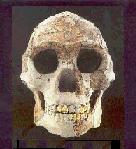 |
Peking (915- 1225 cc) |
Ape | Ape | Human | Ape | Human | Human |
 |
ER 3733 (850 cc) |
Ape | Human | Human | Human | Human | Human |
 |
WT 15000 (880 cc) |
Ape | Human | Human | Human | Human | Human |
Table modified slightly to show only erectus type skulls (original also included H. habilis, ect)
The point this chart attempts to illustrate is that if some creationists say that H. erectus is human, and others say it is an ape, then what better evidence could you ask for in a transitional fossil between the two?
Be aware that two people can disagree about the classification of a skull, without that skull being a transitional form.
Do some creationists disagree on what erectus is? Yes. Is there a reason for this? Yes.
There are two main reasons for this. the first is that prior to the discovery in 19 __ of WT 15000 *(Turkana boy) very little of Homo erectus' anatomy was known. Most of what existed of erectus were skull caps and a few skulls with crushed or distorted faces. Composite faces had been reconstructed with questionable accuracy from the Peking man site.
The second reason is that many Creationists have not studied the fossils of Homo erectus first hand. Richard Leakey holds a monopoly on the fossils in Kenya. Unless you are his personal firend you can not view the fossils. Though even close friends of his are not allowed to view them. This kind of control in science is not healthy. If you do not agree with Leakey, and bow at his feet you do not get in. It's as simple as that.
Dr. Cuozzo has been trying to get in to see the fossils in Kenya for over 20 years. Even though Alan Walker and others gave him permission, Leakey would not allow it. Given Dr. Cuozzo's excellant descriptions, and ground breaking work on Neanderthals one should question why a fellow scientist should not be allowed to view the fossils.
Perhaps they know Dr. Cuozzo would uncover the manipulation in their fossils (the closed diastema in WT 15000 for example, see chapter __). What does Leakey have to hide? Presumably a lot. What does he have to lose? Everything.
Replicas of specimens are expensive (I spent nearly 6,000 on the Turkana boy skeleton, and am probably the only private individual in the U.S who has this skeleton. Less expensive models of this skeleton exist, but these are sculptures (ie: someone carved them out of clay) not cast replicas taken from actual bones. While these sculptures may be fine for visual presentation, they should never be used for metrical anaylisis. What difference has my study of nearly 60 erectus skulls, and all available post-crania make? I have found that this species can not be explained away with ideas that have recently been proposed. Homo erectus is not a human being, diseased, aged or otherwise. It is a species of ape that is distinct from any living today. It is more complex than these apes, and unique in it's anatomy. This ape had nothing to do with human origins, but was created for Adam as a helper. I am certainly unique in my approach to Homo erectus, and I hope others will have the courage to follow suite.
I ask my readers who are already familiar with Homo erectus to forget everything they thought was true about this species, to open their minds and examine the evidence.
In his treatment of Peking man, Jim Foley states: "Interestingly, Gish says that if Weidenreich's model is considered accurate, Boule and Vallois' claim that Peking Man is intermediate between ape and man could hardly be rejected."
This is based on pg 194 of "Evolution: The Challenge of the Fossil Record" (1985). Gish is refering to a book called: "Fossil man" (an English translation of Les Hommes Fossiles by Marcellin Boule and H.V. Vallois (Gish, Evolution the fossils still say no" pg 288), in it a picture is shown of 3 skulls. A female gorilla, a Northern Chinease (human) skull, and a reconstruction of Sinanthropus (Peking man) done by Weidenreich.
Gish gets himself in trouble when he says:
"The reader is then invited to verify for himself that
Sinanthropus occupies a position intermediate between the Anthropoid Apes and Man. If one accepts uncritically Weidenreich's model of Sinanthropus [as a true portrayal of
the real Sinanthropus,] then he could hardly reject the above appraisal."
The same quote is also on p. 291 of Evolution: the fossils still say no (1995) but with the line in brackets (above) taken out.
Is Gish saying that this is what he believes to be true, or that the reader is led to believe that this is the only possible conclusion?
I spoke with Dr. Gish on 7/23/01 and asked him about the above comments. Dr. Gish told me that he believes that Peking man and Java man are "giant apes" and that a more accurate reconstruction of Peking man would show how ape-like it was.
Many Creationists have used Dr. Lubenow's book "Bones of Contention" as a reference, and for the basis of their belief that Homo erectus is a human.
"As pointed out by other creationists [e.g., Lubenow], Homo ergaster, Homo erectus, Homo heidelbergensis, and Homo neanderthalensis can best be understood as racial variants of modern man—all descended from Adam and Eve, and most likely arising after the separation of people groups after Babel."
(The non-transitions in ‘human evolution’—on evolutionists’ terms by John Woodmorappe First published in: Creation Ex Nihilo Technical Journal 13(3):10–13, 1999 )
Foley points out that: "Cuozzo has taken the most extreme stance yet for a young-earth creationist, saying that even H. erectus fossils (in which he would presumably include the Turkana Boy should not be considered human." (Foley 2/01)
I spoke to Dr. Cuozzo specifically about the Turkana child in early 2000, and again on 2/26/01. He told me that he does believe the Turkana child to be a H. erectus individual, and that it too is non-human. I agree with Dr. Cuozzo's assesment of Homo erectus.
Foley adds:
Creationists, on the other hand, assert that apes and humans are separated by a wide gap. If this is true, deciding on which side of that
gap individual fossils lie should be trivially easy."
"It could be pointed out that evolutionists also disagree on how fossils should be classified, which species they belong to, etc. True enough. But
according to evolutionary thinking, these fossils come from a number of closely related species intermediate between apes and humans. If this is so, we would expect to find that some of them are hard to classify, and we do."
(Foley 2/01)
The gap between man and animal is wide. But with the thousands of animals God created, we would expect some to be more similar to humans than others.
See my page on Homologies for more info
It must be pointed out that many Creationists (of which I am one) have never been permitted to view the fossils of hominids. If they were, there would be a greater consensus of which side a fossil lays on.
So it may seem like a good argument against creationism to say that Creationists don't agree on Homo erectus, so which of them should you believe?
Personally I think it is wise to give Dr. Cuozzo's arguments for erectus being non-human more weight, as Dr. Cuozzo is the only one out of the group (Gish, Lubenow, ect) who has examined the actual bones of Homo erectus (I will add the names of the erectus skulls Dr. Cuozzo has studied). The others have had to rely on the work (books) of others for their information.
 Creationists need to do more original research in this area. I hope to do that myself in the future.
Dr. Cuozzo must be commended for his excellent research on the subject of Human origins. Dr. Cuozzo has done much to furthur the Creationist cause, challenging existing Creationist views on hominids (his research on Neanderthals is a case in point), and encouraging others to do the same.
Foley adds that "few Creationists mention "KNM-ER 3733 (H. erectus, 850 cc) either, but those who do seem to consider it human (although it's hard to be sure in Bowden's case). The Turkana Boy is not mentioned much either, but one would think, in view of its essentially human skeleton, that no creationists would consider it an ape, although Cuozzo has been a recent exception." (Foley 2001)
Although I have not yet published anything on erectus, I intend to do so in the coming months. I mention in great detail, both the Turkana child, and KNM-ER 3733
I consider both to be erectus (ergaster), and non-human.
The Turkana child does have a skeleton similar to humans, but I point out in detail the differences.
Foley adds: "It would be fascinating to know what creationists think about fossils such as OH 12 (H. erectus, 750 cc), Sangiran 2 (H. erectus, 815 cc), OH 7 (H. habilis, 680 cc), but unfortunately few creationists even mention these fossils, let alone discuss them in any depth." (Foley 2001)
All of these fossils are discussed elsewhere on my page, and I will elaborate on them more extensively soon.
The feeling I get from statements like Foley's is this " if creationists can't agree on whether or not a skull is human, then why should we listen to anything else they have to say?"
And in part this is a good point. If a skull belongs to a human it should be easy to demonstrate this, and all authorities should agree.
If you have any questions on Creation, Evolution, or just want to say "Hi" please feel free to email me.
Foley's references for the above chart:
References
Baker S.: Bone of contention: is evolution true?, Evangelical Press, 1976
Bowden M.: Ape-men: fact or fallacy? Bromley,Kent:Sovereign, 1981. Ed. 2
Cuozzo J.W.: Buried alive: the startling truth about Neanderthal man. Green Forest, Arkansas: Master Books, 1998, p.101
Gish D.T.: Evolution: the fossils say no, San Diego:Creation-Life Publishers, 1979. Ed. 3 (this is the third edition of a book first published in 1972 and is somewhat out of date)
Gish D.T.: Evolution: the challenge of the fossil record, El Cajon, CA:Creation-Life Publishers, 1985.
Lubenow M.L.: Bones of contention: a creationist assessment of human fossils, Grand Rapids,MI:Baker Books, 1992.
Mehlert A.W. : Australopithecus and Homo habilis - pre-human ancestors? Creation Ex Nihilo Technical Journal, 10.2, 219-40, 1996.
Menton D.N.: The scientific evidence for the origin of man, 1988. (a creationist essay)
Taylor P.S.: The illustrated origins answer book, Mesa,Arizona:Eden Productions, 1992. Ed. 4
Taylor P.S.:Who's who and what's what in the world of "missing" links?, 1996
Taylor P.S. and Van Bebber M.: Who's who and what's what in the world of "missing" links?, 1995 (an earlier version of Taylor 1996)
 | Main Index | Ape-man Index |