|
|
 |
|
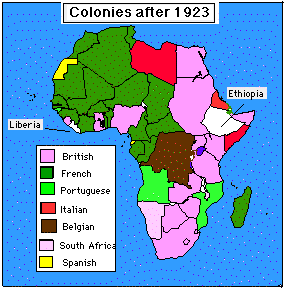
The whole African continent except for Liberia (and Ethiopia only briefly) was colonized by Europeans. European contact began with the Age of Exploration from the 15th century. Portuguese sailors explored along the coast going further and further south on successive voyages until they reached the Cape and then east to India. At first their relations with Africans were on a basis of equality, recognizing, for example, the king of the Kongo as a king similar to the kings of Europe. (The first reports of West Africa note the superior cleanliness of towns to those in Europe.) The Portuguese were looking for the gold of west Africa which had been imported into Europe since ancient times. They were also hoping to outflank the Turks and Venetians to trade with India, cutting out the middle men in the spice trade. Trading posts were set up along the coast of west Africa. The colonization of the Americas created a demand for slaves. According to Basil Davidson it was the slave trade which depressed Africans' status in the minds of the Europeans. Only in the 19th century did the trading posts expand into large scale colonization of the interior (steam, telegraphs and quinine were needed). At the Berlin Conference in 1884 the continent was divided up among the different European powers, formalizing and extending existing European colonies. The frontiers then drawn did not correspond to the ethnic boundaries. The local people were not consulted. The European statesmen did not know who lived where and did not care. Almost all the successor countries have ethnic groups split by frontiers. The only countries which are linguistically homogeneous are: Somalia, Swaziland and Lesotho. But even these have people of the same language living in other territories across the frontier. Only two enclaves and two islands off the coast of Morocco now (2006) belong to Spain. Namibia was ruled by South Africa until 1990. One of the Comoro Islands (Mayotte) and Reunion Island are French colonies. All other territories are independent. Some still have close ties with outside powers. Ethiopia has had until recently a large Soviet military presence of advisors. Angola has had Cuban troops. Ivory Coast, Gabon and Chad and other former French colonies have a French presence, mainly of administrators but also some military. Kenya has a British military presence, ostensibly for training. South Africa is the only power capable of exercising military power beyond its own borders. South African troops operated in Angola until the former regime fell. South African guerrilla proxies were found in Mozambique, Angola and possibly in Zambia and Zimbabwe. Most Africans regarded South Africa as a continuing colonial entity until the April 1994 election. Nigeria has a large army, sometimes used for peacekeeping purposes, as in Sierra Leone and Liberia. Was colonisation a good thing? Some facts. The colonial borders have proved porous in the case of Sudan, Chad and Central Africa where the wars in Darfur have spread across the border to these neighbors. The wars in the Interlacustrine area (Uganda, Rwanda, Congo) ignore the borders. Wars in Libera have involved Sierra Leone, Guinea and Ivory Coast. Is China recolonising Africa? Daily Telegraph on Chinese in Africa |
Interesting reading Basil Davidson - Black Mother |


 Vom Sklavenhandel zur Kolonialisierung
|
|
 Central |
 Southern |
 Africa |
 World Info |
 Home |



