
The proof of the Collatz Problem
The proof : by collatz function
an/2, if an=0 (mod 2)
an=
3an+1, if an=1 (mod 2)
an+1=(22*s-1+s)*an+s , an=s (mod 2)
The second step is generated the function
an+1=(22*s1-1+s1)*an+s1 , an=s1
(mod 2)
an+1=(22*s1-1+s1)*an+s1)*(22*s2-1+s2)+s2 ,an=s2(mod 2) …
We can find a general formula
for this expression:

 Then By My
Formula
Then By My
Formula
 and
and  we omit it
because an dosen’t equal zero
we omit it
because an dosen’t equal zero
And 22*s(j-i)-1
doesn’t equal zero.
 and
and 
The forth step we suppose that at  ,an+1=1 if it holds an+1 at any
number less than
,an+1=1 if it holds an+1 at any
number less than 
The fifth step is analysed 
an=1 and  =1 it will be omit because sj-i=0 either or 1
only
=1 it will be omit because sj-i=0 either or 1
only
an=2 and  =1/2 ,sj-i=0
then an=2 and it is right
=1/2 ,sj-i=0
then an=2 and it is right
But is 1=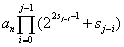 ?
?

 =
= =0
=0

 <0.5j
<0.5j
And by Terras (1976, 1979) function
tn/2 if tn=0 (mod 2)
tn+1=
(3tn+1)/2 if tn=1 (mod 2)
We find that for all 1 step by 3tn+1 there
is two steps by divide on 2 then (1/3)j= 
And we find that 1/3j<1/2jà 1/3<1/2
And
 <0.5j
<0.5j
then  and Collatz
conjecture be right.
and Collatz
conjecture be right.
