
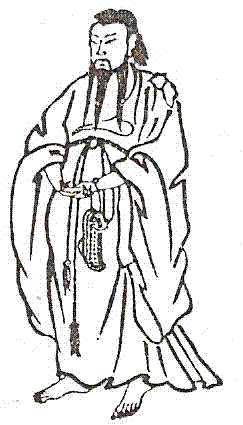
Several centuries before the Christian era Chinese mountain hermits, called hsien, are said to have succeeded, by means of dieting, bodily exercises, regulation of the breath, and mental cultivation, in prolonging life far beyond the ordinary span. Later on, Taoist adepts devoted themselves to the task of compounding an elixir of immortality, indicidentally achieving a mastery over the forces of nature that enabled them to perform all sorts of miraculous feats. A book containing short accounts of prominent figures among the earlier hsien appeared towards the end of the former Han dynasty and this was followed by longer biographical notices of numerous other "immortals." It is from these sources that this volume has been selected and translated. -- JOHN MURRAY [inside dust jacket]
THE WISDOM OF THE EAST SERIES EDITED BY J.L. CRANMER-BYNG, M.C.
CHINESE IMMORTALS [1]
EDITORIAL NOTE THE object of the editor of this series is a very definite one. He desires above all things that, in their humble way, these books shall be the ambassadors of good-will and understanding between East and West, the old world of Thought, and the new of Action. He is confident that a deeper knowledge of the great ideals and lofty philosophy of Oriental thought may help to a revival of that true spirit of Charity which neither despises nor fears the nations of another creed and colour. -- L. CRANMER-BYNG. 50, ALBEMARLE STREET, LONDON, W.I. [4]
INTRODUCTION NOTE ON PRONUNCIATION ABBREVIATIONS I. REMOTE ANTIQUITY II. CHOU DYNASTY III. CH'IN DYNASTY IV. FORMER HAN DYNASTY V. LATER HAN DYNASTY VI. THE THREE KINGDOMS VII. DIVISION INTO NORTH AND SOUTH VIII. T'ANG DYNASTY IX. THE EIGHT IMMORTALS ALPHABETICAL INDEX OF HSIEN [5] [6]
READERS of Gulliver's Travels may remember that on his way to Japan the hero of that work came to the Kingdom of Luggnagg, where he first heard of the existence of certain remarkable individuals called struldbrugs. They formed but a small part of the population, and were distinguished at birth by a red circular spot on the forehead which was an infallible sign that they would never die. Struck with wonder and delight, Gulliver began to dilate on the happiness which he felt sure must be the lot of such fortunate creatures, delivered by the continual apprehension of death. But he was soon disillusioned on discovering that the struldbrug's immortality was not accompanied by that perpetuity of youth, health, and vigour which alone could make life tolerable. Indeed, when he was brought into the presence of a few struldbrugs, his reaction was one of extreme disgust at the ghastliness of their appearance. Still, he was naturally interested in such an unexampled phenomenon, and hoped to learn more on the subject from the accounts given by Japanese authors. However, the shortness of his stay in Japan and his ignorance of the language prevented him from pursuing his inquiries.
That was a great pity; for the Japanese, having been in touch with the civilisation of China for many centuries, could really have told him things about the "immortals" of that country which would have reawakened all his enthusiasm. These immortals were indeed vastly superior to the struldbrugs in that they could remain for ever exempt from both physical and mental decay. By the Chinese they were called hsien, a word which in its written form is a character composed of [7] two pictographic elements, "man" and "mountain"; thus it appears that the name was originally applied to men who had retired from the world in order to live a hermit's life in the mountains. Their activities were mostly confined to the gathering of certain herbs and roots which, when eaten, would not only cure disease but also rejuvenate the body and lengthen life far beyond its normal span. Chief among such plants was the ling-chih or "magic fungus", believed to contain vitalizing elements of marvellous efficacy. We are told that an aged man once dug up something like a human hand, very plump and pink. He boiled and then ate it, whereupon his teeth and hair sprouted anew; his strength returned, and his complexion became like that of a youth. A Taoist who met him said: "The thing you ate was a fleshy chih. Your longevity will equal that of the toroise and crane." We also hear much about cassia or Chinese cinnamon; shu, a species of Atractylis with a root resembling ginger; pine resin, which according to the standard Chinese pharmocopoeia "renders the body light and prevents the onset of old age"; and peaches, the fruit of immortality, which grew in the garden of Hsi Wang Mu, the Western Queen Mother, who dwelt in the K'un-lun mountains.
The eccentric behaviour of the typical hsien, and the seclusion in which he lived, led to the weaving of many legends round him. He was often credited with all kinds of supernatural powers besides the indefinite prolongation of life: thus, he might be able to evoke rain, wind, thunder and lightning, have spirits at his beck and call, pass unharmed through solid matter or fire, effect a transformation of his bodily shape, move with incredible speed, or even appear in several places at once. It is not surprising, therefore, that the hsien cult is soon found in close association with the amorphous system of Taoism, which seems to have existed in some form before the time [8]of Confucius, and was always ready to assimilate any new movement dealing with what was strange or miraculous. No precise date, however, as to the origin of the cult can be extracted from the Taoist writings of the Chou dynasty. Lao Tzu in the Tao Te Ching speaks of the man possessed of Tao as enduring forever: "By maintaining the unity of body and soul, can you not escape dissolution?" And in another mystic passage: "He who has grasped the secret of life will be safe from the attack of buffalo or tiger. . . And why? Because he has no spot where death can enter." Such sayings, vague though they are, may have opened the way to a belief in the posssibility of attaining actual immortality. Chuang Tzu goes a little further when he describes "a spiritual being dwelling on a mountain, whose flesh was smooth as ice and skin as white as snow; he was gentle and submissive as a young girl, ate none of the five cereals but inhaled the wind and drank the dew; soaring above the clouds, he drove a team of flying dragons and roamed beyond the limits of this world." And elsewhere he more than hints at a regimen of the soul and body which will keep death at bay.
Lieh Tzu, who revels in the marvellous, tells of a man who was seen passing through solid rock and floating in the midst of flames, but who when questioned was unable to give any explanation of these feats. Lieh Tzu himself brought his mental passivity to such a pitch that he became wholly unconscious of what his body was resting on, and was borne this way and that by the wind. But the passage which most closely foreshadows the later conception of hsien occurs in his description of the five Islands of the Blest:
Here we have the earliest known occurrence of the character for hsien, though the “immortals” thus designated are more like what we should call fairies than human beings who have won immortality through their own endeavours.
It is true that in a less exalted mood Lieh Tzu also writes as follows: “That which has life must by the law of its being come to an end; and the end can no more be avoided than the living creature can help being alive. So that he who hopes to perpetuate his life and to shut out death is deceived as to his destiny.” But enthusiasts were content to ignore any such warning as this. To them it seemed only natural that Tao, the ultimate principle of the universe, being itself everlasting, should be able to impart the same blessing to its creatures; that is to say, if the whole human personality could be brought into complete harmony with Tao, it might be expected to share in its immortality. Thus, the great question came to be, how to achieve this harmony, or as the common phrase went, how to “attain Tao”. Generally speaking, a twofold process was considered necessary: (1) cultivation of the mind, with Tao as the model: quietude, passivity, gentleness, self-effacement were the main characteristics to be aimed at; (2) a gradual refinement of the bodily substance by means of physical exercises, dieting, regulation of the breath, and the taking of appropriate drugs.
All these methods were practised, more or less, by aspirants to hsienship, but as time went on, more and more importance was attached to the swallowing of a special drug, or elixir, which could make one immortal on the spot, without further [10] trouble. The secret of its preparation has not been revealed to us in full, but we do know that cinnabar, or red sulphide of mercury, was an essential ingredient. Long before the theory of the transmutation of metals led to the beginnings of alchemy in China, instances are recorded of cinnabar having been used as food by hsien of the primitive type: one Ch’ih Fu, for example, is said to have succeeded in becoming completely rejuvenated after dosing himself with a mixture of refined cinnabar and some kind of stone which had been fused in a crucible. Other minerals generally used in compounding the elixir were realgar, copper carbonate, sulphur, mice, sal ammoniac, nitre, and ochre. But cinnabar heads the list as the most important of all, and the reason is not far to seek, for from it is obtained by sublimation the unique metal mercury or quicksilver (i.e. living silver), which is so volatile that it seems to be actually endowed with life. The making of pure gold, either for its own sake or as the basis of a life-prolonging potion known as gold-juice, was also a prime object with Chinese alchemists, and this too was produced in some mysterious way by means of cinnabar. The process is mentioned but not described by Li Shao Chun (see page 40), the first alchemist about whom we have reliable information.
Once the quest for immortality had got well under way, the number of officially recognized hsien increased rapidly. It was felt that any eminent Taoist ought to be included in their ranks, and consequently the list of immortals was swelled by the addition of numerous magicians, philosophers, statesmen, physicians, and so forth, to say nothing of various legendary figures of the past such as the Yellow Emperor and Hsi Wang Mu. Some difficulty must have arisen at first in the case of historical personages whose claim to immortality was rendered dubious by the fact that their deaths had been publicly recorded; [11] but this could be met by the circulation of a report that their coffins had been opened and found empty, except perhaps for a sword or a slipper or some other article of clothing.
At least one great Taoist teacher appears to have been canonized in spite of himself. This was Ch’iu Ch’ang-ch’un, who in his old age was summoned to the court of Jenghiz Khan. When questioned about the secret of longevity, he replied that the essentials were a pure heart and few desires, whereupon Jenghiz exclaimed: “God has sent this venerable hsien to awaken my conscience!” But, strictly speaking, he was no hsien at all, for he openly declared that there was no such thing as a drug of immortality, and his death was followed by no startling resuscitation. Yet he was duly enrolled in the list of immortals. Even a high moral standard was not always regarded as essential for a hsien. As an example we may take the wealthy Fan Li, who helped the King of Yueh to overcome the once powerful State of Wu in 473 B.C. Renowned for the his cunning and aptitude for intrigue, he may fitly be termed the Machiavelli of his day. After a diplomatic triumph in Yueh he migrate to Ch’i, where he amassed great riches. But again he refused to tempt fortune too long, and finally settled down in Lan-ling, where he became a millionaire for the third time. According to the Taoist version of his career, he then took to selling drugs, attained hsienship, and was seen and recognized by successive generations of mortals.
Taoism was largely a reaction against the sober outlook and strict moral discipline of the Confucianist system, which may account for the general tendency of hsien to treat life rather as a huge joke than as a serious problem. The life-story of the famous poet Li Po, dubbed “the banished hsien”, reflects this carefree, bohemian mentality. Much of his time appears to have been spent in roaming over the country and in frequent [12] carousals with a number of choice spirits whose thoughts were centred less on the elixir than on wine. One of these coteries was known as the Six Idlers of the Bamboo Brook, another as the Eight Immortals of the Wine-cup. Different accounts are given of Li Po’s end. The Old T’ang History says bluntly that his last illness was brought on by excessive drinking, but the popular tradition is that he was drowned one night from a boat while making a drunken effort to embrace the reflection of the moon. Even this is rejected by the Taoist fraternity in favour of the more acceptable legend that he was borne up into the sky on the back of a whale.
As the number of hsien multiplied, it was found convenient to divide them into classes according to their habitat, as follows: (1) celestial hsien: those who ascend ot their abode in heaven; ; (2) terrestrial hsien, who either from insufficient merit, personal inclination, or, as some say, by taking half a dose only of the elixir, remain on earth for an indefinite period without growing any older; (3) aquatic hsien, or hsien of the watery element—purely yin or feminine, without any admixture of yang or the masculine principle; (4) divine or spiritual hsien, demi-gods who dwell on the Isles of the Blest or in the Paradise of His Wang Mu. Another classification omits the third group and introduces two others: the human hsien, ascetics who have been able to subdue all earthly passions and lusts of the flesh, but have not yet attained immortality; and the demonic hsien, bodiless phantoms who lead a spectral existence, flitting restlessly hither and thither. But neither of these groups can be regarded as hsien in the usual acceptation of the term, and the distinction between celestial and terrestrial hsien is the only one of real significance.
The Chinese have taken their immortals very seriously, and a literature of almost incredible bulk has grown up around [13] them. A considerable portion of the huge Taoist Canon consists of works dealing with their lives, teachings, and multifarious activities. And in the great encyclopaedia T’u Shu Chi Ch’eng we find biographies of well over a thousand hsien, drawn from various sources and arranged in order of date. Of separate collections, the earliest is the Lieh Hsien Chuan, which contains tersely worded notices of 72 persons of every rank and station, ranging from purely mythical beings to hermits, heroes, and men and women of the common people. Its reputed author is the statesman and Taoist scholar Liu Hsiang, who lived from 77 to 6 B.C. For several reasons, this attribution will not pass muster, but there is some internal evidence to show that part of the book at least must have been written during Liu Hsiang’s lifetime. Another work of a similar kind, but rather more expansive and stylish in composition, is the Shen Hsien Chuan, by the famous writer and adept Ko Hung, more about whom will be found on page 97. Lastly, we may mention a very popular compilation, also entitled Lieh Hsien Chuan, made by the Taoist monk Huan-ch’u of the Yuan dynasty, a thousand years after Ko Hung. This contains 55 biographies with illustrative woodcuts. In a few cases an account of the same hsien is given in more than one of these books, and Lao Tzu appears in all three.
Several other sources have been laid under contribution in the following pages, including some of the official dynastic histories; these are more sober as a rule in their treatment of facts, yet they do not refrain from reporting many a fantastic tale of magic. It has been thought best to make the arrangement of this selection as far as possible chronological, though dates are often uncertain. It will be remembered, of course, that the very nature of a hsien exempts him from the ordinary limitations of time. [14]
NOTE ON PRONUNCIATION
NOTES Notes by the translator are given in small print and inserted, after the Chinese fashion, in the body of the text. [15]
C.H.F.C. = Chin hua fu chih : Topography of Chin-hua Prefecture. C.S. = Chin shu : Chin dynastic history. C.T.S. = Chiu t’ang shu : Old T’ang dynastic history. F.S.T. = Feng su t’ung : Popular traditions (2nd cent. A.D.). H.H.C. = Hsu hsien chuan : Supplementary biographies of hsien (T’ang Dynasty) H.H.S. = Hou han shu : Later Han dynastic history. H.W.T.N.C. = Han wu ti nei chuan : Legend of the Han Emperor Wu (3rd cent. A.D. ?). K.S.C. = Kao shih chuan : Biographies of Scholars (Chin dynasty). K.T.S.C. = Kuan ti sheng chi : Historic vestiges of Kuan Ti, God of War. L.H.C. = Lieh hsien chuan : Biographies of hsien (3rd cent. A.D. ?) L.H.C. (H.C.) = Lieh hsien chuan (by Huan-ch’u) : Biographies of hsien (Yuan dynasty). L.H.C.C. = Lieh hsien ch’uan chuan: Detailed biographies of hsien. L.T.S.H.C. = Li tai shen hsien chuan : Biographies of hsien through the ages. N.H.H.C. = Ning hai hsien chih : Topography of Ning-hai District. P.P.T. = Pao p’o tzu : Taoist practices. By Ko Hung (4th cent. A.D.) P.W.C. = Po wu chich : Record of strange events. S.C. = Shih chi : Historical Record. By Ssu-ma Ch’ien (1st cent. B.C.) S.H.C. = Shen hsien chuan : Biographies of hsien. By Ko Hung (4th cent. A.D.). S.H.F.C. = Shao hsing fu chih : Topography of Shao-hsing Prefecture. S.H.T.K. = Shih hua tsung kuei : Literary Miscellany. S.K.C. = San kuo chih : Dynastic history of the Three Kingdoms. S.K.C.Y.I. = San kuo chih yen i : Historical novel of the Three Kingdoms. S.S.C. = Sou shen chi : Book of marvels (4th cent. A.D.). T.M.C. = T’ung ming chi : Events of the reign of the Han Emperor Wu. T.P.K.C. = Tai p’ing kuang chi : Fabulous tales (10th cent. A.D.). T.S.C.C. = T’u shu chi ch’eng : General Encyclopaedia (A.D. 1726). T.Y.C.J.C. = T’ang yeh chen jen chuan : Life of Yeh Fa-shan. Y.C.C.C. = Yun chi ch’i ch’ien : Taoist extracts (11th cent. A.D.). [16]
HUANG AN was a native of Tai Chun and became an official messenger at that place. He said to himself: "My condition in life is too mean for me to live in the society of others." When studying, he held a whip for self-castigation and carried a thorn in his bosom to keep him from drowsiness .... He was in the habit of eating cinnabar, and his body was red all over. In winter he wore no furs. He used to sit on a spirit tortoise, two feet broad, and to those who asked him how many years he had sat there he answered: "Long ago Fu Hsi caught this animal when he first invented fishing-nets, and gave it to me. I have sat on its back so long that the shell has become quite flat. The tortoise fears the light of sun and moon, and puts out its head only once in two thousand years. This I have seen it do five times already since I have been sitting here." When Huang An wandered about, he carried the tortoise on his back. Men of that time called him "An of the Myriad Years". T.M.C.
Ma Shih Huang was a horse doctor in the time of the Yellow Emperor. He knew the vital symptoms in a horse's constitution, and on receiving his treatment the animal would immediately get well. Once a dragon flew down and approached him with drooping ears and open jaws. Huang said to himself: "This dragon is ill and knows that I can effect a cure." There- [17]upon he performed acupuncture on its mouth just below the upper lip, and gave it a decoction of sweet herbs to swallow, which caused it to recover. Afterwards, whenever the dragon was ailing, it issued from its watery lair and presented itself for treatment. One morning the dragon took Huang on its back and bore him away. L.H.C.
Po Shih Sheng was a pupil of the Venerable Chung Huang. In the days of P'eng Tsu [a Chinese Methuselah] he was already more than two thousand years old. He had no longing to ascend on high, but aspired to nothing more than a long life on earth. Gold-juice he regarded as the best of all drugs, but as his family was poor he could not obtain it. So he kept pigs and sheep, and after ten years or so had amassed a fortune of ten thousand pieces of silver, which enabled him to buy the drug and swallow it.
It was his habit to boil white stones and use them as food. This led him to make his abode on the White Stone Mountain, and thus he acquired the name of Po Shih Sheng (Master White Stone). Sometimes he would eat dried meat, and sometimes too he would abstain from all cereal food.
He was able to walk as far as three or four hundred li (about 130 miles) in one day. His appearance was that of a man of thirty. When somebody asked him why he did not wish to fly up to heaven, he replied: "I'm not at all sure I should enjoy myself as much in heaven as I do in this world." L.H.C. (H.C.)
Wu Kuang lived in the time of the Hsia dynasty. His ears were seven inches long. [18]
In the end, he climbed to the summit of Mount K'ung-t'ung [in Honan] and rose up to heaven in broad daylight. S.H.C.
Tu Tzu ["Master Calf”] was a native of Yeh. As a young man, he used to gather fir-cones and fu-ling
Now Tu Tzu, while he was leading a yellow calf along the road, happened to meet Yang Tu's daughter, and was so delighted with the girl that he arranged to keep her as his handmaid. She, therefore, went out in Tu Tzu's company to gather peaches and plums. They would spend one night away and then return with a number of sacks full of fruit. People in the town tried to follow and keep a watch on them, but although they went out of the gate together, still leading the calf, no runner was able to overtake them, and there was nothing for it but to return. [22]
The couple continued to frequent the market-place for thirty years or more, and then they departed. They have been seen at the foot of Mt. P'an selling their peaches and plums in winter. L.H.C.
Later on, when the virtue of Chou had fal1en into decay, he mounted a chariot drawn by a black ox and departed for the land of Ta Ch'in.
Confucius went away, and said to his disciples: "I understand how birds can fly, how fishes can swim, and how four-footed beasts can run. Those that run can be snared, those that swim may be caught with hook and line, those that fly may be shot with arrows. But when it Comes to the dragon, I am unable to conceive how he can soar into the sky riding [26] upon the wind and clouds. To-day I have seen Lao Tzu, and can only liken him to a dragon." S.C.
By way of reply, the Sage clapped his hands and, remaining in a sitting posture, slowly levitated into mid-air like a rising cloud, until he hovered motionless in celestial space, some thousand feet above the earth. There was a pause, and then he looked down and spoke: "Poised thus between heaven and earth, having my abode in neither, nor belonging to the race of mortals, how can I be subject to your sovereignty, and how can your Majesty cause me to be rich or poor, of high or lowly station?" Understanding came to the Emperor, and descending from his carriage, he made humble obeisance. The Sage then presented him with a copy of the two holy books.
More than twenty years later, a stork would come every morning with a fish two feet long in its beak and deposit it at the woman's door. The latter said nothing about it, but used to sell the fish. This continued for thirty years, when the bird ceased to appear. Mu Yu's mother attained the age of a hundred before she died. L.H.C.
Hsi and his wife, the lady Chia, were returning on one occasion from a visit to their daughter-in-law when they encountered three chariots, one drawn by a white deer, another by a green dragon, and the third by a white tiger. There were thirty or forty mounted attendants in scarlet livery, armed with lances and swords, who filled the roadway with pomp and glitter. They inquired if he was Shen Hsi; and the latter, who knew not what to make of this astounding apparition, replied: "I am; but why do you ask?" One of the men on horseback said: "Shen Hsi has deserved well of the people. Tao is ever present to his mind, and from earliest infancy his conduct has been free from blame. But his allotted span is short, and his years are approaching their close. So Huang and Lao [the Yellow Emperor and Lao Tzu] have sent down three hsien officials in these chariots to escort him to heaven" ...
Presently the three hsien came forward in their feather robes, with staves of office in their hands, and bestowed on Hsi a [31]tablet of white jade, a green jade suit of mail, and a set of red jade characters, which he could not understand. After this ceremony he was borne off to heaven, his ascension being witnessed by a number of field-labourers in the vicinity, who did not know what to make of it. For a little while here came a thick mist, and when it cleared away the whole company had disappeared; all that remained were the oxen which had drawn Hsi's carriage and which were now grazing in the fields. Someone rccognized the animals as belonging to Hsi, and informed his family. His disciples, fearing that their master had been carried off to the hills by evil spirits, searched for him in every direction for a hundred li around, but in vain.
Over 400 years later, Shen Hsi unexpectedly revisited his native village and sought out one of his descendants named Huai-hsi. This man said he had heard his elders speak of a certain ancestor who became a hsien and disappeared, never to return. Shen Hsi stayed with his kinsfolk for about a month, and told them of his experiences when he first went up to heaven: "Though I was unable to see God himself," he said, " I saw Lao Chun [" Prince Lao", i.e. Lao Tzu] seated on the right-hand side. The attendants instructed me not to make any formal acknowledgments, but simply to take my seat in silence. The celestial palace seemed to be composed of an insubstantial, luminous haze; shot through with an indescribable variety of colours. There were hundreds of attendants, mostly female. In the gardens grew trees bearing gems and jade, and all the different kinds of chih plant in great profusion. Dragons and tigers gambolled in our midst, and a tinkling sound was audible, like that of bronze ornaments hanging round a bell, the origin of which I could not discover. The walls shone with a bright glow, and were covered with magic charms. [32]
" Lao Chun was about ten feet in height. His hair hung loose, and he wore embroidered garments. His whole person radiated light. After a while, a bevy of fairy maidens brought in a golden table with jade goblets and set it before me, saying: 'This is the divine elixir: whoso quaffs it shall be exempt from death. If you and your wife
together with a letter saying that he considered himself sufficiently rewarded with a pair of red jade slippers, and adding: "After the lapse of a few years look for me on the island of P'eng-lai." The First Emperor lost no time in sending out to sea an expedition numbering several hundreds of persons, led by Hsu Shih and Lu Sheng. They never reached P'eng-lai, because they encountered violent storms which caused them to turn back. Shrines in honour of An Ch'i have been set up in about a dozen places along the sea shore near the Fu-hsiang pavilion. L.H.C. [34]
YIN SHENG was a beggar boy who lived under a bridge spanning the river Wei at Ch’ang-an. He used to take up his stand in the market-place and beg from those who did business there. On one occasion, disgusted by his importunity, they bespattered him with filth. Yet, when he appeared in his place again, his clothes were in their normal condition and showed no trace of dirt. The authorities, getting wind of the affair, had him arrested and thrown into chains; and yet he continued to beg in the market-place. Being again arrested, and threatened with the death penalty, he left the city. But the houses of all those who had bespattered him collapsed in ruins, killing some dozen people. Hence the jingle which is current in Ch'ang-an:
The Emperor, having received this prescription for longevity bestowed upon him jade and silk. The veteran afterwards retired into the fastnesses of Mount T'ai, only returning to his village at intervals of five or ten years. When 300 years had elapsed, he returned no more. S.H.C.
Shao Chun once attended a banquet given by the Marquis of Wu-an. Among the company was an aged man, over ninety years old. Shao Chun inquired his name and said: " I recognize that old man because I saw him as a child going for a walk with his grandfather." Whereat those present were much astonished. On another occasion, Shao Chun was able to identify an old bronze vessel which he saw in the imperial palace: "That vessel," he said, "was kept by Duke Huan of Ch'i in his sleeping-chamber." Accordingly, the Emperor examined the characters incised thereon, and found that, as he had said, it was an ancient vessel of the Ch'i State ...
Having secretly manufactured the elixir, Shao Chun said to the Emperor: "So long as your Majesty cannot make an end of pride and extravagance, and renounce the allurements of the senses; while smiting and killing go on unchecked, and the passions of joy and anger are not overcome; while in your dominions there are spirits that are not submissive, and in the market-places there are executions and bloodshed, the great secret of the celestial drug cannot be mastered ... " Soon after, Shao Chun fell dangerously ill. The Emperor went to see him, and commanded an attendant to take down from his lips the secrets of his art; but he died before the task was completed. “Shao Chun is not dead,” said the Emperor; [40] “he has only undergone a voluntary transformation.” When he was put. into his coffin, the corpse suddenly disappeared, although the clothes in which he was wrapped were not unfastened, and remained there like the slough of a cicada. This increased the Emperor's wonder, and he regretted that he had not been more diligent in seeking out Shao Chun. S.H.C.
It was after this that the Son of Heaven first sacrificed to the Furnace in person, sent magicians over the sea to seek for the island of P'eng-lai, An Ch'i Sheng and the other immortals,
Taoists from all parts of the country visited Liu An's abode, and among others, eight worthies whose beards and eyebrows were all hoary white. The door-keeper went first secretly and informed the Prince, who ordered him, as if on his own initiative, to put some puzzling questions to the newcomers. Accordingly he said: "Uppermost in our Prince's mind is a desire to seek the Tao that makes one live long without growing old; next, he wishes to find great scholars with a wide range of learning and intimate knowledge of abstruse subjects; and lastly, he wants lusty devil-may-care fellows whose strength is equal to the lifting of weighty tripods or attacking tigers unarmed. Now you, Sirs, are too old, and it is evident that you lack the magic means of warding off senility. How can you investigate profundities, or exercise control over things at a distance, thoroughly assimilate eternal principles, perfect your moral nature? As you are wanting in these requirements I dare not announce you to the Prince."
To this the Eight Worthies smilingly replied: "If his [42]Highness dislikes our antiquity, we will become young." Scarcely had they spoken these words than they all turned into youths of fourteen or fifteen. Their coils of hair became black and silky, and their complexions like peach-bloom. The door-keeper, much amazed, went and told the Prince. Directly the Prince heard the news, he went, without putting on his shoes, bare-footed to welcome them, and conducted them up to the Terrace of Meditation on Hsienship, where he spread brocaded hangings over an ivory couch, kindled the Hundred Harmonies Incense, and placed before them tables of gold and jade.
The Prince paid them deference as if he were their disciple. Facing north,
Thereupon the eight youths turned into old men again and, addressing the Prince, said: "Although our knowledge is incomplete, and we possess merely the education of children, yet hearing that the Prince loves scholars, we have come to join him; but we have still to learn the Prince's mind and what it is he desires. One of us is able without effort to call up [43] wind and rain, instantaneously to raise clouds and mists. He can trace lines across the land and they become rivers, and by scooping up the soil he can make mountains. Another of us can cause high hills to collapse, and the sources of deep springs to dry up. He can tame tigers and panthers, summon scaly monsters and dragons to appear, and press the spirits of heaven and earth into his service. Another of us can divide his personality and transform his shape, and is also able to become visible or invisible at will. He cam hide whole army corps, and turn midday into night. Another can ride the clouds and tread the empyrean, cross the sea and walk upon the waves. He can go in and out where there is no crevice, or travel in a breath one thousand li. Another can enter flames unscathed and plunge into water without a wetting. He is invulnerable by sword or shaft. He feels no cold in winter frosts, nor does he sweat in summer heat. Another is capable of a myriad transformations: bird, beast, plant or tree--as the fancy takes him, he can become each or any of these. He can move mountains and bring rivers to a halt; he can transport a palace or shift a house. Another can boil mud into gold, or freeze lead into silver. He can fuse the eight minerals of the alchemist into a liquid from which pearls fly aloft in lieu of steam. He rides in a chariot of clouds with dragons for his team, and floats above the Great Purity.
The upshot was that the magic drug was duly prepared, but the Prince did not yet proceed to swallow it. Before ascending [44] to heaven he met some of the hsien nobility. Having had but little practice in doing honour to others, and having seldom had occasion to perform the ceremonies of self-abasement, he showed some lack of politeness in his demeanour, talked in too loud a voice, and made a blunder in referring to himself as the Solitary One.
It is related by men who were living at this time that when Liu An and the Eight Worthies at last took their departure from this earth, the vessel containing the dregs of the elixir was left lying in the courtyard, and that the contents were finished up by the dogs and poultry of the establishment, with the result that they too sailed up to heaven; thus, cocks were heard crowing in the sky, and the barking of dogs resounded amidst the clouds. S.H.C.
Tung-fang So is commonly said to be the spirit of the planet Venus,
Though So's words were lacking in modesty and extravagant in their self-praise, he was at once accepted as a man of heroic mould, and gradually rose high in the Emperor's favour. But he kept a troupe of singers and actors, and did not concern himself with State business. Liu Hsiang in his youth often questioned him about the prolongation of life, and found him full of shrewdness and insight. His own contemporaries all describe him as the prince of good fellows, and irresistible in argument. F.S.T.
At the age of three Tung-fang So was in the habit of gesticulating, pointing up to the sky, and talking to himself. One [48]day his foster-mother missed him, and a year went by before he returned. She was greatly shocked, and said: "You have been away for a whole year. Is this how you care for me ?" So replied: "I only went to the Sea of Purple Mud, where the water stained my clothes so that I had to go to the Yu spring to wash them. I left in the morning, and got back at noon: what do you mean by ‘a whole year’ ?" His mother then asked him about the places he had been to.—"After I had finished washing my clothes," said So, "I rested for a bit in the Ming-tu-ch'ung Pavilion and took a nap. The King and his nobles fed me on red chestnuts and sunset-cloud liquor, and when I had eaten my fill I went into a sort of trance. Then I drank a small quantity of celestial yellow dew, and revived again. On my way home I came across an old tiger lying by the roadside, and returned riding on its back." L.T.S.H.C.
The Western Queen Mother once paid a visit to the Han Emperor Wu, and was received in the Nine-Blossom Hall. She bade her attendants fetch in seven peaches, each only the size of a pill, five of which she presented to the Emperor, and ate the other two herself. When the Emperor had eaten his peaches, he placed the stones on his lap, and when the Queen Mother asked why he kept them, he replied: "These peaches are so delicious that I wish to plant the stones." She smiled at this and said: "My peach-tree only bears fruit once in three thousand years."
Now, the Emperor and the Queen Mother were sitting alone together, and none of their suite were allowed to enter the apartment. But Tung-fang So had stolen into the corridor adjoining the Hall on the south, and was peeping at the Queen Mother through a window. She observed him, and said to [49]the Emperor: "This young fellow who is looking through the window has come three times before and stolen these peaches of mine." The Emperor marvelled greatly at this, and from that time onward people looked upon Tung-fang So as a divine being. P.W.C.
Wu Ti of the Han was travelling eastwards, and had not yet emerged from the Han Ku Pass when he came upon a monstrous creature blocking the way. Thirty or forty feet in length, its body resembled in shape that of a buffalo or an elephant. It had black eyes that blazed with light, and its four legs were so firmly planted in the ground that every effort to dislodge it was unavailing. All the courtiers were terrified, but Tung-fang So came to the rescue and asked for some wine to sprinkle over it; then, after some dozens of gallons had been used for that purpose, the monster gradually melted away.
The Emperor asked Tung-fang So to explain the phenomenon, and he replied: "This may be called the product of an atmosphere of sorrow and suffering. The spot on which we stand must have been the site of a dungeon under the Ch'in dynasty, or else the scene of the labours of a multitude of transported criminals. Now, wine has the power to banish grief, and that is why it was able to dispel this phantom."—“Oh, man of much learning," exclaimed the Emperor, "to think that your knowledge can extend as far as this!” S.S.C.
When about to die, Tung-fang So said to one who shared his abode: "In all the world there is none who knows me for what I am, save only Ta Wu Kung." After his death, Wu Ti sent for Ta Wu Kung and questioned him: "Do you know Tung-fang So?"—“ No, I do not know him."—“What sort [50]of things can you do?”—“I possess some skill in astronomy.”—“Are all the stars included in the scheme of your calculations?”—“All are included,” he replied.”—“Alas!” said the Emperor, looking up to heaven with a sigh, “Tung-fang So has lived at my side for eighteen of those years, and I never knew that he was the Year-star.” L.H.C. (H.C.)
One day, Tung-fang So bestrode a dragon and flew away. At the same moment a number of people observed him ascending from the north-west and, gazing upwards, were able to watch his flight. After a while, he was enveloped in a dense mist which made it impossible to see where he went. H.W.T.N.C.
After staying here for ten days, the two friends said they [54]must depart, but were finally induced to remain for six months. The climate was mild and temperate, the birds singing as in one perpetual spring; but homesickness overtook them, and they begged hard to be allowed to return. The two fairy maidens said: “We got you to come here before retribution had fallen on the guilty.”
On one occasion his aid was invoked to combat an epidemic that was sweeping the country, and he was able to dispel the pestilential miasma by means of a magical device. Then a new governor was appointed, who regarded Liu Ken as a mischievous wizard, and summoned him before his tribunal, meaning to have him beheaded. This proceeding caused widespread remonstrance, but the Governor would not desist from his purpose; and Liu Ken paid no attention to those who urged him to make his escape.
When the trial began, the court was crowded with spectators, and there were also present some fifty lictors, who stood holding knives, clubs, and cords in their hands. Ken’s countenance, however, showed no trace of concern. The Governor now addressed him in a bullying tone : “ So you know some Taoist tricks, do you ?” — “I do,” was the reply. — “Can you call up the spirits of the dead ?” — “I can.”—“You can, eh? Well, you had better get some spirits to appear in this court ; for if you don’t, I’ll have you ignominiously put to death.”— “Nothing easier than to conjure up some spirits,” Ken replied. He then asked for the use of a pen, an ink-slab, and a judge’s table. All at once a metallic, clanking sound was heard outside the building, followed by a long whistle, extraordinarily shrill and piercing, which struck awe into the hearers, and set everyone trembling with fear. A moment later, the south wall of the court-house suddenly fell asunder, leaving a gap some forty feet wide, in which a number of heralds appeared shouting out a summons. After them came a body of armed soldiers in red uniform, escorting a closed chariot which was driven [56] straight into the room through the shattered wall, which closed up again behind it.
Liu Ken ordered the occupants of the chariot to be brought out; whereupon the soldiers threw off the coverings and disclosed to view an old man and an old woman, whom they led up to the tribunal with their hands bound behind their backs and a noose round their necks. On looking at them closely, the Governor saw to his horror that they were his own deceased parents, and in an agony of terror and bewilderment began to weep bitterly. But the two spirits spoke sternly to him: “When we were alive,” they said, “official promotion had not come your way, so that we were never able to benefit by your emoluments. Now that we are dead, why do you persecute a blameless hsien official, thus causing us to be arrested and to suffer all this humiliation and distress? How can you have the face to stand up in front of your fellow men?”
At these words the Governor rushed down from his dais and prostrated himself before Liu Ken. Humbly acknowledgeing his guilt as worthy of death, he begged that his father and mother might be pardoned and released from their bonds.
Ken ordered the prisoners to be taken away and dismissed. As the chariot moved off, the wall opened to let it through, closing up as before when it had passed. No sooner had the chariot gone than Ken himself also vanished, leaving the Governor in such a state of stupefaction and remorse that he had all the appearance of a madman.
Immediately after this, the Governor’s wife died, but later on came to life again and reported that she had seen her husband’s parents: they were in a great rage over the treat- [57] ment meted out to the hsien official and their own detention. "And now," she said, "they are coming to kill you." A month later, the Governor himself as well as his wife, son, and daughter were all dead.
"For every aspirant of hsienship an essential thing is the assimilation of drugs. But some drugs are better than others, and there are several grades of hsien. He who is unversed in the mysteries of sexual intercourse, in the art of controlling the breath, and in physical exercises, as well as in the science of celestial drugs, can never hope to become a hsien. Of drugs, the most potent are the reverting cinnabar, nine times refined, and the gold-juice of the Great Monad. Anyone who swallows these will rise up to heaven forthwith, without any interval of days or months. Next in efficacy are such drugs as mica and realgar, which do not immediately confer the power of riding on clouds and driving a team of dragons, [58] yet enable you to have spirits at your command, to assume different shapes, and to live for an indefinite time. After these come the vegetable drugs, which enable one to cure diseases, to rectify shortcomings, to preserve juvenility, to do without cereal food; and to strengthen the breath, although they cannot confer actual immortality. At the best, they will prolong life for a few hundred years, in other cases they will only fortify the natural constitution, and cannot be relied upon for long.
"If you are bent on attaining immortality, begin by getting rid of the three body-spirits. As soon as they are gone, you will gain fixity of will-power and freedom from passion and desire." According to a treatise which the stranger gave me, said Ken, these hidden spirits are in the habit of going up to heaven twice a month in order to report a man's sins and transgressions. Acting on this information, the Controller of Destiny deducts something from his allotted span and diminishes his length of years.
I obeyed these instructions, prepared and swallowed the elixir accordingly, and was thus able to become a hsien. S.H.C. [59]
Hearing that the people of Shu [part of Szechwan] were simple, honest folk, easy to teach and convert, and that there were many celebrated mountains in that region, he departed thither with his disciples, and settled on the Crane's Call mountain, where he wrote a work on Tao in 24 parts. As the result of magical power bestowed on him by Lao Tzu, he now found himself able to heal the sick. Thereupon the people with one accord began to serve and venerate him as their Master, and the number of his followers amounted to tens of thousands. Straightway he appointed so-called Libationers, each of whom had a certain number of families under his control, while some carried out the functions of regular government officials. He also laid down laws and regulations whereby his followers had to contribute in rotation, according to circumstances, rice, silk, utensils, paper and writing-brushes, fuel, and various other articles.
Chang Tao-ling also tried to govern the people by appealing to their sense of shame, for he disliked inflicting punishment. He therefore made it a rule that sick persons should write down all the sins they had committed since they were born and cast these written confessions into a stream of water, vowing to the gods that they would sin no more, on penalty of death. The result was that all the people could count on a cure: if they unexpectedly fell sick, they would forthwith proclaim their misdeeds; thus on the one hand they obtained healing, and on the other were moved to shame and remorse, which deterred them from sinning again. Moreover, the fear of Heaven and Earth brought about a change of heart, and from that time forward all who had transgressed returned to the path of virtue.
In course of time Chang Tao-ling amassed much treasure wherewith to buy the drugs he needed in order to compound the elixir. When the elixir was ready, however, he only took half a dose, for he did not want to rise up to heaven immediately. S.H.C.
He was born near the T'ien-mu [Eye of Heaven] mountain in the 10th year of the chien-wu period of the reign of the Han Emperor Kuang Wu (A.D. 34). To begin with, his mother dreamt that a giant came down to earth from a star in the Great Bear, and gave her a perfume distilled from certain fragrant herbs. On waking, she found the whole house filled with this strange perfume, which still pervaded the place after a month had gone by. Subsequently she conceived and became pregnant. On the day of his birth, yellow clouds enveloped the building, a purple vapour filled the courtyard, and the chamber in which he lay was irradiated with light, as from the sun or moon.
At the age of seven, Tao-ling had mastered the Tao Te Ching and the diagrams known as the plan of the Yellow River and the Scroll of the River Lo, having profoundly studied their mysteries. His character was wise and virtuous, honest and upright. Although he embarked on an official career, all his thoughts were centred in alchemy and the cultivation of Tao. He visited Shu, and falling in love with its deep valleys and lofty peaks, he lived as a hermit on the Hao-ming [Crane's Call] mountain.
Among his disciples was one Wang Ch'ang, who had practised astronomy and was versed in the doctrines of Huang [62] and Lao [the Yellow Emperor and Lao Tzu]. Together they engaged in alchemical research for the rejuvenating drug of the dragon and tiger, and in three years discovered it. Tao-ling was then over sixty, yet after tasting the magic potion he felt like a man of thirty. Accompanied by Wang Ch'ang, he retired to the Northern Sung Mountain, and there encountered a celestial envoy in embroidered robes who delivered the following message: "In a rocky cavern on the central peak are hidden two books entitled The Esoteric Treatise of the Three Sovereigns and The Yellow Emperor's Classic of the nine times refined Elixir. Find and study these, so that you may learn how to ascend to heaven." After that, Tao-ling fasted for the space of seven days. On entering the cavern he heard a sound like the tramping of feet. He dug into the earth at that spot, and there, sure enough, he found the two books.
By means of spiritual meditation and a process of mental refinement he was now able to multiply his bodily form and to dissipate his shadow. Thus, at one and the same time he would be seen floating in his boat on the lake, reciting Taoist scriptures in the main hall, talking to his guests with his elbows on the table, and humming verses as he leant on his staff. This puzzled everybody very much.
(I) When he arrived at the Master's door, he was not admitted, but kept standing there, exposed to the insults and abuse of underlings. This he bore for over forty days and nights, during which he slept in the open air, until at last he was allowed to enter.
(2) He was sent to watch millet fields in the country and keep off wild beasts. In the evening an extraordinarily beautiful damsel appeared, with a concocted tale of having come a long journey, and lost her way. She passed the night in a bed beside Chao Sheng's, and the next day she still stayed on, pleading sore feet. Thus she remained dallying for several days, but Chao Sheng was not to be tempted from the path of rectitude.
(3) Chao Sheng was walking along the road, when he came upon thirty slabs of gold lying unguarded, but he passed on and did not pick them up.
(4) When he was sent into the hills to gather firewood, three tigers sprang out upon him and fixed their teeth in his garments, but without injuring him. Chao Sheng showed no fear, and did not so much as change colour, but said to the tigers: "I am only a poor Taoist who has done no wrong; else I had not come from a distance of a thousand li to serve the Divine Master and learn the secret of immortality. What is it you want? You must have been sent by mountain spirits to make trial of me." After a little while, the tigers got up and made off.
(5) Another time, Chao Sheng bought some dozen rolls of silk in the market; but after he had paid for them, the silk [65] merchant falsely accused him, saying that he had not received the money. Chao Sheng took the clothes off his back and completed the purchase with these, showing no trace of irritation.
(6) Whilst he was keeping watch over a field of grain, a man came up, prostrated himself, and begged for food. His clothes were in tatters, his face was begrimed with dirt, his body covered with purulent sores, and there came from him an abominable smell. Chao Sheng showed every sign of pity and concern: he took off his own garments to clothe him, set food before him from his private store, and made him a present of some rice to boot.
(7) The last ordeal to which Chao Sheng was subjected came when Tao-ling led his disciples to the edge of an almost vertical precipice at the very summit of the Tower-in-the--Clouds mountain. At some distance below they spied a peach tree growing horizontally out of the face of the cliff, like a man's arm. Underneath it yawned a seemingly bottomless abyss. Peaches of unusual size weighed down the branches of the tree.
Turning to his disciples, Tao-ling pointed to the peach-tree and said: "To whichever of you succeeds in plucking peaches from that tree I will impart the most important mysteries of Tao." Thereupon they all crawled to the edge and looked over, but hastily retreated again with trembling limbs and bathed in sweat, declaring that it was impossible. Chao Sheng alone came forward and said: "Under the protection of a divine being, what danger is there to fear? Our Holy Master is here, and assuredly he will not let me be dashed to pieces. If the Master bids us, there must be some way of getting those peaches." So saying, he leapt down and alighted safely on the tree, where he hastened to pluck peaches right and left, [66]stuffing them into the bosom of his robe. The cliff, however, was so sheer and precipitous that it offered no foothold, and he was unable to get back. So he threw the peaches up one by one--two hundred and two in all--and Tao-ling caught them in the air and distributed them among his disciples until each had one. Tao-ling ate one, and kept the last for Chao Sheng. Then he stretched out his hand to help the latter climb up, while the others looked on. To the amazement of all, his arm grew out to a length of thirty feet, and in a moment the disciple was pulled up again. S.H.C.
Two of the three disciples whom he had at that time he knew to be lacking in faith and singleness of heart; so, when he had some of the elixir prepared, he said in order to test them: "The drug of immortality is made, but it would be as well to try its effect first upon a dog. If no harm befalls the beast, we can take some ourselves; but if the dog dies, then it is not for us."
Po-yang then gave the dog a dose, and immediately it fell dead. "Ah," said he, "the drug must have been wrongly compounded owing to failure on my part to understand the divine instructions. Whoever took it would, I fear, share the fate of the dog. What are we to do ?" The disciples asked: [67] "will not then our Master swallow the elixir?" To which Po-yang replied: "I have renounced all worldly interests, and have abandoned my family to come here. Were I to fail in my efforts to become a hsien, I should be ashamed to return home. In that case I would as soon be dead as alive, so I certainly shall take it."
With these words he swallowed the potion, but on the instant that it entered his mouth he fell down lifeless. Seeing which, one of the disciples declared: "Our Preceptor is no ordinary mortal. There must be some mystical reason for his dying after taking the elixir." And then, swallowing some himself, he also fell lifeless. The other two disciples now held a consultation, and agreed that it would be better to refrain from taking a drug that brought but death, though designed to confer immortality. So they set off from their mountain retreat to make- arrangements for the funeral of their Master and dead companion.
As soon as they were gone, Po-yang rose up and set to work refining the drug until he got it perfect. Then he poured some into the mouths of his dead disciple and dog, and in a very short time they too came to life again. This done, he and the disciple went off, together with the dog, all having become hsien. all. their way over the hills they met a wood-cutter, and handed him a letter to be delivered to the other two disciples, thanking them for the trouble they had taken in arranging the funeral. L.H.C. (H.C.)
A good test is to place a piece of swan's down at the aperture of the nostrils, and see that it does not stir when the breath is expelled. Practice will enable the number of heart-beats to be gradually increased, until at last you can hold your breath while you count a thousand. When this number is reached, the aged become rejuvenated, getting steadily younger day by day. This breathing exercise should be performed only in a period of "live air", not in a period of "dead air" ... A day and a night are divided into twelve periods of two hours each: the six periods from midnight to midday are "live air" periods, and the six from midday to midnight are "dead air" periods. Breathing exercises performed in a "dead air" period are useless.
"Womb-eating" has an analogous meaning, namely, being nourished, like the foetus, otherwise than by ordinary food and drink. In exercising the breath it is most essential that much food be not eaten; for raw vegetables, fat meat, and the like, cause the breath to become strong and hard to retain. Anger should also be avoided, because if one gets angry the breath is disturbed and wil1 not flow in abundance, or else it may set up a cough. Thus there are very few who are able to perform these exercises. My great-uncle Ko Hsuan, whenever he was thoroughly intoxicated or the weather was very hot, used to lie down at the bottom of a deep pool and only emerge after a day had passed--a feat which was only rendered possible by his faculty of retaining the breath and of womb-respiration. P.P.T.
These words startled our hero even more, and leaping to his feet, he hurried into the cave. There he saw two old men wearing garments of bark and hats made of straw. Quickly making an obeisance to each, he said: "Worthy sirs, I have just heard your discourse on the art of medicine, and became so rapt in it that I thought no more of turning homewards. It has long been my ambition to alleviate human suffering, and I grieve because I have not yet found the right method, nor succeeded in achieving my aim by my own unaided efforts. Hoping that you will take into consideration my doltish sincerity, I beg of you to enlighten my understanding, and will remember your kindness to the end of my days."
The old man sitting in the senior's place replied: “We do not begrudge the secrets of our art, but we fear lest some day they may be a source of trouble to you. If you make no [71]account of vicissitudes of fortune, and are indifferent to poverty or wealth, high rank or humble station; if money-making is not your chief aim, if you dread not toil and fatigue, if it is your urgent desire to bring comfort to old age and sympathy to the young, then it is in our power to remove the cause of your failure." Hua T'o thanked them with a humble obeisance, and said: "These sage and saintly words shall be treasured up in my heart and observed to the letter."
The old men smiled, and pointing to a recess on the east side, said: "You will find there a volume lying on a stone couch. Take it, and depart quickly from our dwelling. Guard this work with all secrecy, and show it not to the common herd." Having got hold of the book, Hua T'o looked round, but the old men had already disappeared. In some alarm, he quitted the cave, and suddenly it became lost to view. Clouds blew up, a deluge of rain fell, and the grotto in the rock collapsed in ruin.
When he came to examine the medical work, he found in it many strange and curious disquisitions. And from that time forth his every experiment was attended with marvellous success. But before he had reached the age of sixty,
Hua T'o excelled in the knowledge of drugs, and in dispensing medicine he limited his choice to a few kinds. He was able to estimate the fraction of a grain without having recourse to scales or measures. In his practice, the application of acupuncture and cautery was restricted to a few spots of the [72] body. If an internal malady developed itself which could not be reached by the needle or by drugs, he first made the patient swallow "hemp-bubble-powder"
To one Wu P'u, who studied under him, Hua T'o gave the following advice: "The human body," he said, " requires toil and exertion, only it must not be carried to excess. It is exercise that enables food to be properly digested, makes the blood circulate through the veins, and prevents the onset of disease, just as the hinge of a door, being constantly in motion, will never get rusty. It is on this account that the hsien of old practised all sorts of gymnastics--swinging about like a bear, turning their heads round like an owl, stretching their bodies and exercising their joints--in their efforts to check the advance of old age. One of the secrets of my art is called the 'Five-Animal Antics', based on the natural movements of a tiger, a deer, a bear, an ape, and a bird. For banishing disease and at the same time strengthening the leg and feet, physical exercises are essential. If your body is not in good condition, get up and do one of these animal gymnastics: it will cause a pleasant perspiration. [73] Then dust yourself with powder, and you will experience a sensation of lightness and well-being, and have an appetite for food."
P'u put these precepts into practice, and at the age of over ninety his sight was clear, his 'hearing keen, and his teeth perfectly sound. H.H.S.
Hua T'o's fame came to the ears of Ts'ao Ts'ao, who summoned him to his Court and kept him constantly in attendance. He suffered from persistent headache and giddiness, which T'o was able to cure immediately by means of acupuncture.... Now, Hua T'o was a bad-tempered man and difficult to please; he was ashamed of practising medicine as a profession, and moreover, being separated from his family, [74] he was bent on returning home. So he approached Ts'ao Ts'ao and asked permission to go back in order to fetch some prescriptions. Subsequently he gave out that his wife was ill, and though he often promised to return to Court, always failed to do so. Ts'ao sent him repeated messages, and also instructed the prefect and district magistrate to see that he was sent back; but T'o, feeling confident of being able to tire him out, still refused to come. Ts'ao grew very angry, and sent some one to inquire into the matter, through whom he learnt that the wife was only feigning illness. Thereupon he had T'o arrested and thrown into prison: he was put on his trial and condemned to die by swallowing poison. Somebody pleaded for him, saying: "T'o is really a skilled physician, and one on whom human lives depend. He ought to be granted a free pardon." Ts'ao rejected this advice, however, and finally put him to death. When his end was approaching, T'o brought out a roll of manuscript and offered it to the gaoler, saying: "This will tell you how to bring a man to life again." But the gaoler, fearing punishment, dated not accept the gift. T'o did not press him, but procured fire and burned the manuscript. H.H.S.
On a later occasion Ts'ao Kung, accompanied by some hundred scholars, went for an excursion not far outside the city. Fang provided a single jar of wine and a single piece of dried meat. Tilting the jar with his own hands, he poured out wine for all the assembled guests, not one of whom but ate and drank to repletion. Kung thought this very strange, and caused an investigation to be made. On sending round to inspect the wine-shops, he found that the day before they had all been cleared of their stocks of wine and meat. This angered him, and he secretly determined to put Fang to death. The latter was just about to be arrested as he was sitting in Ts'ao Kung's private apartment, when he walked straight into a wall and incontinently vanished. Then Kung hired a number of men to capture him. One of these saw him in the market-place, and was on the point of seizing him when suddenly all [77] the people there were transformed into his exact likeness, so that no one could tell which was really he.
Later on, some of them met Fang on the brow of the Yang--Ch'eng Hill, and again pursued him, whereupon he ran amongst a flock of sheep.
Lao Tzu said: "The ills that afflict me are due to my being encumbered with a body. Once I succeed in freeing myself from my body, what ill can befall me ?"
Afterwards he came up to see Ch'ang-fang in his chamber, and said: "I am really a hsien, but as punishment for an offence I was banished hither. Having now expiated my fault, I am about to quit this world. Would it not be possible for you to accompany me? Downstairs there is a small flagon of wine with which we might drink to each other before parting." In order to bring it up, Ch'ang-fang sent as many as ten men, yet they were unable to lift it. The old man laughed, and proceeded to carry it upstairs on one finger. Though the vessel appeared to hold little more than a pint, the two went on drinking for the rest of the day without emptying it. [79]
Ch'ang-fang had a heartfelt longing to become a seeker after Tao, but the thought of his family caused him anxiety. The old man knew what was in his mind and cutting a piece of green bamboo, told him to hang it up behind his cottage. Now, to the eyes of his relatives this appeared to be not a bamboo but the corpse of Ch'ang-fang himself, and they thought he must have hanged himself. Shocked by the sight, old and young alike bewailed him, and in due course prepared his body for burial. All the while Ch'ang-fang was standing near by, yet he was quite invisible to any of them.
And thus it came about that Ch'ang-fang accompanied the old man into the mountains. They had to force their way through thorny undergrowth, and were surrounded by prowling tigers; yet, though he was left behind in a solitary place by his companion, he showed no sign of fear. Furthermore, the old man made Ch'ang-fang lie down in an empty cave, where with a rotten old rope he hung a boulder ten thousand pounds in weight just over his head. Then a number of snakes appeared and eagerly made for the rope in order to gnaw it through, yet Ch'ang-fang did not stir. On his return, the old man clapped him on the back and said; "I see that you are teachable." Next he told him to eat some ordure which contained three worms and had an evil odour of extraordinary pungency. Ch'ang-fang was overcome by feelings of disgust, whereupon the old man said: "You were near to the attainment of Tao, and it is a pity that you have broken down at this point."
Ch'ang-fang, then, had no alternative but to take his leave and return home. The old man presented him with a bamboo staff, saying: "Astride this, no matter where you are going, you will be able to get there in a moment of time. When you reach home, take the staff and throw it into the Bean Pool." [80]
Riding on this staff, Ch'ang-fang flew back in a second. He was under the impression that he had been away from home only ten days, but in reality it was over ten years. Without delay he threw his staff into the pool, and as he watched he saw it transformed into a dragon.
Fei Ch'ang-fang possessed the extraordinary power of contracting the veins of the earth, so that a stretch of a thousand li came within the limits of vision; and then, relaxing the spell, he would make it expand once more to its normal extent. S.H.C.
After this event Tzu-hsun's renown spread far and wide, and all the high officials at the capital paid assiduous court to him. Some time afterwards, accompanied by his friends, he drove in a donkey-carriage on a visit to the country of Hsu [in Honan], and having reached Jung-yang, put up at a hostelry there. The donkey, however, which he had been driving, suddenly fell down dead, and crawling maggots appeared in the carcass. The landlord hurriedly brought the news to Tzu-hsun, who merely remarked: "Is that so?" and quietly sat down to dinner. When he had finished, he sauntered out and gave the donkey a tap with his stick, whereupon it sprang to its feet and resumed the journey.... [82]
In a later generation he was seen at Pa-ch'eng, east of Ch'ang-an, engaged with an old man in polishing a bronze statue. He said to his companion: "I happen to have witnessed the actual casting of this bronze nearly five hundred years ago." On looking round and seeing that he was observed, he made off, still driving the same old donkey-carriage as of yore. Those who saw him called out: "Master Chi, tarry with us a little! " and began following in the same direction; but though he seemed to be travelling at quite a slow pace, they found that a galloping horse could not overtake him, and gave up the pursuit. H.H.S.
The nobles of the capital, having heard of these wonders, were all very anxious to meet Tzu-hsun, but could find no pretext to gain his company. Now, there was a young advanced student whose family lived near Tzu-hsun. So the nobles formed a plan, and having called the student to them, said: "You are studying with toilsome industry in the hope of compassing wealth and honours. All you have to do is to get Tzu-hsun to come hither, and we will see that you obtain these things without effort." The young man agreed to the proposal, and went home to enter Tzu-hsun's service, sprinkling and sweeping, and attending to his personal wants for many months. Tzu-hsun knew what was in his mind and said: "My young friend, you must be studying for the attainment of Tao, else how could you labour thus?" The other still dissembled his motives, until Tzu-hsun said: "Why don't you tell me the truth instead of keeping up these hollow pretences? I know what is at the back of your mind. The nobles wish to meet me. Well, I won't grudge the trouble of a journey if it leads to your obtaining a good appointment. Go back to the capital, and on such-and-such a day I will come." [83] The youth, much delighted, took his leave, and on arriving at the capital told the nobles all that his master had said.
When the appointed day came, the latter had not yet started on his journey, so the young man's parents came to make inquiries. "Ah," said Tzu-hsun, "you are afraid that I have forgotten my promise, and will cause your son to break faith with the nobles, thus forfeiting his official post. I am just having a meal, after which I will start without delay." In half a day he covered the two thousand li to the capital, where he was at once met by the youth with respectful salutations. When he asked who it was that wished to see him, the youth replied: "A great many persons, Sir, and they deem it no hardship to travel withersoever you may happen to be."--" A thousand li do not fatigue me," replied Tzu-hsun, "so how can I grudge a matter of a few paces? Tell those who want to see me to stay at home, and to-morrow I will pay a visit to each man's house." The youth reported these words to the nobles, and they all refrained from going abroad, but had their houses swept and garnished.
When the time came, Tzu-hsun duly appeared: in every one of the twenty-three homes there was a Tzu-hsun! Each of the courtiers believed that his own particular house had been visited first; but the next morning, when they went to Court and asked each other at what hour Tzu-hsun had been to their respective homes, it turned out that all the twenty-three had received him at exactly the same time. He had been seen by all dressed in the same clothes and presenting the same general appearance, only the words he had used varied according to the conversation of each particular host. The whole capital was struck with wonder and amazement at such a miraculous feat ....
KUAN LU, also called Kung-ming, was a native of P’ing-yuan [in Shantung]. His features were coarse and ugly, and his manners lacking in dignity. Much addicted to wine and good cheer, and fond of his joke, he would only associate with congenial spirits. Hence he was an object of affection to many, though not regarded with particular veneration. At the age of eight or nine he was very fond of gazing at the stars, and was always asking what their names were. At night he would not go to sleep, and his parents found it impossible to keep him from his favourite occupation. “Although I am only a little boy,” he said, “I do love looking at the patterns in the sky.” He also used to say: “Even barn-door fowls and wild herons know about the seasons: how much more should man!” When playing at mud-pies with the urchins of the neighbourhood, he would draw pictures of the sun, moon, and stars on the ground. All his sayings and repartees were highly original, and his seniors were unable to get the better of him in argument. Everyone knew he was destined to be a man of extraordinary talent…
The magistrate of Hsin-tu had a wife and daughter who were afflicted with nervous terrors which developed into a serious malady. He got Kuan Lu to investigate the cause by means of stalk-divination, and the latter said: “On the west side of your house two dead men are buried, one with a spear in his hand, the other holding a bow and arrow. Their heads lie [86] just inside the wall of the house, and their feet are outside. The man with the spear is the cause of the severe headaches from which your two patients suffer, while the man with the bow and arrow is responsible for the pain in the region of the heart which prevents them from eating and drinking. During the daytime these spirits are roaming about, but when night comes they are a plague to human beings, causing nervous terrors." The skeletons were immediately dug up and removed, whereupon both patients recovered ....
Hsii Chi-lung, magistrate of Ch'ing-ho, once took thirteen different articles which he placed in a box, and then asked Kuan Lu to guess what they were: "There are thirteen different things in here," replied the latter, "jumbled all together. The first is a hen's egg; the second is the chrysalis of a silk-worm "--and so he went on, naming each article in turn. His only mistake was when he said a fine-toothed comb instead of a large-toothed one.
Kuan Lu was accompanying the army of Wei on its march to the west when he came to the tomb of Wu-ch'iu Chien. Seized with a fit of melancholy, he leant against a tree and began to chant a doleful ditty. Someone asked him why he did so, whereupon he said: "This is a fine grove of trees, but it does not appear likely to last long; this is a beautiful monument, but it will not. be preserved for posterity. The Black Warrior hides his head, the Green Dragon has no feet, the White Tiger is holding a corpse in his jaws, the Red Bird is wailing and lamenting.
In the second year of Cheng-yuan [A.D. 255] Kuan Lu's younger brother Ch'en said to him: "The Commander-in-Chief has taken you into great favour: are you not looking forward to wealth and honours?" But Kuan Lu sighed deeply and replied: "I know the portion allotted to me. Heaven has bestowed on me intellectual gifts, but has not granted me length of years .... I am not fated to rule over the living, but am going to Mount T'ai to rule over the spirits of the dead." Ch'en wanted to know the grounds of his misgiving, and Kuan Lu said: "There is no bone of life in my forehead, no essence of stability in my eyes, no beam and pillar to my nose. My back, my belly, and the sole of my foot all lack the marks of longevity. Moreover, I was born in the night during an eclipse of the moon. Heaven has its immutable laws which it is impossible to escape. First and last, I have predicted the death of more than a hundred persons, and have never made a mistake."
In the 8th moon of the same year Kuan Lu was appointed an Assistant-Governor, and in the 2nd moon of the following year he died at the age of forty-eight. S.K.C.
Kuan Lu was travelling to his native place when he saw a youth who was cutting wheat in a field. He heaved a deep sigh as he passed him, which made the youth inquire the cause of his mclancholy.--" What is your name?" asked Kuan Lu. On being told that it was Chao Yen, he said: "I was only sad to think that your span of years would not exceed twenty." When pressed further, he added: "Our destinies are controlled by Heaven, and I can do nothing to save you." The youth [88] ran home and told his father, and together they caught up Kuan Lu before he had gone far along the road. In response to their entreaties that he would rescue the son from such an untimely fate, Kuan Lu said: "His destiny is not in my hands, but I will do my best for you. Go home and prepare a flagon of wine and a joint of venison, then await my arrival." They followed these instructions, and on the morrow Kuan Lu appeared in due course. "South of the spot," he said, "where you were cutting wheat yesterday, there is a large mulberry tree. Under this tree you will find two men playing a game of wei-ch’i.
Chao Yen did as he was bid: he found the two men playing wei-ch’i, and so absorbed were they in the game that they finished the wine and venison without noticing him. At last the game came to an end, and the man who was sitting on the north side raised his head. When he saw Chao Yen waiting on them, he cried out in anger: "What do you mean by coming here?" The youth, however, only bowed and made no reply. Thereupon the man on the south side said to his companion: "I am afraid we look rather silly. Here we have been drinking all this man's wine, and eating up his venison. Ought we not to show him some gratitude? "--" That is all very well," replied the other; "but the warrant is already drawn up and cannot be altered now."--" May I have a look [89] at it? " said his companion; and, taking the document, he saw that the length of life therein assigned to Chao Yen was some nineteen years. "Why, there is no difficulty here," he cried; "the figures only need transposing." And, making a flick with his pen, he said to the youth: " We hereby guarantee that you will live until the age of ninety-one."
When the House of Wei established their dynasty, he was dwelling on the bank of the Yellow River, having built himself a thatched hut in which he lived quite alone. He had no proper bed, but sat on a straw mattress. His body was dirty, as if he had been soused in liquid mud. Sometimes he would go several days without eating. In walking he did not keep to the path. He shunned the company of women. When his clothes wore out he would sell some firewood in order to buy old garments to replace them. Winter and summer alike, he wore clothing of a single thickness.
The Governor Tung Ching went to pay him a visit, but Hsien refused to speak to him. This only heightened Ching's opinion of his worth. Eventually his hut was caught in a forest fire, and men who came to look for Hsien found him sitting upright and motionless under the roof. When the fire had burnt itself out and the hut lay in ashes, Hsien got up quite calmly, and then it appeared that his clothes were not even singed.
After he had made himself another hut, there suddenly came a great snowfall which wrecked a large number of houses. Hsien's hut collapsed, and a party of rescuers, seeing no trace of him, feared that he must have frozen to death. But on digging their way into the hut they found him fast asleep under the snow, with a ruddy face and breathing freely, just like one lying drunk in the height of summer.
People recognized that he was no ordinary being, and many [91] wished to learn from him about Tao; but Hsien declared that there was no Tao in him. Thus he continued, now old and now young, for more than two hundred years. At last he parted from his fellow men and went no one knows whither. Those who had questioned him got not a single word to appease their curiosity. S.H.C.
Somebody having asked Huang-fu Mi what kind of man Chiao Hsien was, he replied: "I am not able fully to under-stand him, but can speak from superficial observation only. What the world in general desires is honour and sensual gratification. Clothes are required by the human form, shelter is necessary for our bodies, the mouth cannot do without speech, the heart cannot endure the utter lack of kith and kin. Yet Chiao Hsien renounces honour and the pleasures of the senses, he does without clothes, without house, without kindred. He keeps his mouth shut and speaks not, he makes the universe his roof-tree, he is in mystic unity with the antecedents of supreme Tao, he transcends the world of phenomena and enters into the seclusion of Primordial Stillness. No man is able to fathom his thoughts; the breadth of the Four Seas cannot encompass his mind .... Danger and stress cause him no qualm, honours and affections do not entangle his spirit. He lets not his ears and eyes be defiled by sights and sounds. He has planted his foot in the domain where no hurt is, and has established himself in the realm of independence. His length of years, exceeding those of the centenarian, cannot be reckoned even by his oldest acquaintance. He has been one and the same ever since the time of the Emperor Fu Hsi. K.S.C.
[92]
After Yu Ch'ing, magistrate of Hsi-an, had lain dead for three days, Meng declared that his allotted span was not yet exhausted: “I must go and lodge a complaint before God," he said. So he lay down to sleep beside the corpse,
After this, Meng returned to Yu-chang [in Kiangsi] with one of his disciples. The Yangtse River happened to be in [93] flood, so that no one could cross. But he pointed the white feather fan in his hand across the stream, and lo! a path was opened and left dry for them, by which they crossed over in a leisurely manner. As soon as they were safely over, the water resumed its former course, much to the astonishment of the onlookers. S.S.C.
In the Lu mountains [near Kiukiang] there is a bridge called the Bridge of the Three Rocks. Though some hundreds of feet long, it is not quite a foot in width, and it spans what seems to be a bottomless abyss. Taking a disciple with him, Wu Meng climbed the mountain and crossed over this bridge. They came upon an old man sitting under a cassia tree, and catching 'sweet dew liquor' in a jade goblet which he presented to Meng. A little further on they saw a small party of men preparing ‘jade-fat’ for him.
“Erstwhile I was abashed when I thought of Hsia Hui ; And now I am conscience-stricken when I remember Sun Teng." In the end, Sun Teng rose up to heaven in broad daylight. L.H.C. (H.C.)
Feeling the weight of years, he was now anxious to compound the elixir so as to secure immortality; and having heard that cinnabar was produced in Chiao-chih [part of Annam], he begged for an appointment in that neighbourhood. To this the Emperor objected that Hung's official standing was too high for such a post. But when Hung explained that he cared not for distinction, and that the cinnabar was what attracted him, the Emperor let him have his way. Accordingly, accompanied by his son and nephew, he travelled again to Canton. Here his friend the Governor detained him, and would not hear of his continuing the journey; so Hung stopped on Mount Lo-fou, and there prepared the magic drug.
For a number of years he wandered at will among the mountains, cultivating Tao and writing ceaselessly, until at last he passed away as though he were falling asleep. He was 81 years old, yet his complexion was that of a new-born babe, and his whole body, too, was soft and supple. When they [98] raised the corpse to put it in the coffin, it was as light as an empty suit of clothes. The general belief was that he had merely been released from the flesh and become a hsien. C.S. (condensed).
At the age of fifteen or sixteen I had written verses and various other things which at the time seemed to me worthy of publication. But on looking at them again a few years later, I found much in them to displease me, and I rejected the whole of this early work. When I was something over twenty, I came to the conclusion that these minor writings were dissipating my energy, and that it would be better to concentrate on a single philosophical work. So I made a preliminary sketch of my Pao P’o Tzu. But then came the rebellion; and during my wandering life and my exile in the south, parts of the work were lost. More than ten years passed before I was able to complete the book in its final form, the esoteric part in 20 rolls, the exoteric in 50 rolls. This was in the chien-wu period (A.D. 317). The esoteric chapters treat of hsien and the drugs necessary for hsienship; of demons and magical transformations; of the conservation of vitality and the attainment of longevity; of the exorcising of evil spirits and the warding off of misfortune: all appertaining to Taoism. The exoteric chapters treat of success and failure in the world of mortals, and of what is good or bad in mundane affairs: philosophy of the orthodox school....
Owing to the poorness of my physique, I took little interest in sports and games. When a small boy, I was not equal to my companions in throwing the tile or in boxing. I never engaged in cock or duck fights, nor attended dog or horse racing. [100]
When I began writing this autobiography, some one criticized me for doing so, and asked why I should have any misgivings as to the verdict of posterity. To this I replied that man’s life was fleeting and insecure, and my own position singularly unstable. I had been in conflict with the age, had no influence or friends at Court. No history had sounded my praises, nor had my fame been perpetuated by inscriptions on bronze. Although this autobiography might not advantage me in my own lifetime, yet it would serve to hand my memory down to future times. P.P.T.
When troubles broke out in the country north of the Yellow River, P’o threw his divining slips in order to forecast future developments. “Alas!” he sighed, “the black-haired people are about to be submerged by an alien race, and I fear our native homesteads will be turned into barbarian wastes.”
Afterwards Kuo P’o entered the service of Wang Tun, then plotting rebellion, who asked him to consult his divining slips as to the outcome. P’o returned the answer: “No success.” This confirmed Tun in his suspicion that P’o had had dealings with his enemies; and having been told that the diagrams were also unfavourable, he went on to inquire how long he was going to live. P’o replied: “My previous reading of the diagrams, Sir, makes it clear that if you embark on this enterprise, disaster will overtake you ere long; but if you remain quietly at Wu-ch'ang, your length of years will be beyond computation.” This made, Tun very angry: “Now tell me, please,” he said, “how long your own life will last.”--“My allotted span,” replied P’o, “comes to an end this very day.” In a rage, Tun had him arrested and taken out to the South Hill for execution. Kuo P’o was then forty-nine years of age. C.S.
He now settled on the Mao mountain, beneath which, as he often maintained, was to be found the eighth cave-palace, one of the Ten Greater Celestial Domains, which was 150 li in circumference. Some years later he erected a three-storeyed building, of which he himself occupied the top floor and his disciples the middle floor, while guests were admitted to the ground floor only. He loved the sound of wind in the pines, and had all his courtyards planted with those trees. Occasionally he would wander alone amongst rocks and springs, and everyone who saw him took him for a hsien.
He also constructed a celestial globe, or planetarium, which was about three feet high. The earth was in the middle and remained stationary while the heavens revolved about it. The 28 Stellar Mansions thus fulfilled their periods, and the Seven Bright Ones (sun, moon, and five planets) pursued their courses. The stars were luminous in the dark and faded in the light. The globe was kept constantly revolving by a mechanical device, and the whole thing agreed with the actual motion of the heavens.
When he had received the divine charms and secret formulas from a friend, Hung-ching felt convinced that the elixir could be prepared, only it distressed him that he had none of the necessary drugs. The Emperor, however, gave him pure gold, cinnabar, copperas, realgar, and other minerals, with which he succeeded in compounding a “flying elixir”. It looked like [107] hoar-frost or snow, and when he swallowed some it made his body lighter. The Emperor also took it with good results, and his esteem for Hung-ching increased. He frequently sent him presents with invitations to accept office at Court, which, however, Hung-ching declined. He merely drew a picture of two oxen, one of which was disporting itself in a meadow, while the other was wearing a golden headstall, and being led by a man who whipped it to make it go. The Emperor laughed and said: “Our friend is not to be won over.” On all important matters of State, however, he was invariably consulted, whence he acquired the sobriquet of “Minister in the Mountains” . One of Hung-ching’s disciples, named Huan K’ai, having attained Tao, was about to ascend on high. His master said to him: “I too have cultivated Tao and practised its teachings with extreme dilligence. Surely there must be some fault in me that I am still kept lingering here on earth.” Accordingly, he commissioned K’ai to make inquiries, and after the latter had ascended to heaven, he returned and told Hung-ching, saying: "O Master! Your secret merit has been abundantly manifested; only in the preparation of your Materia Medica
[108] One day, although free from illness, he felt that his hour was at hand, and after composing a poem announcing his departure, he died at the age of eighty-five; but his complexion remained unaltered, his limbs were as supple as ever, and a fragrant perfume hovered over the mountain for days together. L.H.C.C. (condensed).
At the beginning of the shao-hsing period (A.D. 1131) a villager, when digging up the soil, found three porcelain boxes of different sizes, containing a reddish-brown mineral like rusty iron. One who lived near by, Lu Chih by name, got possession of the find and kept it for six months. Then a wandering Taoist, called the Hermit of Mount Mao, appeared on the scene. Lu was much charmed by his conversation, and showed him the cinnabar, at which he expressed his astonishment. It was late in the night before they sought their beds, and when morning came, both the stranger and the cinnabar had disappeared. N.H.H.C.
[109]
The Feast of Lanterns, on the 15th night of the 1st moon, was being celebrated in the grounds of the Palace with lavish [110] profusion. The Imperial Artificer had designed a twclve-storeyed belvedere, 150 feet in height, made of coloured silk and hung with blue and gold ornaments, jade and other precious stones, which tinkled harmoniously in the lightest breeze. The lanterns, made in the shape of prancing dragons, phoenixes, tigers and leopards, showed a degree of inventive skill hardly attainable by man.
Yeh Fa-shan, hurriedly summoned by the Emperor to behold the spectacle, admired it greatly: “Only the display at Liang-chou [in Kansu] can compare with it,” he said. “Why, have you been there so lately?” asked the Emperor. “I had just come from there,” replied Fa-shan, “when I received your Majesty’s summons.” The Emperor was puzzled by this, and said: “If wanted to go there now, could I do so?”—-“With the greatest of ease,” replied Fa-shan; and he bade the Emperor shut his eyes, recommending him not to take a peep, as otherwise he might be terrified by what he saw. The Emperor followed his advice, and with one bound they found themselves flying through the upper air. When their feet touched earth again, Fa-shan said: “Now you may gaze your fill.” And they beheld row upon row of lanterns extending for miles in continuous array amid tightly packed horses and chariots and vast crowds of sightseers. The Emperor expressed his wonder at the scene, and after a while Fa-shan said: “Now we have enjoyed the spectacle, we must go back.” So once again the Emperor shut his eyes and rose up with his companion into the void. In an instant they were back in their original position at the foot of the belvedere, where songs and music were still in progress ....
The Tibetans sent an envoy to Hsuan Tsung with a richly carved box which he was entreated to open himself, so that no one else should discover the wonderful secret within. The [111] other courtiers remained silent, but Fa-shan, scenting mischief, persuaded the Emperor not to open the box himself, but to make the envoy do so. And no sooner had the lid been raised than a hidden cross-bow came into action and shot the envoy dead .... Chang Yueh, Duke of Wei,
Fa-shan had arranged to make a sea-trip to Kua-chou [in Chekiang], and the boatmen were waiting for him when they saw two old men, one dressed in yellow and the other in white, who settled down on the shore and decided to while away the time with a game of wei-ch'i. So they made a beckoning gesture in the air, and an imp emerged from the water, his clothes showing no trace of wet. He was told to bring a [112] chess-board and wine, and they sat down to their game after having agreed that “the winner should eat the Taoist who was coming on the morrow from the north”. They laughed heartily at this gibe, and began putting down their pips. After a while the man in white exclaimed: “You have lost, my dear Sir! Though he is a succulent morsel, I hope you won’t poach on my preserves!” Then they strolled out a long distance over the water and sank beneath the surface.
The boatmen, realizing that mischief was intended to Fa-shan, felt very uneasy, and when the Household Officer came along, informed him of what had passed. He too was much alarmed, and told Fa-shan what he had heard. But the latter only smiled and said: “Indeed! Happily there is no cause for anxiety” The boat had no sooner put off than a fierce storm arose, obscuring the light day. The other people on board grew pale with fear, but Fa-shan said quietly to his attendants: “Take my black charm and throw it over the bows.” Directly this was done, the waves subsided and all was still, and they soon accomplished their voyage. Fa-shan then told the boatmen that they would find a huge fish somewhere within a radius of ten li. And, sure enough, a white fish over a hundred feet long and thirty spans in girth was discovered lying stark and stranded on a sand-bank. They chopped it up into slices, and it provided several months’ food for the neighbouring hamlets. T.P.K.C. (condensed).
At noon on the 3rd day of the 6th moon, the Holy Man turned his sword into the semblance of a corpse. A cloud chariot drove up to his door, strains of celestial music filled the house, a rainbow cloud enveloped him, exquisite perfumes spread abroad, and he departed with his cortege. During the whole of that day, a column of blue smoke was seen by the [113] citizens rising straight up to heaven from the courtyard of the temple. T.Y.C.J.C.
When the time came, the youth dug a small pit by the river bank, just one foot deep, and about ten feet away from the water’s edge. This is filled with water. While the prefect [114] and other citizens were looking doubtfully at these preparations, a white fish, five or six inches long, came swimming down with the current and leapt into the pool. It gradually increased in size, and a thin column of blue smoke began to rise out of the water. Very soon a dark haze filled the sky, making it hard to distinguish one object from another. Kung-yuan then said: “Let us adjourn to the Court house.” But before they had got there, lightning flashed, and a deluge of rain followed. When this had abated, they saw a huge white dragon in the middle of the river, with its head touching the clouds. A moment later it had vanished.
Now it happened that Hsuan Tsung was passionately fond of hsien magic, so the prefect sent Kung-yuan to the Court, together with a memorial recounting the miracle. The Emperor was playing wei-ch’i with Chang Kuo
There was a certain fruit known as ‘sun-ripened berries’ which was then for the first time being brought to the Court from the distant province of Chien-nan. It was fetched by the magic arts of Chang and Yeh, and used to arrive every day just after noon. On this day, however, night came without the fruit. The two magicians looked at each other and said: [115] “Can this be the work of Master Lo ?” It was cold weather, and they were sitting round the stove. Kung-yuan, who had previously stuck a chopstick in the fire, now laughed and drew it out. Soon afterwards the fruit arrived. Yeh questioned the bearer as to the delay, and he said: “When I was just about to reach the capital, blazing fire filled the heavens, and there was no way for me to pass. A few moments ago the fire died away, and I was able to get through.” Thenceforward, everyone treated Kung-yuan with the utmost deference. T.P.K.C.
In the middle of the night voices were heard outside inquiring for three Taoists, and the landlord hastened to tell them that the men they sought were still under his roof This news appeared to fill the inquirers with great joy, and they begged to be allowed to see them without delay. When they were admitted, they turned out to be two of the monks. After making humble obeisance, they exclaimed in piteous accents: “Our brethren of the monastery did not recognize you yesterday as men of Tao, and failed to receive you with proper respect, thereby drawing down severe punishment on their heads. Since then, none of the three hundred have been able
[119]
to rise from their seats. We two alone were not seated, as we were engaged in work at the time, and that is how we were able to follow you hither in order to beg the release of our brethren.”
Hsiang did not reply to this appeal, but continued to slumber, while the other two only laughed. But the monks renewed their supplications with such earnestness that at last Hsiang said: “In future, don’t behave so rudely to strangers. Go home again, and when you enter the monastery you will find that your companions are able to rise from their seats.” The two did as they were bid, and it fell out just as Hsiang had promised ....
The three friends continued their journey and put up for the night at another inn. The accommodation here was small, and the place was already crowded, so the innkeeper said jestingly: “There is no room left, but you Taoists can sleep on a wall, and I give you full permission to do that.” Darkness was rapidly coming on, and both Chih-wei and Yen-sou were strongly in favour of staying there for the night, so Hsiang said to them: “Do you sleep in the common room, and I will look after myself.” So saying, he sprang lightly up on to one of the roof-beams, and hanging from it by one leg, went to sleep upside down.
The innkeeper, happening to get up in the night, saw him in this posture by the light of his candle, and was struck dumb with amazement. But Hsiang said: “If I can make a beam do, what prevents me from trying the wall?” And in a trice he had passed into the wall itself, where he remained for a long time. Mine host was now full of apologies, and ushered the other two into his private apartments, where he provided them each with a clean and comfortable bed. The next morning he tried to persuade Hsiang to make a longer stay,
[120]
but the latter suddenly vanished; and Chih-wei and Yen-sou, having proceeded several li in search of him, found him eventually waiting for them by the roadside. H.H.C.
Ma Hsiang had all the outward appearance of a lunatic. He was in the habit of buying wine on credit from a wine-shop in the street of the White Pagoda. One day, when flushed with liquor, he said to the owner of the establishment: “Now that I have achieved hsienship, I cannot bear to haggle over the price of the wine that I owe you for.” And, producing the philosopher’s stone from his satchel, he proceeded to turn all the wine-vendor’s iron vessels into glistening gold ! C.H.F.C.
Before I awakened to the Truth, I enjoyed no interval of repose; But now I have shaken off all cares with the dust of mortality. Let us sing the praises of good wine, precious as jade-juice, And cease hankering after the charms of female face and form.
With smiles we disguise the bitterness in our heart,
And our hair turns white with the anguish of separation.
Happily, a refuge awaits me in cloud-land:
The illimitable green hills shall be mine!
[121]
Wherefore refine cinnabar in order to preserve our youth?
Noise is not in the market-place, not quiet on the mountain tops.
To those in quest of life-prolonging drugs I say:
“The great secret is to take things with an impassive mind.” S.H.T.K.
Chung-li Ch'uan, the earliest in point of time, seems to have been chiefly responsible for the formation of the group. Tradition makes him a Han general, but there is no real evidence to show that he was an historical personage; and, considering his popular renown, he has but few striking exploits to his credit. His birth was accompanied by strange phenomena,
[122]
and several physical peculiarities are recorded. All his life he was a wanderer, and he was converted to Tao by an aged man whom he met in a remote village. Towards the end of his career he fell in with the Taoist adept T’ao Hung-ching (see p. 106), and received from him “a pinch of the Great Monad” (a mysterious cosmic entity existing before the evolution of material things), a fire-charm, and some of the spiritual elixir.
Artists depict him as a fat, bearded old man, scantily clad, and carrying a feathered fan, with fly-whisk attached, or sometimes a two-edged sword.
Chang Kuo was a hermit whose origin is unknown. It was his custom to ride a white donkey, on which he could cover immense distances in a single day. When he stopped to rest, he would fold the animal up like paper, and put it away in his cap-box. Then, when he was ready to start again, he sprayed water over it from his mouth, and changed it back into a donkey. He is said to have been invited to Court by more than one of the early T’ang emperors, but did not respond until the reign of Ming Huang, who treated him with great respect. On receiving another summons, however, he immediately lay down and died. He was buried in the usual way by his disciples, but subsequently, when the coffin was opened, it was found to be quite empty. Pictures of Chang Kuo show him seated on his donkey and holding a musical instrument called a fish-drum, which looks like a golf-bag with two clubs (really castanets) protruding from it.
Lu Yen (or familiarly, Lu Tung-pin), also of the T’ang dynasty, is probably the most popular member of the group. Though he is said to have failed twice for the doctor’s degree, [123] he is widely worshipped as a patron saint of literature. He became the pupil of an old Taoist encountered by chance, who was no other than Chung-li Ch’uan, and during a period of probation before he became a hsien he had to undergo a series of ten ordeals. The last of these was the hostile approach of a host of demons in terrifying shapes, which left him completely undismayed. Once he fell asleep while a meal of yellow millet was cooking, and dreamt of events extending over the best part of a lifetime; yet on awaking he found the millet still uncooked.
His emblem is the magic two-edged sword which conferred the gift of invisibility, and enabled him to overcome evil spirits.
A picture of Lu Tung-pin, reproduced from a painting on silk through the courtesy of Professor W. Perceval Yetts, will be found on the cover of this book.
Ts‘ao Kuo-chiu is said, on dubious authority, to have been the younger brother of a Sung empress in the eleventh century, “a handsome youth of peaceful disposition”. One day, in the course of their wanderings, Chung-li Ch‘uan and Lu Tung-pin came to his dwelling-place, and asked to be told the object of his spiritual meditations. “Tao alone,” he replied, “is the object which I have in view.”—“And where is Toa?” [sic] asked the two hsien. Kuo-chiu pointed up to heaven.--“Where then is heaven?”--Kuo-chiu pointed to his heart. Chung-li Ch‘uan smiled and said: “The heart is one with heaven, and heaven is one with Tao? Nay, then you have a true understanding of the essential constitution of things.” And accordingly they admitted him to the company of immortals.
Ts‘ao Kuo-chiu is usually represented as a bearded grandee in Court attire. His distinctive attribute is, somewhat incongruously, a pair of clapper castanets.
[124] Li T’ieh-kuai, that is, “Li with the Iron Staff”, is depicted as a lame and repulsive-looking beggar, though originally he was a handsome, well-built man. This is how the transformation came about. When he was setting off to meet Lao Tzu on one of the sacred mountains, he told a disciple that only the spiritual part of him was making the journey, while his body would remain behind. If the spirit should not return within seven days, the body might be burnt. Now, the disciple was anxious to visit his sick brother, so he left on the sixth day, after burning the body. Consequently, when the Master’s spirit returned on the following day, it had nowhere to go, until at last it entered and re-animated the corpse of a beggar who had died of starvation. Thereafter Li T’ieh-kuai walked the earth in the guise of a cripple, clad in rags and tatters.
In pictures he is seen hobbling along with the aid of a staff. Out of a bottle-gourd in his hand there rises a mysterious vapour, in which appears an emblem of his spiritual self.
Han Hsiang Tzu was a nephew of the great T’ang poet Han Yu. At birth he had all the marks of a future hsien. Of an eccentric disposition, he hated all the pomps and vanities of the world, and delighted in stillness and obscurity. His mind was absorbed in the art of alchemy and the pursuit of the elixir. When urged by his uncle to apply himself to study, he replied: “The object of my study is different from yours.” He was instructed by Chung-li Ch'uan and Lu Tung-pin in their system of Tao, and followed them on their wanderings. Coming to a peach-tree, he climbed up to pluck the fruit of immortality, but was thrown to the ground by the snapping of a branch and was killed. At the very same moment he was transfigured and became a hsien. Afterwards, in the guise of a Taoist priest, he tried to convert his uncle, who was a strong [125] Confucianist, and succeeded at least in convincing him that he was no charlatan.
His attribute is a flute, besides which he is often to be seen with a pair of long castanets and an alchemist’s crucible.
Lan Ts’ai-ho is portrayed as a ragged, unkempt, good-looking youth, sometimes even as a girl. All accounts of this hsien are purely legendary, but he is said to have gone about with one foot bare, singing crazy songs which he improvised as he went along. In summer he stuffed his gown with cotton-wool, while in winter he would sleep in the snow, with vapour rising from his body like steam. When drunk, he used to sing and caper, and was followed by crowds of people who did not know what to make of his antics. The cash which he received as alms he would thread on a string and trail behind him as he walked. If any were lost, he would pay no heed. He used to give his money to the poor, or spend it in wine-taverns. It was from a wine-tavern that he eventually soared up to the sky on the back of a crane. This strange being is generally shown with a basket full of flowers and plants associated with longevity, such as chrysanthemums, plum-blossoms, sprigs of pine and bamboo, etc.
Ho Hsien Ku is the only undoubted female hsien belonging to the group. At the age of fourteen or fifteen she dreamt that she was visited by a divinity who advised her to eat powdered mica in order to etherealize her body. She also met a stranger who gave her a peach, and on returning home she found that she had been absent not for one day, as she had supposed, but for a whole month; yet she was not one whit the worse for going all that time without food. Having made a vow of chastity, she withdrew into the mountains, where she would [126] flit to and fro like a bird. Towards the beginning of the eighth century she is said to have ascended on high in broad daylight. Ho Hsien Ku’s special emblem is a bamboo ladle, for which the following explanation is given: she had a stepmother who treated her harshly and kept her toiling all day long over menial domestic duties. Despite this, she behaved with such exemplary patience the Lu Tung-pin was moved to come and rescue her from her miserable drudgery. he found her busy in the kitchen, and as he bore her upwards the ladle she was using still remained in her hand.
[127]
Copyright © 1948
Lionel Giles
from the Wisdom of the East Series
DOWNLOAD:
A Gallery of Chinese Immortals EPUB |||
PDF |||
KINDLE |||
FB2 (remove .txt) |||
by Lionel Giles
Legends of the Immortals EPUB |||
PDF |||
KINDLE |||
by Louis Laloy
The Sayings of Lao Tzu (The Way - Tao Te Ching) EPUB |||
PDF |||
KINDLE |||
by Lionel Giles
