


This page was created to help couples plan and design their personal ceremony **
Following are samples of the various ceremony script components **
Notice: Script samples found here are common and considered public domain
Processional:
The officiant and groom enter first, either through a side door or down the aisle, and wait at the altar. They can either enter together, or with the officiant first, followed by the groom. One variation has the officiant enter from the side and the Groom walk down the aisle first in the procession. In this, groom may either enter alone, escort his mother to her seat, or escort both mothers to their seats, before taking his place.
The groomsmen and bridesmaids usually walk down the aisle in pairs, Bridesmaid on the left, either starting with the two who will stand farthest from the bride and groom, and ending with the maid of honor/best man, or starting with best man and maid of honor, working outwards. A way to remember that bridesmaids are on the left and groomsmen on the right is to think about the origin: The escort must have right hand free, to draw his sword and defend her honor. A modern alternative would be for the officiant, groom, best man, and groomsmen to enter from a side door in a line, with the bridesmaids and maid of honor proceeding down the aisle unescorted. Ring bearer is next, followed by the flower girl (no one walks on the flower petals before the bride), and finally the bride and her father (or other close family member), if she is being escorted. The bride walks on the left side. In simple form, escort leads the bride to the front of the aisle, then takes his seat. A popular traditional option is to have the bride's escort stand for a moment as the officiant asks "Who gives this woman to this man in marriage?" to which he responds "I do," or "Her mother and I do." (or other appropriate answer) Then the bride steps forward as the escort takes his seat. The groom also takes a step forward, to meet her in the middle. The "Hand Off" This is an option where the excort, after answering the question, actually "hands" the bride to the groom. In the simplest form, the escort, with his right hand, takes the brides *right* hand from his left arm and places it in the groom's *left* hand. (Reminder tip: "Right, Right, Left, Left") Groom takes a step forward during the transition to accept the hand off. A more elaborate hand off has the escort shake the hand of the groom first, kiss the bride on the cheek second, then hand off the bride to the groom. Following the hand off, bride usually passes her bouquet to the maid of honor, then faces the groom and places her left hand in his right *OR* after passing the bouquet, the bride and groom face the officiant, turning later in the ceremony to face each other. Ceremony begins. Note: It is not required for either the bride to be escorted, or for the bride to be "given away". While very traditional, both should be considered personal preference. A more modern variation of the processional uses two aisles, with bridesmaids entering from the left and groomsmen from the right. Typically in this option the bride is not escorted. Instead, bride and groom walk down separate aisles, both last in the procession, and they meet at the front. Ideally, the two aisles should be in a "V" formation from the back, coming together at the wedding point. Room layout, however, may require a variation, as two back corner doors may not be available. Seating is arranged to accomodate and surround the two aisles. If there is a pre-opening question, rather than the "who gives this woman" question, it would be a mutual question like "Are you both, this day and before all present, ready to accept each other in marriage?"
While the pattern of traditional processionals is somewhat culturally standard, the bride and groom can alter sequence and/or design of the processional to fit their preferences and personalities. *
Opening:
The opening is usually a greeting to guests, combined with some sentiment of the occasion - either generic or more personal. In some weddings, the opening is directed to the bride and groom rather than the guests, and the focus of the opening is more along the lines of inspiration to the couple, for the commitment they make.
"Dear friends and family, we are gathered here today to witness and celebrate the union of ________________ and _____________________ in marriage. In the years they have been together, their love and understanding of each other has grown and matured, and now they have decided to live their lives together as husband and wife."
"Dear friends and family, we are gathered here today to witness and celebrate the union of ____________________________ and _________________________ in marriage. Through their time together, they have come to realize that their personal dreams, hopes, and goals are more attainable and more meaningful through the combined effort and mutual support provided in love, commitment, and family; and so today, they will begin their life together, as husband and wife.”
"To all present I say: We are gathered here, not to witness the beginning of what will be, but rather what already is! We do not create this marriage, because marriage is created in the hearts of two loving people. We can and do, however, gather to celebrate with __________ and ___________ the wondrous and joyful occurrence that has already taken place in their lives, and the commitment they make today."
"Ladies and gentlemen, family and friends, we are gathered here today to witness and celebrate the joining of ____________________________ and _______________________________ in marriage. With love and commitment, they have decided to live their lives together as husband and wife."
"Welcome everyone. ____________ and ___________ have chosen you, those special and important to them, to witness and celebrate the beginning of their life together. Today, as they join in marriage, they also create a new bond and new sense of family - one that will undoubtedly include all who are present here today."
"We are here today to join _________ and __________ in a life of mutual commitment. It is fitting and appropriate that you, the family and friends of __________ and _________, be here to witness and to participate in their union. For the ideals, the understanding, and the mutual respect which they bring to their life together had their roots in the love and friendship and guidance you have given them. The union of two people makes us aware of the changes wrought by time. But the new relationship will continue to draw much of its beauty and meaning from the intimate associations of their past."
"________ and _________, today you are surrounded by your friends and family, all of whom have gathered here to witness your marriage and to share in the joy of this special occasion. Today, as you join yourselves in marriage, there is a vast and unknown future stretching out before you. The possibilities and potentials of your married life are great; and now falls upon your shoulders, the task of choosing your values and making real your dreams. Through your commitment to each other, may you grow and nurture a love that makes both of you better people. A love that continues to give you great joy, and also a passion for living that provides you with energy and patience to face the responsibilities of life."
"___________ and _____________ - Today you enter as individuals, but you will leave here as husband and wife, blending your lives, expanding your family ties, and embarking upon the grandest adventure of human interaction. The story of your life together is still yours to write. All those present have come to witness and celebrate your love and commitment this day - eager to be a part of the story not yet told."
*
Reading:
A reading usually highlights the importance of marriage. Readings can include a definitional statement, quotes from literature, poetry, or something personal from the couple being married. Ceremonies typically contain one to three readings. Below are some of the more popular readings used:
"True marriage is more than simply joining two persons together through the bonds of matrimony. It is also the union of two hearts and the blending of two families. It lives on the love you give each other and never grows old, but also thrives on the joy of each new day. Marriage is, and should be, an expression of love. May you always be able to talk things over, to confide in each other, to laugh with each other, to enjoy life together, and to also share those moments of quiet and peace, when the day is done. May you be blessed with a lifetime of happiness and a home of warmth and understanding."
"True marriage begins well before the wedding day, and the efforts of marriage continue well beyond the ceremony's end. A brief moment in time and the stroke of the pen are all that is required to create the legal bond of marriage, but it takes a lifetime of love, commitment, and compromise to make marriage durable and everlasting. Today you declare your commitment to each other before family and friends. Your yesterdays were the path to this moment, and your journey to a future of togetherness becomes a little clearer with each new day."
"Marriage is a vital social institution. The exclusive commitment of two individuals to each other, nurtures love and mutual support; it brings stability to our society and meaning to the word family. For those who choose to marry, and for their children, marriage provides an abundance of social benefits, as well as obligations. Embrace the importance of the institution of marriage, and all that it entails, so that your life together may be long and fulfilled"
"Love should have no other desire but to fulfill itself.
But if your love and needs must have desires, let these be your desires:
To melt and be like a running brook that sings its melody to the night.
To know the pain of too much tenderness.
To be wounded by your own understanding of love and the compassion that love brings.
To wake at dawn with a winged heart and give thanks for another day of loving;
To rest at the noon hour and meditate love's ecstasy;
To return home at eventide with gratitude and loving embrace;
Then to sleep with a vision of the beloved in your heart and a song of love in your dreams."
"___________ and ____________, remember to treat yourselves and each other with respect, and remind yourselves often of what brought you together. Take responsibility for making the other feel safe, and give the highest priority to the tenderness, gentleness and kindness that your connection deserves. When frustration, difficulty and fear assail your relationship, as they threaten all relationships at some time or another, remember to focus on what is right between you, and not just the part that seems wrong. In this way, you can survive the times when clouds drift across the face of the sun in your lives, remembering that, just because you may lose sight of it for a moment, that does not mean the sun has gone away, forever. If each of you takes responsibility for the quality of your life together and compassion for the needs of the other, your life together will be marked by abundance and delight."
"May you always need one another; not to fill an emptiness, but to help each other know your fullness. May you want one another; not out of lack, but to feel the warmth of their touch. May you embrace one another; not to encircle one another, but to give comfort. May you succeed in all important ways with each other, and not fail in the little graces. May you have happiness, and may you find it in making one another happy. May you have love, and always find love, in the pursuit of loving one another."
"No other human ties are more tender, and no other vows more important, than those you are about to take. Both of you come to this day with the deep realization that the contract of marriage is sacred and binding, as are all of its obligations and responsibilities. You will leave here embracing one of the greatest human bonds that life has to offer. May your shared life be adorned with the blossoms of love, and your days together be many and rewarding."
"Ultimately there comes a moment when a decision must be made. Two people who love each other must ask themselves how much they hope for as their love grows and deepens, and how much risk they are willing to take. Commitment may well be a fearful gamble. Because it is the nature of love to create, a marriage itself is something which has to be created, the natural consequence of a love so strong, such that as we come together in marriage, we become a new creature - the two becoming one within."
"When you love someone, you do not love them all the time, in exactly the same way, from moment to moment. Such is an impossibility, and even a lie to pretend to. And yet this is what many of us demand. We have so little faith in the ebb and flow of life, of love, of relationships. We leap at the flow of the tide and resist in terror its ebb. We are afraid it will never return. We insist on permanency, on duration, on continuity; when the only continuity possible, in life as in love, is in growth, in fluidity - in freedom, in the sense that the dancers are free, barely touching as they pass, but partners in the same pattern, as they share their common journey."
Apache Blessing:
"Now you will feel no rain, for each of you will be shelter for the other. Now you will feel no cold, for each of you will be warmth to the other. Now there will be no loneliness, for each of you will be companion to the other. Now you are two persons, but there is only one life before you. May beauty surround you both in the journey ahead and through all the years, May happiness be your companion and your days together be good and long upon the earth."
"The only real security is not in owning or possessing, not in demanding or expecting, not in hoping, even. Security in a relationship lies neither in looking back to what was in nostalgia, nor forward to what it might be in dread or anticipation, but living in the present relationship and accepting it as it is now. Relationships must be like islands, one must accept them for what they are here and now, within their limits - islands, surrounded and interrupted by the sea, and continually visited and abandoned by the tides."
"___________ and _______, the time has come to forget all the stress of planning this day and simply enjoy your friends and family who have gathered to spend this day with you. This group of loved ones will, in all likelihood, never be all together in the same place again. Through quiet reflection and nostalgia, think about how each person has touched your life and why they are here with you today. While you create a life together here today, each of those present will certainly be a part of your new life, continuing the celebration of your life together, and providing comfort in your hour of need.
The Prophet, Kahlil Gibran:
"You were born together, and together you shall be forevermore. You shall be together when the white wings of death scatter your days. But let there be spaces in your togetherness, and let the winds of the heavens dance between you. Love one another, but make not a bond of your love; let it rather be a moving sea between the shores of your soul. Fill each others' cup but drink not from one cup. Give one another of your bread but eat not from the same loaf. Sing and dance together and be joyous, but let each one of you be alone. Even as the strings of a lute are alone, though they quiver with the same music. Give your hearts, but not into each other's keeping. For only the hand of Life can contain your hearts. And stand together yet not too near together: for the pillars of the temple stand apart, and the oak tree and the cypress grow not in each other's shadow."
"________ and ________, today you choose each other before your family and friends, to begin your life together. For all the tomorrows that follow, you will choose each other over and again, in the privacy of your hearts. Let your love and friendship guide you, as you learn and grow together. Experience the wonders of the world, even as patience and wisdom calm the restless nature. Through your new partnership, may you triumph over the challenges in your path. Through the comfort of loving arms, may you always find a safe place to call home."
"________and __________, seek from within yourselves *
Vows:
Vows may run from traditional to customized. Below are examples of some common vows. Feel free to add your own embellishments, loving words, funny promises (I promise to take the trash out!) and inside jokes. Also, couples may like pieces of several of the vow samples, while not finding any one sample that completely reflects their preferences. Pieces from several can be blended together to make the "perfect" one. There are 3 formats or "styles" for vows (and also ring exchanges):
1. Echo - Officiant says "Please repeat after me", then reads the vow one line at a time, with participant repeating each line,
2. I Do - Officiant begins with "Do you", then reads the entire vow, which is followed by the participant's response of "I do"
3. Recital - a more personal vow, spoken from memory while looking directly into the partner's eyes, and without prompt by officiant. For those wanting to write their own vows, to make them unique and personal, check out this helpful guide:
10 Tips For Writing Your Own Vows
Note: The vow samples below are in either "I do" or echo format. Either can be be worded slightly different, to change the format. If you prefer echo style, but like the wording of an "I do" sample, editing is a simple task.
**
"Do you ____________, take _____________ to be your lawfully wedded wife/husband, promising to love and cherish, through joy and sorrow, sickness and health, and whatever challenges you may face, for as long as you both shall live?"
"Do you ________________, take _____________, to be your partner in life and to share a path of life with; equal in love, embraced as a mirror for your true self, promising to honor and cherish her/him, through good times and bad, until death do you part?"
Do you ____________, take __________ to be your (wife/husband), to have and to hold from this day forward, for better or for worse, for richer, for poorer, in sickness and in health, to love and to cherish; from this day forward until death do you part?"
"Do you _________ choose _________ to be your partner in life, to support and respect (her/him) in (his/her) successes and as well (his/her) failures, to care for (him/her) in sickness and in health, to nurture (him/her), and to grow with (him/her) throughout the seasons of your life together?"
"Do you _____________, accept _______________ as your lifemate and one true love, promising to share in all that life offers and suffers, to be there for (him/her) in times of plenty, as well as times of need, to soothe (him/her) in times of pain, and to support (him/her) in all endeavors, big and small, for as long as you both shall live?"
"I __________, accept you __________, as my constant companion and my loving (wife/husband). I promise to care for you, honor you, and cherish you, for as long as we both shall live."
"I take you to be my spouse, in equal love, as a mirror for my true self, and as a partner on my path, to honor you and to cherish you, in sorrow and in joy, till death do us part."
"I take you as my wedded [wife/husband], to share my life with you, and pledge that I will love, honor, and care for you in tenderness and affection, in all the many circumstances of our lives."
"___________, I acknowledge my love and respect for you and invite you to share my life as I hope to share yours. I promise always to recognize you as my equal and always to be conscious of your development, as well as my own. I shall seek through kindness and understanding to achieve with you the life we have envisioned."
"___________, I promise to always be there for you, to shelter and hold your love as the most precious gift in my life. I will be truthful and honor you, as I embrace as the most important part of my life. I will care for you always and stand by you in times of sorrow and joy, forever nurturing the love I feel for you."
"I, [Name],
promise you, [Name],
that I will be your [wife/husband] from this day forward,
to be faithful and honest in every way,
to honor the faith and trust you place in me,
to love and respect you in your successes and in your failures,
to make you laugh and to be there when you cry,
to care for you in sickness and in health,
to softly kiss you when you are hurting,
and to be your companion and your friend,
on this journey that we make together."
"I, (Bride/Groom), take you (Groom/Bride), to be my (wife/husband), to have and to hold from this day forward, for better or for worse, for richer, for poorer, in sickness and in health, to love and to cherish; from this day forward until death do us part."
"I, (name), take you, (name), to be my [opt: lawfully wedded] (husband/wife), my constant friend, my faithful partner and my love from this day forward."
I pledge to you endless strength that you can count on when you are weak. I'll be your music when you can't hear, your sunshine when you can't see, or your perfume when you can't smell. You'll never need to look further than me. I'll be your days and nights when you need them filled, your spark of life in the darkness, your hope when you're down and out."
"In the presence of our family and friends, I offer you my solemn vow to be your faithful partner in sickness and in health, in good times and in bad, and in joy as well as in sorrow. I promise to love you unconditionally, to support you in your goals, to honor and respect you, to laugh with you and cry with you, and to cherish you for as long as we both shall live."
"I (name), take you (name) to be my (husband/wife), my partner in life and my one true love. I will cherish our union and love you more each day than I did the day before. I will trust you and respect you, laugh with you and cry with you, loving you faithfully through good times and bad, regardless of the obstacles we may face together. I give you my hand, my heart, and my love, from this day forward for as long as we both shall live."
"I, [name], choose you [name] to be my [husband/wife], to respect you in your successes and in your failures, to care for you in sickness and in health, to nurture you, and to grow with you throughout the seasons of life."
"I, (name), take you, (name), to be my partner, loving what I know of you, and trusting what I do not yet know. I eagerly anticipate the chance to grow together, getting to know the (man/woman) you will become, and falling in love a little more each day. I promise to love and cherish you through whatever life may bring us." *
Exchange of rings:
The first question is who will be speaking during the ring exchange? First option is for the one placing the ring to speak their line as they place the ring on the other's finger, typically prompted by the officiant. The groom speaks the line while placing the ring on the bride's finger, followed by the bride speaking the line while placing the ring on the groom's finger. The ring statement by groom/bride can be recited (memorized), with or without prompt from officiant. This works well for one liners like "With this ring, I thee wed". For longer ring statements, echo style works well. If bride and groom plan to recite a lengthy (memorized) piece during ring exchange, a cheat sheet is recommended. Some couples like to give a response to receiving the ring, so examples of those are also provided. Second option is for the officiant to read a meaningful quote, such as the importance and/or history of the golden band, either before or as the rings are exchanged. This can either be followed by bride/groom statements, or rather instead of. While statements are traditional, it is not required for bride and groom to speak during ring exchange.
"I (name) give you (name) this ring as an eternal symbol of my love and commitment to you."
"With this ring, I thee wed."
"Through this ring, I accept you as my (wife/husband), now and for all time."
"I give you this ring, a symbol of my love, as I give to you, all that I am, and accept from you, all that you are."
"With this ring, I thee wed, and with it, I bestow upon thee all the treasures of my mind, my heart, and my hands."
"I give you this ring as a symbol of my love and faithfulness. As I place it on your finger, I commit my heart and soul to you. I ask you to wear this ring as a reminder of the vows we have spoken today, our wedding day."
"This ring is a token of my love. I marry you with this ring, with all that I have and all that I am"
"I give you this ring as a visible and constant symbol of my promise to be with you, for as long as I live."
"I give you this ring as a symbol of my love for you. Let it be a reminder that I am always by your side and that I will always be a faithful partner to you."
"I have for you a golden ring. The most precious metal symbolizes that your love is the most precious element in my life. The ring has no beginning and no ending, which symbolizes that the love between us will never cease. I place it on your finger as a visible sign of the vows which have made us husband and wife."
"(Name), I give you this ring as a symbol of my love. As it encircles your finger, may it remind you always that you are surrounded by my enduring love. "
With my body, I thee worship
Response (optional):
"I will wear it gladly. Whenever I look at it, I will remember this joyous day and the vows and commitments that we have made."
Options:(Officiant, before or as rings are exchanged)
"You have for each other a golden ring. This most precious of metals symbolizes that love is the most precious element in your life together. The ring has no beginning and no ending, which symbolizes that the love between you will never cease. You place these rings upon each others fingers as a visible sign of the vows which, this day, have made you husband and wife."
Alternate for non-gold rings: "You have for each other special rings – symbols that love is the most precious element in your life together. The ring has no beginning and no ending, which symbolizes that the love between you will never cease. You place these rings upon each others fingers as a visible sign of your vows this day, which will make you husband and wife."
*
Declaration of Marriage:
The officiant will say something like
"And now, by the power vested in me by the State of Idaho, I hereby pronounce you husband and wife. (traditional)_______,"You may kiss your bride." (contemporary) "You may now kiss". Then the first kiss and introduction of the newly joined couple to the attendees: "Ladies and Gentlemen" (or) "Family and Friends", then "I present to you" (and/or) "For the first time" (Mr and Mrs optional)______________ and _____________ _________________ Note: Traditional introduction uses only the groom's name (i.e. "Mr and Mrs John Doe")
If bride is not going to be changing her name, or if the couple has opted for a hyphenated surname, then the introduction should reflect that choice. *
Other Options
Certificate signing:
Typically, officiant and two witnesses sign the certificate sometime after the conclusion of the ceremony, in a semi-private setting, and then the certificate is officially handed to the bride and groom, in a photo op. One option is to include the certificate signing as part of the ceremony. How it works: After the declaration of marriage and first kiss, but before the introduction, officiant will say something like: "Friends and family, to conclude this ceremony, will the designated witnesses please come forward and sign their names to the certificate of marriage." Usually the two witnesses are best man and maid of honor, but can be any two who attended the ceremony. Light background music can be played during the signing. Signing is then followed by hand off of certificate, introduction and recession.
Unity Traditions:
There are a variety of Unity traditions that may be included in a ceremony. Some are old and some are more recent, but unity traditions are growing in popularity, because they add another level of commitment. They usually are between readings and vows, but can also be at the beginning, or just before the declaration of marriage. Below are some examples of popular unity traditions:
Unity Candles: The bride and groom each take a lit candle and simultaneously light a third larger "unity candle." They may blow out their individual lights, or leave them lit, symbolizing that they have not lost their individuality in their unity.
Variation 1: Each mother holds an unlit candle. Fathers light the mother's candles, then mother's use those candles to light bride and groom candles; followed by bride and groom lighting the larger unity candle with their respective candles.
Variation 2: Bride's mother passes a lit candle to last bridesmaid, and the candle is passed ceremoniously up the line to the bride. At the same time, groom's mother passes her candle to the last groomsman, ceremoniously passing the candle up the line to the groom. Then bride and groom turn, with candles in hand, to light the unity candle with the candles they received.
Variation 3: All guests are given a candle, and the first guest's is lit. Guests pass the flame until all are lit, and then the bride and groom together light their unity candle. This variation typically includes a proclamation that this ceremony represents the unity of friends and family supporting the couple in their marriage.
Sample reading for candle ceremony:
(During Candle Lighting) On this day you make a new light together, symbolizing the two becoming one. May you also continue to recognize that separateness from which your relationship has sprung. May the lights of your own special lives continue to feed the new flame of love which will fuel your future together -- through all its hopes and disappointments, its successes and failures, its pleasures and its pains, its joys and its sorrows -- a future filled with the warmth and love of the flame you share today.
**
Hand Fasting: After the readings and before the vows - Officiant will instruct the couples to face each other and hold hands. Officiant wraps the hands and then says, "The promises made today and the ties that are bound here greatly strengthen your union and will cross the years and lives of each soul’s growth. Do you seek to enter this ceremony?" Bride and groom say together, "Yes we do." This is followed by the vows. **
Branding Ceremony: For this, the couple will have to have branding irons made for the ceremony. Bride and groom will have their own irons. Example: Initials in a heart. When they apply the brands to the board, the hearts should just touch. Makes an interesting display for the home. **
Rose Ceremony: A simple unity ceremony where the bride and groom exchange roses. Other variations: 1. The families exchange roses, 2. The bride and groom exchange roses, then present their mothers with the roses. **
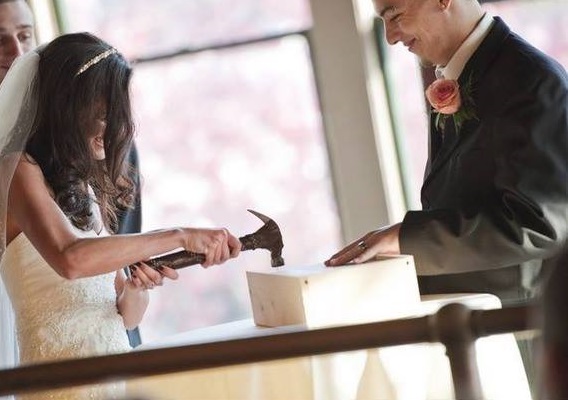
First Fight or Anniversary Box: Originally known as the "First Fight Box", it can also be used as an Anniversary Box, which sounds a bit more positive. Start with a box. It can be carved, painted, decorated, etc, to fit the wedding theme. Predrill the top so that the nails fit snug, but will pass through easily. Insert the nails before the ceremony, so that it will be ready. During the ceremony, put wine and love letters inside, and then bride and groom nail it shut. First Fight Box means it is to be opened after the first fight, letter read and wine drank, to remind the couple of their commitment and love for each other. Same with the Anniversary box, except that it will be opened at a specified anniversary. Pick one - 1st, 5th, or 10th are good choices. Purpose of the box - Fight or Anniversary - will be explained by the officiant during the sealing. *
Wine Ceremony: The bride and groom each take a carafe of wine and each pour some into a single glass, which they both drink from. One carafe contains red wine representing the deep richness of the love in their hearts and the robust energy which keeps their loving relationship going. The other carafe contains white wine, fermented in oak barrels, it represents the strength of a loving marriage and a lingering taste in their soul for the love they feel for each other. The combination creates a rosé, which is symbolic of their blending together through a committed relationship in marriage. Some of the wine will remain in their individual carafes which represents that each of them remain separate individuals
Officiant: "_________ and ___________, As your lives blend together, so shall your wines."
Variation: Tables with wine glasses are placed next to seating area, for guests to pick up a glass as they take their seats. When the bride and groom begin their drink, guests drink with them, to symbolize commitment to the couple.
**
Quaich Ceremony: A quaich is a two handled Loving cup, and signifies the trust and unity between the partners. The Quaich (pronounced "Quake"), filled with wine or other favorite drink, either before or during ceremony, sits on a pedestal between the bride and groom. At the appropriate moment, the groom picks up the Quaich by the handles, bride places her hands on his, then they take turns drinking
Example of reading for Quaich Unity: "The Quaich, a two handled loving cup, is an ancient Scottish tradition that seals the bond of two people, and marks the blending of two families. It symbolizes the love and trust implied by the bond, as the new couple shares the first drink of their marriage together. **
Water Ceremony: The couple each pour a different colored water into a single glass, creating a third color. If children are to be included in the ceremony, simply add more glasses and more different colors. The end result can be a fun experiment **
Sand Ceremony: Similar to the water ceremony, the bride and groom both pour different colored sand into a glass, taking turns, a little at a time, which creates colorful swirls and patterns. After the ceremony and festivities, jar is typically sealed by pouring hot wax into the top of the jar, and then capping it with a cork stopper or other lid. This will preserve the swirls and make a nice display item for the home.
Variation 1: Includes children or other family members of the bride and groom, each having a different colored sand and taking part in the unity ceremony.
Variation 2: Brides family fills one glass with different colored sands, and groom's family fills a second. Then bride and groom take their respective mixes to alternately fill the large container. Variation 3: Bride and groom combine sand during the wedding, but all of the guests receive tiny vials of different colored sands, to add to the carafe during the ceremony. When all sand is in, the carafe is sealed, typically with hot wax.
A common reading used for sand ceremonies (can be adapted for water, too): "Life's moments are as grains of sands, forever moving and shifting with the winds of time. Today, ________ and __________, you are making your eternal commitment to one another, blending the sands of your lives together. The separate vessels of sand you each hold represents your lives up to this moment. And from this moment on, as with the sands you now blend together, you shall become one; a family created."
Colored sands, carafes and vases can be found at many craft stores. Click here for an online selection: Unity Vases and Sand **
Salt Ceremony: Indian weddings often include a salt ceremony, where the bride passes a handful of salt to her groom without spilling any. He then passes it back to her and the exchange is repeated three times. She then performs the salt exchange with all the members of the groom's family, symbolizing her blending in with her new family. **
Breaking Bread Ceremony: The bride and groom tear off pieces of bread, and then each eat a piece. Sometimes the bread is also shared with family and friends. It symbolizes their future as a family together. **
Garland Ceremony or Lei Ceremony: The bride and groom exchange garlands of flowers. This is a common part of Indian weddings, where the ceremony is called varmala or jaimala, and represents a proposal by the bride and acceptance by the groom. It also represents their new unity, blessed by nature. In Hawaiian weddings, the bride and groom typically exchange leis. The families may also exchange leis with the couple. Leis represent the love and respect you have for the person you are giving it to, and the unity of the new family. **
Circling: In Eastern European ceremonies, the bride and groom circle the altar three times, which are their first steps together as husband and wife. In Hindu ceremonies, couples circle the fire seven times, sealing their bond. The unbroken circle represents the unbroken commitment to each other. **
Poetry, special music, photos, videos, audience participation rites, etc., can also be tastefully added to a ceremony for that personal touch.
From the moment the music starts, until their exit as husband and wife.
Openings, readings, vows, ring exchanges, unity, and more
*
These are just examples, and couples should not feel limited by what they see here.
*
Your Day, Your Way
Moments and Milestones
Visitors may use anything found on this page without restriction

The serenity to accept the things you cannot change
The courage to change the things that you must
And the wisdom to know the difference.
Live each day, one day at a time
Enjoying your time together, one moment at a time
Seek the wisdom of experience
Learning all that you can from each other
Accept hardships as the building blocks of experience
Realizing that accepting both the good and bad
Are simply a part of being alive
Strive to make as many things right
As is humanly possible in your life together
That you may be reasonably happy
In the life you share from this day forward"
one line at a time, until the vow is complete.
This format can be tricky, especially if the vows are long and complex.
A written text (cheat sheet) tucked in a sleeve for backup is a good idea for this option.
With my heart, I thee cherish
Would all that I am, I give unto you
Would all that I have, I share with you
From this day until forever done.
With this ring, I thee wed
"I will forever wear this ring as a sign of my commitment and the desire of my heart"
"Wedding rings are made precious by our wearing them. Your rings say that even in your uniqueness you have chosen to be bound together. Let these rings also be a sign that love has substance as well as soul, a present as well as a past, and that, despite its occasional sorrows, love is a circle of happiness, wonder, and delight. May these rings remind you always of the vows you have taken here today."
More contemporary: Groom's first and last, bride's first ("John and Jane Doe")
Introduction is generally suffixed by "husband and wife", "newlyweds", or something similar.
(prompt)And now, ______________ and __________, it is time to light your candles.
or
And now it is time for the candles of unity. 


(The couple each add wine from their carafe into the common cup)
Officiant: "This cup is a sign of your unity. Although you are two distinct persons, both respecting the equal dignity of the other, you have chosen to unite your lives and to seek your happiness together. You drink from the same cup to symbolize your trust in each other, and to be reminded that from this day forward you will share all that is to come, encompassing all sorrows and joys, all hardships and triumphs, all the experiences of life.
Drink now, and may the cup of your lives be sweet and full to overflowing."
(They place the wine glass back on the table and turn back to the officiant)
Officiant: "May the robust energy, strength, and rich love you have for each other be with you always."
Note: We have a Quaich available for ceremonies.
___________ and _________, it is now time to complete your bond.

Variation: A large loaf of fresh baked bread at the point of the receiving line. Bride and groom tear off a small piece and hand it to each guest as they are greeted.
Back to the Moments & Milestones

Contact us:

