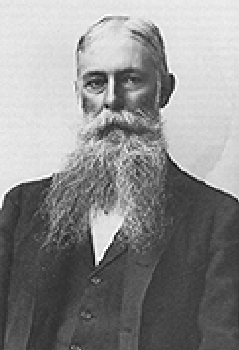
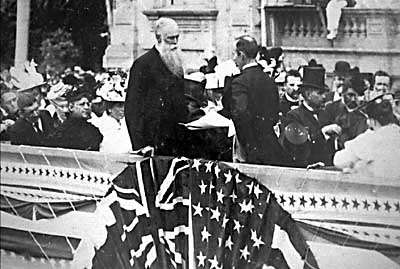
Left: Sanford Ballard Dole. Right: Dole inaugurated as Territorial governor at annexation ceremony, Executive Office Building (Iolani Palace), 1898
In the history of Hawaii since 1778, three men tower far above all others. They each exercised leadership through a lengthy period of profound and turbulent change. The power and scope of their influence reverberates until today. For the past 90 years nobody has come close to their importance in Hawaiian history.
(1) Everyone knows about Kamehameha the Great -- he was the first chief who ever seized control of all the Hawaiian islands under a single sovereignty, thereby creating the Kingdom of Hawaii as absolute ruler.
(2) Kauikeaouli Kamehameha III single-handedly gave up dictatorial power to create the rule of law and the beginnings of democracy when he proclaimed the first Constitution in 1840, establishing executive, legislative, and judicial institutions. Its first sentence, astonishingly bold at that time in the history of Hawaii, says (translated into modern English) "God has made of one blood all races of people to dwell upon this Earth in unity and blessedness." He survived a foreign takeover by England in 1843, obtaining international recognition and treaties. He made it possible for foreigners to come to Hawaii and take an oath to become naturalized subjects of the Kingdom with rights fully equal to natives. He gave up sole ownership of all the lands of Hawaii, inherited from his father by right of conquest, to create a system of government lands, crown lands, and private deeds in the Great Mahele beginning in 1848. He twice wrote treaties offering the annexation of Hawaii to the United States, in 1849 and 1853.
(3) Sanford B. Dole was native-born at Punahou School, April 23, 1844. He spent eleven of his most formative years (ages 11-22) growing up Hawaiian-style, at Koloa, Kauai, where he became expert at konane (similar to checkers) and pahia (a special form of diving). After attending Williams College (Massachusetts) he became a lawyer, and included plantation laborers among his pro bono clients. He adopted a native girl (perhaps his biological child), whose descendants are Hawaiian community leaders today including the famous voyaging canoe navigator Nainoa Thompson. His ties to Koloa remained strong, and he was elected to the Kingdom Legislature 1884-86 from Koloa. In 1887 he led the protest group that forced King Kalakaua to sign a new Constitution. Later Kalakaua appointed him to be a Justice of the Kingdom's Supreme Court.
In 1893 he honorably resigned his judgeship before the revolution; and then led the Provisional Government afterward. U.S. President Grover Cleveland "ordered" him to undo the revolution and reinstate the Queen. Hawaii President Dole wrote a lengthy and strongly-worded letter of refusal, confirming that Hawaii desired annexation but was not a puppet regime. Dole then helped create the Republic of Hawaii and was its only President through four more years as an independent nation, recognized by all the nations who had previously recognized the Kingdom. His strong leadership allowed the Republic of Hawaii not only to defy President Cleveland but also to crush the attempted counter-revolution which made use of rifles and bombs the U.S. Navy permitted to be smuggled in to Robert Wilcox.
When U.S. President McKinley came into office, President Dole renewed the negotiations for annexation to a reluctant United States. Dole drove a hard bargain. The U.S. paid off the accumulated national debt of the Kingdom and Republic (paying more than the market value of the ceded lands at that time). Dole also required the U.S. to hold the ceded lands not as U.S. property but as a public trust for the benefit of all the residents of Hawaii. In 1900, he became Hawaii's first Territorial governor. In 1903 he was appointed judge of the U.S. District Court (Honolulu). Following many years of charitable works, he died in 1926.
Dole and Liliuokalani were friends. He protected her safety and civil rights during the 1893 revolution. Unlike monarchs beheaded and shot during the French and Russian revolutions, Liluuokalani was allowed to simply walk a block to her private home and live there unmolested, with the revolutionary government paying for her Royal Guard troops to continue protecting her. Rifles and bombs were found hidden in the flower bed of her private home (Washington Place) during the Wilcox attempted counter-revolution of 1895; and a search of the home discovered she had already signed documents of appointment to immediately install her cabinet ministers if the counterrevolution had succeeded. She was put on trial and convicted of misprision of treason (knowing about plans for the counter-revolution and failing to report it). She spent several months in a genteel "imprisonment" in a huge private room at Iolani Palace, where she had a full-time personal maid-servant and supplies for sewing her famous politically inflammatory quilt and for writing political songs and journals. President Dole pardoned her, allowing her to speak, write, and travel freely. She was allowed to organize a petition drive opposing the Republic's most cherished goal of annexation, and to travel to Washington D.C. to lobby Congress against the annexation treaty proposed by Dole. But in the end, President Dole's patience and perseverance paid off, and the Republic's Treaty of Annexation was approved by a joint resolution of Congress and signed by President McKinley in 1898.
Helena G. Allen published a book whose title clearly shows her political views: "The Betrayal of Liliuokalani" (Glendale CA, Arthur H. Clark Co., 1982). She describes on pp. 291-292 how Sanford Dole became President of the Provisional Government reluctantly, and as a result of a consensus that included even Liliuokalani.
"The Committee met at eight o'clock, Monday night, January 17, 1893, at Henry Waterhouse's residence to finalize the Provisional Government's 'cabinet' and officers. Thurston, Wilder, and Castle were ill, a fact which probably allowed Sanford Ballard Dole to take a last stand to save the monarchy. Knowing the personal animosity directed toward the queen, Dole agreed she should be dethroned, for her own safety, if nothing else. He also knew the Hawaiians' love for the monarchy was as great as the Americans' hatred for it; therefore, he suggested that Princess Kaiulani be named the queen's successor under a regency. He was immediately shouted down. Dole was then asked to be president of the new government. He hesitated, but was later influenced by Soper, once chief of police under the queen, agreeing to command the military forces. He was further influenced by Sam Damon, who had been close to the queen and was a 'very conservative man.' Damon had spoken to the queen about his offer, and she had told him to go ahead as it probably would save bloodshed. She wrote in her diary: 'I attribute the leniency of the Council to his interposition with them.' The queen had been accused of being (but only by the kindest people) naive. There is no doubt she was, but an interesting observation is that probably the most naive, certainly the least vicious or predatory of all the haole in opposition to her was her successor -- Sanford Ballard Dole. Was it the hand of Providence that brought Dole to a position he didn't want, and which probably carried out the queen's deepest desire that there be no bloodshed? Liliuokalani in her latter years believed it to be so. One hesitates to speculate what might have happened had Lorrin Thurston been placed in Sanford B. Dole's position."
Sanford B. Dole was Hawaii's longest-ruling chief executive at Iolani Palace (1893-1903). His spirit remains there. His statue belongs there. Yet there is no picture of Sanford Dole at the Palace, and no statue of him either at the Palace nor anywhere else in Hawaii (There is a bust of him in the library at the Mission Houses Museum, and an oil portrait in the office of Dole Intermediate School in Kalihi). The Hawaiian sovereignty activists today have made a Soviet-style non-person out of him, and would like to bury all memory of him except occasionally to villify him. But after all is said and done, he was the last chief of government of an independent nation of Hawaii. His firm hand guided Hawaii through a decade of extraordinarily turbulent times when he served as head of government for the Provisional Government, Republic of Hawaii, and Territory of Hawaii. His work as a legislator in the Kingdom, and a judge in both the Kingdom and the Territory, together with his leadership from 1893 to 1903, make him an extremely important figure in the history of Hawaii during the four decades from 1880 to 1920.
Letters granting full diplomatic recognition to the Republic of Hawaii were personally signed by the rulers of at least 19 foreign nations in late 1894 and sent to His Excellency Sanford B. Dole, President of the Republic of Hawaii. Those who signed the letters included Queen Victoria of Britain, Tsar Alexander III of Russia, two princes on behalf of the Emperor of China, the King and Queen of Spain, U.S. President Grover Cleveland, and 14 others. Photographs of letters from all 19 nations are available on a webpage at
https://www.angelfire.com/big11a/RepublicLettersRecog.html
For further information, see:
Sanford Ballard Dole -- His Political Biography
** NOTE ADDED APRIL 23, 2014: Ten years after the above webpage was posted, it is now President Dole's 170th birthday. A new webpage has been posted, which includes new material including links to a book review of a 2011 book which discusses in depth the efforts made by President Grover Cleveland to destabilize the Provisional Government in December 1893. The new webpage also provides a link to photographs of letters recognizing the Republic as the rightful government of Hawaii and Sanford Dole as its President -- letters which were personally signed by Emperors, Kings, Queens, and Presidents of 19 nations on 4 continents in 11 languages, along with photos of ex-queen Lili'uokalani's personally signed letter of abdication and oath of loyalty to the Republic. See
https://www.angelfire.com/big09/Dole170Birthday042314.html
================================
You may now
SEE MORE INFORMATION ABOUT THE 1893 OVERTHROW OF THE HAWAIIAN MONARCHY
or
SEE MORE INFORMATION ABOUT THE ANNEXATION OF HAWAI’I TO THE UNITED STATES
or
GO BACK TO OTHER TOPICS ON THIS WEBSITE