

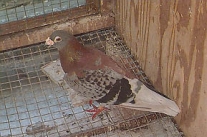
What is a Mosaic ?
Is it a Somatic mutation, the result of a Bipaterity sperm or is it simply a Chimera?
|
If you hear the term Mosaic, and your involved in the television industry, you might think of an iconoscope which is the television camera's photosensitive surface. Should you be involved in the Art World a picture or decorative design made by setting small colored pieces of stone or tile into a surface might come to mind as the meaning for mosaics. We see this on many floor and wall tile designs. These are often attractive and colorful. Others may in vision the process of making pictures or designs from a composite of overlapping photographs as being a mosaic. In botany the term Mosaic is referred to as a viral disease of plants, resulting in light and dark areas of the leaves. In short, the word Mosaic has different meanings to different folks of different walks of life. However, since this is a pigeon web site, the Mosaic types I want to talk about here are strictly biological. Note I said types as there is more than one cause for mosaics in our pigeons. Biology uses the term mosaicism as a condition exhibited by an individual displaying tissues of genetically different types, or possessing cells of two or more different genetic constitutions or an organism that has two or more cell populations that differ in their genetic makeup. When a difference in color, pattern or physical structure exists for these two genetic makeup's we see a mosaic. Their cause could be environmental or genetic in nature but the end result is basically the same. They could either be the result of Somatic mutations or they are the result of a "Chimera"; which is simply an individual that consists of two or more populations of cells that originated from different or separate zygotes. A zygote being a newly fertilized egg. When two such zygotes are deposited within the same egg shell and on the same yolk, they will either develop separately as twins or they can fuss together early in their development and become one individual. Chimeras are actually quite common in many animals but since the DNA of these differing cell populations do not always result in something external to reflect their differences, many chimeras go totally unnoticed by the casual eye. For a good many years, we in
the pigeon world, were of the mistaken belief
that a mosaic was formed when two separate sperm cells fertilize the
same egg, resulting in a mosaic. It was our mistaken belief
that this was our highly
admired Dr. Willard F Hollander's Bipaterity sperm theory
However, that most certainly is an incorrect assumption on
our
part. Hollander never said two sperms fertilized a single egg.
What Hollander did suggest was that one
sperm fertilized an egg forming a perfectly normal zygote and a second
sperm simply made haploid tissue all by itself without
any egg at all. Hollander then suggested this
supposed haploid tissue combined with the perfectly normal fertilized
egg resulting in
what he mistakenly called a mosaic. Thus the Bipaterity
sperm theory about which he wrote two
papers. However, today
we have the advantage of vastly more genetic information
and knowledge. These advancements now tell
us that our mosaics, are in fact, the result of the condition known
as a Chimera.
|
In a recent email Dr. Richard Cryberg explained why Hollander's theory would not work. This is how he explained it. "The
biological problem with haploid tissue from a sperm is several
fold. A sperm has
no viable mitochondria. A cell without viable mitochondria is
simply
unable to divide or do much of anything at all. Sperm also
lack other
organelles that viable cells require for proper function.
Worse, sperm do not
have functional amounts of the RNA that reads the genetic code and
allows
for translation into proteins, thus the whole genetic code in the sperm
is
useless. Sperm absolutely depend on eggs to supply a whole
bunch of stuff and without that stuff the sperm is dead. Even
a sperm that
is diploid is a dead sperm for these reasons. We know diploid
sperm are not
viable because we can make them and they die. You could not
make viable cells by combining two sperm. Not even
artificially
in
a petri dish.
Dr. Richard Cryberg has written a short paper, Chimeras by Cryberg for publication on this website. In Cryberg's paper he explains why Hollander theory is not correct. So for historical reasons I have include an article by Ken Davis about Dr. Hollanders theory. It is posted below for your understanding so that you can compare it to what we now understand today. As you read through Ken's article please keep in mind that this theory is no longer excepted today. In fact, today we also understand that should two or more sperm enter the same egg, polyspermy occurs. In this case, some of the genetic material condensed into chromosome, is attracted to the extra sperm, causing abnormal development and ultimately the death of the embryo due to polyspermy. Regardless of their cause, when we have different genetic cell make-ups, resulting in different genetic outcomes and these outcomes result in something we can see with our eyes, we have a mosaic. Be it the result of a somatic mutation or the result of a Chimera Lets start with
Somatic Mutations. To find answers, as they relate to our
pigeons, I contacted the editor of Pigeon Genetics,
News, Views
& Comments. With his permission I will
cut and past portions of his emails regarding pigeon mosaics.
|

Somatic Mutations
Somatic
mutations are
common in plants. Many of these have been propagated by plant
breeders and account for a lot of the plant variations on the
market. Particularly of the plants that do not produce an
abundance of seeds or that, produce seeds that are so diverse in their
genetic traits that the desired trait is hard to get. Most of
our fruit trees and many of our shade trees are propagated from grafts
or cutting to keep the same genetic characteristics. These
usually are propagated from somatic tissue. Some
plants like Coleus are noted for their somatic mutants and easily
propagated. I
have seen
somatic mutations on lots of plants that produce completely new
varieties and thus
somatic mutations are converted to new genetic status.
But
that is another story since we normally cannot do that with animals.
In animals, we see
somatic mutations but they are
usually not
transmissible by tissue propagation. However, tissues from
these can be grown in the proper medium. Somatic mutations
include moles, warts, cancer, stray colored hairs, stray feathers, etc.. Mosaic
areas can
occur on varying amounts, sizes, and areas on animals just as they do
in plants. Part of these can be somatic but most are
apparently genetic in origin. The single feather or
scattered small patches of feathers can be either genetic or somatic
but by definition they are all mosaics. When we see what
appears to be a somatic mutant, it many times turns out to be by
selection, a genetic mutant. A couple instances of the latter
readily come to mind: Way back when, a German family was
rearing green finches from the Canary Islands, one bird turned up with
a single yellow flight feather. By inbreeding, they were able
to increase the yellow feathers until they had an all yellow bird,
which is the ancestor of our yellow canaries. A number of years
ago, I visited with Elsworth Kistler in Pennsylvania. He had
an Archangel turn up with a white spot about the size of a silver
dollar in the middle of its bronze chest. I saw the bird and
tried to buy it from him. He wanted to breed more of the same
and did not want to part with it. He did this but the white
was now about half the bird. I purchased some of these from
him. Breeding them together, he and I produced some all white
with black tails. Breeding these together produced some all
white birds. When these all white birds were bred back to
full colored birds the white completely disappeared so it was a
recessive white that acted as a migrational white just as the yellow
was a migration mutant in the Canary. Many almonds will
have a group of feathers forming a spot somewhere on the body and these
are probably somatic. A somatic mutation
can occurs in any cell (body cells) except the reproductive cells
(genetic cells) i.e. genes on the chromosome which result in the
reproductive cells (egg and sperm). In warm blooded
animals it is fairly clear cut; unless the trait can be reproduced
genetically it is considered to be somatic. In
plants, this becomes blurred because somatic cells, as
demonstrated above, can be selected to produce a new plant
which can then produce its own reproductive cells and thus the somatic
mutation becomes a genetic. In Insects and
other
cold blooded animals the action of mutations is blurred by the
multitude of ways the organism can be, and is, affected by the
environment in the very broad sense. Many insects can
reproduce parthenogenically until the environmental conditions become
stressful and then reproduce genetically. Many mollusks and
annelids reproduce by being hermaphroditic. Some mollusks are
born female and after a number of years change to males so that sexual
reproduction can be accomplished. Some fish may change sex in
the absence of available males in the population. Alligators
and Crocks reproduce sexually but the sex of the hatchling is dependent
upon the temperature of the eggs during incubation. All of these
things
have a bearing upon the picture as to whether a mutation in an organism
can be called somatic or not. As you can see there
is no simple answer. Bet you did not want to know all of this
when you asked. Keep
up the good work. Dr. Lester P Gibson.
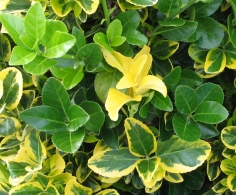
Most somatic mosaics
in our birds show up as a small spot or feather on the body.
If you have an ash red bird, a white bird, or an Almond with small
spots or feathers other than the color they ought to be (blue or black
on red ground) (red on blue ground) etc. they probably are somatic
mosaics.
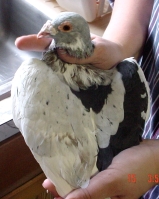
Next we will look at Ken Davis's report on the infamous Two-Sider. A very strange and interesting specimen indeed. I'm sure you will find Ken's article interesting reading. It is based on Dr. Hollanders Bipaterity theory; which as I pointed out above is no longer excepted science . I am however going to including it here, as a window to the past. It shows how our understanding of things have changed over time; as we progress in both our knowledge and our understanding of genetics. Just try and keep in mind, that where Ken refers to this Two-Sider bird as being "Bi-Paternity" (formed two sperms and one egg) it is in actuality a Chimera; which is formed from two separately fertilized gametes placed on a single yolk and subsequently become fused together into one individual. A Chimera is formed when two fertilized eggs fuse into one body shortly after the first few cell divisions or very closely thereafter. The earlier the fusion takes place the more complete the two side differences are. In this instance it must have been very early in development.
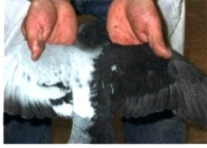
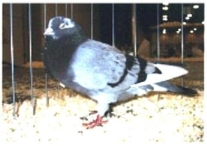
Marvin Lee of Praire Grove, Ar. bred this bird which was genetically a sooty, blue bar, baldhead roller on one side and a black homozygous Chinese owl on the other. The fact that this specimen is of two different breeds, and involves more than just the sex chromosomes is all the more evidence that it is a chimera. Dr. Gibson has the body of this bird preserved. What follows is an article written by Ken Davis. Ken was a close student of the late Dr. Willard F Hollander, a professor of genetics who first put forward the theory of two sperms fertilizing a single egg as one way to create this type of mosaic. Dr. Hollander specialized in the study of bird, mice and fruit fly genetics. He loved his pigeons and was without a doubt the most knowledgeable expert on their genetic make up. The vast majority of what we know about pigeon genetics comes from him. Sadly he passed away and we can no longer ask him for guidance in our studies. So lets now turn to Ken's article for a look into the past for what was once considered its cause.
The infamous two-sider

|
Yes
indeedy, that "two-sider" is a nice mosaic, for sure. But, something
more. If you look at the photo's real close you'll see that the birds
right side is a spread Chinese Owl, complete with the Frill, the
Pantaloon, Owl shaped head, etc... Look at the head-on view.....notice
the difference in feet structure, leg structure and length, the total
package? O.K., now, we were all
going over these
pictures the other night at the
Genetics Meeting at Joe Fraziers Place, and
Leon Stephens told us that he knows how this happened; that it was
"Bi-Paternity". He said that the Frill and the Pantaloon on the Owl
side of the bird are recessive characteristics, so the Mother of this
mosaic had to be a Chinese Owl, and was bred by two cocks, a spread
Chinese Owl cock and a blue series Birmingham Roller, therefore the
mosaic was Sired by two Fathers, hence the "Bi-Paternity".
|
Well,
this ain't what happened! The hen that snuck into the cock pen was a
"Brown Bar Birmingham Roller", and she was left in there, or allowed to
stay, and she was THE ONLY HEN IN THERE. Now, Frill and Pantaloon being
recessive characteristics, how'd they get there? How can they express?
Let's address the color part of it. The mosaic individual is spread
blue on it's right side, and blue bar on it's left side. Now, the Dam,
or Mother to this individual is a true Brown Bar, and she could only
have been bred by true Brown Bar Birmingham Roller cocks and spread
blue Chinese Owl cocks. Well, if she was "treaded" by both,
("Bi-Paternity"), the mosaic would have been a Brown Bar Birmingham
Roller on one side, and a spread blue Chinese Owl on the other side.
But it's not! Careful examination of this mosaic reveals that it is
phenotypically a "pure" Chinese Owl/spread blue on it's right side, and
a Chinese Owl/Birmingham Roller blue bar hybrid on it's left side. So
how can this be? The best explanation is "Super Numerary Sperm". That
is to say that the Brown Bar Birmingham Roller Dam was bred by a Spread
Blue Chinese Owl cock, and that more than one sperm from the Sire
penetrated the ovum. And for reasons not totally yet understood, the
extra spermatozoa affected the phenotype to the results which we now
see. PIGEONS IN GENETICS, FROM DARWIN TO BIPATERNITY, By W.F.HOLLANDER, Professor Emeritus of Genetics, Iowa State University, Ames, Iowa50011. This paper issued at the Department Zoology/Genetics, Iowa State University, February 2001. Not copyrighted |
|
Mosaic Duplication So how will a mosaic, be it from a somatic mutation or the formation of a chimera, reproduce? Will it produce more of the same or will it be one form or the other? When talking about mosaic pigeons, this is a frequent question asked. Reproduction of the same mosaic effect, regardless if it is for structure or color depends on the DNA within of the cells of the gonads. In the case of a somatic mosaic you most likely will not be able to duplicate the mosaic effect since the mutation took place outside of the gonads and therefore no DNA there will reflect that difference. Chimera mosaics are different. With a Chimera it is possible for one gonad to be of one grouping of DNA while the other contains the other grouping of DNA. So in general the bird may indeed be able to pass along both forms of structure or both forms of color differences to their offspring but not both possibilities from both gonads at the same time to a single gamete. Remember a single gamete originates from a single gonad. So your only going to have that gonads DNA passed along to the youngster. Never a combination of both. |
A mosaic of Mosaic photos
all of which are Chimeras.
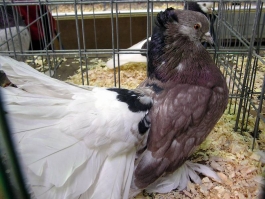
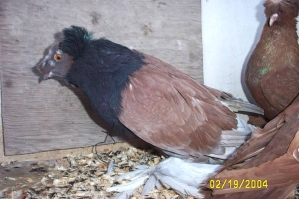
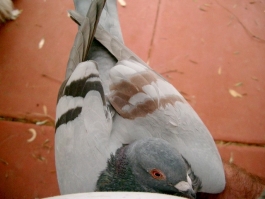
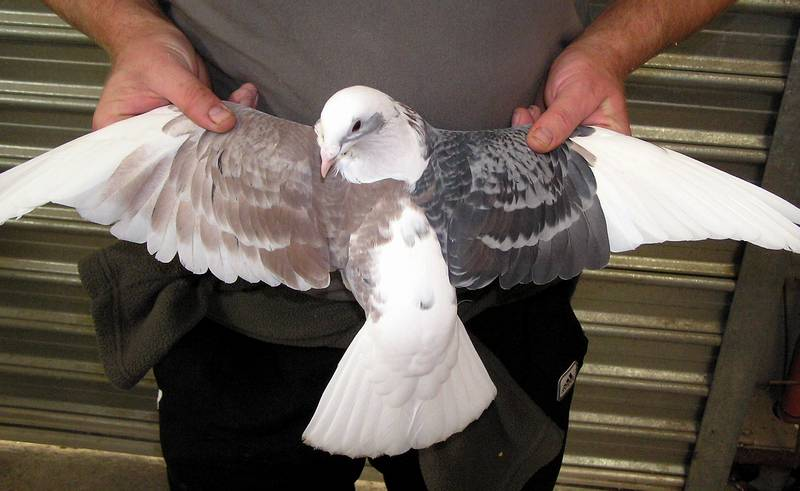
Five Mosaic photos by Michael Spadoni of Geelong Australia


Half Smoky / Blue bar by AL Neese and a Half Mealy / Grizzle by Larry Davis


These two photos of the same bird were taken by David M. Longseth at
the 2003 NYBS.
The right wing shield is a blue check while the left side is a dark
'dun/brown' color with heavy black flecks or sootiness.
This left side may be almond as the sire was an almond bird.
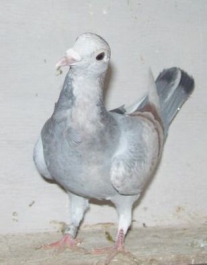
This
young homer cock belonged to Timothy Hume of Saltspring Island, BC
Canada.
It was killed at age four by a falcon. The bird was both a blue bar and
a mealy.

Now to read Dr. Richard Cryberg's report, simply click here for Chimeras by Cryberg and it will take you there and bring you up to date on our understandings of Chimeras.
For
additional information written by Dr. Hollander click here.
Sectoral
Mosaics in the Domestic
Pigeon: 25 More Years by W. F. HOLLANDER
Email: ronhuntley@charter.net
Copyright 1999 by
Ronald Huntley.
Permission is granted to download or copy for non-commercial individual
use only.
The author retains all other rights under copyright.
Ronald R. Huntley
Web Page Designer
Duncan, SC. 29334
phone: (864) 249-0276