
1971-2012
Superbikes
7216 Williams Rd.
Flowery Branch Ga. 30542
678-887-2216
Racing Tires
In 1971 a motorcycle franchise was
born. Originally known as"Motorcycles And
Things", the first motorcycles sold were Bridgestone, Rockford, Rupp and MCB. Later Zundapp, Sprite, Ducati, Norton and Moto Guzzi were added to the line. The name of the franchise was
changed, in subsequent years, to "Superbikes Inc".
In an attempt to integrate computer technology to
marketing motorcycles, "Systems Marketing
Corporation" was formed in 1976. All these
companies had their origin in Gainesville, Florida
and were the creation of Robert Colee.
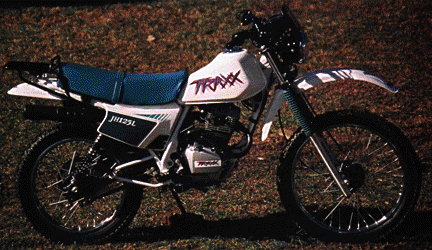
In 1993 the trade names were transfered to Global Communications Group Inc. In 1996 Superbikes was re-opened, in Lawrenceville Ga., for the Atlanta Olympics, as a retail franchise and cyber mall selling Ural and Traxx motorcycles.
In 1999 a joint venture was formed with Chandler Motorcycles Inc., Cycle Re Cycle and Superbikes in Flowery Branch Ga. In 2001 Superbikes went away from the
retail store concept and into cyber space. We still do service
on a limited basis.
| Search this site! |
A rough Flat Rate List
Service and parts sales by appointment only.678-887-2216 Robert
Our Basic Price List
SERVICE
HOURS AMOUNT
TUNE UP JAPANESE SINGLE---1.5------------- $82.50
TUNE UP JAPANESE TWIN-----2.7-------------$148.50
TUNE UP JAPANESE TRIPLE---3.2-------------$176.00
TUNE UP JAPANESE 4CYL.----4.0-W/O SHIMS---$220.00
TUNE UP JAPANESE 4CYL-----6.0-SHIMMED-----$330.00
OTHER TUNE UP AT $55.00 TIMES TIME ON JOB
CARBURATOR REBUILD SINGLE--1.9------------$104.50
CARBURATOR REBUILD TWIN----3.8-------------$209.00
CARBURATOR REBUILD TRIPPLE-5.7-------------$313.50
CARBURATOR REBUILD 4 CYL.--7.3-------------$401.50
TOP END OVERHAUL 4 STR.SIN-5.0-------------$275.00
TOP END # # 4STR. TWIN-----8.0-------------$440.00
TOP END # # 4STR. TRIPPLE-11.0-------------$605.00
TOP END # # 4STR. 4 CYL.--14.0-------------$770.00
BOTTOM END 4STR. SINGLE---10.0-------------$550.00
ATV ADD FOR LABOR----------5.0-------------$275.00
BOTTOM END 4STR. TWIN AIR--12.0------------$660.00
BOTTOM END 4STR, TW WATER--15.0------------$825.00
BOTTOM END 4STR. TRIP. AIR-14.0------------$770.00
BOTTOM END 4STR. TRP WATER-16.0------------$880.00
BOTTOM END 4 STR. 4CYL AIR-16.0------------$880.00
## WATER-------------------18.0------------$990.00
TOP END 2 STROKE SINGLE-----2.0------------$110.00
TOP END 2 STROKE TWIN-------4.0------------$220.00
TOP END 2 STROKE TRIPLE----6.0------------$330.00
WATER COOLED ADD------------2.0------------$110.00
BOTTOM 2 STROKE SINGLE------8.0------------$440.00
BOTTOM 2 STROKE TWIN--------12.5-----------$687.50
BOTTOM 2 STROKE TRIPPLE-----15.0-----------$825.00
WATER ADD-------------------2.0-----------$110.00
FORK REBUILD PER TUBE--------1.5-----------$82.50
TIRE CHANGE ON BIKE---------1.0------------$55.00
OFF BIKE------------------------.5-------------$27.50
RIM LOCKS ADD---------------.1-------------$5.50
CR
EAM TREAT TANK--------2.0------------$110.00
PLUS PARTS $ NOTE: A PARTS DEPOSIT IS REQUIRED
SOME MAKES AND MODELS WILL VARY.

What is the diagram above? A Battery Sulfation Removing tool.
You can build this nifty device yourself. Click here for full details.
In a message dated 4/24/01 6:36:35 AM Pacific Daylight Time,
<< I found out that it
was fully charged after one hour on 6 amps charge. Its probably
better to undercharge than overcharge. >>
As a member of the Electric Auto Association and an electric car owner
(former) I have been exposed to quite a bit of discussion on batterys and
battery charging.
Actually, you don't want to undercharge batteries because that will shorten
battery life too. The rule of thumb is to use a maximum charging rate of
1/10 of the rated amperage value of the battery. That means that on a
motorcycle battery, a charging rate of about 2 amps is the maximum you
should use for a good charge. These figures are usually given in the
literature that comes with new batteries. This is the reason that most
Motorcycle battery chargers are anywhere from 500ma (1/2 Amp) or 1 or 2
amps. Most are 1 amp. I wouldn't use a 6 amp charger unless it was all I
had to use and I didn't have a choice. Then I would watch the voltage to
see that the charger was shut off when the voltage got to 15volts. This
would indicate that the charge is complete.
One of the problems with being too aggressive with the amperage is that you
can put too much heat into the battery and actually warp the plates. This
will shorten the life of the battery and permantly damage the battery.
As for the pulse chargers, (sulfate removers) they definately do work and
there is a lot of testimony form members of the club to this. There is a
pulser that uses the battery itself to generate the pulse. I have one of
these and have revived electric car deep cycle batteries successfully. It
will never bring a totally dead battery back to life, but will definately
help any battery that is getting tired or has started to sulfate (most
batteries that haven't been on a float charger or are neglected over the
winter).
Here's the web site of the pulser that I use.
http://www.pulsetechproducts.com/ It's the clip on type that uses the
battery for power and can be used on any size battery as long as it is the
correct voltage (my pulser is for 12v batteries). I used it on my electric
car by moving it around to different batteries (two 6 Volts at a time).
I've also used it on motorcycle batteries and car batteries. It takes at
least a week to do it's thing. Seems to jolt the sulfate off the plates and
make it fall to the bottom of the battery which is another problem if it
piles up on the bottom and shorts out the plates. Most batteries have
extra room on the bottom for this, but sometimes it is not enough.
If you put an AM radio near one of these when they are on, you can hear the
pulse that is being generated. I'm not sure what these are selling for these
days, but they do in fact work.
Bob
Motorcycle Product News Magazine
"Shaft drive vs chain drive. The age old argument. "
The evolution of the motorcyle drive system has involved quite a bit of too’ing and fro’ing. We started with belt drive then chain and then shaft drive. Belts re-emerged in 1982 on Harleys Sturgis and have been used on quite a few different model motorcycles ever since, mainly cruisers. But which one is the best? Reality is its horses for courses.
On a heavy long distance tourer that won’t see a lot of rough roads or aggressive riding, shaft drive is undoubtedly the way to go. For more sports oriented riding or for use on rougher roads, chain drive has a number of advantages. Let’s consider some of the facts: -
On of the greatest detractors of handling is unsprung mass. That is all the weight that is not being cushioned by the suspension, ie. everything bolted to the bottom of the shock absorber like the rear wheel, tyre, tube, hub, axle, wheel bearings, disc, calliper swing arm etc. To best understand this, grab a pencil and swing your arm around in circle. Mid circle stop and swing back the other way. Now try the same thing with a brick in your hand. Not so easy. The same situation occurs when you hit a bump and the suspension has to travel up and down plus control all that unsprung weight.
There lies the greatest problem with shaft drive. The extra 4 to 8 kg’s a diff and drive shaft weigh over and above the weight of chain and sprockets. This is most evident when braking over rough or broken road when the rear wheel tends to skip and chatter.
The next thing is torque reaction. When converting energy at right angles from a shaft into a diff, there will be a certain amount of torque reaction. This is evident when accelerating hard. The rear end of the bike tends to rise up. Snap the throttle closed and the bike will squat or sink down in the rear. This isn’t a real problem on a tourer but imagine tipping into turn one at Eastern Creek at 200 plus kmh. Close the throttle, down shift and the rear end squats, the steering geometry changes and gets heavier and the ground clearance is reduced. Not the ideal situation for a sports bike!
The third factor with shaft drive is the inability to utilise long travel suspension like on a dirt / motocross bike. Too much angle on the swing arm puts excess loading into the universal joint resulting in uni damage and premature wear.
The good news with shaft drive is, it is clean, quiet and virtually maintenance free.
Belt drive is the other drive source option, one that we don’t see a lot of. Belts are very smooth, clean and quiet and also require minimal maintenance. There is less unsprung mass than a shaft drive system and no torque reaction. The limiting factor is the amount of suspension travel available. Too much travel causes too great a variance of tension on the belt which is a real no no. The other factor is the remote possibility a stone could flick up into the belt / pulley and damage the belt.
That leaves us with chain drive. Still the most efficient way to transfer energy from the motor to the real wheel. Has the lowest amount of unsprung mass and no torque reaction. If we could just increase our dilligence in chain maintenance and lubrication, that would eliminate the chain noise and wear situation to a large degree. On two of my own bikes the chain maintenance is very minimal. My MZ runs a fully enclosed chain, which needs lubing about every 2,000 m’s. My Honda is fitted with a Scottoiler auto chain luber which needs topping up about every 1,000 m’s. That suits my riding requirements to a tee.
You pay your money and make your choice.
Happy Riding,
Cheers, Ron Grant.
Riding Motorcycles in the Smokies
Road Atlanta, May 19, 2001 on turn 3
Road Atalata, May 20, 2001 on turn 3
Team Honda & Yamaha spotters at turn 3 May 19, 2001, Road Atlanta
Parting out 500C.C. Honda CX 500 Frame, Wheels 678-887-2216 Flowery Branch Georgia U.S.A.
Roadracing the Bridgestone
Home
Motorcycle Specifications 1970 on.
Robert Colee