ON CARLOS CASTANEDA
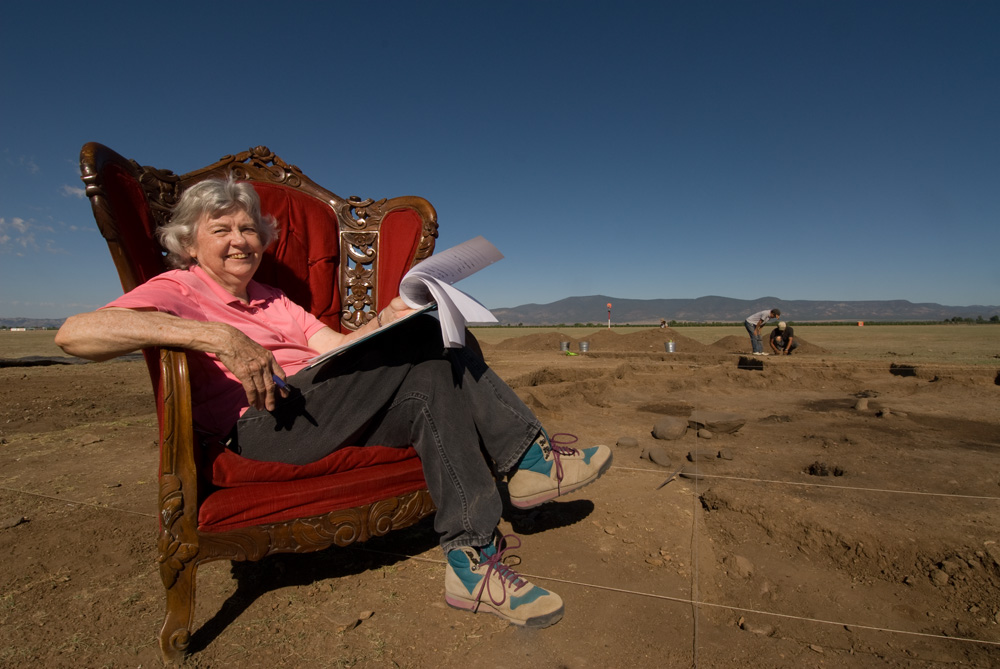
JANE HOLDEN KELLEY, now retired, was one of the first women in North America to enter the area of field archaeology. She is the daughter of famed archaeologist William Curry Holden and spent most of her academic career as a professor of archaeology at the University of Calgary, Canada.
Kelley received a BA in history from Texas Tech in 1949 and an MA in anthropology from the University of Texas in 1951, followed then by a PhD in anthropology from Harvard University in 1966. A noted Yaqui scholar, she is the author of Yaqui Women: Contemporary Life Histories as well as, with Rosalio Moises and her father, of A Yaqui Life: The Personal Chronicle of a Yaqui Indian.
Yaqui Women (1978) is a collection of four life histories --- personal accounts of the Yaqui wars, deportation from Sonora in virtual slavery, life as soldiers with the Mexican Revolutionary army, emigration to Arizona to escape persecution, the rebuilding of the Yaqui villages in post-Revolutionary Sonora, and life in the modern Yaqui communities. The research for Kelley's book was supported through the Canada Council and conducted by her between the years of 1968-1972. In the book (pp. 24 and 25, trade paperback edition) she makes the following reference to Carlos Castaneda and the shaman-sorcerer he allegedly studied under, Don Juan Matus:
"Deliberate falsification is always a possiblity, whether for monetary gain, amusement, or sheer cussedness. A peripheral story serves to illustrate this point. As everyone knows, Carlos Castaneda's books have had a tremendous impact on a wide audience, and Castaneda's don Juan is a Yaqui. I would assume that every anthropologist who has worked with the Yaquis has been bombarded with inquires about Yaqui drug use, sorcery, and what have you. I have received letters from people wanting an introduction to a Yaqui brujo (witch or sorcerer, also
Diablero), and the subject of my Yaqui research is never mentioned without someone asking me if there really is a don Juan. Do I know him or people like him? Or are all Yaquis like don Juan? To such inquiries, I can only say that I have not encountered don Juan or anyone like him, an admission guaranteed to lower my social value on the spot.The Yaquis themselves are now approached by outsiders in search of don Juan. A Pascua Nueva Yaqui leader related that no few Volkswagen buses, usually with California license plates, find their way to Pascua Nueva. The inhabitants of the VW buses are described as "long-haired hippies," for the word hippie has deeply penetrated Yaqui consciousness with strong negative connotations. The Pascua Nueva leader explained with some delight his tactics for dealing with these unwelcome intrusions. When inquiries begin, he says he has never heard of don Juan. Slowly he shifts to admitting cautiously that there is a don Juan but he must be protected. Finally, he weakens and tells the inquirers where don Juan lives. There actually is an old man named don Juan who lives in Pascua Nueva, one said to have considerable ingenuity in spinning tales. Everyone is vastly amused and the hippies are usually good for a little money, cigarettes, beer, and other things before they have been had."
As for Castaneda's shaman-socerer Don Juan Matus actually being a Yaqui in the first place, it is not overly clear. Yaqui Indians have perhaps one of the most notorious and unreceptive reputations around when it comes to interloping non-Yaquis and nosy outsiders snooping around. That non-approachable ambience creates in effect a highly unlikely scenario for anthropologists or anybody else to successfully penetrate their society sufficiently to prove or disprove Castaneda's claims that Don Juan Matus was truly a Yaqui --- or even if he was real or not. Many anthropologists, including Edward H. Spicer and both Holdens, have put together a fairly strong case against anything particularly Yaqui about Don Juan. An astute reader will notice in Castaneda's later books that he approached Don Juan's supposed Yaqui identity more as a simple happenstance than something that had anything really to do with his sorcery.
AND NOW THIS:
In an interesting sidenote, according to reliable sources such as ROSWELL ARCHAEOLOGISTS: The Dirt Before The Dig as well a work done by researcher and author Thomas J. Carey, on Saturday, July 5, 1947, Jane Holden Kelley's father William Curry Holden and some students, who were exploring sites looking for signs of pre-Contact Native American occupation in the mountains west of Roswell, stumbled across the second of the infamous Roswell impact sites where some sort of an object had crashed and in Holden's case, apparently, because of the size of the object, the main impact site. It has been said William Holden and his students are the ones who first reported to law enforcement officials what they thought was a possible crash-down of an aircraft. Military personnel reportedly arrived in the area prior to Holden and his students actually physically seeing the downed craft, cordoned off access to the site, and after Holden and his students showed up on the scene, escorted them out of the area. Holden never really discussed the incident and it was well into his later years before he was actually even inteviewed on the subject.
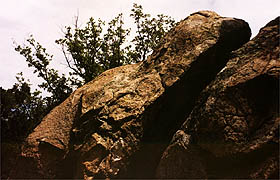
ROSWELL MAIN OBJECT IMPACT SITE
(please click image)
A number of anthropologists and archaeologists OTHER than Holden have been named in association with the suspected downed object that has become known as the Roswell UFO, ranging from the little known fringe such as amateur rock hound and Pothunter known as Cactus Jack, but whose real name was William Lawrence Campbell, to the more famous and academically established types such as Holden. For the most part, however, the more credible the credentials, the less likely they are to come forward or admit to any connection. Jane Holden Kelley is on record as saying that at the time interviews were being conducted, because of his age, her father was easily confused. Memories from his life were jumbled and reordered, and, even though she and her dad were close, he had never mentioned anything to her about the incident.[1]
JANE HOLDEN KELLEY
SEE:
CARLOS CASTANEDA: TIMELINE
THE BEST OF
CARLOS CASTANEDA
<<< PREV ---- LIST ---- NEXT >>>
ROSWELL ARCHAEOLOGISTS
WE DO NOT HAVE SHAMANS
The Case Against "Shamans" In the
North American Indigenous Cultures
FOOTNOTE [1]
It should be noted that the majority of the information passed on to researchers during the interviews with Kelley's father was really more-or-less a reconfirmation of the exact same information he had shared previously with his friend and colleage C. Bertrand Schultz some six months after the alledged crash down at a conference they both attended in December of 1947. At the time of that conference William Curry Holden, born in 1896, would have been 51 years old. In the above the following sentence, to which this footnote is cited, is found:
"Jane Holden Kelley is on record as saying that at the time interviews were being conducted, because of his age, her father was easily confused. Memories from his life were jumbled and reordered, and, even though she and her dad were close, he had never mentioned anything to her about the incident."
There was, however, a first-hand witness to the Schultz-Holden conversation that confirmed Holden's story well before Holden became the ancient and decrepted old fool he seems to have become in his old age as alluded to by so many of his interview critics. The bio-searcher that assisted famed astronomer and meteorite hunter Dr. Lincoln La Paz figure out the object's trajectory by studying the burnt and wilted plants along it's suspected path was at the same conference. He was attending in hopes of hearing his friend Ruth F. Kirk present Aspects of Peyotism Among the Navajo. In that he and Holden knew each other and had participated in Roswell events, he became privy to the content of the conversation between Holden and Schultz.
MEETING DR LA PAZ