
|
Many of the
thumbnails below link to photos on the Navy Historical Center
site. That site is an excellent resource for modellers
and enthusiasts, covering USN history, ships,
aircraft, and some very interesting additional
information.
Some photos were also taken off of a thread on Warbird Information Exchange that hosted many Grumman photos.
Additional photos are from Life magazine's online
archive. For those photos I have chosen not to crop the photos to remove
the word LIFE.
*The
James Dietz painting above illustrates Joe Foss returning to Guadalcanal
after a mission on 25 January, 1943. Leading a
flight of eight F4F Wildcats and four P-38s
Foss encountered a Japanese force of approximately
100 aircraft. Through superior tactics the small element was able to convince
the Japanese that there were more than a mere
dozen aircraft airborne over the "Canal". It
was this kind of fortitude that made the United
States Navy an effective force to be reckoned with
even when often outnumbered during the first half
of the war in the Pacific.
A little prelude before we get to the F4F...
The first of the line that was eventually to become the F4F Wildcat started with the (by today's standards) goofy looking FF-1, often referred to as "Fifi". This was followed by the F2F (of which unfortunately there are no survivors) through the F3F. This aircraft starred in at least two movies: 1940's Flight Command and a year later in Dive Bomber. Watching those movies on TV as a kid got me interested in the little fighter. This aircraft evolved into the F4F, which in its earliest design was a biplane.
FF-1
F2F-1
F3F-1
F3F-2
F3F-3
Wingspan:
34'
6"
28'
6"
32'
32'
32'
Length:
24'
10"
21'
5"
23'
23"
1
1/2"
23'
1 1/2"
Power plant:
R-1820E
R-1535-72
R-1535-84
R-1820-22
R-1820-22
Speed:
198
mph
229
mph
231
mph
256
mph
263
mph
Armament: 3x .30
cal
2x
.30
cal
1x .50 & 1x .30 1x .50 & 1x .30
1x .50 & 1x .30
Bureau No.s
9350/9376
9623/9676 & 9997
0211/0264
0967/1047
1444/1470
F4F-3
F4F-3A
F4F-4
FM-1
FM-2
Martlet I
Martlet
II
Martlet
III
Martlet IV
Wingspan:
38' 0"
38'
0"
38'
0"
38'
0"
38'
0"
38'
0"
38'
0"
38' 0"
38' 0"
Length:
1 28'
10.5"
28' 10.5"
28'
10.5"
28' 10.5"
28'
10.5"
28' 10.5"
28'
10.5"
28'
10.5"
28'
10.5"
Power plant:
R-1830-76*
R-1830-90
R-1830-86
R-1830-86
R-1820-56**
R-1820-G205A
R-1830-S3C4-G
R-1830-S3C4-G
R-1820-G205
Speed:2
330 mph
306
mph
320 mph
320 mph
332 mph
308 mph
Armament: 4 X .50
4 X .50
6 X .50
4 X
.50
4 X
.50
4 X
.50
6
X .50
4 X .50
6 X .50
1:
Though references show the length the same for all models,
it would seem that the R-1820 versions should be shorter.
2: Airspeed is dependent upon
several factors and these numbers are very subjective.
* Either R-1830-76, or R-1830-86
** R-1820-56, -56A, -56W, -56WA,
The F4F Wildcat
entered service during an era of colorful markings,
fuselages were painted silver, wing upper surfaces were
painted chrome yellow, tails were painted in color to
identify the aircraft carrier an aircraft was assigned to
and section colors were applied to the nose and chevrons
on the upper wings. As World War Two approached the
need to better conceal aircraft and ships was identified
by the Navy and on December 30, 1940 a directive was
issued for combat aircraft to be painted in light
gray. This color was similar to light gull gray
(FS36440). On October 13, 1941 another directive was
issued adding non-specular blue gray to surface viewed
from above. This scheme had been in use for patrol
planes for some time and was considered to be very
effective. February 1, 1943 brought another change
when the overall scheme was changed to non-specular sea
blue, intermediate blue and white. On March 22, 1944
those colors were all changed to gloss. On October
7, 1944 a final change was made when it was directed
that gloss sea blue was to be the color scheme for carrier
based aircraft. Two specialized schemes were adopted
for Antisubmarine aircraft on July 19, 1943: Scheme I was
non-specular gull gray on top[ surfaces, with non-specular
light gull gray on sides and gloss white on under
surfaces. Scheme II was to be non-specular dark gull
gray on top, non-specular white on the sides and gloss
white on the lower surfaces. Scheme II became the
more prevalent of the two, but in any case all of the
above mentioned schemes were applied to Wildcats.
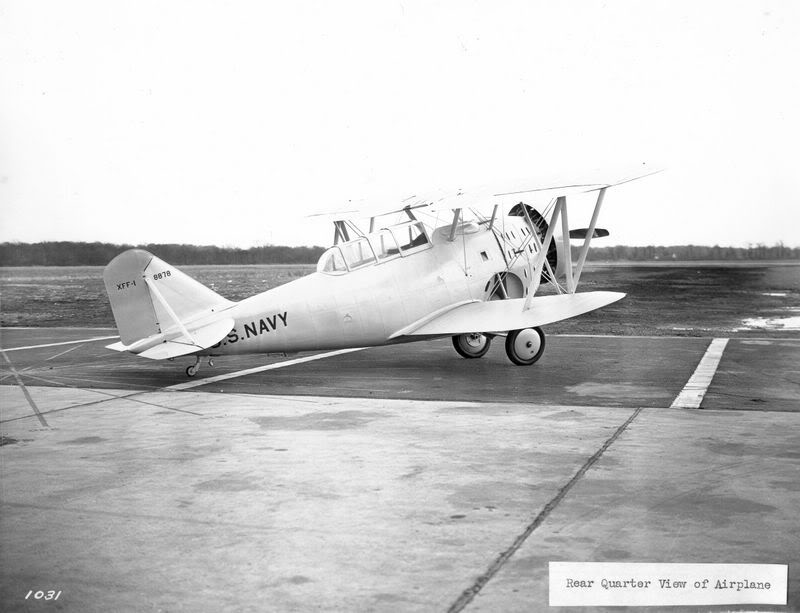
XFF-1
XFF-1 Prototype for FF-1. Bu No.
8878
 |
 |
 |
 |
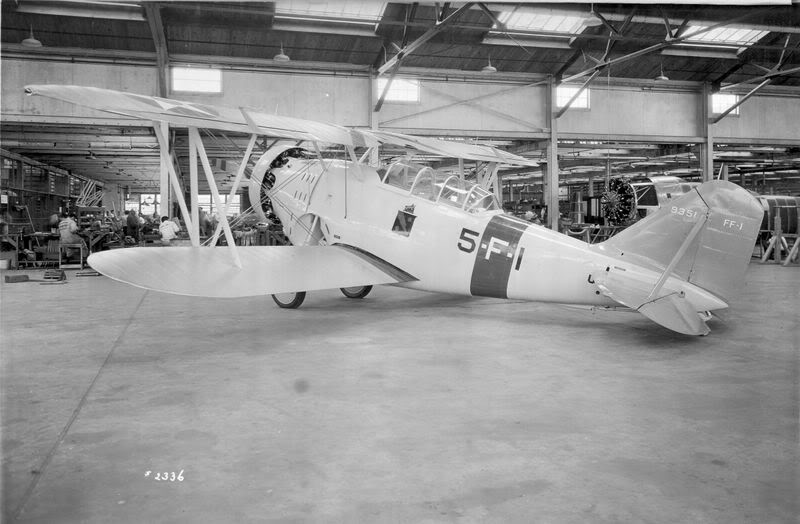
This ungainly aircraft would lead to the graceful F3F
and eventually to the F4F. FF-1 9351 is shown in
the factory at Bethpage.
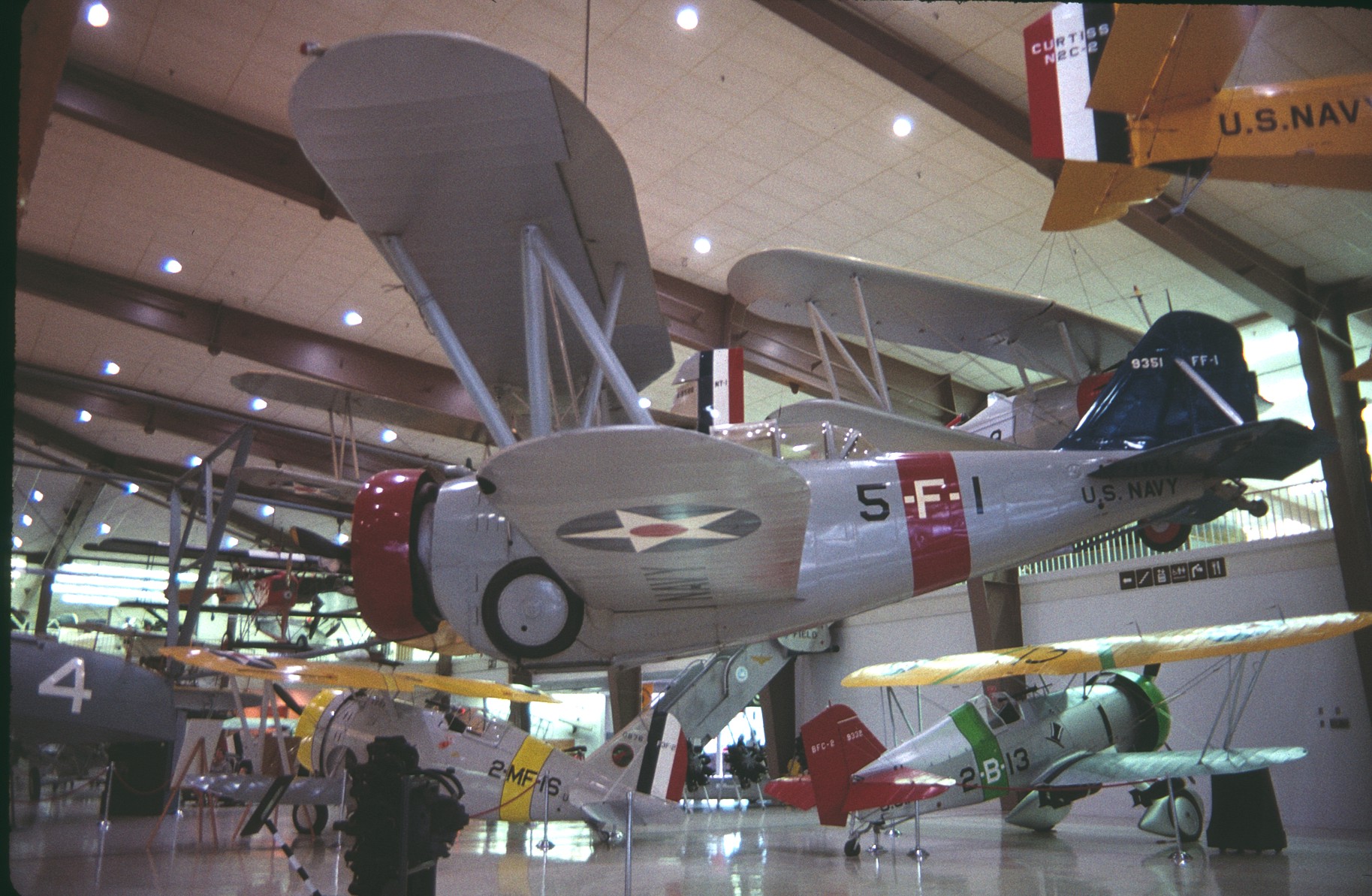
A Canadian Car & Foundry G-23 Goblin displayed as an
FF-1 at the National
Museum of Naval Aviation in Pensacola, Florida.
It was sold to Nicaragua in 1937, but was imported to
the US in 1966.
The same airplane marked as Bu. No. 9358 at Bethpage, NY in 1966. Note the E-2 in the background.
FF-2
FF-2 22 FF-1s converted to dual control
trainers. Some sources state 25 airframes were
converted.
 |
The
most noticeable differences from the FF-1 are a collector
ring for the exhaust (vs. individual stubs on the FF-1)
and the deletion of the tail hook. This FF-2 is in
service with a United States Navy Reserve (USNR) unit.
XSF-1
XSF-1 Prototype for a scout version of
the FF-1. Bu. No. 8940
 |
SF-1
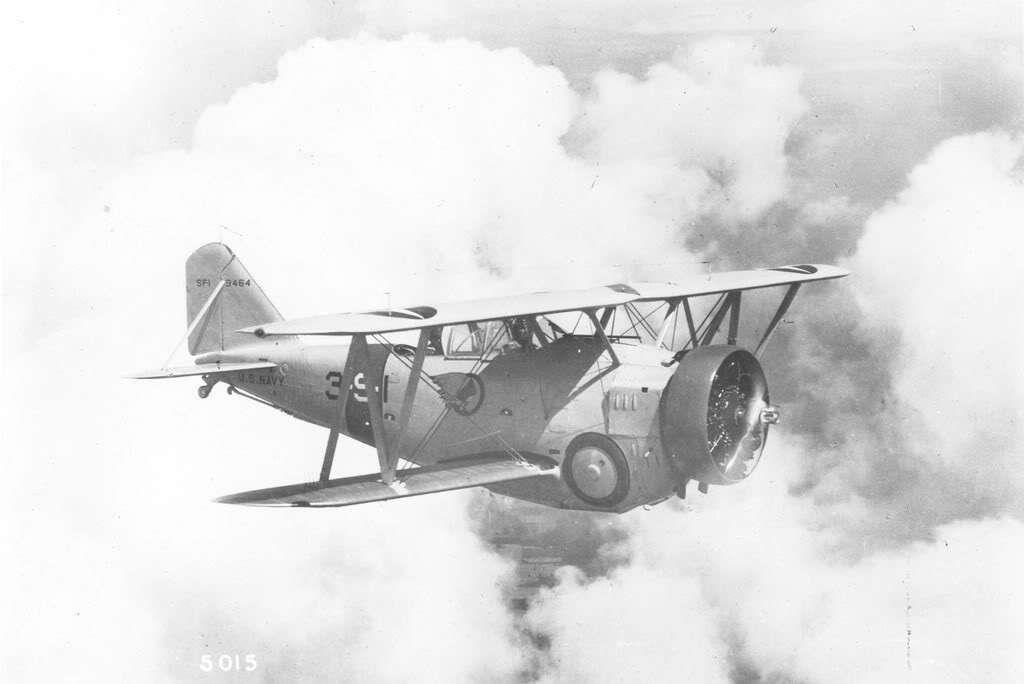
SF-1 Scout version of the FF-1 with dual
controls. 34 built Bu. No.s 9460/9493.
 |
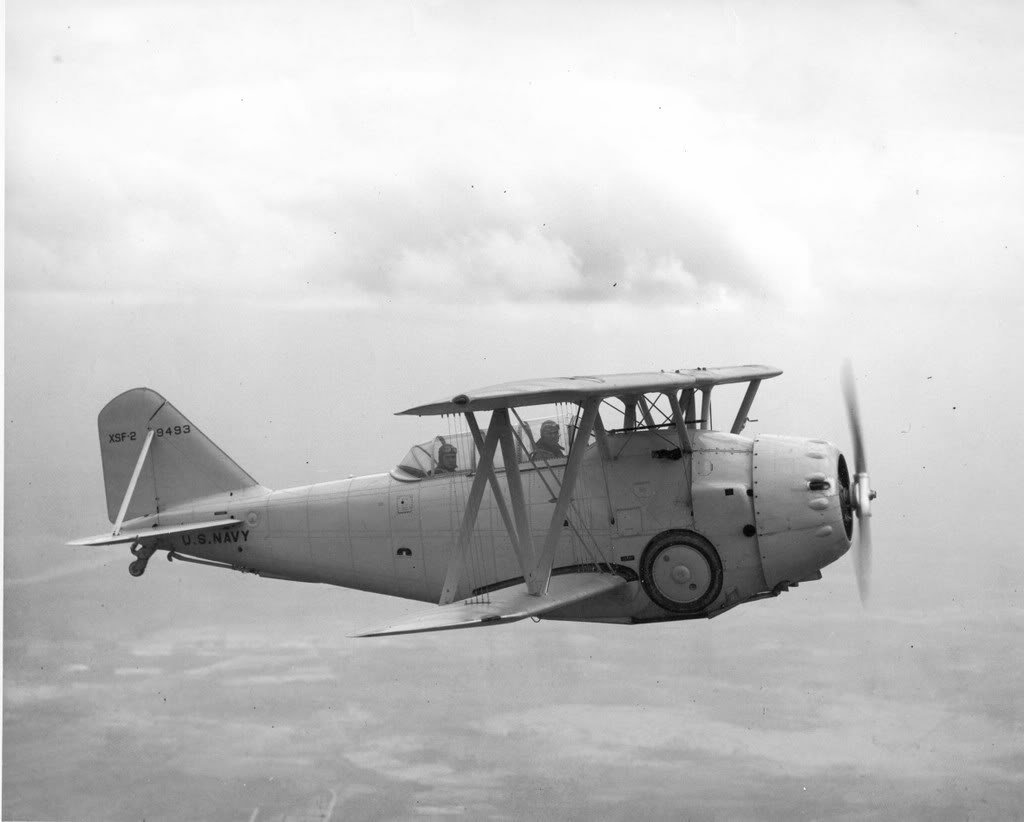
SFXSF-2
XSF-2 9493 converted to planned version
of SF-2. Not produced.
 |
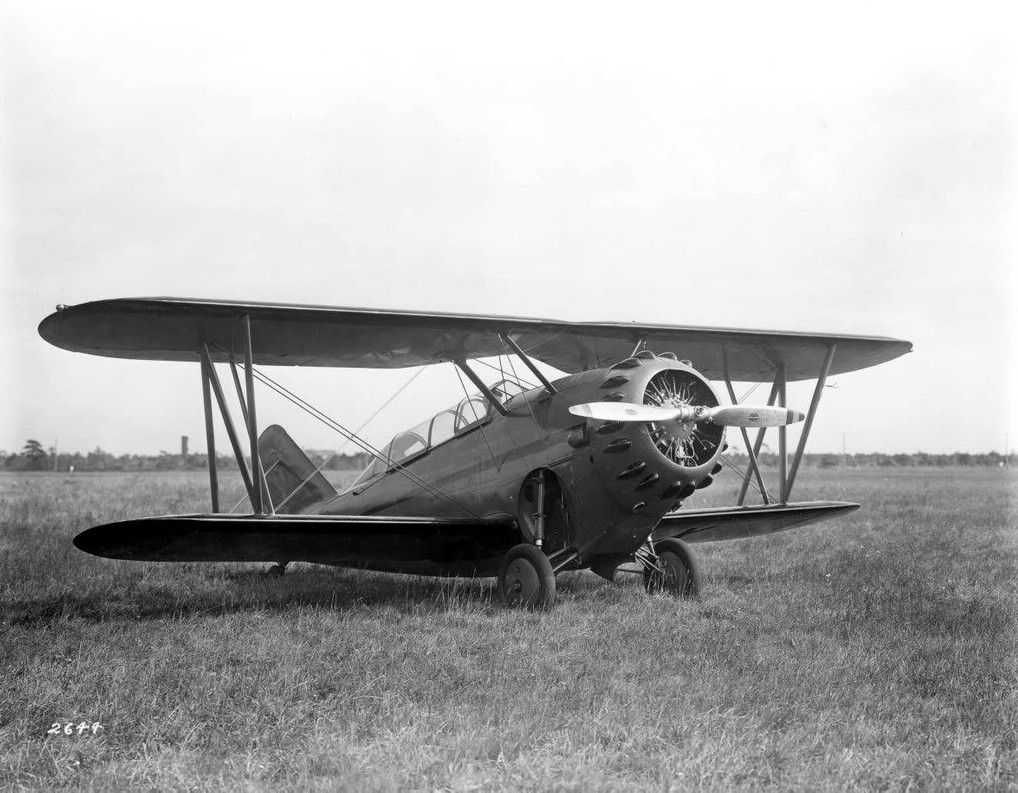
GG-1
GG-1 A company demonstrator built from
unused FF-1 and SF-1 components. Sold to Canadian Car
& Foundry.
 |
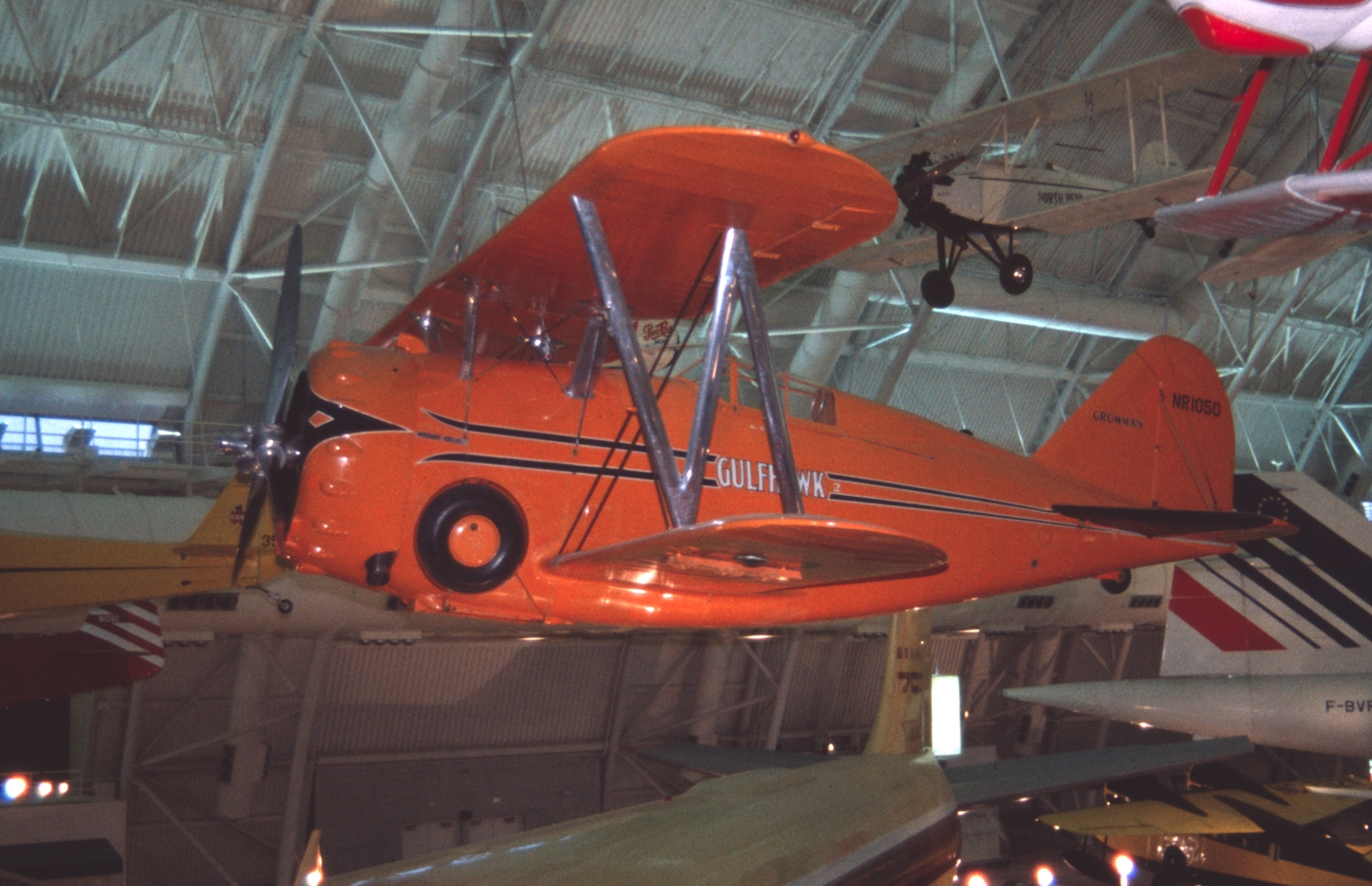
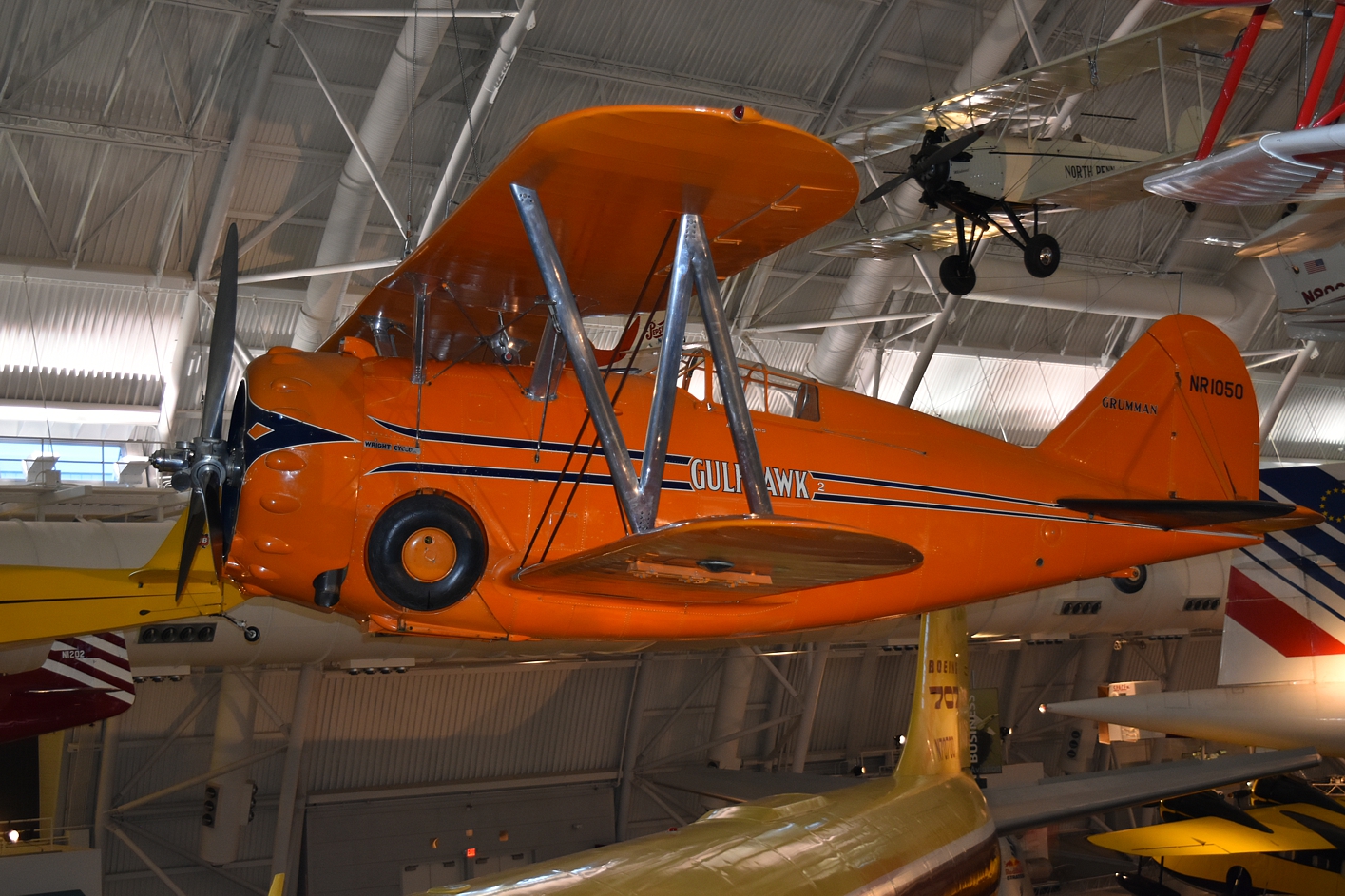
G-22 "Gulfhawk II"
G-22 A hybrid airplane
with the fuselage of an F3F and the short wings of
an F2F.
 |
 |
 |
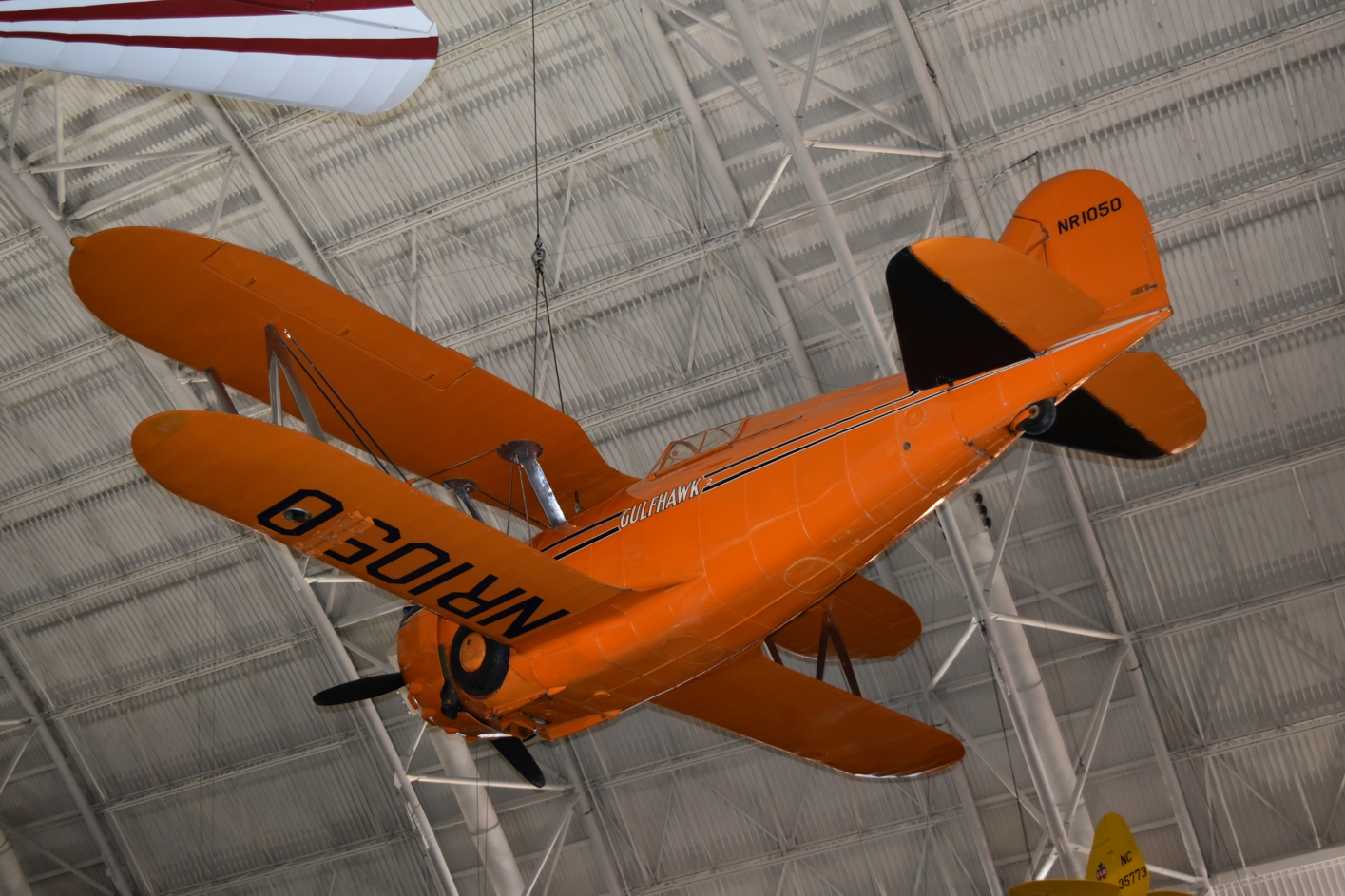 |
Delivered to Gulf Oil in 1936
the Gulfhawk II was flown by Major
Alford Joseph"Al" Williams as a demonstration
airplane until donated to the Smithsonian
Institution in 1948. It is now on display
in the Steven Udvar-Hazy center.
G-23
G-23 55 Production aircraft of the GG-1
design built by Canadian Car & Foundry.
 |
 |
The G-23,
or Goblin as christened by the RCAF, was an
aircraft the RCAF did not want. Those aircraft were
part of a "Turkish" order, but were in fact aircraft meant
for the Spanish Republican forces. Sixteen were
seized in Canada after it was learned their true
destination. Those planes was neither desired, nor
liked by the RCAF, but they did provide valuable
training. Of the flight of six Goblins, four
are without their canopies. One must wonder how
miserable it would have been to fly in the Canadian
winters with only a windscreen for protection.
Delivered
in late 1940, the G-23s were painted in the then current
RAF Fighter Command scheme of Dark Earth and Dark Green
topside with the underside painted half black, half white.
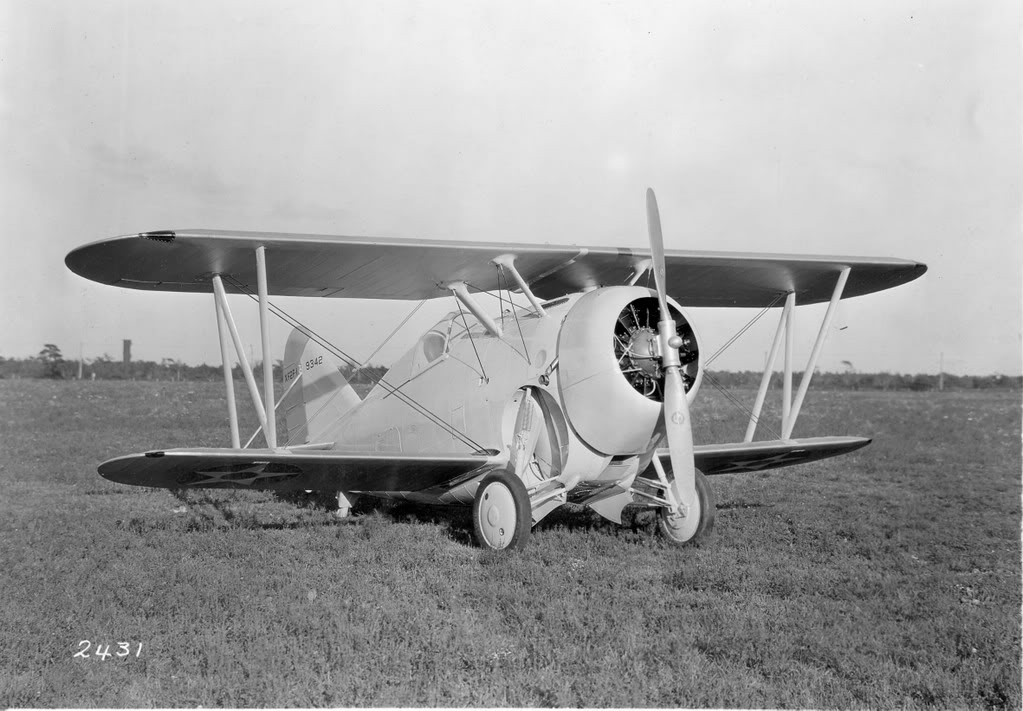
XF2F-1
XF2F-1
Prototype for F2F fighter. Bu. No. 9342.
 |
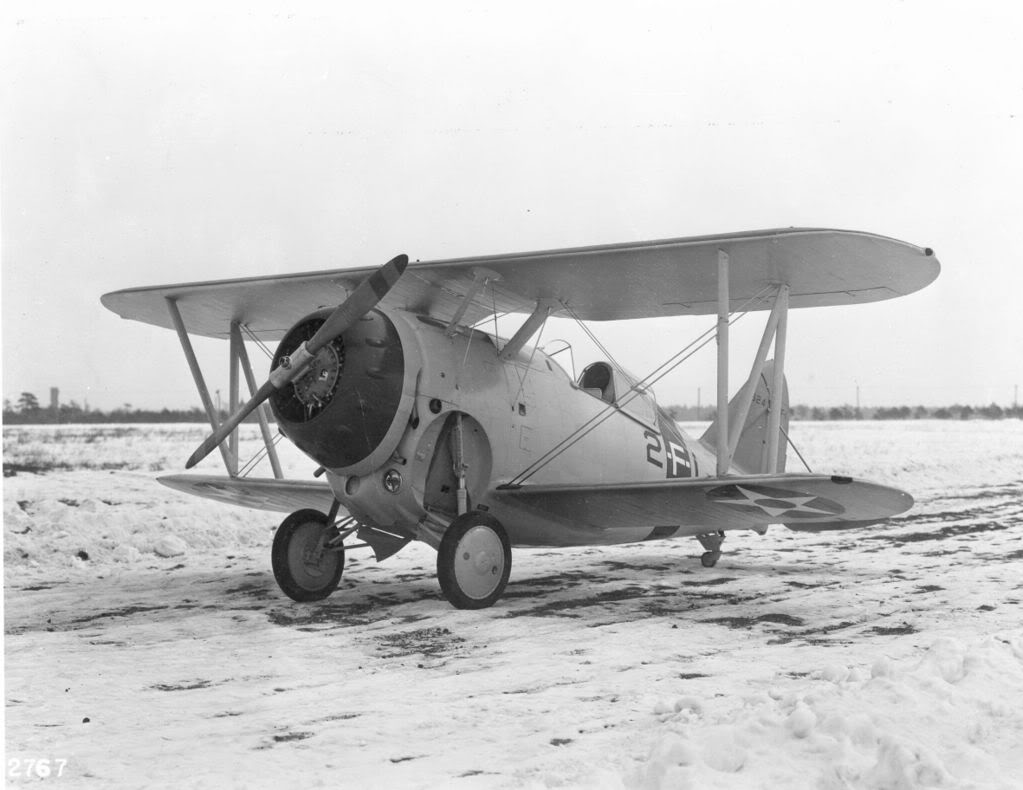
F2F-1
F2F-1 Production version. 55 built
Bu. No.s 9623/9676 & 9997.
 |
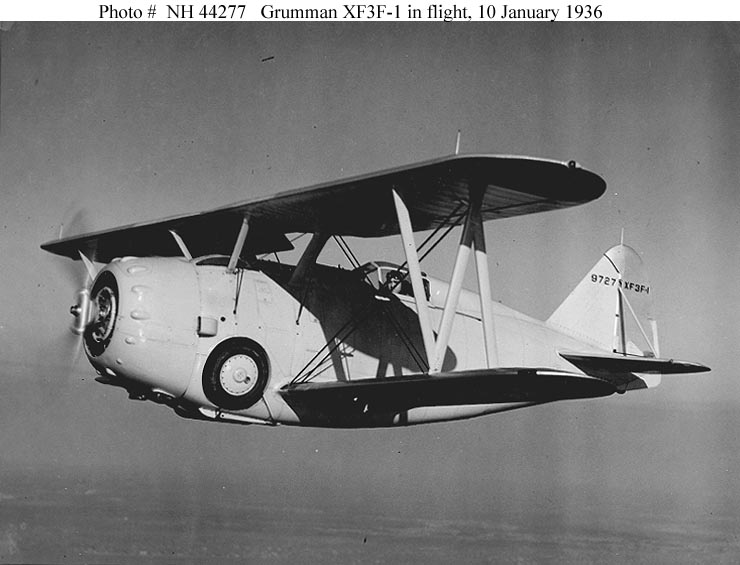
XF3F-1 Prototype for
F3F-1. Bu. No. 9727 (three different aircraft
carried this Bureau number, the original and two
substitutes, each to replace a previously destroyed one.).
 |
F3F-1 54 production airframes. Bu.
No.s 0211/0264
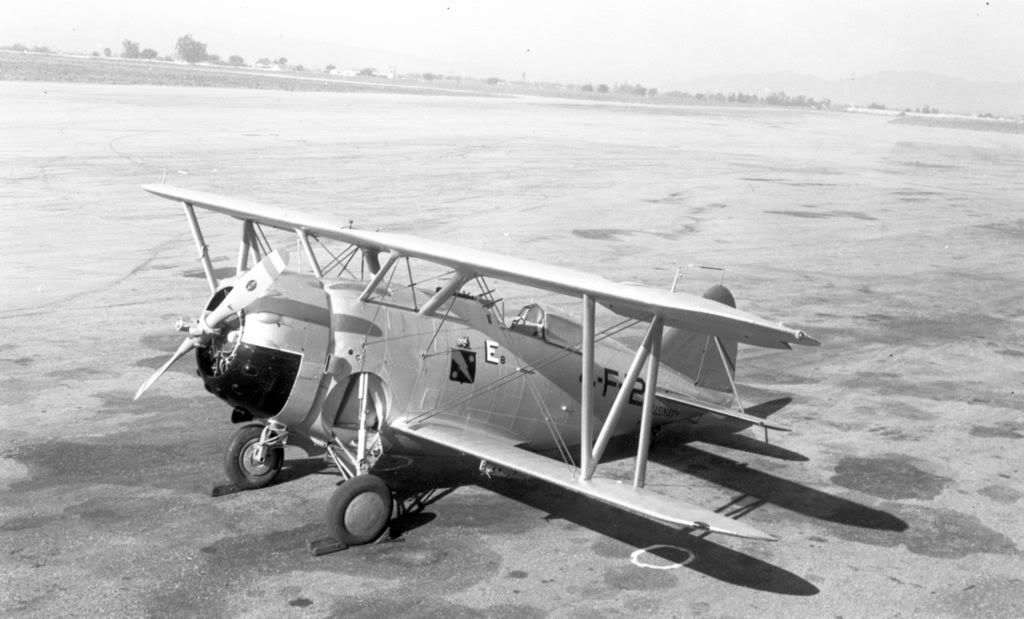 |
XF3F-2
XF3F-2 Prototype for improved
version. Bu. No. 0452
 |
F3F-2 81 Production aircraft. Bu.
No.s 0967/1047.
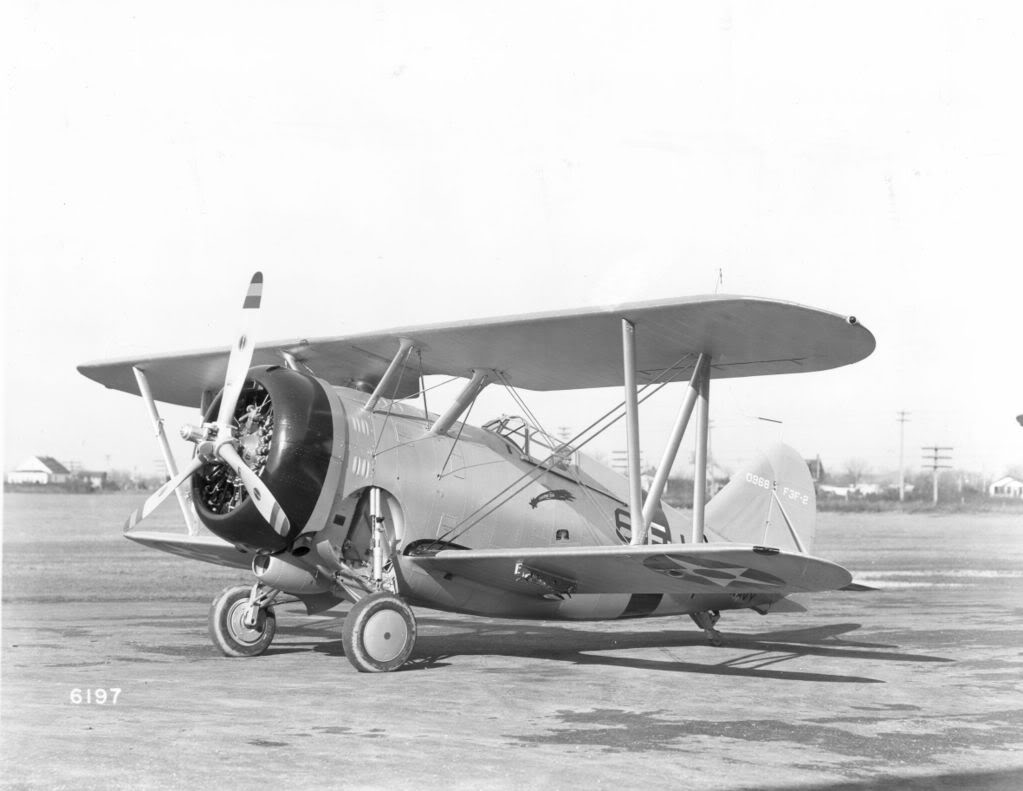 |
XF3F-3 Improved F3F-2. Bu. No. 1031.
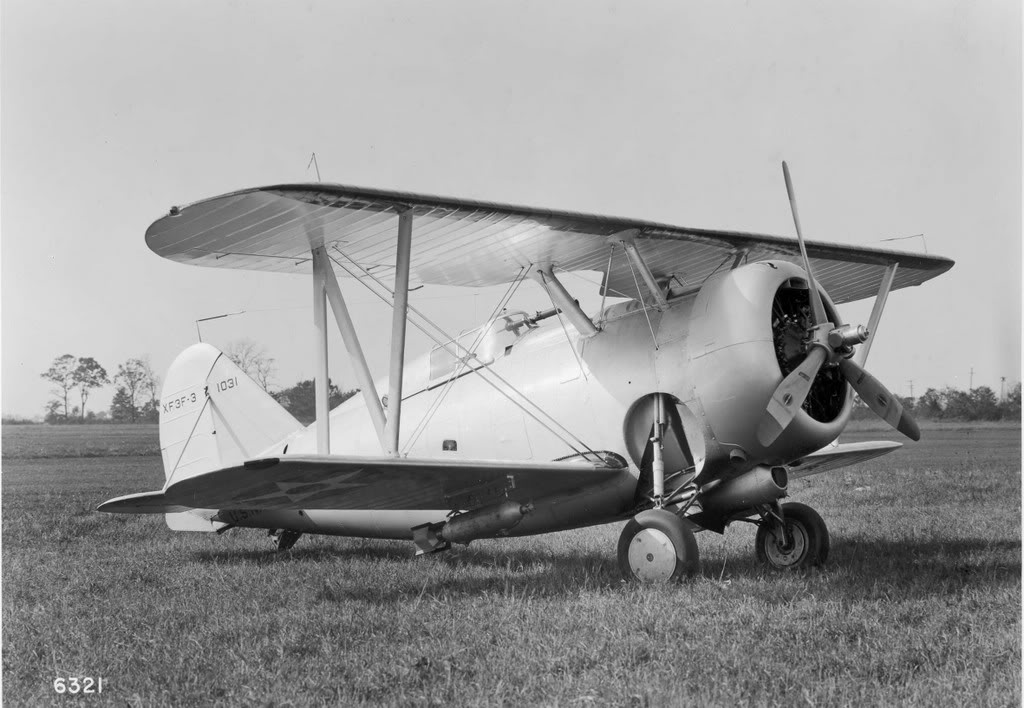 |
F3F-3 27 built. Bu. No.s
1444/1470.
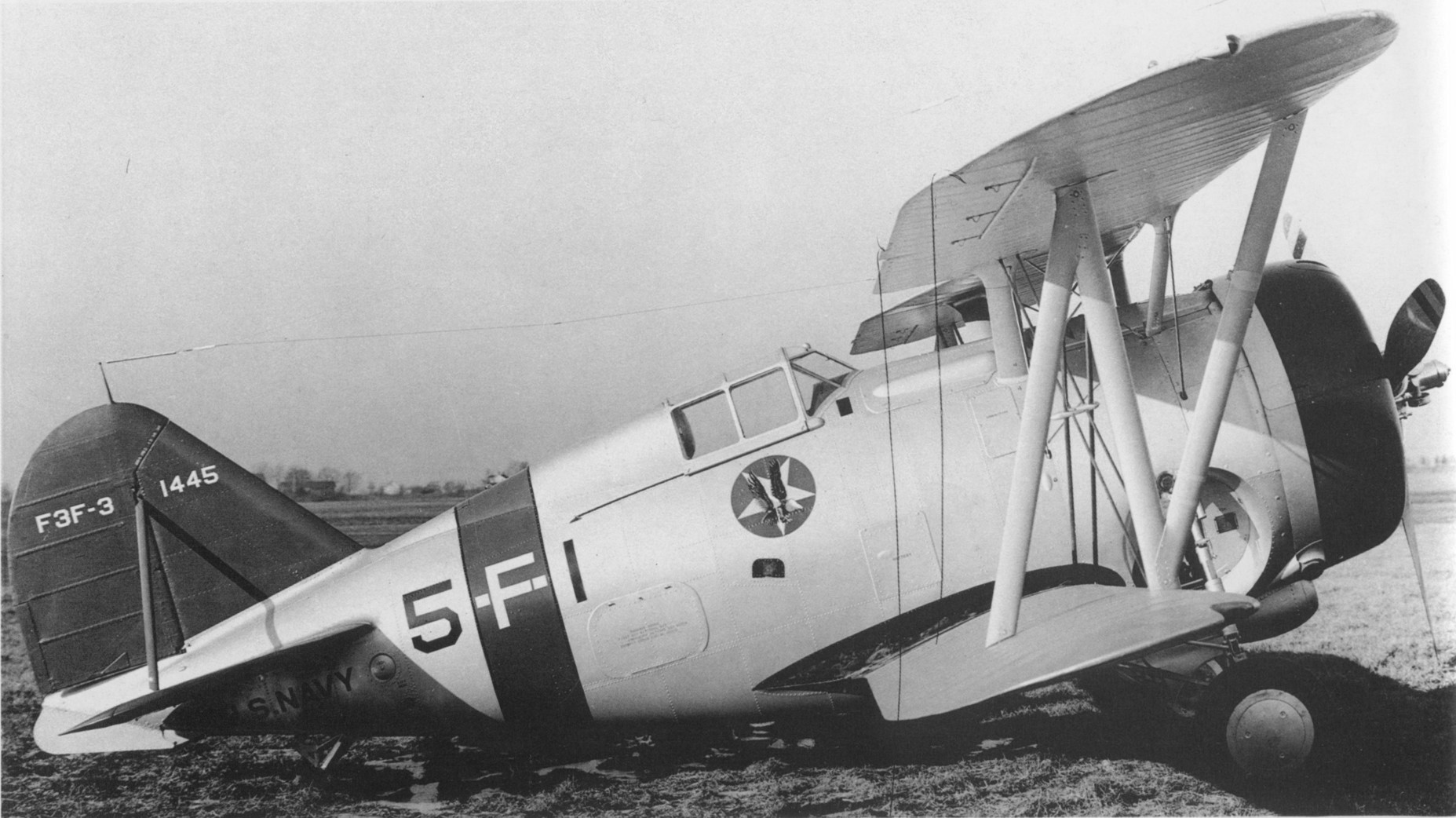 |
XF3F-4
XF3F-4 Test version. One more
conversion for 1031.
XF4F-1
XF4F-1 Biplane fighter, none built.
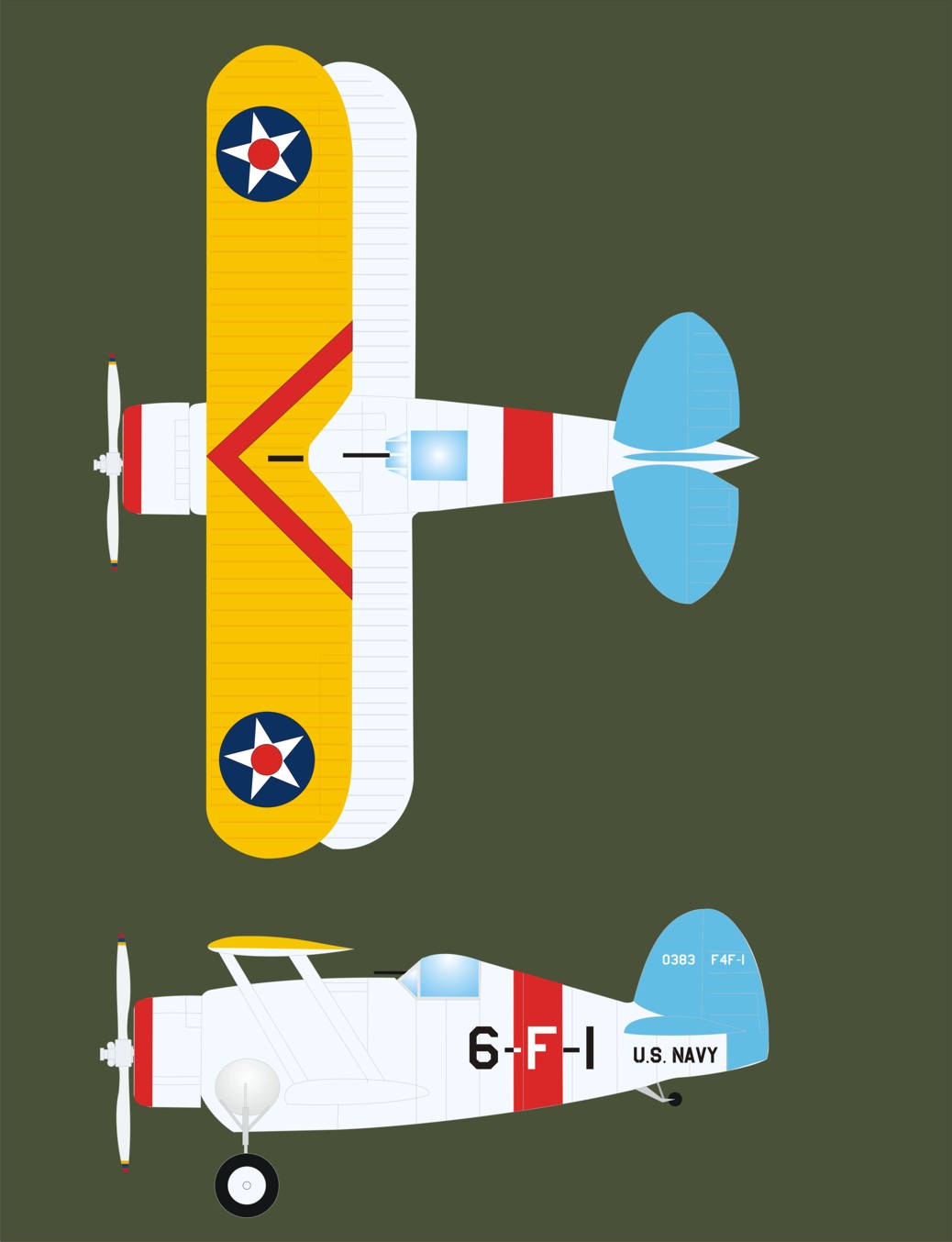 |
The XF4F-1
had not advanced beyond a preliminary design before
Grumman realized that a biplane could not off the
performance needed to compete with Brewster's F2A Buffalo.
The design was then changed to a monoplane that became the
XF4F-2. During the late 1960s, or early 1970s,
aviation history Lloyd Jones published a set of drawings
of the proposed F4F-1. The above artwork is based on
those drawings to represent a "what if" of what that
airplane might have looked like in service. Even the
choice of engine was never finalized, with both the Wright
R-1670 and the P&W R-1535 being considered for the
design.
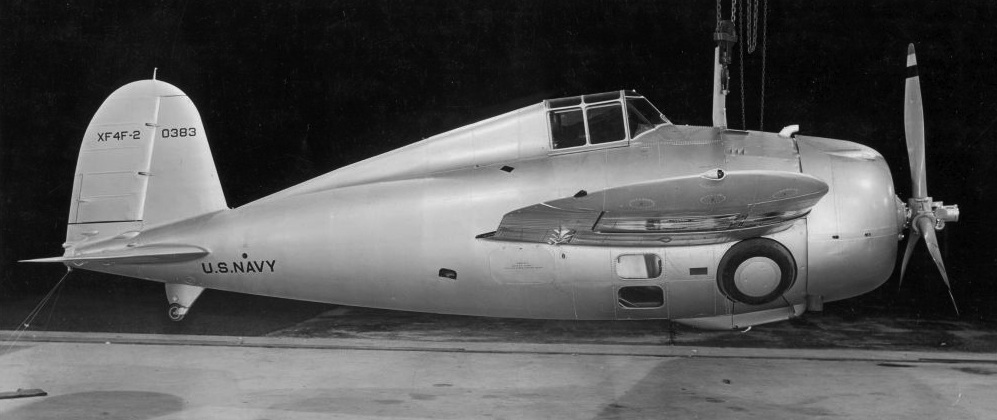
XF4F-2
XF4F-2
First Wildcat prototype, monoplane. Bu. No.
0383
 |
 |
 |
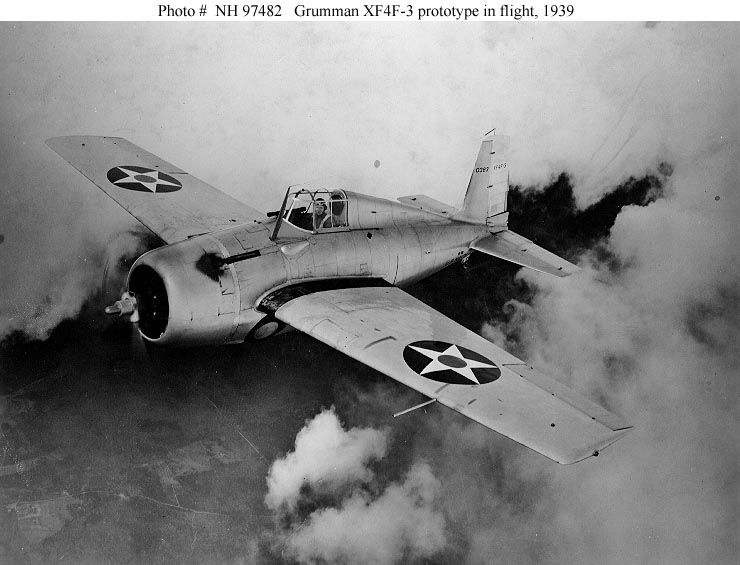
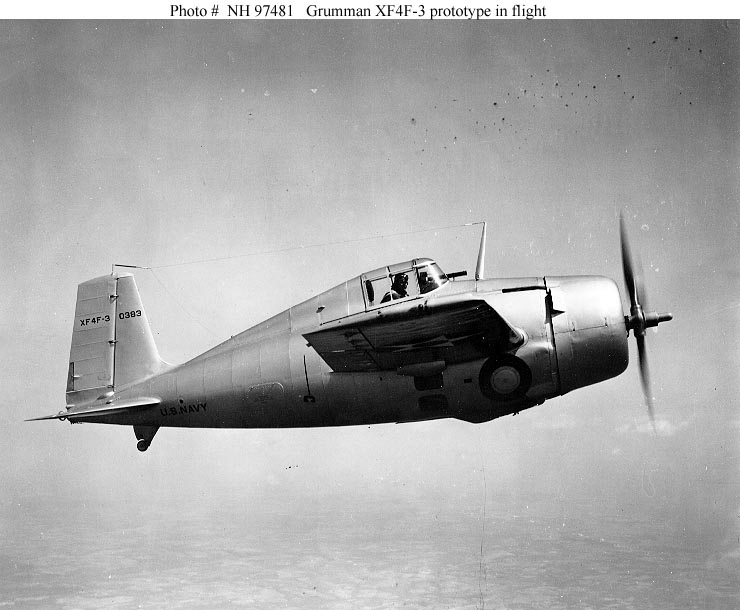
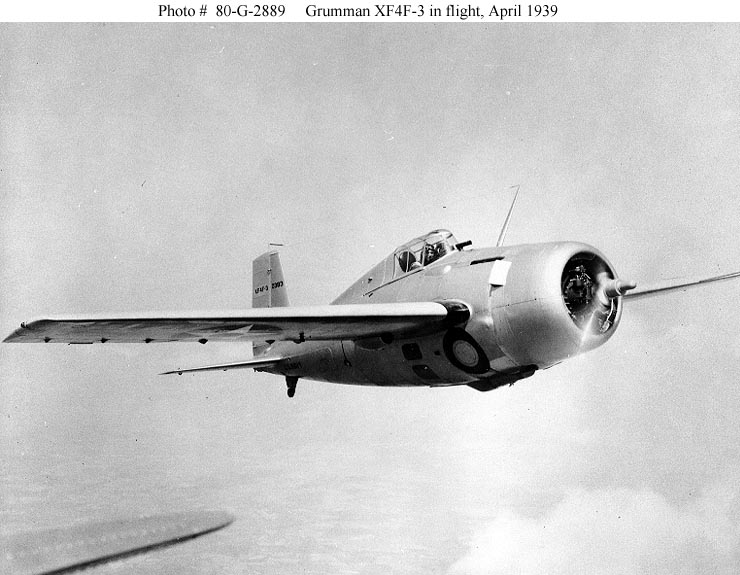
XF4F-3
XF4F-3 0383 converted
to the F4F-3 prototype.
 |
 |
 |
F4F-3
(Early)
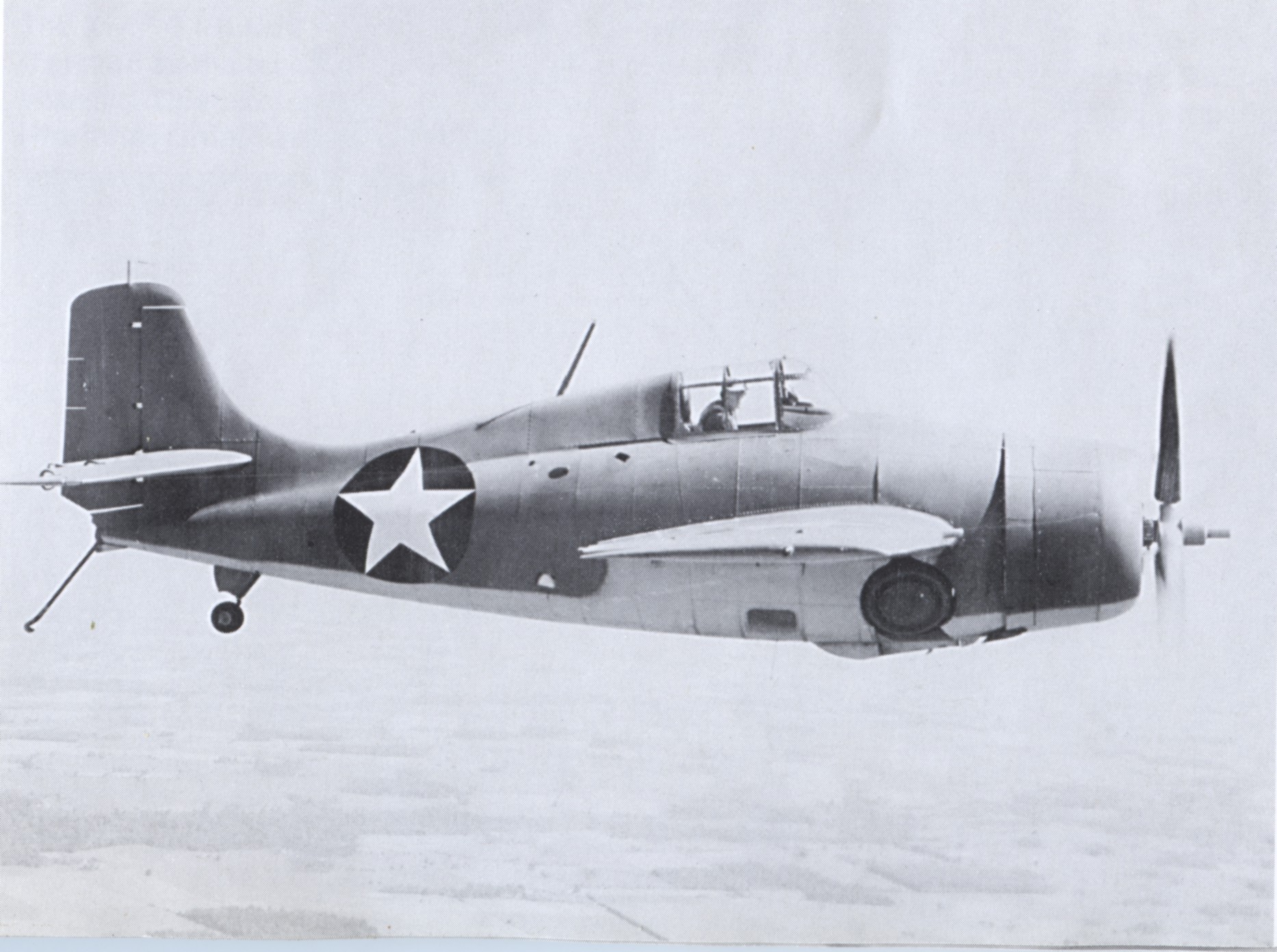
The F4F-3 had
four .50 caliber machine guns, non folding wings and a
straight pitot tube that came out of the leading edge of
the left wing. Early aircraft had an air intake on
top of the cowl lip, a single double wide cowl flap on
each side and a telescopic gun sight. The power
plant was a Pratt & Whitney R-1830-76 engine with a
two stage, two speed supercharger. This was a 14
cylinder, twin row radial engine. The propeller used
on the F4F-3 and F4F-4 was a three bladed, cuffed Curtiss
Electric with a cylindrical hub.
F4F-3
First service version. Bu.
No.s 1844/1845, 1848/1896, 2512/2538, 3856/3874,
3905/3969, 3970/4057 and 12230/12329
 |
 |
 |
 |
 |
F4F-3 Bu. No. 1850. When the F4F first
entered service the navy paint schemes were still very
colorful. This aircraft is assigned to VF-41 aboard
the USS Ranger (CV-4). The fuselage is painted
silver, the upper wing surfaces are chrome yellow and the
tail is painted in the ship's color. In this case
willow green for Ranger. This aircraft
is assigned to the section leader, second section as denoted
by the white cowl and fuselage band. The fuselage code
should read "41-F-4", meaning the number four airplane of
VF-41. At this time, the national insignia is on the
upper and lower surfaces of both wings. (USN)
An
F4F-3 (Bu. No. 2526) over Long Island in 1941. As
WWII approached, color schemes became more drab, with
the first change being to an overall scheme of
non-specular light gray, with small national insignia
and white lettering. The directive for this scheme
was issued in December, 1940. As some aircraft had
already been painted silver at the factory, Grumman
requested that they be delivered in the silver color,
but without yellow wings. (Life)
VF-42 F4F-3 2538 at the
National Advisory Committee for Aeronautics'
(NACA) Langley facility in 1941. Of
interest is the unique sensor on the tail.
The airplane is most likely in a scheme similar
to the color photo of 2526. (NASA)
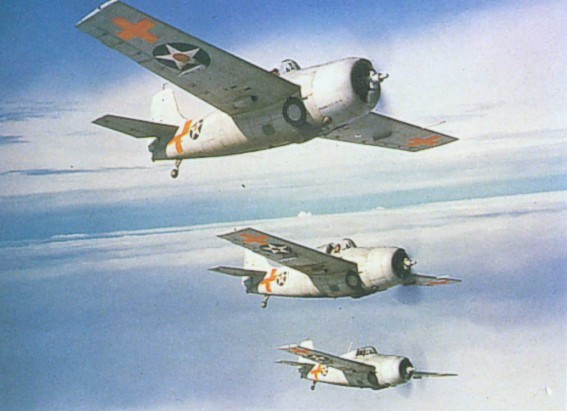
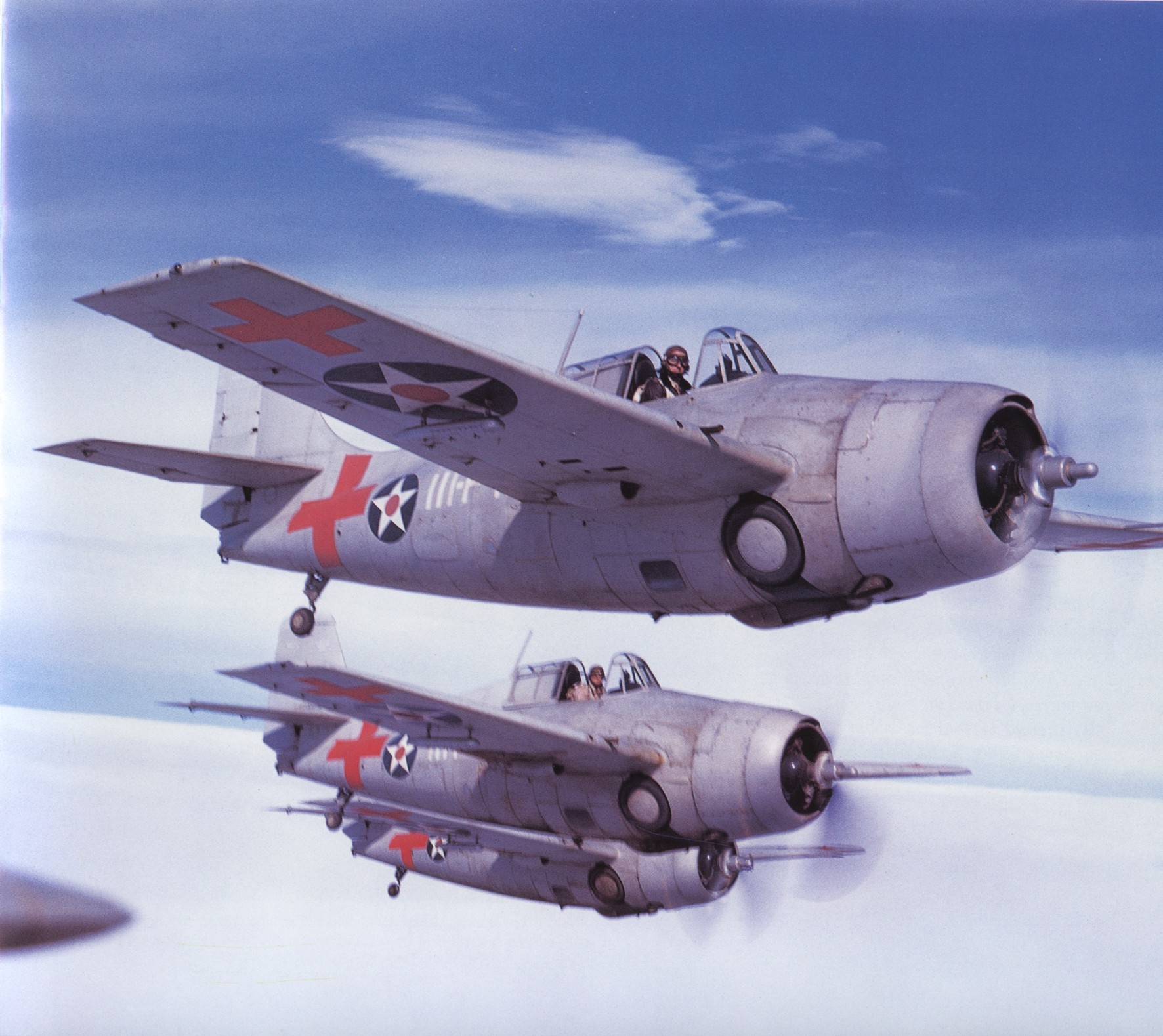
Three
VMF-111 F4F-3s in flight during the Louisiana
maneuvers. The stars are now on both side of the
fuselage and the upper left and lower right wings.
The red crosses on the wings and fuselage were for the
war games. All three are painted in non-specular
light gray overall. (USN)
 |
 |
 |
 |
 |
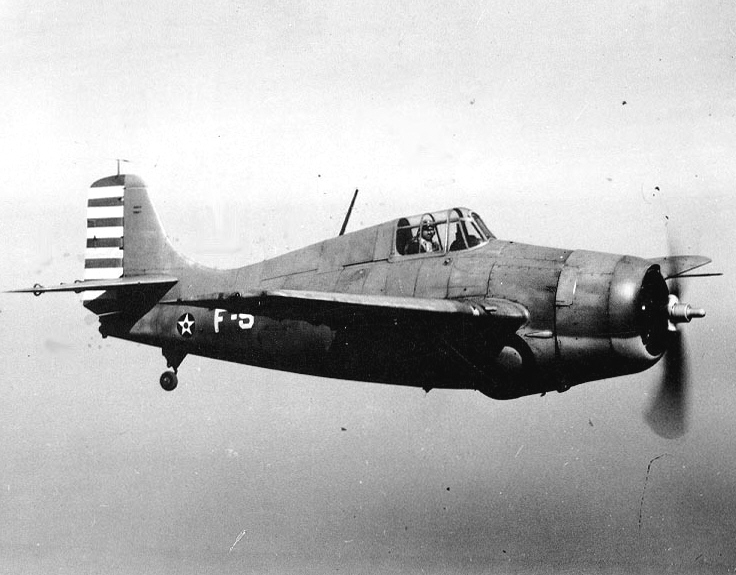
An early F4F-3 in flight. This aircraft is in the non-specular blue gray over non-specular light gray camouflage that was in use at the time of America's entry into the war. This color combination became the standard for carrier aircraft in August 1941. The rudder stripes came into use on December 23, 1941 and would remain until May 6, 1942. The codes have now changed to simply "F-5", no longer identifying the squadron. (USN)
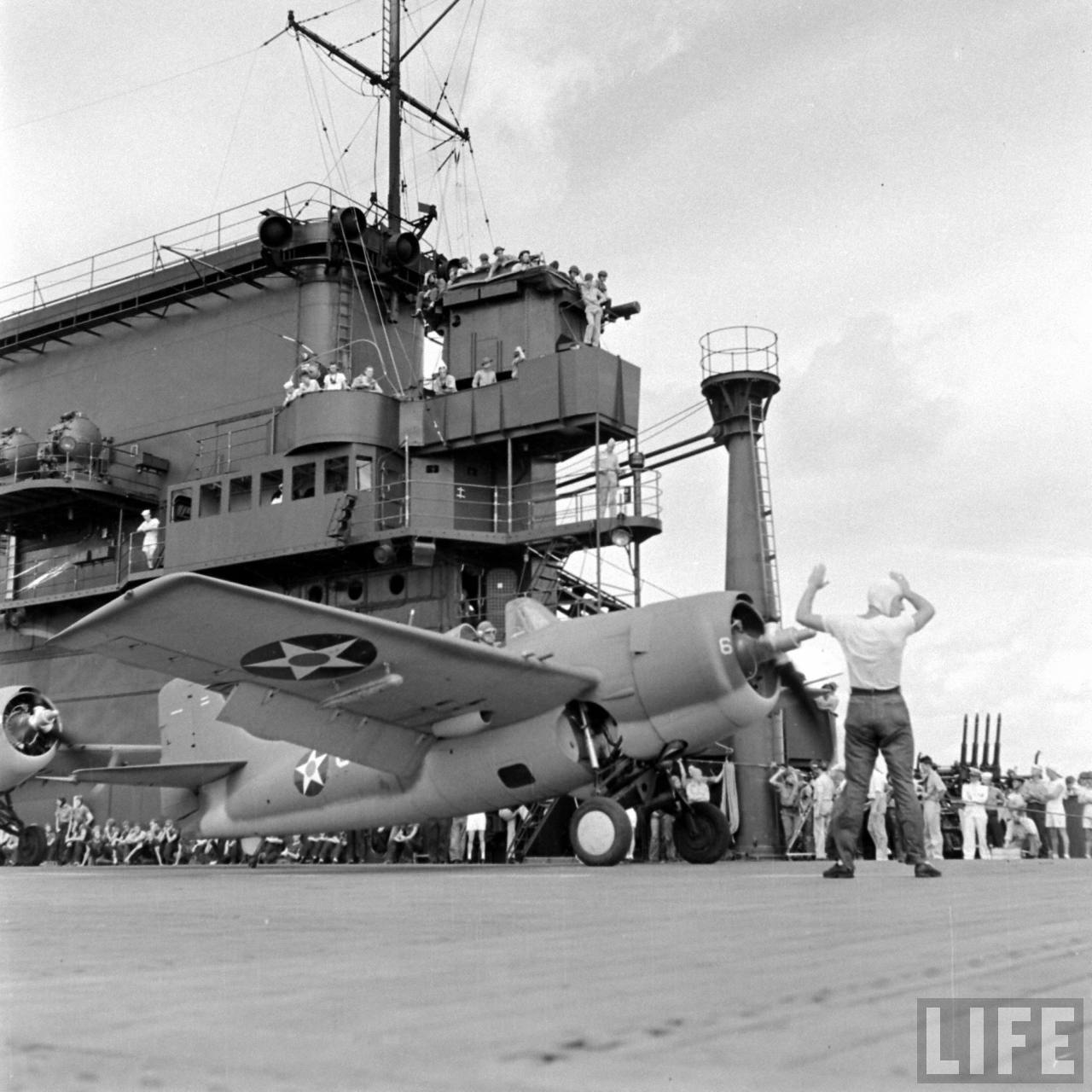
An F4F-3 taking
off from the USS Enterprise. (Life)
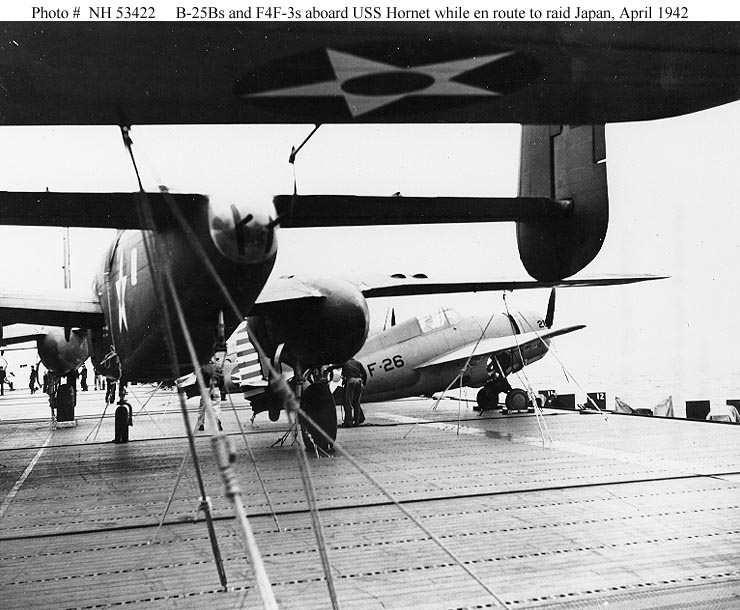
A VF-8 F4F-3
aboard the USS Hornet in April, 1942 during the
Doolittle raid on Japan. It is usually stated the the
Hornet's aircraft where struck below deck to
accommodate the B-25s taking part in the raid, but this
photo shows otherwise. (USN)
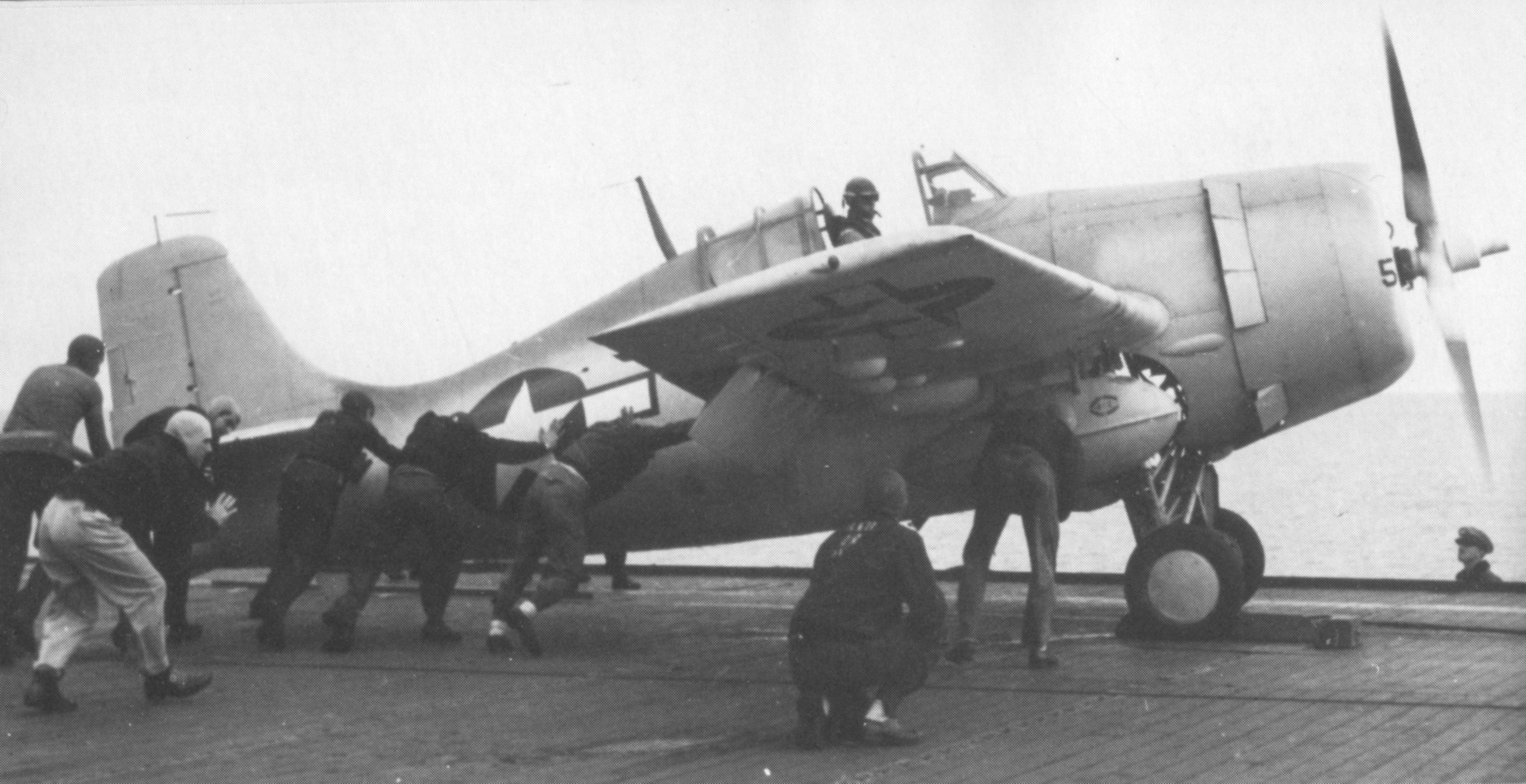
Someone is about
to suffer the Chief's wrath! An early F4F-3 is being
brought up from the hangar deck aboard the USS Enterprise
in late 1941 and something out of the photo is not as it
should be. (Life)
A mixture of
early and late F4F-3s aboard the USS Enterprise,
March, 1942. (USN)
F4F-3A
The F4F-3A differed from
the F4F-3 in being powered by a Pratt & Whitney
R-1830-90 engine with a single stage, two speed
supercharger. With that change in the supercharger
the intercoolers were deleted, also deleting the
intercooler intakes within the cowling. As far as I
can determine that is the only sure-fire way to tell this
variant of F4F-3 from the others.
F4F-3A As F4F-3, but with R-1830-90 engine and lesser performance. Bu. No.s 3905/3969
 |
An F4F-3A on display at the NMNA and painted in the blue gray over light gray scheme. Note the large size of the national insignia. In the lower right corner is an A6M-2 Zero-sen, or "Zero", the Wildcat's adversary in the early stages of the war.
F4F-3 (late)
The late
model F4F-3s were powered by the R-1830-86. This
engine had a different carburetor arrangement and the
intake on top of the cowl was eliminated. Some
aircraft retained the original large cowl flap on the
upper part of the cowl (Bu. Nos. 3856-3874) while the cowl
flap arrangement was changed to three smaller flaps on the
upper half and one smaller one on the lower half, both
sides on later aircraft. (Bu. No.s 3970-4057). The
gun sight was also the reflector type and the telescopic
sight was now gone from USN and USMC Wildcats. (The
external scoop atop the cowl lip was reinstated for Bu.
Nos. 12230-12329)
 |
 |
 |
 |
 |
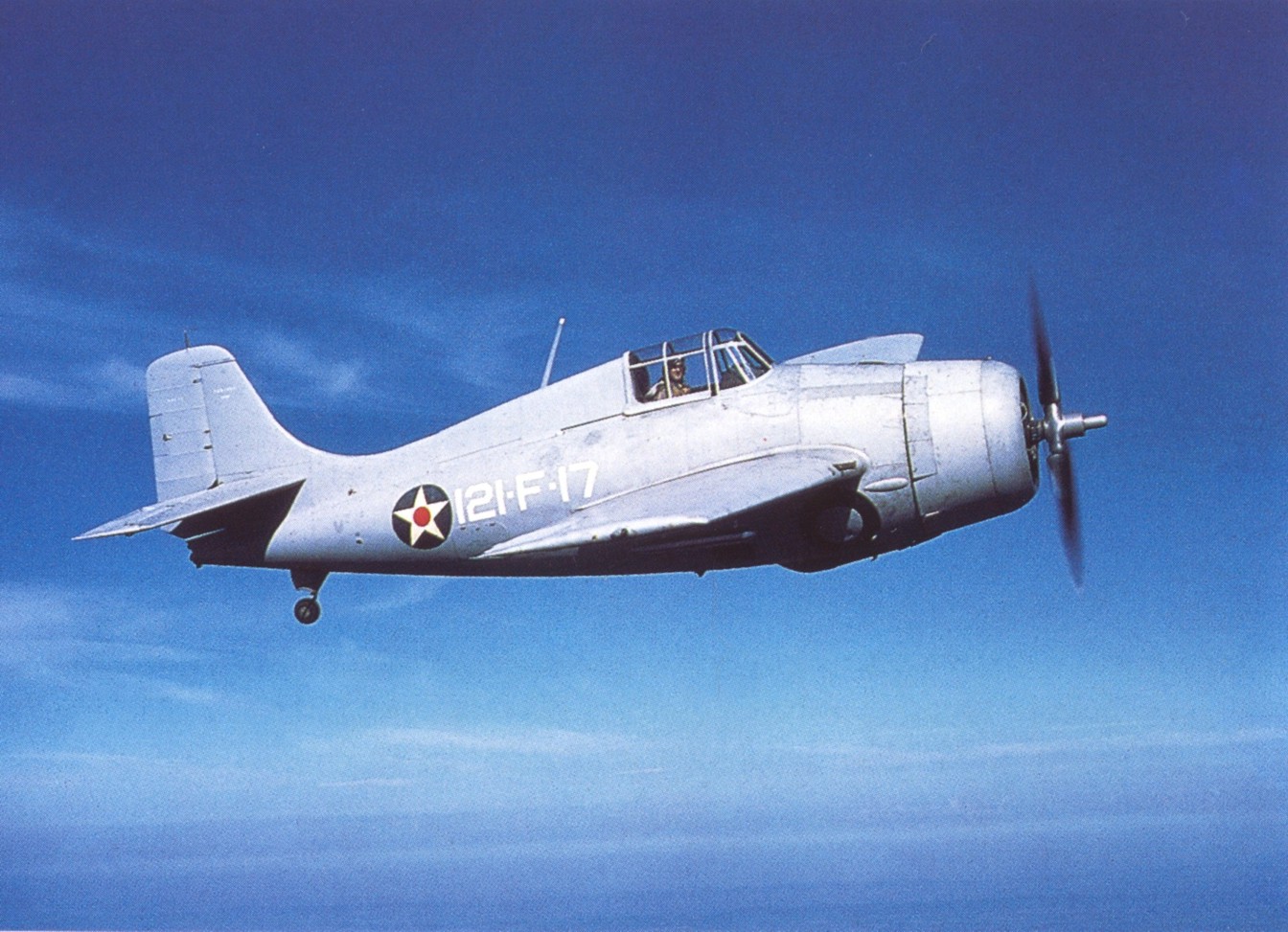
An F4F-3 of VMF-121
in the overall light gray scheme sometime in
1941.
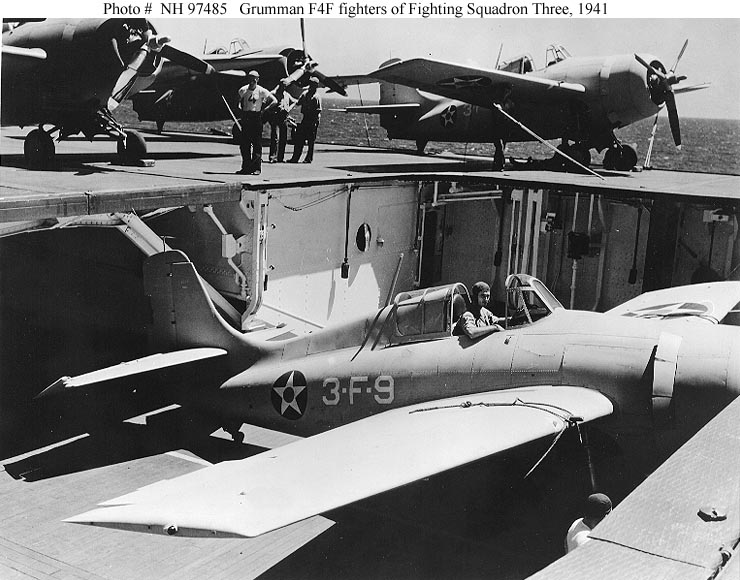
A VF-3 F4F-3 (Bu. No. 3982) rides the forward elevator aboard the USS Saratoga in October, 1941. (USN)
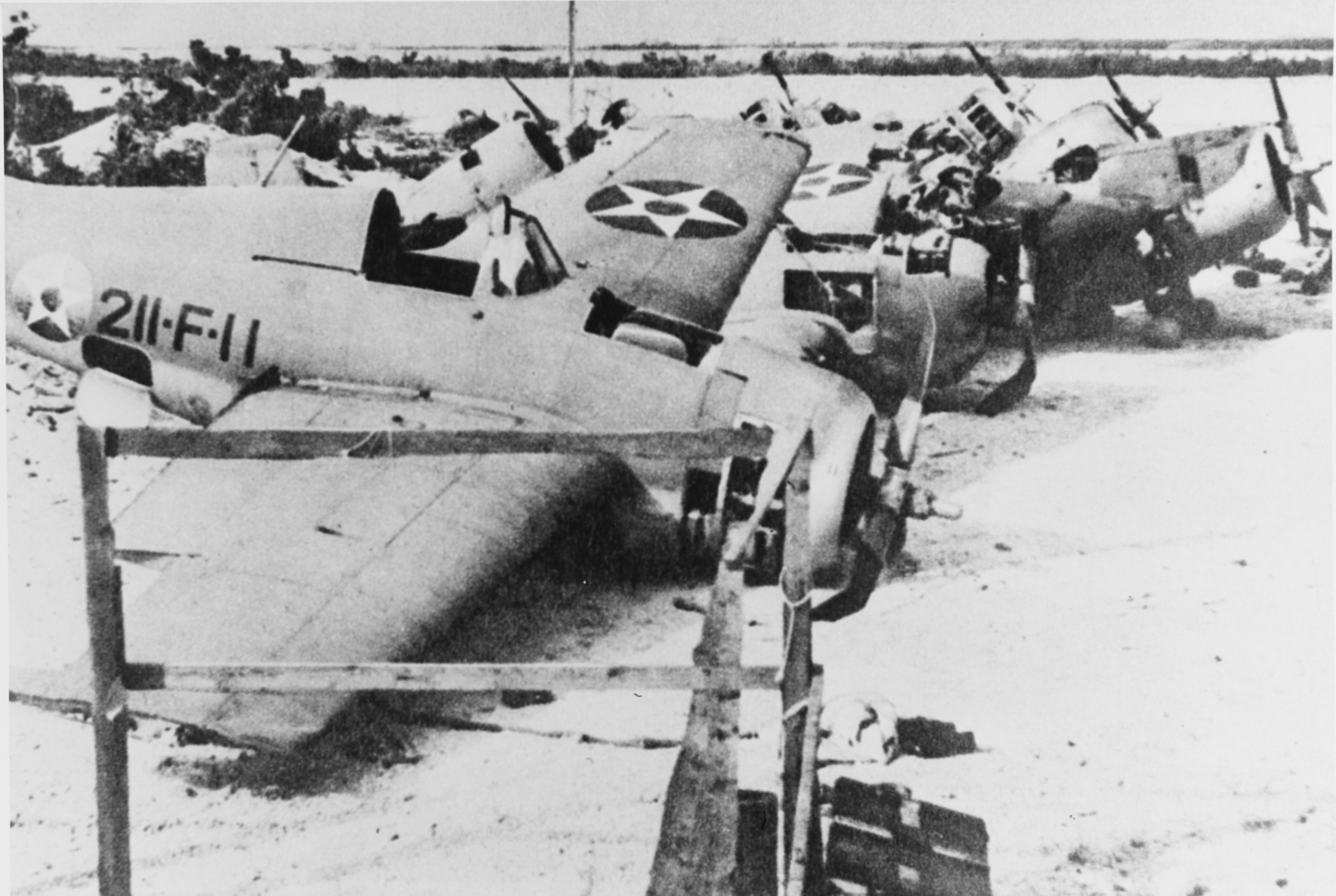
Late F4F-3s of VMF-211 cannibalized on Wake Island,
December, 1941. These aircraft were originally light
gray, but blue gray was sprayed on the top surfaces evident
by the way that the light gray crosses the top of the cowl.
(USN)
VF-6 F4F-3s
aboard the USS Enterprise late 1941. (Life)
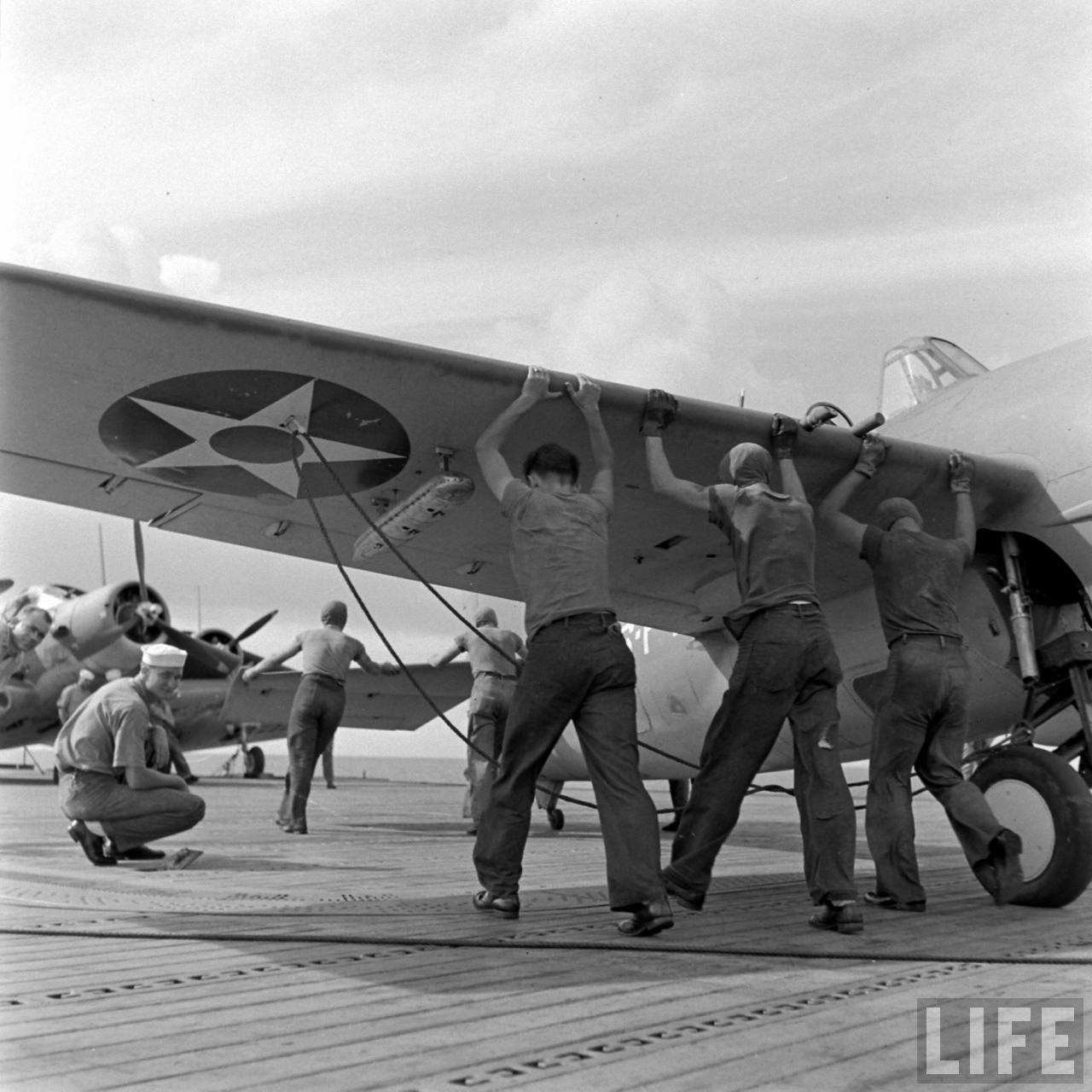
Deck crew
manhandling a VF-6 Wildcat aboard the USS Enterprise
late 1941. (Life)
 |
 |
 |
 |
 |
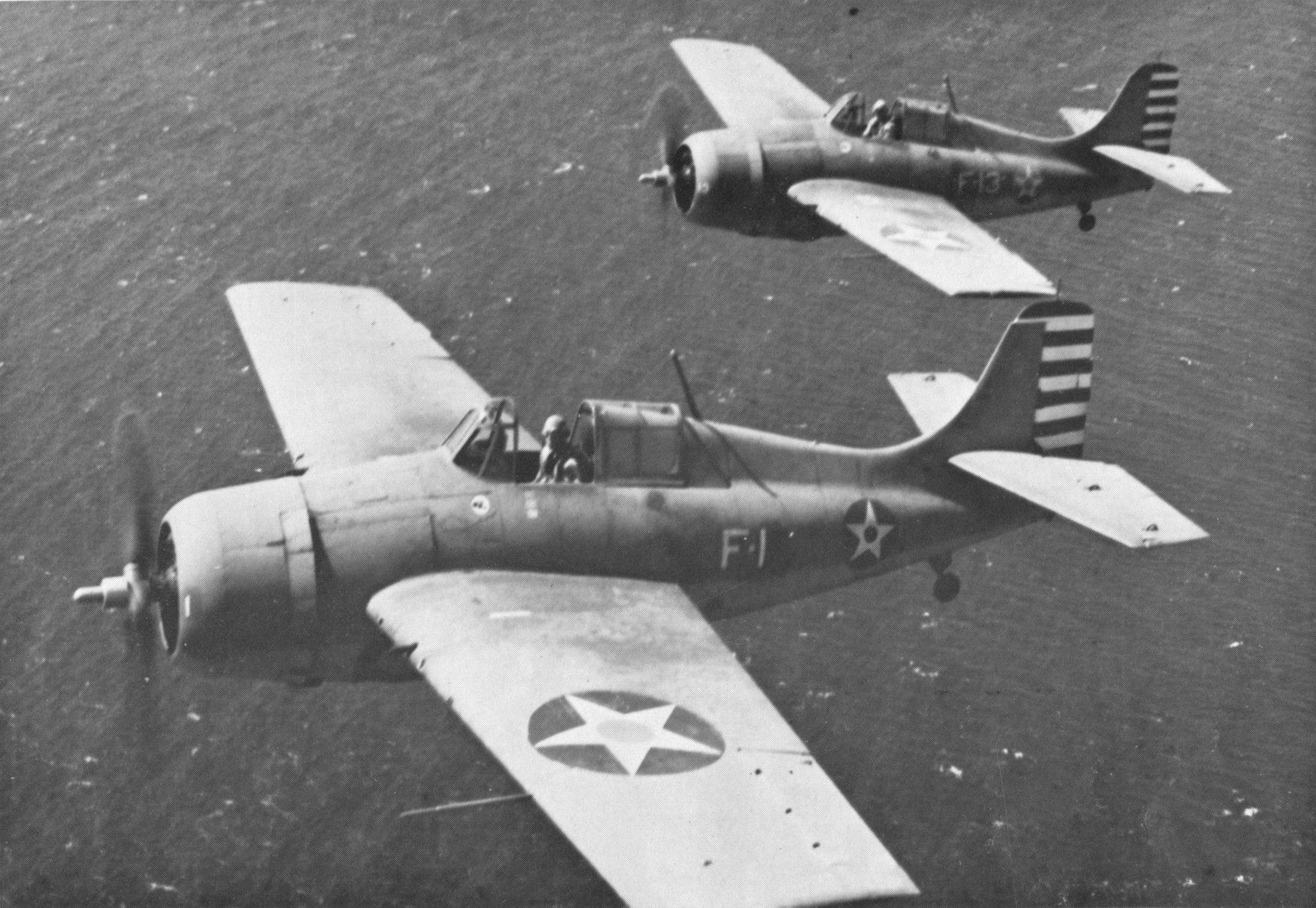
Two late model F4F-3s,
VF-3. Aircraft "F-1" (Bu. No. 3976)
is flown by John Thach, while "F-13"
(Bu. No. 3986) is flown by "Butch"
O'Hare. Both aircraft are in blue gray
over light gray, but notice how the tail stripes
differ. This was common from aircraft to
aircraft as were differences in national
insignia. They also both sport the "Felix the
Cat" markings, still in use today by
VFA-31. (USN)
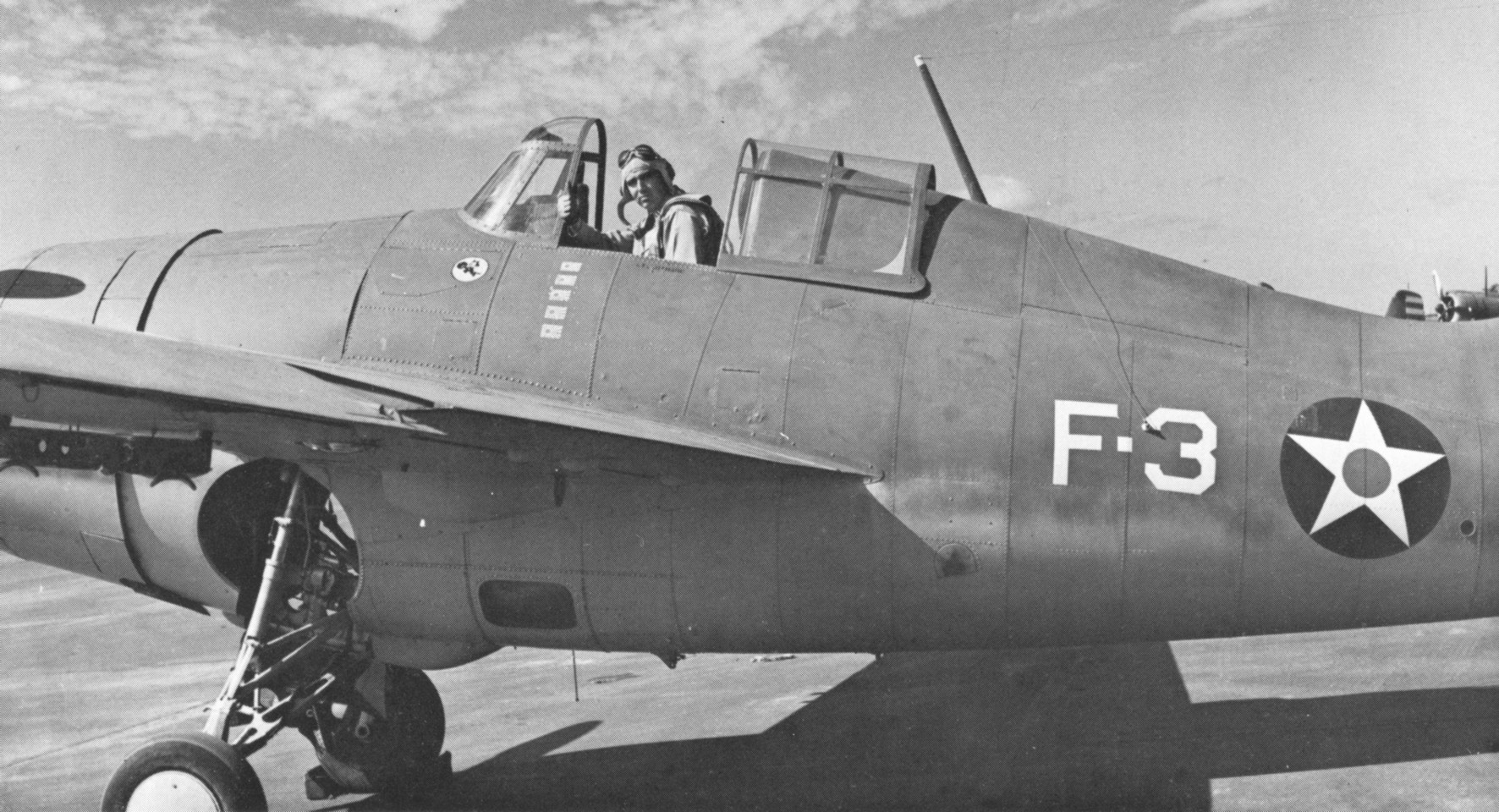
Though
there were many Wildcat aces no person is more closely
associated with the F4F than Edward Henry "Butch" O'Hare,
becoming the first USN ace of World War II and Medal of
Honor recipient while serving with VF-3. (USN)
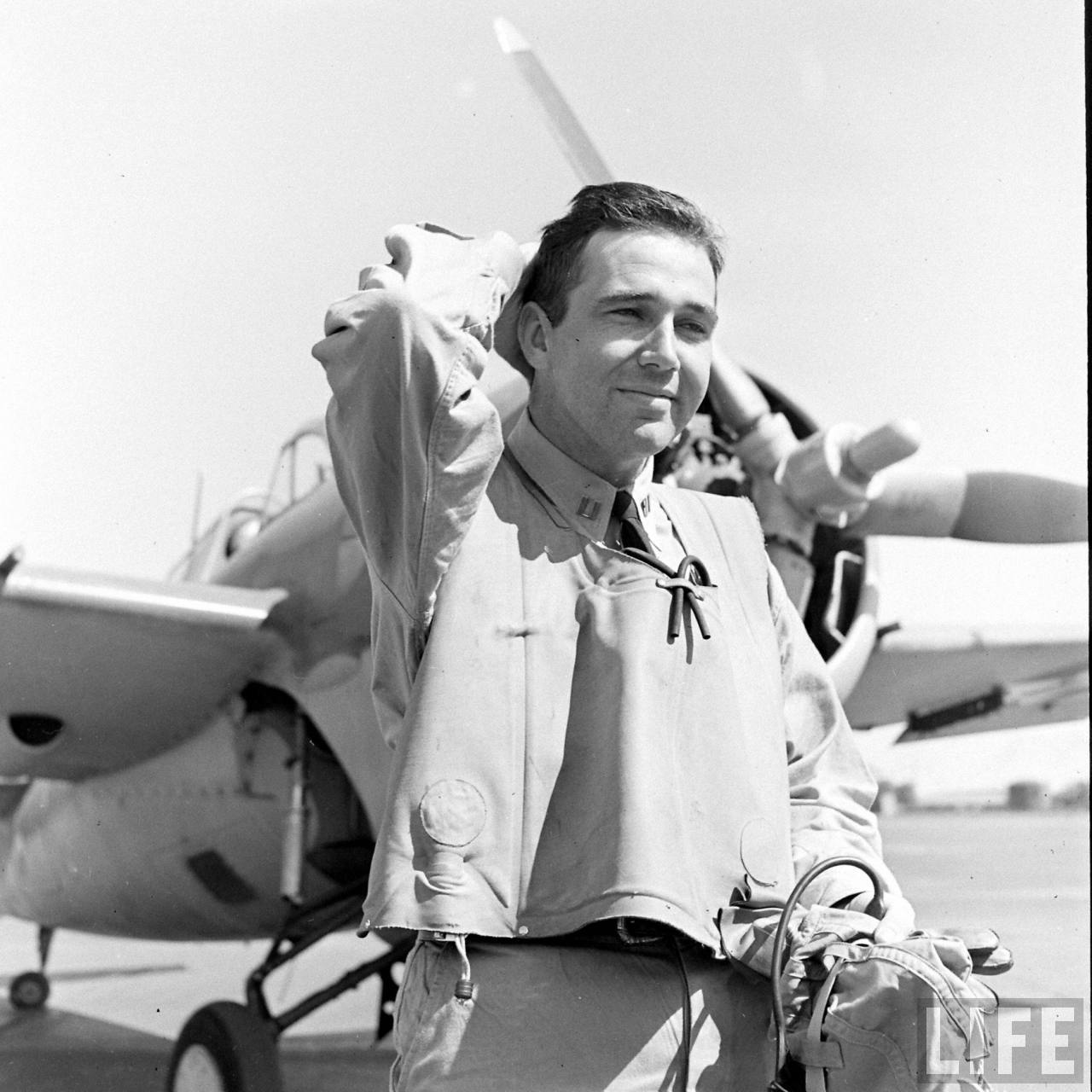
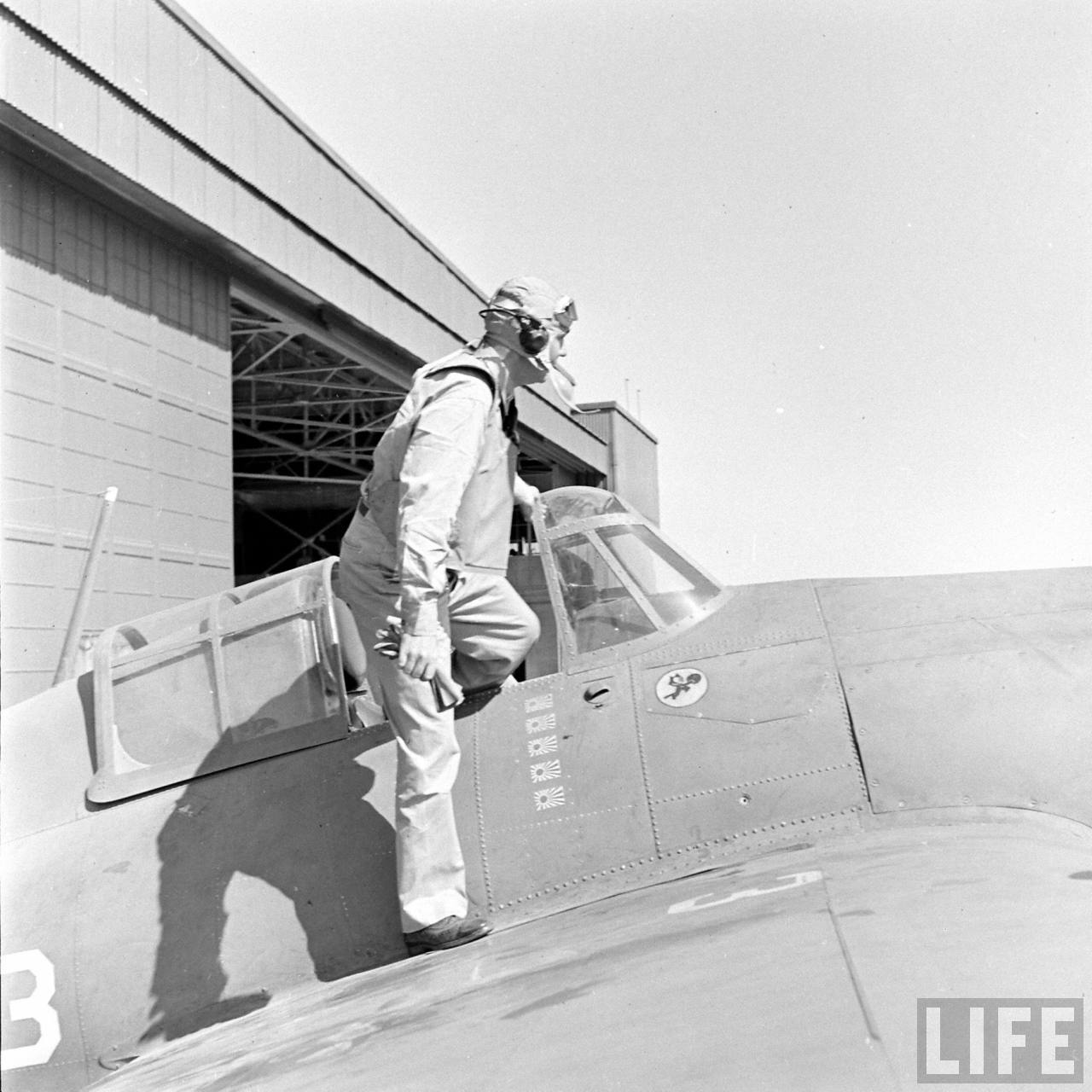
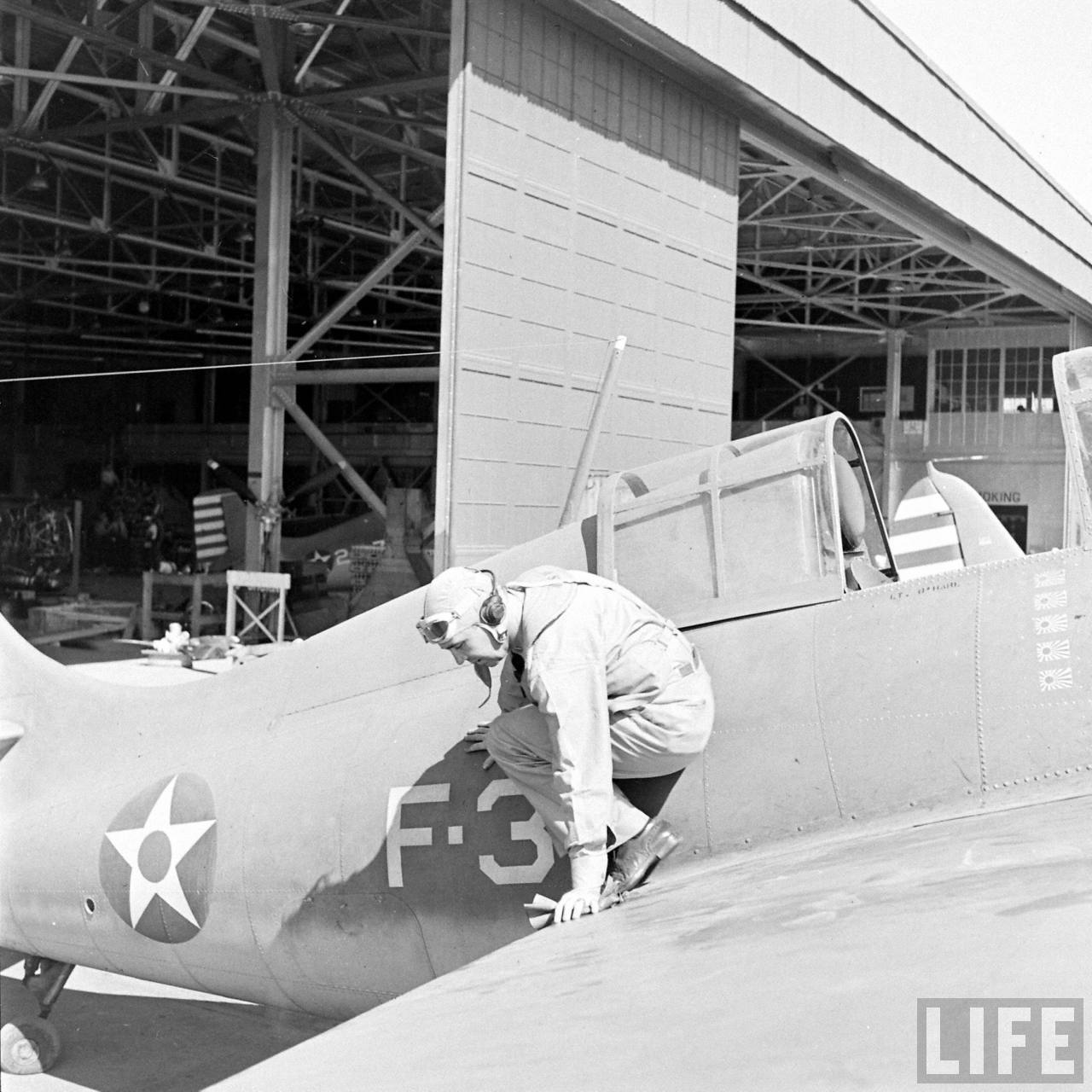
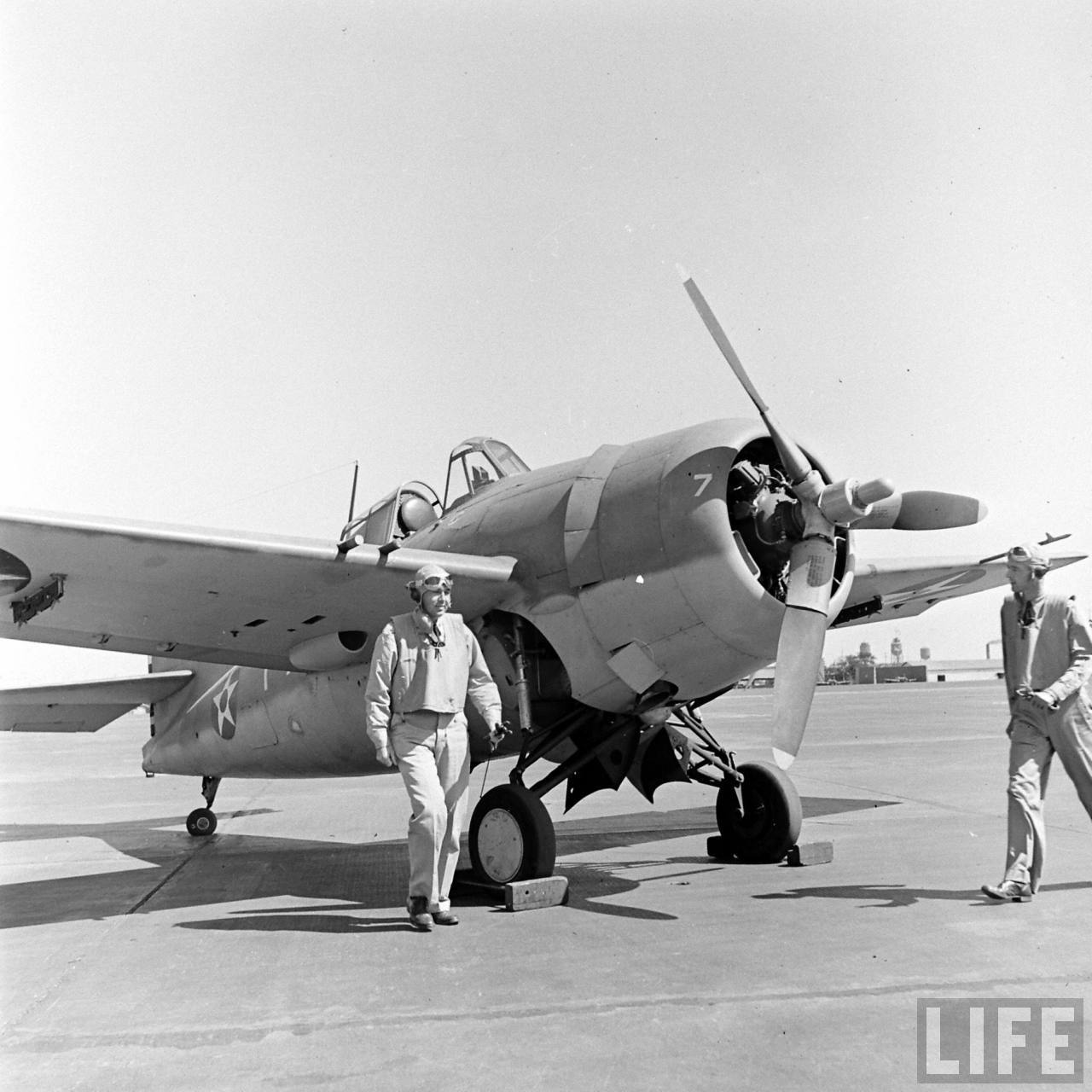
Life
photographer Ralph Morse took a series of photos of
Lieutenant Edward O'Hare in Hawaii during April, 1942.
The first in this group shows O'Hare taxiing in an F4F-3
marked as F-7. (Life)
And climbing out
of F-3. It is quite likely these were shot over the
period of a few days, though it is possible that some were
posed for publicity reasons. Felix the Cat of VF-6 is
prominent under the windscreen and was applied to both sides
of the fuselage. (Life)
 |
 |
 |
 |
 |
O'Hare climbing
down from F-3. (Life)
And walking away from F-7. Lieutenant Commander John S. Thach is walking into the photo from O'Hare's right. Butch O'Hare was later killed in combat, Thach finished the war with six kills and later became an admiral. (Life)
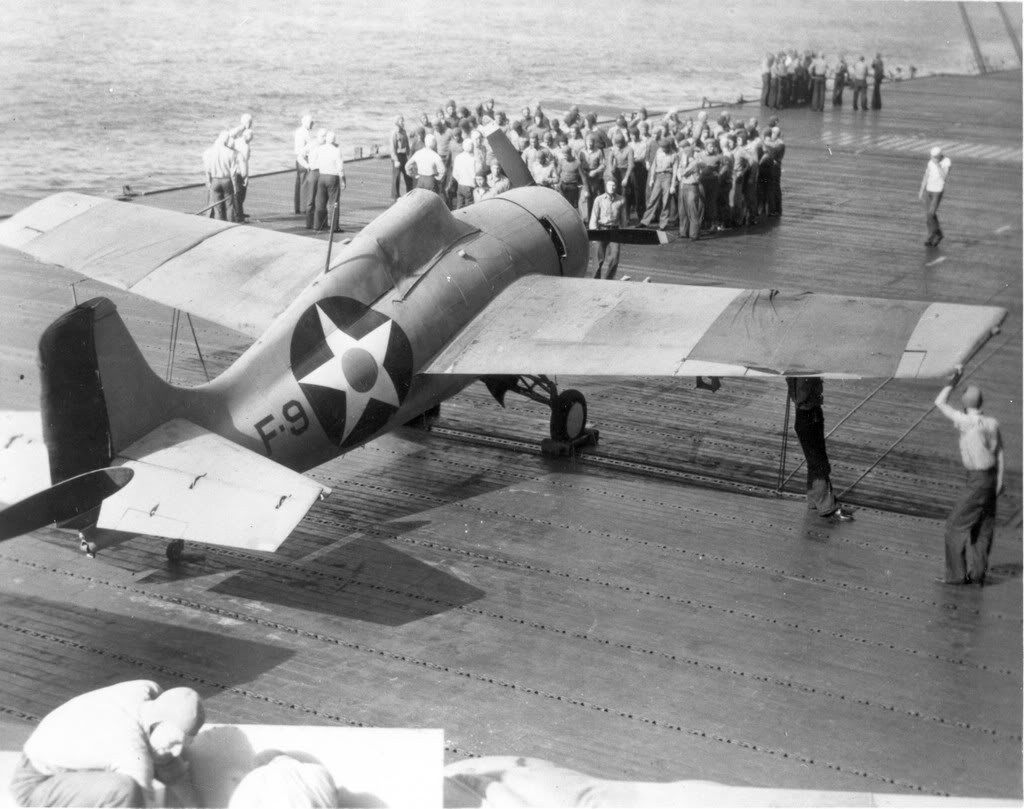
While the fuselage shows the larger insignia
that came into use in early 1942, the tail stripes
and wing insignia on this F4F-3 are covered with
canvas. When aboard ship it was not uncommon
for any colorful markings to be covered so as to
make the ship less conspicuous. With
something as large as an aircraft carrier that seems
like a lesson in futility. (USN)
An F4F-3
launches off of the USS Charger sometime in late 1942/early
1943. This underside shot shows the position of the
wing guns and ejection slots for spent shell casings.
The inboard slots have containers mounted to capture those
casings and the gun on aircraft left inboard has a fairing
that was common on the F4F-3. This photo was
originally reversed giving the impression that the pitot was
on the right wing. A censor has also blotted out the
ship's radar antenna. (Life)
F4F-3P
F4F-3P Photo recon conversion of some F4F-3
airframes.
 |
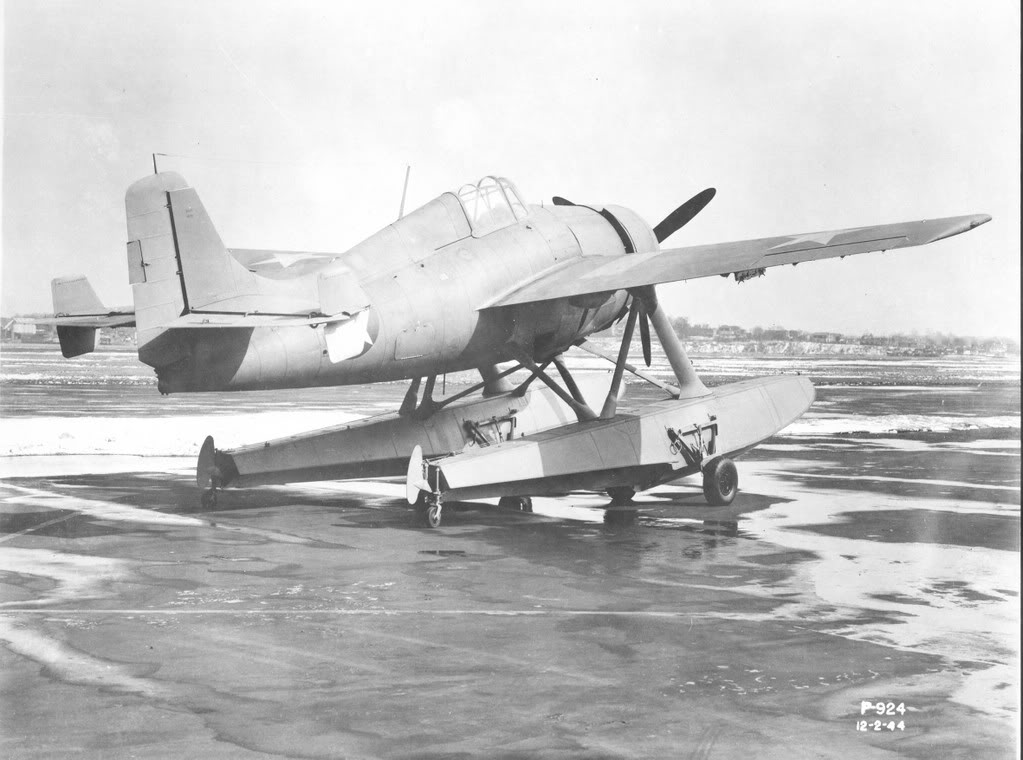
F4F-3S
F4F-3S An F4F-3, Bu. No. 4038
mounted on floats and sometimes called
the Wildcatfish. Not
successful.
 |
 |
 |
 |
F4F-4
The
F4F-4 was the first Wildcat with folding
wings. Armament was increased to six .50
caliber guns. The pitot tube was changed to
one that curved forward from the bottom of the
left wing. Powered by a P&W R-1830-86, the
cowling was the same as the late F4F-3 with four
cowl flaps per side (three on top, one on the
bottom).
XF4F-4 Prototype
for the folding wing F4F-4 with six gun
armament. Bu. No. 1897.
F4F-4 Production
version. 1,169 built. Bu. No.s 4058/4098,
5030/5262, 01991/02152, 03385/03544, 11655/12227.
|
 |
 |
 |
 |
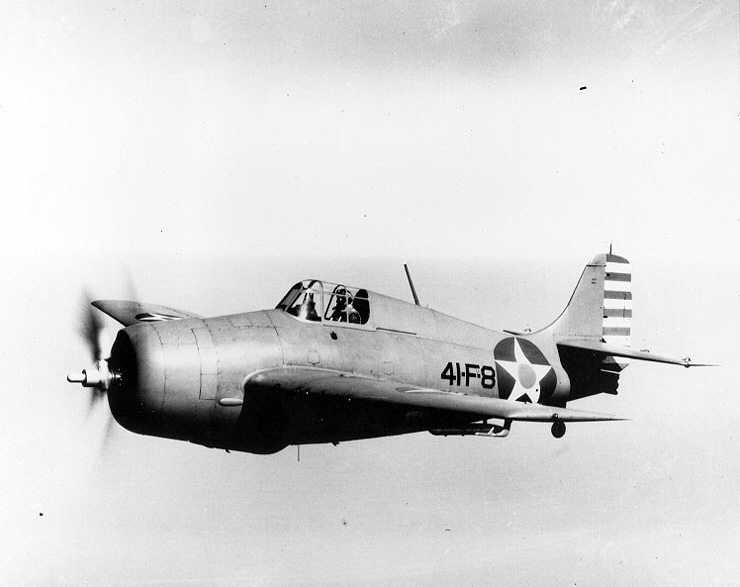
A VF-41 F4F-4 in-flight. This aircraft still has the older style of coding "41-F-8", which remained in use for Atlantic based units long after it disappeared for those in the Pacific. This aircraft also has the six position stars. (USN)
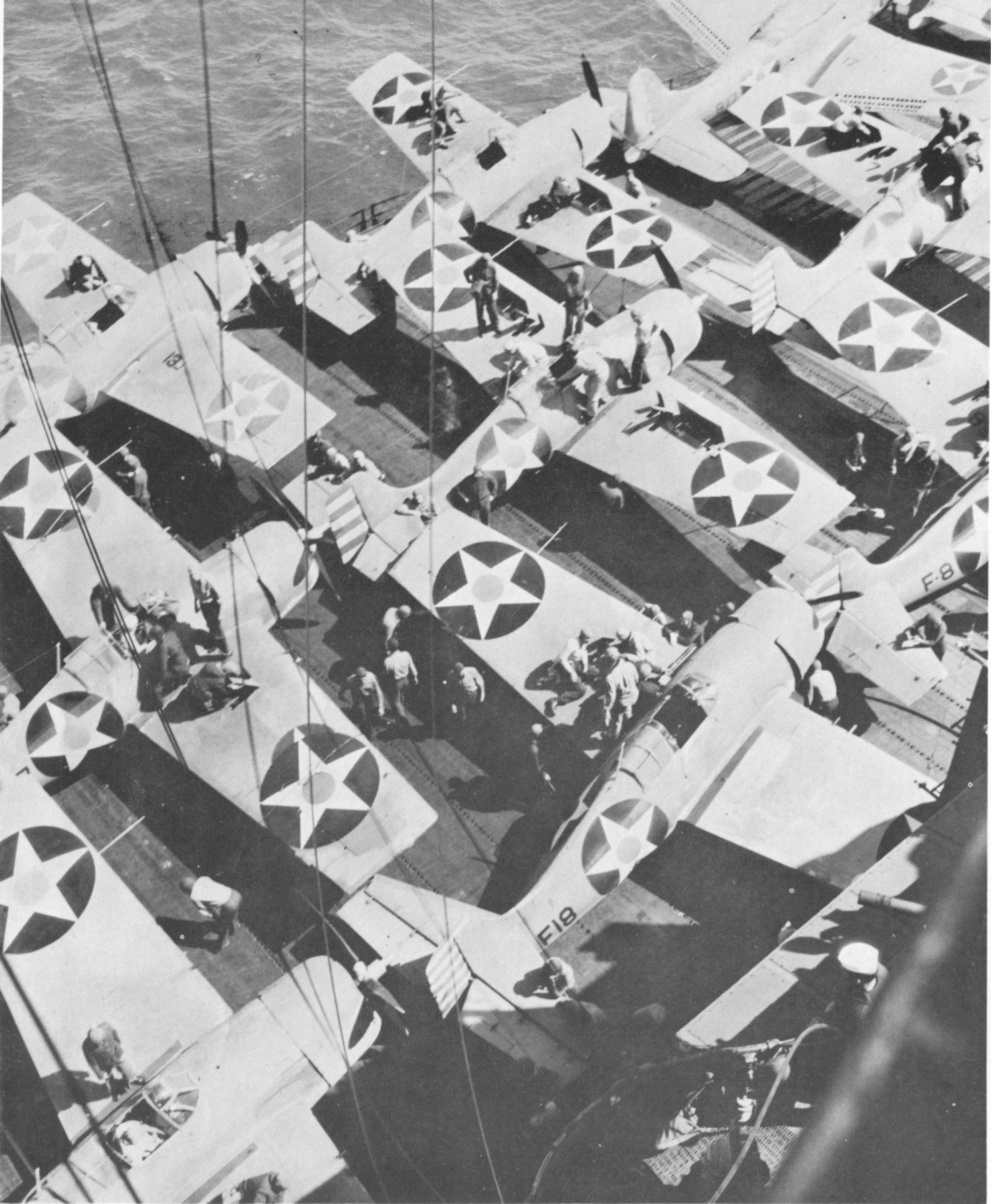
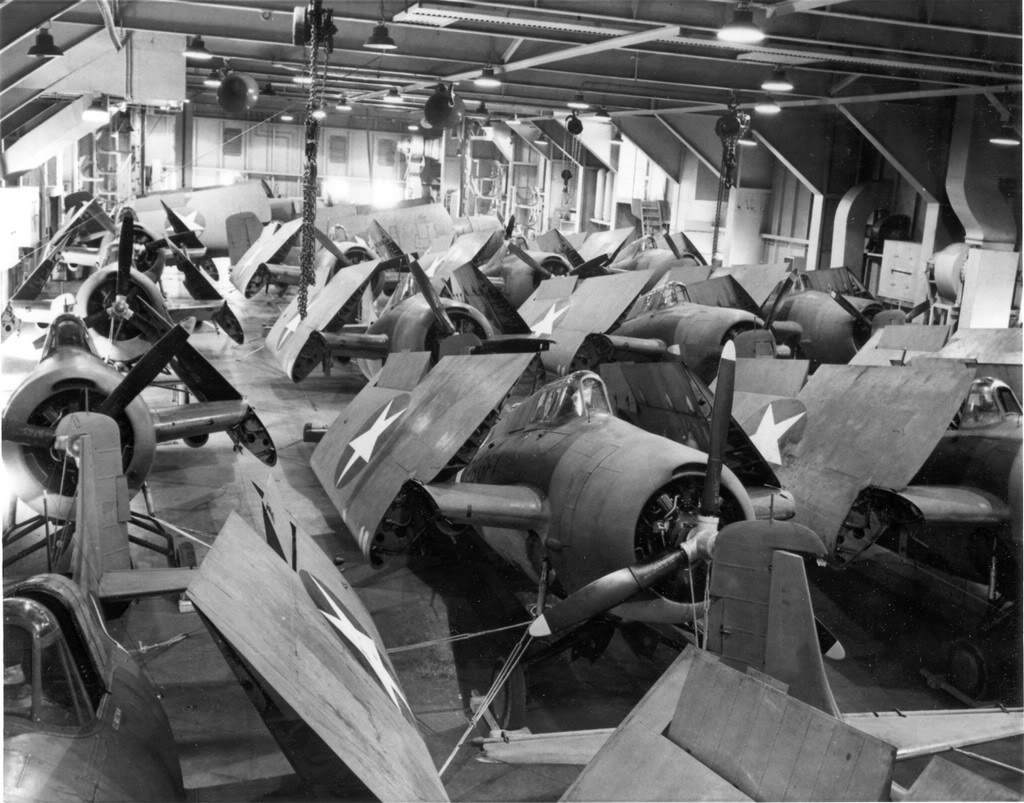
Space is always at a premium aboard ship and the use of folding wings makes sense from that standpoint. These F4F-4s are packed aboard like sardines. Also note that when the wings are folded the ailerons position themselves away from the wing. (USN)
F4F-4s and TBF
Avengers stowed aft on an
aircraft carrier "somewhere in
the Pacific". (USN)
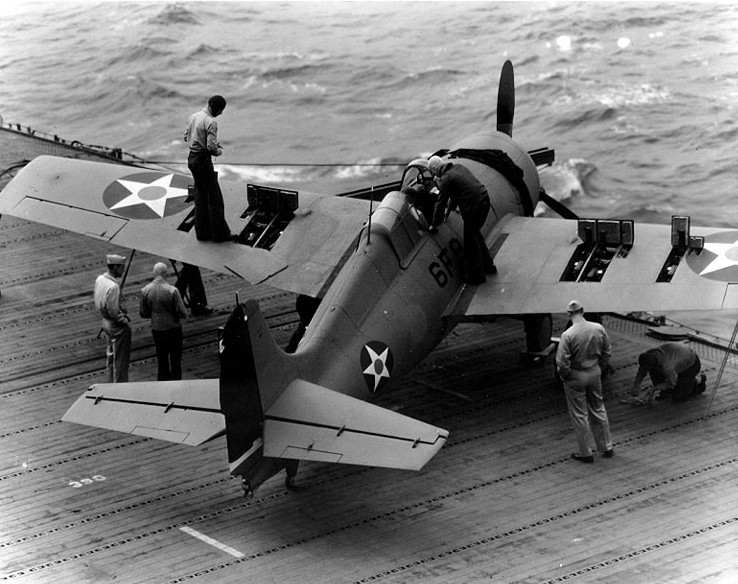
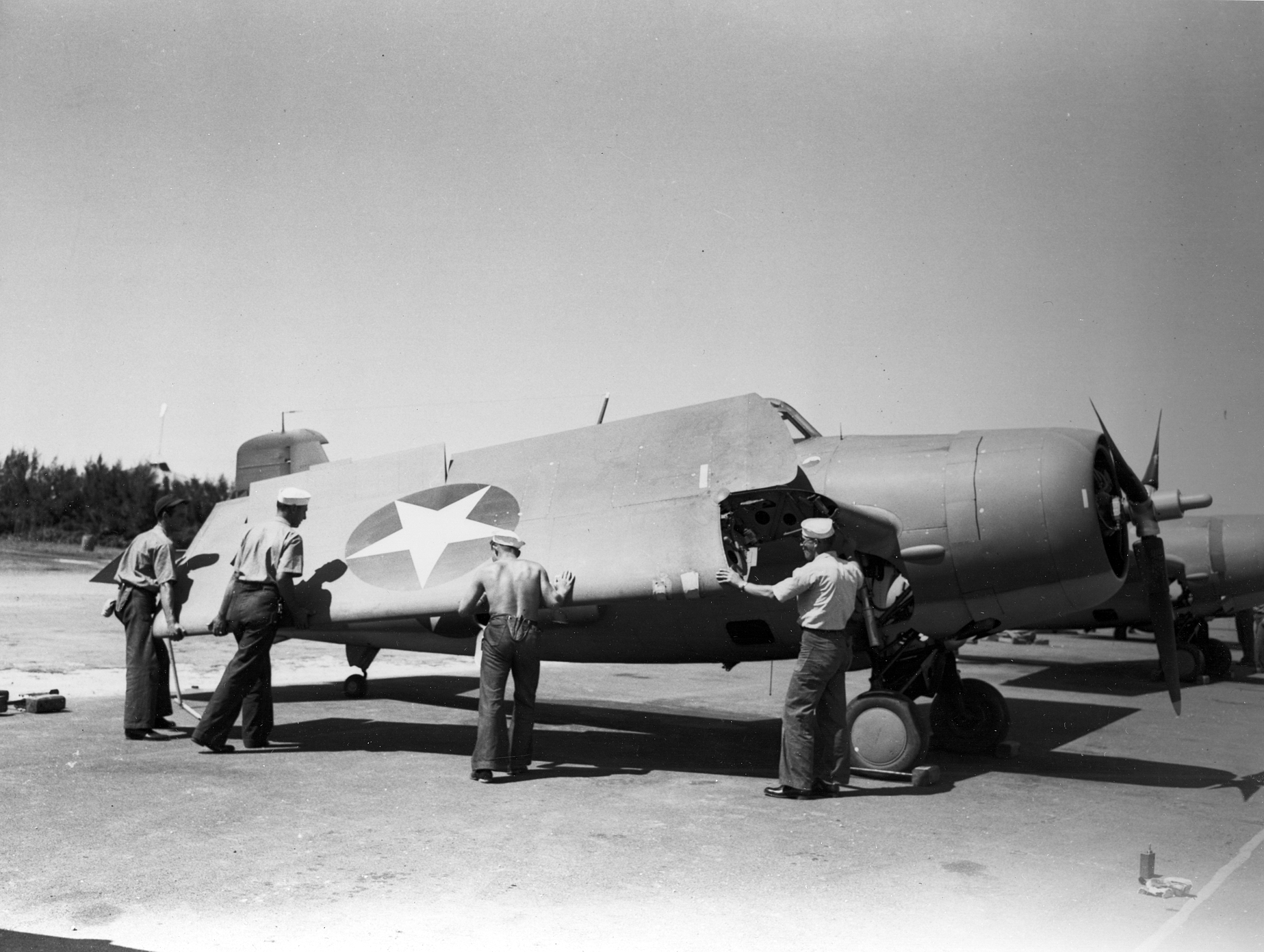
Servicing of a VF-6 F4F-4's guns aboard the USS Enterprise in early 1942. The gun bays are open for all six guns. (USN)
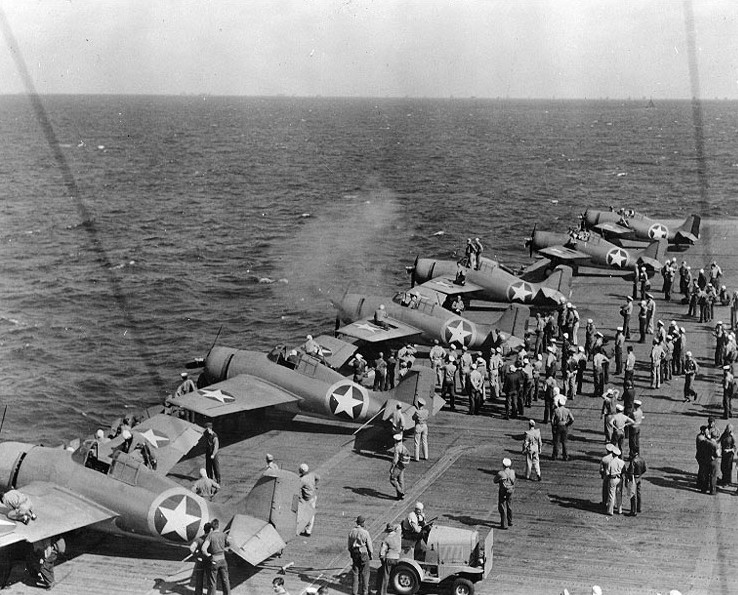
Test firing of guns aboard the USS Ranger just prior to Operation Torch, the allied invasion of North Africa. The yellow circles around the national insignia was applied in preparation for that operation. During the air campaign, F4Fs fought against Vichy French operated Curtiss P-36s. (USN)
 |
 |
 |
|
|
This F4F-4 is stated to be Bu. No. 5171, a VF-3 aircraft flown by John Thach on 4 June, 1942 during the Battle of Midway. (USN)
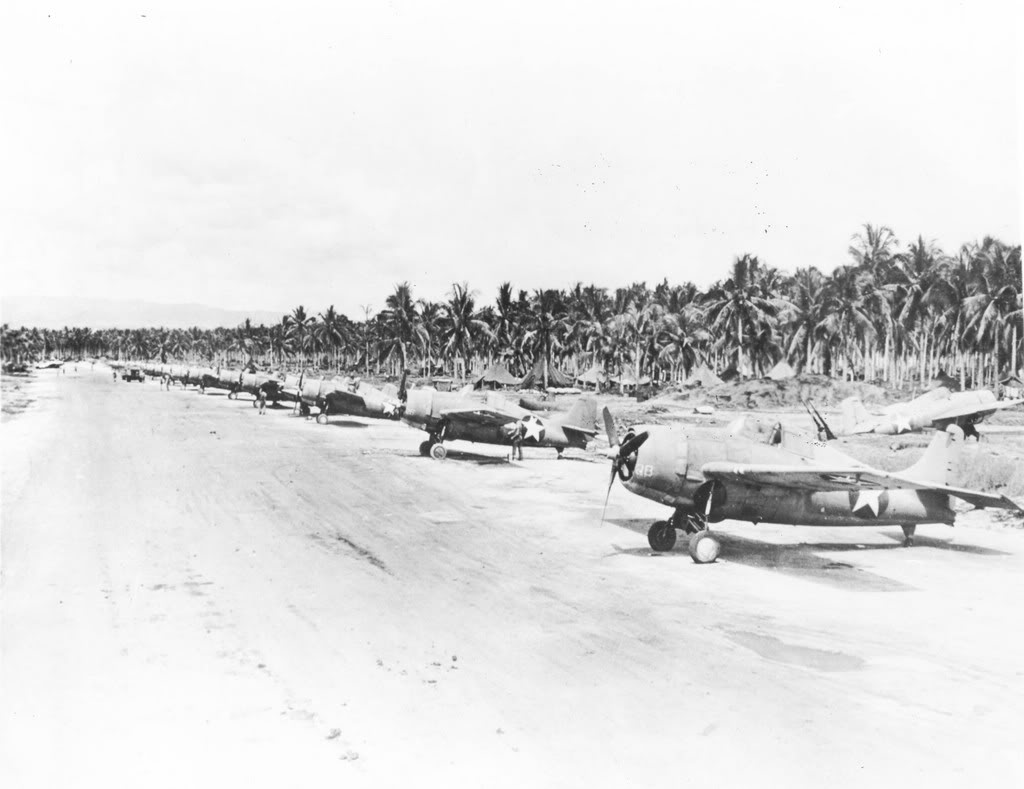
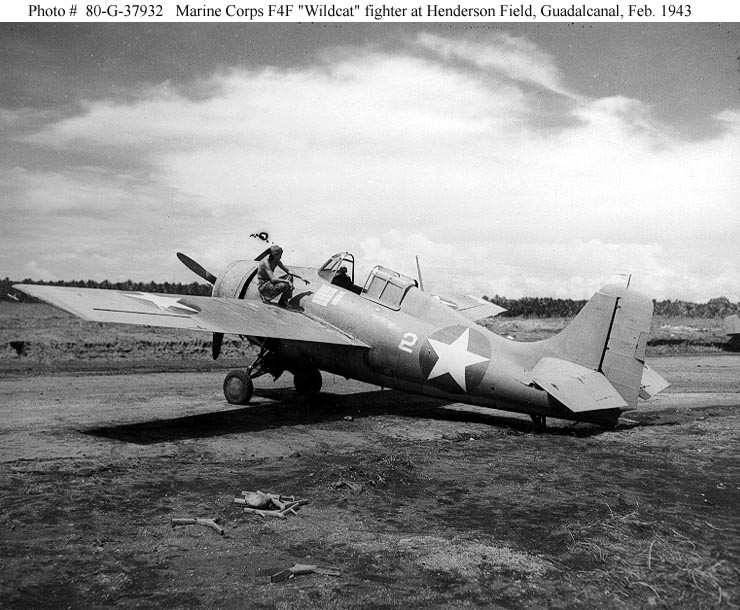
The next two photos show Wildcats at Henderson Field. The F4F was instrumental in routing the Japanese aircraft from the skies over Guadalcanal. The first photo dates from March, 1943 which was near the end of the Battle for Guadalcanal and near the end of the Wildcat's service in the Solomons. The second of the two shows an F4F with 19 kills, which is possibly a unit total. It is from Feb, 1943 (USN)
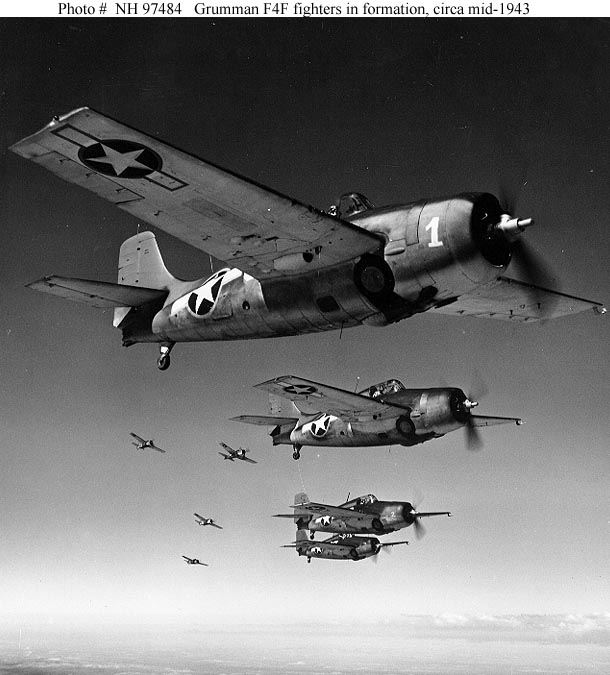
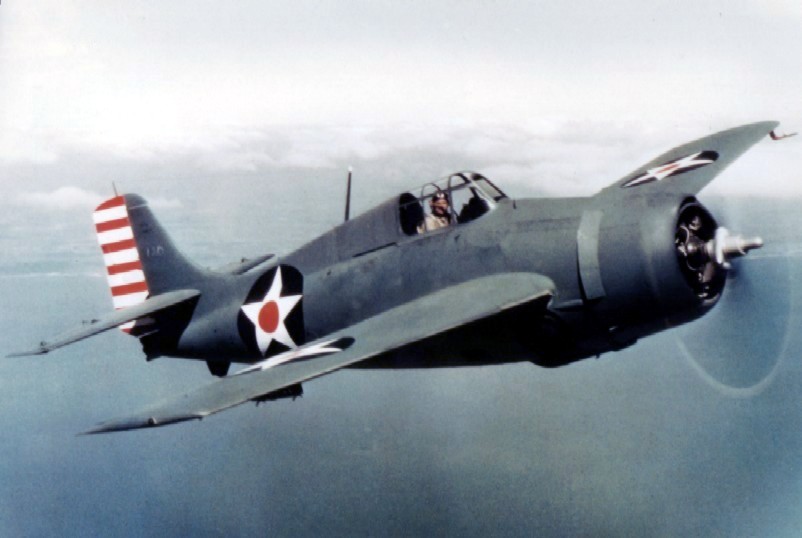
This flight of F4F-4s is shown airborne sometime in 1943. They are most likely a stateside training unit. (USN)
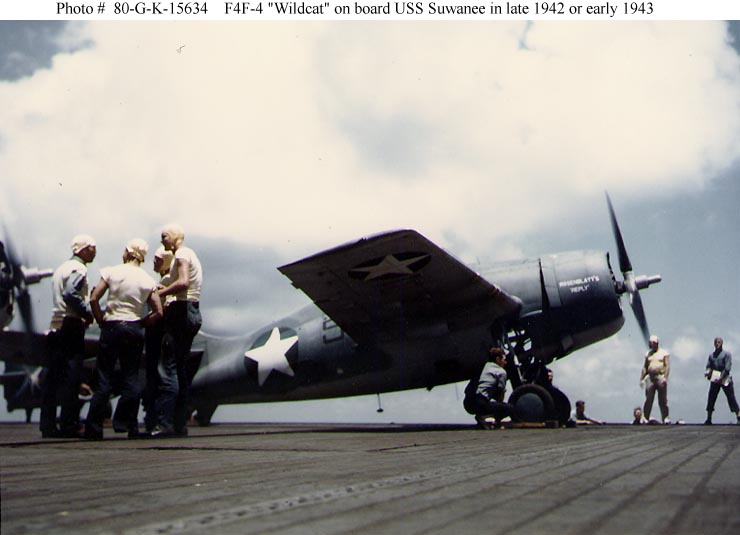
Rosenblatt's Reply is an F4F-4 aboard the USS Suwanee sometime in late 1942, or early 1943. The remnants of a yellow circle around the fuselage insignia indicate that this aircraft took part in the Torch landings. (USN)
 |
 |
 |
|
 |
Aircraft recognition has always been a
problem during a conflict and at the beginning of World
War Two many American aircraft were shot up by our own
forces. To help alleviate that more conspicuous
markings were applied. This F4F-4 illustrates the
larger national insignia and rudder stripes used in the
opening phases of WW II.
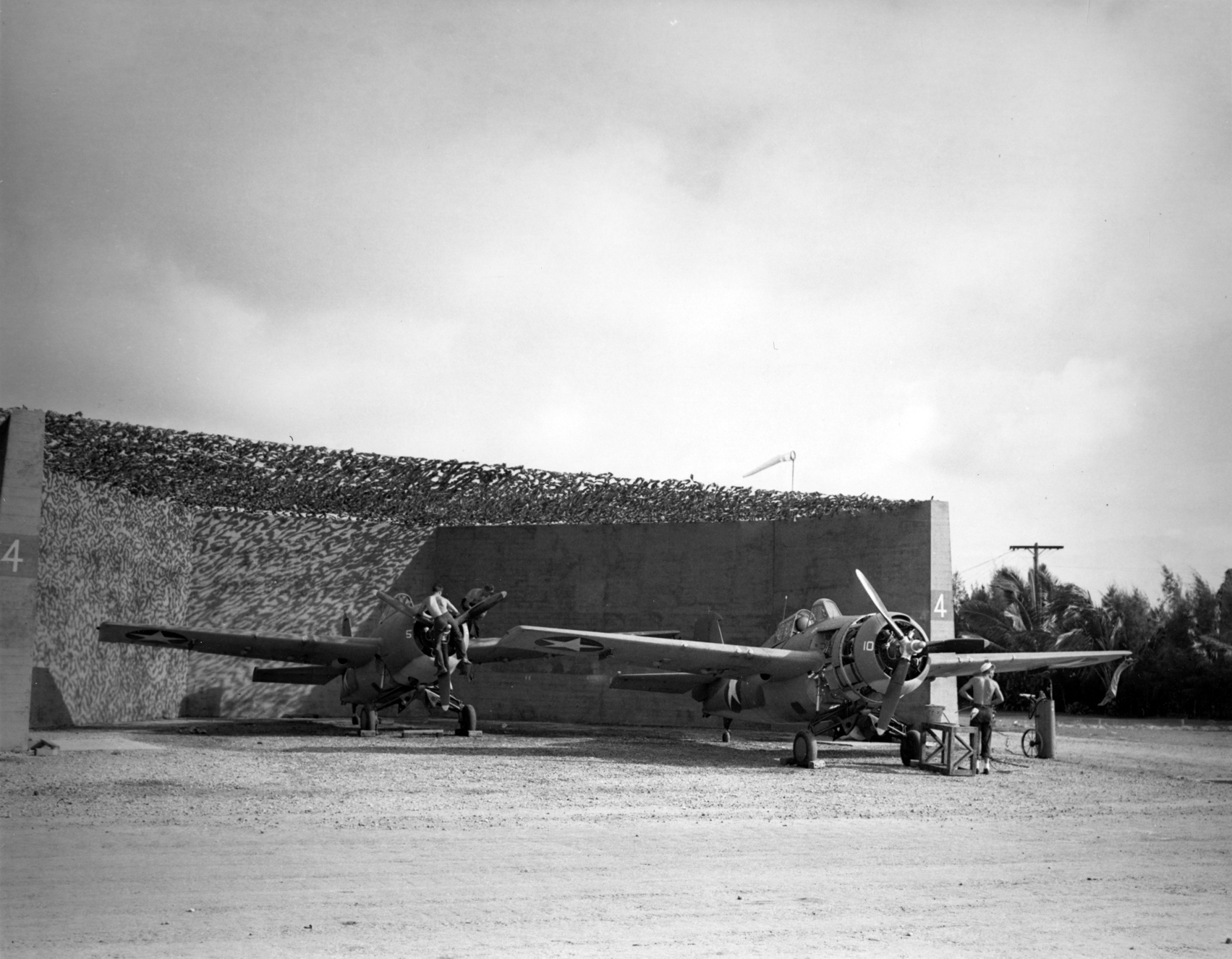
Two F4F-4s of VF-3 parked in
revetments at Kaneohe, Hawaii, May, 1942. The
Wildcat on the left is Bu. No. 5167, the one on the right
is 5149. (USN)
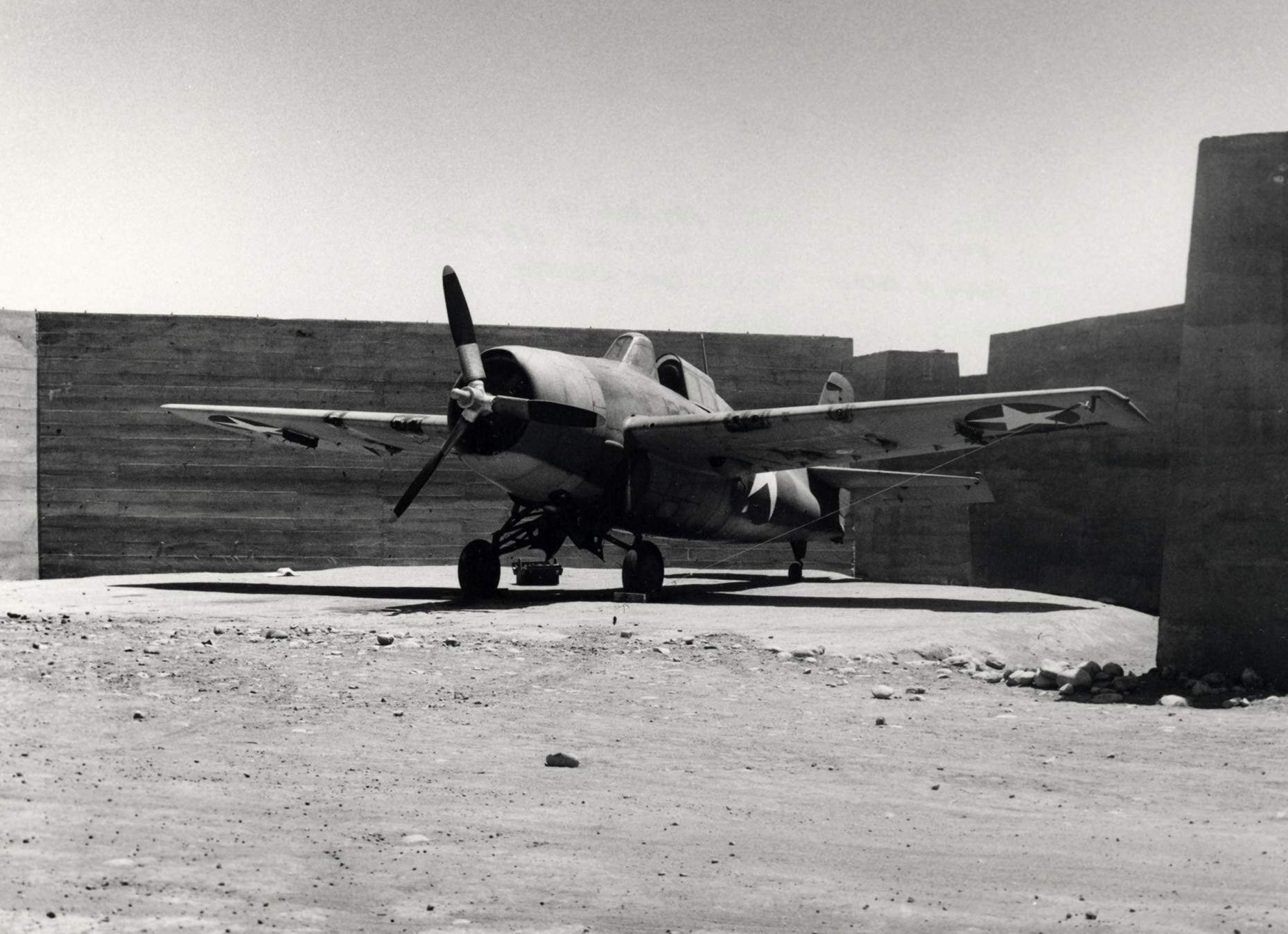
A VMF-122 F4F-4 in a revetment at Camp
Kearney, California sometime in 1942. Camp
Kearney would later become Naval Air Station Mirimar.
(USMC)
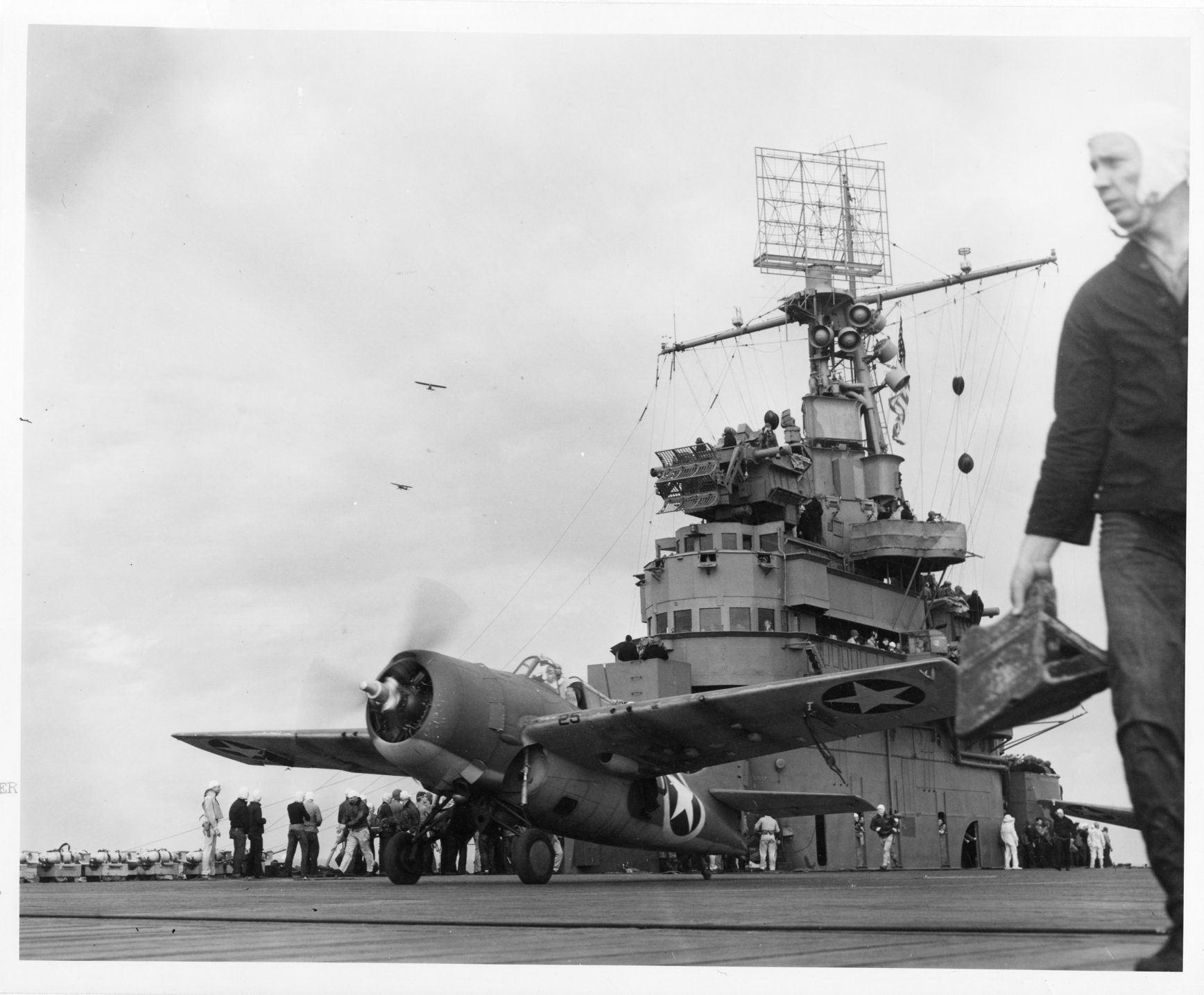
An F4F-4 launching from the USS Ranger
(CV-4) during Operation Torch, 8 November, 1942. It
appears that a tie down is dangling from the bomb rack
under the port wing. (USN)
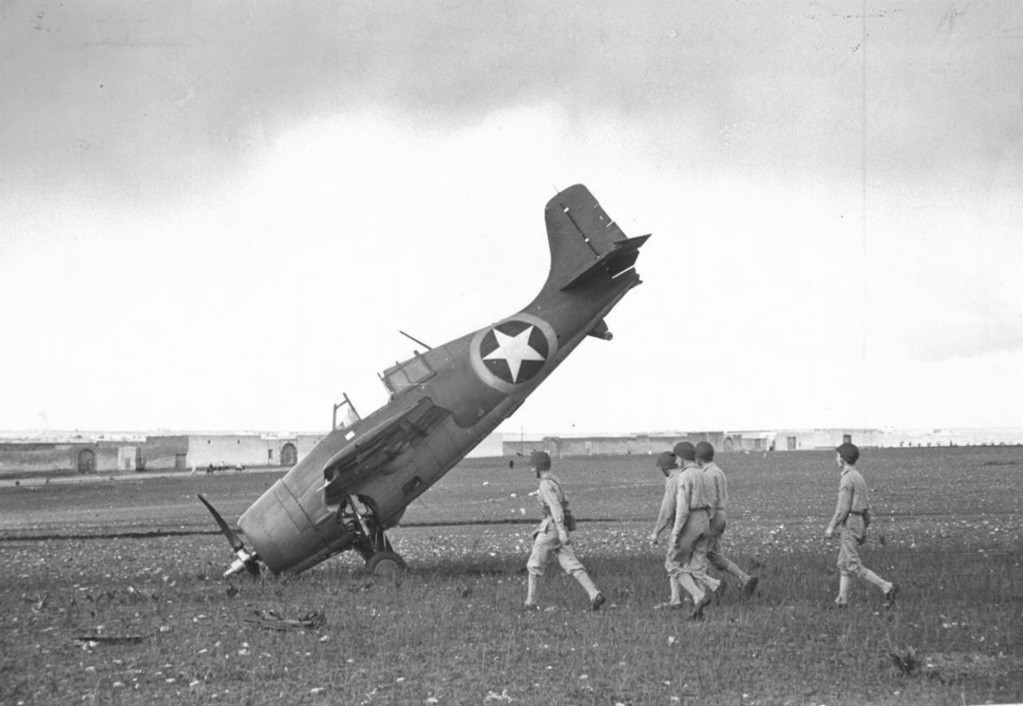
A VF-41 F4F-4 that nosed over on
landing in North Africa during Operation Torch.
(USN)
 |
 |
F4F and FM Wildcats
operated mainly from Escort Carriers during
the latter half of the war. This F4F-4 is
carrying the Atlantic camouflage scheme of
dark gull gray and light gull gray over white.
This scheme is referred to as ASW-1 (or ASW-I)
while the two color version of dark gull gray
over white is ASW-2 (ASW-II). (USN)
The F4F-4s in this photo are somewhat
of a mystery. They appear to be in the three color
Atlantic Scheme I of dark gull gray and light gull gray
over white. While that scheme was occasionally used
on patrol aircraft the two color Scheme II of dark gull
gray over white was more common on fighters, yet in these
two photos this scheme is shown in use on fighters.
The second Wildcat (5) might very well be the
same one as in the first photo.
F4F-4A
Projected version of the F4F-4 powered by an
R-1830-90.
F4F-4B USN designation for the Wildcat IV
in Fleet Air Arm (FAA) service. Powered by
the R-1820-G205.
(See Wildcat IV below)
F4F-4P Photo
recon conversion to at least one F4F-4 Bu.
No.03386.
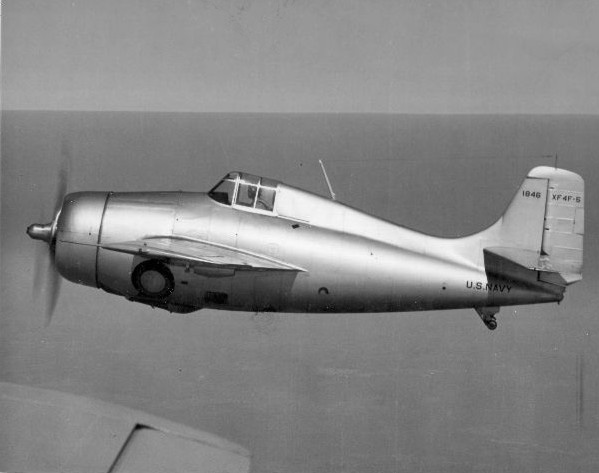
XF4F-5
Two F4F-3s re-engined with R-1820-40
engines. Bu. No.s 1846/1847.
 |
XF4F-6 Prototype for F4F-3A. Bu. No.
7031
 |
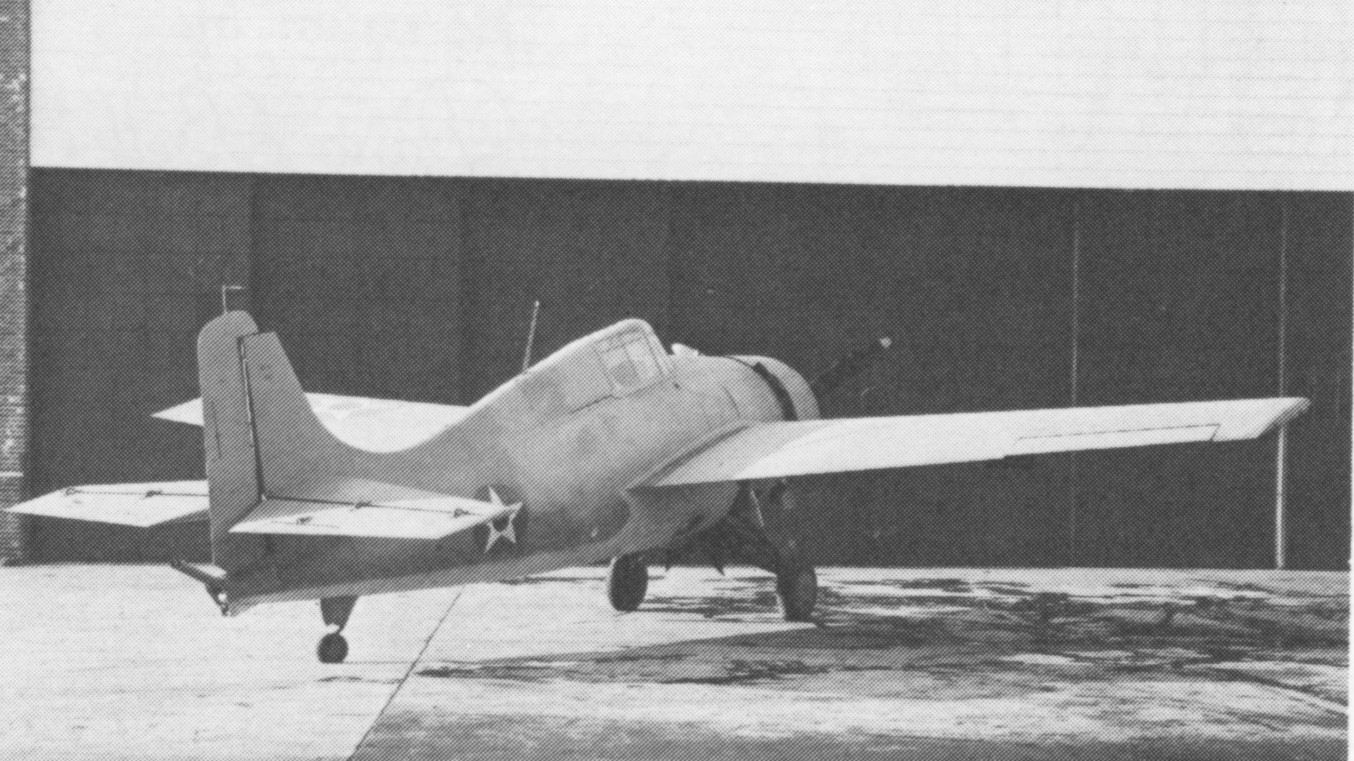
F4F-7 Unarmed recon
version of F4F-4, with non folding wings. 21
built. Bu. No.s 5263/5283
 |
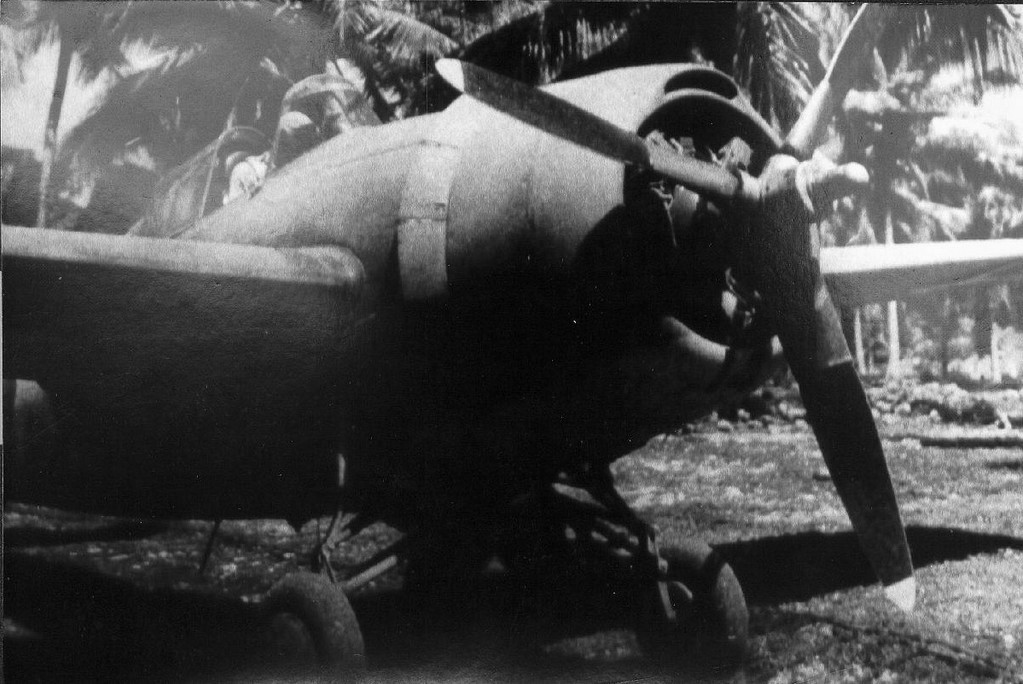 |
The F4F-7 was an effort to add a long
range photo reconnaissance mission to the Wildcat.
Armament was deleted, wings were non-folding and extra
fuel tanks were fitted. Though used in the Solomon
Islands only twenty one were completed out of an order of
one hundred with the balance being completed as
F4F-3s. Two identifying features are the curved
windscreen and two fuel dump tubes in the tail.
These aircraft were Blue-Gray over Light Gull Gray.
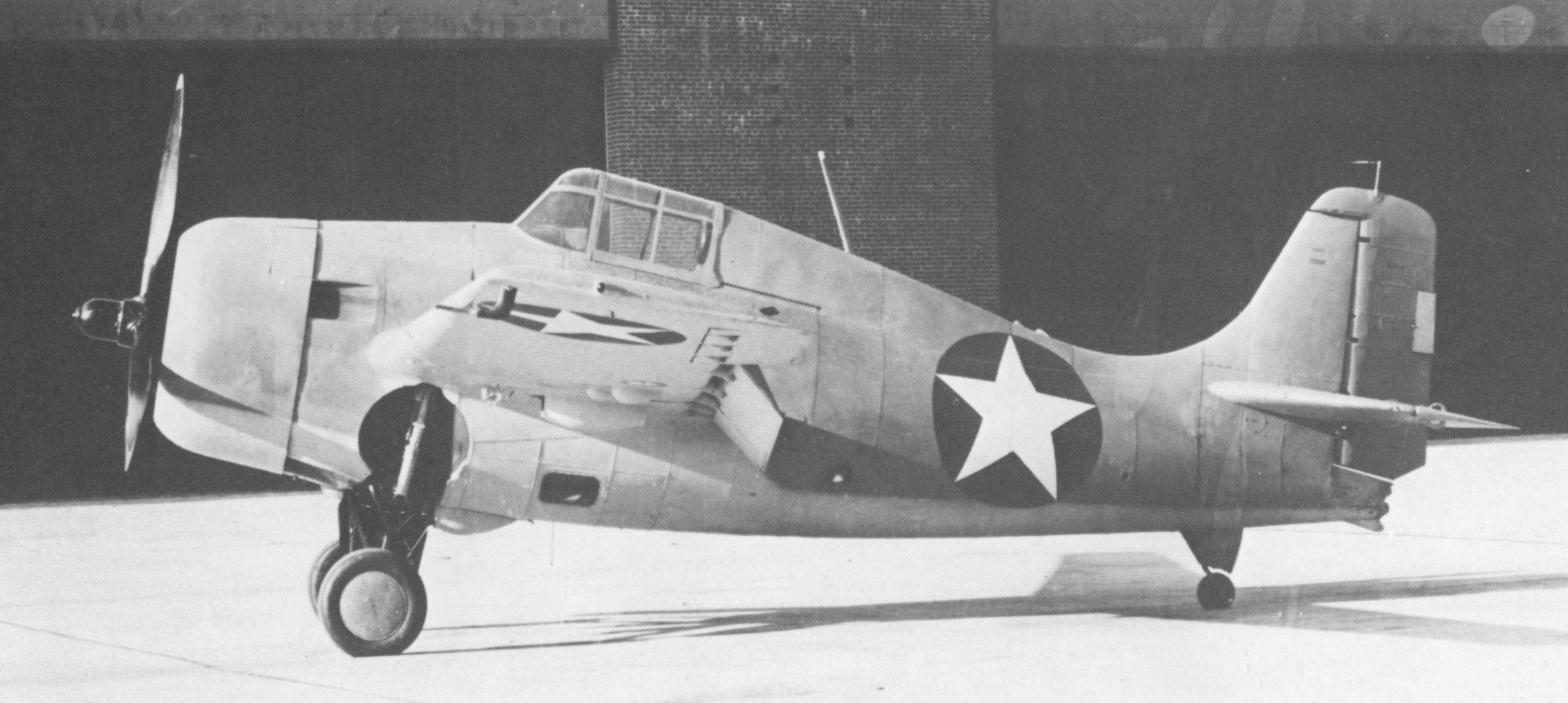
XF4F-8 Two F4F-4s with R-1820-56 engines,
reduced weight and slotted flaps. Also
tested taller fin as used on the FM-2.
Bu. No.s 12228/12229.
 |
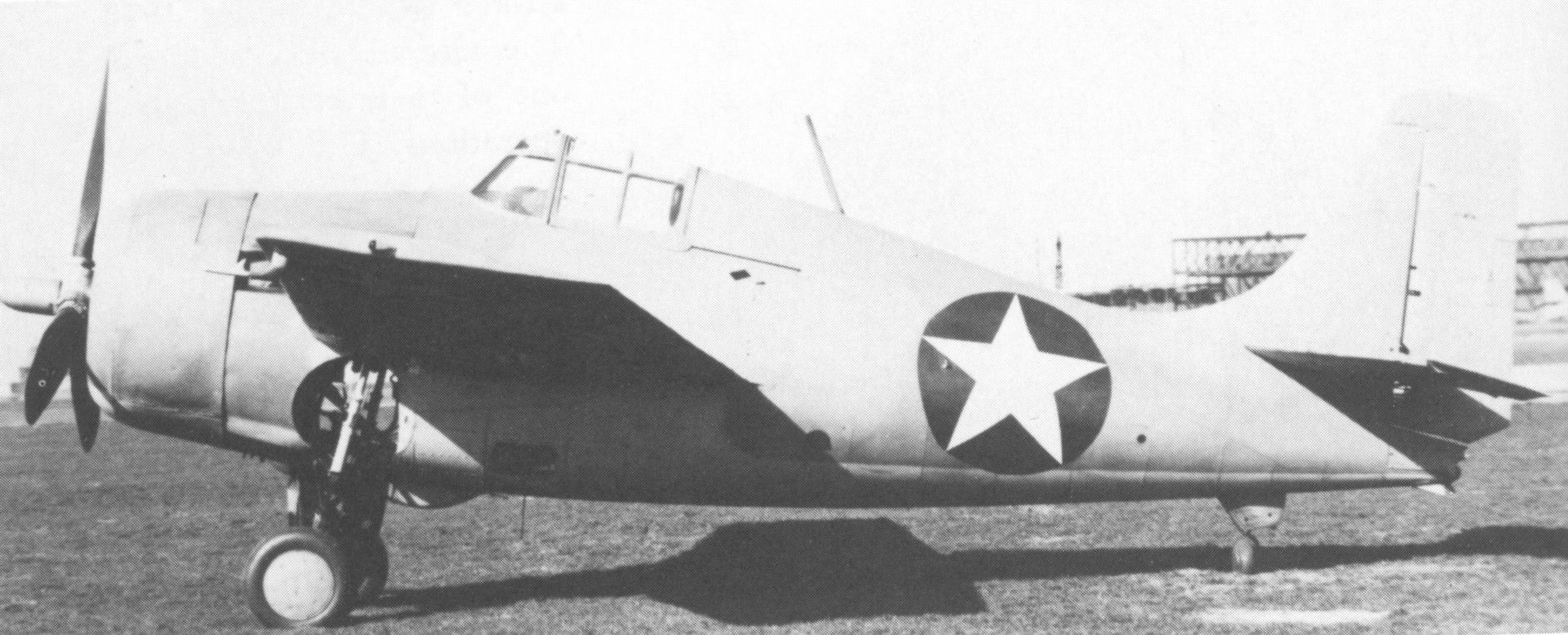 |
The two XF4F-8 Wildcats were
an attempt to get more performance out of the F4F.
Both were fitted with R-1820 engines. While 12228
retained the same fin and rudder as the F4F, 12229 tested
the taller fin combination that became standard on the
FM-2. Both aircraft also retained a six gun armament
and the windows in the belly and 12228 retains the oil
cooler fairings under the wings unlike the FM-2 derived
from this airplane. (Grumman)
FM-1
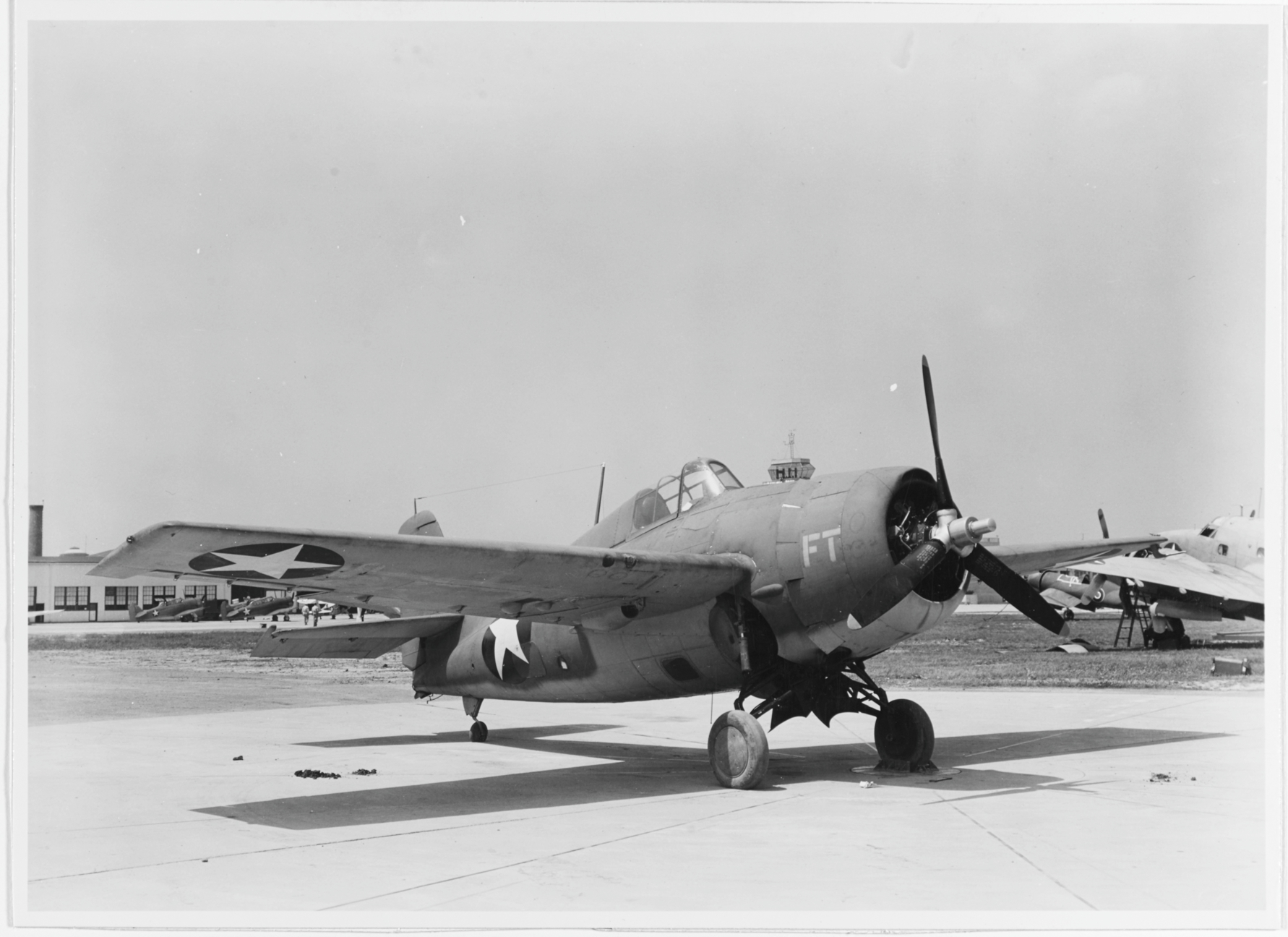
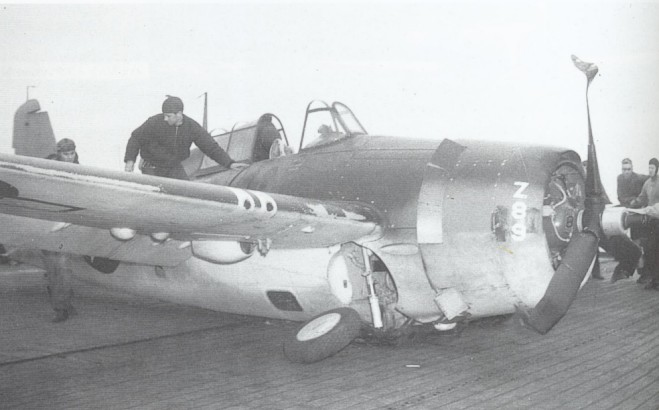
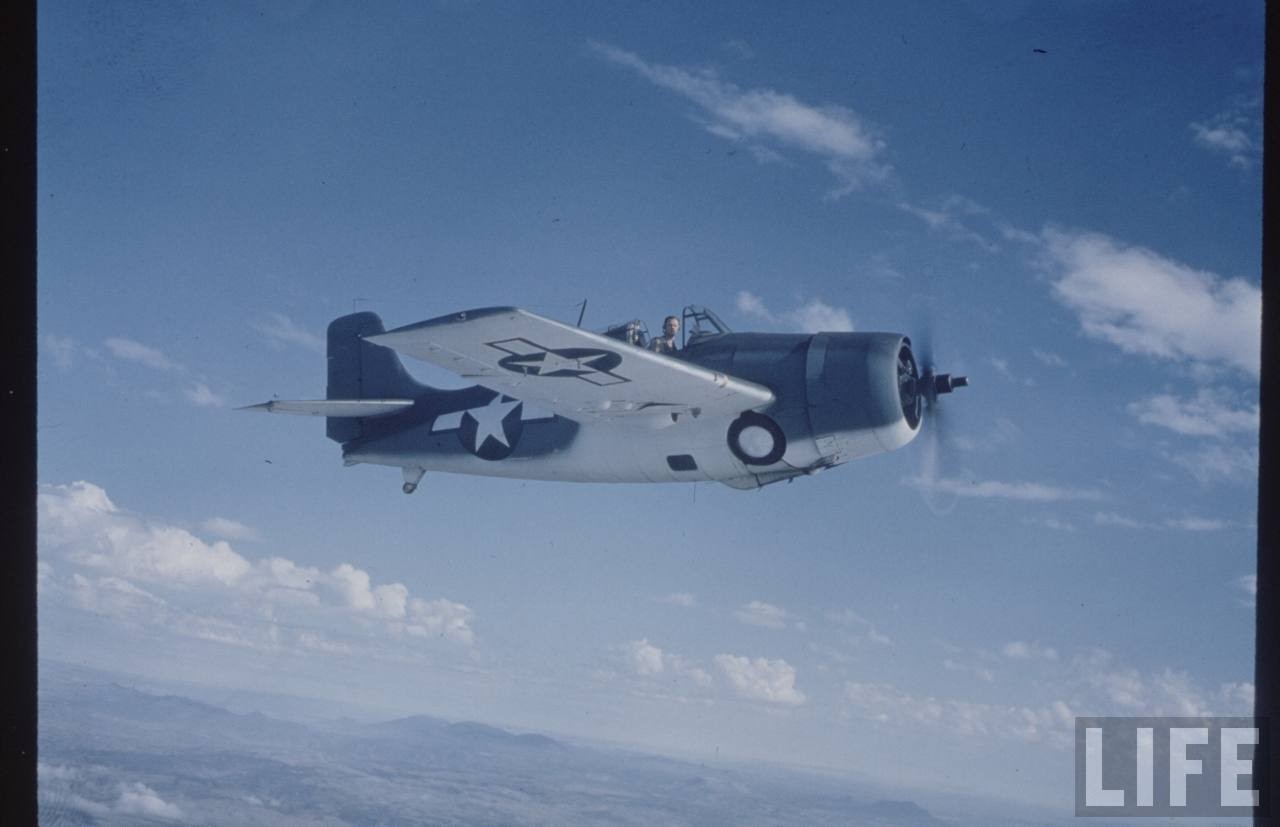
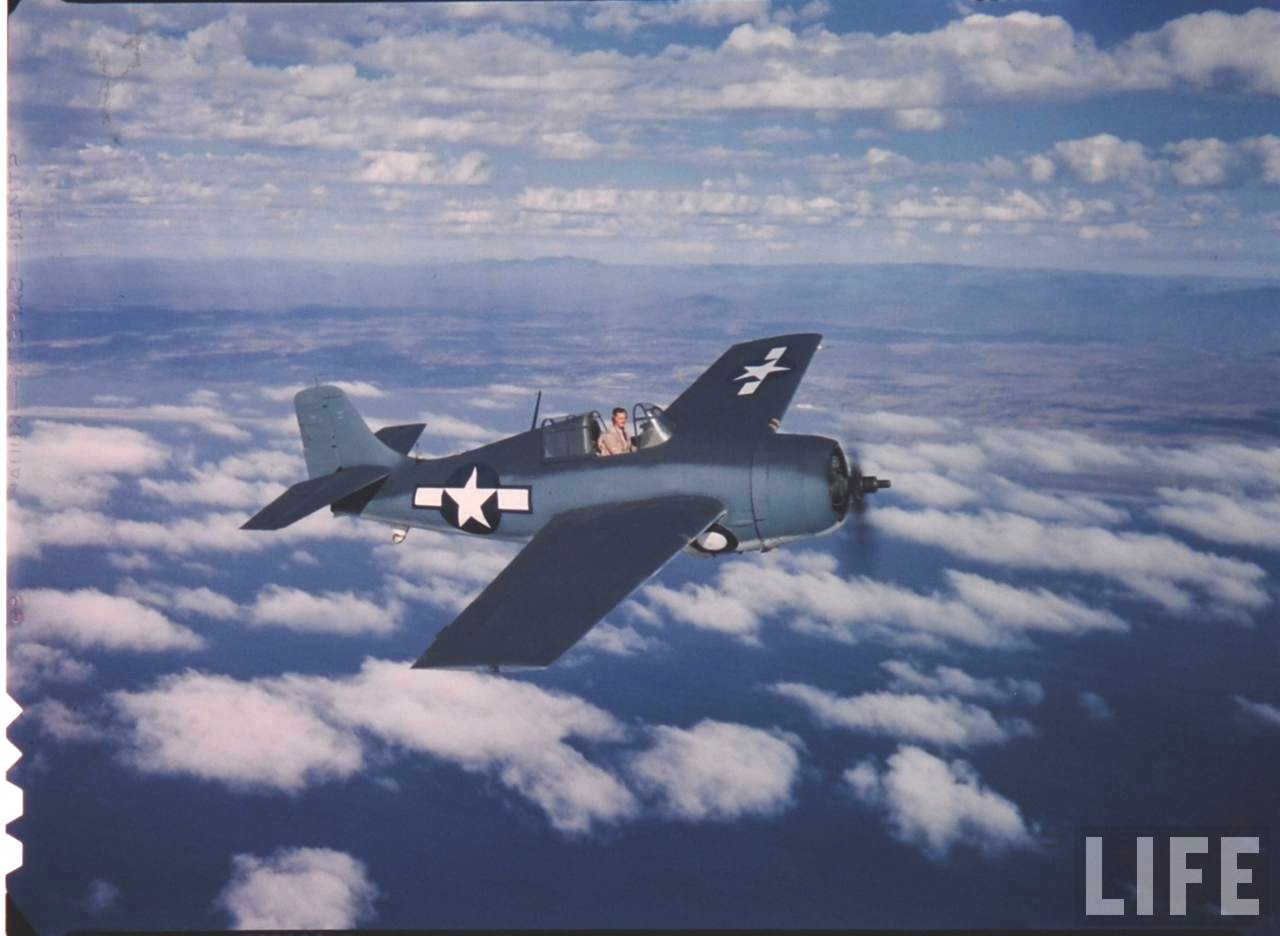
The FM-1 was the first General Motors produced version. Grumman was gearing up to produce F6Fs and needed to free up space, so GM was chosen to continue Wildcat production. The FM-1 differed from the F4F-4 only in the return to a four gun armament.
FM-1 General Motors licensed production of the F4F-4 with only four guns. 1,060 built. Bu. No.s 14992/15951 and 46738/46837.
 |
 |
 |
 |
The first
Eastern built FM-1 (Bu. No. 14992) at Anacostia in
1942. With the exception of only carrying four
wing guns the FM-1 was a copy of the F4F-4.
(USN)
An FM-1
that has suffered some indignities while landing
aboard ship. Note that most of the main gear is
painted black, while the strut appears to be dull
silver with the exception of the telescoping portion,
which is bright. This was the standard for
Wildcats. The national insignia now has the blue
bordered white bars added. Tri color
scheme. (USN)
An FM-1 in the three tone scheme
of non-specular sea blue, non-specular intermediate
blue and non-specular white inflight over North
Island, California in 1943.
FM-2
The FM-2 was the final
development of the Wildcat series and was also the
most numerous version. The FM-2 was powered
by a nine cylinder, single row Wright
R-1820-56, -56W, or -56WA engine. The change
to this engine changed the shape of cowling, which
was now slighter shorter in chord, but a little
fatter without an intake atop the cowl. The
radio mast that had been raked forward on earlier
versions was changed to one that stuck straight
out from the spine. Most references
list only one type of propeller, but photos
indicate at least two types were used:
1. A Curtiss Electric, uncuffed, paddle bladed
propeller, which still had the same double
cylinder appearance of the earlier prop hubs, or
2. An uncuffed, paddle bladed Hamilton
Standard. This last propeller had a
distinctive dome shaped hub. The FM-2 also
had a taller tail than earlier versions and a four
gun armament in folding wings.
A change in the oil cooler system deleted the oil
coolers carried beneath the wings on earlier Wildcat
types.
FM-2
General Motors built version of the
F4F-8. Taller tail, lighter weight
and R-1820-56, -56W, -56A, -56WA
engine. This version also had an
exceptional rate of climb and with 4,127 built
was also the most produced variant. Bu
No.s 15952/16791, 46838/47437, 55050/55649,
56684/57083, 73499/75158 and 86297/86793.
 |
 |
 |
 |
 |
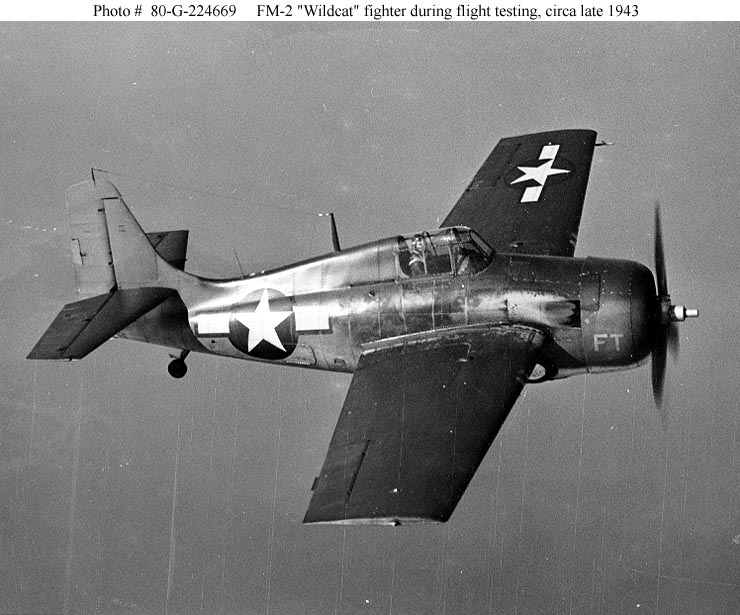
FM-2 Bu. No. 15953, the second FM-2, undergoes flight testing in late 1943. (USN)
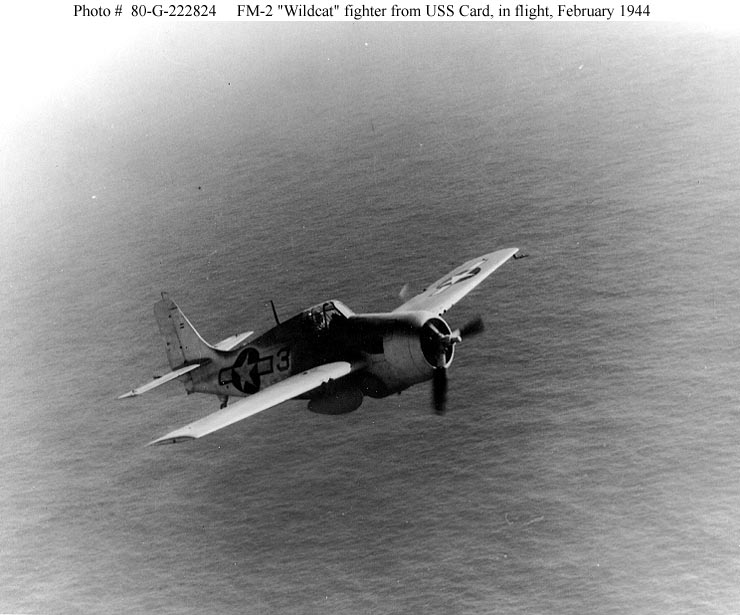
A VC-12 FM-2 operating in ASW duties off of the USS Card in February, 1944. ASW-2. (USN)
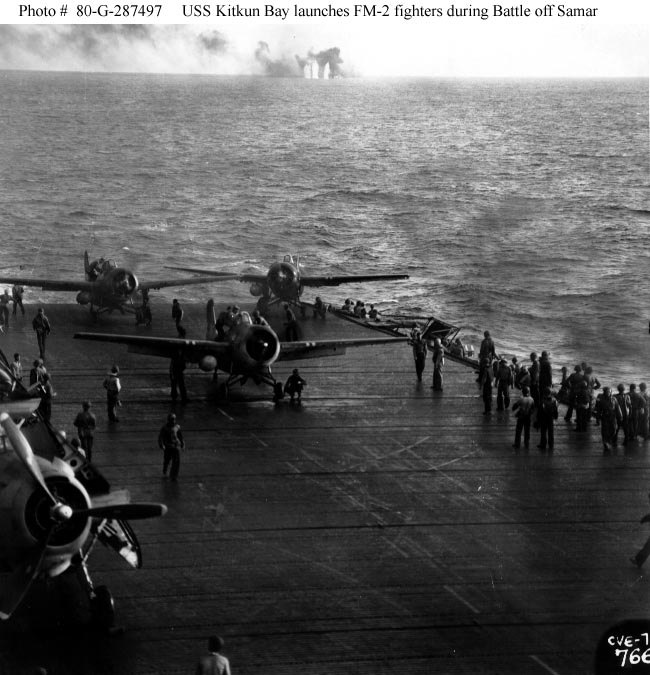
VC-4 aircraft aboard the USS Kitkun Bay
on 25 October, 1944 during the Battle
off Samar when ships, aircraft and men
of Task Unit 77.4.3, better known as "Taffy
3", turned back an attack by a much larger
Japanese task force. In the
background shells are seen splashing close
by the USS White Plains.
(USN)
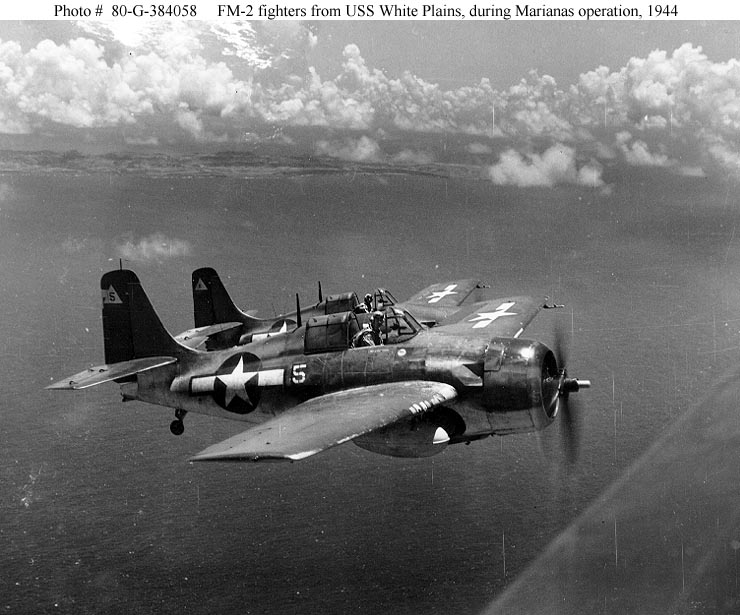
Two
VC-4 FM-2s operating from the USS White
Plains. These aircraft are in
the "tri-color" scheme: Sea blue and
intermediate blue over white.
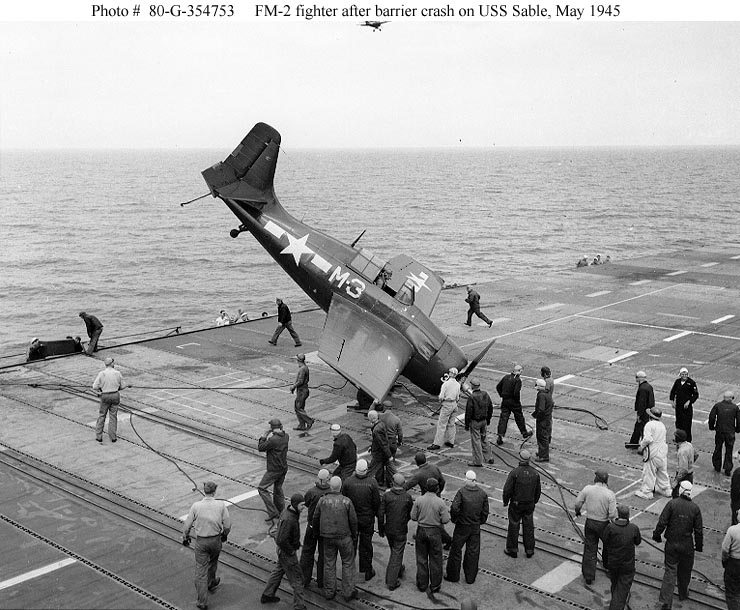
Trouble for a young ensign! A nosed
over FM-2 aboard the USS Sable (IX-81),
one of two carriers built upon paddle
steamers whose sole purpose was to train
pilots while sailing the Great Lakes.
The other carrier was the USS Wolverine
(IX-64). Both ships were crucial
in training young aviators and the Great
Lakes provide a secure area that was not
menaced by U-boats, or other Axis
threats. Quite a few aircraft were
lost in Lake Michigan and several have been
recovered over the last couple of
decades. (USN)
 |
 |
 |
 |
 |
An FM-2 of VC-13 taking off from
the USS Core (CVE-13), having just dis-engaged
from the catapult. The catapult bridle is
visible just below the left main gear having
disengaged from the launching hook on the Wildcat.
The colors on this aircraft are dark gull gray over
white. This combination was used for airwings
operating mainly in the North Atlantic. It was
also carried on TBF/TBM Avengers, F4F-4s and FM-1s,
PV-1s and several other types.
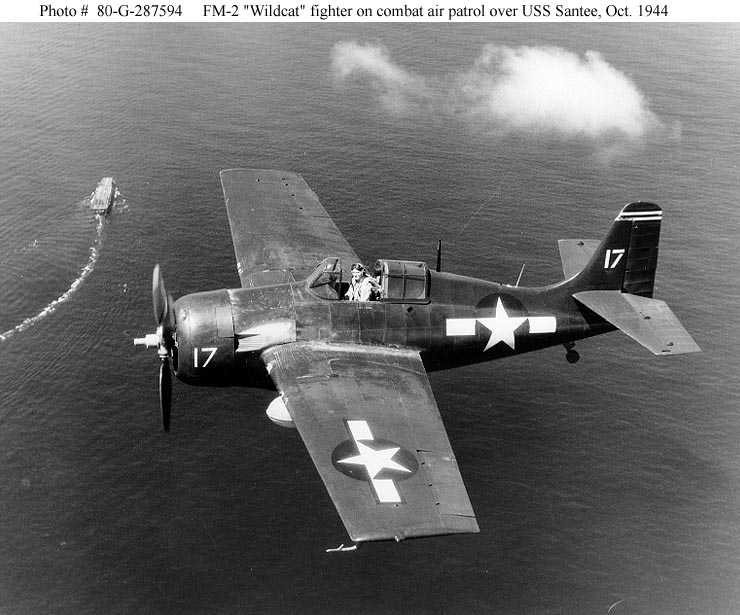
An FM-2 of VF-26*
patrols above the USS Santee (CVE-29) in
October 1944. The Santee was knocked out
of action later that month. By this time
period aircraft were being delivered in an overall
gloss sea blue scheme.
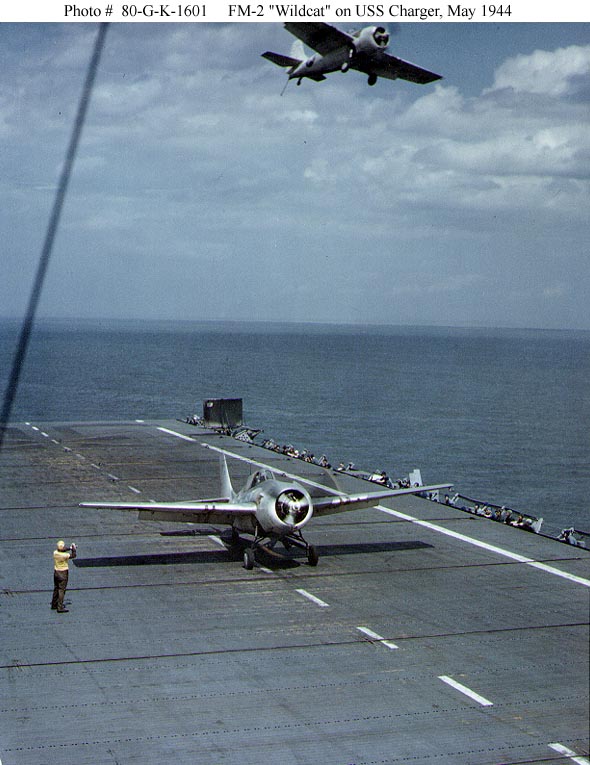
While one
FM-2 recovers aboard the USS Charger another is making
a go-around in the pattern. This was during
work-ups in May, 1944. (USN)
An FM-2 at
the NACA Langley facility in January, 1945.
(NASA)
* Most CVEs operating in
the Atlantic specialized in ASW and the make up of the
squadron reflected this. They usually carried a
Composite Squadron (VC) which comprised Wildcats
and Avengers (or "Turkeys" as they have come to be
called), while those CVEs in the Pacific normally had
conventional fighter (VF) and Torpedo Squadrons (VT),
though late in the war they too carried VC units.
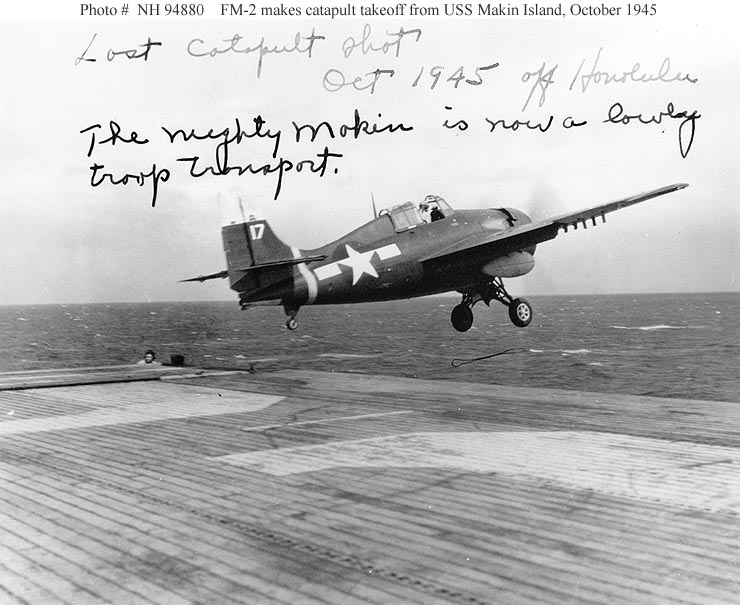
A VC-84 FM-2 catapulted from the USS Makin Island in October, 1945. World War II has been over for a month and the Wildcat will soon be gone from navy service. (USN)
mart-let 1. Brit.
Dial. a house martin 2. Heraldry.
a representation of a swallow close and without
legs, used esp. as the cadency mark of a fourth
son. OK, Neither one of these really
give an appealing definition to a great
fighter. The Wildcat was initially called the
Martlet by the Fleet Air Arm, but thankfully the
correct name was restored with the Wildcat IV to
avoid confusion. Maybe to avoid friction among
allies too.
G-36A
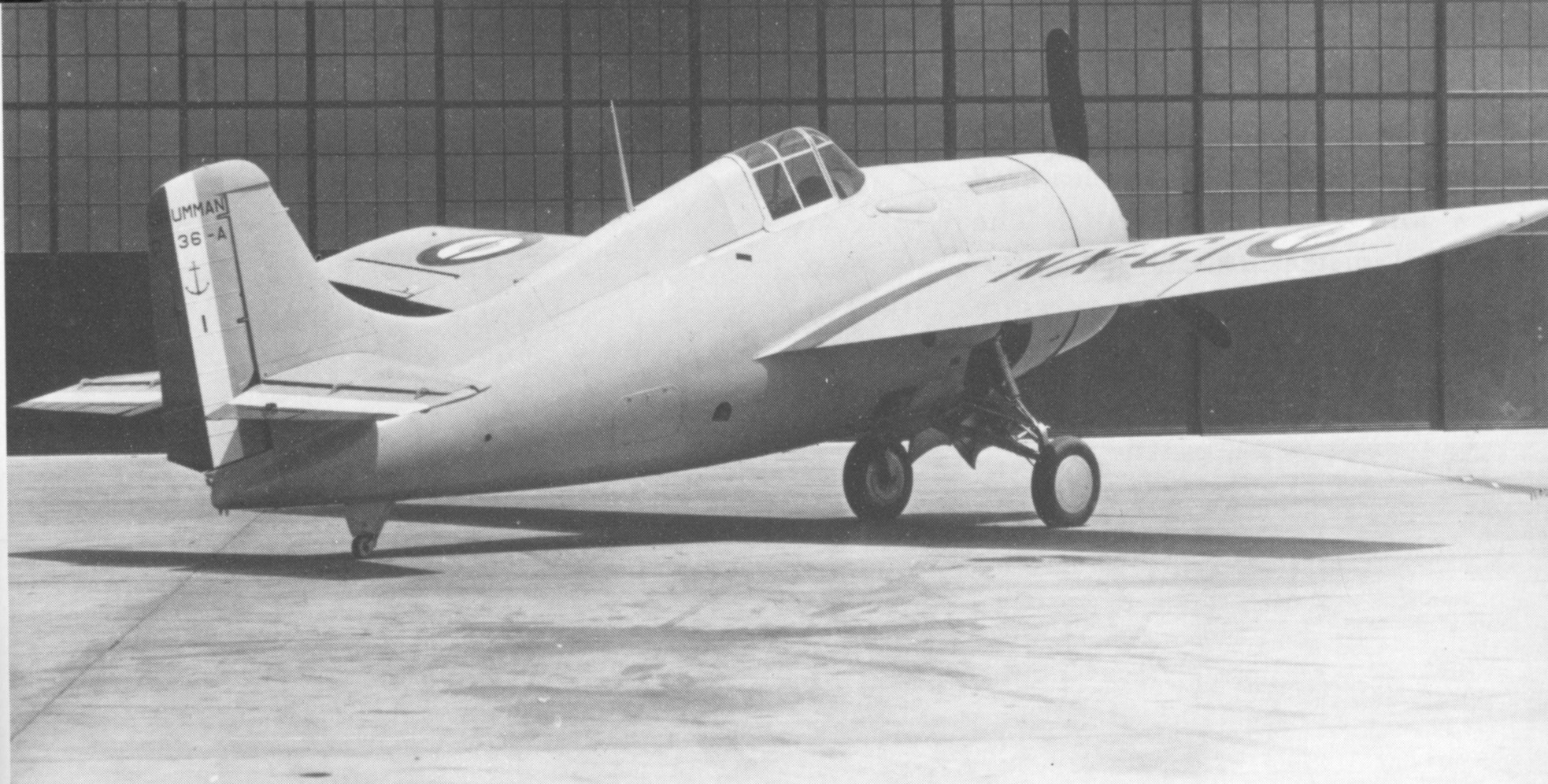 |
Martlet I
Martlet I 81 Grumman G-36A aircraft were ordered by France, but could not be delivered before the fall of France. Very similar to the F4F-3, but powered by the GR-1820-G205A engine and utilizing an un-cuffed Hamilton Standard propeller with a domed hub. This aircraft had the carburetor scoop atop a cowling that resembled the one used on the FM-2, but lacked cowl flaps. The Martlet I used an F4F-3 pitot tube. The two fuselage guns were deleted and the wing guns were replaced with Browning M2 .50 caliber machine guns. Serials AL236/262, AX824/829, BJ507/527, BJ554/BJ570, BT447/BT456 (This last batch was lost at sea when the U46 sank the SS Rupera, so some references only show 71 Martlet Is). Two Martlet I aircraft shot down a Ju88 near Scapa Flow on 25 December, 1940 for the first kill by an American built airplane in British service.
 |
 |
 |
 |
 |
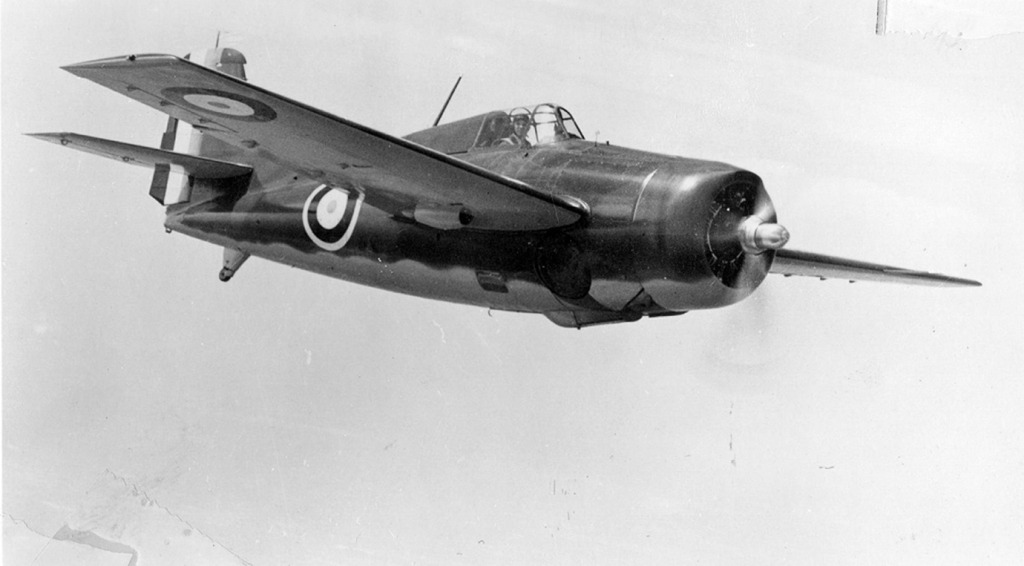
Two shots of
a Martlet I at Bethpage, New York prior to
delivery to the Fleet Air Arm. The camouflage
colors used by Grumman were listed in documents
as "Extra Dark Sea Gray, Light Sea Green
and Duck Egg Blue.". Those colors are far
glossier than the colors used on other FAA
aircraft. It is unclear whether the aircraft
were repainted at Grumman in a scheme equivalent to
the FAA scheme, or if that was done after
delivery. The spacing for the four wings guns is
different from the Navy F4F-3, with the outer gun
being farther outboard on the Martlet I.
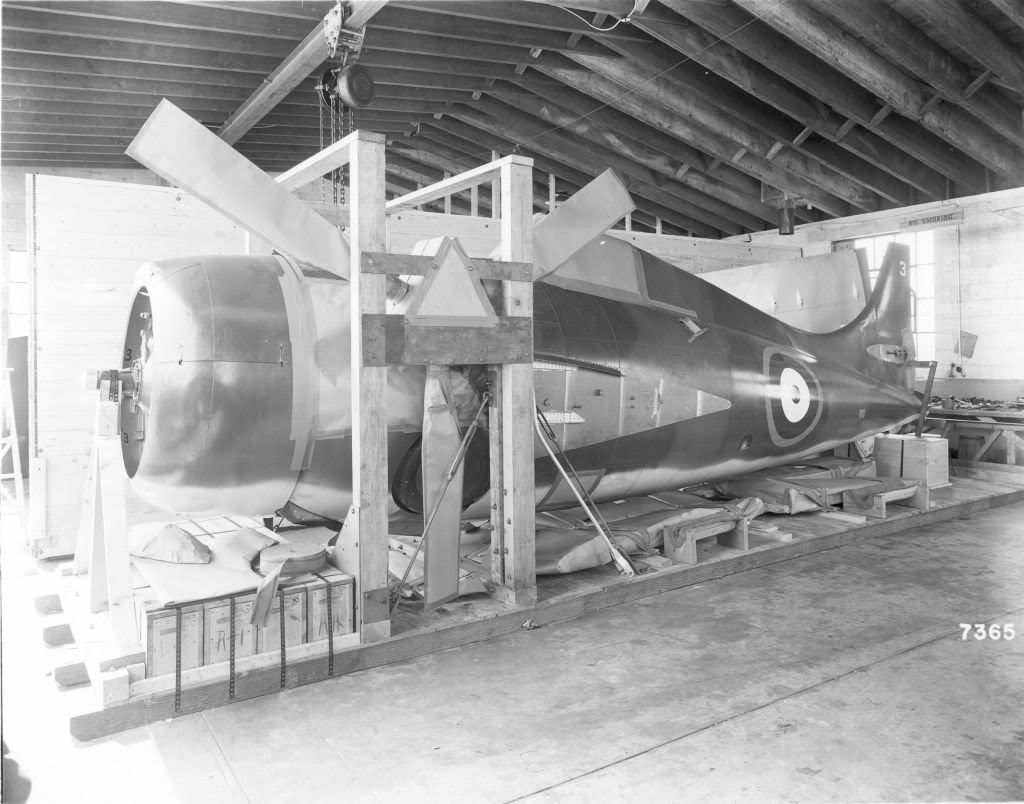
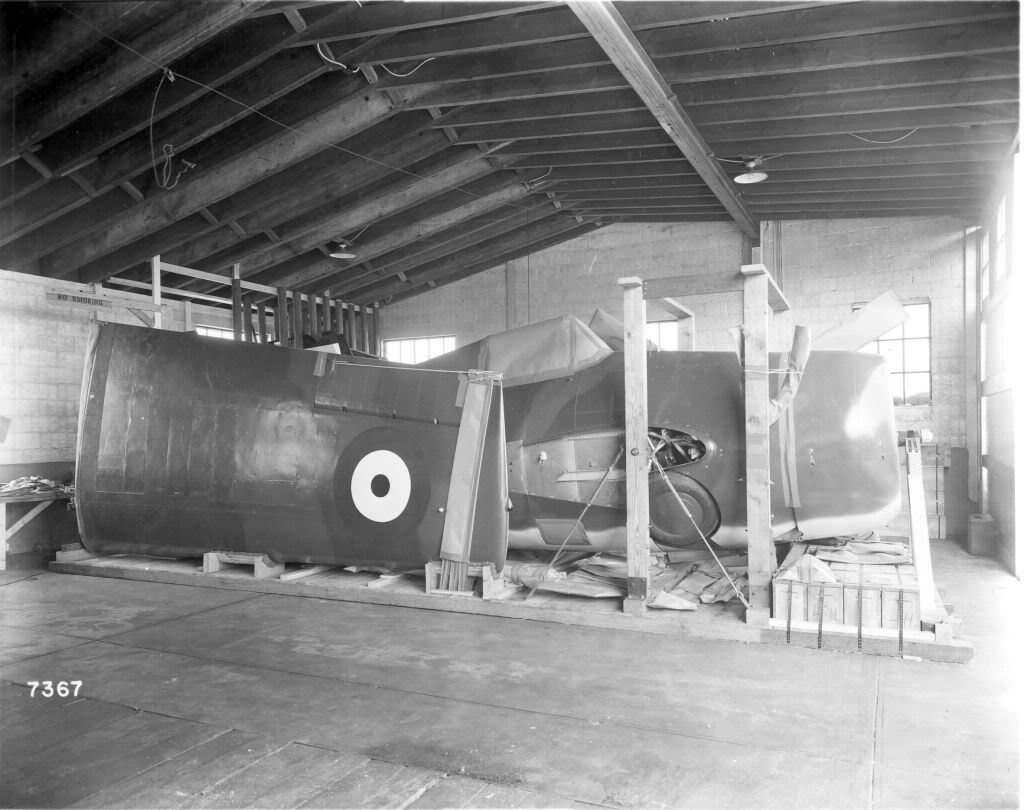
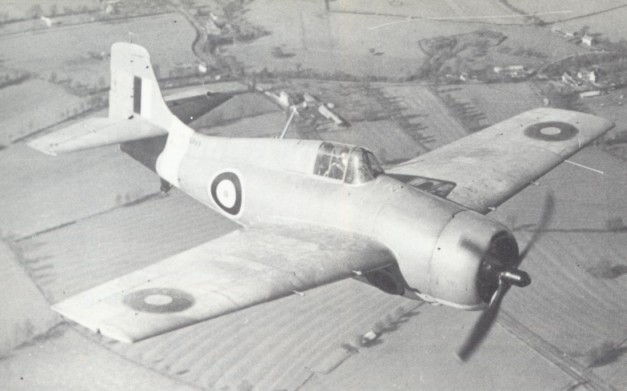
A Martlet packed for shipping.
A Martlet
I (AL257) of the Fleet Air Arm over the English
country side. The color scheme is the standard
FAA scheme of extra dark sea gray and slate gray over
sky under surfaces This color combination is
some times called "Sewage and Slime".
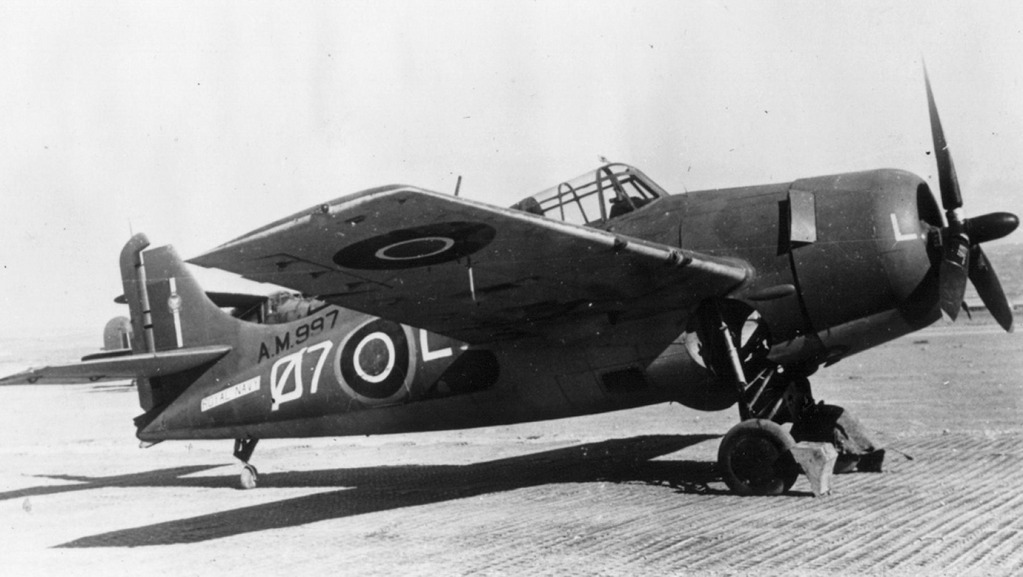
Martlet
II
Martlet
II (G-36B) Similar to F4F-4, but
powered by the R-1830-S3C4-G. 100 built
AJ100/AJ153, AM954/AM963 (non
folding wings and some sources claim they
became Martlet IIIs) and
AM964/AM999. The Martlet II was a
hybrid aircraft, the first ten aircraft of this
one hundred plane order did not have folding
wings, but the remainder did. The engine was
the P&W R-1830-S3C-G engine, export version of
the R-1830-86, the intake on the upper lip was
deleted, but the cowl flaps reverted to the single
double wide flap per side. As this
powerplant utilized a single stage, two speed
supercharger intercoolers were not used.
Consequently, the intercooler intakes within the
cowl lip were deleted. The pitot arrangement
started out as the same type as on the F4F-3, but
it was too easily damaged when folding the
wings. A "kinked" pitot that looked like the
number 7 was tried before settling on the type
used on the F4F-4. The propeller fitted was
a cuffed Curtiss Electric with the domed
hub. The cowling resembled the one used on
late model F4F-3s but used only one cowl flap per
side.
 |
 |
 |
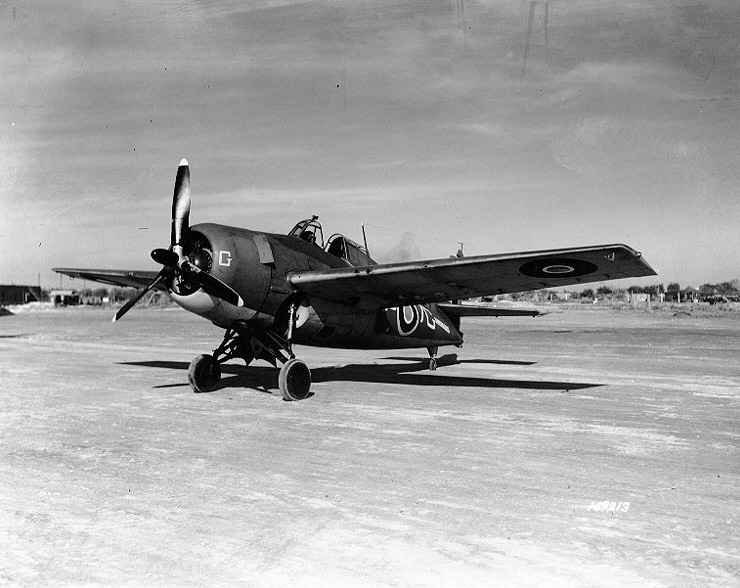
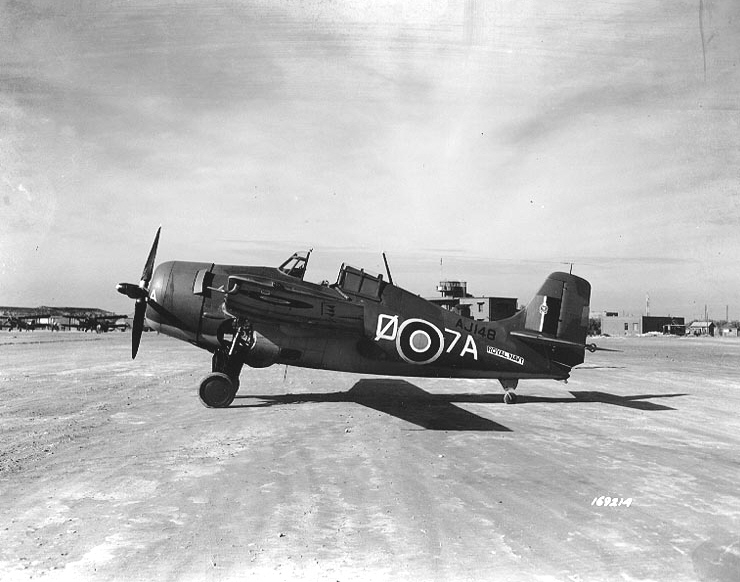
Martlet II (AJ148) in on the ground
in Oran, Algeria during Operation Torch.
This is the same scheme as above. Note
the Fairey Albacores in the
background. (USN)
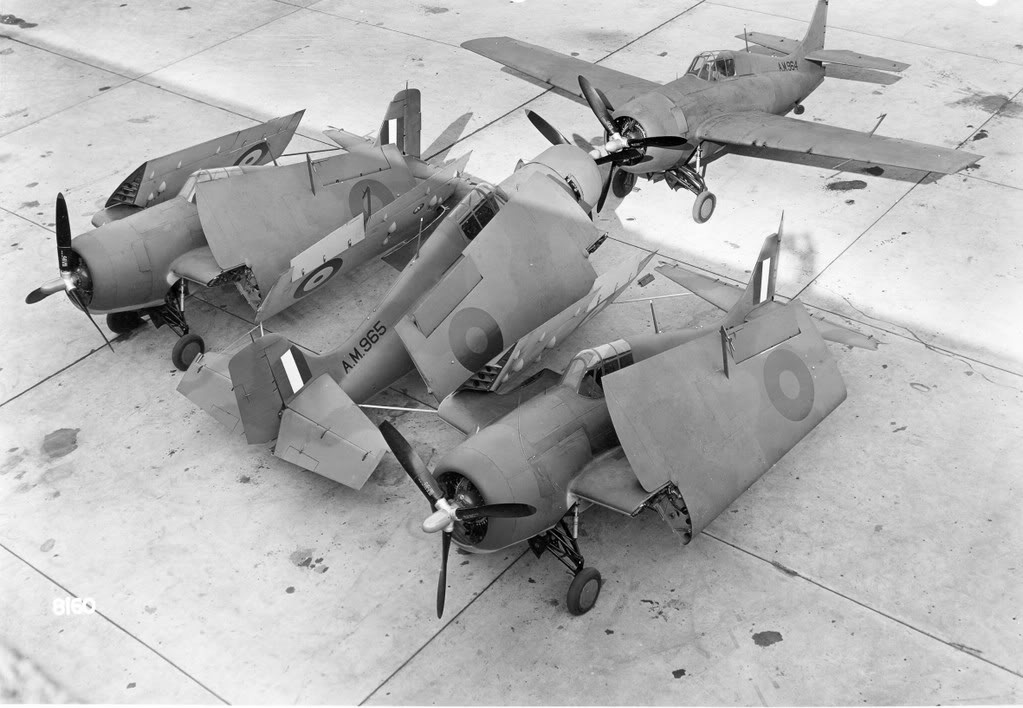
Three Martlet Mk II fighters sit with their wings folded to illustrate how much space is saved with fold-able wings.
 |
 |
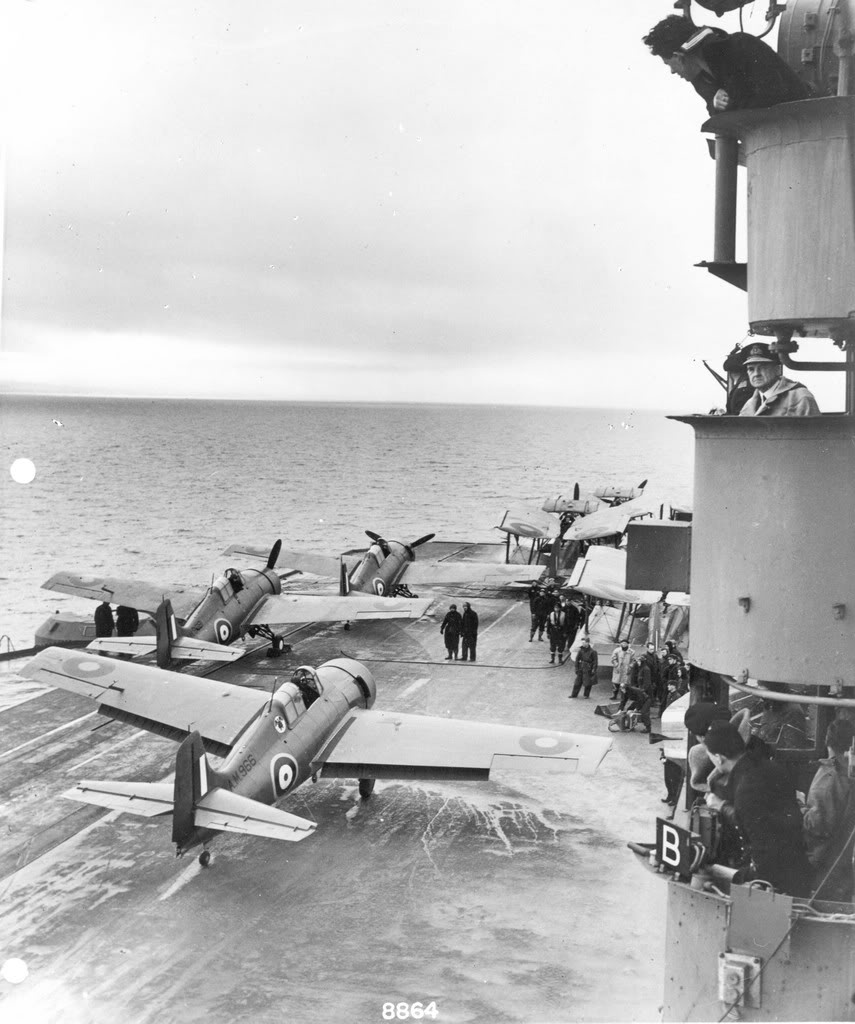 |
Martlet II AJ128 aboard the HMS Formidable
in 1942.
AM997.
AM966 and other Martlet II fighters aboard the
HMS Illustrious.
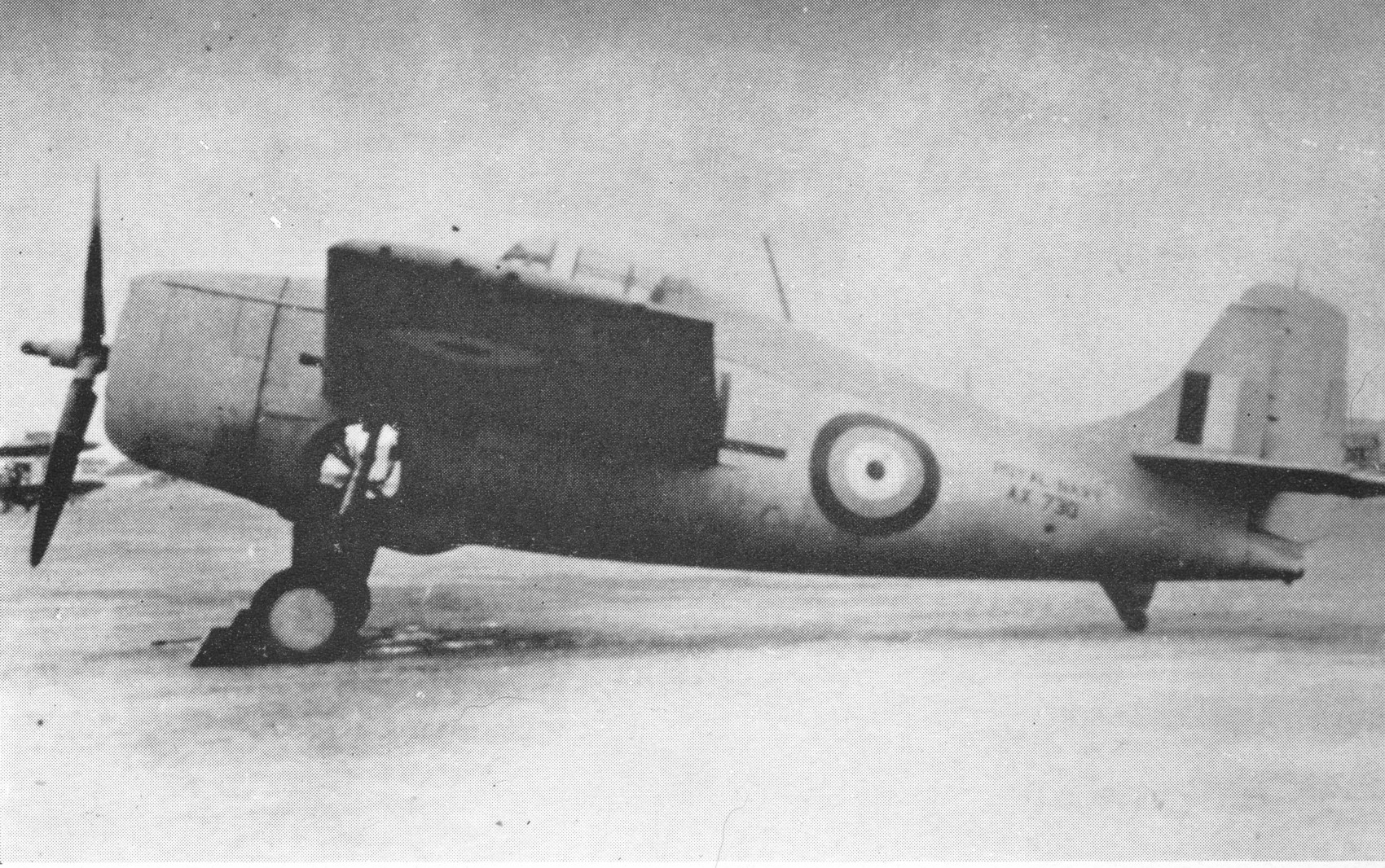
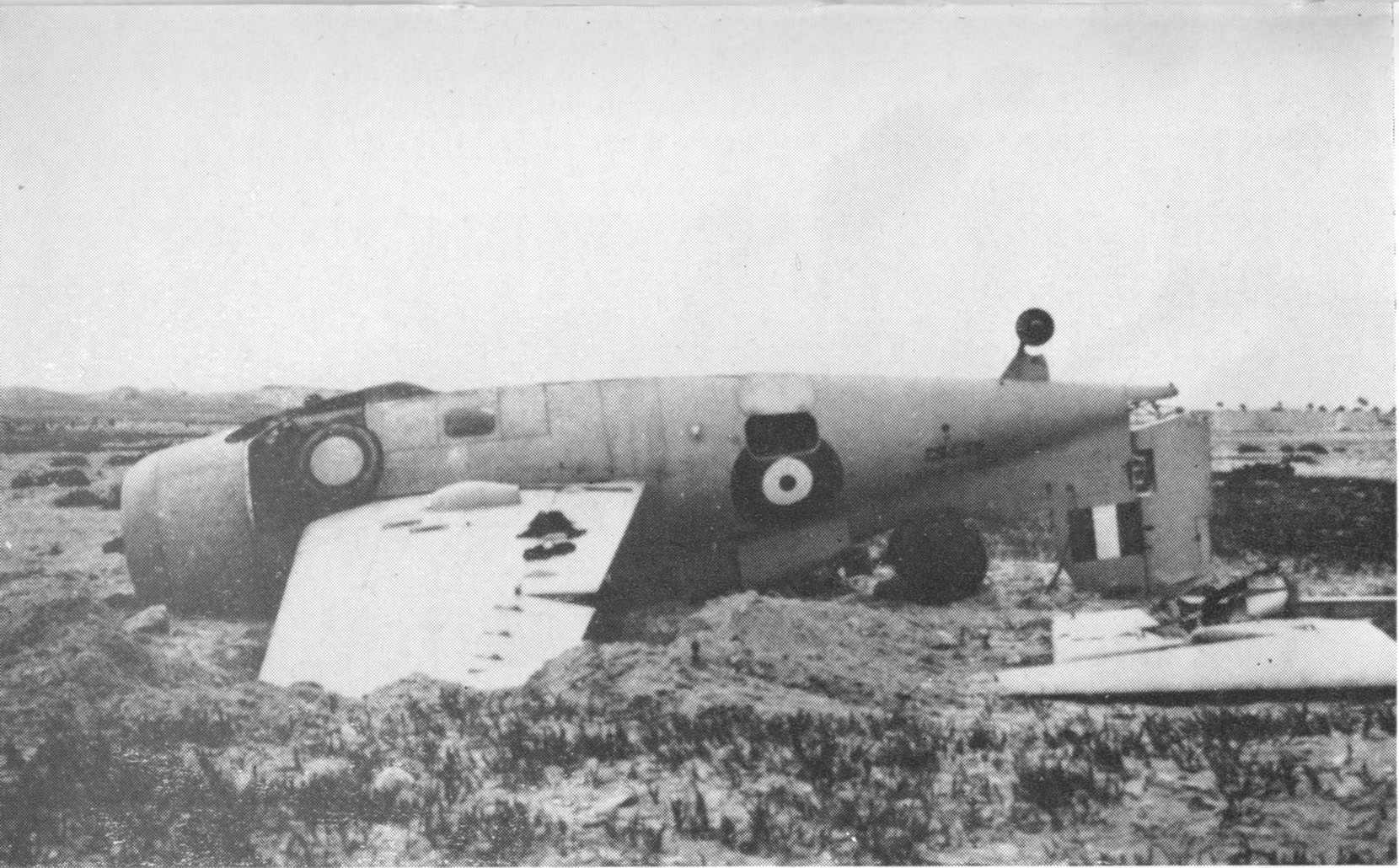
Martlet III
Martlet
III (G-36) As Martlet I, but
powered by the R-1830-S3C4-G and using a Curtiss
Electric propeller as fitted on the F4F-3 and
F4F-4. The cowling resembled the type used
on the F4F-4 with only a single cowl flap per
side, however like the F4F-3A and Martlet II
there were not intercooler intakes within the
cowl. A straight pitot tube was fitted on
the left wing like the F4F-3. 30 built
AX724/747, AX753/AX754, AX761, HK840/842
(ex Bu. No. 3875/3904). Originally
ordered by Greece. The Martlet III
was identical to the F4F-3A and in fact they were
the first thirty F4F-3As ordered. Some
sources roll AM954/AM963
(Martlet II) into this order as
well.
 |
 |
 |
 |
An 805 squadron (FAA) Martlet III landing in North Africa. This aircraft is mid stone and dark earth over azure blue. The aircraft in this block had been earmarked for Greece, but taken over by Great Britain after the fall of Greece. Some sources state that these aircraft were finished in an overall azure blue, but as the comprised the first thirty F4F-3A Wildcats it is more likely that they were painted in the current USN/USMC scheme of overall light gray. Either way 805 sdqn slowly added first the Mid Stone and then the Dark Earth.
Martlet/Wildcat IV
Wildcat
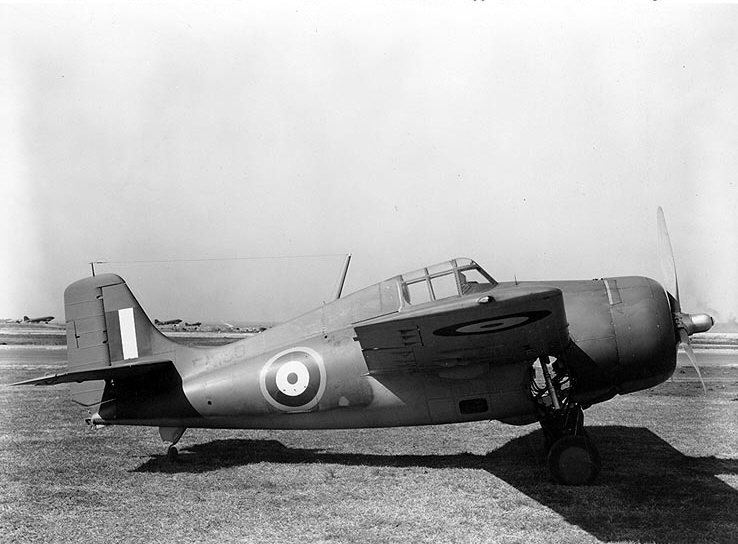
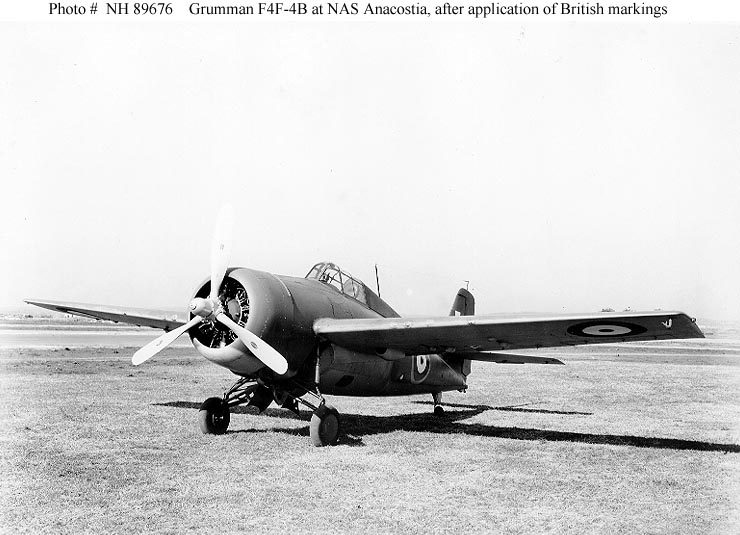
IV F4F-4B, an F4F-4 powered by an
R-1820-G205 engine. 220 supplied to
FAA. FN100/FN319 (Name changed
to Wildcat to standardize with USN) The Martlet IV is best
described as an F4F-4 with an R-1820-G205
engine. The cowling was "shorter and fatter"
(sounds like a broken record, huh?) without a cowl
intake and the propeller was an un-cuffed Hamilton
Standard with a domed hub. F4F-4 pitot
tube. This version was designated the F4F-4B
by the USN.
 |
 |
 |
FN100, the first Martlet IV. This photo looks like the aircraft is Blue Gray over Gull Gray, but I suspect that that is due to lighting the aircraft is most likely Extra Dark Sea Gray/Slate Gray/Sky. Some of the Martlet IVs that took part in Operation Torch carried U.S. markings. This was an attempt to avoid intimidating the Vichy French, as it was believed that the French would be less hostile to an American invasion versus an English one. (USN)
A Martlet IV taxing aboard the HMS Formidable.
Wildcat V
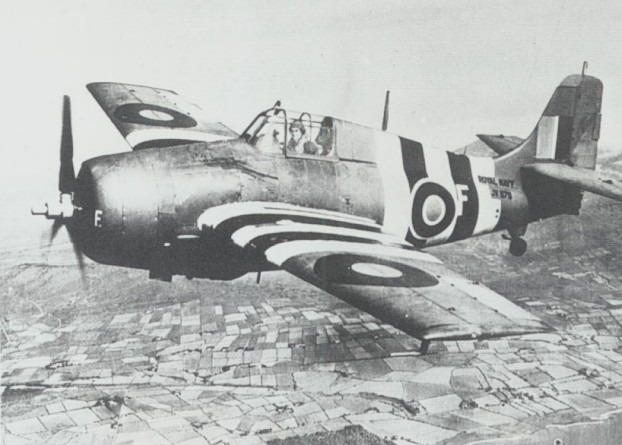
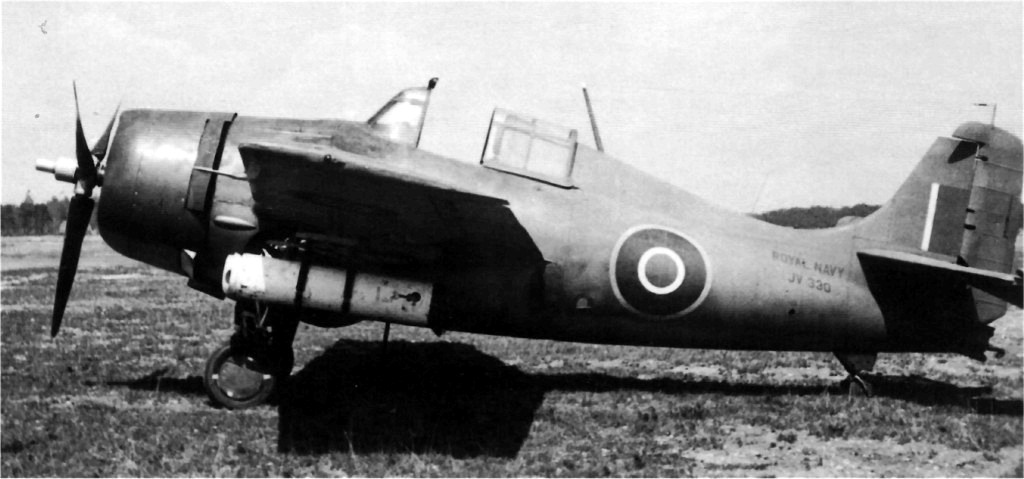
Wildcat
V The Wildcat
V was the FM-1 in FAA
service.
312 to FAA. JV325/JV636 .
 |
 |
Wildcat VI
Wildcat VI 370 FM-2s were operated by the FAA as the Wildcat VI. Serials JV637/JV824, JW785/JW836 and JZ860/JZ889.
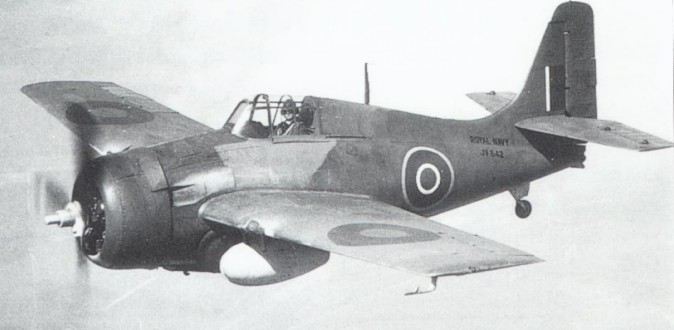 |
A
Wildcat VI (JV642) in the standard FAA
color scheme. Some Wildcat VIs were
delivered in the USN scheme of overall glossy Sea
Blue.
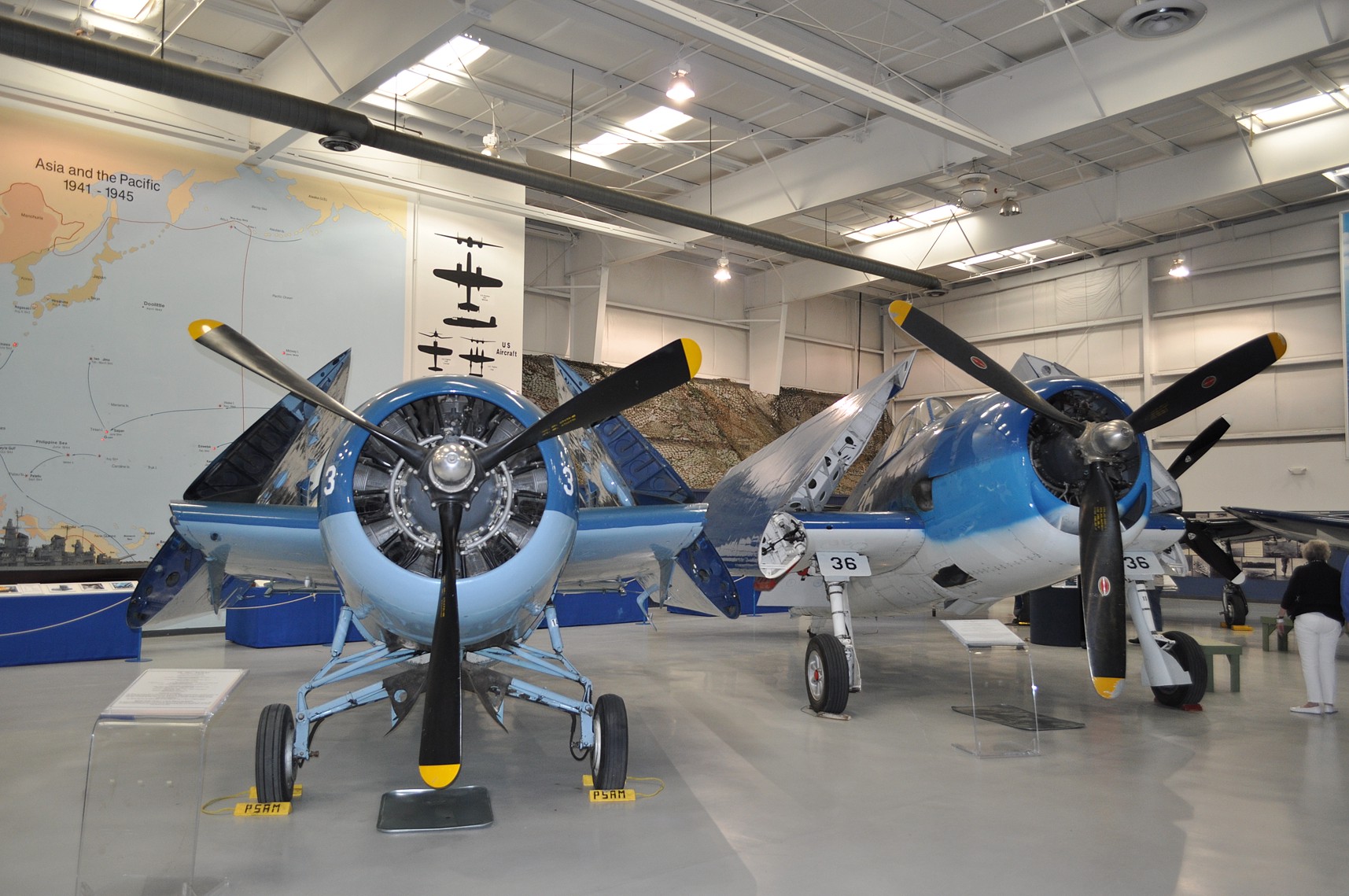
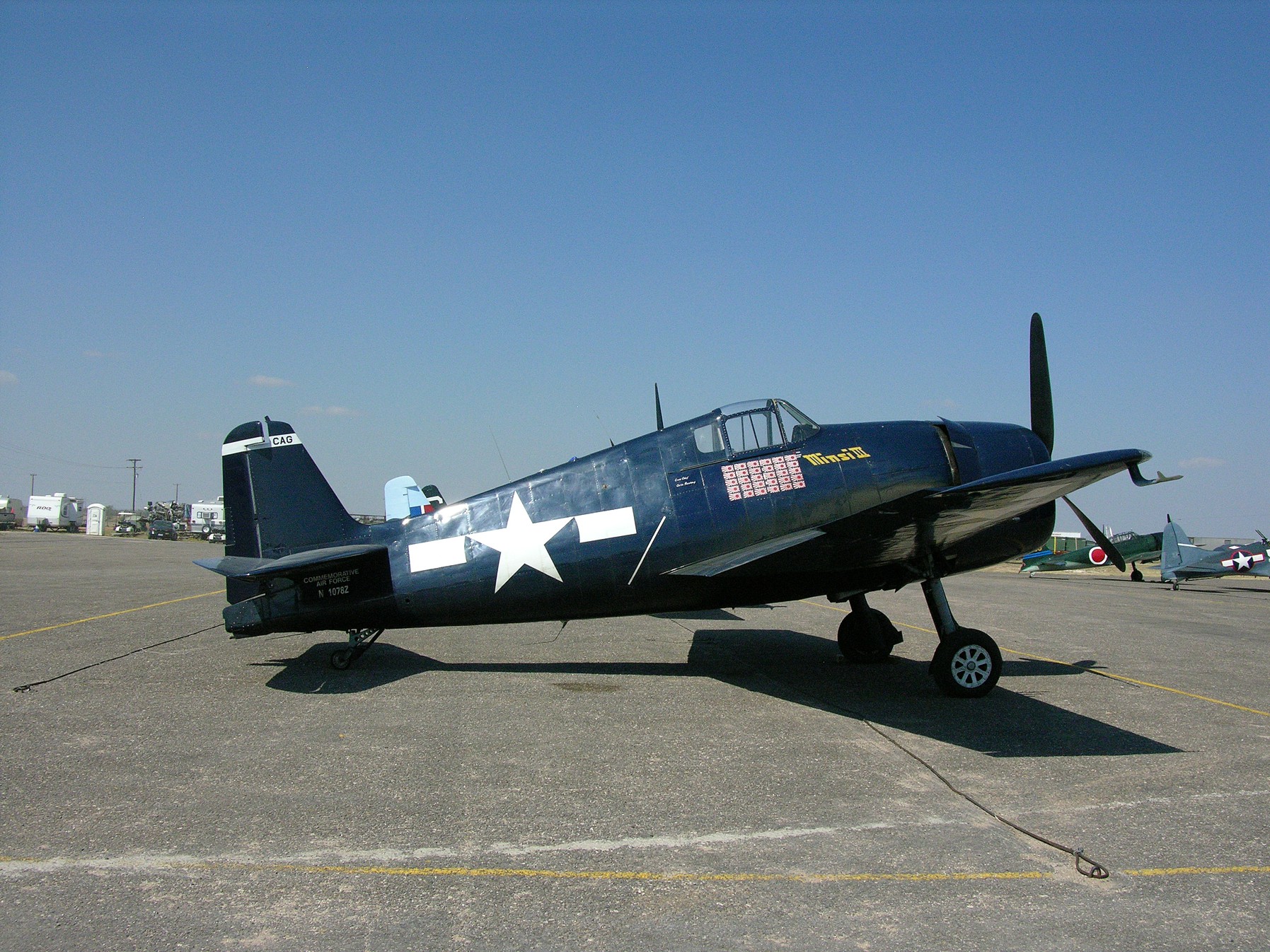
The story of the Wildcat would not be complete without mention of the -
F6F Hellcat
 |
 |
 |
The photos in my collection started as a way to gain ready reference for model building. In my prime modeling days, there were not any surviving F3Fs to be seen. The ones on display today are either rebuilt from wrecks, or built new from the ground up. They are faithful reproductions and do represent the ultimate 1 to 1 scale model! For many years the only F3F kit widely available was the ancient Monogram F3F-2 in 1/32nd scale. It still has merit, but does require a great amount of work. The model has a unique retractable landing; you pull on the prop and then turn it! There are several holes in the fuselage where the gears for the retraction mechanism protrude. The wings were also too short, representing Al Williams' Gulf Hawk rather than an F3F, and in fact at one time had been released as such. Still, all in all it can be built into a beautiful representation of the F3F. Since that time Rareplanes had released a vacuform kit in 72nd , as had Esoteric. Both companies now long gone. MPM currently has an F3F-1, F3F-2 and an FF-1 in 72nd. All three are little jewels in my opinion. They have resin engines and photo etched parts. Lastly, I can not fail to mention the Accurate Miniatures 48th F3F-1 and F3F-2, which are probably the best of the lot.
The first Wildcat kit I ever built was the 1/48th Monogram kit. Let me just say, well, Monogram has come a long way since then. This kit is really for collectors. Since those days most of the Wildcat kits I have built have been 1/72nd. The Revell kit is an old standby and with some added detail can build up very nice. It does need to have the "boiler plate" rivets sanded off though and today modellers also have the choice of building the Hasegawa kit. When I first saw the Hasegawa kit, I actually thought it lacked in detail. This is especially true in the gear area which on the actual aircraft is "chock" full of stuff. Several years ago True Details released a cockpit detail set that also has the gear bay. This adds greatly to the Hasegawa kit. The "Hase" kit has been released as several versions, some requiring some minor modifications. As molded, it represents an F4F-4 and with very minor modifications (filling the outboard gun bays and hole for the guns) can be built as an FM-1 or Martlet V. A quick rundown of the releases: F4F-4 (no modification necessary), Wildcat V (see FM-1), an FM-1 (fill in out board gun ports, there are no gun bay panels molded on the kit) and as an F4F-3 (fill wing fold joint and change cowl flap arrangement for early -3s) Hasegawa has released this kit as a -3 with at least two different sets of markings, one with Thach's aircraft and one as an overall gray a/c. The Martlet V has two choices: JV579 (photo of actual aircraft above) and JV406 of 861 sqdn. The latter is without invasion stripes. The FM-1 kit has markings for an Atlantic scheme VC-12 bird and a VC-33 tri color aircraft. Academy has an F4F that though a little spartan can be built into a good replica (it is one of their first kits). It has only one set of markings: an Atlantic scheme aircraft. Hobby Boss has several versions of the F4F (F4F-3, F4F-4 and FM-1), though all actually represent an F4F-4. AZ Models and Admiral have shared molds for several releases. The way their kits are molded and with the parts in most kits one can build any of the fixed wing Wildcat/Martlet variants. This include the unique gun arrangement for the G-36A and Martlet I.
The FM-2 has four entries in 72nd worth mentioning. The first is the elderly Airfix kit, which though requiring work can be built up very nicely. Probably the biggest drawback is the plethora of rivets. But hey folks, that's what sandpaper was invented for. This kit has been released more times than I can count and has included many different decals. The release I have is from 1986 and contains decals for a USMC squadron CO's aircraft and a rather generic FAA bird in the "sewage and slime" scheme. The second kit is MPM's FM-2. This kit is really an entire Academy kit with a new fuselage with the taller tail, different exhaust ports, etc. It is one of MPM's earlier kits and though it doesn't currently have resin parts it does have etched metal parts. Markings are for an Atlantic scheme VC-12 aircraft and a VC-93 FM-2 off of the USS PetrofBay. The markings for this aircraft are very nice: a large white outline of a shamrock on an over all blue Wildcat. I am in the process (Jan 2016) of building a 1/72nd scale Petrof Bay, so those markings are of great interest to me. Sword introduced a kit in 2004. For the price it is not much better than the MPM version, however it is a very good representation of an FM-2. AZ Modles and Admiral have released the same kit with very fine resin parts and etched metal. These releases make the kit stand out and I would recommend either one of those boxings. Hobby Boss is the most recent, though the wings are from the F4F-4 with six guns and the oil coolers beneath the wings. It also suffers from the compromised way that Hobby Boss created their molds: The cowling looks to be modified from their F4F molds and the engine only has seven cylinders.
Several decals were available at one time in 72nd. A few being Microscale (later Superscale) 72-287 "F4F USN-USMC Aces" (all Blue Gray/Gull Gray) and 72-668 "Pre-WWII F4F-3 Wildcats VF-41 & VF-72 Section Leaders", Aero Master 72-005 "USN & USMC Wildcat Collection" (one overall gray, 3 blue/gray and one tri color) and 72-009 "US Aircraft in FAA Service" (JV579 again and a desert Mk III). Ministry of Small Aircraft Productions released a sheet that had seven aircraft, including two for Torch aircraft. There are certainly more, although certainly not a lot more, but for the most part Wildcats did not carry intricate markings. The exception being the late war escort carrier markings, but those are better painted on anyway. One very unique emblem that appeared on VMO-251 F4Fs was a large octopus, which to the best of my knowledge was only available on a 32nd scale Super Scale sheet. Since I started writing this in 2001 there have been several more decal releases including ones covering FAA use. Also, quite a number of detail sets as well.
In 48th scale Tamiya has a great F4F-4. At one time Kendal had an FM-2 conversion, but that is currently out of production. Hobby Boss has released early and late F4F-3s, F4F-4, FM-1 and FM-2 Wildcats. The 48th scale Hobby Boss kits are very nice kits with the F4F-3, F4F-4, FM-1 and FM-2 very well represented. I have looked at these kits in the box and they hold up very, though I have yet to build any. Aero Master and Eagle Strike have decal sheets available.
For many years the
only 32nd scale kit is the Revell kit which is
re-released from time to time. This kit is
almost as old as I am, but has held up better.
It is a little crude, with grapefruits for
rivets, it does have folding wings though, but
the hinge is really not strong enough. Far
better to fix the wings in place. The engine is good
and with some detailing would be a model unto
itself. For someone up to the challenge this kit
is a rewarding project. In 2003 Trumpeter
released their version which is a really nice
kit Hobbycraft has released the same mold under
their label and with the diminutive size of the
Wildcat I can see people buying multiples of
each.
Colors
A quick run down of the most common exterior colors. Not all ANA numbers have an exact match in the FS595a standard and Blue Gray does mot have an ANA number. Trying to correlate ANA numbers to FS numbers also has pitfalls as they are often not the same. The pre war Light Gray is a pure gray whereas Light Gull Gray has a slight brownish cast to it. At best many of these colors simple get one "in the ballpark".
Name
ANA
number
FS595a
equivalent
Chrome Yellow (Orange
Yellow)
614
13538
Insignia
White
601
17875
Insignia
Blue
605
35044
Light Gull
Gray
620
36440
Dark Gull
Gray
621
36231
Blue
Gray
?
35189
Non Specular Intermediate
Blue
608
35164
Non Specular Sea
Blue
607
35042
Semi Gloss Sea
Blue
606
25042
Gloss Sea
Blue
623
15042
Extra Dark Sea
Gray
603
36118
Slate Gray (Really a
green)
34096
Sky
610
34424
Dark
Earth
617
30118
Mid
Stone
615
30266
Azure
Blue
609
35231
Recommended Reading
Some of these titles are currently out of print, but do resurface from time to time:
Wildcat: The F4F in WW II, Barrett Tillman, Naval Institute Press, 1990
United States Navy Aircraft since 1911,Gordon Swanborough, Peter M Bowers, Naval Institute Press, 1990
F4F Wildcat
in action, Aircraft Number 84, Don
Linn, Squadron Signal Publications inc., 1988
F4F Wildcat in action, Aircraft
Number 191, Richard S. Dann, Squadron Signal
Publications inc., 2004
Grumman F4F Wildcat, Famous Airplanes of the World No. 68, Bunrindo Co. ltd, 1998
The Official Monogram US Navy & Marine Corps Aircraft Color Guide, Vol 2 1940-1949, John M. Elliott, Monogram Aviation Publications, 1989
U.S Navy Aircraft 1921-1941/ U.S. Marine Corps Aircraft 1914-1959, William T. Larkins, Orion Books, 1988 (Recently reprinted by Schiffer)
The American Fighter The Definitive Guide to American Fighter Aircraft From 1917 To The Present, Enzo Angelucci with Peter Bowers, Orion Books, 1985
US Fighters Of World War Two, Robert F. Dorr, Arms and Armour Press, 1991
Fleet Air Arm
British Carrier Aviation 1939-1945, Ron Mackay,
Squadron Signal Publications, 2001
U.S. Military Aircraft Designations and
Serials Since 1909, John Andrade,
Midland Counties Publications, 1979
Aircraft Pictorial 4: F4F
Wildcat, Dana Bell, Classic Warships Publishing,
2012





Page created 12-12-01
Modified 10-06-19
Clifford
Bossie
Grumman F4F Wildcat
Eastern built FM-1 and FM-2 Wildcat
Grumman Martlet