Biggs Photos
This page has a few views of Biggs taken at different time periods. New ones will be added as time and resources permit. I am always looking for photos to add.
 |
 |
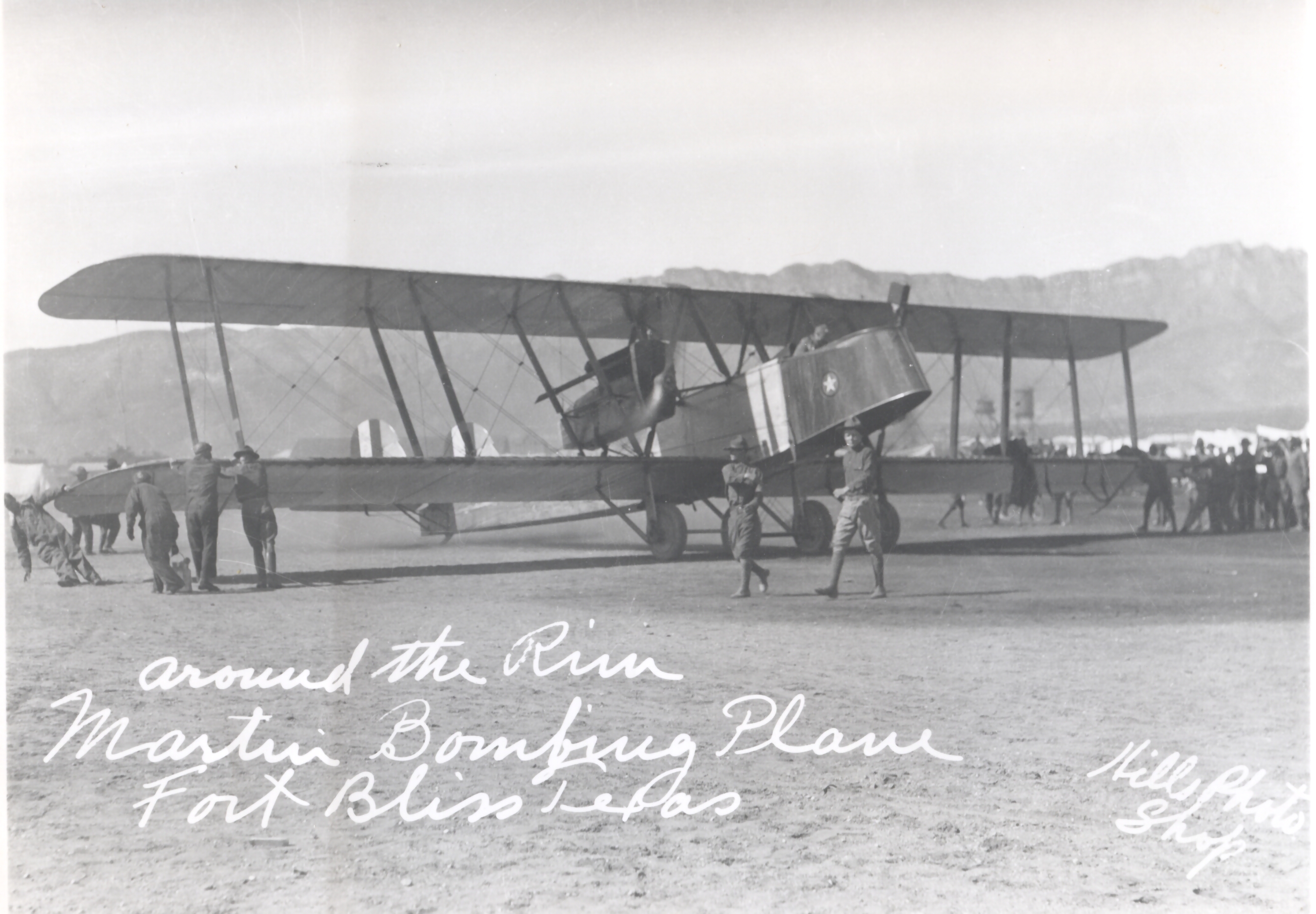
A Martin MB-1 at the original location of Biggs Field in 1919. This was when the flying field was co-located with the parade grounds on Fort Bliss. As the serial number is not evident in either photo it is not known if these are two separate airplanes, or just photo of both sides of the same one. My suspicion is that it is the same airplane.
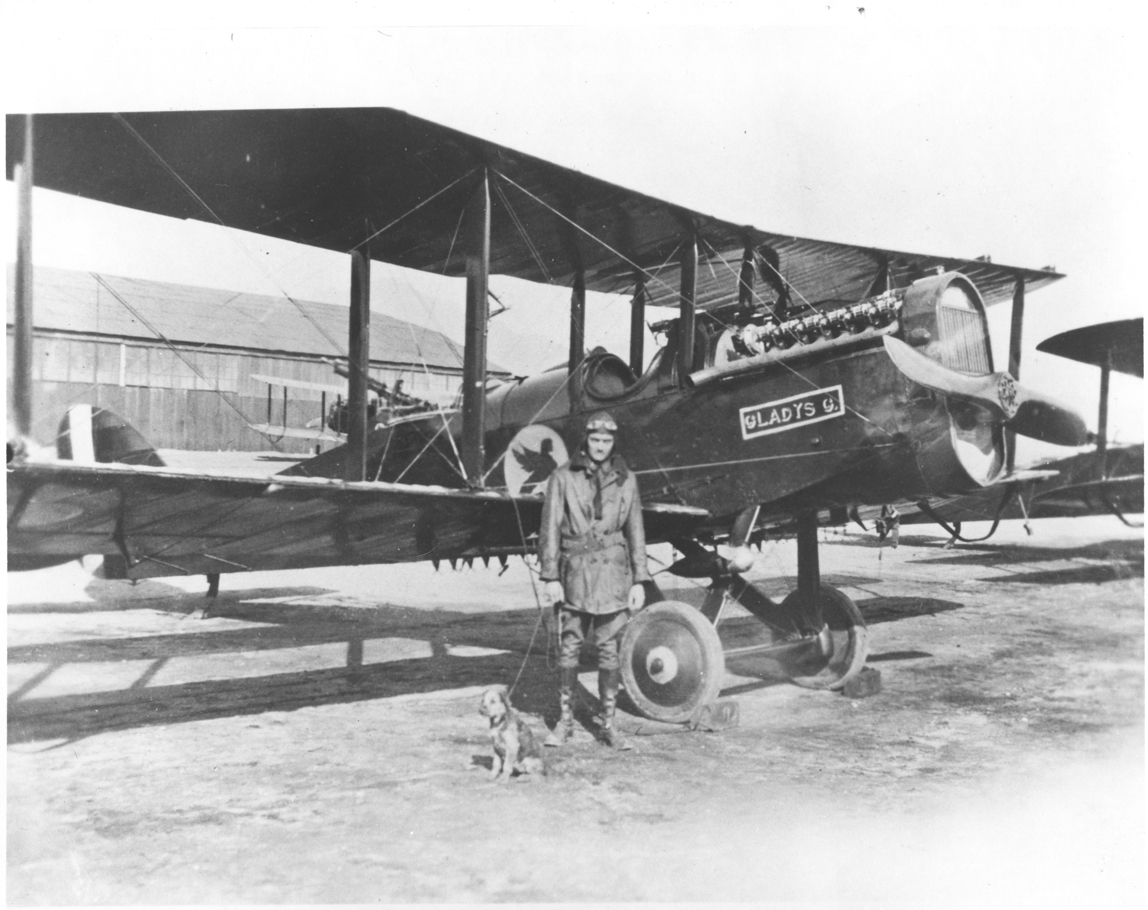 |
Lt. Stacy C. Hinkle in front of a DH-4 at Biggs Field when originally located on Ft. Bliss. The time period is early 1920 and according to the caption on the back the dog's name is "Spin".
 |
This aerial photo shows Biggs Army Airfield in February, 1941. The view is looking towards the East with the old "balloon" (airship) hangar in the lower left center of the photo. This hangar was built post WWI and survived into the mid 1950s. It was built with a North South orientation, yet the prevailing wind is West to East, so airship operations were very restricted. Most of its life it was used to house aircraft and not airships. A large transportation facility was built upon this location in the late 1990s. To the East of the hangar are several aircraft, an A-20 and six O-47s . Above and to the right is a hangar under construction that would later house the 4758th DSES and today is utilized by Raytheon. To the left and above the airship hangar is a structure that looks like a castle, but I really don't know what it is. It could possibly be a restaurant that was built in 1939. (USAAF via John Paul Jones)
 |
 |
US Army C-1 semi rigid airship at Camp Owen Bierne during September, 1920. Owen Bierne would be renamed Biggs Army Airfield in July, 1926. The Army had wanted to operate rigid airships comparable in size to the Navy giants flown during the 1920s. This never came to pass and considering the mixed record of the USN ships it is just as well that it never happened. That role would have taken scarce funds needed by far more capable aircraft.
Weather was always a limiting factor in airship operations and the incorrect alignment of the airship hangar at Biggs made it almost impossible to use the hangar in all but the calmest of winds. A rarity in West Texas.
 |
 |
 |
 |
 |
An unidentified Curtiss A-3 Falcon in front of the balloon hangar. My first inclination is that the aircraft suffered a fire, however the tires and other parts of the airframe are not damaged. What caused the damage is anyone's guess. (John Paul Jones)
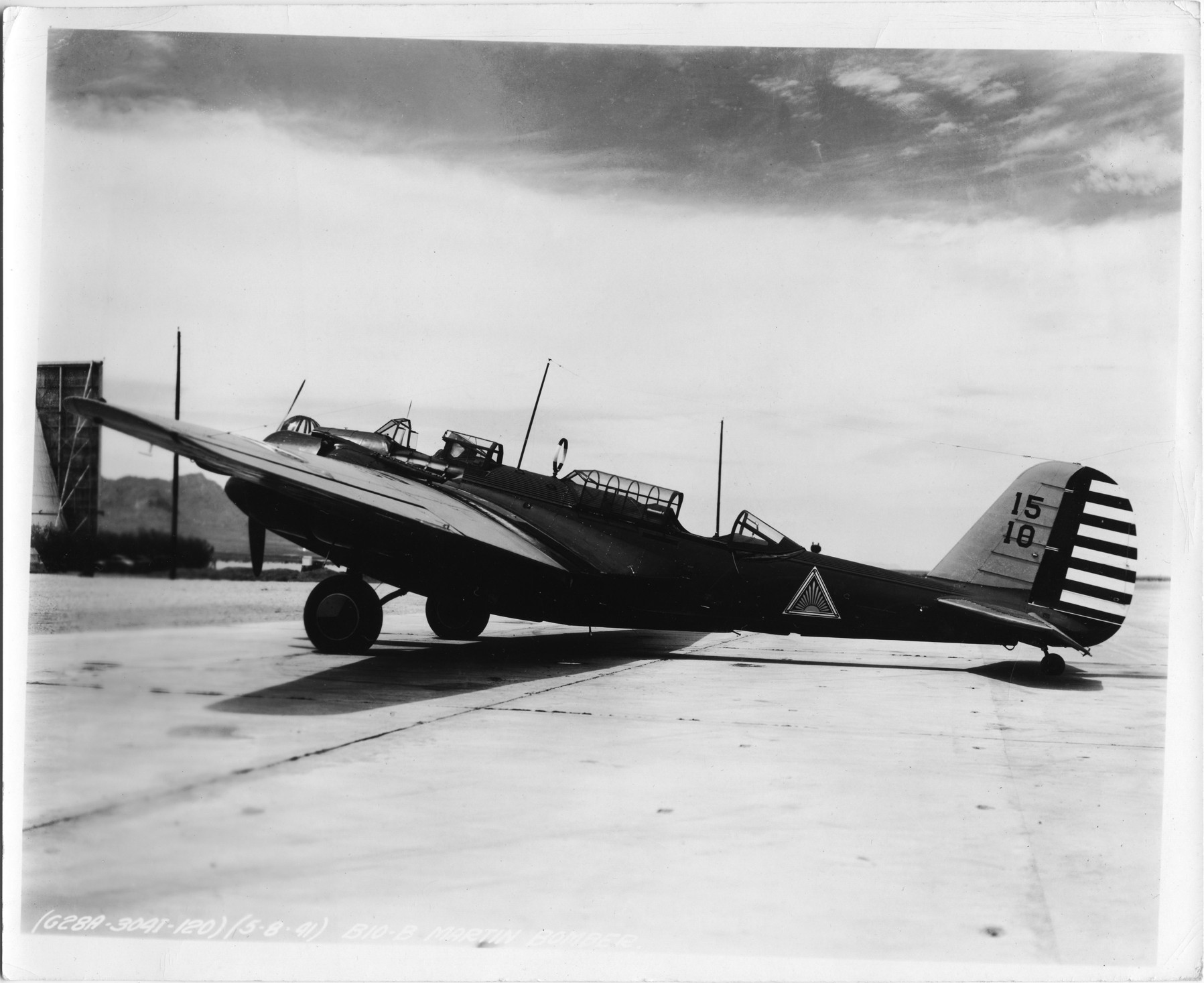 |
A martin B-10B of the 1st Observation Squadron transient at Biggs in 1941. (Paul Webber)
 |
 |
A BC-1A trainer of the 120th Observation Squadron (Colorado ANG) at Biggs with the airship hangar as a backdrop. (USAAF via John Paul Jones)
An A-20A that appears to have suffered a gear up landing rests on the ramp to the Northwest of the Airship hangar. The main gear doors are closed, which leads me to believe that the main gear would not extend versus an accidental gear retraction while taxiing, which would have damaged the doors and most likely left them visible in the photo. Also the propeller blades while bent are not curled back which would indicate they were wind milling on landing. This was most likely a dead stick, wheels up landing. The A-20 also served with the 120th OS. (Photo stolen from David Garcia)
 |
An O-47 taking off from Biggs around the beginning of WWII. Note the field condition and the similar location to the A-20 in the above shot. This aircraft is most likely part of the 120th Observation Squadron. (Colorado ANG)
 |
The photo of the SBC-4 above is not dated, so it is next to impossible to determine when it was taken. The barren area behind it would remain unchanged for decades. This photo was taken very close to the color photo of a B-24D further down the page.
 |
Another gear up landing in this case P-36A 38-6. The airplane is assigned to the 94th Pursuit Squadron and came to grief on 10 February, 1941 and is facing to the east. The single mountain in the distance is Cerro Alto, which provides a perfect landmark. The caption on the reverse states "Landing Gear Failed", uh, more like "Landing Gear Not Extended". Note that even the tail wheel is in the up and locked position. The aircraft was written off at Baton Rouge, LA on 17 Decemeber, 1941.
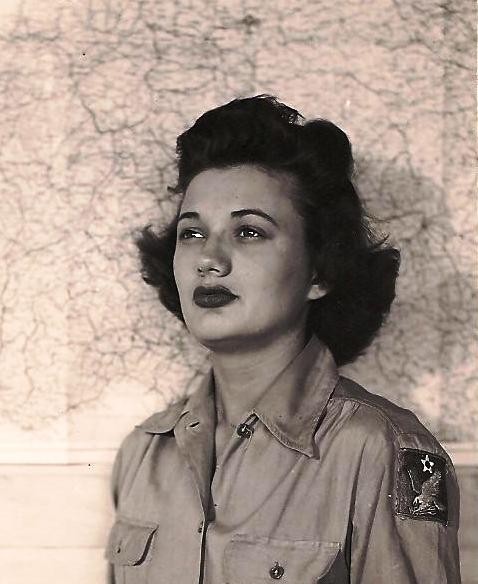 |
Occasionally, it is possible to put a face to an individual whose contribution is unknown or forgotten. One of those individuals is Joyce E. Geier. She was enlisted in the Army Air Force and was a photographer at Biggs Army Air Field in 1944. Later she became a lifeguard for the base swimming pool. She went on to live a full life and an interesting biography of Joyce was published in the Massillon Independent . She currently ( March 7, 2012) lives with her husband Jack in Orlando, Florida.
 |
 |
 |
The second photo is taken in front of B-24J 42-95567.
The last photo is most likely part of the series below.
 |
 |
 |
 |
 |
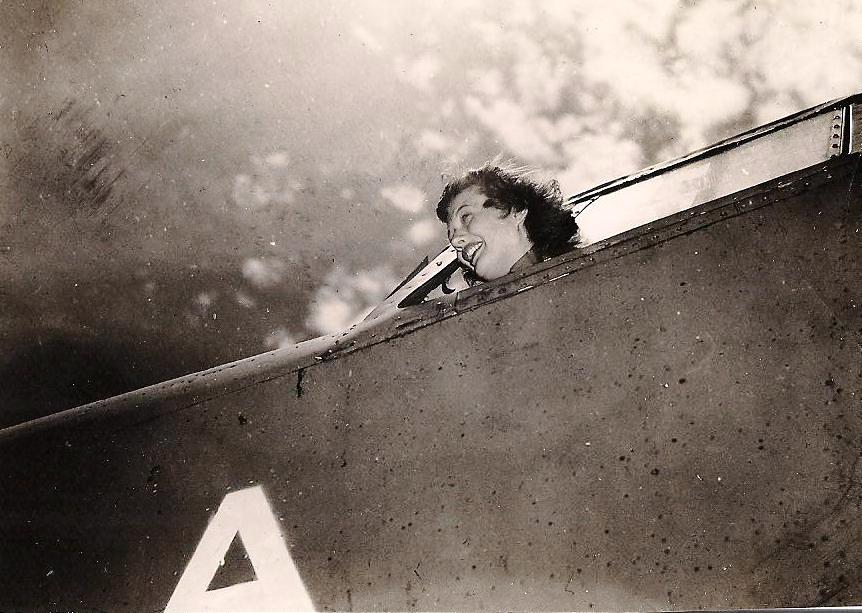
During World War Two many celebrities toured base both state side and overseas to boost morale. One of such visitors to Biggs was Ginger Rogers.
 |
Standing from left; Ross J. Purdy, Howard R. Leach, Waldo J. Oldham, the Pilot, and Carl D. Dunn: Kneeling from left: Richard G. Chapple, Tom E. Ramsey, Fred Eizenlord, Ralph J. Kalberloh and William E. Charlton. (Courtesy of the 100th Bomb Group/www.100bg.com)
I am indebted to Michael P. Faley and the 100th Bomb Group for the above photograph and account of the crew.
 |
 |
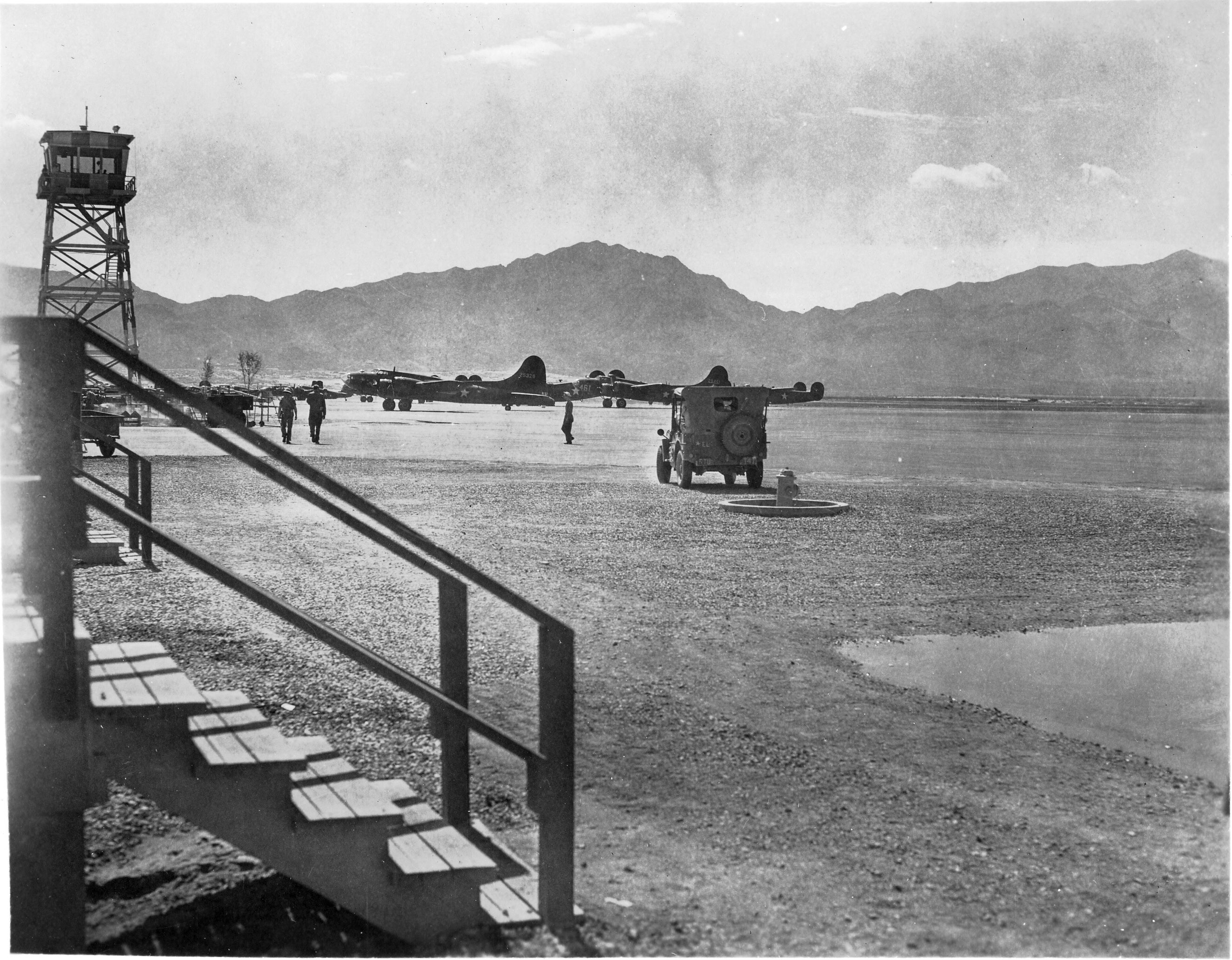 |
This photo and most of those below were taken by Cpl. Clarence E. Schurwan, USAAF. Cpl. Schurwan had been at both Alamogordo AAF (present day Holloman AFB) and Biggs. The photos were provided by Paul M. Webber M.D., and show a bustling field during the intense training conducted during WWI. The time period is roughly 1943 and the location is towards the West end of the field, a little to the North of the above aerial photo, with the Franklin Mountains making a good background. It is interesting also in that in the foreground are two B-17s , where as Biggs mainly trained B-24 crews. In the background are two B-24s and to the left what looks like a B-34 Ventura, behind that is a B-25. The first B-17 in line is 42-2538, the second B-17 is serial 42-5461. Both are B-17Fs and even though they were probably about a year old, they were also probably high time airframes by the time this photo was taken. The first one is stripped of turrets, while the second is not.
 |
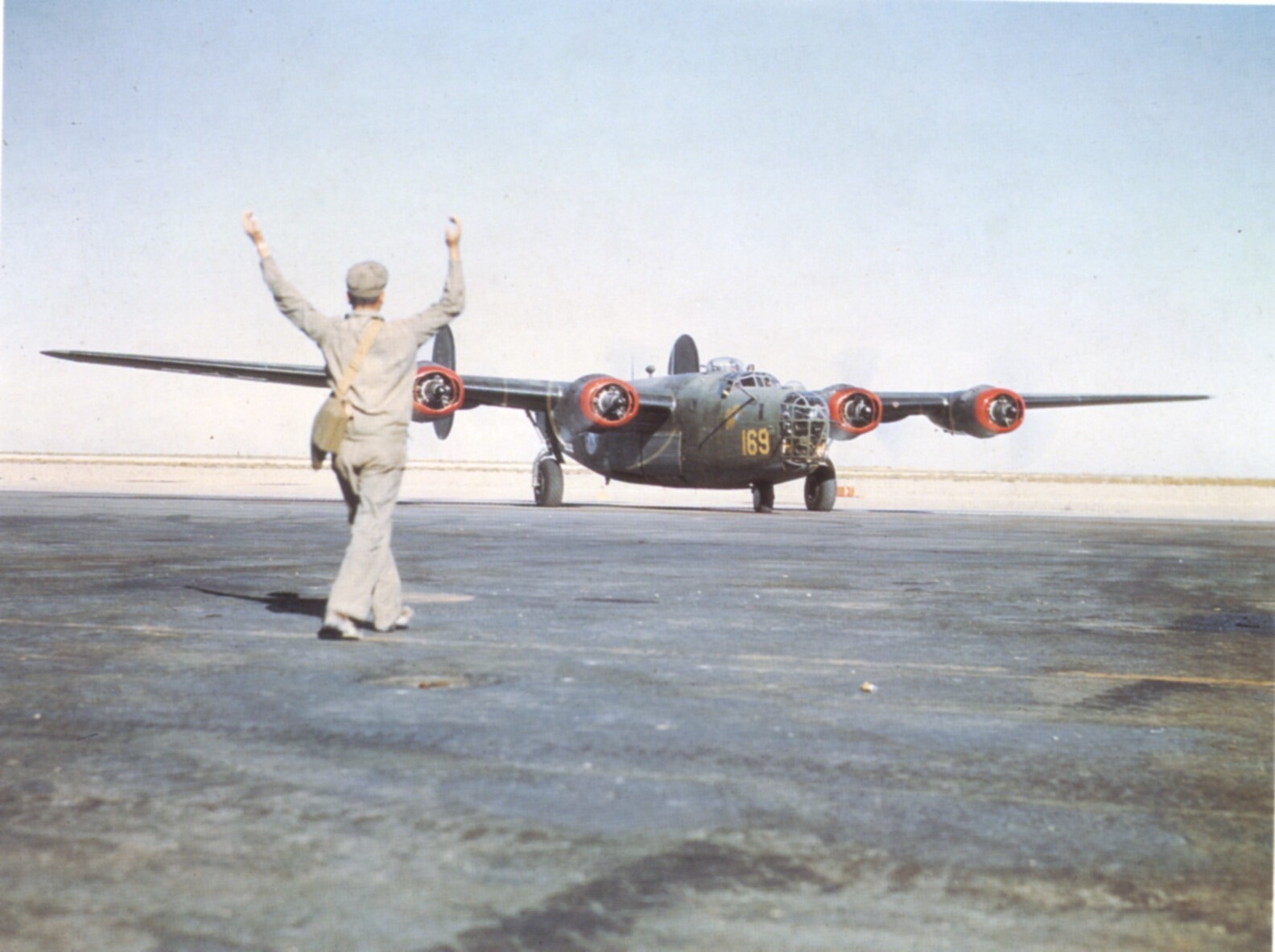
As already stated, Biggs mainly trained B-24s with these two B-24Ds being typical. With the puddles on the ground and the thunderhead in the background the most likely time period would be late summer.
 |
 |
By today's standard's Privately Owned Vehicles (POVs) were allowed very close to the flight line and as can be seen from the tar paper shack, facilities were somewhat austere.
 |
 |
 |
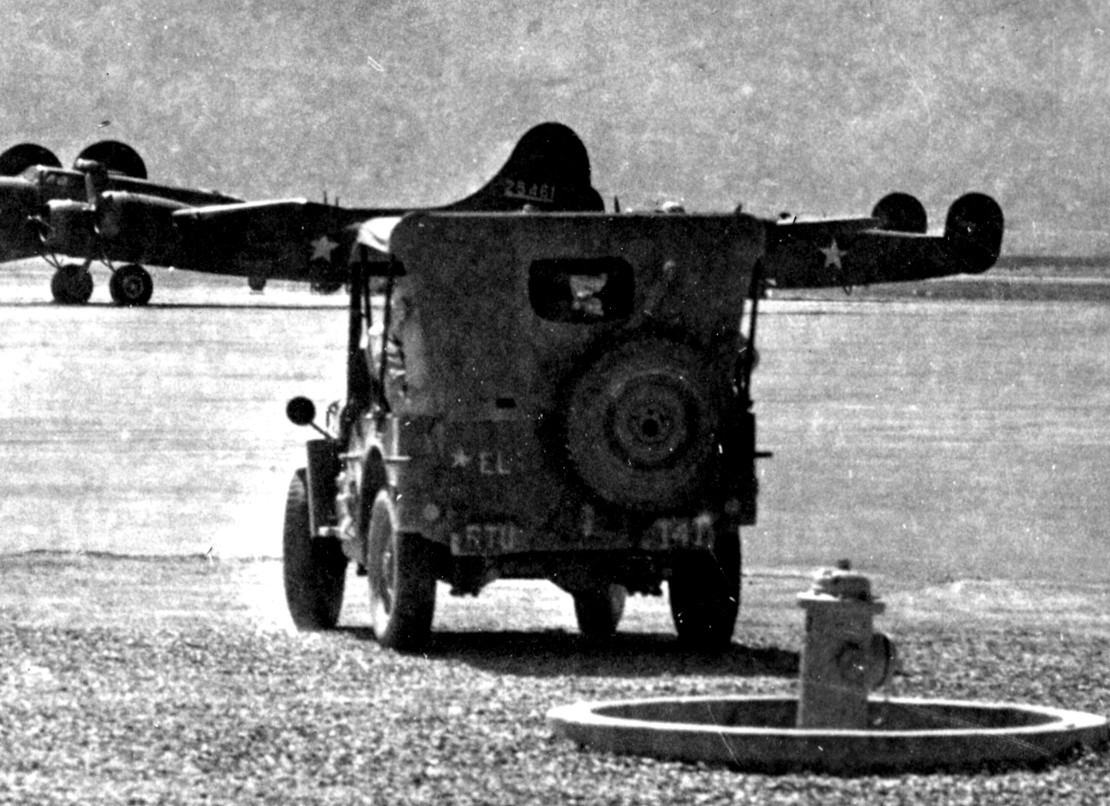
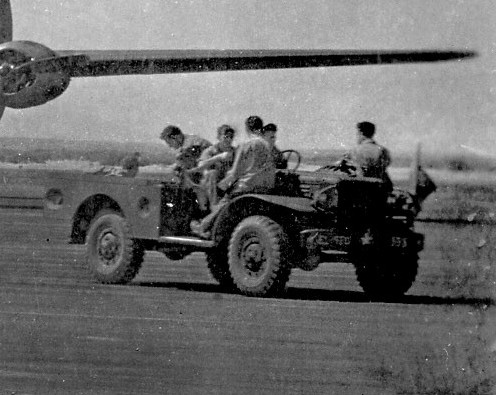
Both of the first shots are enlargements of from the above photos, showing airfield equipment. The one on the left being the ubiquitous Jeep and the one in the center is a WC-51 Dodge Weapons Carrier. Both carry the "EL RTU" markings, which stand for either "El Paso Replacement Training Unit", or "Biggs Replacement Training Unit". During late WWII Biggs based aircraft carried the letters EL on the top portion of the fin. (Paul Webber)
The third photo is from a separate collection and shows a Jeep used to run crews to their aircraft.
Some general photos from the Clarence Schurwan collection:
 |
 |
 |
 |
 |
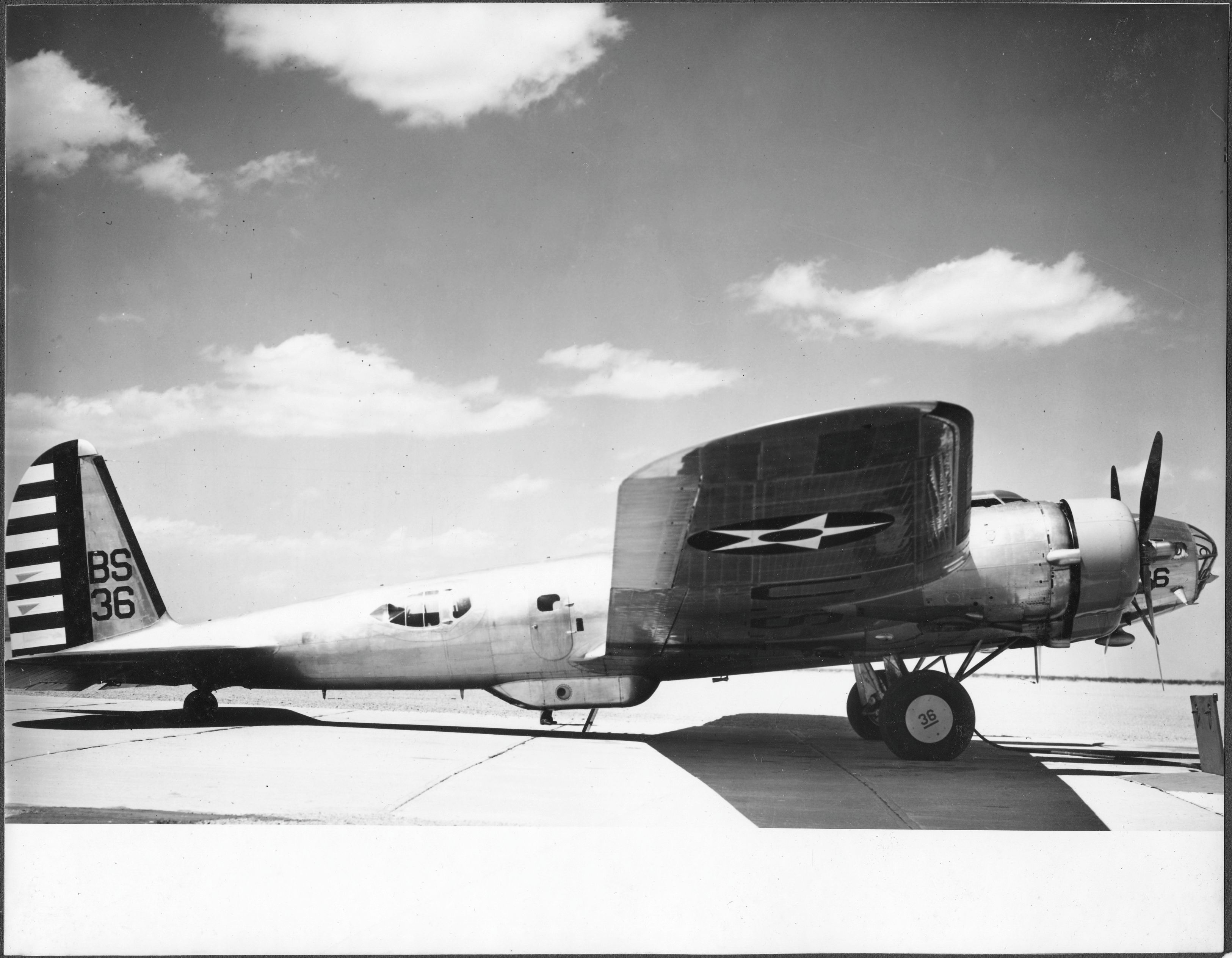
A B-17C from the 19th Bombardment Group, most likely during the fall of 1941. The aircraft was transient at Biggs, the group was based at Albuquerque, New Mexico at the time.
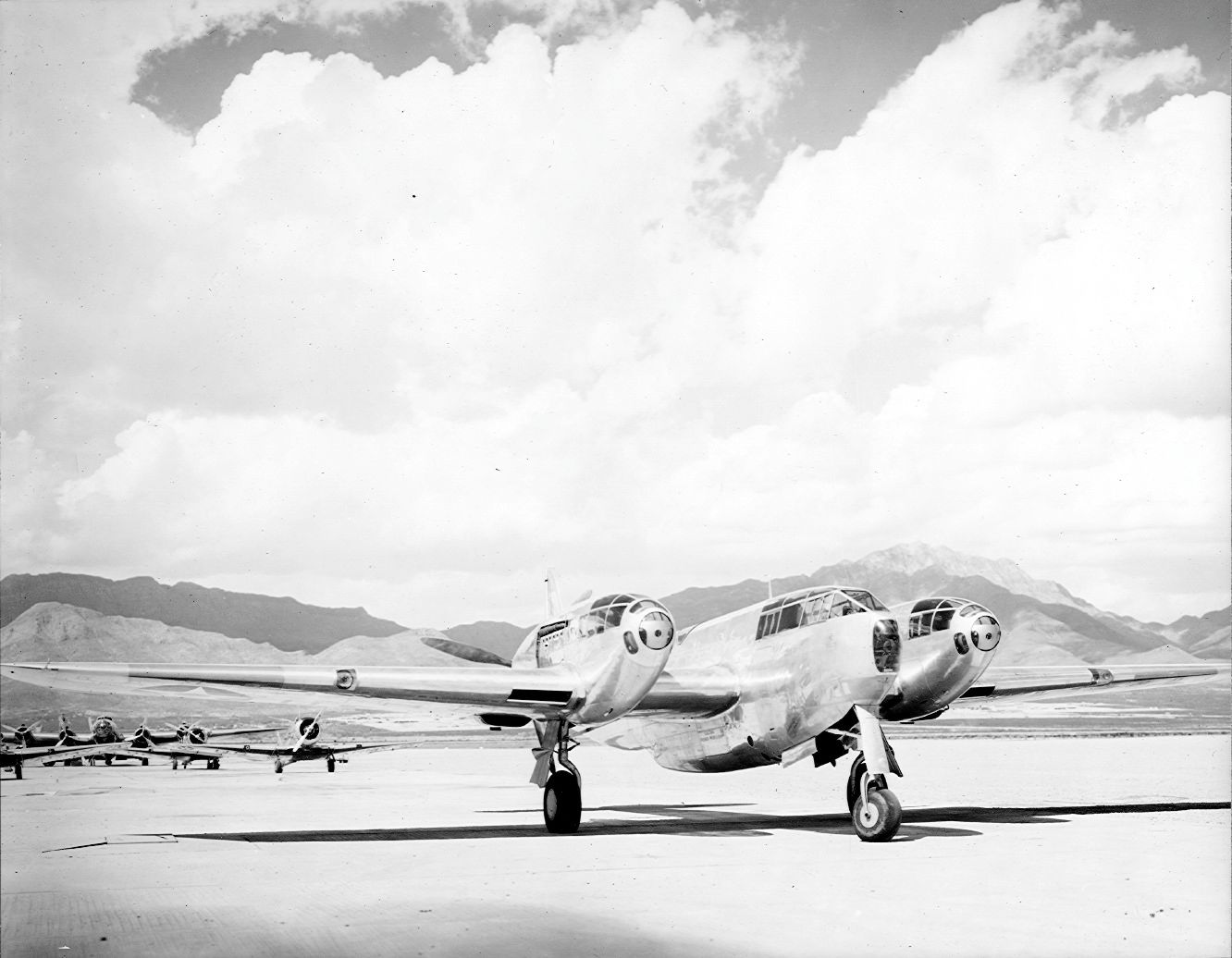
The second photo is Bell Aircraft's FM-1A Aircuda. The Aircuda was envisioned as a bomber destroyer, but in reality was a dismal failure and in actual wartime single engine aircraft made the best "bomber destroyers". It is still a futuristic looking aircraft for its day.
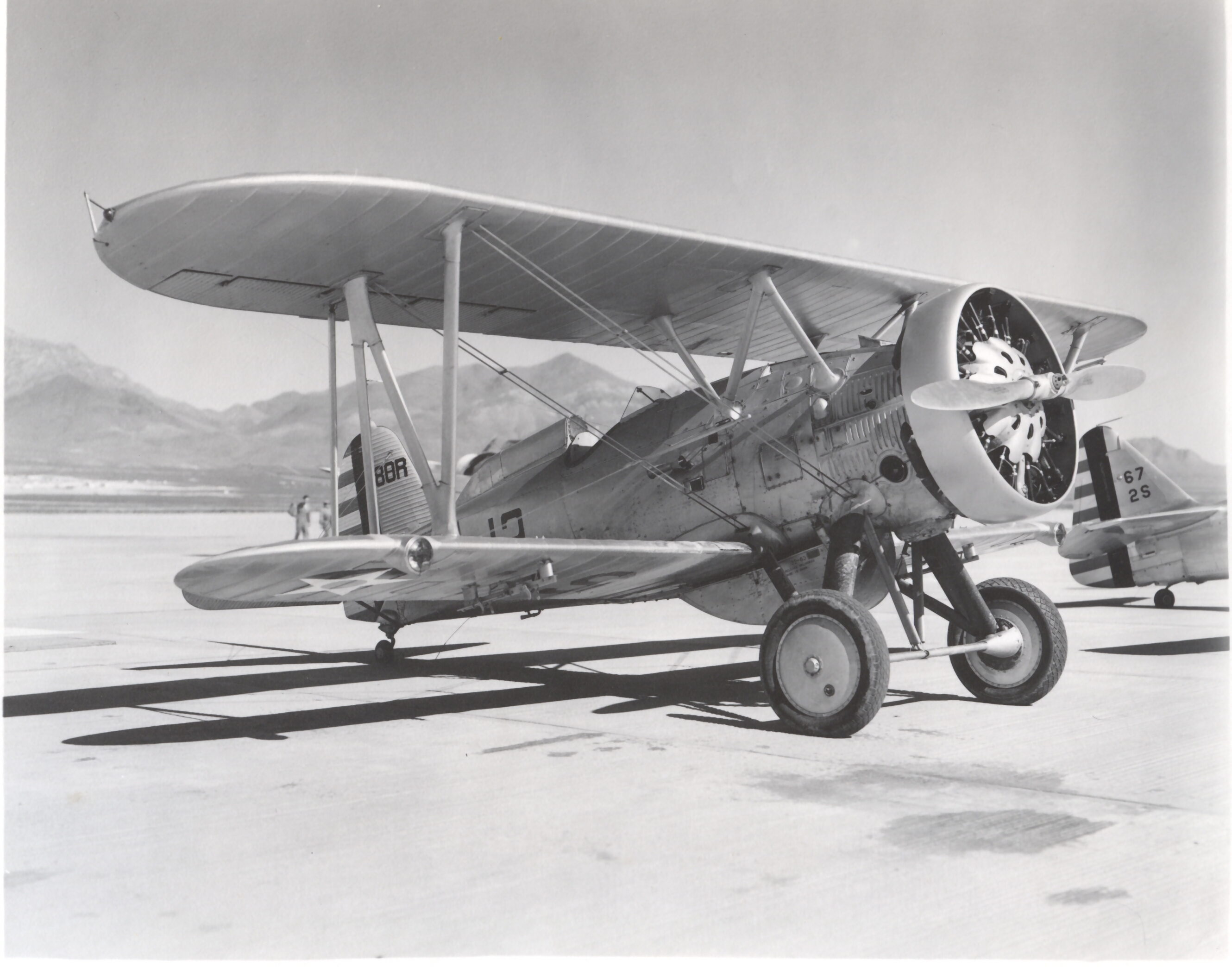
The P-12F is a "hack" for the 8th Corps Area Organized Reserve, photographed at Biggs during 1941. It is one of twenty five P-12Fs, which differed from the P-12E only in the engine exhaust arrangement. (Second P-12 photo courtesy of John Paul Jones)
A double trailer fuel truck parked in front of a C-47.
 |
 |
 |
 |
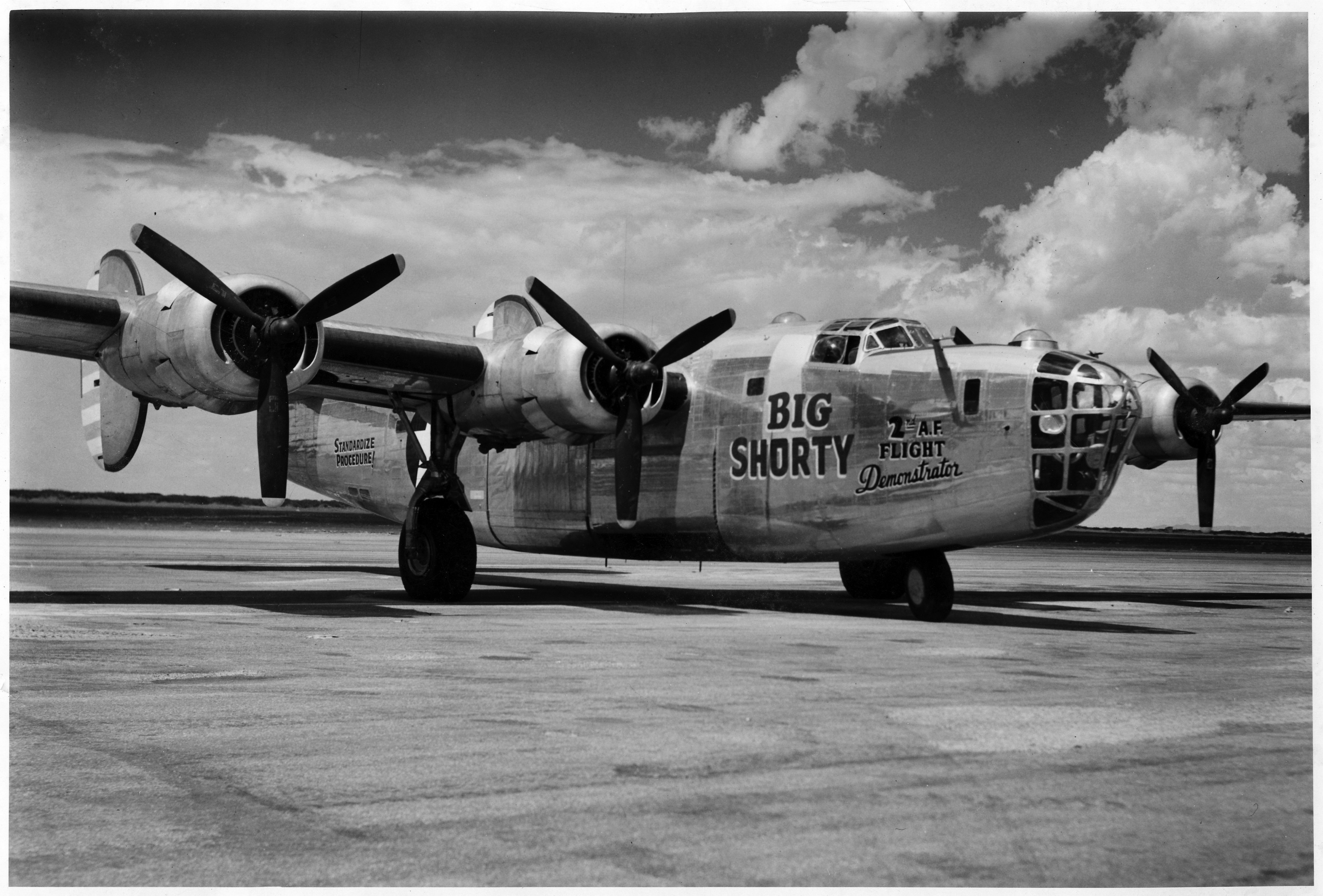
Big Shorty, a war wear B-24D serial number 42-40400 was a demonstrator aircraft used by the 2nd Air Force to promote crew standardization.
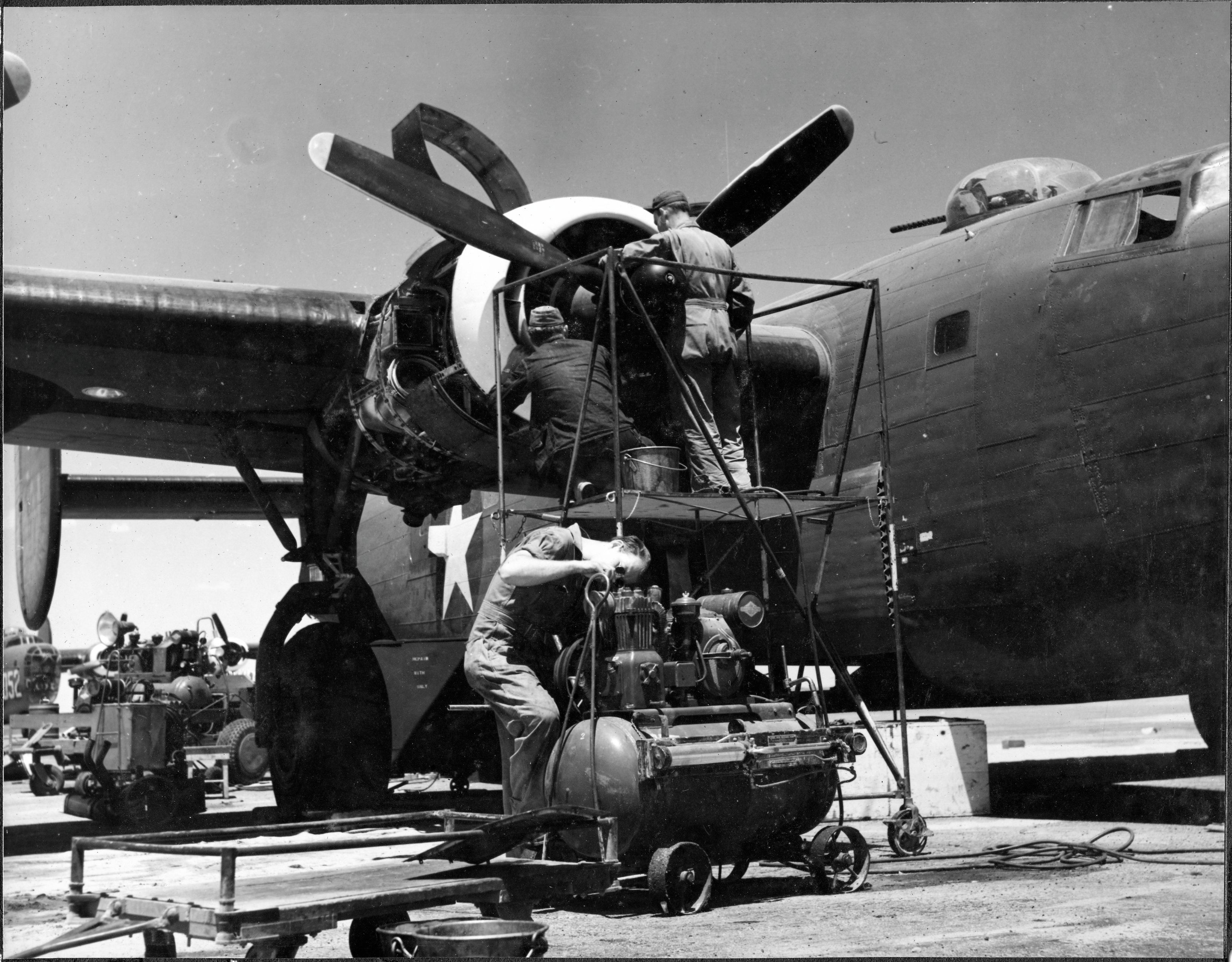
The last two photos show mechanics "wrenching" on a B-24. As can be seen from these two photos most maintenance work is done in the open. The work stand is labeled "579th Bomb Squadron" and notice that one of the mechanics is wearing a sidearm.
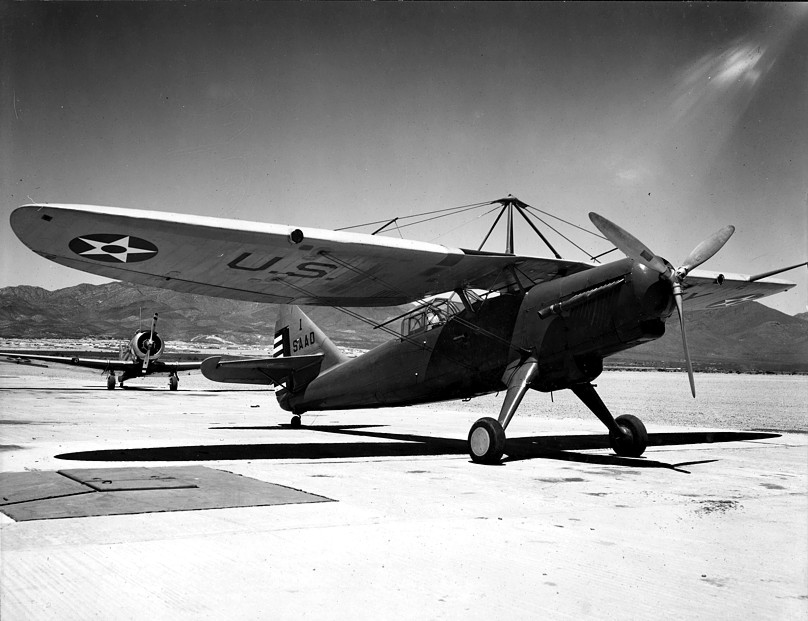 |
An O-43A during a stopover at Biggs. The SAAD acronym on the tail stands for the San Antonio Air Depot.
 |
Taken during one spring dust storms that are so common in the Southwest, this photo shows a number of aircraft probably waiting for the air to clear. In the foreground are at least eight P-40s, behind which are a P-36, an O-43A, two C-39s and a B-17B. The paint job on the P-36 is fairly worn while the P-40s look fresh. The best guess is that they were on a delivery flight on the eve of WWII.
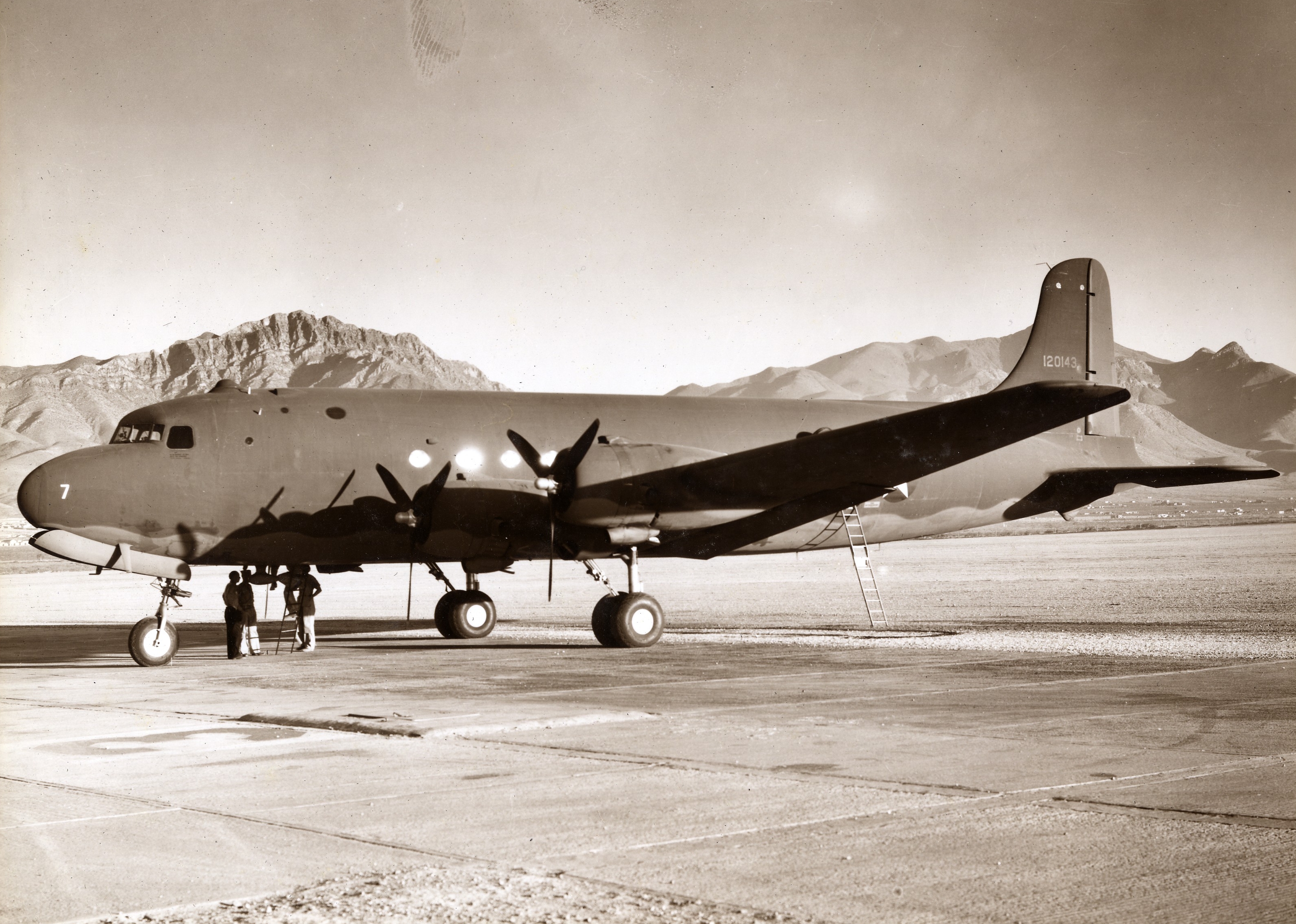 |
An early summer morning in 1942 finds C-54 41-20143 preparing for a flight. The C-54 was a fairly new plane in the AAF inventory at this time and it is possible that this one had just left the factory at Santa Monica. Most likely it had RONed at Biggs on the way to a life of hard work.
 |
 |
 |
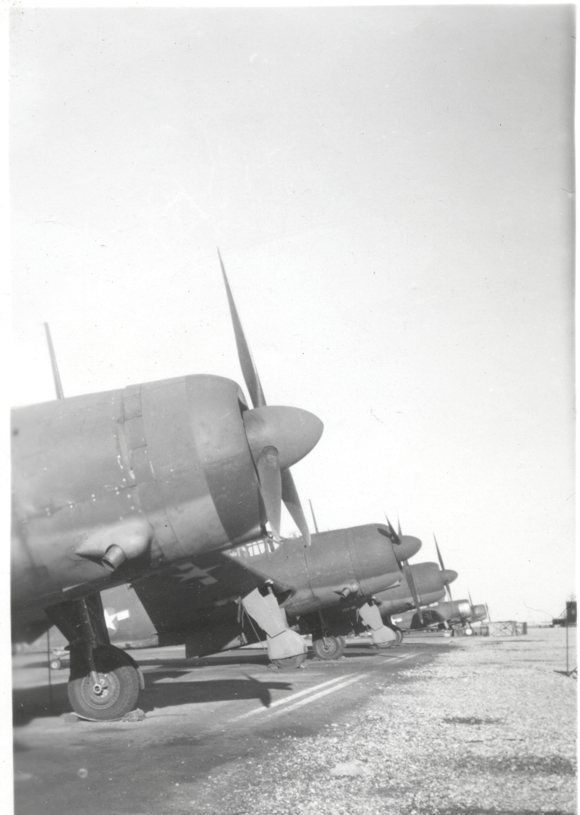 |
A-24 and A-25 aircraft at Biggs during 1943. Most likely they are attached to the 6th Tow Target Squadron. (AAF)
 |
 |
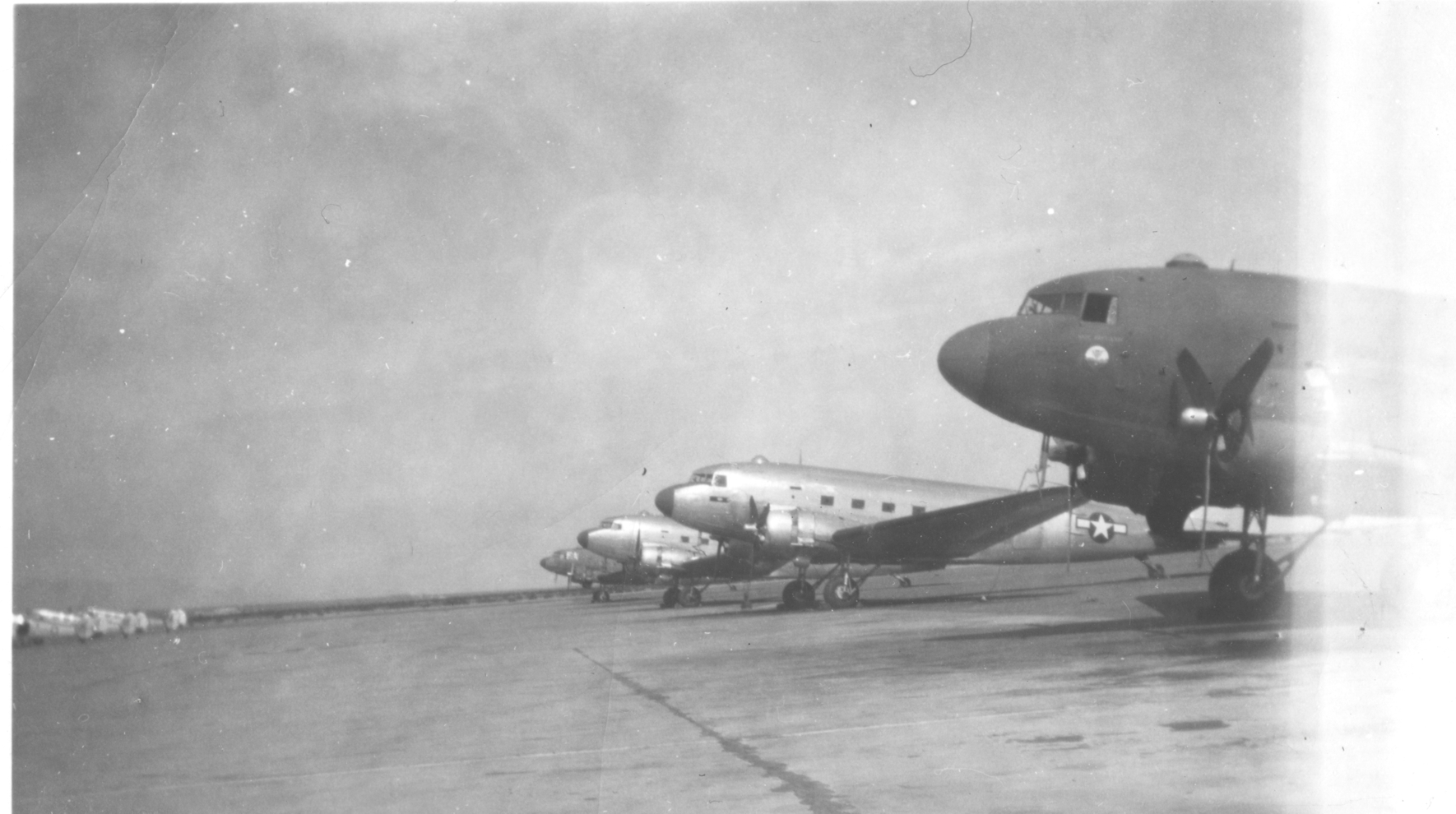 |
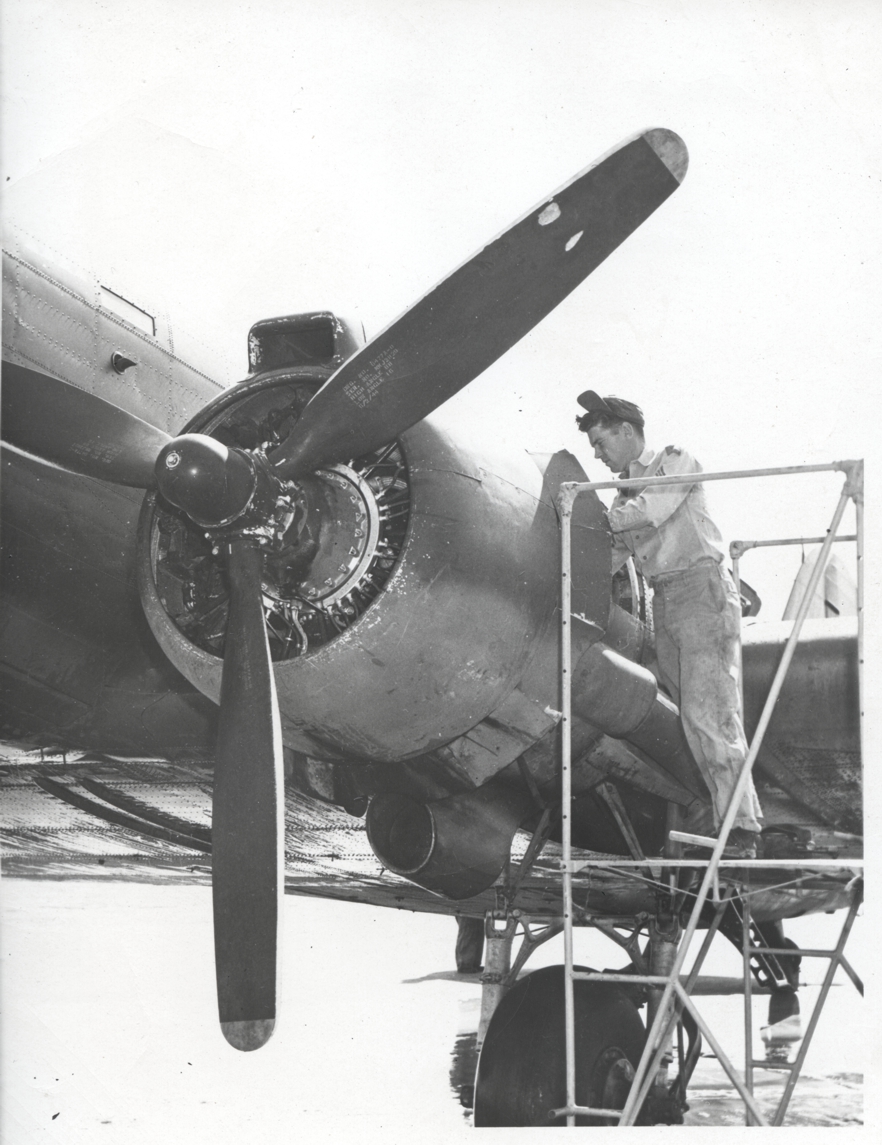
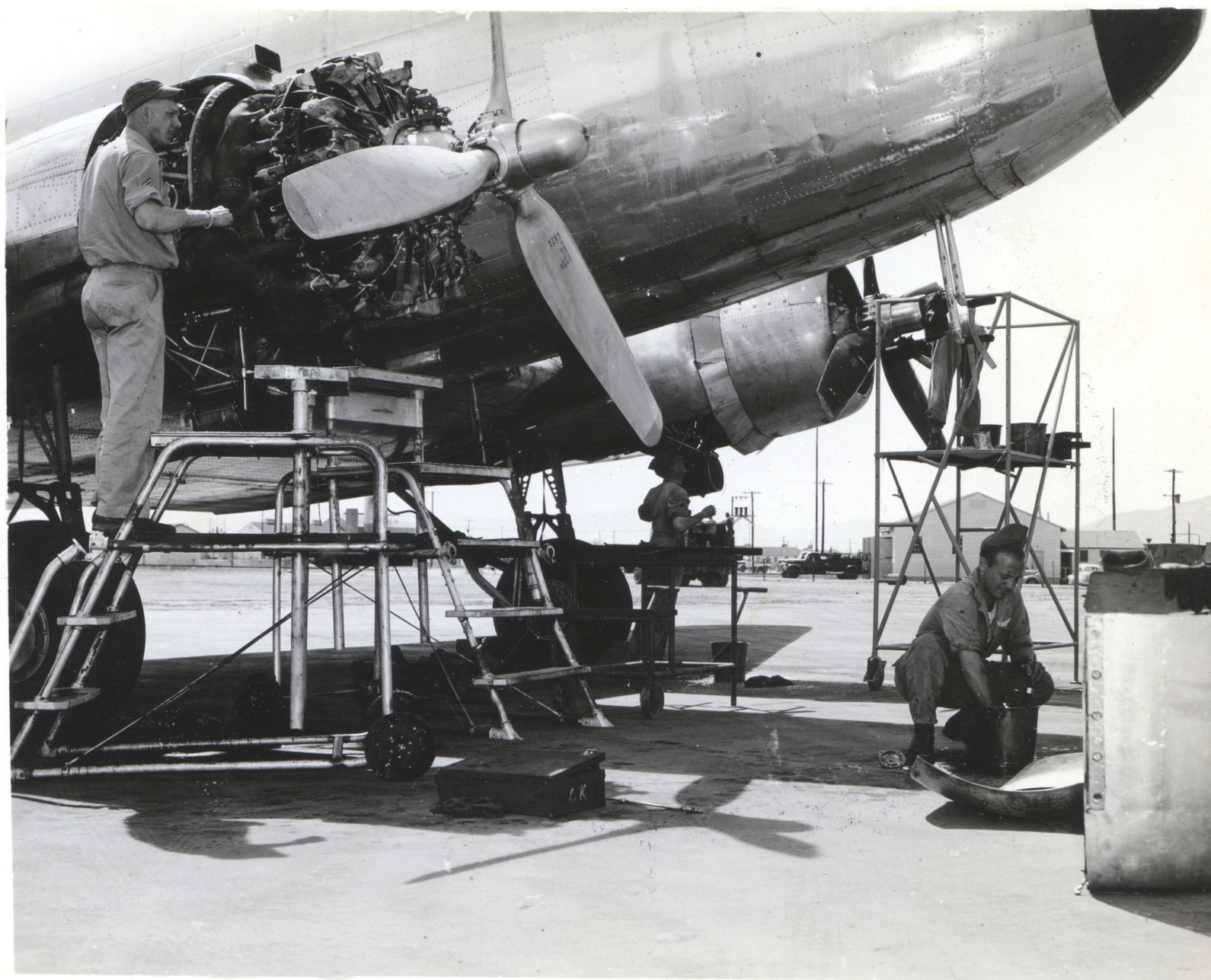
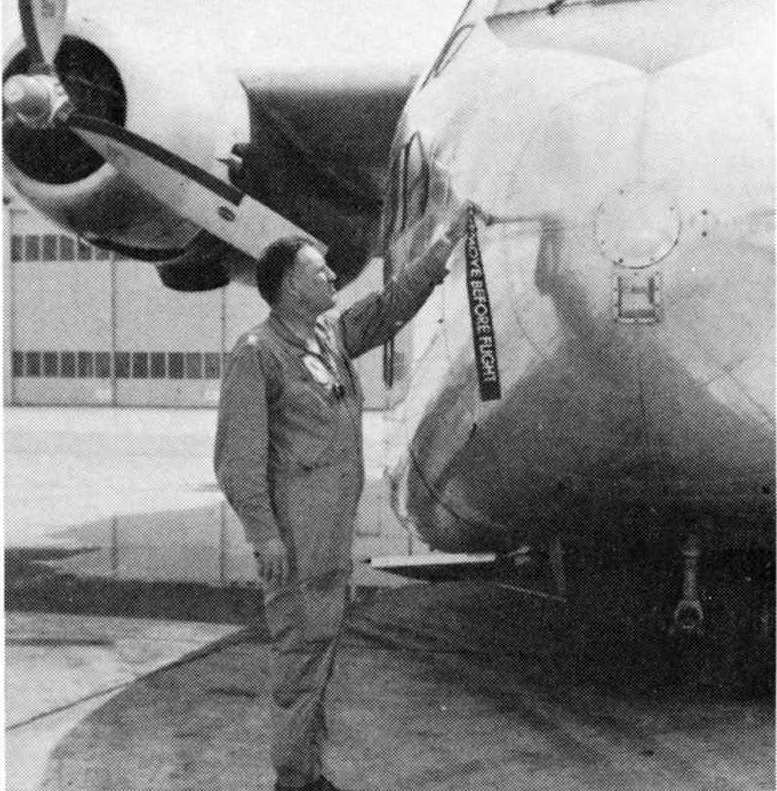
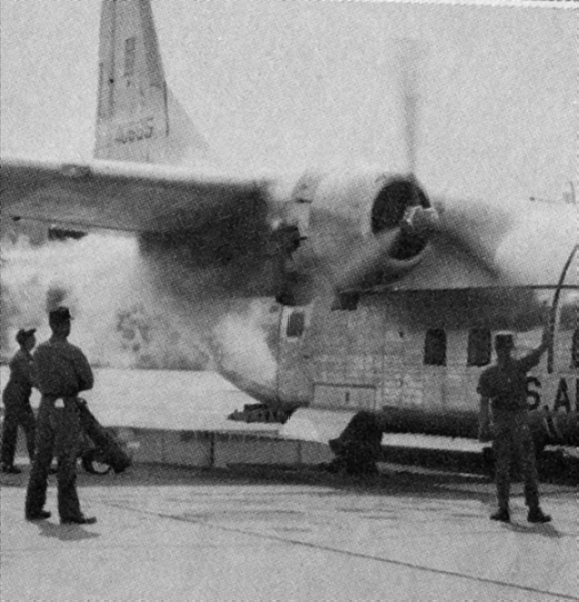
C-47s at Biggs . Maintenance was ever present in the days of recipe engines, many a man hour was needed to keep planes in the air. The last photo shows either AT-7s, or AT-11s in front of a row of Gooney Birds. If they are AT-11s they are most likely out of Deming. The captions on the back of these photos state the time period as 1945. (AAF)
 |
 |
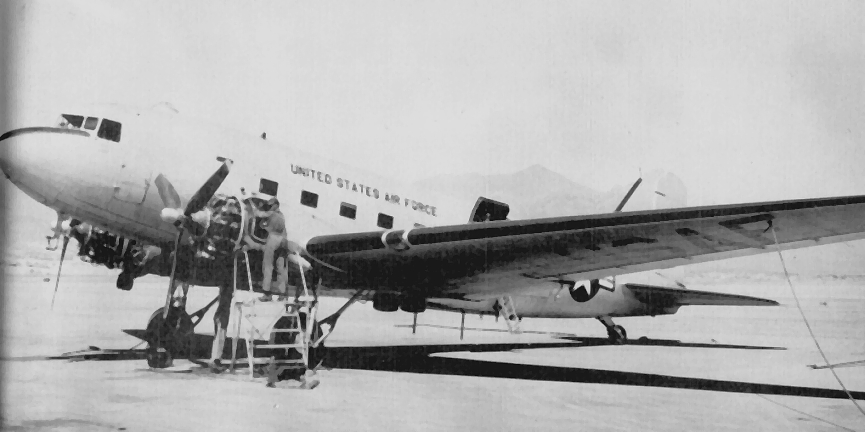 |
The third photo is of an unidentified, but ever present C-47 at Biggs in 1954. (USAF)
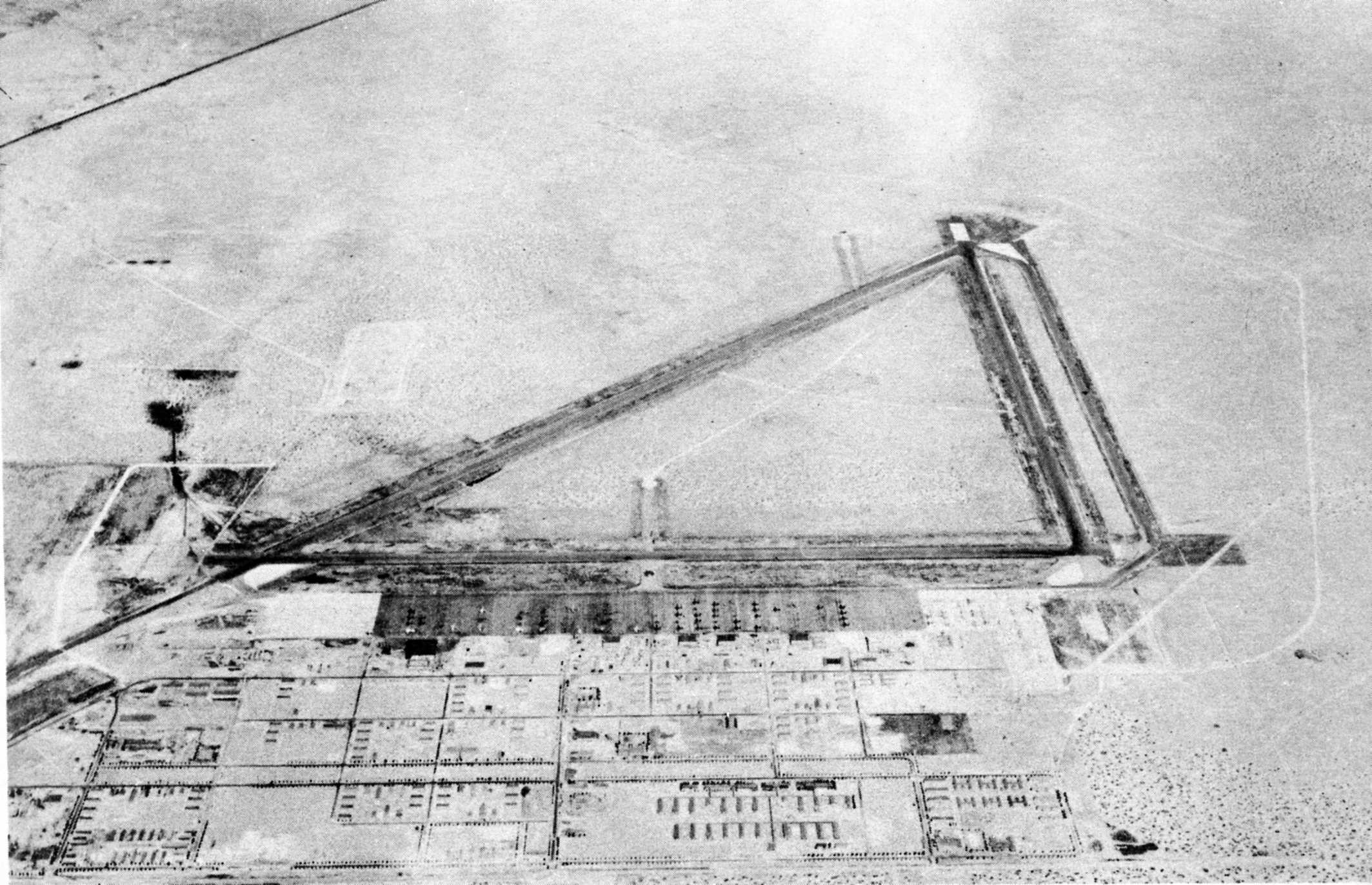 |
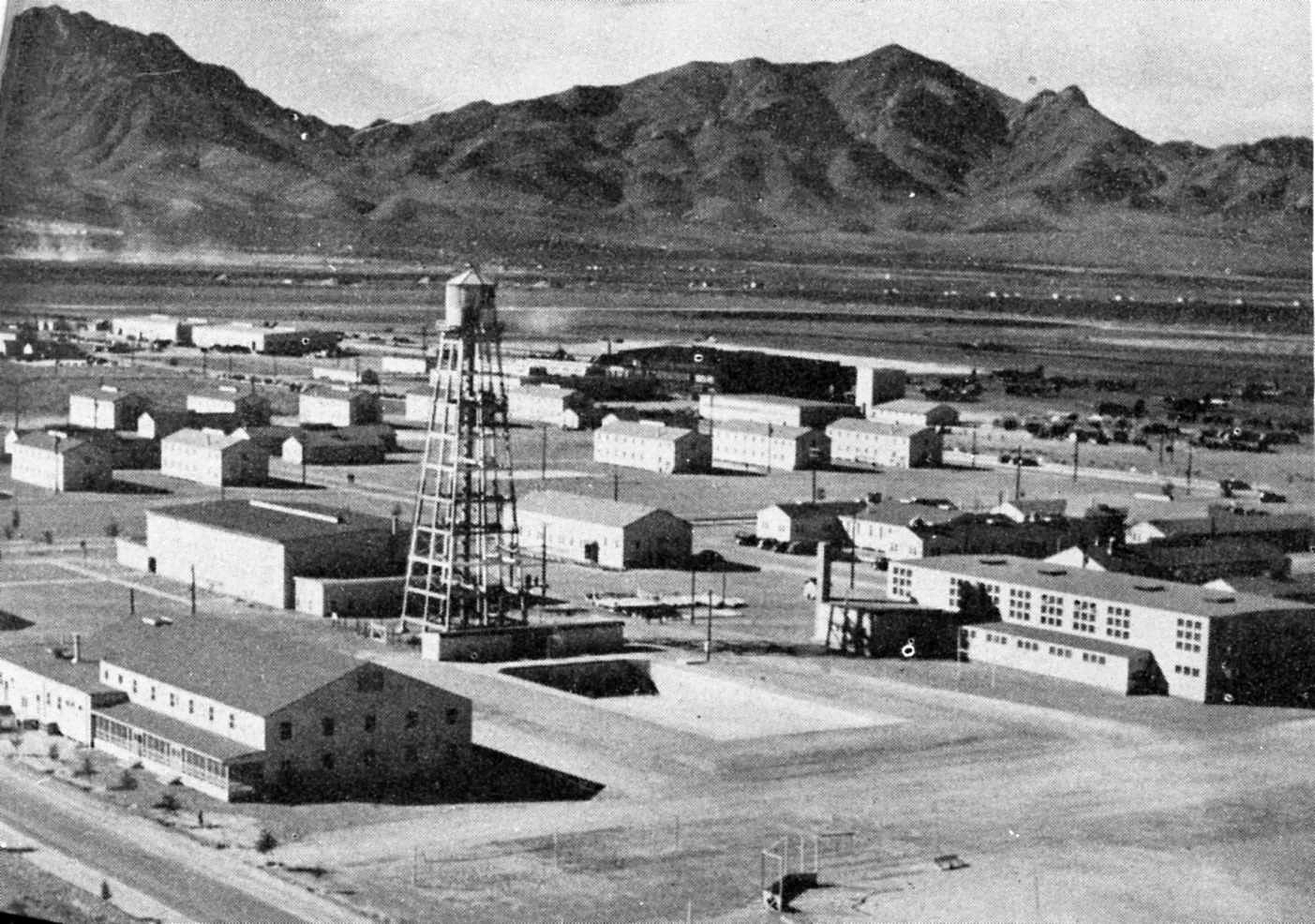
This aerial photo show Biggs about 1947. The base was little changed from World War II at this point. The photo is taken from the South looking North. The Balloon Hangar is out of view to the lower left and the B-36 hangar has yet to be built. (USAF)
 |
This is what the facilities looked like about 1947. The view is towards the Northeast and the balloon hangar is out of view to the lower left. (USAF)
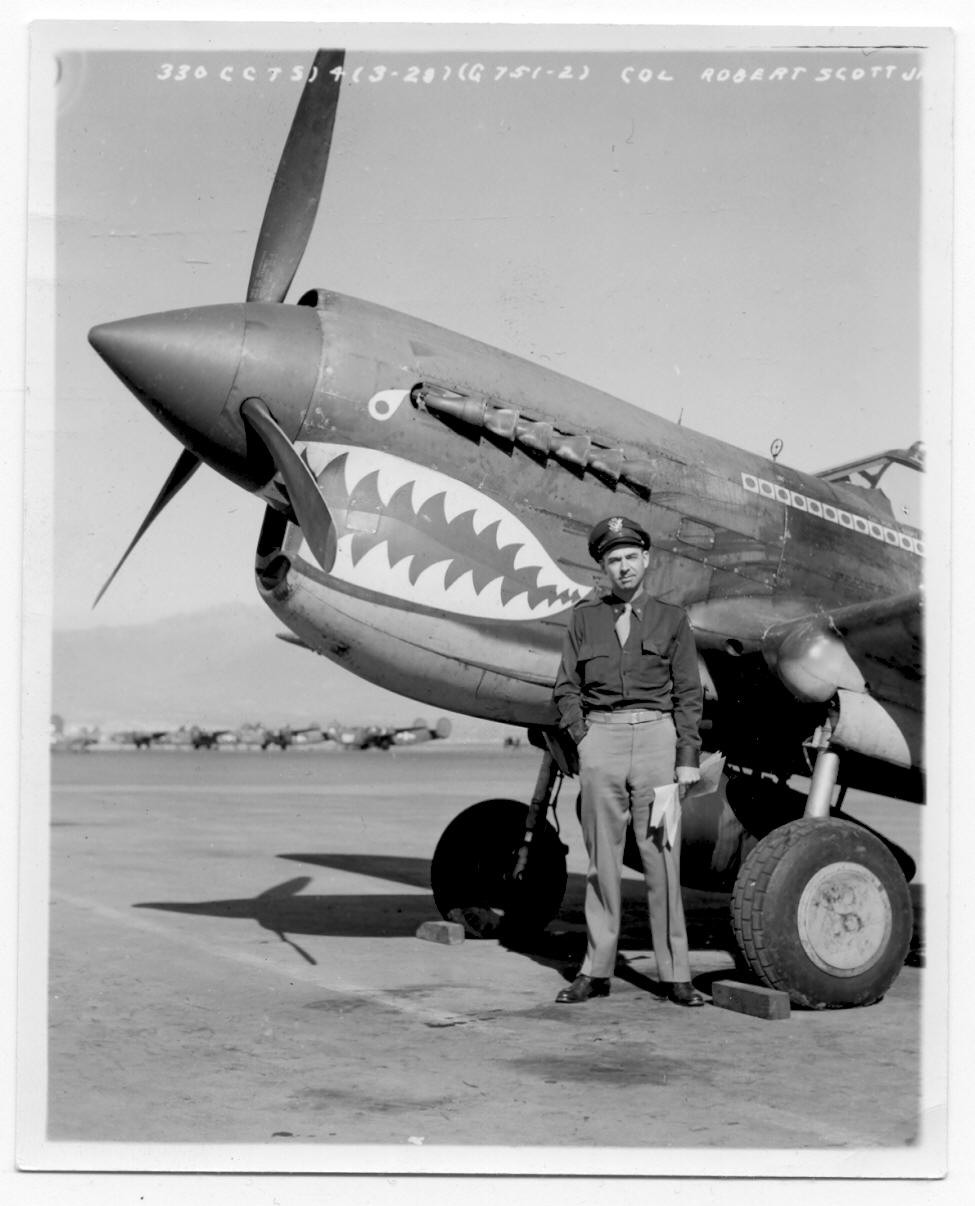
Col, Robert Scott on a wartime stopover at Biggs. (John Paul Jones)
 |
 |
 |
One of the many overlooked needs on any airfield are the various support duties. Here is a ubiquitous Air Force tug at Biggs AFB during the late 1950s. This vehicle is an MB-2 that was produced by several manufacturers, with Euclid being the best known. They were often called "Ukes" by ground personnel. The MB-2 continued in production for many years and the later models changed somewhat in appearance. This "retired" MB-2 continues to soldier on in civilian service at the Midland, Texas airport.
 |
Airfield security has always been a priority, but with SAC it was an obsession. Throughout the late 40s, the 50s and even into the 60s the USAF used many elderly M8 and M20 Greyhound armored cars. The photo shows an M20. These vehicles were normally painted in "Air Force Blue", or "Strata Blue" (FS 15045).
 |
 |
 |
 |
Fire trucks have been a constant presence at air fields since the dawn of aviation and like aircraft they evolved as time went by.
The first photo above shows a REO (left) and a Sterling DDS-235 truck at Biggs in the early 50s. These were World War Two vintage trucks and would be replaced by newer designs during the 1950s. The WWII designation was Class 150 (CARDOX), but by this time both had been re-designated as O-1. (USAF)
The second photo shows the Central Fire Station and a group of fire fighters. The truck to the left in the photo appears to be similar to many civil fire trucks, while the one on the right is a Ward La France Type 750A . If personal experience is any indicator many of the individuals continued careers as fire fighters after leaving the service. (USAF)
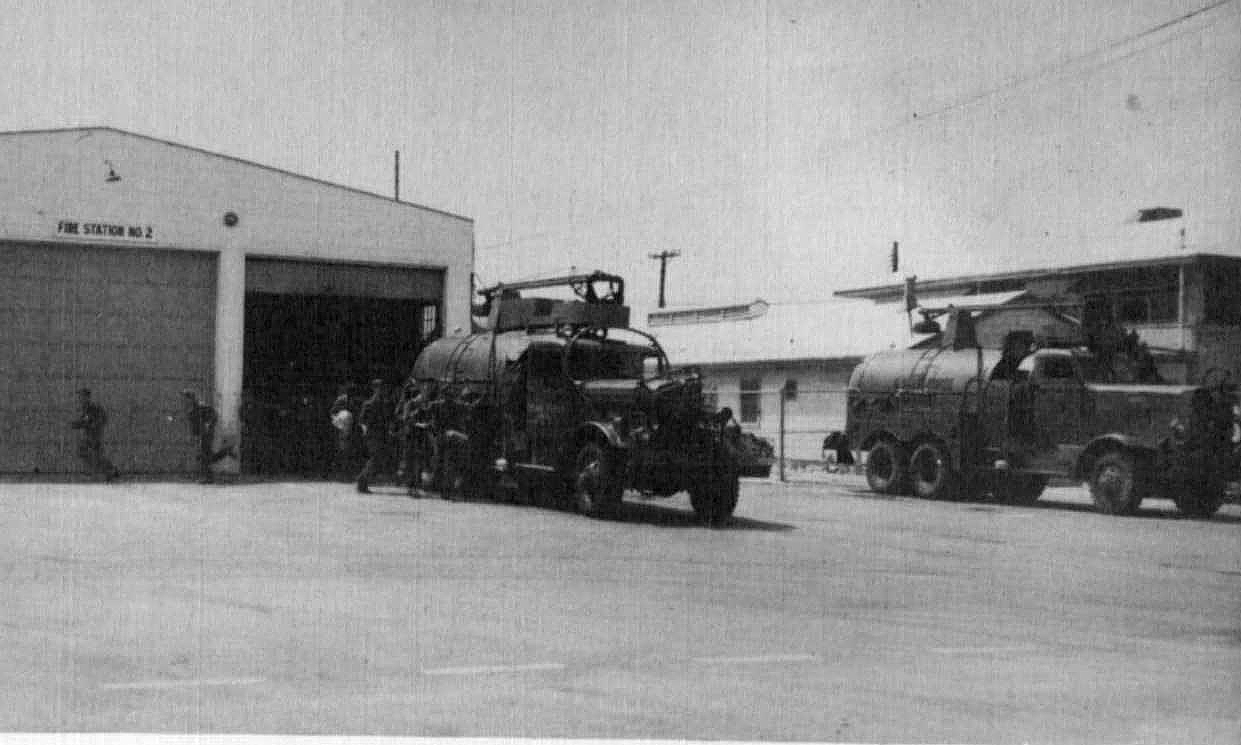
The third photo is of Fire Station number 2. It is too bad that this photo is backlit as many details are lost. The first truck in that photo appears to be based on an M34 chassis while the second could be an International. There is an O-11A and two O-1 trucks. On the right appears to be an M37 Weapons Carrier. (USAF)
The final photo is of an O-11A. This type would remain in service for many years. (USAF)
I am indebted to Art Williams for his help in properly identifying the fire fighting equipment in the above photos. I do not claim to be an authority on everything and my original incorrect labeling of some of the above pieces of equipment attests to that. It is most often only through the help of many enthusiasts that the best information is recorded. So, the current text is a corrected text. Here are some great tidbits from his email:
Photo #1: The two Sterling’s referred to in the photo is actually 1 REO on the left and 1 Sterling on the right. The REO is verified by the serial number 508551 on the door. That makes it the 45th one built out of a block of 125 REO’s. Also, at the time of the photos, both trucks were deemed by the Air Force to be Type 0-1. That can be seen on the Sterling’s door. Prior to that ( WWII) they were both designated as Class 150 (Cardox) . When the “type” system was adopted by the AF, they became the 0-1. Both trucks shared the same Cardox rear body. Only the chassis’s were different. They were both made around 1942 (contract date)
Photo#2: The pumper truck on the right identified as a Ward LaFrance MB-5, is actually a Ward LaFrance Type 750A (a structural pumper) . The MB-5 was a small Navy crash truck built by Ward LaFrance. There were three different AF contracts of the 750A made.
Photo #3: The crash truck referred to as a Type 0-10, is actually a Type 0-11A made entirely by American LaFrance. (the early 0-10 were made by ALF, but Marmon-Herrington finished the 0-10 contract so ALF could build the 0-11A) The truck just to the left of the 0-11A is an old Class 155 crash truck. At the time of this photo, the Air Force now renamed it to be the Type-05. The truck on the right, next to the 0-11A, is the REO again, and next to it the Sterling.
Photo #4: The truck mentioned to be an 0-10, is the same 0-11A in photo 3. It is an early production model of the 0-11A. (and it carries the early P number)
 |
 |
The first photo above is a page scanned from a 1954 yearbook for the 810th Air Division. The panel shows several scenes at Biggs fire stations.
The second photo shows a P-2 truck in 1964. By this time it was common to refer to fire trucks as "Crash and Rescue". (USAF)
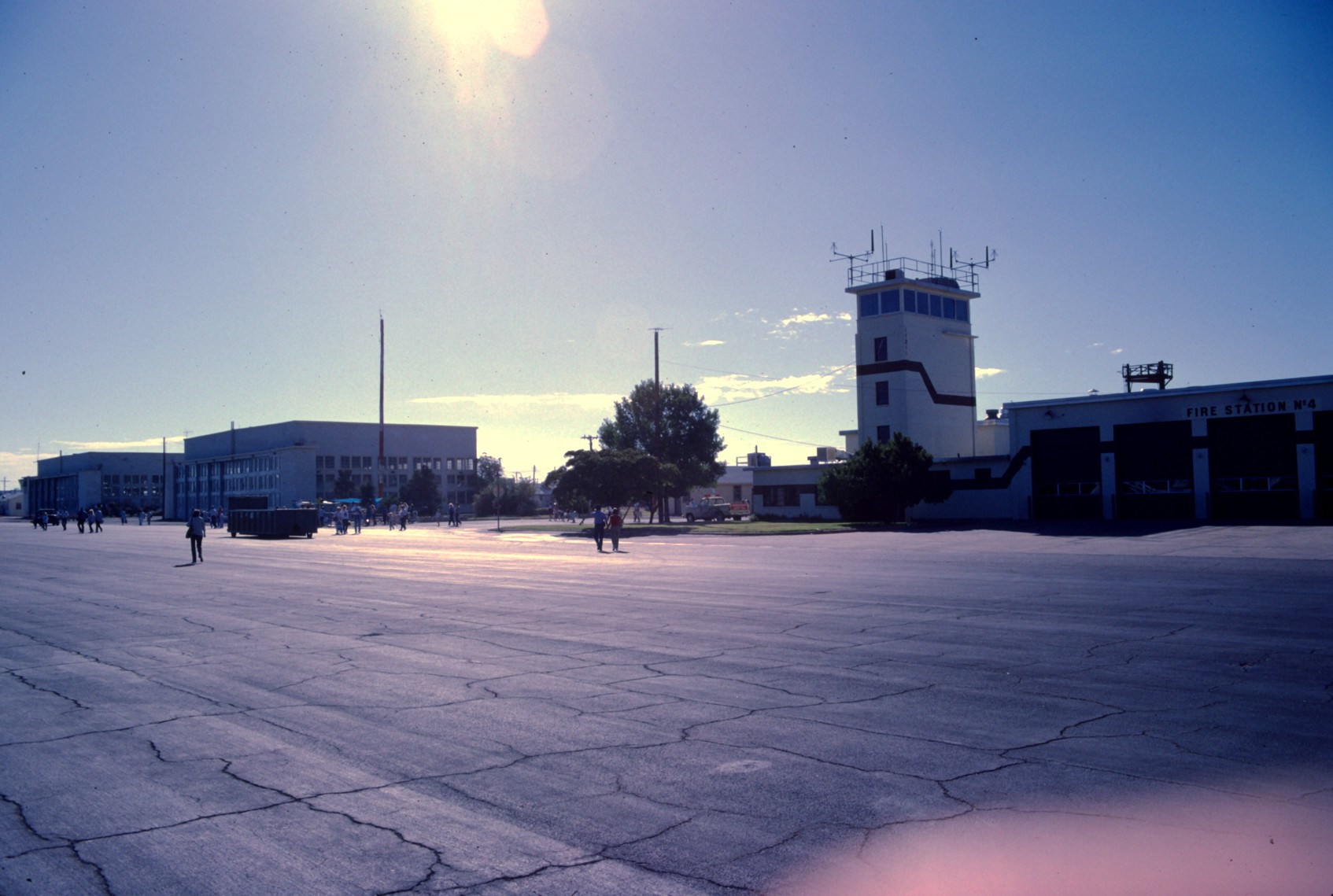 |
The current flight line station was built in the 1960s and is in use by the US Army. This is a 1987 photo, but it looks the same today.
 |
 |
 |
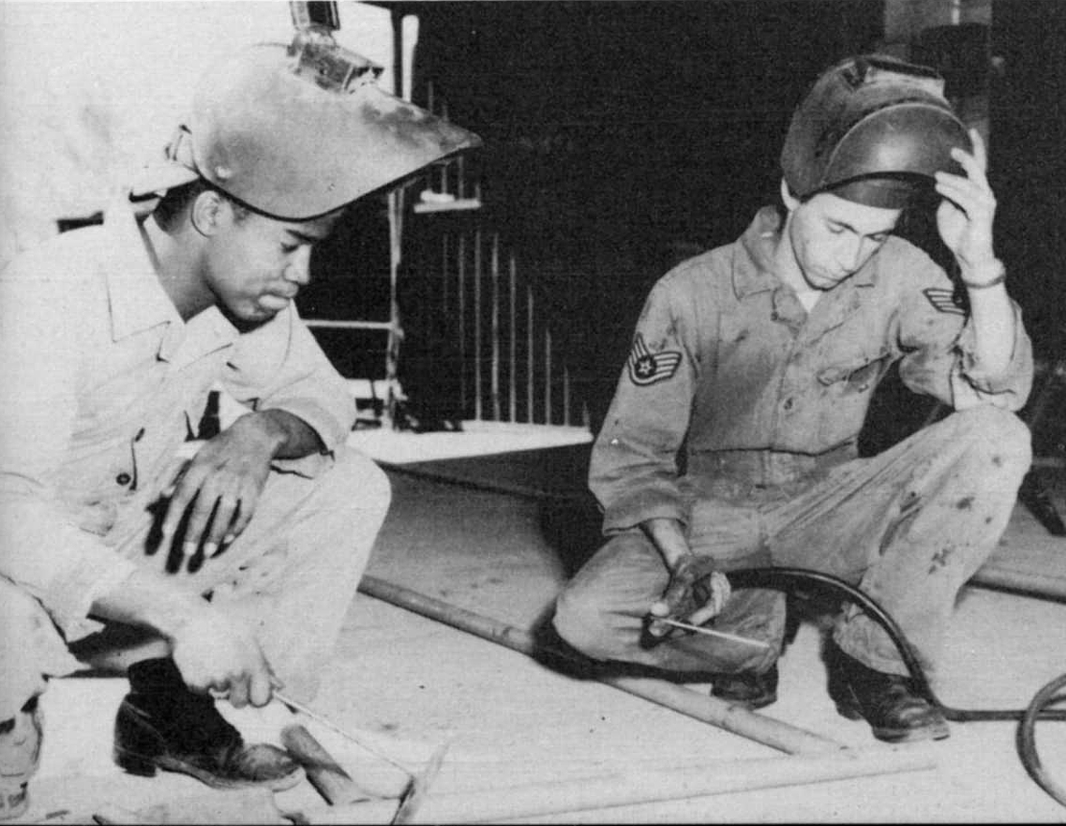 |
Construction is an ongoing process at most military bases and during the 1950s that was a constant at Biggs. (USAF)
For many years construction at Biggs had been minimal, but as of this writing (2008) Biggs AAF is experiencing a building boom due to BRAC that is unprecedented since WWII.
 |
 |
For a brief time in the early 1970s a few UH-34As called Biggs home. 53-4547 was damaged in a hard landing and later became a display at the 3rd ACR museum. For some reason the serial painted on the side was changed to "57-6141" which was the serial of an L-20A (later U-6A) Beaver.
 |
 |
 |
The UH-1 Iroquois, or "Huey" as it is usually known, has been around since the early 1960s and in most people's minds is inseparable from the Vietnam War. All three in the above photos are UH-1Hs, the first being 68-15624. The two white and orange ones are 73-21724 and 74-22367. Both were based at White Sands Missile Range (WSMR) in New Mexico, but flew between Biggs, Ft Bliss and White Sands on almost a daily basis. All three helos are at Biggs in the photos. They have since been replaced with the UH-72 Lakota, which seem to seldom venture far from White Sands.
 |
Though the "Huey" will be around for some years to come, the UH-60 has replaced a great many. UH-60A 84-23967 was on display at the 2004 Amigo Airshow. The Blackhawk was operating out of Biggs in the MAST role at the time.
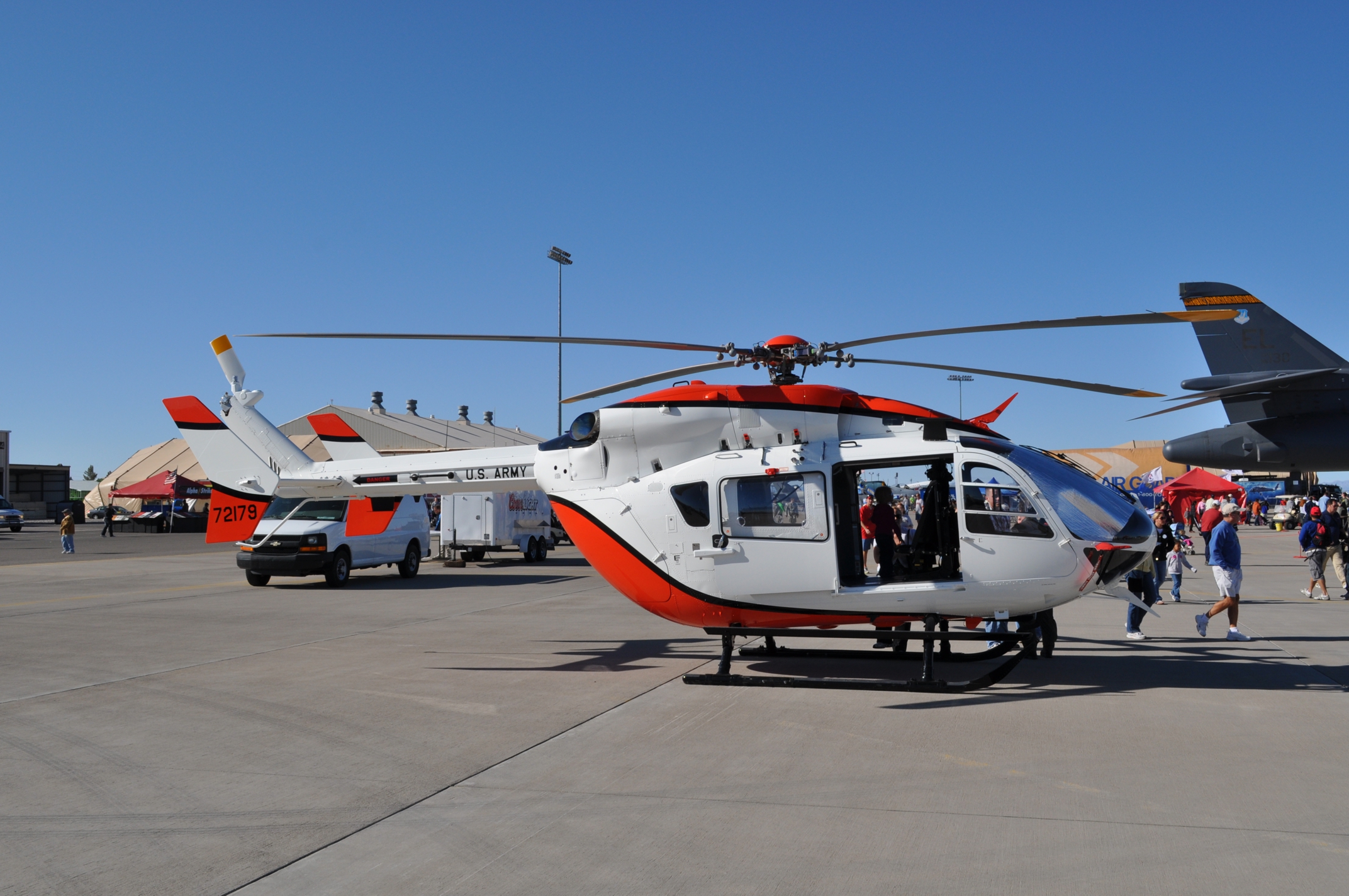 |
The UH-72A Lakota. From crew comments it is clear that the Lakota suffers from density altitude issues and is not the best replacement for the UH-1.
 |
 |
The two panels above are from two different yearbooks at different times. The one on the left is from a 1954 book on the 810th Air Division and the one on the right is from a 1964 book on the 95th Bomb Wing. The chapel and the theater survived until the 1990s.
 |
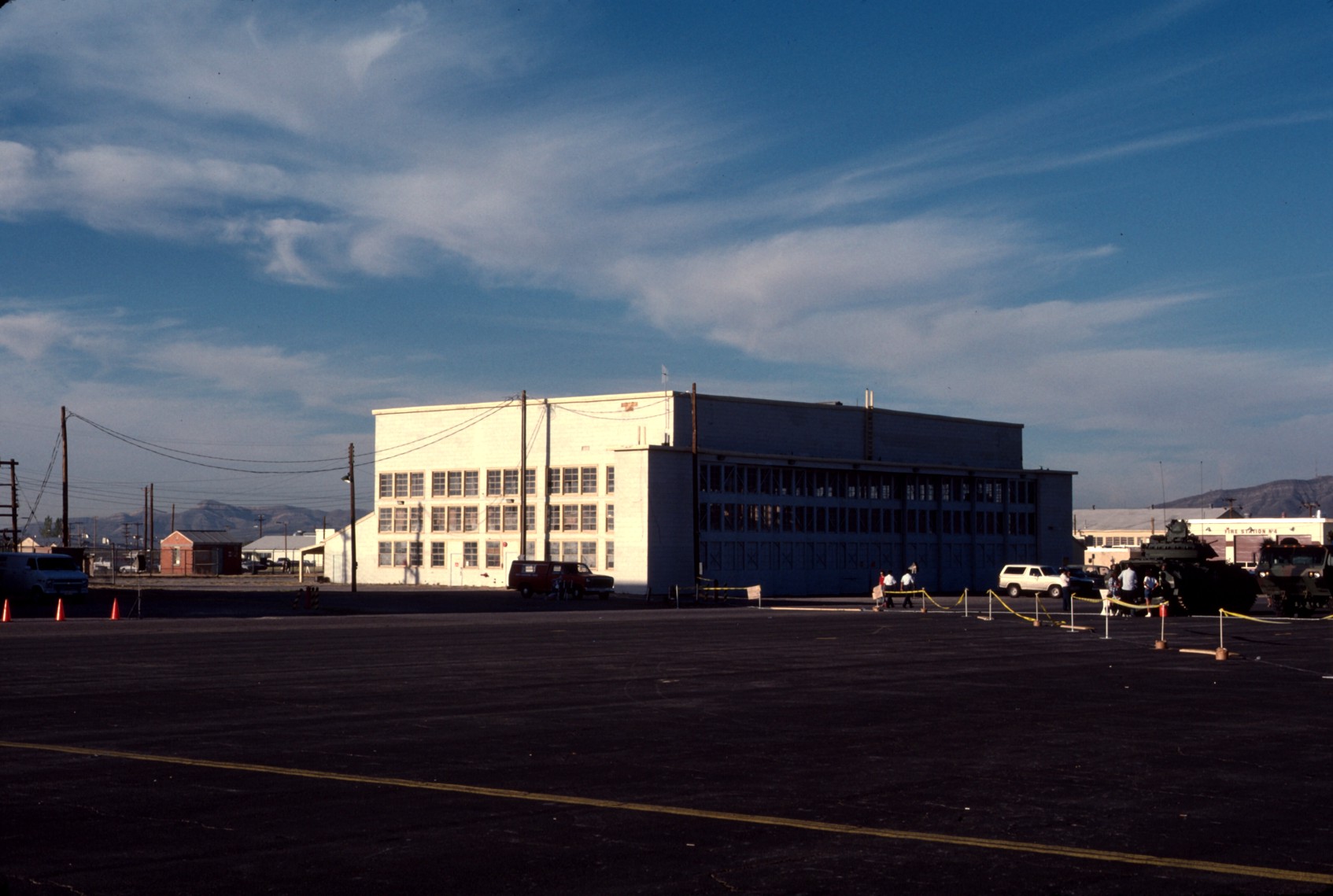 |
A more contemporary photo (1989) shows what I call the "B-17" hangars". They were just as likely built to house B-24s. Biggs had two of these hangars (note slight differences) that survived until about 2000.
 |
This vintage photo dates from 1947 and shows the hangar to the right above as the backdrop for a review by Lieutenant General Elwood Richard Quesada. General Quesada was the Commanding General of the Tactical Air Command at the time. He had a long and distinguished career in the AAF and later USAF, retiring in 1951. Early in his career he was one of the crew members of the "Question Mark" endurance flight in 1929, The General passed away February 9, 1993. (USAF)
 |
 |
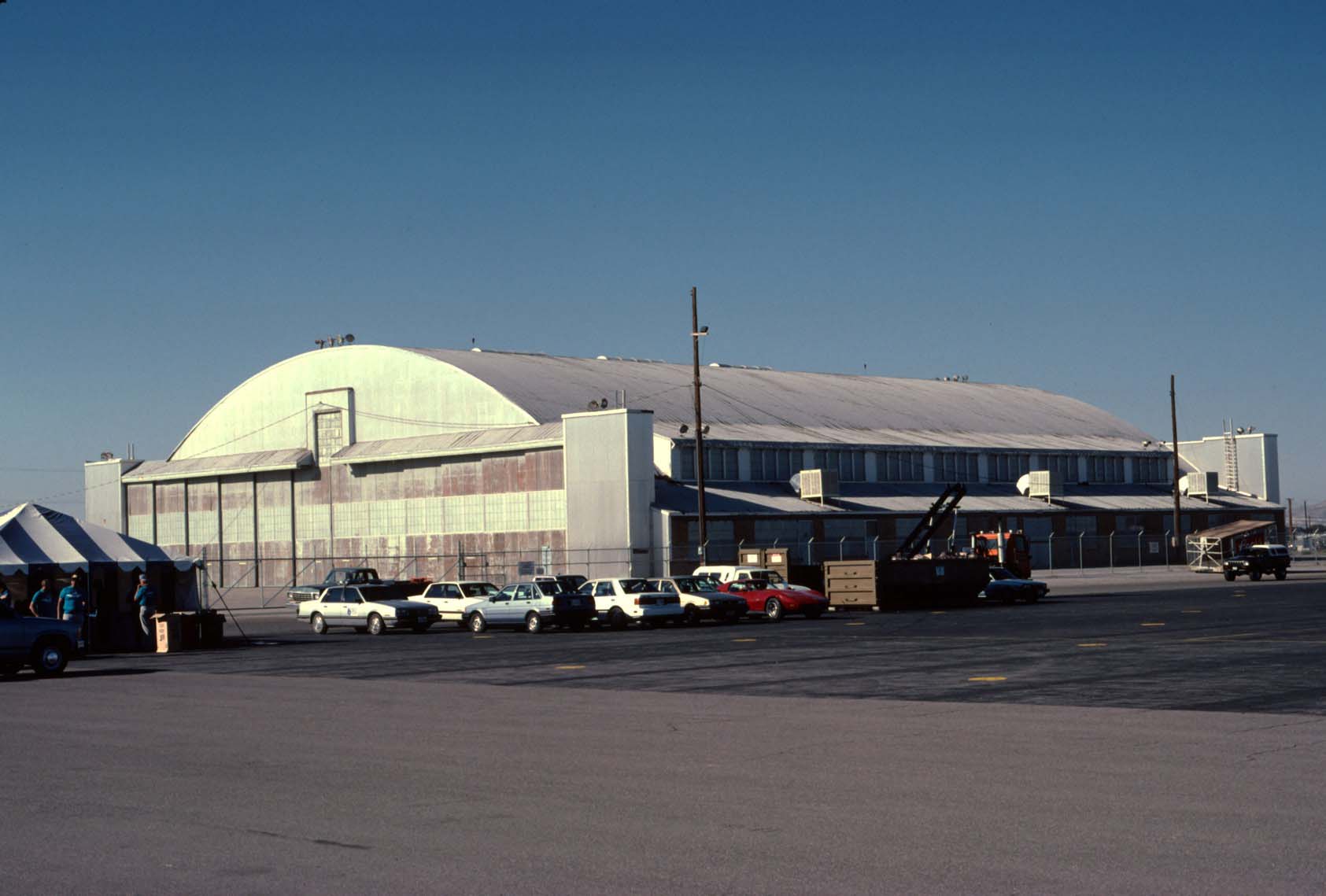 |
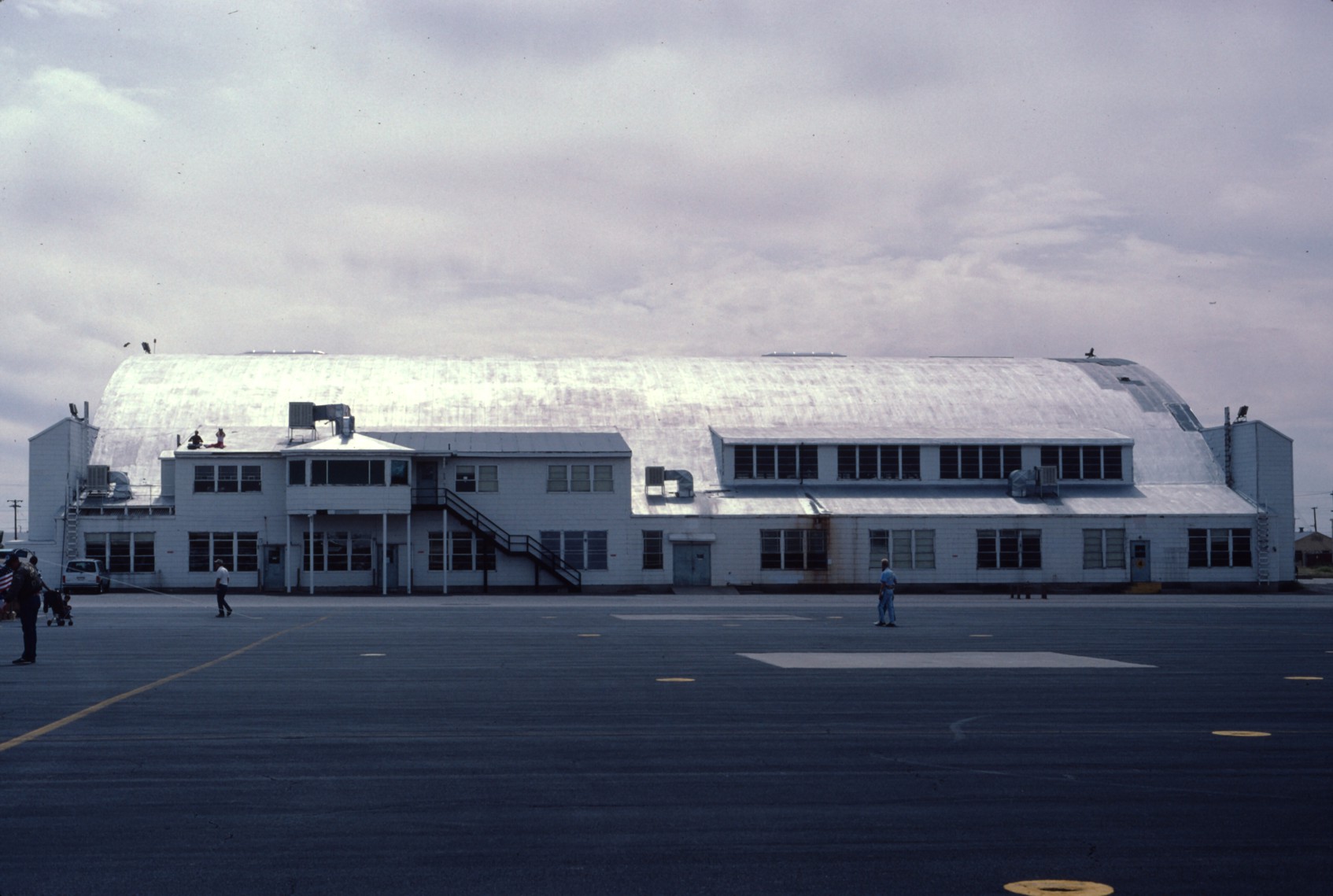
Two large hangars were built in the post WWII era to house 97th BW B-29s, one on the East end of the field and the other towards the West. . The hangar on the right is the one to the East, it housed the Threat System Management Office (TSMO) the Army's version of DSES. That unit operated several former Soviet aircraft: An-2, Mi-2, Mi-4, Mi-24 and several others. The hangar on the West end of the flightline survived until about 2011 and the one on the East end was reclaimed in the Spring of 2013.
 |
 |
 |
The largest hangar on the field is what is often called the "B-52 hangar". In reality is was built in 1953 for the 95th Bomb Wing's B-36s. It is on the West end of the Biggs ramp and houses several offices including the U.S. Border Patrol. The first photo was taken during the 1989 Amigo Airshow and shows three 188th TFS, New Mexico ANG ("Tacos") A-7Ds. Over the years this hangar has been the backdrop to a great many photos. In an email Joe Kinman added this about the hangar: "I had a good laugh when you referred to the large B-52 hanger, we called it VHB hangar (Vertical Hanging Bay-door hangar) ...there were more U-2s in that hangar than B-52s." (Joe was stationed at Biggs from 1960-1966.) The next two photos were taken in September, 2007 and nothing has changed.
 |
 |
As large as the VHB hangar is it is not big enough for a B-36 (or a B-52, or KC-135) to fit completely inside. As can be seen in the above photos there are cutouts for the tail of the airplane to stick out when "inside" the hangar. (Pima Air and Space Museum)
 |
A view of the old Air Force era Operations building with one of the B-29 hangars in the background. 1987 photo.
 |
 |
Though based at MacDill AFB, later Ellington AFB and finally at Westover AFB, the 5th Rescue Squadron maintained a detachment of SC-82A Packets at Biggs. The closest aircraft is C-82A 44-23033. This aircraft survived at least until the late 1990s at the Tucson International Airport and is shown in the second photo at that location in 1987. (USAF)
 |
 |
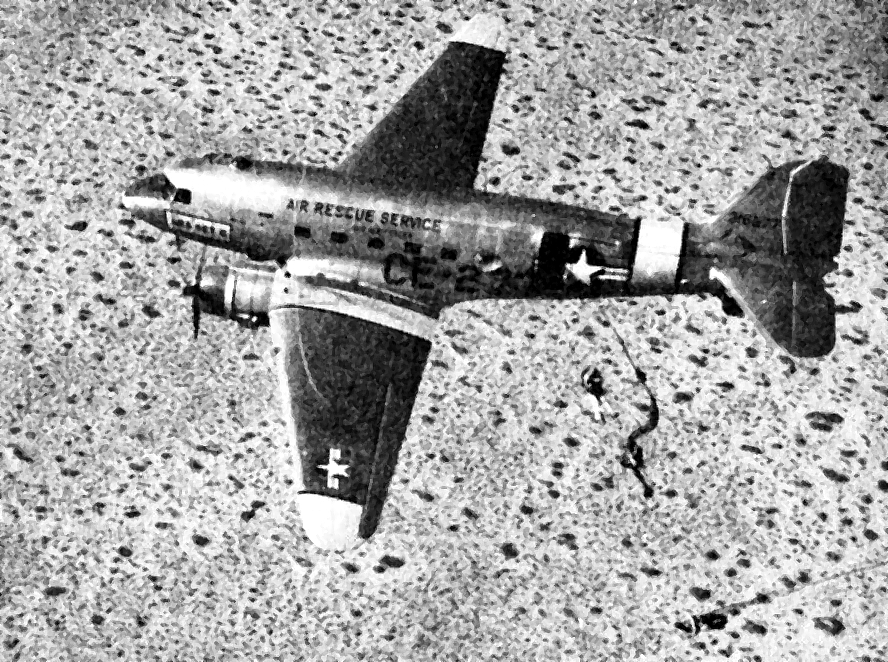 |
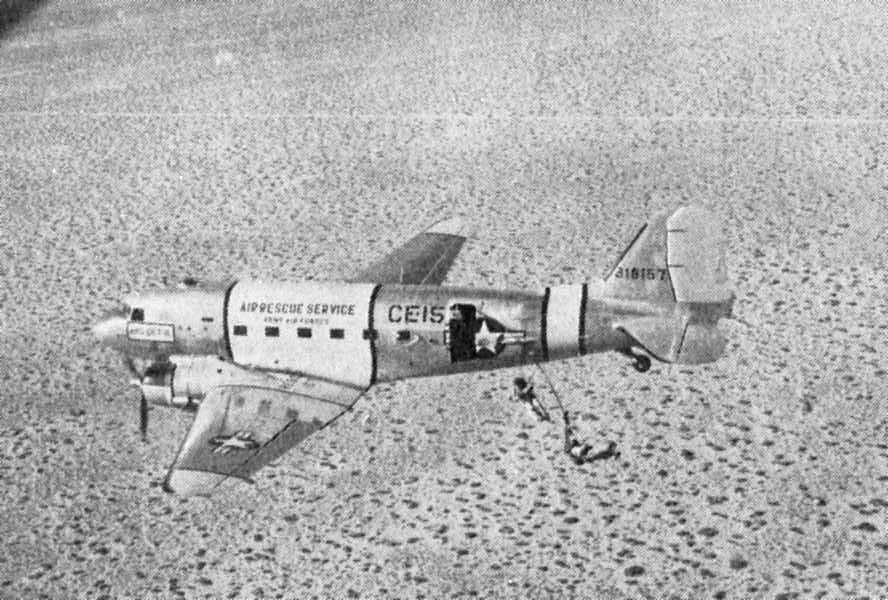
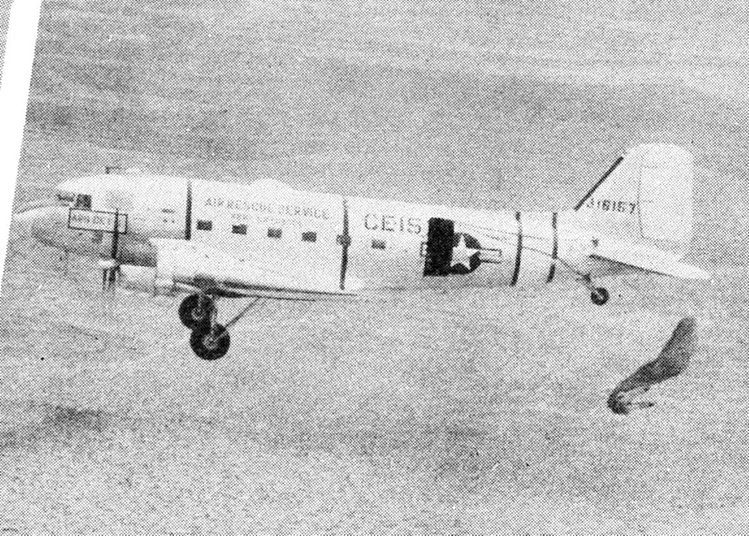
A couple of Air Rescue Service SC-47Bs (43-16157 & 43-16277) operating out of Biggs during pilot survival training operations in the late 1940s. Like the C-82s above, the C-47s most likely were with the 5th RS. (USAF)
In April, 2008 I received the following email from Robert Finch that provided some background for the C-47 photos: "I was really surprised to see the photographs of the Air Rescue paratroops being dropped in the desert Northeast of Biggs AFB in early 1948. I took those photos with a K-20 camera from the backseat of an L-5. We only dropped six men that day (pathfinders) because after we took off the wind came up to about 50 mph, and the last two guys were really banged up by being dragged across the desert when they landed. They radioed for us to stop dropping men and return to Biggs. I still have the original 8"x10" photos of the ones in your website, along with the ones taken from the ground showing me in the L-5 as we went down to take a close look at the injured men. The pilot of the L-5 really had his hands full getting us back to Biggs, with the wind blowing us all over the sky. He flew it right down to the middle of the East-West main runway, and we hardly rolled at all after touchdown. I was in the 85th Bomb Squadron, assigned to the photo lab of the 47th Bomb Group from October 1947 to June 1948."
 |
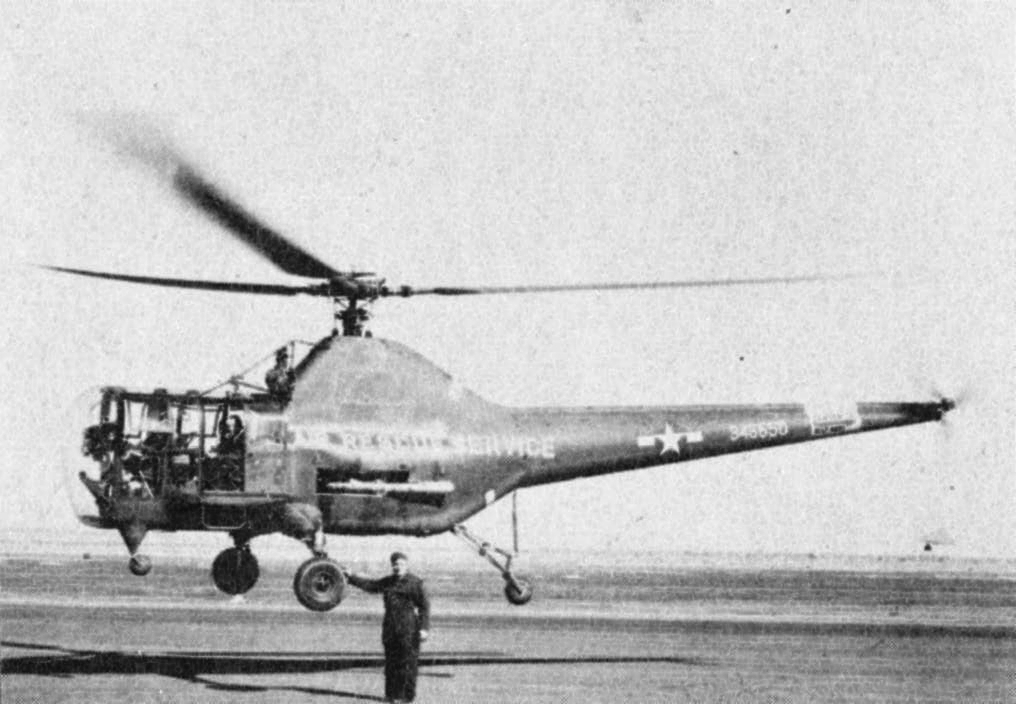 |
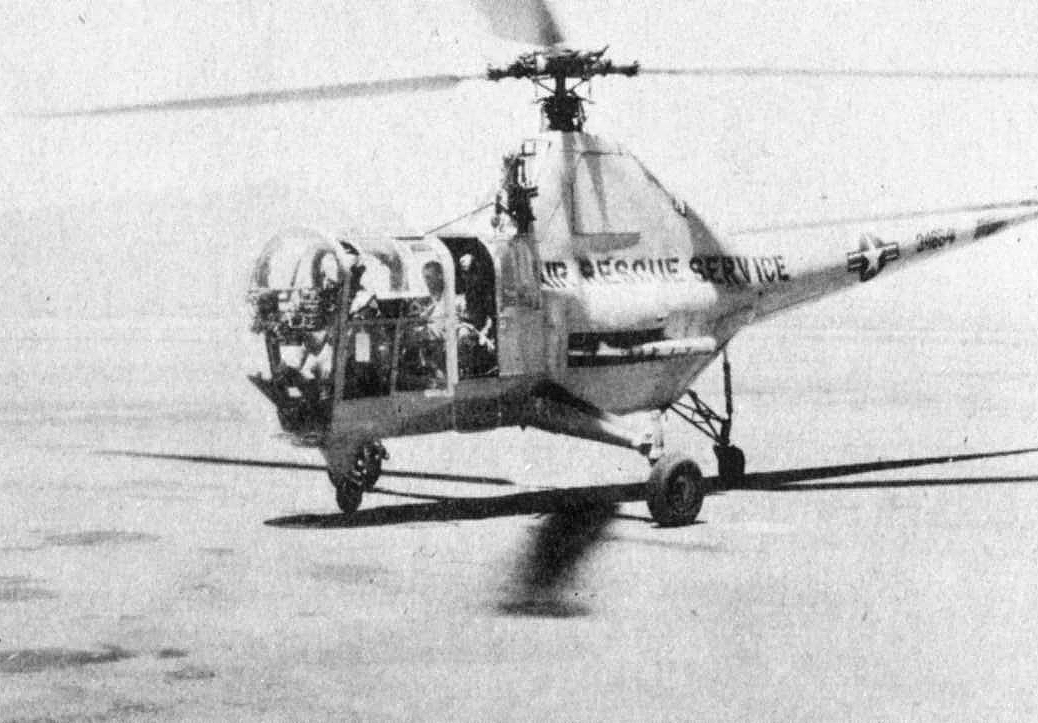
Helicopters were just starting to come into their own in the immediate postwar era. The Sikorsky S-51 was purchased by the USAAF (USAF in October, 1947) as the R-5 and by the USN as either the HO2S (YR-5A), or the HO3S (R-5F). In 1948 with a change in aircraft designations, helicopters were re-designated from an R designation to an H designation. The photos of the two Air Rescue Service R-5As above were taken at Biggs about the time that the R-5 became the H-5 and they illustrate transitional color schemes as well. 43-46641 on the left appears to be painted in yellow and 43-46650 on the right appears to be painted in olive drab. Yellow would become the standard color for several years. Both helicopters were most likely assigned to the 5th Rescue Squadron. One has to wonder what point the airman standing (with his hand on the main wheel) next to the R-5 on the right serves. (USAF)
 |
Even in the post WWII era airships occasionally made an appearance at Biggs. Here is the USN's M-2 blimp on a cross country stop at Biggs in 1946. (USAF)
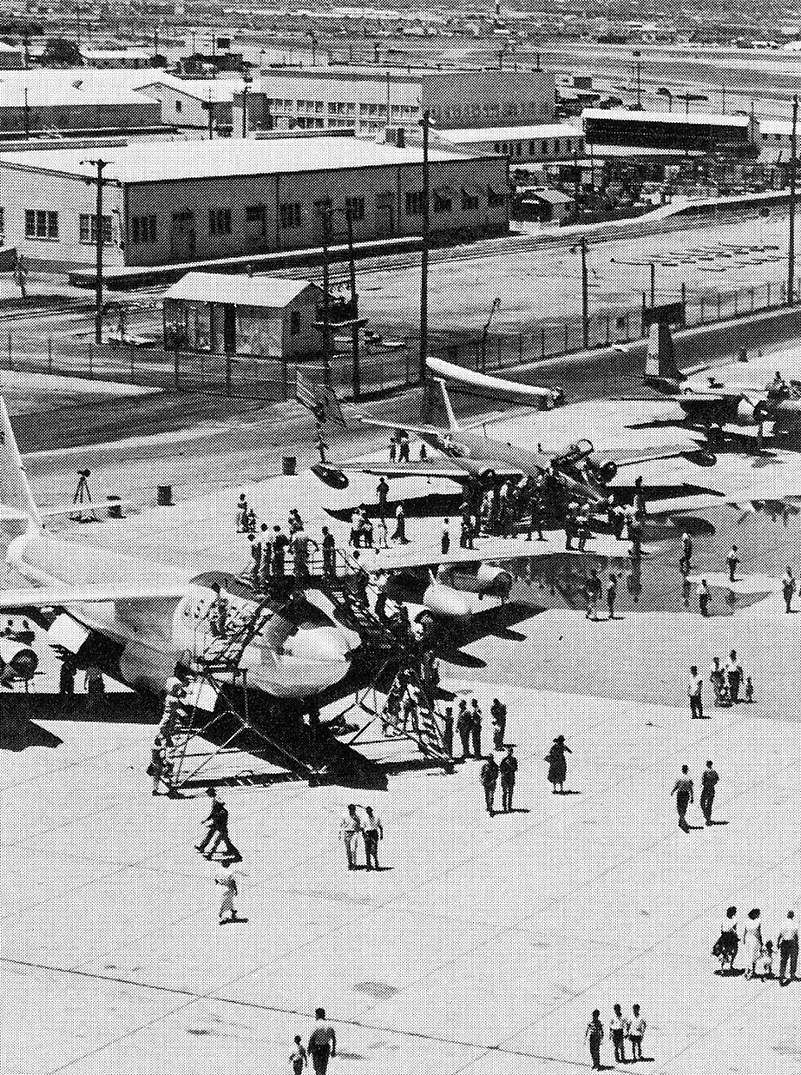 |
This photo is from the 1964 yearbook on the 95th BW, but there is no sure way to tell when it was actually taken. The B-57 most surely belongs to the 4758th DSES, but what unit the A-26 is with is anybody's guess. It could very well be based at Holloman AFB, but that is just speculation. The B-47E would have to be one of the last few in service if the photo is indeed from 1964. It is always possible that it is a stock photo and if so it could show a 97th BW B-47. This photo is taken towards the East end of the ramp. The TSMO hangar is out of the picture towards the right. (USAF)
 |
Throughout the history of Biggs it has not been uncommon for various units to use the base as a temporary "home". In this case RB-57A Canberras of the 172nd Tactical Reconnaissance Squadron (Michigan ANG) are starting engines.
 |
 |
 |
 |
Biggs still serves as a transient point for many aircraft. A regular site has been one of NASA's two B747 Shuttle carriers. N905NA (B747-123 serial 20107) delivered the Space Shuttle Enterprise in March, 1979. The combination stopped at Biggs on its way to Kelly AFB and was delayed to to rain at the destination and a dust storm in El Paso. The 747 had been acquired from American Airlines and at that point in time the letters were still faintly visible stained into the Aluminum finish. N911NA (B747-SR-46 serial 20781) is shown with the Shuttle Endeavor during a 1991 visit.. 905 is shown again at the 2003 and 2006 Amigo Airshows.
 |
NASA's Super Guppy (B377SGT-F) is shown during "touch-and-goes" at Biggs in January, 2007.
 |
 |
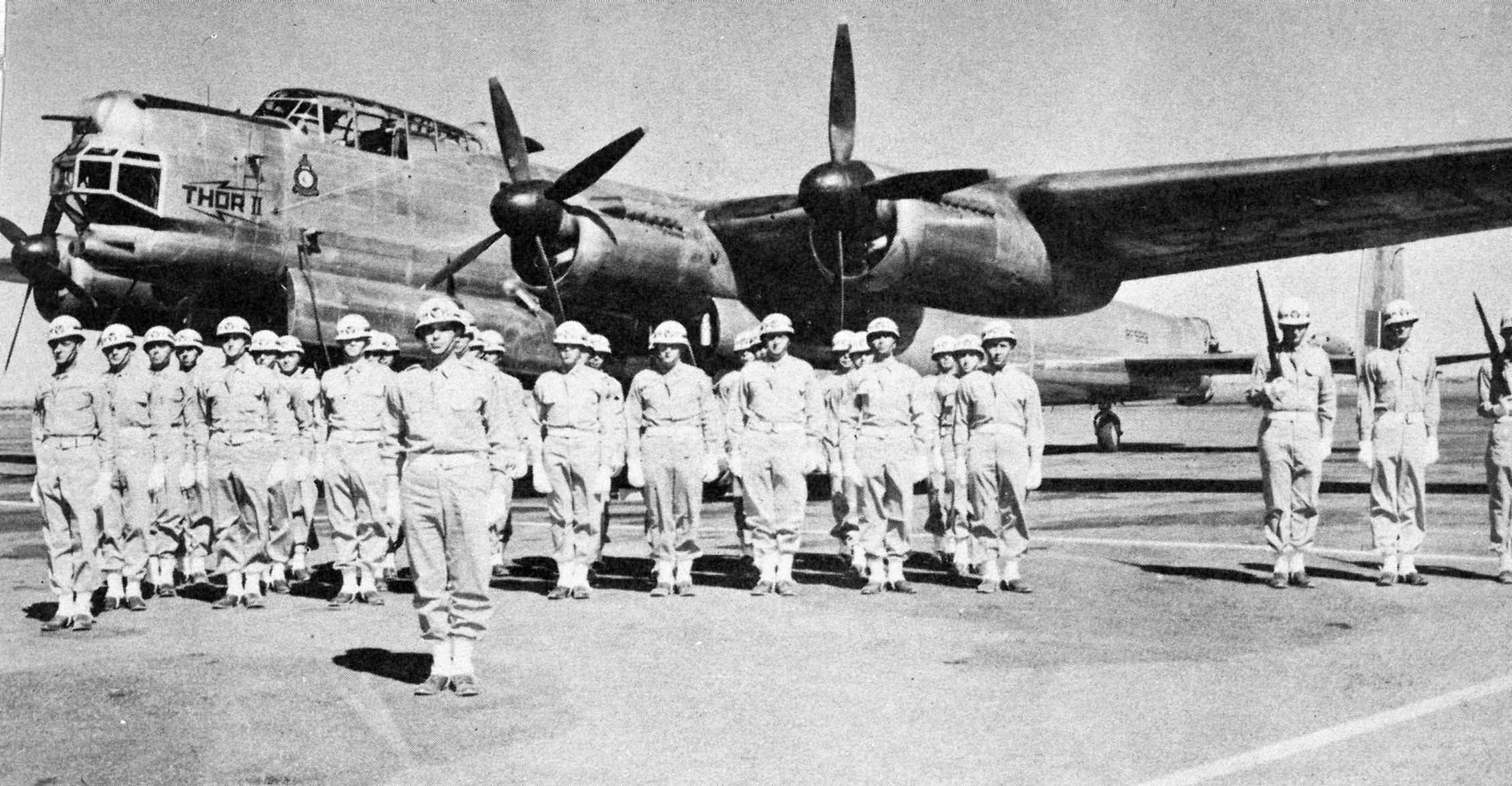
An RAF Lincoln B.2 (RF523) of the Empire Air Armaments School during a 1947 visit to Biggs. RAF Commodore H.D. Spreckley, O.B.E. and Col. Newton Longfellow USAF are shown in front of Thor II during that visit. Col. Longfellow was the CO of the 47th BW at that time. (USAF)
The Amigo Airsho has been an annual event at Biggs since 1981 and continues to draw some interesting aircraft.
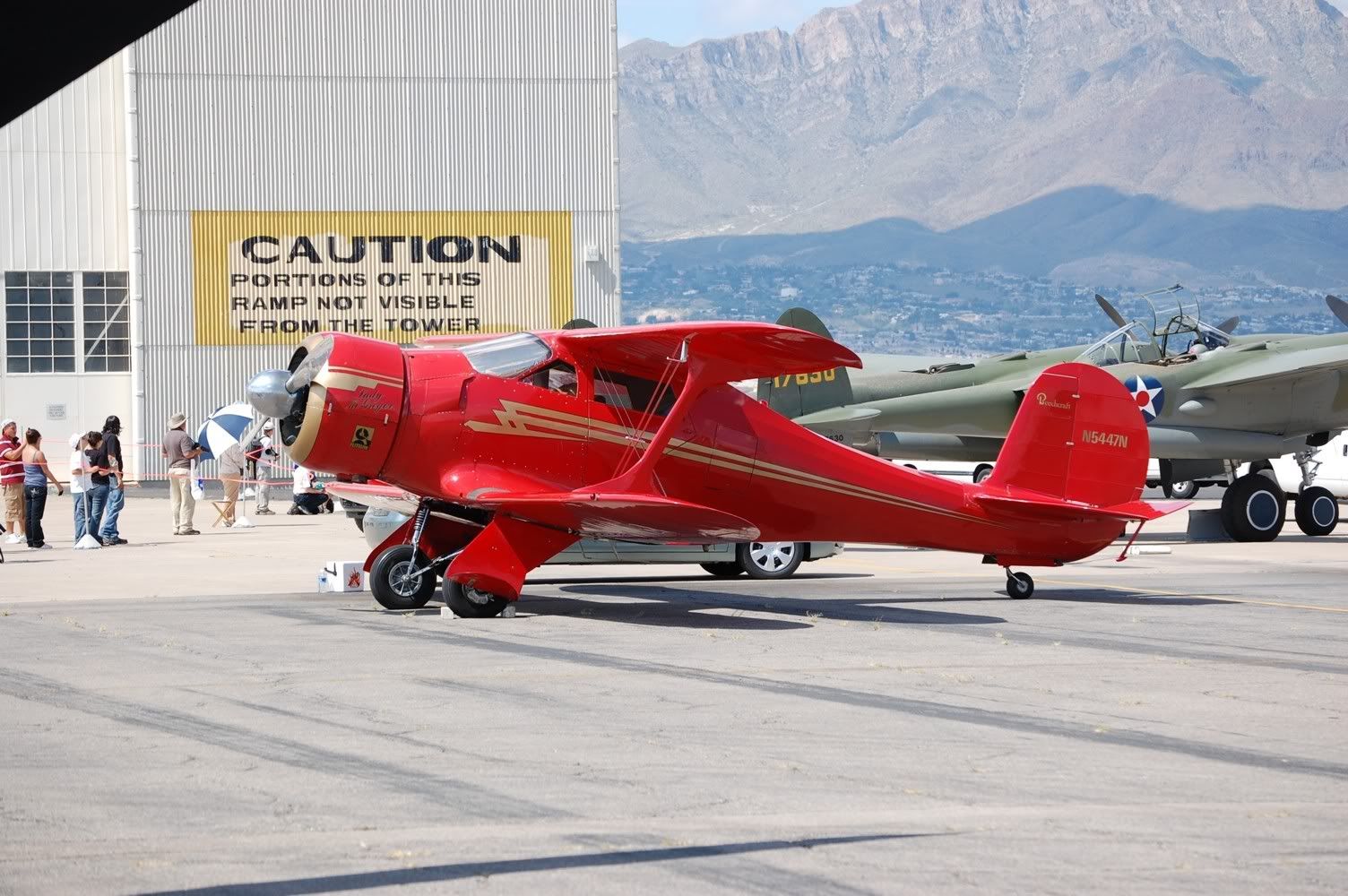 |
This Beech D17S Staggerwing (N5447N) displayed at the 2007 show is registered to Perlan Aviation. It had formerly belonged to Malcom McGregor and is still christened Lady McGregor.
 |
 |
 |
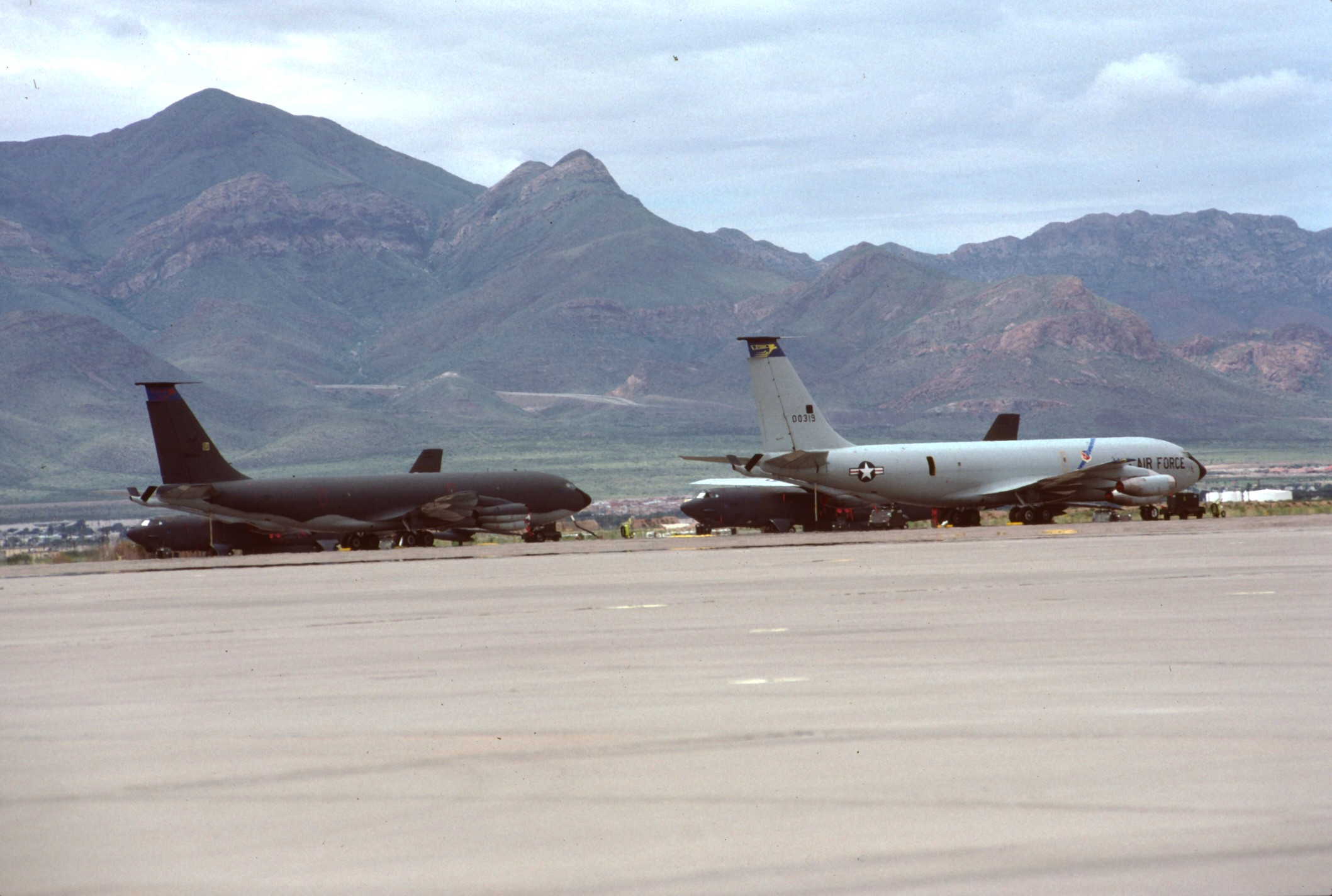 |
In late 1988 the 379th BW made a deployment to Biggs.
 |
Biggs AFB main gate in 1947. The entrance at the time was off Fred Wilson road, versus the later entrance at the intersection of Fred Wilson and Airport rd. The rock pillars were still in place until 2009, though that gate was long gone. The photo is poor quality due to being spread across two pages of a book on the 47th BW. The dark line through the right portion is where the binding of the book split the photo. (USAF)
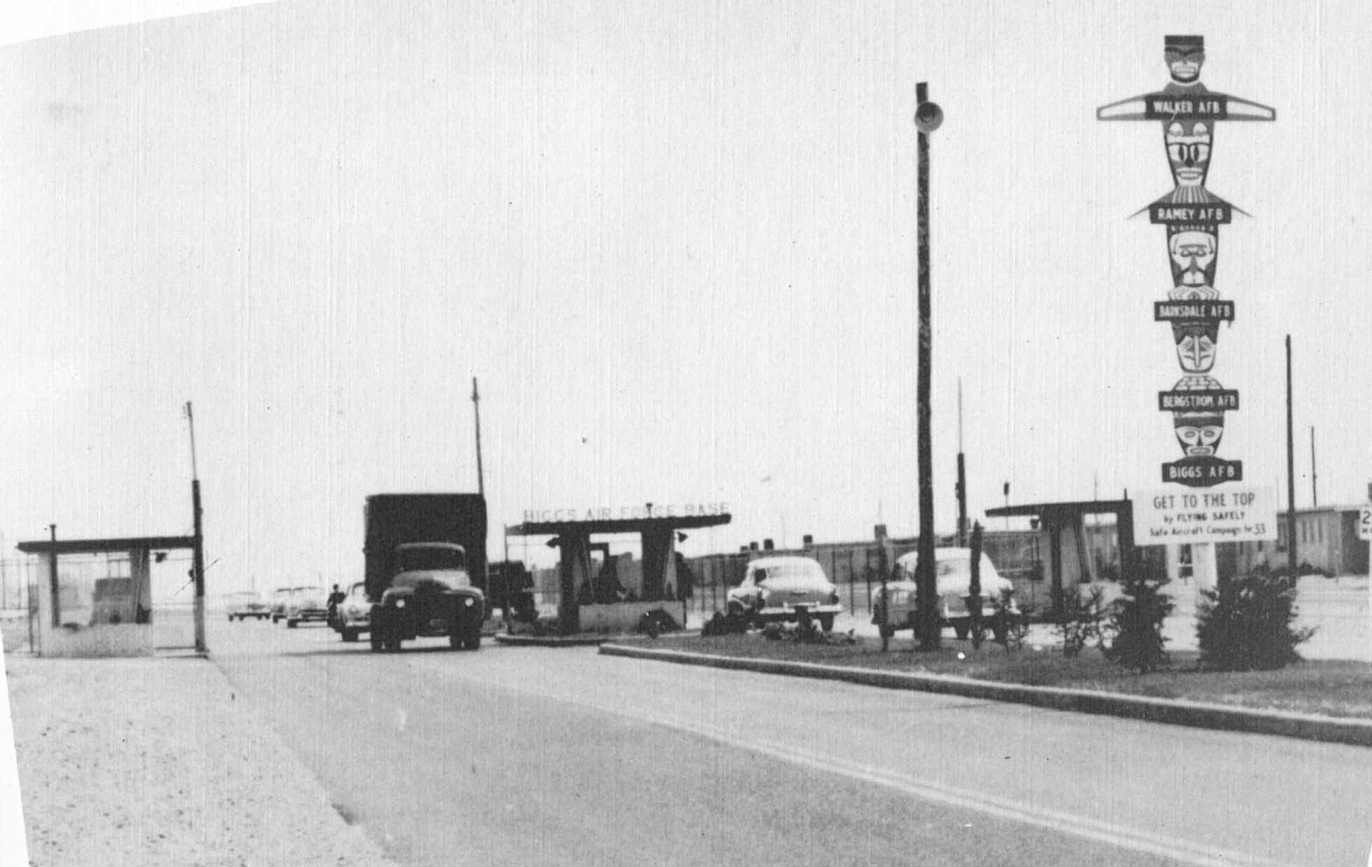 |
This photo shows the main gate in 1953. This is the present location (2007), though the guard shack is long gone, replaced with a more imposing structure. The totem pole is a device used in a safety campaign to implore base personnel to "Get To The Top by Flying Safely Aircraft Safety Campaign for 53". (USAF)
 |
The main gate remained unchanged until removed by the Army in the 1970s. This photo is about 1960. It is little changed from the 1953 photo. Too bad the totem pole is gone. (USAF)
 |
Any organization only functions through the effort of those involved. Their stories, experiences and remembrances are important to history and well, "how things work". I am trying to collect the experiences (however long or short they might be) of the people who served at Biggs. Some are sprinkled though this page and others and some will be tacked on here, at the end.
Here are some recollections I received from Gary Jones in April, 2008: " I just finished reading a very good book ("Jimmy Stewart Bomber pilot,") and thought a lot about my time in the 95th A&E maint Sq.
I arrived at Biggs in Sept 1958 as an E-5 re-trainee from ground radio maintenance into bomb-navigation systems maintenance. There were several of us who re-trained at AF request. We attended FTD at Biggs and went right to work on the B-36 A/C. All of us were very happy to be working on airplanes.( I think). Soon all of the 36's were gone. I remember working long and hard on the very last one which went to Ft. Worth as a monument to the Convair plant. When the last one left we went back to FTD to get ready for the B-52's. I was there on the flightline the day the first 3 arrived. I recall the tug operator connected the tow bar to one and attempted to back it into position and struck the A/C radome with the front of the tug cab. (it was a B-36 towbar). Sounded like a rifle shot and we now had a plane which wouldn't fly until it was fixed.
If I recall correctly those B-52's came from Limestone Maine and were in rough shape. We worked like beavers getting them ready and up to snuff.
Lot's of interesting things occurred there, a U-2 made an overnight visit and was quickly rolled into the big hanger. A C-133 cargo plane ran into ice over Alice TX for about 15 seconds and he made an emergency landing at Biggs and stayed around for quite awhile getting repair to sheet metal and windscreen damaged by the hail I removed the badly damaged radome and replaced it with another. Years later while working in Saudi Arabia I was telling a friend about the C-133 visit and he said he was the Flight engineer on that plane at the time.
I left Biggs Feb 1960 and spent the rest of my AF time working of fighter A/C( F-105, F-4D,E). I retired July 1974(E-8), and now live north of Seattle WA.
Thanks, Gary Jones (gmjones5@verizon.net) "
To return to:




Page updated 07-21-17
Clifford Bossie