
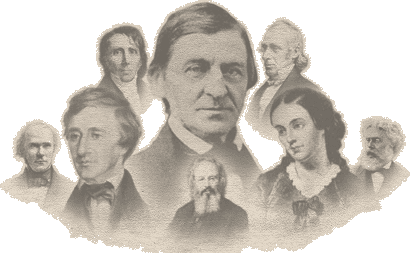
Transcendentalism was rooted in the transcendental philosophy of Immanuel Kant (and of German Idealism more generally), which the New England intellectuals of the early nineteenth century embraced as an alternative to the Lockean "sensualism" of their fathers and of the Unitarian church, finding this alternative in Vedic thought, German idealism, and English Romanticism.
The Transcendentalists desired to ground their religion and philosophy in transcendental principles: principles not based on, or falsifiable by, sensuous experience, but deriving from the inner, spiritual or mental essence of the human. Kant had called "all knowledge transcendental which is concerned not with objects but with our mode of knowing objects." The Transcendentalists were largely unacquainted with German philosophy in the original, and relied primarily on the writings of Thomas Carlyle, Samuel Taylor Coleridge, Victor Cousin,and other English and French commentators for their knowledge of it. In contrast, they were intimately familiar with the English Romantics, and the Transcendental movement may be partially described as a slightly later, American outgrowth of Romanticism. Another major influence was the mystical spiritualism of Emanuel Swedenborg.
As defined in "The Transcendentalist" by Ralph Waldo Emerson:
The term transcendentalism sometimes serves as shorthand for "transcendental idealism," which is the philosophy of Immanuel Kant and later Kantian and German Idealist philosophers.
Another alternative meaning for transcendentalism is the classical philosophy that God transcends the manifest world. As John Scotus Erigena put it to Frankish king Charles the Bald in the year 840 A.D., "We do not know what God is. God himself doesn't know what He is because He is not anything. Literally God is not, because He transcends being."
The Transcendental Movement dramatically shaped the direction of American literature, although perhaps not in the ways its adherents had imagined. Many writers were and still are inspired and taught by Emerson and Thoreau in particular, and struck out in new directions because of the literary and philosophical lessons they had learned. Walt Whitman was not the only writer to claim that he was "simmering, simmering, simmering" until reading Emerson brought him "to a boil." Emily Dickinson's poetic direction was quite different, but she too was a thoughtful reader of Emerson and Fuller. In his own way, even Frederick Douglass incorporated many lessons of transcendental thought from Emerson.
Other writers would deliberately take their direction away from transcendentalism, toward realism and "anti-transcendentalism" or what Michael Hoffman calls "negative Romanticism"; Edgar Allan Poe, Nathaniel Hawthorne, and Herman Melville found extraordinarily creative ways to object to many aspects of their transcendental contemporaries, even as they incorporated others. Few American writers since have been completely free of the influence of Emerson and Thoreau, whether in reaction or imitation.
Unitarian Universalists have long prided ourselves on our seemingly innate ability to transcend traditional beliefs and institutions. Transcend comes from the Latin words literally meaning to climb over, but is more accurately translated to surpass, go beyond, or to exceed. Throughout our history UU’s have surpassed traditional religion by insisting on the application of human reason in scriptural interpretation, and we’ve gone beyond traditional social norms and values by arguing that every individual ought to be free to discover his or her own truth and sense of morality. Like any person or group that moves beyond traditional values and social expectations, UU’s have met varying degrees of ridicule, exclusion, and hostility, if not outright persecution throughout our discombobulated history. During these difficulties, however, we have been comforted and consoled by the sense of personal fulfillment derived from genuine self expression, the integration of mind, word and deed, as well as the less admirable feeling of intellectual superiority over those imprisoned by the worn out irrational ideas of dead ancestors. Our inflated pride, however, which comes easy when surpassing the traditions of others, is taken down a notch or two whenever we are forced to reexamine our own traditions and are challenged to go beyond the constructs and institutions we ourselves have clung to for too long. As historian Perry Miller has suggested, there is a "concealed terror within the assurance of progress."1 English professor David Robinson, who quotes Miller in his book, The Unitarians and the Universalists, goes on to say that within the UU tradition there exists "the self-devouring nature of an impulse that must always destroy itself to go beyond itself."
It goes without saying, then, that Unitarian Universalism has not been without its own share of controversy during those periods it has had to face the angst associated with moving beyond its own traditions. It is somewhat ironic, perhaps, that the most prominent among these controversies, stemming from the Unitarian branch of our history, has itself become known as the "Transcendentalist Controversy," as if the very thing that makes us unique among religions, our willingness to sacrifice much, if not everything, to progress beyond tradition, became our fundamental challenge. Today Transcendentalism is more associated with a mystical literary genre than with the UU denomination, but, as Ian F. Finseth has pointed out, "Transcendentalism cannot be properly understood outside the context of Unitarianism, the dominant religion in Boston during the early nineteenth century."
The term transcendental itself was first coined by the 18th Century philosopher Immanuel Kant in the 1781 publication of his Critique of Pure Reason. Kant used the word to refer to knowledge that is a priori, that is, beyond empirical experience. But it is the great American essayist and poet, Ralph Waldo Emerson who has long been recognized as the father of Transcendentalism. Prior to his extraordinary career in the literary field, the Harvard educated Emerson followed in the footsteps of his long deceased father by becoming a Unitarian minister. In 1830 he was ordained and called to serve Boston’s prestigious Second Church, Unitarian, personally groomed by his predecessor, the Reverend Henry Ware, Jr. who was leaving to become Chair of Pulpit Eloquence and Pastoral care at Harvard. Harvard had been effectively run by the Unitarians since 1805 when Ware’s father, Henry Ware, Sr. was appointed Hollis Professor of Divinity. Just five years later another Unitarian, the Reverend John Thorton Kirkland was named Harvard’s President.
It was during this golden age of American Unitarianism that Emerson’s life took a dramatic change, beginning with the loss of his beloved wife Ellen to tuberculosis. Her death, less than two years after they had been married and Emerson had been ordained, seemed to catapult the grieving minister into spiritual crisis. Before long he shocked his congregation by asking them to dismiss him from administering the Lord’s Supper, something unthinkable to Unitarians at the time. Emerson found the ritual meaningless and could no longer administer it with any sense of integrity. After his congregation denied his request, Emerson resigned his position and traveled to Europe with money from his wife’s estate.
After returning to the United States he bought a home in Concord and began regularly meeting with others to discuss his emerging ideas and philosophy. Within a few short years he had established himself as a well respected and renown writer and lecturer. In 1837, five years after leaving the ministry, Emerson was asked to address the Harvard Divinity School. During his lecture, which lasted well over an hour, Emerson blasted what he referred to as "corpse cold Unitarianism," and challenged his young listeners to find their own unique voice by abandoning their slavish dedication to meaningless traditions. Although he didn’t deny that God spoke in the past, he felt, more importantly, that God continues to speak today through everyday experiences. While he infuriated the Harvard faculty and many of the denomination’s most respected ministers, some of the students listening took Emerson’s words to heart, including a young man by the name of Oliver Wendell Holmes who later referred to the notorious Divinity School Address as "our intellectual Declaration of Independence."
In her recent sermon on the subject, Kelly Crocker, Assistant Minister for Religious Education at the First Unitarian Society of Madison, Wisconsin, points out the three main charges Emerson leveled against the Unitarianism of his day.6 He began, she suggests, by indicting the clergy for their role in creating cold corpse Unitarianism. "…tradition characterizes the preaching in this country;" Emerson charged, "it comes from memory, and not out of soul; it aims at what is usual, and not what is necessary and eternal." Secondly, Emerson challenged Unitarian theology by insisting that "truth is truth, whatever its source," and isn’t restricted to the truths found in Christianity. At the time Unitarians still considered theirs a Christian denomination. They stood out theologically from other Christians only in rejecting dogma and sentimentalism in favor of rationalism, insisting that the enlightened individual could come to God through empirical investigation and the exercise of reason. Through reason they concluded the miracles written about in the Bible were proof that Jesus was sent as the revelation of God. Although they considered theirs "the religion of Jesus rather than the religion about Jesus," the Unitarians of the time, greatly influenced by Enlightenment philosophy, considered themselves liberal Christians, but Christians nonetheless.
It was against this enlightened Christianity that Emerson leveled his most serious charge, implying the Unitarian use of the word miracle was freakish. By this he meant that miracles are not part of the natural order through which the Divine is truly reveled. "Jesus spoke of miracles," he said, "for he felt that… life was a miracle… But the very word Miracle as pronounced by Christian churches, gives a false impression; it is Monster. It is not one with the blowing clover an the falling rain." Emerson came to believe that nature, the human mind and the mind of God correspond to and reflect each other. It is, therefore, unnecessary to approach God through a mediator such as Christ since every person and everything is part of the Universal mind of God and can connect to that mind quite naturally, not supernaturally. "In a system such as Emerson’s," writes David Robinson, "it was the ordinary course of nature that was endowed with divine significance, and a supernatural miracle was simply an intrusion on this process. A belief in miracles was not only unnecessary but obstructive to the religious life." Insisting that intuition of the soul is the only genuine source of religious knowledge, Emerson condemned the worship of the person of Jesus rather than his principles by saying Christianity "has dwelt, it dwells, with noxious exaggeration about the person of Jesus. The soul…" he continued, "knows no persons."
In response, the incensed Unitarian clergy and Harvard faculty attempted to dismiss Emerson’s remarks as "infidelity." The term "transcendentalism" was itself originally a pejorative characterization by those who opposed what Emerson’s supporters simply called the "new views." Nevertheless, as the Reverends David and Beverly Bumbaugh have concluded, "Whatever his intentions may have been, Emerson permanently weakened the authority of Christianity within American Unitarianism and replaced it with an intuitive and mystical quality. In one summer afternoon, Ralph Waldo Emerson transformed the nature of religious discussion."
Although Emerson himself had already left the Unitarian ministry, believing his personal mission was beyond the church, he challenged the Divinity school graduates to do their part to breath new life into Unitarianism. An already radical student by the name of Theodore Parker more than took Emerson’s call to heart. Three years after Emerson’s Divinity School Address, Parker delivered a sermon entitled The Transient and the Permanent in Christianity during which he took Emerson’s "new views" to greater extremes by suggesting all truth is axiomatic and self evident and must, therefore, be true whether Jesus had ever existed or not. As the Bumbaughs have summarized, "The form and the doctrines of Christianity," Parker insisted, "are all transient. What is permanent is the word of God as it is expressed in each human heart, the word of God as it is spoken through Conscience, Reason and Faith and the that truth existed before Jesus, and after him and in all times and places and has no need of miracles to justify it."
If, as somewhat of an outsider, Emerson’s address had been a slap in the face to Unitarianism, Parker’s, as a resolute insider, was a dagger through its heart. His fellow clergyman began calling for him to withdraw from ministry. Some wanted to actually try him for heresy which was still illegal at the time. But Parker refused to resign, insisting his rejection of miracles and Jesus’ divinity was a right of his free speech. Although the Boston Association of Ministers did not have the authority to oust a minister in good standing with his congregation, they did attempt to silence him as much as possible by refusing to exchange pulpits with him. The Association also excluded his name from the Unitarian Yearbook and many ministers refused to sit with him or even shake his hand at ministerial and Unitarian gatherings.
Despite being ostracized by his Fellows, Parker’s popularity grew, particularly among the younger members of the denomination. In 1846 a group of Boston laymen founded the Twenty-Eighth Congregational Society and called Parker as its settled minister. There he regularly preached to a crowd of more than 3,000 people, the largest congregation in Boston, making him the most popular and influential minister there. Indeed, the American Unitarian Association felt so threatened by his popularity that it flirted with the idea of adopting a creed that would exclude Parker from fellowship. Although this never happened, in 1853 they did adopt a declaration affirming "Jesus Christ, the everlasting Son of God, the express image of the Father, in whom dwelt all the fullness of the God-head bodily, and who to us is the Way and the Truth and the Life." The declaration, however, meant more to further distance the denomination for Parker than to "enforce a rigid doctrine," was all but forgotten about within a few years.
Despite these efforts, however, the effects of Transcendentalism upon the denomination had become ingrained. The controversy between those who wanted to retain their identity as liberal Christians and those who came to accept a non-personal God that could be known in many ways, through many traditions, had become part of Unitarianism itself and wasn’t going away anytime soon. The old guard would have to accept that their denomination had forever changed.
Transcendentalist thinkers like both Emerson and Parker tried to shy away from the argument as much as possible by immersing themselves in more important matters, applying their transcendent principles to the social ills of their day. The Unitarian Transcendentalist poet, Henry David Thoreau, for instance, became a staunch advocate of civil disobedience in the fight against slavery. Theodore Parker himself became heavily involved in the temperance movement, women’s rights, prison reform, opposition to the death penalty and war, and is said to have kept a loaded pistol at his desk when preparing his sermons to protect the runaway slaves he was harboring. Because the Transcendentalists viewed God as a living, active and experiential force in the world, it was only natural that they should seek to demonstrate their religious values through social reforms. As Robinson suggests, "Underlying Parker’s theological struggle was a political one, and although he was one of the more dramatic of the political reformers, the political question itself permeated the entire Transcendental movement."
George Ripley, Unitarian minister of Boston’s Purchase Street Church between 1826 and 1841 was another central figure in the Transcendentalist movement and became, perhaps, its most notable social reformer. Like Emerson and Parker, Ripley became a controversial figure by disputing the importance of biblical miracles. But he is most widely known for what is, arguably, the most famous utopian experiment in American history. In April of 1841 Ripley started the Brook Farm, a non-competitive, classless community that attempted to match people’s labor with their interests and skills. Nathaniel Hawthorne was among the its members, and it attracted such prestigious visitors as William Ellery Channing, Margaret Fuller, Horace Greeley as well as both, Ralph Waldo Emerson and Theodore Parker. Unfortunately, after only five years a devastating fire forced the Brook Farm into bankruptcy and closure.
Today, what has become the Unitarian Universalist
Association has learned to embrace its Transcendentalist heritage and, as our
principles suggests, we value the inherent worth and dignity of every person as
a result, and embrace their right to a free and responsible search for meaning.
In many ways the Transcendentalist Controversy is the same coming of age story
for the Unitarian Denomination that is often experienced by its individual
members. Many of today’s UU’s come to the denomination after some experience
with traditional Christianity. After a period of genuine soul searching and
intellectual honesty we begin to realize the love of God must be more inclusive
than any single tradition can confine and, thus, we seek out a community that
transcends tradition by respecting the interdependent web of all existence with
all its diversity. At the same time, this heritage challenges us to continue
questioning our traditions as we strive to transcend, to go beyond, to surpass
even ourselves. Ours is a difficult and challenging faith that ever calls us to
face the terror associated with our own progress. Like the sacred image of the
tail eating snake we must become willing to devour ourselves in order to
transcend ourselves, in the realization there is much more to our lives than
what has already passed. As Emerson wrote, "Every spirit builds itself a
house; and beyond its house, a world; and beyond its world, a heaven. Know then,
that the world exists for you."
