
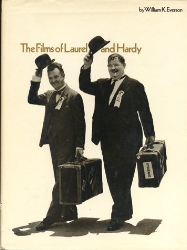
[NOTE: Portions of this book are available for free on-line reading. Click here to go to the on-line link to this book.]
For many years, William K. Everson's book The Films of Laurel and Hardy--now inexplicably and incorrectly re-titled The Complete Films of Laurel and Hardy (Citadel Press, $14.95)--was one of the few print sources for an evaluation of L&H's movie teamwork. For this reason, it occupies a warm place in the hearts of many L&H buffs.
It is still worth a look, but certain elements of the book have dated badly. The entry on Laurel and Hardy's short Duck Soup (1927) was written (as a "lost" film) a few years before it was rediscovered. (Everson wrote a critique of the film in another book, John McCabe and Al Kilgore's Laurel and Hardy [1975], sadly out of print but reviewed elsewhere on this site.) And another "lost" L&H film, Now I'll Tell One (1927), is for obvious reasons not listed in the book. It's a pity that Everson didn't do an update on his book before his death.
Even without the film rediscoveries, the book is lacking in many ways. Everson's claim that Block-Heads (1938) is a "Stan Laurel Production" is in no way backed up by either film historians or even the movie's credits. (Laurel's production credit appears only in Our Relations and Way Out West.) In the entry on Beau Hunks (1931), Everson writes, "Four reels was a clumsy length for Laurel and Hardy, and they never repeated it." But they actually did, when they made A Chump at Oxford (1940) as one of Hal Roach's "featurettes" of the time; it was only when the movie proved to be a hit that L&H added an extended prologue to the movie.
The most annoying aspect of the book, though, is how condescending it is, particularly in reference to L&H's "studio movie" years when 20th-Century Fox and MGM took Laurel's control away from their movies. Everson suggests that Stan and Babe might have been "tired and played out" by this point, even though they went on to tour Europe for many years after their Hollywood stint. In light of the oft-repeated fact that the studios insisted on using typical make-up on L&H, thus "aging" their characters, particularly cruel is a 1944 photo of a made-up Stan, with Everson's caption, "Laurel's age was really beginning to show by now." Even a cursory reading of John McCabe's bio Mr. Laurel and Mr. Hardy could have told Everson about the studio-inflicted problems which he attributes to old age.
In terms of individual critiques, the book is still likable enough, and the generous helping of photos and publicity shots doesn't hurt. But in the three decades since The Films of Laurel and Hardy was first published, many other L&H biographies have far surpassed it in terms of factual accuracy and empathy towards The Boys.
(C) 2010, Steven Bailey.
