
kamnaa ko tyaag, bhakti raah pe tu chal...
vasnaa mein kayuoN jale, aarti saa jal..
Selected Verses from the Bhagwad Gita As It Is*
Lord Krishan defines the relationship of the soul to the human body through the following verses:
2.13 - As the embodied soul continuously passes, in this body, from boyhood to youth to old age, the soul similarly passes into another body at death. A sober person is not bewildered by such a change.
2.22 - As a person puts on new garments, giving up old ones, the soul similarly accepts new material bodies, giving up old and useless ones.
Karma Yoga – The Lord gets things done through us and we should not be boastful of our achievements or be attached to the fruits of our actions.
2.47 - You have to perform your prescribed duty, but you are not entitled to the fruits of action. Never consider yourself the cause of the result of your activities, and never be attached to not doing your duty.
3.27 - The spirit soul bewildered by the influence of false ego thinks himself the doer of activities that are in actuality carried out by the three modes of material nature.
3.9 - Work done as an offering to Vishnu has to be performed, otherwise work causes bondage in this material world. Therefore O Arjun, Perform your prescribed duties for His satisfaction, and in this way you will always remain free from bondage.
4.41 - One who acts in devotional service, renouncing the fruits of his actions, and whose doubts have been destroyed by transcendental knowledge, is situated factually in self. Thus he is not bound by the reactions of work.
5.3 - One who neither abhors nor desires the fruits of his activities is known to be always renounced. Such a person, free from all dualities, easily overcomes material bondage and is completely liberated.
4.19 - One is understood to be in full knowledge whose every endeavor is devoid of desire for sense gratification. He is said by sages to be a worker for whom the reactions of work have been burned up by the fire of perfect knowledge.
4.20 - Abandoning all attachment to the results of his activities, ever satisfied and independent, he performs no fruitive action, although engaged in all kinds of undertakings.
The concept of detachment, eating only remnants of the food offered first to the Lord and realizing God through Dhayana Yoga are emphasized in the following verses.
2.70 - A person who is not disturbed by the incessant flow of desires – that enter like rivers into the ocean, which is ever being filled but is always still – can alone achieve peace, and not the man who strives to satisfy such desires.
3.13 - The devotees of the Lord are released from all kinds of sins because they eat food which is first offered to Krishna. Others, who prepare food for personal sense enjoyment, verily eat only sin.
4.7 - Whenever and wherever there is a decline in religious practice, O Arjun, and a predominance of irreligion – at that time I descend myself.
6.7 - For one who has conquered the mind, the Supersoul is already reached, for he has attained tranquility. To such a man happiness and distress, heat and cold, honor and dishonor are all the same.
6.8 - A person is said to be established in self-realization and is called a yogi (or mystic)when he is content by virtue of acquired knowledge and realization. Such a person is situated in transcendence and is self-controlled. He sees everything – whether it be pebbles, stones or gold – as the same.
Lord Krishan is the creator, sustainer and annihilator of everything material.
7.10 - O Arjun, know that I am the original seed of all existences, the intelligence of the intelligent, and the prowess of the powerful men.
8.5 - Whoever at the end of his life, quits his body, remembering Me alone, at once attains My nature. Of this there is no doubt.
8.16 - From the highest planet in the material world down to the lowest, all are places of misery wherein repeated birth and death take place. But one who attains to My abode, never takes birth again.
9.18 - I am the goal, the sustainer, the master, the witness, the abode, the refuge and the most dear friend. I am the creation and the annihilation, the basis of everything, the resting place and the eternal seed.
9.22 - Those who always worship Me with exclusive devotion, meditating on My transcendental form – to them I carry what they lack, and I preserve what they have.
10.8 - I am the source of all spiritual and material worlds. Everything emanates from Me. The wise who perfectly know this engage in My devotional service and worship Me with all their hearts.
10.20 - I am the Supersoul, seated in the heart of all living entities. I am the beginning, the middle, and the end of all beings.
10.39 - I am the generating seed of all existences. There is no being – moving or non-moving – that can exist without Me.
14.4 - It should be understood that all species of life, are made possible by birth in this material, and that I am the seed-giving father.
Bhakti Yoga – meditating on the Lord’s personal form and chanting the holy names is the easiest way to attain Him.
12.2 - Those who fix their minds on My personal form and are always engaged in worshipping Me with great and transcendental faith are considered by Me to be most perfect.
12.6/7 - Those who worship Me, giving up all their activities unto Me and being devoted to Me without deviation, engaged in devotional service and always meditating upon Me, having fixed their minds upon Me - for them I am the swift deliverer from the ocean of birth and death.
About the Three Modes of material nature.....
14.9 - The mode of goodness conditions one to happiness, passion conditions one to fruitive action; and ignorance, covering one’s knowledge, binds one to madness.
17.4 - Men in the mode of goodness worship the demigods, those in the mode of passion worship the demons; and those in the mode of ignorance worship ghosts and spirits.
Austerity...
17.14 - Austerity of the body consists in worship of the Supreme Lord, the Brahmans, the spiritual master, and superiors like the father and mother, and in cleanliness, simplicity, celibacy and non-violence.
Final Words from Lord Krishan...
18.66 - Abandon all varieties of religion and just surrender unto Me. I shall deliver you from all sinful reactions. Do not fear.
Pass to Vaikunth
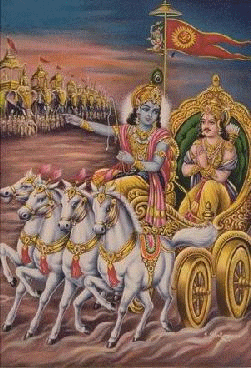
At the battlefield of Kurukheshter, Arjun saw the faces arrayed against him - his own family members, friends and revered teachers. He was overwhelmed with grief at the thought of having to kill them all to win the battle, and said to Krishan (2.7), "Now I am confused about my duty and have lost all composure because of miserly weakness. In this condition I am asking You to tell me for certain what is best for me. Now I am Your disciple, and a soul surrendered unto You. Please instruct me."
This incident marks a major shift in Arjun's relationship with Krishan - from a friend to a disciple. Arjun was in a state of despair. He was facing death along with those of his loved ones. Few situations in life drive a person to an unconditional surrender to the Lord and this was one. There was a transition from a relationship based on friendship to one between a student and a learned Master, when Arjun humbled himself and asked for advice. Lord Krishan was pleased with Arjun's surrender and quick to explain the nature of the soul and our duty/purpose in life.
Normally what we get from a situation depends on what we put into it. But in this case, we are fortunate that Arjun asked for the Lord's advice on our behalf, and it all got recorded. The most confidential knowledge is readily available to us in the Bhagwad Gita. Arjun asked for advice because he was in a life and death situation. Our predicaments in life may not be as severe, but we too are facing certain death. It is only a matter of couple of ticks of the cosmic clock, and we too will be dust. So, we are essentially in the same situation, facing our mortality. But, we are fortunate to have access to the secrets of life from the Bhagwad Gita without first humbling ourselves to attain that knowledge.
At the end of Krishan's message, Arjun could see everything clearly (18.73). Life and death, our duties/obligations and our conduct in life became clear to him. He was perplexed no more. Sanjay was ecstatic with Krishan's words. Through His words he saw Him in all His manifestations (18.75 - 77). By reading and following the injunctions of Bhagwad Gita, we can elevate ourselves to a level where we can go to Vaikunth (Krishnaloka) and break the cycle of death and rebirth. We can put an end to the misery, that is human life.
Bhakti
When the intellectual curiosity has been satiated, when there are no more questions to be asked, when all the spiritual knowledge cataloged and presented in flowery prose by the learned people has been scanned, dissected and assimilated; without the person being able to still the tidal waves of his psyche, it is then that the mental speculation gives way to the practice of ‘Bhakti’. It is then that the intellect surrenders to the divine in a spirit of devotion. It is then that the man’s ascent to a spiritual life begins.
A person introduces an element of ‘Bhakti’ in his life with his very first visit to a temple. When he gets there, the person does not have to recite any prayers, he does not even have to utter a single word, for the Lord can see the devotion in his heart. Just showing up with folded hands and devotion in his heart for a Darshan - Darshan, which requires neither prayer nor commitment but rather is an act of being in His presence, an act that submerges the self in a striving for the infinite - stills the troubled waves of ones mind. About a visit to the temple, the poet says,
Human nature dictates that we find an anchor to build our lives around. In our desperate search we go from door to door, we bounce from person to person and we jump from coattail to coattail to find something stable, someone we could depend on, in times of crisis. At times we feel that we have found that person and we latch on to him. When bad times do come around, as they must, we are in a state of disbelief when we find ourselves bereft of the one person we focused our lives on, one person we centered our pride on, one person who was supposed to be our anchor. Suddenly the framework of our existence seems to be receding from us. We are left only with shattered dreams.
A person who lacks a stable anchor cannot maintain equilibrium in the face of adversity. And as we well know, human relations are all transitory. We have to find something more stable, someone who would not disappoint us in times of need. That is why we have to cultivate a consciousness in which the omnipotent Lord is the anchor. The fortieth chapter of the Yajur Ved states that we should build our lives around Him, as He is the only one who is eternal and would stand by us in every adversity. To start with, one could simply visualize the deity of Lord Krishan and chant the Hare Krishan Mahamantar any time he is not mentally occupied with doing something. Over time this could extend to keeping that image of the Lord in the subconscious at all times. When He rules the subconscious mind, the person is surrendered and the rhythms of life are keyed to performing His service. In the Bhagwad Gita(12.8), Lord Krishan says, "Just fix your mind upon Me, and engage all your intelligence in Me. Thus you will live in Me always, without a doubt".
Continued practice in surrendering himself enables a person to develop the consciousness capable of remembering the Lord at the time of final exit. In the Bhagwad Gita( 8.5), Lord Krishan says, "Whoever at the end of his life quits his body remembering Me, attains My nature. Of this there is no doubt". Mahatma Gandhi did not suddenly think of invoking the Lord's name by saying Hey Ram at the time of his death. He spent his whole life with Him as his anchor. He constantly practiced keeping Him in his subconscious. And so must we!...so that our faith becomes a living experience.
Many scholars have studied the Bhagwad Gita and tried to provide us with an insight into the teaching of Lord Krishan. Although every chapter of Gita alludes to some aspect of our moral code, the most powerful teaching arises from Arjun's paralysis on the battlefield.
Arjun's perplexity arises over the question of dharam, which as a warrior, bids him to fight in order to protect the goodness, and as a person, forbids him to kill the members of his own family, his revered teachers and dear friends. Faced with Arjun's renunciation and his inability to wage war, Lord Krishan resolves his dilemma in two parts. He reminds Arjun that: (1) he must observe his dharam and, (2) the soul survives the body. In the first instance He tells Arjun that he must perform his duty, which for a warrior is to fight the evil forces to the very end and preserve goodness. Secondly, one should not worry about death, as the soul can never be slain. Rather it sheds one body at death and takes on a new one, in birth after birth.
Further Lord Krishan says that successive rebirths may be avoided by observing your dharam with complete disregard to the fruits of your action. He exhorts Arjun to hold alike happiness and unhappiness, gain and loss, victory and defeat in pursuit of his dharam. A person need not become an ascetic to achieve liberation, but only renounce the fruits of his action, and perform his duty without caring about the results. Lord Krishan says that your entitlement is only to the action, and not to the fruit it bears.
These are the answers to Arjun's dilemma. But there is another teaching which is of the greatest importance. This is the teaching of devotion to God. Lord Krishan says that he who along with his struggle for survival, also remembers Him and adores Him, is the greatest ascetic.
Steeped in this Hindu philosophy, one overcomes all obstacles in life and leads a peaceful and happy life.
In the twelfth chapter of the Bhagwad Gita, Arjun enquires from Lord Krishan about the relative merits of reaching Him through devotional service versus through worshipping the impersonal Brahman, the unmanifested.
Lord Krishan answers, "Those whose minds are fixed on me in steadfast love, worshipping me with absolute faith, I consider them to be most perfect." He further adds, "As for others who worship the unmanifest, indefinable and changeless, that which is omnipresent, constant, eternal and lies beyond the perception of the senses, and they do so by holding all the senses in check, are tranquil minded and devoted to the welfare of humanity, and see the Atman in every creature; they will also come to me."
"But the devotees of the unmanifest have a harder task, because the unmanifest is very difficult for embodied souls to realize."
Bhakti yoga, or the process of reaching Him by being in direct devotional service to the Lord is easier and natural for us humans. The individual soul is embodied since time immemorial, and it is very difficult for a common man to visualize that he is not the body and that the Lord does not have any physical attributes either. In Bhakti yoga, as described in Bhagwad Gita, a person accepts the Deity of Krishan as Brahman with body features and engages himself in devotional service to the Lord. So it becomes a very easy and natural process for him to reach the Supreme Being.
Janana yoga, or the process of reaching Him through understanding the unmanifested Supreme Being is very difficult. By his very nature, a common man has trouble identifying with the formless Supreme. However, if he is persistent in his quest, he might realize the eternal and attain spiritual realization through the guidance of a highly learned devotee. But the unguided intellectualization of the unmanifest may lead a person to become an atheist. Unfortunately a large percentage of today's intelli gensia falls squarely into this category.
Bhakti Yoga, according to the Bhagwad Gita, is the shortest path to spiritual realization.
The last few chapters of the Bhagwad Gita enumerate the modes of material nature and the characteristics of people living under their influence.
The three modes of material nature are 'sattva-guna' or the mode of goodness, 'rajas-guna' or the mode of passion, and 'tamas-guna' or the mode of ignorance.
Lord Krishan says, "Sattva rules a person who offers sacrifices in accordance with scriptural instructions and does not covet their fruits. Satto-guni, or a person inspired by sattva is impelled by an inner sense of duty. The performance of sacrifices by a Rajo-guni is for the outward show, in the hope of a divine reward and is inspired by rajas. The Tamo-gunis on the other hand, totally disregard the scriptural instructions and make no offering, no prayer of dedication, no gift to the priest and are devoid of faith."
The Lord further adds, "The austerity of the body comprises of reverance for the gods, brahmins and gurus; uprightness, physical cleanliness and sexual purity and non-violence. Austerity of speech comprises of speech that does not hurt anyone, is truthful, kind and beneficial, as well as daily recitation of scriptures. The austerity of mind comprises serenity of mind, gentleness, self control and inner purity. The triple austerities practiced with the highest faith and with nary a thought of reward crossing ones mind is the nature of sattva. The austerity undertaken out of self-pride, and in order to gain the reputation and homage attendant on pious acts is of the rajas type. Austerity practiced under some foolish misconceptions, by means of self torture or to hurt another person is of the tamas type."
Clearly a satto-guni will do everything as an offering to God. Any work done in this mode shall be the result of doer's best effort and will be performed with great will-power and determination. The motive for the effort will be something higher than the next paycheck or the next promotion. Internally a person will be all fired up to perform but outwardly he would appear to be calm and unstressed as there is no passion involved in the effort. The non-attachment to rewards of ones actions is sometimes considered to suggest coldness and lack of enthusiasm. But in reality, one is freed from the fear of failure and the desire of rewards, and offers everything he does as a sacrament of devotion to his duty. Leading ones life as a satto-guni therefore, is the most spiritual and stressfree mode that one should strive to achieve.

jag to andhakaar hai, is se tu nikal...
gyan kaa prakash kar, moD tu samabhal...
Radha Krishan ke charan maiN nitya kar naman...
Man to mandir hai......haridaya hai varindavan....
