|
Bavarian Pouter (Bayerische Kröpfer) |

At the huge pigeon/poultry show in Nürnberg, Germany in December, 1995 there
was a good number of Bavarians on display. I was surprised to note that the
foot feathering was not very well developed. Although some birds showed good
length and shape of foot feathering there were a number of birds which had
very small muffs, somewhat like a Lahore.
The most striking color in Bavarians is black, no doubt due to the sharp
contrast of white and black feathering. Few blacks were shown in Nürnberg but
I recall an excellent black hen shown in a "Voliere"--a community pen with
perhaps 20 Bavarians in it. To my knowledge there are no black Bavarians in
the United States.
The difficulty in breeding the Bavarian is achieving the proper markings.
At this point, the U.S. birds do not breed true. That is, a mating of two nicely
marked birds might yield young with too much white in the wings (bishop marked),
pied marked young (marked like an English or Pigmy Pouter), as well as some
properly marked young. The percentage of well marked has increased in the
last several years so perhaps we are getting closer to having the markings
"fixed".
Another difficulty is the presence of the pencilled gene in the breed.
Pencilled can create some very attractive washed out laces as found in Czech
Bagdads and Hana Pouters. However, when attempting to breed properly colored
blue bars pencilled distorts the color by washing out the bars somewhat and
giving a grizzled effect in the secondary flights and tail not unlike
undergrizzle. A true white bar cannot be achieved by using the pencilled gene.
I mention this because there are some expressions of heterozygous pencilled blue
bars where the bars are nearly white. Again, the effect is reminiscent of
grizzle rather than toy stencil. A breeder interested in the washy "laces"
would do well to combine the effect with spread. In blue bars the color
washes out in the wings to produce a white bird with a colored head. The
typical markings of the wings are lost. We have specifically selected to eliminate pencilled from our stock of Bavarians and believe it to no longer be present in our stud.
The highest quality is generally found in the blue bars. In the United
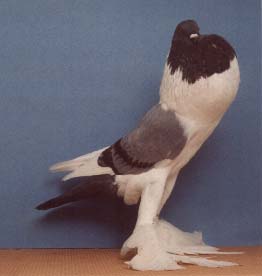
States the breed has a small following and has been exhibited since the 1980s. The bird pictured is a recent winner in the National Pouter
and Cropper Club. Bred and owned by the team of Jay Beals and Layne Gardner
this cock bird shows nice type with long legs and very nice markings. He was not only champion of breed but also overall champion pouter/cropper over more than 525 birds.
Click on the hyperlink to view a photo of a past National Champion
Bavarian Pouter. This blue bar young hen was bred by the team of Jay Beals
and Layne Gardner and is part of a developing stud of wonderfully typed
Bavarians.
National Champion

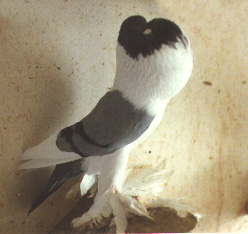
Blue bar in Zausinger's loft
A very nice blue bar Bavarian in the loft of the originator of the breed, Karl Zausinger. This photo was taken by Frank Barrachina during Frank's visit to Zausinger in the 1980s.
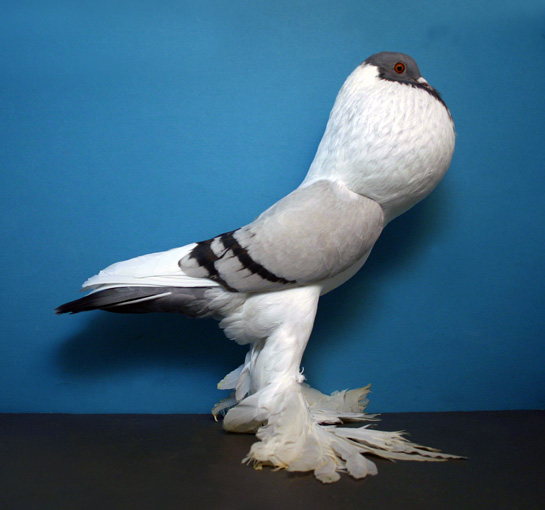
"E" rated Blue Bar This lovely blue bar, shown at the 2009 VDT show in Leipzig bred by the breed originator's son, Karl Zausinger.
 Return to Layne's Pigeon Site