


About Our Magickal Moon...
Full Moon names date back to Native Americans, of what is now the northern and eastern United States. The tribes kept track of the seasons by giving distinctive names to each recurring full Moon. Their names were applied to the entire month in which each occurred. There was some variation in the Moon names, but in general, the same ones were current throughout the Algonquin tribes from New England to Lake Superior. European settlers followed that custom and created some of their own names. Since the lunar month is only 29 days long on the average, the full Moon dates shift from year to year. Here is the Farmers Almanac’s list of the full Moon names.
The Moon, in Astrology, is the ruler of Cancer. The Moon represents our deepest personal needs, our basic habits and reactions, and our unconscious. Where the Sun acts, the Moon reacts. How do we instinctively react or respond to problems? What do we feel we need for a sense of security? Look to the Moon in your natal chart for answers. The Moon is associated with the Mother and with feminine energy in general. The Moon is both our inner child and our inner mother. It is responsive, receptive, and reflective. The Moon is our spontaneous and instinctual reactions. Just as the Moon circles the Sun, in a symbolically protective manner, and reflects the Sun's light, the Moon in our chart shows how we protect ourselves, as well as make ourselves feel secure, comfortable, and safe. We can also think of the Moon as that which gives us animation. It rules rhythmic ebb and flow of activity and energy. The Moon is a mediator between the inner world and the outer world. While the Sun is rational, the Moon is irrational. Habitual behaviors and prejudices are ruled by the Moon. Prejudices may not be acted out, as our Sun may censor them, but the Moon rules our spontaneous reactions and feelings. For some of us, our Moons seem to drive our personalities more than the Sun does. This is particularly true if the Moon is in a water sign (Cancer, Scorpio, or Pisces), or if it is conjunct an angle in the chart (near the Ascendant, Descendant, 4th house cusp, or 10th house cusp). For true happiness in life, it is wise to neither give your Moon too much nor too little importance in your life. Grant Lewi, in Astrology for the Millions, offered the most evocative description of the Moon when he wrote the following: "When you "know what you mean but you can't say it," it is your Moon that knows it and your Sun that can't say it. "Thoughts that do often lie too deep for tears" are the thoughts of your Moon's nature. The wordless ecstasy, the mute sorrow, the secret dream, the esoteric picture of yourself that you can't get across to the world, or which the world doesn't comprehend or value - these are the products of the Moon in your horoscope.


When you are misunderstood, it is your Moon nature, expressed imperfectly through the Sun sign, that you feel is betrayed. When you know what you ought to do, but can't find the right way to do it, it is your Moon that knows and your Sun that refuses to react in harmony. Also, when you "don't know why I said that," it was your Moon expressing despite your Sun (if you are innerly satisfied with the involuntary speech), or the Sun expressing against the will of the Moon (if you are displeased with what has slipped out). Things you know without thought - intuitions, hunches, instincts - are the products of the Moon. Modes of expression that you feel are truly your deepest self belong to the Moon: art, letters, creative work of any kind; sometimes love; sometimes business. Whatever you feel is most deeply yourself, whether or not you are able to do anything about it in the outer world, is the product of your Moon and of the sign your Moon occupies at birth. With respect to the other luminary (the Sun), the Moon infuses the past into our lives through the feelings, while the Sun reflects the present or the "here and now". When we are "acting out" our Moon, we are imaginative, creative, intuitive, sentimental, adaptable, introspective, and protective. On the negative side, we can be moody, restless, and irrational. In the natal chart, the position of the Moon by sign shows how we emote and respond to our environment, as well as our instinctual habits, especially in our homes and in private. By house, the Moon's position shows which areas of life we feel the most "at home" or comfortable.

The Goddess & The Moon
The Moon has traditionally been connected with the three aspects of the triple Goddess.. Maiden ( Waxing Moon), Mother (Full Moon), Crone (Waning Moon), there is also another aspect not readily mentioned and that is the Entrantress (Dark Moon). Rituals and spells always work better when they are done in sync with the proper Moon Phases. By doing this you combine the natural energy with you own energy and power. The Moon's cycle can affect the way we feel about things. In particular, when the Moon is Full or New/Dark, both males and females can experience dramatic changes in their mood and behavior. When the Moon is Full, stress becomes a major factor and people become more sensitive to details. An overload of work will add to the frustration and people will deal with their own needs rather than paying attention to others' needs. Often, a lack of assertiveness will be obvious. A Dark Moon brings with it the sense of calmness. In this Moon cycle, people's emotions get back to normal, their determination will return with the feeling that anything can be accomplished, and there will be more energy and acceptance of other other's ideas.


The Full Moon
Amid the cold and deep snows of midwinter, the wolf packs howled hungrily outside Indian villages.
Thus, the name for January’s full Moon. Sometimes it was also referred
to as the Old Moon, or the Moon After Yule. Some called it the Full Snow Moon,
but most tribes applied that name to the next Moon.
Since the heaviest snow usually falls during this month, native tribes of the north
and east most often called February’s full Moon the Full Snow Moon.
Some tribes also referred to this Moon as the Full Hunger Moon,
since harsh weather conditions in their areas made hunting very difficult.
As the temperature begins to warm and the ground begins to thaw, earthworm casts appear,
heralding the return of the robins. The more northern tribes knew this Moon as the Full Crow Moon,
when the cawing of crows signaled the end of winter; or the Full Crust Moon,
because the snow cover becomes crusted from thawing by day and freezing at night.
The Full Sap Moon, marking the time of tapping maple trees, is another variation. To the settlers,
it was also known as the Lenten Moon, and was considered to be the last full Moon of winter.
This name came from the herb moss pink, or wild ground phlox, which
is one of the earliest widespread flowers of the spring. Other names for
this month’s celestial body include the Full Sprouting Grass Moon,
the Egg Moon, and among coastal tribes the Full Fish Moon,
because this was the time that the shad swam upstream to spawn. .
In most areas, flowers are abundant everywhere during
include the Full Corn Planting Moon, or the Milk Moon.
This name was universal to every Algonquin tribe. However, in Europe
they called it the Rose Moon. Also because the relatively short season
for harvesting strawberries comes each year during the month of June . . .
so the full Moon that occurs during that month was christened for the strawberry!
July is normally the month when the new antlers of buck deer push out of their foreheads
in coatings of velvety fur. It was also often called the Full Thunder Moon,
for the reason that thunderstorms are most frequent during this time.
Another name for this month’s Moon was the Full Hay Moon.
The fishing tribes are given credit for the naming of this Moon, since sturgeon,
a large fish of the Great Lakes and other major bodies of water, were most
readily caught during this month. A few tribes knew it as the
Full Red Moon because, as the Moon rises, it appears reddish through
any sultry haze. It was also called the Green Corn Moon or Grain Moon.
This is the full Moon that occurs closest to the autumn equinox. In two years out of
three, the Harvest Moon comes in September, but in some years it occurs in October.
At the peak of harvest, farmers can work late into the night by the
light of this Moon. Usually the full Moon rises an average of 50 minutes
later each night, but for the few nights around the Harvest Moon,
the Moon seems to rise at nearly the same time each night: just 25 to
30 minutes later across the U.S., and only 10 to 20 minutes later for
much of Canada and Europe. Corn, pumpkins, squash, beans,
and wild rice the chief Indian staples are now ready for gathering.
This was the time to set beaver traps before the swamps froze, to ensure a supply of warm winter
furs. Another interpretation suggests that the name Full Beaver
Moon comes from the fact that the beavers are now actively preparing for
winter. It is sometimes also referred to as the Frosty Moon.
During this month the winter cold fastens its grip, and nights are at their
longest and darkest.It is also sometimes called the Moon before Yule. The term Long
Night Moon is a doubly appropriate name because the midwinter night
is indeed long, and because the Moon is above the horizon for a long time.
The midwinter full Moon has a high trajectory across the sky because it is opposite a low Sun.

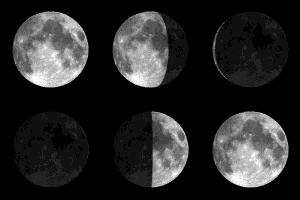
A new moon is the moment when the Sun and Moon are in conjunction, meaning that the Sun and Earth are on the opposite sides of the Moon. A New Moon cannot normally be seen from the Earth since only the dark side of the Moon faces the Earth at New Moon. Sometimes, if the New Moon is close to the Lunar nodes of its path, it causes a Solar Eclipse.
A few days after the new moon phase, the Moon will be visible again in a phase that lasts until the first quarter, called waxing crescent moon. The initial period, just after the Moon becomes visible, is sometimes called new moon, although it has another definition. Although only a small part of the Moon may be illuminated by the Sun, the rest of the Moon may also be faintly visible, due to a reflection from the Earth to the Moon, called earthshine. The waxing crescent moon is most visible after sunset.
During the first quarter, half of the Moon is illuminated, as seen from the Earth. The Moon rises near the middle of the day and sets near the middle of the night. In northern regions of the world, the right part will be visible, while the left part will be visible in the southern regions. Near the equator, the upper part is bright after moonrise, and the lower part is bright before moonset (the bright part appears and disappears first).
The waxing gibbous moon occurs between the first quarter and the full moon. The sun illuminates more than half of the Moon's surface during this period.
Full moon appears when the Sun and the Moon are on opposite sides of the Earth. As seen from Earth, all of the Moon's surface will be visible. The full moon is visible from sunset to sunrise. , the Moon can appear to be full for a couple of days, since more than 98 percent of the Moon's disc is illuminated a day before or after the full moon. During full moon, the Moon may pass through Earth's shadow causing a lunar eclipse. If the whole moon is in the Earth's shadow, or umbra, a total lunar eclipse occurs. If only a part of the Moon enters the umbra, we see a partial lunar eclipse.
The period between full moon and third quarter The portion of the visible half of the Moon illuminated goes down from 100 percent to 50 percent during this period.
The third quarter moon occurs when the other half of the Moon is illuminated compared to the first quarter. On the day of third quarter, the Moon rises approximately in the middle of the night and sets in the middle of the day. Third Quarter Moon; The Moon is now in a position 270° degrees from tfrom Earth.
The waning crescent moon is the period between the third quarter moon and the next new moon. It is most visible before sunrise. The Sun illuminates less than half the Moon during this period. When only a small part of the Moon is visible, it may be possible to see earthshine on the dark side of the Moon.
A lunation is a cycle of the Moon. It starts at new moon and lasts until the next new moon. On average, it takes the Moon 29 days 12 hours 44 minutes to go from one new Moon to the next. This time frame is called a synodic month. The duration of a synodic month varies from one lunation to another, most importantly because the orbit of the Earth and Moon are ellipses rather than circles, where the orbit speed depends on how close the orbiting object is to the mass center. For example, the Moon moves faster when it is closest to the Earth. Some years, such as 2004, have relatively small duration differences throughout the year (five hours difference between minimum and maximum duration), while the year 2008 will have larger differences (more than twelve hours).

Blue Moon --
The saying "once in a blue moon" has nothing to do with color. Instead it refers to the relatively rare occurance of what is called a "blue moon". When there is 2 Full Moons in one month. (However, an actual blue-colored moon could occur from atmospheric effects such as a big forest fire on Earth causing a lot of haze. This has happened in the past!)
More on the Blue Moon..

Apogee and Perigee of the Moon
Apogee and perigee refer to the distance from the Earth to the moon. Apogee is the furthest point from the earth. Perigee is the closest point to the earth and it is in this stage that the moon appears larger. Looking at the moon in the sky without anything to compare it to, you wouldn't notice any size difference. But the difference in size can in fact be quite significant.
If you were to photograph a full moon at apogee and perigee (using the same lens), here's how the two sizes would compare: The average distance from Earth is 237,700 miles (382,500 km). Effects of Apogee and Perigee of the moon have a definite affect on the weather and tides here on Earth. When the moon is at Apogee, the furthest distance from the Earth, it has less gravitational pull. Weather conditions can be more stable and the tides more predictable. When the moon is at Perigee, closer to the Earth, there is much more gravitational pull and it can whip up the tides and cause weather to become more unstable.

What Is...EarthShine
If there is a glow on the dark portion of the Crescent Moon It is caused by sunlight that reflects off the Earth onto the Moon's dark side, you can see the Moon's outline, and it's dark features, even though only a thin crescent is bright. We see the Moon because of reflected sunlight. (the Moon does not generate its own light). At times, however, the dark part of the Moon glows this is EarthShine.
More on EarthShine..

The Harvest Moon
A harvest moon occurs at a specific time of the year. The moon officially turns full when it reaches the spot opposite to the sun. The harvest moon happens on 13:59 Greenwich time on the Saturday nearest to the fall equinox, which is September 23rd. Once in every three years we get the same full moon in October, but the one in September is called the harvest moon because farmers can continue their harvest late into the night by the light of the full moon. The same moon appears three days in succession, but the one that appears on Saturday is the one that receives this name. Other names for this moon are the Wine Moon, the Elk Call Moon and the Singing Moon. It received the name of harvest moon because it appears in the Northern Hemisphere at the time of the year that coincides with the harvesting of crops. During a harvest moon there are other advantages for the bird lovers of our planet. This is the perfect time to watch the birds migrate past the light that emits from the moon. Some studies have proven that birds rely on the Harvest moon to migrate from one area to another. They have also proven that the birds wait for this moon to begin their migration.
The moon during the year rises about 50 minutes later each day, but near autumn equinox the time shortens to 30 minutes. Some years there is an extra treat for moon watchers when they do their gazing between dusk and dawn. Wildfires in North America and dust storms in Africa sometimes fill our air with aerosols. A low hanging harvest moon can give an array of colors that is not usually seen. There is also an added treat to watching a harvest moon. This is called moon illusion because the rising or setting moon looks bigger than when it does high in the sky.

The Moon & The Tides
Almost everyone is aware of the role that gravity plays in our lives. Not only does it keep our feet planted firmly on the ground, but it also keeps order in the solar system. The gravitational forces associated with the Sun and the planets interact to describe the orbits that we are familiar with, as well as keep the Moon trapped in orbit around the Earth. These forces aren't only limited to managing the dynamics of the celestial bodies, however. Gravity also has a more directly observable influence on our planet. Specifically, gravitational forces are responsible for the rise and fall of the ocean's tides all over the world.
More on the Moon and Tides..
Your Moon Signs
Moon in the Signs
You may be familiar with your 'Sun Sign', but what is a Moon Sign? Like your Sun Sign being in what Zodiac sign when you were born, the same for your Moon Sign, it's what sign the Moon was in when you were born. The Moon is said to rule your personality, while the Sun rules your individuality, You may be surprised to learn that you may illustrate more of your Moon Sign qualities than your Sun Sign, by reading your Moon Sign you will be able to see how much the Moon affects your personality. The descriptions are quite general, but may ring true nonetheless.
More on Your Moon Signs..
The Moon continuously "moves" through the Zodiac, from Aries to Pisces. Each sign possesses its own meaning. Not only does the Moons position in each sign represent your personality, it also represents different meanings in each Sign for day to day use. Check where the Moon is when planning Magickal work and Rituals, or when gardening and harvesting.
More on Moon in the Signs...
CURRENT MOON
Visit my other Web~sites


This Web Site Was Created & Designed By
Debrannah Esposito
Cheyannah~Selene
