Changes in technology and role may see the tank platoon of the future fielding a number of different vehicle types. In addition to conventional vehicles with large-calibre guns. there may also be vehicles designed to provide increased protection against infantry and anti-tank systems.
A common tactic against armoured vehicles is to attack them with RPGs from several directions at once. Many tankers who encounter such tactics wrongly assume that the enemy needs to be highly coordinated to achieve this. In fact, the reverse is often the case. Small, independent units simply fire at any vehicle that enters their area. If there is more than one unit in the area, the result is a simultaneous attack from multiple directions. Such tactics work particularly well in close-terrain such as urban environments, since there is ample concealment and cover to allow anti-tank teams to get close and escape afterwards.
Sometimes these close-range tank-hunter teams work in co-ordination with longer-range weapon systems such as machine guns, grenade launchers, mortars and ATGWs. Long-ranged weapons may be used to suppress friendly dismounted infantry that attempt to defend the tanks. Even if infantry are not present, receiving such fire causes tanks to “button up” and makes it harder for them to spot anti-tank teams. Many Russian-made ATGWs are available with thermobaric warheads intended for anti-personnel and anti-bunker use.
Experience of such tactics in Grozny has caused the Ural Tank Factory to experiment with a new class of armoured vehicle, which they call the Tank Support Combat Vehicle or BMP-T/BMPT. This is in fact a revival of an 1980’s concept from the GSKB-2 design bureau. The vehicle is also known as the Tank Support Fighting Vehicle or Tank Assistance Combat Vehicle and (more colourfully) as “The Terminator”. Under the 1990 Conventional Forces, Europe Treaty (CFE) such a vehicle is not technically a tank, so we may see similar vehicles fielded by nations that want to expand their armoured fleet while technically still observing CFE restrictions.
The BMPT is built from a T-72 (or T-90) hull and has tank-level armour, the vehicle weighing around 47 tons. One thing to understand about the Terminator is that it is not an Infantry Fighting Vehicle, even if externally it does resemble Heavy IFVs such as the Russian BTR-T and Israeli Achzarit, Puma, Nakpadon, Namer/Namera and Jordanian Temsah.
The BMP-T is more correctly thought of as an anti-infantry tank. While it mounts a pod of ATGWs, its main armament is a mix of 30mm cannon, machine guns and automatic grenade launchers.
The Terminator has been marketed as a supplement to tanks, but can be viewed as a logical evolution in response to modern tactics and technology. Its weapons can engage targets in mountainous and urban terrain. Potent, man-portable anti-tank weapons allow attack from a wide choice of directions, so all-round observation, protection and fields of fire are needed.
While the BMP-T is along the right lines, there is room for improvement. Attacks against armoured vehicles are likely to be from several directions at once, so any vehicle designed to suppress such action must be capable of firing simultaneously into more than one quadrant at once. Also, as this article notes, armament should have capability against both mobile and fixed infantry in the field and in urban conditions. In other words, the vehicle needs capability against anti-tank teams within buildings or sheltering behind brick, concrete or entrenchments.
Those with a historical turn of mind will draw parallels between these vehicles and the MG-armed “Female” tanks of World War One. For this reason we will name this class of vehicles “Bitches”, to distinguish them from more conventional tanks, which we will term “Bulls”.
The ideal armament suite for a Bitch will be settled once these vehicles have seen more action. However, a good start would include:
APFSDS rounds would be used against well-protected targets. The 50x330mm Supershot APFSDS-T round is expected to have a muzzle velocity of 1,600m/s with a 640gm tungsten penetrator. Alternately, inert training ammunition can be fired when there is a need to minimize collateral damage. Canister and HESH rounds are also a likely possibility.
The weight saving achieved by not mounting a 120mm gun and the associated turret can be partially used to increase the levels of lateral armour.
 The illustration on the right shows a modified M1 Abrams hull with an unarmoured and up-gunned Bradley turret.
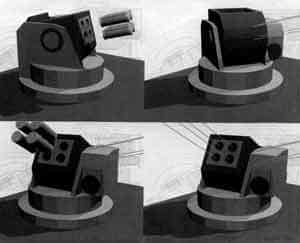 On top of the turret will be a reloadable grenade discharger such as the Thales Reactor (right). This provides 360° coverage and may have both defensive and offensive applications. The system will have between six and nine barrels and be ready loaded with a selection of smoke, flare, chaff, decoy and fragmentation grenades.
The French Ruggieri DPEC Spider system has five-barreled firing units, each barrel loaded with a pair of 40mm grenades. These grenades are preset to explode at ranges of between 11 and 44 metres, giving each firing unit a coverage of 2,600 square metres over a 120° arc out to 50m range.
Amidships of the vehicle hull on each side would be a local defence station. This would be a small rotatable hatch mounting a pair of 66mm fragmentation grenade launchers set at 45° elevation. Below these would be a horizontally-aimed Ruggieri Spider unit. The hatch would open downwards allowing the launchers to be reloaded under armour. Ruggieri units would also be mounted on each barbette, RWS and at various locations on the hull and turret. These will be supplemented by ERA/anti-personnel charges. These either act as explosive reactive armour or can be command-fired to function like M18 Claymore mines. It is also possible that such charges can be triggered automatically to destroy incoming projectiles before they impact. Remotely fired shotguns may also prove useful.
Although the current trend is towards smaller tank crews, I see the Bitch as having a crew of at least five. These would be the commander, driver, gunner and two assistant-gunners. The assistant-gunners are responsible for operating the barbette and RWS-mounted MGs, and also the close-range defensive weapons. One assistant-gunner would be sat near the forward barbettes and the other nearer the rear RWS. Positioned this way they can operate the weapons manually in an emergency but for normal use they would have a set of centralized and duplicated controls, so each man can aim and fire any of the four guns as needed. This capability may be expanded so that any of the crew can operate any of the weapon systems without leaving their seat. The vehicle commander would locate, identify and designate targets for the gunner or assistant-gunners to engage. As well as conventional periscopes the hull of the vehicle would also have numerous cameras to improve local visibility.
A conversation I had with Ralph Zumbro fielded the idea that the tactical role I propose for the Bitch could be met by a Heavy IFV. Obviously, there are economic and logistical advantages to using an IFV rather than a new design of vehicle. The innovation here would be that the IFVs would be organic to the tank platoon and manned by tankers, not attached from an infantry company.
While the IFV-Bitch crews may be called upon to dismount, I see these vehicles as operating more like ACAVs. Like the ACAV, additional armament that will include a pair of wing-guns will be fitted. On a modern vehicle these will be .50 MGs mounted so they be operated both “heads up” and from under armour.
The anti-infantry firepower of the Bitches will be supplemented by that of a vehicle we shall designate “The Sentinel”. The anti-infantry capabilities of ADA artillery are well known:
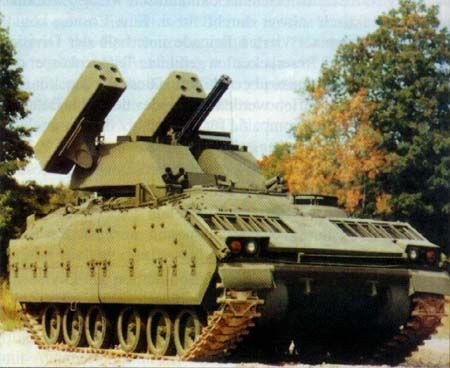 The Sentinel is basically an ADA or “flak-tank”, but differs from existing designs in two respects:
Firstly, it is equipped with sufficient secondary armament, armour and protective systems to allow it to operate alongside other tanks in a direct-fire combat role.
The second difference is that the Sentinel is designed not just to destroy enemy aircraft, but also to counter missile and rocket threats to the platoon. While it is likely that future tanks will include their own active protection systems, the Sentinel can use its more capable sensor and weapon systems to provide an additional layer of coverage over a wider area. Even when there is little potential threat from enemy aircraft, the Sentinel will still prove to be highly useful.
“Bulls” is the term we will assign to the more traditional form of tank. Since these have big guns and by the World War One definition would therefore be “male”, then “Bull” seems appropriate.
While writing this article the following article was published:
“It would seem that the Canadian Forces are taking some of the lessons re-learned during Operation Medusa in Afghanistan to heart. Canada's DND:
“The heavily protected direct fire capability of a main battle tank is an invaluable tool in the arsenal of any military. The intensity of recent conflicts in Central Asia and the Middle East has shown western militaries that tanks provide protection that cannot be matched by more lightly armoured wheeled vehicles.... [Canada's existing Leopard C2/1A5] tanks have also provided the Canadian Forces (CF) with the capability to travel to locations that would otherwise be inaccessible to wheeled light armoured vehicles, including Taliban defensive positions.”
In October 2003, Canada was set to buy the “Styker/LAV-III 105mm Mobile Gun System to replace its Leopard C2 tanks. In the end, however, the lessons of war have taken Canada down a very different path; one that now has them renewing the very tank fleet they were once intent on scrapping, and backing away from the wheeled vehicles that were once the cornerstone of the Canadian Army's transformation plan...”
Many articles have been written about the form that future tanks will take. Most proposals have the crew reduced to three due to the presence of an automatic loading system. An proposal published in International Defence Review and Armor Magazine positioned the three crewmen in the hull sitting side by side. Duplicate controls allowed any crewman to be either driver, commander or gunner. The turret was unmanned and operated by remote control.
My conception of a Bull tank is in many ways more conservative. The current trend towards three-man crews probably needs to be rethought. Even if an automatic loading system is fitted, the extra pair of hands and eyes the fourth crewman contributes are too useful to lose. Automatic loaders can malfunction or be damaged and even if they do not someone has to keep them topped up. The fourth crew-member, who should more accurately be described as an assistant-gunner, will also prove very useful in operating the vehicle’s secondary weapons and other local defensive systems. The CV90120 has an automatic loader, but retains a 3-man turret crew, giving each a day/night sighting system and access to the fire control system.
The concept of an external unmanned turret always looks good on paper but this article from ARMOR magazine raises some very credible objections to just how practical this is for a tank. Crew that are not seated in or under the turret cannot aim or operate the turret manually should systems fail. No matter how good the sensor systems fitted to the vehicle, there is still likely to be frequent situations when the commander is better off viewing something with his own eyes. The view from the top of a turret is far better than that from the hull.
I believe that while future tanks may mount the crew under the protection of the hull armour, turrets should retain a capability for crew to view the world from a hatch on the turret roof. In addition to permitting naked-eye observation, such hatches can provide extra ventilation and can be used as escape routes.
Several nations are developing 130mm and140mm tank guns, but it is debatable as to how useful these will be for likely conflicts in the near future. The weight of the rounds makes an automated loading system mandatory, and the increased size of the rounds further reduces the number of rounds that can be carried by a tank. For these reasons, I suspect that the 120mm and 125mm guns will continue to be used by current and future tank designs, although some of the latter will doubtless have the capability to be re-armed with 130mm or 140mm weapons should be need arise. At least one prototype 140mm offers the option of being rebarreled and rechambered to use 120mm ammo. A good argument can be made that tanks should revert to 105mm weapons, allowing a greater number and wider variety of rounds to be carried. Such a move would also simplify logistics since the 105mm continues to be used on various light tanks and tank destroyers. If longer range or greater destructive ability than can be offered by the 105mm is needed, ATGWs can be used. Rifled weapons such as the 105mm L7/M68 and 120mm L30 do have a greater potential for the use of a wider variety of ammunition types than smooth-bore weapons. A revision to 105mm is unlikely, however; tankers like big guns!
Several models of Cannon Launched Guided Projectiles (CLGP) for tank guns are now available. These are essentially guided missiles that can be fired from a gun barrel, and offer the gunner greater range and higher hit probability. While the use of such rounds is likely to continue, it is also possible that we will see tanks with guided missiles mounted in pods on the turret or hull. This practice would allow the tank to use missiles with a warhead calibre greater than that of its main gun. It would also make it easier to change or upgrade missile systems. Some proposed high-velocity missile systems have a time of flight that makes them comparable to conventional tank rounds and some such designs offer the option of “kinetic energy (KE)” kills rather than the use of HEAT warheads that can be affected by ERA. Potentially, tanks may also mount surface to air or dual-purpose missiles.
Many combat vehicles now have sensors that alert the crew if the vehicle is illuminated by a laser range finder (LRF), laser designator or IR searchlight. Systems that detect millimetric radar illumination are also available. This trend may result in future tanks once again mounting co-incidence rangefinders in addition to their LRF systems.
Another change we are likely to see is increasing use of Active Protective measures. Since the 1980s, many tanks of Russian design have been fielded with systems that intercept and destroy incoming missiles . Most of these use some form of fragmentation charge. Systems that use a focussed blast and are less dangerous to nearby friendly infantry are also being tried. IR jammers intended to confuse ATGWs are also in use. Interest is now finally being shown in western-built active defensive systems such as Rafael Trophy. The Thales Reactor system has already been mentioned, and has the potential to fill a number of roles. In an urban environment, fragmentation grenades projected by the Reactor can be used to engage enemies on roofs or high stories that cannot be fired upon by tank weapons with more limited elevation. Several manufacturers offer systems where threat detection can be linked to automatically trigger jammers and smoke, decoy and interceptor launchers.
Systems such as Thales Reactor will be supplemented by more traditional forms of smoke grenade discharger mounted on the turret sides. All vehicles will have the capability to generate smoke from their engine exhausts.
On this page, a proposal to use the XM214 minigun as a tank-mounted CIWS to destroy incoming threats at longer ranges is suggested. Another idea proposed is that ERA should incorporate a layer of ball-bearings so that they can also function like Claymore mines for self-defence. Integrated into a threat detection system, such charges could be triggered before a projectile impacts to destroy it in flight.
All of the vehicles described on this page will have high levels of more traditional “passive armour”, but this may take less conventional configurations such as Carlton Meyer’s Frontal shield and Tank roof ideas.
As may already have been inferred, a tank needs more secondary armament than just a co-axial and TC’s MG. This topic has already been addressed here and on this page. Veteran tanker Ralph Zumbro has often advocated that the co-axial armament of a tank should include a .50 calibre MG to exploit the stability that the main gun mount provides to allow targets to be engaged by MG fire at ranges of up to 2,000m. A .50 co-ax also has superior anti-material and anti-personnel capability and would simplify logistics since both the TC's and co-axial weapons would use the same ammunition. The French Leclerc MBT mounts a .50 MG as co-axial armament.
Tanks are vulnerable to close range attack because they have a considerable “dead zone” within which it is difficult to fire upon targets within a certain range. Traditional vision systems also have a limited field of vision at close range, and operating “heads up” to compensate for this increases crew vulnerability.
In future, we are likely to see more attention paid to improving close-range visibility. Independently traversable vision systems offer improved capabilities, as does the use of video cameras that include the blind spots of the tank. Such cameras will also prove useful when a tank is manoeuvring in close quarters. In this article, I have suggested that certain weapon systems can be directly slaved to such cameras. An interesting innovation tried by the Israelis is to link a camera to motion sensors that can direct it towards incoming threats and movement.
Traditional tank vision systems view the world at a fixed elevation, preventing threats at a higher level being seen within certain ranges. Future systems are likely to rectify this.
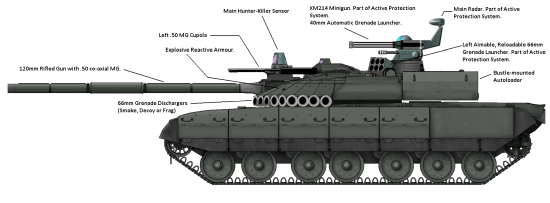
The image above has been adapted from one of a Russian Black Eagle tank, and is intended to give some impression of what a future Bull tank might look like.
The forward face of the turret is covered by Explosive Reactive Armour panels. Below these in a 90 degree arc on each side of the gun is a battery of conventional muzzle-loaded vehicle grenade dischargers. These are most likely to be loaded with smoke rounds, but can also be loaded with chaff, flares or anti-personnel rounds.
On either side of the gun on the roof of the turret is a remote-controlled cupola mounting a .50 MG. Normally one weapon is controlled by the vehicle commander and the other by the assistant-gunner, but all crew members have common controls. At least one of these cupolas is provided with a hatch so the TC can go “heads-up” if necessary. The .50 MG cupolas can be automatically slewed to aim at targets located by the hunter-killer periscope.
Only one hunter-killer periscope is visible in the illustration, but it is likely the vehicle will have a pair for redundancy. The vision systems of the .50 MG cupolas can also be used to search for targets for the main armament.
Visible behind the .50 MG cupola is a reloadable multi-barrel grenade launcher based on the Thales Reactor. There is one on each side of the turret. This launcher can be traversed and elevated, and can be reloaded automatically from under the armour. It is usually loaded with interceptor rounds and forms part of the active protection system. If necessary, it can be loaded with smoke or anti-personnel rounds and is useful for attacking targets that the tank’s direct-fire weapons cannot easily engage. It can also place smoke at greater ranges and with greater accuracy than traditional vehicle-mounted smoke dischargers.
Mounted to the rear of the turret roof is a XM214 mini-gun with a 360 degree arc of fire. As part of the active protection system, this is automatically aimed to engage missiles a medium range. The weapon can also be manually aimed by the crew to engage other targets. Also on this mount is a radar and other sensors that direct the active protection system. The radar is supplemented by flat-panel antennas mounted on the turret and hull. A 40mm automatic grenade launcher is also mounted with the XM214. While this is mainly used to engage ground targets, it could also be loaded with flare and decoy ammunition. Weapons such as the XM307, HMGs or light cannon could be mounted instead of the 40mm AGL.
There is little point in proposing new forms of combat vehicle without considering how such vehicles fit into the force as a whole.
On this page I suggest an armoured battalion composed of companies of armoured infantry and tanks. Each tank company is composed of three tank platoons, each with six tanks.
At least one tank in each platoon will be a Sentinel and two of the vehicles are likely to be Bitches. The remainder of the combat vehicles will be Bulls.
It is quite possible that Bulls will be replaced or supplemented by missile-armed heavy assault vehicles such as the proposed Thunderback design.
By the Author of the Scrapboard : | |
|---|---|
 | Attack, Avoid, Survive: Essential Principles of Self Defence Available in Handy A5 and US Trade Formats. |
 | |
 | Crash Combat Fourth Edition Epub edition Fourth Edition. |
 | |
 | |