By the Author of the Scrapboard : | |
|---|---|
 | Attack, Avoid, Survive: Essential Principles of Self Defence Available in Handy A5 and US Trade Formats. |
 | |
 | Crash Combat Fourth Edition Epub edition Fourth Edition. |
 | |
 | |
The M/2030 assault rifle round is an interesting concept and worth investigating further. One of its most interesting facets is the versatility of the potential projectiles.
The Saboted Rounds
The use of a saboted projectile not only exploits the velocity and flat trajectory that such a system offers, but also the property that the bullet does not have to come in contact with the rifling, so can be an optimal aerodynamic shape. This has been known for a long time. In the 1930s and 40s the German Professor Haack proposed a saboted projectile of a "reverse teardrop" shape for ideal external ballistics –Hartikka's proposed round is of a similar shape.
Another benefit of the saboted projectile is that the bullet does not need to be jacketed, simplifying production. Certain bullets can be cast from lead or bronze, others can be milled from brass or steel rod.
Where I differ with Hartikka is that I'd suggest a bullet of 6-7mm for a little more target effect and carrying power.
Full Calibre Rounds
When I saw this part of his concept I immediately thought of the 9x39mm Russian rounds. As well as being used in silenced weapons these are also used in short barreled CQB weapons since their terminal effects are not as velocity dependent as lighter rounds.
Large calibre rifle bullets were common in the latter half of the 19th century and some types are still in use. A friend of mine is a great fan of the .45-70 round. With it he claims that he could hunt any animal on the North American continent. :-
"Low loaded ball rounds will do for rabbit without destroying any more meat than a .22 rifle would.
A lightweight pistol bullet of 200 to 250 grains weight and .457 diameter can be driven to about 900 to 1000 fps for practice and most short-ranged medium game uses.
Take the bullet weight up to 350 to 500 grains and drive it from 1300 to 1500 fps and it will take about any large game in the north."
The best reason for going to a .45-70 is that you can cast accurate bullets for it from wheel weight lead, and still shoot game with it, Something that smaller calibers probably should not do. That increases it's economy."
Such versatility may prove useful for police or SERE applications.
Multiple Rounds
Another idea that occurred to me is that such a large calibre round could make use of duplex or triplex loads. These have been developed for both 5.56mm and 7.62mm rounds, but the M/2030 offers a greater capacity. Probably these bullets would resemble a stack of Minie Balls.
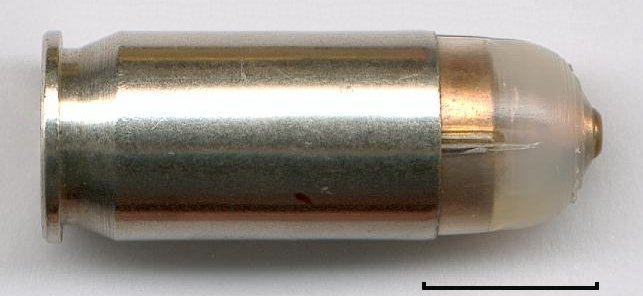
A form of multiple load that I have considered for close range operations uses three different shaped projectiles –a conical hollow based round, a spherical ball and cylindrical bullet with a concave nose cavity. Fitted together these would occupy the same space as a conventional round.
While researching Victorian weapons I came across an interesting reference to a buckshot load for the Martini-Henry. My friend the 45-70 fan mentions that there was a Buck loaded "Garrison load" for this round too. This was probably a very comforting thing to have when on night sentry duty.
The Martini-Henry version contains 11 balls of .275 (No.2) Buckshot, quite an impressive load for what is effectively a 50 gauge weapon. One wonders how such a narrow column of shot spread, even if fired from a rifled barrel. Such a round may have been quite effective. There is a history of the 45-70 load being used by the National Guard against rioters in the late 1800's.
The .45-70 also had a smaller shoted "foraging" load that was equivalent to a .410 shotshell.
Other possibilities for the M/2030 round include flechettes, buck and ball loads and various less lethal rounds.
Casings
The Author of the original article suggests a plastic cased round, although more conventional designs could be used for civilian use. An idea that occurs to this writer is that of aluminum cased ammunition. By utilizing the structural rigidity of the solid propellant a very thin case could be used and manufacture also simplified. The case would be spun or cast from aluminium and the propellant made as a single block. A measured quantity of binding agent is poured into the case and the block of propellant dropped in, displacing the binding agent of fill the space between propellant and case wall. This sets to form one unit of high mechanical strength despite the thin case wall.
The Hose
The principles of the M/2030 round can also be applied to a GPMG type weapon. The author has often suggested a .50 calibre GPMG firing saboted penetrator rounds or multiple flechettes.
Further Thoughts
The M/2030 rounds could also be used in an Amphibious Assault rifle that also fires 4.5mm saboted underwater rounds.
nbsp; A weapon like the M/2030 could be created today. A 5.56x45mm casing can accomodate a bullet of about 9mm calibre, and 9mm barrels that will fit a M16 receiver are available for the Colt SMG. The same case could be used for a saboted high velocity round of around 7mm.
While the West drags its heels, there can be little doubt others are not. The Russians already have the 9x39mm round and have been experimenting with 6mm bullets for the 6x49mm UMG. It can only be a matter of time before the two are combined.
UPDATE
The Whisper® range of rounds includes a subsonic .338 (8.58mm) round based on .221 Fireball brass that can be fired from M16 series weapons. The bad news is that JD Jones, inventor of the Whisper® rounds has told me that the .300 Whisper® and larger calibre Whispers® will not feed relieably in some M16 magazines unless they are modified slightly.
For further and updated discussion on alternatives to the 5.56mm see this page
The concept of a 9mm barreled assault rifle firing heavy subsonic full calibre rounds or saboted supersonic 6-7mm rounds is still viable for weapons designed for the 7.62x39mm M43 round and AK type magazines.
Salvo Squeeze Bore (SSB) was a novel application of the Squeeze bore and Taper bore mechanisms used by some World War Two Anti-tank guns. The idea of Taper bore weapons in fact dates back to 1903 when the German Karl Puff originally proposed the idea.
SSB was a more modestly funded contemporary of the SPIW flechete weapon programs. With hindsight the SSB appears to have been a more promising idea with a better basis in exterior and terminal ballistics.
The idea of SSB was to load a cartridge with between two and eight short full-calibre projectiles. Because they were "short and wide" a larger number could be fitted in a given volume than more conventional duplex or triplex rounds. The ingenious innovation was that the barrel of the weapon would have a squeeze bore section that would convert the short fat projectiles into longer, narrower projectiles with a better aerodynamic shape before they exited the muzzle. Since each cartridge fired several projectiles and they were designed to adopt a circular dispertion the chances of a hit were greatly increased. Projectiles were designed to be lethal to at least 400m and disperse in a pattern that would ensure at least one hit on a man-sized target at 400m.
The most practical squeeze bore device as a tapered muzzle attachment that could be easily removed should there be a requirement to fire conventional rounds. The most common rounds developed were:-
According to Jane's Infantry Weapons 1976 the US Navy in 1967 used the .50 round on some of their riverine craft. This effectively allowed a weapon with a cyclic rate of 600rpm to deliver 3,000 shots per minute.
Now suppose we look at SSB in the context of application to the M2030. Suppose our weapon has a .45 calibre 10" barrel that can have a 6-8" squeeze bore section added to the muzzle. Without the barrel extension we have a compact large calibre SMG-type weapon. The attachment points at the muzzle can also be used to fit suppressor.
With the squeeze bore section added we have an assault rifle length system with assault rifle performance but which fires multiple projectiles for each single cartridge fired. .45 projectiles that are swaged down to around 7mm would probably be most suitable.
This system offers some interesting possibilities. If we build a cartridge with a single projectile designed to pass through the squeeze bore we are reproducing (on a smaller scale) the WW2 anti-tank weapon. The swaged projectile will have a very good sectional density. Since the base area of the round has decreasesd the pressure of gases acting on the base of the round has effectively risen, increasing muzzle velocity. Both of these characteristic tend to produce a short time of flight, flat trajectory and good penetration. It is worth remembering that before being adopted for anti-tank applications taper bore/squeeze bore weapons were originally offered as hunting and sniping weapons.
With the squeezebore section removed the weapon can still fire full calibre and saboted ammo, although why the latter would be wanted when Salvo and Single Squeeze bore rounds are available is open to debate.
Another interesting idea is what happens when a SSB round is fired from a weapon with the Squeeze bore section removed. Each cartridge fired would launch a pattern of large calibre low sectional density bullets. This is likely to be very effective in Close Quarter Battles where stray rounds travelling down-range or rounds penetrating interior walls may be a danger to non-combatants.
By the Author of the Scrapboard : | |
|---|---|
| | Attack, Avoid, Survive: Essential Principles of Self Defence Available in Handy A5 and US Trade Formats. |
| | |
| | Crash Combat Fourth Edition Epub edition Fourth Edition. |
| | |
| | |