If you have enjoyed this article or it has been helpful to you please feel free to show your appreciation. Thank you.
Added 29-4-03
Updated 24-2-21
This is a bit of a rambling article. One of it’s purposes was to gather together information on the RPG-2 and investigate an internet myth about the weapon. This lead to a discussion on the non-anti-tank applications of the RPG-2 and similar weapons, which inspired a very clever idea from Ralph Zumbro and my own concept of the recoilless grenade launcher and the MBIL.
A while back I was trying to find some information on the RPG-2. There was plenty of stuff about the RPG-7, but very little about its stablemate, despite the fact that the design has seen considerable action over the decades, and is still in fairly wide use in many parts of the world. In 2004 a locally-produced version know as the Yasim began to be used by Hamas.
According to various sources the RPG-1 was Soviet copy of the German Panzerfaust 150.“The Rocket Propelled Grenade” by Gordon L. Rottman disputes this (p.14) and claims the RPG-1 and RPG-2 were inspired by, but not copies of, the Panzerfaust 250. Incidentally, Panzerfausts were not rocket launchers, but recoilless bomb throwers. The RPG-2 is a logical development of wartime anti-tank weapons. The result was a very simple but effective weapon.
The Chinese-produced models of the RPG-2 and RPG-7 are known at the Type 56 and Type 69, respectively. Some sources claim the NVA designated these weapons the B40 and B41, though others maintain these were different weapons and you will find this designation used for larger recoilless guns. B40 seems to have become a common term for the Vietnamese version with English speakers.
Externally the RPG-2 and RPG-7 look very similar. The most obvious difference is the RPG-7 tube has a conical tail pipe, while that of the RPG-2 was straight-walled. However, the Chinese Type 56-1, an improved model of the RPG-2 (Type 56), also has a conical tailpipe. The RPG-2 may have a ring-shaped blast deflector, but this is often not present.The RPG-7 may have an extra handgrip and an optic sight, but these are not present on some examples.
The real difference between the two systems is one of mechanism. The RPG-2 does not use a rocket-assisted projectile, while the RPG-7 is a sort of hybrid –a recoilless gun that fires a rocket-assisted projectile. Although both weapons use a 40mm tube, it would be probably be catastrophic if a RPG-7 round was fired from a RPG-2. To prevent this the primers of the rounds are in different positions. It is possible to modify a RPG-7 to fire RPG-2 ammo by shortening the tube a little, although I don’t know if such a modified launcher can still use RPG-7 rounds. Whether the RPG-2 is a rocket launcher or a recoilless gun is confusing, since many writers do not understand the difference.
Of the websites I could find that mentioned the RPG-2, the following statement frequently popped up:
“One interesting feature of RPG-2 is that they could only be shoulder fired right-handed since the vent for the blast was located on the right hand side of the weapon itself close to the firing mechanism housing which would be lethal to a left-handed user.”
Many anti-tank weapons cannot be fired from the left shoulder because the sights are configured for right-handed use. A recoilless weapon venting gas out the side doesn’t seem logical, however.
All of the websites below report this. Most seem to be mirrors of the same article.
This site also maintains that the RPG-2 would be fatal if fired from the left shoulder, although it claims this is due to a gas escape hole, not a blast vent.
I attempted to find out if the RPG-2 really did have this feature and, if so, why. Typically, most of the pictures I could find of the RPG-2 only showed the left-hand side!
Eventually I found a picture of a Type 56-1 viewed from the right – no gas port apparent. Later I located this picture of Vietnamese Type 56 : again, nothing resembling a vent or port.
To confirm this further, I asked a couple of friends who had served in RVN and were likely to have examined RPG-2s, or even been shot at with them.
Ralph Zumbro, author of “Tank Sergeant”:
“Handled yes, shot at, yes. BUT, I have never shot one. I don’t remember any port on the side of the weapon, nor do I remember seeing any exhaust from the right side....I was close enough to have noticed and the rocket went over my head and damn near sucked me outta the damn turret.”
Since this page first went on-line Rebekah St. Claire of the “Sword of the Motherland Foundation” at www.russianwarrior.com has contacted me.
“I wanted to tell you that *yes* there is a gas exhaust port on the side of the weapon that would make firing the weapon from the wrong side difficult to say the least.
We have a picture of it. Go to our picture gallery of the RPG-2. Then go to the ’Trigger Assembly’ section. It will be in the middle right picture. Look right above the striker at the rear of the assembly. It hits the firing pin which ignites the motor. The firing pin then is pushed back by a small spring leaving the little port open where a small amount of exhaust gas escapes.
The amount of gas that comes out of the port is very small. I doubt that it could kill the user, although it would probably be very uncomfortable.”
The gas port is actually at the rear of the pistol grip, not on the side of the barrel as I suspected. It sounds like the function of this feature is to relieve pressure on the firing pin or reduce fouling. While this would prevent or hinder operation from the left shoulder, it does not sound like the potentially fatal discharge of gas that many of the above sites claim.
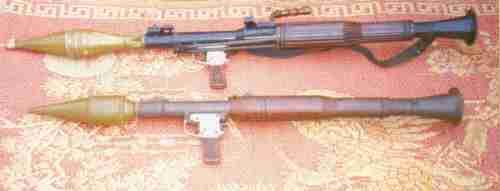
Another claim you’ll see is that the RPG-2 is 1.4m to 1.494m loa. Copies of Jane’s Infantry Weapons as recent as 2002-3 give this figure yet describe the Type 56 as 1.194m length. 1.4m is a shade over four and a half feet and a good foot longer than the dimensions commonly given for the RPG-7 (0.95m). In older copies of Jane’s Infantry Weapons metric and imperial lengths given significantly disagree, for example 38"/ 1.49m.
Comparative photos of the Type 56-1 (Chinese RPG-2) (lower) and Type 69-1(Chinese RPG-7) (upper) such as the one on the left give the impression that the Type 56-1 is actually a few inches shorter than the Type 69-1. Jane’s gives the length of the Type 69-1 as 0.91m. The Type 56-1 appears to be about six inches shorter than the original RPG-2/ Type 56.
Another erroneous source of information on the RPG-2 is Wikipedia. The Wikipedia article on this weapon is very badly written, claiming the RPG-2 is a recoilless rifle (the launch tube is unrifled) and that the round is not a rocket since the propellant is completely consumed while the round is still in the launching tube. Fully consuming the propellant while within the launcher is in fact a common trait of many infantry rocket launchers, so this does not help us determine if the weapon is a recoilless gun or rocket launcher. Jane’s Infantry Weapons refer to the RPG-2 as a “rocket launcher” and the propellant element as a “motor”. However, some readers will be aware that Jane’s often does not correct entries for decades at a time, perpetuating errors and typos. I consulted “Sword of the Motherland Foundation” as to whether the RPG-2 projectile is a rocket or a recoillessly-launched grenade:
“Yes, the propulsive unit is a separate motor - simply a larger version of the toy model rocket motors that you can buy at hobby shops. It is carried separately and must be screwed into the PG-2 projectile for the unit to fire. It is a rocket in the strictest sense. If you fire it, it burns propellant in a direction until exhausted. If you fired it without attaching it to the projectile it would shoot off like an unguided firework (take cover!). But, it’s not a charge that explodes (like an artillery powder bag).”
On the other hand, the Osprey book “The Rocket Propelled Grenade” by Gordon L. Rottman states: “First test-fielded in 1954, the RPG-2 was a "recoilless weapon" and not a "rocket launcher"; the projectile was launched by a propellant cartridge similar to that used by the non-reloadable German Panzerfaust first used during World War II. In contrast, the RPG-7 and 16 are "rocket-assisted recoilless weapons"; a propellant cartridge launches the projectile and a rocket booster ignites almost immediately after launching to increase the projectile's velocity and range.”
and reminds us
“"RPG" is normally translated into English as "rocket propelled grenade," but in fact it means Reaktivnoi [Ruchnoi] Protivotankovii Granatomet (hand antitank grenade launcher). Most models can best be technically described not as "rocket propelled grenades" but as recoilless antitank projectors. RPG can also mean Reaktivnoi Protivotankovii Granati (antitank rocket grenade). This latter term refers to the single-shot, disposable models...Therefore, technically the term "rocket launcher" does not apply to most Soviet/Russian RPGs and German Panzerfaust weapons even though the term is widely used to describe them.”
“Infantry Weapons of the World” (Foss and Gander, 1977) and “Brassey’s Infantry Weapons of the World” (Owen, 1975) both give descriptions that are more suggestive of a recoilless bomb projector rather than a rocket launcher. The ease with which RPG-2 copies and their ammo are locally produced would tend to support this conclusion.
Despite the wide availability of the RPG-7, the RPG-2 is still a very common weapon in many parts of the world, probably due to the simplicity of both the launcher and the ammo, which makes it easy for small guerrilla units to manufacture their own. Although the PG-2 warhead is described as ineffective against modern tanks, the RPG-2 is still in use with both the Chinese and North Koreans. One gets the impression these are issued more for general support or mischief-making than for anti-tank use. The effective range of the RPG-2 is usually given as 150m, although used for high-trajectory fire a range of 800m is probable. This source claims 600m, but only 460 if the round has a self-destruct feature. Interesting is that certain US field manuals give the maximum range of the M72 as 1000m.
Given how often RPG-type weapons are used against targets other than tanks, it is perhaps surprising that only one type of round was designed for the RPG-2, the PG-2 anti-tank round. A wider variety of ammo is available for the RPG-7, and it is possible that the same warheads could be mated to RPG-2 boosters. Several users such as the KNLA have produced their own “home-made” explosive-fragmentation loads for the RPG-2/ Type 56.
The Panzerfaust 150 was offered with fragmentation sleeves (“Splitterringe”) and a similar device would increase the utility of the PG-2 round.
Is there still a role for a lightweight, simple rocket launcher mainly intended to attack personnel and soft-skinned targets? The Chinese certainly think so. In addition to the Type-56 they have also recently produced a double-barrelled launcher. According to some sources this launcher uses either thermobaric, smoke and/or incendiary rounds, further suggesting that it is intended for non-tank targets. Other sources claim airburst rounds were developed. The ammunition was possibly developed from that for the Type 70-1 62mm launcher, so an anti-armour round is feasible.
Since I first wrote this article, an RPG-2 based weapon, the Yasim has been fielded by Hamas.
The closest western equivalent to the RPG-2 is probably the M72.
Since this is a disposable, throwaway item it allows all men in a squad to have such a capability, rather than being the responsibility of a specialist. The capabilities of the M72 would be greatly improved if the rocket were fitted with a HEDP warhead rather than the dedicated HEAT round it now has. This HEDP would be a HEAT round with enhanced fragmentation. There is a licensed copy of the LAW with a HEDP/ Bunker-defeat warhead, and Greece makes a M72 with an anti-personnel warhead. The Russian RPG-18 and RPG-22, which closely resemble the M72, have versions with thermobaric warheads.
Another weapon that would benefit from such a HEDP round is the M202 Flash launcher.
Although still in the inventory, the M202 weapon is not that well know. It is a four-barreled 66mm launcher for incendiary “Thickened Pyrotechnic Agent (TPA)” rockets. Some sources say there are also tear gas loads available or were planned. A HEAT round seems to have been tested but was never issued.
Various other projectiles for this weapon may be possible. Since it is the same calibre as an M72, the same warhead or rocket could be developed for both weapons. A weapon based on the M72 using an incendiary rocket similar to that used in the M202 would be very useful. It would be small enough to be carried by a stealthly crawling soldier yet could quickly destroy a machine gun nest or similar position.
Multiple rocket launchers made from bazookas were used as trench artillery in Korea, so a similar weapon may still prove useful for other applications.
The RPG-2 and –7 type weapons have an important advantage over weapons such as the M72. RPGs have a pistol grip with a thumb safety and they are usually carried by a designated operator.
These two factors mean that a RPG can be brought into action far faster than a M72, an important consideration in anti-ambush or encounter scenarios. Vietnamese units used to place their RPG operators at the head of a formation. On encountering an enemy, many of these projectiles would be fired up into the canopy to shower the foe with fragments.
Emery Nelson: Yep, pretty much SOP for any insurgent or third world army. It worked very well in Vietnam and usually caused immediate casualties amongst our infantry and causing us to go to ground and call for support. The NVA would then either disperse or maneuver, leaving a squad to hold us by the nose and draw our indirect fire. Then they would also withdraw.
Presently, US infantry have no system that can deliver a similar level of rapid firepower. What is needed is not only a new design of launcher, but a change in tactics to use it to maximum effect. Several men in a unit must patrol with their hands on a readied LAW, not a rifle.
Ralph Zumbro:
If the cocking lever of an M-16 were moved to one side or other, there would be nothing on top of the weapon to prevent mounting a 40mm-60mm tube that was long enough to exhaust over the trooper’s shoulder.
Attach the handle to the LEFT side of the bolt carrier and use a rubber sealing slit to crud-proof it. Put the battery for igniting the rocket inside the pistol grip. It’d be a special issue weapon, of course, but a shortie would be a usable crew weapon
Such a weapon would be a good platform for RLGL rounds, and a useful supplement to the MBIL. There already exist variants of the M16 that omit the carrying handle and have a rail interface along the top. I’ve even seen a version with a folding front sight. These upper rails are intended for sighting systems but could also be used to mount overbarrel launchers.
The operator could load this weapon himself if the forward section of the tube slid forwards like a M203. In fact the barrel of the M203 might be modified to this system by fitting a new breach section and trigger.
<XMP></BODY></xmp>