

WHAT'S NEW AT NORTHWEST ARKANSAS SHORIN-RYU KARATE & TAIJIQUAN:
Karate Classes End
As of July 15 Karate-Kenpo classes are no longer offered except by Private Lesson. Classes may resume in the fall if there is sufficient interest in an evening class.
NEW CLASS SCHEDULE:
Taijiquan - Wednesday 7 - 8 p.m. at WRMC Center For Exercise

(Above) Mr. Geoff Jensen with instructor Randal Seyler (left) and Mr. Jeremy Hess (right).

(Above) Geoff and Beth Jensen
WELCOME to the webpage of Northwest Arkansas Shorin-Ryu Karate & Taijiquan. We practice traditional Okinawan karate and kobudo and taijiquan.
Taijiquan classes are taught by Randal on Friday at 5:30 p.m. and by appointment at the Washington Regional Medical Center's Center For Exercise.
Fees are $30 per month for all karate kenpo classes. No contracts required, and no belt testing fees are charged. There are no testing fees for the shorin-ryu karate program. Come by and experience taijiquan and traditional Okinawan shorin-ryu karate. Women Self-Defense classes are also offered, and private lessons are available upon request.
Taiji classes are $40 per month for all classes. Discounts are available for family plans and Center members.

Phil Grigsby is a 2nd degree black belt in Okuhara-Ha Shorin-Ryu and is an instructor in jeet kune do and filipino martial arts, having studied with the late Terry Gibson of Tulsa, Oklahoma. He also holds a black belt in taekwondo under USTF master instructor Randy Edwards and is a member of the World Black Belt Bureau.

Randal Seyler, chief instructor and founder of Northwest Arkansas Karate & Taijiquan, began studying taekwondo in 1978 and shorin-ryu in 1979, and holds a 3rd degree black belt in shorin-ryu and a 1st degree black belt taiho-ryu karate. He also teaches Yang taiji and studies shaolin kung fu, which he began studying in 1990 under Mike Snyder and Dr. Zhou Cheng. He teaches the tai chi for arthritis short Sun-style taiji form along with the Yang inspired 24 Forms. A member of the Tai Chi for Heath Community and the World Black Belt Bureau, Seyler has written for Black Belt and Karate Illustrated magazines.
For more information go by the Center for Exercise, or contact Seyler at 479-267-4340, email kyanshorinryu@yahoo.com.

WHAT IS KARATE?
Shorin-ryu karate is derived from southern China's Shaolin (pronouced "shorin" in Japanese) kung fu schools of White Crane, Tiger, Dog, and 5 Ancestor Boxing. The Shaolin Temple was the birth place of Chinese kung fu, as well as Ch'an (Zen) Buddhism, according to legend. Ta Mo is said to have brought Buddhism to China's Honan Provence over 1,500 years ago.
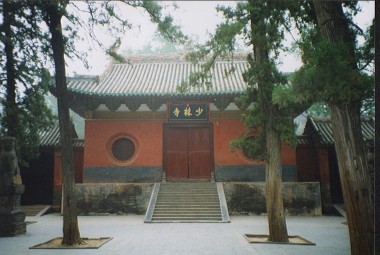
When Chinese kung fu combined with indigenous Okinawan and Japanese martial traditions, the result was the Okinawan art of tode, later called karate.

CHOTOKU KYAN
Exerpt from an article by Graham Noble
Chotoku Kyan (1870-1945), pictured above, was born into a high-ranking family in Shuri in 1870. His father Chofu was a steward to Shotai, the last king of the Ryukyus. According to Shoshin Nagamine, Chofu Kyan was of such an upright character that King Shotai entrusted him with much of the business of the royal household.

In 1871 the Japanese Government declared that the Ryukyu Islands were to become part of Japanese territory and renamed Ryukyu-han. A few years later the islands were fully integrated into the Japanese local government system as Okinawa-ken (Okinawa prefecture). As a process of 'Japanisation' began, the old Ryukyu Kingdom was swept away.
King Shotai had been deposed with the foundation of Ryukyu-han. In 1879 he was removed to Japan and kept there for five years. He took with him over 90 retainers. Chofu Kyan went with the King and took with him his young son, Chotoku.
It seems that Chofu Kyan, a cultivated man with knowledge of both Chinese and Japanese literature, had been opposed to Japan's takeover of Okinawa. Hoshu Ikeda has in his possession a petition against the Japanese measures, and one of the seven signatories is Kyan. He was a traditionalist who did not want the old ways to die out, and it seems that it was he who kindled Chotoku Kyan's enthusiasm for karate. Apparently, Chofu Kyan himself had some knowledge of "te", but although he trained his young son in wrestling to toughen him up, he entrusted the teaching of karate forms to others. Shoshin Nagamine believes that this was because he was too fond of Chotoku to train him the correct, severe way. Anyway, at age 20, Chotoku Kyan was put under the tutelage of famous experts: Kokan Oyadomari, Kosaku Matsumora, and Ankoh Itosu.
Chotoku Kyan's biographers all state that he was small and weak as a child and this we can believe, because even when fully grown he was slightly built and frail-looking. He looked more like a retiring scholar than a karate master, and as Hiroyasu Tamae wrote, "you were amazed that such a small man was so great a bujin."
Kyan however had a strong personality that belied his small physique, and by the age of 30 he was recognised as an expert in both Shuri-te and Tomari-te. He was challenged often, and as he was not a person to back down, he had to fight frequently. As far as Okinawan karate historians are aware, he was never beaten in these fights. Because of Kyan's size he did not train to trade punches with bigger men but would practice stepping and other evasive techniques by the banks of the Hija River, over and over again. His method of fighting was to defend and then counterattack immediately. He was known to be expert in kicking techniques, and altogether we can imagine him as a perfect example of the Shorin-ryu stylist as described by Gichin Funakoshi, a smaller, lighter man whose karate was marked by quickness and mobility.
"He excelled in practical fighting and had great confidence and power," wrote Hiroyasu Tamae. "We all know of the famous incident when he threw the wrestler over the parapet of the bridge."
Well, as it happens... I don't know about that incident - unless it is another version of the tale told by Shoshin Nagamine. This happened when Kyan was about 40 years old and working as a wagon driver. He crossed the path of Matsuda, a big, strong fellow who was bullying the younger men of the village. When Kyan reproached him for his behaviour, Matsuda turned on him and challenged him to fight. He was aware that Kyan knew karate but felt that he would be too small and slight to make use of this in a real fight. When the two men met on the banks of the Hija river, Kyan took up a natural stance with his back to the water. As Matsuda went for him Kyan evaded the attack and countered with a kick that sent the big man into the river.
The abdication of the king and the establishment of Okinawa-ken were harsh facts of life for many Okinawans. For those of higher birth it was especially unfortunate because the government reforms led to the abolition of the old social ranking system and the loss of their privileges and financial support. Kyan's family suffered in this way, and Chotoku Kyan, whose father had been a retainer and friend of the king himself, had to make ends meet by breeding silkworms and pulling a rickshaw. Yet throughout all this his enthusiasm for karate never diminished.
Kyan taught karate at the Okinawan School for Agriculture and the Kadena Police Station, and besides this he taught many other students directly. He and his students would demonstrate karate in the region around his home of Kadena. Apart from karate he would often teach his pupils the traditional dancing seen at Okinawan festivals. Evidently he believed that these dances were related in some way to karate, and in this he was not alone. "If you go into the Okinawan countryside you will often see men performing a traditional dance to the music of the samisen," wrote Gichin Funakoshi in his first book, 'Ryukyu Kempo Karate' (1922). "This dancing resembles karate and is different from the usual maikata dancing. I think it is related to traditional Okinawa-te."
Kyan Sensei had many students but according to Katsumi Murakami his two favourites were Ankichi Arakaki and Taro Shimabuku. Murakami's section on Kyan in his book 'Karate-do to Ryukyu Kobudo' throws light on another side of Chan Mi-gua's character. It is entitled "Sensei Chotoku Kyan: absorbing virtues as well as sins," meaning that here was someone who lived life to the full.
According to Murakami, Kyan not only taught Arakaki and Shimabuku karate but also encouraged them to do many other things, including drinking and visiting the local brothel - on the grounds that an experience of everything is important for martial arts development. So it was that at times he would train these two students in the brothel.
Well, Gichin Funakoshi too had as one of his precepts "Do not think karate is only in the dojo," but this was not exactly what he had in mind. Nevertheless, there was something behind Kyan's teaching. He stressed to his students that whatever they did they should keep in their minds the idea of "Busai," or correct martial way. I am not sure exactly what this involves but perhaps it means that to some extent you should remain unattached to whatever you are doing and keep a clear mind and a strong spirit, whether drinking, visiting a brothel - or even pulling a rickshaw.
Both Ankichi Arakaki and Taro Shimabuku would visit Kyan Sensei's home for training at night. They carried lanterns to light their way but Kyan told them to stop using the lanterns so that they could develop their night vision. When they trained at night he chose uneven terrain and sometimes even threw water on the ground to make a foothold difficult. In this way they developed their kata.
Chotoku Kyan was fond of cockfighting and would often carry a fighting cock around with him. On one such occasion Arakaki and Shimabuku, wanting to test their teacher's ability, started a quarrel with a gang of young men and then ran off, leaving Kyan to face the group alone. The men attacked Kyan who quickly proceeded to beat them, still holding the bird under one arm. Even Arakaki and Shimabuku, who watched from a distance, were surprised at how he fought using only his feet and one free arm.
Kyan's wife had to work hard as a dyer of cloth and pig breeder, but whenever a pig was ready for sale Kyan himself always insisted on taking it to the market. Murakami writes that Kyan would often cheat his wife of the money he received and use it to pay for women and travel. He liked to travel and on one occasion took Arakaki and Shimabuku to Hokkaido where they demonstrated karate in a large tent. When a local fighter named Sampu Taku challenged them Kyan counselled Arakaki to step back carefully to the walls of the tent, then knock the challenger down if he moved on him. Unfortunately, Murakami does not tell us if a fight actually ensued or, if it did, what was the result.
It's too bad we don't have more information on this incident, but the story of another challenge match was given in a recent Japanese magazine. It occurred in Taiwan in 1930, when Kyan's demonstration of karate somehow resulted in a challenge from Shinzo Ishida, judo instructor of Taipei Police Headquarters.
Kyan would have been 60 years old at the time but he agreed to the match straightaway. The only thing that concerned him a little was that the judoka might be able to take a firm grip to apply his throwing waza (technique). Because of this Kyan wore a vest on his upper body rather than a judo jacket.
Ishida himself was wary of karate's striking techniques and when the two men faced each other they kept their distance for some time, sizing each other up with fierce stares. Then suddenly Kyan closed in, thrusting his thumb into the side of Ishida's mouth and fiercely gripping his cheek. With a kick to the knee he knocked Ishida to the ground and followed him down. Kneeling astride the judoka he delivered a tsuki (thrust) to the solar plexus, just stopping short of full contact. Ishida immediately conceded the match.
All in all Chotoku Kyan comes across to us as one of the most attractive karate masters, an interesting mixture of vices and virtues. No doubt he had his faults but he also had personal qualities which earned him the loyalty of his students and the respect of other experts and he remains one of the most important figures in Okinawan karate history. Even Katsumi Murakami, who tells us of Kyan's visits to the brothel and cheating on his wife, does not do so out of any desire to put him down. In fact he describes Kyan as one of the greatest karate experts.
Like Choshin Chibana, Kyan Sensei stressed that the way to success in karate was found only through constant practice. He continued to train and teach throughout his life. Hiroyasu Tamae remembered him giving a demonstration when he was in his late sixties. "In Showa 13 (1938) there was a demonstration of karate in which many famous experts were invited to display their kata. I was there, and many of the experts did not perform themselves - they let their students do it. Only Kyan Sensei, in spite of the fact that he was nearly 70 years old, performed his own kata."
"At that time people over 60 were considered to be old and infirm but Kyan Sensei performed the kata at full power without displaying any infirmity. Only when he stepped down from the platform did he stumble slightly. The audience was impressed."
When Shoshin Nagamine opened his karate dojo in 1942 Chotoku Kyan gave a demonstration of 'Passai' and bo kata. "His beautiful performance at the age of 73 could still exalt his audience to the quintessence of karate-do," Nagamine recalled.
In 1945, with the American invasion of the island, World War 2 truly came to Okinawa. Perhaps 60,000 Okinawan civilians were killed in the battle. Master Kyan survived all this but at 75 his body was too weak to withstand the following privations and he died in September 1945.
Kyan Sensei's kata
Kyan concentrated his teaching on seven (or perhaps eight) kata. These kata and the teachers from whom he learned them (it is believed) are as follows:
'Annanko' an un-named Taiwanese. 'Wanshu' Saneida (Maeda). 'Chinto' Kosaku Matsumora. 'Passai' Kokan Oyadomari. 'Kushanku' Chatan Yara. 'Seisan' Sokon Matsumura. 'Gojushiho' Sokon Matsumura. Clearly, if these attributions are correct, Kyan studied with a variety of masters, most of them famous figures during their day. I have no information on Saneida, but since 'Wanshu' is always regarded as a Tomari kata we can be fairly sure that he was an expert in Tomari-te. The most famous Tomari-te master was Kosaku Matsumora, and he was one of Chotoku Kyan's teachers. Kokan Oyadomari is less well known but in the opinion of Hoshu Ikeda he was a bujin (martial artist) equally as great as Matsumora. He was an officer on the staff of the Ryukyu Royal Family and was often called Oyadomari Pechin.
Chirkata Yara, better known as Chatan Yara, was one of the forerunners of Shuri-te. He was born in 1816, but his date of death is unknown. Sokon Matsumura we all know about. Both these masters would have been old men - Matsumura about 80 years old - when Kyan began studying karate, and we cannot be sure they were even teaching at that time. Rather than learning direct, Kyan may have learned from their senior students.
There are actually two versions of how Kyan learned 'Annanko.' I have never felt particularly happy about the story that he learned it from a Taiwanese expert in Chinese boxing - mainly because the kata does not look Chinese. An alternative version is that he was taught the kata by his father. Another possibility, of course, is that Kyan developed the kata himself.
Kyan also may have taught 'Nai-hanchin,' and if he did he would have got it from Ankoh Itosu. Kyan is usually given in karate genealogies as a student of Itosu but generally his kata are quite different from the Itosu versions so I don't think the teaching here can have been very extensive. It is notable that Choshin Chibana, in listing Itosu's students, did not name Kyan. Instead Chibana referred to Kyan as a student of Oyadomari.
Kyan's favourite kata, which he often performed at demonstrations, were 'Chinto,' 'Passai,' and 'Kushanku.' They are distinctive kata with significant variations in technique from the more widely practiced forms such as those of the Japanese Shotokan, Wado, or Shito schools. For instance, rather than the sequence of forearm blocks at the beginning of 'Passai,' the Kyan (Oyadomari) 'Passai' has a quite different sequence of sharper, open handed techniques. In 'Chinto' ('Gankaku' in Shotokan), the two turns at the start of the kata are done in the opposite direction to those in the Itosu version. In the kicking techniques, rather than bringing the foot to the knee before kicking from a one-legged stance, it is brought behind the other foot into a kosa-dachi (crossed stance) and the kick is launched from this position. Hoshu Ikeda refers to these forms as "koryu," or "old style", and although Kyan may have made his own changes to the kata, much of the old style must have remained.
In his short memoir of Chotoku Kyan, Hiroyasu Tamae mentioned an interesting thing. He wrote that other Shuri karate experts referred to Kyan's kata as "Inaka-de," or "primitive." (In his translation Professor Karasawa explained that the words have something of a "country-yokel" implication.) As I said, his kata do have their own character, but there are several reasons why such a view could have arisen.
First, to anyone who was used to the more widespread Itosu versions of the kata, Kyan's forms may well have looked a little strange; but this was mainly a question of unfamiliarity.
Second, Kyan's kata showed strong Tomari-te influences and Shuri karateka tended to look down on Tomari kata as in some way inelegant or unrefined. Apart from any technical considerations this may have been part of a general feeling on the part of Shuri people that their culture was superior to that of the rest of Okinawa. George Kerr, an authority on Okinawan history, wrote: "The pre-eminence of Shuri families and the privileges and advantages conferred automatically through residence at the king's capital, created a tradition of prestige which has persisted into the 20th century, for wherever Okinawans assemble for the first time, in Ryukyu, in Japan, or in overseas communities, it is quickly but tactfully established if a man has been born in Shuri, educated in Shuri, or has married a woman of Shuri, in that order of precedence."
Third, it seemed that Kyan did make his own changes to the kata. As Tamae noted: "Even when the kata was a well known one Kyan Sensei's version had strange additions and gestures. So an expert, even if he only glimpsed part of the kata could identify it as one of Kyan's."
Well, if some other experts did refer to Kyan's kata in a rather negative way I think it was mainly a question of style prejudice - a case of his kata differing from the prevailing form. Personally I can't see that his kata are in any way inferior to other forms. In fact, in the case of 'Passai' and 'Chinto' I prefer his kata to more widely practiced versions. The opening defensive sequences in Kyan's 'Passai' for example seem less cumbersome than the series of forearm blocks in the Itosu 'Passai-dai,' and his 'Chinto' kata in particular is light, sharp, and full of vitality. I guess it all boils down to personal taste.
One last question: Why was Kyan called "Chan Mi-gua" - small-eyed Kyan? Katsumi Murakami says it was because he had narrow eyes and Hiroyasu Tamae says that he was blind, or poorly sighted, in one eye. These seem sufficient explanation but Hoshu Ikeda gives another reason for the name:
"His method of training was never to wear a gi top. This was to allow the air to temper the skin and allowed detailed observation of the muscles. This was considered to be a sophisticated attitude to training at that time. This half-naked method allowed him to make detailed observations of the movement and tension of the students' muscles, and his habit of fixing his eyes rigidly on the student to see if he was using his muscles correctly earned him the name 'Mi-gua'."
Okuhara Bunei

Okuhara (1917-1963?) was a pre-war student of Okinawan karate master Chotoku Kyan and a contemporary Joen Nakazato, founder of the shorinji-ryu style and one of Kyan’s top early students.
Although Okuhara reportedly died fairly young, his Japanese student Haruka Nakama of Tokyo went on to propagate Okuhara’s style and, although not as famous as Matsubayashi-Ryu or Seibukan, Okuhara’s style survives in dojos from Japan to Finland, and from Venezuela to Texas and Arkansas.

Okuhara (left, above) appears in photos from 1931 practicing “secret techniques” with Nakazato — these photos were published in Mark Bishop’s 1989 work “Okinawan Karate: Teachers, Styles and Secret Techniques” on page 81.

Haruka Nakama (above) was a student of Bunei Okuhara, and it was Nakama sensei who was head instructor of the U.S. Naval Base's Thew Gym in Yokosuka Japan, where Seyler's instructor, Jeff White, learned Okuhara-ha Shorin-Ryu.
Kyan’s style is called sukunaihayashi, or shobayashi style, and the Chinese characters used to write “shorin” are the same as those used for “shaolin.”
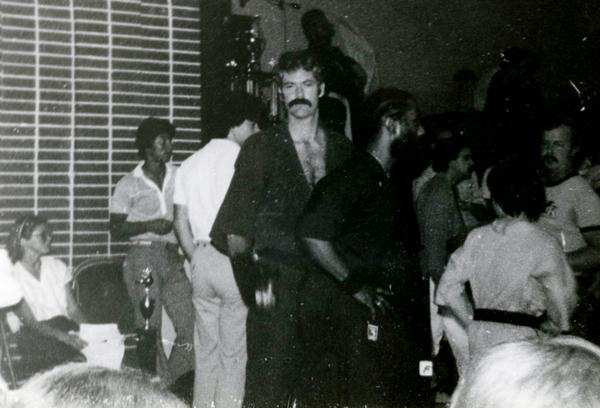
Fayetteville Shorin-ryu Karate-do instructor Randal Seyler is a sandan (3rd degree black belt) in Shorin-ryu and a shodan (1st degree black belt) in Taiho-Ryu. His original shorin-ryu instructor, Jeff White, was a nidan who studied under Nakama Sensei in Yokosuka, Japan in the early 1970s.

TAIHO-RYU: TRADITIONAL KARATE/JUJITSU
Above: Taiho-Ryu Dumas (Ark.) Dojo, 1989. Front row 2nd from left, Sensei Burmick Appleby and Michael Miller. Seyler is 2nd from right in second row.
Taiho-Ryu is an American martial arts system founded by Sensei Bo Hardy. Seyler's sensei is Burmick Appleby (3rd degree black belt and Taiho-Ryu Hall of Fame member) of Dumas, Arkansas. (See link page below, and photo above, Appleby is pictured on right holding sword). Taiho-Ryu is a jujitsu-based art, with roots in isshin-ryu, which is also a shorin-ryu style influenced by Kyan Sensei.

Sensei Hardy's book "DEFENSIVE LIVING" is now available through Century Martial Arts Supply and it is highly recommended, as is the Taiho-Ryu system.
LINKS
Below are several links to various karate organizations to provide further information about the various martial arts we study at Northwest Arkansas Karate Kenpo & Taijiquan.
Tai Chi Program Information
NWA Shorin-Ryu message board
Shorin-Ryu Karate-do Finland
Shorin-Ryu Karate-do Japan
Shorin-Ryu Karate-do Venezuela
White Rock Kenshin Kan
Ratcliff AOSKKF Shorin-Ryu
Taiho-Ryu Karate & Jujitsu
Shorinji-Ryu Kata Page
