



 Alexis and Greg spent Christmas and New Year in Tasmania, the 300km long island dangling off the bottom of Australia. We started up the Beast and caught the Spirit of Tasmania ferry for the 12 hour journey over the Bass Strait to the seventh state of Australia. Over the two weeks they journeyed from the east to the west, north to south. We visited the beautiful wild Cradle Mountain, stunning golden beaches of the Wineglass Bay with its golden sands, Stanley with the headquarters of the Van Dieman company and travelled up the Jacob’s Ladder to Tasmania’s only ski resort Ben Lomond. We pulled the Beast up and camped on the golden sands of the Bay of Fires where red algae colour the granite rocks along the beach.
 We pulled up on the beach to spend Christmas at Freycinet National Park and we were woken up at 8.30am on Christmas morning by a fire engine roaring into the campsite with sirens blaring and a hoard of elves cheering and Father Christmas screaming “Merry Christmas!”. We set up a table on the beach, had Christmas lunch and dinner with a few bottles of wine, champagne and port and then saw Father Christmas walking along the beach handing out presents to kids. A very relaxing Christmas!
We headed down the east coast to the wooded peninsula to the east of Hobart, which was used until the 1870s as a penal settlement. Due to its location, disconnected from the mainland, it became prime real estate as a penal colony. Port Arthur became the gaol for second time offenders with a strict and cruel programme of punishment where the worst of the convicts were sent and sentenced to work in chain gangs. Flogging became a way of life, 100 lashes being the normal punishment with silent solitary treatment being used for the worst offenders. An asylum was set up for those that had endured the solitary confinement. Between 1830 and 1877 about 12,500 transported convicts were imprisoned at Port Arthur and one in seven died at the settlement. Port Arthur hit the news on 28th April 1996 when a madman produced an AR15 semi-automatic rifle and massacred 35 people in a killing spree.
Al Draffan and Sarah Wilson flew in from Melbourne to join us for a few days and to travel around Tasmania. We travelled through the forested and rocky centre to the west coast. We visited the desolate mining town of Queenstown where the hills have been sliced in half by copper mining. The mining pollution has been so devastating on the surrounding countryside that King River running away from the town is classified as dead with the ancient Huon Pines (upto 10,000 years old) barely clinging to the shoreline. We left the devastated hills and travelled through the poppy fields to Tasmania’s capital Hobart for New Year, pulling up at the docks and set up the Beast for New Years Eve. The docks were heaving with the winners of the Rolex Sydney to Hobart race that set off from Sydney on Boxing day. We went down to the waterfront pubs and rubbed shoulders with the yachties before seeing the New Year in under a drizzly sky watching the fireworks. We had to tear ourselves away from Hobart and left Al and Sarah happily eating their way through the amazing Taste of Tasmania, a food and wine festival to head back to Melbourne
The island of Tasmania became disconnected from the mainland during the melting of the last ice age, about 30,000 years ago enabling unique species and peoples to be established on the island. Tasmania was named after Abel Tasman who named it initially Van Dieman’s land (later to become Tasmania) in 1644. It became the second colony in Australia in 1803.
Like mainland Australia, the invading Europeans decided to make agreements with local populations. When the couldn’t make agreements, they kidnapped and created slaves of groups of Aborigines. In 1830, a military operation known as the 'Black Line' was launched against the Aboriginal people remaining in the settled districts. Every able-bodied male colonist, convict or freeman, was to form a human chain across the settled districts, moving for three weeks south and east in a pincer movement, until the people were cornered on the Tasman Peninsula. As part of the misguided attitudes that have plagued Australia during its 200 year history, the aborigines were resettled in the Bass Strait on Flinders Island. Many of them died of disease and poor diet bringing about the complete ethnic cleansing of the mainland aboriginal population in Tasmania.

The Tasmanian Devil is the icon of the island, but is seriously under threat from the Devil Facial Tumour Disease. It is the only cancer that has been identified that could potentially be transmitted through saliva and blood. Once the devils have contracted the cancer they die within 5 months and the disease is threatening to make the Tasmanian Devil extinct as it is estimated that over 90% of the population have already died.
Back to the normal life and earning money, we are enjoying the Australian obsession with sports. The impending Commonwealth Games and the Grand Prix are just arund the corner. The Australian Open Tennis started in Melbourne in January. Adriano cam down to visit for the weekend so Greg took Adriano to see Tim Henman play. Having not seen each other for a few months, several bottles of vodka were consumed to celebrate. The match therefore took on a slightly drunken edge with the two brits sitting on the front row with their british flag dangling over the side. Patriotic shouts of ‘Come on, Tim’ turn to ‘You’re crap, Tim’ as Tim’s skills waned, leading to Greg being one of the few people to have been thrown out of a tennis match for being drunk and disorderly. Bring on the Commonwealth Games!
• Tasmania has over 18 national parks with the Tasmanian Wilderness World Heritage Area covering 1.38 million hectares. There are over 2000km of walking tracks across Tasmania.
• The hole in the ozone layer is presently centred over Tasmania. Sun burn time is about 15-30 minutes with very deep burns occurring.
• Tasmania is made up out of 300 islands.
• The average summer temperature in Tasmania is a comfortable 21?C (70?F) with the average winter temperature of 12?C (52? F).
• Tasmania is also known as the Velcro Triangle and the Apple Isle.
• The next land mass to the south of Tasmania is the Antarctic, 2000km away.
• Tasmania grows most of Australia’s heroin poppies. These are for use in legal drugs. Tasmania also has the largest lavender farm in the world and it is the only commercial lavender producer in the southern hemisphere.
• The Thylacine or Tasmanian Tiger was hunted to extinction in the 1930s with the last one shot in captivity in 1936. It was a dog-like marsupial with stripes on its back. It had a backward facing pouch.
• Australia has had the worst year on record for flies. Part of this is due to the experimental use of dung beetles in a kangaroo poo eradication programme. The programme ceased to have funding last year and this year has seen a massive increase in the fly population. Australian flies are obsessive in landing on your face, nose, mouth and ears and once swatted will return to the same spot.
• The Southern Cross is a series of five stars that can only be seen in the southern hemisphere. They feature on the Australian and New Zealand flag. The Southern Cross' stars were of great importance to the aboriginal people. In central Australia, it was the belief that the pattern created by the stars in the cross was the footprint of a wedge-tailed eagle. The pointers were his throwing stick and the dark patch, his nest. Other indigenous peoples believed that the Southern Cross and its pointers are a Stingray (the cross) being pursued throughout the southern sky by a Shark (the pointers).
• The ancient Greeks could see the Southern Cross but as the Earth has wobbled on its axes it can now only be seen in the southern hemisphere.
• The Australian word for sheets, duvet covers and general bedding material is Manchester. The word for a duvet is Doona. The word for a cool box (a very useful word to know in Summer) is Esky. The word for beating is to bash.
 so Snowy Mountains in northern Victoria/Southern New South Wales, first stopping off for the Wangaratta Jazz Festival. We spent a few days in Kosciuszko National parks watching wet kangaroos and wombats wonder around in the mountain drizzle. The snow season in the Snowy Mountains is from July through to September and the depth of snow can get as thick as 3.5m but is usually a few centimetres. Unfortunately we were there in the snow melt and drizzly rain. The highest mountain in Australia is Mount Kosciuszko at a mere 2228m.
 Uluru, formerly named Ayers Rock, is a massive monolithic sandstone rock with a high iron content. We arrived at the rock just in time to line up with the other cars and watch the amazing sunset as it changed colour and merged into the purple sky. We met the
  club for Victoria about our trip. A visit to Glenrowan in Victoria allowed us to get an insight into the best known Australian outlaw, Ned Kelly, a bank robber who ransacked banks and murdered police across southern Australia. He was hanged in 1880 after a shoot out against the police, dressed in some homemade armour. Plans are afoot to go skiing in the Snowy Mountains and to take a trip through the red centre to Uluru (Ayres Rock).
  So we set off from Darwin with the sole aim of reaching Daly Waters for Alexis?s 29th birthday. We stocked up with water, food and petrol and started along the stunning Stuart Highway south. The sky was a brilliant blue with a few scattered clouds streaming across it, the pale green and white of the eucalyptus trees and the red soil of the outback were exactly what we were expecting but the colours were not ? they were so brilliant in strength. Due to the heat of the day there were many forest fires along the road. One particularly bad one we stopped to have a look at. It was rampaging along the side of the road, birds were running out, insects scurrying across the road and lizards darting away from the heat our whilst the kites circled above waiting to scavenge out the unfortunate cooked ones. A sad situation but when careless people throw cigarettes out the window it all becomes kindling wood. The fire brigade were out trying to stop other fires from spreading by controlled burning around the fires. Bill Bryson had written about Daly Waters in his book Down Under and so we had to visit it too. We reached Daly Waters after a 8 hour drive in a car that is lucky to stay under 40 oC, sweaty and hungry. We made straight for the bar! The Daly Waters Pub is something to be seen to be believed. Situated right next to the camp site, this backwater pub is the centre of the town and adorned with everything and notes from across the world. The walls are coated in t shirts, pictures, badges, stickers, signs, old agricultural machinery, the compulsory knickers and now a Beastly Adventure card. Dinner consisted of a pasty due to the kitchens being closed followed with an ice cold beer and a bottle of Aussie champagne! No better way to celebrate your birthday!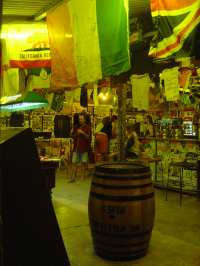
 outback fun. Hell?s Gate was named after a gap in the hills located 2km south where the police used to escort settlers and aborigines into the jurisdiction of the Northern Territory Police, a mere 200km away. If you were escorted to Hell?s Gate it was a death sentence. Hell?s Gate now has a camp site, a station (farm), a restaurant and runway. The runway is used by the station and surrounding stations for refuelling before zooming off to round up cattle over the million plus hectares that some of the farms cover.
  We experienced our first proper rain since Europe (Malaysia was quick rainstorms) as we dropped down onto the western ?Sunshine Coast?. We stopped at Inisfail before working our way down to Townsville where we met Sharon and Ken who fed a 100 strong troupe of Rainbow Lorikeets who would descend every day for their treat of sugar, bread and water.
 100,000 people which drops by 15,000 people in the wet season as people head towards the sun and a drier atmosphere. Temperatures in the wet season soar and the atmosphere gets very sticky. Darwin has suffered badly over the past since it was established in 1869. The Japanese carried out mass bombings of Darwin in 1942 and over 30,000 people were evacuated from the city. When Cyclone Tracy hit in 1973 it completely wiped out most of the buildings in the town, leaving a new ?70s town in its place with faceless grey and white buildings. The World War II air raid shelters and tunnels are still in place and can be visited but Greg and Alexis indulged themselves in the Deckchair Cinema, an open air cinema, looking out onto the bay and lounging on deckchairs you can enjoy