The Amazing Mr Henry Keck
The First Governor of Darlinghurst Gaol
Henry Keck was appointed to be the first
governor of Darlinghurst Gaol.
He had papers saying that he had been an officer in the British Army
and in charge of Dublin Castle. This was his first deception.
Many more were to follow. The papers were all forged.
He was an enterprising
governor with a weakness for easy money, and his new job perfectly
suited his talents. It didn't take him long to set up business
operations designed to line his pockets.
First he organised vegetable gardens, a
dairy farm, poultry farm and piggery inside the gaol
grounds, using prison labour. His pigs were fed prisoners' grain and
were the finest in the colony. All his produce
was sold in the Sydney markets with proceeds to Keck - and a small
allowance for the workers.
From this Keck moved into manufacture - of clothing, boots, and, most
successfully, cabbage tree hats.
He did not however limit his activities to
inside the gaol -
he also sent out overnight fishing parties from Woolloomooloo.
Keck was a man of culture
and found some musicians among his prisoners. He was able to train and
assemble small orchestras which were hired out to functions
around Sydney Town.
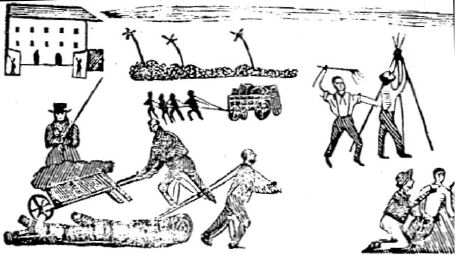
Old Convict Woodcut
However, his most enterprising exploit was the establishment
of brothel activities within the gaol
for prisoners with spare earnings. It operated from the women's cells
and proved so popular that he expanded it to include prostitutes from local brothels outside the gaol.
Finally Keck installed two prostitutes in the courthouse next door,
using lawyers' chambers that were empty at
night, and allowing prisoners access to the
court through the underground passage.
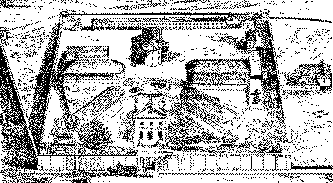
The courthouse is outside the south wall (on the right)
As well as being able to buy the services
of prostitutes, prisoners were able to buy food, tobacco and rum. They
were able to buy candles so that they could continue carrying out work
for him at night in their cells. Some were allowed, for a fee, to have
a few days out of prison in which to carry out their own affairs.
Gambling was conducted on cockroach races and card games.
This state of affairs continued for eight
years. Released prisoners who told of the proceedings in gaol
were not believed as Keck was generous and popular in Sydney and
inspectors saw only a smooth running operation.
His downfall came in 1849 when a
prisoner was recognised on the streets when he should have been locked
up. Next, Keck was seen driving around with a notorious thug as his
coachman.
Finally, one of his orchestras became
very drunk at a public function and refused to return to gaol.
The story was published and warders came forward with sensational allegations.
Keck was sacked in 1849 and left the gaol.
He was later appointed Clerk of the George Street Markets (now the
Queen Victoria Building). He died in Surry Hills on Christmas Day in
1863, and you can find his gravestone in Camperdown Cemetery in Sydney.
From "A Walk with History - Darlinghurst Gaol".
A loose collection of documents compiled by some previous teachers.
Additional information from Mr Noel Williams
of Perth, one of the great great great grandsons of Henry Keck.

Return to Darlinghurst Gaol
Page.
- allegations
- claims, stories that may or may not be true.
- sensational
- shocking, disturbing, exciting
- proceedings
- things that were happening in the jail.
Return to the Story
- access
- a way to go through, a path. Here, they used the underground
passage.
- chambers
- rooms or offices.
- prostitutes
- sex workers, people who provide sex for money.
- brothel
- usually a house where prostitutes work.
Return to the Story.
- exploit
- one of the things he did.
- functions
- parties, celebrations.
- culture
- love of music and other fine things.
- Woolloomooloo
- the suburb between Darlinghurst and Sydney Town.
Return to the story.
- cabbage tree hats
- hats made with the big leaves of the cabbage tree palm.
- manufacture
- to make things, here hats and boots.
- produce
- goods from a farm, like vegetables, cheese, milk.
- line his pockets
- to put money into his pockets.
- enterprising
- full of imagination, profitable.
- deception
- lie, trick, here using papers that were not real.
Return to the story.
Return to Main Page

